Archives for category: Students

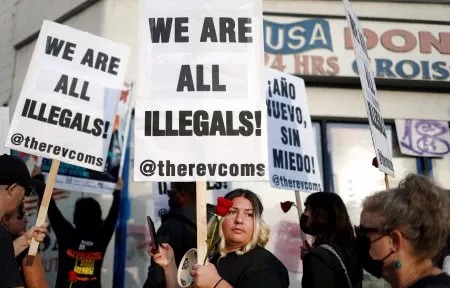
Newsweek reports that school officials and students in Bridgeport are planning to stand up for their fellow students who are immigrants. Meanwhile, the students are protesting in the best way possible, holding posters that say: “WE ARE ALL ILLEGALS.” The kids are alright.

A school district in Connecticut is defying President Donald Trump‘s order to allow Immigration and Customs Enforcement (ICE) agents to go to sensitive locations.

Bridgeport Public Schools announced on Tuesday guidelines designed to protect students in the event of an attempted raid by ICE agents at any of its schools.

Newsweek has contacted the White House via email for comment outside of normal office hours.

Why It Matters

Trump has begun implementing sweeping immigration reforms and is preparing to target millions of undocumented immigrants. The school district’s stance signals the emergence of grassroots opposition to the administration’s plans to initiate the largest mass deportation operation in U.S. history.

What To Know

Bridgeport Public Schools’ announcement came after the acting director of the Department of Homeland Security (DHS) issued a directive on January 21 ending the policy that ICE agents would not conduct actions in or near “sensitive” areas, such as churches, hospitals or schools.

Interim school superintendent Dr. Royce Avery reaffirmed that the school district’s immigration enforcement guidelines remain in place. Avery said that ICE agents and other government officials are prohibited from entering school buildings, boarding buses or attending school events without prior written approval from the superintendent.

“Every student in Bridgeport, regardless of their immigration status, has the right to feel secure and supported in our schools,” he said.

Avery did not say if any ICE raids were planned in Bridgeport. He added that Bridgeport Public Schools does not collect or store information about students’ immigration status, ensuring their privacy is protected….

What People Are Saying

Interim school superintendent Dr. Royce Avery said in a press release: “I became an educator to advocate for all students, and I will ensure their rights and privacy are upheld. Our schools will remain a safe space where all students can learn, grow, and succeed without fear or discrimination.”

Acting Secretary of Homeland Security Benjamine Huffman said in a statement: “This action empowers the brave men and women in CBP [Customs and Border Protection] and ICE to enforce our immigration laws and catch criminal aliens—including murders and rapists—who have illegally come into our country. Criminals will no longer be able to hide in America’s schools and churches to avoid arrest. The Trump Administration will not tie the hands of our brave law enforcement and instead trusts them to use common sense.”

Janet Murguía, president and CEO of Latino civil rights and advocacy organization UnidosUS, told Newsweek: “Many of the president’s proposed executive orders, however, are strictly punitive measures such as changing enforcement targets to include schools, churches and hospitals, and are designed to inflict pain on the most vulnerable—families, children and even the sick and injured.”

John Thompson retired after many years as a teacher in Oklahoma. Although he usually writes about politics, he has recently been writing about what he learned in the classroom.

He wrote:

If we want to prepare our students for the 21stcentury, educators, patrons, and politicians should relearn the lessons of history as to why classroom instruction is only one of the education tools we need to develop. 

After more than two decades of failures, the corporate reform belief that individual teachers can transform public schools has been disproven. But, holistic learning requires a team effort where we bring students out of the school, as well as bringing members of diverse communities into the school. This narrative describes the learning that my young friends and I shared when exploring nature.

The first time I took inner city kids camping and fossil hunting, a couple of minutes into the first lesson I became hooked by my new career. A third grader shouted that she had found a “real live dinosaur nose! It still has blood on it!” 

Sleepy Hollow Camp was the type of progressive institution you would expect from the veterans of the civil rights campaign “Freedom Summer” who helped lead the program. Sleepy Hollow was committed to positive behavioral reinforcement.  We received marvelous professional development for picking up on warning signs before misbehavior escalated, for disengaging when necessary, and for re-engaging kids in a constructive manner. The data from the families’ applications for the program gave us extremely valuable information. Outstanding social workers helped us to interpret the students’ records.  Professional development included cooperative games and culminated in a “ropes course” for building teamwork. 

Sleepy Hollow’s professional development for environmental education was fantastic.  We were provided the hands-on materials about our camp in the Arbuckle Mountains, where “twice this ancient mountain range had been worn away.  But three times it rose from the sea.” We identified plants and animals that flourished “where the American South met the West, and as a result we had as much biodiversity as anywhere in the United States.” 

When teaching such lessons to adolescents, it did not take long for them to recognize them as metaphors for their lives. The children first raised the issue of respecting the diversity of people, as well as biomes. And kids sought the reassurance that people who have been beaten down, like mountain ranges, can rise again. 

After each long day of adventures, an evening campfire was always perfect for celebrating new friendships, reflecting on the day’s discoveries, and contemplating the meaning of life.  

Rashad, one of the teen leaders at camp who was well-known at his middle school for political protests involving Black Nationalism, took charge of the evening talent shows. He excelled at satire, and my lessons often inspired the jokes and dance numbers. In such a setting, the power of children’s moral consciousness in driving the intentionality required for deep learning was clearly illuminated.    

August offered extraordinary meteorite showers as the campfires were dimming.  Walking back to the cabin or the tent, the kids were quiet and contemplative knowing that they were sharing something profound. Those night- time reflections borrowed the language of the Black church.  We were all lying silently in our bunks one night when the cabin’s leader, Tyson, volunteered an account of a family tragedy.  He asked if we knew the story behind the song “Amazing Grace,” and told his cabin mates about the slave trader, John Newton’s, conversion at sea and his becoming an abolitionist.  Tyson then sang for us an incredibly beautiful version of the hymn.

I came to know Richard a bit more intimately after violence broke out after a turtle was killed. Members from another street gang knew how devoted Richard was to wildlife, so they provoked a fight by killing a turtle he had adopted. 

The wiry and high-strung 8th grader began our most intense conversation with a calm account of the death of his grandmother along with six others in a boiler explosion at an Oklahoma City school. Summing up the lessons he learned through mourning, he spoke in a low voice, “I think about things – deep things,” while his eyes darted back and forth, frantically, on high alert for danger.

Richard switched the subject to tales about his days in California living with a rich uncle, an “O.G.” (Old-time Gangsta.) Richard talked about how he would plan ways to invest the family’s wealth to help the underprivileged.  Pumping his fists and striking out for emphasis, Richard repeated again, “I think of things – deep things.”

But everything changed for Richard when his uncle was busted on drug charges and all their money was lost.  He claimed to not being upset by all of that. It brought him closer to real suffering and prompted new ideas for helping the poor.  By this point in our conversation, he exhibited the explosive force of a television evangelist, proclaiming, “I think of things – deep things!”

Back home, his once-powerful uncle still had enemies, and Richard was now more vulnerable and afraid. But that just made him identify more with people who never had power and made him wish he could do good – not just for people, but for all of the earth.  That is why the turtle’s death upset him so much. Again subdued, Richard wrapped up his sermon, “I think of things – deep things.”

Richard’s peers confirmed that his uncle had had money, power, and a reputation, and that I would understand when we returned to the city and saw his family.  It was on the bus ride home that I fully grasped the trauma and fearfulness that dominated Richard’s home life. In those two weeks away, the camp had become a safe zone for him and he grew more and more agitated the closer we got to the inner city.  He sat pensively, practically glued to me for the ride home.  

Richard’s suffering was also apparent to the other students and I was struck by the empathy that they expressed. Even the kids who were the most “down” with the “Crips” — the gang that rivalled his uncle’s “Bloods” — started to treat him with kindness. Something transformative had happened over the course of the two weeks at camp.  

Richard was picked up by his uncle. Someone who had once displayed power and inspired fear was now a broken man and clearly an alcoholic. Richard made a point of introducing me as his friend, and the uncle earnestly voiced appreciation. Though we had just met, the former gang leader grasped my hand and forearm and made it clear that he needed to communicate his deep appreciation for helping his nephew. Like many others, O.G. grieved for the pain he had inflicted upon his family.

This, and countless other poignant conversations, illustrates the challenges faced by children and educators alike in trying to overcome the legacy of poverty. But it also points to solutions. Simply put, there is no substitute for honest and painful discussions with young people about the troubles and transgressions of their past, and often grim and anxious aspects of their present. Long after high-profile tragedies are forgotten by society, trauma endures for many survivors. Despite such stress and tragedy, Richard, his friends, and even his uncle, managed to hold onto their moral core. 

This could be the rock upon which school improvement in the inner city is founded. 

This post appeared originally in the Louisville Courier-Journal. It has since been posted by The Network for Public Education, whose contents are curated by Peter Greene.

Liam Amick: Trinity won’t let me write about Amendment 2. Here’s why I’m against it.

Liam Amick is a senior at Trinity High School, a Catholic school in Kentucky, where vouchers are on the ballot next week in Amendment 2, a proposed amendment to the state constitution that would okay vouchers. Trinity has made support of the Amendment mandatory. Amick would like to disagree, and does so in the Courier Journal.

Every day when I drive into school, I’m greeted by yard signs blazing with the message “YES on 2!” To see these put up at Trinity, a school that generally requests little political discussion at school, was quite a shock.

I’m a “private school kid.” I went to St. Francis of Assisi for first through eighth grades, and I am now a senior at Trinity High School. I will always be indebted to those schools for providing me with fantastic educations and experiences in the most formative years of my life. But to say I am disappointed with Trinity’s stance on Amendment 2 — a Kentucky ballot measure that would allow public tax funding to be used for private schools — would be an understatement.

An even bigger disappointment has been Trinity’s and the Archdiocese of Louisville‘s responses to criticism of their position. When both Trinity’s Student Government and Faculty Senate asked if the “YES on 2!” signs could be taken down, they were told that the archdiocese had asked us to put them up and there was absolutely no chance of them being taken down. Also, the administration doesn’t allow our school journalism program to report on any political topics and or criticisms of Trinity and its policies, so I felt that to share my views I had to look outside of the school.

In my opinion, the desire of non-public schools to support Amendment 2 is logical, but closed-minded. What’s important to remember is that, in Kentucky, 65% of non-public schools are found in Louisville, Lexington and the general Northern Kentucky area. Out of 120 counties in Kentucky, 89 have no access to a non-public school, and well-run, accredited non-public schools aren’t going to magically appear in those counties after the passage of Amendment 2. So, the “school choice” amendment would in fact offer students in these areas no “choice” to go to a different school.

Supporters of Amendment 2 often bring up Kentucky’s 2023 $1 billion budget surplus, claiming that that money will be used to provide funding to public schools and said schools will lose no money. However, that surplus money already has a destination. According to House Appropriations and Revenue Chair Jason Petrie, the extra money has “provided the opportunity to invest more than $2.7 billion over the next two years to improve road, rail, river, air, and water infrastructure.” Although Petrie claims they are also making “targeted investments in school facilities,” the bottom line is that significantly fewer tax dollars would go to public schools, leaving no replacement funding in their wake.

Read the full op-ed here. You can view the post at this link : https://networkforpubliceducation.org/blog-content/liam-amick-trinity-wont-let-me-write-about-amendment-2-heres-why-im-against-it/

The Brookings Institution has published a study of absenteeism rates that shows they have soared. But as of now, the reasons for increased absenteeism are unidentified.

The study was conducted by Tom Swiderski, Sarah Crittenden Fuller, and Kevin C. Bastian.

Here is the key finding:

“Between 2018-19 and 2021-22, the percentage of chronically absent K-12 students nearly doubled from 15% to 28%, with only a marginal decline in 2022-23, remaining well above pre-pandemic levels.”

Why are children and young people not attending school? What are they doing instead? What are the costs to them and their schools?

Paul Krugman, the economist who writes a regular column for the New York Times, recently explored why Republicans oppose free lunch for students. The simple answer is that it’s just plain weird. The more complex answer is that they don’t want to create an “entitlement” for children. The irony that he does not explore is why Republicans are unwilling to pay for free lunches, yet eager to pay the tuition of students who attend religious or other private schools, regardless of their family’s income.

He writes:

You could say that Tim Walz became the Democratic vice-presidential nominee with one weird trick — that is, by using that word to describe Donald Trump and JD Vance, a categorization that went viral. In his maiden campaign speech he upgraded it a bit further to “creepy and weird as hell.” (If you think that’s over the top, have you seen Trump’s bizarre rant speculating about whether Joe Biden is going to seize back his party’s presidential nomination?)

But Walz is more than a meme-maker. He has also been an activist governor of Minnesota with a strong progressive agenda. And I’d like to focus on one key element of that agenda: requiring that public and charter schools provide free breakfasts and lunches to all students.

Perhaps not incidentally, child care has long been a signature issue for Kamala Harris, and Walz’s policies may have played a role in his selection as her running mate.

In any case, free school meals are a big deal in pure policy terms. They have also met fierce Republican opposition. And the partisan divide over feeding students tells you a lot about the difference between the parties, and why you really, really shouldn’t describe the MAGA movement as “populist.”

Now, even many conservatives generally support, or at least claim to support, the idea of cheap or free lunches for poor schoolchildren. The National School Lunch Program goes all the way back to 1946, when it passed with bipartisan support and President Harry Truman signed it into law.

Why should the government help feed kids? Part of the answer is social justice: Children don’t choose to be born into families that can’t or won’t feed them adequately, and it seems unfair that they should suffer. Part of the answer is pragmatic: Children who don’t receive adequate nutrition will grow up to be less healthy and less productive adults than those who do, hurting society as a whole. So spending on child nutrition is arguably as much an investment in the future as building roads and bridges.

There’s a strong case that in general child nutrition programs more than pay for themselves by creating a healthier, higher-earning future work force. In other words, this is one area where there really is a free lunch.

Schools, then, should feed students who might otherwise not get enough to eat. But why make free meals available to all children, rather than only to children from low-income households? There are multiple reasons, all familiar to anyone who has looked into the problems of antipoverty policy in general.

First, trying to save money by limiting which children you feed turns out to be expensive and cumbersome; it requires that school districts deal with reams of paperwork as they try to determine which children are eligible. It also imposes a burden on parents, requiring that they demonstrate their neediness.

Additionally, restricting free meals to children whose parents can prove their poverty creates a stigma that can deter students from getting aid even when they’re entitled to receive it. I know about this effect from family history: My mother, who grew up in the Depression, used to talk about her shame at not being able to afford new shoes because her parents, although just as poor as her classmates’ parents, couldn’t bring themselves to apply for government assistance.

And it’s not as if feeding children is prohibitively expensive. So if you want to make sure that children get enough to eat, having schools offer free meals to all their students, without an income test, would seem to be simple common sense.

But Republicans in general aren’t on board. The Minnesota law that Walz signed passed essentially along party lines. The people behind Project 2025, in particular, don’t approve. (Yes, despite denials, Project 2025 is a very good guide to what a second Trump administration might do.) The project’s magnum opus, “Mandate for Leadership,” whose 900 pages lays out a detailed policy agenda, singles out feeding students as something that should be reined in. “Federal school meals increasingly resemble entitlement programs,” it warns, as if this is self-evidently a bad thing. A bit farther down, it reads, “The U.S.D.A. should not provide meals to students during the summer unless students are taking summer-school classes.” I guess being hungry isn’t a problem when school is out.

Stories like this are why my hackles rise whenever people call MAGA a populist movement. The people who will almost certainly make policy if Trump wins are as committed as ever to a right-wing economic agenda of cutting taxes on the wealthy while slashing programs that help Americans in need — including programs that help children.

In addition to being cruel, this agenda tends to be unpopular. Most Americans support providing all students with meals, regardless of their income, just as most Americans now support the Affordable Care Act, which Trump will very likely again try to destroy if returned to office.

But the American right lives in an echo chamber that normalizes views on both economic and social policy that are very much at odds with what a majority of voters want. Those extreme views often fly under the radar. But sometimes they do attract attention. And when they do, many people find them … weird.

Peter Greene wades into the debate about what teachers should call students who ask to be addressed by a different name.

He writes:

Names have power, so it makes sense that young humans, who are generally in search of both identity and some amount of power over their own lives, will often try to exert some control over their own names.

As a teacher, it’s not a fight worth picking. I taught so many students–soooooo many– who wanted to be called by another name. Sometimes it was perfectly understandable– a common nickname for their full name, or going by a middle name. Sometimes it was a leap– “Albert” would prefer to go by “Butch.” I had some unusual cases, like the girl who had the same name as three other students in class, so told me she’d rather go by Andrea (pronounced Ahn-dray-uh). And a few times, I had a trans student who wanted to use a different name.

Did I agree with all of them? No more than I agreed with some of my students’ questionable fashion choices. But it cost me nothing to honor these preferences, to give students that small measure of control over their own identities. It was a small thing for me, but a thing that helped make my classroom a safe, welcoming space where we could get on with the work of learning to be better at reading, writing, speaking and listening.

So I don’t get teachers like Vivian Geraghty, the middle school language arts teacher who found herself with two transgender students and a) refused to call them by their chosen names and b) asked to have them removed from their classrooms.

Geraghty is going to matter because she was told to resign, maybe, and then sued the district. Based on a U.S. District judge decision, this matter is going to trial (at least partly because there seems to be dispute about what actually happened). According to court documents, the students made their request on Day One and Geraghty knew these requests were “part of the student’s social transition” but disagreed because of her religious beliefs and “wanted those students out of her classroom.”

Geraghty cites her religious convictions as the reason she would not honor the student request, and though this is a fashionable hill for christianists to die on these days, I don’t really get it. Why is transgenderism such a heinous crime against religion and conscience that they cannot even acknowledge such people exist is beyond me. 

Part of the dispute is over whether Geraghty jumped or was pushed. Her defense is from theAlliance Defending Freedom, the conservative culture panic law group that has made several trips before SCOTUS, including Dobbs. They say Geraghty could not put aside her beliefs to “affirm untruths that harm children.”

And yet she was okay with treating two actual children like this.

I do not and probably never will grasp the current argument that one cannot practice one’s faith unless one is fully free to discriminate against people of whom you disapprove, and yet that argument surfaces again and again. 

But I do believe this– it is not a teacher’s job (nor, really, that of any adult) to tell a student who he or she is. We can nudge, offer encouragement and support, and create a safe place for them to try to figure it out. But the most basic part of treating a human being like a human being is to call them by the name they have for themselves. If you can’t do that and if you insist that you must have the God-given right to make your disapproval of their identities clear to them in every interaction, then you do not belong in front of a classroom. 

Back in February, long before President Biden stepped back and Vice-President Kamala Harris became the Democratic nominee for President, two red-state Governors spoke out against vouchers. Both are Democrats who understand the importance of public schools for their communities. They are Governor Roy Cooper of North Carolina, whose gerrymandered legislature has a Republican supermajority, and Governor Andy Beshear of Kentucky, whose legislature is controlled by Republicans. When Beshear ran, he picked a teacher as Lieutenant Governor.

The two Governers wrote this article in USA Today:

In North Carolina and Kentucky, public schools are the center of our communities. We’re proud public school graduates ourselves – and we know the critical role our schools play in teaching our students, strengthening our workforces and growing our economies.

We’ve seen record-high graduation rates of almost 90% in our public schools. North Carolina and Kentucky rank in the top 10 for National Board-certified teachers, one of the highest recognition teachers can earn.

In Kentucky, we’ve seen significant improvement in elementary school reading, even with setbacks from the pandemic like many states experienced. In North Carolina last year, public school students completed a record 325,000 workforce credentials in areas like information technology and construction. The bottom line? Our public schools are critical to our success and an overwhelming number of parents are choosing them for their children.

That’s why we’re so alarmed that legislators want to loot our public schools to fund their private school voucher scheme. These vouchers, instituted in the 1950s and 1960s by Southern governors to thwart mandatory school desegregation, are rising again thanks to a coordinated plan by lobbyists, private schools and right-wing legislators.

Voucher programs chip away at the public education our kids deserve

This is their strategy: Start the programs modestly, offering vouchers only to low-income families or children with disabilities. But then expand the giveaway by taking money from public schools and allowing the wealthiest among us who already have children in private schools to pick up a government check.

In North Carolina, the Republican legislature passed a voucher program with no income limit, no accountability and no requirement that children can’t already go to a private school. This radical plan will cost the state $4 billion over the next 10 years, money that could be going to fully fund our public schools. In Kentucky, legislators are trying to amend our constitution to enshrine their efforts to take taxpayer money from public schools and use it for private schools.

Both of our constitutions guarantee our children a right to public education. But both legislatures are trying to chip away at that right, leaving North Carolina and Kentucky ranked near the bottom in per-pupil spending and teacher pay.

Public schools are crucial to our local economies. In North Carolina, public schools are a top-five employer in all 100 counties. In many rural counties, there are no private schools for kids to go to – meaning that those taxpayer dollars are torn out of the county and put right into the pockets of wealthier people in more populated areas.

Governor Roy Cooper, North Carolina

In fact, in Kentucky, 60% of counties don’t even have a certified private school. This has caused rural Republicans in red states like Texas and Georgia to vote against voucher schemes that would starve their rural schools.

Governor Andy Beshear, Kentucky

Private schools get taxpayer dollars with no real accountability

As governors, we’ve proposed fully funding our public schools, teacher pay raises to treat our educators like the professionals they are and expanded early childhood education. We know that strong public schools mean strong communities. Families in Kentucky and North Carolina know that too. In North Carolina, nearly 8 in 10 children go to public schools.

Our public schools serve all children. They provide transportation and meals and educate students with disabilities. And they’re accountable to taxpayers with public assessments showing how students and schools are doing and where they need to improve.

But private schools that get this taxpayer money have little to no accountability. They aren’t even required to hire licensed teachers, provide meals, transportation or services for disabled students. They don’t even have to tell the taxpayers what they teach or how their students perform. North Carolina’s voucher system has been described as “the least regulated private school voucher program in the country.”

Studies of student performance under school voucher programs not only showed that they don’t help them, but that they could actually have harmful effects. Results from a 2016 study of Louisiana’s voucher program found “strong and consistent evidence that students using an LSP scholarship performed significantly worse in math after using their scholarship to attend private schools.” In Indiana, results also showed “significant losses” in math. A third study of a voucher program in Ohio reported that “students who use vouchers to attend private schools have fared worse academically compared to their closely matched peers attending public schools.”

We aren’t against private schools. But we are against taxpayer money going to private schools at the expense of public schools.

The future of our nation goes to class in public schools, and all Americans must be on guard for lobbyists and extremist politicians bringing similar plans to their states. Our segregationist predecessors were on the wrong side of history, and we don’t need to go back.

We are going to keep standing up for our public school students to ensure that they have the funding they need, and that teachers are paid like the professionals they are. It’s what’s best for our children, our economy and our future.

Roy Cooper is the governor of North Carolina. Andy Beshear is the governor of Kentucky.

Malena Galletto, the daughter of immigrants from Argentina, was accepted at 28 colleges, including all eight Ivy League colleges. Malena attended the Bronx High School of Science, one of the city’s most selective high schools, where she had a 97% average. Malena is the first in her family to attend college.

Malena has decided to go to Harvard.

When you hear Donald Trump rant about immigrants, accuse them of horrible criminal behavior, think of Malena.

It is 7 p.m. on March 28th, 2024. Malena Galletto ’24 sat in her dad’s car on their way to a family friend’s house for a long weekend. In the back seat, Galletto sat with her laptop opened to the eight college portals that released their decisions. Dartmouth, Brown, Cornell, Harvard, Yale, Princeton, Columbia, and University of Pennsylvania. 

Having received an encouraging letter from Columbia a few weeks prior, Galletto opened the Columbia decision first. She rejoiced at her first acceptance of the day. She then opened Dartmouth, followed by Brown and Cornell, and eventually Harvard, Yale, University of Pennsylvania, and Princeton. By the end of the night, Malena had gotten into all eight ivies.  

In total, Galletto applied to 28 colleges in the United States, hopeful that she would get into at least one of them. She was accepted to all 28 universities that she applied to. Galletto is an Argentinian-American who grew up in Washington Heights, and she embraces her Latin culture. Growing up, she was strongly immersed in the Tango community. 

Galletto: “My mom loves dancing. I spent so much time watching her and her friends Tango, that dancing is just a part of me. I think that I probably learned to Tango before I learned to walk.” 

Galletto’s culture is one of the most important things for her. Galletto believes that preserving Argentinian culture through celebrating the traditional dance of Tango is crucial for keeping it alive and thriving. Growing up in Washington Heights in Manhattan, Galletto had a first hand account of how the pandemic negatively impacted the Tango community. Due to social distancing, cultural activities and showcases were canceled, giving a devastating blow to the whole community.  

Galletto: “Despite these challenges, over the past couple of years, we have been focused on ensuring that Argentinian cultural heritage remains active. Efforts to keep the community engaged have been paramount, as we are continuing to find innovative ways to connect and celebrate our traditions, despite the restrictions. This includes everything from increasing our outreach to hosting virtual concerts. As I was preparing for college applications, this commitment to cultural preservation was a significant part of my application, since it is such a big part of who I am and my story.”

Throughout her fight for preserving her culture and maintaining her passions for education, Galletto recognizes her mom as her biggest cheerleader and motivation. 

Despite being the valedictorian of her high school, Galletto’s mother did not get the opportunity to attend college. 

Galletto: “My mom was the valedictorian of her high school, and she has always emphasized the importance of education. She believes that education opens up a world of opportunities, and she has always pushed me to prioritize my education. This has been crucial for me, as I have been looking to strike the perfect balance for maintaining my grades and also to continue fighting for what I believe in.”

Galletto: “Being first-generation and of low-income, navigating the complexities of college was daunting. I did not have the generational wisdom passed down by parents who attended college, so not understanding the process felt a little like stumbling in the dark. However, the process was made a lot less challenging thanks to the generosity of the Bronx Science Foundation. Their abundance of resources helped me decipher the intricacies of the applications, financial aid, and campus life. For someone like me, the first person in my family to attend college, those resources were not just helpful — they were transformative. They empowered me to chase my dreams despite the odds stacked against me.”

Class Size Matters is one of the most effective—if not the MOST effective—advocacy organizations for public schools in New York City. Its leader, Leonie Haimson, fights for reduced class sizes, more funding, and the privacy of student data. I am a member of the board of Class Size Matters.

On June 12, CSM will hold its annual awards dinner. The awards are called the Skinny, in contrast to the Broad Award, which was given to districts that raised test scores, closed schools, and used metrics inappropriately.

I will be there to celebrate the award winners, who are parent-members of the Board of Education who stood strong for students, teachers, and well-funded public schools.

Please join us!

Class Size Matters Skinny Award Dinner

START:Wednesday, June 12, 2024•6:00 PM

END:Wednesday, June 12, 2024•9:00 PM

LOCATION: 1st floor•124 Waverly Pl. , New York, NY 10011 US

HOST CONTACT INFO: info@classsizematters.org

Buy tickets:

https://actionnetwork.org/ticketed_events/class-size-matters-skinny-award-dinner?source=direct_link
[2024_Skinny_Awards_Announcement_final.png]
Class Size Matters Skinny Award Dinnerhttps://actionnetwork.org/ticketed_events/class-size-matters-skinny-award-dinner?source=direct_link
actionnetwork.orghttps://actionnetwork.org/ticketed_events/class-size-matters-skinny-award-dinner?source=direct_link

Leonie Haimson
Executive Director
Class Size Matters
http://www.classizematters.org
Leonie@classsizematters.org

Seventeen high school students in Georgia marked the 70th anniversary of the Brown decision by writing an article calling on the state’s political leaders to fully fund public schools, instead of funding vouchers. They are members of the Georgia Youth Justice Coalition.

They wrote in the Atlanta Journal-Constitution:

As young Georgians, we share the belief that all children should have the freedom to pursue their dreams and that our futures depend on receiving a great education. To get there, we must equip every public school with the resources to deliver a quality education for every child, no matter their color, their ZIP code or how much money their parents make.

Unfortunately, we find ourselves in yet another moment of massive resistance to public education with increasingly aggressive efforts on behalf of the state of Georgia to privatize our public schools and return us to a two-tiered system marked by racial segregation. As public school students in high schools across Georgia, we believe that the 70th anniversary of Brown v. Board of Education is not just a cause for celebration but an invitation to recommit ourselves to the promise of a public education system that affirms an essential truth: Schools separated by race will never be equal.

Even as our country celebrates the anniversary of Brown this month, we know that our state actively worked to obstruct desegregation, which did not meaningfully take place for another 15 years. Seven years after the Supreme Court’s ruling that separating children in public schools on the basis of race was unconstitutional, the Georgia General Assembly revoked its school segregation law in 1961. Another 10 years later, a court-ordered desegregation plan finally took effect — in 1971.

In 2024, educators across Georgia, from Albany to Atlanta, from Valdosta to Vinings, from Dalton to Dublin, and everywhere in between, are working hard to provide students like us with a quality education, empowering us to build a brighter future in Georgia for all. Yet politicians in the Georgia Capitol seem dedicated to resegregating and privatizing our public schools by taking tax dollars meant to support all of the students in our communities and giving it to unaccountable voucher programs that favor the wealthiest few.

The long and shameful history of vouchers is something that politicians who forced them to become law this year don’t want us to know. In many cities, public education funding was funneled to private “segregation academies” where white children received better resources than children of color. Instead of making our public schools stronger and moving us all forward together, these politicians are defunding our public schools by more than $100 million and working to drag us backward to the days when Georgia was still resisting court-ordered desegregation.

We want our leaders to get serious about what works: fully funding our public schools so that we can improve our neighborhood schools. That’s where 1.7 million public school students in Georgia learn and grow, and where we all can have a say. Research all across the country shows that voucher programs will not improve student outcomes in Georgia, but we know what will best serve students.

Young Georgians like us need investments in our public schools so we have the opportunity to learn and thrive. Gov. Brian P. Kemp has $16 billion of unspent public funds — enough to cover the costs of funding our schools and investing in our communities. Georgia has one of the highest overall rates of child poverty in the nation. Yet our state is one of only six states that provides schools with no specific funding to support children living in poverty. By refusing to give our schools what they need, we are setting our schools and our students up for failure.

Politicians brag about Georgia’s teachers being among the highest paid in the South even though they know they have created a crisis around public education that puts our teachers, our parents and students like us in an impossible position. Right now, nearly every school district in Georgia operates with a waiver to avoid adhering to classroom size restrictions because they cannot afford to hire enough teachers. And though the American School Counseling Association recommends a counselor-to-student ratio of 1:250, Georgia mandates a counselor-to-student ratio of 1:450 students. Many schools cannot even meet that ratio because of a lack of funding. All of that is by design because politicians have refused to update Georgia’s school funding formula for nearly 40 years.

This year, as we celebrate 70 years since Brown v. Board of Education, we invite every Georgian to join us in our call for fully funded neighborhood public schools so that every Georgia student has an inviting classroom, a well-rounded curriculum, small class sizes and the freedom to learn.

The writers are members of the Georgia Youth Justice Coalition. Nia G. Batra is a sophomore at Decatur High School. Hunter Buchheit is a senior at Walton High School. Ava Bussey is a senior at Marietta High School. Keara Field is a senior at McDonough High School. Saif Hasan is a junior at Lambert High School. Jessica Huang is a senior at Peachtree Ridge High School. Shivi Mehta is a junior at the Alliance Academy for Innovation. Bryan Nguyen is a senior at the Gwinnett School of Mathematics, Science, and Technology. Rhea Sethi is a senior at North Gwinnett High School. Maariya Sheikh is a senior at Campbell High School. Harrison Tran is a junior at Jenkins High School. Sharmada Venkataramani is a sophomore at South Forsyth High School. Thomas Botero Mendieta is a junior at Archer High School. Kennedy Young is a senior at Campbell High School.