Archives for category: School Choice

Jan Resseger writes here about the failure of ranking and rating schools by test scores and other metrics. These rankings cause parents to flee low-rated schools, making them even more segregated by income and race. If “reformers” intended to help struggling schools, they didn’t. They made it harder for those schools to improve.

She writes:

Here is the lead in a story in the Washington City Paper (Washington, D.C.) that describes not only  how public school ratings and rankings work in the nation’s capital but also their impact in every public school district in the United States.  Read this carefully:

“Before the pandemic shut down D.C. schools, each public school, like each student, got a report card. Every fall the school report card included a STAR rating, from one through five. The rating was based on a formula designed and used by the Office of the State Superintendent of Education (OSSE), D.C.’s education agency. Federal law requires OSSE to identify the ‘bottom 5 percent’ of District schools, so that they can receive additional funding. In effect, OSSE’s STAR Framework ratings used a measurement of need to indicate a measurement of quality.  And as a measurement of quality, the formula failed.” (Emphasis is mine.)

The author of the commentary is Ruth Wattenberg, who formerly served on the Washington, D.C. State Board of Education (SBOE). She explains that the 2015 federal education law, the Every Student Succeeds Act—the version that replaced the 2002, No Child Left Behind Act—requires all states to assign school ratings which are said to be a measure of need for the bottom 5 percent of “struggling” schools. However, in a place like Washington, D.C. with universal school choice, while ESSA requires states to rate schools to target the bottom scorers for improvement, parents use the ratings as an advertisement for the best schools in the system—perhaps the only evidence some parents consider as they choose a school for their children.

The ratings are always understood by the general public as a measure of school quality.

In a large city school district, when parents choose a school according to the ratings, these measures help resegregate the school district by income and race. Wattenberg explains: “In D.C., where families can choose to send their kids to any public school in the district, this flawed rating system is especially consequential. ‘Many kids have left their neighborhood schools’ because of the ratings, says Sheila Carr… grandparent of current D.C. students… A small exodus can trigger budget, staffing, and program cuts that have the potential to drive more families away from a particular school, triggering yet more cuts.  A decade ago Carr remembers, this meant multiple school closings. Although DCPS (D.C. Public Schools) has avoided more closures recently, enrollments at some schools are way down. Anacostia High School enrolls just 287 students.”

Across metropolitan areas where numerous suburban school districts surround the central city, the ratings redline the poorer and most segregated school districts and encourage anybody who can afford it to seek the the school districts with the highest ratings: the homogeneously white and wealthy exurban school districts.

Across the states, legislatures and departments of education have developed their own rating systems to comply with the federal mandate, but these systems almost always feature each district’s aggregate standardized test scores, which have been documented to reflect primarily family income.  Wattenberg explains the research she and her colleagues explored as they set out to redesign their rating system: “One expert showed us how high-poverty schools disproportionately got low ratings, even when test scores reported that their students had learned more than average. Education researcher and D.C. public school parent Betsy Wolf concluded that ‘our accountability system measures family income more than it measures school quality.’ Based on these findings, the SBOE resolved in 2022 that the rating system was ‘fundamentally flawed’ and recommended eliminating it… Education and poverty expert Sean Reardon says that average test scores ‘are the results of all the opportunities kids have had to learn their whole lives, at home, in the neighborhood, in preschool and in the school year.  So it’s misleading to attribute average test scores solely to the school where they take the test.’”

Apparently in Washington, D.C. the board came up with a new system that is not likely to be much better: “At the SBOE’s early January meeting, some parents’ hopes of pushing to revamp the report cards faded. OSSE surfaced its new report card, and, instead of labeling schools with stars, the new proposal assigns each school a number, one to 100, called an ‘accountability score.’ The number will still be highlighted on each school’s online profile and on the central School Report Card, where it will be among the first and primary impressions of a school that parents will see.  The formula that produces the new accountability score, while slightly revised and less toxic, is still biased against low-income schools. It is still the same formula OSSE uses to identify the neediest schools for the U.S. Department of Education.”

Wattenberg adds: “Less biased data on school quality measures educational practices and conditions known to promote student learning, such as teacher retention and the extent to which a school offers instruction on a variety of subjects, including social studies, science, and the arts, rather than an overly narrow focus on math and reading (which is what end-of-year tests focus on). Survey data showing student perceptions, such as the extent to which students feel academically challenged and supported is also an effective metric.”

From a parent’s point of view, the new summative grade tells no more about the teachers or the curriculum or students’ experiences at school.  It is really no different than the five star rating system Wattenberg remembers in Washington, D.C.’s previous system.  Here in Ohio, where I live, we have a five star system, which is no better than the A, B, C, D, F system we had before we got the new five stars.  In Washington, DC,  the new 1-100 rating number Wattenberg describes being earned by each school will only cue up competative parents to go for the highest rated schools in a giant competition. Most people choosing a school on the basis of the ratings will not be able to discern how the metric balances all the variables in each school or whether the rating really say anything about what is happening at the school.

Having attended school in a small Montana town, where we all went to the same middle school and high school, and having parented two children who attended our neighborhood elementary and middle school and came together at our community’s only high school here in a Cleveland, Ohio inner suburb, I prefer the old and more radical solution to the whole problem of school choice driven by metrics published in the newspaper or school report cards. In fact, for the majority of families in the United States, neighborhood schools are still the norm. A system of neighborhood schools embodies the idea that parents’ responsibility is to help their children embrace the opportunities at the school where they are assigned.

As parents when my children were in elementary school, we used the PTA meetings as places to strategize about how we could better support innovations and special programs to make school more fun and challenging for all the students.  A district-wide school support agency in our community provides a tutoring program for students who need extra help, and there is a community supported, district-wide music camp for a week in June when the high school orchestra director and his staff, along with a raft of graduates from the high school music program, help students from across the middle schools to prepare for joining the high school band and orchestra.  People from across the school district turn out for the concert that culminates the summer music camp.

This kind of community involvement connects parents with the community’s public schools in a qualitative way.  When people engage personally with a school, the teachers and the students, parents can learn so much more about a school than any metric can expose.

At the very least, it is time for the U.S. Department of Education to stop demanding that states rate and rank their public schools.  Wattenberg is correct that the ratings—a measurement of need—are misinterpreted by the press and misunderstood by the public as a measurement of quality.

Jan Resseger reports that the wild expansion of vouchers in Ohio has worked as predicted: they confer public money on students who already attend private and religious schools. They do not benefit children who are poor. The claim that they would “help poor children escape failing schools” was a hoax.

Maybe voucher advocates believed it thirty years ago, when no one knew how vouchers would work. But now we know. The evidence from every state with vouchers shows the same result: the overwhelming majority of vouchers are used by students who never attended public schools. The more states expand vouchers, the more they subsidize affluent families. And the poor kids who take vouchers fall behind their peers in public schools.

She writes:

The Cleveland Plain Dealer placed Laura Hancock’s expose about Ohio’s wildly expanded school voucher program on the front page above the fold in Sunday’s paper. It is good to see this dangerous threat to public schooling—inserted into the state budget with minimal public discussion—receiving the attention it deserves.

Hancock’s message? Ohio isn’t helping poor kids in public schools, the original promise of Ohio’s first voucher program in Cleveland in the 1990s. Instead, the new vouchers are a gift to middle income and wealthy families whose children are already enrolled in private and parochial schools:

“The number of Cuyahoga County students (students in greater Cleveland) receiving state-funded scholarships to attend private schools has skyrocketed this year after state lawmakers expanded a voucher program, but state data suggests that doesn’t necessarily mean more kids have opted out of public schools. Across the county’s 31 districts, the number of students receiving tuition payments in the EdChoice-Expansion scholarship… has increased nearly four-fold, from 2,500 students last year to nearly 9,200 this year. Those districts, however, have not seen a corresponding loss in student population, indicating that most of the families newly benefiting from the vouchers were already enrolled in private schools rather than fleeing a school district.”

Hancock profiles, for example, three of Cleveland’s middle and upper income suburbs where the vouchers now serve as a tuition-reimbursement entitlement for families of students already paying private school tuition: “Enrollment in Rocky River City School District fell by just 22 students between last year and this year, even though the number of kids receiving vouchers shot up from 16 to 309. In Bay Village City School District, there are 30 fewer students despite a voucher jump from 13 to 229. Westlake City School District has 19 fewer students; vouchers in the district spiked from 41 to 581.”

Hancock lists the ten Ohio public school districts with the largest growth in students accepting a voucher under Ohio’s huge expansion of school vouchers this year.  Three are exurbs of Cleveland; one is a shared exurb of Cleveland and Akron; one is an exurb of Akron; one is an exurb of Columbus, and four are exurbs of Cincinnati. In every one of these districts, according to data from the Ohio Department of Education, the median income is far above the state’s median of $41,132.59. In Indian Hill, a Cincinnati suburb, the median income is $96,508.50. Median income in Hudson, part of suburban Cleveland and Akron, is $82,183.00, and in Olentangy, a Columbus exurb, median income is $79,892.50.

Why are the ten school districts with so many students taking vouchers for the first time all wealthy suburbs? Hancock explains: “because the legislature… removed income eligibility caps for EdChoice-Expansion. Last year, the cap was 250% of the federal poverty level for a scholarship, or $75,000 for a family of four. Now there are no income caps, although families only get partial scholarships when they earn above 450% of the poverty level, or above $135,000 for a family of four.”

Hancock adds that the state is giving away a whole lot of money in each voucher: $6,167 for grades K-8 and $8,407 for grades 9-12. Thomas S. Poetter, a professor at Miami University of Ohio, who recently edited the new Vouch for This!, adds that the vouchers are worth more than the state school funding formula has established as the base cost public schools are expected to spend per student—the amount that includes the state and local contributions required by the school funding formula. Poetter writes: “(T)he fact remains that the state will be spending more per pupil on individual children in private high schools with its voucher program… than it will for individual public school students across the state… That has been the case for nearly the entire life of the EdChoice ‘Scholarship’ program (it’s a voucher program) but it really hits home with the high figures coming at us in the new budget. And just think of all that could be done in our public schools to better our offerings… if we weren’t sending more than $1 billion a year into private hands to be used in ways that none of us would ever approve of in public education….” (Vouch for This!, pp. 130-131)

Hancock quotes Troy McIntosh from the Ohio Christian Education Network and the Center for Christian Virtue enthusing about the new voucher expansion. She quotes Senator Andy Brenner, Chair of the Ohio Senate Education Committee, explaining that families ought to get the vouchers because they are paying taxes and therefore ought to get a personal reward for their children. She adds that after the voucher expansion, “the Catholic Diocese of Columbus is looking to potentially build schools in areas that currently don’t have a Catholic school.”

Hancock’s article omits one urgently important issue with Ohio’s new voucher expansion: over half the state’s counties are rural and entirely lack a private school where students might potentially carry a voucher. The expansion of private school tuition vouchers will shift the distribution of money from the state’s school foundation budget away from the state’s rural school districts because private school tuition vouchers can be used only by students in areas where private schools exist—places with larger and more concentrated populations.  In a report last year for the Ohio League of Women Voters (You should scroll down and then download report.), Susan Kaeser explains: “Most of the public school population is concentrated in Ohio’s 8 largest urban counties, and so is the private school population. The 8 largest counties have 46% of the public school population and 71% of the private school students…  Public education is the only consistently available education choice in Ohio’s 46 small counties, those with less than 8,000 public school students… Private schools across these 46 counties serve a total of only about 7,000 students.” “Rural taxpayers underwrite private choice in the state—but not where they live.”

Hancock reminds readers that “over 130 public school districts… are suing the state over the constitutionality of the vouchers.”  Coincidentally on Sunday, the Plain Dealer also published a commentary by William Phillis, Executive Director of the Ohio Coalition for Equity and Adequacy of School Funding, which is a co-plaintiff with the public school districts in the Vouchers Hurt Ohio lawsuit.  Phillis provides the history, beginning in 1819, of Ohio’s efforts to establish and support public education.  Our system of public common schools, Phillis reminds us, is protected by the language of the 1851 Ohio Constitution in Article VI, section 2: “Convention delegates crafted language that required the legislature to secure, by taxation, a thorough and efficient system of common schools and clarified that religious sects or other sects shall not control any part of school funds of the state.”

The school voucher explosion for the wealthy that was slipped into Ohio’s FY 2024-2025 state budget last summer epitomizes what we were warned about last year in the conclusion to The School Voucher Illusion, edited by experts Kevin Welner, Gary Orfield, and Luis A. Huerta and published by the Teachers College Press: “As currently structured, voucher policies in the United States are unlikely to help the students they claim to support. Instead, these policies have often served as a facade for the far less popular reality of funding relatively advantaged (and largely White) families, many of whom already attended—or would attend—private schools without subsidies. Although vouchers are presented as helping parents choose schools, often the arrangements permit the private schools to do the choosing… Advocacy that began with a focus on equity must not become a justification for increasing inequity. Today’s voucher policies have, by design, created growing financial commitments of taxpayer money to serve a constituency of the relatively advantaged that is redefining their subsidies as rights—often in jurisdictions where neighborhood public schools do not have the resources they need.” (The School Voucher Illusion: Exposing the Pretense of Equity, p. 290)

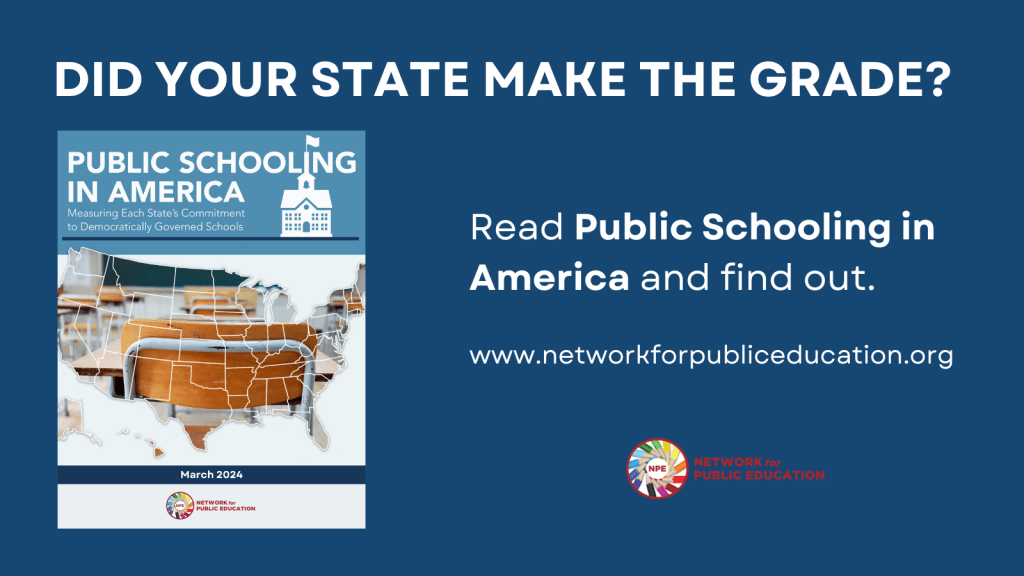
The Network for Public Education released a report card today grading the states on their support for democratically-governed public schools. Which states rank highest in supporting their public schools? Open the report to find out.

Measuring Each State’s Commitment to
Democratically Governed Schools

EXECUTIVE SUMMARY


Neighborhood public schools remain the first choice of the overwhelming majority of Ameri-
can families. Despite their popularity, schools, which are embedded in communities and gov-
erned by elected neighbors, have been the target of an unrelenting attack from the extreme
right. This has resulted in some state legislatures and governors defunding and castigating
public schools while funding alternative models of K-12 education.

This 2024 report, Public Schooling in America: Measuring Each State’s Commitment to
Democratically Governed Schools
, examines these trends, reporting on each state’s commit-
ment to supporting its public schools and the children who attend them.

What We Measure

We measure the extent of privatization in each state and whether charter and voucher laws
promote or discourage equity, responsibility, transparency, and accountability. We also rate
them on the strength of the guardrails they place on voucher and charter systems to protect
students and taxpayers from discrimination, corruption and fraud.

Recognizing that part of the anti-public school strategy is to defund public schools, we rate
states on how responsibly they finance their public schools through adequate and equitable
funding and by providing living wage salaries for teachers.

As the homeschool movement grows and becomes commercialized and publicly funded,
homeschooling laws deserve public scrutiny. Therefore, we rate states on laws that protect
children whose families homeschool.

Finally, we include a new expansive category, freedom to teach and learn, which rewards
states that reject book bans, and the use of unqualified teachers, intolerance of LGBTQ stu-
dents, corporal punishment, and other factors that impinge on teachers’ and students’ rights.

How does your state rank?

Pamela Lang, a journalist and graduate student in Arizona, wrote for The Hechinger Report about her futile search for a school that would enroll her son, who has special needs. Despite Arizona’s budget-busting voucher program, she and he were turned away again and again. It’s time for her to check out her local public school, where her son would get the services he needs and he could not be rejected.

Please read her account.

If you live in Arizona, school choice may be coming to your neighborhood soon. As someone who has had more school choice than I know what to do with, I can tell you what may feel like a shocking surprise: Private schools have the power to choose, not parents.

I live in Phoenix, where the nearby town of Paradise Valley is getting ready to offer the privatization movement’s brand of choice to families. The district has indicated that it will likely vote to close four public schools due to insufficient funds. If this happens, other districts will probably follow: The state’s recent universal voucher expansion has predictably accelerated the diversion of money from public to private schools.

Arizona approved use of school choice vouchers, called Empowerment Scholarship Accounts, or ESAs, in 2011 on the promise that they were strictly for children with special needs who were not being adequately served in the public school system. The amount of funds awarded to qualified students was based on a tiered system, according to type of disability.

Over the years, the state incrementally made more students eligible, until full expansion was finally achieved in 2022. For some students, the amount of voucher money they qualify for is only a few thousand dollars, nowhere near enough to cover tuition at a private school. Often, their parents can’t afford to supplement the balance. However, my son, who is autistic, qualified for enough to cover full tuition.

I took him out of public school in 4th grade. Every school I applied to seemed to have the capability to accommodate his intellectual disability needs but lacked the willingness. Eventually, I found a special education school willing to accept him. It was over an hour from our home, but I hoped for the best. Unfortunately, it ultimately was not a good fit.

I then thought Catholic schools would welcome my son, but none of them did. One Catholic school principal who did admit him quickly rescinded the offer after a teacher objected to having him in her class.

The long list of general, special-ed, Catholic and charter schools that turned my son away indicate how little choice actually exists, despite the marketing of ESA proponents.

There was a two-year period where I gave up and he was home without social opportunities. I was not able to homeschool, so a reading tutor and his iPad became his only access to education.

I then tried to enroll him in private schools for students with disabilities.

These schools were almost always located in former office suites in strip malls with no outdoor access. My son’s current school shares space with a dialysis center in a medical building, while a former school was located in a small second-floor suite in a Target plaza.

Once a private school admits your child, they can rescind admission without cause. Private schools are at leisure to act as virtual dictatorships, and special-ed schools in particular are notorious for keeping parents at a distance…

Education is a human right, and public schools, open to all, are the guardians of this right. What privatizers call choice does not really exist.

Please open the link and read the article in full.

In the Public Interest is an excellent source of information about privatization in every sphere of life, wherever privatizers see a chance to turn a public service into private profit. Its latest post is about the citizens’ fight to overturn a new voucher plan in Nebraska.

Open the link to see the cost of vouchers in Arizona, New Hampshire, North Carolina, and Ohio. Count on costs to go up every year, as legislators expand eligibility and raise income limits.

In early 2023, the Nebraska legislature passed LB753, which created a new private school tax-credit voucher program. The bill allows a dollar-for-dollar tax credit to individuals and corporations that donate to a scholarship granting organization (SGO), which would issue the vouchers to families to pay for private school. Eligibility requirements are broad, allowing, for example, any child entering either kindergarten or 9th grade at a private school, or any student who has spent at least one semester in a public school to apply for a voucher. The bill would divert up to $25 million annually from the state, but that figure could go up to $100 million.

The bill includes a standard “hands off clause,” which prevents the state from exercising any authority over the school and how it operates.  It’s basically a license to discriminate.

Shortly after the bill was passed, public school supporters launched a referendum petition drive to put repeal of the new law on the November 2024 ballot. In fewer than 90 days, the repeal campaign gathered nearly double the number of required signatures from across the state. The effort was led by Support Our Schools Nebraska, a coalition that includes, among others, the Nebraska State Education Association, OpenSky Policy Institute, Parent-Teacher Association of Nebraska, Stand for Schools, League of Women Voters of Nebraska, Omaha NAACP, ARC of Nebraska, Nebraska Farmers Union, and the Nebraska Civic Engagement Table.

In Nebraska, 84% of private schools are religiously affiliated. Many, if not most of these schools are legally permitted to discriminate against applicants based on their gender orientation, religious affiliation, or other characteristics. The Nebraska OpenSky Policy Institute has estimated that state aid distributed to public schools could decrease by almost $12 million in response to the new voucher program.

Forces aligned against the repeal include the usual suspects, like the American Federation for Children, founded by anti-public-education zealot Betsy DeVos, which donated $583,000 along with $103,000 of in-kind services to the pro-voucher effort, on top of money DeVos spent to influence Nebraska state senate races in the last cycle. The Nebraska Catholic Conference, whose coffers stand to gain from LB753, has also thrown its weight and reach behind the anti-public education side. Jeremy Ekeler left his job as associate director of education policy at the Conference in November to become the executive director of Opportunity Scholarships of Nebraska, a state-approved scholarship granting organization helping to implement LB753. They’re not only working to defeat the ballot measure, they’re trying to keep it off the ballot entirely, following a playbook the right has used to subvert a variety of citizen-led, petition-driven initiatives around the country.

As we have pointed out before and as the chart above illustrates, vouchers bleed public school districts of needed funds, allow for discrimination, lower educational standards (by not necessarily having many), and lead to resegregation.

As if that weren’t enough, they turn out to be budget busters for states.

In the Public Interest will keep an eye on this fight because it may be the clearest indication that, while conservative politicians have thrown their support to various schemes that divert public funds from public schools, the public opposes these efforts and will show up at the polls to make their feelings felt.

This report was written by Tanisha Pruitt, Ph.D., for Policy Matters Ohio in April 2023. It provides a comprehensive review of the funding of K-12 education in the state. The state has 1.6 million students. The state Constitution says (Article 6, section 2):

The General Assembly shall make such provisions, by taxation, or otherwise, as, with the income arising from the school trust fund, will secure a thorough and efficient system of common schools throughout the state; but no religious or other sect, or sects, shall ever have any exclusive right to, or control of, any part of the school funds of this state.

The legislature and governor of Ohio apparently believe that the state Constitution does not mean what it says. The Republican leadership has steadily increased the funding of charter schools (which are not “common schools,” but are privately managed schools, some for-profit) and vouchers, which go primarily up religious schools.

The report was written before the legislature lifted income caps on vouchers, agreeing to subsidize the tuition of all students regardless of family income.

Please open the link to see the graphs.

The Policy Matters Ohio report begins:

School is a place where childhood happens. Ohio’s public educators teach children of all races and backgrounds basic skills, but also challenge and inspire them to follow their dreams. For many students, school is a safe place to learn, develop and grow.

Ohio currently educates 1.6 million children attending school in our cities, suburbs and small towns. For years, almost no one was happy about how the state of Ohio funded public schools. The system pitted communities against each other and private and charter schools against public schools. We were living in the K-12 version of the “Hunger Games”: The wealthier your district, the stronger your chances of success.

Most state lawmakers signed off on a system that relied too heavily on local property taxes,[1] so communities where many residents have low incomes struggled to pay for the basics like updated resources and teaching materials. The state capped the funding it sent to some districts, often leaving those districts feeling cheated. In others, state funding failed to keep up with changing costs and student needs. Since 2005, lawmakers have been systematically sending more resources to the wealthiest Ohioans by cutting the state income tax, which accounts for nearly one-third of the state’s spending on schools. Meanwhile, lawmakers have diverted almost $1 billion a year from local levies to private and charter schools.[2]

These policy choices have taken a toll on Ohio’s educational outcomes. Education Week ranks Ohio 46th in the nation for equitable distribution of funding.[3] The performance metrics included: (1) state spending by examining per-pupil expenditures adjusted for regional cost differences, the percent of students in districts with per-pupil spending at or above the national average, spending index, and percent of total taxable resources spent on education and (2) Equity, by examining the degree to which education funding is equitably distributed across the districts within the state.[4]

The pandemic has contributed to a decline in test scores, which could have an impact on our overall ranking, if we do not get students caught up.[5] Over nearly two decades, we can draw a straight line between the racial and economic achievement gaps and the lack of funding to provide Black, brown, economically disadvantaged students[6] and students with disabilities what they need to succeed in school.

Ohio’s schools are becoming more racially and ethnically diverse; the Hispanic[7]population (a close proxy for Latinx) alone has more than doubled over the last 10 years.[8] Student poverty is also on the rise with 51% of students considered economically disadvantaged and the homeless student population doubling over the last decade.[9]

COVID-19 created unstable and even chaotic learning environments across Ohio. The elevated stress and social isolation caused by the move to virtual learning[10]exacerbated students’ need for mental health services.[11] The pandemic continues to take a toll on educators as well. COVID and other outbreaks are making educators sick. Moreover, increased stress and low pay cause many educators to leave the profession. Districts across the state have grappled with unprecedented staff shortages. For example, Columbus City Schools (CCS) had 800 employees absent every day during the height of the pandemic.[12] Hamilton City School officials were forced to cancel classes when 170 staff members were out due to illness.[13]

COVID has especially hammered school districts in communities that can’t raise enough money through local property taxes — especially in big cities, where Black, brown and economically disadvantaged students are more likely to live.[14] Schools in these communities often have fewer resources for COVID mitigation efforts like improving ventilation.[15]

Long before COVID, many policymakers neglected public schools, siphoning away their funding for tax giveaways[16] to corporations and undercutting them with schemes that send public money to charters and private schools. Combined with the effects of COVID, Ohio’s legacy of inadequate and inequitable funding has weakened the role school plays as a foundational public service for families and communities. For our state to be a vibrant place where people want to live, we need fully and fairly funded schools in all districts, no matter what students look like, or how much money their families have.

This report describes how the state funds public K-12 education and some key investments proposed in the 2024-25 Executive Budget, the legacy of unconstitutional funding, the role private school vouchers play in harming public schools, and how the Fair School Funding Plan — when fully funded and fully implemented, including weights and cost corrections — can provide districts with more resources to prepare Ohio’s children to succeed.

A brief history of Ohio school funding

The framers of Ohio’s constitution obligated the state to provide a “thorough and efficient system of common schools” for all students.[17] In 1991, the Ohio Coalition for Equity & Adequacy of School Funding, representing more than 500 school districts in Ohio, filed suit in the Perry County courts against the State of Ohio for failing to uphold this constitutional requirement.[18] In DeRolph vs. The State of Ohio — named for Perry County school district student Nathan DeRolph — plaintiffs argued the state was failing to live up to its obligation due to over-reliance on local property taxes for school funding: In wealthy communities, high property values generated revenues needed to provide students with more resources for cutting-edge technology, advanced classes, and extracurricular activities; the opposite was true in poor communities. This left schools in cities, rural areas and many low-income communities severely under-resourced, significantly harming outcomes for their students.

The litigation dragged on until 1994 when Perry County Court Judge Linton Lewis, Jr. ruled that “public education is a fundamental right in the state of Ohio” and that the state legislature must provide a better and more equitable means of financing education.

The DeRolph case was the start of a foundational shift in the school funding system in Ohio, but the fight for constitutional and equitable funding continued for decades following the ruling. By failing to keep up with inflation and by diverting public funds to charter schools[19] and vouchers (i.e., scholarships to private schools), lawmakers in fact cut state aid to traditional public schools over time.[20] As a result, public schools have increasingly relied even more on local resources, which exacerbates the problem of unequal funding and quality across districts,[21] a problem that persists today….

Public dollars, private benefits

Two smaller education systems run alongside Ohio’s traditional public schools: charters and private schools. When legislators redirect funding from traditional public schools to pay for charters and vouchers (which pass public dollars through parents and into private schools), the vast majority of Ohio students who attend traditional public schools have to make do with less.

In Ohio charter schools have been branded “community schools” and are considered “public” because they cannot charge tuition and they are supposed to accept all students. However, charter schools do not necessarily serve the public good. Charter school sponsors may contract with for-profit companies to operate the schools. In 2020, Ohio had 313 charter schools serving 102,645 students and 178 (57%) of them were operated by for-profit entities.[48]These “operators” have been the source of much scandal in Ohio. Simply put: The charter system in Ohio has lots of loopholes for private, profit-seeking companies to siphon off public dollars.

In FY 2022 the state sent $1.45 billion to charter schools — up from nearly $620 million in 2007.[49] During that time, Ohio’s legislators earned our state a reputation as “the wild west of charter schools” by failing to hold charters and their operators accountable.[50] Problems with Ohio’s charter school system came to a head with the ECOT scandal: A for-profit online charter school, the Electronic Classroom of Tomorrow squandered millions in public money by inflating enrollment numbers.[51] Other charter scandals have prompted rounds of legislative reform to reduce self-dealing, prevent the state from paying for students who were not actually attending school, and stop attempts at double-dipping by selling state-purchased materials back to the state for even more public dollars.[52]

The Ohio Charter School Accountability Project, a joint effort of the Ohio Education Association (OEA) and Innovation Ohio, using data primarily from the Ohio Department of Education (ODE), created a tool to help Ohioans know the state of publicly funded charters and private schools that accept public vouchers, and how they compare to traditional school districts. Analysis includes state report card rankings, classroom expenditures, and state aid deductions to charter schools. This system is intended to provide transparency so that parents, teachers, students and advocates can hold charter schools accountable.[53]

Based on the recent Annual Community Schools report conducted by the Ohio Department of Education (ODE),[54]community schools in Ohio are receiving more funding through the Quality Community School Support Grant (QCSS). Eligibility requirements for these grants are based on performance standards and overall academic achievement. In the current budget lawmakers increased funding to QCSS to $54 million for FY 2022, a $24 million increase from 2021. This increase includes a per-pupil increase of $1,750 for economically disadvantaged students and a $1,000 per-pupil increase for all other students.[55]

Vouchers eat up state funding for K-12 schools

As problematic as under-regulated charter schools can be, the proliferation of private school vouchers has had the most serious consequences for public schools and the vast majority of Ohio students who attend them. Since the Cleveland Voucher Program for low-income students in Cleveland City Schools launched in 1996, policymakers have expanded voucher programs across the state. Ohio currently has four main school voucher programs: the Educational Choice (EdChoice) Scholarship Program, the Cleveland Scholarship and Tutoring Program (CSTP), the Autism Scholarship Program, and the Jon Peterson Special Needs (JPSN) Scholarship Program. The EdChoice program is split into two types: the Traditional EdChoice Scholarship, also known as performance-based EdChoice, and the EdChoice Expansion Scholarship, also known as income-based EdChoice.

Policymakers introduced the Traditional EdChoice scholarship program in 2005 and continue to expand it. The EdChoice Expansion program was introduced in 2014 and has also expanded in scope. The performance-based EdChoice program is available to students in underperforming school districts, while the income-based EdChoice program is available to low-income students. The Cleveland Scholarship is for all K-12 students in the Cleveland Metropolitan School District. The other two scholarships, Autism and JPSN, are for autistic students and students with any disability, respectively.

What started as a program to provide alternative education options for students in what the state perceived to be underachieving schools has now expanded to include students from public schools with high achievement grades. According to a brief by the Northwest Local School District, 47.7% of the buildings on the current list of Ohio schools eligible for vouchers have overall grades of “A,” “B,” or “C” under the state’s report card system. The number of eligible schools has also grown rapidly. During the 2018-19 school year Ohio had fewer than 300 school buildings that were considered eligible; by 2020-21, 1,200 school buildings were eligible: a 300% increase in just two years.[56] Similarly, income-based vouchers are now being proposed for families earning up to 400% of the federal poverty level. This expansion would be a costly and needless expansion, subsidizing private education for families that need no help. A family of four could earn up to $120,000 and be considered income eligible. This expansion will make vouchers nearly universal, by providing an additional handout to upper-middle-class families at the expense of public schools.

Vouchers in the state budget

After years of tax cuts for the wealthy and corporations that have drained resources from public schools, and as COVID has created new pressures, the state further undercuts public schools by pumping hundreds of millions of public dollars into private schools.[57]

The 2022-23 biennial budget expanded funding of private schools, especially through EdChoice and other voucher programs. Traditional, performance-based EdChoice received $212.5 million, and the income-based EdChoice Expansion program received close to $103 million, a combined 61.4% of voucher payments statewide in FY 2022. The Autism and JPSN scholarships received $116.5 million and $76.6 million, respectively, making up 17% and 12.4% of distributed scholarship funds. The Cleveland Scholarship program received $46 million and only makes up 9.1% of distributed scholarship funds.[58]

Legislators have increased voucher payments from state funds since 2014, as illustrated in Figure 6.[59]

Figure 6
https://datawrapper.dwcdn.net/7sKMh/2/

The FSFP funds vouchers directly instead of allowing them siphon away districts’ state funding. Lawmakers increased total voucher allocations from $395.4 million in FY 2020 to $635.1 million in FY 2022.[60]They also increased direct state aid to private schools, though not as dramatically. Policymakers increased funding for “auxiliary services” to private schools from $149.9 million in FY 2021 to $154.1 in FY 2022 and just under $156 million in FY 2023. Meanwhile, “nonpublic administrative cost reimbursement” aid — which reimburses charter schools for the cost of mandated administrative and clerical activities such as preparation, filing and records keeping[61] — increased from $68.9 in FY 2021 to $70.8 in FY 2022 and $71.6 in FY 2023.[62]

Lawmakers have increased spending on vouchers by increasing the amount families can receive. For income-based EdChoice Expansion vouchers for FY 2022-23 the state now awards qualifying K-8 students $5,500 per year and high school students $7,500 per year for tuition at non-public schools, up from previous award amounts in FY 2020-21 which provided $4,650 for K-8 students and $6,000 for students grades 9-12.[63]….

Voucher expansion threatens our public schools

Because of the General Assembly’s continued expansion of voucher programs, more Ohio families are enrolling in them — up from 52,000 in 2019 to 69,991 in 2021. Even accounting for this growth, most voucher students were already attending private school before receiving vouchers.[64] Further, the number of vouchers is a fraction of the number of students served in public schools. When students use state-funded vouchers to attend private schools, even if they were never enrolled in traditional school districts, it means less money in the state budget that could otherwise be spent creating great public schools, which must serve all students.

The Ohio Coalition for Equity and Adequacy of School Funding, a coalition of over 100 school district and 20 education and community groups, took the state of Ohio to court, claiming that EdChoice Expansion violates the constitutional requirement that the state provide a “thorough and efficient system of common schools.” Coalition advocates believe that state lawmakers’ growing investment in vouchers could lead to a school funding system that privileges private education even more in years to come.[65]

Many proponents of voucher expansion have painted it as the state simply supporting parents’ right to choose where their child will be educated, but choice is not the problem, priorities are. The state has not fulfilled its constitutionally mandated responsibility to fairly fund public schools. Key components of the FSFP are still outstanding. Allocating close to $1 billion in public funds for students to take vouchers to private schools is a huge disservice to the 90% of students who attend our public schools.

Ultimately, the way the executive budget proposes to distribute foundation aid over FY 2024-25 will further erode the share going to traditional public schools by allocating a greater share to charters. The proposed budget would send 77.9% of foundation funds to traditional schools, compared to 79.1% in the last budget. Charters would take 10.8%, up from 9.9%. Voucher programs stay at 7.1%, and joint vocational school districts increase to 4.2% from 3.8%.

Recommendations & conclusion

Ohio has underfunded public schools and other essential public services for years.[66] Ohio lawmakers have cut state income taxes since 2005, reducing our ability to provide an equitable education system for all our students, and giving huge windfalls to the wealthiest Ohioans and little or no benefit to people with middle or low incomes.

Policymakers have a constitutional duty to protect public schools. Ensuring a thorough and efficient system of common schools means correcting disparities generated from over-reliance on property taxes by fully implementing the FSFP, with accurate estimates of how much it really costs to educate our kids.

Lawmakers in Ohio need to invest in developing an educator workforce of qualified teachers who are paid fairly for their essential work and strongly supported while doing it. Other pressing issues include a bussing crisis,[67] fewer 5-year-olds prepared for kindergarten,[68]lowered reading and math proficiency scores,[69] chronic absenteeism,[70] and a persistent digital divide.[71]

The state has sufficient revenue to meet these challenges, so long as legislators make public schools and kids a priority. Ohio has the money to fully commit to the FSFP in this budget. Instead of phasing in funding piece by piece, year after year, lawmakers should fully fund it right now. Ohioans must come together to demand lawmakers live up to the promise of the FSFP in the next biennium and beyond.
New Hampshire reluctantly accepted federal money to open new charters. The reluctance occurred when Democrats were in charge of the legislature. Once Republicans captured control of the legislature, the reluctance disappeared. Governor Sununu selected a home-schooling parent as state commissioner of education, and New Hampshire is now all in for vouchers and charters.

But New Hampshire can’t escape certain inevitable problems that accompany school choice:

First, sending public money to private schools does not improve education; in fact, it weakens the public schools, attended by the vast majority.

Second, vouchers always cost more than was predicted.

Third, most vouchers will be used by kids already attending private schools.

Fourth, many charter operators are more interested in money than in the hard work of education.

New Hampshire is now going through the throes of a charter school closure. Four other new charter schools in the state have closed.

New Hampshire Public Radio reported:

A charter school in Exeter is closing less than two years after it opened, as former school officials face an ongoing investigation for alleged embezzlement and fraud.

“We tried everything that we could to save the school but sadly, the obstacles were insurmountable,” Jennifer Roopenian, the current chair of the Coastal Waters Chartered Public School board of trustees, told NHPR via email on Sunday.

Roopenian said the board learned of another “financial discrepancy” last week, and “despite our attempts to find a solution, the board had to make the heartbreaking decision to close the school.”

The development comes as the Exeter Police Department is pursuing two investigations into former officials associated with the school, which served students from kindergarten through 12th grade. One investigation involves alleged tampering with a public record; the other involves alleged embezzlement. State agencies, including the New Hampshire Attorney General’s office and New Hampshire Department of Education, say they are also communicating with the police about the allegations but declined to give more details.

Coastal Waters Chartered Public School opened in 2022 with a mission inspired by Waldorf teaching, which focuses on arts, nature and creativity. But some parents say there were red flags that the school was in trouble early on, and no one — the state, or the school board of trustees — was providing proper oversight to ensure its success.

By this winter, the school had lost more than half its student population since its opening year.

“They sold a really good story about the Waldorf method, about how kids would be learning in traditional ways as well as Waldorf ways,” says Stephanie Carr Thomas, a former Coastal Waters parent who pulled her children out of the school in 2022. “But that’s not what happened.”

Coastal Waters Chartered Public School is one of a handful of charters that have opened in New Hampshire amid increased funding and a growing interest in school choice. Charter schools are approved by the State Board of Education and receive funding directly from the state, about $9,000 per student. In 2022, Coastal Waters also won a $1.36 million federal grant as part of the New Hampshire Department of Education’s charter school expansion initiative.

Nicole Mazur, a former Coastal Waters parent and board member, said the school’s alternative vision drew families who couldn’t afford private school but wanted more personalized, outdoor-based education for their kids. And at the beginning, she said, many parents tried to help the school succeed.

“There were people wanting to help and volunteer, and helping to work out whatever kinks there were, just saying: ‘Tell me where to be and I’ll be there, and we’ll help,’’’ Mazur recalled. “There was a lot of excitement and positivity.”

But she said that excitement quickly gave way to concerns about the school’s facilities and finances…

In late 2022, Mazur and several other parents quit the board of trustees and pulled their kids out of the school, citing concerns about their children’s well-being and lack of financial transparency by the board chairman and treasurer, William Libby. Libby did not respond to NHPR’s request for comment.

Reports from both the state and the school show that enrollment continued to shrink over the last year, from 128 students in 2022 to 47 students as of last week…

Some Coastal Waters families say it’s unclear what power the education department has in its own investigation. The department’s misconduct investigations typically involve licensed individuals who have violated the educator code of conduct or code of ethics. But some former Coastal Waters officials didn’t have New Hampshire educator licenses to begin with.

The state requires charter schools to ensure at least half of its teaching staff either hold state certification or have three years of teaching experience. Roopenian, the current Coastal Waters board chair, said the school’s most recent teaching staff met those requirements.

Jesse Peloski, who withdrew his children from Coastal Waters in late 2022, said he worries the mechanisms for reporting and monitoring concerns about charter schools are “potentially very broken.”

“There is a huge desire for alternatives to public schooling,” he said. “But there’s also a huge opportunity for exploitation there.”

Secretary of Education Miguel Cardona has been nearly invisible these past three years, other than lamenting test scores. Veteran educator Nancy Bailey has some suggestions about how he could help kids, schools, and teachers right now. This post was reposted by the Network for Public Education.

The secretary keeps talking about raising the bar. Nancy Bailey has some thoughts about some bars he could work on. Reposted with permission.

She writes:

Education Secretary Cardona focuses on reducing absenteeism, tutoring, and after-school programs. And he refers to raising the bar, which sounds like A Nation at Risk talk.

Yet there are so many K12 issues that Cardona and the Biden administration could address, lead, and support the states and local school districts.

Here are some educational issues Cardona should drive this new year. If you have more, please share.

1. The Arts

Poor public schools have gone without the arts for years. Cardona should push for qualified art and music teachers for every school.

The arts help students struggling with mental health difficulties, and jobs exist in the arts.

Every child in K12 should have access to a vital arts program.

2. Career Education

Career-technical education is essential, but companies pushing their agendas into high schools to get workers raises concerns.

Tax dollars should help students decide what careers they want, giving them the chance to experience high school, not creating schools for corporate preparation.

3. Class Size

Reducing class sizes would help students with disabilities in inclusion classes and is essential for student safety. Cardona must endorse lowering class sizes and showcase schools that do.

If schools can’t lower every class (classes like P.E. wouldn’t be necessary), give students access to at least one small class where they are known.

Lowering class sizes in K-3rd grade would also help children get a good start. See the STAR Study.

4. Corporal Punishment

In 2023, The Washington Post reported that 15 states still permitted corporal punishment in schools (St. George, 2023). Like Florida, which vaguely gives a nod to it. Teens who wear the wrong kind of prom dress or misunderstandings resulting in paddling are examples.

Cardona deserves praise for standing against corporal punishment last year in schools, claiming educators should favor evidence-based approaches and that there should be no spanking, hitting, or paddling.

5. Data

Cardona must study and draw attention to child privacy laws which are currently inadequate.

In 2018, the NEPC published Educating All Our Children: Your Kids, Their Data, No Privacy by Linda McSpadden McNeil.

She stated:

When children’s privacy is violated in ways that are overt, visible, and knowable, the violation is unquestioned. It is unacceptable. In most cases, it is illegal.

So why is it different when the violation is hidden, opaque, electronic, commercial, and complicated?

6. High-Stakes Standardized Testing

President Biden promised teachers and parents he’d end harmful high-stakes standardized tests. Instead, he pushed assessments even during the pandemic.

Can Cardona show the American people who want these tests reduced or eliminated what, if anything, the Biden administration will finally do to end high-stakes standardized tests?

7. Lead in School Pipes

The Biden-Harris team promised to repair the lead pipes in homes and schools. They’re to be commended for this. It would be nice, however, if Cardona presented a report.

No amount of lead is O.K. for developing children, and it can lead to learning disabilities.

8. Reading

Reading has become a volatile issue, and Cardona has been mostly silent. Many commercial programs with little independent study, but nonetheless called the Science of Reading, are being pushed into classrooms.

The subject of reading deserves a better forum than short, often hostile debates on X.

Cardona should call for a new National Reading Panel to study programs and address reading instruction. The panel should include teachers who teach reading since they were left off the last panel. This panel should consider the concerns of the last NRP member, the only educator on the panel, Joanne Yatvin (Yatvin, 2002). Parents should also be given a voice on this panel. A new NRP would allow for a better collection of the research, old and the latest findings, and a review of the work of the last NRP.

9. Recess

Every public school in the nation should give children several unstructured breaks throughout the school day, supervised, on safe, well-designed playgrounds.

Driving students to work nonstop with mindfulness training or a dozen other excuses to bypass recess should not be permitted.

10. School Buildings

Americans need to know the status of their public school buildings. How are the HVAC systems and air quality? How many school facilities are still falling apart? Are public school buildings safe?

Are new schools being built to support teachers?

11. School Choice

The Biden administration discussed regulating charter schools (Lieberman, 2022). But concerns about vouchers, educational savings account, nonprofit and for-profit charters, and religion in schools needs to be better addressed.

In addition, the Biden administration should describe what they mean by community schools (often called charter schools), partnerships, and social impact bonds and how these schools are still public.

12. School Libraries and Librarians

It’s an abomination to drill children to learn to read in poor schools, and then not provide them a school library with a qualified school librarian.

Closing school libraries has been a disaster in many school districts, see Philadelphia as an example.

13. School Safety

The gun lobby is unfortunately influential, so despite shootings in this country, don’t hold your breath for meaningful gun laws. It was thoughtful of Cardona to visit Parkland.

In the meantime, school administrators must devise creative ways to make schools safe and identify students in their schools who need mental health help. See class size above.

14. Social-Emotional Learning

Concerns about the data collected on students includes social-emotional learning. Teachers always want their students to be socially and emotionally healthy, but social-emotional learning seems more about collecting unnecessary sensitive data about students.

Who is using this information and why?

15. Special Education

Parents are in danger of losing special education services. The All Handicapped Children’s Act reauthorized to IDEA should have evolved into a more inclusive and better programs for students with exceptional needs, but instead it has been hijacked by those who don’t want to pay for it.

Cardona should look into special education and create a task force to study it and determine exactly how much special education funding schools receive and the kind of services students receive. He might start with Tammy Kolbe’s work and the National Education Policy Center report Funding Special Education: Charting a Path that Confronts Complexity and Crafts Coherence.

16. Teacher Preparation

School reform has changed teacher preparation dramatically. There needs to be more effort to oversee these mostly fast-track nonprofit or for-profit programs often connected to charter schools.

Cardona should step up here to promote fully university-prepared teachers, and he should work with university education programs to improve their coursework and degree offerings. The United States Department of Education might provide scholarships to attract young people who want to pursue a teaching career in university education programs, not unknown nonprofits or charter school preparation.

Fast-track groups like Teach for America are a concern because they turn those without real qualifications into the system with little understanding of child development or what’s needed to teach well, and Grow Your Own programs are ill-defined.

17. Technology

While technology is useful to learning, a recent Columbia University study indicates that children read better with paper print not online.

The Guardian cites MIT neuroscientist John Gabrieli, skeptical about the promises of big tech and its salesmen.

Gabrieli states:

I am impressed how educational technology has had no effect on scale, on reading outcomes, on reading difficulties, on equity issues.

Is Cardona behind teachers or for replacing them with technology? Actions matter.

18. Third-Grade Retention

Third-grade retention is unnecessary. No child should be made to feel like a failure. Children can still learn to read in third grade, can still grow and become great learners. Speaking out on this issue would help end it.

References

St. George, D. (2023, August 10). In over 15 states, schools can still paddle students as punishment. The Washington Post. Retrieved from https://www.washingtonpost.com/education/2023/08/10/school-paddling-corporal-punishment/.

Yatvin, J. (2002). Babes in the Woods: The Wanderings of the National Reading Panel. Phi Delta Kappan, 83(5), 364–369. https://doi.org/10.1177/003172170208300509

Lieberman, M (2022). Lawmakers, Education Secretary Clash Over Charter School Rules. Education Week, https://www.edweek.org/policy-politics/lawmakers-education-secretary-clash-over-charter-school-rules/2022/04

Share this:

FacebookTwitterEmailShare

Readers wishing to comment on the content are encouraged to do so via the link to the original post.

Find the original post here:View original post

Garry Rayno writes a consistently informative report on legislative activity in New Hampshire.

In his latest report, he describes the partisan split concerning ghe state’s voucher program, euphemistically called “Education Freedom Accounts,” which means that taxpayer money will follow if you leave public schools.

The voucher program has already exceeded the costs projected by the state Department of Education. The state commissioner, appointed by Governor Chris Sununu, is Frank Edelblut, who home-schooled his 10 children. He is no fan of public schools.

Republicans, who are in the majority in both houses, have proposed expanding the voucher program and raising the income limits. Their ultimate goal appears to be a universal voucher program where everyone is eligible for a voucher.

Democrats have proposed laws to limit the number of students who get vouchers, to require that income limits are enforced beyond the first year of use, to ban vouchers in religious schools, and to impose accountability on voucher schools.

Rayno writes:

Few programs in state government have an open-ended budget limit, instead most have to stay within the budget lawmakers set.

Some federal programs where the state shares the costs such as Medicaid do not have set limits, but have to serve all who qualify under federal guidelines.

But the fairly new Education Freedom Account program approved three years ago in the state’s two-year budget package has no limit on what is spent from the state’s Education Trust Fund. Sort of like Santa Clause this time of year.

Although the program is fairly new, many attempts have been made to change it during the past two years and this the third session since its passage is no different.

Supporters want to expand the eligibility for students, while opponents and skeptics seek to put restraints and accountability measures on the program that has grown 158 percent since its inception, while the cost has increased 174 percent in figures released earlier this year by the Department of Education.

The future of vouchers depends on which party wins control of the legislature in November.

The Network for Public Education has worked recently with “Documented,” an organization that defends democracy. Its executive director Nick Surgey led a panel at our 10th conference in D.C. in October. Nick and his colleagues described their very well documented work to expose the plot to destroy public education. As I left the room, David Berliner said to me, “That was a terrifying hour.”

Here is the video. Please take the time to watch.

Nick is an expert on the extremist Alliance Defending Freedom, which has led attacks on public schools and on abortion rights. The Speaker of the House Mike Johnson was a lawyer for ADF.

Please read the Documented brief describing their work.

It will open your eyes to a well-funded plot to destroy our public schools.