Archives for category: School Choice

The organization called “In the Public Interest” is a valuable source of information on the creeping (or galloping) privatization of public goods and services. Headed by Donald Cohen, ITPI keeps tabs on takeovers by billionaires and equity services of public services that we all need and squeezing a profit out of them.

ITPI reported on the report created by the Network for Public Education to evaluate state support for public schools.

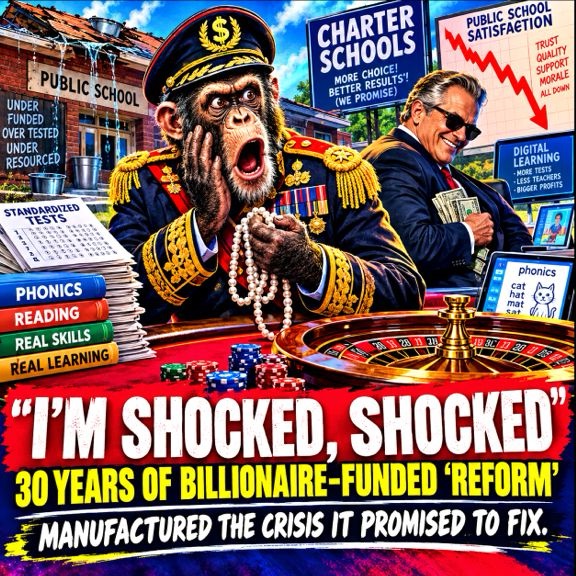
We’ve long argued that increased funding for alternatives to public education usually comes at the expense of public education. While some politicians have insisted that it’s a “yes, and,” not an “either/or” proposition, we’ve known that, since the 1960s, the long game has been to slowly defund public schools while increasing high-stakes consequences through reliance on standardized testing and sanctions against schools and educators to justify further defunding. As schools are increasingly labeled as “failing,”  privatization in the guise of “school choice” becomes the only alternative. 

Now a new, comprehensive study from our friends at the Network for Public Education (NPE), a nonprofit public education advocacy organization, brings the receipts. 

Public Schooling in America: 2026 Report Card studied all 50 states, plus DC, reviewing nearly forty factors across four categories: Privatization, Protections for Homeschooled Students, School Funding, and Conditions for Teaching and Learning.

The study makes a clear case that the more states invest in private education alternatives, the less they invest in public education.

“The data confirm what we have long suspected: privatization and disinvestment go hand in hand,” says Carol Burris, Executive Director of NPE and the report’s author. “These are not states struggling with limited resources. They have made deliberate choices to abandon their public schools while directing billions in public dollars to private alternatives.”

The full report, a must-read for anyone who cares about education in the United States, is available here, or you can start with the executive summary here.

Donald Cohen
Executive Director

The Network for Public Education, which I co-founded with science teacher Anthony Cody in 2012-2013, supports the improvement of public schools and opposes privatization of public funding for schooling. Nearly 90% of children in the U.S. are enrolled in public schools. Their schools should be staffed by qualified teachers and fully funded. NPE works with state organizations that share our commitment to the principle: Public funds for public schools.

The following report was produced by NPE Executive Director Carol Burris and staff. Burris retired as a career teacher and award-winning high school principal.

NEW REPORT GIVES 17 STATES FAILING GRADES FOR ABANDONING PUBLIC SCHOOLS

Network for Public Education’s Most Comprehensive Report Card Finds Privatization and Disinvestment Go Hand in Hand

New York, New York

The Network for Public Education (NPE) released Public Schooling in America: Measuring Each State’s Commitment to Public Schools (2026), an expansive state-by-state assessment of support for public education. The report evaluates all 50 states and the District of Columbia across four categories: Privatization, Protections for Homeschooled Students, School Funding, and Conditions for Teaching and Learning. It documents a troubling national pattern: the statehouses most aggressively redirecting public money toward private alternatives are the most neglectful of their public schools, teachers, and students. NPE’s analysis found a strong, statistically significant negative relationship between privatization and policies that support public schools (p < 0.0001).

Only two states — Nebraska and Vermont — earned an A. Seventeen states received an F, failing to meet even 40% of the points allocated across NPE’s 39 standards. Florida ranked last, scoring 14 out of 102 possible points, with Arizona close behind. “The data confirm what we have long suspected: privatization and disinvestment go hand in hand,” said Carol Burris, Executive Director of NPE and the report’s author. “These are not states struggling with limited resources. They have made deliberate choices to abandon their public schools while directing billions in public dollars to private alternatives.”

The report draws on original research in addition to research from other organizations — including the Education Law Center, the Learning Policy Institute, and EdChoice — to deliver a comprehensive assessment of public education and privatization across 39 distinct factors. These include teacher-to-student ratios, teacher satisfaction, school funding levels, and the degree to which laws governing vouchers, charter schools, and homeschools protect both taxpayers and students.

Public Schooling in America also provides a roadmap for reform, showing policymakers and advocates exactly where laws and policies must change to better serve students and rein in the serious, well-documented problems created by privatized alternatives.

“Public schools are the only institutions in American life obligated to welcome every child, regardless of circumstance,” NPE President Diane Ravitch added. “They build community and democracy. They are as American as apple pie.”

The full report is available here

About the Network for Public Education

The Network for Public Education is a nonprofit advocacy organization dedicated to protecting, preserving, and strengthening public schools for every child in America.

Scott Maxwell is a columnist for the Orlando Sentinel. In this column, he argues that voucher schools in Florida should not be allowed to dodge accountability. And, he explains, they are completely unaccountable. The state Constitution requires that the state provide high-quality education, which voucher schools do not. He neglects to notice that the state Constitution states that no public money should go to religious schools. Not a penny, but most vouchers go to religious schools.

What is more, the voters of Florida rejected an effort to strip that language from the state Vonstitution in 2012.

Scott Maxwell wrote:

Teachers and parents have filed a landmark lawsuit challenging the legality of Florida’s billion-dollar school voucher system

The argument at the heart of their suit is that Florida’s constitution requires tax dollars be spent on “high-quality” education. Yet Florida’s voucher system is a black-hole of accountability, sometimes paying for kids to go to “schools” that are total disasters — where teachers lack degrees, inflate grades and use curriculum that is rubbish.

I’m not convinced the teachers and parents will win this lawsuit. In fact, I doubt they will. Similar challenges have been unsuccessful. And Gov. Ron DeSantis has done a pretty thorough job of stacking the courts with political allies, especially at the appellate level.

But I know for a fact the teachers and parents have a point. In fact, It’s inarguable. This newspaper has spent nearly a decade documenting voucher schools that failed children.

Often, the parents themselves were shocked and outraged to learn that schools were failing their kids and that there was little to no accountability.

The Sentinel’s multi-year “Schools Without Rules” investigation into voucher (or “scholarship”) schools found some schools employed teachers that lacked any teaching credentials or college degrees.

Some were such financial disasters, they shut down in the middle of the year, stranding families. (One in Orlando was evicted from a commercial complex where a neighboring tenant was “Drug Tests R Us.”)

Some refused to serve children with disabilities, whether it was autism or reliance on a wheelchair. Even more refused to teach children who are gay or had gay parents. These were schools eager for the public money but unwilling to serve all the public. None of this was discreet. Some had written policies saying that they wouldn’t serve children with Down’s syndrome or who uttered the sentence: “I am gay.”

Some schools taught junk science and bogus history, suggesting that dinosaurs and humans roamed the earth together and downplaying slavery and segregation.

And at some schools, parents were so appalled at what they found that they reported to the state things like “Cleaning lady substituting for teacher” and “I don’t see any evidence of academics.”

If you think any of that represents “high quality” education, you might also believe the mini tacos at 7-Eleven are five-star dining.

Many private schools that accept vouchers do stellar jobs and fill niche needs that public schools have historically struggled to meet. But too many taxpayer-funded schools are total trainwrecks. And the reason is that Florida has very few standards for voucher schools.

That is, in fact, the crux of the lawsuit, which lists about 20 different things that public schools are required to do by state law, but which all voucher schools are not.

Like providing certain levels of school safety staffing and having threat-management plans in place. Offering vetted curriculum and providing transportation. Hiring qualified teachers. And publicly posting test scores from state assessments that show whether students are actually learning anything. Public schools must do all of that.

The argument from choice-without-standards supporters is that parents should be able to choose any education they want for their kids without exception.

There are two problems with that argument.
One is that no other government-funded voucher program works that way — and for good reason. We don’t let recipients of food vouchers use them on Twinkies and Mountain Dew. This is public money meant to provide nutritional sustenance. So there are guidelines. The same way there is for Medicaid and Medicare. You don’t get to spent public money that’s meant to fulfill a public purpose on anything you like just because you invoke cries of “freedom” or “choice.”

The other problem is that using this money to provide “high quality” education isn’t optional. It’s part of the Florida Constitution — a point the lawsuit addresses when it says: “… choice does not change the Constitution. When public funds are used to educate a child, that child is entitled to the same level of educational opportunities, the same quality standards, and the same basic protections.”

You can certainly make the argument that some public schools have failed some students. Do you know how we know that? Because these schools were required by law to disclose their test scores, standards, hiring practices and curriculum.
In fact, newspapers in Florida were often the ones that exposed problems at public schools.

And most anytime we did, public officials would spring to action and agree reform was needed.
Yet most every time we’ve exposed problems in taxpayer-funded voucher schools, state lawmakers leaders looked the other way.
The most pathetic part of all this is that it’s easily fixable.

Florida could still offer “choice,” but also demand that any schools that receive public money meet basic standards. Hire qualified teachers. Post the results of nationally-normed standardized test scores and graduation rates. And ban discrimination.

“To me, this is just common sense,” said Stephanie Vanos, an Orange County School Board member who also happens to be an Orlando mom and joined the lawsuit as a plaintiff in that capacity. “I’m not saying they need the thousands of pages of rules that apply to us, but we need a common-sense set of rules that should apply to everybody.”

She is, of course, right. Schools that do good jobs shouldn’t be afraid of accountability and transparency. Most aren’t.

In fact, ask yourself these basic questions:
Why shouldn’t parents and students be guaranteed qualified teachers?

Why shouldn’t taxpayers be able to see what kind of test scores are being produced at all the schools they’re funding?

And why shouldn’t taxpayers be assured that the money they’re spending is actually providing “quality” education, as the Constitution requires?
Better yet, ask those who defend the status quo.

Mike DeGuire, retired Denver educator, warned Coloradans that the usual billionaires are lining up behind Mike Bennett for the Democratic nomination for Governor. Bennett is currently a Senator but previously was Superintendent of Schools in Denver, where he promoted the NCLB agenda of test-and-punish, charters schools, and corporate reform. He never was an educator so he swallowed corporate reform hook, line, and sinker.

DeGuire wrote:

Colorado’s Democratic primary for governor between Attorney General Phil Weiser and U.S. Sen. Michael Bennet is heating up. TV ads are everywhere, and social media is abuzz with supporters extolling their favorite candidate’s strengths or the opponent’s weaknesses. Colorado has elected only one Republican governor in 50 years, so many pundits believe whoever wins the Democratic primary will likely win the November election. 

Money is becoming a big factor in this campaign. Bennet has a distinct advantage thus far, primarily due to one group of funders: billionaires. More than half of Bennet’s super PAC donations are from billionaires, individuals and groups affiliated with organizations run by billionaires, and from a “dark money” group. Research shows that billionaires “are swaying elections all across America.”

As of the May 18 filing deadline, Bennet had over $11.5 million in total donations compared to Weiser’s $7 million. Over $7 million of Bennet’s money is from his super PAC, Rocky Mountain Way, which includes over $1 million from an independent expenditure dark money organization called Brighter Future for Colorado. Weiser has $1.1 million from his super PAC, Fighting for Colorado, and just over $6 million from individual donations.

Michael Bloomberg is the 18th richest man in the world with a net worth of over $109 billion, and he is the largest individual donor to Bennet’s super PAC, giving $2.5 million thus far. But he is not the only billionaire donor in Bennet’s camp. These billionaires also contributed to Bennet’s super PAC: Steve Mandel and his wife ($175,000,); Tench Coxe and his wife ($100,000); Edythe Broad ($3,000); Marc Heising ($75,000); Eric Mindich ($25,000); Deborah Simon ($25,000); and Robert Fanch ($25,938).

In addition to the billionaires’ money, over a dozen hedge fund managers and venture capitalists contributed between $10,000 and $100,000 each to Bennet’s super PAC. The ultra-wealthy use their donations to gain loyalty from candidates who will enact policies that align with their values and protect their wealth through tax breaks, financial incentives and limited regulations on their corporations. They also use nonprofit foundations to fund organizations they support philosophically. 

Tax filings published by ProPublica for the years 2022-24 show that billionaires Reed Hastings and John Arnold used their nonprofit, City Fund, to give money to Denver Families for Public Schools, which contributed $45,000 to Bennet. The former CEO of City Fund, Neerav Kingsland, donated $2,000. The Bloomberg Family Foundation donated millions to the Charter School Growth Fund. That nonprofit also funds the Colorado League of Charter Schools which, along with 50Can and Stand for Children, gave $470,000 to Bennet’s super PAC. Bloomberg’s dark money group, the American Opportunity Action, gave $45,000. The total investment from Bloomberg and other billionaire-funded nonprofits surpasses $3 million. 

Bloomberg’s support for Bennet’s candidacy reflects a relationship and shared philosophy on education reform that stretches back nearly two decades. Before Bennet entered the U.S. Senate, he served as Denver’ school superintendent from 2005 to 2009, the same time that Bloomberg was serving as New York mayor, where he had control of the city’s schools. Like Bennet, Bloomberg promoted corporate education reforms, oversaw the expansion of charter schools, test-based accountability systems, and market-oriented policies. 

Both Bennet and Bloomberg ran for president in 2020. Bloomberg spent over $37 million of his own money on his unsuccessful campaign. Bennet received money for his candidacy from over 32 billionaires who were hedging their bets on who would eventually win the party’s nomination. Several billionaires supporting Bennet for president included some of the richest people in Colorado: the Ergen family, Pat Stryker and Ken Tuchman.

While Bloomberg often wins when he donates money to candidates, there are exceptions. Last year, Bloomberg joined with 26 other billionaires to support former Gov. Andrew Cuomo in the New York mayoral race, donating $13 million to his campaign. New Yorkers resoundingly said no to the billionaire money and elected Zohran Mamdani. 

The money involved so far in this year’s gubernatorial Democratic primary pales in comparison to the $34 million spent in the last contested Colorado Democratic primary, in 2018.Many observers believe that Gov. Jared Polis basically bought the governor’s seat by contributingmore than $22 million of his own money to defeat three other candidates. Bloomberg was also involved in the 2018 gubernatorial race, donating $2 million to Mike Johnston who came in third to Polis. Five years later, Bloomberg helped Johnston win his 2023 race for Denver mayor when he and another billionaire, Reid Hoffman, donated nearly $2 million to Johnston’s election. 

Ballots drop June 8 for the June 30 Democratic primary. Will the independent and Democratic voters buck the trend of billionaires swaying elections and elect Weiser, or will this billionaire investment pay off for Bennet? 

Peter Greene describes the hypocrisy at the center of school choice. Its partisans talk about giving parents the power to choose the school they want. The truth is that the school they want doesn’t have to admit them. Schools choose the students they want. “School choice” literally means schools choose. That may explain why every state that offers universal vouchers is paying the tuition of kids who were already enrolled in private schools.

Greene writes:

Around 200 school districts in Ohio sued the state over its voucher program, a program that funnels a billion dollars (give or take a few million) to private schools (most of them religious). Last summer, the Franklin County Judge Jaiza Page, ruled that EdChoice is mostly unconstituttional. That, of course, triggered an appeal (and some special legislator crankiness) and that appeal seems to have triggered a whole new definition of school choice.

The Institute for Justice, one more education privatization law shop, has been working on the state’s case, and after the Franklin County decision they were pointing at Simmons-Harris v. Goff, an old case that supported a different version of choice. They also mentioned the argument that the parental right to direct a child’s education requires a school choice system. And the state has also been claiming that having two separately operated but equally swell school systems is totally okay. Because “separate but equal” has always been a winning argument in education.

The Ohio 10th District Appellate Court panel of judges heard arguments from the parties (the school district count is now up to 330) and seemed to notice a problem with that whole “parental rights” argument. 

Parents don’t actually get to choose.

Judge David Leland posited hypothetical gay parents of a student living in a rural area with just one private school. The school could reject that student, and then parental choice available would be… what?

As reported by Laura Hancock at Cleveland.com:

“All the parents do is apply to private schools,” Leland said. “The schools are the ones who make the choice. They’re the ones who decide. Unlike a public school … the public schools have to take everybody. That’s the requirement in public education so that everybody in society would have an equal opportunity to get a good education and grow to the extent of their ability.”

That’s when the state floated its new definition of school choice:

Stephen Carney, an appellate lawyer with the Ohio Attorney General’s office, argued that parents nonetheless have a choice in applying. That’s why it’s considered school choice, he said.

Got it? Parents have a choice of where to apply, and that’s school choice. 

First, that’s silly. I have a choice to apply for a mortgage for a multi-million dollar house. That’s not the same as being able to choose that house. 

Second, if that’s what school choice means, then everyone in the state already had school choice before any voucher program was ever started! Every parent in the state always had the ability to apply for their child’s admission to any private school. 

This is not what anyone ever thought school choice promised, though it is an accurate definition of what it delivers. 

It’s one more reminder that the voucher crowd is not actually interested in school choice, because they consistently avoid addressing the actual obstacles to parents who want to choose a private school– tuition cost and discriminatory policies. EdChoice is not about providing actual school choice; it’s just about finding ways to funnel public tax dollars to private mostly-religious schools. 

If the 10th District panel upholds the ruling against, that will simply grease the wheels carrying the case up to the state (mostly-GOP) supreme court. Can’t wait to see what arguments the state uses there, but I’m betting they’ll keep the wheels on those goalposts.

Peter Greene knows the dirty little secret about vouchers: schools choose, families don’t.

Not only do private and religious schools choose their students, they are free to discriminate against students because of their race, religion, sexual preference, disability, or for any other reason. A religious school can exclude students who are not of the same faith. Any private school may exclude gay students or straight students if their parents are gay.

Governor Jared Polis of Colorado is openly gay, but he embraced Trump’s federal vouchers, which subsidizes private schools that discriminate against him and his children.

He is the first Democratic Governor to sign on to the Trump-McMahon voucher plan. They both hate public schools and are doing their best to defund them. Polis is willing to go along.

Now, New York Governor Kathy Hochul is interested in following Polis’s lead. She thinks that she will win the votes of Orthodox Jews by letting the state pay their tuition. This is truly outrageous for two reasons:

  1. The Orthodox Jews vote Republican. Hochul’s gift won’t change their behavior.
  2. The Orthodox schools have been called out repeatedly for refusing to teach the state curriculum, for teaching students primarily in Hebrew, not English, and for delivering a sub-par education.

Governor Hochul should be ashamed of herself.

Governor Polis, on the other hand, has a long history of disdaining public schools. He personally founded two charter schools.

And on a historical note, I had a personal encounter with Polis in 2010, when he was a member of Congress. I was invited by Representative Rosa DeLauro to meet with the Democratic members of the House Education Committee and discuss my book The Death and Life of the Great American School System: How Testing and Choice Are Undermining Education.

When I finished speaking, then-Rep. Polis announced that my book was “the worst book he had ever read” and tossed it across the table at me. He demanded his money back. Another member of Congress pulled out $20 and bought Polis’s copy of my book.

Garry Rayno, writer of “The Distant Dome” for inDepthNH, has been covering the legislature for many years. The presence of a large faction of libertarians in the legislature make it difficult to predict what they will do.

In this post, he reviews the likely consequences of passing a voucher bill for which everyone is eligible.

Rayno wrote about what vouchers will accomplish: They will subsidize the well-to-do while diminishing the resources of poor districts.

He wrote:

This week the House will vote on what is perhaps one of the Republicans’ biggest priorities, universal public school open enrollment or Senate Bill 101.

The bill has changed since it left the Senate with a new funding source so one town’s school property tax dollars are no longer sent to another school district following one of its students.

Under the new plan, the district enrolling another district’s student would receive a $9,000 payment from the state’s often tapped Education Trust Fund which was originally established to hold state tax dollars for public education separately to guarantee the state meets its obligation to provide its students an adequate education and to pay for it.

Over the last five years about $130 million dollars has been drawn from the trust fund to largely subsidize the education of children who were not supported by the state dollars because they are in private, or religious schools or homeschooled and their parents were footing the bill.

Despite two superior court rulings the state is not meeting its obligation to pay for an adequate education for its students, lawmakers have not seen fit to increase state aid to public schools which receive about $4,200 per pupil in state aid, along with differentiated aid for poverty, English language learners and special education making the average per pupil aid around $5,000 per student.

If this bill passes, and it probably will, even more money will be drawn from the Education Trust Fund to pay for students moving from one public school to another.

The State Department of Education declined to predict how many students might take advantage of the new open enrollment policy, so just how much of a hit the trust fund will take is not known.

The trust fund is not the only entity that will experience financial loss with the new policy.

The school district losing the student will lose his or her state aid which ranges from $4,200 on the low end to about $8,000 on the high side.

Chances are the districts losing students will be in property poor communities that can ill afford to lose any state aid for their schools without impacting property taxes. Even if they reduce staff if enough students leave, many costs like buildings, electricity, heating and transportation will remain the same.

The district receiving the students will receive the $9,000 per student state aid but its average per pupil cost is likely to be higher than the state average of about $23,000 per student.

That means the receiving district will have to pick up the difference in theory although adding a few students is not likely to change overall costs much.

And the big issue still hanging over the open enrollment bill is who pays for a student’s special education costs who transfers.

The sending district is responsible for those costs, so some — and it may actually be many — school districts will be sending the receiving districts substantial checks to cover special education services which have been growing steadily more expensive with the state and federal governments not living up to their obligations to pay those bills.

That means local property taxpayers in a sending district will continue to pay the majority of the special education costs for their student if he or she transfers out of the district.

Under the bill, parents are responsible for their student’s transportation to the new school although they can make arrangements with the receiving districts to drop their student at a convenient bus stop, but that is not guaranteed.

Looking at the bigger picture, who will be able to participate in the new open enrollment scheme? Probably not a single parent — most likely a mother — who has to work one or two or three jobs to support her children, or poor families with both parents working.

The largest group served by the open enrollment plan will be children of well-to-do parents who have the time and money to drive their children the 10 or 50 or 100 miles to the school of their choice be it for academics, the theater, music, art or athletic program, or even the special education services, to schools in property wealthy school districts.

Once again it is the reverse Robin Hood concept where the property wealthy districts and wealthy families receive the greatest benefit while the property poor districts and their families will see less state aid and dwindling educational resources for their children.

Much like the state’s voucher program, while it was originally touted as a way for low-income parents to access the best educational environment for their children, the greatest benefit is to those families wealthy enough to send their children to private or religious schools or to homeschool their children.

There is a lot of rhetoric about open enrollment providing the best educational experience for children, but that is only true if you can afford to and have the time to transport their children to another school district.

Since the supporters of the voucher program or Education Freedom Accounts, were able to open the program to any eligible parent in New Hampshire last year regardless of income this year, they have proposed several other ways to expand it beyond the legal cap of 10,000 students this year and 12,500 this coming school year by opening it up to military families and allowing EFA students to take classes at their local public schools at no cost.

When the program originally passed, EFA students were not allowed to go back to their former school for a class or two, there was a bold black line.

Now supporters of the program want to blur the line which is fine for the student and his or her parents but not the school districts which lost the state aid associated with those students.

The proposed changes do not help those low-income parents who were used to finally get the program passed by including it in the budget package during the 2021 session, but are now seldom mentioned. The program did not have the votes to pass on its own five years ago.

If the voucher program were truly helping kids who do not do well in the public school environment from low-income families, there would be a lot less opposition.

Those kids are a small minority and do not receive the vast majority of the benefits.

Those who benefit from the new open enrollment program are the same people who benefit from  the voucher program, those wealthy enough to send their children to private and public institutions and homeschool, not those leaving public schools, who are few and far between and a declining percentage.

The greatest beneficiaries of this “school choice” push are not the ones who need government’s help. They can do quite well on their own.

And all of these changes to public education do nothing to reform it or fund it adequately, but do make it more difficult to provide for the educational needs of 90 percent of the state’s children who attend public schools.

And that is the bigger picture too many people fail to see.

An organization called the Ben Gamla Charter School Foundation wants to open a virtual Jewish religious charter school in Oklahoma.

The story is not as straightforward as it appears.

Behind the Florida-based Ben Gamla charter chain is a for-profit management company called Academica, which derives huge annual profits from its connection to more than 200 charter schools across the nation.

There are fewer than 9,000 Jews in the state of Oklahoma, and they are not clamoring for a Jewish charter school.

The state charter board twice rejected the Ben Gamla application, because a previous appeal for a Catholic online charter school was turned down by Oklahoma state courts, then by a 4-4 decision in the U.S. Supreme Court because Justice Amy Coney Barret recused herself due to her friendship with a lawyer for the religious school.

The Ben Gamla Foundation filed a lawsuit on March 24, claiming that the state law banning public funding for religious schools is unconstitutional religious discrimination.

The lawsuit asks a federal judge to strike down Oklahoma’s ban on religious charter schools, and to order the state to stop denying applicants on the basis of their religious character.

“We’re asking the court to end that blatant religious targeting and allow families to choose schools that are best for them,” Peter Deutsch, a former Democratic congressman in Florida and founder of the National Ben Gamla Jewish Charter School Foundation, said in a statement.

The lawsuit alleges that Oklahoma’s requirement that charter schools be “nonsectarian” is unconstitutional, citing the First Amendment’s Free Exercise Clause and the Fourteenth Amendment’s Equal Protection Clause.

But Jewish organizations in Oklahoma are wary of the Ben Gamla application. A small group of Jews and a rabbi in Tulsa recently asked to join a lawsuit to block the Ben Gamla charter school.

The group filed a motion Wednesday in federal court in Oklahoma City seeking to intervene in the lawsuit brought by the National Ben Gamla Jewish Charter School Foundation, which is trying to become the nation’s first publicly funded religious school.

Rabbi Daniel Kaiman, the principal rabbi of Congregation B’nai Emunah in Tulsa, says he opposes the mixing of religion and government because of the potential for abuse. His own children attend a public elementary school in Tulsa.

“I am passionate about Jewish education—indeed, I have dedicated my life to it. Kaiman wrote in a declaration filed with the court. “Children in my congregation, including my own children, receive excellent, privately funded Jewish education through our synagogue and at home in accordance with our community values. But the mixing of religion and government creates opportunities for religious coercion…”

The motion was filed on behalf of the seven by the ACLU, Americans United for Separation of Church and State, the Education Law Center, the Freedom From Religion Foundation and Oklahoma Appleseed.

The Ben Gamla school would under insert religious teaching into all subjects and require all employees to uphold Jewish values in their lives. What any of that means is unclear. How would math, reading, science, and other subjects be taught from a Jewish perspective. What sort of “values” would employees uphold and who would determine whether they did?

The Ben Gamla application is opposed by state Attorney General Gentner Drummond, who is against religious charter schools. But Drummond leaves office in January and might be replaced by a supporter of religious charter schools.

The state charter school board is pro-charter and is not vigorously opposing the Ben Gamla application. In fact, the state charter board retained First Liberty Institute to represent it. It is a conservative Christian legal group that believes that religious charter schools should be legal.

Oklahoma Jews are opposed to Ben Gamla. The Jewish Federation of Greater Oklahoma City sent a statement to the state Attorney General saying that religious charter schools “risk eroding the constitutional safeguards that protect both religious freedom and government neutrality toward religion.”

Ben Gamla’s financial interdependence on the Academica charter chain should alarm Oklahomans as much as the effort to turn public money over to religious schools.

Academica is a very wealthy for-profit charter management organization.

According to Ben Gamla’s strategic plan, Academica will control its budget and finances, facilities and management, human resources, and much more. And, of course, charge a management fee.

Academica manages more than 200 charter schools in at least 22 states. Its biggest chains are Somerset Academy (at least 80 campuses), Mater Academy (40-50 schools), Doral Academy, and Pinecrest Academy.

Academica held more than $115 million in properties in Florida in 2010 and collected $19 million in profit. That’s 16 years ago, the network has vastly expanded, and no one has updated the total value of Academica’s real estate since then or its annual profits.

Academica makes its hefty profits through management fees and “related party transactions.”

This is how a “related party transaction” works:

A real estate LLC controlled by Academica allies buys or builds a school property. The nonprofit charter school, like Ben Gamla or Mater or Somerset, leases the building. The school collects public funds from the state or the city, then pays rent to the LLC. The rent is high, often as much as 20% of all public funding. The management company chooses the services provided, making contracts with its allies.

The Network for Public Education described Academica in its report on for-profit schools:

Academica: The largest EMO is Academica, based in Miami, Florida. Academica’s owner is a real estate developer, Fernando Zulueta, who opened the first charter, Somerset, as part of a housing development he had constructed. He reasoned that his real estate venture would be more attractive to buyers since students would have a school within the development. Using their real estate companies, Fernando and his brother, Ignacio, built what journalist Jessica Bakeman called “an empire of charter schools.”

Over 100 active corporations linked to Fernando Zulueta and his family members are listed as residing at Academica’s Miami headquarters at 6340 Sunset Drive and 6457 Sunset Drive in Miami.39 They include real estate corporations, holding companies, and finance corporations, as well as sub-chains both within and outside of Florida.

Like many other charter schools and chains, Academica cashed in on the COVID Paycheck Protection Program during the pandemic. Individual schools and other nonprofit and for-profit entities related to the chain received in total up to $35.7 million dollars, even though there is no evidence of revenue lost during the pandemic. In fact, during the pandemic, the EMO continued to expand. In total, charter schools cashed in on one billion dollars from the PPP program.

Mater Academy Foundation, Inc., the related non-profit corporation that oversees Academica’s Mater brand of charter schools, acquired a $127.5 million educational facilities lease revenue bond to purchase several facilities from Academica. The South Florida Business Journal detailed the purchase price of several of the facilities and the Academica-affiliated real estate entities that cashed in on the sales, concluding that “the Pandemic Profiteering deal allows Academica to cash out after investing in the development of charter schools, although it will still earn management fees for the schools.”

The connection between Fernando Zuleta’s real estate holdings and his for-profit managed charter schools goes beyond the state of Florida. According to the State Public Charter School Authority, Academica Nevada pays the lease on behalf of the charter school Mater Academy Mountain Vista of Nevada to Stephanie Development LLC. The managingmembers of Stephanie Development are Fernando and Ignacio Zulueta and Robert and Clayton Howell. Robert Howell is the manager of Academica Nevada.

About 18% of all charter students are enrolled in for-profit charter schools, like those of Academica. If Ben Gamla is approved in Oklahoma, that will open new horizons for their expansion.

Be sure to read NPE’s report:

For-Profit Charter Schools Gone Wild—Proof That Greed and Education Don’t Mix

https://share.google/KgVigiNsDfKzQa0AD

Peter Greene retired after 39 years of teaching, and now is the best-informed and most prolific writer about misguided and sometimes malicious efforts to “reform” public schools.

Peter has his own blog–Curmudgucation–and also writes a column about reform frauds for FORBES.

In this post, he tells the remarkable and unsavory story of vouchers in Nebraska. Nebraska is a solid red state, but its voters don’t want vouchers. Rural legislators–even Republicans–know it’s a waste of money and are sure to defund their public schools.

But the voucher-pushers keep looking for clever ways to bypass the voters, who have made it clear that they don’t want vouchers.

Peter Greene writes:

Nebraska’s voucher fans are bound and determined, like legislators in many states, to get around the voters so they can get vouchers installed.

In May of 2023, Nebraska’s Governor Jim Pillen signed into law LB 753, creating tax credit vouchers for subsidizing private schools.

The concept has been floated in Nebraska before, notably turning up more than once in 2022’s session. In 2023, it finally progressed through the legislature. But NSEA political action director Brian Nikkelson told the Nebraska Examiner that the public did not support the vouchers, and if the bill was passed, there would be a petition drive to force the bill to go on the ballot for voters to decide.

And so there was. It was a heck of a battle, with the pro-voucher forces have attracting a mountain of money, some of it from outside the state. Paul Hammel at the Nebraska Examiner reported that big money contributors include C.L. Werner, an Omaha-based trucking company executive ($100,000), Tom Peed and his son Shawn of a Lincoln publishing company ($75,000 each), and former Nebraska governor U.S. Senator Pete Ricketts ($25,000). Governor Pillen himself has contributed $100,000 to the campaign to save vouchers from a vote.

At the same time, Hammel reported, the American Federation for Children, the school choice advocacy group founded by Betsy DeVos, has contributed $103,000 in in-kind services and $583,000 in cash to the campaign.

It didn’t matter. Support Our Schools needed 60,000 signatures to force a referendum. They ended up with about twice that number (that’s roughly 10% of all eligible voters in the state). So this November, the voters of Nebraska were supposed to have their say. So you’d expect that voucher fans, who keep telling us how much everyone loves vouchers, would just sit back, secure in the knowledge that their program would win the referendum handily.

Well, no.

Instead, legislators cooked up LB 1402. This bill proposed to repeal the Opportunity Scholarships that were created under LB 753, and then to replace them with a new version of Opportunity Scholarships. This version would have been an education savings account (ESA) style super-voucher that hands over taxpayer money to send a student to a private or parochial school. It was more sketchy than last year’s bill because it appropriates state funds (rather than tax-credited contributions) to pay for the vouchers.

But mostly what it did it render the petition drive moot, because it repealed the version of vouchers that the public was going to vote on. “Ha,” they apparently thought. “That’ll stop those damned voters.”

In 67 days, the coalition of opponents gathered the necessary signatures—again. That repeal passed in November 2024, with 45 out of 49 legislative districts voting to repeal, and Nebraska’s voucher law was toast. The voters had sent a clear and unequivocal message.

Surely the state’s leaders would say, “Well, the voters have spoken, so that’s that.”

Fat chance.

Voucherphiles were back with a new proposal in January 2025. “I’m not dissuaded by the fact that it was defeated at the ballot box,” said freshman State Sen. Tony Sorrentino of Omaha.

To nobody’s surprise, Governor Jim Pillen was first to jump on the as-yet-rule-free federal school voucher proposal. Okay, it was a small surprise, because Nebraska is not known for grabbing federal dollars, but hey– this is Free Federal Money for private schools. In fact, U.S. Rep. Adrian Smith, R-Neb., helped Congress usher the tax credits provision onto President Donald Trump’s desk, even though his home district was among those shooting down vouchers in 2024.

Pillen’s new idea is to sell vouchers for the “gap” year, the year between the time when Nebraska’s vouchers are required to end and the time when the federal vouchers are supposed to kick in. The proposal is being sent through the state’s Labor Department rather than the Department of Education because that would skirt the requirement for any sort of hearing or debate, probably because voucherphiles have a pretty good idea of how that would go.

Nebraska is one of those states where rural Republicans have opposed all attempts at vouchers, and they aren’t sounding any friendlier about this one. Zach Wendling at Nebraska Examiner talked to State Sen. Tom Brandt of Plymouth, a Republican who opposed Linehan’s previous proposals; he said he is opposed to using any public money for private school choice. He’s still waiting to see how the federal tax credit program includes public schools (because, remember, there are no actual rules yet attached to the federal voucher program).

“The referendum simply eliminated that. Period, end of story,” he continued on the state policy. “There’s no other interpretation you can draw from that.”

The gap funding would cost about $5 million for around 2,500 students. Of course, with no rules in place, it’s possible that not all of Nebraska’s current voucher students would qualify for federal vouchers. Nor can we predict what slice of the federal money pie Nebraska would be entitled to. If it comes to that, we could expect voucherphiles to argue that more gap funding is needed to cover new gaps, or maybe to expand above and beyond the federal offerings.

Nebraska voucher fans are making a lot of “think of the children” noises, but families have plenty of time to look for new arrangements (i.e. finding the student a new school or going back to paying the full tuition with their own money).

This is the same story we’ve seen over and over again. Vouchers never win when voters have a chance to be heard. Every single taxpayer-funded voucher program in this country has been created without giving the taxpayers a say or ignoring the say they had already said. Taxpayer-funded vouchers are all the result of legislators backed by deep-pocketed voucher fans deciding they are going to inflict these on the taxpayers. Nebraska’s taxpayers just happen to have a few more tools to fight back with, but Nebraska’s voucherphiles just keep looking for a way to avoid that whole pesky democracy thing.

The Century Foundation published an analysis of Trump’s federal voucher program, which explains why it is a hoax and a fraud. The authors are Kayla Patrick and Loredana Valtierra.

The promise it makes is that families and students will choose schools that are just right for them, but the reality is that schools choose the students they want.

The promise is that school choice will benefit black and brown children, as well as children with disabilities, but children abandon all civil rights protections when they enroll in private schools.

The promise is that schools of choice will produce better academic outcomes but typically they produce worse outcomes (see Josh Cowen, The Privateers).

The promise is that school choice represents accountability but it usually means no accountability at all, because nonpublic schools don’t take national or state tests.

Kayla Patrick and Loredana Valtierra write:

Modern school voucher programs are often framed as a response to declining academic achievement and a way to expand “parent choice” by enabling private educators to operate within the public system. But in practice, vouchers operate quite differently than advertised. It’s the private schools, not families, who ultimately decide who enrolls, and they do so outside the accountability systems that govern public education and public dollars and ensure every student has equal opportunity to learn.

The Federal Tax Credit Scholarship Program (FTCS), passed as part of the Republican Party’s “One Big Beautiful Bill” (OBBBA), scales this model for camouflaged privatization to the national level. Though branded as a tax incentive, it functions as a nationwide voucher system that diverts public dollars to private schools while allowing those schools to play by different rules than public providers—evading civil rights protections, academic oversight, and any requirement to provide meaningful evidence to the public of their students’ outcomes.

A National Voucher Program Disguised as a Tax Credit

The FTCS nationalizes a model that at least twenty states and counting –including Arizona, Georgia, Louisiana, and Pennsylvania – have already adopted, one which functions by siphoning public dollars through scholarship granting organizations (SGOs). Under this law, individual taxpayers can donate up to $1,700 annually to SGOs in exchange for a 100 percent federal tax credit, effectively turning private donations into reimbursed public expenditures.

SGOs then will distribute “scholarships” to K–12 students to use toward private school tuition, books, curriculum materials, tutoring or other educational classes, and educational therapies provided by licensed providers. While the program is optional for states, at least twenty-seven have already signaled their intent to participate.

[To see which states have expressed their intent to participate, open the link.]

Despite its branding, this design drains public revenue that would otherwise support public schools—which still educate roughly 90 percent of American students—and redirects it to private, religious, and largely unregulated providers. 

The program model also ignores what parents time and again have told us they want for their children. When given a direct choice at the ballot box, voters have repeatedly rejected school vouchers and related private-school subsidy measures. In the 2024 election, proposals to authorize or expand voucher-style programs in Colorado, Kentucky, and Nebraska were defeated, and historical ballot measure data show that voters have rejected every statewide private voucher or education tax credit initiative placed before them since 1970. This opposition is reflected in polling that shows nearly 70 percent of voters say they would rather increase federal funding for public schools than expand government-funded vouchers, including majorities across party lines.

[Open the link to see which states have held referenda on vouchers.]

Broad Eligibility, Few Quality Controls, and Limited Public Benefit

Even measured against its stated goal of affordability, the FTCS program misses the mark. But if the goal is to make education more affordable for families under real financial strain, this program is also ineffective. Private K–12 tuition averages nearly $13,000 per year nationwide, placing private schooling out of reach for many families even with a modest subsidy. Yet the tax credit is not targeted to families facing affordability pressures. It allows households earning up to 300 percent of area median income to qualify, a threshold that would make roughly 90 percent of U.S. households eligible. In high-income regions, families earning as much as $500,000 per year could receive publicly subsidized support for private education, while in a city like New York—where median income is about $81,000—families earning nearly $244,000 would qualify. At a time when families are struggling to afford groceries, housing, and child care, this program directs public dollars toward a limited use—private education subsidies for households that largely do not need the financial help—rather than toward measures that would help most families, like lowering child care or housing costs.

At a time when families are struggling to afford groceries, housing, and child care, this program directs public dollars toward a limited use—private education subsidies for households that largely do not need the financial help—rather than toward measures that would help most families, like lowering child care or housing costs.

At the same time, the program imposes no meaningful accountability requirements on participating schools. There are no academic performance standards, no transparency obligations, and no requirement to evaluate outcomes. In contrast to nearly every other federal program serving children, from Title I to Head Start, this is public spending without public oversight. Federal programs historically are monitored for fiscal, quality, and sometimes for safety compliance by the agency with charge over the program. In this case, U.S Department of Education (ED) expertise plays no role in oversight of new national policy for education.1

What State Leaders Can and Cannot Control

FTCS offers a tempting hook for well-intentioned state policymakers as well: Some governors and state legislatures may view the tax credit as a way to unlock new resources for priorities like tutoring or after-school programs. In practice, however, it offers no new, flexible funding for states and gives them little control over how public dollars are used. The law defines “scholarship-granting organizations” so broadly that states cannot meaningfully restrict eligibility, set standards, or influence whether funds flow primarily to high-cost private schools rather than unmet public needs.

Once a state opts in, its role is largely administrative and unfunded. States receive no resources to carry out oversight, cannot impose safeguards, and must submit eligible organizations to the U.S. Treasury without authority to shape program design or accountability. Far from being additional education funding that states need, opting in requires that states absorb the fiscal, administrative, and equity consequences of a federal program they are unable to direct or correct. It is not “free money” for states. The opt-in decision is therefore the only meaningful leverage states have—and governors should use their right to refuse to play along in order to protect their public education systems.

Why Oversight and Accountability Matters

Public funding should never function on a good-faith system. It’s very simple: in good policymaking, whenever taxpayer dollars are allocated, oversight measures are put in place to make sure those dollars are spent in the way intended. We already know from numerous examples in the school choice policy space itself that no accountability means that those who need the help the least receive the most benefit.

Eighteen states have a universal private school choice program. Unfortunately, states that have expanded vouchers or education savings accounts with minimal oversight have already seen waste, fraud, and abuse. Arizona’s universal Empowerment Scholarship Account (ESA) program, for instance, has minimal controls, audit practices that automatically approve reimbursements, and has been linked to purchases of non-educational items like diamond rings, televisions, and even lingerie with taxpayer funds, prompting investigations by the state attorney general. Rather than lowering costs for families, the program has generated ballooning expenses for the state and contributed to a growing budget crisis—with no measurable benefit to students at all.

Similarly, the federal Charter Schools Program has repeatedly been shown to lack meaningful accountability, with investigations and audits documenting hundreds of millions of dollars wasted on schools that never opened or closed prematurely, and charter networks facing conservatorship over financial mismanagement and self-dealing. These outcomes are the predictable result of public dollars flowing to private operators without meaningful oversight.

Decades of research on voucher programs show mixed or negative academic outcomes, particularly in math and reading, and no evidence that vouchers close opportunity gaps. In Louisiana, Indiana, and Ohio, studies found declines in student achievement following expansions in voucher programs. Students in Louisiana’s voucher program experienced drops in both math and reading in their first two years, while voucher students in Indiana and Ohio performed worse than comparable peers who remained in public schools. 

The program nationalizes an unproven experiment while insulating it from the very safeguards that exist to protect students and taxpayers alike.

Taken together, these examples underscore why oversight and accountability are not optional when public dollars are at stake. The FTCS program includes no meaningful accountability, evaluation, or research requirements to justify an estimated $26 billion cost to taxpayers. Without data on student learning, fiscal integrity, or long-term outcomes, the public has no way to assess whether this investment is helping students or simply reshuffling them across systems while diverting resources away from the public schools that serve most children and toward unknown corporate interests.2 In effect, the program nationalizes an unproven experiment while insulating it from the very safeguards that exist to protect students and taxpayers alike.

Who Profits When Public Dollars Become Private Subsidies?

Another consequence of turning public education dollars into private subsidies is that it creates a lucrative marketplace for the companies that manage these voucher systems. A handful of firms have seized on state voucher expansions to secure multimillion-dollar contracts, turning what was pitched as a cost-saving policy into a business opportunity for tech and finance intermediaries. These companies often have limited experience running education programs, and in some states have faced scrutiny over operational problems, questionable spending controls, and high administrative costs. 

This track record raises questions about whether families truly benefit from FTCS’s model. It would seem the opposite: it diverts taxpayer dollars into private profit streams instead of lowering education costs for struggling families. Instead of more wasteful government contracts, these dollars should be used to improve neighborhood schools by hiring high-quality educators, increasing after school programs, expanding pre-K, and hiring mental health professionals.

A Tax Policy Not Designed to Support Education

Congress gave sole interpretive authority for this program to the U.S. Treasury Department, deliberately excluding the U.S. Department of Education and its education-specific expertise. As a result, a major national education policy will be implemented through the tax code, with limited attention to accountability, equity, or educational impact. While advocates have urged the Treasury Department to include stronger transparency, safeguards, and state authority, it is unlikely those measures will be adopted to address the program’s core design flaws.

This use of the tax code stands in sharp contrast to prior policies that successfully supported children and families. The 2021 expanded Federal Child Tax Credit helped to lift more than 2 million childrenout of poverty and reduced the country’s child poverty level to a historic low of 5.2 percent. This program will likely do the opposite. Research shows that private school voucher programs disproportionately benefit wealthy families. Consistent with many other provisions in the law, Congressional Republicans have chosen to prioritize a tax break that disproportionately benefits the wealthy, over nearly every other form of charitable giving, such as donations to food pantries, hospitals, or community services.

By incentivizing families to exit public schools, the voucher tax credit also undermines the financial stability of those schools, particularly in rural and high-need communities. Because education funding is largely enrollment-based, even modest shifts can lead to school closures, consolidations, and reduced services. This leaves behind those families who don’t have the time or resources to navigate private systems, and asks taxpayers to reimburse private donations on top of existing public education costs.

Civil Rights Protections Are Excluded

Public schools that receive federal funding are required to comply with federal civil rights laws, including Title VI and Title IX of the Civil Rights Act, the Individuals with Disabilities Education Act (IDEA), and Section 504 of the Rehabilitation Act. In 2024, ED received 22,687 civil rights complaints, including about 8,400 related to disability discrimination, reflecting just how often students and families rely on these protections. 

These laws require schools to take corrective action to prevent and respond to discrimination, provide accommodations and services to students, investigate complaints, and offer families meaningful avenues for recourse. This is what public accountability looks like in practice, and its success depends on ED’s legal authority and the staff capacity to respond when families ask for help.

By contrast, the OBBA does not require scholarship-granting organizations or the private schools and programs they fund to comply with these federal civil rights protections, even though they benefit from publicly subsidized dollars. This means that if a student experiences harassment or discrimination based on race, national origin, sex, religion, or disability, families may have little or no ability to hold private schools accountable or seek remedies comparable to those guaranteed in public schools.

Evidence from state voucher programs shows why this gap matters. An investigation in North Carolina found that voucher funds flowed to private schools that were significantly whiter than the communities they serve, reinforcing racial segregation rather than expanding opportunity. In the absence of enforceable civil rights guardrails, public funding supports exclusionary practices that would be unlawful in public schools.

The Cost to Public Schools and Communities

Ultimately, this voucher/tax credit perpetuates a broader pattern of states, in addition to the federal government, stepping back from their responsibility to fully fund and strengthen public schools. Rather than address the systemic problems that perpetuate low-performing schools, it treats educational inequity as a series of individual problems to be solved by sending public dollars to private education. No matter how the administration spins it, these programs fail to prioritize students from lower-income families while simultaneously subsidizing private education for higher-income families. It invites taxpayers to feel as though they are helping children access opportunity, while leaving the underlying inequities in public education unresolved and, in many cases, deepened.

[Open the link to see data on source of insurance.]

This tax credit is projected to cost $26 billion, which is a high price tag that instead could be doing real good in public schools. If Congress instead invested this through Title I, that money would amount to roughly $1,238 per student in schools serving low-income communities. Research shows that investments of this size improve reading and math outcomes. In other words, we know how to use public dollars to help students succeed. This policy chooses not to.

Imagine putting that $26 billion, the lowest estimated cost of the tax credit over ten years, toward Title I, the federal program that benefits most public schools. That would more than double Title I’s current funding at $18.4 billion. Title I’s flexibility allows schools to meet their specific needs to improve student achievement: more teachers, aides, professional development, wraparound services, and more. 

IDEA is supposed to fund 40 percent of each student’s special education each year, but the federal government has never met that promise. Current funding at $14.2 billion amounts to less than 12 percent of the promise. However, adding $26 billion to IDEA would almost triple current funding and completely close the gap. 

We know that the unprecedented funding from the American Rescue Plan and other COVID relief packages will make a major return on investment: every $1,000 invested per student will be worth $1,238 in future earnings. That funding also required states to at least maintain their education budgets at prior funding so that the federal investment would not replace their responsibility and effort, but work together. The FTCS model completely disregards these precedents, and their values.

The Federal Tax Credit Scholarship Is a Heist Taken Straight from the Right’s Privatization Playbook

The Federal Tax Credit Scholarship program follows a familiar privatization strategy. It routes public dollars to private actors while stripping away the oversight, transparency, and civil rights protections that normally accompany public investment. Framed as generosity and choice, it instead creates a system in which taxpayers assume the cost while private schools and intermediaries operate largely beyond public accountability.

The program recreates many risks at a national scale. The schools and organizations receiving these publicly subsidized funds are not required to demonstrate academic results, comply with federal civil rights law, or provide transparency about how dollars are spent. Families are left without protections, taxpayers without accountability, and policymakers without evidence that the investment is improving student outcomes.

When public dollars are transformed into lightly regulated private subsidies, they invite exploitation. The Federal Tax Credit Scholarship is not an isolated policy choice: it follows a pattern of policies that weaken, and normalize weakening, public education while insulating private actors from responsibility. History shows where this path leads: higher costs, weaker safeguards, and fewer assurances that public investments serve the public good.

Notes

  1. The Trump administration has taken multiple actions to reduce the role of the U.S. Department of Education, including firing staff and reassigning education programs and staff to other agencies through interagency agreements (IAAs) without congressional authorization. Such actions raise legal and governance concerns and further erode the education-specific expertise, oversight, and accountability that Congress has historically vested in ED.
  2. Under the OBBA, the federal tax credit for contributions to SGOs applies to individual taxpayers. The law does not provide separate federal tax credit rules for corporate contributions; whether and how corporations might participate or benefit may depend on future Treasury and IRS regulations and state tax policies. Many states currently allow corporate contributions to SGOs.
Read more about Kayla Patrick

Kayla Patrick, Contributor

Read more about Loredana Valtierra

Loredana Valtierra, Contributor