When an education policy is tried and failed, then tried again and continues to fail, that policy may justly beee called “zombie policy.” It survives despite experience..
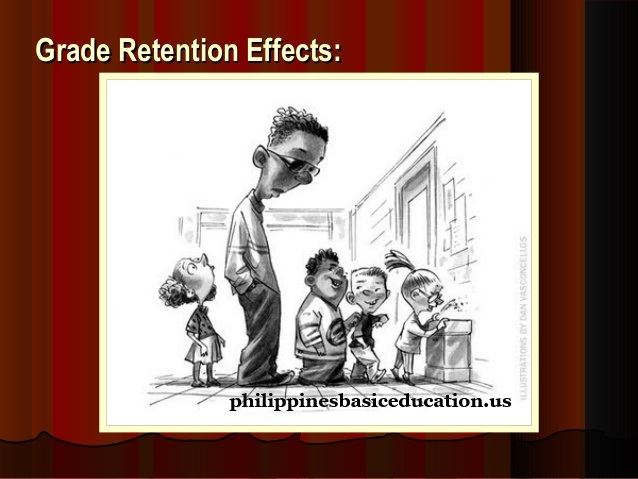
Tom Ultican, retried teacher of physics and advanced mathematics in California, here describes such a policy. It is called “grade retention,” but is more commonly known as flunking a student because he or she is not “ready” to be promoted with peers. The short-term effect may seem successful: test scores. But the long-term effect on students’ success is typically negative.
Ultican writes:
Twenty-six American states have a mandatory third-grade retention policy for students who do not pass the state’s reading exam and Maryland is set to implement that policy in 2027. According to researchers, this is bad thinking based on intuition not science. Writing for Education Trust, Brittney Davis declared, “The research is clear that grade retention is not effective over time, and it is related to many negative academic, social, and emotional outcomes for students — especially students of color who have been retained.”
Economist Jiee Zhong won her PhD from Texas A&M in 2024 and is now an assistant professor of economics at the University of Miami. Last year, she just finished a very impressive study on the effects of grade retention for Texas third graders. Texas abandoned mandatory third-grade retention in 2009.
Zhong studied outcomes of third-graders from 2002-03, 2003-04 and 2004-05 school years who took the Texas reading exam that carried retention consequences. This large data set allowed her to use a fuzzy regression discontinuity design to extract many results. By 2024, the students studied were all young adults over 26 years of age. She was able to evaluate their education, social and economic outcomes using powerful math techniques.
Zhong concluded:
“I find that third-grade retention significantly reduces annual earnings at age 26 by $3,477 (19%). While temporarily improving test scores, retention increases absenteeism, violent behavior, and juvenile crime, and reduces the likelihood of high school graduation.”
For one outcome, she investigated a group of students who barely passed or barely failed the reading test. She learned that the barely failing students earn $1,682 (11.3%) less at age 23 than the barely passing students. Zhong noted that 64.2% of barely passing students graduated from high school while just 55.1% of the barely failing students graduated. She observed that both of these results were statistically significant at a 5% level.
Zhong also noticed a racial disparity. She reports, “White students experience a sharp 43.8 percentage point decline in high school graduation probability, higher than the reductions for Black (17.6 percentage points) and Hispanic students (0.6 percentage points).”
These results from 2025 add more weight to similar results that previous researchers have reported.
The Retention Illusion
In January 2025, Duke University in Chapel Hill, North Carolina published a linked series of three policy briefs concerning grade retention by Claire Xia and Elizabeth Glennie, Ph.D. The Duke researchers stated, “The majority of published studies and decades of research indicate that there is usually little to be gained, and much harm that may be done through retaining students in grade.”
They also mention the grade retention illusion is held by many community members, administrators and teachers who believe grade retention is helpful and needed. The Duke researchers stated, “The findings that retention is ineffective or even harmful in the long run seem counterintuitive.” This belief is so strong that on the 31st Annual Phi Delta Kappa/Gallop Poll, 72% of the public favor stricter promotion standards even if significantly more students would be held back. Other studies show the public being strongly opposed to social promotion believing low-achieving students will continue to fall farther behind.
The study found that students who had been consistently taught by teachers using “the science of reading” were gaining basic literacy skills, but were limited in their comprehension of what they read. They could read the words, but they couldn’t step back and explain what they had read.
Let’s back up for a few minutes and see this new study in historical perspective. The “science of reading” was based on the recommendations of the National Reading Panel. That panel was established by Congress in 1997 to determine the best, most effective ways to teach reading. Most of its 14 members were academics. In 2000, the panel released its report, callled Teaching Children to Read: An Evidence-Based Assessment. It recommended that effective reading instruction should include:
Phonics: Explicit, systematic instruction in letter-sound correspondences.
Fluency: Guided oral reading to encourage automaticity.
Vocabulary: Direct and indirect instruction of word meanings.
Comprehension: Teaching specific strategies for understanding text.
When George W. Bush became President in 2001, his education agenda featured the findings of the National Reading Panel. Dr. Reid Lyon, the organizer of the panel, became President Bush’s advisor. Bush’s No Child Left Behind legislation included $6 billion for reading instruction, based on the recommendations of the National Reading Panel, as well as an independent evaluation of its results.
Independent evaluators reviewed the progress of students in the districts that implemented the panel’s recommendations.
In 2008, they published their conclusions:
Reading First had a statistically significant positive impact on multiple practices promoted by the program, including the amount of instructional time spent on the five essential components of reading instruction (phonemic awareness, phonics, vocabulary, fluency, and comprehension) and professional development in scientifically based reading instruction.
Reading First did not produce a statistically significant impact on student reading comprehension test scores in grades one, two, or three.
Reading First had a statistically significant positive impact on first graders’ decoding skills in Spring 2007.
After the $30 million study, involving four major research organizations, reported that “the science of reading” improved decoding skills but not comprehension, enthusiasm for the NRP report waned.
But the NRP report found a second life less than a decade after it seemed to have faded.
Emily Hanford, a journalist who worked for American Public Media, began researching early literacy in 2016. Her 2022 podcast Sold a Story maintained that the source of poor literacy skills could be traced to the work of Marie Clay and Lucy Calkins, both of whom were advocates of balanced literacy, which did not incorporate the findings of the NRP.
Hanford became an advocate for “the science of reading” and the revival of phonics.
Many states enacted legislation mandating “the science of reading” and banning “three-cuing” and other elements of Calkins’ program.
“The science of reading” is unquestionably the dominant mode of teaching reading today.
Harkay wrote:
Four school districts in major urban areas using the science of reading found while students are grasping basic literacy skills, limitations toward deeper comprehension still exist, according to a new study.
The “Robust Reading Comprehension” report, conducted by nonprofit research organization SRI, examined literacy instruction in districts in Texas, Maryland, North Carolina and Virginia that have been using materials rooted in the popular phonics-based literacy approach for at least five years.
Through numerous classroom observations, teacher surveys and interviews with district officials in Aldine Independent School District, Baltimore City Public Schools, Guilford County Schools and Richmond Public Schools, researchers found a majority of reading lessons lacked “depth” – meaning foundational skills were mainly limited to working on single words rather than reading them in sentences.
Comprehension lessons in later elementary grades also mainly focused on completing a task, such as identifying a main character, rather than using a text for discussion and understanding its purpose.
“You’re not able to really think about the unpacking of a complicated sentence. You’re not thinking about really intentional vocabulary instruction or the building of kids’ word knowledge over time,” said Dan Reynolds, one of the lead authors of the report. “Ultimately, how should we be framing kids to read? Are we teaching our K-4 kids that reading is just tasks? Are we teaching them that they just need to label stuff and fill out graphic organizers?”
In recent years, nearly every state has passed science of reading laws, including many that have limited the type of programming and instructional materials a school can use – a move that has drawn some criticism that it’s too restrictive and that the instruction faces its own limitations.
The report defined surface literacy skills as a student’s ability to complete tasks and understand texts based on their literal meeting while robust instruction would further push a child to understand, evaluate and synthesize what they had read for its significance.
The study said its “comprehension observations alone are more rigorous than nearly all studies conducted in the last 50 years.” It’s not expected to be representative of reading instruction across the country, Reynolds said, but “we have four big districts in four different states, and we saw this pattern happening in all four of them with three different curricula.”
The study also found that teachers struggled with implementing comprehension-focused learning materials and said many times the curriculum was too dense, required substantial planning or may not have been developmentally appropriate. Professional development opportunities for these educators were also limited.
Researchers reported less than a quarter of observed comprehension lessons were engaging in robust learning. More than two-thirds of the lessons focused on “surface-level” comprehension.
“It seems that these curriculums are designed to build knowledge and they don’t develop meaning, and so then why read about the Civil War or about insects?” said Katrina Woodworth, director at SRI’s Center for Education Research & Improvement. “The point is to both teach reading and to build students’ knowledge base so that they have more scaffolding for future learning of both content and meaning.”
The SRI researchers also found that many review tools that measure comprehension don’t make a distinction between surface-level and robust instruction and skills. So, while educators are tasked with meeting a baseline standard, like having a child compare and contrast a text, it may be “unintentionally encouraging teachers to focus on surface-level goals,” the report said.
Without distinction, it weakens instruction for students and can later manifest as a skills disadvantage, Reynolds said.
“Districts had done so much to get the kids all the way there [with literacy], but it was losing voltage in the end,” Reynolds said. “If we can actually shift the way that districts are thinking about improving their comprehension instruction, they can take that all the way home and deliver really high quality comprehension instruction because so many pieces are already in place.”
Reynolds and one of his fellow co-authors, Sara Rutherford-Quach, said they saw glimpses of “magic” in the classroom when students understood a passage in wide-ranging contexts, which is the type of instruction they’re hoping to see districts incorporate more of in early grades.
“The kids were way more engaged,” Rutherford-Quach said. “Surface-level is important and necessary in some cases, … but it really is fundamentally different when you start talking about meaning and making it matter to the kids, and you see that they’re invested in it.”
Reynolds added that it’s unlikely robust comprehension could make up 100% of lessons in the classroom, but “we are thinking that if we can shift that needle from 24% robust lessons up to 50 or 60, then that would be a real catalyst for comprehension growth.”
The report recommended district leaders create “a shared vision for robust comprehension and define what it means for students, teachers, schools and the district,” and align how to best measure the extent of learning. It also called for better professional learning structures that could help model and rehearse robust comprehension work.
Previous reporting from The 74 found the percentage of recent high school graduates who lack “robust” comprehension skills is the highest it’s ever been, according to 2023 data. The sooner districts can engrain literacy skills that go beyond just explicit tasks, the easier it will be as they continue through the K-12 system, Reynolds said.
“I see the distinction between surface level and robust comprehension as critical to comprehension in fifth grade, but I also see it in the kids when they’re in 12th grade. Surface level comprehension and robust comprehension is the difference between a two on the AP exam and a three,” he said.
One evaluation in 2008. Another evaluation in 2026. Same conclusions. What have we learned?
The ultimate expert, Jeanne Chall, had it right. A former kindergarten teacher who became a renowned Harvard professor, she was commissioned by the Carnegie Corporation to review the research on reading. In her 1967 book, Learning to Read: The Great Debate, she concluded that the best approach was: both. Start early with phonics, she said, then transition to excellent children’s literature. If we continued to swing from extreme to extreme–from phonics to whole word, from whole word to phonics–she predicted, we would forever be trapped in that pendulum.
John Thompson, historian and retired teacher, reports on the latest education news from Oklahoma: the Chamber of Commerce is intent on reviving the failed test-and-punish agenda of the Bush-Obama years, plus the so-called “Mississippi Miracle,”which is credited with amazing results in reading.
John writes:
Once again, attacks on under-funded Oklahoma public schools are examples of the threats the nation’s schools face. Yes, we’ve gotten rid of State Superintendent Ryan Walters, but I’m more worried about today’s “accountability-driven” mandates, such as those pushed by the Chamber of Commerce.
On the other hand, our public schools have a history of receiving support from holistic, bottom-up efforts by a variety of excellent social work agencies, nonprofits, volunteers, and innovative educators.
These partners remind me of 1990’s, when student performance was growing. The head of the Oklahoma City Public School System curriculum department dropped into my History classroom, saying that she had been watching me teach, and I might like to try something new. She suggested that I start the year with the 20th century to get my kids hooked on history. Then, around Thanksgiving, we would return to the beginning of the subject, and reteach the 20th century.
It was a brilliant approach, supported by cognitive science. And it showed inner city students respect by nurturing meaningful, challenging instruction. The result was that my kids worked from bell-to-bell, from day one to their graduation day, learning how to learn.
I doubt that would be allowed today, when “everyone” is pressured to be on the “same page,” often requiring the same type of data-driven instruction.
Then, as the No Child Left Behind Act of 2001 approached, our principal gave us aligned and paced curriculum guidelines; They are now pervasive. She said that she knew we wouldn’t use it, but rather than throwing it away, we should keep it handy in case a top administrator visited the class.
Before NCLB, we had the autonomy to adjust our lessons in order to promote in-depth learning. For instance, when my students came to class carrying Ralph Ellison’s The Invisible Man, which they were reading in their English class, I would quickly change my schedule. Our History class would learn about Ellison’s childhood in Oklahoma City, and how his famous “Battle Royal” scene was inspired by a cruel joke that was played on him when he applied for a job.
And, around that time, the bipartisan MAPS for Kids succeeded in saving the OKCPS from a financial collapse by raising taxes. MAPS for Kids listened to educators, parents, top national education and cognitive science researchers, and students; it called for the meaningful instruction which treated high-challenge kids with the same respect and opportunities that are bestowed on students in the exurbs.
I was in the room when MAPS and OKCPS leaders agreed that educators should receive a clear message – their job is to teach the Standards of Instruction, not to standardized tests.
I was then in the room when top district administrators were supposed to reveal the agreement to a committee of principals. The committee chair started with summaries of ridiculous policies that had been imposed over the years. Principals replied with absurd, but hilarious stories, about the tumultuous effects of non-educators’ political demands.
But, the administrator then said that we would have to dramatically expand standardized testing.
When I pushed back, a highly respected administrator put her hands on my shoulders, and said, “John, I’ve always said you don’t make a hog heavier by weighing it. But this is politics. We have no choice.”
When NCLB and subsequent corporate school reforms were implemented, the supposed goal was using top-down, accountability mandates to rapidly transform schools serving our poorest children of color. But in my experience, those were the students who were most damaged by output-driven reforms that forced teachers to be “on the same page” when teaching the same lessons.
Reformers also brought frequent benchmark testing into schools. Lacking explicit stakes, benchmarks could have created a culture of testing for diagnostic, not accountability, purposes. In my experience, however, the test prep culture, combined with more frequent tests, further undermined the teacher autonomy required for holistic instruction.
Today, the campaign for the “Science of Reading,” now known as the “Mississippi Miracle,” is driven by “extensive use of formative and benchmark assessments to track student progress and inform instructional differentiation.” The American Federation of Teachers’ president Randi Weingarten supported much or most of the “Science of Reading” but she “doesn’t advocate for what we have found so disrespectful: scripted curricula or ‘teacher proof’ programs.”
And we face new threats when, as is happening in Oklahoma,” the ideology-driven, reward-and-punish parts of the “Mississippi Miracle,” are combined with the Moms for Liberty’s focus on “back to basics” foundational skills and phonics.
But, I would remind the Chamber of its call for recruiting and retaining high-quality teachers in order to attract and retain business investors for Oklahoma. After all, the best way to attract high-quality teachers, and parents of students, is to allow for high-quality, holistic teaching and learning, not make them work in a 21st century version of a Model T assembly line.
Paul Thomas was a teacher in South Carolina for many years; he is now a professor of education at Furman University. He believes that the movement to mandate “the science of reading” is a fraud, as is the so-called “Mississippi Miracle.” The key to the alleged miracle, he says, is holding back third-graders with low reading scores. That is the magic bullet, not the reading curriculum.
In this post, he compares the claims for SOR with research.
He writes:
Journalists and politicians are both drawn to and depend on compelling stories.
Regretfully, whether or not those stories are factually true is less and less important, and in some cases, what makes the stories compelling is over-simplification while the truth is complicated or often not clearly defined.
The stories told about education have a long history of being trapped in compelling but false claims. Currently, the most popular and compelling education story is about reading proficiency among US students; this story is grounded in a very compelling story about reading reform in Mississippi, identified as reform labeled the “science of reading.”
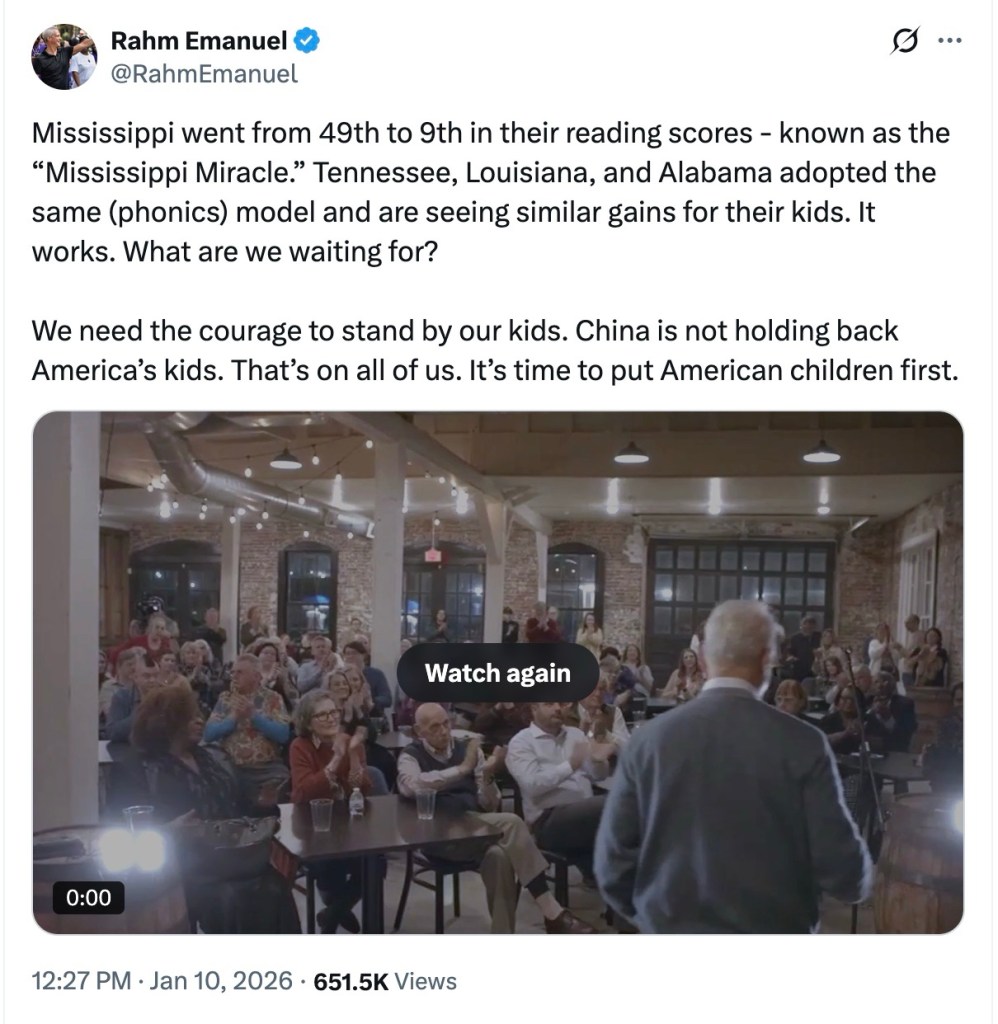
The repetition of the so-called Mississippi “miracle” has occurred dozens of times since 2019—and here are just two of the most recent:
•Rahm Emanuel on Twitter:
•And yet another article in The New York Times: How Mississippi Transformed Its Schools From Worst to Best.
Everything about the Mississippi story fits perfectly into the larger stories that Americans love.
So there is now a recurring accusatory question: If high-poverty poverty state with a large proportion of Black students can radically improve reading proficiency among their students, why don’t all states adopt that policy?
From that, it gets uglier because the implication and direct accusations that follow are damning: The education establishment, bolstered by teachers unions, simply don’t think poor and Black students can learn; the education establishment uses poverty as an excuse and will not let go of the soft bigotry of low expectations.
Throughout the stories being told about reading, teachers, and education, there is a discouraging pattern: The stories are not supported by the evidence (ironically, the stories behind the “science of reading” lack scientific research), and in many cases, the evidence contradicts the story being told.
Is poverty an excuse for student achievement and is teacher quality/knowledge a major reason students underachieve?
Poverty, inequity, and other out-of-school factors are the primary cause factors in measurable student achievement (test scores), accounting for 60% or more of those scores.
Teacher quality impacts measurable student achievement at rates of about 1-14%.
Research:
If you want to read the research that directly contradicts the received wisdom about how to teach reading, open the link.
The Trump administration is engaged in a war against science and medicine. It has eliminated funding in many crucial areas of research conducted by universities and by the National Institutes of Health. Incalculable damage has been done to set back the search for cures for cancer, Alzheimer’s, heart disease, infectious diseases, HIV, respiratory diseases, and pediatric cancer. People will die because of the ignorance of those who close down ongoing, vital research.
Trump has consistently claimed that “climate change” is a hoax. He has said that the term “climate change” refers to the weather. He hates wind farms and has cut federal funding for them. He has hated wind farms since wind turbines were built near his Trump International Golf Links in Scotland. He sued to block them but repeatedly lost.
Now he is closing down a major hub of climate research.
The Trump administration said it will be dismantling the National Center for Atmospheric Research in Colorado, one of the world’s leading Earth science research institutions.
The center, founded in 1960, is responsible for many of the biggest scientific advances in humanity’s understanding of weather and climate. Its research aircraft and sophisticated computer models of the Earth’s atmosphere and oceans are widely used in forecasting weather events and disasters around the country, and its scientists study a broad range of topics, including air pollution, ocean currents and global warming.
But in a social media post announcing the move late on Tuesday, Russell Vought, the director of the Office of Management and Budget, called the center “one of the largest sources of climate alarmism in the country” and said that the federal government would be “breaking up” the institution.
Mr. Vought wrote that a “comprehensive review is underway” and that “any vital activities such as weather research will be moved to another entity or location.”
Scientists, meteorologists and lawmakers said the move was an attack on critical scientific research and would harm the United States.
The National Center for Atmospheric Research was originally founded to provide scientists studying Earth’s atmosphere with cutting-edge resources, such as supercomputers, that individual universities could not afford on their own. It is now widely considered a global leader in both weather and climate change research, with programs aimed at tracking severe weather events, modeling floods and understanding how solar activity affects the Earth’s atmosphere.
The center’s research has often proved useful in unexpected places, such as when its studies of downdrafts in the lower atmosphere in the 1970s and 1980s led to development of wind shear detection systems around airports that helped address the cause of hundreds of aviation accidents during that era.
John Thompson, historian and retired teacher in Oklahoma, wrote this thoughtful review of my memoirs, An Education: How I Changed My Mind About Schools and Almost Everything Else.
He writes:
Diane Ravitch’s An Education: How I Changed My Mind About Schools and Almost Everything Elseis dedicated to her wife Mary; her sons, Joe, Michael, and Steven; her grandsons Nico, Aidan, Elijah, and Asher; and her ex-husband Richard. An Education intertwines deeply emotional personal and family experiences with the history of how she became such a transformative education leader. Although Diane denies it, I believe she’s the most influential education advocate of the last century.
I’ve been reading Diane Ravitch’s work for decades, but An Education is my favorite book. And my favorite passage started with Diane’s citation of Robert Hutchins who said, “We have to learn to live with those whose opinions differ from our own. After all, they may turn out to be right.”
Then she wrote about Hutchins statement, “for three decades I didn’t realize that it was intended for me.”
Being from Oklahoma, I was captured by the first part of her book, about growing up in Texas. I especially loved her story about meeting Roy Rogers at the Rodeo when she was 9 years old. After Rogers slapped her hand, Diane said, “I determined on the spot that I would never wash that hand again!”
Diane was a tomboy who loved horses and dogs. But she experienced sexism and trauma. She said she “did not have an idyllic adolescence. No one ever does.” But her teenage years were “destroyed by my father abusing me.”
During the middle of her book, she recalled her complicated marriage to Richard Ravitch and, then, her wonderful wife, Mary. Mary worked with the progressive educator Deborah Meier and opened a progressive small school in New York City.
I was especially impressed by Diane’s communication with Al Shanker. He sought to allow teachers to start schools within schools to turnaround kids “in the back of the classroom with their heads on their desks.” Back in the late 1980s, it seemed like he might be able to bring diverse factions together. But, by 1994, charters had been high-jacked by corporate reformers and their winners and losers ideology.
In the middle of An Education. Diane revealed in so much detail the inside stories of her years as a conservative. Back then, when I was an academic historian, I learned the most about Diane when reading her 1983 book, “The Troubled Crusade: American Education, 1945 – 1980.” Although I couldn’t yet read her work through the eyes of a teacher, I was exceptionally taken by her calls for teaching background knowledge so students could develop reading comprehension skills so they could “read to learn,” and her placing education pedagogies in a broad historical context.
Diane recalls her support for meritocratic, standardized testing, and color-blind policies, when she questioned bilingual education, and even the benefit of the Equal Rights Amendment. This was the time when she made friends with Bill Bennett, President Reagan’s Secretary of Education, and Chester Finn, and Tennessee Governor Lamar Alexander. I knew she had ties to Daniel Patrick Moynihan, but I too thought that progressives’ criticism of him was too politically correct. And, until I read An Education, I knew little about the two sides of James Coleman’s research, whose earlier research had seemed persuasive to me.
Neither would I have thought that Chester Finn was like a “sibling” to Diane.
When explaining her then-conservative beliefs, I sometimes felt that Diane was too hard on herself. For instance, she was far, far from alone in failing to understand the wisdom of Gov. Ann Richards, who said, “If there ever is school choice in Texas, the hard-right Christians will get the money to indoctrinate children.”
Moreover, as An Education schooled me on the propaganda behind the so-called “Texas Miracle” it did more than foreshadow the “New York City Miracle,” the “Harlem Miracle,” and the “Mississippi Miracle.” It brought me back to the decades-long Oklahoma reality when our curriculum and policies were based on Texas’ accountability systems. During most of my career, our policies were informed by one Texas trick after another to jack up accountability metrics.
Diane served as member of the National Assessment Governing Board from 1997 to 2004, and she would dig deeply into the numbers and the methodologies behind NAEP. But, as she explained, few journalists read the fine print of the research and they wrote “breathlessly” about supposedly dismal results in traditional public schools. They certainly didn’t report properly about the way that students’ outcomes were linked to family income.
When serving in the Education Department, Diane took a lead in establishing national standards for every school subject. Drawing upon excellent historians, multicultural History standards were set. She hoped standards like those would remain voluntary and “unify their respective fields and establish a common ground for a curriculum without telling teachers how to teach.”
But the conservative Lynne Cheney “published a scathing denunciation of them.” Cheney said the History standards focused too much on people like Joe McCarthy and the Ku Klux Klan, and not enough on Ulysses S. Grant, and Robert E. Lee. This launched the modern wars over curriculum that have become especially destructive under President Trump.
Even so, in 2002, Diane hoped that Mayor Mike Bloomberg and Joel Klein (who knew nothing about education) would succeed in improving New York City Schools. Klein reorganized schools from top to bottom, with multiple schools per building drawing on funding by the Gates Foundation. (By the way, I saw the chaos Klein created when visiting dozens of hurriedly opened school, especially in Bedford–Stuyvesant. Usually, leaders of the new schools didn’t even know how many new schools were being opened in their building.)
And, even worse, Jack Welch CEO of General Electric pushed 20-70-10 “stack ranking,” meaning 70% of teachers would be in the middle in terms of effectiveness, and 10% should be “removed,” even if it took the use of invalid and unreliable metrics to evaluate all teachers.
Especially after Diane engaged in a seven-year debate with Deborah Meier, which further “broadened her perspectives,” she became an invaluable leader of the grass-roots opposition to corporate school reforms. She objected to top-down mandates on teaching reading. Diane was among the first to explicitly link in a detailed manner the reforms to the wider privatization movement. And she nailed it when identifying them as the “Billionaires Boys Club.”
Diane analyzed the public relations campaigns which sold “reforms” as the “New York City Miracle.” Drawing upon her insights from serving on the National Assessment Governing Board, she clearly explained why NYC schools flipped back and forth between A and F grades. Then, she linked President Obama’s flawed $5 billion RTTT experiment with the problems with Common Core curriculum and tests that were years above students’ reading levels.
Diane then quotes John Maynard Keynes who said, “When the facts change, I change my mind. What do you do, sir?”
Today, Diane changes minds by clearly explaining the interconnections between Free Market ideology, and profits, and the mindsets of elites that push privatization. She also reports daily on the interconnected attacks on schools throughout the nation. And now she’s sharing the same wisdom when spreading the word about Trumpism and today’s attacks on democracy.
I always read Diane’s daily blog posts. And I so very much appreciate An Education, even if it briefly pulled me away from reading everything in the Diane Ravitch Blog.
Rebecca Redelmeier writes in Chalkbeat about passage of a new law in Pennsylvania mandating the use of “evidence-based” reading instruction. By that, they mean that teachers should teach reading by relying on what is called “the science of reading.” This terminology is based on a federal report that was released to the public in 2000, affirming the importance of phonics, the connections of letters and sounds.
The Department of Education spent $6 billion testing the “science of reading” recommendations. The program–Reading First–was abandoned after investigations found conflicts of interest and self-dealing among Department staff who awarded contracts.
When Reading First was evaluated, the results were unimpressive. Students did well in phonics but comprehension levels were unchanged.
Now states are mandating the same approaches that were tested 25 years ago.
Redelmeier wrote:
Pennsylvania will require schools to adopt evidence-based reading curriculum by the 2027-28 school year and institute new literacy instruction training for teachers.
The new requirements come as part of the state’s 2025-26 budget, which Gov. Josh Shapiro signed into law Wednesday, four months past the budget deadline. Literacy instruction and initiatives will get $10 million in the budget. The $50.1 billion budget deal puts $665 million total towards public schools.
Moments before signing the bill, Shapiro said the budget invests in “something known as structured literacy,” referring to an approach to reading instruction that includes teaching students phonics and phonemic awareness, which research supports as effective.
The approach “puts a renewed emphasis on teaching [kids] to read well and training our teachers to teach reading effectively,” Shapiro said.
Some Pennsylvania school districts previously used reading curriculums that did not follow research-backed methods. In Philadelphia, the school district implemented an evidence-based curriculum last school year. But the rollout has been rocky. Students’ reading scores dippedafter the first year.
The curriculum mandate brings Pennsylvania up to speed with several other states that have passed laws that require literacy instruction to follow the science of reading, a body of research that has found young children need phonics instruction to learn how to read well.
Federal Judge Rita F. Lin ruled that the federal government cannot withhold $1.2 billion in funding for medical and scientific research as punishment for alleged anti-Senitism. This is an important victory for free speech, academic freedom, and the First Amendment. The Trump administration’s efforts to impose its views on the nation’s institutions of higher education—and U.S. research funding as leverage is unprecedented in American history.
A federal judge on Friday blocked the Trump administration from imposing a $1.2-billion fine on UCLA along with stipulations for deep campus changes in exchange for being eligible for federal grants.
The decision is a major win for universities that have struggled to resist President Trump’s attempt to discipline “very bad” universities that he claims have mistreated Jewish students, forcing them to pay exorbitant fines and agree to adhere to conservative standards.
A spokesperson for the U.S. Department of Justice did not immediately respond to a request for comment.
The preliminary injunction, issued by U.S. District Judge Rita F. Lin of the Northern District of California, rendered moot — for now — nearly every aspect of a more than 7,000-word settlement offer the federal government sent to the University of California in August after suspending $584 million in medical, science and energy research grants to the Los Angeles campus.
The government said it froze the funds after finding UCLA broke the law by using race as a factor in admissions, recognizing transgender people’s gender identities, and not taking antisemitism complaints seriously during pro-Palestinian protests in 2024 — claims that UC has denied.
The settlement proposal outlined extensive changes to push UCLA — and by extension all of UC — ideologically rightward by calling for an end to diversity-related scholarships, restrictions on foreign student enrollment, a declaration that transgender people do not exist, an end to gender-affirming healthcare for minors, the imposition of free speech limits and more.
“The administration and its executive agencies are engaged in a concerted campaign to purge ‘woke,’ ‘left,’ and ‘socialist’ viewpoints from our country’s leading universities,” Lin wrote in her opinion. “Agency officials, as well as the president and vice president, have repeatedly and publicly announced a playbook of initiating civil rights investigations of preeminent universities to justify cutting off federal funding, with the goal of bringing universities to their knees and forcing them to change their ideological tune.
Universities are then presented with agreements to restore federal funding under which they must change what they teach, restrict student anonymity in protests, and endorse the administration’s view of gender, among other things. Defendants submit nothing to refute this….”
Universities including Columbia, Brown and Cornell agreed to pay the government hundreds of millions to atone for alleged violations similar to the ones facing UCLA. The University of Pennsylvania and University of Virginia also reached agreements with the Trump administration that were focused, respectively, on ending recognition of transgender people and halting diversity, equity and inclusion efforts.
Friday’s decision, for the time being, spares the UC from having to proceed with negotiations that it reluctantly entered with the federal government to avoid further grant cuts and restrictions across the system, which receives $17.5 billion in federal funding each year. UC President James B. Milliken has said that the $1.2-billion fine would “completely devastate” UC and that the system, under fire from the Trump administration, faces “one of the gravest threats in UC’s 157-year history.”
This is not the first time a judge rebuked Trump for his higher education campaign.
Massachusetts-based U.S. District Judge Allison Burroughs in September ordered the government to reverse billions in cuts to Harvard. But that case did not wade directly into settlement negotiations.
Those talks have proceeded slowly. In a court hearing last week, a Department of Justice lawyer said “there’s no evidence that any type of deal with the United States is going to be happening in the immediate future.” The lawyer argued that the settlement offer was only an idea that had not received UC approval. Because of that, he said, a lawsuit was inappropriate. Lin disagreed.
“Plaintiffs’ harm is already very real. With every day that passes, UCLA continues to be denied the chance to win new grants, ratcheting up defendants’ pressure campaign,” she wrote. “And numerous UC faculty and staff have submitted declarations describing how defendants’ actions have already chilled speech throughout the UC system.”
The case was brought by more a dozen faculty and staff unions and associations from across UC’s 10 campuses, who said the federal government was violating their 1st Amendment rights and constitutional right to due process.
UC, which has avoided directly challenging the government in court, was not party to the suit. “This is not only a historic lawsuit — brought by every labor union and faculty union in the UC — but also an incredible win,” said Veena Dubal, a UC Irvine law professor and general counsel for one of the plaintiffs, the American Assn. of University Professors, which has members across UC campuses.
Dubal called the decision “a turning point in the fight to save free speech and research in the finest public school system in the world.” Asked about Friday’s outcome, a spokesperson said UC “remains focused on our vital work to drive innovation, advance medical breakthroughs and strengthen the nation’s long-term competitiveness. UC remains committed to protecting the mission, governance, and academic freedom of the university.”
This is nuts. With federal funding, Harvard scientists have produced major breakthroughs in medicine, engineering, and science. To break Harvard, as the administration wants to do, would cripple American innovation.
The Boston Globe reported:
The Department of Health and Human Services’ Office of Civil Rights on Monday formally recommended barring Harvard University from receiving federal funding, three months after it accused the university of violating civil rights laws by failing to protect Jewish and Israeli students on campus.
In a news release, the office said it would refer Harvard to the office that is responsible for “suspension and debarment decisions” and that it notified Harvard of its right to an administrative hearing. The university has 20 days to notify the office of its decision.…
The 57-page notice relied heavily upon Harvard’s own report on antisemitism and anti-Israeli bias that it released earlier this year, which followed high-profile protests at Harvard and other campuses against the war in Gaza in 2023 and 2024.
The Trump administration’s move this week to choke off Harvard University’s access to future federal funding came after a scathing letter from the college accusing the administration of distorting evidence to show that the school violated civil rights laws by allowing antisemitism to persist on campus.
The brewing feud represents an escalation of tensions between Harvard and the administration, which just weeks ago seemed on the verge of agreeing on a deal to keep federal funds flowing to the university.
In a strongly worded, 163-page letter with attachments on Sept. 19, which has not been previously reported, Harvard assailed the government’s findings. The university accused investigators at the Health and Human Services Department of relying on “inaccurate and incomplete facts,” failing to meet a single legal requirement to prove discrimination and drawing sweeping conclusions from a survey of one-half of 1 percent of the student body.
Harvard painted a picture of a chaotic Trump administration rushing to leverage federal power against the university. For instance, it noted that the health department had chided the college for failing to produce certain records. But Harvard’s documents showed that the records in question had been provided in response to a request from the Education Department. Harvard said the health department never asked for those records.
Harvard said the health department’s decision to refer its findings to the Justice Department was “based on a fabricated and distorted interpretation of the record.”
The stark language was a departure from months of mostly measured tones from Harvard as the university has resisted the administration’s pressure campaign to impose President Trump’s political agenda on the nation’s elite colleges.
Mr. Trump and his administration have sought to exert control over who universities can hire, which students they should admit and what subjects should be taught by leveraging huge sums of federal research money. Those moves, which Harvard has maintained violate the college’s First Amendment rights and infringe on the nation’s long-held ideals of academic freedom, are aimed at shifting the ideological tilt of the higher education system, which the administration sees as hostile to conservatives and intent on perpetuating liberalism.
The administration’s reply to Harvard’s letter came on Monday, when the health department initiated a process to cut off Harvard from future federal research funding, which has increasingly become the lifeblood for the nation’s largest private and public colleges. In 2022, the health department accounted for nearly 81 percentof $41.6 billion in federal funding for research into agricultural science, environmental science, public health and other life sciences, according to government records.
President Trump said Tuesday that his administration was close to reaching a multimillion-dollar agreement with Harvard University, which would end a monthslong standoff that had come to symbolize the resistance to the White House’s efforts to reshape higher education.
Harvard, which would become the latest university to strike a deal with the Trump administration, has been seeking an end to a thicket of investigations that the government opened as part of its wide-ranging efforts to bring the university in line with Mr. Trump’s agenda.
“We are in the process of getting very close,” President Trump said in an appearance from the Oval Office. He added that the details were being finalized and said, “They would be paying about $500 million.”
Mr. Trump said that the education secretary, Linda McMahon, was “finishing up the final details.” He added that the plan was for Harvard to operate trade schools.
“They are going be teaching people to do A.I. and a lot of other things — engines, lots of things,” he said. “We need people in trade schools.”
The U.S. Supreme Court voted by 5-4 to approve the Trump administration’s cuts to federal research grants on health, due to their possible connection to diversity, equity, and inclusion, and to “radical gender ideology.” Chief Justice John Roberts voted with the Court’s three liberal justices to stop the cuts to research funding.
WASHINGTON (AP) — The Trump administration can slash hundreds of millions of dollars’ worth of research funding in its push to cut federal diversity, equity and inclusion efforts, the Supreme Court decided Thursday.
The high court majority lifted a judge’s order blocking $783 million worth of cuts made by the National Institutes of Health to align with Republican President Donald Trump’s priorities. The high court did keep Trump administration guidance on future funding blocked, however.
The court split 5-4 on the decision. Chief Justice John Roberts was along those who would have kept the cuts blocked, along with the court’s three liberals.
The order marks the latest Supreme Court win for Trump and allows the administration to forge ahead with canceling hundreds of grants while the lawsuit continues to unfold. The plaintiffs, including states and public-health advocacy groups, have argued that the cuts will inflict “incalculable losses in public health and human life.”
The Justice Department, meanwhile, has said funding decisions should not be “subject to judicial second-guessing” and efforts to promote policies referred to as DEI can “conceal insidious racial discrimination.”
The lawsuit addresses only part of the estimated $12 billion of NIH research projects that have been cut, but in its emergency appeal, the Trump administration also took aim at nearly two dozen other times judges have stood in the way of its funding cuts.
Solicitor General D. John Sauer said judges shouldn’t be considering those cases under an earlier Supreme Court decision that cleared the way for teacher-training program cuts. He says they should go to federal claims court instead.
But the plaintiffs, 16 Democratic state attorneys general and public-health advocacy groups, argued that research grants are fundamentally different from the teacher-training contracts and couldn’t be sent to claims court. Halting studies midway can also ruin the data already collected and ultimately harm the country’s potential for scientific breakthroughs by disrupting scientists’ work in the middle of their careers, they argued.
U.S. District Judge William Young judge in Massachusetts agreed, finding the abrupt cancellations were arbitrary and discriminatory. “I’ve never seen government racial discrimination like this,” Young, an appointee of Republican President Ronald Reagan, said at a hearing in June. He later added: “Have we no shame.”



 Diane Ravitch's blog