Let us be thankful for the good things in our lives. Our families and friends. Health. Food. The blessings of freedom and democracy, which we must defend every day.
Let us think about those who do not enjoy the blessings of family, friends, good health, shelter, and food.
Do what you can to support those less fortunate than yourself. Lend a helping hand at a local community center or church or synagogue or mosque. Support groups that are helping immigrant families who are living in terror, fearful of being kidnapped by ICE.
Remember that it is not normal to have armed military patrolling the streets of our cities. It is not normal to see masked men pepper spraying fellow citizens in the streets. It is not normal to see armed men chasing people on farms, where they are picking the fruits and vegetables on our Thanksgiving table, tackling them, and whisking them away to unknown detention centers.
We don’t have a crisis of too many immigrants. We have a crisis of a do-nothing Congress that has been unable to pass legislation creating a process for honest, hard-working immigrants to have a legal path to citizenship.
We have a crisis of bigotry, of white nationalists who think they can restore a world of white supremacy that has disappeared. Nope, won’t happen. Twenty percent of our population is Hispanic. About 57-58% is Caucasian. Among children 17 and younger, about 49-50% is Caucasian.
Like it or not, our society is diverse. Banning the word “diversity” doesn’t change reality.
We must, all of us, practice kindness. Gratitude. Generosity of spirit.
Several days ago, Politico wrote about the scurrilous text messages shared by Young Republican leaders. When Vice President jD Vance was asked about the chat, he said in effect, “Boys will be boys.” Other GOP bigwigs had the same reaction. But the people in the chat group were not teenagers. They were adults in their 20s and 30s. The chat included racist, anti-Semitic, misogynistic, homophobic comments. One said “I love Hitler.”
It shows the attitudes that Trump has unleashed and encouraged among the younger generation of Republicans. They knew enough to worry what would happen if their chats ever went public. They knew.
But they also demonstrated what a fraud the Trump administration’s concern about anti-Semitism is. It’s a useful ploy, nothing more. People who actually care about anti-Semitism don’t make jokes about gas chambers.
Here’s an excerpt:
NEW YORK — Leaders of Young Republican groups throughout the country worried what would happen if their Telegram chat ever got leaked, but they kept typing anyway.
They referred to Black people as monkeys and “the watermelon people” and mused about putting their political opponents in gas chambers. They talked about raping their enemies and driving them to suicide and lauded Republicans who they believed support slavery.
William Hendrix, the Kansas Young Republicans’ vice chair, used the words “n–ga” and “n–guh,” variations of a racial slur, more than a dozen times in the chat. Bobby Walker, the vice chair of the New York State Young Republicans at the time, referred to rape as “epic.” Peter Giunta, who at the time was chair of the same organization, wrote in a message sent in June that “everyone that votes no is going to the gas chamber.”
Giunta was referring to an upcoming vote on whether he should become chair of the Young Republican National Federation, the GOP’s 15,000-member political organization for Republicans between 18 and 40 years old.
“Im going to create some of the greatest physiological torture methods known to man. We only want true believers,” he continued….
“Can we fix the showers? Gas chambers don’t fit the Hitler aesthetic,” Joe Maligno, who previously identified himself as the general counsel for the New York State Young Republicans, wrote back.
“I’m ready to watch people burn now,” Annie Kaykaty, New York’s national committee member, said.
The exchange is part of a trove of Telegram chats — obtained by POLITICO and spanning more than seven months of messages among Young Republican leaders in New York, Kansas, Arizona and Vermont. The chat offers an unfiltered look at how a new generation of GOP activists talk when they think no one is listening.
“I’m ready to watch people burn now,” Annie Kaykaty, New York’s national committee member, said.
The exchange is part of a trove of Telegram chats — obtained by POLITICO and spanning more than seven months of messages among Young Republican leaders in New York, Kansas, Arizona and Vermont. The chat offers an unfiltered look at how a new generation of GOP activists talk when they think no one is listening…
Together, the messages reveal a culture where racist, antisemitic and violent rhetoric circulate freely — and where the Trump-era loosening of political norms has made such talk feel less taboo among those positioning themselves as the party’s next leaders…
Mixed into formal conversations about whipping votes, social media strategy and logistics, the members of the chat slung around an array of slurs — which POLITICO is republishing to show how they spoke. Epithets like “f—-t,” “retarded” and “n–ga” appeared more than 251 times combined.
Vice President JD Vance laughed about the exchanges. Just the jokes that “kids” say, although these “boys” were adults.
The vice president suggested the real problem is the idea that an offensive joke can ruin a young person’s life.
“The reality is that kids do stupid things, especially young boys,” Vance said on “The Charlie Kirk Show.” “They tell edgy, offensive jokes. That’s what kids do. And I really don’t want us to grow up in a country where a kid telling a stupid joke — telling a very offensive, stupid joke — is cause to ruin their lives.”
The hateful language has entered the GOP mainstream with no filters. One far-right blogger said the conversation was “tame” compared to the chatter on far-right sites. It’s no longer taboo to admire Nazis, Hitler, and gas chambers.
In the post at 9 a.m. today, two scholars of racism and equity explained that Trump’s scrubbing of museums, national parks, and other federal facilities is an attempt to capture control of the culture and erase the place of Blacks, women, and anyone else who is not a straight white male.
But, as scholar Julian Vasquez Heilig writes here, Trump and his commissariat cannot control the popular culture. In time, we can hope, his mean-spirited efforts to revise history will become a bad joke, a cruel joke, a stupid joke. He and all those who carry out his orders will become a public laughing stock.
Vasquez Heilig writes on his blog Cloaking Inequity:
The Super Bowl has always been more than football. It is a ritual, a spectacle, a national performance. It’s where America tells the world who it thinks it is, and who it wants to be. Which is why the announcement that Bad Bunny will host the halftime show is far more significant than a musical lineup change. It’s a cultural earthquake.
I remember the first time I heard Bad Bunny. It was December 6, 2019, at La Concha Hotel in San Juan. In the downstairs lounge, the beat of reggaetón was shaking the walls, and I pulled out Shazam to figure out what it was. The song was Vete. The room was electric, filled with Puerto Ricans singing every word in Spanish, unapologetically themselves. That night, it hit me: Bad Bunny was not just making music in San Juan, he was celebrating culture. He wasn’t crossing over into the mainstream by adapting; he was dragging the mainstream toward him. He refused to translate, refused to dilute, and now he is everywhere—on playlists, on charts, SNL, in crowded places from San Juan to New York to Madrid.
That’s why his Super Bowl moment matters so much. It is not just a performance, it is the culmination of a global movement that began in places like that basement lounge in Puerto Rico. What felt local then is now universal. Bad Bunny’s rise shows how culture flows upward, from the margins to the center, from overlooked communities to the biggest stage in the world. For millions of us, this is affirmation. For the right wing, it is destabilization. Because when the halftime show belongs to Bad Bunny, it proves that America is no longer just what they imagine it to be. It is bigger, louder, and more diverse than great again nostalgia can contain.
Jay-Z, Kendrick Lamar, and the New Halftime Era
The NFL’s halftime choices haven’t shifted by accident. When the league came under fire for its treatment of Colin Kaepernick and broader criticisms about racial injustice, it needed credibility. Enter Jay-Z and Roc Nation. The NFL tapped him to advise and help curate halftime shows.
The results have been undeniable. Kendrick Lamar’s halftime performance last year was a watershed moment—unapologetically Black, politically charged, and culturally defining. That performance sparked widespread discussion, and even a blog post I wrote about it entitled “TV Off”: What Kendrick Lamar Was Really Saying at the Super Bowl drew more than 100,000 readers in just a few days. Clearly, the hunger to talk about representation and ownership of the halftime stage is real.
Now with Bad Bunny taking the baton, the NFL is making another cultural statement, whether it fully realizes it or not (I think it does). The league’s biggest platform is no longer reserved for the safe, predictable acts of yesterday. It’s becoming a stage where hip hop, reggaeton, and the voices of communities once marginalized are front and center.
Bad Bunny and the Right’s Panic
For decades, the halftime show was dominated by choices that reinforced a narrow image of America: classic rock icons, country stars, or pop acts who wouldn’t ruffle feathers but had wardrobe malfunctions. Bad Bunny shatters that mold. His performance won’t be a side act, it is the show. Spanish won’t be a novelty; it will be central.
This is exactly why the right wing panics. To them, football Sundays and Super Bowls have long been “their” cultural territory. They’ve wrapped the game in patriotic rituals, military flyovers, and moments of silence for conservative heroes. When someone like Bad Bunny steps into the spotlight, it disrupts their monopoly. It forces a new definition of America—one that is multilingual, multicultural, and undeniably Latino. That’s what makes his halftime role so radical: after focusing on the Black experience with Kendrick, this year signals that Latino identity is no longer peripheral. It’s woven into the fabric of America’s biggest stage.
Why ICE Wants to Loom Over the Moment
It might sound absurd that ICE wants to connect itself to the Super Bowl halftime show, but immigration enforcement has always thrived in the shadows of visibility. When Latino joy and success are celebrated so publicly, ICE apparently feels the need to remind America of its terrorizing power.
Bad Bunny performing at the Super Bowl is a triumph of belonging. But ICE’s assaults, raids, arrests, kangaroo courts, and deportations are constant reminders that belonging is conditional on politics. While millions watch a Puerto Rican superstar, ICE agents are throwing mothers and journalists to the ground, spraying pepper liquid into the eyes of Americans who dare to ask questions, arresting elected politicians at the behest of Washington politicians after turning off their body cameras, and authorized by the Supreme Court to detain people simply for looking Latino and poor.
The contradiction is sharp: on the world’s stage, Latino identity is being widely celebrated; on America’s streets, it’s criminalized. ICE doesn’t need to show up at the stadium—it already shows up in our daily life. Its existence ensures that even at moments of cultural triumph, there’s a purposeful shadow of fear and terroristic threats.
Danica Patrick’s Tone-Deaf Criticism
And then, inevitably, a silly critic emerges from the sidelines. This time it’s Danica Patrick, who dismissed Bad Bunny’s hosting role. Her comments were more than unhelpful, they were stupid.
Patrick should know better. She carved her own career by getting along in a male-dominated sport, where every step forward was a battle for representation. She knows the symbolic weight of breaking barriers. For her to turn around and mock or diminish Bad Bunny’s presence is hypocritical at best, willfully ignorant at worst.
Bad Bunny isn’t there to tick a diversity box, he’s there because he is one of the most influential artists alive— maybe THE most. The incredible success of his shows that he did for his most recent album this past summer ONLY in Puerto Rico is proof that the center of American culture is shifting. Criticizing that isn’t just a matter of taste. It’s a refusal to accept reality.
The Lions, Charlie Kirk, and Who Gets Tribute
The battle over cultural ownership in America doesn’t stop at the Super Bowl. It plays out every Sunday on the NFL field. When conservative commentator Charlie Kirk was assassinated, the league encouraged teams to hold moments of silence in his honor. Most complied. But the Detroit Lions, along with a few other teams, did not.
That decision matters. It was a quiet but deliberate act of boundary-setting, a refusal to let every NFL broadcast become a political ritual sanctifying right-wing political ideology. By declining the tribute, the Lions reminded us that not every form of patriotism must come prepackaged with conservative allegiance. It wasn’t loud or defiant. It was subtle and deeply symbolic. Sometimes resistance isn’t what you do, it’s what you decline to perform and participate.
The Lions’ restraint connects to the same cultural realignment symbolized by Bad Bunny’s Super Bowl performance. Both moments reject the idea that American culture belongs to a single tribe. They push back against the notion that sports, music, or patriotism must orbit one political pole. They insist, instead, that culture belongs to everyone, not just the loudest or the angriest voices claiming to defend it.
The Double Standard of Protest
Of course, this tension between culture, power, and dissent has long been visible in the NFL. When Colin Kaepernick knelt during the national anthem to protest police brutality, he was branded a traitor by many of the same voices now demanding “respect” for Charlie Kirk. His silent, dignified act of conscience was recast as an attack on America itself.
The outrage was never really about the flag. It was about control. It was about who is allowed to define what counts as “patriotic.” Kaepernick’s kneeling was an act of moral courage, but it exposed how fragile America’s cultural gatekeepers truly are when confronted with truth. They could not tolerate a protest that revealed their own comfort with injustice and brutality.
Meanwhile, state violence continues daily without the same moral outrage from the right-wing. ICE officers violently throw mothers and journalists to the ground without cause. They pepper-spray citizens in their eyeballs for daring to ask questions in a conversation. They arrest and detain American citizens in raids not for crimes but for looking poor, brown, or foreign. These acts have not provoked right-wing primetime outrage or public boycotts. Their hypocrisy is staggering.
A man kneeling quietly for justice was vilified. Agents brutalizing families are ignored. The problem has never been the method of protest, it has always been their morality. Silence in the face of injustice is acceptable; silence against injustice is not. The Lions’ quiet refusal and Kaepernick’s quiet protest share something profound: both disrupted the script of cultural obedience. Both reminded us that resistance isn’t always loud. Sometimes it’s the refusal to play along.
The Supreme Court’s Enabling Role
And looming behind all of this is the judiciary. Recent Supreme Court rulings have expanded law enforcement’s power, narrowing protections under the Fourth Amendment and giving politicians more leeway to persecute immigrants using federal data. Justice Brett Kavanaugh has been the lead in the right-wing judicial majorities that have handed law enforcement broad authority to stop, question, and detain anyone with minimal cause. Its new rulings have created the legal cover that now makes racial profiling essentially legal.
Racial profiling has happen illegally before and the new legal result empowered by the Supreme Court is the same: citizens living under suspicion, families living in fear, communities targeted not for what they’ve done but for how they look. The Supreme Court has enabled ICE brutality in the same way NFL owners enabled the blackballing of dissent, by creating structures that justify exclusion and violence while insisting neutrality.
The Bigger Picture: Who Owns the Stage?
So what do Bad Bunny, Kendrick Lamar, Jay-Z, Danica Patrick, ICE, the Lions, Charlie Kirk, and Brett Kavanaugh all have in common? They are all part of the “fight, fight, fight” (see new Trump $1 coin) over who gets to define American culture.
The right wing has long claimed the NFL as its territory: its rituals, its tributes, its symbols of patriotism. But culture evolves. It cannot be contained. From Detroit to San Juan to Los Angeles, new voices are shaping the narrative. Bad Bunny’s halftime show, Kendrick’s explosive performance, and even the Lions’ silent refusal all tell the same story: football does not belong exclusively to one political ideology. Neither does America.
The real question is whether we are willing to see that America’s identity is bigger than its old rituals. Are we willing to admit that inclusion is not a threat but a fact? Because culture doesn’t wait for permission. It claims the stage. And this year, that stage will belong to Bad Bunny.
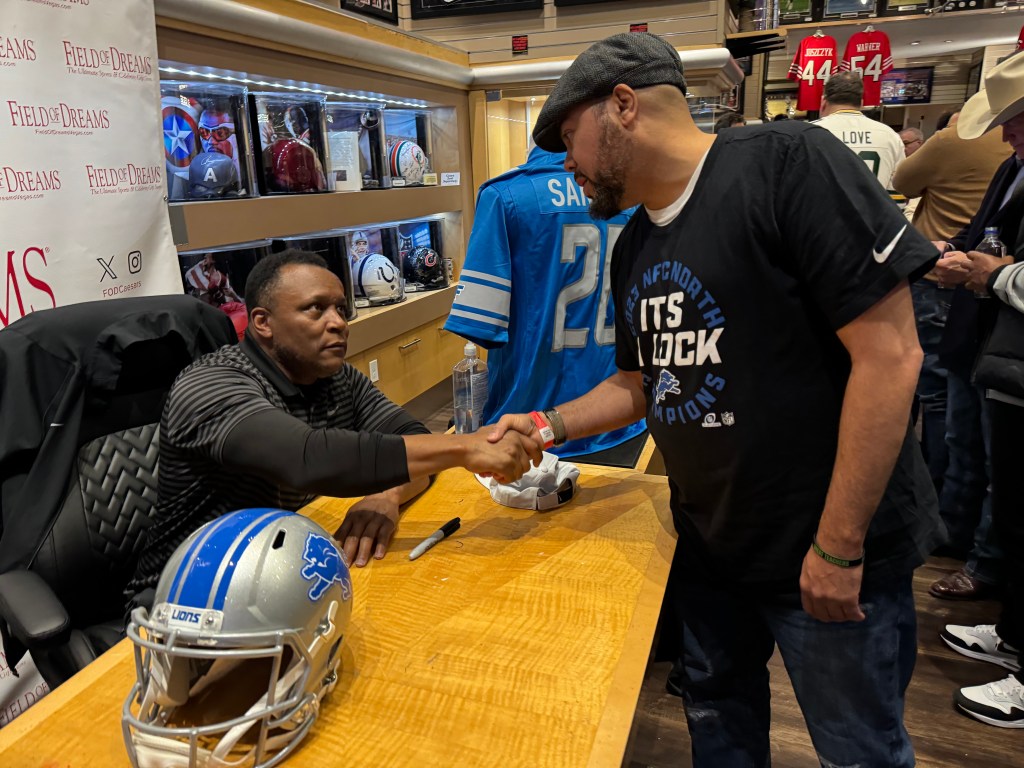
Julian Vasquez Heilig is a professor, writer, and a legit lifelong Detroit Lions fan since 1981. He attended the NFC Championship in San Jose two years ago to support his Cardiac Cats and last year’s playoff loss to the Washington Commanders at Ford Field. He was also at the official Lions partners party during the NFL Draft in Detroit, where he met Robert Porcher and Jason Hanson. Over the years he’s spotted Billy Sims in Times Square, endured the heartbreak of the Lions’ 0–16 season, and treasures his personally autographed Barry Sanders helmet. Beyond education and equity, Julian dabbles in writing about sports, culture, and society.
Two scholars–Kimberlé Crenshaw and Jason Stanley–explain why Trump is censoring exhibits at the Smithsonian. He has also imposed censorship of signage and exhibits at other federal sites, including national parks. He has enlisted the U.S. Department of Educatuon to organize rightwing groups to create a “patriotic” civics course.
Kimberlé Crenshaw is an American civil rights advocate and a scholar of critical race theory. She is a professor at the UCLA School of Law and Columbia Law School, where she specializes in race and gender issues
Jason Stanley is the Bissell-Heyd Chair in American Studies in the Munk School of Global Affairs & Public Policy at the University of Toronto and the author of Erasing History: How Fascists Rewrite the Past to Control the Future
Trump and his far-right cabal are l trying to revise history and memory. Unless he abolishes or rigs future elections, all this tinhorn fascist censorship will be swept away by his successors. He will rightly be judged, when that day comes, as the closest thing this country has ever seen to having a dictator. He will be portrayed in the Smithsonian and the textbooks as a buffoon and a tyrant.
In a letter sent to Smithsonian secretary, Lonnie G Bunch III, on 12 August, the Trump administration announced its plan to replace all Smithsonian exhibits deemed as “divisive” or “ideological” with descriptions deemed as “historical” and “constructive”. On 21 August, just nine days later, the White House published a list of said offending fixtures – the majority of which include exhibits, programming and artwork that highlight the Black, Latino and LGBTQ+ perspectives on the American project. Included in his bill of particulars was an exhibit that rightly depicts Benjamin Franklin as an enslaver, an art installation that acknowledges race as a social construct and a display that highlights racist voter suppression measures, among others.
The assault on the Smithsonian comes wrapped, as it were, as part of a broader attack on democracy, scenes of which we see playing out every day. The federal occupation of Washington DC, the crackdown on free speech on campus, the targeting of Trump’s political opponents, the gerrymandering of democracy – these are interwoven elements of the same structural assault. So with many fires burning across the nation, concerned citizens who are answering the call to fight the destruction of democracy may regard his attack on history and memory as a mere skirmish, a distraction from the herculean struggle against fascism unfolding in the US. But this is a mistake. Trump’s attack on American museums, education and memory, along with his weaponization of racialized resentment to package his authoritarian sympathies as mere patriotism, is a critical dimension of his fascist aims. The fight for democracy cannot avoid it, nor its racial conditions of possibility.
Fascism always has a central cultural component, because it relies on the construction of a mythic past. The mythic past is central to fascism because it enables and empowers a sense of grievance by a dominant racial or ethnic group whose consent is crucial to the sustainability of the project. In Maga world, the mythic past was pure, innocent and unsullied by women or Black leaders. In this kind of politics, the nation was once great, a byproduct of the great achievements of the men in the dominant racial group. In short, the assault on the Smithsonian and, more broadly, against truthful history and critical reflection is part of the broader fascist attack on democracy.
From this vantage point, racial equality is a threat to the story of the nation’s greatness because only the men of the dominant group can be great. To represent the nation’s founding figures as flawed, as any accurate history would do, is perceived, in this politics, as a kind of treason.
The success of the fascist dismantling of democracy is predicated on the widespread systematic failure to see the larger picture. The anti-woke assault that is a key pillar of Trumpism is part of that failure, partly due to the racial blinders and enduring ambivalence of too many in positions of leadership in the media and elsewhere. Those who sign on to the attack on “wokeness” but regard themselves as opponents of the other elements of the fascist assault are under the mistaken assumption that these projects can be disaggregated. In fact, the dismantling of democracy and of racial justice are symbiotically entangled. To support one is to give cover for the others.
It is no coincidence that this ‘proper’ ideology Trump exposes is constitutive of a more well-known strand of fascism – nazism
It is clear that the Trump administration understands this relationship and fully weaponizes racist appeals as a foundational piece of its fascist agenda. And if this was once the quiet part, it is now pronounced out loud in official government documents. In an executive order issued on 27 March 2025 titled “Restoring Truth and Sanity to American History”, Trump reveals that his mandate to ban “improper ideologies” targets core commitments repudiating a scientific racism that historically naturalized racial hierarchy thereby neutralizing resistance. According to Trump, the problem with the Smithsonian American Art Museum’s exhibit The Shape of Power: Stories of Race and American Sculpture was that it promoted the idea that “race is a human invention”.
The understanding that race is a social construct as opposed to a biological fact is perhaps the most fundamental advance in repudiating enslavement, genocide and segregation. Rejecting the idea that racial inequality is natural or pre-ordained – a claim that grounded enslavement and dispossession in America – forms the cornerstone of the modern commitment to a fully inclusive democracy. Trump’s declaration that this cornerstone is “improper” is an effort to turn the clock back, upending the entire American postwar project. It is no coincidence that this “proper” ideology Trump exposes is constitutive of a more well-known strand of fascism – nazism. How else can we understand why Maya Angelou was purged from the Naval Academy library while Adolf Hitler remains?
The fight against fascism in the US must be as robust in its embrace of racial equality as Trump’s embrace of outdated ideas about race and racism. The defense of memory, of truthful history, of telling the whole American story rather than ascribing agency in history to the deeds of “great men” is vital to the American democratic project. A pro-democratic education fosters the agency of its citizens by teaching about social movements that overturned entrenched hierarchies which blocked democratic equality and imposed racial tyranny. The story of how ordinary Americans lived and struggled and remade America is essential knowledge in developing and sustaining a multiracial democracy. The Smithsonian has been a vital institution in making this knowledge accessible to the masses. The National Museum of the American Latino and the National Museum of the American Indian, for example, provide artifacts and perspectives about the nation’s westward expansion that challenge the myth of unoccupied territory and manifest destiny. The National Museum of African American History and Culture brings forward the global scale of enslavement as well as its infusion across national institutions, culture and politics.
Nikole Hannah-Jones has had her share of controversy. Born in Iowa to a mixed-race couple, she attended desegregated public schools, graduated from Notre Dame and received a masters in journalism from the University of North Carolina. In her career as an investigative journalist, she covered education, civil rights, and healthcare. She worked at newspapers in North Carolina and Oregon, then for ProPublica. In 2015, she joined the staff of The New York Times.
In 2019, The Times published The 1619 Project, a group of essays that Hannah-Jones assembled, to commemorate the arrival of the first Blacks to the land that would later become the USA. In the lead essay, which Hannah-Jones wrote, she maintained that the arrival of that ship bringing enslaved Blacks marked the true origin of the nation. She recast the history of the U.S. from a Black perspective. Some historians criticized aspects of her thesis, others defended it.
The 1619 Project was widely celebrated and widely condemned, even banned. Trump responded by creating a 1776 Commission, whose purpose was to celebrate US history patriotically (that is, to leave out the shameful parts).
Hannah-Jones won the Pulitzer Prize for The 1619 Project in 2020.
In 2021, the UNC-Chapel Hill’s Hussman School of Journalism and Media announced that Hannah-Jones would join the Hussman faculty as Knight Chair in Race and Investigative Journalism. The faculty and administration urged the UNC Board to give her tenure, as was customary with previous holders of the chair. However, the Board of the university refused to take action on this tenure recommendation. After a public uproar, the board of trustees offered her tenure, but Hannah-Jones rejected the offer, choosing instead to accept the offer of a chair at Howard University.
She wrote in the New York Times about the mainstreaming of Charlie Kirk’s bigoted views after his tragic assassination. This is an except from her excellent commentary.
Last year, The Washington Examiner, a conservative news outlet, published a column calling the organization Kirk co-founded, Turning Point USA, “one of the most destructive forces in Republican politics.” It said that “a healthy conservative movement cannot tolerate conspiracy theorists being presented as serious political figures” and called the organization’s leadership “toxic.” But the period since Kirk’s death has revealed a deeply unsettling cultural shift. Eight months into President Trump’s second term, it is clear that Kirk’s ideas are no longer considered on the extremist periphery but are embraced by Republican leadership.
The mainstreaming of Charlie Kirk demonstrates that espousing open and explicit bigotry no longer relegates one to the fringe of political discourse.
When Representative Jasmine Crockett, Democrat of Texas, bemoaned that only two of the 58 Democrats who refused to sign the resolution honoring Kirk were white, Laura Loomer responded on X by railing against “ghetto Black bitches who hate America serving in Congress.” Loomer is not merely some right-wing provocateur. She has the ear of the president of the United States and understood that such an explicitly racist comment in 2025 America would bring no political consequence.
And while Trump has surrounded himself with people who have said racist things and maintained ties to white and Christian nationalists, the number of Democrats and esteemed American institutions that have engaged in the mainstreaming of Charlie Kirk demonstrates that espousing open and explicit bigotry no longer relegates one to the fringe of political discourse, a phenomenon we have not witnessed since the civil rights era.
In some parts of polite society, it now holds that if many of Kirk’s views were repugnant, his willingness to calmly argue about them and his insistence that people hash out their disagreements through discourse at a time of such division made him a free-speech advocate, and an exemplar of how we should engage politically across difference. But for those who were directly targeted by Kirk’s rhetoric, this thinking seems to place the civility of Kirk’s style of argument over the incivility of what he argued. Through gossamer tributes, Kirk’s cruel condemnation of transgender people and his racist throwback views about Black Americans were no longer anathema but instead are being treated as just another political view to be respectfully debated — like a position on tax rates or health care policy.
Using Kirk’s knack for vigorous argument to excuse the re-emergence of unabashed bigotry in mainstream politics feels both frightening and perilous.
As the Trump administration wages the broadest attack on civil rights in a century, and the shared societal values of multiculturalism and tolerance recede, using Kirk’s knack for vigorous argument to excuse the re-emergence of unabashed bigotry in mainstream politics feels both frightening and perilous. Kirk certainly produced viral moments by showing up on college campuses and inviting students a decade his junior to “prove” him wrong about a range of controversial topics such as Black crime rates and the pitfalls of feminism. But his rise to fame was predicated on the organization for which he served as executive director, Turning Point USA, and its Professor Watchlist. The website invited college students not to engage in robust discussions with others with different ideologies, but to report professors who “advance leftist propaganda in the classroom.”
The site includes photos of professors, along with often highly misleading summaries of the thought crimes that landed them on the list. It provides the telephone numbers of the universities that employ them for students and parents to register their complaints. While the site claims the organization supports free speech, many professors have recounted enduring campaigns of harassment after being put on the list. (I was placed on it in 2021 because of my work on the 1619 Project, after it was announced that I would be a professor at Howard University.)
A couple of years ago, Angel Jones, now a professor at a university in Maryland whose work focuses on educational inequality, joined the hundreds of professors across the country who found themselves on the list.
Jones landed on it under the tag “racial ideology” when she published an article citing research about how distressing it is for Black people to go to work after witnessing news coverage of police killings. She told me someone had sent her a picture of a house thought to be hers, but it turned out to belong to another Angel Jones. Someone else had threatened to hang her from a tree and burn her alive. The scholar changed her classroom and removed her name plate from her office door. The university where she was working at the time installed a safety alarm button under her desk.
“I would cry. I was very fearful. I was anxious,” Jones told me. “I was afraid to go to class sometimes. I was just scared all of the time.
“I love teaching — it makes my heart go pitter patter — so to be in a space where I am afraid of my students, like that rocks me in a way I can’t even articulate,” she added.
When Jones learned of Kirk’s killing, she remembers that there was a sense of disbelief shared by many Americans who were shocked by the gruesome video. But soon, that disbelief was replaced by another feeling. In the immediate hours after his death, she watched as pundits and politicians eulogized Kirk as that rare example of someone who practiced a willingness to hear opposing ideas because he saw it as thesalve for political violence. After all she’d gone through, and the stories she’d heard of other professors similarly harassed, the tributes pouring in for Kirk both infuriated and saddened her.
The next day, Jones went to the class she taught on misinformation and disinformation and showed her students a short Instagram video she had made in response. In the video, she says that while she does not celebrate Kirk’s death, she also refuses to mourn him. “I cannot have empathy for him losing his life when he put mine at risk and the lives of so many other educators just because we dared to advocate for social justice,” she says in the video, “because we dared to do our jobs.”
After she showed the video, a white male student in her class asked Jones if she thought her lack of empathy for Kirk might radicalize students. After a short, tense exchange, the student took his backpack and left. Jones said it had made her nervous. There’s a Turning Point USA chapter on her campus, and Kirk’s followers and even some politicians had been posting about revenge on social media. Jones switched her classes to virtual for the week.
The past few weeks have filled Ash Lazarus Orr with a similar sense of foreboding. Orr has been at the forefront of resisting efforts to target transgender Americans, including as a plaintiff in a federal lawsuit brought by the A.C.L.U. against a Trump administration policy that would prevent transgender people from having their chosen gender on their passports.
While Orr was never named by Kirk, they say Kirk’s rhetoric helped fuel an environment that makes transgender Americans vulnerable to violence and that has paved the way for the removal of their civil rights; in February, Iowa became the first state in the country to take away legal civil rights protections for transgender residents.
“I firmly believe that no one should be killed for their beliefs, no matter how harmful those beliefs might be,” Orr told me. “But we are watching our rights being stripped away. We are having our friends’ lives cut short, and then we are told to stay quiet while those responsible are celebrated.”
In just a few short years, Orr has watched as the momentum toward recognizing the full humanity and rights of transgender people has collapsed. Orr recently left their home state of West Virginia, finding it no longer safe after being threatened and assaulted.
Kirk’s rhetoric of “Christian white nationalism, anti-transgender, quote anti-woke culture-war framing, this isn’t on the edge anymore,” Orr told me. “It has moved into what many consider the center of Republican identity.” They said they were deeply concerned about how few people seemed willing to point out the consequences of this shift: “Who is actually fighting for us?”
Robin D.G. Kelley, a historian at U.C.L.A. whose scholarship on racial injustice also landed him on the Professor Watchlist, is struck by how rapidly our society has changed since Trump took office a second time.
Kelley pointed to the fact that Trump was widely condemned during his first term when he called the white supremacists who rallied in Charlottesville, Va., “very fine people.” Now, Democrats and political centrists were lining up to honor a man who promoted the same Great Replacement Theory that served as the rallying cry for that march. At a time when the president of the United States is using his power to go after diversity efforts and engaging in a mass deportation project, some progressives are arguing that people of color, immigrants and members of other marginalized groups who felt dehumanized by Kirk’s commentary, podcasts and debates have to find a way to locate common ground with his followers.
“There has been an extreme shift,” Kelley told me. “This treatment is authorizing the idea that white supremacy and racism is not just a conservative idea, but a legitimate one.”
Charlie was an unrepentant white supremacist. He was a male chauvinist who believed that a woman’s place was in the home, raising children and deferring to the authority of her husband. He was a proud and unrepentant bigot. He should not have been murdered. Political violence is poison to a democracy, which should rely on persuasion, not repression, censorship, or violence.
Coates reminds us that if Charlie’s views prevailed, we would abandon the rights of everyone who was not a straight white Christian male. That’s a majority of us.
Coates wrote:
Before he was killed last week, Charlie Kirk left a helpful compendium of words—ones that would greatly aid those who sought to understand his legacy and import. It is somewhat difficult to match these words with the manner in which Kirk is presently being memorialized in mainstream discourse. New York Times columnist Ezra Kleindubbed Kirk “one of the era’s most effective practitioners of persuasion” and a man who “was practicing politics in exactly the right way.” California governor Gavin Newsom hailed Kirk’s “passion and commitment to debate,” advising us to continue Kirk’s work by engaging “with each other, across ideology, through spirited discourse.” Atlantic writer Sally Jenkinssaluted Kirk, claiming he “argued with civility” and asserting that his death was “a significant loss for those who believe engagement can help bridge disagreements.”
The mentions of “debate” and “engagement” are references to Kirk’s campus tours, during which he visited various colleges to take on whoever come may. That this aspect of Kirk’s work would be so attractive to writers and politicians is understandable. There is, after all, a pervasive worry, among the political class, that college students, ensconced in their own bubbles, could use a bit of shock therapy from a man unconcerned with preferred pronouns, trigger warnings, and the humanity of Palestinians. But it also shows how the political class’s obsession with universities blinds it to everything else. And the everything-else of Kirk’s politics amounted to little more than a loathing of those whose mere existence provoked his ire.
It is not just, for instance, that Kirk held disagreeable views—that he was pro-life, that he believed in public executions, or that he rejected the separation of church and state. It’s that Kirk reveled in open bigotry. Indeed, claims of Kirk’s “civility” are tough to square with his penchant for demeaning members of the LGBTQ+ community as “freaks” and referring to trans peoplewith the slur “tranny.” Faced with the prospect of a Kamala Harris presidency, Kirk told his audience that the threat had to be averted because Harris wanted to “kidnap your child via the trans agenda.” Garden-variety transphobia is sadly unremarkable. But Kirk was a master of folding seemingly discordant bigotries into each other, as when he defined “the American way of life” as marriage, home ownership, and child-rearing free of “the lesbian, gay, transgender garbage in their school,” adding that he did not want kids to “have to hear the Muslim call to prayer five times a day.” The American way of life was “Christendom,” Kirk claimed, and Islam—“the sword the left is using to slit the throat of America”—was antithetical to that. Large “dedicated” Islamic areas were “a threat to America,” Kirk asserted, and New York mayoral candidate Zohran Mamdani was a “Mohammedan,” with Kirk supposing that anyone trying to see “Mohammedism take over the West” would love to have New York—a “prior Anglo center”—“under Mohammedan rule.”
Kirk habituallyrailed against “Black crime,” claiming that “prowling Blacks go around for fun to go target white people.” He repeated the rape accusations against Yusef Salaam, a member of the exonerated Central Park Five who is now a New York City councilman, calling him a “disgusting pig” who had gotten away with “gang rape.” Whatever distaste Kirk held for Blacks was multiplied when he turned to those from Haiti. Haiti was, by Kirk’s lights, a country “infested with demonic voodoo,” whose migrants were “raping your women and hunting you down at night.” These Haitians, as well as undocumented immigrants from other countries, were “having a field day,” per Kirk, and “coming for your daughter next.” The only hope was Donald Trump, who had to prevail, lest Haitians “become your masters.”
The point of this so-called mastery was as familiar as it was conspiratorial—“great replacement.” There was an “anti-white agenda,” Kirk howled. One that sought to “make the country more like the Third World.” The southern border was “the dumping ground of the planet,” he claimed, and a magnet for “the rapists, the thugs, the murderers, fighting-age males.” “They’re coming from across the world, from China, from Russia, from Middle Eastern countries,” he said, “and they’re coming in and they’re coming in and they’re coming in and they’re coming in…”
You can probably imagine where this line of thinking eventually went.
“Jewish donors,” Kirk claimed, were “the number one funding mechanism of radical open-border, neoliberal, quasi-Marxist policies, cultural institutions, and nonprofits.” Indeed, “the philosophical foundation of anti-whiteness has been largely financed by Jewish donors in the country.”
Kirk’s bigotry was not personal, but extended to the institution he founded, Turning Point USA. Crystal Clanton, the group’s former national field director, once texted a fellow Turning Point employee, “I HATE BLACK PEOPLE. Like fuck them all … I hate blacks. End of story.” One of the group’s advisers, Rip McIntosh,once published a newsletter featuring an essay from a pseudonymous writer that said Blacks had “become socially incompatible with other races” and that Black culture was an “un-fixable and crime-ridden mess.” In 2022, after three Black football players were killed at another college, Meg Miller, president of Turning Point’s chapter at the University of Missouri, joked (“joked”) in a social media message, “If they would have killed 4 more n-ggers we would have had the whole week off.”
Kirk subscribed to some of the most disreputable and harmful beliefs that this country has ever known. But it is still chilling to think that those beliefs would be silenced by a gunshot. The tragedy is personal—Kirk was robbed of his life, and his children and family will forever live with the knowledge that a visual record of that robbery is just an internet search away. And the tragedy is national. Political violence ends conversation and invites war; its rejection is paramount to a functioning democracy and a free society. “Political violence is a virus,” Klein noted. This assertion is true. It is also at odds with Kirk’s own words. It’s not that Kirk merely, as Klein put it, “defended the Second Amendment”—it’s that Kirk endorsed hurting people to advance his preferred policy outcomes…
Mere weeks before his death, Kirk reveled in Trump’s deployment of federal troops to DC. “Shock and awe. Force,” he wrote. “We’re taking our country back from these cockroaches.” And in 2023, Kirk told his audience that then president Joe Biden was a “corrupt tyrant” who should be “put in prison and/or given the death penalty for his crimes against America.”
What are we to make of a man who called for the execution of the American president, and then was executed himself? What are we to make of an NFL that, on one hand, encourages us to “End Racism,” and, on the other, urges us to commemorate an unreconstructed white supremacist? And what of the writers, the thinkers, and the pundits who cannot separate the great crime of Kirk’s death from the malignancy of his public life? Can they truly be so ignorant to the words of a man they have so rushed to memorialize? I don’t know. But the most telling detail in Klein’s column was that, for all his praise, there was not a single word in the piece from Kirk himself.
Jamelle Bouie is one of the best, most interesting opinion writers for The New York Times. As a subscriber to that newspaper, I signed up for Bouie’s newsletter, which is where these thoughts of his appeared.
Jamelle Bouie writes:
Virtually every person of note in American politics has, rightfully, condemned the horrific killing of Charlie Kirk and expressed their deep concerns about the growing incidence of political violence in the United States. Wherever we stand politically, we all agree that he should still be alive.
There has been less agreement about Kirk’s life and work. Death tends to soften our tendency to judge. And sudden, violent death — especially one as gruesome and shocking as this one — can push us toward hagiography, especially in the immediate wake of the killing.
So it goes for Kirk.
“Charlie inspired millions,” President Trump said in an Oval Office speech on Wednesday. “He championed his ideas with courage, logic, humor and grace.”
“The best way to honor Charlie’s memory,” Gov. Gavin Newsom of California declared, “is to continue his work: engage with each other, across ideology, through spirited discourse.”
Kirk’s approach, wrote the editors of Politico’s Playbook, “was to persuade, to use charm and charisma and provocation and the power of argument to convince people of the righteousness of his cause.”
There is no doubt that Kirk was influential, no doubt that he had millions of devoted fans. But it is difficult to square this idealized portrait of Kirk as model citizen with the man as he was.
Kirk’s eulogists have praised him for his commitment to discourse, dialogue and good-faith discussion. Few if any of them have seen fit to mention the fact that Kirk’s first act on the national stage was to create a McCarthyite watchlist of college and university professors, lecturers and academics. Kirk urged visitors to the website to report those who “discriminate against conservative students and advance leftist propaganda in the classroom.”
The list, which still exists, is a catalog of speech acts in and outside the classroom. The surest way to find yourself on the watchlist as an academic is to disagree, publicly, with conservative ideology, or even acknowledge ideas and concepts that are verboten among the far right. And the obvious intent of the list is made clear at the end of each entry, where Kirk and his allies urge readers to contact the schools and institutions in question. Targets of the watchlist attest to harassment and threats of violence.
The Professor Watchlist is a straightforward intimidation campaign, and you can draw a line directly from Kirk’s work attacking academics to the Trump administration’s all-out war on American higher education, an assault on the right to speak freely and dissent.
To speak of Kirk as a champion of reasoned discussion is also to ignore his frequent calls for the state suppression of his political opponents.
“‘Investigate first, define the crimes later’ should be the order of the day,” Kirk declared in an editorial demanding the legal intimidation of anyone associated with the political left. “And for even the most minor of offenses, the rule should be: no charity, no goodwill, no mercy.”
Speaking last year in support of Trump’s plan for mass deportation, Kirk warned that the incoming president would not tolerate dissent or resistance. “Playtime is over. And if a Democrat gets in our way, well, then Matt Gaetz very well might go arrest you,” he said.
It is also important to mention that Kirk was a powerful voice in support of Trump’s effort to “stop the steal” after the 2020 presidential election. His organization, Turning Point USA, went as far as to bus participants to Washington for the rally that devolved into the Jan. 6 riot attack on the Capitol.
And then there is Kirk’s vision for America, which wasn’t one of peace and pluralism but white nationalism and the denigration of Americans deemed unworthy of and unfit for equal citizenship.
On his podcast, Kirk called on authorities to create a “citizen force” on the border to protect “white demographics” from “the invasion of the country.” He embraced the rhetoric of white pride and warned of “a great replacement” of rural white Americans.
“The great replacement strategy, which is well underway every single day in our southern border, is a strategy to replace white rural America with something different,” he said last year. “You believe in God, country, family, faith, and freedom, and they won’t stop until you and your children and your children’s children are eliminated.”
Kirk also targeted Black Americans for contempt. “Prowling Blacks go around for fun to go target white people — that’s a fact,” he said in 2023. Kirk was preoccupied with the idea of “Black crime,” and on the last episode of his show before he was killed, he devoted a segment to “the ever-increasing amount of Black crime,” telling his audience, falsely, that “one in 22 Black men will be a murderer in their lifetime” and that “by age of 23, half of all Black males have been arrested and not enough of them have been arrested.”
Kirk told his listeners that Justice Ketanji Brown Jackson of the Supreme Court “is what your country looks like on critical race theory,” that former Vice President Kamala Harris was “the jive speaking spokesperson of equity,” and that the Rev. Dr. Martin Luther King Jr. “was awful.”
“I have a very, very radical view on this, but I can defend it, and I’ve thought about it,” Kirk said at a 2023 event. “We made a huge mistake when we passed the Civil Rights Act in the 1960s.”
This is just a snippet of Kirk’s rhetoric and his advocacy. He also believed that there was no place for transgender people in American society — “We must ban trans-affirming care — the entire country,” he said in 2024 — and has denounced L.G.B.T. identities as a “social contagion.”
It is sometimes considered gauche, in the world of American political commentary, to give words the weight of their meaning. As this thinking goes, there might be real belief, somewhere, in the provocations of our pundits, but much of it is just performance, and it doesn’t seem fair to condemn someone for the skill of putting on a good show.
But Kirk was not just putting on a show. He was a dedicated proponent of a specific political program. He was a champion for an authoritarian politics that backed the repression of opponents and made light of violence against them. And you can see Kirk’s influence everywhere in the Trump administration, from its efforts to strip legal recognition from transgender Americans to its anti-diversity purge of the federal government.
We can mourn Kirk. We can send prayers to his friends and family. We can take stock of the gravity of this event. We can — and should — do all of this and more without pretending he was something, as a public figure, that he was not.
The assassination of Charlie Kirk was vile, disgusting, and abhorrent. The perpetrator has apparently been identified and will be held accountable, as he should be.
Charlie was a bright star in the orbit of Donald Trump, and his many fans and admirers are raising him up on a pedestal because of his tragic death. A Florida member of Congress has proposed erecting a statue to him in the halls of Congress. Trump is awarding him the nation’s highest civilian honor, the Presidential Medal of Freedom.
Senator Jim Banks spoke to Indiana Republicans after Charlie’s death and urged them to use redistricting to eliminate every Democratic Congressman because “they” killed Charlie. Of course, we now know, as Senator Banks did, that Charlie was not killed by Democrats or a cabal of left wing fanatics, but by a young white Utah man who was raised in a staunchly Republican home. At this writing, we do not know why he killed Charlie. We don’t know his views about politics, whether he objected to Charlie’s views from the left or from the far-far right.
Although his death has been mourned by people of all political views, it’s important to acknowledge what Charlie advocated and what he opposed.
He opposed gun control and argued that more people should have guns. A few deaths every year, he said, was a small price to pay to preserve the Second Amendment.
He opposed the civil rights movement and belittled Dr. Martin Luther King Jr. as an “awful” man. In 2021, he referred to George Floyd as a “scumbag.”
He opposed affirmative action. He called Justice Ketanji Brown Harris “a diversity hire.”
He opposed gender equality.
He published a list of academics called ProfessorWatch. They are/were people who teach about “gender ideology” and racial justice. On social media, professors whose names were on Charlie’s list said they were threatened, doxxed, suspended, harassed, even fired. So while he is supposedly a champion of free speech, he encouraged suppression of free speech by professors on his Watchlist.
Charlie, the Times reported, “rejected the idea that climate change posed an existential threat to humanity, describing it as ‘complete gibberish, nonsense and balderdash’ in December 2024 to members of Turning Point UK, the British offshoot of Turning Point USA.”
In another source, Charlie stated his absolute opposition to abortion. Charlie compared abortion to the Holocaust. When a questioner asked what he would do if his daughter was raped and became pregnant at the age of 10, he said the baby should be born.
A reader of this blog who is called Quickwrit posted the following comment about Charlie’s ideology:
Kirk’s view of women clearly stated in a comment he addressed to Taylor Swift on her announcement of her engagement to Travis Kelce:
“Reject feminism. Submit to your husband, Taylor. You’re not in charge.” — The Charlie Kirk Show, August 26, 2025
Kirk comments on Civil Rights and race:
“We made a huge mistake when we passed the civil rights act in the 1960s” — at America Fest, December 2023.
“If I see a Black pilot, I’m going to be like, boy, I hope he’s qualified.” — The Charlie Kirk Show, January 23, 2024
“Happening all the time in urban America, prowling Blacks go around for fun to target white people, that’s a fact. It’s happening more and more.” – The Charlie Kirk Show, May 19, 2023
“If I’m dealing with somebody in customer service who’s a moronic Black woman, I wonder is she there because of her excellence, or is she there because of affirmative action?” – The Charlie Kirk Show, January 3, 2024
“Michelle Obama and [U.S. Representative] Sheila Jackson Lee and [U.S. Supreme Court Justice] Ketanji Brown Jackson…You do not have the brain processing power to otherwise be taken really seriously. You had to go steal a white person’s slot to be taken somewhat seriously.” — The Charlie Kirk Show, July 13, 2023
“The American Democrat party hates this country. They wanna see it collapse. They love it when America becomes less white.” — The Charlie Kirk Show, March 20, 2024
“Islam is not compatible with western civilization.” — The Charlie Kirk Show, June 24, 2025
“Islam is the sword the left is using to slit the throat of America.” — Charlie Kirk post on X September 8, 2025
“There is no separation of church and state. It’s a fabrication, it’s a fiction, it’s not in the constitution. It’s made up by secular humanists.” — The Charlie Kirk Show, July 6, 2022. (But in fact, in the First Amendment, the Constitution clearly forbids religion in government, and Founding Father James Madison, who our nation honors with the title “Father of the Constitution” made it clear why he and the other Founding Fathers who wrote the Constitution very deliberately left out any mention of God, let alone of Jesus, in the Constitution; here is what The Father of our Constitution declared: “The religion of every man must be left to the conviction and conscience of every man. [Government] MUST NOT PREFER ONE RELIGION OVER ANOTHER OR PROMOTE ANY RELIGION OVER NONBELIEF.”
Kirk’s evangelicalism inflected both the tone and content of his message. He was open to talk with anyone, but steadfast in his confidence that his path was the correct one. “If you do not have a religious basis, specifically a Christian one, for your society, something else is going to replace it,” he said at the Texas A. & M. event. He and his followers were locked in a battle with an enemy that was not just ideologically opposed but unwell, possibly evil. Democratic leaders, Kirk said, were “maggots, vermin, and swine”; transgender identity was a “middle finger to God.”
Charlie had every right to express his views and advocate for them. His murder was an abomination and a stain on our nation. Unlike Charlie, I support gun control. I don’t believe that the Second Amendment gives everyone a right to carry arms at will.
I disagreed with Charlie Kirk on every issue. I would have urged him to eliminate ProfessorWatch, which endangers professors who did not agree with him; it suppressed their free speech rights.
As Americans, our freedom of speech is protected by the First Amendment. We are entitled to believe what we want. No one should ever be murdered because of their views.
I was born in 1967 in Chalmette, Louisiana (St. Bernard Parish), a suburb of New Orleans so close to the city that is is the actual site of the 1815 Battle of New Orleans.
I did not know that my father moved to Chalmette in the mid-1950s as part of the “white flight” from New Orleans.
I did not know why the St. Bernard-Orleans Parish line was so starkly white on the St. Bernard side and black on the Orleans side.
I did not know that the black teachers at my all-white elementary and middle schools were part of an effort for local officials to dodge federal mandates to racially integrate the schools (as in integrating the student body).
(I do remember seeing what I think was one black student in the special education, self-contained classroom of my elementary school– such an unusual, remarkable event that it puzzled my young mind to see him as a student assistant in the cafeteria, and the moment remains clearly in my memory to this day.)
I did not know that when I moved to a more rural section of St. Bernard Parish as I started high school that the African-American residents “down the road” knew full well of the dangers of trying to reside in certain sections of the parish (namely, Chalmette and Arabi).
I did not know that the school-superintendent uncle of one of my favorite teachers tried circa 1961 to create an “annex school” near the Arabi-New Orleans city line in order to enable white parents in the city to avoid racial integration by using school vouchers from New Orleans to enroll their children in an all-white public school just across the parish line.
I did not know that the proliferation of parochial schools in New Orleans was fueled by white flight from the New Orleans public schools.
I did not know that the reason I attended an all-girls public middle- and high school was for local officials to try to sham-integrate the St. Bernard public schools but to keep “those black boys away from our white girls.”
There’s a lot that I did not know and did not begin to learn until I was in my twenties and started asking questions.
But there were a lot of lessons that many white adults in my life tried to instill in me, lessons that indeed needed some serious questioning:
“You know property values will drop if the blacks start moving into a neighborhood.”
“It is better for a white woman to have a physically-abusive white boyfriend or husband than a black one, even if he does treat her well.”
“Interracial marriage is cause for a family disowning a child.”
“The city is a wreck because blacks are lazy and destroy everything.”
As I began reading about New Orleans officials’ cross-generational efforts to obliterate the black middle class in New Orleans (by, for example, by destroying multiple black owned businesses in order to build both the Desire housing project in 1956 and construct Interstate 10 in 1966), I felt like I had been lied to for decades– and my views as a white child and young adult repeatedly manipulated in order to purposely cement in me a sense of white superiority that no amount of personal maturity would ever shake.
Nevertheless, I am happy to say that such twisted, misplaced superiority is indeed and forever shaken in me and shown to be the mammoth lie that it is– the very lie that happens to fuel the white saviors who would impose themselves on black communities– including the center of the community:
The community school.
The community should be the final word on its schools, and when it is, those schools are successful, even in the face of racially-imposed hardship and intentional, multi-generational deprivation of basic resources, including physical space, current textbooks, and even ready supplies of toilet paper.
Such is the story of George Washington Carver High School in New Orleans– a school created as part of a school complex and housing project and build in New Orleans, Louisiana, to intentionally be a segregated school despite its opening post-Brown vs. Board of Education.
In her book, What We Stand to Lose: Black Teachers, the Culture They Created, and the Closure of a New Orleans School (2025, Beacon Press), Dr. Kristen Buras offers to readers a detailed history and daily life of G. W. Carver High School in New Orleans, from its inception to its white-savior closure in 2005, post-Katrina, when the state of Louisiana refused to grant the returning Carver community a charter to operate their own school. Buras details what no pro-charter, education reformer discussed at any length as regards traditionally-black New Orleans public schools: the repeated, intentional, multi-generational, systematic fiscal neglect of both the schools and the black community in New Orleans.
In contrast, Buras not only discusses these issues; she brings them to life through her numerous interviews with Carver faculty and staff, a life that begins even before Carver High School opened its doors in the 1958-59 school year.
Right out of the gate, the community served by Carver High School– families residing in the Desire Housing Project– had to face the reality that the project homes were poorly constructed and were starting to fall apart due to a lack of concrete foundations on swampland, no less.
Indeed, the location of what was known as the “Carver Complex” was originally a Maroon colony for escaped African slaves in a backswamp area that 1973 Carver graduate describes as “really not made for residential living.”
Separate was not equal, but to the Carver community, it was theirs, and in the midst of profound racism, the faculty and staff at Carver High devoted themselves to their students and the students’ families, who also happened to be their neighbors.
What speaks loudly to the teacher commitment to Carver High students, as Buras notes, is their multi-decade commitment. Despite being chronically underfunded and under-maintained across its almost-fifty years pre-Katrina, Carver High School had a very low teacher turnover.
In What We Stand to Lose, readers are introduced to the precise and disciplined teachings of music teacher Yvonne Busch, who was known for offering free music lessons during summer break. Former student Leonard Smith produced a documentary about Busch, who retired in 1983 after a 32-years at Carver. We learn of the 38-year career of social studies teacher, Lenora Condoll, who wanted so much for her students to experience the larger world that she organized fundraisers to take her students on Close-Up trips to Washington, DC, and who, on a practical note, showed students that they could make a dressy wardrobe out of a few basic items, including her “black, cashmere skirt.” We meet Enos Hicks, head coach of track and football and athletic director once Carver High opened. By that time, Hicks had been teaching for twenty years already. When Hicks’ students saw “his bag of medals” for track and field, they believed that they, too, could excel and receive their own medals.
These are real teachers whose legacy is undeniable among Carver alumni. They inspired their students to hold their heads high in self-respect despite the cultural pressures and dangers to be pressed into a Whites Only mold of “forever less-than.”
Carver High School was at most 30 minutes from my own high school. I had no idea such quality against the odds was so nearby.
Trump’s insistence on purging the Smithsonian of the accurate portrayal of Black history is yet another example of his efforts to minimize and sanitize that history.
Since taking office, Mr. Trump has led an effort to purge diversity, equity and inclusion policies from the federal government and threatened to investigate companies and schools that adopt such policies. He has tried to reframe the country’s past involving racism and discrimination by de-emphasizing that history, preferring to instead spotlight a sanitized, rosy depiction of America.
The administration has worked to scrub or minimize government references to the contributions of Black heroes, from the Tuskegee Airmen, who fought in World War II, to Harriet Tubman, who guided enslaved people along the Underground Railroad. Mr. Trump commemorated Juneteenth, the celebration of the end of slavery in the United States that became a federal holiday in 2021, by complaining that there were too many non-working holidays in America. He has called for the return of Confederate insignia and statues honoring those who fought to preserve slavery.
And he has previously attacked the exhibits on race at the Smithsonian, which has traditionally operated as an independent institution that regards itself as outside the purview of the executive branch, as “divisive, race-centered ideology.”
CNN described Trump’s determination to compel museums to remove exhibitions of events that show shameful behavior by whites and the government:
President Donald Trump escalated his campaign to purge cultural institutions of materials that conflict with his political directives on Tuesday, alleging museums were too focused on highlighting negative aspects of American history, including “how bad slavery was.”
In a Truth Social post, Trump directed his attorneys to conduct a review of museums, comparing the effort to his crackdown on universities across the country.
“The Smithsonian is OUT OF CONTROL, where everything discussed is how horrible our Country is, how bad Slavery was, and how unaccomplished the downtrodden have been — Nothing about Success, nothing about Brightness, nothing about the Future,” Trump wrote.
Trump’s comments come days after the White House announced an unprecedented, sweeping review of the Smithsonian Institution, which runs the nation’s major public museums. The initiative, a trio of top Trump aides wrote in a letter to Smithsonian Institution secretary Lonnie Bunch III last week, “aims to ensure alignment with the President’s directive to celebrate American exceptionalism, remove divisive or partisan narratives, and restore confidence in our shared cultural institutions.”
The letter said the review would focus on public-facing content, the curatorial process to understand how work is selected for exhibits, current and future exhibition planning, the use of existing materials and collections and guidelines for narrative standards.
Bunch — who has served as Secretary of the Smithsonian Institution since 2019 and is the first African American to hold the position — has made multiple comments about the importance of educating people about slavery through the National Museum of African American History and Culture specifically. He told Smithsonian Magazine that part of the purpose of that museum “was to help a nation understand itself — an impossible task without the full recognition of the horrors of slavery.”
Exhibits at the Smithsonian take years of planning and are heavily evaluated by teams of scholars and curatorial experts before they make their debut. Janet Marstine, a museum ethics expert, said that the demands laid out by the Trump administration “set the Smithsonian up for failure.”
“Nobody could provide those kinds of materials in such a comprehensive way, in that short amount of time, and so it’s just an impossible task,” she said. The White House has asked the Smithsonian to provide a wide array of materials, from internal emails and memos to digital copies of all placards and gallery labels currently on display.
The Smithsonian declined to comment on Trump’s latest remarks. A White House official, asked about the attorney review process Trump described, said the president “will explore all options and avenues to get the Woke out of the Smithsonian and hold them accountable.”
Still, Trump’s efforts to target colleges and universities — which he is now comparing to his focus on Smithsonian museums — has been even more aggressive. His administration has moved to strip federal funding from higher education institutions for a variety of reasons, including allegations of antisemitism and failure to comply with certain policy changes. Columbia University recently settled with the Trump administration for more than $220 million dollars and Trump has also been in a protracted battle with Harvard University after his administration froze $2 billion in federal funding.
The Trump administration’s push to align federal support with his cultural agenda has extended beyond the nation’s capital. The Institute of Museum and Library Services and the National Endowments for the Arts and the Humanities canceled tens of millions of dollars in federal grants earlier this year, affecting small museums, library initiatives, arts programs and academic research projects across the country.
Trump has previously praised the Smithsonian museums, including the National Museum of African American History and Culture, which he toured during his first term as president.
“I’m deeply proud that we now have a museum that honors the millions of African American men and women who built our national heritage, especially when it comes to faith, culture and the unbreakable American spirit,” Trump said during remarks at the museum in February 2017. Later that month, Trump said the museum “tells of the great struggle for freedom and equality that prevailed against the sins of slavery and the injustice of discrimination.”
Earlier this year, Trump signed an executive order that put Vice President JD Vance, who serves on the Smithsonian’s Board of Regents, in charge of stopping government spending on exhibits that don’t align with the administration’s agenda. He also tasked a former member of his legal team, attorney Lindsey Halligan, with helping to root out “improper ideology” at the Smithsonian.
“Museums in our Nation’s capital should be places where individuals go to learn — not to be subjected to divisive narratives,” the executive order said.
The Smithsonian began a review of its own in June, and has repeatedly stressed its commitment to being nonpartisan. The institution told CNN in July that it was committed to an “unbiased presentation of facts and history” and that it would “make any necessary changes to ensure our content meets our standards.”
The Smithsonian was established in the 1840s by the US with funds from the estate of James Smithson, a British scientist. As a unique trust instrumentality that is supported by federal funds, it is not an executive branch agency, which makes it a complex question whether the Trump administration has the ability to control its exhibits. It is governed by a 17-member Board of Regents led by Chief Justice John Roberts.
The fact that the Smithsonian is not an “executive branch agency” won’t deter Trump. He has ignored laws and the Constitution when they don’t support his agenda. Neither the Library of Congress nor the National Portrait Gallery is an executive agency. Yet Congress sat silently as Trump forced out their leaders.
Trump is rapidly assuming control of every federal agency that was designed to be independent.

 Diane Ravitch's blog