Archives for category: Racism

Mississippi is as red a state as any in the country but a white Democrat has a real chance of winning. His name is Brandon Presley. He’s a second cousin of Elvis, and he grew up dirt poor. He’s a genuine progressive. He has gone out of his way to court Black voters. Presley has a chance of upending politics in the state and perhaps the region.

The Daily Yonder reports that Presley must overcome the rural-urban divide:

American politics are defined by the rural-urban divide. Democrats own the major cities; Republicans dominate smaller cities and the countryside. Brandon Presley aims to change that, at least in Mississippi. The 46-year-old Democrat is challenging the GOP incumbent, Tate Reeves, for the governorship. If he wins, he would be the Magnolia State’s first Democratic governor in a generation.

But a Presley victory is potentially something more. To win, the Democrat must score well with Mississippi’s rural voters. Such a turnabout would redound across the nation. William Browning, a Mississippi-based reporter, claims “If Brandon Presley beats Reeves, this changes the way people view elections.” In other words, a Presley victory could shake the nation out of its rural-urban divide. It would prove that Democrats can win rural America, and prompt Republicans to woo the cities.

Presley’s campaign is an uphill climb. Mississippi is the definition of a Republican stronghold. The GOP controls every statewide office and possesses supermajorities in both the state Senate and House. The race will be decided by rural voters, a Republican-leaning demographic. Sixty-five of Mississippi’s 82 counties are designated as rural (using the nonmetropolitan definition) and more than half of the state population, 54%, qualify as the same.

Despite these realities, Presley has more than a puncher’s chance at victory. Reeves is vulnerable. A January 2023 survey showed 57% of state voters wanted an option beyond Reeves. A June poll was even more ominous for the incumbent. One-fifth of Republicans supported Presley over the GOP incumbent. A Mississippi political observer explained these numbers bluntly, “Reeves is not likeable and is kind of arrogant.”

Presley’s prospects go beyond an unpopular incumbent. Every observer of any political stripe agrees that he is a one-of-a-kind political talent. Brannon Miller, a longtime state political hand, calls him Mississippi’s “best retail politician.” One reporter already termed him the “second best politician in state history.”

Tall, gregarious, and oozing Southern charm, he is, as one Democratic official described him, “a back-pattin’ doesn’t-know-a-stranger Democrat.” He is also equipped with a biography straight from a Hollywood script. Second cousins with Elvis, Presley was born dirt poor. Raised just down the road from Elvis’s Tupelo, he came of age in tiny Nettleton, Mississippi (population 1,995). At age 8, his alcoholic father was murdered. Thereafter, his single mom struggled to provide for him and his two siblings, Greta and Greg. The family regularly lived without electricity, running water, or a phone.

In 2001, the 23-year-old came home from college and was elected mayor of Nettleton. He has been running ever since. In 2007, voters elected him Public Service Commissioner for northern Mississippi, a post he has been reelected to three times by successively wider margins.

Presley is not a standard issue “national” Democrat. He steers clear of divisive social issues. Pro-life on abortion, he is an evangelical Christian who hews to Mississippi’s cultural mainstream. He is also a self-described “populist.” Born from his rough-and-tumble childhood, Presley also draws upon the rich tradition of Southern economic populism. Dana Burcham, the Nettleton city clerk, sums up Presley’s philosophy in saying, “He’s for the little people.”

Presley’s populism is apparent in his rhetoric. He defines his politics as one in which, “you side with the people against a system that is set up against the people all day long.” But his populism is also obvious in his record. As mayor and public service commissioner, he focused upon bread-and-butter issues for his rural and small-town constituents. Nettleton’s current mayor, Phillip Baulch, and Burcham credit Presley as the source of the town’s turnaround. Mayor Presley turned abandoned property into parks, audited the city’s books, balanced the budget, and cut taxes. The results are tangible. Storefronts abound with commerce. Downtown is tidy. Nettleton, if not thriving, is surviving.

Read on to finish the story.

The New York Times says changes in the laws of Mississippi may have a large effect on the outcome of the Mississippi race.

Just three years ago, Mississippi had an election law on its books from an 1890 constitutional convention that was designed to uphold “white supremacy” in the state. The law created a system for electing statewide officials that was similar to the Electoral College — and that drastically reduced the political power of Black voters.

Now Mississippi is holding its first election for governor since those laws fell, the contest is improbably competitive in this deep-red state, and Black voters are poised to play a critical role.

Voters overturned the Jim Crow-era law in 2020. This summer, a federal court threw out another law, also from 1890, that had permanently stripped voting rights from people convicted of a range of felonies.

Black leaders and civil rights groups in Mississippi see the Nov. 7 election as a chance for a more level playing field and an opportunity for Black voters to exercise their sway: Roughly 40 percent of voters are Black, a greater share than in any other state.

Presley is going after Black voters.

“This election is going to be one that is historical,” said Charles V. Taylor Jr., the executive director of the Mississippi state conference of the N.A.A.C.P. “It’d be the first time we don’t have to deal with this Jim Crow-era Electoral College when it comes to the gubernatorial race. And also, we’re at a point in our state where people are fed up and frustrated with what’s currently happening.”

Democrats are trying to harness that energy behind Brandon Presley, the party’s nominee for governor. Mr. Presley, who is white, is seeking to ride his brand of moderate politics and his pledges to expand Medicaid to an underdog victory over Gov. Tate Reeves, an unpopular Republican incumbent who has been trailed by a welfare scandal.

Black Mississippians lean heavily Democratic: Ninety-four percent voted for Joseph R. Biden Jr. in 2020, according to exit polls. Any path to victory for a Democrat relies on increasing Black turnout and winning over some crossover white voters.

Mr. Presley, a member of the Mississippi Public Service Commission and a second cousin of Elvis Presley, has made outreach to Black voters central to his campaign, seeking to win them over on Medicaid expansion, addressing a rural hospital shortage and providing funding for historically Black colleges.

On a recent October weekend, Mr. Presley navigated the tents and barbecue smokers at the homecoming tailgate for Alcorn State University, one of six historically Black colleges in the state. As he darted from tent to tent, wearing a purple-and-gold polo to support the home team, Mr. Presley introduced himself to unwitting voters and took selfies with his backers, many who flagged him down amid the din of music and aroma of smoking ribs.

Presley needs a strong turnout to win. I plan to send him a donation.

“This election is going to be one that is historical,” said Charles V. Taylor Jr., the executive director of the Mississippi state conference of the N.A.A.C.P. “It’d be the first time we don’t have to deal with this Jim Crow-era Electoral College when it comes to the gubernatorial race. And also, we’re at a point in our state where people are fed up and frustrated with what’s currently happening.”

Democrats are trying to harness that energy behind Brandon Presley, the party’s nominee for governor. Mr. Presley, who is white, is seeking to ride his brand of moderate politics and his pledges to expand Medicaid to an underdog victory over Gov. Tate Reeves, an unpopular Republican incumbent who has been trailed by a welfare scandal.

If Mississippi voters elect Presley, it would affect th southern
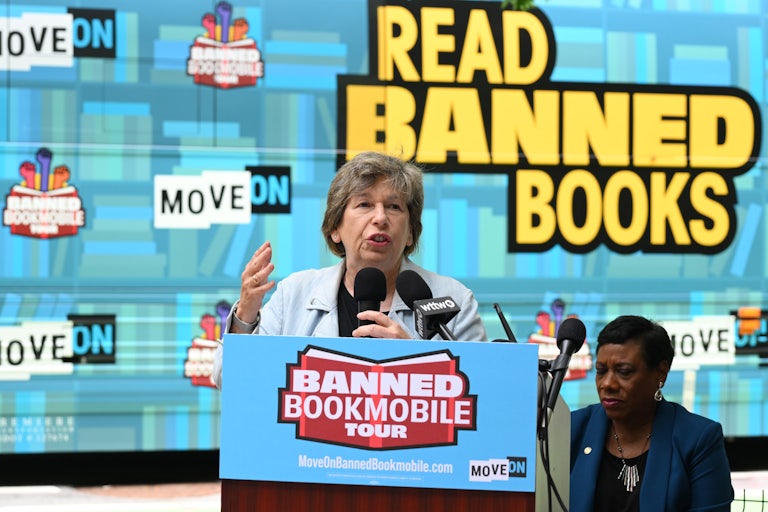
The New Republic convened a meeting to discuss Trump, book banning and the culture wars. Randi Weingarten described the attack on schools as a coordinated strategy to destroy public schools and promote vouchers. Edith Olmsted of The New Republic interviewed her. None of this is new to readers of this blog, but the American public needs to hear this message. Again and again.

Book Bans Are a Conservative Plot to Destroy Public Schools, Says Randi Weingarten, The teachers union head denounced the “extremist strategy,” which also includes voucher campaigns and manufactured outrage over critical race theory.

DANIEL BOCZARSKI/GETTY IMAGES FOR MOVEON

Teachers union head Randi Weingarten says that the campaign by conservatives to ban books isn’t about the books at all, but part of a broader strategy to destroy public schools—one that was supercharged by the pandemic.

“You take the agita and the anxiety that people had at Covid, that fear, and you combine it with a right wing who has wanted to kill public schools for years and take that money for vouchers, and you have the scenario we have,” Weingarten, the president of the American Federation of Teachers, said Wednesday at The New Republic’s Stop Trump Summit.

Vouchers, which use public education dollars to fund private and religious school attendance, are just one pillar of the conservative campaign to “undermine, destroy, and defund” public schools, she said. The other two are book banning and manufactured outrage over critical race theory.

Weingarten pointed to conservative activist Chris Rufo and a comment he made at Hillsdale College, a Christian nationalist school, in which he admitted that focusing on these issues was all part of a master plan to promote universal vouchers: “To get to universal school choice, you really need to operate from a premise of universal public school distrust.”

In an interview with TNR after the event, Weingarten explained the “extremist strategy” Rufo and other conservatives have used to defund public schools. “The hook was trust. If you really create as much distrust as possible in public schooling, then parents will look at privatization as an option,” she said.

That’s where critical race theory comes in.

“[Rufo] tried to make a term that nobody knows so toxic, so that you can weaponize it and make fear,” she said. “Conversations about hard subjects became weaponized as indoctrination. Which is patently ridiculous, and dangerous.”

Race, as well as gender, is the subject conservatives have focused on in their campaigns to ban books in public schools and libraries.

“What [Republican Governor Ron] DeSantis is doing in the so-called ‘war on woke,’ is exactly part of their playbook—to make people afraid of books, and afraid of what we do in school,” Weingarten said. According to Pen America, Florida passed 15 “educational intimidation” bills in the last two and a half years.

The “parents’ rights” movement is made up of a loud minority, Weingarten said, and actively undermines what most parents want. “What we see in Florida is that 60 percent of the book banning has been done by 11 people,” she said.

The AFT has partnered with The New Republic in fighting back against such bans. TNR’s Banned Books Tour has been delivering thousands of banned books across the country this month, most recently in Florida.

Joshua Benton wrote about Elon Musk’s grandfather in The Atlantic. Benton spent more time researching him than did Musk’s biographer Walter Isaacson. It’s not a pretty picture but it might provide insight into Musk’s worldview. I hope not.

Benton wrote:

In Walter Isaacson’s new biography, Elon Musk, a mere page and a half is devoted to introducing Musk’s grandfather, a Canadian chiropractor named Joshua N. Haldeman. Isaacson describes him as a source of Musk’s great affection for danger—“a daredevil adventurer with strongly held opinions” and “quirky conservative populist views” who did rope tricks at rodeos and rode freight trains like a hobo. “He knew that real adventures involve risk,” Isaacson quotes Musk as having said. “Risk energized him.”

But in 1950, Haldeman’s “quirky” politics led him to make an unusual and dramatic choice: to leave Canada for South Africa. Haldeman had built a comfortable life for himself in Regina, Saskatchewan’s capital. His chiropractic practice was one of Canada’s largest and allowed him to possess his own airplane and a 20-room home he shared with his wife and four young children. He’d been active in politics, running for both the provincial and national parliaments and even becoming the national chairman of a minor political party. Meanwhile, he’d never even been to South Africa.

What would make a man undertake such a radical change? Isaacson writes that Haldeman had come “to believe that the Canadian government was usurping too much control over the lives of individuals and that the country had gone soft.” One of Haldeman’s sons has written that it may have simply been “his adventurous spirit and the desire for a more pleasant climate in which to raise his family.” But another factor was at play: his strong support for the brand-new apartheid regime.

An examination of Joshua Haldeman’s writings reveals a radical conspiracy theorist who expressed racist, anti-Semitic, and antidemocratic views repeatedly, and over the course of decades—a record I studied across hundreds of documents from the time, including newspaper clips, self-published manuscripts, university archives, and private correspondence. Haldeman believed that apartheid South Africa was destined to lead “White Christian Civilization” in its fight against the “International Conspiracy” of Jewish bankers and the “hordes of Coloured people” they controlled.

Benton writes that Haldeman wrote a self-published book, and there is only one copy in all of North America, at Michigan State University. Benton traveled there to read it. It’s title:

The International Conspiracy to Establish a World Dictatorship and the Menace to South Africa.

In this book, Haldeman expressed his hope that South Africa would become “the leader of White Christian Civilization as she is becoming more and more the focal point, the bulwark, and the subject of attack by anti-Christian, anti-White forces throughout the world.”

He was, quite simply, a vociferous racist and anti-Semite. Isaacson’s father was Jewish. It’s surprising that he paid so little attention to Musj’s lineage.

The Boston Globe reported that teachers in New Hampshire are torn between two laws: one requires teaching the Holocaust, the other bans teaching “divisive concepts.” The reactionary “Moms for Liberty” has offered a $500 bounty to anyone who turns in a teacher for violating the “divisive concepts” law. The Anti-Defamation League has documented a sharp rise in anti-Semitic incidents in New England; the majority of those incidents occurred in New Hampshire.

New Hampshire schools have become battlegrounds in the culture wars over racism and gender identity, and comprehensive education on the Holocaust is in danger, experts and teachers say. In 2020, after events including the mass shooting two years earlier that killed 11 people at the Tree of Life synagogue in Pittsburgh, New Hampshire passed a law requiring instruction on the Holocaust and other genocides in grades 8 through 12. But then, in 2021, as part of a backlash to the nation’s racial reckoning after the murder of George Floyd, New Hampshire banned the teaching of “divisive concepts” such as implicit bias and systemic racism.

Now these two laws are colliding in the state’s classrooms. Some of the topics that the divisive concepts laws restrict are precisely the ones that Holocaust education experts say must be covered to prevent a repeat of history. A key part of teaching about the Holocaust and other genocides is examining how one group of people could agree to participate in the mass murder of another. The answer, in part, lies in the use of propaganda that asserts one group as inferior. Adolf Hitler modeled his depiction of Jews as an inferior race on America’s racist treatment of Black people and the study of eugenics in this country.

Letters of concern to the New Hampshire Legislature and interviews with teachers reflect that, in teaching about the Holocaust, many feel scared to discuss certain topics as a way to draw contemporary parallels because of the state’s divisive concepts law.

Kingswood social studies teacher Kimberly Kelliher is among them. She says the state’s reporting mechanism for parents to accuse teachers of violating the law — plus a monetary award offered by the parent activist group Moms for Liberty aimed at encouraging such reports — frightens her. “The Holocaust is not a single event. It is a series of attitudes and actions that led to an atrocity,” says Kelliher, who has taught social studies for more than two decades. “When we look at the divisive concepts law, if we are denying people from talking about certain things, then we’re not honestly talking about the attitudes and actions.”

Kelliher, like other teachers I spoke with, said she now avoids the word “racism” when talking to students about the Holocaust. Others say they avoid mentioning current events and hot-button topics such as implicit bias.

But a New Hampshire scholar says it’s impossible to avoid subjects like these if we truly want to learn from the atrocities of the past. “You can’t teach about Nazi perpetrators without teaching about implicit bias. You just can’t do it. What motivates the perpetrator?” says Tom White, the coordinator of educational outreach at Keene State College’s Cohen Center for Holocaust and Genocide Studies. Hitler took advantage of implicit bias and conspiracy theories against Jews that had existed through thousands of years of antisemitism. “The central crux of fascism is to make their followers afraid that they’re under attack by another group, that they’re threatened by another group,” White says. “Implicit bias,” he adds, “is the crux of all of this….”

Under New Hampshire’s law, instruction must include facts about the Holocaust and other genocides, plus teach students “how and why political repression, intolerance, bigotry, antisemitism, and national, ethnic, racial, or religious hatred and discrimination have, in the past, evolved into genocide and mass violence.” Teachers, state Department of Education guidelines say, should help students “identify and evaluate the power of individual choices” in preventing such behavior.

Reports of antisemitic incidents and propaganda are on the rise nationally and regionally, according to the Anti-Defamation League of New England. In 2022, the nonprofit tracked 204 antisemitic incidents in New England, a 32 percent increase from the previous year. In New Hampshire, where 183 of those incidents took place, the spike of white supremacist propaganda activity included a classmate shouting antisemitic comments at a Jewish student; a swastika and the phrase “Kill all Jews” scrawled on a rock in a public place; and a neo-Nazi group distributing stickers with the Star of David and message “Resist Zionism…”

The divisive concepts law in New Hampshire prohibits students from being “taught, instructed, inculcated or compelled to express belief in or support” that someone is “inherently superior” to another based on a particular trait, including sex, race, and religion, and also states that students cannot be taught that an individual is “inherently racist, sexist or oppressive, whether consciously or unconsciously.” Educators who run afoul of this provision can face sanctions, including loss of their teaching licenses

The state’s two largest teacher unions are suing the New Hampshire education commissioner, the attorney general, and the head of the human rights commission to repeal the divisive concepts law, citing the chilling effect it is having on teaching. Deb Howes, president of the American Federation of Teachers-New Hampshire, says the law’s title, which includes the words “Right to Freedom from Discrimination,” is downright Orwellian in its doublespeak, given the law itself “is in effect chilling speech on the very concept of discrimination against various marginalized groups.”

The vagueness of the divisive concepts law is one of teachers’ biggest concerns, Howes adds. “The divisive concepts law is so broadly worded. None of us are teaching that anyone deserves to be inherently oppressed, but we also know that when you’re talking about either history or the impact of history on current events, there are people who are oppressed and it comes from somewhere,” she says.

Dan and Farris Wilks are politically powerful billionaires who live in Cisco, Texas. They both finished high school but went no further. They got into fracking early on and sold their oil and gas business to the government of Singapore for $3.5 billion in 2011.

They are passionate evangelical Christians. They fund Christian nationalist groups. They fund anti-gay organizations and anti-abortion groups. They consider climate change a hoax. They are major funders of voucher advocacy. They would like to see every student enrolled in a private Christian school or home-schooled.

The brothers are closely associated with ALEC and the Koch network. They are big contributors to Senator Ted Cruz.

Dan and Farris Wilks are major funders of PragerU videos, which present history and economics from a rightwing perspective, echoing the views of Dennis Prager, the talk-show host who created the videos.

Read about Dan Wilks here.

Read about Farris Wilks here.

The Wilks brothers have been described as “the Koch brothers of the Christian right” for their funding of anti-abortion and anti-LGBTgroups. In addition to a variety of groups on the Religious Right, the brothers have funded organizations associated with the Koch brothers’ political network such as the American Legislative Exchange Council (ALEC) and the State Policy Network (SPN). Farris Wilks runs The Thirteen Foundation, which has been described as “one of the biggest and quietest anti-abortion donors in the United States.”

The Guardian summarized their negative influence here.

Experts who follow the influence of the Wilks brothers say their sprawling agendas and big checks spark strong concerns.Videos denying climate science approved by Florida as state curriculum

“Farris and Dan Wilks, who believe their billions were given to them by God, have spent the last decade working to advance a dominionist ideology by funding far-right organizations and politicians that seek to dismiss climate change as ‘God’s will’, remove choice, demonize the LGBTQ community, and tear down public education, all to turn America into a country that gives preference to and imposes their extreme beliefs on everyone,” said Chris Tackett, a Texas-based campaign finance analyst.

“The goal of [the] Wilks and those that share their ideology is to gain control of levers of power and control information. That’s why they invest heavily into politicians, agenda-driven non-profits and media organizations like PragerU and the Daily Wire. It is all connected.”

The Orlando Sentinel reported that the DeSantis administration used federal funds to create a new office to network with rightwing school boards, headed by Terry Stoops. DeSantis wants to stamp out anything he thinks is “woke,” that is, any instruction about racism, sexism, homophobia, or any other form of injustice or bigotry.

Leslie Postal writes:

A new Florida Department of Education employee who’s reaching out to conservative school board members makes $126,000 a year, a salary funded by a federal grant designed to boost “well-rounded educational opportunities,” health and safety and effective use of technology.

Terry Stoops was tapped in April to head the department’s new office of Academically Successful and Resilient Districts. Most of his contacts during his first months on the job were to school board members who’d been endorsed by Gov. Ron DeSantis and representatives of conservative groups, his emails and calendar show.

In April, for example, he met several school board members at a “Learn Right” summit in Sarasota spearheaded by a founder of Moms for Liberty, the conservative group launched in Florida and focused on schools.

He emailed more than a dozen school board members endorsed by the governor in the 2022 election cycle and others who had the backing of Moms for Liberty, including Alicia Farrant, elected to the Orange County School Board in November.

And in May, Stoops met with the Herzog Foundation; its goal is “Advancing Christian Education.”

Apolitical school boards have not been contacted.

DeSantis, who is running for president, told Fox News in June that if elected he would try to abolish the federal education department and other agencies. If Congress would not approve doing that, “I’m going to use those agencies to push back against woke ideology and against the leftism we see creeping into all institutions of American life,” he said in that interview on June 28…

Stoops also met with people who were not school board members but seemed to share his political views. For example, he attended a virtual meeting about American Birthright, a blueprint for how to teach students social studies that embraces “the ideals of conservative Americans.”

Stoops, who spent nearly two decades in North Carolina mostly working on education policy for the conservative John Locke Foundation, was on the executive committee that helped devise American Birthright, which was released last year.

NBCT high school teacher Justin Parmenter frequently tweets (X’s) about politics and schools in North Carolina. He has been reviewing the religious schools that take vouchers. Here is the latest.

Fayetteville Christian got $1.3m NC taxpayer dollars this year. They deny admissions to non-Christians and LGBTQ (whom they refer to as “deviate and perverted”).

I don’t want my public dollars going to institutions that can discriminate this way. #nced #ncga #ncpol

His Twitter handle is his name.

Jamelle Bouie is an amazing columnist for the New York Times. if you sign up for his extended column, you get fascinating insights, plus a list of what he’s reading now and even a recipe. This column caught my eye because I was thinking about writing a post about how some counties in Texas are criminalizing travel on roads that lead to the airport or out of state if the traveler intends to get an abortion. They are planning to suspend freedom to travel in order to block abortions. But then I saw that Jamelle Bouie wrote about the same subject, noting that it extended beyond Texas, and drew a parallel with slavery, where different states had different laws regulating human bondage.

Bouie wrote:

One of the ironies of the American slave system was that it depended for its survival on a federal structure that left it vulnerable and unstable.

Within the federal union, the slave-dependent states had access to a national market in which they could sell the products of slave labor to merchants and manufacturers throughout the country. They could also buy and sell enslaved people, as part of a lucrative internal trade in human beings. Entitled to representation under the supreme charter of the federal union, slave owners could accumulate political power that they could deploy to defend and extend their interests. They could use their considerable influence to shape foreign and domestic policy.

And because the states had considerable latitude over their internal affairs, the leaders of slave-dependent states could shape their communities to their own satisfaction, especially with regard to slavery. They could, without any objection from the federal government, declare all Black people within their borders to be presumptively enslaved — and that is, in fact, what they did.

But the federal union wasn’t perfect for slaveholders. There were problems. Complications. Free-state leaders also had considerable latitude over their internal affairs. They could, for example, declare enslaved Black people free once they entered. And while leaders in many free states were unhappy about the extent of their free Black populations — in 1807, as the historian Kate Masur tells us in “Until Justice Be Done: America’s First Civil Rights Movement, From the Revolution to Reconstruction,” Ohio lawmakers passed a law requiring free Black migrants to register with the county clerk and have at least two white property owners vouch for their ability to support themselves — they ultimately could not stop the significant growth of free Black communities within their borders, whose members could (and would) agitate against slavery.

The upshot of all of this was that, until the Supreme Court’s decision in Dred Scott v. Sandford settled the matter in favor of slaveholders, the status of an enslaved Black person outside a slave state was uncertain. It was unclear whether property in man extended beyond the borders of states where it was authorized by law.

It was also unclear whether a slave state’s authority over an enslaved Black person persisted beyond its borders. And on those occasions when a free Black person was within the reach of slave-state law — as was true when free Black sailors arrived in Southern ports — it was unclear if they were subject primarily to the laws of their home states or the laws of the slave states. South Carolina assumed the latter, for example, when it passed a law in 1822 requiring that all “free Negroes or persons of color” arriving in the state by water be placed in jail until their scheduled departure.

One would have to conclude, surveying the legal landscape of slavery before Dred Scott, that federalism could not handle a question as fundamental as human bondage. The tensions, contradictions and conflicts between states were simply too great. As Abraham Lincoln would eventually conclude, “A house divided against itself cannot stand. I believe this government cannot endure, permanently half slave and half free. I do not expect the Union to be dissolved — I do not expect the house to fall — but I do expect it will cease to be divided. It will become all one thing or all the other.”

I want you to keep all this in mind while you read about the latest developments in state and local laws regarding abortion. On Monday, Steve Marshall, Alabama’s Republican attorney general, announced in a court filing that the state has the right to prosecute people who make travel arrangements for women to have out-of-state abortions. Those arrangements, he argued, amount to a “criminal conspiracy.”

“The conspiracy is what is being punished, even if the final conduct never occurs,” Marshall’s filing states. “That conduct is Alabama-based and is within Alabama’s power to prohibit.”

In Texas, anti-abortion activists and lawmakers are using local ordinances to try to make it illegal to transport anyone to get an abortion on roads within city or county limits. Abortion opponents behind one such measure “are targeting regions along interstates and in areas with airports,” Caroline Kitchener reports in The Washington Post, “with the goal of blocking off the main arteries out of Texas and keeping pregnant women hemmed within the confines of their anti-abortion state.”

Alabama and Texas join Idaho in targeting the right to travel. And they aren’t alone; lawmakers in other states, like Missouri, have also contemplated measures that would limit the ability of women to leave their states to obtain an abortion or even hold them criminally liable for abortion services received out of state.

The reason to compare these proposed limits on travel within and between states to antebellum efforts to limit the movement of free or enslaved Black people is that both demonstrate the limits of federalism when it comes to fundamental questions of bodily autonomy.

It is not tenable to vary the extent of bodily rights from state to state, border to border. It raises legal and political questions that have to be settled in one direction or another. Are women who are residents of anti-abortion states free to travel to states where abortion is legal to obtain the procedure? Do anti-abortion states have the right to hold residents criminally liable for abortions that occur elsewhere? Should women leaving anti-abortion states be considered presumptively pregnant and subject to criminal investigation, lest they obtain the procedure?

Laws of this sort may not be on the immediate horizon, but the questions are still legitimate. By ending the constitutional guarantee of bodily autonomy, the Supreme Court has fully unsettled the rights of countless Americans in ways that must be resolved. Once again, a house divided against itself cannot stand.

Politicians should choose their words with care. When they whip up animus towards any group, there are mentally ill people who take them seriously and act out violently on their impulses.

That’s what a Black man said to DeSantis. He accused DeSantis of responsibility for the murder of three innocent Black people in a Dollar General store by unleashing a hate campaign against “woke” and against teaching the history of racism. And by making it easier to buy guns.

Gov. Ron DeSantis railed at a Black questioner in Jacksonville on Thursday who suggested his policies bore some blame for the racist shooting there last month that left three Black people dead.
“You have allowed people to hunt people like me,” the man said, leading DeSantis to angrily respond, “I’m not going to let you accuse me of committing criminal activity! I am not going to take that.”

The confrontation happened at the end of an event in which DeSantis and state Surgeon General Joseph Ladapo continued their longstanding campaign attacking masks, vaccine boosters and other COVID measures.

The man said the governor his policies have “allowed weapons to be put on the street in the hands of immature, hateful people that have caused the deaths of the people that were murdered.”

“You don’t get to come here and blame me for some madman,” DeSantis said as his supporters cheered. “That is not appropriate, and I’m not going to accept it. That is nonsense.”

DeSantis noted how gunman Ryan Palmeter was temporarily held for a mental health examination in 2017 under the Florida law known as the Baker Act.

“That guy was Baker Acted,” DeSantis told the questioner. “He should have been ruled ineligible [to own firearms], but they didn’t involuntarily commit him.”

DeSantis signed a bill this year allowing people to carry guns without getting a state permit.

The questioner was escorted out of the restaurant where the event was being held….

Behind a lectern sign reading “Mandate Freedom,” DeSantis and Ladapo slammed some of the COVID measures being done in other states in response to rising infections. They also attacked the new round of COVID booster shots expected to be made available soon.

“We will not allow the dystopian visions of paranoid hypochondriacs to control our health policies, let alone our state,” DeSantis said.

Ladapo, who was admonished by U.S. public health agencies earlier this year that his fueling of vaccine hesitancy is harming the public, told residents they should ignore expert guidance on vaccines if “you have an intuition about what the right thing is.”

Watch the number of COVID deaths in Florida. DeSantis and Lapado will both have blood on their hands for urging people not to get vaccinated.

This is one of the most brilliant articles I have read in many years. It answers the question that constantly arises: why do poor people vote for a political party that offers them nothing but alarming narratives about the Other?

Thom Hartmann explains that if you get people to vote for racism, against trans people, and against other imaginary threats, they will ignore the facts of poverty, health care, and the extreme income inequality and wealth inequality that characterizes our nation today.

Hartmann writes:

There’s a popular internet meme going around that says:

“Say you’re in a room with 400 people. Thirty-six of them don’t have health insurance. Forty-eight of them live in poverty. Eighty-five are illiterate. Ninety have untreated mental illnesses. And every day, at least one person is shot. But two of them are trans, so you decide ruining their lives is your top priority.”

Consider some of the basic realities of life in modern America:

— Almost 30 million Americans lack health insurance altogether, and 43 percent of Americans are so badly under-insured that any illness or accident costing them more than $1000 in co-pays or deductibles would wipe them out.

— Almost 12 percent of Americans, over 37 million of us, live in dire poverty. According to OECD numbers, while only 5 percent of Italians and 11 percent of Japanese workers toil in low-wage jobs, almost a quarter of Americans — 23 percent — work for wages that can’t support a normal lifestyle. (And low-income Japanese and Italians have free healthcare and college.)

— More than one-in-five Americans — 21 percent — are illiterate. By fourth grade, a mere 35 percent of American children are literate at grade level, as our public schools suffer from a sustained, two-decade-long attack by Republicans at both state and federal levels.

— Fully a quarter of Americans (26 percent) suffer from a diagnosable mental illness in any given year: over half of them (54 percent) never receive treatment and, because of cost and a lack of access to mental health care, of the 46 percent who do get help, the average time from onset of symptoms to the first treatment is 11 years.

— Every day in America an average of 316 people are shot and 110 die from their wounds. Gun violence is now the leading cause of death for American children, a situation not suffered by the children of any other country in theworld.

And these are just the tip of the iceberg of statistics about how Americans suffer from Reagan’s forty-year-long GOP war on working-class and poor people.

— Almost half (44 percent) of American adults carry student debt, a burden virtually unknownin any other developed country in the world (dozens of countries actually pay their young people to go to college).

— Americans spend more than twice as much for healthcare and pharmaceuticals than citizens of any other developed country. We pay $11,912 per person per year for healthcare; it’s $5,463 in Australia, $4,666 in Japan, $5496 in France, and $7,382 in Germany (the most expensive country outside of us).

And we don’t get better health or a longer lifespan for all the money; instead, it’s just lining the pockets of rich insurance, pharma, and hospital executives and investors, with hundreds of billions in profits every year.

— The average American life expectancy is 78.8 years: Canada is 82.3, Australia is 82.9, Japan is 84.4, France is 83.0, and Germany is 81.3.

— Our public schools are an underfunded mess, as are our highways and public transportation systems. While every other developed country in the world has high-speed train service, we still suffer under a privatized rail system that prevents Amtrak from running even their most modern trains at anything close to their top speeds.

Given all this, it’s reasonable to ask why Republicans across the nation insist that the country’s most severe problems are teaching Black History and trans kids wanting to be recognized for who they are.

If you give it a minute’s thought, though, the answer becomes pretty obvious. We have a billionaire problem, compounded by a bribery problem, and the combination of the two is tearing our republic apart.

The most visible feature of the Reagan Revolution was dropping the top income tax bracket for the morbidly rich from 74 percent down to 27 percent and then shooting the tax code so full of loopholes that today’s average American billionaire pays only 3.4 percent income tax. Many, like Trump for decades, pay nothing or next to nothing at all. (How much do you pay?)

But for a few dozen, maybe a hundred, of America’s billionaires that’s not enough.

Afflicted with the hoarding syndrome variant of obsessive compulsive disorder, there is never enough money for them no matter how many billions they accumulate.

If they’d been born poor or hadn’t gotten a lucky break, they’d be living in apartments with old newspapers and tin cans stacked floor-to-ceiling; instead, they have mansions, yachts, and virtual money bins worthy of Scrooge McDuck.

That in and of itself wouldn’t be so problematic if those same billionaires hadn’t worked together to get Clarence Thomas to cast the tie-breaking vote in the Citizens United case a few billionaires helped bring before the Supreme Court.

After Thomas and his wife, Ginni, were showered with millions in gifts and lavish vacations, the corrupt Supreme Court justice joined four of his colleagues — several of whom (Scalia, Roberts) were similarly on thetake — to legalize political bribery of politicians and Supreme Court justices.

The rubric they used was to argue that money isn’t really money; it’s actually “free speech,” so the people with the most money get to have the loudest and most consequential voices in our political and judicial discourse.

To compound the crisis, they threw in thenotion that corporations aren’t corporations but, instead, are “persons” fully deserving of the human rights enshrined in the Bill of Rights, the first ten Amendments to theConstitution — including the First Amendment right of free speech (now redefined as money).

In the forty-two years since the start of the Reagan Revolution, bought-off politicians have so altered our tax code that fully $51 trillion has moved from the homes and savings of working class Americans into the money bins of the morbidly rich.

As a result, America today is the most unequal developed nation in the world and the situation gets worse every day: many of our billionaires are richer than any pharaoh or king in the history of the world, while a family lifestyle that could be comfortably supported by a single income in 1980 takes two people working full-time to maintain today.

In the years since the Court first began down this road in 1976, the GOP has come to be entirely captured by this handful of mentally ill billionaires and the industries that made them rich.

As a result, Republican politicians refuse to do anything about the slaughter of our children with weapons of war; ignore or ridicule the damage fossil fuel-caused global warming is doing to our nation and planet; and continue to lower billionaire and corporate taxes every time they get full control of the federal or a state government.

The price of all this largesse for America’s billionaires is defunding the social safety net, keeping the minimum wage absurdly low, and gutting support for education and public services.

While there are still a few Democrats who are openly and proudly on the take (Manchin, Sinema, the corporate “problem solvers” in Congress), most of the Democratic Party has figured out how severe the damage of these neoliberal policies has been.

In the last session of Congress, for example, the For The People Act passed the House of Representatives with near-united Democratic votes (and not a single Republican) and only died in the Senate when Manchin and Sinema refused to go along with breaking a Republican filibuster.

The Act would have rolled back large parts of Citizens United by limiting big money in politics, providing for publicly funded elections, restoring our political bribery laws, and ending many of the GOP’s favorite voter suppression tactics.

All of this, then, brings us back around to that meme that opened this article:

Why are rightwing billionaires funding “activist” groups and politicians who’re trying to end the teaching of Black History and make the lives of trans people miserable?

When you think about it a minute — and look at the headlines in the news — the answer becomes apparent: as long as we’re all fighting with each other about history or gender, the “hoarding syndrome billionaires” and their corporations are free to continue pillaging America while ripping off working people and their families.