Archives for category: Race

Florida Governor Ron DeSantis issued a statement about his higher education agenda. He intends to expunge all references to or studies of diversity, equity, inclusion and “critical race theory,” the study of institutionalized racism from the curriculum of the state’s colleges and universities. He also wants to place the hiring of new faculty in the hands of college presidents and boards of trustees, whom he controls. The hiring of new faculty typically is in the hands of the faculty, not the president or the board of trustees.

DeSantis claims that he is furthering “civil discourse and intellectual freedom” by suppressing the ideas he disagrees with. He believes that the only studies that belong on a college campus are the achievements and thoughts of white men.

He has flipped the script, accusing those who defend the freedom to teach and learn of “suppressing” free thought. It is he who is suppressing intellectual freedom.

In Florida, faculty are free to express Governor DeSantis’ views. They are not free to express dissent from the party line. That is not freedom.

Ron DeSantis is the ultimate arbiter of truth in Florida. None dare challenge him if they teach in a public school, college, or university. There’s a word for this ideology: fascism.

“Today, Governor Ron DeSantis announced legislation for the 2023 Session to further elevate civil discourse and intellectual freedom in higher education, further pushing back against the tactics of liberal elites who suppress free thought in the name of identity politics and indoctrination. Among its many provisions, the legislation will ensure Florida’s public universities and colleges are grounded in the history and philosophy of Western Civilization; prohibit DEI, CRT (CRITICAL RACE THEORY), and other discriminatory programs and barriers to learning; and course correct universities’ missions to align education for citizenship of the constitutional republic and Florida’s existing and emerging workforce needs.”

“In Florida, we will build off of our higher education reforms by aligning core curriculum to the values of liberty and the Western tradition, eliminating politicized bureaucracies like DEI, increasing the amount of research dollars for programs that will feed key industries with talented Florida students, and empowering presidents and boards of trustees to recruit and hire new faculty, including by dedicating record resources for faculty salaries,” said Governor Ron DeSantis.

“This 2023 legislative proposal builds on reforms made during the 2022 Legislative Session through Senate Bill 7044 to dismantle accreditation agency monopolies, increase tenured faculty accountability, and make the transition between a Florida state college and university more seamless. Specifically, the 2023 proposal raises the standards of learning and civil discourse of public higher education in Florida by:

Requiring the State University System Board of Governors (BOG) and State Board of Education (SBOE) to review and realign general education core courses to make sure they provide historically accurate, foundational and career relevant education, not suppress or distort significant historical events or include a curriculum that teaches identity politics;

Prohibiting higher education institutions from using any funding, regardless of source, to support DEI, CRT, and other discriminatory initiatives;

Requiring institutions’ presidents and boards of trustees to take ownership of hiring and retention decisions, without interference from unions and faculty committees;

Allowing institutions’ presidents and boards of trustees to conduct a post-tenure review of a faculty member at any time with cause;

Prohibiting postsecondary institutions from using discriminatory political filters, including political loyalty oaths and DEI statements, in the hiring process.”

“Requiring preeminent state research universities to include annual research expenditures of $50 million or more for STEM-related occupations, businesses, or industry partners in Florida that are employing Florida residents;

Requiring the Board of Governors (BOG) to align universities’ missions to education for citizenship of the constitutional republic and Florida’s existing and emerging workforce needs;

Providing additional responsibilities and clarifications for FSU’s Florida Institute of Politics, including renaming it the Florida Institute for Governance and Civics; and Providing additional responsibilities and clarifications for FIU’s Adam Smith Center for the Study of Economic Freedom.”

The New York Times reported on DeSantis’s aggressive attack on higher education as part of his cynical use of culture war tactics, which build his base nationally.

The DeSantis-controlled board of New College fired its president, English professor Patricia Okker, who was appointed in 2021.

While expressing her love for both the college and its students, Dr. Okker called the move a hostile takeover. “I do not believe that students are being indoctrinated here at New College,” she said. “They are taught, they read Marx and they argue with Marx. They take world religions, they do not become Buddhists in February and turn into Christians in March.”

Governor DeSantis also announced on Tuesday that he had asked the Legislature to immediately free up $15 million to recruit new faculty and provide scholarships for New College….

The shake-up of New College, which also included the election of a new board chairwoman, may be ongoing and dramatic, given the new six board members appointed by Mr. DeSantis.

They include Christopher Rufo, a senior fellow at Manhattan Institute who is known for his vigorous attacks on “critical race theory,” an academic concept that historical patterns of racism are ingrained in law and other modern institutions.

At the time of his appointment, Mr. Rufo, who lives and works in Washington State, tweeted that he was “recapturing” higher education.

Another new board member is Eddie Speir, who runs a Christian private school in Florida. He had recommended in a Substack posting before the meeting that the contracts of all the school’s faculty and staff be canceled.

The other new appointees include Matthew Spalding, dean of the Washington, D.C., campus of Hillsdale College, a private college in Michigan known for its conservative and Christian orientations. An aide to the governor has said that Hillsdale, which says it offers a classical education, is widely regarded as the governor’s model for remaking New College.

In addition to the governor’s six new appointees, the university system’s board of governors recently named a seventh member, Ryan T. Anderson, the head of a conservative think tank, the Ethics and Public Policy Center, which applies the Judeo-Christian tradition to contemporary questions of law, culture, and politics. His selection was viewed as giving Mr. DeSantis a majority vote on the 13-member board.

The plan seems clear: Fire faculty who teach “identity” courses or anything “woke,” drive away the students, who wanted the progressive approach that New College offered, and turn the college into the Florida branch of Hillsdale College.

The Miami Herald reported today on Governor DeSantis’ plans to cleanse higher education in the state. Conservatives are creating “civics” institutes as a vehicle for patriotic indoctrination, not as a means to think critically about how to improve democracy. Censorship, which DeSantis practices, would be condemned in any genuine civics class.

Gov. Ron DeSantis on Tuesday announced a package of major reforms to Florida’s higher education system, including tighter controls on faculty tenure, the establishment of “civics institutes” at three universities and prohibitions on diversity, equity and inclusion programs.

Speaking at a news conference in Bradenton, the governor unveiled a plan that would allow university boards of trustees and presidents to conduct reviews of tenured faculty members “at any time,” in addition to the periodic reviews that now take place. Regarding university presidents in particular, he proposes “reestablishing their authority over the hiring process.”

Currently, according to a flier distributed by the governor’s staff, “faculty committees can tie the hands of university presidents and bind them to only consider a small pool of recommended candidates.”

And under a heading in the flier that reads “Education not indoctrination,” he proposes changes in standards and course content “to ensure higher education is rooted in the values of liberty and western tradition.” His plan would require schools to “prioritize graduating students with degrees that lead to high-wage jobs, not degrees designed to further a political agenda.”

The proposal also would prohibit state schools from “supporting campus activities or programs that promote divisive concepts like DEI and CRT.” The letters refer to diversity, equity and inclusion programs and critical race theory.

In addition, he proposes establishing “world-class civics institutes” at the University of Florida, Florida International University and Florida State University. The institutes, according to the flier, would develop courses and curricula “that can be used to educate the next generation on the values of liberty and constitutionalism.”

The flier included information on the governor’s higher education budget proposals as well. He proposes $100 million for “recruitment and retention of highly qualified faculty at state universities” and $15 million for faculty and student recruitment at New College of Florida, where he recently appointed six conservative members to the board of trustees.

The New College board meets Tuesday for the first time since the appointments.

Read more at: https://www.miamiherald.com/article271870522.html#storylink=cpy

Keith Benson is a teacher in Camden, New Jersey. He is also President of the Camden Educators Association, an author, and a member of the board of the Network for Public Education. He wrote the following article for the Newark Star-Ledger. He reminds us that when Republican governors and ideologues talk about “parental rights,” they assume that only white parents have parental rights. Black parents too have parental rights, and black and white and Latino and Asian students—all students— have the right to learn accurate, factual history.

To make sense of America’s fixation with the (non)existence of critical race theory (CRT) in schools and the ways by which CRT became a partisan flashpoint, we must consider this phenomenon as a contemporary manifestation of what Emory University professor Carol Anderson calls, “white rage.”

With corporate news media refusing to unequivocally point out that CRT, a complex legal theory, is not taught in K-12 schools but is taught in some graduate schools of education and law schools, allowed predominantly white grievants and Republican politicians to shapeshift CRT into anything American history-adjacent that offended their whitewashed sensibilities.

Republican lawmakers like Ron DeSantis and Glen Youngkin, along with a host of conservative pundits, Greg Abbott (Texas), and Sarah Huckabee Sanders (Arkansas), and astroturf “parent groups,” don’t want American children – which does include Black children – to learn, and in some cases making it illegal to be taught this history at all.

The decrying of CRT is part of a long American tradition of white backlash that is aided by a well-funded conservative messaging apparatus skilled in amplifying white rage for political gain based on misinformation in efforts to protect whiteness and the societal benefits it provides white Americans.

By exhaustively covering anti-CRT rallies at suburban school board meetings following President Joe Biden’s convincing defeat of Donald Trump in 2020, mass media platformed white grievance in response to an imaginary issue.

A complicit media apparatus, however, is not the only bad actor advancing CRT propaganda. As the organized effort attacking CRT is also bolstered by some of the same education reform advocates who champion school choice as the answer for, ironically, urban Black parents to receive a “better” education.

White backlash, the concept that greater equity achieved through increased political representation or economic opportunity for non-white ethnic groups results in a loss of social status among white Americans, has been ubiquitous throughout our nation’s history.

The passing of the Second Amendment, the amendment conservatives hold so dear – that they are willing to sacrifice the lives of students and school staff to preserve it in its entirety – was passed to pacify slave states by permitting them to arm militias consisting exclusively of white men, to crush efforts by enslaved Black people, if they chose to fight for their freedom as exhibited in the Stono Rebellion (1739) and Haitian Revolution (1791).

The enacting of Black Codes immediately following Emancipation and the formation of the Ku Klux Klan, the nation’s first terrorist organization, founded soon after Black Americans gained access to the franchise; the establishment of school choice resulting from the Brown (1954) decision where white parents refused to integrate southern public schools, and instead began an alternative schooling system in protest of white tax dollars going toward educating Black children are not examples of CRT, but historic examples of how white rage impacts our society today.

In its place, Republican lawmakers are calling for the teaching of white supremacist “classical” “patriotic” history and social studies curriculum that uncritically celebrates American history that lionizes the “founding fathers,” and uncritically champions capitalism.

Aside from conservatives and lawmakers’ commitment to derail students’ understanding of history, is the collection of individual groups like the Center on Educational Excellence, National Charter School Alliance, and National Parents Union who supported those Republican governors’ rise to power in advocacy, or in their silence against lawmakers’ campaign of miseducation

For decades, education reform advocates, consisting primarily of wealthy ideologues and representatives from the business community, publicly lamented the shortcomings in public education as evidenced by test scores and graduation rates.

They argued that privatizing education in the form of school vouchers, charter schooling, online education, and now homeschooling are answers to “underperforming” public schools — a message targeted principally toward Black parents.

While much could be unpacked regarding the nonsensical nature of that argument, through massive funding of “think tanks” and foundations, combined with sustained lobbying of lawmakers of both parties, the goal of shifting collective responsibility of educating all of America’s children through its public schools to that of a private endeavor where parents focus only on what impacts their child directly, has been achieved.

Significant expanses of the country see their public institutions deliberately dismantled and replaced with more voucher and corporate charter schools.

Where is the prominent pushback from the reform community from the likes of KIPP, Teach For America, the Broad Foundation, Democrats for Education Reform, and National Charter Schools Conference, to the deliberate miseducation of America’s students, including the Black students to whom these organizations appealed for decades?

As Republican lawmakers endeavor to pass more choice legislation while simultaneously mandating the whitewashing of American history, we have to ask: Do Black parents have a choice in the type of history their child will learn, or is the concern for Black parents’ choice matter only to conservatives and reformers when weaponized to attack public education?

Keith E. Benson is the author of Education Reform and Gentrification in the Age of #CamdenRising: Public Education and Urban Redevelopment in Camden, NJ (2018) available on Peter Lang Publishing at www.peterlang.com. He is the President of the Camden Education Association, a board member of the Network for Public Education and co-founder of Working Together, LLC.

The College Board has not released the syllabus for the AP African-American Studies course that the state of Florida wants to ban because, they say, it has “no educational value” and violates state law by invoking “critical race theory.”

But the syllabus was released by NBC News and is easily found on the internet.

And here is the syllabus.

I suggest that you read it for yourself.

Stanley Kurtz, a conservative academic, wrote a scathing critique in National Review, where he blasted the AP course as “Neo-Marxist” and intent on propagating a socialist-Marxist-Communist mindset. Google and you will find follow-up articles by Kurtz.

I taught the history of American education, and I wrote books that specifically included the history of the education of Black Americans. To write about the history, I read many of the authors cited in the AP course. None of those authors, like Frederick Douglass or Carter Woodson or W.E.B. DuBois or Booker T. Washington, should be excluded from a course like this.

I will say without hesitation that the course is not, as Florida officials claim, “leftwing indoctrination.” Very few Americans know anything about African history, so my guess is that 99% of that history will be new to every reader. I am not sure why DeSantis is upset by “intersectionality.” A reporter should ask him to define it. I saw no problem in the mention of the Black Lives Matter movement or the reparations movement, because they are part of history; they exist. Why ban them? The DeSantis team wants the AP course of study to be upbeat; to show the celebratory rightwing view of American history; to exclude authentic African American thinkers, like Kimberlé Crenshaw and Michelle Alexander.

True there is a topic on “Black Queer Studies” that must drive Ron DeSantis and his allies crazy. I doubt that any students will be turned gay by learning about the topic. But this topic alone will be sufficient to get the course banned in DeSantis’ state and probably other red states. It might get axed by the College Board, which is alert to its bottom line. If the pushback hurts revenue, the College Board is likely to beat a hasty retreat.

Kurtz is right on one count. He wrote that “A stunningly large portion of the APAAS curriculum is devoted to the history of black studies.” This is true. Students will learn a lot about the leading scholars of the field and their contributions. Much of the scholarship is about the scholarship. And much, rightly, is about the brutal exploitation and degradation of African peoples.

In discussions with students about their expectations for the course, students said there should be an “unflinching look at history and culture.” Of course. They don’t want a sanitized history. They also said “Emphasis should be placed on joy and accomplishments rather than trauma.” They felt that they had learned about slavery every year, and “students feel they have been inundated with trauma.” In this course, it’s hard to find the “joy and accomplishments” that students are hoping to learn about. It is unlikely that they will learn much about barrier-breaking individuals like Dr. Charles Drew; LBJ’s Housing Secretary Robert Weaver; Guy Bluford (the first Black astronaut) or Mae Jamison (the first Black female astronaut); Ralph Bunche (the first African American to win a Nobel Prize for his diplomacy); Leontyne Price, the great international opera star, born in Laurel, Mississippi, or the newest international opera star Michelle Bradley, born in Versailles, Kentucky; or even the first Black President, Barack Obama. Of the hundreds and thousands of African Americans who have achieved their dreams, not much is said. The students say they know a lot about Dr. King, Malcolm X, and Rosa Parks; they want more. And they should have the pleasure of learning the inspiring stories of African-Americans who shattered stereotypes and made history.

The College Board says this is a preliminary version of the ultimate AP exam. It’s a good start. Let’s see if it can survive the political maelstrom.

Just in case there was any doubt about what Governor DeSantis and Florida legislature banned when they outlawed any discussion of “critical race theory,” that doubt has been resolved. They do not want schools and teachers to acknowledge race, racism, or the very existence of people of color in the United States. Sight unseen, the DOE has banned an AP course on African American studies. The Department claimed that the content of the course is historically inaccurate and violates state law, even though the Department has never seen the course syllabus.

The Miami Herald reported today:

Without a detailed explanation, Gov. Ron DeSantis’ administration has rejected a new Advanced Placement course on African American studies for high school students, broadly claiming it violates state law and that it “lacks educational value.”

When asked for specifics on the content, the Florida Department of Education did not respond, making it unclear what items the state believes are unlawful or objectionable.

“In the future, should College Board be willing to come back to the table with lawful, historically accurate content, FDOE will always be willing to reopen the discussion,” the state wrote in a letter to the College Board, the company that administers the course as well as other interdisciplinary courses and the SAT exam.

The Advanced Placement program is the first course in African American studies to be offered by the College Board. It would allow high school students to earn credits and advanced placement at many colleges across the country.

The course has been in development for more than a decade, and it focuses not just in history, but explores the “vital contributions and experiences of African Americans” in literature, the arts, political science, geography and science, according to the College Board. A syllabus is not yet publicly available.

Read more at: https://www.miamiherald.com/news/local/education/article271362032.html#storylink=cpy

Ohio is a state dominated by Republicans. When progressive candidates won seats on the state board in the recent election, Republicans moved swiftly to strip the state board of its powers and transfer them to a new state agency.

The state board has 19 seats. Eleven are elected. Eight are appointed by the Governor, Republican Mike DeWine.

News5 reported on the GOP plan to strip the state board of its powers.

For the first time in years, progressive candidates will control the elected seats on the executive agency, regulating if a resolution is able to pass or not. Candidates are voted on as nonpartisan candidates, however, each leans conservative or progressive and will be endorsed by a party. School board candidates tend to share their beliefs publically.

Three of the five seats up for grabs were taken by liberal candidates. Tom Jackson, of Solon, beat out incumbent Tim Miller by about 50,000 votes. Teresa Fedor, a now-former state senator from Toledo, beat opponent Sarah McGervey by more than 30,000 votes. Katie Hofmann, of Cincinnati, beat out incumbent Jenny Kilgore by around 30,000 votes.

“We’re just looking forward to getting back to Columbus and doing the people’s work,” Jackson told News 5.

Now, seven of the 11 elected seats are held by Democrats. The elected seats ensure that the total board can’t pass all resolutions it wants, since it needs a 2/3 majority. Of the 19 total seats, eight were appointed by Gov. DeWine. Now, with 12 GOP seats, a Democrat would need to switch over for policy to pass. This could change depending on attendance.

Even though Republicans hold a majority, they don’t have a 2/3 majority, and they won’t be able to pass resolutions without at least one Democrat.

Republican Governor Mike DeWine endorsed the plan to neuter the state board.

Gov. Mike DeWine said Wednesday he supports an Ohio Senate bill that would overhaul the Ohio Department of Education, gut powers from the Ohio State Board of Education and give his office more oversight of education.

“I think virtually every governor for 40 or 50 years has wanted to have more control in regard to the Department of Education,” DeWine, a Republican, told reporters. “So this governor is not going to be different. You know, I support the bill.”

Senate Bill 178 would put the Ohio Department of Education under a cabinet-level official in the governor’s office and rename the agency the Department of Education and Workforce, which would be called by the acronym DEW. The cabinet official would oversee the department, a task currently held by the state school board. The department would have two divisions: one for primary and secondary education and one for workforce training.

The 19-member state school board, made up of 11 elected members and eight members appointed by the governor, would continue to exist, but it would be stripped of most of its duties. It would oversee educator licensing and select the superintendent of public instruction, who would be a secretary to the board and an advisor to the DEW leader in the governor’s office.

“Candidly, the bill was not our idea, but I support the bill,” DeWine said. “I think what the public expects is accountability. And it’s hard to have accountability under our current system. You know, having the Department of Education with kind of a joint control between the governor’s office and the governor on certain areas, and other areas be the state elected Board of Education, I think is a very significant improvement.”

We have seen the same anti-democratic move in other states, like Indiana and North Carolina, where the legislature removed powers from the Governor or state superintendent so as to keep control of education in Republican hands, disregarding the voters’ wishes.

The U.S. Supreme Court is pondering the fate of affirmative action, the policy in higher education that aims to increase the representation of African American and Hispanic students. Students of color have long been underrepresented in the nation’s top colleges. Affirmative action is a good faith effort to increase their numbers. Critics who oppose affirmative action want admissions to be based solely on objective measures, like SAT-ACT scores. The critics claim that white and Asian-American students are discriminated against by affirmative action and that the number of places available for them are diminished by affirmative action.

Iris Rotberg, professor of education policy at the graduate school of education and human development at George Washington University, contends in the Hechinger Report that the real scandal in admission to elite colleges is the large number of places set aside for white students.

She writes:

The main barrier is affirmative action for affluent white students, which uses up a significant number of admissions slots at many highly selective institutions. This preferential treatment constitutes a major obstacle for everyone else — including white students who are not in privileged categories.

Consider how affirmative action played out for Harvard’s class of 2023. More than 43 percent of admitted white students were in one of four categories that received preferential treatment: legacies, recruited athletes, applicants on the dean’s interest list and children of faculty and staff.

An analysis of this class shows that three-quarters of these students would not have been admitted if their applications had not received preferential treatment.

More important, that preferential treatment resulted in far fewer slots for other applicants.

In addition, Harvard gives preferential treatment to white students who attended elite private schools.

About one-third of Harvard’s students attended private high schools, compared with the national average of less than 10 percent….

While the Students for Fair Admissions case has prompted a unique analysis of Harvard’s admissions practices, the practices themselves are not unique and are consistent with practices at many other highly selective institutions, where a substantial number of white applicants receive preferential treatment.

At the same time, Black and Hispanic students continue to be substantially underrepresented at highly selective institutions. A 2017 New York Times analysis of elite colleges and universities, for example, found that Black students, who account for 15 percent of the college-age population, averaged only 9 percent of freshman enrollment at the eight Ivy League institutions; Hispanic students accounted for 22 percent of the student-age population, but averaged 15 percent of freshman enrollment.

In addition, Black and Hispanic enrollment rates are even lower when the list of institutions is expanded to include the top 100 elite colleges and universities. Black students comprised 6 percent of student enrollment and Hispanic students 13 percent at those schools.

As many studies have shown, the underrepresentation of Black and Hispanic students does not reflect a lack of high-achieving students, but the barriers these students face in applying to highly selective institutions — costs, insufficient counseling and the recruitment policies of the institutions themselves, for starters.

The Ford Foundation decided to eliminate one of its best programs. This program has encouraged some of our most outstanding scholars of color. Who made this decision and why?

A millionaire foundation president constantly surrounded by controversy and verbal missteps (Google Darren Walker), a former University president who resigned, and the “cold” wealthy Apple tech heir just killed the most successful philanthropic diversity effort ever. Darren Walker, Francisco G. Cigarroa, and Laurene Powell Jobs are sunsetting the Ford Fellowship. For decades, this program has been addressing educator diversity in higher education and enhancing the contributions of faculty of color. Despite its unrivaled accomplishments— in an instant— one of the most successful diversity programs of all time— 6,102 fellows since the inception of the program in 1967— is now in the dustbin of history.


Educator diversity is one of the biggest challenges facing education today. It is an acute issue as students of color rarely encounter teachers of color in K-12 and then have the same experience in higher education. The last decade of research has shown that higher education hasn’t moved the needle and improved diversity in an appreciable way— but the Ford Fellowships clearly have. Mary Beth Gasman, a Professor at Rutgers University, said in the Washington Post that higher education has not solved this problem because colleges and universities “don’t want” faculty of color and now neither does the Ford Foundation.


In an email message to Ford Fellows, Darren Walker, Francisco G. Cigarroa, and Laurene Powell Jobs and the Ford Foundation board offered a couple of flawed reasons for killing the prestigious and impactful program. They argued that “winding down” the Ford Fellowships is acceptable because the Gates and Lumina foundations participate in higher education philanthropy. Leaving to the side the failures that the Gates Foundation has wrought on K-12 and Higher Education, it’s a straw man argument because unfortunately neither of these— nor any other foundation— are funding educator diversity in higher education in “meaningful and inspiring ways” as the Ford Foundation fellowships have done.


Walker, Cigarroa, and Jobs and the Ford Foundation board also engage a sleight of hand by mentioning that they will refocus on “social and racial justice.” What they neglect to mention is that the Ford Fellowship have supported the intellectual foundation of grassroots social and racial justice activism and movements. For example, while the program has encompassed many intellectual disciplines, this award has identified and supported some of the leading educational scholars and movement influencers such as Travis Bristol (Educator Diversity), Keffrelyn Brown (Culturally Relevant Pedagogy), Julian Vasquez Heilig (Community-Based Education Reform), Delores Delgado Bernal (Latinx students and schools), Daniel Solorzano (Critical Race Theory), Angela Valenzuela (Ethnic Studies), Chezare Walker (Black Youth and schools), Bryan Brayboy (Indigenous students and schools) and many more. I can only imagine how slighted the scholars of color supported by this fellowship may feel by this gross oversight of their widespread impact on social and racial justice. What Walker, Cigarroa, and Jobs and the Ford Foundation board don’t realize is that the fellowships are funding social and racial justice intellectual capital across the nation and globe. If they would have asked the Ford Fellows, they may have realized this. Furthermore, to set up a competitive and false dichotomy between funding Ford Fellowships and racial justice and movement building is insulting and demeaning for Ford Fellows and communities of color.


Killing the Ford Fellowships is not actually a “judgement call” as they say in their closing statement, but rather severe ignorance of the incredibly rich history of the Ford Fellowship. The closing of the Ford Fellowships just compounds Darren Walker’s ongoing errors, controversies, and missteps as a leader. Maybe for Darren Walker this “judgement call” is payback as the Ford Fellows created a movement and publicly protested his extensive support of prisons.


So, what is to be done? How do we hold the board members of the Ford Foundation representing Xerox, Ford, Davidson Kempner, Aluko & Oyebode, Cisco Systems, Sigma Impact, Mastercard and others accountable? Do you know how to reach out to them? Should Ford Fellows boycott the proposed 2023 conference? If Walker, Cigarroa, and Jobs and the Ford Foundation board were truly interested in movement building, the fellowship could have been reworked to encourage scholars to apply who are leaders and were identified as future leaders in social and racial justice. This new approach would add to the heritage of the Ford Fellowships and honor the legacy of leadership whose shoulders Walker, Cigarroa and Jobs and the Ford Foundation board stood on— but have now fallen off. By simply killing the Ford Fellowships, Darren Walker, Francisco G. Cigarroa, and Laurene Powell Jobs and the Ford Foundation board are destroying the intellectual foundation of social and racial justice movements and killing philanthropy’s most successful diversity program of all time. Shame on them.

In the past few years, we have seen the rise of something called the “parental rights” movement. This movement consists of angry white parents, mostly women, like “Moms for Liberty” and “Parents Defending Freedom,” who insist that they as parents have the “right” to decide what their children are taught in school and what books they read. They strenuously object to teaching about race and racism, which they say makes their children “uncomfortable.” They believe that teachers are “grooming” their children to be gay or transgender by teaching them about gender or sexuality. Of course, if the last were true, almost everyone would now be transgender, since most students have taken a sex-ed course at some point, focused mainly on health.

In response to the outcry from these groups, a number of states, led by Florida and Virginia, have passed laws they describe as “parental rights” laws, which ban the teaching of “divisive concepts” because they make students “uncomfortable.” The most “divisive” concept of all is “critical race theory,” which states ban. Since legislators don’t know what critical race theory is, their laws are meant to remove any teaching about race and racism from the curriculum.

Bottom line: only white parents have parental rights.

But what about Black parents? Do they have rights? Apparently not.

What about other parents who do not identify with angry white parents? Don’t their children have the right to learn an accurate history of the state, the U.S., and the world?

Why do Moms for Liberty get to define what all parents want?

Shouldn’t Black children learn about the history of race and racism?

Why shouldn’t all students learn accurate history, even if it makes them “uncomfortable”?

Why should a small subset of far-right fringe white parents get the power to censor what everyone else is taught and is allowed to read?

These “parental rights” laws are a paper-thin veneer for censorship, gag orders, lies and propaganda. They are the product of arrogant racists who can’t be bothered to hide their venomous racism.

They prefer ignorance to knowledge. They should not be allowed to impose their hateful ideology on others.

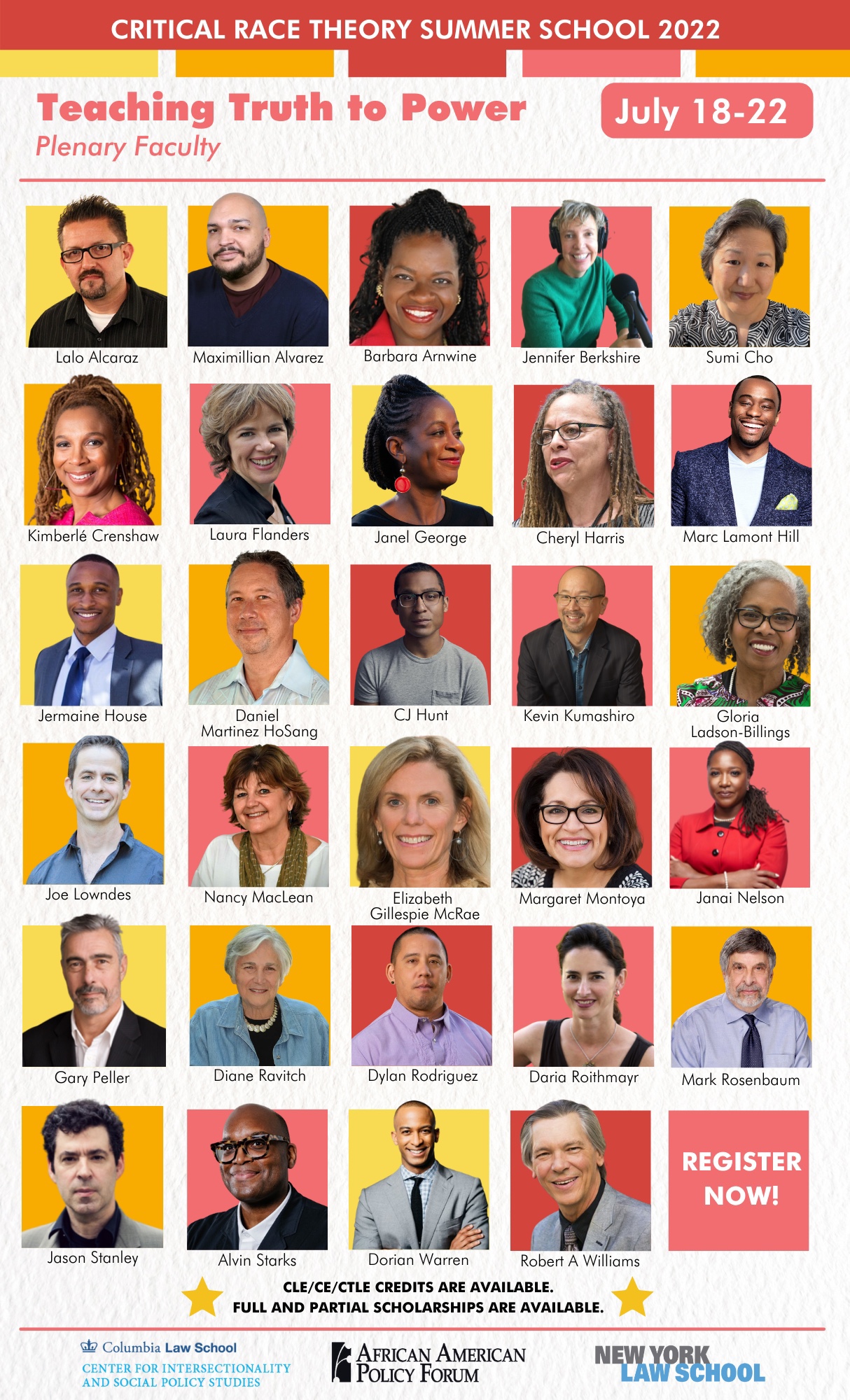
I will be a participant in a summer school program on Critical Race Theory. You are invited to sign up. I am part of the panel on July 20.

Greetings Friends and Colleagues, 

The African American Policy Forum is so excited to be Teaching Truth to Power this year at Critical Race Theory Summer School! It is crucial that we prepare racial justice advocates to defend the right to teach truth in classrooms. This powerful and urgent program runs July 18 to July 22, 2022. 

Seats are limited, so register here today! Events will be held daily between 1 p.m. to 6 p.m. ET throughout the week. Be sure to sign up for our listserv so that you don’t miss any updates. 

CRT Summer School 2022 will include a variety of plenaries, breakout sessions, and networking opportunities aimed to inform, activate, and inspire. We’re inviting parents, educators, students, social workers, legal practitioners, media professionals and concerned community members from all walks of life, because there is something for anyone to learn from the sheer breadth of options available this year! 

Daily Plenary Sessions

July 18 – Everyday CRT: A Commonsense Framework for Racial Liberation

July 19 – Public Schools, Private Agendas: How the Assault on Racial Justice Undermines Education

July 20 – Strange Bedfellows: The Left/Right Convergence that Enabled the Normalization of White Nationalism

July 21 – Define, Do Not Defend: How to Resist the Disinformation Campaign Against CRT

July 22 – Transforming a Moment to a Movement: Building A New Coalition to Secure our Multiracial Democracy

Discounts and Purchase Orders

Group sales (registration in increments of ten and five) are available and yield a 25% discount. For Purchase Orders please contact crt@aapf.org for more information.

Individual recipients of this email are eligible for a 10% discount using the following code during check-out: TSICAF-992000-IWANJ.

Full and partial scholarships are available. For more information visit our website: www.aapf.org/crtsummerschool.

On Demand Content

Great news! This year, all CRT Summer School content will be available to all registrants after the close of the event until Labor Day. You can watch anything you missed or revisit your favorites to ensure that you are a prepared racial justice advocate ready to defend the right to teach truth in schools.

We hope to see you at CRT-SS 2022! Please also share this email with your network – friends, colleagues, and constituents.

Onward,

African American Policy Forum

#TruthBeTold