Archives for category: Race

A recap: The College Board is the owner of the Advanced Placement program, which provides a syllabus and an examination based on that syllabus. The organization is officially nonprofit, but it is a business that pays large salaries ($1 million+) to its top executives and relies on its revenue stream from the SAT and AP.

The College Board has engaged with leading scholars over the past two years. As the course grew closer to completion, it held meetings with state officials to collect feedback.

Florida has sought to be in the forefront of states banning a vague concept called “critical race theory,” which many teachers see as censorship of any discussion of racism in the past or present.

Florida officials denounced the early draft of the College Board syllabus. When the final draft was released on February 1, all of the topics and names that Florida singled out were either eliminated or made optional.

The College Board insisted that it did not cave to political pressure but stood its ground.

Unpersuaded, more than 1,000 scholars and supporters of African American studies signed a letter of protest to the College Board.

More than 1000 African American studies faculty members, administrators and supporters in higher education condemned the College Board’s capitulation to the Florida Department of Education in the creation of the Advanced Placement African American studies course.

In a letter addressed to College Board CEO David Coleman, the collective called for the current curriculum to be rescinded, resources be made available for students “confronting censored AP content,” to stop making false claims that the current class properly teaches African American studies and to fight “widespread efforts by states to censor anti-racist thought.”

“African American Studies is the study of the persistence of anti-Blackness and the connections between historical and contemporary efforts to resist structural racism,” the letter read. “It is an interdisciplinary engagement with the ways in which people of African descent remade and re-envisioned the world through ideas, art, politics and social movements despite the enduring character of white supremacy.”

The letter said the College Board did not uphold its “commitments against politically-motivated meddling” and specifically took issue with the removal of terms like systemic racism and intersectionality at Florida’s request, which “demean, malign and caricature Black life and the study of it.”

Signees contend that the current curriculum now lacks the fundamental aspects of African American studies and if not rescinded, some faculty will advise their institutions against accepting the AP credit.

“As a result, students may take the course without ever encountering key words and related concepts in the field including intersectionality, Black feminism, racial color blindness, institutional racism, and Black Lives Matter,” the letter read.

“Students and educators cannot engage these topics and ideas if the terms themselves are censored, as the terms themselves convey critical insights that are central to African American Studies. African American Studies is more than the study of the Black past.’”

Read more at: https://www.miamiherald.com/news/politics-government/article272531681.html#storylink=cpy

Ron DeSantis responds to critics of his campaign to stamp out “critical race theory” by saying that Florida mandates a high school course in Black history. What he doesn’t say is that the course is offered in only 11 of the state’s 67 districts.

It isn’t offered because the state has not funded the development of a curriculum and has ignored the “mandate.”

The unenforced mandate was passed in 1994 in an attempt to make amends for the atrocities that occurred in Rosewood, Florida, exactly 100 years ago.

In 1923, 200 white terrorists sacked and burned the all-black town of Rosewood, Florida. The town was burned to the ground, and some who resisted were lynched.

Mary Ellen Klas wrote in The Miami Herald:

The painful details of the unpunished lynchings and vigilante violence went from being family secrets to the foundation for legislation awarding the first reparations paid by a state in the nation’s history to survivors of racial violence. They also became the catalyst for the 1994 law requiring the teaching of Florida’s Black history in K-12 schools. The law requires that courses comprise five components: African beginnings, the passage to America, slavery, the Reconstruction period after the Civil War and the “contributions of African Americans to society.”

DeSantis and his education commissioner Manny Diaz, Jr. object to any mention of the state’s violent racist history, and they certainly don’t want people today to know that the state agreed to pay reparations to the few survivors of the Rosewood massacre. That may be why they objected vehemently to any mention of the reparations movement in the AP course. They have a guilty conscience.

As DeSantis defends against charges that he is “erasing the state’s Black history,” he cites the 1994 law as evidence that it is required to be taught, but he is confronted with contradictions:

▪ Budget records show that the implementation of the law that has been on the books for decades has been not only understaffed and barely enforced, but DeSantis and legislative leaders have rejected requests to beef up resources to expand the teaching of Black history in Florida.

▪ The word “reparation,” which is central to the Rosewood saga that spawned the Black history law, is now considered off-limits in Florida classrooms because state officials have determined that discussion of the reparation movement, which involves offering financial restitution to the descendants of enslaved people for the harms of slavery and racial discrimination, is an attempt at “indoctrination.”

“We proudly require the teaching of African American history. We do not accept woke indoctrination masquerading as education,’’ wrote Education Commissioner Manny Diaz on Twitter last month as he defended the Department of Education’s decision to reject the Advanced Placement course in African-American Studies because it “lacked educational value.”

Hypocrites. DeSantis is hoping to become President by appealing to racism and to white grievances and resentment towards Blacks. He has amplified false claims about critical race theory, which involves the study of racism. He wants to make open bigotry respectable by loudly proclaiming that anyone who wants factual history and wants to eliminate racism is “woke.”

Lincoln spoke to “the better angels of our nature.” DeSantis appeals to the worst instincts of our nature.

Read more at: https://www.miamiherald.com/news/politics-government/article271882322.html#storylink=cpy

The College Board released this letter last night. It seeks to demonstrate that it did not cave in to Florida’s demands. It does not explain why all of Florida’s targeted names and topics were deleted.

Our commitment to AP African American Studies, the scholars, and the field

COLLEGE BOARD COMMUNICATIONSFebruary 11, 2023

Our commitment to AP African American Studies is unwavering. This will be the most rigorous, cohesive immersion that high school students have ever had in this discipline. Many more students than ever before will go on to deepen their knowledge in African American Studies programs in college. 

Teachers and students piloting this course are everywhere voicing their enthusiasm for the discoveries they are making. They are thriving in the openness and respect of the classroom environments they have built.

There is always debate about the content of a new AP course. That is good and healthy; these courses matter. But the dialogue surrounding AP African American Studies has moved from healthy debate to misinformation. 

We are proud of this course. But we have made mistakes in the rollout that are being exploited.

We need to clear the air and set the record straight.

  1. We deeply regret not immediately denouncing the Florida Department of Education’s slander, magnified by the DeSantis administration’s subsequent comments, that African American Studies “lacks educational value.” Our failure to raise our voice betrayed Black scholars everywhere and those who have long toiled to build this remarkable field.
  2. We should have made clear that the framework is only the outline of the course, still to be populated by the scholarly articles, video lectures, and practice questions that we assemble and make available to all AP teachers in the summer for free and easy assignment to their students. This error triggered a conversation about erasing or eliminating Black thinkers. The vitriol aimed at these scholars is repulsive and must stop.

    Rather, scholars are essential to this course, and each AP teacher must select works by scholars to include in the syllabus they submit for AP course authorization, as they do in a range of other AP courses that require secondary sources in the syllabus. We are requesting copyright permission to include works on our AP Classroom digital platform by every author mentioned in any iteration of the framework, bringing these readings to students worldwide by enabling AP teachers to assign them with one click.
  3. We should have made clear that contemporary events like the Black Lives Matter movement, reparations, and mass incarceration were optional topics in the pilot course. Our lack of clarity allowed the narrative to arise that political forces had “downgraded” the role of these contemporary movements and debates in the AP class. The actual pilot course materials teachers used were completed on April 29, 2022—far prior to any pushback. In these pilot materials, teachers were told to pick only one such topic. This topic could be assigned after the exam since it didn’t count and would have no impact on the student’s AP score.

    The official framework is a significant improvement, rather than a watering down: three weeks are now dedicated to a research project of the student’s choice, which counts as 20% of the student’s AP Exam score for college credit. This model better aligns with the flexibility colleges themselves often provide students to do an extended paper on a topic of their choice. We encourage students to focus their projects on contemporary issues and debates to ensure their application of knowledge to the present.
  4. We have not succeeded in focusing the conversation on the remarkable work and flexibility of the pilot teachers in different states. The fact is that pilot teachers everywhere are introducing the core concepts of this discipline with skill and care. Sadly, in some states teachers have more room to maneuver than others. We recognize that in some states teachers and students will be able to draw more widely on Black Studies scholarship than in others. But we must resist the narrative that teachers in states with restrictions are not doing exceptional work with their students, introducing them to so much and preparing them for so much more.

    By filling the course with concrete examples of the foundational concepts in this discipline, we have given teachers the flexibility to teach the essential content without putting their livelihoods at risk. The committee will continue to evaluate this approach, making further changes to the framework if they decide to do so.
  5. While it has been claimed that the College Board was in frequent dialogue with Florida about the content of AP African American Studies, this is a false and politically motivated charge. Our exchanges with them are actually transactional emails about the filing of paperwork to request a pilot course code and our response to their request that the College Board explain why we believe the course is not in violation of Florida laws.

    We had no negotiations about the content of this course with Florida or any other state, nor did we receive any requests, suggestions, or feedback.

    We were naive not to announce Florida’s rejection of the course when FDOE first notified us on September 23, 2022, in a letter entitled “CB Letter AP Africain [sic] Studies.” This letter, like all written communications we received from Florida, contained no explanation of the rejection. Instead, Florida invited us to call them if we had any questions.

    We made those calls, as we would to any state that says they have unstated concerns about an AP course. These phone calls with FDOE were absent of substance, despite the audacious claims of influence FDOE is now making. In the discussion, they did not offer feedback but instead asked vague, uninformed questions like, “What does the word ‘intersectionality’ mean?” and “Does the course promote Black Panther thinking?” FDOE did not bring any African American Studies scholars or teachers to their call with us, despite the presence in their state of so many renowned experts in this discipline.

    Since FDOE did not make any requests or suggestions during the calls, we asked them if they could share specific concerns in writing. They said they had to check with their supervisors and get permission. They never sent us any feedback, but instead sent a second letter to us on January 12, 2023, as a PR stunt which repeated the same rejection but now with inflated rhetoric and posturing, saying the course lacked “educational value.”

    On the day after Florida sent us that second letter, the AP executive overseeing the process of developing this course—the only AP leader who participated in the telephone calls with FDOE—followed up with the College Board’s FDOE liaison to ask whether we should ever expect any actual feedback from Florida. This is the response:

    “I don’t think they [FDOE] intend to provide any notes. My guess is that [the FDOE staff member] shared his notes with leadership (as he told us he would) and they shut it down. He might have even been instructed not to share notes.”
    We have made the mistake of treating FDOE with the courtesy we always accord to an education agency, but they have instead exploited this courtesy for their political agenda. After each written or verbal exchange with them, as a matter of professional protocol, we politely thanked them for their feedback and contributions, although they had given none.

    In Florida’s effort to engineer a political win, they have claimed credit for the specific changes we made to the official framework. In their February 7, 2023, letter to us, which they leaked to the media within hours of sending, Florida expresses gratitude for the removal of 19 topics, none of which they ever asked us to remove, and most of which remain in the official framework.

    They also claimed that we removed terms like “systemic marginalization” and “intersectionality” at their behest. This is not true. The notion that we needed Florida to enlighten us that these terms are politicized in several states is ridiculous. We took a hard look at these terms because they often are misunderstood, misrepresented, and co-opted as political weapons. Instead we focused throughout the framework on providing concrete examples of these important concepts. Florida is attempting to claim a political victory by taking credit retroactively for changes we ourselves made but that they never suggested to us.

    FDOE’s most recent letter continues to deride the field of African American Studies by describing key topics as “historically fictional.” We have asked them what they meant by that accusation, and they have failed to answer. The College Board condemns this uninformed caricature of African American Studies and the harm it does to scholars and students.

This new AP course can be historic—what makes history are the lived experiences of millions of African Americans, and the long work of scholars who have built this field. We hope our future efforts will unmistakably and unequivocally honor their work.

APTag

Contact

All Accessallaccess@collegeboard.org

The College Board respects your privacy, and we are committed to protecting it. Access our Data Privacy Principles, Privacy Statement, and Program-Specific Privacy Policies here.

Writing in the Tampa Bay Times, journalist Jeff Solochek reports that the College Board released a letter last night denouncing the Florida State Department of Education. The College Board says it was naive in trusting the latter agency, which wanted to score political points.

Taken aback by Florida’s attacks against its new AP African American studies course, the College Board late Saturday denounced the state Department of Education, saying it used the course to advance a politically motivated agenda.

The organization’s letter, published at 8 p.m. Saturday, came just two days after it released another statement that did not take such a harsh tone as it pushed back against the department’s claims that portions of the course are “historically fictional.”

“There continue to be conversations and misinformation, and we felt the urgency to set the record straight and not wait another day to do so,” a College Board spokesperson said. The College Board publishes AP courses and exams.

In its latest unsigned statement, the College Board said it is proud of its “historic” course, which has been crafted by renowned scholars. It acknowledged it made mistakes during the rollout and accused Florida of exploiting the situation.

Gov. Ron DeSantis has criticized the course and said Florida would not accept it without revisions. DeSantis has been using attacks against the way race is taught in schools, calling it “woke,” in many speeches amid wide speculation that he will use the issue as part of a presidential campaign.

Neither the governor’s office nor the Department of Education could be reached for comments late Saturday on the College Board’s statement.

Related: Florida claims about AP African American studies are false, College Board says

The College Board stated in its latest letter that it regrets not having denounced the Florida Department of Education’s “slander” that the course “lacks educational value.” The failure to speak up “betrayed Black scholars everywhere,” College Board wrote.

It said it also should have made more clear that the course outline did not include all the scholarly articles, lectures and other materials that will be part of the course. That led to the idea that some important thinkers were eliminated, it said — something Florida officials claimed credit for.

“The vitriol aimed at these scholars is repulsive and must stop,” the group wrote.

College Board made other defenses of the materials and the course preparation. Then it turned its sights on Florida’s interaction with the course.

It called the Department of Education’s claims that it had been in frequent dialogue with College Board over the course content “a false and politically motivated charge.”

Florida officials have claimed credit for changes made to the course outline.

“We had no negotiations about the content of this course with Florida or any other state, nor did we receive any requests, suggestions or feedback,” College Board wrote.

It said the organization was “naive” not to publicize Florida’s course rejection when it first came in September. It said the letter misspelled the word “African” and contained no explanation of the rejection.

The article continues with more detail. What it does not explain is why every objection raised by Florida was met by either a deletion of the name or topic, or a shift from “included” to optional.

Did the College Board cave to Florida or reject Florida’s demands? You decide.

Here is a brief interview about what should never be taught in school.

Governor Ron DeSantis and his Education Commissioner Manny Diaz Jr. denounced the new AP African American Studies course in January. They listed specific objections to the syllabus. When the College Board released its final draft on February 1, everything that Florida opposed had been deleted.

The College Board insisted that it did not bow to political pressure because the revisions were made before Florida officials denounced the original.

The New York Times reported that the College Board and Florida officials were in frequent contact between September and February 1. The first attack on the AP course was written by Stanley Kurtz and published in the National Review on September 12. Kurtz warned that the AP course was “NeoMarxist” and takes “leftist indoctrination to a whole new level.”

About the same time, the College Board and Florida officials began negotiations.

The Times said today:

While the College Board was developing its first Advanced Placement course in African American studies, the group was in repeated contact with the administration of Gov. Ron DeSantis of Florida, often discussing course concepts that the state said it found objectionable, a newly released letter shows.

When the final course guidelines were released last week, the College Board had removed or significantly reduced the presence of many of those concepts — like intersectionality, mass incarceration, reparations and the Black Lives Matter movement — though it said that political pressure played no role in the changes.

The specifics about the discussions, over the course of a year, were outlined in a Feb. 7 letter from the Florida Department of Education to the College Board.

The existence of the letter was first reported by The Daily Caller, aconservative news site. A copy of the letter was posted on Scribd. Its authenticity was verified by a spokeswoman for the Florida Department of Education, which released a copy early Thursday.

The College Board responded to the letter with one of its own, released on Thursday, saying that Florida’s concerns had not influenced any revisions to the course, which had been shaped instead by feedback from educators.

“We provide states and departments of Education across the country with the information they request for inclusion of courses within their systems,” the letter said, adding, “We need to clarify that no topics were removed because they lacked educational value. We believe all the topics listed in your letter have substantial educational value.”

The discussions between the College Board and the state took place as right-wing activists across the country were increasingly taking aim at school lessons that emphasize race and racism in America. Governor DeSantis, who has presidential ambitions, has cast himself as the voice of parents who are fed up with what he has called “woke indoctrination” from progressive educators.

The back and forth between Florida and the College Board is sure to add to the controversy over the Advanced Placement curriculum, which has prompted a debate among academics in the fields of Black studies, U.S. history and beyond. It has also cast suspicion on the College Board, long criticized for producing exams that seemed to favor white and affluent students.

Supporters of the new A.P. course — which can yield college credit for high school students who do well in it — say it encourages the study of Black history and culture, which have often had only a limited place in high schools. They see another advantage as well, saying that the class will attract Black and Hispanic students, who have not enrolled in A.P. classes as frequently as white students, enriching their study skills and potentially enabling them to amass college credit.

The Florida letter suggests discrepancies with the College Board’s account of events. Florida publicly announced that it had rejected the A.P. course in January, a few weeks before the College Board released its final guidelines — too little time, the board said, to make any politically motivated revisions. But according to the letter, the state informed the College Board months before, in September 2022, that it would not add the African American Studies class to the state’s course directory without revisions.

The Florida letter also outlines a key Nov. 16 meeting to air differences between the state and the College Board over the course. In the meeting, the state claimed that the A.P. African American Studies course violated regulations requiring that “instruction on required topics must be factual and objective and may not suppress or distort significant historical events.”

According to the state, the College Board acknowledged that the course would undergo revisions, while pushing back against the state’s request to remove concepts like “systemic marginalization” and “intersectionality,” which the College Board saw as integral to the class.

Nevertheless, by the time the course’s final framework was released on Feb. 1, those terms had largely been removed, except that intersectionality was listed as an optional subject for the course’s required final project, in which students can choose their area of focus.

In its response to the Florida letter, the College Board said, “We are confident in the historical accuracy of every topic included in the pilot framework, as well as those now in the official framework.” The board has also said that students and teachers could still engage with ideas like intersectionality through optional lessons or projects and through A.P. Classroom, a free website that will serve as a repository for important texts for the class.

Even so, many scholars have noted the omission of terms that, according to the College Board’s own research documents, are considered central to African American Studies as it is taught on college campuses.

Intersectionality, for example, is an influential theory first laid out by the legal scholar Kimberlé Crenshaw in 1989. It posits that race, class, gender, sexuality and other forms of identity intersect in ways that shape individuals’ experience of the world.

Professor Crenshaw’s work is important to several disciplines, including African American studies, gender studies and legal studies. She is also closely associated with critical race theory, a concept that has become a lightning rod among conservative curriculum activists, who object to schools emphasizing the concepts of racism or white privilege.

Ron DeSantis threw his weight around, and the College Board capitulated. He is now the official arbiter of what history may be taught to advanced students in American high schools.

Congressman Jamaal Bowman (D-NY) released the following statement about the College Board’s decision to remove segments of the African American Studies AP course to placate Florida Governor Ron DeSantis:

NEWS: Rep. Bowman Statement on the College Board’s 

Decision to Revise Its AP African American Studies Curriculum

NEW YORK, NY – The College Board recently revised its Advanced Placement course in African American studies eliminating some of the most important aspects of American history. 


Rep. Bowman released the following statement in response: 


“The College Board’s decision to surrender to the political pressure of Florida Governor Ron DeSantis and water down AP African American Studies has serious national implications,” said Congressman Jamaal Bowman Ed.D (NY-16). “To remove some of the most rigorous and historically significant Black history and scholarship from millions of students across the country is a crime against education and democracy. Truthful public education is the single best investment we can make as a country to build prosperous, healthy and equitable societies however, the College Board has shown us yet again that their interest is in sustaining and increasing profits and not in providing an ethical, insightful, and comprehensive curriculum that meets the needs of all students.”


“African American studies is critical to ensuring all students feel seen in their educational experiences, and is fundamental to our ability to address ongoing injustices and improve our society for all people. Because of the College Board’s decision to acquiesce to fear, students all over the country will now not have access to African American literature from prolific authors that have shaped American life. To deliberately strip our children of the opportunity to build a better future for the next generation is a recipe for disaster for this country and the world. African American history is American history. Removing any part of African American history in any curriculum removes a critical lifeline of America.”


Nikole Hannah-Jones‘ edited book The 1619 Project is easily the most controversial book in many years, maybe decades. I can’t think of another book that has been banned by conservative legislatures.

It first appeared as a special issue of the New York Times Magazine, where Hannah-Jones is a contributing writer. Soon after its publication, it was criticized by several eminent historians, who disagreed with the assertion that some Founding Fathers supported the Revolution to protect slavery. They had other objections and were no doubt miffed that a journalist had written a new history of the United States. The Times triple-checked, made some revisions, then The 1619 Project was published as a book and promptly denounced by conservative politicians, who hated the idea that Black people played a major role in the nation’s history, let alone a central role.

President Trump responded in September 2020 by announcing that he would create a “1776 Commission” to write a “patriotic curriculum.” Teaching that systemic racism exists, he said, was “a form of child abuse.” The day before the election, November 2, he established the commission by executive order.

However, he was busy trying to overturn the election and didn’t get around to appointing the members of the 1776 Commission until December 18. The president of the commission was Larry Arnn, president of conservative Hillsdale College. The commission included no professional historians of the United States. It held its first meeting on January 5 and released its new curriculum on January 18, no doubt a world record for the development of a course curriculum.

Hours after Joe Biden was inaugurated on January 20, he signed an executive order disbanding the 1776 Commission.

Now The 1619 Project has been turned into a six-part series, streaming on HULU. In states where it has not been banned, it should be a great tesaching tool. Count me as an admirer of the book. I have read many books about African American history, and I learned a lot by reading it.

Jesse J. Holland, a veteran journalist, reviews it here. He says that it’s a shame that the people who most need to see it are least likely to watch it.

Dan Rather and Elliott Kirschner write a blog called Steady. Their voice is always thoughtful, reasonable, informed, and…steady. I think that they, like me, are old enough to remember when we believed that overt racism was ebbing and that white supremacy was dead. Our hopes have been shattered since 2016. It takes the use of critical race theory to understand why we were so naive. Here is their take on the big Education story of the day:

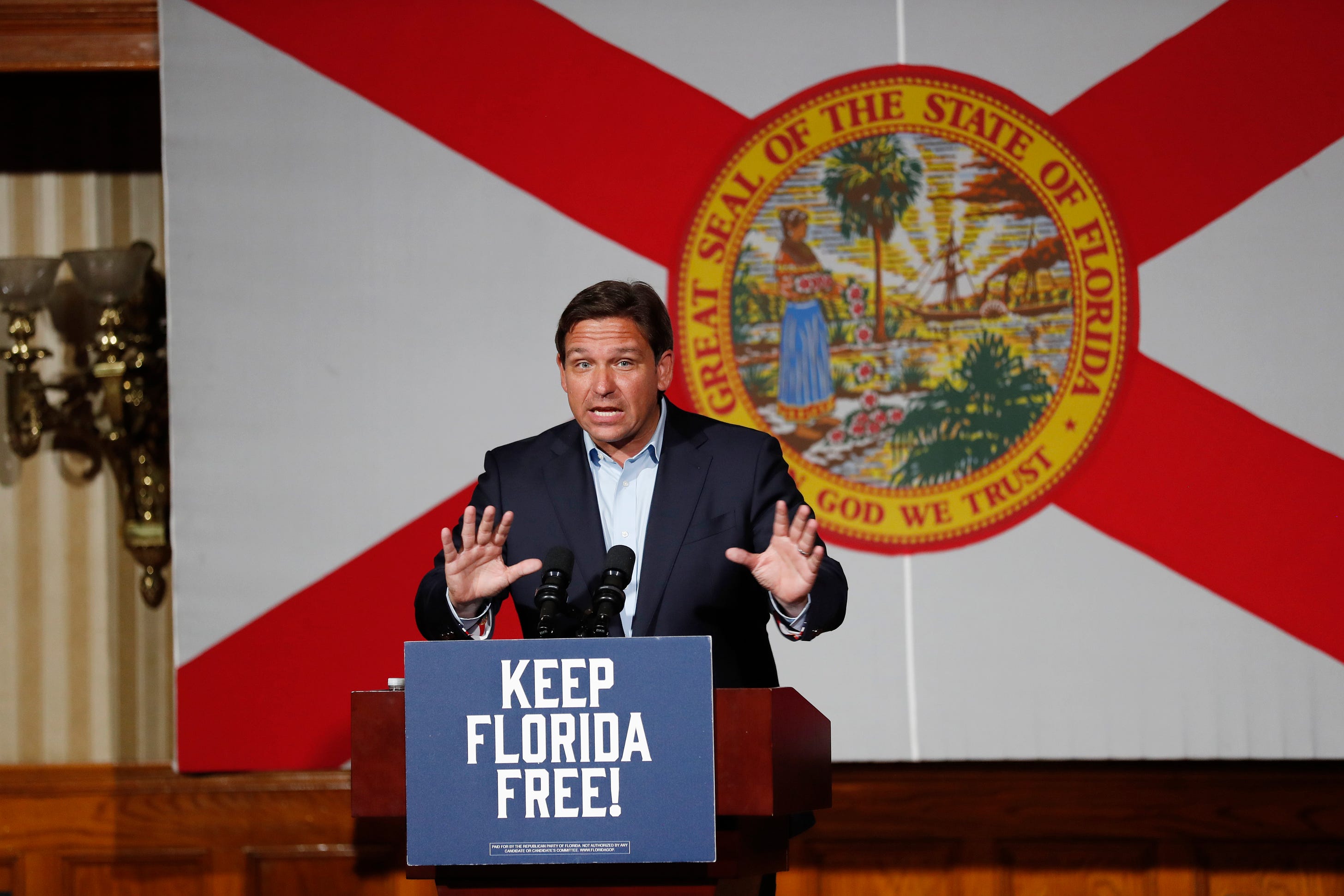
Photo credit: Octavio Jones

Editor’s note: this is an ironic banner in front of DeSantis. Florida is not free for those who don’t share his ideology. If you think racism exists today in Florida, you are not free to discuss it in school or college. You are free to agree with him.

Rather and Kirschner write:

Much of American history is entangled with racism and white supremacy. That is the reality of our beloved nation, no matter how much we wish it were not.

As we sit here nearly a quarter of the way through the 21st century, it is obvious that we need to have the maturity to look back to our past as well as ahead to the future. Can we do this with our eyes wide open? Will we study and learn from the lessons of history?

You can’t grapple with the truth if you hide it from view. Yes, our national narrative is an inspiring one — of freedom, rights, and new opportunities. But it is also a narrative of pain — of the bondage, rape, and murder of enslaved people. It is a story of mass death, broken treaties, and land stolen from Native people. And it is a story of persecution of the “other,” time and again.

The chasm between the noble promises of our founding documents and our historical realities continues to obstruct our national journey toward a more perfect union.

Yes, ours is a country that has facilitated exploration, innovation, and growth, but it is also one built upon families torn apart at the auction block, bodies whipped, and police dogs and fire hoses set against children.

Cities were redlined. Public schools were segregated. And despite our carefully cultivated national image as a meritocracy, throughout our history we have seen talent overlooked and our common humanity diminished on account of people’s race, religion, and sexual orientation.

The ripples of injustice continue to destabilize our society.

It shouldn’t be controversial to say any of this. But acknowledging these truths today is a political act, because it threatens the privileged narratives of those who seek to sugarcoat our past. These are men and women who serve their own ambitions by fortifying their cynical holds on power, delighting in division, feeding off fear, and applauding anger.

And that brings us to Florida’s Governor Ron DeSantis.

Listing all of his efforts to leverage the power of his office to attack equity, empathy, and justice would stretch this post immeasurably. But doing so would also jeopardize the central point: DeSantis is an opportunist. He is not weighing the merits of any one campaign. Rather, he wants headlines as a culture warrior standing up to “wokeness,” a term he has eagerly redefined to suit his own purposes. It allows him to sneer at and dismiss any attempt to reckon with American injustice.

DeSantis has focused his assaults on two of our society’s most traditionally marginalized groups: Black Americans and the LGBTQ community. While these populations have thus far felt the brunt of his targeting, we need to see clearly that his rhetoric is a threat to all who care about a democratic, peaceful, empathetic, and just America. Those of us with the greatest privilege should bear a special burden in rejecting this hate.

DeSantis’s pugilism has enabled him to consolidate power in Florida. Any opposition to his toxic initiatives must contend with the uncomfortable truth that voters validated his message and style via his landslide win in November. Now DeSantis thinks he can take his show on the road with a presidential bid. That remains to be seen. Florida has been trending Republican in recent years, and success there might not translate to the current battleground states, many of which saw big Democratic wins in the midterms.

All that being said, there is a great danger to framing this struggle primarily through the lens of electoral politics. This normalizes a discourse that should be rejected by society’s mainstream. Just as the outright bigotry of the past became socially unacceptable, so too should these latest attempts at divisiveness.

It should not surprise us that DeSantis is making schools — both K-12 and college — a central target. He wants to teach a distorted view of America. He wants to make dissenting speech not only suspect but even criminal. He wants to silence the voices of his critics and of critical thinking more generally. This is a playbook that has been followed by demagogues before to very dangerous ends.

It is essential that DeSantis not be covered by the press through a false equivalence paradigm. We can debate what we should teach and how to teach it. But we can’t replace the truth, as unsavory as it may be, with sanitized narratives that suit those already in power. This is a battle for the minds of the voters of the future. This is about what kind of nation we will become.

But DeSantis primarily cares about what kind of country we are now. He wants to appeal to fear because he thinks he can mine that fear for votes. That is his game plan. And he’s not hiding it. There can be no appeasement. DeSantis has already shown that he isn’t interested in deliberations or good faith compromise. Those would disrupt his approach of means to an end.

History illustrates that hatred can be taught, but so can empathy and justice. We are on a winding journey as a nation. And we have much farther to go. But we have made progress in the face of bigots and autocrats because people had the courage to forge the inequities of our past into a more equitable future.

This history, this truth, is what scares people like DeSantis the most. But it is one that can give us hope if we are determined not to look away.

When I first had a chance to read the College Board’s AP African American Studies syllabus, I predicted that the College Board was likely to beat a hasty retreat if its bottom line was jeopardized. I have not yet seen the revised edition, but the media is reporting that certain hot topics and prominent names were deleted to make the course palatable to Ron DeSantis and other conservative governors.

The New York Times reported:

After heavy criticism from Gov. Ron DeSantis, the College Board released on Wednesday an official curriculum for its new Advanced Placement course in African American Studies — stripped of much of the subject matter that had angered the governor and other conservatives.

The College Board purged the names of many Black writers and scholars associated with critical race theory, the queer experience and Black feminism. It ushered out some politically fraught topics, like Black Lives Matter, from the formal curriculum.

And it added something new: “Black conservatism” is now offered as an idea for a research project.

This last addition was a direct concession to criticism from the conservative National Review, which assailed the AP course as Neo-marxist indoctrination that left out the voices of African American conservative writers and scholars.

The Times’ story continues:

But the study of contemporary topics — including Black Lives Matter, incarceration, queer life and the debate over reparations — is downgraded. The subjects are no longer part of the exam, and are simply offered on a list of options for a required research project.

And even that list, in a nod to local laws, “can be refined by local states and districts.”

The expunged writers and scholars include Kimberlé W. Crenshaw, a law professor at Columbia, which touts her work as “foundational in critical race theory”; Roderick Ferguson, a Yale professor who has written about queer social movements; and Ta-Nehisi Coates, the author who has made the case for reparations for slavery. Gone, too, is bell hooks, the writer who shaped discussions about race, feminism and class.

After the curriculum was released, Professor Crenshaw said that even if her name and others had been taken out of the curriculum because secondary sources — theorists or analysts — were being eliminated in favor of facts and lived experience, the decision sent a troubling message. “I would have made a different choice,” she said. “Even the appearance of bowing to political pressure in the context of new knowledge and ideas is something that should not be done.”

But she said she was also disappointed because she had believed the course would capitalize on a hunger of young students to learn “ways of thinking about things like police brutality, mass incarceration and continuing inequalities.”

Instead, she said, “the very same set of circumstances that presented the need for the course also created the backlash against the content that people don’t like.”

David Blight, a professor of American history at Yale University, said Wednesday that he had written an endorsement of the new curriculum, at the College Board’s request, and that he believed it had much to offer not just about history but also about Black poetry, art and the origins of the blues, jazz and hip-hop. But he withdrew his endorsement on Wednesday, after learning that some sections had been cut.

“I withdrew it because I want to know when and how they made these decisions to excise these people, because that’s also an attack on their academic freedom,” Dr. Blight said.

PEN America, a free speech organization, echoed that concern. While the College Board had said the changes were not political, the board “risked sending the message that political threats against the teaching of particular types of content can succeed in silencing that content,” said Jeremy C. Young, senior manager of free expression and education at PEN America…

Dr. Gates, who was a consultant to the curriculum, said he was “sorry that the College Board’s policy is not to require secondary sources in its curricula.” He teaches Harvard’s introduction to African American studies, “and academic subjects such as ‘Intersectionality’ and critical race theory, the 1619 Project, reparations for slavery, Black homophobia and antisemitism are fair game, of course, for such a class,” he said in an email. The 1619 Project is an initiative by The New York Times.

The College Board insists it made its changes in December before DeSantis denounced the syllabus.

But the conservative attack on the syllabus began last September, when Stanley Kurtz received a leaked copy and wrote a scathing critique in The National Review called “Neo-Marxing the College Board with AP African American Studies.”

He wrote in September:

A new and sweeping effort to infuse leftist radicalism into America’s K–12 curriculum has begun. The College Board — the group that runs the SAT test and the Advanced Placement (AP) program — is pilot-testing an AP African American Studies course. While the College Board has withheld the course’s curriculum framework from the public, I have obtained a copy.

Although K–12 teachers and academic consultants working with the College Board have publicly denied that AP African American Studies (APAAS) either pushes an ideological agenda or teaches critical race theory, those denials are false. APAAS clearly proselytizes for a socialist transformation of the United States, although its socialism is heavily inflected by attention to race and ethnicity. Even if there were no laws barring such content, states and local school districts would have every right to block APAAS as antithetical to their educational goals. In any case, APAAS’s course content does run afoul of the new state laws barring CRT. To approve APAAS would be to gut those laws.

Kurtz followed with additional articles in The National Review lambasting the course as radical leftist indoctrination that violated state laws prohibiting the teaching of critical race theory. He applauded DeSantis’s attack on the course.

Although the College Board insisted that it’s revisions had nothing to do with the conservative pushback and was completely nonpolitical, Kurtz laughed:

Here’s the reality. The College Board is in a panic. Its repeated attempts to keep the APAAS curriculum secret have failed. That curriculum has now been widely published, and the teacher’s guide has been exposed here at NRO as well. My sources tell me that at least one other red state is seriously considering pulling out of the course. More red states are likely doing the same. The College Board knows that if it doesn’t stop the bleeding, the red states will be lost.

The College Board knew it had a problem months before DeSantis condemned the course. Could it take the risk of offering a course that would be rejected by red states that had already banned “critical race theory?”

The Times pointed out:

Acceptance for the new curriculum is important to the College Board, a nonprofit, because A.P. courses are a major source of revenue. The board took in more than $1 billion in program service revenue in 2019, of which more than $490 million came from “AP and Instruction,” according to its tax-exempt filing.

The College Board is a nonprofit but it pays hefty salaries. According ito Forbes, its Chief Executive Officer David Coleman (the architect of the Common Core standards) was paid $1.8 million in salary in 2018 (the last year that figures were available), and its president received more than $1 million. The company holds over $1 billion in assets.

Could they risk publishing a course that might be rejected by every red state? Maybe. But would they? Clearly, it was decided that it was easier to drop the controversial names and topics than to offend powerful conservative figures who might hurt their revenues.