Archives for category: Privatization

The U.S. Department of Education’s Office of the Inspector General conducted an in-depth audit of the federal Charter Schools Program, which was initiated in 1994 with a few million dollars by the Clinton administration. Thanks to astute lobbying by the charter industry, the modest program grew to $440 million a year with little or no accountability. Betsy DeVos pushed it aggressively to large charter chains, including for-profit chains.

You will be interested in this account of the audit, written by Valerie Strauss on her blog “The Answer Sheet” in the Washington Post, introducing an analysis by Carol Burris, executive director of the Network for Public Education.

This audit demonstrates the power and persistence of the Network for Public Education, a small but smart advocate for public schools. NPE operates with one full-time employee and a small number of part-time employees. Our work is motivated not by greed but by idealism and a passionate commitment to the common good. We believe in well-funded schools with experienced teachers for all children.

The introduction by by Strauss and the analysis by Burris has many links, but none transferred when I copied it. I copied some, but not all of them. I urge you to open the original and find the links.

Strauss begins:

The U.S. Education Department’s Office of Inspector General has released a new audit of the federal Charter School Program that found some alarming results about how charter school networks have used millions of dollars in funding. Among other things, the audit found that charter school networks and for-profit charter management organizations did not open anywhere near the number of charters they promised to open with federal funding. This piece looks at the new audit and what it tells us.


The reason this is not surprising is that investigations into the Charter School Programs by the Network for Public Education, an advocacy group that opposes the growth of charter schools, found that same problem, as well as others and reported it a few years ago. You can read my stories about their “Asleep at the Wheel” here and here. (The second report noted that the state with the most charter schools that never opened was Michigan, home to former education secretary Betsy DeVos, who has pushed to expand charter schools for decades.)


Charter schools are publicly funded but privately managed. The federal charter program, which began in 1994 with the aim of expanding high-quality charters, had bipartisan support for years, but many Democrats have pulled back from the movement, citing the fiscal impact on school districts and repeated scandals in the sector. The Biden administration is making some changes to the program in an effort to stop waste and fraud and provide more transparency to the operation of charters.


This piece was written by Carol Burris, executive director of the Network for Public Education and a former award-winning principal in New York. She has been chronicling the charter school movement and the standardized-test-based accountability movement on this blog for years. The Network for Public Education is an alliance of organizations that advocates for the improvement of public education and sees charter schools as part of a movement to privatize public education.


By Carol Burris


A new report issued by the Office of the Inspector General (OIG) entitled “The Effectiveness of Charter School Programs in Increasing the Number of Charter Schools” documents how states, charter management organizations, and charter developers often make wildly exaggerated claims regarding the number of charter schools they will open or expand to secure large grants.

The OIG, an independent watchdog of the U.S. Department of Education (the Department), found that for grants issued between 2013 and 2016, only 51 percent of the schools promised by Charter School Programs (CSP) recipients opened or expanded.


The OIG audit also exposed the sloppy record keeping and weak oversight that characterize CSP operations. Since 2006, the department has paid a private corporation, WestEd, millions of dollars to compile, check and update CSP records. WestEd’s present CSP contract exceeds $12 million. In total, WestEd has active contracts with the U.S. Department of Education worth more than $27.6 million. Yet an alarming number of grant records could not be found when requested by the OIG auditors. And while the Biden administration is attempting to clean up and reform the CSP, according to the independent OIG, more work needs to be done.


What did the Office of the Inspector General audit?
The audit had three goals. The first was to describe how the department’s Office of Elementary and Secondary Education tracked and reported the number of charter schools that opened and expanded using Charter School Program funds. A second goal was to determine whether CSP grant recipients actually delivered the number of charter schools they promised when they applied for their often multimillion dollar awards. Finally, the audit sought to determine how many schools were still open two years after CSP funding ended.


As its title stated, the audit was an attempt to measure the program’s effectiveness in fulfilling its mission. To conduct the audit, the OIG examined 2013 through 2016 CSP grant records. During that period, the department awarded 103 CSP grants to states, charter management organizations, or individual charter developers. Ninety-four were closely investigated by the OIG. The likely reason these years were chosen was that most grants are for five years. The auditors also found that the department often extends them further when grantees have not spent all of their money. Therefore, more recent grants were excluded because records were likely to be incomplete.

Incomplete and inaccurate records

The auditors noted that while the department, through WestEd, tracked spending and schools while grants were open, the tracking stopped as soon as the grant was complete. Therefore, the department had no way of knowing whether schools remained open beyond the years federal funds propped them up. This speaks to the purpose of the program — to open and expand high-quality charter schools.


When auditors asked the department to define the term high-quality, the department responded that the “CSP office does not determine whether a charter school is high-quality because state rules for determining high quality vary.”


“Additionally,” it said, “the determination of whether a charter school is a high quality is often the responsibility of charter school authorizers.” The department also told auditors that tracking a school’s existence after all money was doled out was not its job.


Even if the department wanted to do a quality check of schools as they were funding and expanding, the OIG found that there was no accurate base of information that they could rely on to determine whether they should continue what was often a multimillion-dollar grant. From the audit:


Although the CSP office created processes for tracking and reporting on charter schools that opened and expanded and charter schools that remained open through the grant performance period end date, those processes did not result in CSP grant recipients reporting precise, reliable, and timely information in their FPRs [final performance reports], APRs [annual performance reports], and data collection forms. The processes also did not result in the CSP office receiving all the necessary information to assess grant recipients’ performance or evaluate the overall effectiveness of the CSP.


Specifically, the department could not produce 13 percent of the required final reports from grantees and 43 percent of the required final data collection sheets. Auditors noted that grantees would report different numbers of schools opened or expanded among required collection forms and final reports. The accuracy of the final documents prepared by WestEd for the department was beyond the scope of the audit.

During our research for our second “Asleep at the Wheel” report, we found that the data collection sheets produced by WestEd and published in 2019 by then Education Secretary Betsy De Vos were replete with errors. Schools that had closed or never opened were reported as open or future. We also noted inaccuracies in recently submitted sheets we received from a Freedom of Information Act request, especially relating to the for-profit management status of the awardee.


But the OIG discovered a far worse problem yet. More than half of the schools that grantees committed to opening or expanding did not open or expand at all.

CSP grantees failed to meet commitments
Grant applicants asked for and received millions of dollars based on their promises to open and expand charter schools. However, when the auditors examined 94 grantee applications, they found that many grantees fell far short of their commitments.

The OIG determined that based on the commitments made in the 94 applications, state education agencies, CMOs, and developers promised to open or expand 1,570 charter schools using CSP funds.


As of July 2021, approximately 75 percent of the grant funding had been spent, yet grantees had only opened or expanded 51 percent of the charters they had promised.


This begs the question, where did millions of tax dollars go? I identified grantees by matching applications on the department website along with numbers in the data set with grant codes in the OIG report.


In its 2016 CSP application, the Florida Department of Education put forth what it called a “bold and ambitious plan to … develop a high-impact system to dramatically improve the opportunities of educationally disadvantaged students. The department said that it would use the grant to “support the creation of 200 new high-quality charter schools over the next five years.”

Florida received $70.7 million to achieve its “bold and ambitious” plan. According to the OIG report, it had only opened 33 percent — or 66 — of the schools it promised to open as of July 2021, although it had spent over 51 percent of the CSP funds.


Colorado’s 2015 application promised that it would open 72 charter schools with its over 24.2 million dollar grant. In the end, it opened fewer than half — just 33 — and expanded three schools. Nevertheless, it spent 87.5 percent of its funds.

Tennessee ambitiously promised to open 114 charter schools. It opened just 16, though it managed to spend 63 percent of its grant. These states are not outliers. The report shows a pattern.

And CMOs also failed to deliver. The KIPP charter network promised 65 schools for its jumbo $48,750,000 grant, one that well exceeded most states. It delivered 34 schools and expanded one.

Finally, there are grants to developers that the department directly provides. The Innovation Development Corporation received a $405,730 CSP grant to open The Delaware Met. It was open for just a few months before it was shut down. It also received and spent $72,000 to open DE Stem. That school was shut down before it even opened. Willow Public School, a Washington charter school, took and spent a $602,875 grant, opened, ran into trouble, changed its name, and then shut down.


The department and the National Alliance for Public Charter Schools attribute the problem to authorizer reluctance and state caps on the number of schools that can open. Really? Every state that got a grant has a state board that can override local rejections of applications. State applicants and the department are also well aware of caps. Take the case of the 2018 $78,888,888 CSP grant to the New York State Department of Education, which was outside the scope of the OIG audit.

In the New York State application review, which you can find here, raters acknowledge that New York State had not even used up its previous grant which was open beyond its terms and that charter expansion would be limited by the state cap on the number of charters. Yet they gave the application high scores, and it was approved. Where did that 2018 money go? Over $10 million went to provide staff development in technology for charter schools.

Jumbo grants

Why do states and charter management organizations ask for jumbo grants knowing they cannot deliver? Because they want the money to fund their charter school operations.


States and charter management organizations get to keep 10 percent of the cut for grant administration and technical assistance to charter schools. The bigger the grant, the bigger the cut.

Therefore, KIPP was allowed to keep nearly $5 million for its charter management organization, even though it fell way short of its commitment. The Florida Department of Education secured over $7 million for administrative services on its grant.
Second, there are no guidelines about how much an individual charter school can get. We have seen grants as low as $250,000 and grants to schools of $1.5 million. When a state realizes it cannot or will not meet its commitment, it just doles out larger amounts.


Third, until President Biden, no prior administration did anything about it over the Charter School Program’s existence. Therefore, states, CMOs, and individual schools realized pretty quickly that they could create grandiose applications, sometimes including falsehoods, and there would be no real consequences if commitments were never met.

The present department has taken a terrible beating for creating modest CSP reform regulations which are still being fought by the charter trade organizations and their proxies, including the Thomas B. Fordham Institute, a charter school authorizer. Challenges include both a lawsuit and a Republican-sponsored bill to overturn the new rules.

But as the OIG audit shows, reforms are desperately needed.

.
A new report on Florida’s education budget found that vouchers will divert $1.3 billion from public schools this year alone. This is money that goes mainly to religious schools that meet no accountability standards and are free to discriminate and ignore state and federal laws.

The amount of public money being spent on private schools in Florida has increased substantially since 2019, according to a new report by the Florida Policy Institute and the Education Law Center.

The analysis estimates that some $1.3 billion in taxpayer funds will be diverted school vouchers this year, amounting to 10% of the overall funding the state earmarked for public school districts for the 2022-2023 school year.

“This enormous increase in the flow of public dollars to fund private education has happened so quickly that many Floridians are likely unaware of the financial impact being placed upon public school districts and the way these voucher programs are affecting the availability of their tax dollars for public education,” the report reads in part.

Private schools don’t have to comply with federal civil rights laws or state laws on standardized testing, teacher certification or certain building codes in the way that public schools do.

Leon County Schools Superintendent Rocky Hanna, who spoke at a press conference about the report’s findings, said expanding vouchers is taking away resources away from traditional public schools.

“Enough is enough,” Hanna said. “What’s happening is, we are diverting funds from students with special needs, from students who otherwise are going to lose programs that are vitally important to their academic success later in life….”

The report – titled ‘Florida’s Hidden Voucher Expansion’ – traces the growth in the state’s voucher programs to 2019, when the state legislature created the Family Empowerment Scholarship or FES.

State lawmakers expanded the program in 2021, loosening the qualifications for applying and rolling two other voucher programs into the FES – the McKay Scholarship and Gardiner Scholarship, which set aside funding for students with disabilities.

Now, families who make nearly $100,000 a year are able to qualify for the FES. Students are no longer required to have attended public schools to apply for a voucher; now, students who were homeschooled can also qualify. Families also have greater flexibility in how the funds can be spent, including on transportation, private tutoring, online learning and other costs.

The impact of the vouchers on school districts varies depending on how much they rely on state versus local money. Funding for the FES comes from the Florida Education Finance Program or FEFP – which allocates money on a per student basis and is a key source of revenue for local school districts.

The report estimates that in the Miami-Dade school district, $225 million will be diverted to private schools in the 2022-2023 school year, amounting to “8% of the district’s total FEFP budget”.

Bacardi Jackson is the Interim Deputy Legal Director for Children’s Rights at the Southern Poverty Law Center. She argues that diverting public funds into private schools is part of a long legacy of undermining students’ equal access to education – especially Black students.

Open the link and read on.

Remember how voucher advocates claim that vouchers will “save” poor kids from “failing public schools”? T’aint so.

Stephen Dyer compared the progress of Ohio students in voucher schools to those in public schools. Guess what? The longer students are enrolled in voucher schools, the farther behind they fall.

He writes:

One thing you’d expect to hear a lot from voucher proponents is that students taking private school tuition subsidies do better the longer they’re in the private schools taxpayers are paying.

I mean, assuming these “choices” are so vastly superior to “failing” public schools, right?

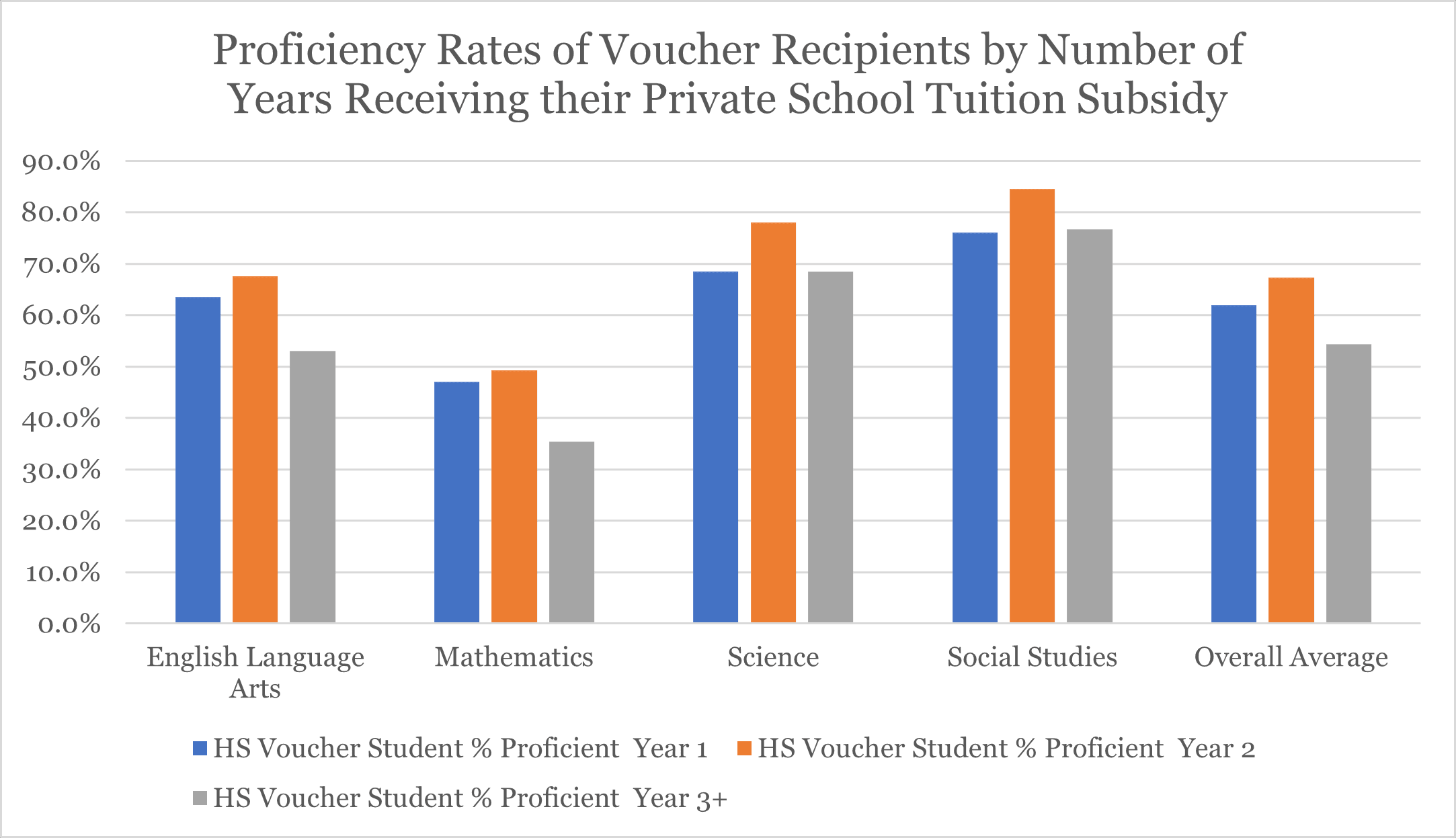
Yet you never hear that argument. Now I know why: according to state test data, the longer students take vouchers, the worse they do on state tests — in some cases a lotworse. Especially in high school.

Here is how students perform on state High School proficiency rates, depending on how long they’ve been taking vouchers. You can see pretty clearly that especially in English and Math, students do markedly worse if they’ve been taking vouchers for 3 plus years than they do if they’ve only been taking it for a year.

This provides some pretty compelling evidence that students taking vouchers are better prepared by public schools, but once they enter the private system, that success wanes. Only in Social Studies is there an increase, but it’s only a 0.9% increase. Math drops by nearly 1/4. Overall, there’s, on average, a 12.1% drop in proficiency rates the longer a high school student takes a voucher….

Let me put it simply:

  • Generally, Voucher students do worse on state tests the longer they take vouchers.
  • The Black-White achievement gap is much greater among voucher students than public school students.
  • Private Schools that accept Vouchers take a Whiter population of students than the districts from whence the students come.

I just have one simple question: How is it again that Vouchers provide “better” opportunities for students of color who are being “failed” by public schools, as voucher proponents continuously claim?

Because Ohio data sure suggest that students of color are best served by their local public schools, not the private schools who are more reluctant to take them, even with significant taxpayer-funded tuition subsidies.

Jeremy Mohler is communications director for the nonpartisan organization “In the Public Interest,” which fights the privatization of public goods and services. This article draws a link between policies of privatization and the rise of rightwing populism

He writes:

It’s one sentence in a 1,244-word article, but it made me pause and think deeply.

The article is a guest essay in the New York Times about the rise of Sweden’s far-right political party, which was created out of a neo-Nazi group and resembles the increasingly Trumpian Republican Party with its hatred of immigrants, journalists, and others.

The sentence: “Once one of the most economically equal countries in the world, Sweden has seen the privatization of hospitals, schools and care homes, leading to a notable rise in inequality and a sense of profound loss.”

That makes me wonder: How much has privatization contributed to soaring far-right populism, white nationalism, and fascism in the U.S.?

In Sweden, argues journalist and author Elisabeth Asbrink, high levels of political and economic inequality leaves people looking for answers to why they’re suffering and who is to blame—and far right leaders are happy to provide them.

“It was better in the good old days, [those leaders] say, and people believe them,” Asbrink writes. “Back to red cottages and apple trees, to law and order, to women being women and men being men.”

Sound familiar?

As we have documented, the privatization of public schools, water, and other public goods increases inequality. Government contractors create new fees for things like delinquent tax payments and probation. They lower wages and benefits for workers. Privatization also has helped shred crucial parts of the social safety net, like Medicaid.

Scholars have argued along these lines for some time now. “Neoliberalism creates a failed democracy,” says cultural critic Henry A. Giroux, “and in doing so, opens up the fascists’ use of fear and terror to transform a state of exception into a state of emergency.”

But I think it’s important to highlight the role of privatization—something embraced by both parties for the past 40 or so years.

A Democratic candidate for governor of Pennsylvania, Josh Shapiro, recently endorsed private school vouchers, which would take public money from the state’s lowest funded public schools and give it to private schools.

Like privately operated charter schools, private school vouchers might help some students, but they leave most of the others behind in public schools starving for resources.

Conservatives have long pushed for such privatization schemes, and Democrats have too often joined them. Meanwhile, America’s far too many underfunded schools continue to suffer—with policies like charter schools and vouchers only making things worse.

And we wonder why “Make America Great Again” resonates with so many people.

Stephen Dyer, a former state legislator in Ohio, writes a blog that tracks funding and privatization in Ohio. It’s called “10th Period.” He relies on state data to tell the truth about the failure of charters and vouchers. Here is the latest data on charter schools.

Dyer’s summary:

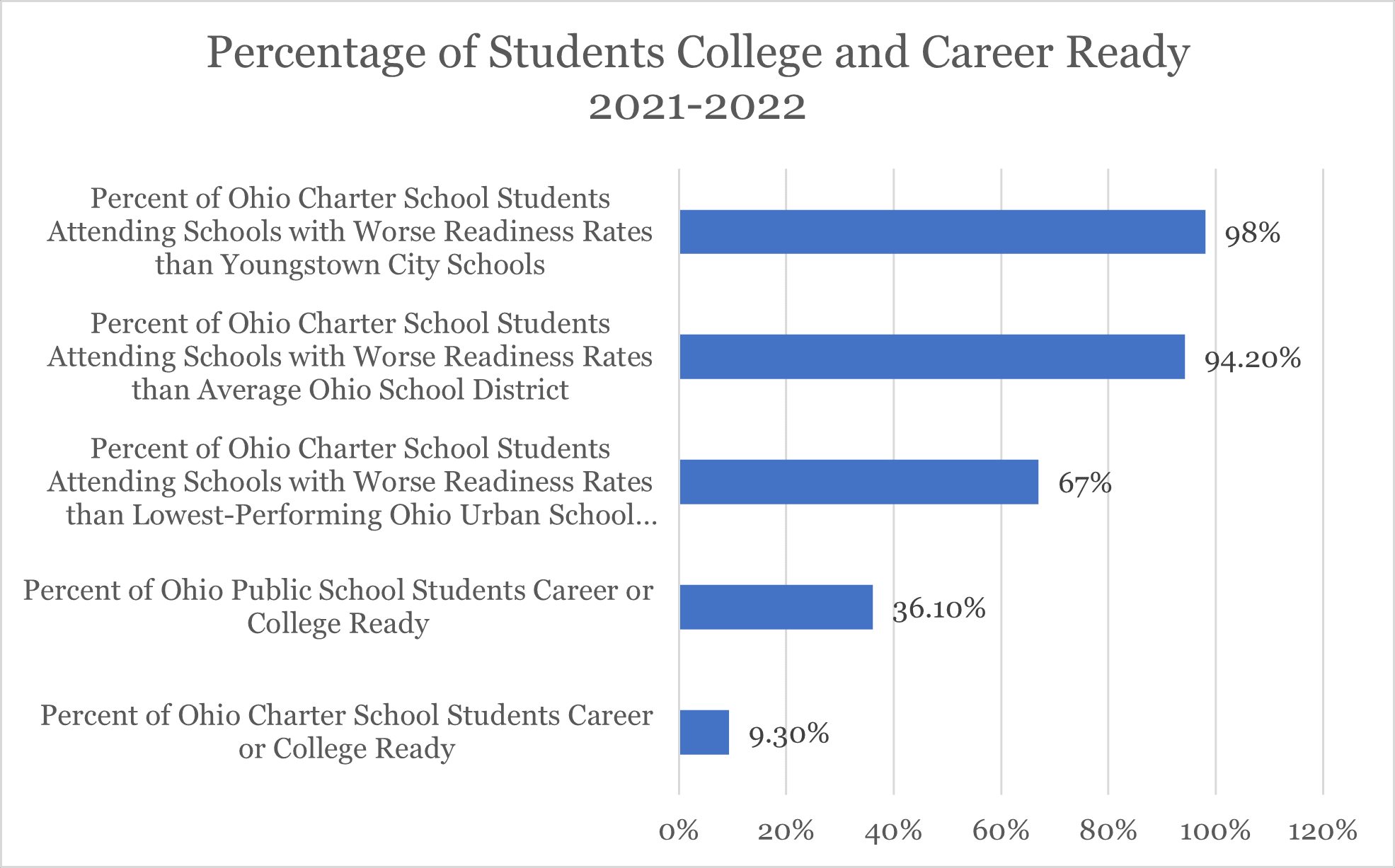
98 Percent of Ohio Charter School Graduates are Less Prepared for Post-Graduate World Than Students in Youngstown City Schools

Dayton is the lowest performing major urban district. Yet 2 out of 3 Ohio charter schools are less prepared than Dayton students

Ohio’s new report card has revealed something extremely troubling about Ohio’s Charter Schools. On a new measure called “Students in the 4-year Graduation Cohort who Completed a Pathway and are Prepared for College or Career Success”, only 9 percent of Ohio’s potential Charter School graduates met those qualifications. More than 36 percent of Ohio’s public school district students met those qualifications.

(Data Note: These data only examine students who could graduate high school, not whetherthey graduated high school. Public School Districts graduated 91.4 percent of their potential 121,968 graduates. Charter Schools only graduated 65 percent of their 4,657 potential graduates — a lower rate than any Ohio Public School District.)

Of the 43 Ohio Charter Schools with enough students to count in this College and Career Readiness measure, 18 schools had zero — that’s right, not a single student —who qualified as college or career ready. That means that 3 out of every 25 Ohio charter school graduates attended a school where not a single potential graduate was considered college or career ready.

But it gets worse.

More than 54 percent of Youngstown City School potential graduates are college or career ready. Only one Ohio Charter School — Dayton Early College Academy — has a higher rate.

That means that 98 percent of potential Ohio Charter School graduates are less prepared for post-high school lives than Youngstown City Schools’ potential graduates. Remember that Youngstown was seen as such a “failed” school district that the state created a new law to take over the district — in large part so more Charter Schools could open there.

Yet that district’s students are more likely to be prepared for post-high school lives than 98 percent of the 4,657 students potential graduating Ohio’s Charter Schools.

But wait. It gets worse.

The lowest-performing major urban school district in Ohio — Dayton — only had 5.7 percent of its students qualify as career or college ready.

Not good.

But before all you pro-charter school/voucher people scream “School Choice, Now!”, an astonishing 2 out of every 3 potential Ohio Charter School graduates attend schools with worse post-graduate preparation measures than Dayton.

Dayton is the home of the Thomas B. Fordham Institute and has been a hotbed of charter and voucher activity for 25 years. It’s not like school choice hasn’t been tried in Dayton.

And it ain’t working.

More Ohio students in all schools need to be career and college ready than they currently are. Full stop.

But what’s clear is that the best place for that to happen is in Ohio’s local public schools, not in Ohio Charter Schools.

I’d also like to use some space to bring up the Ohio Virtual Academy (OHVA) — the ECOT-sized online school. OHVA was paid to educate 14,530 students last year — more students than ECOT ever was paid to educate.

Yet they are just as bad as ECOT at preparing their students for the post-graduate world. An astonishing 87 of 1,820 potential OHVA grads were considered college or career ready. That 4.8 percent rate is lower than all but one Ohio school district — New Miami Local in Butler County, which only had 1 of 44 potential graduates considered college or career ready.

There’s more. If you want to follow the terrible results of privatization in Ohio, subscribe to Stephen Dyer’s blog.

Kathryn Joyce of Salon has written one dynamite article after another about the movement to destroy public education. In this post, she writes that Florida was ranked # 1 in “educational freedom” by the far-right Heritage Foundation, which wants to privatize all schools. This is a brilliant, must-read article!

Arizona, which has pushed hard to expand charters and vouchers, came in a close second.

That claim, along with the fact that the list’s top 20 states are mostly deep “red” and its bottom 10 are almost all dark “blue,” might come as a surprise to education watchers who are familiar with more traditional assessments of education performance. But in the Heritage Foundation’s inaugural “Education Freedom Report Card,” the think tank is grading according to a different metric entirely: not things like average student funding, teacher salary or classroom size, but how easily state legislatures enable students to leave public schools; how lightly private schools and homeschooling are regulated; how active and welcome conservative parent-advocacy groups are; and how frequently or loudly those groups claim that schools are indoctrinating students….

In the category of education choice, Heritage’s primary focus is on education savings accounts(ESAs), a form of school voucher that allows parents to opt out of public schools and use a set amount of state funding (sometimes delivered via debit card) on almost any educational expenses they see fit. ESAs can be used towards charter schools, private schools, parochial schools and low-cost (and typically low-quality) “voucher schools,” as well as online schools, homeschooling expenses, unregulated “microschools” (where a group of parents pool resources to hire a private teacher) or tutoring. The report’s methodology also notes that the percentage of children in a state who attend these alternatives to public schools figures into its rankings, implying that families who choose traditional public schools are not considered examples of educational “freedom.” The “choice” category also awards points based on how non-public schools are regulated, docking states that require accreditation or the same level of testing mandated for public schools.

States can lose points if they have credentialed teachers and gain points if they let anyone without any credentials teach. They also lose points if they have good pension plans and unions. They gain points by having strong bans on “critical race theory” and gain points for teaching patriotic history.

What’s especially noteworthy about this report — which Heritage says it will release on an annual basis — is how closely most of its ranking criteria track with the right’s broader education agenda. Over the last few months, almost all the issues addressed in this report have been highlighted as key action items for conservative education reformers, from the promotion of ESAs, as a preferred pathway to universal school vouchers, to alternative teacher credentialing to the expansion of the anti-CRT movement, which now encompasses anything related to “diversity, equity and inclusion…”

Framing the report by invoking the libertarian economist [Milton] Friedman — who, over the course of his controversial career, proposed eliminating Social Security, the Food and Drug Administration, the licensing of doctors and more — is a telling choice. In a foundational 1955 essay, as Heritage notes, Friedman famously argued that “government-administered schooling” was incompatible with a freedom-loving society, and that public funding of education should be severed from public administration of it — which would end public education as the country had known it for generations…

“Friedman may have been an accomplished number-cruncher, but when it came to social issues, he was a crackpot,” said Carol Corbett Burris, executive director of the Network for Public Education. He claimed that “vouchers ‘would solve all of the critical problems’ faced by schools,” from discipline, to busing to segregation, Burris continued. “He presented no evidence, just claims based on his disdain for any government regulation….”

By 1980, Friedman was declaring that vouchers were merely a useful waypoint on the road to true education freedom, which would include revoking compulsory education laws. In 2006, shortly before his death, Friedman told an ALEC audience that it would be “ideal” to “abolish the public school system and eliminate all the taxes that pay for it.”

For Heritage to use Friedman as its ideological lodestar, public education advocates observe, makes clear what the report values most in the state education systems it’s ranking….

“The fact that the Heritage Foundation ranks Arizona second in the country, when our schools are funded nearly last in the nation, only underscores the depraved lens with which they view the world,” said Beth Lewis, director of the advocacy group Save Our Schools Arizona, which is currently leading a citizen ballot referendumagainst the state’s new universal ESA law. “Heritage boasting about realizing Milton Friedman’s dream reveals the agenda — to abolish public schools and put every child on a voucher in segregated schools….”

“With this report,” added Burris, “the Heritage Foundation puts its values front and forward — that schooling should be a free-for-all marketplace where states spend the least possible on educating the future generation of Americans, with no regulations to preserve quality.” It’s no accident, Burris added, that Heritage’s top two states, Florida and Arizona, were ranked as the worst on the Network for Public Education’s own report card this year.

In a shocking development, Josh Shapiro, the Democratic candidate for Governor, has endorsed a school choice bill that was barely passed by the Republican House.

Shapiro is currently the state’s attorney general. He is running against an extreme Trumper who participated in the January 6 insurrection.

On Saturday, Shapiro told supporters that he favors the “Lifeline Scholarship Program,” which passed the Republican House in April by a vote of 104-98. That was the first time that a voucher bill ever passed the State House. It also was passed by the Senate Education Committee in June.

The bill is supported by the Trump-endorsed Republican candidate and puts Shapiro in the same boat with Betsy DeVos and Charles Koch. Shapiro joins the tiny number of Democrats, like Senator Cory Booker of New Jersey, who supports school choice.

You can bet that many parent advocates and teachers are shocked. The research is clear that school choice does not improve student’s educational outcomes. What’s up?

In Arizona, Save Our Schools Arizona and other parent groups are gathering signatures to force a referendum on the legislature’s plan to unleash a universal voucher plan. Parents and teachers overwhelmingly defeated a voucher proposal in 2018, but the salaries Koch-sponsored forces are pushing an even bigger voucher plan than before. In their proposal, every student in the state would be eligible for a voucher.

The Grand Canyon Institute has assembled the facts about the proposal. The greatest beneficiaries would be families whose children already attend private schools and parents affluent enough to pay for the cost of private high school.

Max Goshert, Assistant Research Director of the Grand Canyon Institute, writes:

Phoenix, Arizona – 2022 was a blockbuster year for Arizona policy. Along with a record budget and a billion-dollar investment in water, Arizona passed the largest private school scholarship program in the country. Previously, only families who met certain conditions, such as having a student with a disability, a parent who served in the military, a student who attended a D or F school, a student who lives on a Native American reservation, or a sibling of one of these students, could participate in the Empowerment Scholarship Account (ESA) program.

HB 2853 establishes universal eligibility for the ESA program, meaning that any student attending grades K-12 can receive a scholarship, which is estimated to average $6,966 in FY23 (certain circumstances, like disability status, can change the scholarship size). Unlike the 2017 expansion, which capped participation at 30,000 recipients, there is no limit on the number of students who can participate in the program.

Naturally, the polemic public debate resulting from the seismic shift in education has spawned a gamut of predictions on what the impact of this expansion will be. In an attempt to foster conversation that is grounded in fact, we address several questions about the ESA program by diving into the data.

How will the ESA expansion impact academic outcomes?

As with any policy that impacts education, the most important feature of the ESA expansion is how it impacts the quality of education that students receive. While the literature on the academic outcomes of participation in voucher programs is mixed, with some research reporting significant positive effects, several recent studies have found negative impacts on student achievement, especially in math, for statewide voucher programs in Ohio, Indiana, and Louisiana (Mills and Wolf, p.8). This is likely due to the rapid expansion of these voucher programs from smaller populations to the entire state, overwhelming existing private school infrastructure (p.43).

Arizona’s expansion is the largest in the country, with the Joint Legislative Budget Committee (JLBC) estimating that 36,078 public school students will begin participating in the ESA program. While some families may choose to homeschool given their new ESA eligibility, most will likely elect to attend a private school. Given that there are currently 59,171 private school students, Arizona private schools will see a 39% rise in demand, a tremendous increase in a short period of time that threatens to overwhelm existing facilities. Consequentially, Arizona will likely see a similar decline in academic outcomes due to the inadequate supply of private schools.

What are the accountability requirements for ESAs?

While ESA participants are required to use a portion of the program funding in reading, grammar, mathematics, social studies, and science, there are no minimum standards of academic achievement, such as reading or math proficiency. Private schools are not required to be accountable for the academic outcomes of their students. This contrasts sharply with Louisiana’s voucher program, where private schools must apply to become voucher recipients and undergo site visits, financial audits, and health and safety assessments from the Louisiana Board of Elementary and Secondary Education (Abdulkadiroglu et al, p. 4). Private schools must maintain eligibility by administering annual state achievement tests to voucher recipients along with financial audits.

Who benefits the most from ESA expansion?

Of the 9,710 applicants to the ESA program for SY2023, approximately 77% do not have a history of attending an Arizona public school. Effectively, these ESAs serve not to enable those attending public school to attend private school, but as a public subsidy for families that already had the means to pay for private schools or homeschooling. This is in line with a 2018 study by the Grand Canyon Institute which found that, while enrollment in the private school sector has been relatively flat, private school subsidies from Arizona’s General Fund have increased 50-fold from $3 million in SY2000 to $141 million in SY2016. As with other private school subsidies, the beneficiaries are largely those who are already attending private schools, not those attending public schools who would otherwise attend privates.

What are the limitations on ESA expenses?

ESA funding can be used to pay private school tuition, curriculum, homeschooling, and other educational expenses. The Arizona Department of Education (ADE) maintains a comprehensive list of approved spending categories and ESA allowable items. However, because state statute on allowable items is broad, parents are able to use ESA dollars for expenses with questionable educational benefit. Uptown Jungle Peoria, an indoor playground, recently attracted attention when they advertised that they would accept ESA money, an expenditure that ADE confirmed was appropriate. Parents may also use ESA dollars to purchase Lego kits, lawn darts, and croquet sets. ADE staff oversee ESA expenditures to ensure that they fall under program guidelines, yet allowable purchases that are more recreational may come at the expense of academic experience.

How much will the ESA expansion cost taxpayers?

Initial estimates from the JLBC are that taxpayers will spend $33 million in FY23, $65 million in FY24, and $125 million in FY25 from empowerment scholarships. With 77% of the 9,710 enrollees this school year coming from outside of the public system, the cost of these students will likely be around $52 million, very close to the JLBC estimate. As participation in the ESA program proliferates due to public awareness in the coming years, the burden of the program on the General Fund will rise substantially.

How will the ESA expansion impact school choice?

Arizona currently has 2,391 public schools and 448 private schools. The estimated award for FY23 of $6,966 covers the entire average cost of private elementary schools ($6,710), but only about a third of the cost of private secondary schools ($18,590). Consequentially, families will have to pay around $12,000 per student out of their own pocket once they reach high school, a financial barrier that will be too burdensome for those who rely on ESAs to pay for private school tuition. The families that experience the greatest expansion of school choice are those who are wealthy enough to pay the difference in tuition at the secondary education level.

The impact of school choice by the ESA expansion is further limited by the lack of public accountability of private schools, creating a vacuum of information on academic outcomes. With little means to determine how well private schools educate their students, parents must rely more on marketing and word-of-mouth, impairing their ability to make well-informed decisions for school choice.

HB 2853 is scheduled to go into effect on September 24 however that date could be put on hold if an initiative successfully gathers sufficient signatures to refer the issue to the November 2024 ballot.

For more information, contact:
Max Goshert, Assistant Research Director
mgoshert@azgci.org, 602.595.1025, Ext. 12

The Grand Canyon Institute (GCI) is a nonpartisan, nonprofit organization dedicated to informing and improving public policy in Arizona through evidence-based, independent, objective, nonpartisan research. GCI makes a good faith effort to ensure that findings are reliable, accurate, and based on reputable sources. While publications reflect the view of the institute, they may not reflect the view of individual members of the board.

Texas Governor Greg Abbott is determined to pass voucher legislation if he is re-elected. He has pushed for vouchers repeatedly and been defeated by a coalition of urban Democrats and rural Republicans. Our friends, the Pastors for Texas Children, have been champions of public schools, knowing that vouchers would undermine public schools in rural and suburban Texas. Governor Abbott, as usual, is pandering to the far-right extremists in his party who want to privatize everything.

The Texas Monthly describes Abbott’s sleazy tactics:

Undermining public schools has been a winning strategy for governors in several states. But for many rural, conservative communities in Texas, such schools are the only game in town.

By Bekah McNeel

At a July campaign event in Fort Stockton, Governor Greg Abbott played what has proven to be a winning card for Republicans across the country. “Parents,” he said, “should not be forced to send their child to a government-mandated school that teaches critical race theory, or is forcing their child to wear a face mask against their parents’ desire, or is forcing them to attend a school that isn’t safe.”

Actually, Abbott long ago outlawed mask mandates, and he and the Republican Legislature have heavily regulated what can be taught about race in Texas schools. But touting the progress of his agenda is less compelling than making a bogeyman of public schools altogether—telling parents that they deserve more control over what, where, and how their children learn. It’s a strategy that has well served Republican politicians such as Virginia governor Glenn Youngkin and Florida governor Ron DeSantis.

The buzz phrase “parental control” can cover a lot of ground, from oversight over classroom lessons and library books to school choice, and it’s a concept that most Republican voters support. But Abbott has lately taken parental control a giant step further by promoting school vouchers—government funds that would allow families to send their kids to public or private schools, including religious institutions and homeschooling arrangements. Supporters depict vouchers as the acme of parents’ control over their children’s education. But critics, including many conservative Texans, worry that they will inevitably drain resources from public schools, which in many small communities are the only schools available.

What most call “vouchers” can actually be several different things: tax credits for tuition or homeschooling supplies, access to a government savings account or scholarship that can be used for private school tuition, or a reimbursement for a set amount of educational expenses. Abbott has not committed to a specific kind of program, only to the idea that parents’ tax dollars should be able to pay for private school tuition.

These subsidies—often between $4,000 and $8,000 a year—don’t cover the full annual tuition rates of most private schools, which average between $9,000 and $11,000 in Texas, leading many critics to describe them as gifts to those who can already afford some level of tuition. The neediest students, they argue—those most likely to be in struggling schools—are still left with a considerable bill if they choose to participate.

“It looks like voucher programs in the past have always been about subsidizing affluent to wealthy folks who want private school for their kids,” said Charles Luke, codirector of Pastors for Texas Children. His group has always opposed vouchers, not only on the basis of the potential cost to public schools, but also on the grounds of separating church and state. Luke worries about government interference with religious or church-affiliated schools. “Government interference isn’t good for the church,” he said.

Where the money comes from and what strings are attached will be the devil in the details of bills soon to be filed for the 2023 Legislature, especially as Republicans vie to cut property taxes as well. Texas pays for public schools on a per-pupil basis, so every student lost represents a loss of revenue. School-voucher proponents say that state money should follow students to whatever public or private schools their parents choose. But superintendents argue that when a student leaves a public school for a private one, the district’s costs—for everything from classroom teachers to bus drivers—don’t decline proportionately.

Superintendents and elected representatives from rural areas—many of whom are Republicans—fear that the state would fund vouchers by reducing funding for public schools in places where such schools serve as community hubs, providing meeting spaces, sports competitions, and social services like school nutrition programs and health screenings. Places like Palestine, Texas.

Carol Burris is the executive director of the Network for Public Education. She recently received a press release from Betsy DeVos’s organization, the ironically-named American Federation for Children, asserting that the drop in test scores during the pandemic was the fault of the unions. The purpose of the “American Federation for Children” is to promote vouchers, especially for religious schools, and it is always eager to criticize public schools and teachers’ unions. AFC much prefers religious schools where children are indoctrinated without apology and where discrimination against unwanted children is common. Maybe they should change their name to the American Federation for Some Children (who share our religious views).

Burris writes:


Walter Blanks, the Press Secretary of the American Federation for Children, got on the rickety old soapbox of Betsy De Vos to blame teacher unions for the recent drop in student performance on NAEP. Moms for Liberty then jumped on calling for parents to “fire teacher unions.”

Did children suffer a decline in learning progress during the pandemic? Of course.  Anyone who has ever taught in a school, unlike Mr. Blanks, could have predicted a drop.

As a former teacher and principal, I know that the relationship between a student and teacher and the relationship among students is critical for learning. And I also remember all those students who, without my cajoling and watchful eye, would have been content to put their heads down or look out the window instead of at their books. That’s kids. The warm smile directed at them, the subtle tap on the desk, you can’t do that over the internet.

But are unions the culprit for the NAEP score drop? There is no evidence of that. 

First, if union influence in keeping remote learning were to blame, we would expect to see a larger drop in city scores than suburban scores. Suburban schools, with or without unions, were far more likely to open. However, suburban scores dropped significantly more in Reading for both low and high achievers than for city students, whose scores barely budged. In Math, the point drop for high achievers was the same; suburban low achievers lost more ground than their counterparts in cities. 

Second, we would expect regional differences depending on the influence of unions.

But there is only one point difference in the scores’ drops between the union-heavy northeast and the right-to-work dominated south. And western states, where unions are prevalent in the most populous states, saw much smaller score drops than the south.  

Not content to blame unions in general, Walter Blanks singles out Randi Weingarten as a national villain. Ms. Weingarten, a woman and strong leader, married to Rabbi Sharon Kleinbaum, has become a prime target for the misogynist right. But the facts do not bear out his accusations. Even as Weingarten was listening to her members concerned with their own family and student health, she was quietly working behind the scenes to get schools safely opened.

As a New York City public school grandma, I know it. And I am thankful for those efforts. My granddaughter returned to in-person learning in the fall of 2020 as New York City public schools opened. There were bumps and starts, but they opened. Even so, the majority of NYC parents still kept their children remote. 

Will Mr. Blanks blame those parents and hundreds of thousands like them who were fearful of sending their children back to school? 

Covid 19 was a national tragedy. Over one million Americans died horrible deaths.  We will feel the pain and ramifications for years to come. And yes, our children deserve all our efforts to repair the academic and emotional damage of the pandemic. But using that tragedy to push an anti-union agenda does not help repair the damage. It continues to enflame the anger of parents still reeling from the pandemic themselves.

Blanks ends his essay by touting how school choice is the answer. I am scratching my head to reconcile that with the American Federation for Children’s stalwart support for low-quality online virtual schools and homeschools. You can’t blame learning loss on a lack of in-person learning and then support virtual learning solutions. Will AFC now advocate for the closure of online charters and homeschools? Don’t hold your breath.