This article by Dominick Anthony Walsh in Houston Public Media is an excellent, even-handed description of the voucher debate in Texas. The issues and arguments could apply to any other state. He interviewed Josh Cowen, who spent close to 20 years as a voucher researcher but has since become a voucher critic. He also interviewed several voucher researchers who continue to support them.
“Once you got to the real ballgame and created the fully scaled up voucher programs, the results were really catastrophic,” Cowen said.
Researchers found that voucher programs in some states led to worse test score results than natural disasters like Hurricane Katrina and even the COVID-19 pandemic.
To sum it up: early voucher studies with small sample sizes showed mostly positive results, while the past decade or so of statewide results have largely shown poor outcomes, especially around test scores.
School choice research can be difficult to parse because there’s a lot of money and ideology involved.
Cowen worked on some of the early studies with Patrick Wolf, Distinguished Professor of Education Policy and the 21st Century Endowed Chair in School Choice in the Department of Education Reform at the University of Arkansas.
The former collaborators disagree about how to interpret findings.
Wolf has found some positive results around high school graduation and college completion. He also pointed to the effects of competition in Florida, where he said public schools’ test scores improved after they were forced to compete for students. But he has also observed negative impacts on test scores, including in Louisiana.
It’s worth noting that Patrick Wolf’s department and chair are funded by the Walton Family Foundation, the biggest private funder of school choice programs. when he cites high school graduation rates, he fails to mention the very high attrition rates in voucher schools. If 100 students enter a voucher program but only remain to 55 graduate from high school and 45 go to college, is the graduation rate 45/55 or 45/100?
Governor Greg Abbott’s voucher proposal would cost the state hundreds of millions, perhaps billions. And most of the money will fund students already enrolled in private and religious schools, as it does in every other state that has a voucher/ESA program.
Towards the end of the month, Governor Greg Abbott clarified for the first time what he means by school choice.
“Schools are for education, not indoctrination,” he said, to a round of applause.
“Now is the time to expand ESAs to every child in the state of Texas,” he continued.
He put his stamp of approval on a specific form of vouchers — education savings accounts, where families who pull students out of public education receive money. One bill in the legislature would give families about $10,000 a year that they can spend or hold on to.
The policy would mean that the Annapolis Christian Academy parents Abbott was speaking to could use taxpayer dollars for their kids’ religious private school tuition.
Now, where do you think students are more likely to be indoctrinated? At the Annapolis Christian Academy or the local public school?
All four bills put forward by Republicans this year to let parents use state education funding to cover the costs of educational opportunities outside the public school system failed to make it through this year’s General Assembly.
One bill carried by Sen. Amanda Chase, R-Chesterfield, died in the Democrat-controlled Senate. Two others carried by Dels. Phillip Scott, R-Spotsylvania, and Marie March, R-Floyd, failed in Republican-controlled House Education subcommittees
The most promising, House Bill 1508 from Del. Glenn Davis, R-Virginia Beach, initially cleared the House Education Committee, which Davis chairs, but ran into trouble later in the legislative process.
That bill, which gained the support of numerous Republicans including Lt.-Gov. Winsome Earle-Sears, would have created the Virginia Education Success Account Program, a proposal that would allow parents to set up a savings account funded with state dollars that could be used to cover educational expenses outside public schools in Virginia. Funds could be used for costs like tuition, deposits, fees and textbooks at a private elementary or secondary school in Virginia.
Last month, Davis estimated that an average of $6,303.25 could have been available per student. The program would only have applied to students previously enrolled in public school or who were starting kindergarten or attending first grade for the first time….
Davis said when the bill reached the House Appropriations Committee Friday, he was one vote short of what he needed to pass the legislation and agreed to send it back to the Education Committee in hopes of fast-tracking it through the approvals it still needed. He told the Mercury he considered adding a delayed enactment clause to the proposal to skirt concerns about the current budget cycle but said the committee was “one day short” of exercising that option.
But that bill died in committee.
Democrats opposed all of these measures, because they would take funding away from public schools.
Oklahoma State Superintendent Ryan Walters seems to have absorbed all his talking points from ALEC, the rightwing bill mill or he may just be trying to duplicate whatever Florida Governor Ron DeSantis is doing. All the talking points are there about critical race theory, “diversity, equity, and inclusion,” the “science of reading,” the fear of students turning transgender or being recognized as such, the readiness to censor anything that mentions sexuality or gender, and of course, vouchers for home schoolers and religious schools.
Superintendent Walters adds another item to his “reform” agenda: pay for performance, which has been tried for a century and never worked anywhere. It is hard to find an educational program that has been more thoroughly discredited, especially in the past dozen years. Performance these days equals test scores, and the teachers in the most affluent schools always come out in top, while those who teach the most vulnerable children are always on the bottom. No need to reinvent that broken wheel. Even Republican legislators know instinctively that “performance,” defined as test scores favors those in the whitest, most advantaged schools.
John Thompson, historian and former teacher, writes:
Last week, rightwing Oklahoma Secretary of Education Ryan Walters tried to “Shove ‘Choice’ Down the Throats of Unwilling Schools and Parents,” but he received serious pushback by influential Republicans for ignoring legislative norms in budget-making. This week, Walters’ revealed more of his plans to divide and conquer public schools, while ramping up the stakes for educators who don’t comply with ambiguous and weird mandates. The response by numerous Republicans, however, seems to indicate that a bipartisan effort against Walters’ and Gov. Kevin Stitt’s extremism is growing.
Walters started the Board of Education meeting, where his budget was presented with a prayer, which included a “reference to his school choice goals.” He then condemned “a loud and vocal crowd, a minority for sure, that say that all that is needed to fix the problems in education is to toss more money and to leave everything alone.” Walters then promised:
“There will be school choice. We will ensure that indoctrination and CRT (critical race theory) are eliminated in our state. We will also make sure that our kids are safe. There will be no boys in the girls bathrooms. There will be no pornography in our schools. We will make sure all of our vendors and the schools are focused on education and not diversity, equity and inclusion.”
Then, Walters met with rural superintendents in Atoka, the home of the Republican Speaker of the House Charles McCall, who has opposed voucher expansion. Walters explained that his “incentive pay plan that would reward a select few highly rated teachers in each school with up to $10,000 on top of their salaries.”
Walters then complained that:
“Tulsa has done so poor that if you took Tulsa Public Schools out of what we’re doing, we’re in the top half nationally. If you take Tulsa and OKC out, we’re in the top 15.”
So, the Tulsa World reported that Walters said:
“He would be open to pushing for Tulsa Public Schools to be broken up into smaller schools because of academic results there he says are dismal and parents who complain they are locked in because they can’t afford private school tuition and suburban schools bursting at the seams.”
At the same time, Walters’ allies are revealing more options for punishing educators who don’t comply with confusing mandates. While Walters seems to be backing off from his suggestion that all federal education funds be rejected, Sen. David Bullard filed a bill to “develop a ten-year plan to phase out the acceptance and use of federal funds for the support of K-12 education.” Sen. Shane Jett would “add seven more prohibited topics to House Bill 1775, which bans eight race and gender concepts from K-12 schools.” Jett and Rep. Terry O’Donnell seek to ban “teaching about sexual orientation and gender identity to elementary-age children,” And Jett “would outlaw any school policies that respect or promote ‘self-asserted sex-based identity narratives,’” as well as hosting “drag queen story time.”
Moreover, Sen. Cody Rogers “would prohibit school employees from calling students by names or pronouns that differ from the students’ birth certificates, unless having received written consent from the child’s parent.” Rep. Danny Williams would completely ban sex education from public schools.
And the Tulsa World reported, the Oklahoma State Regents for Higher Education responded to Walters’ “urgent request” to audit spending on diversity, equity and inclusion, or DEI, programs. The Regents, “scrambled hundreds of employees to compile a 10-year review of its spending history on and current materials used for … DEI programs.” They found that DEI spending was “a third of 1%” of the budget.
But, on the eve of submitting his budget to the legislature, Walters, as well as his ally Gov. Stitt, faced more bad news. As the Oklahoman reports, Attorney General Gentner Drummond, who defeated Stitt’s appointee, John O’Conner, announced an “investigation into misspent education funds” which “hung over the state Capitol on Wednesday.” As an investigation by Oklahoma Watch and The Frontier found, Connors’ lawsuit led “some critics to question whether the lawsuit was an honest attempt to recoup the funds.” Consequently, The Oklahoman reported, “some high-ranking lawmakers appeared hesitant to heed funding requests from Oklahoma’s new state superintendent because of his alleged part in the controversy.” The reason was it was “a mix of Walters’s and Gov. Kevin Stitt’s staff, not a state agency [that] was overseeing the program.”
The Republican Chair of the House Appropriations and Budget subcommittee for Education, Mark McBride, said (and Speaker Charles McCall confirmed) he had been authorized to investigate the lawsuit, and was wrong in not doing so. But now, as Nondoc reports, A.G. Drummond said he “would pursue accountability for state officials, potentially including Walters owing to his prior role as director of an organization tasked with dispersing the funds.” (for what it’s worth McCall, a likely candidate for governor, attended the budget presentation.)
The Tulsa World added that Stitt had blamed the parent company of ClassWallet for the “unflattering audit of federal pandemic relief funds under Stitt’s control.” But, the audit was critical of how the Stitt administration spent $31 million to provide pandemic relief for students’ educational needs.”
Nondoc further explained that Walters’ presentation to the committee “took the opportunity with some of the lawmakers’ questions to expound on campaign rhetoric, including addressing questions regarding his ‘liberal indoctrination’ comments and past declarations to get federal funding out of Oklahoma public education.” And, his two-point plan, funding “science of reading” and pay-for-performance, drew plenty of criticism.
Republican Rhonda Baker, chair of the Common Education Committee, told Walters, “We have, as a legislative body, voted on the science of reading.” She added, “We’ve been very supportive of that, and we have made sure that there has been funding for that, so none of that is new. What is challenging, though, … is that we are not keeping teachers.”
Moreover, Democrat Rep. Andy Fugate said Walters performance pay plan would backfire by drawing teachers away from high-challenge schools and finding schools where “it’s easiest to teach.” Similarly, McBride said:
“Merit pay, I’m OK with it if you work in the oil field or some industry, but in education I just don’t see it working. … If you’ve got a classroom of troubled youth, how do you compare that to the classroom over here where the teacher’s got all the A and B students? It’s just almost impossible to me to evaluate that.”
I’ve heard mixed appraisals as to whether Walters really believes his own words. Regardless, as his ideology-driven claims become more extreme, it seems more likely that there will be more bipartisan pushback against Walters, Stitt, and MAGA true-believers. And, who knows, maybe it will open the door to Republican Adam Pugh’s bill, based on discussions with hundreds of superintendents and education leaders and over a thousand educators, that “would spend $241 million on teacher pay raises, guarantee 12 weeks of maternity leave for teachers and offer $15 million in scholarships to future educators who pledge to work in high-poverty schools,” while bestowing respect on teachers.
Dave Dewitt, editor-in-chief of the Ohio Capital Journal, wrote a blistering critique of the state’s political leadership, who place the interests of the private sector above the common good of the public.
Many Ohioans pay taxes for schools but don’t have school-age children. Their taxes are meant to fund quality public schools because having educated citizens is a public good. Sending their money to unaccountable for-profit, private, and religious schools is a terrible abuse.
Compelling taxpayers to support private interests at the expense of public ones is not only unethical, but unconstitutional when those private interests intertwine with religion. American taxpayers should never be forced to fund the efforts of religious institutions of any kind. Not one red cent.
“Families are eligible for EdChoice scholarships by either living in the boundaries of a low-performing school or by household income. Currently, a family of four can qualify for state money if the household income is at or below $69,375, or 250% of the Federal Poverty Guidelines. The limit would increase to 400% of the Federal Poverty Guidelines, which would be $111,000 for a family of four, under DeWine’s proposal. …”
EdChoice vouchers are distributed as checks given to private schools to help cover a student’s tuition. The scholarship amount is currently $5,500 for students in grades k-8 and $7,500 for grades 9-12. Republicans who control the legislature expanded vouchers in 2012, 2020, and 2021.
So vouchers are already available to low-income households and in low-performing districts, which means the only reason to increase the voucher threshold to 400% is for a massive sweetheart giveaway to private interests.
DeWine’s budget also would increase per-student building funding for all charter schools from $500 to $1,000 per student — a 100% bump — and provide an extra $3,000 for each economically disadvantaged student, or a student who qualifies for free or reduced lunch — up from $1,750 currently.
DeWine, Hancock notes, did not propose any extra per-student money for traditional public education.
Sadly, American public education was marked as a $500 billion a year opportunity for private profiteering some time ago, and Ohio has been leading the way.
Getty Images.
Over the past several decades, Ohio’s seen one boondoggle after another.
Contrary to what you may have heard, average student achievement has been increasing for half a century. Across 7 million tests taken by U.S. students born between 1954 and 2007, math scores have grown by 95 percent of a standard deviation, or nearly four years’ worth of learning. Reading scores have grown by 20 percent of a standard deviation during that time, nearly one year’s worth of learning.
The narrative of “failing public schools” has been manufactured by corrupt private school bloodsuckers looking to wet their beaks in the public school money pot.
Aside from its false pretenses, it undercuts funding and saps the ability of public schools to address real problems.
But initiatives like these are the very things money-strapped districts are forced to cut first, alongside practical necessities like busing or the teachers themselves.
But he seems to want to balance this politically with a massive giveaway of public dollars to private school interests and the religious zealots aligned with CCV, which is unacceptable.
Many Ohio taxpayers — even those who don’t have children or whose children are no longer school-age — are happy to help fund public schools.
We understand that quality public schools increase property values and make our communities attractive places to live, which helps them thrive.
We want our communities and our public schools to thrive.
What most Ohio taxpayers do not want is our public schools to continue to suffer as money and resources are siphoned away from them to prop up private, for-profit, and religious interests.
But when it comes to funding those interests, or fully and fairly funding Ohio’s public schools, Republican Statehouse leaders have continually legislated for the private interests.
The vultures have poll-tested their messaging, so they love to talk about “school choice,” “parents’ rights,” and “funding the students, not the system.”
This is a smooth evasion that attempts to elide the fact that the question isn’t about whether parents have a choice where to send their kids for schooling; everybody already does.
What these interests are asking for are endless direct state subsidies to their private enterprises and religious institutions.
And that’s what DeWine and these lawmakers stand prepared to keep giving them, on our dime and at the expense of our public schools.
Every Ohio public school faces a yearly audit, but no such requirement exists for private schools receiving public vouchers. Why not? If public money is continually funneled into these schools, why are they not subjected to the same auditing standards as public schools to make sure that money is actually going toward appropriate education of students?In an analysis of one proposed bill, the nonpartisan Legislative Services Commission found that two-thirds of kids getting vouchers in Ohio’s expansion program have never been in public schools.
So that means that these kids aren’t being “rescued” from public schools; they were never going to public schools in the first place. This is pure state subsidy of private school tuition. As the LSC puts it, these are “existing nonpublic school students that represent a new state responsibility.”
Do the private schools lead to greater academic success?
Given all this, what assurances are Ohioans being given that our money will not be misused as it has been in the past? If this money is coming out of public school funding, what guarantees do we have that our public schools will be fully funded under the new Fair Funding plan?
COLUMBUS, OH — JANUARY 31: Ohio Senate President Matt Huffman (R-Lima) takes questions from the press following State of the State Address, Jan. 31, 2023, in the Warren G. Harding Briefing Room at the Statehouse in Columbus, Ohio. (Photo by Graham Stokes for Ohio Capital Journal. Republish photo only with original story.)
Ohio Senate Republicans led by President Matt Huffman have made clear they want the full “Backpack Bill” pushed by the CCV. That would be the biggest win possible for the private interests. As this DeWine proposal is brought and negotiated between the House and Senate, it looks likely to become, essentially, “Backpack Bill Light.”
I’m not holding my breath for full, fair public school funding. Legislators repeatedly steamroll DeWine and there’s no reason to think they won’t on this. There’s only one pot. It’s meant for high-quality public schools. But they always turn their backs on our public schools in favor of the private interests.
I come from a family of educators: My mom, a longtime teacher and junior high school principal; my sister, a primary school special education teacher; my grandmother, a high school teacher; my other grandmother, a school librarian; my grandfather, a school teacher and later the dean of a Kent State University branch.
I grew up surrounded by public educators, both at school and at home. I grew up generally believing that we as a society agreed about the importance and value of public education.
It came as a great shock to me when I entered adulthood that there are incredibly well-funded private interests working every day to undermine and rob our public schools.
Then I started seeing one for-profit school scam after another in Ohio, and realized that our state government was actively stoking the grift.
When I ask the public educators I know for their thoughts, many tell me there’s a definite role for traditional charters and private schools for the maybe 10% of students best off at them, but it’s unconscionable to rob the other 90% of public school students and prioritize the 10%.
That seems reasonable.
Traditional charter and private schools have a place, but they must face just as much scrutiny and accountability and auditing as our public schools if they are to receive our money.
And propping up private schools should never, ever come at the expense of our already woefully unsupported public schools.
We need to dedicate ourselves to a positive vision of the wonderful beacons our public schools can be when we invest in them, when we support them, when we encourage them to be creative, and when we give them the resources and opportunity to thrive.
Public education is not failing. Ohio politicians are failing to prioritize and invest in public education.
When Vallas ran before, he garnered only 5% of the vote. But this time, he is a contender. Vallas has a long record in education. He has imposed privatization wherever he went, or in the case of New Orleans, happily advanced the privatization agenda.
She begins her post:
In January 2018, I posted about Paul Vallas, who was at the time dropping hints about becoming Chicago’s next mayor. Vallas ran and lost, winning only 5.4 percent of the vote in the February 2019 general election.
Four years later, in January 2023, Vallas is considered a real possibility (see also hereand here) for at least landing in a mayoral-race runoff following Chicago’s February 28, 2023, general election.
Vallas as mayor would be bad news for Chicago. Full stop. On January 24, 2023, the Chicago Tribune posted this benign candidate bio for Vallas, but don’t be fooled, Chicago. Vallas is anything but benign.
Chicago voters need to be informed about what they would be getting should Vallas become mayor. Therefore, I am reposting some of the Vallas history I posted four years ago, in 2018.
Vallas is terrible with budgets and with fulfilling promises, but through it all, he has managed to serve and protect his own interests.
Please open the link and read her summary of Vallas’ career.
Joshua Q. Nelson wrote a story for FOX News, saying that I was a hypocrite for sending my sons to private schools (more than 50 years ago) and ignoring the fact that I turned against school choice publicly in 2010. His source was Corey DeAngelis, who works for Betsy DeVos. He has attacked me so often on Twitter that I blocked him.
A little bit of research would have shown that I supported school choice from the late 1980s (when charters first emerged) until 2008 (when I started writing a book about my disavowal of conservative education ideology—charters, vouchers, standardized testing, merit pay, and high-stakes accountability).
My change of mind and heart was well covered, not only in The New York Times, but in The Wall Street Journal and other publications). And the book became a national bestseller.
Christina Pushaw, a close aide to Ron DeSantis, amplified the story in her Twitter account, as did the notorious Chris Rufo.
Since the story came out, I have received numerous death threats. Yesterday, I got another one, a long and garbled message with religious allusions, which ended by saying “Yes, we will be ‘slaying Goliath.’ You are Goliath.”
I think Joshua Q. Nelson should be aware that he was played by DeAngelis and correct his story.
Meanwhile, I am flattered that Ron DeSantis and Betsy DeVos and their minions read my tweets and perhaps my blog. I would like to recommend that they read my last three books, where I demonstrate the importance of public schools and the hoax of school choice, which originated as the battle cry of segregationists after the Brown decision.
In a diverse society like ours, public schools bring children from different backgrounds together. They are essential for our democracy. They are the best choice.
Of course, parents are free to make private choices but they should not expect taxpayers to pay for their choice to send their child to a private school that discriminates against others.
Meanwhile, here is a reading assignment for Corey DeAngelis, Christina Pushaw, Chris Rufo, Ron DeSantis, and Betsy DeVos:
Garry Rayno of InDepthNH reports on opposition to the funding of New Hampshire’s expansive voucher plan, which has never been submitted to a public referendum. A lawsuit has been filed to block the use of public school funds for unaccountable vouchers. The voucher program, serving mostly kids who already attend students in private and religious schools, is far more expensive that its sponsor low-ball projections.
CONCORD — A bill to expand the uses for the state’s Education Trust Fund ran into opposition Friday as opponents said it would give the new Education Freedom Account program a blank check without accountability.
The prime sponsor of House Bill 440, Rep. Glenn Cordelli, R-Tuftonboro, said the bill simply “cleans up and codifies” what is in legislation elsewhere in statutes and comes at the Department of Education’s request. He noted the current trust fund statute does not address money for kindergarten or leases for charter schools.
“This bill clarifies (sections of law),” Cordelli said, “so there is a full picture of what comes out of the Education Trust Fund.”
However, those testifying in opposition at a public hearing Friday before the House Education Committee, said the bill is not a “housekeeping measure” but an attempt to divert millions of dollars to the Education Freedom Account program from public schools without sufficient accountability.
“The program was funded for two years as a pilot program and now you are giving it a blank check,” said David Trumble. “Why take a huge gamble. You built a program with no foundation for it and now you want to build a tall skyscraper on it.”
HB 440 would allow the Education Trust Fund to be used to pay for Education Freedom Account grants to parents and for phase-out grants to school districts losing students to the program.
The bill also changes the funding for the state’s portion for charter school leases from the general fund to the Education Trust Fund.
The Department of Education would be able to use 1 percent of the money in the Education Trust Fund to administer the EFA program, under the bill.
The Legislative Budget Assistant was not able to determine the cost of the changes in the bill because the department had not responded at the time of the bill’s printing, but noted the 1 percent going to the department would be $10.6 million in the current fiscal year, and $11 million in fiscal year 2024 and $11 million in fiscal year 2025.
The use of the fund for the EFA program is being challenged in court as the plaintiffs claim the program uses money earmarked for public education for private programs.
The suit challenging the funding for what has been described as the most expansive voucher program in the country, claims money raised by the Lottery Commission, and money from the Education Trust Fund may only be used for adequate education grants to school districts, citing the law creating the fund in 1999.
The suit, brought by Deb Howes as a citizen taxpayer, who is also president of AFT (American Federation of Teachers)-New Hampshire, seeks an injunction blocking the state from using any more of the Trust Fund Money to fund the EFA program.
Speaking at the public hearing, Howes reiterated her opposition to the bill, saying it is not a housekeeping measure.
“If money is coming out of (the Education Trust Fund),” she said, “does not mean it should be coming out of it.”
Public school and district tax money is not limitless, Howes said, noting it is all coming out of taxpayers pockets.
“When you run short of money,” Howes said, “you are going to shortchange the 160,000 kids in public schools.”
Please open the link to read the rest of the article.
But this acceleration is not a consequence of parental dissatisfaction, as the spokesman claims. It is the result of a well-organized, well-orchestrated, lavishly-funded campaign to defame public schools, led by the religious right and such organizations as the Koch network, the Heritage Foundation, The American Legislative Exchange Council, Betsy DeVos’ American Federation for Children, and the front groups they fund, such as Moms for Liberty and Parents Defending Freedom. ALEC undoubtedly prepared model legislation and handed it out to their far-right allies in state legislatures.
None of these funders or their puppet groups are mentioned in the article. It is no accident that multiple red states are debating bills to enact vouchers for private and religious groups or that 75-80% of the voucher funding in every state will end up in the bank accounts of families whose children never attended public schools. The legislation should be characterized as a handout to families whose children never attended public school.
It doesn’t take much digging to understand that the crusade against “critical race theory” (which is taught in graduate classes in law and education, not in K-12), against any mention of homosexuality, against “dangerous” books in school libraries, against fictional children who need litter boxes in the classroom because they think they are cats or dogs—is absurd propaganda designed to discredit public schools and pave the way for public funding of religious schools, which freely discriminate against students and families and openly indoctrinate their students into their dogma.
Instead of identifying the Heritage Foundation as a major player in the war to destroy public education, Stanford quotes its spokesman, who spouts the line that school choice is the result of parent dissatisfaction. What she does not mention is that voucher supporters maneuver to avoid public referenda because they know the public is opposed to vouchers. Right wingers go to great lengths to avoid the word “vouchers” and to quash referenda, because they are afraid of the voters.
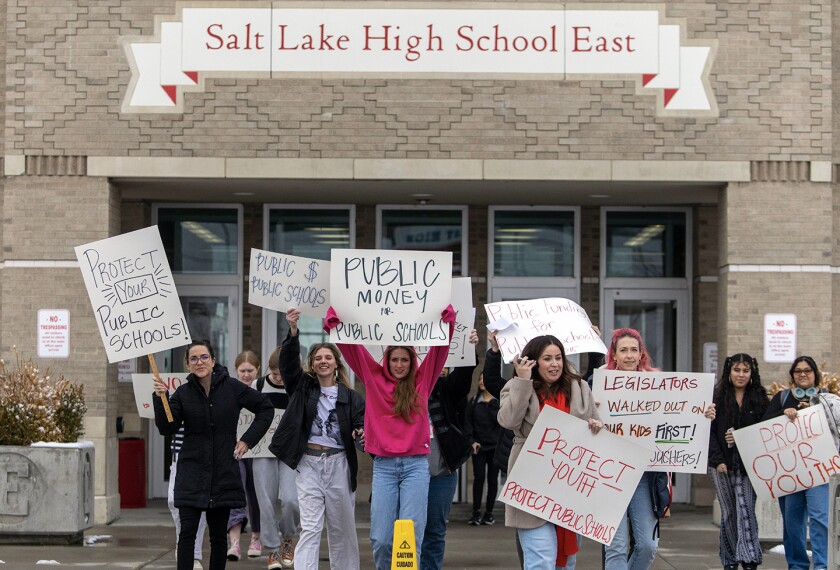
Students and teachers from East High School in Salt Lake City walk out of school on Jan. 25, 2023, to protest legislation that would create private-school vouchers in the state. Several years of pandemic restrictions and curriculum battles have emboldened longtime advocates of funneling public funds to private and religious schools in statehouses throughout the country.
Rick Egan/The Salt Lake Tribune via AP
Stanford begins:
Emboldened by frustrations with pandemic-era policies and battles over what schools are teaching, conservative parents and politicians have accelerated a push for school choice policies that would funnel public funds into private schools.
Though school choice has been debated for decades, the movement is in a unique moment as advocates use parent concerns over COVID-era mask requirements; curriculum addressing race, gender, and sexuality; and library book content to bolster their argument that families should have more options outside of traditional public schools. And the school choice proposals states are considering—and, in some cases, have already passed—are more sweeping than previous iterations.
Already this year, lawmakers in at least 11 states—Idaho, Iowa, Kansas, Missouri, Nebraska, North Dakota, Oklahoma, South Carolina, Texas, Utah, and Virginia—have introduced and, in some cases, passed school choice bills. Although they vary in scope, many of the bills would establish or expand private school voucher and education savings account programs that give families public funds to pay for tuition at private schools, cover the costs of homeschooling, or pay for other schooling expenses.
John Thompson, a retired teacher and historian in Oklahoma, has written frequently about events in his state for this blog. Here, he describes the political coercion that determined right-wingers are promoting in Oklahoma and calling it “choice.” From his description, some Republican legislators are worried about “liberal indoctrination,” transgender students using the “wrong” bathroom, litter boxes for children who think they are cats (this seems to be a QAnon idea), and the danger of “social-emotional learning.” Apparently students in Oklahoma have no social or emotional issues.
Ryan Walters, Oklahoma’s newly elected, extreme rightwing Secretary of Education, first says that “the state should have the ‘most comprehensive school choice in the country.’” Secondly, Walters pushes the rightwing Michigan-based Hillsdale College curriculum; he doesn’t want to allow schools to choose to retain research-based curriculums that he identifies as “liberal indoctrination.” As Clark Frailey, executive director of Pastors for Oklahoma Kids, says, Walters seems to be pushing for “Christian Dominionism,” which is “based on the philosophy that Christianity is at the core of America’s foundation and all institutions need to align with that viewpoint. If people won’t convert, then a government religion must be forced upon them.”
Two voucher programs for private schools and homeschools have been filed. The most interesting one is Sen. Shane Jett’s Oklahoma Parent Empowerment Act for Kids (PEAK). Even extremely conservative Republicans legislators worry that vouchers would undermine the finances of their rural schools. Jett seems to be offering a carrot and a stick to those vulnerable constituencies. He would impose vouchers only in counties with a population of more than 10,000 people. But, vouchers would be offered in counties with fewer than 10,000 residents if they are served by a “trigger district.”
The Oklahoman then reports:
Jett defined a “trigger district” as a public school system that allows or tolerates House Bill 1775 violations, use of school bathrooms according to gender identity, anthropomorphic behavior known as “furries,” disparagement of the oil and gas industry, lesson plans promoting social-emotional learning and animal rights activism, among other topics.
In other words, the bill would coerce schools into “choosing” to comply with the entire extremist agenda. But that begs the question about how educators would choose to deal with today’s threats to public education. Republican Sen. Adam Pugh’s newly revealed plan for school improvement was based on meetings with 200 public school superintendents; every college president in Oklahoma; and “hundreds, if not thousands” teachers and parents and advocacy groups. Based on these listening sessions, Pugh did not propose vouchers.
Pugh’s plan would raise teacher pay so the minimum starting salary was $40,000, “with graduated raises to the minimum salary schedule based on longevity.” The estimated cost would be $241 million, which is less than the cost of Sen. Julie Daniels’ voucher bill ($275 million). They would also create an “Oklahoma Teacher Corps” and a teacher mentoring system; provide certain teachers at least 12 weeks of maternity leave; update the school funding formula, and pass Pugh’s seven other constructive reforms.
As Pugh explained, “I hope this plan will demonstrate to teachers that we’re serious about the work that you do, and we appreciate how you pour your heart and your soul into educating kids, as we need you to stay in the classroom, and we need more of you.”
While that offers us a bit of a sigh of relief, Oklahomans should be aware that the push [to] move taxpayer money into private schools isn’t going anywhere. It’s a well-funded campaign and the state’s administrators and board members have been handpicked to make that a top priority.
I’m afraid I agree with the Stillwater News. Pugh’s bills raise hope. But Oklahoma Republicans will continue to coerce schools into compliance with their extremist privatization and Christian Dominionism ideologies – and call it “choice.”
On the other hand, more Republicans sound like they are getting fed up by Walters and his minions. This week, the Secretary of Education was supposed to present a budget to a legislative subcommittee for planning purposes, but a letter obtained by the Tulsa World shows that Walters seems to be prioritizing “ridding public education of ‘liberal indoctrination.’” Walters’ “spokesman” said he “has requested additional information on diversity, equity, inclusion programs (DEI) to fully understand the extent of indoctrination happening in higher education.”
The letter said:
Please provide a full outline and review of every dollar that has been spent over the last 10 years on diversity, equity, inclusion. Additionally, I want an overview of your staffing and the colleges underneath your oversight as the Chancellor of Oklahoma Higher Regents within every DEI program … and expenditures,” Walters wrote on letterhead of the Office of the Secretary of Education. “Lastly, please provide a copy of the materials that are being used in any of these programs.”
Neither has Walters followed legislative norms for presenting a public education budget. As Nondoc reported, Walters said he instituted a hiring freeze and a spending freeze for the State Department of Education when he took office and all related decisions require his approval. And, in addition to demanding vouchers, he has insisted on any teacher pay raise being performance-based. Above all, Walters said he would be bringing a completely different budget than the one his predecessor drafted.
Republican Toni Hasenbeck (R-Elgin) responded saying, “district superintendents had expressed concern for ‘the next four years’” because of Walters’ campaign comments. Rep. Dell Kerbs, (R-Shawnee) commented, “I don’t need elevator speeches. I need details.” Subcommittee Chairman Mark McBride (R-Moore) understood the argument that performance pay could be a part of teacher pay, but he said that Walters’ plan went too far. And then he tried to get Walters back to the normative procedures which the subcommittee follows for helping craft funding priorities.
McBride “interrupted Walters,” and asked, “Are you saying the budget will totally change — you’re presenting a budget that’s not going to be the same budget, and you’re going to totally change it?”
Nondoc reported that “McBride seemed confused and paused for a moment.” When Walters tried to change the subject, [McBride] interrupted him and asked why Walters was presenting a budget that would not exist in a week. Walters again changed the subject and, as Nondoc reported, “McBride interrupted him again, asking him to stay on topic presenting monetary figures rather than discussing policy and slipping into “campaign rhetoric.” McBride said, “With all due respect, I need the performance review for last year. That’s what you’re here to present.” Then, after that interruption, Walters stopped his presentation.
After the meeting, Matt Langston, Walters’s “spokesman” (a paid GOP consultant based in Texas) said, “Not one person in Oklahoma is surprised that Democrats are unhappy with the political theater that was orchestrated today.” According to Langston:
They do not want transparency, accountability or even basic reform because they are used to playing in the shadows. Union bosses, whining and liberal tears will not stop education reform, and the superintendent is looking forward to next week’s actual budget hearing.
Stay tuned! When Walters reveals his budget, chaos and vitriol will increase, and we’ll see whether Walters really believes he can implement his promise or “suggestion,” that “received some pushback from lawmakers in 2022,” a ten-year plan to reject all federal spending on education …
In a taped conversation, a lobbyist for vouchers in Utah said what everyone suspected: “I can’t say this is a recall of public education, even though I want to destroy public education. I can’t say that. The Legislature can’t say that because they’ll be just scraped over the coals.”
She said the quiet part out loud.
She was supposed to say that vouchers would give every child a chance to get a better education.
She forgot to say that vouchers would enable EVERY child to get a great education “regardless of their zip code.”
She forgot her talking points.
She said what she and her team say when there are no reporters or recorders around. The goal is “to destroy public education.”
When the story was published, the lobbyist apologized for saying what she believed.