Yeah, yeah, I know it’s a strange headline, but it’s true.
Here is the story: Politico reporter goes to Arizona to cover the voucher story. Discovers that the chief advocate for vouchers is a beautiful, charming mom who uses state money to home-school her five children.
Writer is wowed by this mom. Writer notes that mom is funded by DeVos and Koch machine. It doesn’t matter. She’s so charming and pretty, who cares that vouchers are busting the state budget?
Writer pays more attention to the adorable mom than to those fighting to stop the damage she is doing to kids, public schools, and communities. Somehow she becomes the hero of the story.
Who cares that vouchers are used mostly by families whose kids never went to public schools? Who cares that vouchers are harming the state’s public schools?
Who cares that Arizona voters overwhelmingly rejected voucher expansion? Who cares that the legislature ignored their vote?
Who cares that less than 5% of the state’s students are undermining the state budget and the schools that educate the other students?
Families, mostly from high-income zip codes, have applied the taxpayer funds for everything from ski lift passes to visits to trampoline parks, a $4,000 grand piano, more than a million dollars in Legos, online ballet lessons, horse therapy and cookie-baking kits. Proponents justify expenditures like these in the name of parents’ prerogative to shape their children’s education or by pointing to wasteful spending by public schools. As a result, ESA costs have ballooned from the legislature’s original estimated price tag of $100 million over two years, to more than $400 million a year — a figure, critics have noted, that would explain more than half of Arizona’s projected budget deficit in 2024 and 2025.
Ain’t it grand?
Love is love, even when it is underwritten by billionaires!
The Network for Public Education urges you to sign a petition opposing the appointment of Linda McMahon as Secretary of Education. McMahon is committed to privatization of our neighborhood schools. Her background in the wrestling industry does not qualify her to lead the federal role in education.
Writing in his blog Curmudgucation, Peter Greene reviews Kevin Huffman’s career as a big Reform honcho and his latest advice about what the federal government should do to make schools better. Peter noted that none of Huffman’s ventures has been successful, which makes a fine example of someone who has mastered the art of “failing upward.”
Peter Greene writes:
A few weeks ago, Kevin Huffman was in the pages of the Washington Post, bemoaning the lack of education discussion during the Presidential campaign and offering thoughts about What America Needs To Do Next. Nobody needs to read it. Really.
Kevin Huffman is a long-time reformster; in fact Kevin Huffman, as the Tennessee Grand High Commissioner of Education, represents a reformster milestone. Huffman’s career path took him to Swarthmore, which led to a Teach For America posting, which led to law school, which led to practicing education law in DC, which led back to TFA, first as general counsel and later as various VP executive titly things. Then, a few years later, Governor Bill Haslam tapped him for Tennessee Educational Poobahdom. Which made him the first TFA temp to get to run an entire state’s education system.
Once in charge, he made his reformy mark. (I will mention, because someone always brings it up, that he was for a brief while married to Michelle Rhee). He chimed in with Arne Duncan to claim that low-achieving students, including those with learning disabilities, just needed to be tested harder. And as a super buddy of charter schools, he took $3.4 million dollars away from Nashville city schools because their board didn’t approve the charter that he had personally shepherded through the process.
He became one of Jeb Bush’s Chiefs for Change.Huffman was a loyal Common Core warrior and was right at the front of the line to hand the feds the Race to the Top keys to Tennessee education in exchange for a NCLB waiver. Huffman never met a reformster idea he didn’t like (evaluation to root out bad teachers, performance based pay, charters)
Huffman also recruited Chris Barbicfrom Houston to come run the Achievement School District. The ASD was an attempt to see if New Orleans style public-to-private education conversion could be implemented without the fortuitous advent of a hurricane. Could human beings deliver that kind of destruction without the assistance of nature and create a network of business investment opportunities private charter schools?
The Achievement School District was created to catapult the bottom 5% of schools in Tennessee straight to the top 25% in the state. In doing so, we dramatically expand our students’ life and career options, engage parents and community members in new and exciting ways, and ensure a bright future for the state of Tennessee.
Let’s just be real: achieving results in neighborhood schools is harder than in a choice environment. I have seen this firsthand at YES Prep and now as the superintendent of the ASD. As a charter school founder, I did my fair share of chest pounding over great results. I’ve learned that getting these same results in a zoned neighborhood school environment is much harder.
Failing so consistently that a little more than a week after Huffman’s WaPo op-ed, Chalkbeat reported that research by Brown’s Annenberg Institute found that the ASD “generally worsened high school test scores.” It also didn’t help on ACT scores and “data related to attendance, chronic absenteeism, and disciplinary actions wasn’t encouraging, either.” Researchers found neither short-term nor long-term gains for students, and Tennessee legislators seem to finally be getting the idea that the ASD is junk.
But the guy who created it is still failing upward, having passed through the reform-pushing City Fund and now working as CEO of Accelerate, one more educational consulting fix-it shop operated by people with lots in the reformy funding universe (the board includes John White and Janice Jackson). They’re particularly keyed in to tutoring and individualized instruction, both computerized.
So what advice does the chief with no actual edu-wins to his name have to offer? Well, he thinks that George W. Bush was swell, and remember, reading and math scores wet up in the early days of No Child Left Behind. Folks like Monty Neill of Fairtest have since pointed out that these gains were only on the state Big Standardized Test. I was in the classroom at the time, and I can tell you exactly why test scores went up initially– because once the tests were rolled out we could learn how to teach to the test, and after a few years we had collected all the test prep gains we were going to get.
Huffman likes the “gains” in race to the Top testing which, again, reflect teachers learning how to game the new PARCC and SBA tests.
But, Huffman complains, by the end of the Obama administration, the feds were giving in to demands for more local control and pre-COVID test scores were already dipping, then “following the academic wreckage covid-19 left behind, heavy deferral to the states on spending and policy has left us with massive learning gaps and no national plan for closing them.”
It takes a person whose educational “experience” is almost entirely outside the classroom to believe that the Big Standardized Test is a useful measure of learning that should be the centerpiece of education policy rather than understanding that BS Testing is the most toxic force to be unleashed on education in the last couple of decades.
Huffman argues we need “strong national leadership around education policy,” which makes sense only if such leadership is guided by an actual understanding of teaching and learning and schooling, but history suggests that isn’t happening any time ever. But, he asserts, everyone wants “the best basic education for their children.” I don’t know what to do with that “basic” in there.
How do we get it?
For starters, the next president should issue a national call for all states and all groups of students to surpass pre-pandemic learning levels in reading and math by 2030 — and direct the Education Department to report on each state’s progress.
God, one of my least favorite forms of management– management by insistence. This is like sales managers who issue increased sales targets with helpful directives like “sell more.” But worse, this is demanding that schools focus more intently on the wrong damn target– test scores.
Huffman also wants the feds to replace ESSA (too weak) with “a return to nationwide education goals” along with accountability measures. And also, grants for states that “pursue ambitious education reform” as, one assumes, defined by the feds.
In other words, Huffman would like to rewind to 2002 and start NCLB/CCSS/RTTT all over again, and I guess we can say that keeping on with something that hasn’t worked yet is on brand for Huffman. But man– it all didn’t work the first time, and not just “didn’t work” but “did more harm than good.”
But he has some specifics that he wants the feds to enforce this time. One is phonics-based learning and I don’t have time to get into the reading wars other than to say that any time someone says “if we just use X, every student will learn Y” they are wrong.
He also wants the feds to boost high-dosage tutoring, which coincidentally is one of the foci of his present gig. High-dosage tutoring is hard and expensive to scale up, with the research support very narrow and specific. He also wants more CTE (fine).
Bottom line, Huffman wants presidents not to abdicate their “responsibility to push school districts toward success,” a sentiment in line with the reformster notion that everything wrong with education is the fault of lazy educators who have to be coerced into doing their jobs (and certainly not treated like partners in the education world).
The federal standards and BS Testocrats had their shot, and they failed hard. In many ways, their failures are still haunting the public school system. Huffman is a poster child for the Teach For America crowd who visited a classroom for a couple of years and parleyed that into “education expert” on their resume, going on to promote and support an array of ill-advised policies flavored with a barely-concealed disdain for the people who have actually made education and teaching a career. They should not get a do-over. They cannot be taken seriously, even if they manage to be platformed by major media outlets.
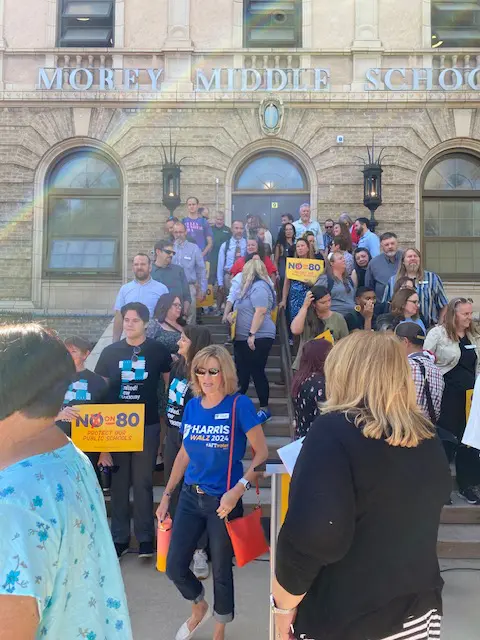
It’s looking like Coloradans have rejected an effort to enshrine school choice in the state Constitution.
As of 9:45 p.m., Amendment 80 was losing, with 52 percent opposed to 48 percent in support. This measure, which would have been the first of its kind in the nation, needs 55 percent of the vote to go into the state constitution.
It would have added language stating each “K-12 child has the right to school choice” and that “parents have the right to direct the education of their children.” It explicitly named charters, private schools, home schools and “future innovations in education” as options guaranteed by the state constitution.
Opponents celebrated the amendment’s apparent defeat.
“We find it really encouraging that people understand what this ballot measure was really trying to do, which was to create a pathway for a private school voucher system,” said Kevin Vick, president of the Colorado Education Association. “And we’re also really encouraged that Colorado voters really value public schools and don’t want to see that happen.”
A legislative analysis concluded that the measure would have no immediate impact on education in Colorado but could have opened the door to future changes to laws and funding for education.
Vick said the vagueness of the measure would have created a “legal quagmire,” which he said, in a worst-case scenario could have meant millions of dollars taken out of the public education system.
The battle over the measure drew millions of dollars from both sides and complaints against proponents alleging deceptive campaign practices. Amendment 80 was a nuanced ballot issue and difficult for many to understand.
When Denver voter Kyle Slusher first read Amendment 80, he thought giving children options would be a good thing.
“But if it is actually just creating a lane for private schools to take from public school funding, that’s not obviously something that needs to be occurring,” he said.
After doing more research he changed his mind and voted “no.”
Advance Colorado, a conservative action committee that doesn’t disclose its donors, proposed the amendment. They argued Amendment 80 would protect families’ right to choose the school — public, private or home school — that they deem is the best fit for their child. It was also backed by Ready Colorado, the Colorado Catholic Conference and the Colorado Association of Private Schools.
The measure was opposed by a coalition that included the Colorado Education Association, the Colorado PTA, the Christian Home Educators of Colorado, Colorado Democrats, Stand for Children, the ACLU Colorado and others.
School choice is popular in Colorado, with nearly 40 percent of public school students choosing a school outside their assigned neighborhood school. The 30-year-old school choice law has bipartisan support. Critics of the measure argued that the constitutional amendment wasn’t needed because laws giving Coloradans the right to attend the school of their choice for free already exist.
But proponents worried about what they said were increasing attempts to erode choice by local school boards, the state legislature and the State Board of Education. Proponents said Amendment 80 would be a backstop to any legislative attempt to reverse decades of bipartisan work to expand choice for students.
Jeanne Melvin is a public education activist in Ohio. She urges Ohio voters to vote YES on issue 1. This would put a bipartisan commission in charge of redistricting instead of the Legislature. It would block the Legislature from designing their own districts to assure a supermajority. Ohio’s Republican supermajority has passed numerous bills to privatize school funding, including a universal voucher bill that enables all parents to get public funding to subsidize their private school tuition. Vouchers. Most students who use vouchers were already enrolled in private schools. Like all universal vouchers programs, Ohio’s is welfare for the wealthy.
Melvin writes:
Public Education is on the ballot across our nation.
Americans must choose between two presidential candidates whose policies, strategies, and experience relating to issues in public education are at opposite ends of the spectrum.
This November, Ohio voters will also decide if politicians should be left in charge of drawing our voting maps, or if the politicians should be removed from the process in favor of a citizens commission.
According to Dr. Christina Collins, former State School Board member and current director of Honesty for Ohio Education, the lack of competitive districts brings “extreme” education policies like attempting to regulate curriculums to avoid what legislators call “critical race theory” from getting into schools, the anti-LGBTQ law keeping transgender students from playing sports in the teams that align with their gender identity, and active bills that would threaten funding and dictate the kind of materials allowed in school libraries.
As previously stated, Ohio’s gerrymandered GOP majority has brought forward some extreme education bills designed to benefit private schools and to defund and diminish public school districts. Public education advocates have responded with facts, logic, and common sense, but lawmakers and lobbyists have chosen not to listen.
Ohioans can VOTE YES on Issue 1 on or before November 5,a bipartisan effort to remove the politicians from legislative redistricting in favor of a 15-member citizens commission made up of five Republicans, five Democrats, and five independents.
For education, this would mean that instead of Ohio lawmakers focusing on culture wars and EdChoice school voucher expansion, they could focus on more important issues, such as fair school funding to help our local public school districts.
What struck me as most bizarre about Project 2025 was not its efforts to block-grant all federal funding of schools, nor its emphasis on privatization of K-12 schools. (Block-granting means assigning federal funding to states as a lump sum, no strings attached, no federal oversight).
No, what amazed me most was the split screen between the report’s desire to hand all power over education to states and communities, and the report’s insistence on preserving enough power to punish LGBT students, especially trans students and to impose other far-right mandates, like stamping out critical race theory. You know, either you let the states decide or you don’t. The report wants it both ways.
It’s also astonishing to realize that the insidious goal of the report is eventually abandon federal funding of education. That’s a huge step backward, taking us to 1965, before Congress passed the Elementary and Secondary Education Act, whose purpose was to raise spending in impoverished communities. I essence, P2025 says that decades of pursuing equitable funding “didn’t work,” so let’s abandon the goal and the spending.
Here is the Brookings analysis:
Project 2025 outlines a radical policy agenda that would dramatically reshape the federal government. The report was spearheaded by the right-wing Heritage Foundation and represents the policy aims of a large coalition of conservative activists. While former President Trump has attempted to distance himself from Project 2025, many of the report’s authors worked in the previous Trump administration and could return for a second round. Trump, himself, said in 2022, “This is a great group, and they’re going to lay the groundwork and detail plans for exactly what our movement will do.”
In other words, Project 2025 warrants a close look, even if the Trump campaign would like Americans to avert their gaze.
Project 2025’s education agenda proposes a drastic overhaul of federal education policy, from early childhood through higher education. Here’s just a sample of the Project 2025 education-related recommendations:
Dismantle the U.S. Department of Education (ED)
Eliminate the Head Start program for young children in poverty
Discontinue the Title I program that provides federal funding to schools serving low-income children
Rescind federal civil rights protections for LGBTQ+ students
Undercut federal capacity to enforce civil rights law
Reduce federal funding for students with disabilities and remove guardrails designed to ensure these children are adequately served by schools
Promote universal private school choice
Privatize the federal student loan portfolio
It’s an outrageous list, and that’s just the start of it.
We’ve reviewed the Project 2025 chapter on education (Chapter 11), along with other chapters with implications for students. We’ve come away with four main observations:
1. Most of the major policy proposals in Project 2025 would require an unlikely amount of congressional cooperation
Project 2025 is presented as a to-do list for an incoming Trump administration. However, most of its big-ticket education items would require a great deal of cooperation from Congress.
Proposals to create controversial, new laws or programs would require majority support in the House and, very likely, a filibuster-proof, 60-vote majority in the Senate. Ideas like a Parents’ Bill of Rights, the Department of Education Reorganization Act, and a federal tax-credit scholarship program fall into this category. Even if Republicans outperform expectations in this fall’s Senate races, they’d have to attract several Democratic votes to get to 60. That’s not happening for these types of proposals.
The same goes for major changes to existing legislation. This includes, for example, a proposal to convert funding associated with the Individuals with Disabilities Education Act (IDEA) to no-strings-attached block grants and education savings accounts (with, presumably, much less accountability for spending those funds appropriately). It also includes a proposal to end the “negotiated rulemaking” (“neg-reg”) process that ED follows when developing regulations related to programs authorized under Title IV of the Higher Education Act (HEA). The neg-reg requirement is written into HEA itself, which means that unwinding neg-reg would require Congress to amend the HEA. That’s unlikely given that HEA reauthorization is already more than a decade overdue—and that’s without the political baggage of Project 2025 weighing down the process.
The prospect of changing funding levels for existing programs is a little more complicated. Programs like Title I are permanently authorized. Eliminating Title I or changing the formulas it usesto allocate funds to local educational agencies would require new and unlikely legislation. Year-to-year funding levels can and do change, but the vast majority of ED’s budget consists of discretionary funding that’s provided through the regular, annual appropriations process and subject to a filibuster. This limits the ability of one party to make major, unilateral changes. (ED’s mandatoryfunding is more vulnerable.)
In sum, one limiting factor on what an incoming Trump administration could realistically enact from Project 2025 is that many of these proposals are too unpopular with Democrats to overcome their legislative hurdles.
2. Some Project 2025 proposals would disproportionately harm conservative, rural areas and likely encounter Republican opposition
Another limiting factor is that some of Project 2025’s most substantive proposals probably wouldn’t be all that popular with Republicans either.
Let’s take, for example, the proposed sunsetting of the Title I program. Project 2025 proposes to phase out federal spending on Title I over a 10-year period, with states left to decide whether and how to continue that funding. It justifies this with misleading suggestions that persistent test score gaps between wealthy and poor students indicate that investments like Title I funding aren’t paying off. (In fact, evidence from school finance reforms suggests real benefits from education spending, especially for students from low-income families.)
The phrase “Title I schools” might conjure up images of under-resourced schools in urban areas that predominantly serve students of color, and it’s true that these schools are major beneficiaries of Title I. However, many types of schools, across many types of communities, receive critical support through Title I. In fact, schools in Republican-leaning areas could be hit the hardest by major cuts or changes to Title I. In the map below, we show the share of total per-pupil funding coming from Title I by state. Note that many of the states that rely the most on Title I funds (darkest blue) are politically conservative.
[Open the link to see the map.]
Of course, the impact of shifting from federal to state control of Title I would depend on how states choose to handle their newfound decision-making power. Given that several red states are among the lowest spenders on education—and have skimped on programs like Summer EBT and Medicaid expansion—it’s hard to believe that low-income students in red states would benefit from a shift to state control.
What does that mean for the type of support that Project 2025 proposals might get from red-state Republicans in Congress? It’s hard to know. It’s worth keeping in mind, though, that the GOP’s push for universal private school voucher programs has encountered some of its fiercest resistance from ruralRepublicans across severalstates.
3. Project 2025 also has significant proposals that a second Trump administration could enact unilaterally
While a second Trump administration couldn’t enact everything outlined in Project 2025 even if it wanted to, several consequential proposals wouldn’t require cooperation from Congress. This includes some actions that ED took during the first Trump administration and certainly could take again.
Here are a few of the Project 2025 proposals that the Trump administration could enact with the authority of the executive branch alone:
Roll back civil rights protections for LGBTQ+ students
Roll back Title IX protections against sex-based discrimination
Dismantle the federal civil rights enforcement apparatus
Eliminate current income-driven repayment plans and require higher monthly payments for low-income borrowers
Remove protections from predatory colleges that leave students with excessive debt
Federal education policy has suffered from regulatory whiplash over the last decade, with presidential administrations launching counter-regulations to undo the executive actions of the prior administration. Take, for example, “gainful employment” regulations that Democratic administrations have used to limit eligibility for federal financial aid for colleges that leave students with excessive loan debt. A second Trump administration would likely seek to reverse the Biden administration’s “gainful employment” regulations like the first Trump administration did to the Obama administration’s rules. (Then again, with the Supreme Court striking down Chevron, which provided deference to agency expertise in setting regulations, the Trump administration might not even need to formally undo regulations.)
Other Project 2025 proposals, not explicitly about education, also could wreak havoc. This includes a major overhaul of the federal civil service. Specifically, Project 2025 seeks to reinstate Schedule F, an executive order that Trump signed during his final weeks in office. Schedule F would reclassify thousands of civil service positions in the federal government to policy roles—a shift that would empower the president to fire civil servants and fill their positions with political appointees. Much has been written about the consequences of decimating the civil service, and the U.S. Department of Education, along with other federal agencies that serve students, would feel its effects.
4. Project 2025 reflects a white Christian nationalist agenda as much as it reflects a traditional conservative education policy agenda
If one were to read Project 2025’s appeals to principles such as local control and parental choice, they might think this is a standard conservative agenda for education policy. Republicans, after all, have been calling for the dismantling of ED since the Reagan administration, and every administration since has supported some types of school choice reforms.
But in many ways, Project 2025’s proposals really don’t look conservative at all. For example, a large-scale, tax-credit scholarship program would substantially increase the federal government’s role in K-12 education. A Parents’ Bill of Rights would require the construction of a massive federal oversight and enforcement function that does not currently exist. And a proposal that “states should require schools to post classroom materials online to provide maximum transparency to parents” would impose an enormous compliance burden on schools, districts, and teachers.
Much of Project 2025 is more easily interpretable through the lens of white Christian nationalism than traditional political conservatism. Scholars Philip Gorski and Samuel Perry describe white Christian nationalism as being “about ethno-traditionalism and protecting the freedoms of a very narrowly defined ‘us’.” The Project 2025 chapter on education is loaded with proposals fitting this description. That includes a stunning number of proposals focused on gender identity, with transgender students as a frequent target. Project 2025 seeks to secure rights for certain people (e.g., parents who support a particular vision of parental rights) while removing protections for many others (e.g., LGBTQ+ and racially minoritized children). Case in point, its proposal for “Safeguarding civil rights” says only, “Enforcement of civil rights should be based on a proper understanding of those laws, rejecting gender ideology and critical race theory.”
These types of proposals don’t come from the traditional conservative playbook for education policy reform. They come from a white Christian nationalist playbook that has gained prominence in far-right politics in recent years.
At this point, it’s clear that the Trump campaign sees Project 2025 as a political liability that requires distance through the election season. Let’s not confuse that with what might happen during a second Trump administration.
Marta W. Aldrich reported in Chalkbeat that Governor Bill Lee will make universal vouchers his top priority in education this coming year. Tennessee currently has a voucher program that is limited to three urban districts and is not fully enrolled. The Governor, who is a graduate of public schools, wants all students, rich and poor alike, to have a public subsidy to pay for private and religious schooling.
Republicans have made universal vouchers a high priority, knowing that it will drain students and funding from their local public schools.
Governor Lee’s effort to pass universal vouchers failed last year because of opposition by urban Democrats and rural Republicans. However, some of the Republican opponents were defeated with the help of out-of-state money spent to elect voucher-friendly Republicans who were willing to undercut their local public schools.
From what we already know about vouchers, we can predict that the great majority of them will be used by affluent families whose children are already enrolled in nonpublic schools. In his recently published book, The Privateers, Josh Cowen of Michigan State University has shown that the low-income students who transfer to nonpublic schools do not make academic gains and frequently experience “catastrophic” declines in their outcomes.
A new universal school voucher proposal will be the first bill filed for Tennessee’s upcoming legislative session, signaling that Gov. Bill Lee intends to make the plan his No. 1 education priority for a second straight year.
Senate Majority Leader Jack Johnson said this week that he’ll file his chamber’s legislation on the morning of Nov. 6, the day after Election Day. He expects House Majority Leader William Lamberth will do the same.
The big question is whether House and Senate Republican leaders will be able to agree on the details in 2025. The 114th Tennessee General Assembly convenes on Jan. 14 as Lee begins his last two years in office.
During the 2024 session, the governor’s Education Freedom Scholarship proposal stalled in finance committees over disagreements about testing and funding, despite a GOP supermajority, and even as universal voucher programs sprang up in several other states….
Similar to last year’s proposal, the new bill would provide about $7,000 in taxpayer funds to each of up to 20,000 students to attend a private school beginning next fall, with half of the slots going to students who are considered economically disadvantaged. By 2026, all of Tennessee’s K-12 students, regardless of family income, would be eligible for vouchers, though the number of recipients would depend on how much money is budgeted for the program.
“This story was originally published by Chalkbeat. Sign up for their newsletters at ckbe.at/newsletters”.
Colorado voters, beware! On the November 5 ballot: an amendment to the State Constitution to protect school choice.
If you want to support public schools and a raid on the state’s treasury by privatizers, defeat it!
This proposed amendment is weird. Ever since the founding of this nation, states have had explicit pledges in their constitution to protect public schools, open to all. Colorado’s state Constitution includes such language as well as language explicitly rejecting public funding for religious schools.
Article 9, Section 2 of the Constitution says:
Section 2. Establishment and maintenance of public schools. The general assembly shall, as soon as practicable, provide for the establishment and maintenance of a thorough and uniform system of free public schools throughout the state, wherein all residents of the state, between the ages of six and twenty-one years, may be educated gratuitously.
Article 8, Section 7 of the Constitution says:
Section 7. Aid to private schools, churches, sectarian purpose, forbidden. Neither the general assembly, nor any county, city, town, township, school district or other public corporation, shall ever make any appropriation, or pay from any public fund or moneys whatever, anything in aid of any church or sectarian society, or for any sectarian purpose, or to help support or sustain any school, academy, seminary, college, university or other literary or scientific institution, controlled by any church or sectarian denomination whatsoever; nor shall any grant or donation of land, money or other personal property, ever be made by the state, or any such public corporation to any church, or for any sectarian purpose.
Now, the privatizers want to cancel that language and replace it with language chartering what was previously forbidden.
On November 5, 2024, Colorado voters will weigh in on a hot topic in education today: school choice. Amendment 80 would make the concept of “school choice” a guaranteed right in the Colorado constitution. The text of the amendment reads as follows:
(1) PURPOSE AND FINDINGS. THE PEOPLE OF THE STATE OF COLORADO HEREBY FIND AND DECLARE THAT ALL CHILDREN HAVE THE RIGHT TO EQUAL OPPORTUNITY TO ACCESS A QUALITY EDUCATION; THAT PARENTS HAVE THE RIGHT TO DIRECT THE EDUCATION OF THEIR CHILDREN; AND THAT SCHOOL CHOICE INCLUDES NEIGHBORHOOD, CHARTER, PRIVATE, AND HOME SCHOOLS, OPEN ENROLLMENT OPTIONS, AND FUTURE INNOVATIONS IN EDUCATION. (2) EACH K-12 CHILD HAS THE RIGHT TO SCHOOL CHOICE.
According to University of Southern California Professor Guilbert Hentschke, “school choice has become a catch-all label describing many different programs that offer students and their families alternatives to publicly provided schools.” Since school choice covers many options, it can be confusing, and it is often the “subject of fierce debate in various state legislatures across the United States.” The critical distinction to make regarding school choice is often whether it affects public or private schools.
School choice has been the mantra for voucher-systems currently enacted in at least twenty states. School choice with voucher-type legislation entails using taxpayer dollars for education savings accounts, opportunity scholarships, tax credits, or actual vouchers so families can choose any type of schooling for their child — private, public or home schooling. This idea represents an emphasis on “funding students instead of funding school systems.”
The focus on school choice has resulted in increased enrollment in charter schools, private schools, and home schooling. At the same time, the school choice movement has also created instability, competition, ideological curricula, resource inequities, increased segregation, loss of community, and reduced funding for public neighborhood schools. In Colorado, of all eligible school-age children, about 76% attend public schools, 15% attend charter schools, 8 percent are in private schools, and 1% are homeschooled.
Advance Colorado is the conservative think tank organization that developed the language for Amendment 80, and they coordinated the expensive signature gathering to secure approval for the measure, originally titled Initiative 138. The backers acknowledge that parents already have the right in state statute to “send their kids to a neighborhood school, charter school, private school, home school, or across district lines.”
Advance Colorado’s solution to the “problem” of legislators promoting charter accountability is to put “the right to school choice in the Colorado Constitution” which they assert will give school choice “legal advantages a normal statute does not have.” Over fifty highly paid lobbyists were assigned to kill the charter accountability bill which was publicly opposed by Governor Polis, and was defeated in the House committee.
Even though Advance Colorado states its goal is to protect the charter schools from future legislative interference, Amendment 80 encompasses “private and home schooling” options. Including “private schools as a guaranteed right” is a plan promulgated by Americans for Prosperity and other conservative think tanks in several red states where voucher bills have been passed or expanded. Fields said he thinks “parents should be in charge of education,” adding “I think it’s easier when they have resources to send their kid to the school that they want to.”
Colorado State board of education members Lisa Escárcega and Kathy Plomer wrote in a September 11 op-ed that Amendment 80 is “not just about school choice.” They cautioned that “Amendment 80, brought by wealthy, in and out-of-state organizations, is part of a nationally coordinated master plan to go around voters in states where voucher proponents have been unsuccessful in passing state voucher laws.” They pointed out that in Colorado, “voters turned down three education voucher ballot initiatives in the 1990s.Voucher and private school proponents then tried the legislative route. The Colorado legislature has turned down any type of voucher or education savings account 18 times just since 2016.” While the amendment doesn’t mention vouchers, the state board members expressed their concern that “If parents have a right to send their children to private schools, then shouldn’t the state pay for it?”
Using public taxpayer dollars for children to attend private schools or for home schooling is not legal in Colorado, nor is it currently popular. (They can get some indirect support.) Kevin Welner of the National Education Policy Center stated that “it would be hard to persuade voters or politicians that Colorado should join the ranks of states that provide taxpayer subsidies for private schools or homeschooling.”
Even though Fields insists this amendment “is not paving the way for a voucher program in Colorado,” the far-right conservative groups providing the money to promote Amendment 80 have tried to enact vouchers in Colorado for years.
Vouchers are not necessarily an effective system to improve student learning and according to recent research, they can hinder state budgets significantly. Josh Cowen, senior fellow at the Education Law Center, pointed to decades of evidence showing private school vouchers have led to some of the steepest declines in student achievement on record. He added that measures similar to Amendment 80 passed in Arizona, Florida and Ohio have led to serious budget cuts.
Who is funding this effort to enshrine “school choice” in the state constitution?
In an op-ed about Advance Colorado last year, Colorado Newsline editor Quentin Young wrote that “Coloradans don’t know who’s supplying its money or their true motivations, because nonprofits don’t have to disclose their donors.” Advance Colorado is the same “dark money group” that gathered signatures for Initiative 108, which would have forced over $3 billion in cuts to services to citizens.
Advance Colorado started as “Unite for Colorado” in 2019, which bankrolled almost every major Republican effort in Colorado in 2020. Unite for Colorado spent over $17 million in 2020 on Republican candidates, and they have “become the most important fundraising entity for conservatives and for Republicans,” said Dick Wadhams, a former chairman of the Colorado GOP. Unite for Colorado changed its name to Advance Colorado Action in 2021 due to questionable conflicts over its spending practices, which are still in litigation.
As a “dark money group,” Advance Colorado receives grants from many sources, most of which are unknown, yet there is evidence that connects Advance Colorado to several conservative organizations. There are also reports that tie the group to Phillip Anschutz, Colorado’s richest billionaire. According to Cause IQ, between 2020-2023, over $28 million was funneled to Unite Colorado/Advance Colorado from the Colorado Stronger Alliance.
Colorado Dawn was formed in 2021 to “support organizations who further the efforts to educate the public about western values and economics,” and it has received over $3 million from Unite Colorado (Advance Colorado). Tax records from the Colorado Dawn’s 2022 990’s list state Board of Education member Steve Durham as chairman, Senator Paul Lundeen as Vice-chairman, and Michael Fields as Treasurer. Lundeen announced in 2022 his hopes that Colorado would enact a voucher program after the Supreme Court “cleared the way for public dollars in a Maine tuition assistance program to flow to private religious schools.” The Colorado Secretary of State’s office indicates that Colorado Dawn spent over $1.3 million to collect signatures for Amendment 80.
On Sept 13, 2024, the CEA announced its opposition to Amendment 80 at a press conference in Denver. A coalition of various representatives from across the state, the National Education Association, and the ACLU described their main reasons for opposing Amendment 80.
The speakers at the press conference emphasized that the amendment is unnecessary because school choice is already protected in law and has been for 30 years. In addition, they stated that the amendment opens the door to taking money from public schools to fund private schools. Speakers stressed that funding private schools would drain money away from rural public schools, private schools pose significant civil rights concerns, and they don’t belong in the Constitution.
In interviews with Chalkbeat, several education experts weighed in on the wording in Amendment 80, indicating it could create years of “litigation” order to interpret the amendment’s misleading language, which Kristi Burton Brown also acknowledged in her interview with KOA radio.
Currently, the following groups are opposing the measure: ACLU of Colorado, AFT Colorado, Colorado Fiscal Institute, CEA, The Colorado Association of School Executives (CASE), AFSCME, Advocates for Public Education Policy, Business and Professional Women of Colorado, Colorado Immigrant Rights Coalition, League of Women Voters Colorado, Soul 2 Soul Sisters, Bell Policy Center, Colorado PTA, One Colorado, United for a New Economy, Colorado Democratic Party, American Association of University Women, Colorado WINS, Colorado AFL-CIO, Stand for Children, and New Era Colorado Action Fund.
Colorado voters will need to decide which rationale they support regarding this school choice amendment. Will they agree with Advance Colorado that a constitutional amendment is necessary to ensure that the legislature will not update current charter school laws? Or will they believe that Colorado does not need to go the route of other states and create a pathway to use public funding for private and home schools?
************************************
Mike DeGuire, Ph.D., has been a teacher, district level reading coordinator, and a principal in the Denver metro area for most of his education career.
The charter lobby has created a mythology that charter schools are more successful than public schools. As the study shows, the mythology is not true. What parent would choose a school that is likely to close in a few years?
Parents want to know if they can depend on a school being there not only when their children start but also when they finish. Based on a marketplace model with fewer regulations, the charter school sector is far more unstable than local public schools.
While the fate of each school cannot be predicted, we can show trends.
Doomed to Fail: An analysis of charter school closures from 1998-2022 uses data from the Common Core of Data, the primary database on non-private elementary and secondary education in the United States, to determine charter school closure rates and the number of students affected when closures occur. The report analyzes charter school closures from 2022 to 2024 to determine the reasons why schools close and how much notice families receive.
Charter schools come with no guarantees. And, as this report shows, in far too many cases, these schools were doomed to fail from the very start.
Here are some of the key findings of the report:
-By year five, 26% of charter schools have closed
-By year ten, nearly four in ten charters fail, rising to 55% by year twenty.
-More than one million students have now been stranded by charter closures
-Eight states have closure rates that exceed 45%.
-The inability to attract and retain students is the primary reason for failures.
-The second most frequent reason is fraud and gross mismanagement.
-Forty percent of closures are abrupt, giving insufficient warning.
-School operators, not authorizers, initiate the majority of closures (blowing a hole in the “accountability” myth..
The report includes some pretty startling examples of charter shutdowns during the last two years, exposing corruption, mismanagment, and operators who did not bother to tell parents the school would be closing until just before it happened. There is also a section written by Gary Rubenstein on the failure of the Tennessee Achievement District. The report can be found here and the Executive Summary here.
Jennifer McCormick was the last elected state superintendent of schools. She switched parties because of the Republicans’ hostility to public schools.
She is running for Governor of Indiana against Senator Mike Braun, who is a far-right Republican. Braun and his running mate, an evangelical extremist, want to get rid of public schools.
The 74 reports:
U.S. Sen. Mike Braun, a conservative Republican, is still ahead in the state’s gubernatorial race but his lead among Indiana voters over Democrat Jennifer McCormick has shrunk in recent weeks.
Polling released this week by the Democratic Governors Association shows Braun just three points in front of McCormick, 44% to 41%. That’s a dropoff from the Sept. 17 results of an Emerson College Polling/The Hill voter survey that had Braun with roughly 45% of the vote and McCormick with 34. Libertarian candidate Donald Rainwater also picked up more support but less dramatically so, going from 5.8% to 8%.
Indiana has not elected a Democratic governor since 2000 and Republican presidential candidate Donald Trump holds a comfortable 14 percentage point lead, 57% to 43%, over Democrat Kamala Harris, according to an ActiVote poll released Tuesday.
If elected to succeed Republican Gov. Eric Holcomb, Braun and his running mate, pastor, podcaster and far-right Christian nationalistMicah Beckwith, have pledged universal school choice for every Indiana family while focusing on parental rights and school safety.
McCormick, a career educator, was the last person elected to the superintendent of public instruction’s office before it became an appointed position in 2021. She seeks to expand affordable child care, fight what she believes is excessive state-mandated testing and call for an equitable school funding formula.
She also wants to place limits on the state’s private school voucher initiative: The program grew to encompass more than 70,000 children in 2023-24, a 31% increase from the year before. The state allocated $439 million in tuition grants to private parochial or non-religious schools last year — up from nearly $312 million the year before.
McCormick said the program, which might have been intended for lower-income children, is often utilized by white suburban families and is too expensive.
“We can’t afford it,” she told The 74, “and it is sucking the resources out of our traditional schools.”
Braun, 70, wants to expand school choice by removing the $220,000 annual family income cap from the voucher program, known as the Choice Scholarship Program, and doubling the $10 millionallocated to the state’s Education Scholarship Account Program. The program, which has also seen tremendous growth in participation, gives special education students and their siblings funds for tuition and support services.
Braun did not make himself available for an interview and attempts to reach various supporters were not successful.
“School choice programs put parents in the driver’s seat, allowing them to choose schools that prioritize their children’s needs,” he states in his education plan. “Providing universal school choice will ensure every Hoosier family has the same freedom to choose their best-fit education.”
A former school board member, Braun also wants to create an Indiana Office of School Safety to streamline the efforts of several departments, including the state police — and implement age-appropriate cyber training for students regarding online safety. He said, too, that the state should limit cellphone use on campus.
Braun wants to increase Indiana’s public teacher base salary — and financially reward educators whose students perform well.
Keith Gambill, president of the Indiana State Teachers Association, said his group endorsed McCormick, 54, because of her commitment to funding traditional public schools.
He noted she did not have the group’s endorsement when she initially ran for the state superintendent’s office as a Republican. But, Gambill said, after filling the role and understanding the state’s educational needs, she switched parties and her values more closely aligned with the union’s.
“She really stood up to members of — at that time — her own party in working toward what was best for our schools,” he said, speaking of her time in office. “And, of course, as soon as they were challenged, they didn’t like that. She realized that if she was going to make a difference in public education, she would have to move in a different direction.”
McCormick aims to secure a minimum base salary of $60,000 for pre-K-12 educators, and adjust veteran teacher salaries to reflect their non-educator peers. She wants to increase academic freedom, safeguard university tenure and protect the ability of teachers unions to collectively bargain for wages and benefits.
Her running mate, Terry Goodin, a former state representative, was a teacher, assistant principal and public school superintendent at Crothersville Community Schools.
Braun, in his education plan, said he wants schools to notify parents about their child’s request to change their name or use different pronouns on campus. He has denounced gender-affirming surgery for minors and opposes transgender students playing on girls’ sports teams. Braun has the backing of Americans for Prosperity and CPAC — and maintains high ratings from the NRA.
Braun was endorsed by Trump in 2023 and won his party’s nomination for governor in May after beating out a crowded field of GOP contenders. He acknowledged last month, according to Axios, that Harris’s presence at the top of the presidential ticket has complicated down-ballot races, including his own.
“I think that’s had an impact,” he said, “but I’m going to plow through that because this is a lot about kitchen table issues once you’re starting to run for governor.”