Archives for category: Literacy

The far-right has always hated bilingual education. They think everyone should speak English, and those who don’t should be deported.

The Trump administration is setting the stage to eliminate bilingual education. This move is of a piece with their plan to deport millions of hard-working, honest immigrants who strengthen the economy.

Their goal is to restore a nation that is dominated by white straight Christian men, with a few white Christian women like Pam Bondi in leadership roles, and to banish any programs that help people improve their lot. That’s what MAGA means: a return to the “good old days” when power was in the hands of people like Trump.

The Washington Post reported:

The Trump administration has quietly rescinded long-standing guidance that directed schools to accommodate students who are learning English, alarming advocates who fear that schools will stop offering assistance if the federal government quits enforcing the laws that require it.

The rescission, confirmed by the Education Department on Tuesday, is one of several moves by the administration to scale back support for approximately 5 million schoolchildren not fluent in English, many of them born in the United States. It is also among the first steps in a broader push by the Trump administration to remove multilingual services from federal agencies across the board, an effort the Justice Department has ramped up in recent weeks.

The moves are an acceleration of President Donald Trump’s March 1 order declaring English the country’s “official language,” and they come as the administration is broadly targeting immigrants through its deportation campaign and other policy changes. The Justice Department sent a memorandum to all federal agencies last month directing them to follow Trump’s executive order, including by rescinding guidance related to rules about English-language learners.

Since March, the Education Department has also laid off nearly all workers in its Office of English Language Acquisition and has asked Congress to terminate funding for the federal program that helps pay for educating English-language learners. Last week, education advocates noticed that the guidance document related to English learning had a new label indicating it was rescinded and remains online “for historical purposes only.”

On Tuesday, Education Department spokeswoman Madi Biedermann said that the guidance for teaching English learners, which was originally set forth in 2015, was rescinded because it “is not in line with Administration policy.” A Justice Department spokesman responded to questions by sending a link to the July memorandum and said he had no comment when asked whether the guidance would be replaced.

For decades, the federal government has held that failing to provide resources for people not proficient in English constitutes discrimination based on national origin under Title VI of the Civil Rights Act.

In rescinding the guidance, the Trump administration is signaling that it may stop enforcing the law under that long-standing interpretation. The Education and Justice departments have been responsible for enforcing the law….

“The Department of Education and the Department of Justice are walking away from 55 years of legal understanding and enforcement. I don’t think we can understate how important that is,” said Michael Pillera, an attorney who worked at the Education Department’s Office for Civil Rights for 10 years and now directs the Educational Opportunities Project at the Lawyers Committee for Civil Rights.

Without pressure from the federal government to comply with the law, it is possible that some school districts will drop services, Pillera said, particularly as many districts struggle with financial pressures.

Since Governor Ron DeSantis got his “Don’t Say Gay” law in 2023, Florida has led the nation in book banning. That nefarious activity is currently on hold because a federal judge struck down DeSantis’s “Don’t Say Gay” law.

Anytime a book banning law gets knocked down, we should celebrate a victory for the freedom to read. Another court, higher-up, may overturn the decision, but for now it’s good news.

Stephany Matt of the Palm Beach Post reported:

federal judge has struck a blow against Florida’s book bans, ruling that part of a DeSantis-backed law used to sweep classics and modern novels off school shelves is so vague that it’s unconstitutional.

U.S. District Judge Carlos Mendoza of the Middle District of Florida focused on the portion of the law that prevents books that “describes sexual conduct” in his Aug. 13 order, saying it’s “unclear what the statute actually prohibits” and to what detail of sexual conduct is prohibited.

The statute (HB 1069) was signed by Gov. Ron DeSantis in 2023, and it’s been used to remove thousands of books from Florida’s school library shelves.

Mendoza drew concern with classical literature and more modern works such as “The Handmaid’s Tale,” among 23 books removed from Orange County and Volusia County schools.

To defend book removals, DeSantis and state officials have pointed to “government speech,” a legal doctrine that the government has the right to promote its own views without being required to provide equal time or a platform for opposing views.

Mendoza disagreed.

“A blanket content-based prohibition on materials, rather than one based on individualized curation, hardly expresses any intentional government message at all,” he said. “Slapping the label of government speech on book removals only serves to stifle the disfavored viewpoints.”

The judge’s order is a win for Penguin Random House and five other publishers, the Authors Guild, two parents and authors Julia Alvarez, John Green, Angie Thomas, Laurie Halse Anderson and Jodi Picoult. Green is famous for his books “Looking for Alaska” and “Paper Towns,” both of which were mentioned in the order.

Penguin Random House is “elated” that the federal judge upheld First Amendment protections for students, educators, authors and publishers, and that books may only be removed if they lack “serious literary, artistic, political, or scientific value” when considered, said Dan Novack, vice president and associate general counsel of Penguin Random House.

“This is a sweeping victory for the right to read, and for every student’s freedom to think, learn, and explore ideas,” Novack said in a statement…

The judge’s order does not cast down all of the law, which restricts teachers from using preferred pronouns in schools outside their assigned sex at birth and expedites a process for people to object to reading materials and books in schools..

Paul L. Thomas was a high school teacher in South Carolina for nearly twenty years, then became an English professor at Furman University, a small liberal arts college in South Carolina. He is a clear thinker and a straight talker.

He wrote this article for The Washington Post. He tackles one of my pet peeves: the misuse and abuse of NAEP proficiency levels. Politicians and pundits like to use NAEP “proficiency” to mean”grade level.” There is always a “crisis” because most students do not score “proficient.” Of course not! NAEP proficient is not grade level! NAEP publications warn readers not to make that error. NAEP proficient is equivalent to an A. If most students were rated that high, the media would complain that the tests were too easy. NAEP Basic is akin to grade level.

He writes:

After her controversial appointment, U.S. Education Secretary Linda McMahon posted this apparently uncontroversial claim on social media: “When 70% of 8th graders in the U.S. can’t read proficiently, it’s not the students who are failing — it’s the education system that’s failing them.”

Americans are used to hearing about the nation’s reading crisis. In 2018, journalist Emily Hanford popularized the current “crisis” in her article “Hard Words,” writing, “More than 60 percent of American fourth-graders are not proficient readers, according to the National Assessment of Educational Progress, and it’s been that way since testing began in the 1990s.”

Five years later, New York Times columnist Nicholas Kristof repeated that statistic: “One of the most bearish statistics for the future of the United States is this: Two-thirds of fourth graders in the United States are not proficient in reading.”

Each of these statements about student reading achievement, though probably well-meaning, is misleading if not outright false. There is no reading crisis in the U.S. But there are major discrepancies between how the federal government and states define reading proficiency.

At the center of this confusion is the National Assessment of Educational Progress, a congressionally mandated assessment of student performance known also as the “nation’s report card.” The NAEP has three achievement levels: “basic,” “proficient” and “advanced.”

The disconnect lies with the second benchmark, “proficient.” According to the NAEP, students performing “at or above the NAEP Proficient level … demonstrate solid academic performance and competency over challenging subject matter.” But this statement includes a significant clarification: “The NAEP Proficient achievement level does not represent grade level proficiency as determined by other assessment standards (e.g., state or district assessments).”

In almost every state, “grade level” proficiency on state testing correlates with the NAEP’s “basic” level; in 2022, 45 states set their standard for reading proficiency in the NAEP’s “basic” range. Therefore, it is inaccurate to say that nearly two-thirds of fourth-graders are not capable readers.

The NAEP has been a key mechanism for holding states accountable for student achievement for over 30 years. Yet, educators have expressed doubt over the assessment’s utility. In 2004, an analysis by the American Federation of Teachers raised concerns about the NAEP’s achievement levels: “The proficient level on NAEP for grade 4 and 8 reading is set at almost the 70th percentile,” the union wrote. “It would not be unreasonable to think that the proficiency levels on NAEP represent a standard of achievement that is more commonly associated with fairly advanced students.”

The NAEP has set unrealistic goals for student achievement, fueling alarm about a reading crisis in the United States that is overblown. The common misreading of NAEP data has allowed the country to ignore what is urgent: addressing the opportunity gap that negatively impacts Black and Brown students, impoverished students, multilingual learners, and students with disabilities.

To redirect our focus to these vulnerable populations, the departments of education at both the federal and state levels should adopt a unified set of achievement terms among the NAEP and state-level testing. For over three decades, one-third of students have been below NAEP “basic” — a figure that is concerning but does not constitute a widespread reading crisis. The government’s challenge will be to provide clearer data — instead of hyperbolic rhetoric — to determine a reasonable threshold for grade-level proficiency.

What’s more, federal and state governments should consider redesigning achievement terms altogether. Identifying strengths and weaknesses in student reading would be better served by achievement levels determined by age, such as “below age level,” “age level” and “above age level.”

Age-level proficiency might be more accurate for policy and classroom instruction. As an example, we can look to Britain, where phonics instruction has been policy since 2006. Annual phonics assessments show score increases by birth month, suggesting the key role of age development in reading achievement.

In the United States, only the NAEP Long-Term Trend Assessment is age-based. Testing by age avoids having the sample of students corrupted by harmful policies such as grade retention, which removes the lowest-performing students from the test pool and then reintroduces them when they are older. Grade retention is punitive: It is disproportionately applied to students of color, students in poverty, multilingual learners and students with disabilities — the exact students most likely to struggle as readers.

Some evidence suggests that grade retention correlates with higher test scores. In a study of U.S. reading policy, education researchers John Westall and Amy Cummings concluded states that mandated third-grade retention based on state testing saw increases in reading scores.

However, the pair acknowledge that these were short-term benefits: For example, third-grade retention states such as Mississippi and Florida had exceptional NAEP reading scores among fourth-graders but scores fell back into the bottom 25 percent of all states among eighth-graders.

The researchers also caution that the available data does not prove whether test score increases are the result of grade retention or other state-sponsored learning interventions, such as high-dosage tutoring. Without stronger evidence, states might be tempted to trade higher test scores for punishing vulnerable students, all without permanent improvement in reading proficiency.

Hyperbole about a reading crisis ultimately fails the students who need education policy grounded in more credible evidence. Reforming achievement levels nationwide might be one step toward a more accurate and useful story about reading proficiency.

The article has many links. Rather than copying each one by hand, tedious process, I invite you to open the link and read the article.

As I was writing up this article, Mike Petrilli sent me the following graph from the 2024 NAEP. There was a decline in the scores of White, Black, and Hispanic fourth grade students “above basic.”

70% of White fourth-graders scored at or above grade level.

About 48% of Hispanics did.

About 43% of Blacks did.

The decline started before the pandemic. Was it the Common Core? Social media? Something else?

Should we be concerned? Yes. Should we use “crisis” language? What should we do?

Reduce class sizes so teachers can give more time to students who need it.

Do what is necessary to raise the prestige of the teaching profession: higher salaries, greater autonomy in the classroom. Legislators should stop telling teachers how to teach, stop assigning them grades, stop micromanaging the classroom.

Way back in 2014, Secretary of Education Arne Duncan was selling the idea that teachers should be rewarded or punished based on their students’ test scores. That idea, baked into Race to the Top, was a dismal failure. Teachers who taught the neediest kids got low ratings, and teachers in the most advantaged schools got the highest ratings. Bill Gates was similarly infatuated with the idea, and he handed out hundreds of millions of dollars to districts and charter chains to test it. Rigorous evaluation showed it to be demoralizing to teachers with no impact on test scores.

What we should have learned from the experience of Race to the Top is that carrots and sticks applied to teachers do not help students and do not improve education.

It’s parents and home life that have the largest effect on student learning. So said the American Statistical Association in 2014, making a futile attempt to persuade Secretary Duncan that he was on the wrong track.

Susan E. Mayer and Ariel Kalil explain why policymakers should focus on parents and help them become better parents. [Let me add, however, that I disagree with their comments about reading and math proficiency. As I have written many times before, NAEP proficiency is not grade level; it is a high bar, and it’s unlikely that most students would ever score the equivalent of an A.]

They write:

American schoolchildren are performing abysmally in tests of basic skills. Only 36% of fourth-grade students were deemed proficient in national math tests and only 33% were deemed proficient in reading as of 2022, the latest year for which such data is available.

Those numbers are even worse than before the pandemic – 5 percentage points lower in math from 2019 and 2 percentage points lower in reading. And the drop in reading and math proficiency after the pandemic has happened to both economically advantaged and disadvantaged children. Students across the board need help.

There is a tendency to blame schools – and by extension, teachers – for students’ poor performance. The temptation to focus solely on schools, however, is misguided. Parents are the ones who must build the foundation for children’s learning. Yet parenting has long been viewed as a private behavior for which women are presumed to possess unique instincts, leaving parents with little evidence-based guidance on how to develop their children’s skills.

Meanwhile, the political right often favors more accountability for teachers, more charter schools and more vouchers for private schools. The political left often favors more teacher training, reducing class sizes, more equitable distribution of school resources and patience as students recover from the pandemic-related dip in scores.

But it’s parents and family background that make the biggest difference. This is evident because the gap in children’s math and reading test scores is already large at the start of kindergarten, in line with their socioeconomic status, and does not narrow as children progress through schooling.

Many people think that the solution, therefore, is to improve parents’ socioeconomic status, which will in turn improve children’s skills. But the reason that low-income parents parent their children differently than high-income parents is not a causal result of the low income itself. Improving parents’ household income would be laudable for many reasons, but experimental evidence shows that giving parents cash payments after they have a child neither changes parental investments nor changes the child’s skills. [Note from Diane: I disagree. Making cash payments is not the same as improving family socioeconomic status; investing in good jobs, housing, and long-term improvements in SES would make a huge difference.]

Instead, we need to support parents in directly changing what they do. Our experimental research on specific parent behaviors that boost child skills points to the importance of reading and talking to children. Analysis we conducted of the American Time Use Survey shows that on average, however, only 21% of mothers of children ages 3 to 6 report spending daily time reading with their child, only 30% report any daily time playing games with them, and only 11% report daily time dedicated to “listening or talking with” their child.

Worse, many parents are misinformed about how to prepare their young children for school. According to a survey we conducted with 2,000 parents in Chicago, about 25% more parents thought it was essential that children know the alphabet before starting school than thought it was important to spark children’s curiosity.

But this is misguided. Children will eventually learn the alphabet and how to count to 50. Especially for parents with less than a four-year college degree, language interactions with young children – parental storytelling, reading books and asking questions about them – along with math interactions such as playing with shape blocks and reading books about numbers are correlated more strongly with growth in children’s language and math skills than activities such as teaching the alphabet and counting or practicing letter sounds and how to calculate simple sums.

We do a disservice to parents by not redirecting their attention from rote skills, such as memorizing letters, sounds and numbers, to more open-ended inquiry. But researchers are limited as well. We need many more resources devoted to improving high-quality research on understanding precisely what types of parent engagement build the child skills necessary for success in later life. We also need much more research on how to boost parents’ capacity for child skill-building.

But first we must acknowledge that mothers, fathers and other caregivers play a crucial role in building children’s skills. Second, we have to acknowledge that as a nation, we have an interest in what parents do. Children are not just the property of their parents. They are the nation’s future.

Their schooling can only build upon the foundation that parents provide. The United States spends more on education per pupil and less on supporting parents than almost any other wealthy country. The government needs to expand its vision of what it means to support childhood development and invest in helping parents create nurturing learning environments at home in the years before formal schooling begins.

We should signal the value children have for the nation by making work compatible with raising children through family leave, providing access to health care for all children and caretakers and offering free access for children to libraries and museums where they can build a love of learning.

We should also explore new solutions, such as providing digital libraries and utilizing technology in innovative ways to support parents in helping their children learn. Evidence from our recent research shows that this can increase parental reading, boost child language development and close the socioeconomic gap in children’s language skill.

Susan E. Mayer is a professor and a dean emeritus at the University of Chicago Harris School of Public Policy. 

Ariel Kalil is the Daniel Levin Professor at the University of Chicago Harris School of Public Policy. They are the directors of the Behavioral Insights and Parenting Lab at the University of Chicago.

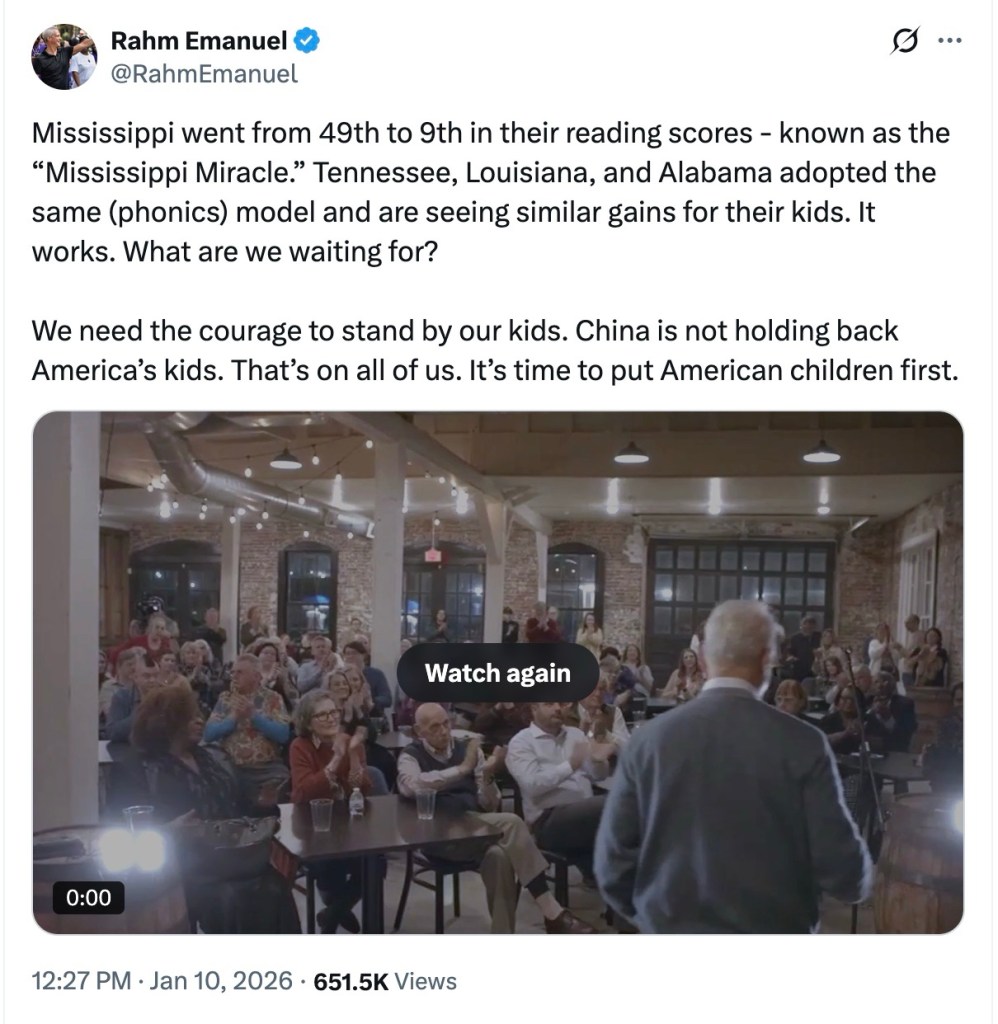
A few years back, the story of the “Mississippi Miracle” in reading was all the rage. The increase in scores of fourth grade students on NAEP scores was hailed as miraculous, a testament to the dramatic power of the “science of reading.” New York Times’ columnist Nicholas Kristof wrote a column praising Mississippi for raising the test scores of its fourth graders without spending any more money. Anyone could do it!

I was critical of Kristof’s enthusiasm and pointed out that the scores of fourth graders soared but the reading scores of eighth graders did not. The scores of the older students were among the lowest in the nation. What kind of “miracle” dissolves as students get older?

Thomas Ultican reviews the “Mississippi Miracle” and also finds it to be hype. But he sees it as good reason to kill NAEP, which Trump is now doing.

I don’t often disagree with Tom, who is a relentless researcher of scams and hoaxes perpetrated by the critics of public schools.

I oppose the misuse of high-stakes standardized tests to hold teachers, students, and schools “accountable,” because the tests are loaded with errors and inevitably reflect family income and family education, not the ability of students or teachers. I have written about the inherent flaw of standardized tests in my last three books.

What I like about NAEP is that it is a no-stakes test. It too reflects family income and family education, like all standardized tests. But no one is punished or rewarded for their test scores.

NAEP shows trends by states, cities, gender, race, ethnicity, special ed status, income, etc.

It is NAEP that reveals the lie behind the “Mississippi Miracle.” NAEP shows that fourth graders made dramatic progress and minimal sleuthing demonstrates that the lowest performing students were held back in third grade, excluded from the testing pool.

It’s NAEP that reveals that eighth graders placed 43rd of 50 states. The Miracle didn’t persist.

I think NAEP should remain and the federal mandate for testing every child every year in every school should be abandoned.

Trump or Musk or a bunch of kids who work for DOGE decided that the U.S. doesn’t need to collect statistics or conduct research about the condition of education. So they wiped out the National Center for Education Statistics at the U.S. Department of Education. This is akin to closing down the Bureau of Labor Statistics. NCES is literally the only reliable, nonpartisan source of information about U.S. education. It is not partisan.

NCES is the heart of the U.S. Department of Education. Its purpose is to study “the progress and condition” of American education. It collects data and statistics about every aspect of American education. A bill was passed in 1867 to create an agency with that mission, and that was the beginning of NCES. At first, it was called the Department of Education, but two years later, it was renamed the Office of Education and placed in the Department of the Interior. In 1939, it was shifted to the Federal Security Agency, and in 1953 it became part of the newly created Departnent of Health Dducation and Welfare. In 1979, President Carter signed legislation creating the U.S. Department of Education, and in 1980, the Department began to function.

NCES has always been nonpartisan. It publishes an annual report called The Condition of Education, which is a valuable compendium of facts and trends that covers almost every aspect of education, from preschool through graduate studies. If you want to know the high school graduation rate over the past century, that’s the source. If you want to compare the graduation rates by gender or race, that’s there too.

NCES also oversees the National Assessment of Educational Progress (NAEP), the federal testing program known as “the nation’s report card.” NAEP has a bipartisan governing board, which is appointed by the Secretary of Education and serves as a policymaking body.

During my time as Assistant Secretary of Education for the Office of Education Research and Innovation from 1991-93, NCES was in my domain. In 1998, Secretary Richard Riley appointed me to serve on the governing board of NAEP, which I did for seven years. There were parts of my domain that I might have offloaded, but with a scalpel, not a chainsaw.

Musk and his DOGE team just eviscerated not only the Department of Education by firing half its employees, but they laid waste to NCES.

Jill Barshay of The Hechinger Report has the story. The staff of NCES has been reduced from about 100 to 3. Three! I think that’s called a death certificate.

She began:

President Donald Trump promises he’ll make American schools great again. He has fired nearly everyone who might objectively measure whether he succeeds.

This week’s mass layoffs by his secretary of Education, Linda McMahon, of more than 1,300 Department of Education employees delivered a crippling blow to the agency’s ability to tell the public how schools and federal programs are doing through its statistics and research branch. The Institute of Education Sciences (IES) is now left with fewer than 20 federal employees, down from more than 175 at the start of the second Trump administration, according to my reporting. It’s not clear how the institute can operate or even fulfill its statutory obligations set by Congress. 

IES is modeled after the National Institutes of Health and was established in 2002 during the administration of former President George W. Bush to fund innovations and identify effective teaching practices. Its largest division is a statistical agency that dates back to 1867 and is called the National Center for Education Statistics (NCES), which collects basic statistics on the number of students and teachers. NCES is perhaps best known for administering the National Assessment of Educational Progress, which tracks student achievement across the country. The layoffs  “demolished” the statistics agency, as one former official characterized it, from roughly 100 employees to a skeletal staff of just three. 

“The idea of having three individuals manage the work that was done by a hundred federal employees supported by thousands of contractors is ludicrous and not humanly possible,” said Stephen Provasnik, a former deputy commissioner of NCES who retired early in January. “There is no way without a significant staff that NCES could keep up even a fraction of its previous workload…”

The mass firings and contract cancellations stunned many. “This is a five-alarm fire, burning statistics that we need to understand and improve education,” said Andrew Ho, a psychometrician at Harvard University and president of the National Council on Measurement in Education, on social media.  

Former NCES Commissioner Jack Buckley, who ran the education statistics unit from 2010 to 2015, described the destruction as “surreal.” “I’m just sad,” said Buckley. “Everyone’s entitled to their own policy ideas, but no one’s entitled to their own facts. You have to share the truth in order to make any kind of improvement, no matter what direction you want to go. It does not feel like that is the world we live in now.”

The deepest cuts

While other units inside the Education Department lost more employees in absolute numbers, IES lost the highest percentage of employees — roughly 90 percent of its workforce. Education researchers questioned why the Trump administration targeted research and statistics. “All of this feels like part of an attack on universities and science,” said an education professor at a major research university, who asked not to be identified for fear of retaliation. 

The future of NAEP is up in the air. The staff to oversee contracts for data collection, testing, and analysis of results is gone.

Please open the article and read it. This is a deliberate death-blow to the most important function of the U.S. Departnent of Education: the collection and dissemination of facts, data, statistics, and trends in the states and the nation.

The Thought Police lost an important case in Arkansas! Score one for librarians, booksellers, and people who read books! It’s a setback for those who don’t read books, never have, never will.

Doktor Zoom writes on the blog Wonkette:

A federal judge Monday tossed out parts of an Arkansas state law that allowed librarians and booksellers to be sent to prison for up to a year for allowing minors to access “obscene” or “harmful” materials, whatever local officials might decide is “obscene” or “harmful.” Probably gay penguins.

In his ruling, US District Judge Timothy Brooks found that the law, Act 372, violated the First Amendment and also generally sucked, was overly vague, and didn’t provide adequate guidance to libraries and booksellers to help them avoid being arbitrarily prosecuted. The law created a new process for complaints and required libraries (tell you what, just assume “and booksellers” is part of every sentence, OK?) to shelve “harmful” materials in a special adults-only section, although it didn’t mandate that such a section be behind a beaded curtain like at an old video store. A similar law in Idaho — minus the librarian-jailing — is also being challenged in federal court, as are multiple other censorship laws. 

Brooks wrote that the law “deputizes librarians and booksellers as the agents of censorship; when motivated by the fear of jail time, it is likely they will shelve only books fit for young children and segregate or discard the rest,” which was of course the point. For all the Mad Moms’ insistence that they only want to protect tiny innocent kids from “obscene” materials, the actual targets of book banning tend to be anything rightwing parents dislike, especially mentions of LGBTQ people, books about race, and sex education. 

Not surprisingly, Arkansas Attorney General Tim Griffin said that while he’ll respect the ruling, he plans to appeal, and Gov. Sarah Huckabee Sanders issued a statement calling Act 372 “just common sense” because “schools and libraries shouldn’t put obscene material in front of our kids,” so there. 

Holly Dickson, executive director of the ACLU of Arkansas, said yippee, now we can poison kids’ minds, destroy the family, and kill God, or at least that’s how wingnuts will interpret what she actually said, which was 

“This was an attempt to ‘thought police,’ and this victory over totalitarianism is a testament to the courage of librarians, booksellers, and readers who refused to bow to intimidation…”

To learn more about the court decision, open the link.

This is a first, to my knowledge. Parents in Massachusetts filed a class action lawsuit seeking damages from Lucy Calkins and others who installed the “Whole Language” reading curriculum in their public schools. The parents claim that Calkins and others purposely sold a defective product that ignored “the science of reading” and caused their children to need tutors and other assistance in learning to read.

For the record, I don’t approve of this lawsuit. As far as I’m concerned, it’s far too early to reach a definitive judgment about the efficacy of either Whole Language or the “science of reading.” The phonics-based approach was tried more than two decades ago in a federal program called Reading First. RF was created by No Child Left Behind and cost $6 billion. The program was tainted with scandal, and the evaluations were unimpressive.

I was never a fan of Whole Language but I do not believe that its adherents intended to deceive. I knew many of its advocates, and they sincerely believed that Whole Language was the best way to learn to read.

Furthermore, I do not think that this issue should be resolved in a court of law. Nor do I think that the issue of access to medical care by a pregnant woman or the parents of transgender youth should be decided by courts. But my opinion doesn’t count. We will see if this lawsuit goes anywhere.

The Boston Globe reported:

In what appears to be a first-of-its-kind consumer protection lawsuit, two Massachusetts families are suing famed literacy specialists Lucy CalkinsIrene Fountas, and Gay Su Pinnell, their companies, and their publishers, alleging the former teachers used “deceptive and fraudulent” marketing practices to sell curriculums that ignored the scientific consensus about the importance of phonics to early reading.

The lawsuit, filed Wednesday in Suffolk Superior Court, alleges three minors, identified in the complaint by their initials, suffered developmental and emotional injuries, while their parents, identified as Karrie Conley of Boxborough and Michele Hudak of Ashland, suffered financial losses, having paid for tutoring and private school tuition to compensate for the flawed reading curriculums used by their children’s public schools.

“I trusted that when I was sending my children off to school, they were getting instruction that had been tested and proven effective,” Conley said during a virtual press conference Wednesday morning. “… This isn’t some luxury we’re asking for. This is reading.”

The lawsuit, shared with the Globe in advance, alleges the defendants ignored a plethora of research demonstrating the importance of phonics, or the relationship between letters and sounds, in creating, marketing, and selling their early literacy products and services. The omission of phonics from their curriculums was intentional, despite widely known evidence of its importance, the complaint alleges.

“Defendants denigrated phonics at worst and paid mere lip service to phonics at best,” the lawsuit reads.

A 2023 Globe investigation found more than one-third of all Massachusetts districts, including Amherst, Brookline, and Cambridge, were using the defendants’ curriculums in their elementary schools. 

A lawsuit represents only one side of a complaint. Representatives for the defendants did not return an immediate request for comment, though Calkins, Fountas, and Pinnell have in the past denied any wrongdoing.

The Massachusetts lawsuit represents a new step in the early literacy advocacy movement and could spur new complaints like it nationwide. It follows several years of heightened debate surrounding the “science of reading,” a broad body of research demonstrating how the brain learns to read and which shows a firm grasp on phonics to be key to early reading success.

At issue in the complaint is whether the literacy authors knowingly ignored scientific research and purposely sold “defective and deficient” curriculums to school districts across Massachusetts. The lawsuit argues the authors and their publishers did and in doing so broke a state consumer protection law.

“Defendants knew or should have known they were committing unfair and deceptive acts,” the complaint reads.

Rather than emphasizing phonics, or the sounding out of words, Fountas and Pinnell, longtime publishing partners, and Calkins have come under increasing scrutiny for their curriculums’ cueing directions, which instruct children to, for example, look at a picture for context in helping determine an unknown word. In Calkins’s curriculum, Units of Study, this skill has been called “picture power.”

The Massachusetts Department of Elementary and Secondary Education, which considers the defendants’ curriculums to be low quality, has doled out millions of dollars in grant money to help local school districts purchase new materials grounded in reading science. A 2023 Globe investigation found nearly half of all school districts in the state were using a low-quality curriculum in their elementary schools, and, of those, nearly 3 in 4 were using either Calkins’s or Fountas and Pinnell’s materials.

In addition to the authors, the lawsuit, which seeks class action status, names as defendants Calkins‘s company, The Reading & Writing Project at Mossflower; the board of trustees of Teachers College at Columbia University, which used to house Calkins‘s curriculum work; Fountas and Pinnell LLC; New Hampshire-based Heinemann Publishing; and HMH Education Co., a Boston-based publisher.

At what point does Florida go from the absurd to the ridiculous? Or has that point already been passed? A school board in Florida voted to ban a book called Ban This Book.

I wish someone would explain to school board members, to Moms Restricting Liberty, and to Governor Ron DeSantis that whenever a book is banned, that book gets national notoriety and a big sales bump. Authors are thinking, “Please ban my book,” it needs publicity, and yahoos oblige.

Scott Maxwell, columnist for the Orlando Sentinel, writes:

The headline that made its way around the world last week looked like a joke:

“Florida school board bans book about book bans”

The story couldn’t have been more meta. Or more Florida. I half-hoped it was satire, but having covered Florida’s increasingly ridiculous education priorities in recent years, knew it wasn’t.

The Tallahassee Democrat explained that the Indian River County School Board voted 3-to-2 to ban a book called “Ban This Book.”

The book is a lighthearted yet poignant tale about a 9-year-old girl named Amy Anne Ollinger who, upon learning that her school is trying to censor books, decides to fight back by cultivating her own secret library in her school locker. It’s part comedy and part thought-provoker. Some of the book focuses on how Amy Anne doesn’t always go about things the right way.

A promotional blurb for the book says: “Ban This Book is a love letter to the written word and its power to give kids a voice.” Publishers Weekly said it celebrates “kids’ power to effect change.”

To that end, I have a new proposal for Florida’s book-banners: Before pushing to censor any book, you have to first actually read it and then prove you understood it. In this case, “Ban This Book” was written for 8-to-12-year-olds. So you might need to put on your thinking cap.

The story in Indian River got even more ridiculous when it revealed that virtually all the censorship stemmed from one person — a Moms for (so-called) Liberty member who objected to books by everyone from Toni Morrison to Kurt Vonnegut.

“She also got ‘Anne Frank’s Diary: The Graphic Adaptation’ pulled from a high school,” the story said. “And, in response to her objection to a children’s book that showed the bare behind of a goblin, the school district drew clothes over it.”

OK, let’s stop here. If you’re a grown adult whose crowning accomplishments are to censor a book about the Holocaust, ban a book on book-banning and draw cartoon underpants on a cartoon goblin, then to paraphrase Jeff Foxworthy: You might be an idiot.

So this is my plea today to my fellow Floridians during an election year: Stop electing idiots. Specifically, stop electing them to school boards.

Governor Ron DeSantis unleashed a rightwing barrage against school libraries and public libraries, and even he has backed off (a bit) as a small number of angry censors, led by groups like Moms for Liberty, have barraged librarians with demands for censorship. These “Moms” don’t want “Liberty”; they want to impose their views on others.

Sarah Ravits of the Gambit in Louisiana describes the intense attacks on libraries and librarians, by groups whose purpose is to restrict access to books they don’t like.

She writes:

Amanda Jones never thought of herself as a controversial person.

A beloved librarian in a small, tight-knit South Louisiana community, she’d earned numerous awards for her commitment to education over the years, including the coveted National School Librarian of the Year honor in 2021.

“I had a rock-solid relationship with my community, and I was in good standing,” she says. “I grew up here, and I devote so much time to my school, community and children.”

But her life took a sudden, bizarre turn in 2022 when she spoke at a public library board meeting.

During a heated discussion about whether a local library should restrict access to certain books for teenagers, Jones echoed what many educators have been saying for years.

Challenges to books are often “done with the best of intentions,” but frequently target the Black and LGBTQ communities, she said. Removing or relocating those books could be “extremely harmful to our most vulnerable — our children. Just because you don’t want to read it or see it does not give you the right to deny [it to] others.”

Jones certainly wasn’t the lone, dissenting voice that evening — she says at least 30 other people in attendance expressed similar sentiments.

But the next day she found herself being viciously targeted in a smear campaign by the ultra-conservative nonprofit Citizens for a New Louisiana, and the Facebook account Bayou State of Mind.

“They made memes about me and posted my picture and where I work,” Jones told Gambit. “They said that I advocate for teaching anal sex and that I want to give 6-year-olds pornography and erotica.”

As false and ridiculous as the claims were, they took off like wildfire across the internet and spilled over into everyday life as Jones, her family and her colleagues were bombarded with threatening messages and phone calls, including from people who said they were going to kill her.

Jones, terrified and suffering from severe mental distress, eventually took a medical leave of absence…

Right-wing activists have led efforts nationwide to attack books while targeting libraries and their workers. That, in turn, has led Republicans enthralled to these radical interests to push legislation forwarding their agenda in states across the country.

The war against libraries has been felt especially hard in Louisiana, where multiple parishes have become engulfed in legal and political battles centered around book censorship…

While some of the most egregious bills failed to even make it out of legislative committees, these efforts have nonetheless had a chilling effect on library workers.

One librarian in the New Orleans area, who spoke to Gambit under condition of anonymity, says they are “disillusioned and annoyed,” by the implication that librarians distribute obscene materials.

“I’m not a criminal,” the librarian says. “My job is to provide people with good information….”

Adding to librarians’ frustrations is the fact that book challengers often take passages wildly out of context, and it takes already-strained library board members and workers months to fully audit books after they’ve been challenged.

In St. Tammany Parish, for example, more than 150 books were challenged last year, according to the Louisiana Illuminator.

Going after so many books at once was a clear tactic to overwhelm librarians, who are required to produce reports on each book called into question. For every complaint, the library’s policy was to pull the book from circulation and refer it to a committee for review. Eventually, the number of challenged books was so high the library created a policy that it will not pull books from shelves while they are under review.

Many of the complaints came from just a handful of activists who don’t even have library cards or kids who use the library. In fact, in many states these complaints aren’t even coming from people who live in the state, let alone the local community…

Some of those involved passing legislation to bring criminal charges to librarians, which passed in fellow red states like Arkansas, West Virginia and Missouri.

The Arkansas law, for example, states school and public librarians can be sentenced up to six years in prison for distributing “obscene” or “harmful” material to students under 18.

That law, however, is currently blocked by a federal judge…

Then there are the ongoing attempts by the Legislature to discredit the American Library Association, considered to be the top professional library association, by blasting it as being too “woke” and “Marxist.”

One particularly shocking bill, authored by Livingston Parish Republican Rep. Kellee Dickerson, sought to imprison public librarians with hard labor and slap them with huge fines if they dared to get reimbursed for attending ALA conferences.

“If you’re going to put librarians in jail for even trying to associate with (their) profession’s national organization, that kinda gives away the game,” says one of the librarians Gambit spoke with…

Some of the more problematic bills, like throwing librarians in jail for attending the ALA conferences with public funds, died immediately in committee….

Then there are everyday citizens who have joined the fight to stand up for librarians and books.

Lisa Rustemeyer, a semi-retired mother of grown children in St. Tammany Parish, has become an activist in recent months.

Rustemeyer previously never thought she’d see public libraries being targeted, and said she felt a “gut instinct” to stand up when she saw they were under fire.

Lately she has found herself writing letters, making phone calls, attending public meetings and urging legislators to reconsider their bills.

Rustemeyer says she has always turned to libraries during “tough times,” while looking for answers, or simply for entertainment. “It’s where you meet other people and see your neighbors,” she says. “Libraries represent democracy and free speech.”

The way she sees it, dismantling and undermining public trust in libraries is a step toward dismantling and undermining trust in democracy itself.

“This doesn’t really come from a logical place,” she says. “(Lawmakers) are not scared of guns, but they’re scared of books? There’s no logic in it, which makes it infuriating. There’s no evidence that any kid has ever been harmed by a book. And here we are at the bottom of literacy, we’re at the bottom in (education) for as long as I can remember. We should not take award-winning books out of the hands of children. That is insane….”

Amanda Jones, meanwhile, has decided to double down on her advocacy work.

While the groups who targeted her expected Jones to be a shrinking violet, she says her commitment to literacy and free speech has only grown stronger.

“I was a hot mess for about a year, and then I decided to make lemonade out of lemons,” she says. “Screw them … No one wants to be famous for being defamed and called a groomer.”

Because she was already well-known in the library world, she says she has decided to share her story far and wide.

“I decided I wanted to tell my story, speak out and try to help other people know, they can also speak out,” she says.

What helps motivate her, she says, is that moment most librarians can probably relate to: when a book resonates with a new reader.

Jones calls it a “home run” moment.

“When you put a book in a kid’s hand, and it becomes their ‘home run’ book — it’s when you hook them into reading,” she explains. “And you know that because they read that book, they’re going to read one or two more, and then become a lifelong reader.”

She has seen it happen over and over throughout her career.

She says, “Every student deserves to see themselves reflected in the characters on our shelves.”