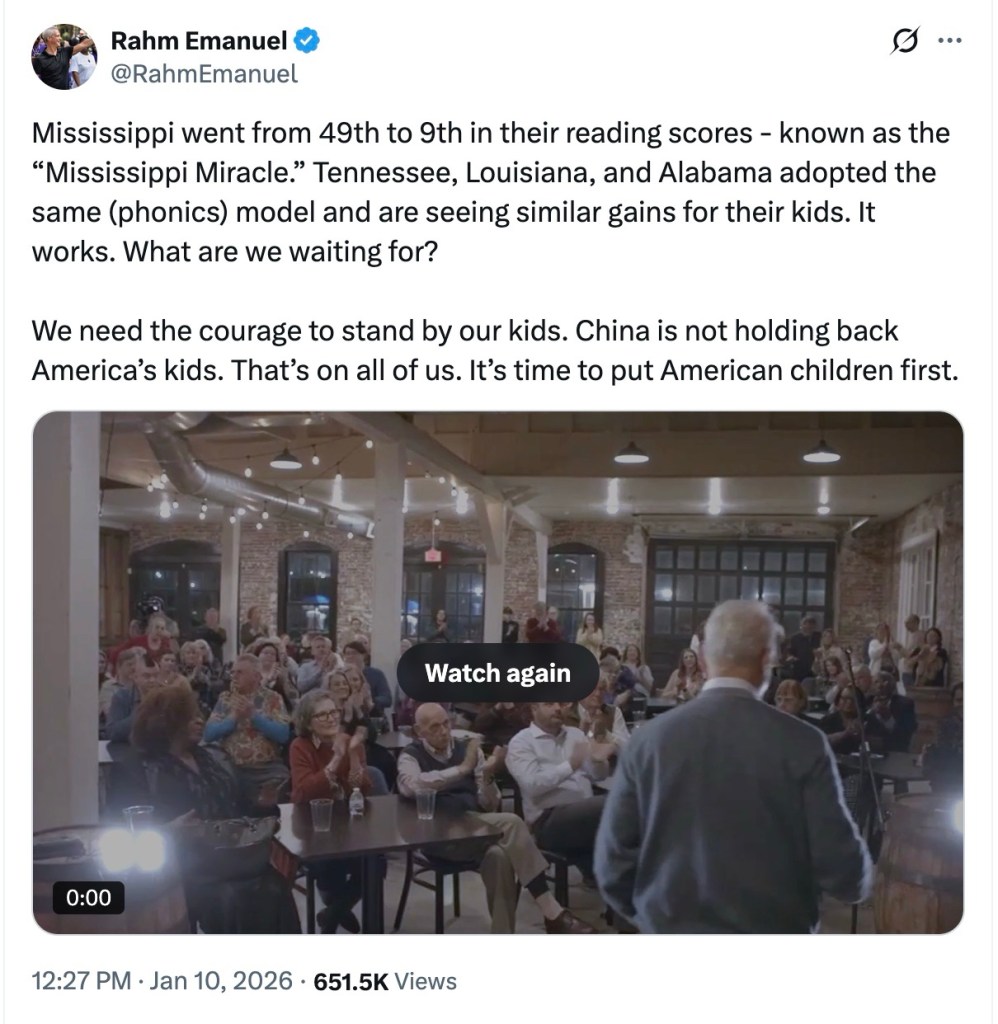
Oklahoma legislators are debating whether to follow the lead of Mississippi by adopting a phonics-based reading curriculum and requiring the retention of 3rd graders who can’t pass the reading test. Mississippi has been hailed for the dramatic rise in its 4th grade reading scores, which was initiated by the Barksdale Foundation in 1999 with a gift to the state of $100 million to improve reading.
The dominant Republicans in the Oklahoma legislature are taking advice from Jeb Bush’s ExcelinEd group, which enthusiastically supports school choice, privatization, high-stakes accountability, and holding back 3rd graders who don’t pass the state reading test.
The key to instant success in the Mississippi model (it worked in Florida too) is holding back 3rd graders who can’t pass the test. If the low-scoring students are retained, 4th grade scores are certain to rise. That’s inevitable. Is the improvement sustainable? Look at 8th grade scores on NAEP. Sooner or later, those kids who “flunked” 3rd grade either improve or drop out.
Many years ago, I attended a conference of school psychologists. While waiting my turn to speak, the president of the organization said that the latest research showed children’s three worst fears:
- The death of their parents
- Going blind.
- The humiliation of being left back in school
Let’s not lose sight of the pain of those left back and think about alternative ways to help these children .
John Thompson, historian and retired teacher in Oklahoma, urges the legislators to think again before enacting a punitive retention policy.
Thompson writes:
The appointments of Lindel Fields as Oklahoma State Superintendent (replacing Ryan Walters), and Dr. Daniel Hamlin as Secretary of Education, create great opportunities for improving our state’s schools. In numerous conversations with a variety of advocates and experts, I’ve felt the hope I experienced during bipartisan MAPS for Kids coalition which saved the Oklahoma City Public School System, and working with the experts serving in the administrations of Sandy Garrett and Joy Hofmeister.
On the other hand, we still face threats from ideology-driven politicians and lobbyists who spread falsehoods about the simplistic programs they push.
Just one example is a legislative committee meeting on the “Science of Reading.” Although I admit to being slow to acknowledge the need for more phonics instruction, and “high-dose tutoring,” as long it is not a part of a culture of teach-to-the test, I remain skeptical of simple solutions for complex, interconnected, problems. So, I am more open to positive programs, like those that enhance the background knowledge that students need to read for comprehension, as opposed to increasing test scores.
But I’m especially worried Oklahoma could focus on the punitive part of the so-called “Mississippi Miracle,” which requires the retention of 3rd graders who don’t meet accountability-driven metrics.
For instance, when Rep. Jacob Rosecrants, a former inner-city teacher who took over my classroom when I retired, expressed concern that their “highly structured teaching and testing approach … might actually discourage reading,” his reservations were “largely dismissed.” Instead, Rep. Rob Hall, who asked for the meeting, said, “What we’ve learned from other states is that wide-spread illiteracy is a policy choice.”
In fact, it is unclear whether Rep. Hall’s policy choice has produced long-term improvements in reading comprehension.
Based on my experiences in edu-politics, and the judgements of local experts, who saw how our 2012 high-stakes testing disaster unfolded, I’d be especially worried by how the Oklahoma School Testing Program could be used to hold back kids, and the reward-and-punish culture it could produce. The same persons pushing accountability for 3rd graders also seem to believe the lie that NAEP “proficiency” is “grade level,” and that setting impossible data-driven targets will improve student outcomes.
If these regulations were used to determine whether 3rd graders are retained, the damage that would be done would likely be unthinkable. It is my understanding that 50% to 75% of the students in high-challenge schools might not be eligible for promotion. And like the latest expert who briefed me about 3rd grade testing, I’ve witnessed the humiliation that retention imposed on children as Oklahoma experimented on high-stakes End-of-Instruction tests, which undermined learning cultures, even when they were just a pilot program.
I would urge legislators to read this study by Devon Brenner and Aaron Pallas in the Hechinger Report on 3rd grade retention. Brenner and Pallas concluded, “We are not persuaded that the third grade retention policy has been a magic bullet; retention effects vary across contexts. Even in Mississippi, the evidence that retention boosts achievement is ambiguous.”
By coincidence, another reputable study of the “Mississippi Miracle” was recently published. Chalkbeat’s Matt Barnum evaluated the “Southern Surge” in reading programs in Mississippi, Louisiana, Tennessee, and Alabama. And, yes, “Mississippi’s ascent has been particularly meteoric and long-running. Since 1998, the share of fourth graders reading at a basic level on NAEP has increased from 47 to 65%.” And, Louisiana’s 4th graders made progress.
But, eighth graders’ results “have been less impressive for these Southern exemplars.” Alabama’s eighth grade reading scores have been falling and are among the lowest in the country. Louisiana’s eight grade reading scores remain at the 2002 level. And, Mississippi’s eighth grade reading scores are about the same as they were in 1998.
Barnum noted, “a number of studies have found that retention does improve test scores.” But:
The long-run effects of holding back struggling readers remain up for significant debate. A recent Texas study found that retaining students in third grade reduced their chances of graduating high school and decreased their earnings as young adults. A paper from Louisiana found that retention led more students to drop out. (Some studies find no long run effect on high school completion, though.)
I would also add that Tennessee’s huge School Improvement Grant, which was focused on test score gains, “did not have an impact on the use of practices promoted by the program or on student outcomes (including math or reading test scores, high school graduation, or college enrollment).”
Moreover, as the Tulsa World reported, Mississippi “spent two years and $20 million preparing for the rollout of the program.” It provided far more counselors and more intensive teacher training and student interventions. But it cites data suggesting “students who received intensive literacy instruction in third grade made only temporary gains, briefly besting their national peers in fourth grade but falling back behind in subsequent years.”
Even the most enthusiastic supporters of the “Mississippi Miracle”, like The 74, agree that it required “universal screenings to identify students with reading deficiencies early and to communicate those results to parents.”
And Mississippi’s success required the prioritization of “proactive communications and stakeholder engagement strategies around early literacy;” “building connections and coherence with other agency efforts across the birth through third grade continuum, especially pre-K;” and anticipating a “multi-year timeline to see changes in third grade outcomes, and invest in monitoring and evaluation strategies that can track leading indicators of progress and identify areas for improvement.”
What are the chances that Oklahoma would adequately fund such programs?
So, what will Superintendent Fields conclude after studying evidence from both sides of the debate?
The Tulsa World recently quoted Fields saying “that literacy is the building block. … So until we get that right, everything else is just going to be hard.” I’m impressed that he then added, “I’m learning about it myself.”
He then said:
What’s important to note about that is the Mississippi Miracle was not an overnight thing. It was more than a decade in the works. And I think if we were to model that and replicate it, you have to do the whole thing — we can’t walk around the block today and run a marathon tomorrow. I think replicating that and setting the tone for the next 8 or 10 years, we can expect to see the same kind of results. I think that’s an excellent example to look to.
Fields wants more than a “program.” He wisely stated:
We might disagree on how we actually get there, but I haven’t found anybody that disagrees that we have to get reading right before the other things.
He then called for “systemic, long-term dedication” to “a multi-faceted approach.” He also emphasized investments in teacher training, and the need to improve teachers’ morale.
In other words, it sounds like our new Superintendent is open to humane, evidence-based, inter-connected, and well-funded efforts that draw on the best of the “Mississippi Miracle,” but not simplistic, politicized, quick fixes, that ignore the damage that those ideology-driven programs can do to children. And I suspect he would think twice before holding back third graders before studying the harm it can do to so many students.
So, if I had just one recommendation to offer, I would urge a balanced effort that combines win-win interventions, not programs that can do unknown amounts of harm, especially to high-poverty children who have suffered multiple traumas. That would require a culture that uses test scores for diagnostic purposes, not for making metrics look better.


 Diane Ravitch's blog