Archives for category: Lies

Mercedes Schneider reviews Kristen Buras’ new book about a Black high school that was closed against the wishes of the community it served. The book is What We Stand to Lose: Black Teachers, the Culture They Created, and the Closure of a New Orleans School (2025, Beacon Press). Buras describes a school whose teachers went beyond the call of duty to help their students. If you care about education, if you care about social justice, you should read this book. I did not post the review in full, so please open the link to finish reading.

Mercedes Schneider writes:

I was born in 1967 in Chalmette, Louisiana (St. Bernard Parish), a suburb of New Orleans so close to the city that is is the actual site of the 1815 Battle of New Orleans.

I did not know that my father moved to Chalmette in the mid-1950s as part of the “white flight” from New Orleans. 

I did not know why the St. Bernard-Orleans Parish line was so starkly white on the St. Bernard side and black on the Orleans side.

I did not know that the black teachers at my all-white elementary and middle schools were part of an effort for local officials to dodge federal mandates to racially integrate the schools (as in integrating the student body).

(I do remember seeing what I think was one black student in the special education, self-contained classroom of my elementary school– such an unusual, remarkable event that it puzzled my young mind to see him as a student assistant in the cafeteria, and the moment remains clearly in my memory to this day.)

I did not know that when I moved to a more rural section of St. Bernard Parish as I started high school that the African-American residents “down the road” knew full well of the dangers of trying to reside in certain sections of the parish (namely, Chalmette and Arabi).

I did not know that the school-superintendent uncle of one of my favorite teachers tried circa 1961 to create an “annex school” near the Arabi-New Orleans city line in order to enable white parents in the city to avoid racial integration by using school vouchers from New Orleans to enroll their children in an all-white public school just across the parish line.

I did not know that the proliferation of parochial schools in New Orleans was fueled by white flight from the New Orleans public schools.

I did not know that the reason I attended an all-girls public middle- and high school was for local officials to try to sham-integrate the St. Bernard public schools but to keep “those black boys away from our white girls.”

There’s a lot that I did not know and did not begin to learn until I was in my twenties and started asking questions.

But there were a lot of lessons that many white adults in my life tried to instill in me, lessons that indeed needed some serious questioning:

“You know property values will drop if the blacks start moving into a neighborhood.”

“It is better for a white woman to have a physically-abusive white boyfriend or husband than a black one, even if he does treat her well.”

“Interracial marriage is cause for a family disowning a child.”

“The city is a wreck because blacks are lazy and destroy everything.”

As I began reading about New Orleans officials’ cross-generational efforts to obliterate the black middle class in New Orleans (by, for example, by destroying multiple black owned businesses in order to build both the Desire housing project in 1956 and construct Interstate 10 in 1966), I felt like I had been lied to for decades– and my views as a white child and young adult repeatedly manipulated in order to purposely cement in me a sense of white superiority that no amount of personal maturity would ever shake.

Nevertheless, I am happy to say that such twisted, misplaced superiority is indeed and forever shaken in me and shown to be the mammoth lie that it is– the very lie that happens to fuel the white saviors who would impose themselves on black communities– including the center of the community:

The community school.

The community should be the final word on its schools, and when it is, those schools are successful, even in the face of racially-imposed hardship and intentional, multi-generational deprivation of basic resources, including physical space, current textbooks, and even ready supplies of toilet paper. 

Such is the story of George Washington Carver High School in New Orleans– a school created as part of a school complex and housing project and build in New Orleans, Louisiana, to intentionally be a segregated school despite its opening post-Brown vs. Board of Education.

In her book, What We Stand to Lose: Black Teachers, the Culture They Created, and the Closure of a New Orleans School (2025, Beacon Press), Dr. Kristen Buras offers to readers a detailed history and daily life of G. W. Carver High School in New Orleans, from its inception to its white-savior closure in 2005, post-Katrina, when the state of Louisiana refused to grant the returning Carver community a charter to operate their own school. Buras details what no pro-charter, education reformer discussed at any length as regards traditionally-black New Orleans public schools: the repeated, intentional, multi-generational, systematic fiscal neglect of both the schools and the black community in New Orleans.

In contrast, Buras not only discusses these issues; she brings them to life through her numerous interviews with Carver faculty and staff, a life that begins even before Carver High School opened its doors in the 1958-59 school year.

Right out of the gate, the community served by Carver High School– families residing in the Desire Housing Project– had to face the reality that the project homes were poorly constructed and were starting to fall apart due to a lack of concrete foundations on swampland, no less.

Indeed, the location of what was known as the “Carver Complex” was originally a Maroon colony for escaped African slaves in a backswamp area that 1973 Carver graduate describes as “really not made for residential living.”

Separate was not equal, but to the Carver community, it was theirs, and in the midst of profound racism, the faculty and staff at Carver High devoted themselves to their students and the students’ families, who also happened to be their neighbors.

What speaks loudly to the teacher commitment to Carver High students, as Buras notes, is their multi-decade commitment. Despite being chronically underfunded and under-maintained across its almost-fifty years pre-Katrina, Carver High School had a very low teacher turnover.

In What We Stand to Lose, readers are introduced to the precise and disciplined teachings of music teacher Yvonne Busch, who was known for offering free music lessons during summer break. Former student Leonard Smith produced a documentary about Busch, who retired in 1983 after a 32-years at Carver. We learn of the 38-year career of social studies teacher, Lenora Condoll, who wanted so much for her students to experience the larger world that she organized fundraisers to take her students on Close-Up trips to Washington, DC, and who, on a practical note, showed students that they could make a dressy wardrobe out of a few basic items, including her “black, cashmere skirt.” We meet Enos Hicks, head coach of track and football and athletic director once Carver High opened. By that time, Hicks had been teaching for twenty years already. When Hicks’ students saw “his bag of medals” for track and field, they believed that they, too, could excel and receive their own medals.

These are real teachers whose legacy is undeniable among Carver alumni. They inspired their students to hold their heads high in self-respect despite the cultural pressures and dangers to be pressed into a Whites Only mold of “forever less-than.”

Carver High School was at most 30 minutes from my own high school. I had no idea such quality against the odds was so nearby.

To continue reading the review, open the link.

Vermont Senator Bernie Sanders wrote an article for The New York Times calling for Health and Human Services Secretary Robert F. Kennedy Jr. to resign. Since Sanders was chairman of the Senate Committee overseeing HHS, he argues with facts, not just indignation.

He writes:

Robert F. Kennedy Jr., the secretary of health and human services, is endangering the health of the American people now and into the future. He must resign.

Mr. Kennedy and the rest of the Trump administration tell us, over and over, that they want to Make America Healthy Again. That’s a great slogan. I agree with it. The problem is that since coming into office President Trump and Mr. Kennedy have done exactly the opposite.

This week, Mr. Kennedy pushed out the director of the Centers for Disease Control and Prevention after less than one month on the job because she refused to act as a rubber stamp for his dangerous policies. Four leading officials at C.D.C. resigned the same week. One of those officials said Mr. Kennedy’s team asked him to “change studies that have been settled in the past” apparently to fit Mr. Kennedy’s anti-vaccine views. This is not Making America Healthy Again.

Despite the overwhelming opposition of the medical community, Secretary Kennedy has continued his longstanding crusade against vaccines and his advocacy of conspiracy theories that have been rejected repeatedly by scientific experts.

It is absurd to have to say this in 2025, but vaccines are safe and effective. That, of course, is not just my view. Far more important, it is the overwhelming consensus of the medical and scientific communities.

The American Academy of Pediatrics, the country’s largest professional association of pediatricians, representing over 67,000 doctors who treat our children every day, calls immunizations “one of the greatest public health achievements,” which prevents tens of thousands of deaths and millions of cases of disease.

The American Medical Association, the largest professional association of physicians and medical students, representing over 270,000 doctors along with 79 leading medical societies, recently said that vaccines for flu, R.S.V. and Covid-19 are “the best tools to protect the public against these illnesses and their potentially serious complications.”

The World Health Organization, an agency with some of the most prominent medical experts around the globe, recently noted that over the past 50 years, vaccines have saved at least 154 million lives and reduced the infant deaths by 40 percent.

Against the overwhelming body of evidence within medicine and science, what are Secretary Kennedy’s views? He has claimed that autism is caused by vaccines, despite more than a dozen rigorous scientific studies involving hundreds of thousands of children that have found no connection between vaccines and autism.

He has called the Covid-19 vaccines the “deadliest” ever made despite findings cited by the W.H.O. that Covid shots saved over 14 million lives throughout the world in 2021 alone.

He has ridiculously questioned whether the polio vaccine has killed more people than polio itself did even though scientists have found that the vaccine has saved 1.5 million lives and prevented around 20 million people from becoming paralyzed since 1988.

He has absurdly claimed that “there’s no vaccine that is safe and effective.”

Who supports Secretary Kennedy’s views? Not credible scientists and doctors. One of his leading “experts” that he cites to back up his bogus claims on autism and vaccines had his medical license revoked and his study retracted from the medical journal that published it.

Many of his supporters are from Children’s Health Defense — the anti-vaccine group he founded and profited from — and a small circle of loyalists that have spread misinformation and dangerous conspiracy theories on vaccines for years.

The reality is that Secretary Kennedy has profited from and built a career on sowing mistrust in vaccines. Now, as head of H.H.S., he is using his authority to launch a full-blown war on science, on public health and on truth itself.

What will this mean for the health and well-being of the American people?

Short term, it will be harder for Americans to get lifesaving vaccines. Already, the Trump administration has effectively taken away Covid vaccines from many healthy younger adults and kids, unless they fight their way through our broken health care system. This means more doctor’s visits, more bureaucracy and more people paying higher out-of-pocket costs — if they can manage to get a vaccine at all.

Covid is just the beginning. Mr. Kennedy’s next target may be the childhood immunization schedule, the list of recommended vaccines that children receive to protect them from diseases like measles, chickenpox and polio. The danger here is that diseases that have been virtually wiped out because of safe and effective vaccines will resurface and cause enormous harm.

Two years ago, when I was the chairman of the Senate Health, Education, Labor and Pensions Committee, I held a hearing with the major government officials responsible for protecting us from a new pandemic, including the head of the C.D.C. Without exception, every one of these agency heads said that, while they could not predict the exact date, there will be a future pandemic and we must be much better prepared for it than we are today.

Unfortunately, Secretary Kennedy’s actions are making a worrisome situation even worse by defunding the research that could help us prepare for the next pandemic. This month, he canceled nearly $500 million in research for the kinds of vaccines that helped us stop the Covid pandemic. At the same time, Mr. Kennedy is cutting funding to states to prepare and respond to future outbreaks of infectious diseases. This is unacceptable.

America’s health care system is already dysfunctional and wildly expensive, and yet the Trump administration will be throwing an estimated 15 million people off their health insurance through a cut of over $1 trillion to Medicaid and the Affordable Care Act. This cut is also expected to result in the closing of or the decline in services at hundreds of nursing homes, hospitals and community health centers. As a result of cuts to the Affordable Care Act, health insurance costs will soar for millions of Americans. That is not Making America Healthy Again.

Secretary Kennedy is putting Americans’ lives in danger, and he must resign. In his place, President Trump must listen to doctors and scientists and nominate a health secretary and a C.D.C. director who will protect the health and well-being of the American people, not carry out dangerous policies based on conspiracy theories.

Concerned about RFK Jr.’s assault on vaccines, I called my local CVS pharmacist a few days ago to schedule every vaccine for which I was eligible. I got the flu vaccine and the RSV vaccine.

I asked for the COVID-19 vaccine, but was told that the latest version would not be available until mid-October. I’m in the eligible group (over 65), but no vaccine yet. When I got home, I learned that the vaccine is not available in certain states, including New York. I worry that RFK Jr. may decide to cancel the vaccine altogether.

Wajahat Ali writes on his blog, The Left Hook, about RFK Jr.’s threat to public health:

In today’s Democracy-ish, Danielle and I spend the hour discussing the most dangerous horseman of Trump’s Apocalyptic cult: RFK Jr. 

Oh, you know, the scion of the Kennedy empire who was a heroin addict, suffered from brain worms, ate exotic animals, and was described as a predator by his own cousin.

That RFK Jr., who promotes reckless and dangerous anti-vaxx conspiracies, eugenics, and has no medical background or training. That’s the wealthy, mediocre, white man that Trump has elevated as the director of America’s Health and Human Services.

I mean, what could go wrong? 

Who needs vaccines during COVID or the rise of measles? Who needs Medicaid except 20% of Americans who depend on it for healthcare? Who needs the National Institute of Health or the CDC staffed by competent, qualified professionals who have spent their lives devoted to saving lives?

Not the United States, because we aren’t a bunch of woke, weak pansies who listen to so-called experts, damn it!

Welcome to Trump and MAGA’s pro-death march led, in part, by RFK Jr. and his broligarch friendswho are perfectly fine killing Americans to make a profit and advance their white supremacist agenda. 

We bring all the receipts. It’s depressing, but it’s worth hearing to ensure you stay informed, safe, and protected.

Here’s Danielle’s write-up at DAM DIGEST:


In the United States, public health has long depended on institutions like the Centers for Disease Control and Prevention (CDC), the National Institutes of Health (NIH), and the Department of Health and Human Services (HHS). For decades—through Republican and Democratic administrations alike—these agencies functioned under a shared goal: protecting Americans’ health through science, research, and expertise.

But in recent years, that foundation has begun to crack. The appointment of Robert F. Kennedy Jr. (RFK Jr.), an outspoken anti-vaccine activist with no medical training, to lead HHS has brought that crisis into sharp focus. His presence in the nation’s top public health office signals a seismic shift—one where politics trumps science, conspiracy theories replace research, and ideology threatens lives.

The Erosion of Trust in Science

During the COVID-19 pandemic, more than one million Americans died, while public health officials faced harassment, death threats, and relentless political attacks. Former CDC Director Anthony Fauci, who spent his career working to save lives, became a target of right-wing media and extremist groups.

Instead of rallying around experts, leaders like Donald Trump and his allies downplayed the severity of the pandemic, promoted misinformation about masks and vaccines, and openly mocked scientists. This politicization of science directly fueled vaccine hesitancy, prolonging the crisis and causing unnecessary deaths.

Now, five years after the peak of the pandemic, the United States faces a resurgence of diseases once thought to be under control—measles, polio, and other preventable illnesses—precisely because vaccination rates have dropped.

RFK Jr.: Conspiracies Over Credentials

RFK Jr.’s position is especially alarming given his history of promoting anti-vaccine propagandaand debunked eugenics myths. He has falsely claimed that autism and other health conditions are caused by vaccines and even suggested that COVID-19 was “targeted to spare Jews and Black people”—a statement widely condemned as antisemitic and racist.

Despite his lack of medical training, Kennedy insists he can “diagnose” children by sight, attributing health challenges to supposed “mitochondrial issues visible in their faces.” Licensed physicians, including those trained at Harvard and Mayo Clinic, have dismissed such claims as pseudoscience.

Yet under the Trump administration, this man now wields control over Medicare, Medicaid, the CDC, NIH, and national vaccine policy—institutions responsible for the health of over 330 million Americans.

The Resignations and Walkouts

The consequences are already unfolding. After Kennedy moved to push out CDC Director Dr. Susan Monarez—a Trump appointee who nonetheless refused to abandon science—top scientists and health officials resigned in protest. Dr. Dimitri Daskalakis, a respected infectious disease expert, wrote in his resignation letter that serving under Kennedy was “untenable” because HHS leadership was no longer guided by science.

Soon after, CDC staff staged mass walkouts, warning the public that American lives are being endangered by unqualified leadership. These resignations leave critical gaps at the very moment the nation faces rising COVID variants, climate-driven disease risks, and growing vaccine hesitancy.

Cuts That Will Cost Lives

Beyond personnel, the Trump–Kennedy administration has overseen massive funding cuts:

  • $500 million slashed from vaccine research
  • $1 trillion cut to Medicaid, threatening to shutter rural hospitals and nursing homes
  • Reductions in NIH research funding
  • Cuts to foreign aid and peacekeeping operations, destabilizing global health security

These moves directly undermine America’s preparedness for the next pandemic. As climate change accelerates, experts warn that new infectious diseases are almost inevitable. Yet instead of strengthening systems, leaders are dismantling them.

The Bigger Picture: A Pro-Death Movement

This moment cannot be seen in isolation. It reflects a broader “pro-death” political movement that prizes ideology over evidence, power over public health, and partisan gain over human life. Whether it was Trump pushing “herd immunity” at the expense of vulnerable Americans, or Kennedy advancing conspiracy theories that endanger children, the pattern is clear: science is under attack.

The result? Americans are less safe, less protected, and less prepared for the crises ahead.

Why This Matters Now

The rise of unqualified, conspiracy-driven figures like RFK Jr. at the helm of America’s most critical health institutions is not just political theater—it is a direct threat to public safety. The decisions made today about vaccines, research funding, and disease response will determine whether millions live or die in the years ahead.

Public trust in science and medicine must be restored. That means demanding qualified leaders, protecting the integrity of institutions like the CDC and NIH, and pushing back against those who seek to weaponize public health for political gain.

Because as history has shown—from pandemics to polio eradication—science saves lives. Conspiracies cost them.

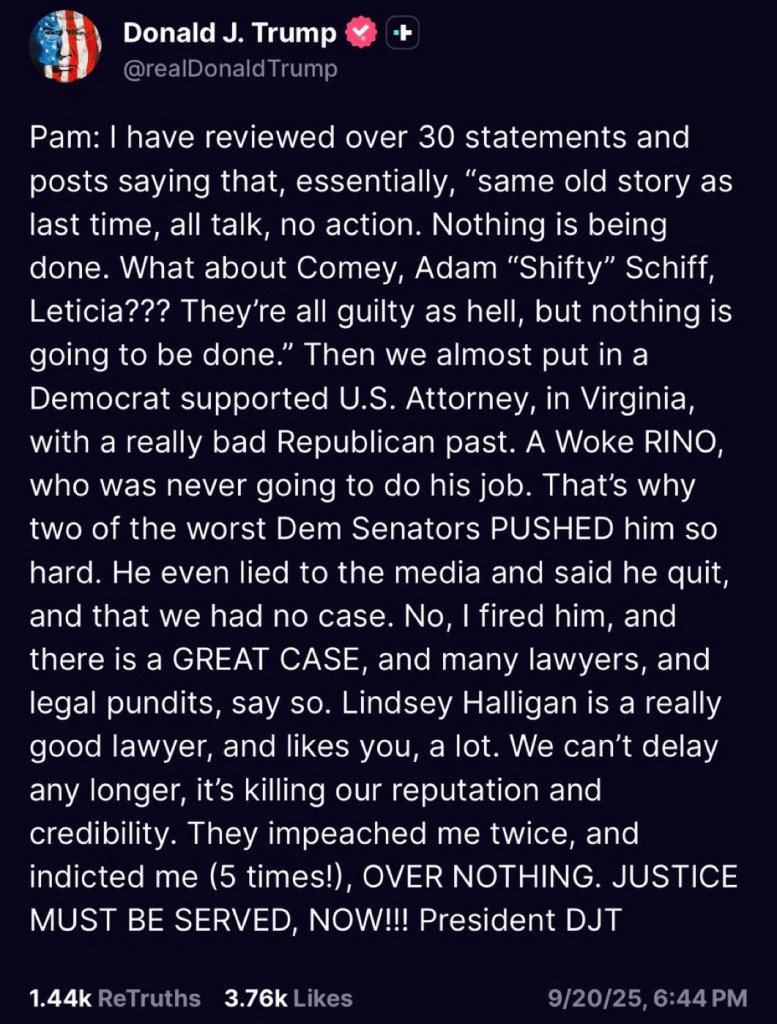
Trump warned that he was prepared to take an active role in reviewing exhibits in the Smithsonian museums, especially the African-American Museum. Too many show bad portrayals of their nation, he complained. Think about it: is it possible to show slavery in a positive light?

Trump’s insistence on purging the Smithsonian of the accurate portrayal of Black history is yet another example of his efforts to minimize and sanitize that history.

The New York Times wrote that Trump is hostile to an honest confrontation with the past:

Since taking office, Mr. Trump has led an effort to purge diversity, equity and inclusion policies from the federal government and threatened to investigate companies and schools that adopt such policies. He has tried to reframe the country’s past involving racism and discrimination by de-emphasizing that history, preferring to instead spotlight a sanitized, rosy depiction of America.

The administration has worked to scrub or minimize government references to the contributions of Black heroes, from the Tuskegee Airmen, who fought in World War II, to Harriet Tubman, who guided enslaved people along the Underground Railroad. Mr. Trump commemorated Juneteenth, the celebration of the end of slavery in the United States that became a federal holiday in 2021, by complaining that there were too many non-working holidays in America. He has called for the return of Confederate insignia and statues honoring those who fought to preserve slavery.

And he has previously attacked the exhibits on race at the Smithsonian, which has traditionally operated as an independent institution that regards itself as outside the purview of the executive branch, as “divisive, race-centered ideology.”

CNN described Trump’s determination to compel museums to remove exhibitions of events that show shameful behavior by whites and the government:

President Donald Trump escalated his campaign to purge cultural institutions of materials that conflict with his political directives on Tuesday, alleging museums were too focused on highlighting negative aspects of American history, including “how bad slavery was.”

In a Truth Social post, Trump directed his attorneys to conduct a review of museums, comparing the effort to his crackdown on universities across the country.

“The Smithsonian is OUT OF CONTROL, where everything discussed is how horrible our Country is, how bad Slavery was, and how unaccomplished the downtrodden have been — Nothing about Success, nothing about Brightness, nothing about the Future,” Trump wrote.

Trump’s comments come days after the White House announced an unprecedented, sweeping review of the Smithsonian Institution, which runs the nation’s major public museums. The initiative, a trio of top Trump aides wrote in a letter to Smithsonian Institution secretary Lonnie Bunch III last week, “aims to ensure alignment with the President’s directive to celebrate American exceptionalism, remove divisive or partisan narratives, and restore confidence in our shared cultural institutions.”

The letter said the review would focus on public-facing content, the curatorial process to understand how work is selected for exhibits, current and future exhibition planning, the use of existing materials and collections and guidelines for narrative standards.

Bunch — who has served as Secretary of the Smithsonian Institution since 2019 and is the first African American to hold the position — has made multiple comments about the importance of educating people about slavery through the National Museum of African American History and Culture specifically. He told Smithsonian Magazine that part of the purpose of that museum “was to help a nation understand itself — an impossible task without the full recognition of the horrors of slavery.”

Exhibits at the Smithsonian take years of planning and are heavily evaluated by teams of scholars and curatorial experts before they make their debut. Janet Marstine, a museum ethics expert, said that the demands laid out by the Trump administration “set the Smithsonian up for failure.”

“Nobody could provide those kinds of materials in such a comprehensive way, in that short amount of time, and so it’s just an impossible task,” she said. The White House has asked the Smithsonian to provide a wide array of materials, from internal emails and memos to digital copies of all placards and gallery labels currently on display.

The Smithsonian declined to comment on Trump’s latest remarks. A White House official, asked about the attorney review process Trump described, said the president “will explore all options and avenues to get the Woke out of the Smithsonian and hold them accountable.”

Still, Trump’s efforts to target colleges and universities — which he is now comparing to his focus on Smithsonian museums — has been even more aggressive. His administration has moved to strip federal funding from higher education institutions for a variety of reasons, including allegations of antisemitism and failure to comply with certain policy changes. Columbia University recently settled with the Trump administration for more than $220 million dollars and Trump has also been in a protracted battle with Harvard University after his administration froze $2 billion in federal funding.

The Trump administration’s push to align federal support with his cultural agenda has extended beyond the nation’s capital. The Institute of Museum and Library Services and the National Endowments for the Arts and the Humanities canceled tens of millions of dollars in federal grants earlier this year, affecting small museums, library initiatives, arts programs and academic research projects across the country.

Trump has previously praised the Smithsonian museums, including the National Museum of African American History and Culture, which he toured during his first term as president.

“I’m deeply proud that we now have a museum that honors the millions of African American men and women who built our national heritage, especially when it comes to faith, culture and the unbreakable American spirit,” Trump said during remarks at the museum in February 2017. Later that month, Trump said the museum “tells of the great struggle for freedom and equality that prevailed against the sins of slavery and the injustice of discrimination.”

Earlier this year, Trump signed an executive order that put Vice President JD Vance, who serves on the Smithsonian’s Board of Regents, in charge of stopping government spending on exhibits that don’t align with the administration’s agenda. He also tasked a former member of his legal team, attorney Lindsey Halligan, with helping to root out “improper ideology” at the Smithsonian.

“Museums in our Nation’s capital should be places where individuals go to learn — not to be subjected to divisive narratives,” the executive order said.

The Smithsonian began a review of its own in June, and has repeatedly stressed its commitment to being nonpartisan. The institution told CNN in July that it was committed to an “unbiased presentation of facts and history” and that it would “make any necessary changes to ensure our content meets our standards.”

The Smithsonian was established in the 1840s by the US with funds from the estate of James Smithson, a British scientist. As a unique trust instrumentality that is supported by federal funds, it is not an executive branch agency, which makes it a complex question whether the Trump administration has the ability to control its exhibits. It is governed by a 17-member Board of Regents led by Chief Justice John Roberts.

The fact that the Smithsonian is not an “executive branch agency” won’t deter Trump. He has ignored laws and the Constitution when they don’t support his agenda. Neither the Library of Congress nor the National Portrait Gallery is an executive agency. Yet Congress sat silently as Trump forced out their leaders.

Trump is rapidly assuming control of every federal agency that was designed to be independent.

No other President has attempted to do that.

Richard Haass, who was chairman of the Council on Foreign Relations for 20 years, is a seasoned diplomat. Since he now speaks for himself, not an organization, he lays out his concerns about the trap that Trump has set for himself when he meets with Putin in Alaska. Putin is not allowed to travel in Europe, where he has been declared a war criminal, both for his invasion of Ukraine and for the systematic kidnapping of thousands of Ukrainian children.

Haass writes:

The big story this week is the highly anticipated meeting… between Presidents Trump and Putin in Alaska. That Friday’s meeting is taking place on U.S. soil is in itself a big win for Vladimir Putin, who has not set foot in this country since 2007. The invitation undermines international efforts to isolate him on account of Russian aggression and war crimes in Ukraine. That this meeting is with him alone and does not include Ukraine’s President Volodymyr Zelenskyy is also to Putin’s advantage. As they say, you’re either at the table or you’re on it.

The run-up to the meeting has been less than reassuring. The president and his envoy-to-everywhere Steve Witkoff have been talking about land swaps. There are several problems with them. Any swap that gives Russia anything rewards it for aggression. Second, land swaps might leave Ukraine worse off militarily if Putin (as is likely) treats any ceasefire as a pause rather than a prelude to a lasting treaty. This risk grows exponentially if swaps are not tied to meaningful security assurances to Ukraine. More generally, territory is the sort of issue that should be held in reserve for final status talks associated with a permanent peace. They are contentious and may be needed to craft a larger package. The focus now should be on bringing about a ceasefire, the simpler the better.

The vice president didn’t help matters by declaring that “We’re done with funding the Ukraine war business.” Only by continuing to do so is there an actual chance that Putin will conclude (however reluctantly) that more war will not deliver more of what he wants. Other pressure could come from imposing new sanctions on Russia and announcing U.S. support for giving Ukraine access to the $300 billion in frozen Russian assets. It is unclear whether the administration will exercise these options. I have my doubts.

My nightmare scenario as we approach Alaska is that President Trump and his envoy, who appear to be conducting diplomacy unencumbered by much in the way of either expertise or experts, will largely side with the Russian president, present a joint proposal to the Ukrainian president, and, when said proposal is rejected as it invariably would be, Trump will blame Zelenskyy for bursting his diplomatic bubble and cut off U.S. aid to Ukraine in response.

As much as I would like to see real progress toward a fair ceasefire and the United States doing all in its power to stand against territorial acquisition by force, I would think the best outcome at Alaska is no agreement, with Trump having learned (again) that his good friend Vlad places a higher priority on undermining Ukraine’s standing as an independent sovereign country than winning hearts and minds in this White House. It is thus somewhat reassuring that the White House spokesperson is walking back expectations, now casting the meeting as a “listening exercise.” If so, the president will have escaped from a trap of his own making, which would be a good thing. No deal is better than a bad one.

Trump and Putin are meeting Friday in Alaska to discuss Ukraine. Ukrainian leader Zelensky was not invited, nor were any representatives of Europe. Trump will hear Putin’s grievances and claims. He will hear no other. After Russia intensified its drone bombing of Ukrainian civilian targets, Trump demanded a ceasefire. Putin ignored him. He gave his a deadline of 50 days (!) to stop the attacks. Putin intensified the attacks. Then Trump said the deadline was 10-12 days. That was two weeks ago. Putin got a face-to-face meeting with Trump on American soil, and his war against Ukraine goes on.

Timothy Snyder is one of the nation’s pre-eminent historians of Europe. He taught at Yale University for many years, but decided to accept an offer to teach at the University of Toronto after Trump was re-elected in 2024. He is the author of many books, including the national bestseller On Tyranny.

Snyder writes:

In the ancient world, people spoke of “Ultima Thule,” a mythical land in the extreme north, the end of the earth.

By venturing north to Alaska to meet Vladimir Putin, Donald Trump reaches his own Ultima Thula, the arctic endpoint of a foreign policy dreamworld.

The premise of Trump’s foreign relations is that foreign leaders can be dealt with like Americans, with fantastic promises and obnoxious bullying.

The fantasies do not function beyond America’s borders. The empty offer of a “beautiful” future does move dictators who commit crimes for their own visions, or affect people who are defending their families from a criminal invasion.

Ukraine has been resisting Russia’s full-scale invasion for three and a half years. Ukrainians fight because Russians invade their land, steal their wealth, kidnap their children and raise them as Russians, torture civilians in basements, murder people with any sort of association with politics or civil society, and destroy their sovereignty.

Putin, for that matter, has his own vision of a beautiful future, and no reason to prefer Trump’s to his own. Putin’s utopia is one of a Ukraine with no government, with a population cowed by torture, with children stolen and brainwashed, with patriots murdered and buried in mass graves, with resources in Russian hands.

Like Trump’s fantasizing, Trump’s bullying also does not work abroad. To be sure, many Americans are afraid of Trump. He has purged his own political party through stochastic violence. He is deploying the US military as a police force, first in California and then in Washington DC.

But foreign enemies apprehend these intimidation tactics differently. In Moscow, deployments of soldiers inside the United States look like weakness. Trump is signalling that he sees the task of the US military as to oppress unarmed Americans. The very move that shocks Americans delights America’s foes.

The tough talk may resonate in America, where we confuse words with actions. But for Russian leaders it covers a weak foreign policy. Trump has made extraordinary concessions to Russia in exchange for nothing at all. Russia has repaid him by continuing the war and seeking to win it — and by laughing at Trump on state-controlled television.

What are those concessions? Just by meeting Putin in Alaska, Trump gives the Russian dictator a chance to spread his own story of his invasion of Ukraine, both to the Americans around Trump and to the American press. By shaking hands with an indicted war criminal, Trump signals that the killings, the tortures, the kidnapings do not matter. 

Even the choice of Alaska is a concession, and an odd one. Russians, including major figures in state media, routinely claim Alaska for Russia. As one of Putin’s special envoys put it, Putin’s journey to Alaska is a “domestic flight.”

Inviting people who claim your territory inside your main military base on that territory to discuss a war of aggression they started without any participation of the country they invaded — well, that is just about as far as a certain logic of fantasy can go. It is Ultima Thule.

It is Ultima Thule, the very end, because Trump has already conceded the more fundamental issues. He does not speak of the need for justice for Russian war criminals, or of the need for Russia to pay reparations. The Trump administration grants that Russia can determine Ukraine’s and America’s foreign policy on the crucial point of NATO membership. They have accepted that Russia’s invasions should lead not only to de facto but also de jure changes in sovereign control over territory.

It would take a longer essay to explain how senseless these concessions are. Accepting that invasion can legally change borders undoes the world order. Granting Russia the right to decide the foreign policy of others encourages further aggression by Russia. Dropping the obvious legal and historical responses to criminal wars of aggression — reparations and trials — encourages war in general.

Trump speaks loudly and carries a small stick. The notion that words alone can do the trick has led Trump to the position that Putin’s words matter, and so he must go to Alaska for a “listening exercise.” Trump’s career has been full of listening to Putin, and then repeating what Putin says.

Trump and Putin are moved by the future perception of their greatness. Putin believes that this can be achieved by war, and an element of this war is the manipulation of the American president. Trump believes that this can achieved by being associated with peace, which, so long as he is unwilling to make policy himself, puts him in the power of the warmaker.

northern lights

Putin is not moved to end the war when his own propaganda is repeated by the president of the United States. He cannot be enticed by a vague vision of a better world, since he has in mind his own very specific atrocity.

In Alaska, Trump reaches his personal Ultima Thula, the limits of his own personal world of magical talk. 

He faces a very simple issue: will Putin accept an unconditional ceasefire or not.

Putin has refused any such thing. The Russians propose an obviously ridiculous and provocative counter: that Ukraine should now formally concede to Russia territory that Russia does not even occupy, lands on which Ukraine has built its defenses. And then Russia can of course attack again, from a far better position. 

Putin knows that Trump wants the Nobel Peace Prize. And so Putin’s obvious move is to suggest to Trump that war will end someday, and Trump will get the credit, if the two of them just keep talking (and while Russia keeps bombing).

If Trump leaves Alaska without Putin having agreed to an unconditional ceasefire, there are two paths that Trump can take. He can continue the fantasy, though it will become ever more obvious, even to his friends and supporters, that the fantasy is Putin’s.

Or Trump can make the policy that will make the war harder for Putin, and thereby bring its end closer.

The United States has not formalized its outlandish concessions to Russia, and could take them back in one press conference. The United States has the policy instruments to change the direction of the war in Ukraine, and could employ them.

Trump has threatened “serious consequences” if Putin does not accept an unconditional ceasefire. Those are words, and thus far the consequences of Trump’s words, for Russia, have been more words. This all becomes clear now, at Ultima Thule, clear to everyone. 

When Trump reaches the border of his fantasy world, what is his next step? Where will he go after Ultima Thule?

Thomas Friedman writes a regular column for The New York Times. This one is unusually perspicacious. I was deeply moved by its candor. And I agree with him. Trump and his enablers are turning the Presidency into a monarchy, giving him more power than any President ever had and more power than the Founders imagined. Checks and balances have been wiped out. The Supreme Court’s rightwing majority approves of all his power grabs. He is imposing heavy fines on universities without regard to basic principles of academic freedom. He has made it criminal to support policies that advance diversity, equity, and inclusion. He is waging war on science. He is forcing the news media to pay him tribute. He fires veteran data scientists unless they report good news.

In his first term, his most notable achievement was the funding of “Operation Warp Speed,” which invested in the rapid production of mNRA vaccines. These vaccines dramatically reduced COVID, which killed one million people in the U.S. Yet just days ago, Trump’s Health Secretary Robert F. Kennedy Jr. cancelled $500 million in research grants for mNRA vaccines. RFK killed further development of Trump’s greatest triumph. When asked about it at a press conference, Trump took pride in what RFK was doing. Did he understand the question?

His actions are unprecedented. They are the actions of a dictator.

He writes:

Of all the terrible things Donald Trump has said and done as president, the most dangerous one just happened on Friday. Trump, in effect, ordered our trusted and independent government office of economic statistics to become as big a liar as he is.

He fired Erika McEntarfer, the Senate-confirmed head of the Bureau of Labor Statistics, for bringing him economic news he did not like, and in the hours immediately following, the second most dangerous thing happened: The senior Trump officials most responsible for running our economy — people who in their private businesses never would have contemplated firing a subordinate who brought them financial data they did not like — all went along for the ride.

What they should have said to Trump is this: “Mr. President, if you don’t reconsider this decision — if you fire the top labor bureau statistician because she brought you bad economic news — how will anyone in the future trust that office when it issues good news?” Instead, they immediately covered for him.

As The Wall Street Journal pointed out, Labor Secretary Lori Chavez-DeRemer had actually gone on Bloomberg TV early Friday and declared that even though the jobs report that had just been released was revised downward for May and June, “we’ve seen positive job growth.” But as soon as she got the news hours later that Trump had fired the very B.L.S. director who reports to her, she wrote on X: “I agree wholeheartedly with @POTUS that our jobs numbers must be fair, accurate, and never manipulated for political purposes.”

As The Journal asked: “So were the jobs data that were ‘positive’ in the morning rigged by the afternoon?” Of course not.

The moment I heard what Trump had done, I had a flashback. It was January 2021, and it had just been reported that Trump, after losing the 2020 election, had tried to pressure Georgia’s Republican secretary of state to “find” him enough votes — exactly 11,780, Trump said — to overturn the presidential election and even threatened him with “a criminal offense” if he didn’t. The pressure came during an hourlong telephone call, according to an audio recording of the conversation.

The difference, though, is that back then there was something called a Republican official with integrity. And so Georgia’s secretary of state did not agree to fabricate votes that did not exist. But that species of Republican official seems to have gone completely extinct in Trump’s second term. So Trump’s rotten character is now a problem for our whole economy.

Going forward, how many government bureaucrats are going to dare to pass along bad news when they know that their bosses — people like Treasury Secretary Scott Bessent; the director of the National Economic Council, Kevin Hassett; Labor Secretary Chavez-DeRemer; and the U.S. trade representative, Jamieson Greer — will not only fail to defend them but will actually offer them up as a sacrifice to Trump to keep their jobs?

Shame on each and every one of them — particularly on Bessent, a former hedge fund manager, who knows better and did not step in. What a coward. As Bessent’s predecessor, Janet Yellen, the former Treasury secretary and also the former chair of the Federal Reserve — and a person with actual integrity — told my Times colleague Ben Casselman of the B.L.S. firing: “This is the kind of thing you would only expect to see in a banana republic.”

It is important to know how foreigners are looking at this. Bill Blain, a London-based bond trader who publishes a newsletter popular among market experts called Blain’s Morning Porridge, wrote on Monday: “Friday, Aug. 1 might go down in history as the day the U.S. Treasury market died. There was an art to reading U.S. data. It relied on trust. Now that is broken — if you can’t trust the data, what can you trust?”

He then went on to imagine how his Porridge newsletter will sound in May 2031. It will begin, he wrote, with “a link to a release from Trump’s Ministry of Economic Truth, formerly the U.S. Treasury: ‘Under the leadership of President Trump, the U.S. economy continues to grow at record speed. Payrolls data from the Ministry of Truth, a subsidiary of Truth Social, show full employment across America. Tensions in the inner cities have never been so low. All recent graduates have found highly paid jobs across America’s expanding manufacturing sector, causing many large companies in Trump Inc to report significant labor shortages.’”

If you think this is far-fetched, you clearly have not been following the foreign policy news, because this kind of tactic — the tailoring of information to fit Trump’s political needs — has already been deployed in the intelligence field.

In May the director of national intelligence, Tulsi Gabbard, fired two top intelligence officials who oversaw an assessment that contradicted Trump’s assertions that the gang Tren de Aragua was operating under the direction of the Venezuelan regime. Their assessment undermined the dubious legal rationale Trump invoked — the rarely used 1798 Alien Enemies Act — to allow the suspected gang members to be thrown out of the country without due process.

And now this trend toward self-blinding is spreading to further corners of the government.

One of America’s premier cyberwarriors, Jen Easterly, who was the director of the Cybersecurity and Infrastructure Security Agency during the Biden administration, had her appointment to a senior teaching position at the U.S. Military Academy at West Point revoked last week by Army Secretary Daniel Driscoll after Laura Loomer, a far-right conspiracy theorist, posted that Easterly was a Biden-era mole.

Read that sentence again very slowly. The Army secretary, acting on the guidance of a loony Trump acolyte, revoked the teaching appointment of — anyone will tell you — one of America’s most skilled nonpartisan cyberwarriors, herself a graduate of West Point.

And when you are done reading that, read Easterly’s response on LinkedIn: “As a lifelong independent, I’ve served our nation in peacetime and combat under Republican and Democratic administrations. I’ve led missions at home and abroad to protect all Americans from vicious terrorists …. I’ve worked my entire career not as a partisan, but as a patriot — not in pursuit of power, but in service to the country I love and in loyalty to the Constitution I swore to protect and defend, against all enemies.”

And then she added this advice to the young West Pointers she will not have the honor of teaching: “Every member of the Long Gray Line knows the Cadet Prayer. It asks that we ‘choose the harder right instead of the easier wrong.’ That line — so simple, yet so powerful — has been my North Star for more than three decades. In boardrooms and war rooms. In quiet moments of doubt and in public acts of leadership. The harder right is never easy. That’s the whole point.”

That is the woman Trump did not want teaching our next generation of fighters.

And that ethic — always choose the harder right instead of the easier wrong — is the ethic that Bessent, Hassett, Chavez-DeRemer and Greer know nothing of — not to mention Trump himself.

That is why, dear reader, though I am a congenital optimist, for the first time I believe that if the behavior that this administration has exhibited in just its first six months continues and is amplified for its full four years, the America you know will be gone. And I don’t know how we will get it back.

We have learned, over the past decade, that Trump often projects what he is doing, what he has done, or what he intends to do, on others. We have heard his nonstop claim that the 2020 election was rigged since the day it was decided. Even now, his Director of National Intelligence Tulsi Gabbard says that the 2020 election, which he lost, was rigged. Apparently it is a job requirement to agree with his delusions and lies.

There are people who suspect the 2024 election was rigged to enable Trump’s re-election. I am one of them, though I have no evidence, just a gut feeling that the American electorate would not re-elect a twice-impeached convicted felon and sexual predator who campaigned on a platform of hate, divisiveness, and lies. But that’s just me. Time and again, Trump thinks, acts, and speaks like a mobster, so why would he not cheat to win? Winning means redemption, revenge, and riches. He never accepts losing.

A CIA whistleblower claims that the voting machines were programmed to produce a Trump win. He believes that Harris and Walz won, and it was not close.

During their week of breaking up, Elon Musk said several indiscreet things about Trump. Among them was a tweet saying that Trump would not have won without him, and that Republicans would not control the House without him. Was he referring to his gift of $300 million to the campaign? Or, did he mean another kind of help? Did Trump spill the beans when he said that no one understood the voting machines in Pennsylvania better than his close friend Elon?

An investigation of voting irregularities in Rockland County, New York, was initiated a few months ago. Some districts in Rockland posted surprising results in a few districts. Governor Kathy Hochul won one district by hundreds of votes, but Presidential candidate Kamala Harris received zero votes. An MIT professor claimed that the vote reflected bloc voting by Orthodox Jews, but others questioned his analysis. The judge will decide whether to proceed in late September.

A side note: I was a member of a federal commission created after the debacle of the 2000 election to make recommendations for improving elections. The commission was bipartisan, chaired by former Presidents Jimmy Carter and Gerald Ford. One of our recommendations was that the federal government should pay the cost of replacing existing voting machines with electronic touch screens. We made this recommendation after reviewing all existing and proposed machines.

Interestingly, the most accurate voting machine tested in 2001 was the one in New York City, known as a mechanical lever machine. The voter enters an enclosed space, closes a curtain behind her, pulls individual little levers for the preferred candidates, then records the vote by pulling a large lever that also opens the curtain, and exits. Every vote is cleanly and correctly registered on paper. That machine had 100% accuracy but it was considered antiquated. It was likened to an old-fashioned cash register that would soon be replaced by touch-screen technology.

Congress adopted some of our commission’s recommendations, including the purchase of touch-screen technology and allocated $350 million to states that agreed to buy the new machines.

Some members of the commission–including me– were concerned about the possibility of hacking. Hackers had demonstrated that there were no electronic machines, no matter how sophisticated, that were secure. But our doubts were dismissed. There was no reversing the inevitable march of progress.

Last week, the Bureau of Labor Statistics reported the number of new jobs created in the past month–73,000. The BLS lowered its estimates of new jobs created in the previous two months by 258,000.

The sections of the BLS report that outraged Trump said:

Total nonfarm payroll employment changed little in July (+73,000) and has shown little change 
since April, the U.S. Bureau of Labor Statistics (BLS) reported today. The unemployment rate,
at 4.2 percent, also changed little in July. Employment continued to trend up in health care
and in social assistance. Federal government continued to lose jobs...

Revisions for May and June were larger than normal. The change in total nonfarm payroll employment
for May was revised down by 125,000, from +144,000 to +19,000, and the change for June was revised
down by 133,000, from +147,000 to +14,000. With these revisions, employment in May and June
combined is 258,000 lower than previously reported. (Monthly revisions result from additional
reports received from businesses and government agencies since the last published estimates and
from the recalculation of seasonal factors.)

Trump was furious. The revisions meant that the labor force grew not by 291,000 new jobs, but by only 33,000 jobs. He insisted that the numbers were “rigged,” and he announced that they had been rigged for political reasons, to make him look bad. He fired the Commissioner of the Bureau of Labor Statistics, Erika McEntarfer, accusing her of chicanery. She had worked for the BLS for 20 years.

The message that was sent to all agencies was that Trump wants only good news. Numerous commentators wondered if any government data could be trusted during Trump’s tenure.

Gene Sperling posted this tweet. Sperling was a senior economic advisor to both President Clinton and President Obama.

@GenebSperling:

For anyone who spends even a split second taking even 1% of the Administration’s explanation for firing the BLS commissioner seriously, read the words of Bill Beach, the former Trump-appointed BLS commissioner:

“These numbers are constructed by hundreds of people. They’re finalized by about 40 people. These 40 people are very professional people who have served under Republicans and Democrats.

And the commissioner does not see these numbers until the Wednesday prior to the release on Friday. By that time, the numbers are completely set into the IT system. They have been programmed. They are simply reported to the commissioner, so the commissioner can on Thursday brief the president’s economic team.

The commissioner doesn’t have any hand or any influence or any way of even knowing the data until they’re completely done. That’s true of the unemployment rate. That’s true of the jobs numbers.”

I was going to post this but then I saw this brilliant article in The New York Times by Peter Baker, the Times‘ chief White House correspondent. He put Trump’s latest effort to control the jobs data into a broad perspective. Trump wants to control the news, the arts and culture, and history. He is a deeply insecure man. He wants the world to believe that he’s the most amazing person who ever lived and superior to all past presidents. Deep down he knows he’s in over his head. He has surrounded himself with sycophants and blocks out any news that disrupts his fantasy of greatness.

In an article titled “Trump’s Efforts to Control Information Echo an Authoritarian Playbook, Baker writes:

An old rule in Washington holds that you are entitled to your own opinions but you are not entitled to your own facts. President Trump seems determined to prove that wrong.

Don’t like an intelligence report that contradicts your view? Go after the analysts. Don’t like cost estimates for your tax plan? Invent your own. Don’t like a predecessor’s climate policies? Scrub government websites of underlying data. Don’t like a museum exhibit that cites your impeachments? Delete any mention of them.

Mr. Trump’s war on facts reached new heights on Friday when he angrily fired the Labor Department official in charge of compiling statistics on employment in America because he did not like the latest jobs report showing that the economy isn’t doing as well as he claims it is. Mr. Trump declared that her numbers were “phony.” His proof? It was “my opinion.” And the story he told supposedly proving she was politically biased? It had no basis in fact itself.

The message, however, was unmistakable: Government officials who deal in data now fear they have to toe the line or risk losing their jobs. Career scientists, longtime intelligence analysts and nonpartisan statisticians who serve every president regardless of political party with neutral information on countless matters, such as weather patterns and vaccine efficacy, now face pressure as never before to conform to the alternative reality enforced by the president and his team.

Mr. Trump has never been especially wedded to facts, routinely making up his own numbersrepeating falsehoods and conspiracy theories even after they are debunked and denigrating the very concept of independent fact-checking. But his efforts since reclaiming the White House to make the rest of government adopt his versions of the truth have gone further than in his first term and increasingly remind scholars of the way authoritarian leaders in other countries have sought to control information.

“Democracy can’t realistically exist without reliable epistemic infrastructure,” said Michael Patrick Lynch, author of the recently published “On Truth in Politics” and a professor at the University of Connecticut.

“Anti-democratic, authoritarian leaders know this,” he said. “That is why they will seize every opportunity to control sources of information. As Bacon taught us, knowledge is power. But preventing or controlling access to knowledge is also power.”

The British philosopher Francis Bacon published his meditations on truth and nature more than four centuries before Mr. Trump arrived in Washington, but history is filled with examples of leaders seeking to stifle unwelcome information. The Soviets falsified data to make their economy look stronger than it was. The Chinese have long been suspected of doing the same. Just three years ago, Turkey’s autocratic leader fired his government’s statistics chief after a report documented rocketing inflation.

Mr. Trump’s advisers defended his decision to fire the Labor Department official, saying he was only seeking accuracy, and they released a list of recent job estimates that were later revised. While revisions of job creation estimates are normal, they argued without evidence that recent ones indicated a problem.

The bureau’s “data has been historically inaccurate and led by a totally incompetent individual,” Taylor Rogers, a White House spokesman, said on Saturday. “President Trump believes businesses, households and policymakers deserve accurate data when making major policy decisions, and he will restore America’s trust in this key data.”

Mr. Trump has spent a lifetime trying to impose his facts on others, whether it be claiming that Trump Tower has 10 more floors than it actually has or insisting that he was richer than he actually was. He went so far as to sue the journalist Timothy L. O’Brien for $5 billion for reporting that Mr. Trump’s net worth was less than he maintained it was. The future president testified in that case that he determined his net worth based in part on “my own feelings.” (The suit was dismissed.)

His fast-and-loose approach to numbers and facts finally caught up with him last year when he was found liable for fraud in a civil case in which a judge found that he used his annual financial statements to defraud lenders and ordered him to pay what has now exceeded $500 million with interest. Mr. Trump has appealed the ruling.

During his first term as president, Mr. Trump chastised the National Park Service for not backing up his off-the-top-of-his-head estimate of the crowd size at his inauguration. He used a Sharpie pen to alter a map to argue that he was right to predict that a hurricane might hit Alabama, and federal weather forecasters were rebuked for saying it would not.

Most explosively, he pressured Justice Department officials to falsely declare that the 2020 election was corrupt and therefore stolen from him even after they told him there was no evidence of widespread voter fraud.

This second term, however, has seen Mr. Trump go further to force his facts on the government and get rid of those standing in the way. After just six months of his return to office, the Union of Concerned Scientists, a nonprofit advocacy group, counted 402 of what it called “attacks on federal science,” nearly double its count from the entire first term.

Gretchen T. Goldman, president of the union and a former science adviser to President Joseph R. Biden Jr., said federal agencies like the Bureau of Labor Statistics, whose director was fired by Mr. Trump on Friday, are meant to operate more independently to avoid the politicization of data collection and reporting.

“Firing the top statistical official sends a clear signal to others across the government that you are expected to compromise scientific integrity to appease the president,” she said. “This puts us in dangerous territory far from an accountable and reality-based government.”

Mr. Trump’s team has aggressively sought to steer information emerging from the federal government since January if it contradicted the president. The top aide to Tulsi Gabbard, Mr. Trump’s director of national intelligence, ordered intelligence analysts to rewrite an assessment on the Venezuelan government’s relationship with the gang Tren de Aragua that undermined the president’s claims. Ms. Gabbard later fired two intelligence officialsbecause she said they opposed Mr. Trump.

Mr. Trump and his allies assailed the nonpartisan Congressional Budget Office for projecting that his tax and spending legislation would add trillions of dollars to the national debt and offered his own numbers instead.

“I predict we will do 3, 4, or even 5 times the amount they purposefully ‘allotted’ to us,” he said, referring to growth expected to be stimulated by tax cuts, which he insisted would “cost us no money.” Mr. Trump called the budget office “Democrat inspired and ‘controlled,’” even though it is nonpartisan and Republicans have majorities in both chambers of Congress.

In recent days, Mr. Trump has sought to rewrite the history of the 2016 election when, according to multiple intelligence reports and investigations, including by Republicans, Russia intervened in the campaign with the goal of helping him beat Hillary Clinton. Ms. Gabbard released documents that she claimed showed that in fact President Barack Obama orchestrated a “yearslong coup and treasonous conspiracy” against Mr. Trump, even though the documents she released did not prove that.

Federal officials have gotten the hint. Throughout the government, officials have sought to remove references to topics like “diversity” that might offend Mr. Trump or his team and to revise presentation of history that might in his view cast the country in a negative light. After Mr. Trump ordered the National Park Service to remove or cover up exhibits at its 433 sites across the country that “inappropriately disparage Americans,” employees have flagged displays on slavery, climate change and Native Americans for possible deletion.

Just last week, the Smithsonian Institution confirmed that it had removed Mr. Trump from an exhibit on impeachment at the National Museum of American History, despite the fact that he is the only president to have been impeached twice. The exhibit was changed to say that “only three presidents have seriously faced removal,” referring to Andrew Johnson, Richard M. Nixon and Bill Clinton — with no mention of Mr. Trump.

The Smithsonian, which has been under pressure from Mr. Trump to eliminate “anti-American ideology,” as he put it in an executive order, said in a statement that it had made the change after reviewing the “Limits of Presidential Power” section of the exhibit, which also includes sections on Congress, the Supreme Court and public opinion.

Because the other sections had not been updated since 2008, the Smithsonian said it decided to revert the impeachment section back to its 2008 version, even though it now presents a false account of history. After The Washington Post and other outlets reported about the change, the Smithsonian on Saturday said the exhibit would be “updated in the coming weeks to reflect all impeachment proceedings in our nation’s history.”

The president’s decision to fire Erika McEntarfer, the commissioner of the Bureau of Labor Statistics, came just hours after her office issued its monthly report showing that job growth in July was just half as much as last year’s average. The bureau also revised downward the estimated job creation of the two previous months.

Mr. Trump erupted at the news and ordered her dismissed, claiming on social media that the numbers were “RIGGED in order to make the Republicans, and ME, look bad.” He offered no proof but just said it was “my opinion.”

Both Democrats and Republicans criticized the move, including Mr. Trump’s labor statistics chief in his first term, William W. Beach, who wrote on social media that it was “totally groundless” and “sets a dangerous precedent.”

Speaking with reporters before heading to his New Jersey golf club for the weekend, Mr. Trump asserted bias on the part of Dr. McEntarfer, who was appointed by Mr. Biden and confirmed by a large bipartisan vote in the Senate, including Vice President JD Vance, then a senator. The example Mr. Trump offered as evidence was flatly untrue.

“Days before the election, she came out with these beautiful numbers for Kamala,” Mr. Trump said, referring to his opponent, Vice President Kamala Harris. “Then right after the election — I think on the 15th, Nov. 15 — she had an eight or nine hundred thousand-dollar massive reduction.” What he meant was that the bureau revised downward its estimate of how many jobs had been created by 800,000 or 900,000 only after the election so as not to hurt Ms. Harris’s chances of victory.

Except that it actually happened the exact opposite way. Dr. McEntarfer’s bureau revised the number of jobs created downward by 818,000 in August 2024 — before the election, not after it. And the monthly report her bureau released just days before the election was not helpful to Ms. Harris but instead showed that job creation had stalled. The White House offered no comment when asked about the president’s false account.

“It’s a post-factual world that Trump is looking for, and he’s got these sycophants working for him that don’t challenge him on facts,” said Barbara Comstock, a former Republican congresswoman from Virginia.

But firing the messenger, she said, will not make the economy any better. “The reality is the economy is worse, and he can’t keep saying it’s better,” she said. “Joe Biden learned that; people still experience the experience they have, no matter how much” you tell them otherwise.

Paul L. Thomas was a high school teacher in South Carolina for nearly twenty years, then became an English professor at Furman University, a small liberal arts college in South Carolina. He is a clear thinker and a straight talker.

He wrote this article for The Washington Post. He tackles one of my pet peeves: the misuse and abuse of NAEP proficiency levels. Politicians and pundits like to use NAEP “proficiency” to mean”grade level.” There is always a “crisis” because most students do not score “proficient.” Of course not! NAEP proficient is not grade level! NAEP publications warn readers not to make that error. NAEP proficient is equivalent to an A. If most students were rated that high, the media would complain that the tests were too easy. NAEP Basic is akin to grade level.

He writes:

After her controversial appointment, U.S. Education Secretary Linda McMahon posted this apparently uncontroversial claim on social media: “When 70% of 8th graders in the U.S. can’t read proficiently, it’s not the students who are failing — it’s the education system that’s failing them.”

Americans are used to hearing about the nation’s reading crisis. In 2018, journalist Emily Hanford popularized the current “crisis” in her article “Hard Words,” writing, “More than 60 percent of American fourth-graders are not proficient readers, according to the National Assessment of Educational Progress, and it’s been that way since testing began in the 1990s.”

Five years later, New York Times columnist Nicholas Kristof repeated that statistic: “One of the most bearish statistics for the future of the United States is this: Two-thirds of fourth graders in the United States are not proficient in reading.”

Each of these statements about student reading achievement, though probably well-meaning, is misleading if not outright false. There is no reading crisis in the U.S. But there are major discrepancies between how the federal government and states define reading proficiency.

At the center of this confusion is the National Assessment of Educational Progress, a congressionally mandated assessment of student performance known also as the “nation’s report card.” The NAEP has three achievement levels: “basic,” “proficient” and “advanced.”

The disconnect lies with the second benchmark, “proficient.” According to the NAEP, students performing “at or above the NAEP Proficient level … demonstrate solid academic performance and competency over challenging subject matter.” But this statement includes a significant clarification: “The NAEP Proficient achievement level does not represent grade level proficiency as determined by other assessment standards (e.g., state or district assessments).”

In almost every state, “grade level” proficiency on state testing correlates with the NAEP’s “basic” level; in 2022, 45 states set their standard for reading proficiency in the NAEP’s “basic” range. Therefore, it is inaccurate to say that nearly two-thirds of fourth-graders are not capable readers.

The NAEP has been a key mechanism for holding states accountable for student achievement for over 30 years. Yet, educators have expressed doubt over the assessment’s utility. In 2004, an analysis by the American Federation of Teachers raised concerns about the NAEP’s achievement levels: “The proficient level on NAEP for grade 4 and 8 reading is set at almost the 70th percentile,” the union wrote. “It would not be unreasonable to think that the proficiency levels on NAEP represent a standard of achievement that is more commonly associated with fairly advanced students.”

The NAEP has set unrealistic goals for student achievement, fueling alarm about a reading crisis in the United States that is overblown. The common misreading of NAEP data has allowed the country to ignore what is urgent: addressing the opportunity gap that negatively impacts Black and Brown students, impoverished students, multilingual learners, and students with disabilities.

To redirect our focus to these vulnerable populations, the departments of education at both the federal and state levels should adopt a unified set of achievement terms among the NAEP and state-level testing. For over three decades, one-third of students have been below NAEP “basic” — a figure that is concerning but does not constitute a widespread reading crisis. The government’s challenge will be to provide clearer data — instead of hyperbolic rhetoric — to determine a reasonable threshold for grade-level proficiency.

What’s more, federal and state governments should consider redesigning achievement terms altogether. Identifying strengths and weaknesses in student reading would be better served by achievement levels determined by age, such as “below age level,” “age level” and “above age level.”

Age-level proficiency might be more accurate for policy and classroom instruction. As an example, we can look to Britain, where phonics instruction has been policy since 2006. Annual phonics assessments show score increases by birth month, suggesting the key role of age development in reading achievement.

In the United States, only the NAEP Long-Term Trend Assessment is age-based. Testing by age avoids having the sample of students corrupted by harmful policies such as grade retention, which removes the lowest-performing students from the test pool and then reintroduces them when they are older. Grade retention is punitive: It is disproportionately applied to students of color, students in poverty, multilingual learners and students with disabilities — the exact students most likely to struggle as readers.

Some evidence suggests that grade retention correlates with higher test scores. In a study of U.S. reading policy, education researchers John Westall and Amy Cummings concluded states that mandated third-grade retention based on state testing saw increases in reading scores.

However, the pair acknowledge that these were short-term benefits: For example, third-grade retention states such as Mississippi and Florida had exceptional NAEP reading scores among fourth-graders but scores fell back into the bottom 25 percent of all states among eighth-graders.

The researchers also caution that the available data does not prove whether test score increases are the result of grade retention or other state-sponsored learning interventions, such as high-dosage tutoring. Without stronger evidence, states might be tempted to trade higher test scores for punishing vulnerable students, all without permanent improvement in reading proficiency.

Hyperbole about a reading crisis ultimately fails the students who need education policy grounded in more credible evidence. Reforming achievement levels nationwide might be one step toward a more accurate and useful story about reading proficiency.

The article has many links. Rather than copying each one by hand, tedious process, I invite you to open the link and read the article.

As I was writing up this article, Mike Petrilli sent me the following graph from the 2024 NAEP. There was a decline in the scores of White, Black, and Hispanic fourth grade students “above basic.”

70% of White fourth-graders scored at or above grade level.

About 48% of Hispanics did.

About 43% of Blacks did.

The decline started before the pandemic. Was it the Common Core? Social media? Something else?

Should we be concerned? Yes. Should we use “crisis” language? What should we do?

Reduce class sizes so teachers can give more time to students who need it.

Do what is necessary to raise the prestige of the teaching profession: higher salaries, greater autonomy in the classroom. Legislators should stop telling teachers how to teach, stop assigning them grades, stop micromanaging the classroom.