Archives for category: Injustice

Jamelle Bouie, columnist for The New York Times, wrote several columns (see here) about the decision by the U.S. Supreme Court to eviscerate the Voting Rights Act in its Callais decision. This one is titled “The Law They Hate Was a High Point of Our History.” The high court majority, six hard-right Republicans, decided that partisan redistricting is just fine, but redistricting that takes account of race is not. Thus, a state legislature dominated by one party can justly produce a voting map that gives every seat to its own party, but it may not permit districts created to encourage representation of racial minorities.

In the wake of the Callais decision, some states of the Confederacy quickly carved up districts to eliminate seats held by Democrats and by Blacks. Some of these states will have only white Republicans in Congress.

Bouie wrote:

The Voting Rights Act of 1965 wasn’t the top-down dictate of a rogue, liberal Supreme Court — if such a thing has ever existed.

It wasn’t the brainchild of out-of-touch bureaucrats in Washington, nor was it some kind of martial settlement imposed on the states of the former Confederacy.

It was, instead, an achievement of the most effective social movement of the postwar United States. The Voting Rights Act revitalized American democracy and stands as one of its great achievements.

This, somehow, has been lost in the discourse around the Supreme Court’s decision in Louisiana v. Callais. The court’s clear hostility to the law, as well as the glee with which conservative Republicans have dismantled the South’s majority-minority congressional districts in its wake, makes it seem as if the V.R.A. was a handcuff placed on American politics by some outside force.

The truth is that the Voting Rights Act was conceived, crafted and passed in order to further realize American democracy. And it was, itself, the product of an explosion of democratic energy.

The V.R.A. was forced onto the national agenda by the tireless work of the grass roots activists in the Civil Rights Movement, who struggled, bled and put their lives on the line in a fierce fight to secure their fundamental rights as Americans. It was signed into law by a president who had won election in one of the largest landslides in American history. It was subsequently reauthorized by Congress, after Congress, after Congress, after Congress.

The most recent reauthorization in 2006 was nearly unanimous, and there was broad support from the public — so much that to justify the Supreme Court’s attack on the law in Shelby County v. Holder, Chief Justice John Roberts had to fabricate a constitutional doctrine about the “equal sovereignty” of states, and Justice Antonin Scalia had to characterize the reauthorization as an unfair “racial entitlement” that politicians would never remove for fear of backlash.

If there is any single law that you could plausibly say represents the general will of the American people, it might be one that was reaffirmed nearly every decade for 40 years by the people’s representatives.

This isn’t just a historical point or a piece of idle trivia. It is essential. And it gets to what is so egregious about the court’s campaign against the law.

The Voting Rights Act was an attempt by the people of the United States, affirmed across two generations of voters and lawmakers, to make good the 15th Amendment to the Constitution — itself the hard fought product of war and reconstruction. It was an attempt to wield the authority of the federal government to secure the fundamental right to vote as well as the fundamental right to representation. It stood for substantive equal protection — the chance to make democracy real.

The V.R.A. was not, contra John Roberts and the rest, an expression of colorblindness, indifferent to the social realities of the United States. It did not pretend to treat supposed neutrality as truly neutral, nor did it place racial inequality outside the remit of the Constitution. And it was not, as this court would have it, the bland expression of a bloodless commitment to anti-discrimination. In fact, it was the most significant attempt in this country’s history to realize the promise of political equality.

The Voting Rights Act has more — much more — democratic legitimacy than this Supreme Court has ever enjoyed. After all, most of this court’s conservative majority was appointed by presidents who entered office as winners of the Electoral College but not the popular vote.

It is that relative difference in democratic legitimacy that makes this court’s voting rights jurisprudence so offensive.

Those voting rights rulings, from Shelby County v. Holder in 2013 to Callais in 2026, come from a court that has placed itself above the people at large. It is a court that will, according to its whims, ignore the clear commands, directions and intent of Congress. It is a court that treats voters and legislators as errant children to be corralled and disciplined by wise jurists. It is a court that doesn’t answer hard constitutional questions as they arise as much as it imposes constitutional meaning based on its narrow interests and ideological preoccupations.

It is a court that is trying to shape the political system to its liking, despite the claims of the chief justice, with no limits other than its partisan preferences. It is a court, in other words, that is wielding a cramped and parochial vision of the Constitution against American democracy, rather than treating the Constitution as a tool for realizing our democratic aspirations.

There have been many frustrating decisions from this Supreme Court. Louisiana v. Callais may not even be its worst decision — that prize might still go to Trump v. United States, where the chief justice conjured, out of thin air, an anti-constitutional doctrine of criminal immunity for the president.

Callais, however, might be the most emblematic of this court’s decisions: a flashing warning that our democracy is being crushed underneath the imperial authority of an arrogant and reactionary juristocracy. We can either discipline that court — and put it in its place — or accept our fate as its subjects.

Dan Froomkin writes “Press Watch,” a blog that covers the media. In this post, he criticizes the mainstream media for treating the U.S. Supreme Court’s Callais decision as a partisan issue. It is that, but it is at bottom a decision that destroys Black political power. It allows states to divvy up districts in ways that eliminates Black representation. And former Confederate states wasted no time in breaking up districts that elect Blacks to Congress.

He writes:

States across the South are redrawing election maps to eliminate majority-Black congressional districts.

Much of the major-media coverage is casting this in purely political terms – as just another part of the partisan battle for the House in November.

So for example, a May 9 Associated Press article headlined “What to know about the latest wave of changes to congressional districts,” started off this way:

The remaking of the U.S. political map accelerated this week in courts and legislatures, all of it in this round expected to boost Republicans in their attempt to keep control of Congress in November’s elections.

May 13 New York Times article started off like this:

Gov. Brian Kemp of Georgia on Wednesday called lawmakers back to the capital next month to redraw the state’s legislative districts for the 2028 election cycle, and to work on changes to the state’s voting system.

The call for a special session, which will begin on June 17, comes as Southern lawmakers have been rushing to reconfigure congressional maps to be more favorable to Republicans for this year’s midterms in response to the recent Supreme Court decision that weakened the Voting Rights Act of 1965.

But in the South, the significance of redistricting goes far beyond any partisan issue.

So let me rewrite that for you:

In a stunning display of racism, white Republican leaders throughout the South are stripping Black people of their franchise in order to retain political power.

The catalyst was a 6-3 Supreme Court decision on April 29 that gutted the Voting Rights Act of 1965, landmark legislation that gave Black people the opportunity to elect candidates of their choice.

Six right-wing justices insisted that intentional voting discrimination is a thing of the past. Southern legislators immediately responded by redrawing election boundaries to dilute the Black vote, in many cases making it virtually impossible for Black people to be elected to Congress.

What has happened in a matter of days amounts to a wrenching reversal of 60 years of racial progress — a revival of the Jim Crow era when Black people had no political power, no matter their number.

On a personal level, Black voters in the South are struggling with the repercussions of having one of their essential rights being brutally ripped away from them.

In states like Georgia, Louisiana, and Mississippi, where they make up more than 30 percent of the population, Black Americans will have little to no say in who is elected to Congress. And as the effects of the court decision trickle down to the local level, they may get shut out of some of those elections as well.

Meanwhile, the leaders of the white nationalist movement known as MAGA are celebrating. In some cases, their racism is expressed openly. “For too long, Tennessee politics has been dominated by cosmopolitan communists and race hustlers imposing their corrupt will on a deeply rural and conservative state,” Representative Andy Ogles of Tennessee posted on social media.

For the authoritarian leaders of MAGA, the dilution and nullification of Black votes is a crucial step in their quest to remain in power — even as most voters have turned against them.

MAGA’s future depends on suppressing the votes of groups that don’t support its white-male dominated Christian nationalist ideology. Reducing minority representation, to them, is essential to destroying majority rule. Destroying Majority rule is how they win.

Gerrymandering that leads to Southern states being almost entirely represented by white, right-wing elected officials dramatically improves MAGA’s political calculus. In the short run, it improves the odds of retaining Congress in November. MAGA’ strategy to keep the White House in 2028 includes yet more Black disenfranchisement, through voter intimidation, deception and disruption.

So far, MAGA’s plan is working, raising the prospect that Trump and his successors may remain in power for the foreseeable future.

But another way to characterize the current drive to disenfranchise Black voters is that it is the desperate – and maybe final — act of a white nationalist party that is being rejected by increasing number of voters.

For American journalists, this ought to be epic, tectonic stuff, worth aggressive and ongoing coverage.

And keep in mind that in the mid- to late-20th century, the struggle for civil rights was the dominant story in American politics, the subject of vast amount of journalism, some of it heroic. Ultimately it was journalism that brought the civil rights marchers into the American public’s breakfast nooks and living rooms, forcing the country to reckon with a brutal and sordid history of racism, and, eventually, try to move beyond it.

But today, as in the early days of the civil rights movement, too much of the media is averting its eyes from the experience of Black people. Too much coverage treats this extraordinary and consequential display of racism and societal regression as if it were just an ordinary political battle.

Some Reporters Get It

Some mainstream journalists have recognized the racial element of redistricting, and their work provides models of better, more appropriate coverage.

As evidence that you can address both the racial and political nature of the Republican moves in a news article, consider Emily Cochrane’s reporting in the Times about a new Tennessee map “that slices up Memphis to scatter Black voters into neighboring districts, a move intended to eliminate the state’s last Democratic House seat.” After several paragraphs of partisan framing, she wrote:

Democrats, noting that about two-thirds of Memphis voters are Black, said it was a blatant attack on hard-won gains for fair representation in a state shaped by slavery, segregation and the civil rights movement.

She described the scene in the state capitol in Nashville during the special session to pass the new map:

Black lawmakers delivered emotional speeches about family members, friends and colleagues who endured segregation or struggled with barriers to voting in the 1960s. State Senator Charlane Oliver of Nashville, a Democrat, stood on her desk right before the vote, holding a banner reading “No Jim Crow 2.”

And she quoted an attendee:

“My race is who I am and it informs my politics,” said Danyelle Norment, 30, who woke up early to drive in from Memphis. “It’s not something that’s separate or can be left behind.”

She added, “it’s really, really important to have folks who can understand our lived experience.”

In the Washington PostJustin Jouvenal profiled Press Robinson, an 88-year-old civil rights pioneer. “That law passed in 1965 was the bedrock of improvement of life in America for people of color,” Robinson told Jouvenal.

Now, Robinson fears a wipeout of Black political power, much like the one that occurred after Reconstruction.

“History is now repeating itself,” he said.

On PBS Newshour, Liz Landers covered the story as part of the network’s “Race Matters” series, bringing us the voice of Leona Tate, a civil rights activist:

So now we move backwards with the Supreme Court decision that will go down as one of the most racist rulings in our nation’s history.

Tate was 6 years old when she became one of the first students to desegregate a New Orleans school, Landers noted. Then Tate continued:

I had no idea what racism was at that time, but I knew by third grade that it was the color of my skin that made a difference. I just can’t believe that it’s still happening 66 years later. It’s cheating, to me. That’s how I feel. It’s really cheating. And it’s really illegal.

It does bring back that feeling from a long time ago, and it’s not a good feeling.

Read the Black Press

As in the 1950s and 60s, the Black press is revealing what the white press is slow to acknowledge.

Brandon Tensley, writing for Capital B, explained “How One Supreme Court Ruling Is Rewriting 60 Years of Voting Protections.” “Most Black Americans reside in the South,” he wrote. Lawmakers in former slaveholding states dismantling majority-Black districts “could change the balance of power and the complexion of leadership in this country.”

Gerren Keith Gaynor, writing for TheGrio, headlined the fact that “Black legislators lead the resistance as Republicans rush to redraw maps after gutting of Voting Rights Act.” “It’s disturbing and disgusting to see how this administration and the white leadership here are trying to codify white supremacy and dilute Black political voting power because that’s what’s happening,” Tennessee State Rep. Justin J. Pearson told Gaynor. “I think none of us should make any mistake about what is going on. The attempt to remove Black representation and our ability to elect representatives of our choice is one of the most significant attacks on Black voter participation and Black voter representation since the end of Reconstruction.”

TheRoot published a viral video of Louisiana resident Marshan Camese delivering a powerful speech at a state Senate hearing over redistricting. “I believe the country as a whole is rebuking your party. Y’all are in a death spiral,” he said. “That’s why y’all have to redistrict. That’s why y’all have to cheat.” MAGA, he said, “is the last breath of the Confederacy.”

Civil rights leaders are headed to Alabama tomorrow for a rally they’re calling “All Roads Lead to the South.” As I wrote in my Heads Up News newsletter this week, this could be the birth of a movement that combines the battle for voting rights with the battle for democracy.

“Black folks from across the country are gonna be busing in, flying in, to show up and to really begin organizing to turn out in the November election,” Wisdom Cole, the Senior National Director of Advocacy for the NAACP, told TheRoot. “This is such an important moment to activate all of us.”

Note: the rally in Alabama was held last Saturday.

Heather Cox Richardson sums up the struggle for equal rights since the Brown decision of May 17, 1954. The struggle has continued in the years since then, aided especially by the Voting Rights Act of 1965.

The VRA enabled Black Americans to have a voice, representation, and genuine political power. The U.S. Supreme Court decided on April 29, 2026, in Louisiana v. Callais that there is no longer any need for federal protection of voting rights for Black Americans, and they made a decision that is certain to lead to the loss of meaningful representation for Blacks, who–the Court majority decided–no longer needed federal protection. The former Confederacy proceeded to enact redistricting that will wipe out many Black-held seats in Congress. Racism is alive.

Richardson writes:

Seventy-two years ago tomorrow, on May 17, 1954, the Supreme Court unanimously decided Brown v. Board of Education of Topeka, Kansas. That landmark decision declared racial segregation in public schools unconstitutional because segregated schools denied Black children “the equal protection of the laws guaranteed by the Fourteenth Amendment.”

Three years after the Brown v. Board decision, in the face of massive resistance to desegregation in the South, President Dwight D. Eisenhower proposed the Civil Rights Act of 1957 to protect the right of Black Americans to vote, using the federal government to overrule the state laws that limited voter registration and kept Black voters from the polls. To prevent the passage of the first federal civil rights legislation since 1875, South Carolina senator Strom Thurmond launched the longest filibuster in U.S. history, speaking for 24 hours and 18 minutes.

(Senator Cory Booker (D-NJ) broke Thurmond’s record on March 31 through April 1, 2025, speaking for 25 hours, 5 minutes, and 59 seconds, but his speech was not a filibuster.)

Southern Democrats known as “Dixiecrats” managed to weaken the measure, but Senate majority leader Lyndon B. Johnson (D-TX) managed to wrestle the Civil Rights Act of 1957 through Congress, and Black Americans and their white allies began trying to register Black Americans to vote.

But the law proved too weak to force white registrars to allow Black voters onto the rolls, and by 1961, activists with the Student Nonviolent Coordinating Committee (SNCC, pronounced “snick”) were at work in Mississippi to promote voter registration. In 1964 they launched the “Freedom Summer,” bringing college students from northern schools to work together with Black people from Mississippi to educate and register Black voters.

Just as the project was getting underway, three organizers—James Chaney, from Mississippi, and Andrew Goodman and Michael Schwerner from New York—disappeared outside Philadelphia, Mississippi. Lyndon Johnson, president by then, used the popular rage over the three missing voting rights workers to pressure Congress into passing the Civil Rights Act of 1964, designed to try to hold back the white supremacists and to make it possible for Black Americans to register to vote. The measure passed, and on July 2, Johnson signed it into law.

On August 4, investigators found the bodies of the three missing men. Ku Klux Klan members working with local law enforcement officers had murdered them and then buried the bodies in an earthen dam that was under construction.

And still, white officials refused to accept the idea of Black voting. In Selma, Alabama, where the city’s voting rolls were 99% white even though Black Americans outnumbered white Americans among the 29,500 people who lived there, local Black organizers had launched a voter registration drive in 1963, but a judge stopped voter registration meetings by prohibiting public gatherings of more than two people.

Selma voting rights activist Amelia Boynton invited the Reverend Dr. Martin Luther King Jr. to the city to draw national attention to its struggle, and he and other prominent Black leaders arrived in January 1965. For seven weeks, Black residents made a new push to register to vote. County sheriff James Clark arrested almost 2,000 of them on a variety of charges, including contempt of court and parading without a permit. A federal court ordered Clark not to interfere with orderly registration, so he forced Black applicants to stand in line for hours before taking a “literacy” test. Not a single person passed.

Then, on February 18, white police officers, including local police, sheriff’s deputies, and Alabama state troopers, beat and shot an unarmed man, 26-year-old Jimmie Lee Jackson, who was marching for voting rights at a demonstration in his hometown of Marion, Alabama, about 25 miles northwest of Selma. Jackson died eight days later, on February 26. Black leaders in Selma decided to defuse the community’s anger by planning a long march—54 miles—from Selma to the state capitol at Montgomery to draw attention to the murder and voter suppression.

On March 7, 1965, the marchers set out. As they crossed the Edmund Pettus Bridge, state troopers and other law enforcement officers met the unarmed marchers with billy clubs, bullwhips, and tear gas. They fractured the skull of young activist John Lewis and beat Amelia Boynton unconscious. A newspaper photograph of the 54-year-old Boynton, seemingly dead in the arms of another marcher, illustrated the depravity of those determined to stop Black voting.

On March 15, President Johnson addressed a nationally televised joint session of Congress to ask for the passage of a national voting rights act. “Their cause must be our cause too,” he said. “[A]ll of us…must overcome the crippling legacy of bigotry and injustice. And we shall overcome.” Two days later, he submitted to Congress proposed voting rights legislation.

Under the protection of federal troops, the Selma marchers completed their trip to Montgomery on March 25. Their ranks had grown as they walked until they numbered about 25,000 people. That night, Viola Liuzzo, a 39-year-old mother of five who had arrived from Michigan to help after Bloody Sunday, was murdered by four Ku Klux Klan members who tailed her as she ferried demonstrators out of the city.

A bipartisan majority of Congress passed the Voting Rights Act by a vote of 77–19 in the Senate and 333–85 in the House. Dr. King and Mrs. Boynton were guests of honor as President Johnson signed the Voting Rights Act of 1965 on August 6. Recalling “the outrage of Selma,” Johnson said: “This right to vote is the basic right without which all others are meaningless. It gives people, people as individuals, control over their own destinies.”

And yet, on April 29, 2026, the Supreme Court gutted the protections for the Black-majority districts Congress provided for in the Voting Rights Act after years of weakening the law in other ways. In its wake, Republican-dominated southern state legislatures are rushing to redraw their district lines to dilute the votes of Black Democrats.

Today, thousands of Americans, including eighteen members of Congress, traveled to Selma and Mongomery to call Americans to action to protect voting rights. Pastor Kenneth Sharpton Glasgow told Joseph D. Bryant of Alabama news site AL, “This moment is bigger than Democrats or Republicans. This is about democracy itself. This is about whether Black communities, poor communities, rural communities, formerly incarcerated people, and marginalized voices will continue to have representation and political power in America.”

Speakers united around the theme that those trying to gerrymander their way into control of Congress in defiance of voters had reawakened a movement. “They think they can draw us out of power,” Representative Alexandria Ocasio-Cortez (D-NY) told an audience in Montgomery.

“They do not know the sleeping giant that they just awakened. Because it is not a coincidence, and our whole country must understand, that it was not until voting rights were ratified in this country that we got the Great Society. Because when Black Americans have the right to vote and that vote is protected, our schools get funded. When voted rights are protected, healthcare gets expanded. When voted rights are protected, our country moves forward. And Montgomery, that’s what they’re actually afraid of. They’re afraid of us coming together. They’re afraid of us protecting one another.”

Notes:

https://www.eisenhowerlibrary.gov/research/online-documents/civil-rightAs-act-1957

https://www.al.com/news/birmingham/2026/05/mass-mobilization-expected-in-selma-montgomery-this-weekend-after-supreme-court-decision.html

https://www.al.com/news/birmingham/2026/05/church-buses-and-charter-buses-are-heading-to-selma-and-montgomery-for-a-reclamation-of-power.html

https://www.booker.senate.gov/senator-bookers-marathon-speech

Bluesky:

indivisible.org/post/3mlyzqeapbs2g

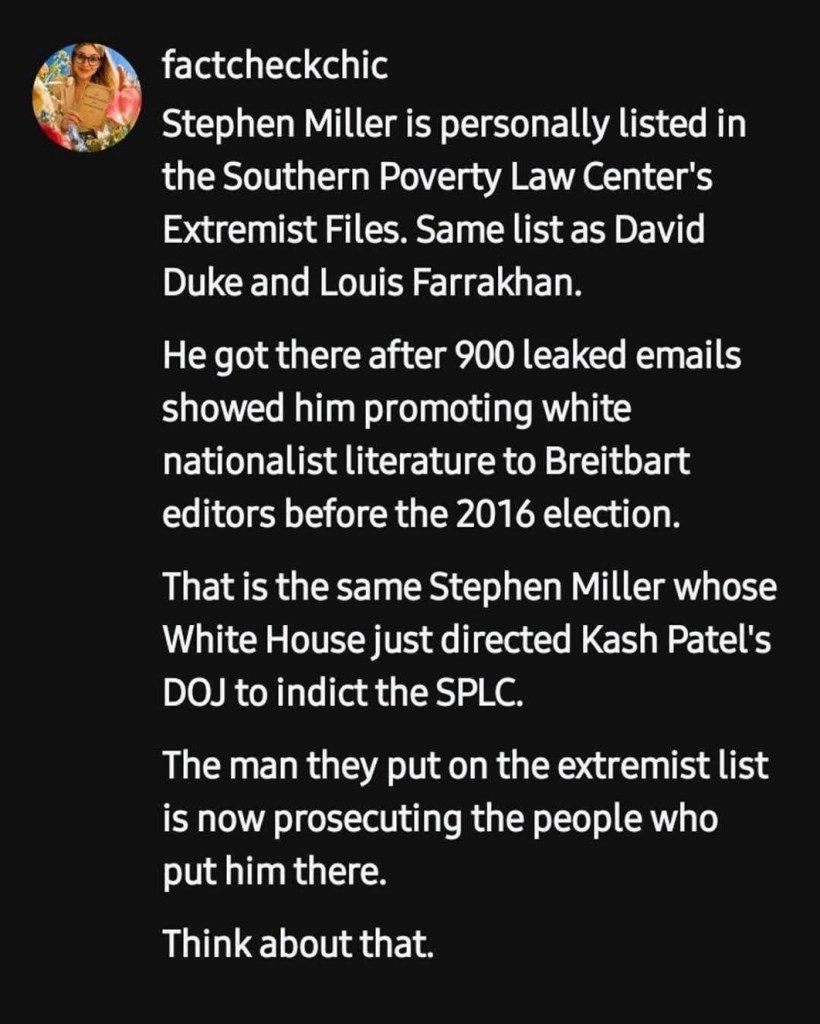
The Department of Justice indicted the Southern Poverty Law Center by paying informants to infiltrate extremist groups.

CNN wrote:

The Justice Department alleges in the criminal case brought last month that the Southern Poverty Law Center — which has drawn the ire of President Donald Trump and other Republicans for labeling right-wing organizations as hate groups — defrauded donors by not informing them of secret payments to hate group members to act as informants.

The Justice Department alleges that SPLC has funneled $3 million to hate groups like the KKK, Unite the Right, and the Aryan Nations. SPLC also listed Moms for Liberty as a hate group, and M4L said that SPLC should be shut down.

One of the specialties of SPLC is compiling a list of hate groups and individuals who spread hate.

As an organization that was created to oppose racial injustice in the South, SPLC became a natural target for the GOP vengeance campaign.

The odd thing about the suit is that SPLC paid infiltrators, not the groups themselves.

This is a brazen assault on a significant civil rights group that has tangled with hate-groups for more than 50 years.

It is also a demonstration of the Trump administration’s weaponization of the Justice Department, turning it into a partisan cudgel.

Some large corporations have paused their charitable gifts to SPLC, including a division of Schwab that manages charitable gifts, Fidelity, and vanguard.

It was noted on Twitter that Stephen Miller, Trump’s policy advisor, is in the SPLC list of extremists.

The six conservative-right wing justices on the U.S. Supreme Court gutted the Voting Rights Act of 1965, by striking down Section 2, which requires that minorities have districts in which their voting preferences may be heard. This section led to the creation of districts that elected Black representatives.

We can now expect redistricting of Congressional districts and state legislative districts to sharply reduce the number of Black elected officials.

Richard L. Hasen of Slate wrote that the decision “will go down in history as one of the most pernicious and damaging Supreme Court decisions of the last century. All six Republican-appointed justices on the court signed onto Justice Samuel Alito’s opinion gutting what remained of the Voting Rights Act protections for minority voters, while pretending they were merely making technical tweaks to the act.

This decision will bleach the halls of Congress, state legislatures, and local bodies like city councils, by ending the protections of Section 2 of the act, which had provided a pathway to assure that voters of color would have some rudimentary fair representation. It’s the culmination of the life’s work of Chief Justice John Roberts and Samuel Alito, who have shown persistent resistance to the idea of the United States as a multiracial democracy, and a brazen willingness to reject Congress’ judgment that fair representation for minority voters sometimes requires race-conscious legislation. It gives the green light to further partisan gerrymandering. It protects Alito’s core constituency: aggrieved white Republican voters. It’s a disaster for American democracy.

Future generations of legal scholars will review the Republicans’ retreat from civil rights protections enacted in the 1960s. Perhaps psychologists will figure out why Justice Clarence Thomas consistently opposes laws intended to protect people like him.

Dan Rather, the esteemed journalist, wrote on his blog Steady about the dreadful consequences of Trump’s defunding of science, medicine, and public health.

But on Friday night, when we weren’t looking for a controversial announcement, Trump fired every single member of the 24-person National Science Board. Why? The simplest answer is that the members of the board were not his sycophants. They allegiance is to science, not to the person of Donald J. Trump. He couldn’t control them. They had to go.

Dan Rather wrote:

We toss around terms like “American exceptionalism” far too easily. But there is little debate that, in areas of science and medicine, this country has long been the world leader. We have more top scientists, elite doctors, and preeminent researchers than anywhere else. Their work has meant people live longer, healthier lives.

It is also a cornerstone of American influence around the world.

Scientific and medical research requires significant funding. It has thrived because our elected officials have had the political will to provide a financial pipeline to the public and private sectors.

President Donald Trump is severing that lifeline.

As the mainstream media was renting tuxedos and getting manicures ahead of the White House Correspondents’ Dinner, Trump was busy pounding nails into the coffin of the American scientific research community.

Tucked away on Friday evening, in a terse, two-line email, the White House personnel office fired the entire National Science Board. “On behalf of President Donald J. Trump, I’m writing to inform you that your position as a member of the National Science Board is terminated, effective immediately,” the email read.

No reason was given in the email, and the White House has had no additional comment on the firings.

The independent, 24-person board is made up of top scientists and engineers who serve staggered, six-year terms, to ensure overlap between presidential administrations. They are chosen “solely on the basis of established records of distinguished service.”

The board advises the National Science Foundation (NSF), which supports a wide range of research, from Antarctic exploration to quantum computing. NSF-funded research helped develop the MRI machine, LASIK eye surgery, and Wi-Fi, among many other innovations. It distributes $9 billion in research grants annually.

“[I]t is not enough simply to keep abreast of the rest of the world in scientific matters. We must maintain our leadership,” President Harry Truman said in 1950, when he established the board.

Keivan Stassun, a physicist and astronomer at Vanderbilt University who was appointed to the board in 2022, called the Trump purge “a wholesale evisceration of American leadership in science and technology globally,” to the Los Angeles Times.

Although the president is often reluctant to explain why he does imprudent and detrimental things, if one looks hard enough, a reason can usually be found. In this case, there may be two.

Reason one: to save face. The board was set to meet in early May to work on the release of a new report. The report outlines how the U.S., once the world leader in scientific research, is losing ground to China. If there is no board, the report can’t be released.

Reason two: money. In its 2026 budget, the Trump administration recommended a 55% cut to the NSF. After lobbying by the National Science Board, Congress rejected the White House’s proposal and funded the NSF at 2025 levels.

To avoid the same fate for this year’s budget, which again recommends slashing the foundation’s funding, Trump did away with the board before its members could convince members of Congress.

Friday’s firings are just the latest in Trump’s long list of objectionable actions to cast doubt on scientific findings and thwart research.

The United States has been on the cutting edge of scientific and medical research since the end of World War II. The National Institutes of Health (NIH) has been the world leader in funding biomedical research. A 2020 study found that NIH-funded research was associated with every new drug approved between 2010 and 2019.

But all of that is now changing. And Trump is to blame.

Science is “explicitly designed to counter human self-deception,” psychologist Steven Pinker told Chris Mooney in his book “The Republican War on Science.”

When deception is your modus operandi, you will naturally try to squash, discount, and demonize the truth. Being anti-science helps protect established special interests. Think climate change denialism and fossil fuel companies.

Trump called the climate crisis “the greatest con job ever perpetrated on the world” at last year’s United Nations General Assembly. He said this even as the globe is in the midst of the warmest 10-year span on record, according to the National Oceanic and Atmospheric Administration.

The NSF’s board is not the first the Trump administration has hamstrung. In June of last year Robert F. Kennedy Jr., the Secretary of Health and Human Services, fired the 17-person vaccine advisory board and replaced many with vaccine skeptics. Trump himself replaced leading scientists with tech billionaires on the President’s Council of Advisors on Science and Technology.

The administration significantly cut funding to the National Cancer Institute, once the gold standard for rigorous, evidence-based research. It no longer funds mRNA research, a revolutionary technology that has the potential to radically improve cancer care.

It canceled 22 separate mRNA contracts, including one working on a vaccine for brain cancer in children. Kennedy is an mRNA skeptic, claiming the vaccines aren’t safe while providing no evidence.

Pancreatic cancer is an incurable disease with a dismal survival rate. Fortunately for pancreatic cancer patients, research into an mRNA vaccine was far enough along that the cuts didn’t affect the very promising treatment.

BioNTech, a German biomedical research company, partnered with Moderna, an American company, to develop pancreatic cancer vaccines using mRNA technology.

The technology, already in development when the pandemic hit, was used to create the Covid vaccine. The Lancet estimated that mRNA vaccines prevented 14.4 to 19.8 million deaths just in the first year of use.

MRNA vaccine technology was in the pipeline thanks to billions of dollars in federal grants over decades. This allowed researchers to get Covid vaccines to market incredibly quickly. This technology is now helping people with pancreatic cancer live years longer than ever before.

Moderna is also using mRNA therapy in combination with other drugs to cut melanoma death rates by 49%. Applications for a variety of cancers are in the works.

Paul Darren Bieniasz, a British-American virologist, wrote in The Guardian, “If we continue the destructive course plotted by this administration, medicines that would otherwise have saved lives in future generations, will not be invented. Technologies that would have ensured future employment and prosperity in the U.S. will not be devised. Solutions that allow the generation of power while causing less damage to the environment, will never be developed. Clearly, if we decline to nurture science, the lives of future Americans will be shorter, sicker and poorer.”

While Donald Trump won’t be around to see that, millions of Americans will. Trump doesn’t like inconvenient truths. Science is a kaleidoscope of inconvenient truths. Rather than deal with them like the world leader he should be, he gaslights, he rages, he denies all.

And as with so much else in this administration, we the people pay the price.
John Thompson, retired teacher and historian, lives in Oklahoma and keeps watch on the state of democracy.

He wrote:

Oklahoma is one of several case studies revealing how Trumpians and reactionary institutions such as the Heritage Foundation seek to undermine democracy. So, it is not just Oklahomans who need to come to grips with the multiple ways that Gov. Kevin Stitt, and the Republican-controlled legislature are challenging basic legal norms and the principles of our democracy.

We must understand why Sen. David Bullard told his Republican colleagues that they must restrict voter ballot initiatives. “Your democracy does not need you right now,” he said. “Your republic needs you . . . The Republican form of government says that you’re ruled by your elected officials.”

When I was a child, Oklahoma was a racist, sexist, corrupt oligarchy. But a highly respected federal judge told me that we started to become a democracy on January 1, 1963, the day that Sen. Robert S. Kerr died. That allowed Attorney General Robert Kennedy to send federal investigators into Oklahoma. A month later, they started the investigation of our corrupt Supreme Court. Afterwards, we created one on the nation’s most honest judicial selection processes.

Gov. Stitt has been committed to turning the clock back to the time when the bribery of the Court was the norm. Now, he hopes that an initiative petition can be used to undermine our trustworthy judiciary. That would be a non-starter if the norms of the petition process were respected. But the date of vote was shifted to August 25, when there are virtually no Democrat primaries, and low turnout, so the voters tend to be conservative Republicans.

And that is just one issue where Republicans seek an August vote. They also changed the date for seeking reversing the voters’ decision to protect SoonerCare from Medicaid cuts and for reversing the voters’ decision on the Tobacco Settlement Trust which has ensured that funds from the tobacco settlement are used for building a healthy society. They also hope this tactic will allow for the passage of new Voter I.D. requirements, and cutting property taxes in a regressive manner.

The governor and the legislature have cut taxes by $1.3 billion since 2020. And last year, they committed to the goal of putting “income taxes on the path to zero.” Now the goal is cutting property taxes.

As Christy Taylor of GenXpletives explains:

Oklahoma currently ranks 49th in the nation in per-pupil spending. That means only one state in the country spends less on each student’s education than Oklahoma does. When you adjust for inflation, per-pupil spending has declined since 2008.

Moreover, roughly 80% of every property tax dollar collected in Oklahoma goes directly to public schools and career tech centers.

Even worse, is what Sen. Bullard was speaking about when attacking democracy. He sponsored a ballot measure that required that no more than 10 percent of signatures for a ballot measure come from a county with 400,000 or more people, essentially giving rural, conservative areas the power to block an initiative from appearing on the ballot.

And in another surprise, Gov. Stitt voted to award “a lucrative investment advisory contract to a firm owned by his former chief of staff and one-time business partner — a company that has the power to steer more than $2 billion in state pension, endowment and sovereign wealth fund money.”

Also, it was no surprise, but SB 1439:

Prohibits Oklahoma courts from hearing any civil or administrative action against fossil fuel producers, manufacturers, processors, refiners, pipeline operators, transporters, sellers, trade associations, or any entity that purchases fossil fuels to generate electricity — when the claim arises from or relates to climate change, its alleged effects, or greenhouse gas emissions.

I have been focusing on recently revealed tactics for empowering the affluent and disempowering the poor and working class that the Republican super-majority rushed into place. But, we can’t ignore their HB 3242, which mandates:

Biological sex segregation in restrooms, changing areas, sleeping quarters, and student housing at public schools, public universities, public buildings, and domestic violence shelters. It creates a private right to sue for any person who encounters someone of the opposite biological sex in a covered space

Neither can we ignore their attempt to make it harder to regulate puppy mills.

And we can’t overlook the way that what Cherokee Nation Chief Chuck Hoskin was banned from speaking to the House of Representatives because he voiced concerns about rolling back Medicaid.

And we can’t forget that lawmakers filed more than 30 immigration-related bills and that “the vast majority of these bills would further marginalize and penalize Oklahoma immigrants.”

In other words, we must remember that the 2026 session has been full of both “under-the-table” strategies for sneaking rewards to elites that most of Oklahomans would oppose, and loudly displaying cruelty and hatefulness that they believe will bring victory in low-turnout elections.  

Erwin Chemerinsky writes on the legal site Cafe that a judge’s ruling upholding the Trump administration’s demand for a list of Jews at U of Penn is “egregiously wrong.”

Chemerinsky is the dean of the law school at UC Berkeley and a constitutional scholar.

He wrote:

A federal judge in Philadelphia was egregiously wrong in upholding an Equal Employment Opportunity Commission subpoena to the University of Pennsylvania that effectively requires it to provide a list of its Jewish faculty and staff. At a time of increasing antisemitic acts, and at a moment when the likes of Nick Fuentes and Candace Owens are expressing vile anti-Jewish hate to massive audiences, it should be unthinkable to ask a university to compile and turn over a list of Jewish people on campus, including their home addresses and phone numbers. The University has appealed and the United States Court of Appeals for the Third Circuit should quickly reverse federal district court Judge Gerald Pappert’s truly insensitive opinion…

The EEOC’s goal is to force the University to create a list, with contact information, of as many Jewish faculty and staff on campus as possible so that the agency can reach out to interview them.  It is a fishing expedition by the EEOC with the hope that if it contacts enough Jewish faculty and staff, it might find evidence of antisemitism on campus.

For many reasons, this is unconstitutional; it also is deeply frightening. The Supreme Court has held for almost 70 years, since NAACP v. Alabama in 1958, that requiring organizations to disclose their members violates freedom of association. In that case, the Court held that Alabama violated the First Amendment in requiring that groups like the NAACP disclose their membership lists. Many cases since have reaffirmed this principle. For example, in Americans for Prosperity v. Bonta (2021), the Court declared unconstitutional a California requirement that non-profit groups turn over their list of donors that they already were required to provide to the federal government….

There are also serious privacy concerns in requiring that the University compile and turn over contact information. The district court said the information here—personal home addresses and phone numbers, task-force participation, survey receipt—is not “highly personal.” This is just wrong as a matter of law. In U.S. Department of Defense v. FLRA (1994), the Supreme Court recognized substantial federal employee privacy interests in home addresses. Moreover, a list of home addresses and phone numbers is one thing; a list of home addresses paired with religious identity is another. Similarly, in Kallstrom v. City of Columbus (1998), the United States Court of Appeals for the Sixth Circuit recognized that disclosure of home addresses can threaten personal security when linked to a category that a hostile actor has targeted. Hostile attacks on Jewish victims are at their highest number in decades….

This egregious decision should be reversed on appeal.

Despite the Trump regime attacking the Constitution, eroding our rights, and filling every office with incompetent or malevolent individuals, our legal system has frustrated some (certainly not all) of their evil designs.

Not three hurrahs but only two. Why? The Department of Justice is now wholly under Trump’s control. It has become Trump’s law firm, answering only to him. The U.S. Supreme Court has been far too accepting of Trump’s reckless policies. Too many federal judges have gone along with him.

All too often, the regime has ignored the judges. Rulings against Trump’s policies have come from all kinds of judges, including some appointed by Trump. Grand juries have refused his efforts to indict his enemies.

Nonetheless, many federal judges across the country have repeatedly blocked the regime. Many have defended the right of due process for immigrants, many of whom are arrested without a warrant or access to a lawyer, then disappeared into a detention camp or deported to a country they never lived in.

Here are reasons for cheer.

The U.S. Supreme Court declared that Trump does not have the power to slap tariffs on every other country, because the Constitution gives the power of the purse to Congress, not the President. Trump, furious, responded by slapping a 10% tariff on every country, then raised it to 15%. Will the Supreme Court ignore his open defiance?

This is the same Court that ruled that the President is above the law. Absolute immunity. Trump is the kind of guy who loves absolute immunity for any actions he takes.

Even more powerful than the decisions of judges has been the refusal of grand juries to indict Trump’s enemies and critics. That’s why he attacked Iran without congressional approval. Why should he bother? He is above the law, the dream of a habitual law-breaker.

Many federal judges have repeatedly defended the very American idea that immigrants–even undocumented immigrants–have legal rights. They have repeatedly interfered with ICE’s efforts to arrest, detain, and oust immigrants, without a hearing, without due process.

Federal judges confounded Trump’s vendetta against big law firms who represented Trump’s enemies.They frustrated his vengeance so consistently that the Justice Department dropped the charges. The law firms that quickly acquiesced to Trump have egg on heir collective faces.

The grand juries have been dogged in their refusal to bow to Trump’s pursuit of vengeance.

When Sean Charles Dunn, a paralegal in the Justice Department hurled his footlong Subway sandwich (turkey) at US Customs and Border Patrol agents, he was charged with a crime, fired from his job, and hauled before a grand jury. The grand jury refused to indict him. The “Sandwich Guy” was briefly a folk hero for his defiance.

Mark Joseph Stern, writing in Slate, said that the grand jury’s refusal to indict appeared to be an instance of jury nullification, stating that “a grand jury will typically indict a ham sandwich, but it turns out a D.C. grand jury won’t indict the guy who threw the sandwich.”

Trump told Pam Bondi to go after his enemies and she did.

She charged former FBI Director James Comey with lying to Congress, but the grand jury refused to indict him. She charged him again, and the next grand jury did not indict him.

Bondi then went after New York State Attorney General Leticia James, who won successful convictions of Donald Trump in New York state courts.

Trump wanted her indicted for bank fraud and mortgage fraud. (DOJ allegedly received confidential information from Bill Pulte, chair of the Federal Housing Finance Agency). Eric Siebert, the first interim federal prosecutor in Virginia, who was respected by both parties, refused to bring charges because the evidence was flimsy. He resigned and was replaced by Lindsay Halligan, a personal attorney of Trump’s who had no experience as a prosecutor.

Halligan persuaded a grand jury to indict James but the prosecution was invalidated because Halligan had not been confirmed by the Senate and her predecessor had used up the 120 days when he was interim prosecutor.

Two new grand juries refused to indict James, even though they heard only the prosecutors’ evidence, not her defense. .

In another high-profile case, Secretary of Hegseth wanted to punish six members of Congress–all military veterans–who endorsed a video declaring that members of the military should not obey illegal orders. Hegseth himself was on video saying exactly the same thing a few years ago, but no matter. Trump said that their actions were “seditious” and deserved the death penalty. In another comment, he called them “traitors.” Trump’s top aide Stephen Miller said that the six were engaged in an “insurrection.”

The case was put before a grand jury by the U.S. Attorney for D.C., Jeanine Pirro, a former FOX News host.

The grand jury unanimously refused to indict them.

Not one member of the Grand Jury supported the indictment.

In a separate case, Hegseth tried to reduce Senator Mark Kelly’s rank and pension to punish him for participating in the video. Kelly said he had free speech rights. Federal Judge Richard Leon, a Bush II appointee, enjoined Hegseth’s actions. Hegseth is appealing; he wants to bring Kelly down. His case, however, is absurd. How can a U.S. Senator be muzzled because he is a veteran? How can the Secretary of Defense be allowed to vindictively reduce the rank and pension of those who served honorably but had the temerity to speak their mind?

A few days ago, Federal Judge Brian Murphy in Massachusetts ruled that the government’s policy of deporting immigrants to third countries–countries they have never lived in–is illegal. This is an unusually cruel policy. The decision will of course be appealed.

So three cheers for the brave judges who stand up for the rights of individuals.

Three cheers for Grand Juries, especially those who think for themselves and refuse to be cowed by political bigwigs.

And two cheers for our legal system, which moves very slowly and can bankrupt anyone who does not have a pro bono lawyer.

Andy Borowitz is America’s humorist. More than that, he is incisive and brilliant. He used to write for The New Yorker, but now has his own Substack blog called The Borowitz Report. I subscribe, and I recommend that you do so as well.

In this post, he gives insight into our notorious Attirney General, Pam Bondi, who has turned the Department of Justice into Trump’s personal law firm.

It’s important to remember that she was Attorney General of Florida from 2011 to 2019. She claimed that human trafficking was her #1 issue but somehow overlooked Jeffrey Epstein. As Attorney General, she is still shielding his crimes. Could it be that she is doing this to protect Trump?

Her obnoxious, aggressive, pugnacious appearance before the House Judiciary Committee showed the real Pam Bondi.

Borowitz writes:

Win McNamee/Getty Images

Can the attorney general of the United States go to prison? 

The answer, of course, is yes: John Mitchell, who served under Richard M. Nixon, later served 19 months behind bars for crimes related to the Watergate cover-up. 

Will the toxin known as Pam Bondi follow in his footsteps? 

It’s worth considering in light of her appearance before Congress on Wednesday, a performance that Kimberly Guilfoyle might call “too shouty.” 

Her testimony was unquestionably obnoxious. But was it criminal? 

When you examine the evidence, it doesn’t look good for Pam. 

This was the pivotal moment: responding to a question from California Rep. Ted Lieu about the Epstein scandal, Bondi snapped, “There is no evidence that Donald Trump has committed a crime. Everyone knows that.”

Lieu, who must have been tickled that Bondi was dumb enough to step into the weasel trap he set for her, responded that the attorney general might have just committed perjury. Which, as every Watergate superfan knows, is exactly what earned her Republican predecessor, John Mitchell, a trip to the pokey. 

When the Trump shitshow is finally over, two things must happen. First, there must be a solid month of dancing in the streets. Second, there must be a reckoning: ideally, Nuremberg-style trials of the corrupt quislings who enabled this unprecedented crime spree. With those enjoyable tribunals in mind, let us now consider the case of Pam Bondi.


Remember when Trump nominated Matt Gaetz to be attorney general? We were so much younger then—although, it should be added, not young enough for Matt Gaetz.

At the time, I observed that Gaetz’s nomination was not what QAnon had in mind when they said they wanted to bring pedophiles to justice. In the end, Matt turned out to be as reckless with Venmo as he was about the age of consent, and Trump quickly withdrew his name.

Pundits claimed that Trump never expected Gaetz to pass muster with the Senate. By their reckoning, he was a “sacrificial lamb”—an odd way to describe a man who, in his personal life, had consistently behaved like a wolf. But by shitcanning Gaetz, the theory went, Trump was sending a signal to his Senate toadies that they’d better confirm all his other nominees, no matter how idiotic, incompetent, or drunk. When it came to Pete Hegseth, Robert F. Kennedy, Jr., Tulsi Gabbard, Dr. Oz, Kash Patel, and myriad other passengers in Trump’s clown Cybertruck, the gambit seemed to pay off.

Matt Gaetz, peering into the gates of Hell. (Erin Scott-Pool via Getty Images)

As for the job of attorney general, Democrats and Republicans alike seemed relieved that it would not be filled by a summer-stock version of Jeffrey Epstein. Surely, whoever Trump named as Gaetz’s replacement would be an improvement.

Instead, Trump picked Pam Bondi.

In 2016, when she was Florida attorney general, Bondi secured her place in Trump’s heart with a speech at the Republican National Convention. Her bloodcurdling attack on Hillary Clinton inspired the GOP mob to break into a familiar chant, which prompted Bondi to comment, “Lock her up? I love that.” And so, by approving the incarceration of a woman who had never been charged with a crime, Bondi displayed an attitude towards due process that would someday serve her splendidly as the nation’s top law enforcement officer.

She would, of course, have another opportunity to assert her preference for imprisoning innocent people with the case of Kilmar Armando Abrego Garcia. On April 14, 2025, El Salvador’s President Nayib Bukele, Trump’s accomplice in the world’s most notorious administrative error, joined him in the Oval Office, receiving a much warmer welcome there than was offered Ukrainian President Volodymyr Zelenskyy. After chummily congratulating each other on the abduction and deportation of a non-criminal, the two men started workshopping how their brilliant strategy might be applied to innocent American citizens.

“The homegrowns are next, the homegrowns,” Trump told Bukele, who calls himself “the world’s coolest dictator”—a stroke of branding so cringe, it’s amazing it didn’t come from Elon Musk. “You’ve got to build about five more places,” Trump advised him.

Where did America’s attorney general stand on this flagrant nullification of a basic right enshrined in the Constitution? Trump added, “Pam is studying. If we can do that, it’s good.”

Pam, apparently, is a quick study. On Fox that evening, she was all in on Trump’s blatantly illegal idea, asserting, “These are Americans who he [Trump] is saying who have committed the most heinous crimes in our country, and crime is going to decrease dramatically.”

It’s not that Bondi is bad at her job—it’s that she’s outstanding at the exact opposite of her job, that is, using the DOJ to subvert justice whenever possible. Bondi’s Department of Injustice, a mutant creation worthy of George Orwell and Lewis Carroll, has proven inhospitable to career DOJ lawyers, who have struggled in court to defend the indefensible.

One such staffer, senior immigration attorney Erez Reuveni, committed what Bondi apparently considers a cardinal sin: uttering a truthful statement within earshot of a judge. After acknowledging what was obvious to any thinking person (but seemingly elusive to Messrs. Trump and Bukele)—that Abrego Garcia’s deportation was a mistake—Reuveni was put on indefinite leave and then fired.

Meanwhile, Liz Oyer, a longtime DOJ pardon attorney, was fired for refusing to restore gun rights to the actor Mel Gibson, who lost them after pleading no contest to domestic battery charges in 2011. Apparently, Trump believes Mel Gibson needs lethal weapons more urgently than Ukraine.

We shouldn’t be surprised to see Trump standing up for the rights of domestic abusers, since a sizable number of the January 6 rioters he pardoned fit that description. He doubled down on his support for this cohort by appointing a crony accused of domestic violence, Herschel Walker, ambassador to the Bahamas.

But what makes the Mel Gibson case particularly rich is that Trump has repeatedly claimed he is punishing universities for their “failure to combat antisemitism.” If Trump is serious about spanking antisemites, he need look no further than his pal Mel. 

After the actor’s 2006 drunk driving arrest in Malibu, the police report indicated, “Gibson blurted out a barrage of anti-semitic remarks about ‘fucking Jews’. Gibson yelled out: ‘The Jews are responsible for all the wars in the world.’ Gibson then asked: ‘Are you a Jew?'”

Mel Gibson after his 2006 drunk driving arrest (L) and his 2011 domestic violence arrest (R).

In the upside-down world of Pam Bondi, highly regarded DOJ lawyers are fired and Mel Gibson is rearmed. But do such perversions of justice make Bondi a candidate for worst attorney general ever? They most certainly do, when one considers how decisively and repeatedly she has violated her oath of office:

“I will support and defend the Constitution of the United States against all enemies, foreign and domestic; that I will bear true faith and allegiance to the same; that I take this obligation freely, without any mental reservation or purpose of evasion; and that I will well and faithfully discharge the duties of the office on which I am about to enter. So help me God.”

Rather than defend the Constitution, Bondi has used her time in office to tirelessly protect pedophiles—which should come as no surprise to anyone familiar with her tenure as Florida’s AG. The following campaign ad from that era, in which she vowed to “put human trafficking monsters where they belong—behind bars,” hasn’t aged well:

As Bloomberg’s Mary Ellen Klas wrote, “Bondi kept her distance from the state’s most prominent sex-trafficking case, even as Epstein’s victims pleaded with the courts to invalidate provisions of his non-prosecution agreement and filed lawsuits alleging that he abused them when he was on work release from jail.”

I am confident that Bondi’s misdeeds—including but not limited to her role in the Epstein cover-up—have more than earned her a Nuremberg-style tribunal. I am not, however, suggesting we chant, “Lock her up.” Unlike our current attorney general, I believe in due process.