Archives for category: Inequality

Reporters at The New York Times pored through 5,000 pages from various federal agencies and found that the following words had been removed from government websites and publications. As the article points out, Trump and Musk frequently claim to be champions of “free speech,” but they have no problem censoring words and ideas that offend them.

Karen YourishAnnie DanielSaurabh DatarIsaac White andd Lazaro Gamio wrote:

As President Trump seeks to purge the federal government of “woke” initiatives, agencies have flagged hundreds of words to limit or avoid, according to a compilation of government documents.

  • accessible
  • activism
  • activists
  • advocacy
  • advocate
  • advocates
  • affirming care
  • all-inclusive
  • allyship
  • anti-racism
  • antiracist
  • assigned at birth
  • assigned female at birth
  • assigned male at birth
  • at risk
  • barrier
  • barriers
  • belong
  • bias
  • biased
  • biased toward
  • biases
  • biases towards
  • biologically female
  • biologically male
  • BIPOC
  • Black
  • breastfeed + people
  • breastfeed + person
  • chestfeed + people
  • chestfeed + person
  • clean energy
  • climate crisis
  • climate science
  • commercial sex worker
  • community diversity
  • community equity
  • confirmation bias
  • cultural competence
  • cultural differences
  • cultural heritage
  • cultural sensitivity
  • culturally appropriate
  • culturally responsive
  • DEI
  • DEIA
  • DEIAB
  • DEIJ
  • disabilities
  • disability
  • discriminated
  • discrimination
  • discriminatory
  • disparity
  • diverse
  • diverse backgrounds
  • diverse communities
  • diverse community
  • diverse group
  • diverse groups
  • diversified
  • diversify
  • diversifying
  • diversity
  • enhance the diversity
  • enhancing diversity
  • environmental quality
  • equal opportunity
  • equality
  • equitable
  • equitableness
  • equity
  • ethnicity
  • excluded
  • exclusion
  • expression
  • female
  • females
  • feminism
  • fostering inclusivity
  • GBV
  • gender
  • gender based
  • gender based violence
  • gender diversity
  • gender identity
  • gender ideology
  • gender-affirming care
  • genders
  • Gulf of Mexico
  • hate speech
  • health disparity
  • health equity
  • hispanic minority
  • historically
  • identity
  • immigrants
  • implicit bias
  • implicit biases
  • inclusion
  • inclusive
  • inclusive leadership
  • inclusiveness
  • inclusivity
  • increase diversity
  • increase the diversity
  • indigenous community
  • inequalities
  • inequality
  • inequitable
  • inequities
  • inequity
  • injustice
  • institutional
  • intersectional
  • intersectionality
  • key groups
  • key people
  • key populations
  • Latinx
  • LGBT
  • LGBTQ
  • marginalize
  • marginalized
  • men who have sex with men
  • mental health
  • minorities
  • minority
  • most risk
  • MSM
  • multicultural
  • Mx
  • Native American
  • non-binary
  • nonbinary
  • oppression
  • oppression
  • oppressive
  • orientation
  • people + uterus
  • people-centered care
  • person-centered
  • person-centered care
  • polarization
  • political
  • pollution
  • pregnant people
  • pregnant person
  • pregnant persons
  • prejudice
  • privilege
  • privileges
  • promote diversity
  • promoting diversity
  • pronoun
  • pronouns
  • prostitute
  • race
  • race and ethnicity
  • racial
  • racial diversity
  • racial identity
  • racial inequality
  • racial justice
  • racially
  • racism
  • segregation
  • sense of belonging
  • sex
  • sexual preferences
  • sexuality
  • social justice
  • sociocultural
  • socioeconomic
  • status
  • stereotype
  • stereotypes
  • systemic
  • systemically
  • they/them
  • trans
  • transgender
  • transsexual
  • trauma
  • traumatic
  • tribal
  • unconscious bias
  • underappreciated
  • underprivileged
  • underrepresentation
  • underrepresented
  • underserved
  • undervalued
  • victim
  • victims
  • vulnerable populations
  • women
  • women and underrepresented
  • Notes: Some terms listed with a plus sign represent combinations of words that, when used together, acknowledge transgender people, which is not in keeping with the current federal government’s position that there are only two, immutable sexes. Any term collected above was included on at least one agency’s list, which does not necessarily imply that other agencies are also discouraged from using it.
  • The above terms appeared in government memos, in official and unofficial agency guidance and in other documents viewed by The New York Times. Some ordered the removal of these words from public-facing websites, or ordered the elimination of other materials (including school curricula) in which they might be included.

  • In other cases, federal agency managers advised caution in the terms’ usage without instituting an outright ban. Additionally, the presence of some terms was used to automatically flag for review some grant proposals and contracts that could conflict with Mr. Trump’s executive orders.

  • The list is most likely incomplete. More agency memos may exist than those seen by New York Times reporters, and some directives are vague or suggest what language might be impermissible without flatly stating it.

  • All presidential administrations change the language used in official communications to reflect their own policies. It is within their prerogative, as are amendments to or the removal of web pages, which The Times has found has already happened thousands of times in this administration.

  • Still, the words and phrases listed here represent a marked — and remarkable — shift in the corpus of language being used both in the federal government’s corridors of power and among its rank and file. They are an unmistakable reflection of this administration’s priorities.

  • For example, the Trump administration has frequently framed diversity, equity and inclusion efforts as being inherently at odds with what it has identified as “merit,” and it has argued that these initiatives have resulted in the elevation of unqualified or undeserving people. That rhetorical strategy — with its baked-in assumption of a lack of capacity in people of color, women, the disabled and other marginalized groups — has been criticized as discriminatory.

Haha. That “rhetorical strategy,” assuming that those groups are incompetent has not only been “criticized as discriminatory.” IT IS DISCRIMINATORY!

Umair Haque, a London-based economist, is pessimistic about the direction of our economy., He wrote this a day before Trump announced that he was imposing 25% tariffs on Canada and Mexico, our neighbors and largest trading partners, and 10% tariffs on Europe and China. Haque predicts that the economic consequences for the U.S. will be devastating.

He wrote on his blog, The Issue:

Hi guys. I’m going to keep it short and sweet, because this one’s urgent. Friends, gather round, you will need to understand what I’m about to discuss.

Trump just announced tariffs of 25% on Canada and Mexico and a little less on China…

What’s going to happen?

Americans don’t have much experience with tariffs, with macroeconomic changes and transformations in general. So it’s OK not to know. And I’d expect the country to be wayyyyy more alarmed, but it isn’t, because it doesn’t understand what’s about to hit it, which is going to be…

Absolutely catastrophic.

See how people are already “shocked” and “surprised” by what’s happening (all over again)? They aren’t listening and learning. Please, take a second to understand all this, urgently and seriously. This is why I write these long essays. You are going to be affected, and I don’t want you and your loved ones to get hurt.

Chaosterity

What do tariffs of 25% mean

They mean that everything that’s imported from Canada and Mexico is going to rise in price, many things by a lot more than 25%. What’s imported from there? Food, vegetables, fruit, lumber, all kinds of basics. Why will it rise, in some cases more than the tariff rate? Because of course distributors and the entire value chain needs to make money in order to operate.

So we are going to see a ruinous wave of inflation. When I say ruinous, I mean it. 25%? That’s an enormous rate for a tariff. Normally, if want to discourage trade or investment, we’d set that rate at maybe 5 or 10%. Not only do these guys have no idea what they’re doing, they have no idea what kind of ruin they’re about to unleash.

In short order, Americans are going to be catastrophically more for nearly everything on the shelves. They already can’t afford it, which we know because of course credit balances are skyrocketing and living standards are falling.

But that’s only sort of the small story. This isn’t just “about tariffs,” but an approach to the economy which also appears to include attempting to lay off the entire government.

I called it Chaosterity the other day. Tariffs hurt people, and the people they hurt the most are those who have the least. In this regard, while attempting to lay off the entire government is austerity, deciding you’re going to have 25% less stuff (which is another way to think about 25% tariffs, at an equivalent price level), is going to result in chaos, a kind which most living Americans have never really seen. We’re talking 1930s level consequences.

Because what all this does next is…what blunders like this do next…they accumulate and begin cascades, vicious spirals. Let me continue.

The best lens to understand what just happened is what Britain did to itself via Brexit.

What Brexit Did to Britain

Today, just 3 in 10 Brits think it was a good idea. Back then, when it happened, the nation was gripped by this weird mania.

Economists and intellectuals would try to warn people about the effects of tariffs. Of breaking up with your biggest trading partners. For a country that imports nearly everything.

Sound familiar?

What happened next to Britain? It suffered the longest, steepest, sharpest fall in living standards in history.

But even that’s not really the worst part. It’s economy is shrinking, and it will never recover. To what it was before Brexit. That is because of course now it has to reach a much smaller equilibrium, since it has less investment, capital of all kinds, whether financial or human, less trade, less commerce.

Sound familiar?

Today, British incomes have stagnated so long and hard that people wonder why they’re earning such pittances. The differences are stark, and almost unbelievable. The same jobs in America will pay 3 to 5 times as much, and in Europe, 2 to 3 times as much.

Britain turned itself into a much, much poorer country. It will never recover. The losses are now permanent.

Meanwhile, because it’s economy now has had to become much smaller, it’s once vaunted social contract is in tatters. The NHS is dying. The BBC is already dead. The streets are full of trash and crime, local authorities are bankrupt, and there’s a sense that nothing works, and there is no future. 

There isn’t.

The government’s plan, to “kickstart growth”? To build…another runway at Heathrow. Go ahead and laugh. This is what’s left—this level of incompetence and this paucity of vision.

Brexit cost Britain everything. It destroyed its future so severely that we don’t have a wordfor “rich country that made itself poor and a pariah.”

Go to Paris, compared to London, and the streets are clean, people are happy, and things are generally flourishing. In London? People dress in modern-day rags, the pain and despair are etched on their faces, and the poverty is everywhere.

This is what happens next.

Open the link to continue reading.

Joel Westheimer is Professor of Education and Democracy at the University of Ottawa. He is also a columnist for CBC Radio in Ontario. His most recent book is What Kind of Citizen? Educating Our Children for the Common Good.

This column appeared in the Globe & Mail in Canada.

When Mark Zuckerberg declared that Meta would stop its fact-checking efforts on its social media platforms, he was conducting a master class in bowing to authoritarianism. The move has been viewed as an effort to placate U.S. president-elect Donald Trump, who has praised Meta’s decision. But while it’s easy to direct our outrage at Mr. Zuckerberg personally, his announcement reflects something much deeper and more troubling: the rarefied world of the modern plutocrat.

Social norms govern behaviour for most people, setting limits on what we deem acceptable. But those norms are no longer the same across different social and economic strata. We would like to believe that commonly held norms reflect ideals of fairness, decency and accountability. But Mr. Zuckerberg and his fellow plutocrats share their own set of norms that privilege shareholder value, political expediency and the maintenance of their unparalleled influence. These norms, values and perceptions of what is acceptable behaviour are shaped not by the needs of democracy or society, but by the insulated, self-reinforcing logic of their own milieu – a logic wherein bowing to a fascist seems reasonable, even admirable.

As former deputy prime minister Chrystia Freeland pointed out more than a decade ago, plutocrats live entirely insulated from the rest of us. Their lives are global. They move from one Four Seasons hotel to another. They eat at the same restaurants. They see only each other. As much as we would like to believe otherwise, Mr. Zuckerberg, Jeff Bezos, Elon Musk and their peers do not feel guilty at night. They sleep fine.

The chasm between their world and ours mirrors the grotesque wealth inequality that defines our era, an inequality not seen since the days of the robber barons. And like that earlier gilded age, this one is undermining democracy at its core.

The insulated world plutocrats live in also allows for dangerous indifference to the consequences of their decisions. While the rest of society grapples with misinformation, rising authoritarianism and the erosion of trust in public institutions, the tech elite shrug. Their wealth not only shields them from the effects of democratic decline but often ensures they benefit from it. After all, authoritarian regimes offer stable environments for market expansion and profit maximization – no pesky regulations or democratic checks to contend with.

The implications are chilling. Meta’s decision isn’t just a policy shift; it’s a reflection of a deeper decay in democratic accountability. In a world where billionaires and their companies wield extraordinary power, platforms such as Facebook and X have become the de facto public squares of our time. Yet these spaces are governed not by the public interest but by the profit margins of the ultra-wealthy. When this small handful of individuals decide what speech is amplified, suppressed or ignored, they fundamentally reshape the boundaries of democratic discourse.

What does it mean for democracy when the norms governing the lives of the wealthiest people on Earth are so utterly detached from the values of the societies their platforms claim to serve; when truth is sacrificed to political gain; when fascism is appeased to protect market share; and when those with unimaginable resources opt to placate authoritarianism rather than challenge it? These decisions do not occur in a vacuum. They emerge from a cultural context that prizes wealth and influence above all else – even the integrity of democratic systems.

Mr. Zuckerberg’s announcement is a reminder that democracy does not simply erode; it is eroded. The responsibility for this erosion lies not just with one, two or three men or companies, but with a broader culture of plutocratic complacency and complicity. The erosion is cumulative, each decision stacking upon the next to create a structure that serves the interests of the few at the expense of the many.

The rest of us, however, are not powerless. History demonstrates that when perverse norms of the wealthy are weaponized against democracy, people can and do fight back. From labour movements to civil-rights struggles, ordinary citizens have reclaimed power from elites before and can do so again. Norms can be reimagined and reclaimed. It’s time to insist that truth is not negotiable, that democracy is not a product to be monetized, and that the plutocrats of our age should not be above accountability.

The robber barons of old built railroads and monopolies; today’s tech barons shape reality itself. If we fail to hold them accountable, the price will be not just economic inequality, but the very fabric of democracy. And that is a cost we cannot afford to pay.

This article just appeared on the website of The New York Review of Books.

https://www.nybooks.com/online/2025/01/11/their-kind-of-indoctrination/

It is my review of Trump’s plans for K-12 education.

NYRB is the most distinguished literary-political journal in the nation. It has a huge readership. It reaches a different audience than education journals.

If you subscribe to NYRB, you can open it in full. If you don’t, it costs $10 for 10 issues. Or, if you wait, I will post it in full in a few weeks.

Repeat after me: The school choice movement began in response to the Brown Decision of 1954.

School choice was a euphemism for using public dollars to fund segregation academies for whites, to enable them to escape anticipated desegregated schools.

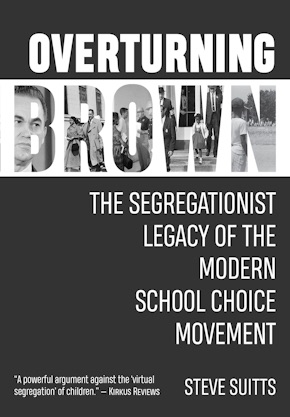
Steve Suitts wrote an excellent book about the history of school choice, called Overturning Brown: The Segregationist Legacy of the Modern School Chhoice Movement.

I reviewed the book in The New York Review of Books. The review was titled “The Dark History of School Choice.”

Now, ProPublica reports, southern states are using voucher money to fund the same segregation academies founded in the 1950s and 1960s.

The latest ProPublica report begins:

On May 14, the final day for submitting new bills in the Mississippi Legislature, a bold new package of them landed on the desks of Mississippi lawmakers. The plans called for the creation of a voucher program that paid for students to attend private schools.

A few weeks later, in the heat of mid-June, the governor urged lawmakers to support the $40 million program, promising it “will bear the sound fruit of progress for a hundred years after this generation is gone.” Public school support would continue, he assured. But vouchers would “strengthen the total educational effort” by giving children “the right to choose the educational environment they desire.”

It was 1964.

Key backers of the move included a group of white segregationists that had formed after the U.S. Supreme Court ruled state-mandated public school segregation unconstitutional.

Across the South, courts had already rejected or limited similar voucher plans in Alabama, Louisiana, Virginia and Arkansas. But Mississippi lawmakers plowed forward anyway and adopted the program. For several years, the state funneled money to white families eager for their children to attend new private academies opening as the first Black children arrived in previously all-white public schools.

Now, 60 years later, ProPublica has found that many of these private schools, known as “segregation academies,” still operate across the South — and many are once again benefiting from public dollars. Earlier this week, ProPublica reported that in North Carolina alone, 39 of them have received tens of millions in voucher money. In Mississippi, we identified 20 schools that likely opened as segregation academies and have received almost $10 million over the past six years from the state’s tax credit donation program.

At least eight of the 20 schools opened with an early boost from vouchers in the 1960s.

“The origins of private schools receiving public funds were with the segregation academies,” said Steve Suitts, a historian and the author of “Overturning Brown: The Segregationist Legacy of the Modern School Choice Movement.”

Most private schools receiving money from the voucher-style programs exploding across the country aren’t segregation academies. But where the academies operate, especially in rural areas, they often foster racial separation in schools and, as a result, across entire communities.

Despite the passage of decades, most segregation academies across Mississippi remain vastly white — far more so than the counties where they operate, federal private school surveys show. Mississippi is the state with the highest percentage of Black residents.

At 15 of the 20 academies benefiting from the tax credit program, student bodies were at least 85% white as of the last federal private school survey, for the 2021-22 school year. And among the 20, enrollments at five were more than 60 percentage points whiter than their communities. Another 11 were at least 30 percentage points whiter.

In 1964, the White Citizens’ Council was among those pushing for the voucher plan. The pro-segregation group was founded in the Mississippi Delta town of Indianola in the 1950s by Robert “Tut” Patterson, who sought to “save our schools if possible” from integration and “if that failed, to develop a system of private schools for our children.”

For Patterson, it was personal. His family, including a young daughter who would start school that fall, lived on what he called a “plantation” with 35 Black families. As he later told an interviewer, “We took care of them. We practically lived with them. We loved them. We tended to them, but I didn’t want to mingle my children with them.”

Vouchers. This is the education idea that Republicans have been pushing for 30 years. This is the policy that is now universal in half a dozen red states. This is the main policy idea of the next Trump regime.

Segregation returns, funded by the taxpayers.

Trump has promised to eliminate the U.S. Department of Education. He needs Congressional approval to do it. Trump made this promise during the campaign. The details are spelled out in Project 2025. The elimination of ED is step one. Then right wingers approve their dream, which is to “block grant” all the big funding. That means that the money goes to states without limits on how it is spent. They can spend it as they wish, without federal oversight. But then comes the kicker: the federal government stops funding Title 1, Special Education, and other “categorical programs,” and the states have to fund it themselves. This works for the well-off states, because they currently pay more than they receive. But the poor states, which voted overwhelmingly for Trump, are screwed. They receive more from the federal Department of Education than they pay in. Tough justice. Bad for kids.

What about the U.S. Department of Education?

Heather Cox Richardson wrote:

One of President-elect Trump’s campaign pledges was to eliminate the Department of Education. He claimed that the department pushes “woke” ideology on America’s schoolchildren and that its employees “hate our children.” He promised to “return” education to the states. 

In fact, the Department of Education does not set curriculum; states and local governments do. The Department of Education collects statistics about schools to monitor student performance and promote practices based in evidence. It provides about 10% of funding for K–12 schools through federal grants of about $19.1 billion to high-poverty schools and of $15.5 billion to help cover the cost of educating students with disabilities.

It also oversees the $1.6 trillion federal student loan program, including setting the rules under which colleges and universities can participate. But what really upsets the radical right is that the Department of Education is in charge of prohibiting discrimination on the basis of race and sex in schools that get federal funding, a policy Congress set in 1975 with an act now known as the Individuals with Disabilities Education Act (IDEA). This was before Congress created the department.

The Department of Education became a stand-alone department in May 1980 under Democratic president Jimmy Carter, when Congress split the Department of Health, Education, and Welfare into two departments: the Department of Health and Human Services and the Department of Education. 

A Republican-dominated Congress established the Department of Health, Education, and Welfare in 1953 under Republican president Dwight D. Eisenhower as part of a broad attempt to improve the nation’s schools and Americans’ well-being in the flourishing post–World War II economy. When the Soviet Union beat the United States into space by sending up the first  Sputnik satellite in 1957, lawmakers concerned that American children were falling behind put more money and effort into educating the country’s youth, especially in math and science. 

But support for federal oversight of education took a devastating hit after the Supreme Court, headed by Eisenhower appointee Chief Justice Earl Warren, declared racially segregated schools unconstitutional in the May 1954 Brown v. Board of Education decision. 

Immediately, white southern lawmakers launched a campaign of what they called “massive resistance” to integration. Some Virginia counties closed their public schools. Other school districts took funds from integrated public schools and used a grant system to redistribute those funds to segregated private schools. Then, Supreme Court decisions in 1962 and 1963 that declared prayer in schools unconstitutional cemented the decision of white evangelicals to leave the public schools, convinced that public schools were leading their children to perdition. 

In 1980, Republican Ronald Reagan ran on a promise to eliminate the new Department of Education.

After Reagan’s election, his secretary of education commissioned a study of the nation’s public schools, starting with the conviction that there was a “widespread public perception that something is seriously remiss in our educational system.” The resulting report, titled “A Nation at Risk,” announced that “the educational foundations of our society are presently being eroded by a rising tide of mediocrity that threatens our very future as a Nation and a people.”

Although a later study commissioned in 1990 by the Secretary of Energy found the data in the original report did not support the report’s conclusions, Reagan nonetheless used the report in his day to justify school privatization. He vowed after the report’s release that he would “continue to work in the months ahead for passage of tuition tax credits, vouchers, educational savings accounts, voluntary school prayer, and abolishing the Department of Education. Our agenda is to restore quality to education by increasing competition and by strengthening parental choice and local control.”

The rise of white evangelism and its marriage to Republican politics fed the right-wing conviction that public education no longer served “family values” and that parents had been cut out of their children’s education. Christians began to educate their children at home, believing that public schools were indoctrinating their children with secular values. 

When he took office in 2017, Trump rewarded those evangelicals who had supported his candidacy by putting right-wing evangelical activist Betsy DeVos in charge of the Education Department. She called for eliminating the department—until she used its funding power to try to keep schools open during the covid pandemic—and asked for massive cuts in education spending.

Rather than funding public schools, DeVos called instead for tax money to be spent on education vouchers, which distribute tax money to parents to spend for education as they see fit. This system starves the public schools and subsidizes wealthy families whose children are already in private schools. DeVos also rolled back civil rights protections for students of color and LGBTQ+ students but increased protections for students accused of sexual assault. 

In 2019, the 1619 Project, published by the New York Times Magazine on the 400th anniversary of the arrival of enslaved Africans at Jamestown in Virginia Colony, argued that the true history of the United States began in 1619, establishing the roots of the country in the enslavement of Black Americans. That, combined with the Black Lives Matter protests in 2020, prompted Trump to commission the 1776 Project, which rooted the country in its original patriotic ideals and insisted that any moments in which it had fallen away from those ideals were quickly corrected. He also moved to ban diversity training in federal agencies. 

When Trump lost the 2020 election, his loyalists turned to undermining the public schools to destroy what they considered an illegitimate focus on race and gender that was corrupting children. In January 2021, Republican activists formed Moms for Liberty, which called itself a parental rights organization and began to demand the banning of LGBTQ+ books from school libraries. Right-wing activist Christopher Rufo engineered a national panic over the false idea that public school educators were teaching their students critical race theory, a theory taught as an elective in law school to explain why desegregation laws had not ended racial discrimination. 

After January 2021, 44 legislatures began to consider laws to ban the teaching of critical race theory or to limit how teachers could talk about racism and sexism, saying that existing curricula caused white children to feel guilty.

When the Biden administration expanded the protections enforced by the Department of Education to include LGBTQ+ students, Trump turned to focusing on the idea that transgender students were playing high-school sports despite the restrictions on that practice in the interest of “ensuring fairness in competition or preventing sports-related injury.” 

During the 2024 political campaign, Trump brought the longstanding theme of public schools as dangerous sites of indoctrination to a ridiculous conclusion, repeatedly insisting that public schools were performing gender-transition surgery on students. But that cartoonish exaggeration spoke to voters who had come to see the equal rights protected by the Department of Education as an assault on their own identity. That position leads directly to the idea of eliminating the Department of Education.

But that might not work out as right-wing Americans imagine. As Morning Joe economic analyst Steven Rattner notes, for all that Republicans embrace the attacks on public education, Republican-dominated states receive significantly more federal money for education than Democratic-dominated states do, although the Democratic states contribute significantly more tax dollars. 

There is a bigger game afoot, though, than the current attack on the Department of Education. As Thomas Jefferson recognized, education is fundamental to democracy, because only educated people can accurately evaluate the governmental policies that will truly benefit them.

In 1786, Jefferson wrote to a colleague about public education: “No other sure foundation can be devised for the preservation of freedom, and happiness…. Preach, my dear Sir, a crusade against ignorance; establish and improve the law for educating the common people. Let our countrymen know that the people alone can protect us against [the evils of “kings, nobles and priests”], and that the tax which will be paid for this purpose is not more than the thousandth part of what will be paid to kings, priests and nobles who will rise up among us if we leave the people in ignorance.”

Mercedes Schneider is a high school teacher in Louisiana who holds a doctorate in statistics and research methodology. It’s no secret that she is also a devout Christian who takes her faith seriously, so seriously that she doesn’t try to impose it on anyone else. As a veteran teacher, she writes with authority and keen intellect about education.

The following essay by Schneider was posted by the Network for Public Education. To read the full essay, please open the link.

Teacher and scholar Mercedes Schneider takes a look at Project 2025. Reposted with permission.

Schneider writes:

Project 2025 identifies itself as “The Presidential Transition Project,” further described as “an agenda prepared by and for conservatives who will be ready on Day One of the next Administration to save our country”:

The Heritage Foundation is once again facilitating this work, but as our dozens of partners and hundreds of authors will attest, this book is the work of the entire conservative movement.

The next conservative President will enter office on January 20, 2025, with a simple choice: greatness or failure.  It will be a daunting test, but no more so than every other generation of Americans has faced and passed. The Conservative Promise represents the best effort of the conservative movement in 2023—and the next conservative President’s last opportunity to save our republic.

Though the 900+-page document is clearly meant for “the next conservative President,” former president and 2024 Republican presidential candidate, Donald Trump, has publicly attempted to distance himself from the far-right, Heritage-Foundation-steeped governing plan.

In the opening pages of the document, numerous contributors include in their bio sketches connection to the Trump administration. So there’s that.

But one issue that has my attention is that the July 17, 2024, Intercept reports that “Conservative Groups Are Quietly Scurrying Away from Project 2025”:

THE MORE PEOPLE learn about it, the more unpopular and politically toxic Project 2025 has proven to be. This has led the Trump and Vance campaign to attempt to distance itself from the effort. Former Trump adviser Stephen Miller now says he had “zero involvement with Project 2025,” despite appearing in a promotional video. And just today, The Intercept discovered two more conservative groups that have quietly bowed out from the controversial 900-page manifesto — including a national anti-abortion organization.

Miller’s group, America First Legal Foundation, was one of the first organizations to jump ship from the Project 2025 advisory board. Last week, America First Legal asked to be removed from the Project 2025 advisory board webpage. The organization was part of Project 2025 since at least June 2022, when the Heritage Foundation first announced the advisory board’s formation.

America First Legal staff were deeply involved in writing and editing the Project 2025 playbook. Its vice president and general counsel, Gene Hamilton, drafted an entire chapter about the Justice Department, which proposes launching a “campaign” to criminalize mailing abortion pills. In a footnote, Hamilton thanked “the staff at America First Legal Foundation,” who he wrote deserved “special mention for their assistance while juggling other responsibilities.” …

America First Legal did not respond to questions about why it asked to be removed from the Project 2025 advisory board despite its prior participation.

As of Tuesday afternoon, Americans United for Life, an anti-abortion group, and the Mackinac Center for Public Policy, a Michigan think tank, were among the more than 100 groups listed on the Project 2025 website as part of its advisory board. By Wednesday, Americans United for Life and the Mackinac Center had vanished.

Both organizations were relatively recent additions to the Project 2025 coalition. The Heritage Foundation announced they had joined in February 2024, several months after the massive playbook was released.

Neither organization would elaborate as to why it had joined the Project 2025 board in the first place or why it was exiting it now.

The distancing of conservative groups from a plan that has clearly been brought into the public eye reminds me of the 2011 exposure of the American Legislative Exchange Council (ALEC) by the nonprofit watchdog, Common Cause, and subsequent corporate member exodus.

Seems like far-right conservatives have a history of not really wanting the public aware of those conservative plans and schemes.

It should come as no surprise that ALEC is a Project 2025 advisory board member:

Project 2025 is the conservative, American white Evangelical Christian plan for operating government. Below is a “note” from Heritage Foundation’s Project 2025 director, Paul Dans:

Let me offer some excerpts. Not many, for it does not take much reading to realize that the Project 2025 overarching goal is to force all of America into a white Evangelical Christian mold.

A smidge from Heritage Foundation president, Kevin Roberts’, foreword:

PROMISE #1: RESTORE THE FAMILY AS THE CENTERPIECE OF AMERICAN LIFE AND PROTECT OUR CHILDREN. The next conservative President must get to work pursuing the true priority of politics-the well-being of the American family. In many ways, the entire point of centralizing political power is to subvert the family. Its purpose is to replace people’s natural loves and loyalties with unnatu- ral ones. You see this in the popular left-wing aphorism, “Government is simply the name we give to the things we choose to do together.” But in real life, most of the things people “do together” have nothing to do with government. These are
the mediating institutions that serve as the building blocks of any healthy society. Marriage. Family. Work. Church. School. Volunteering. The name real people give to the things we do together is community, not government. Our lives are full of interwoven, overlapping communities, and our individual and collective happiness depends upon them. But the most important community in each of our lives-and
the life of the nation— is the family. Today, the American family is in crisis. Forty percent of all children are born to unmarried mothers, including more than 70 percent of black children. There is no government program that can replace the hole in a child’s soul cut out by the absence of a father. Fatherlessness is one of the principal sources of Ameri- can poverty, crime, mental illness, teen suicide, substance abuse, rejection of the church, and high school dropouts. So many of the problems government programs are designed to solve-but can’t-are ultimately problems created by the crisis of marriage and the family. The world has never seen a thriving, healthy, free, and
prosperous society where most children grow up without their married parents.
If current trends continue, we are heading toward social implosion. Furthermore, the next conservative President must understand that using gov- ernment alone to respond to symptoms of the family crisis is a dead end. Federal power must instead be wielded to reverse the crisis and rescue America’s kids from familial breakdown. The Conservative Promise includes dozens of specific policies
to accomplish this existential task. Some are obvious and long-standing goals like eliminating marriage penalties in federal welfare programs and the tax code and installing work requirements for food stamps. But we must go further. It’s time for policymakers to elevate family authority, formation, and cohesion as their top priority and even use government
power, including through the tax code, to restore the American family. Today the Left is threatening the tax-exempt status of churches and charities that reject woke progressivism. They will soon turn to Christian schools and clubs with the same totalitarian intent. The next conservative President must make the institutions of American civil society hard targets for woke culture warriors. This starts with deleting the terms sexual orientation and gender identity (“SOGI”), diversity, equity, and inclusion (“DEI”), gender, gender equality, gender equity, gender awareness, gender-sensi- tive, abortion, reproductive health, reproductive rights, and any other term used to deprive Americans of their First Amendment rights out of every federal rule, agency regulation, contract, grant, regulation, and piece of legislation that exists. Pornography, manifested today in the omnipresent propagation of transgender ideology and sexualization of children, for instance, is not a political Gordian knot inextricably binding up disparate claims about free speech, property rights, sexual liberation, and child welfare. It has no claim to First Amendment protection. Its purveyors are child predators and misogynistic exploiters of women. Their product is as addictive as any illicit drug and as psychologically destructive as any crime. Pornography should be outlawed. The people who produce and distribute it should be imprisoned. Educators and public librarians who purvey it should be classed as registered sex offenders. And telecommunications and technology firms that facilitate its spread should be shuttered. In our schools, the question of parental authority over their children’s education is a simple one: Schools serve parents, not the other way around. That is, of course, the best argument for universal school choice-a goal all conservatives and con- servative Presidents must pursue. But even before we achieve that long-term goal, parents’ rights as their children’s primary educators should be non-negotiable in American schools. States, cities and counties, school boards, union bosses, principals, and teachers who disagree should be immediately cut off from federal funds. The noxious tenets of “critical race theory” and “gender ideology” should be excised from curricula in every public school in the country. These theories poison our children, who are being taught on the one hand to affirm that the color of their skin fundamentally determines their identity and even their moral status while on the other they are taught to deny the very creatureliness that inheres in being human and consists in accepting the givenness of our nature as men or women.


Schneider continues:

Free the churches, imprison the librarians.

Roberts was in the news for stating that an “ongoing American Revolution” will “remain bloodless if the left allows it to be.” According to The Hill, that comment caused “blowback” for Roberts and the Heritage Foundation.

None of Jesus’ ministry involved any political agenda, much less the government-driven denigration of “other” or the imposing of His will on any human being.

Yet here we are.

Paul Krugman, the economist who writes a regular column for the New York Times, recently explored why Republicans oppose free lunch for students. The simple answer is that it’s just plain weird. The more complex answer is that they don’t want to create an “entitlement” for children. The irony that he does not explore is why Republicans are unwilling to pay for free lunches, yet eager to pay the tuition of students who attend religious or other private schools, regardless of their family’s income.

He writes:

You could say that Tim Walz became the Democratic vice-presidential nominee with one weird trick — that is, by using that word to describe Donald Trump and JD Vance, a categorization that went viral. In his maiden campaign speech he upgraded it a bit further to “creepy and weird as hell.” (If you think that’s over the top, have you seen Trump’s bizarre rant speculating about whether Joe Biden is going to seize back his party’s presidential nomination?)

But Walz is more than a meme-maker. He has also been an activist governor of Minnesota with a strong progressive agenda. And I’d like to focus on one key element of that agenda: requiring that public and charter schools provide free breakfasts and lunches to all students.

Perhaps not incidentally, child care has long been a signature issue for Kamala Harris, and Walz’s policies may have played a role in his selection as her running mate.

In any case, free school meals are a big deal in pure policy terms. They have also met fierce Republican opposition. And the partisan divide over feeding students tells you a lot about the difference between the parties, and why you really, really shouldn’t describe the MAGA movement as “populist.”

Now, even many conservatives generally support, or at least claim to support, the idea of cheap or free lunches for poor schoolchildren. The National School Lunch Program goes all the way back to 1946, when it passed with bipartisan support and President Harry Truman signed it into law.

Why should the government help feed kids? Part of the answer is social justice: Children don’t choose to be born into families that can’t or won’t feed them adequately, and it seems unfair that they should suffer. Part of the answer is pragmatic: Children who don’t receive adequate nutrition will grow up to be less healthy and less productive adults than those who do, hurting society as a whole. So spending on child nutrition is arguably as much an investment in the future as building roads and bridges.

There’s a strong case that in general child nutrition programs more than pay for themselves by creating a healthier, higher-earning future work force. In other words, this is one area where there really is a free lunch.

Schools, then, should feed students who might otherwise not get enough to eat. But why make free meals available to all children, rather than only to children from low-income households? There are multiple reasons, all familiar to anyone who has looked into the problems of antipoverty policy in general.

First, trying to save money by limiting which children you feed turns out to be expensive and cumbersome; it requires that school districts deal with reams of paperwork as they try to determine which children are eligible. It also imposes a burden on parents, requiring that they demonstrate their neediness.

Additionally, restricting free meals to children whose parents can prove their poverty creates a stigma that can deter students from getting aid even when they’re entitled to receive it. I know about this effect from family history: My mother, who grew up in the Depression, used to talk about her shame at not being able to afford new shoes because her parents, although just as poor as her classmates’ parents, couldn’t bring themselves to apply for government assistance.

And it’s not as if feeding children is prohibitively expensive. So if you want to make sure that children get enough to eat, having schools offer free meals to all their students, without an income test, would seem to be simple common sense.

But Republicans in general aren’t on board. The Minnesota law that Walz signed passed essentially along party lines. The people behind Project 2025, in particular, don’t approve. (Yes, despite denials, Project 2025 is a very good guide to what a second Trump administration might do.) The project’s magnum opus, “Mandate for Leadership,” whose 900 pages lays out a detailed policy agenda, singles out feeding students as something that should be reined in. “Federal school meals increasingly resemble entitlement programs,” it warns, as if this is self-evidently a bad thing. A bit farther down, it reads, “The U.S.D.A. should not provide meals to students during the summer unless students are taking summer-school classes.” I guess being hungry isn’t a problem when school is out.

Stories like this are why my hackles rise whenever people call MAGA a populist movement. The people who will almost certainly make policy if Trump wins are as committed as ever to a right-wing economic agenda of cutting taxes on the wealthy while slashing programs that help Americans in need — including programs that help children.

In addition to being cruel, this agenda tends to be unpopular. Most Americans support providing all students with meals, regardless of their income, just as most Americans now support the Affordable Care Act, which Trump will very likely again try to destroy if returned to office.

But the American right lives in an echo chamber that normalizes views on both economic and social policy that are very much at odds with what a majority of voters want. Those extreme views often fly under the radar. But sometimes they do attract attention. And when they do, many people find them … weird.

Seventeen high school students in Georgia marked the 70th anniversary of the Brown decision by writing an article calling on the state’s political leaders to fully fund public schools, instead of funding vouchers. They are members of the Georgia Youth Justice Coalition.

They wrote in the Atlanta Journal-Constitution:

As young Georgians, we share the belief that all children should have the freedom to pursue their dreams and that our futures depend on receiving a great education. To get there, we must equip every public school with the resources to deliver a quality education for every child, no matter their color, their ZIP code or how much money their parents make.

Unfortunately, we find ourselves in yet another moment of massive resistance to public education with increasingly aggressive efforts on behalf of the state of Georgia to privatize our public schools and return us to a two-tiered system marked by racial segregation. As public school students in high schools across Georgia, we believe that the 70th anniversary of Brown v. Board of Education is not just a cause for celebration but an invitation to recommit ourselves to the promise of a public education system that affirms an essential truth: Schools separated by race will never be equal.

Even as our country celebrates the anniversary of Brown this month, we know that our state actively worked to obstruct desegregation, which did not meaningfully take place for another 15 years. Seven years after the Supreme Court’s ruling that separating children in public schools on the basis of race was unconstitutional, the Georgia General Assembly revoked its school segregation law in 1961. Another 10 years later, a court-ordered desegregation plan finally took effect — in 1971.

In 2024, educators across Georgia, from Albany to Atlanta, from Valdosta to Vinings, from Dalton to Dublin, and everywhere in between, are working hard to provide students like us with a quality education, empowering us to build a brighter future in Georgia for all. Yet politicians in the Georgia Capitol seem dedicated to resegregating and privatizing our public schools by taking tax dollars meant to support all of the students in our communities and giving it to unaccountable voucher programs that favor the wealthiest few.

The long and shameful history of vouchers is something that politicians who forced them to become law this year don’t want us to know. In many cities, public education funding was funneled to private “segregation academies” where white children received better resources than children of color. Instead of making our public schools stronger and moving us all forward together, these politicians are defunding our public schools by more than $100 million and working to drag us backward to the days when Georgia was still resisting court-ordered desegregation.

We want our leaders to get serious about what works: fully funding our public schools so that we can improve our neighborhood schools. That’s where 1.7 million public school students in Georgia learn and grow, and where we all can have a say. Research all across the country shows that voucher programs will not improve student outcomes in Georgia, but we know what will best serve students.

Young Georgians like us need investments in our public schools so we have the opportunity to learn and thrive. Gov. Brian P. Kemp has $16 billion of unspent public funds — enough to cover the costs of funding our schools and investing in our communities. Georgia has one of the highest overall rates of child poverty in the nation. Yet our state is one of only six states that provides schools with no specific funding to support children living in poverty. By refusing to give our schools what they need, we are setting our schools and our students up for failure.

Politicians brag about Georgia’s teachers being among the highest paid in the South even though they know they have created a crisis around public education that puts our teachers, our parents and students like us in an impossible position. Right now, nearly every school district in Georgia operates with a waiver to avoid adhering to classroom size restrictions because they cannot afford to hire enough teachers. And though the American School Counseling Association recommends a counselor-to-student ratio of 1:250, Georgia mandates a counselor-to-student ratio of 1:450 students. Many schools cannot even meet that ratio because of a lack of funding. All of that is by design because politicians have refused to update Georgia’s school funding formula for nearly 40 years.

This year, as we celebrate 70 years since Brown v. Board of Education, we invite every Georgian to join us in our call for fully funded neighborhood public schools so that every Georgia student has an inviting classroom, a well-rounded curriculum, small class sizes and the freedom to learn.

The writers are members of the Georgia Youth Justice Coalition. Nia G. Batra is a sophomore at Decatur High School. Hunter Buchheit is a senior at Walton High School. Ava Bussey is a senior at Marietta High School. Keara Field is a senior at McDonough High School. Saif Hasan is a junior at Lambert High School. Jessica Huang is a senior at Peachtree Ridge High School. Shivi Mehta is a junior at the Alliance Academy for Innovation. Bryan Nguyen is a senior at the Gwinnett School of Mathematics, Science, and Technology. Rhea Sethi is a senior at North Gwinnett High School. Maariya Sheikh is a senior at Campbell High School. Harrison Tran is a junior at Jenkins High School. Sharmada Venkataramani is a sophomore at South Forsyth High School. Thomas Botero Mendieta is a junior at Archer High School. Kennedy Young is a senior at Campbell High School.

Arthur Camins is a retired educator. This post appeared in The Daily Kos.

Open the link to read the article in full.

He writes:

Liar, Liar. Pants on Fire. The lies from the powerful, especially Republicans, have risen to stunningly Orwellian 2 + 2 = 5 levels. The lies that protect their wealth and power have been quite successful at gaining wide acceptance. They keep at it because they know most of us reject a grossly inequitable society in which only some people enjoy a stable secure life. Inevitably, the truth seeps through the cracks in their wall of deceptions. Most Americans want fairness and access to decisions that affect our lives. The purveyors of self-protecting fabrications are afraid of the truth. Increasingly, they resort to authoritarianism, outlawing truth-telling, spreading misinformation, and blocking democratic processes.

The well-trod lies are designed to sound like common sense but are demonstrably false. They include:

Providing parents with choices through school vouchers and charter schools improves achievement and equity.

No, they support the privileged, starve and undermine public education, and get the rest of us to fight amongst ourselves for scraps.

The competitive free market will reduce costs and provide choices to consumers to improve education, healthcare, and housing.

No, the free market never reduced the cost of any of these or made these necessities affordable to everyone. Instead, the free market continues to make profits for a few, provides higher quality for those with money to spare, and leaves the rest of us with lower quality or nothing at all.

People are poor because they are lazy or stupid, so social support is a waste of money.

No, our economic and social systems ensure that there are haves and have-nots, haves pass on unearned wealth to their children, that taxes on the rich remain unfair, while trying to convince the rest of us that our struggles are our fault.

Taxing wealth reduces the incentive to innovate and slows economic growth.

No, the United States taxed wealth at far higher rates in the past without stopping us from becoming the world’s largest and most innovative economy. Increasing inequity disincentivizes and slows innovation by keeping too many of us struggling to make ends meet.

These are the lies that the powerful repeat again-and-again, wherever and whenever they can. They assume we are gullible, will fall back, and accept our fate. Our lives do not need to be this way if we organize and if we vote.

The 2024 election is a critical test for voters. Will we accept our inequitable, powerless fate or fight back? Report after report tells us that so many people will, in disgust, stay home that the authoritarian, wealth-protecting, anti-democratic liars will win control of Congress and the presidency. Life’s necessities still cost too damn much, so hearing from Democrats that the inflation, employment, and average wages are getting better falls on deaf ears. Voters–especially the young adults and people of color who Democrats need to win– see that in 2023, our country once again finds money for war but too little to help people. The enduring perception is that no one is on their side.

If Democrats want to win elections, they need to tell the unvarnished truth: The biggest, most enduring lie is that inequity is inevitable. Democrats: Don’t tell people to trust you. Tell them to organize! Tell them:

Do you want to know what Democrats should say? Open the link.