Archives for category: Houston

The state takeover of the Houston Independent School Board involved firing the elected school board, replacing them with a state-picked board, and hiring a new superintendent who was never a teacher but is a military man, a Broadie, and a failure as Dallas superintendent.

The new school board held its first meeting and set up only 35 seats for the public. The room holds 310 people. Everyone else was shunted to a room where they could watch the meeting on a screen. One man who registered to speak was handcuffed when he insisted on entering the room where the board was neeting.

The board unanimously agreed that superintendent Mije Miles should be allowed to serve even though his state license had lapsed in 2018.

This meeting exemplified the state’s contempt for public schools, and its complete indifference to the public, which has a stake in public schools. The public schools belong to the public, not to Republican politicians in Austin.

It’s not often that I have the opportunity to repost something written years ago. John Thompson, teacher and historian, summarized Mike Miles’s disastrous three years in Dallas. At the time I posted John’s analysis, I didn’t know how to embed links. His commentary starts in the second paragraph of the linked post.

Miles is a military veteran. He has no experience as a teacher or principal. Yet somehow he thinks he knows how to reform schools. That conceit is a hallmark of the Broad Academy.

Miles was recently selected by the Texas Commissioner of Education Mike Morath—also not an educator—to be the superintendent of schools in Houston, one of the nation’s largest school districts. The state took control of The Houston Independent School District because one school—Wheatley High School—received failing scores for several years in a row. This past year, its state score rose to a C, but the state didn’t care. These are Republicans who don’t believe in local control or democracy.

Mike Miles arrived in Dallas after a stint as superintendent of a tiny district in Colorado. He’s a know-it-all. He arrived with an attempt at a Broadway show performance in which he was the star (the video was deleted).

He quickly set numerical goals that everyone was expected to meet. He alienated teachers, who left DISD in record numbers. He had no appreciation for words like “trust,” “respect,” “collaboration,” “teamwork.” It was his way or the highway.

It was not surprising that Miles’s first action as superintendent in Houston under the state takeover was to fire every member of the staff at 29 schools and invite them to reapply for their jobs. So what if this creates instability for students? Miles doesn’t care. He also plans to evaluate teachers in part by test scores, a well-discredited method.

He is a razzle-dazzle guy who likes to take bold actions, no matter who he hurts or what chaos he creates for the students and the professionals.

One of Mike Miles’ worst actions in Dallas was the time he called the police to arrest a school board member who was visiting a school in her district. That tells you the kind of guy he is: arrogant, insensitive, tough, mean.

Soon after he arrived in Dallas, his family moved back to Colorado because Mike was such a toxic guy. Hopefully, this time they stayed in Colorado.

Education doesn’t need military leaders. It doesn’t need people who don’t give a hoot for the morale of the teachers.

Miles was booted out of Dallas after three years of failure.

The question now is why Mike Morath, who was on the Dallas school board when Miles wreaked his damage on the district, decided to install him in Houston. Was it to punish Houston? Houston public schools today are performing better than Dallas. Why didn’t Morath take control of Dallas and give Miles another chance to ruin that district?

Broadies have a very bad track record. They were taught to be top-down, decisive, arrogant, indifferent to others. This is not an approach that blends well with students, teachers, teaching and learning.

Great educational leaders have experience in the classroom. They attract dedicated teachers and protect them. They understand that every child is precious to someone, whatever their test scores. They care about education more than test scores. They listen.

Mike Miles is not that guy.

Here are a few other commentaries about Niles while he was in Dallas:

Miles arrives: https://dianeravitch.net/2012/05/20/enter-the-new-dallas-superintendent/

Teachers flee Dallas, and Miles urges other districts not to hire them: https://dianeravitch.net/2013/08/06/dallas-teachers-flee-superintendent-mike-miles-under-investigation-his-family-moves-back-to-colorado/

Miles calls police to arrest a school board member visiting a school in her district: https://dianeravitch.net/2014/10/13/breaking-news-dallas-superintendent-miles-calls-police-to-remove-school-board-member-from-school/

At the end of his stormy three years, Miles compares his time in Dallas to “Camelot”:https://dianeravitch.net/2015/06/24/mike-miles-compares-his-three-year-tenure-in-dallas-to-camelot-starring-him-as-king-arthur/

PS: I take this state invasion of HISD personally. I graduated from HISD in 1956.

Harold Meyerson of The American Prospect writes here about the sharp divergence between red states and blue states. Their elected officials have very different ideas about how to build their state and serve the needs of the public. There is one issue that he overlooked: vouchers. Red states are busy handing out tax dollars to families whose children are already enrolled in private and religious schools and tearing down the wall of separation between church and state.

Which side are you on?

He writes:

Two Prospect pieces on red and blue trifecta states make clear we really are two separate nations.

If there’s anyone who’s still mystified about why congressional Democrats and Republicans can’t come to an agreement on anything so basic as honoring the debts they’ve incurred, may I gently suggest they take a look at what Democrats and Republicans are doing in the particular states they each completely control.

Yesterday, we posted a piece by my colleague Ryan Cooper on how Minnesota, where Democrats now control both houses of the legislature and the governor’s office, has just enacted its own (to be sure, scaled-back) version of Scandinavian social democracy—including paid sick leave for all, paid family leave, a minimum wage for Uber and Lyft drivers, sector-wide collective bargaining in key industries, and the outlawing of “captive audience” meetings, in which management compels employees to attend anti-union rants. A new law also strengthens women’s right to an abortion. Similar laws have been enacted or are under consideration in other Democratic “trifecta” states, though none quite so pro-worker as some of Minnesota’s.

Also yesterday, we posted one of my pieces, this one on everything that Texas’s Republican legislature and governor are enacting to strip power from their large cities, almost all of which are solidly Democratic. One new bill says the state can declare elections to be invalid and compel new ones to be held under state supervision in the state’s largest county, Harris County, which is home to reliably Democratic Houston. And the state Senate has also passed a bill that would strip from cities the ability to pass any regulations on wages, workplace safety, business and financial practices, the environment, and the extent of property rights that exceed the standards set by the state. Which leaves cities with the power to do essentially nothing. No other Republican trifecta states have gone quite as far as Texas, but Tennessee’s legislature did effectively abolish Nashville’s congressional district and expel its assemblymember; Alabama’s legislature revoked Birmingham’s minimum-wage law; and Florida’s governor suspended Tampa’s elected DA because he wouldn’t prosecute women and doctors for violating the state’s new anti-abortion statutes. Beyond their war on cities, Republican trifecta states have long refused to expand Medicaid coverage, have recently also begun to re-legalize child labor and legislate prison terms for librarians whose shelves hold banned books, and in the wake of the Dobbsdecision, criminalized abortions.

Just as cosmic inflation propels the stars away from each other with ever-expanding speed, so Democratic and Republican states are also moving away from each other at an accelerating pace—the Democrats toward a more humane future; the Republicans borne back ceaselessly into a nightmare version of the past. Any dispassionate view of America today has to conclude that the differences between these two Americas are almost as large and intractable as those that split the nation in 1860 and ’61. (The South’s opposition to fairly paid and nondiscriminatory labor was the central issue then and remains a central issue now.)

That said, when confronted with the choice between those two Americas, voters in those red states have frequently backed the blue-state versions of economic rights and personal freedoms, as is clear from their many initiative and referendum votes to raise the minimum wage, expand Medicaid, and preserve the right to an abortion. Likewise, the polling on unions shows their national favorability rating now exceeds 70 percent of the public, including roughly half of self-declared Republicans. Only by their relentless demagoguery on culture-war issues and immigration, their adept gerrymandering, and the disproportionate power that the composition of the Senate vests in barely inhabited states can the Republicans enforce their biases against a rising public tide—but enforce them they do wherever they have the power.

All right, as John Dos Passos wrote in his USA Trilogy, we are two nations—and becoming more so with each passing day.


Postscript: In his Washington Post column…, Perry Bacon noted that while a number of news publications have gone under recently, a few, in his words, “are reimagining political journalism in smart ways.” He cited seven such publications, and his list was headed by—ahem—The American Prospect.

Houston Mayor Sylvester Turner told the Houston Chronicle that he has heard from several people that the state will choose former Dallas superintendent Mike Miles as the takeover superintendent to replace the elected local Board of Education.

This would be a punishment for the Houston Independent School District.

Mike Miles is a military man who trained at the Broad Academy. He is known for top-down leadership. He led the Harrison School District in Colorado Springs, Colorado, before coming to Dallas. He lasted three years in Dallas, from 2012 to 2015. During his tenure, he established a teacher evaluation system based on test scores. Teacher dissatisfaction soared during his tenure, and many teachers abandoned the district.

When Miles arrived, he set out numerical goals that the district was expected to reach. He expected everyone to share his vision.

After one year, Miles’ family returned to Colorado because of hostility to him.

The Network for Public Education sponsored a conversation among me, Daniel Santos, and Domingo Morel.

Daniel Santos is an 8th grade social studies teacher in the Houston schools and vice-president of the Houston Federation of Teachers.

Domingo Morel is author of Takeover and the nation’s leading expert on the process by which a state abrogates local control of a school district.

I am a graduate of the Houston public schools.

As background, there are two things you should know:

1. Houston is not a “failing” district. It has a B rating.

2. State law in Texas allows the state to take control of a district if only one of its schools has persistently low scores.

Students, parents, teachers, and elected officials have complained about this abrogation of democracy. Governor Abbott and State Commissioner Mike Morath ignore them.

Watch the discussion here.

Carol Burris, executive director of the Network for Public Education, recently joined parents, students, and teachers at a rally in Austin, Texas, to protest the state’s decision to take control of the Houston Independent School District. The district is no longer “independent,” since the state asserted its control. And Republicans showed that they don’t really believe in “local control,” any more than they believe in “parents rights.”

As a graduate of HISD, I feel especially outraged by the state takeover on flimsy grounds. Governor Abbott and Commissioner Mike Morath are playing politics. These kids are the future of Texas. Why are they being used as pawns?

Burris wrote the following explanation of the state takeover. It appeared on Valerie Strauss’s “Answer Sheet” blog at the Washington Post website.

Strauss begins:

The administration of Texas Gov. Greg Abbott (R) announced this month that the state was taking over the public school district in Houston even though the Texas Education Agency last year gave the district a “B” rating. The district, the eighth-largest in the country, has nearly 200,000 students, the overwhelming majority of them Black or Hispanic, and opposition to the move in the city, which votes Democratic, has been strong.


Texas Education Agency Commissioner Mike Morath said the takeover was necessary because of the poor performance of some schools in the district — even though most of the troubled schools have made significant progress recently.


Here is the real story of the takeover, written by Carol Burris, an award-winning former New York school principal who is executive director of the Network for Public Education. The nonprofit alliance of organizations advocates the improvement of public education and sees charter schools — which are publicly funded but privately operated — as part of a movement to privatize public education.


By Carol Burris


Houston parents, teachers, and community leaders are protesting the decision by Texas Education Agency Commissioner Mike Morath to take over the Houston Independent School District. Some see the takeover as grounded in racism and retribution; others as big-government intrusion.


For Houston mom Kourtney Revels, the decision represents a hypocritical dismissal of parents by Gov. Greg Abbott (R). “How can Governor Abbott pretend to support parent empowerment and rights when he has just taken away the rights of over 200,000 parents in Houston ISD against their will and has not listened to our concerns or our voice?” she asked.

The takeover is the latest move in a long list of actions by Abbott’s administration to attack public school districts and expand privatized alternatives, including poorly regulated charter schools and now a proposed voucher program that would use public money for private and religious education. And critics see them all as connected.


State Rep. Ron Reynolds, a Houston Democrat, told the Houston Chronicle, that the takeover of the Houston district is part of Abbott’s attempt “to push” vouchers and charter schools, and to “promote and perpetuate the things that Governor Abbott believes and hears about, and that obviously isn’t diversity, equity and inclusion.”

The first takeover forum sponsored by the Texas Education Agency, which Morath leads, was described in the Houston Chronicle as “emotional and chaotic.” This week, the Greater Houston Coalition for Justice is leading a protest march before another TEA hearing. U.S. Rep. Sheila Jackson Lee (D), who represents the city, has asked the Biden administration to open a civil rights investigation into the takeover.

Background

The Houston Independent School District is Texas’s largest school district, with 284 schools and almost 200,000 students. It is also the eighth-largest district in the nation. Eight in 10 students come from economically disadvantaged families, and more than 1 in 3 students are not proficient in English. Fewer than 10 percent of the students are White.

The first attempted takeover of HISD by Morath was in 2019. The rationale for the takeover was school board misconduct and the seven negative ratings of Phillis Wheatley High School, one of the district’s 284 schools. Wheatley had been rated “academically acceptable” almost every other year until the YES Prep charter school opened nearby in 2011. During the 2021-2022 school year, Wheatley served 10 times as many Black students and more than twice as many students with disabilities as YES Prep, located just a five-minute drive away.

The district went to court to stop the takeover, and the debate wove through the courts until the Texas Supreme Court gave the green light for the takeover in January.

Almost four years have passed since the first takeover attempt, and the district has made impressive strides. The electorate replaced the 2019 school board, and a highly respected superintendent, Millard House, was appointed.

By every objective measure, the district is on a positive trajectory. The district is B-rated, and in less than two years, 40 of 50 Houston schools that had previously received a grade of D or F received a grade of C or better. Wheatley High School’s grade, the school that triggered that 2019 takeover attempt, moved from an F to a C, just two points from a B rating.

While there is a law that triggers a TEA response when a school repeatedly fails, the state Supreme Court did not mandate the takeover of the district. Under Texas law, Morath had two options — close the school or take over the district by appointing a new Board of Managers and a superintendent. He chose to strip local control. For those who have followed the decisions of Morath, his choice, the harsher of the two, comes as no surprise.

Mike Morath and charter schools

Mike Morath, a former software developer, was appointed education commissioner by Abbott in 2015. Morath had served a short stint on the Dallas school board, proposing that the public school district become a home-rule charter system, thus eliminating the school board and replacing it will a board appointed by then-Mayor Mike Rawlings, the former chief executive of Pizza Hut. Transformation into a charter system would also eliminate the rights and protections of Dallas teachers, making it easier to fire staff at will.

Morath and the mayor were supported in their quest to privatize the Dallas school system by a group ironically called Support Our Public Schools. While many of its donors remained anonymous, one did not — Houston billionaire John Arnold. Morath admitted encouraging the development of Support Our Public Schools and soliciting Arnold’s help in founding the organization.

Arnold, a former Enron executive and Houston resident, is a major donor and board member of the City Fund, a national nonprofit that believes in disruptive change and “nonprofit governing structures” for schools rather than traditional school boards. The City Fund touts New Orleans as the greatest school reform success. Arnold is joined on the board of the City Fund by billionaire and former Netflix CEO Reed Hastings, who has blamed public school woes on elected school boards and said 90 percent of all students should be in charter schools.

The plot to turn the Dallas school system into a charter system fizzled by January 2015. In December of that year, Abbott plucked Morath from the school board to become Texas education commissioner based on his record as a “change-agent.”

As commissioner, Morath has unilaterally approved charter schools at what many consider to be an alarming rate. Patti Everitt is a Texas education policy consultant who closely follows the decisions of the Texas Education Agency. Everitt noted that Morath “has the sole authority to approve an unlimited number of new charter campuses in Texas — without general public notice, no community meeting, and no vote by any democratic entity.” According to Everitt, he has used this power more frequently than his predecessors. “Since Mike Morath became Commissioner, data from TEA shows that he has approved 75 percent of all requests from existing charter operators to open new campuses, a total of 547 new campuses across the state,” she said.

In 2021, according to Everitt, Morath approved 11 new campuses for International Leadership of Texas Charter Schools, even though 28 percent of the chain’s schools had received D or F grades in prior ratings.


Georgina Cecilia Pérez served two terms on the Texas State Board of Education, from 2017 to 2022. During that time, she observed the Texas Education Agency up close. A 2017 state law provides financial incentives for districts to partner with open-enrollment charter schools, institutions of higher education, nonprofit organizations or government entities. She said that several charter partnerships with the Houston school district have been in the works waiting for the state takeover. She predicts Morath will approve them, “with no public vote.”


Abbott, Morath, and vouchers

Few were surprised this year when Abbott declared that establishing an Education Savings Account (ESA) voucher program would be one of his highest priorities this legislative session. ESA vouchers, the most controversial of all voucher programs, provide substantial taxpayer dollars, through an account or via a debit card, to private school and home-school parents to spend on educational services. Eight states presently have ESA vouchers, with three new programs in Arkansas, Iowa and Utah approved to begin in coming academic years. Other legislatures in red states, notably New Hampshire and Florida, are pushing for ESA program expansion.

Abbott had been reluctant to embrace vouchers — possibly because of a lot of opposition in Texas, especially in rural areas — causing some to speculate that his newly expressed support for them is linked to presidential ambitions. School choice is a pet cause of one potential rival for the Republican presidential nomination, Florida Gov. Ron DeSantis (R).

Two voucher bills are now weaving their way through the Texas Senate. S.B. 8 would give families a voucher of $8,000 per child a year and institute a parents’ “bill of rights” that allows parents to review public school curriculums through parent portals. A second bill, S.B. 176, would give private school and home-school families a $10,000-per-child annual voucher. Although Abbott has not endorsed either bill, he has made it clear that he supports a universal voucher program, promoting universal vouchers in speeches at some of the state’s most expensive private Christian schools.

Last year, Morath gave tacit support for vouchers, claiming that “there is no evidence” that vouchers would reduce public school funding. In February 2023, however, when questioned during a state Senate hearing, the commissioner admitted that voucher programs could have a negative fiscal impact on public schools.

That same month, his second-in-command, Deputy Commissioner Steve Lecholop, encouraged an unhappy parent from the Joshua Independent School District to work with the governor’s speechwriter to promote vouchers, saying it would be a great way to “stick it to” the school district.

The lack of success of district takeovers

Regardless of Abbott’s and Morath’s ultimate objective — whether it be flipping some or all of Houston’s public schools to charters — research on state takeovers has consistently shown that state takeovers nearly always occur in majority-minority districts and rarely improve student achievement. Student results in takeover districts, with only a few exceptions, have remained the same or decreased. That was the conclusion of a comprehensive cross-state study published in 2021. The study’s authors, Beth Schueler of the University of Virginia and Joshua Bleiberg of Brown University found “no evidence that takeover generates academic benefits.”

This intervention does not help students, and it mutes community voices, undermines democracy in Black and Hispanic communities, and pushes charter schools and other privatized alternatives to democratically governed schools.

An example is the takeover of Philadelphia’s public schools in 2001. Then-Gov. Tom Ridge (R) hired Edison Learning, a for-profit management company led by Chris Whittle, to study the district at the cost of $2 million. Edison Learning made a recommendation that it play a significant role in the reform and proposed running up to 70 schools. After community outrage, the number was reduced to 20. A few years later, the number of managed schools increased to 22. It was not long, however, before Edison Learning and the district were embroiled in a lawsuit concerning liability damages after a student was sexually assaulted in an Edison-operated school. By 2008, all for-profit management companies, including Edison, were gone. By 2017, the state takeover experiment ended.

Retired teacher Karel Kilimnik of Philadelphia had a first-row seat. She taught at a school taken over by the for-profit management company called Victory Co., which ran six schools under the School Reform Commission. The Reform Commission “promised academic and financial improvements that failed to materialize over their 16 years of control,” Kilimnik said. “Instead of improving the district, they opened the door to privatization and charter expansion and laid out the welcome mat for graduates of the uncertified Broad Superintendents Academy. They paved the way for the doomsday budget resulting in massive layoffs, larger class sizes, and the elimination of art and music.”

In his 2017 book, “Takeover,” New York University professor Domingo Morel concluded that, based on his extensive research, state takeovers are driven more by the desire of state actors to take political control away from Black and Hispanic communities than about school improvement. Recently in the Conversation, Morel described the seizure of the Houston school district as motivated by a need by the Republican establishment to thwart the growing empowerment of Black and Latinos as their numbers increase in Texas.

“The Houston public school system is not failing,” Morel said. “Rather, Republican Gov. Greg Abbott, Education Commissioner Mike Morath, and the Republican state legislature are manufacturing an education crisis to prevent people of color in Houston from exercising their citizenship rights and seizing political power.”

Allison Newport, a Houston mother of two Houston public school elementary students, agrees. “The commissioner should be congratulating Houston ISD and Wheatley High School for such incredible improvement in performance instead of punishing the students, parents, and teachers who worked so hard to make it happen.”

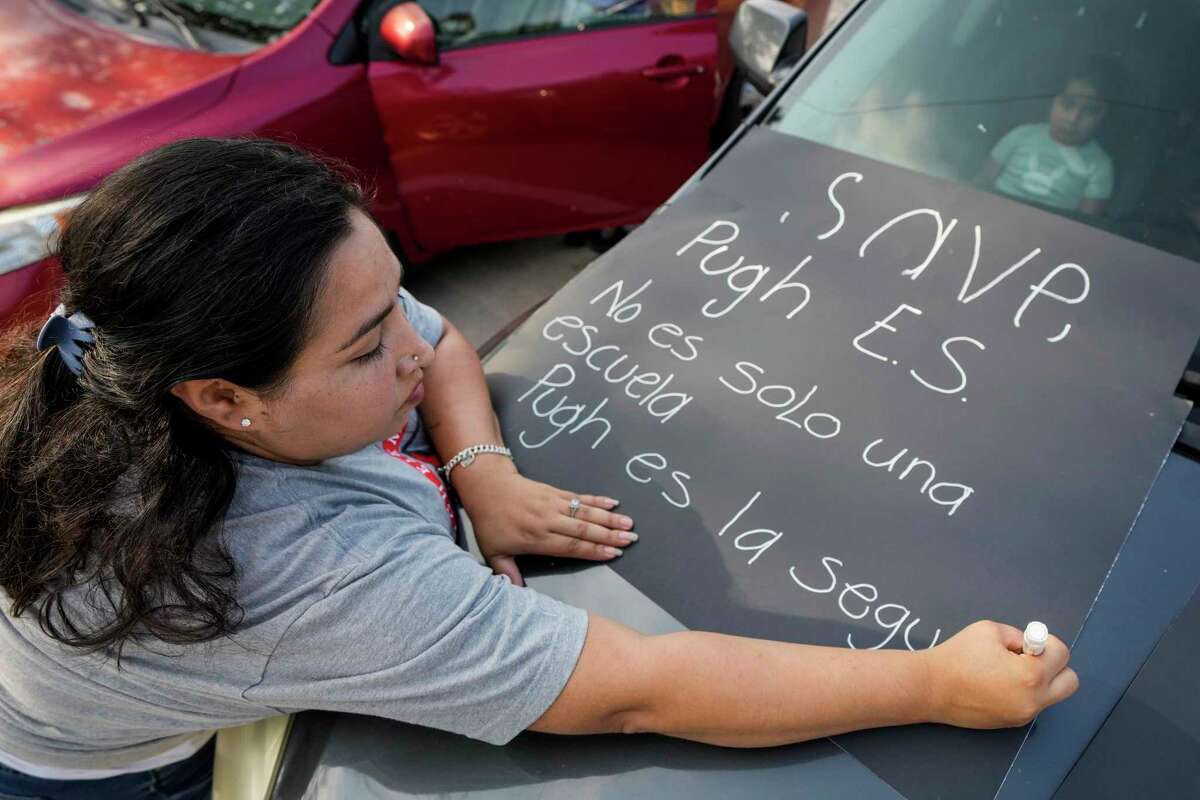
In 2025, Texas passed a ridiculous law stating that if a school district had even one school that was deemed to be “failing,” the state could take over the entire school district. Houston has one high school, Wheatley High School, that has persistently low test scores (and also unusually high percentages of students with special needs and other groups of high-needs students).

The State Department of Education has been trying for years to seize control of the Houston public schools. The state superintendent, appointed by callous Governor Gregg Abbott is software engineer Mike Morath, whose sole claim to educational “experience” is having served on the Dallas school board.

These Republicans do not believe in local control of schools. They believe the state should take away local control, the easier to erode democracy and advance privatization.

Ruth Kravetz, a former teacher and administrator in the Houston Independent School District, now leads an organization called Community Voices for Public Schools. She wrote an editorial in The Texas Observer (where I published my first article) denouncing the threatened takeover as “unfair, racist, and wasteful.”

As a 1956 graduate of HISD, I take this personally.

After years of wrangling and legal battles, the state took control of HISD a few days ago.

Kravetz writes:

I am a parent and teacher with Community Voices for Public Education, a Houston-based nonprofit rooted in the belief that our community schools are a public good, not a commodity to be sold off to the highest bidder. That is why we, along with many other Houstonians, have protested the attempted state takeover of Houston ISD for years—a dramatic assault on local control that may take place this week.

At a February protest, HISD student Elizabeth Rodriguez stated, “Instead of punishing us with a takeover, our schools should be better funded to make sure students have all the support we need and the facilities we deserve. We are not just test scores.”

Contrary to what you may hear from some Republican leaders, Houston Independent School District (HISD) is not a failing district. HISD received a B grade in the most recent state school ratings and is AAA bond-rated.

Why, then, is Houston ISD even under threat of a takeover?

In 2015, Texas passed a law that allows the state to take over an entire school district if even one campus is rated F in standardized test performance for five years. The state says the rationale for the takeover is Wheatley High School’s low 2019 accountability rating and problems with the HISD school board. Since 2019, when the takeover bid began, Houston ISD had successfully delayed Texas’ efforts, but the GOP-controlled state Supreme Court cleared the state’s legal path in January.

In the past few years, HISD already proved that local control works: Since 2019, voters elected an almost entirely new school board, and students and teachers worked to bring Wheatley’s state score up to a C in 2022. Since 2015, HISD reduced its number of low-performing schools from 58 to nine, which is fewer than are found in Dallas ISD. Even using the state’s deeply flawed accountability system to rate schools, Houston ISD comes out fine.

Nevertheless, the state’s takeover efforts persist. If successful, a state-appointed board of managers will make all policy decisions with Texas Education Agency (TEA) Commissioner Mike Morath pulling the strings behind the scenes. HISD’s democratically elected board will only have a ceremonial role with no voting authority. And the kicker is that the unelected Morath, who’s appointed by Governor Greg Abbott, has full discretion to expand the takeover. The superintendent could also be replaced, and individual schools could be parceled off to charter school operators—such as YES, KIPP, IDEA, and churches—with the usual consequences as seen around the country.

Charter schools often purposefully underenroll students with disabilities and other at-risk children, inflating their state accountability ratings. Should this occur in Houston following a takeover, the state will likely take the credit in its accountability shell game.

A takeover may also lead to teachers leaving the district, creating more classroom vacancies. The chances for a bond to replace older elementary schools will go out the window. If other takeovers are any indication, we can also expect more of our taxpayer dollars to go to costly consultants than to the needs of children.

If all this doesn’t make you mad, how about this? Over and over again, the governor and the TEA commissioner have moved the goalposts in the middle of the game.

In 2019, Wheatley High initially received a passing grade from the TEA, but the agency later changed its scoring criteria and applied them retroactively. And in January, TEA publicly announced more rule changes that will be implemented immediately and applied retroactively to last year’s seniors, whose data is counted in this year’s accountability rating. At the high school level, schools that were projecting a B rating are now projecting a D. School districts around the state are raising the alarm about the change.

We tell our children they have to be honest and to play by the rules; we should expect the governor and TEA commissioner to do the same.

Unfortunately, the state takeover of Houston ISDhas nothing to do with student needs. It is about power, profits, and a willful disregard for children living in poverty.

As I ponder the district’s future, I am reminded of a student I once taught. When I went to his house to help him think about college, he had no electricity and the only furniture in the house was a bed, an engine block, and a chair. He did his homework by a street lamp outside. The last thing he needed was more pressure to meet arbitrary standardized testing goals or for the state to punish his school for serving low-income students like himself.

From Beaumont to New Orleans to Detroit, takeovers—which disproportionately target districts with high Black and Brown political participation—do not improve student achievement and experiences.

Please open the link to finish this excellent article.

Governor Abbott and Mike Morath don’t have any idea how to improve schools or districts. They do know how to loot them and privatize them for the benefit of their cronies and campaign donors.

Shame on you, Governor Abbott and Mike Morath!

The Texas State Supreme Court gave the green light yesterday to a state takeover of the Houston Independent School District, based on the low performance of one school, which has high proportions of the neediest students. This will allow State Superintent Mike Morath (not an educator) to appoint a “board of managers.” Will the board reflect the anti-public school bias of Governor Abbott? Will HISD be purged of imaginary CRT and other fantasies of the far-right? It doesn’t matter to the Court or to Morath that state takeovers have a very poor record. See Domingo Morel’s book Takeover: Race, Education, and American Democracy.

Houston Public Media reports:

State-appointed managers can replace elected school board members in the largest district in Texas, according to a decision released by the state’s Supreme Court Friday morning.

Justices overruled an appellate court’s decision that had blocked TEA from taking over the district. The case isn’t over, though. A lower court will hear further arguments.

“No basis exists to continue the trial court’s temporary injunction against the Commissioner’s appointment of a board of managers,” the opinion read.

It is not clear if TEA will use the decision to replace the Houston ISD board.

“TEA is currently reviewing the decision,” a spokesperson wrote.

The Texas Education Agency first attempted to seize control of the Houston Independent School District in 2019. The agency pointed to dysfunction at the school board, as well as years of what TEA deemed unacceptable academic performance at Houston ISD’s Wheatley High School.

Invoking a 2015 state law, TEA argued the circumstances allowed education commissioner Mike Morath to appoint a group of managers in place of the elected school board trustees.

While the takeover was stalled, all but two of the elected Houston ISD board members departed, the board hired a new superintendent, and Wheatley High School received a passing grade from TEA.

The Houston Chronicle wrote:

The takeover issue has been simmering for years. Education Commissioner Mike Morath first made moves to take over the district’s school board in 2019 after allegations of misconduct by trustees and after Phillis Wheatley High School received failing accountability grades….

Advocates and education researchers have called into question the effectiveness of takeovers, and even the process can upend a district and create distraction.

“The back and forth over this issue has created significant chaos in HISD,” said Brandon Rottinghaus, professor of political science at University of Houston. “That’s problematic from a governing perspective and the ability to right the ship and move forward.”

The looming possibility of a takeover makes Mary Hendricks, a third-grade HISD teacher, a little nervous.

“I’m concerned for the students because I’ve been teaching for 16 years, and they’ve been through a lot of changes, like Hurricane Harvey and COVID,” Hendricks said. “I don’t think another catastrophic change would be what’s best for our kids.”

Some students have become aware of the possibility of a takeover. Elizabeth Rodriguez, a senior at Northside High School heard about it at an after-school club she is in called Panthers for Change, a teen advocacy group.

Rodriguez is skeptical of using test scores as a measure of school success and thinks they should not be a major deciding factor in whether the district is taken over.

“There are some students who are really smart and do well in classes, but don’t do well on the STAAR,” Rodriguez said. “Not everyone is the same, and everyone works differently.”

A Brown University study from 2021 looked at 35 school districts from across the country that were taken over by states between 2011 and 2016. It found takeovers typically affected districts where the vast majority of affected students were Black or Hispanic and from low-income families.

Ruth Kravetz, co-founder of Community Voices for Education, a Houston-based advocacy group that focuses on education, said the state should focus its energy on investing in public education, especially for at-risk students in the state’s largest school system.

“Takeovers have historically had horrible outcomes and are used overwhelmingly for students of color,” Kravetz said. “What the state is doing is starving are schools of money and narrowing the curriculum by spending so much money on testing. If the governor really wanted to improve the state of schools he would spend the money on all the schools in the state of Texas better.”

As I mentioned in the previous post, the Houston Chronicle won a Pulitzer Prize for its editorial about the Big Lie and the follow-up efforts to suppress voting by those who might vote Democratic. It is a brilliant series, well deserving of a Pulitzer Prize. Here is another editorial that shines a bright light on the state legislature’s dastardly effort to curtail voting rights. How the Republican leaders voted to suppress voting rights while claiming to protect the integrity of elections.

You don’t say.

A voting bill that truly protects people’s rights instead of raiding them doesn’t need a shroud of darkness or legislative chicanery to prevail. It doesn’t run from the sun or shrivel under scrutiny. Only lies do.

The biggest problem Republican lawmakers have in pushing restrictive voting legislation in the name of integrity is that they themselves have none.

The latest example came Thursday, as the House Elections Committee abruptly took up Senate Bill 7, the upper chamber’s main voter-suppression legislation, without any warning and leaving no room for public comment. The bill aids voter intimidation by letting partisans film voters they find suspicious and takes aim at voting innovations that helped increase turnout in blue Harris County, including drive-thru voting.

Chairing the Elections Committee is none other than state Rep. Briscoe Cain, R-Deer Park, a young lawyer who earned his stripes in Texas-style voter integrity politics by proudly tweeting a photo of himself in November, in aviator glasses and a cowboy hat pulled low, announcing that he was headed to Pennsylvania to join Donald Trump’s quest to overthrow the presidential election through baseless allegations of voter fraud.

It surprised many when incoming House Speaker Dade Phelan entrusted Cain with his first chairmanship. It has been less surprising that Cain’s excellent adventure in committee leadership has, well, flunked most heinously. Last week, Cain blindsided fellow lawmakers by introducing a motion to substitute SB 7 with the language of his own bill, HB 6. His move, to hear him reason it, required no public discussion, since the committee had already discussed and approved the House bill.

Cain played it coy as Democrats sought clarification and questioned whether this would gut SB 7 and replace it wholesale with the language in HB 6. “I wouldn’t say that,” he responded.

Lesser and greater evil

HB 6 gives partisan poll watchers almost unlimited freedom inside a polling place and limits when they can be ejected to a narrow set of circumstances. It further criminalizes the electoral process, targeting elections officials who may fear that making a mistake could land them in jail (say, when trying to kick out a disruptive poll watcher). It also puts new burdens on those who assist voters who are elderly, disabled or have limited English proficiency, while also threatening them with a felony for even accidental violations of their oath.

SB 7 also contains broad protection of partisan poll watchers while also giving them the ability to record voters if they think they are violating election law. It increases burdens on volunteers that help people get to the polls, regulates the distribution of polling locations in large urban counties and bans mega voting sites, 24-hour poll locations and drive-thru voting.

Cain, speaking over lawmakers’ objections that they didn’t have time to consider the substituted language, likely would have bullied through if not for his fellow Republican, state Rep. Travis Clardy, of Nacogdoches, refusing to cast a vote.

After the committee reconvened later that day, Clardy supported the measure and the revised SB 7 — to mirror HB 6 — passed on a party-line vote. Still, it was nice that however briefly, at least one Republican on the committee believed that if you claim election bills are about honest elections, you should show a little honesty in discussing them.

In March, Chairman Cain — yet, again — broke with legislative rules in a decidedly less successful scheme. He left about 200 people who traveled to the Capitol to testify on HB 6 twiddling their thumbs after he strayed from procedure in a hasty attempt to block testimony from Rep. Nicole Collier, D-Fort Worth, chair of the Texas Legislative Black Caucus.

In April, the Senate approved SB 7 in the middle of the night — after a slew of amendments that few had a chance to read in full — with few people watching. As reported by the Chronicle, lawmakers adjourned at 1:39 a.m. April 1, then cleverly reconvened one minute later at 1:40 a.m. to declare a new legislative day, complete with a new roll call and a fresh prayer — thus complying with public notice rules without slowing down the bill’s passage.

“If you really think you’re securing the election, do it in the light of day,” says Emily Eby, an attorney with the Texas Civil Rights Project. “If you really think you’re preserving the integrity of the ballot box, do it in front of Texans.”

Of course, Republican lawmakers don’t think anything of the sort. Not if they understand basic math, anyway. An analysis of voter fraud cases by this editorial board found that over the past 15 years and more than 94 million votes cast in Texas elections, the Texas Attorney General’s Office has prosecuted only 155 people, with few of them facing charges serious enough to warrant jail time.

The GOP’s true motivation is not preventing fraud in voting, but preventing broader voting across demographic lines from an electorate that’s growing younger and more diverse. The only threat at the polls is the GOP’s attempt to bar the door.

As a native Texan, I have not had a lot of reasons to proud of my state lately. The leadership—Governor Gregg Abbott and Lt. Governor Dan Patrick—compete to see who is meanest. They pushed through a very restrictive abortion law that pays bounties to people who squeal on women who got an abortion (the bill turns citizens into the Stasi of East Germany or the neighborhood spies of Cuba or the morality police of Iran). Dan Patrick is a voucher zealot, whose bad idea gets knocked down by the Legislature regularly. Abbott recently brought up his dim thought of revisiting a 1982 Supreme Court decision that ordered Texas and other states to educate the children of undocumented immigrants. Abbott wants them to remain illiterate, which is likely to cost the state more in the long run than allowing them to go to school (his proposal is also inhumane, but decency and humanity are not part of his calculus.)

But here is some good news from Texas! The editorial board of the Houston Chronicle won a Pulitzer Prize for writing about Trump’s absurd claim that the 2020 election was rigged and stolen from him. His team of lawyers brought dozens of lawsuits claiming election fraud, but lost all of them, even when the judges were appointed by Trump, even twice before the U.S. Supreme Court, which has a lop-sided majority of Republican-appointed justices.

The full series is here. The Chronicle is behind a paywall, and you may have to subscribe (as I do) to read them all. But I couldn’t resist sharing my favorite, which was published on January 8, 2021. It calls on Senator Ted Cruz to resign because of his shameful behavior in promoting The Big Lie.

The editorial says:

In Texas, we have our share of politicians who peddle wild conspiracy theories and reckless rhetoric aiming to inflame.

Think U.S. Rep. Louie Gohmert’s “terror baby” diatribes or his nonsensical vow not to wear a face mask until after he got COVID, which he promptly did.

This editorial board tries to hold such shameful specimens to account.

But we reserve special condemnation for the perpetrators among them who are of sound mind and considerable intellect — those who should damn well know better.

None more than U.S. Sen. Ted Cruz.

A brilliant and frequent advocate before the U.S. Supreme Court and a former Texas solicitor general, Cruz knew exactly what he was doing, what he was risking and who he was inciting as he stood on the Senate floor Wednesday and passionately fed the farce of election fraud even as a seething crowd of believers was being whipped up by President Donald Trump a short distance away.

Cruz, it should also be noted, knew exactly whose presidency he was defending. That of a man he called in 2016 a “narcissist,” a “pathological liar” and “utterly amoral.”

Cruz told senators that since nearly 40 percent of Americans believed the November election “was rigged” that the only remedy was to form an emergency task force to review the results — and if warranted, allow states to overturn Joe Biden’s victory and put their electoral votes in Trump’s column.

Cruz deemed people’s distrust in the election “a profound threat to the country and to the legitimacy of any administrations that will come in the future.”

What he didn’t acknowledge was how that distrust, which he overstated anyway, was fueled by Trump’s torrent of fantastical claims of voter fraud that were shown again and again not to exist.

Cruz had helped spin that web of deception and now he was feigning concern that millions of Americans had gotten caught up in it.

Even as he peddled his phony concern for the integrity of our elections, he argued that senators who voted to certify Biden’s victory would be telling tens of millions of Americans to “jump in a lake” and that their concerns don’t matter.

Actually, senators who voted to certify the facts delivered the truth — something Americans haven’t been getting from a political climber whose own insatiable hunger for power led him to ride Trump’s bus to Crazy Town through 59 losing court challenges, past state counts and recounts and audits, and finally taking the wheel to drive it to the point of no return: trying to bully the U.S. Congress into rejecting tens of millions of lawfully cast votes in an election that even Trump’s Department of Homeland Security called the most secure in American history.

The consequences of Cruz’s cynical gamble soon became clear and so did his true motivations. In the moments when enraged hordes of Trump supporters began storming the Capitol to stop a steal that never happened, desecrating the building, causing the evacuation of Congress and injuring dozens of police officers, including one who died, a fundraising message went out to Cruz supporters:

“Ted Cruz here,” it read. “I’m leading the fight to reject electors from key states unless there is an emergency audit of the election results. Will you stand with me?”

Cruz claims the message was automated. Even if that’s true, it’s revolting.

This is a man who lied, unflinchingly, on national television, claiming on Hannity’s show days after the election that Philadelphia votes were being counted under a “shroud of darkness” in an attempted Democratic coup. As he spoke, the process was being livestreamed on YouTube.

For two months, Cruz joined Trump in beating the drum of election fraud until Trump loyalists were deaf to anyone — Republican, Democrat or nonpartisan journalists, not to mention state and federal courts — telling them otherwise.

And yet, Cruz insists he bears no responsibility for the deadly terror attack.

“Not remotely,” he told KHOU Thursday. “What I was doing and what the other members were doing is what we were elected to do, which is debating matters of great import in the chamber of the United States Senate.”

Since the Capitol siege, Cruz has condemned the violence, tweeting after the death of Capitol Police officer Brian Sicknick that “Heidi and I are lifting up in prayer” the officer’s family and demanding the terrorists be prosecuted.

Well, senator, those terrorists wouldn’t have been at the Capitol if you hadn’t staged this absurd challenge to the 2020 results in the first place. You are unlikely to be prosecuted for inciting the riots, as Trump may yet be, and there is no election to hold you accountable until 2024. So, we call for another consequence, one with growing support across Texas: Resign.

This editorial board did not endorse you in 2018. There’s no love lost — and not much lost for Texans needing a voice in Washington, either.

Public office isn’t a college debate performance. It requires representing the interests of Texans. In your first term, you once told reporters that you weren’t concerned about delivering legislation for your constituents. The more you throw gears in the workings of Washington, you said, the more people back home love you. Tell that to the constituents who complain that your office rarely even picks up the phone.

Serving as a U.S. senator requires working constructively with colleagues to get things done. Not angering them by voting against Hurricane Sandy relief, which jeopardized congressional support for Texas’ relief after Harvey. Not staging a costly government shutdown to repeal the Affordable Care Act in 2013 that cost the economy billions. Not collecting more enemies than friends in your own party, including the affable former House Speaker John Boehner who famously remarked: “I get along with almost everyone, but I have never worked with a more miserable son of a bitch in my life.”

We’re done with the drama. Done with the opportunism. Done with the cynical scheming that has now cost American lives.

Resign, Mr. Cruz, and deliver Texas from the shame of calling you our senator.