Archives for category: Hoax

Carol Burris, executive director of the Network for Public Education, recently joined parents, students, and teachers at a rally in Austin, Texas, to protest the state’s decision to take control of the Houston Independent School District. The district is no longer “independent,” since the state asserted its control. And Republicans showed that they don’t really believe in “local control,” any more than they believe in “parents rights.”

As a graduate of HISD, I feel especially outraged by the state takeover on flimsy grounds. Governor Abbott and Commissioner Mike Morath are playing politics. These kids are the future of Texas. Why are they being used as pawns?

Burris wrote the following explanation of the state takeover. It appeared on Valerie Strauss’s “Answer Sheet” blog at the Washington Post website.

Strauss begins:

The administration of Texas Gov. Greg Abbott (R) announced this month that the state was taking over the public school district in Houston even though the Texas Education Agency last year gave the district a “B” rating. The district, the eighth-largest in the country, has nearly 200,000 students, the overwhelming majority of them Black or Hispanic, and opposition to the move in the city, which votes Democratic, has been strong.


Texas Education Agency Commissioner Mike Morath said the takeover was necessary because of the poor performance of some schools in the district — even though most of the troubled schools have made significant progress recently.


Here is the real story of the takeover, written by Carol Burris, an award-winning former New York school principal who is executive director of the Network for Public Education. The nonprofit alliance of organizations advocates the improvement of public education and sees charter schools — which are publicly funded but privately operated — as part of a movement to privatize public education.


By Carol Burris


Houston parents, teachers, and community leaders are protesting the decision by Texas Education Agency Commissioner Mike Morath to take over the Houston Independent School District. Some see the takeover as grounded in racism and retribution; others as big-government intrusion.


For Houston mom Kourtney Revels, the decision represents a hypocritical dismissal of parents by Gov. Greg Abbott (R). “How can Governor Abbott pretend to support parent empowerment and rights when he has just taken away the rights of over 200,000 parents in Houston ISD against their will and has not listened to our concerns or our voice?” she asked.

The takeover is the latest move in a long list of actions by Abbott’s administration to attack public school districts and expand privatized alternatives, including poorly regulated charter schools and now a proposed voucher program that would use public money for private and religious education. And critics see them all as connected.


State Rep. Ron Reynolds, a Houston Democrat, told the Houston Chronicle, that the takeover of the Houston district is part of Abbott’s attempt “to push” vouchers and charter schools, and to “promote and perpetuate the things that Governor Abbott believes and hears about, and that obviously isn’t diversity, equity and inclusion.”

The first takeover forum sponsored by the Texas Education Agency, which Morath leads, was described in the Houston Chronicle as “emotional and chaotic.” This week, the Greater Houston Coalition for Justice is leading a protest march before another TEA hearing. U.S. Rep. Sheila Jackson Lee (D), who represents the city, has asked the Biden administration to open a civil rights investigation into the takeover.

Background

The Houston Independent School District is Texas’s largest school district, with 284 schools and almost 200,000 students. It is also the eighth-largest district in the nation. Eight in 10 students come from economically disadvantaged families, and more than 1 in 3 students are not proficient in English. Fewer than 10 percent of the students are White.

The first attempted takeover of HISD by Morath was in 2019. The rationale for the takeover was school board misconduct and the seven negative ratings of Phillis Wheatley High School, one of the district’s 284 schools. Wheatley had been rated “academically acceptable” almost every other year until the YES Prep charter school opened nearby in 2011. During the 2021-2022 school year, Wheatley served 10 times as many Black students and more than twice as many students with disabilities as YES Prep, located just a five-minute drive away.

The district went to court to stop the takeover, and the debate wove through the courts until the Texas Supreme Court gave the green light for the takeover in January.

Almost four years have passed since the first takeover attempt, and the district has made impressive strides. The electorate replaced the 2019 school board, and a highly respected superintendent, Millard House, was appointed.

By every objective measure, the district is on a positive trajectory. The district is B-rated, and in less than two years, 40 of 50 Houston schools that had previously received a grade of D or F received a grade of C or better. Wheatley High School’s grade, the school that triggered that 2019 takeover attempt, moved from an F to a C, just two points from a B rating.

While there is a law that triggers a TEA response when a school repeatedly fails, the state Supreme Court did not mandate the takeover of the district. Under Texas law, Morath had two options — close the school or take over the district by appointing a new Board of Managers and a superintendent. He chose to strip local control. For those who have followed the decisions of Morath, his choice, the harsher of the two, comes as no surprise.

Mike Morath and charter schools

Mike Morath, a former software developer, was appointed education commissioner by Abbott in 2015. Morath had served a short stint on the Dallas school board, proposing that the public school district become a home-rule charter system, thus eliminating the school board and replacing it will a board appointed by then-Mayor Mike Rawlings, the former chief executive of Pizza Hut. Transformation into a charter system would also eliminate the rights and protections of Dallas teachers, making it easier to fire staff at will.

Morath and the mayor were supported in their quest to privatize the Dallas school system by a group ironically called Support Our Public Schools. While many of its donors remained anonymous, one did not — Houston billionaire John Arnold. Morath admitted encouraging the development of Support Our Public Schools and soliciting Arnold’s help in founding the organization.

Arnold, a former Enron executive and Houston resident, is a major donor and board member of the City Fund, a national nonprofit that believes in disruptive change and “nonprofit governing structures” for schools rather than traditional school boards. The City Fund touts New Orleans as the greatest school reform success. Arnold is joined on the board of the City Fund by billionaire and former Netflix CEO Reed Hastings, who has blamed public school woes on elected school boards and said 90 percent of all students should be in charter schools.

The plot to turn the Dallas school system into a charter system fizzled by January 2015. In December of that year, Abbott plucked Morath from the school board to become Texas education commissioner based on his record as a “change-agent.”

As commissioner, Morath has unilaterally approved charter schools at what many consider to be an alarming rate. Patti Everitt is a Texas education policy consultant who closely follows the decisions of the Texas Education Agency. Everitt noted that Morath “has the sole authority to approve an unlimited number of new charter campuses in Texas — without general public notice, no community meeting, and no vote by any democratic entity.” According to Everitt, he has used this power more frequently than his predecessors. “Since Mike Morath became Commissioner, data from TEA shows that he has approved 75 percent of all requests from existing charter operators to open new campuses, a total of 547 new campuses across the state,” she said.

In 2021, according to Everitt, Morath approved 11 new campuses for International Leadership of Texas Charter Schools, even though 28 percent of the chain’s schools had received D or F grades in prior ratings.


Georgina Cecilia Pérez served two terms on the Texas State Board of Education, from 2017 to 2022. During that time, she observed the Texas Education Agency up close. A 2017 state law provides financial incentives for districts to partner with open-enrollment charter schools, institutions of higher education, nonprofit organizations or government entities. She said that several charter partnerships with the Houston school district have been in the works waiting for the state takeover. She predicts Morath will approve them, “with no public vote.”


Abbott, Morath, and vouchers

Few were surprised this year when Abbott declared that establishing an Education Savings Account (ESA) voucher program would be one of his highest priorities this legislative session. ESA vouchers, the most controversial of all voucher programs, provide substantial taxpayer dollars, through an account or via a debit card, to private school and home-school parents to spend on educational services. Eight states presently have ESA vouchers, with three new programs in Arkansas, Iowa and Utah approved to begin in coming academic years. Other legislatures in red states, notably New Hampshire and Florida, are pushing for ESA program expansion.

Abbott had been reluctant to embrace vouchers — possibly because of a lot of opposition in Texas, especially in rural areas — causing some to speculate that his newly expressed support for them is linked to presidential ambitions. School choice is a pet cause of one potential rival for the Republican presidential nomination, Florida Gov. Ron DeSantis (R).

Two voucher bills are now weaving their way through the Texas Senate. S.B. 8 would give families a voucher of $8,000 per child a year and institute a parents’ “bill of rights” that allows parents to review public school curriculums through parent portals. A second bill, S.B. 176, would give private school and home-school families a $10,000-per-child annual voucher. Although Abbott has not endorsed either bill, he has made it clear that he supports a universal voucher program, promoting universal vouchers in speeches at some of the state’s most expensive private Christian schools.

Last year, Morath gave tacit support for vouchers, claiming that “there is no evidence” that vouchers would reduce public school funding. In February 2023, however, when questioned during a state Senate hearing, the commissioner admitted that voucher programs could have a negative fiscal impact on public schools.

That same month, his second-in-command, Deputy Commissioner Steve Lecholop, encouraged an unhappy parent from the Joshua Independent School District to work with the governor’s speechwriter to promote vouchers, saying it would be a great way to “stick it to” the school district.

The lack of success of district takeovers

Regardless of Abbott’s and Morath’s ultimate objective — whether it be flipping some or all of Houston’s public schools to charters — research on state takeovers has consistently shown that state takeovers nearly always occur in majority-minority districts and rarely improve student achievement. Student results in takeover districts, with only a few exceptions, have remained the same or decreased. That was the conclusion of a comprehensive cross-state study published in 2021. The study’s authors, Beth Schueler of the University of Virginia and Joshua Bleiberg of Brown University found “no evidence that takeover generates academic benefits.”

This intervention does not help students, and it mutes community voices, undermines democracy in Black and Hispanic communities, and pushes charter schools and other privatized alternatives to democratically governed schools.

An example is the takeover of Philadelphia’s public schools in 2001. Then-Gov. Tom Ridge (R) hired Edison Learning, a for-profit management company led by Chris Whittle, to study the district at the cost of $2 million. Edison Learning made a recommendation that it play a significant role in the reform and proposed running up to 70 schools. After community outrage, the number was reduced to 20. A few years later, the number of managed schools increased to 22. It was not long, however, before Edison Learning and the district were embroiled in a lawsuit concerning liability damages after a student was sexually assaulted in an Edison-operated school. By 2008, all for-profit management companies, including Edison, were gone. By 2017, the state takeover experiment ended.

Retired teacher Karel Kilimnik of Philadelphia had a first-row seat. She taught at a school taken over by the for-profit management company called Victory Co., which ran six schools under the School Reform Commission. The Reform Commission “promised academic and financial improvements that failed to materialize over their 16 years of control,” Kilimnik said. “Instead of improving the district, they opened the door to privatization and charter expansion and laid out the welcome mat for graduates of the uncertified Broad Superintendents Academy. They paved the way for the doomsday budget resulting in massive layoffs, larger class sizes, and the elimination of art and music.”

In his 2017 book, “Takeover,” New York University professor Domingo Morel concluded that, based on his extensive research, state takeovers are driven more by the desire of state actors to take political control away from Black and Hispanic communities than about school improvement. Recently in the Conversation, Morel described the seizure of the Houston school district as motivated by a need by the Republican establishment to thwart the growing empowerment of Black and Latinos as their numbers increase in Texas.

“The Houston public school system is not failing,” Morel said. “Rather, Republican Gov. Greg Abbott, Education Commissioner Mike Morath, and the Republican state legislature are manufacturing an education crisis to prevent people of color in Houston from exercising their citizenship rights and seizing political power.”

Allison Newport, a Houston mother of two Houston public school elementary students, agrees. “The commissioner should be congratulating Houston ISD and Wheatley High School for such incredible improvement in performance instead of punishing the students, parents, and teachers who worked so hard to make it happen.”

Dr. Allison Neitzel writes a blog called “MisinformationKills,” where she exposes charlatans promoting fake cures for COVID. I recommend that you follow her blog. She knows who the fakers and grifters are and calls them out.

She recently discovered that Dark Money was deeply invested in the privatization of education. She posted this link on Twitter and wrote the following commentary on her blog.

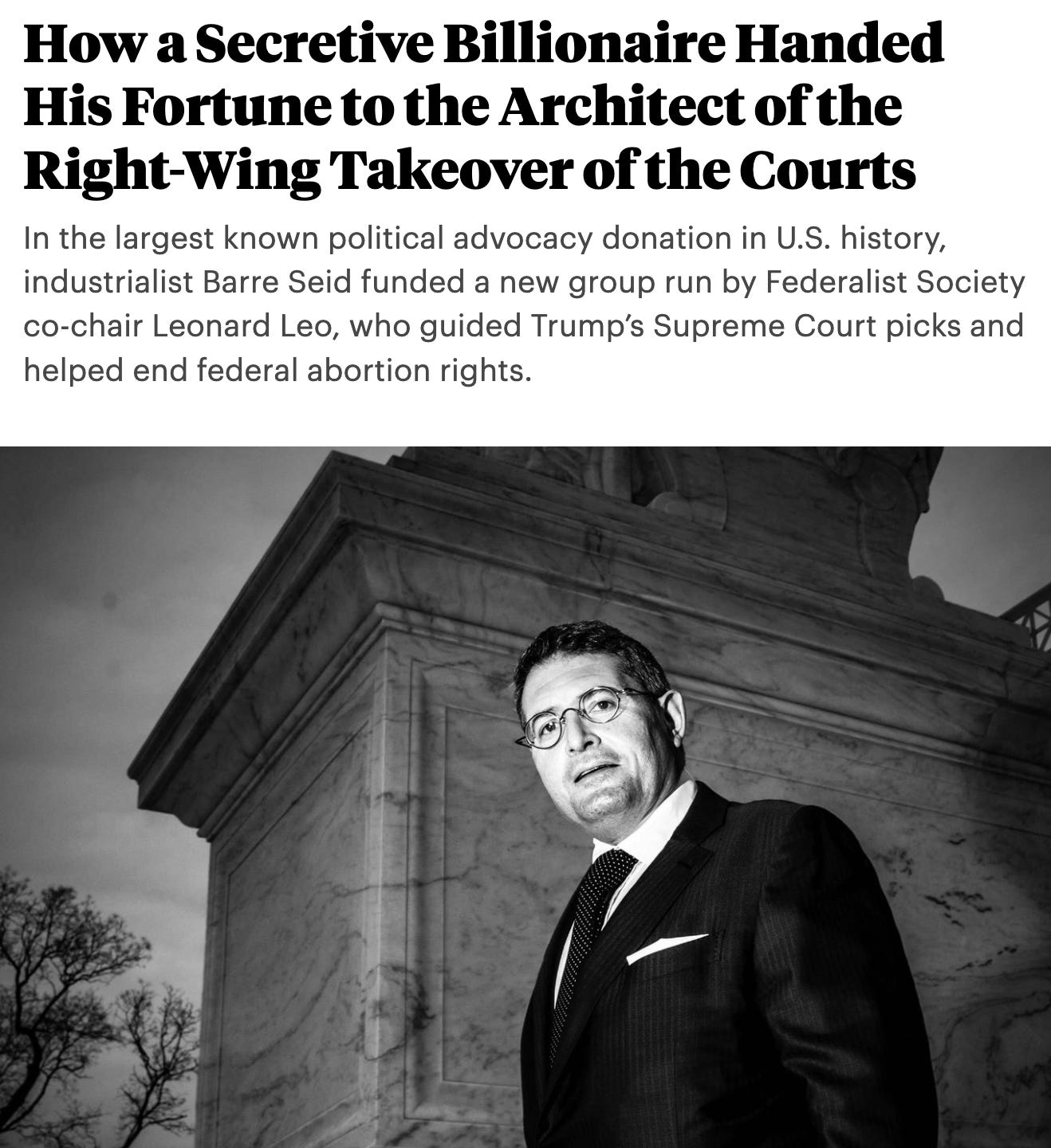
Leonard Leo, the former VP of the Federalist Society and current member of the Council for National Policy, was recently outed for his funneling of dark money to a conservative parents group fighting the “woke-ification” of the US school system. While such groups need their “concerned parents” to voice their messages, groups like this do not hold the political power they think they do. They are granted the illusion of grassroots power that actually comes from the astroturfing campaigns of the shadowy, far-right Council for National Policy. These parents are lower level marks recruited into a GOP multi-level marketing scheme that benefits from counting Trump’s Secretary of Education Betsy DeVos’s parents of Amway wealth as CNP members.

Like his CNP colleague Charles Koch, Leo has been active in covertly controlling our government for some time. He was instrumental in the halting of Obama’s appointment of Merrick Garland to the Supreme Court where his old friend Clarence Thomas serves as an extremely controversial justice on a rogue court. The organizing efforts of the CNP and Federalist Society since the late 70s/early 80s were successful in overturning Roe v. Wade, despite the majority of the nation supporting abortion.

MisinformationKills’s Newsletter

Roe overturned in win for Council for National Policy

The Supreme Court of the United States voted today to overturn Roe v. Wade. This was a long time coming thanks to “most pro-life president ever” Donald J. Trump’s digital strategist Steve Bannon’s political efforts and influence. Source: Slate Bannon is a former member of the Council for National Policy, part of a shady network of Christian extremist pol…

The CNP brought us the fall of Roe as well as the rise of America’s Frontline Doctors. Ginni Thomas, Clarence’s QAnon wife, served as CNP Action Committee Chair when the pro-Trump, pro-hydroxychloroquine group was created in concert with the Tea Party Patriots for Dr. Simone Gold. The future insurrectionist’s organization appears to have been staffed by the existing far-right American Association of Physicians & Surgeons. Gold, now being sued for embezzling AFLDS’s dirty money, has shown herself to be completely corrupted by proximity to this powerful network. Without her MD or her JD, Gold’s quest for self-importance could have easily led her to Moms for Liberty. She’s now a member of the CNP, naturally.

Gold’s anti-vax movement ties into a larger GOP anti-science movement that includes anti-abortion (for the Christians) and anti-climate science (for the Kochs). Beyond that it is part of a larger anti-truth, anti-regulation movement for an attempted Christo-fascism takeover of the country by the GOP overlords at the CNP. To keep a propaganda machine like this going, they must continue to recruit talent and make sure younger generations don’t wise up to what they are doing. While New Jersey starts implementing media literacy in their curriculums, less progressive states like Florida are banning books and waging war on the culture of the American classroom. Trump’s 2024 CNP heir apparent Ron DeSantis has an AFLDS member as his Florida Surgeon General and has recruited more talent from the existing Koch Network for his own public health “accountability” committee. This is not coincidence.

The CNP has made power grabs for control of the courts, public health, media, and now the classroom. They won’t stop until they have complete control over the American people and our way of life. This is not small government, but rather silent large government. Unfortunately for the CNP ideologue oligarchs, younger generations – including those in medicine – are paying attention and forming real grassroots opposition. Fighting this network requires understanding of the inter-connectedness of their various efforts to take down the many pillars that uphold this decades old house of cards. It requires educating the public about the CNP’s forty year reign and the risk in allowing it to continue. Somewhere in those banned history books are the stories of empires that have fallen before them.

It is time to wake up from our postmodern nightmare of never-ending information warfare, epistemological conflicts/divides, incoherent narratives, and existential despair. We must embrace the hard realities of our complicated and complex world to stop falling prey to the comfort and convenience of simplicity. First and foremost, we need to dispel the myth that an individual can survive independently without responsibilities to others or in a world devoid of trust. It is simple to believe that a person’s success is theirs and theirs alone or even simpler to blame their failures on the distrusted others.

Unlike their attempted coup on January 6th, 2021, this revolution does not require violence – just education, some of that Trump sunlight on the issues, active citizenship, and a great deal of spine from our many American institutions under attack.

Carl Davis, research director of the Institute on Taxation and Economic Policy, reviews tax credits for vouchers and concludes that they are a tax avoidance scheme for the wealthy.

Key findings

• Lawmakers in several states are discussing enacting or expanding school voucher tax credits, which reimburse individuals and businesses for “donations” they make to organizations that give out vouchers for free or reduced tuition at private K-12 schools. In effect, these credits allow contributing families to opt out of paying for public education and other public services.

• New data—published here for the first time—reveal that wealthy families are overwhelmingly the ones using these credits to opt out of paying tax to public coffers. In all three states providing data, most of the credits are being claimed by families with incomes over $200,000.

• Wealthy families’ interest in these programs is being driven partly by a pair of tax shelters that can make “donating” profitable. These shelters hinge on stacking state and federal tax cuts and are being advertised in the states as a way to get a “double tax benefit” and “make money” in the process. This kind of language is a far cry from most nonprofit fundraising pitches and gives some sense of the supersized nature of the tax benefits being offered for private and religious K-12 schooling.

• Voucher tax credits are without merit and should be repealed. Short of that, states can end their use as profitable tax shelters with straightforward reforms. A national solution to this problem, however, will require action by the IRS.

One of the most disturbing recent shifts in U.S. public policy has been the renewed push to privatize the nation’s K-12 education system.[1] Originally born out of a desire to preserve school segregation and racial inequality more broadly, the so-called “school choice” movement is enjoying a resurgence as many state lawmakers look for ways to move more kids into private and religious schools.[2] That end is being hastened through the tax code in major ways. In short, school privatization proponents have managed to set up state policies that harness deficiencies in federal tax law and the self-interest of wealthy families to gin up enthusiasm for privatizing the U.S. public education system.

Voucher Tax Credits

State voucher tax credits are among the most significant tools eroding the public education system and propping up private schools. These policies are on the books in 21 states and proposals to create or expand them are being discussed this year in places like Alabama, Georgia, Kansas, Montana, Nebraska, South Carolina, and Texas.[3]

Voucher tax credits reimburse individuals and businesses for “donations” they make to organizations that give out vouchers for free or reduced tuition at private K-12 schools—the overwhelming majority of which are religious in nature.[4]

Unlike charitable gifts to other causes where taxpayers save less than 10 cents in state taxes for every dollar donated, these supersized incentives often give private school “donors” their full donation back. This unusual payoff scheme necessitated a whole new set of regulations from the IRS to enforce the commonsense notion that families being reimbursed for their “gifts” have not done anything genuinely charitable and should not receive federal charitable deductions.[5] Before those regulations took effect, it was common for private schools to tell wealthy families that pairing voucher credits with the federal charitable deduction was a great way to “make money.”[6]

While the IRS has taken steps to prevent taxpayers from misusing the charitable deduction in combination with these state tax credits, significant tax avoidance is still occurring through less-scrutinized channels. The fact that these programs continue to allow many high-income taxpayers to turn a profit for themselves is helping accelerate the diversion of public funding into private schools. States have the power to prevent aggressive tax avoidance through their voucher tax credits, as explained below, but many have turned a blind eye in the interest of maximizing growth in these programs.

A Subsidy for the Wealthy

Despite voucher tax credits’ charitable facade, the reality is they allow wealthy families to opt out of paying for public education and other public services, and to redirect their tax dollars to private and religious instruction instead. If a taxpayer sends $1,000 to a private school organization and receives a $1,000 state tax credit in return, the plain result of that is that the tax dollars have been rerouted away from public coffers and to private organizations instead.

We now know that wealthy families are overwhelmingly the ones using these credits to opt out of paying tax to public coffers because new data—published here for the first time—that we’ve obtained from tax agencies in three states show exactly that.

Please open the link and read the rest of this important study and analysis.

Maurice Cunningham is a retired professor of political science in Massachusetts. He is an expert on Dark Money in education issues. His revelations about the money behind a state referendum to expand the number of charters indefinitely in Massachusetts in 2016 helped to defeat the referendum. I wrote about his role in my book Slaying Goliath.

What Happened to Election Day at National Parents Union?

There I was on the edge of my seat in front of the television waiting for Steve Kornacki to break down the numbers in the election for the hotly contested highest offices in the National Parents Union. Could Keri Rodrigues be re-elected to another three year term? Might Alma Marquez, elected secretary-treasurer three years ago before mysteriously disappearinglaunch a comeback bid? Would the networks call a winner before my bedtime?

But no, nothing. No network call. No Steve Kornacki. No election at all.

That was a huge disappointment because on January 27, 2020, Beth Hawkins of The74 reported “Founders Keri Rodrigues and Alma Marquez were voted into three-year terms as inaugural president and secretary-treasurer, respectively.”

So I waited three years for the next election. If you can’t get reliable information about a Walton Family Foundation franchise like NPU from a Walton Family Foundation publication like The74, where can you look?

I’m kidding. I knew there would be no election, just like I knew the Hawkins piece was corporate puffery, and just as I knew there was no real election in 2020 where Rodrigues and Marquez “launch[ed] the National Parents Union on Jan. 16, when they … [held] an inaugural summit in New Orleans with 125 delegates from all 50 states, Washington, D.C., and Puerto Rico.” For one thing, Rodrigues signed NPU’s incorporation papers on April 4, 2019 as president. Then on the 2020 annual report Rodrigues signed as president with a term ending December 31, 2025. Tim Langan (later to marry Rodrigues, in 2022) replaced Marquez as treasurer. There has never been any accounting of what happened to the duly elected treasurer and apparently zero curiosity about her from the “125 delegates from all 50 states, Washington, D.C., and Puerto Rico” who presumably left New Orleans thinking they had elected her to a three year term.

Still, an election for a part-time job that pays $232,000 for twenty hours per week would seem attractive enough to draw some opposition. (Source: National Parents Union Form 990 tax return for 2021)

The $180,000 is from a related organization, the Walton Family Foundation franchise Massachusetts Parents Union, also a 20 hour per week gig. (Source: Massachusetts Parents United Form 990 tax return for 2021)

Reading over The74 article I’m struck by how important it was for the Waltons to portray NPU as something like a real union. But it isn’t. For one thing unions elect their leadership democratically. Rodrigues promised Fox News that NPU would “be creating a national parent council and a board of advisers. We will assemble delegates, agree on by-laws, vote on ratification, and form our union.” The parent council has never materialized, no by-laws have been made public, and ratificationwas about as valid as the treasurer’s vote. But they did appoint delegates! Then NPU killed off all the delegates. They were replaced with a 7 person parent “advisory council.” Keep your bags packed, councilors.

Who would vote if NPU did hold an election? Rodrigues recently tweeted “Just held our last @NationalParents Union leadership meeting where @TafshierCosby announced we have now grown to almost 1,000 affiliated organizations in all 50 states, Washington, D.C. and Puerto Rico.”

There are no parent organization affiliates. The only verifiable affiliated organizations are those, as I wrote in Dark Money and the Politics of School Privatization, that are in the charter school industry or related privatization fronts. Cosby is identified at the NPU website Senior Director of the NPU Center for Organizing and Partnerships and “also the CEO of Parent Impact.” Parent Impact is apparently part of the KIPP charter school business. Itwas recognized by the IRS as a tax exempt organization only on September 10, 2020. IRS placed Parent Impact on the auto-revocation list for not filing tax returns on May 15, 2021.

I didn’t let the popcorn go to waste on election night but I sure did miss Steve Kornacki.

Maurice T. Cunningham is author of Dark Money and the Politics of School Privatization. As a (now retired) educator in the UMass system, he is a union member.

Carol Burris, the executive director of the Network for Public Education, was invited by the Texas AFT (American Federation of Teachers) to speak about pending voucher legislation.

This is what she said:

I lived in Texas for ten years–not far from here in a little town called Martindale when my husband was a Southwest Texas State University student. Then we moved to Houston, where two of our three daughters were born.

The Texas that I remember was a conservative state. Taxpayers didn’t like footing the bill for anything they did not need to.

So now I am back in Texas 40 years later, and I am wondering where all the conservatives have gone. Because all of the proposed voucher bills to give taxpayer money for private schools and homeschools are multi-billion dollar entitlementprograms that would make socialists blush.

Now, for my part, I like most entitlement programs like the GI Bill that members of our military earn or food stamps because no one in America should go hungry.

But these voucher bills are giveaways to people to pay for private schools even though there is a perfectly good public school just down the road.

But that good neighborhood public school, where most Texans send their children, will disappear. Because you can have a multi-billion dollar voucher program or well-funded public schools, but you can’t have both.

Let’s look at some of the voucher bills being pushed in Texas right now. These bills were not written by Texans for Texas. I read voucher bills. Your bills are all pretty much the same bills I see being proposed in other states. Earlier today, Corey DeAngelis, who works for Betsy De Vos, was rallying a small crowd at the capitol. Corey, bless his heart, is the Where’s Waldo of the voucher world. If there is a voucher bill, Corey will show up to sing its praises. But he will never tell you what it will cost. So I will.

Texas Senator Middleton proposed a voucher bill. Mr. Middleton’s voucher would give parents $10,000 a year and create a new taxpayer-funded bureaucracy to dole out the money.

Currently, in Texas, there are 309,000 private school students and 750,000 homeschooled students. There are 9.9 million Texas households. I did the math. If all private school and homeschool families take that $10,000, this voucher system will cost ten billion dollars–that is over $1,000 a household a year.

The Lt Governor is pushing a more modest voucher bill that would give $8,000 a year to families. Do you feel much better knowing that every Texas household could fund vouchers at over 800 dollars a year?

If one of these bills passes, Texas will fund a public school system, a charter school system, and a voucher school system. Something has to give. Because unless Governor Abbott says he will pay for billions of dollars of vouchers by raising taxes, that money is coming out of your public schools.

At the Network for Public Education, we have been studying voucher programs for years and know a few things about them.

First, they always grow. Every program that begins with restrictions grows each year.

Arizona began with special education students. Now it has a universal ESA voucher program.

Indiana insisted that students try public schools first. It was limited to low-income students. Now 77% of all Indiana families are eligible and the legislature is now trying to raise the income cap to make the wealthiest Indiana families eligible.

The second thing we know is that vouchers always cost a lot more than politicians say. When New Hampshire’s program was passed, it was estimated to cost about $3 million in year two. The actual cost came in at $22.7 million, a cost increase of 756%. In Arizona, they are still trying to figure out how to pay for this year’s vouchers that came in way over budget at a half billion dollars.

Third, most of the money goes to families that were perfectly willing and able to pay for a private school anyway. That percentage in most states is between 75% and 80%. The vast majority of voucher recipients are families whose children are already enrolled in private schools.

And if one of these bills passes, you will also see all of the waste and sketchy spending we have seen in other states—taxpayer funds used for horseback riding lessons, trampolines, big screen TVs, and items being bought only to be returned for a store gift card. And Texas politicians know it! Senate Bill 8 tells parents they cannot sell the items they buy with vouchers for a year.

When our daughters attended public schools, they had to return their books at the end of the year. With these voucher programs, you get taxpayer money to buy books and other items, sell them, and pocket the cash.

Finally, let’s talk about the more important cost that goes beyond financial concerns.

The Texas I remember was proud of its diversity. It embraced it. Whether you were a Baptist or a Catholic, Chicano, Black or white, a Texas identity glued everyone together. It formed the basis of a civil democracy.

Understanding others and tolerating different points of view cannot be learned by reading books; you learn empathy and tolerancethrough shared life experiences with those who are different fromyou. And that starts in public schools where every child—Christian, Jewish, gay, straight, kids with disabilities all have a place. Read Senate Bill 8. It is an invitation to state-funded discrimination. Do not publicly fund a private school system that gets to sort and select children and shut those it does not want out.

Go with what you know and want to conserve. Texas public schools made Texans great.

I had a conversation with Tim Slekar on his program, “Busted Pencils,” about the Rightwing attack on teaching history honestly and accurately.

We had fun, and you might enjoy listening:

#BustEDPencils Pod.
It’s not an attack on history. It’s an attack on #democracy.


Guest: Diane Ravitch.


Listen here: https://civicmedia.us/podcast/teaching-history-in-hostile-times

Dana Milbank, a fabulous columnist at The Washington Post, reviews Kevin McCarthy’s long record of claiming that he didn’t know, he didn’t see it, he didn’t hear it, he has no opinion.

After McCarthy gave 40,000 hours of security video from January 6, 2021, to Tucker Carlson, he was surprised to hear that Tucker Carlson took clips to “prove” that nothing much happened that day. He was confused. I’m confused too as I thought that Carlson had long advanced the claim that the insurrection and violence that we saw that day was actually a “false flag” operation, manipulated by the FBI, Antifa, and Black Lives Matter. All along, Carlson has pandered to his viewers by insisting that Trump supporters had nothing to do with the turmoil and desecration of the nation’s Capitol.

Just another day at the Capitol is the new line at FOX. If you thought otherwise, your eyes deceived you. The insurrectionists were actually peaceful protestors, now victims and patriots.

This new line was too much for many of the Republicans who were there that day and ran for their lives.

Milbank wrote:

Not since the Know-Nothing Party disappeared in the 1850s has a public figure boasted about his ignorance with as much gusto as Kevin McCarthy does.

It doesn’t seem to matter what you ask the speaker of the House. He hasn’t read it, seen it or heard about it.

The explosive documents from the Dominion case showing Fox News hosts privately said Donald Trump’s election lies were hokum but promoted the lies on air anyway?

“I didn’t read all that. I didn’t see all that,” McCarthy told The Post.

The way Fox News’s Tucker Carlson (predictably) manipulated the Jan. 6, 2021, security footage McCarthy (foolishly) gave the propagandist, giving the false appearance that the bloody insurrection was “mostly peaceful”?

“I didn’t see what was aired,” McCarthy asserted.

Senate GOP leader Mitch McConnell, in an implicit rebuke of McCarthy, blasting the Carlson propaganda while holding up a statement from the Capitol Police chief denouncing Fox News’s “outrageous,” “false” and “offensive” portrayal of the insurrection?

You guessed it. McCarthy “didn’t see” McConnell do that.

The benighted McCarthy has been amassing this impressive body of obtuseness for some time. If ignorance is bliss, the California Republican has been in nirvana for years now.

How about Trump’s speech on the Ellipse on Jan. 6, 2021, provoking the sacking of the Capitol?

“I didn’t watch it,” McCarthy said.

Rep. Andrew Clyde (R-Ga.) calling the insurrectionists’ rampage a “normal tourist visit”?

“I don’t know what Congressman Clyde said,” quoth McCarthy, and “I didn’t see it.

When his own designated negotiator reached a bipartisan agreement to form a commission to probe the Jan. 6 attack (a commission McCarthy ultimately killed)?

I haven’t read through it.”

Trump, in a recorded phone call, demanding Georgia’s secretary of state “find” enough votes to overturn the election results?

I have to hear it first.”

Trump telling four congresswomen of color (three of them U.S.-born) to “go back” where they came from, prompting chants of “send her back” among his rallygoers?

I didn’t get to see the rally.”

Rep. Marjorie Taylor Greene (R-Ga.) harassing Rep. Alexandria Ocasio-Cortez (D-N.Y.) with shouts and slander just off the House floor?

I didn’t see that. I don’t know what happened.”

Trump’s ludicrous allegation that former GOP congressman and MSNBC host Joe Scarborough may have murdered a staffer?

“I don’t quite know about the subject itself. I don’t know this subject well.”

Trump’s scandalous claim that Democrats inflated the death toll from a hurricane in Puerto Rico to “make me look as bad as possible”?

“I haven’t read it yet,” McCarthy pleaded.

At best, McCarthy’s willful cluelessness is just a dodge. But this week, McCarthy’s see-no-evil approach was just plain evil.

After Carlson aired his phony portrayal of the insurrection, several Republicans finally spoke up about Fox News’s lies: “Inexcusable and bull—-” (Sen. Thom Tillis, N.C.), “whitewashing” (Sen. Lindsey Graham, S.C.), “dangerous and disgusting” (Sen. Mitt Romney, Utah).

Then there was McCarthy, questioned by reporters just outside the speaker’s office, which the supposedly “peaceful” insurrectionists had ransacked that terrible day.

“Do you regret giving him this footage so he could whitewash the events of that day?” asked CNN’s Manu Raju.

“No,” McCarthy replied, adding some gibberish about “transparency” (which is the very opposite of Carlson’s fabrication).

“Do you agree with his portrayal of what happened that day?” Raju pressed.

“Look,” McCarthy said. “Each person can come up with their own conclusion.”

Talk about dangerous and disgusting. Given a choice between fact and fiction, between law and anarchy, between democracy and thuggery, the speaker of the House proclaimed his agnosticism. In doing so, he threw the power of the speakership behind the insurrectionists and against the constitutional order he swore to uphold. McCarthy’s leadership team even endorsed Carlson’s fakery, promoting a link to the segment from the House GOP conference’s official Twitter account with four alarm emojis and a “MUST WATCH” recommendation.

Of course, were McCarthy to turn against Fox News, the speaker, weakened by the promises he made to secure the speakership, would be swiftly replaced by the likes of GOP caucus chair Elise Stefanik of New York (who claimed Carlson’s propaganda “demolished” the “Democrats’ dishonest narrative” about Jan. 6), or Rep. Tom Massie (R-Ky.), who went on Carlson’s show to congratulate him on his deception.

So McCarthy sells out democracy to preserve his title. He gave the security footage to Carlson in the first place because he promised that to the far-right Republicans denying him the speakership during his 15-ballot quinceañera in January.

Even Fox Corp.’s chairman, Rupert Murdoch, has expressed some regret over the network’s role in perpetrating Trump’s “big lie,” saying it should have been “stronger in denouncing it.” The internal documents exposed in the Dominion lawsuit show beyond any doubt that Fox News hosts knew the truth about the 2020 election and yet encouraged viewers night after night to believe Trump’s lies.

Those hosts continue to deceive and manipulate viewers nightly. The same day Carlson aired his Jan. 6 fabrication, Trump said on Sean Hannity’s radio show that he would have been willing to let Vladimir Putin “take over” parts of Ukraine. But when Hannity played excerpts of the interview on Fox News, the network edited out Trump’s proposed surrender.

The latest Fox News lies have proven too much for the Senate GOP leader. Though McConnell has enabled Trump at crucial moments, he said at a news conference this week that it was “a mistake” for Fox News to portray the insurrection “in a way that’s completely at variance with what our chief law enforcement official here in the Capitol thinks.”

Yet McCarthy continues to put himself before his country. In just two months on the job, McCarthy “already … has done more than any party leader in Congress to enable the spread of Donald Trump’s Big Lie,” the Senate majority leader, Chuck Schumer, charged on the Senate floor this week. The speaker, he said, “has made our democracy weaker.”

And McCarthy isn’t finished with his depredations. Greene, given a position of influence and respectability by the speaker, is launching a probe, complete with a field trip to a D.C. jail, into the “inhumane treatment” allegedly suffered by the accused insurrectionists awaiting trial. McCarthy has also given the green light to a new probe designed to challenge the conclusions of the Jan. 6 committee.

The man who will lead that panel, Rep. Barry Loudermilk (R-Ga.), declared this week that Americans “didn’t see the other side” of the insurrection. “I think the truth is going to be somewhere between the violent videos and the supposedly peaceful actions there,” he said.

No. The only truth is that Jan. 6 was a violent attack on the seat of American democracy. There was nothing peaceful about an armed insurrection attempting to overturn an election — even if some people there that day weren’t themselves violent.

But that truth — and this democracy — are threatened by a dangerously weak speaker of the House, who has concluded that the only way to preserve his own power is to support Fox News in its sabotage of this country.

Sara Stevenson retired after many years as a teacher in a religious school and librarian in a public Austin middle school. She wrote the following article for the Fort Worth Telegram.

Every two years, some Texas legislators file bills to push for private-school vouchers, rebranded recently as educational savings accounts, or ESAs. Their purpose is to funnel taxpayer dollars from public schools to private and religious schools. Thanks to a coalition of urban Democrats and rural Republicans, who cherish their community public schools, these initiatives fail each legislative session. But with Gov. Greg Abbott and Lt. Governor Dan Patrick prioritizing the issue, will this time be different?

ESAs are indeed repurposed vouchers. The only difference is that with ESAs, taxpayer dollars will go directly to parents to use toward a private school, individual tutoring or other education services. Voucher advocates usually begin by focusing on special education students or low-income students.

Adherents argue that these kids are unfairly “trapped” in low-performing schools and need to be rescued. Most voucher bills, including Senate Bill 176 filed this year, state that children who qualify for special education services must waive their rights to accommodations and supplemental services, rights which are guaranteed under federal law. How does this benefit special education students?

The Council for Exceptional Children, which advocates for both disabled and gifted children, opposes voucher-type programs for all youth. It argues that if children with disabilities are “off the books,” they will return to the shadows and not receive the deserved support they need to succeed.

On the other hand, advocates of ESAs argue that parents of poor children deserve the same freedom to choose a private school or other educational options that wealthy parents enjoy. They appeal to the siren song of equality and fairness as well as parent empowerment.

The unanswered questions are: which children, which parents, who is choosing, and at what cost?

While advocates stress the idea of parental choice, it is the private schools that do the choosing. The proposed $10,000 account would go directly to the parent and could be used toward many forms of education with little or no accountability. But private schools can still accept or reject any student for any reason. A local private school admissions director once told me, for instance, that the school did not accept children with discipline records.

In contrast, public schools are required to serve every child who comes through the door. Furthermore, most highly-rated private schools charge far more than $10,000 per year at the secondary level. Who will make up the difference?

And then there’s the state budget. If ESAs go to families whose students already attend private schools, they essentially become a tax break for private-school parents. It’s estimated that ESAs will cost at least $3 billion in the first year to reimburse the parents of current private school children in Texas.

Not only do ESAs create a new middle-class entitlement, but they drain public schools of needed funds.

Perhaps if public schools in Texas had enough money to meet the needs of all their students and to provide competitive salaries for teachers, the ESA position could be more persuasive. But as it stands, according to U.S. News, the state allotment for per-pupil spending in 2022 is less than all but seven other states. Only eight states pay teachers less than the average salary in Texas, according to the Comparable Wage Index, which accounts for cost of living variations across the country.

Most importantly, if we’re going to radically change the way we fund education in Texas when our state constitution obliges us to adequately fund our public schools, what do the data say? Do children receiving private-school vouchers or ESAs perform better on standardized testing, an objective measure? According to the Brookings Institution, a center-left think tank in Washington: “Four recent rigorous studies — in the District of Columbia, Louisiana, Indiana, and Ohio — used different research designs and reached the same result: On average, students that use vouchers to attend private schools do less well on tests than similar students that do not attend private schools.”

While using an ESA to put a child in a private school may please individual parents, it won’t translate into an objective improvement in learning outcomes for Texas children. So, it does not justify such a large transfer of taxpayer funds from public schools to parents’ pockets.

Sara Stevenson taught for 10 years in a Catholic high school and worked for 15 years as a public school librarian. She lives in Austin.

Read more at: https://www.star-telegram.com/article272626305.html#storylink=cpy

On Wed, Mar 1, 2023 at 6:46 AM Sara Stevenson <sarastevenson910@gmail.com> wrote:

Best,

Sara

Josh Cowen is the voucher lobby’s worst nightmare. He was a participant in voucher research from its beginnings. He knows the research as well as anyone in the country. He knows that vouchers have failed. And unlike many others in this tight-knit world, he declined to climb aboard the gravy train funded by billionaires. He determined to tell the truth: vouchers hurt kids.

In this article, as in many others that he has written, he explains that there is no upside to vouchers. They subsidize kids already in private school. They harm the kids who leave public schools. They defund the public schools that the vast majority of children attend.

He begins:

What if I told you there is a policy idea in education that, when implemented to its full extent, caused some of the largest academic drops ever measured in the research record?

What if I told you that 40 percent of schools funded under that policy closed their doors afterward, and that kids in those schools fled them at about a rate of 20 percent per year?

What if I told you that some the largest financial backers of that idea also put their money behind election denial and voter suppression—groups still claiming Donald Trump won the 2020 election. Would you believe what those groups told you about their ideas for improving schools?

What if I told you that idea exists, that it’s called school vouchers, and despite all of the evidence against it the idea persists and is even expanding?

And that’s only the beginning.

Governor Greg Abbott and Lt. Governor Dan Patrick want vouchers in Texas, just like other red states. So they swallow a bunch of myths about the benefits of choice. They want a subsidy of $10,000 for every child who wants to attend a private or religious school, and they ignore research that tells them their assumptions about vouchers are wrong. For one thing, if every one of the 300,000 plus students asked for a voucher, it would immediately cost the state $3 billion! But they are indifferent to actual evidence. Is it wishful thinking or the desire to please their hard-right funders that drives them to overlook the needs of the more than 5 million students in public schools?

The editorial board of the Houston Chronicle, one of the state’s largest newspapers, dissected the shabbiness of their claims:

Here are the best arguments for vouchers — and why they’re wrong.  

Claim: Vouchers increase choice.

Who could be against choice? Not us. We’re just against a lack of accountability.

Texas is already awash in choice.

Take Houston ISD, with its mix of magnet schools, charter schools and traditional public schools. Texas also allows districts to participate in interdistrict open enrollment. And even if the districts don’t participate, students in certain low-performing schoolscan still request a transfer to another school in their district or even in another district.

If lawmakers want more choice, the state should be looking for ways to double down on what’s already working —and in some people’s eyes, that includes charters. Research is mixed there, too, on whether charter schools really perform any better than traditional public schools but at least there’s a thin layer of oversight. Over private schools, there could be none.

Claim: Vouchers increase choice for all students.

As more states adopt large-scale voucher systems, a clearer picture of who tends to benefit first is emerging: families already enrolled in private schools. “The only people it’s going to help are the kids who don’t need the help,” was how one rural Republican representative put it in November.

In Arizona, 80 percent of recipients were already enrolled in private schools. And when private school tuition at the top schools is tens of thousands of dollars, the benefit of a $10,000 subsidy might close the gap for a middle-income family, but is decidedly less able to do so for a low-income one. Those top tier private schools aren’t, by and large, the ones suddenly within reach. And they’re still able to reject students.

So what does that leave?

“The typical voucher school is what I call a sub-prime provider,” Joshua Cowen, a policy analyst and professor of education policy at Michigan State University, said. “They often pop up once a state passes a voucher program.”

Claim: Vouchers improve outcomes.

In the early days of smaller, more targeted voucher programs, the research seemed promising. But that promise has largely evaporated as programs have scaled up.

“I’ve been in both eras of this work,” Cowen explained. The early studies “are still the best evidence we have that vouchers work and they are 20 years old.” Instead he said more recent studies of Louisiana, Ohio and other large-scale voucher programs have shown “catastrophic, devastating outcomes” in student test scores, on par with the disruption caused by disasters including Hurricane Katrina.

Why? In part, lack of accountability.

“They don’t have to take STAAR, they don’t have to fall under A-F, they don’t have to accept all kids with a voucher,” said Bob Popinski, the senior director of policy at Raise Your Hand Texas, a public policy nonprofit that advocates for public education.

There are some programs that have added accountability guardrails with some positive effect, but without knowing what might take shape in Texas, a state that already struggles to regulate the proliferation of choice that exists today, we’re not hopeful.

Claim: Vouchers fight indoctrination.

In Texas, this latest fight for “school choice” has been tied just as often to supposed fights over curriculum and library books as it has been to improving learning.

It’s a dubious argument, alleging that public schools are indoctrinating children with what Abbott called “woke agendas.” Meanwhile, private schools that actually do follow a particular dogma of one stripe or another would actually stand to benefit the most through expanded voucher programs that suddenly mean public dollars can, in fact, support private religious schools free to teach whatever they believe.

That fight has been funded by conservative groups with deep pockets and focuses on buzz words and book titles – things that most parents aren’t really concerned about.

Literacy. Math. Bullying. Responsiveness.

Those are the issues that Colleen Dippel, director of Families Powered, hears most often from the parents who rely on her service to help navigate the many school choices currently available. Her organization supports more choice, including in the form of an effective voucher program, but she stressed that she’s equally likely to steer a parent to a public school as she is a charter or private school.

“It’s not the job of the parents to fix the schools,” she said of helping parents find the best fit for their child. “We have to start listening to them.” We agree but we believe the solutions should and can happen within our public schools.

Claim: We can fund both vouchers and public schools.

“We can support school choice and, at the same time, create the best public education system in America,” Lt. Gov. Dan Patrick wrote in support of vouchers back in 2022 when he was gearing up for this legislative session. “These issues are not in conflict with each other.”

In the State of the State, Abbott promised that public schools will remain fully funded if the state expanded its limited education savings accounts available to families with students with special education needs.

These statements are laugh-to-keep-from-crying wrong.

Despite Abbott’s repeated “all-time high” claims about school funding, Texas already fails to support schools adequately now, falling well below the national average in per pupil spending. Other states, meanwhile, are already showing just how costly voucher schemes are and how they can further drain public education in the long-term.

At first, school district funding looks stable, maybe even stronger thanks to occasional sweeteners such as a boost in the basic allotment or a one-time teacher pay increase, according to Cowen.

“Those are all short-term ways to make it harder to vote against,” he said. “But you can’t sustain that in the long-run.”

Within two or three budget cycles, he said, the state can’t keep up funding two parallel education systems. And eventually the state aid to school districts takes a hit. That’s what public school districts say happened in Ohio in a lawsuit that claims the state’s voucher system has siphoned “hundreds of millions of dollars of taxpayer funds into private (and mostly religious) institutions.”

Here in Texas, one-ranking official even confirmed as much in a secretly recorded conversation in which he said that public schools could lose out on funding if a student opted for a voucher: “maybe that’s one less fourth grade teacher,” the official explained.

In short: vouchers don’t make sense, or cents, for Texas. Lawmakers should reject them. Again.
