Thom Hartmann is a veteran journalist who write The Hartmann Report, where this article appeared:
Dear MAGA voter,
I’m not writing this to mock you. I’m writing because you were lied to. And it wasn’t by the people you were told to hate, but by the man you trusted the most.
You were pissed off when you voted in 2024. Honestly, rightfully angry. Your town lost its factory. Your kids can’t afford the house they’ve been dreaming of for years. The politicians in Washington kept promising you things and delivering nothing; in fact, Republicans even took away your Medicaid and food stamps as well as your kids’ school lunches. You wanted someone who’d finally blow the whole damn thing up and put regular people first.
So did I and millions of other Americans. The difference is who we trusted to do it. Let’s talk about what actually happened.
You were told Trump would “drain the swamp” of corruption in Washington DC. Instead, as Marjorie Taylor Greene can tell you, Donald Trump has built the most corrupt, billionaire-stuffed cabinet (13 of them!) in American history. Epstein-buddy Howard Lutnick. Billionaire hustler Scott Bessent. Hedge fund managers and Wall Street insiders as far as the eye can see.
And then he handed the core agencies of the federal government — with no vote, no vetting, no accountability to anyone — over to Elon Musk, the single richest human being on the planet. Not a populist or a Washington outsider: the most powerful oligarch alive, whose source of wealth came from Obama bailing out Tesla and who now gets tens of billions in annual government contracts.
Musk’s teenage hackers then stole your Social Security information and destroyed America’s soft power by gutting USAID: as Bill Gates said, “The picture of the world’s richest man killing the world’s poorest children is not a pretty one.” This is your swamp now, one that’s already literally killed at least a million children around the world while handing our nation’s soft power over to Putin.
He also said there would be no more “stupid wars.” Yet he’s spending $1 billion a day and has already destroyed six American lives in Iran and still can’t explain to us why he attacked them or what actual threat that country represented to America. It appears he just did it because Putin, Netanyahu, and Kushner all encouraged him to.
And now The Washington Post is reporting that Putin is giving Iran “targeting information” so they can kill American troops, just like when Putin put a bounty on US soldiers in Afghanistan and that was fine with Trump during his first term. Is that the kind of war you want? Somehow I doubt it.
You were also promised lower drug prices. Remember that? Trump made it a centerpiece of his campaign pitch. He looked straight into the camera and said he’d take on Big Pharma. But the pharmaceutical industry is making more money than ever before, and now the same Republican Congress that cheers Trump’s every move has cut a trillion dollars out of Medicaid (the cuts come later this year).
That’s the national healthcare program that covers roughly one in five Americans, the majority of them in rural, working-class communities that voted for the same Republicans who gutted it on Trump’s orders. Your neighbors. Your family members. People who believed in him. Cuts made simply to pay for a trillion dollars of Trump’s $5 trillion tax break for himself, Mark Zuckerberg, Elon Musk, Jeff Bezos, Larry Ellison, and the other billionaires who put him into office.
And then there’s the tariffs, which he told you China would pay. But China isn’t paying: you are. Tariffs are taxes collected at the border and paid by American importers, that are then passed on to American consumers like you and me.
The people most exposed to rising prices on clothes, appliances, groceries, and cars are working-class families who spend a higher share of their income on the necessities of life. That’s you. The billionaires in his cabinet can absorb and even profit from Trump’s inflation; you can’t.
And while all this is happening, the national debt keeps exploding. It ballooned by $7 trillion during his first term. His second-term tax proposals are deficit-financed giveaways that only benefit corporations and the ultra-wealthy.
Trump talks about “no taxes on tips” and “no taxes on Social Security” but those cuts are very, very limited and expire in a few years; the tax breaks on billionaires are deep and last forever. Your grandchildren will spend their lives paying off Trump’s tax cuts for people who summer in the Hamptons. This isn’t fiscal conservatism: it’s looting dressed up in a red hat.
Remember the wall? Mexico was going to pay for it. Mexico didn’t pay for a single inch of it. And remember when Elon Musk publicly defended keeping H-1B visas, the program Trump uses to import European workers for his shabby golf motels and that let corporations import cheaper foreign labor and hold down American wages? That caused a genuine civil war inside MAGA world for about a week, before the Murdoch/Ellison Epstein-class billionaire media moguls changed the subject. Trump sided with the billionaires; being one himself, he always sides with the billionaires.
Don’t forget Social Security and Medicare. He swore — repeatedly, explicitly — that he’d never cut them. Watch what the fine print says, particularly since he fired over 7,000 Social Security workers to make it really hard on people who are trying to sign up. That’s about encouraging people to move to the Medicare Advantage scam plans that are so profitable to his insurance industry donors.
Watch what DOGE is circling. Watch the budget proposals coming out of his own party’s Congress. The cuts aren’t coming for the people at Mar-a-Lago: they’re coming for you.
And perhaps the cruelest irony of all: the communities hit hardest by Trump’s policies are the communities that supported him most. Farmers crushed by retaliatory tariffs from trading partners. Rural hospitals dependent on federal funding now facing existential pressure. FEMA cuts hurting people in bright red Southern states. The economic pain is landing heaviest on the people who believed in him the most.
None of this is an accident. This is what happens when you elect a pathological liar who talks like a populist but governs for the donor class. Your anger was real. His betrayal is real.
I’m not asking you to become a Democrat. I’m not asking you to agree with me about anything except this: a man who fills his cabinet with hedge fund managers, hands power to the world’s richest oligarch, lets Big Pharma walk, starts a war to distract us from news he raped 13-year-old girls, and watches your grocery bill climb while calling it “victory” is not on your side.
He never was.
The swampy system you were furious at? It’s still there. It just has a new Dear Leader.
You deserve better than this. Heck, we all deserve better than this.
The Century Foundation published an analysis of Trump’s federal voucher program, which explains why it is a hoax and a fraud. The authors are Kayla Patrick and Loredana Valtierra.
The promise it makes is that families and students will choose schools that are just right for them, but the reality is that schools choose the students they want.
The promise is that school choice will benefit black and brown children, as well as children with disabilities, but children abandon all civil rights protections when they enroll in private schools.
The promise is that schools of choice will produce better academic outcomes but typically they produce worse outcomes (see Josh Cowen, The Privateers).
The promise is that school choice represents accountability but it usually means no accountability at all, because nonpublic schools don’t take national or state tests.
Kayla Patrick and Loredana Valtierra write:
Modern school voucher programs are often framed as a response to declining academic achievement and a way to expand “parent choice” by enabling private educators to operate within the public system. But in practice, vouchers operate quite differently than advertised. It’s the private schools, not families, who ultimately decide who enrolls, and they do so outside the accountability systems that govern public education and public dollars and ensure every student has equal opportunity to learn.
The Federal Tax Credit Scholarship Program (FTCS), passed as part of the Republican Party’s “One Big Beautiful Bill” (OBBBA), scales this model for camouflaged privatization to the national level. Though branded as a tax incentive, it functions as a nationwide voucher system that diverts public dollars to private schools while allowing those schools to play by different rules than public providers—evading civil rights protections, academic oversight, and any requirement to provide meaningful evidence to the public of their students’ outcomes.
A National Voucher Program Disguised as a Tax Credit
The FTCS nationalizes a model that at least twenty states and counting –including Arizona, Georgia, Louisiana, and Pennsylvania – have already adopted, one which functions by siphoning public dollars through scholarship granting organizations (SGOs). Under this law, individual taxpayers can donate up to $1,700 annually to SGOs in exchange for a 100 percent federal tax credit, effectively turning private donations into reimbursed public expenditures.
SGOs then will distribute “scholarships” to K–12 students to use toward private school tuition, books, curriculum materials, tutoring or other educational classes, and educational therapies provided by licensed providers. While the program is optional for states, at least twenty-seven have already signaled their intent to participate.
[To see which states have expressed their intent to participate, open the link.]
Despite its branding, this design drains public revenue that would otherwise support public schools—which still educate roughly 90 percent of American students—and redirects it to private, religious, and largely unregulated providers.
The program model also ignores what parents time and again have told us they want for their children. When given a direct choice at the ballot box, voters have repeatedly rejected school vouchers and related private-school subsidy measures. In the 2024 election, proposals to authorize or expand voucher-style programs in Colorado, Kentucky, and Nebraska were defeated, and historical ballot measure data show that voters have rejected every statewide private voucher or education tax credit initiative placed before them since 1970. This opposition is reflected in polling that shows nearly 70 percent of voters say they would rather increase federal funding for public schools than expand government-funded vouchers, including majorities across party lines.
[Open the link to see which states have held referenda on vouchers.]
Broad Eligibility, Few Quality Controls, and Limited Public Benefit
Even measured against its stated goal of affordability, the FTCS program misses the mark. But if the goal is to make education more affordable for families under real financial strain, this program is also ineffective. Private K–12 tuition averages nearly $13,000 per year nationwide, placing private schooling out of reach for many families even with a modest subsidy. Yet the tax credit is not targeted to families facing affordability pressures. It allows households earning up to 300 percent of area median income to qualify, a threshold that would make roughly 90 percent of U.S. households eligible. In high-income regions, families earning as much as $500,000 per year could receive publicly subsidized support for private education, while in a city like New York—where median income is about $81,000—families earning nearly $244,000 would qualify. At a time when families are struggling to afford groceries, housing, and child care, this program directs public dollars toward a limited use—private education subsidies for households that largely do not need the financial help—rather than toward measures that would help most families, like lowering child care or housing costs.
At a time when families are struggling to afford groceries, housing, and child care, this program directs public dollars toward a limited use—private education subsidies for households that largely do not need the financial help—rather than toward measures that would help most families, like lowering child care or housing costs.
At the same time, the program imposes no meaningful accountability requirements on participating schools. There are no academic performance standards, no transparency obligations, and no requirement to evaluate outcomes. In contrast to nearly every other federal program serving children, from Title I to Head Start, this is public spending without public oversight. Federal programs historically are monitored for fiscal, quality, and sometimes for safety compliance by the agency with charge over the program. In this case, U.S Department of Education (ED) expertise plays no role in oversight of new national policy for education.1
What State Leaders Can and Cannot Control
FTCS offers a tempting hook for well-intentioned state policymakers as well: Some governors and state legislatures may view the tax credit as a way to unlock new resources for priorities like tutoring or after-school programs. In practice, however, it offers no new, flexible funding for states and gives them little control over how public dollars are used. The law defines “scholarship-granting organizations” so broadly that states cannot meaningfully restrict eligibility, set standards, or influence whether funds flow primarily to high-cost private schools rather than unmet public needs.
Once a state opts in, its role is largely administrative and unfunded. States receive no resources to carry out oversight, cannot impose safeguards, and must submit eligible organizations to the U.S. Treasury without authority to shape program design or accountability. Far from being additional education funding that states need, opting in requires that states absorb the fiscal, administrative, and equity consequences of a federal program they are unable to direct or correct. It is not “free money” for states. The opt-in decision is therefore the only meaningful leverage states have—and governors should use their right to refuse to play along in order to protect their public education systems.
Why Oversight and Accountability Matters
Public funding should never function on a good-faith system. It’s very simple: in good policymaking, whenever taxpayer dollars are allocated, oversight measures are put in place to make sure those dollars are spent in the way intended. We already know from numerous examples in the school choice policy space itself that no accountability means that those who need the help the least receive the most benefit.
Eighteen states have a universal private school choice program. Unfortunately, states that have expanded vouchers or education savings accounts with minimal oversight have already seen waste, fraud, and abuse. Arizona’s universal Empowerment Scholarship Account (ESA) program, for instance, has minimal controls, audit practices that automatically approve reimbursements, and has been linked to purchases of non-educational items like diamond rings, televisions, and even lingerie with taxpayer funds, prompting investigations by the state attorney general. Rather than lowering costs for families, the program has generated ballooning expenses for the state and contributed to a growing budget crisis—with no measurable benefit to students at all.
Similarly, the federal Charter Schools Program has repeatedly been shown to lack meaningful accountability, with investigations and audits documenting hundreds of millions of dollars wasted on schools that never opened or closed prematurely, and charter networks facing conservatorship over financial mismanagement and self-dealing. These outcomes are the predictable result of public dollars flowing to private operators without meaningful oversight.
Decades of research on voucher programs show mixed or negative academic outcomes, particularly in math and reading, and no evidence that vouchers close opportunity gaps. In Louisiana, Indiana, and Ohio, studies found declines in student achievement following expansions in voucher programs. Students in Louisiana’s voucher program experienced drops in both math and reading in their first two years, while voucher students in Indiana and Ohio performed worse than comparable peers who remained in public schools.
The program nationalizes an unproven experiment while insulating it from the very safeguards that exist to protect students and taxpayers alike.
Taken together, these examples underscore why oversight and accountability are not optional when public dollars are at stake. The FTCS program includes no meaningful accountability, evaluation, or research requirements to justify an estimated $26 billion cost to taxpayers. Without data on student learning, fiscal integrity, or long-term outcomes, the public has no way to assess whether this investment is helping students or simply reshuffling them across systems while diverting resources away from the public schools that serve most children and toward unknown corporate interests.2 In effect, the program nationalizes an unproven experiment while insulating it from the very safeguards that exist to protect students and taxpayers alike.
Who Profits When Public Dollars Become Private Subsidies?
Another consequence of turning public education dollars into private subsidies is that it creates a lucrative marketplace for the companies that manage these voucher systems. A handful of firms have seized on state voucher expansions to secure multimillion-dollar contracts, turning what was pitched as a cost-saving policy into a business opportunity for tech and finance intermediaries. These companies often have limited experience running education programs, and in some states have faced scrutiny over operational problems, questionable spending controls, and high administrative costs.
This track record raises questions about whether families truly benefit from FTCS’s model. It would seem the opposite: it diverts taxpayer dollars into private profit streams instead of lowering education costs for struggling families. Instead of more wasteful government contracts, these dollars should be used to improve neighborhood schools by hiring high-quality educators, increasing after school programs, expanding pre-K, and hiring mental health professionals.
A Tax Policy Not Designed to Support Education
Congress gave sole interpretive authority for this program to the U.S. Treasury Department, deliberately excluding the U.S. Department of Education and its education-specific expertise. As a result, a major national education policy will be implemented through the tax code, with limited attention to accountability, equity, or educational impact. While advocates have urged the Treasury Department to include stronger transparency, safeguards, and state authority, it is unlikely those measures will be adopted to address the program’s core design flaws.
This use of the tax code stands in sharp contrast to prior policies that successfully supported children and families. The 2021 expanded Federal Child Tax Credit helped to lift more than 2 million childrenout of poverty and reduced the country’s child poverty level to a historic low of 5.2 percent. This program will likely do the opposite. Research shows that private school voucher programs disproportionately benefit wealthy families. Consistent with many other provisions in the law, Congressional Republicans have chosen to prioritize a tax break that disproportionately benefits the wealthy, over nearly every other form of charitable giving, such as donations to food pantries, hospitals, or community services.
By incentivizing families to exit public schools, the voucher tax credit also undermines the financial stability of those schools, particularly in rural and high-need communities. Because education funding is largely enrollment-based, even modest shifts can lead to school closures, consolidations, and reduced services. This leaves behind those families who don’t have the time or resources to navigate private systems, and asks taxpayers to reimburse private donations on top of existing public education costs.
Civil Rights Protections Are Excluded
Public schools that receive federal funding are required to comply with federal civil rights laws, including Title VI and Title IX of the Civil Rights Act, the Individuals with Disabilities Education Act (IDEA), and Section 504 of the Rehabilitation Act. In 2024, ED received 22,687 civil rights complaints, including about 8,400 related to disability discrimination, reflecting just how often students and families rely on these protections.
These laws require schools to take corrective action to prevent and respond to discrimination, provide accommodations and services to students, investigate complaints, and offer families meaningful avenues for recourse. This is what public accountability looks like in practice, and its success depends on ED’s legal authority and the staff capacity to respond when families ask for help.
By contrast, the OBBA does not require scholarship-granting organizations or the private schools and programs they fund to comply with these federal civil rights protections, even though they benefit from publicly subsidized dollars. This means that if a student experiences harassment or discrimination based on race, national origin, sex, religion, or disability, families may have little or no ability to hold private schools accountable or seek remedies comparable to those guaranteed in public schools.
Evidence from state voucher programs shows why this gap matters. An investigation in North Carolina found that voucher funds flowed to private schools that were significantly whiter than the communities they serve, reinforcing racial segregation rather than expanding opportunity. In the absence of enforceable civil rights guardrails, public funding supports exclusionary practices that would be unlawful in public schools.
The Cost to Public Schools and Communities
Ultimately, this voucher/tax credit perpetuates a broader pattern of states, in addition to the federal government, stepping back from their responsibility to fully fund and strengthen public schools. Rather than address the systemic problems that perpetuate low-performing schools, it treats educational inequity as a series of individual problems to be solved by sending public dollars to private education. No matter how the administration spins it, these programs fail to prioritize students from lower-income families while simultaneously subsidizing private education for higher-income families. It invites taxpayers to feel as though they are helping children access opportunity, while leaving the underlying inequities in public education unresolved and, in many cases, deepened.
[Open the link to see data on source of insurance.]
This tax credit is projected to cost $26 billion, which is a high price tag that instead could be doing real good in public schools. If Congress instead invested this through Title I, that money would amount to roughly $1,238 per student in schools serving low-income communities. Research shows that investments of this size improve reading and math outcomes. In other words, we know how to use public dollars to help students succeed. This policy chooses not to.
Imagine putting that $26 billion, the lowest estimated cost of the tax credit over ten years, toward Title I, the federal program that benefits most public schools. That would more than double Title I’s current funding at $18.4 billion. Title I’s flexibility allows schools to meet their specific needs to improve student achievement: more teachers, aides, professional development, wraparound services, and more.
IDEA is supposed to fund 40 percent of each student’s special education each year, but the federal government has never met that promise. Current funding at $14.2 billion amounts to less than 12 percent of the promise. However, adding $26 billion to IDEA would almost triple current funding and completely close the gap.
We know that the unprecedented funding from the American Rescue Plan and other COVID relief packages will make a major return on investment: every $1,000 invested per student will be worth $1,238 in future earnings. That funding also required states to at least maintain their education budgets at prior funding so that the federal investment would not replace their responsibility and effort, but work together. The FTCS model completely disregards these precedents, and their values.
The Federal Tax Credit Scholarship Is a Heist Taken Straight from the Right’s Privatization Playbook
The Federal Tax Credit Scholarship program follows a familiar privatization strategy. It routes public dollars to private actors while stripping away the oversight, transparency, and civil rights protections that normally accompany public investment. Framed as generosity and choice, it instead creates a system in which taxpayers assume the cost while private schools and intermediaries operate largely beyond public accountability.
The program recreates many risks at a national scale. The schools and organizations receiving these publicly subsidized funds are not required to demonstrate academic results, comply with federal civil rights law, or provide transparency about how dollars are spent. Families are left without protections, taxpayers without accountability, and policymakers without evidence that the investment is improving student outcomes.
When public dollars are transformed into lightly regulated private subsidies, they invite exploitation. The Federal Tax Credit Scholarship is not an isolated policy choice: it follows a pattern of policies that weaken, and normalize weakening, public education while insulating private actors from responsibility. History shows where this path leads: higher costs, weaker safeguards, and fewer assurances that public investments serve the public good.
Notes
The Trump administration has taken multiple actions to reduce the role of the U.S. Department of Education, including firing staff and reassigning education programs and staff to other agencies through interagency agreements (IAAs) without congressional authorization. Such actions raise legal and governance concerns and further erode the education-specific expertise, oversight, and accountability that Congress has historically vested in ED.
Under the OBBA, the federal tax credit for contributions to SGOs applies to individual taxpayers. The law does not provide separate federal tax credit rules for corporate contributions; whether and how corporations might participate or benefit may depend on future Treasury and IRS regulations and state tax policies. Many states currently allow corporate contributions to SGOs.
The introduction of vouchers for private and religious schools is accompanied by certain lies.
Vouchers won’t cost much
Vouchers will save poor kids from failing public schools.
Voucher schools will be more accountable than public schools.
Vouchers won’t hurt public schools.
Every one of those claims is a lie. Vouchers always cost far more than was predicted. In every state, most vouchers are claimed by students who are already in enrolled nonpublic schools. Voucher schools typically are completely unaccountable for their use of public funds.
West Virginia passed a law to allow taxpayer-funded school vouchers in 2021, and they’ve been tweaking it ever since. They opened it up to more and more students. Consequently, the costs of the program are ballooning: when the law was passed, supporters declared it would cost just $23 million in its first year, and now the estimate for the coming school year is $245 to $315 million.
With that kind of money on the line, you’d think that the state might want to put some accountability and oversight rules in place. You know– so the taxpayers know what they’re getting for their millions of dollars.
But you would be backwards. Instead, the legislature is considering a bill to reduce accountability for private and religious schools. SB 216, the Restoring Private Schools Act of 2026, is short and simple. It consists of the current accountability rules for private, parochial or church schools, or schools of a religious order– with a whole lot of rules crossed out.
What are some of the rules that the legislation proposes to eliminate for private and religious schools? Here’s the list of rules slated for erasure:
The requirement for a minimum number of hours of instruction.
The requirement to maintain attendance and disease immunization records for each enrolled student.
The requirement to provide, upon request of county superintendent, a list of the names and addresses of all students in the school between ages 7 and 16.
The requirement to annually administer a nationally normed standardized test in the same grades as required for public schools. Ditto the requirement to assess the progress of students with special needs.
Since there’s no test requirement, there is also no requirement to provide testing data to parents and the state department of education.
The requirement to establish curriculum objectives, “the attainment of which will enable students to develop the potential for becoming literate citizens.” Scrap also the requirement for an instructional program to meet that goal.
So under this bill, private schools would not have to have a plan for educating students, would not have to spend a minimum amount of time trying to educate students, and would not have to provide the state with any evidence that they are actually educating students.
The bill does add one bit of new language:
As autonomous entities free of governmental oversight of instruction, private, parochial, or church, schools may implement such measures for instruction and assessment of pupils as leadership of such schools may deem appropriate.
In other words, private religious schools accepting taxpayer-funded vouchers may do whatever the hell they want.
The bill is sponsored by Senator Craig Hart. Hart calls himself a school teacher, and is mentioned as an agriculture/FFA teacher, though I could find no evidence of where he teaches. He was elected in 2024 after running as a hardcore MAGA. He has pushed for requiring Bibles in school, among other MAGA causes.
Said Eric Kerns, superintendent of Faith Christian Academy, “It just gives private schools a lot more flexibility in what they would be able to do as far as assessment and attendance and school days. Our accountability is that if people aren’t satisfied with the education they’re receiving, then they go to another private school or back to the public school or they homeschool.” Also known as “No accountability at all.” A school is not a taco truck.
As reported by Amelia Ferrell Knisely at West Virginia Watch, at least one legislator tried to put some accountability back in the bill. GOP Sen. Charles Clements tried to put back a nationally-recognized testing requirement and share results with parents. Said Clements
I want to see private schools survive, but I think we have to have guardrails of some sort. There’s a lot of money around, and it’s a way for people to come in and not produce a product we need … I think it just leaves the door open for problems.
Exactly. And his amendment was rejected. The School Choice Committee chair said the school could still use a real test if they wanted to, but the bill would allow more flexibility to choose newer test options; I’m guessing someone is pulling for the Classical Learning Test, the conservative unwoke anti-SAT test.
Democrat Mike Woelfel tried to put the immunization record back; that was rejected, too.
Look, the Big Standardized Test is a terrible measure of educational quality, and it should be canceled for everyone. But for years the choice crowd promised that once choice was opened up, we’d get a market driven by hard data. Then it turned out that the “hard data” showed that voucher systems were far worse than public schools, and the solution has not been to make the voucher system work better, but to silence any data that reveals a voucher system failure.
The goal is not higher quality education. The goal is public tax dollars for private religious schools– but only if the private religious schools can remain free of regulation, oversight, or any restrictions that get in the way of their power to discriminate freely against whoever they wish to discriminate against.
This is not about choice. It’s about taxpayer subsidies for private religious schools, and it’s about making sure those schools aren’t accountable to anyone for how they use that money. It’s another iteration of the same argument we’ve heard across the culture–that the First Amendment should apply because I am not free to fully exercise my religion unless I can unreservedly discriminate against anyone I choose and unless I get taxpayer funding to do it.
We’ve been told repeatedly that the school choice bargain is a trade off– the schools get autonomy in exchange for accountability, but that surely isn’t what’s being proposed here. If West Virginia is going to throw a mountain of taxpayer money at private schools, those schools should be held accountable. This bill promises the opposite; may it die a well-deserved death.
Paul Thomas was a classroom teacher for many years in South Carolina. He decided to become a professor of education, and eventually joined the faculty at Furman University, first class liberal arts institution in South Carolina.
He writes here about the improbability of miracles. I disagree with Paul Thomas on one point: Miracles are not only unlikely or improbable. There are NO miracles in education. My friend Mike Klonsky of Chicago said to me years ago. “If you are looking for a miracle, go to church, not to school.”
In all my years, I have found no reason to doubt this wisdom.
My entire career in education, begun in the fall of 1984, has been during the accountability era of education that is primarily characterized by one reality—perpetual reform.
The template has been mind-numbingly predictable, a non-stop cycle of crisis>reform>crisis>reform, etc.
Another constant of that cycle is that the crisis-of-the-moment has almost always been overblown or nonexistent, leading to reforms that fall short of the promised outcomes. Reforms, ironically, just lead to another crisis.
But one of the most powerful and damning elements in the crisis/reform cycle has been the education miracle. [1]
Two problems exist with basing education reform on education miracles. First, and overwhelmingly, education miracles are almost always debunked as misinformation, misunderstanding of data, or outright fraud. Research has shown that statistically education miracles are so incredibly rare that they essentially do not exist.
Second, even when an education miracle is valid, it is by definition an outlier, and thus, the policies and practices of how the miracle occurred are likely not scalable and certainly should not be used as a template for universal reform.
Those core problems with education miracles have prompted the attention of Howard Wainer, Irina Grabovsky and Daniel H. Robinson, who have analyzed the reading reform miracle claims linked to Mississippi:
In 1748, famed Scot David Hume defined nature. He elaborated such a law as “a regularity of past experience projected by the mind to future cases”. He argued that the evidence for a miracle is rarely sufficient to suspend rational belief because a closer look has always revealed that what was reported as a miracle was more likely false, resulting from misperception, mistransmission, or deception….
A careful examination confirms that enthusiasm to emulate Mississippi should be tempered with scepticism….
In short, the authors followed a key point of logic: If something seems too good to be true, then it is likely not true.
In their analysis, On education miracles in general (and those in Mississippi in particular), they focused on two of the key problems with the story about Mississippi’s outlier grade 4 reading scores (in the top quartile of state scores) on NAEP: What is the cause of the score increases? And, why are Mississippi’s grade 8 reading scores remaining in the bottom quartile of state scores?
They found, notably, that Mississippi’s instructional reform, teacher retraining, additional funding, and reading program changes were not the cause of the score increases, concluding:
But it was the second component of the Mississippi Miracle, a new retention policy, perhaps inspired by New Orleans’ Katrina disaster a decade earlier, that is likely to be the key to their success….
Prior to 2013, a higher percentage of third-graders moved on to the fourth grade and took the NAEP fourth-grade reading test. After 2013, only those students who did well enough in reading moved on to the fourth grade and took the test.
It is a fact of arithmetic that the mean score of any data set always increases if you delete some of the lowest scores (what is technically called “left truncation of the score distribution”)….
In short, Mississippi has inflated grade 4 NAEP scores, but that is unlikely evidence that student reading proficiency has improved. This is not a story about reading reform, but about “gaming the system”:
It is disappointing, but not surprising, that the lion’s share of the effects of the “Mississippi miracle” are yet another case of gaming the system. There is no miracle to behold. There is nothing special in Mississippi’s literacy reform model that should be replicated globally. It just emphasises the obvious advice that, if you want your students to get high scores, don’t allow those students who are likely to get low scores to take the test. This message is not a secret….
Wainer, Grabovsky and Robinson’s analysis also needs to be put in context of two other studies.
First, their analysis puts a finer point on the findings by Westall and Cummings, whose comprehensive review of contemporary reading reform found the following: Third grade retention (required by 22 states) is the determining factor for increased test scores (states such as Florida and Mississippi, who both have scores plummet in grade 8), but those score increases are short-term.
Next is a recent study on grade retention. Jiee Zhong concluded:
[T]hird-grade retention significantly reduces annual earnings at age 26 by $3,477 (19%). While temporarily improving test scores, retention increases absenteeism, violent behavior, and juvenile crime, and reduces the likelihood of high school graduation. Moreover, retained students exhibit higher community college enrollment but lower public university attendance, though neither estimate is statistically significant.
Grade retention masquerading as reading reform, then, is fool’s gold for inflating test scores, but it is also harming the very students the reform purports to be helping.
The evidence now suggests that reading reform should not be guided by miracle claims; that no states should be looking to a miracle state for reading reform templates; that the so-called “science of reading” movement is mostly smoke and mirrors, and should be recognized as the “science of retention”; and that grade retention policies are distorting test scores at the expense of our most vulnerable students in life changing ways.
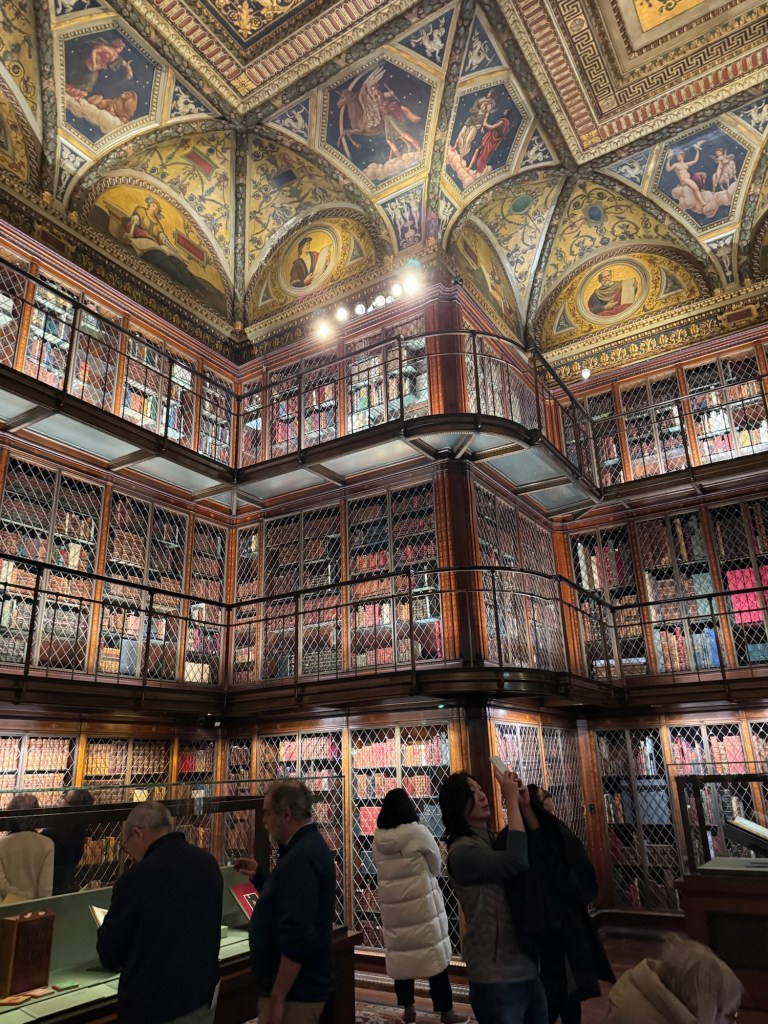
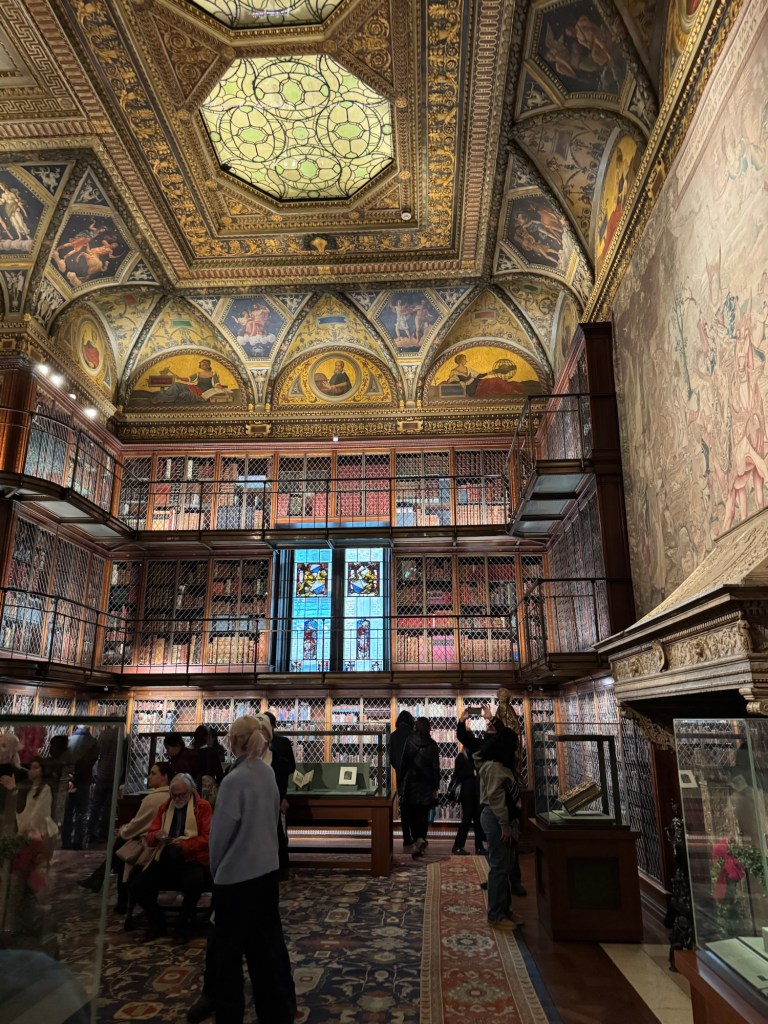
Last Friday, Mary and I took our oldest grandson, who is now 32, to The Morgan Library and Museum in Manhattan. The Morgan is a small but breath-taking collection of books and manuscripts that belonged to the personal collection of J.P. Morgan. The building is breathtaking, as are the books, which include an original Gutenberg Bible.
We began by seeing an exhibition of illustrated Bibles and other religious books that were over 1,000 years old. I kept thinking of the Hebrew scribes and Christian monks who spent years writing and illustrating these gorgeous volumes. Every letter, every line was perfect. How did they do it?
Then we visited the main library, a magnificent room with three layers of leather-bound books.
Mr. J.P. Morgan’s LibraryAnother view of this magnificent room
The room included a jewel-encrusted Bible, made in France and Austria in the 9th century
Mr. Morgan’s jewel-encrusted Bible
All of this splendor reminded me of the poverty in the streets outside his library and home, but I doubt that he thought much about the people outside.
In an exhibition case, there were several unusual printed documents. One was about a woman named Mary Toth or Toths, an English woman who pulled off an elaborate hoax in 1726, when she was 23 years old. She told doctors that she had given birth to bunnies. The illustration showed her, a few doctors, and many bunnies. The story spread rapidly, and many people believed that she had in fact given birth to bunnies. She was eventually discredited, briefly jailed, and eventually the charges against her were dismissed.
I said to my grandson, if that happened today, it would spread like wildfire on the internet and many people would swear it was true. My grandson said, “Some people will believe anything because they are ignorant.”
The stranger standing next to us interjected, “Some things never change.”
On the same day that we visited The Morgan Library, our frequent commenter Bob Shepherd left the following observation about why people are so gullible:
Three of the most powerful and important experiments ever performed were Stanley Milgram’s electric shock experiment, Solomon Asche’s line length determination experiment, and Philip Zimbardo’s prison experiment. I won’t go into the details of these here. You can look them up in a quick Google search if you are fuzzy on their details. What these experiments, which have been repeatedly replicated, show conclusively is that about two thirds of people are so driven by desire to be accepted by the group that they will conform to and actively participate in the most egregious behavior toward others in order to be themselves accepted by a perceived “authority.” Next time you are in a public place–at a game, in a restaurant, in a club–look around you. Two thirds of the people you see are potential collaborators–people capable of extreme evil, which, as Hannah Arendt pointed out, is TYPICALLY characterized by mediocrity.
Years ago, when I was a baby editor, I went to work for McDougal, Littell. Ms. Littell–the co-founder’s wife–was the editor of their literature program at the time, and she had chosen for the 12th-grade book an essay by the English historian Hugh Trevor-Roper about what an “evil genius” Hitler was. Well, I risked my job by objecting to this piece because Hitler was not a genius. He was a common thug and a psychopath, and people are sheep, easily led, easily bullied into submission and acquiescence. Or consider John Gotti–the psychopathic criminal Mafia thug. The press created an image of the brilliant “Dapper Don,” who could constantly evade punishment. But after he was finally imprisoned, tapes of wire taps on Gotti were released, and these showed that he was the lowest sort of ignorant thug, incapable of clear reasoning or speech, driven by the basest motivations, and unable to say anything without accompanying it with a string of curses that stood in for the words lacking in his fourth-grade vocabulary.
People want to belong. They want to get along. They want Daddy to tell everyone what to do. And they will idolize absolute monsters if they get that from them.
Bob is a polymath—an author, editor, guitarist, teacher, and humorist–who seems to have read deeply in every field.
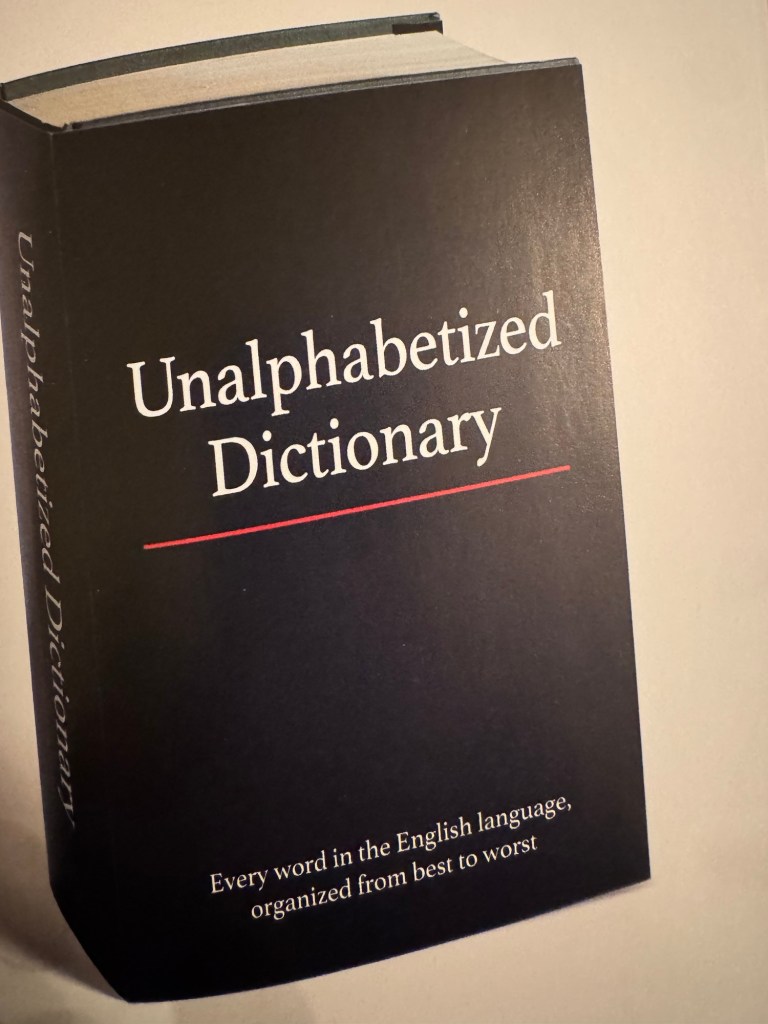
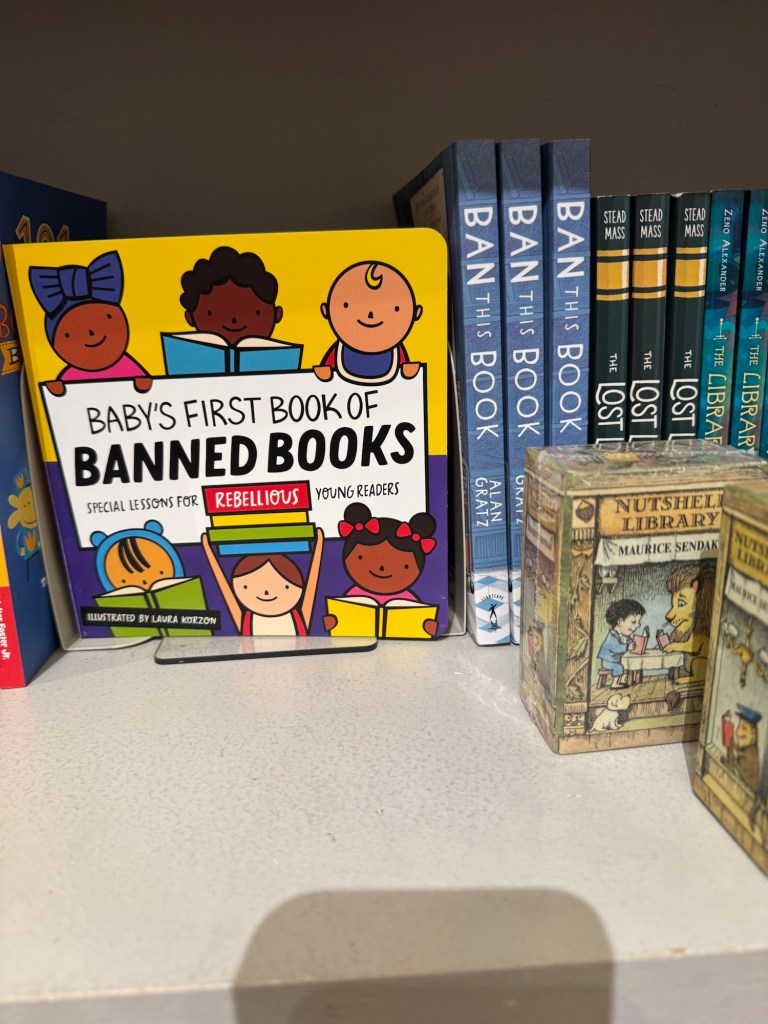
Oh, we stopped in the gift shop, and I bought a couple of delightful books. One was titled Rejected Books: The Most Unpublishable Books of All Time.
Some of those unpublishable books:
Famous People in Owl MasksUnalphabetized DictionaryTerrible Drawings of Horses
Several reporters at The New York Times worked together for months unraveling the secrets of Jeffrey Epstein’s financial success. How did he go from being a high school math teacher to a multimillionaire? His greatest trick, it appears, was cultivating and leveraging friendships among people who were wealthy and powerful. Name-dropping was a tactic. So were lying and boasting, as he rose in elite circles, cultivating contacts, references, women, and friends.
Predictably, the legislature removed income limits and the program now subsidizes affluent families whose children never went to public school.
The program this year will cost $51.6 million. Almost $50 million goes to students already enrolled in private or religious schools.
Meanwhile, the funding for vouchers is drawn from the state’s Education Trust Fund, which was intended for public schools. That means the subsidy for nonpublic schools comes right out of the public schools’ budget, with no tax increases to compensate public schools. The vast majority of New Hampshire’s students are now subsidizing the nonpublic schools.
There is a new regime at the Department of Education that has released more than the most basic information about the Education Freedom Account program.
For the program’s first four years, the department released spreadsheets detailing the numbers of students, where they live and how much each student received in grants with a total cost of the program and the quarterly state distributions to cover those grants.
The money does not really go to the parents, its goes to the Children’s Scholarship Fund NH, which takes its cut and sends the rest in the child’s name to ClassWallet, a company that received early stage investments twice from the Chinese-based venture capital firm Sinovation Ventures.
A 2018 Defense Department report flagged the company as participating in China’s “technology transfer strategy,” a state initiative to acquire foreign innovation.
Several states that also use ClassWallet for voucher money distribution have raised concerns about data security and foreign influence like Arizona and Missouri, but not New Hampshire, although Gov. Kelly Ayotte issued Executive Order 2025-04 which would appear to prohibit doing business with a company with investors like ClassWallet.
ClassWallet does not technically work for the state, but it was hired by a state contractor, Children’s Scholarship Fund of NH, which administers the EFA program.
How many parents of EFA students would want their education spending data potentially accessed by a foreign country like China?
That information is not what was released late last month by the Department of Education, but is easily found with a Google Search, which ironically also brings up that Sinovation Ventures was co-founded by former China Google President Kai-Fu Lee.
The information released last month provides far greater detail than released under former DOE Commissioner Frank Edelblut, who kept the program’s details out of the public’s eye, such as where the money went and if the children’s foundation was carefully vetting income levels and other requirements to access additional grant money.
A small sample compliance report by the now long gone DOE overseer of the EFA program, indicated it was not following guidelines.
The 100 applications sampled for the report over the first two years of the program had a 25 percent error rate that resulted in a rebate to the state for only those applications improperly approved not for 25 percent of the program’s costs.
One of the biggest criticisms of the program is that very few of the students using the state’s money are actually leaving public schools to join the program. Instead the vast majority of the students using EFAs were already in religious or private schools or homeschooled when their parents applied to participate in the state-funded program that draws its funding from the Education Trust Fund, which also pays for the bulk of state aid to public schools, no matter how meager compared to every other state in the country.
This year the program is projected to cost $51.6 million and will cost an additional $61.9 million next year, totaling $113.5 million for biennium, which makes it $26.7 million over budget.
And if you read the fine print of the data released last month, only $1.68 million on the low end, to $4.42 million on the high end for this school year, and $2.52 million if you use the four-year average is going to kids who were not in public schools when they joined the program out of the $51.6 million for this school year.
The data from the DOE notes that for the current school year only 343 students left public schools to join the program whose enrollment is now 10,510 students, which is nearly double what it was last year before the Republican-controlled legislature removed any earnings cap for the program.
That 3.26 percent of the students is the low end of the estimate above, and if you use the number of new students this year compared to last school year, which is 4,745, the new students from public schools is 7 percent and the high figure.
If you add the kids leaving public schools for the last four years, the number is 1,162 which compared to enrollment over those four years of 23,937 and the number is the four-year average.
That means state taxpayer money going to support students who were not in public schools when they joined the EFA program for this school year would be between $49.92 million and $47.18 million.
That is money the state was not paying to educate these kids because they were in religious or private schools or homeschooled and not supported by state dollars.
In essence that is a new education cost for the state, but no new taxes, or fees or anything was created to pay for it.
Instead, it is money drawn from the Education Trust Fund which was established after the Claremont education decisions to support public education.
As Rayno writes: For those receiving the money on the upper end of the income scale, the little less than $5,000 grant average is a subsidy that allows another ski trip to Aspen or Tahoe this winter.
So when lawmakers say the state doesn’t have the money to increase its share of public education costs, it really means “we do not want to increase the state’s share, but we are OK subsidizing religious and private schools and homeschooling.”
For those receiving the money on the upper end of the income scale, the little less than $5,000 grant average is a subsidy that allows another ski trip to Aspen or Tahoe this winter.
But the above figures are probably a little generous because they do not account for the kids who joined the EFA program from public schools and then returned to public schools either before or after one year.
Data released by the department indicates that last school year, 101 of the former public school students who switched to the EFA program, re-enrolled in public schools.
For the 2023-2024 school year, 75 EFA students returned to public schools, and for the 2022-2023 school year, 38 re-enrolled in public schools.
But those are not the only ones leaving the EFA program every year.
It also does not include EFA students who either graduated or completed their course of instruction that school year or left for unexplained reasons.
For the 2024-2025 school year, 151 EFA students left the EFA program because they graduated or completed their course of study along with the 101 who returned to public schools, and the 887 who left for unexplained reasons.
The total number of students leaving the program that school year was 1,139 or 21 percent of the total EFA enrollment for the year.
For the 2023-2024 school year, 108 students either graduated or completed their course of study, with the 75 who returned to public schools, and 525 who left for unexplained reasons.
The total number of students leaving the EFA program that school year were 708, or 19 percent of the total EFA enrollment.
For the 2022-2023 school year, 76 students graduated or completed their course of studies, along with the 38 who re-enrolled in public schools and the 344 who left for unexplained reasons.
The total number of students leaving the program was 458 students or 15 percent of the enrollment that year.
Total students leaving over the three-year period was 2,305 from a total three-year enrollment of 12,557 or 18.4 percent.
What would we say about a dropout rate of nearly 20 percent if it were a public school?
This is not the widely successful program its advocates tout on the floor of the House and Senate and does not save school districts the amount of money Edelblut used to claim because more than 90 percent of the students in the program were not in public schools, but he counted them as savings to school districts.
This program is not serving the children of low-income parents who want an alternative to public schools, but those parents who can already afford to pay for their children to attend those alternatives without the state’s taxpayers’ help.
That is not government helping the most vulnerable, it is Robin Hood in reverse, a system New Hampshire knows very well.
Gary Rubinstein is a teacher of mathematics at Stuyvesant High School in NYC and a prominent critic of corporate reform. He started his career as one of the first corps members of Teach for America. After many years inside the reform world, he saw its flaws and became an apostate. Like me. With his superb mathematical skills, he has debunked charter school “miracles,” TFA data, the Tennessee Achievement School District, which did a lot of boasting but failed.
His review is a delight to read.
He writes:
Fifty years after the publication of her first book, ‘The Great School Wars’, author and historian Diane Ravitch has released her long awaited memoirs. In ‘An Education: How I Changed My Mind About Schools and Almost Everything Else’ Ravitch takes us through her life from her childhood in Houston through the ups and downs of a long and productive life driven by truth and integrity.
What makes this book a ‘must read’ is that it has the three elements that a great autobiography should. First, her life story is interesting on an objective level. Anyone picking up the book and reading over the book jacket will know that Ravtich is someone who achieved fame and notoriety through the unlikely passion of the history of Education in America. But in this book we learn about the sorrow she had to endure between her great triumphs. So her story, even if it weren’t so well written, would make a very good book. A second component of a great autobiography is the author’s ability to reflect on 80 plus years of life and find the pivotal moments that changed the course of her life. But for an autobiography to be ‘great’ it must be infused and brought to life with excellent precise writing. As ‘An Education’ has all three aspects, this is a book you are going to want to read and then keep to re-read over the years when you are in need of inspiration.
If you have read any of Ravitch’s education books, you know that she is a master of absorbing decades of events and processing them and creating an insightful, and incredibly efficient, thesis which she develops over the course of a book. As she explains in this book, she learned her craft while writing as a journalist for The Wellesley News and then for The New Leader magazine. In all her books she exhibits this efficient technique that would make Strunk and White beam. But, by design, Ravtich’s books on Education are stripped of emotional language. Those books educate you through a series of well chosen facts that lead you to understand the implications and big moments without having to spell out every detail. The big question, which this new book answers with an emphatic ‘Yes’ is whether or not her kind of writing can be used to evoke the joy and the sorrow she experienced through her full 87 years of living.
When I started reading this book, I would bookmark interesting passages that show her talent for memoir. Eventually I realized that I was bookmarking almost every page. So after the first 50 of so pages, I had to slow down on the bookmarking. Here are some of my favorite moments (I will try not to give away too much).
Since Ravitch can write a full tale in the span of five or six lines, there are so many interesting stories in this book. As a writer she reminds me of one of those painters, I don’t know so much about painting to know what this is called – maybe impressionistic? – who, rather than producing a full photographic quality image, instead just does the minimal with the paint and brush to convey the emotion and ideas. This is something that is very difficult to do yet she makes it look easy.
A few pages later, Ravitch relays an amusing story about how as a teen she found a pearl in an oyster and ended up in the newspaper for it and also got food poisoning from eating the oyster: “The next day, after the newspaper appeared with a photograph of me in short shorts, identified by name, strange men began calling the house, asking for me and saying impudent things. That went on for days, along with the vomiting. My mother was not amused.” This is so efficient, not a word wasted and it does convey the absurdity and the humor with a minimal delivery reminiscent of maybe Bob Newhart.
Here’s one I liked: “The only Sunday school teacher I remember was a strapping guy who discussed Bible stories and the Jewish religion with us. He told us that when he was our age he had run away with the circus.” Ah, see how great this is? In the first sentence she sets up the scene. And then in just a few words tells us the perfect thing to understand this guy. No more is needed and no more is said.
Throughout the book, Ravitch takes stories and moments that could easily fill several pages and finds a way to convey them in a few words. For the reader, this has the effect of injecting all the humor and sometimes the sorrow of these moments directly into our brains without it having to be processed and translated in our minds.
Though these two examples are fun and convey the innocence of childhood, Ravitch is similarly terse in her telling of some of the deepest tragic moments of her life. When these happen in the book, the descriptions are so efficiently written that, like sometimes when bad things happen in life unexpectedly, we find ourselves pausing and wondering if that really just happened. The matter of fact telling of memorable moments of life, both big and small, happy and tragic, has a powerful effect on the reader.
The book really gets rolling when Ravitch enters college in 1956 at Wellesley. In one sense she is a fish out of water and then she eventually completely at home with the lifelong friends she made there. This was a really fun chapter to read as Ravitch has the first of her many brushes with fame, like her friend Maddy – eventually Madeleine Albright. Just as always, Ravitch perfectly sets up the matter of fact description of her friend’s background and then, in an instant it is revealed who she became known as. The Madeleine Albright story was less than one page long.
One of my favorite parts was the description about a satirical musical Ravitch and her friends wrote for the Wellesley Junior Show. It was hilarious. I kind of want to see the full script but her description of it, as all her descriptions, gave us just enough that we feel like we saw the whole show but forgot some of the missing details.
After college, Ravitch starts domestic life but isn’t quite content. She then goes on a lifelong quest for love and for purpose. As she goes through different eras in her life, she meets a new cast of colorful characters, some famous, some not, but always relevant to her story.
In this book we learn how she went from being the wife of an influential New York City figure to the influential Dr. Ravitch the Education guru of this country. As she rises in the ranks, she finds herself in the company of so many famous people — even several presidents, yet she conveys in her telling of these encounters that, to her, it wasn’t such a big deal. They are all just people. Anyone who has gotten the chance to meet her in person and see her interact with so many people who are not famous will see that she treats non famous people like they are special and is always asking them questions rather than talking about herself.
One of the funniest anecdotes in the book is when she inadvertently got Isaac Asimov angry with her over small talk related to word processors. Again, this is only a few lines, but another interesting adventure in Ravitch’s full life that put her often in the room with all kinds of famous people.
While married to her husband, Diane unexpectedly meets her soulmate who happens to be a woman. In the chapter about the genesis and growth of her relationship, they have now been together for almost 40 years, she is able to convey what it means to finally experience the joy of true love.
In the last chapters of the book we learn about the Washington years in the Department of Education and how that came about and what she tried to accomplish there. We also learn about what it took to renounce much of her work and to follow the evidence into a more evolved system of beliefs about what can improve education in this country. She lost a lot of friends and titles in the process but she kept her personal integrity and commitment to the truth.
Throughout the book, the theme is that Ravitch is never just one thing or the other. Is she a education conservative or an education liberal? Is she straight or gay? Is she a southerner or a north easterner? Is she an introvert or an extrovert? Is she a socialite or a homebody? And throughout her life she is sometimes one and sometimes the other. She is someone who defies categorization. And though in the subtitle she says she ‘changed her mind about schools and almost everything else’ she never changed her core belief that you don’t just stay in the same place just because you are comfortable there.
And like with her, this book is a lot of different things. On one level it is an amusing and interesting read about someone whose choices led her on an unlikely adventure ending with her being, in some circles, a huge celebrity. But it is also an inspirational tale of how having values and staying true to them can help you overcome some of the unfortunate obstacles you have to deal with in life. And though I doubt it was intended to accomplish something else, I think that for many readers they will want to write down their own memoirs after reading this. Ravitch makes it look so easy to analyze your life, find the key moments in it and write some succinct prose – though of course it isn’t so easy but still a worthwhile task.
After finishing this book, I had an experience that only a few people were also able to have. In the acknowledgements in the ‘friends’ section, among sixteen other names, there was my own. I got a chill seeing this, never expecting it. But this made me think something else, also a lesson, though maybe unintended from this great book. This book reminds us of the importance of relationships. Everyone you know has a story to tell. Some people’s lives may not have the highs and lows of Diane Ravitch’s but for each person, their joys and sorrows are meaningful to them. And even if they don’t have the capability to write the way Ravitch can, if they could, you might find yourselves in the acknowledgement page for that friend or family member. So enjoy the relationships you have while you can and remember that you are an important person in many people’s lives.
So pick up a copy today and take a ride through the ups and downs of a well lived life. Though she has made a career of writing about education and teaching, through this book she educates and teaches us that if you keep an open mind and are committed to learning and following the facts, you might end up in a comfortable home a long way from where you started.
Kristen Buras lives in New Orleans and has written several notable books about the charter school takeover of the city’s schools. After two decades at Emory University and Georgia State University, she currently works in New Orleans as a scholar-activist. She is cofounder and director of the New Orleans-based Urban South Grassroots Research Collective, a coalition with Black educational and cultural groups that melds community-based research and organizing for racial justice. Buras has written multiple books on urban educational policy, including Charter Schools, Race, and Urban Space: Where the Market Meets Grassroots Resistance and What We Stand to Lose: Black Teachers, the Culture They Created, and the Closure of a New Orleans High School.
Her latest report appears here:
The Stories Behind the Statistics: Why a Report on ‘Large Achievement Gains’ in Charter Schools Harms New Orleans’ Black Students
Buras’ latest report exposes how “Large Achievement Gains” in New Orleans’ charter schools mask persistent inequities
The National Center for Charter School Accountability (CCSA), a project of NPE, has released a new independent report, The Stories Behind the Statistics: Why a Report on ‘Large Achievement Gains’ in Charter Schools Harms New Orleans’ Black Students, authored by noted scholar Dr. Kristen Buras. The report delivers a penetrating critique of the widely circulated “success narrative” surrounding the charter-school takeover of New Orleans following Hurricane Katrina. It challenges the Education Research Alliance for New Orleans (ERA)’s claims of significant achievement gains. It reveals how shifting metrics, questionable data, and students’ lived experiences paint a far more complex—and troubling—picture.
The Stories Behind Statistics raises substantial concerns about the foundations of ERA’s conclusions. First, it details how Louisiana officials repeatedly modified the school performance metrics in ways that boosted the apparent success of charter schools, creating an illusion of dramatic improvement. Second, it questions the reliability of the data ERA relied upon, noting allegations, lawsuits, and documented violations—including grade-fixing, financial mismanagement, and other irregularities—that have occurred across the New Orleans charter sector. Third, the report underscores the longstanding lack of meaningful oversight and accountability for charter schools, which further undermines confidence in the performance data.
Finally, the report scrutinizes ERA’s surveys on teaching quality and school climate, demonstrating that the experiences of Black students—when examined at the school level—are far more negative than ERA’s brief suggests. To bring these realities into focus, Dr. Buras incorporates original qualitative research, including firsthand testimony from students and parents describing their experiences in New Orleans charter schools.
The Stories Behind the Statistics urges policymakers, researchers, and the public to look beyond celebratory headlines and examine the deeper structural issues that continue to shape the city’s all-charter experiment—issues that profoundly affect the educational experiences of Black youth and their families.
According to Network for Public Education President Diane Ravitch, “As cities and states across the nation look to New Orleans as a model of charter-school reform, this report cautions how important it is to dig deeper than surface metrics. Without transparency, accountability, and attention to student experience, reforms that appear successful on paper may in fact perpetuate inequities and undermine educational justice for students.”






 Diane Ravitch's blog