Archives for category: History

Chris Tomlinson is an award-winning columnist for the Houston Chronicle. In this column, he describes the damage that extremists are doing to our country.

The true story was almost custom-made for Hollywood.

A powerful man convinces his nephew to marry into a wealthy family, and the two conspire to kill four of the bride’s relatives to inherit their fortune. Then, they begin slowly poisoning the loving, unsuspecting wife. Will anyone catch on and stop the villains before they complete their nefarious plot?

A good yarn, but like too many products these days, it’s gotten caught in the culture wars because the killers were white supremacists, and their victims were members of the Osage tribe.

The National Review says the only thing Martin Scorsese’s “Killers of the Flower Moon” has going for it “is the woke idea that America’s white men are spiritually sick

I think the only thing conservative media has going for it is racial grievance, convincing older white people of their imminent demise if they don’t elect white supremacists. Bankrupted of ideas, these billionaire-financed outlets have become nothing more than outrage factories.

Conservative media wants to make every aspect of American life political. Want a vaccination? Woke! Don’t want to pay taxes? Righteous! Want renewable energy? Woke! Want a military-style rifle? Righteous! Electric vehicles? Woke!

Why? Because powerful people with financial interests vulnerable to human progress want voters to elect backward politicians who will protect their profits.

So, partisans work to make every consumer purchase a political talisman.

Come back to the office with a Chick-fil-A bag, and some of your coworkers may suspect you oppose LGBTQ rights. But conservatives will also give you a side-eye too because they’ve launched a Chick-fil-A boycott over the company employing an executive overseeing diversity, equity and inclusion policies

Conservatives and progressives have extensive lists of companies and individuals that have perpetrated some egregious act. The perceived misdemeanors are as wide-ranging as they are sometimes absurd. But propagandists know calling out a well-known brand, especially on Twitter, now called X, is a surefire way to grab attention…

I saw “Killers of the Flower Moon” last weekend, and Scorsese made another fine film about what Hannah Arendt might call the banality of evil. Almost all his films have been about America’s spiritually sick white men; this one is no different.

I agree with critics who say Scorsese spends too much time with the white guys and not enough with the Osage, whose people were murdered. Woke this film is not.

The director’s biggest mistake was making a historical drama revealing how white people did terrible things to people of color. Teaching history has also become a political act.

Anyone who deviates from the white supremacist narratives established between 1875 and 1955 should brace for conservative condemnation, no matter how many endnotes they include. Conservatives want to ignore how many of our ancestors sweetly depicted in sepia-toned photographs committed crimes against humanity. Talking about it gets you labeled woke or worse.

The Texas Legislature has made it a crime to teach American history that might make children uncomfortable. By that measure, no teacher can screen “Killers of the Flower Moon” without fear of persecution.

The systematic murder of the Osage took place in Oklahoma, but Texas also has a long history of atrocities. The Texas Rangers are celebrating their bicentennial, but few are talking about how troopers massacred Mexican Americans or ethnically cleansed Native Americans in shocking numbers and violence.

The Republican majority has also made it illegal to explain how slavery was the original sin of the U.S. Constitution. Teachers must say slavery was a deviation from American values, even though Southerners forced Thomas Jefferson to cut a proposed part of the Declaration of Independence that called for abolition. The Constitution ordered that enslaved people only count as three-fifths of a human.

Pretty originalist to me.

These days, politicians rely on grievance and fear rather than ideas and hope. But politicizing everything only divides us, and ignoring our history condemns us to repeat it; look at the resurrection of fascism.

Patriots don’t hate their fellow citizens; they learn from the past and compromise for a more perfect Union.

This story is fascinating. It’s about the quest to understand the origins of a painting of three white children that originally included a young slave. At some point, the enslaved youth was painted over and eliminated.

One determined art collector enlisted the help of art historians to identify the white children and the enslaved youth. The young man was named Bélizaire. The painting was held for decades in storage in a New Orleans art museum. It was just another family painting: three children. If you can open the video, please do (I don’t know if it is behind a pay wall).

Once the original painting was restored and its history documented, it was purchased by the Metropolitan Museum of Art, where it is prominently displayed.

How a Rare Portrait of an Enslaved Child Arrived at the Met” is a 10-minute film that touches on themes of race, art and history.

For many years, a 19th century painting of three white children in a Louisiana landscape held a secret. Beneath a layer of overpaint meant to look like the sky: the figure of an enslaved youth. But a 2005 restoration revealed him and now the painting has a new, very prominent home at the Metropolitan Museum of Art. Who was the enslaved child? Who covered over his figure? Why did the painting languish for decades in attics and a museum basement?

The Times further describes the journey of the painting:

To learn more, read “‘His Name Was Bélizaire’: Rare Portrait of Enslaved Child Arrives at the Met.” Alexandra Eaton writes:

One reason “Bélizaire and the Frey Children” has drawn attention is the naturalistic depiction of Bélizaire, the young man of African descent who occupies the highest position in the painting, leaning against a tree just behind the Frey children. Although he remains separated from the white children, Amans painted him in a powerful stance, with blushing cheeks, and a kind of interiority that is unusual for the time.

Since the Black Lives Matter movement, the Met and other museums have responded to calls to reckon with the presentation of Black figures. When the European Galleries reopened in 2020, the museum included wall texts to highlight the presence of African people in Europe and to call attention to issues of racism, previously unmentioned. In the American Wing, which had presented “a romanticized history of American art,” Kornhauser said, a presidential portrait was recast with the consciousness of the present: John Trumbull’s 1780 portrait of George Washington and his enslaved servant William Lee identified only the former president until 2020, when Lee’s name was added to the title. However, unlike Bélizaire, Lee is depicted at the margins, lacking in any emotion or humanity.

Jeremy K. Simien, an art collector from Baton Rouge, spent years trying to find “Bélizaire” after seeing an image of it online in 2013, following its restoration, that featured all four figures. Intrigued, he kept searching, only to find an earlier image from 2005, after the painting had been de-accessioned by the New Orleans Museum of Art and was listed for auction by Christie’s. It was the same painting, but the Black child was missing. He had been painted out.

“The fact that he was covered up haunted me,” Simien said in an interview.

One of my grandsons sent me an article about the national rush to mandate “the science of reading,” and it caused me to explain briefly (without boring him) the background of the latest panacea.

I didn’t tell him the history of the “reading wars,” which I researched and wrote about in Left Back (2000). I didn’t tell him that reading instruction has swung back and forth between the phonetic method and the “whole word” method since the introduction of public schooling in the first quarter of the 19th century. Horace Mann opposed phonics. But the popular McGuffey readers of that century were phonetic. In 1930, the Dick-and-Jane readers were introduced, and they swept the country. Unlike the McGuffey readers, they featured pictures of children (white and suburban), they used simple words that could be easily recognized, and they were bright and colorful. By the 1950s, Dick and Jane style readers were used in about 80% of American schools. They relied on the whole word method, also know as look-say.

In 1955, this national consensus was disrupted by the publication of Rudolf Flesch’s wildly popular book, Why Johnny Can’t Read, which castigated the look-say method and urged a revival of phonics. The fervor for phonics then is similar to the fervor now.

But the debate about which method was best quickly became politicized. “Bring back phonics” was the battle cry of very conservative groups, who lambasted the whole-word method as the conspiratorial work of liberal elites. Phonics thus was unfairly tarnished as a rightwing cause.

The definitive book about the teaching of reading was written in 1967 by Harvard literacy expert Jeanne Chall: Learning to Read: The Great Debate. Chall wrote about the importance of phonics as part of beginning reading instruction, followed up by wonderful children’s literature. She warned against going to extremes, a warning that has been ignored with every pendulum swing.

The 1980s began the dominance of whole language, which brought back whole-word sight reading and de-emphasized phonics. Textbook companies boasted that their programs were whole language. Literacy conferences were focused on whole language. Phonics was out. Many reading teachers held on their phonics books, even though phonics was out of style.

There is always a crisis in reading, so in the late 1990s, the pendulum began to move again. As it happened, a very influential supporter of phonics held a key position at the National Institutes of Health. Dr. Reid Lyon was director of the NIH’s National Institute of Child Health and Development. His field of expertise was learning disabilities.

From Wikipedia:

From 1992 to 2005, Lyon served as a research neuropsychologist and the chief of the Child Development and Behavior Branch of the NICHD at the National Institutes of Health; in this role he developed and oversaw research programs in cognitive neuroscience, learning and reading development and disorders, behavioral pediatrics, cognitive and affective development, School Readiness, and the Spanish to English Reading Research program. He designed, developed and directed the 44-site NICHD Reading Research Network.

Lyon selected the members of the National Reading Panel. Like him, most were experimental researchers in higher education. Only one—Joanne Yatvin— was experienced as an elementary school teacher and principal. She wrote a “minority view” dissenting from the report, and she worried that the report would be misused.

President George W. Bush signed No Child Left Behind into law on January 8, 2002. This law was the single largest intrusion of the federal government into education in American history. Before NCLB, education was a state responsibility. Since passage of NCLB, the federal government established mandates that schools had to obey.

One of the components of this law was the Reading First program. RF was based on the report of the National Reading Panel, which emphasized the importance of phonemic awareness, phonics, decoding, and fluency.

The Reading First program allocated $6 billion over six years to encourage districts to adopt the “science of reading,” as established by the National Reading panel.

There were two reasons that the program ended.

First, there were financial scandals. Google “Reading First Program Scandals”). The New York Times reported here about conflicts of interest and steering of contracts to favored textbook publishers. “In a searing report that concludes the first in a series of investigations into complaints of political favoritism in the reading initiative, known as Reading First, the report said officials improperly selected the members of review panels that awarded large grants to states, often failing to detect conflicts of interest. The money was used to buy reading textbooks and curriculum for public schools nationwide.”

Second, the final evaluation of the program found that it taught what it aimed to teach but there was no improvement in students’ comprehension.

Here is the summary of the final evaluation:

The findings presented in this report are generally consistent with findings presented in the study’s Interim Report, which found statistically significant impacts on instructional time spent on the five essential components of reading instruction promoted by the program (phonemic awareness, phonics, vocabulary, fluency, and comprehension) in grades one and two, and which found no statistically significant impact on reading comprehension as measured by the SAT 10. In addition to data on the instructional and student achievement outcomes reported in the Interim Report, the final report also presents findings based upon information obtained during the study’s third year of data collection: data from a measure of first grade students’ decoding skill, and data from self-reported surveys of educational personnel in study schools.

Analyses of the impact of Reading First on aspects of program implementation, as reported by teachers and reading coaches, revealed that the program had statistically significant impacts on several domains. The information obtained from the Test of Silent Word Reading Fluency indicates that Reading First had a positive and statistically significant impact on first grade students’ decoding skill.

The final report also explored a number of hypotheses to explain the pattern of observed impacts. Analyses that explored the association between the length of implementation of Reading First in the study schools and reading comprehension scores, as well as between the number of years students had been exposed to Reading First instruction and reading comprehension scores were inconclusive. No statistically significant variation across sites in the pattern of impacts was found. Correlational analyses suggest that there is a positive association between time spent on the five essential components of reading instruction promoted by the program and reading comprehension measured by the SAT 10, but these findings appear to be sensitive to model specification and the sample used to estimate the relationship.

The study finds, on average, that after several years of funding the Reading First program, it has a consistent positive effect on reading instruction yet no statistically significant impact on student reading comprehension. Findings based on exploratory analyses do not provide consistent or systematic insight into the pattern of observed impacts.

After the disgrace of the Reading First program, support for phonics dissipated. But in the past few years, journalists (led by Emily Hanford) have trumpeted the idea that the report of the National Reading Panel established the “science of reading.” New York Times columnist Nicholas Kristof wrote about the “Mississippi Miracle,“ claiming that the “science of reading” had lifted fourth grade reading scores, and no new spending was needed in a very poorly resourced state. Kristof did not explain why the SOR did not cause a rise in eighth grade scores in Mississippi, nor did he understand that retaining low-scoring third graders raises the percentage of fourth graders who get high test scores. State after state is now mandating the “science of reading.”

And so the cycle begins again.

As a young person and a Jew, I swore I would never visit Germany. Growing up in Houston in the late 1940s and early 1950s, I occasionally met people who had a blue number tattooed on their arm, a legacy of their time in a Nazi concentration camp. I learned about the Holocaust at religious school, not public school. With my knowledge of the Holocaust, I was determined to avoid the nation that sought to eliminate the Jews of Europe. I was fortunate that my father’s parents came to America from Poland in the 19th century, and my mother arrived from Bessarabia after World War 1. Every member of their families who remained in Europe was slaughtered. Not one survived.

In 1984, I received an invitation from the State Department to visit West Germany and Yugoslavia to speak about education. I decided to go. It was a fascinating trip, and I overcame my phobia about visiting Germany.

Years later, after the Wall had come down, I went to Germany as a tourist with my partner and our Brooklyn neighbors. The wife, an emergency room nurse, was born in Germany, and is one of the kindest people I know. For the first time, I saw Germany as a vibrant and thriving nation. I visited the Holocaust Museum in Berlin and saw the honesty with which Germany was confronting its past. Every town we visited had its memorials to those who had perished because of Hitler’s genocide.

A few days ago, I was again in Berlin. Frankly, I fell in love with Berlin. The German people acknowledge the horrors of their past. They don’t sugar coat it. Their contrition is impossible to ignore. There are memorials scattered across the city to those who were unjustly murdered—Jews, Roma, homosexuals, and others.

Right near our hotel was a field of 2,711 stelae of different sizes that looked like coffins. We stopped to view the site where Hitler’s bunker once existed. It’s now just blank ground with a large marker explaining what it was. It was where Hitler and Eva Braun married, knowing all was lost. She killed herself. Hitler killed himself. When the Soviets entered Berlin, they totally destroyed the bunker.

Several readers corrected my statement that Hermann Göring and his wife and children died in the bunker. They are right. It was Joseph Goebbels and his family who committed suicide in the bunker. Göring committed suicide in Nuremberg the night before he was to be executed by hanging.

As the war drew to a close and Nazi Germany faced defeat, Magda Goebbels and the Goebbels children joined Hitler in Berlin. They moved into the underground Vorbunker, part of Hitler’s underground bunker complex, on 22 April 1945. Hitler committed suicide on 30 April. In accordance with Hitler’s will, Goebbels succeeded him as Chancellor of Germany; he served one day in this post. The following day, Goebbels and his wife committed suicide, after having poisoned their six children with a cyanide compound. (Wikipedia)

On our last day in Berlin, we intended to go to the museum of the Stasi, the secret police that monitored every East German’s life. But we decided instead to visit the memorial center of the German resistance.

The museum tells the story of Germans who opposed the rise of Hitler in the 1930s, who worked against him during the war years, who anticipated that he would destroy Germany’s struggling democracy, and who worked to end his brutal tyranny. There were stories of opposition to Hitler by trade unionists and Communists, by Jews and Catholics and Protestants. The museum identified religious leaders, scholars, scientists, educators, students, social workers, and others who worked against Hitler. Most were killed. It went into great detail about the failed assassination attempt by leading German officers on July 20, 1944. All of them were murdered.

My partner, a former teacher of history and social studies, wondered why Holocaust studies in the schools do not tell their stories. In some sick way, the constant focus on bodies and atrocities was not having its intended effect; it was desensitizing the students to cruelty and inhumanity.

Of course, the brutality must be shown and remembered. But why not make resistance to evil the centerpiece? Why not focus on courage and heroism in the face of overwhelming force? Why not tell the story of Georg Esler, the German carpenter who tried to assassinate Hitler in 1939? Or the story of the White Rose Society, the college students who bravely distributed flyers about Nazi atrocities in 1942-43, who were captured and executed? They should be celebrated for their courage and conviction.

Meanwhile, back home, our own nation is convulsed by battles about teaching the past. Some insist on whitewashing history because the truth might make young people “uncomfortable.”We see the rising influence of groups like “Moms for Liberty,” who demand censorship and oppose honest teaching of the past and the present. They have a right to speak, but they should not have the right to impose their bigotry and intolerance on others. Moms for Liberty should learn from Germany about the importance of teaching truth.

If you visit Berlin, don’t miss this tribute to the resistance.

Jan Resseger writes brilliantly about the importance of education in a democracy. She reads widely in the work of authors who understand why education should not be privatized and turned into a consumer good. You will enjoy reading this essay.

She writes:

I find myself struggling these days to understand how those of us who prize our U.S. system of public education seem to have lost the narrative. As I listen to the rhetoric of today’s critics of public schooling—people who distrust or disdain the work of school teachers and who believe test scores are the only way to understand education, I worry about the seeming collapse of the values I grew up with as a child in a small Montana town whose citizens paid so much attention to the experiences its public schools offered for the community’s children. The schools in my hometown provided a solid core curriculum plus a strong school music program, ambitious high school drama and speech and debate programs, athletics, a school newspaper, and an American Field Service international student every single year at the high school. While many of us continue to support our public schools, what are the factors that have caused so many to abandon their confidence in public education?

It is in this context that I found myself reading “Education and the Challenges for Democracy,” the introductory essay in the current issue of Education Policy Analysis Archives. In his essay, Fernando M. Reimers, a professor in the graduate school of education at Harvard University, explores the interconnection of public education and democracy itself. Reimers explains, for example, that the expansion of our democracy to include more fully those who have previously been marginalized is likely to impact the public schools in many ways and that these changes in the schools will inspire their own political response:

“(T)he expansion of political rights to groups of the population previously denied rights (e.g. women, members of racial or religious minorities) may lead to increased access for these groups to educational institutions and a curriculum that prepares them for political participation. These changes, in turn, feed back into the political process, fostering increased demands for participation and new forms of representation as a result of the new skills and dispositions these groups gained by educational and political changes. But these increases in representation may activate political backlash from groups who seek to preserve the status quo. These forces may translate into efforts to constrain the manner in which schools prepare new groups for political participation. In this way, the relationship between democratic politics and democratic education is never static, but in perpetual, dynamic, dialectical motion that leads to new structures and processes. The acknowledgement of this relationship as one that requires resolution of tensions and contradictions, of course, does not imply an inevitable cycle of continuous democratic improvement, as there can be setbacks—both in democracy itself, and in education for democracy.”

Reimers continues: “Democracy—a social contract intended to balance freedom and justice—is not only fluid and imperfect but fragile. This fragility has become evident in recent years… In order to challenge the forces undermining democracy, schools and universities need to recognize these challenges and their systemic impact and reimagine what they must do to prepare students to address them.” While Reimers explains that the goal of his article is not only, “to examine how democratic setbacks can lead to setbacks in democratic education, but also how education can resist those challenges to democracy,” he presents no easy solutions. He does, however sort out the issues to which we should all be paying attention—naming five specific challenges for American democracy:

“The five traditional challenges to democracy are corruption, inequality, intolerance, polarization, and populism… The democratic social contract establishes that all persons are fundamentally equal, and therefore have the same right to participate in the political process and demand accountability. Democracy is challenged when those elected to govern abuse the public trust through corruption, or capturing public resources to advance private ends… Democracy is also challenged by social and economic inequality and by the political inequalitythey may engender… One result of political intolerance is political polarization… Political intolerance is augmented by Populism, an ideology which challenges the idea that the interests of ordinary people can be represented by political elites.” (emphasis in the original)

Reimers considers how these threats to democracy endanger our public schools: “The first order of effects of these forces undermining democracy is to constrain the ability of education institutions to educate for democracy. But a second order of effects results from the conflicts and tensions generated by these forces….” As the need for schools and educators to prepare students for democratic citizenship becomes ever more essential, political backlash may threaten schools’ capacity to help students challenge the threats to democracy.

In their 2017 book, These Schools Belong to You and Me, Deborah Meier and Emily Gasoi articulate in concrete terms what Reimers explains abstractly as one of the imperatives that public schools must accomplish today: “(W)e need a means of ensuring that we educate all future citizens, not only to be well versed in the three Rs, and other traditional school subjects, but also to be able to see from multiple perspectives and to be intellectually curious and incisive enough to see through and resist the lure of con artists and autocrats, whether in the voting booth, the marketplace, or in their social dealings.” (These Schools Belong to You and Me, p. 25) Schools imagined as preparing critical thinkers—schools that focus on more than basic drilling in language arts and math—are necessary to combat two of the threats Reimers lists: corruption and populism.

But what about Reimers’ other threats? How can schools, in our current polarized climate, push back against intolerance, inequality, and polarization? Isn’t today’s attack on “diversity, equity and inclusion” in some sense an expression of a widespread desire to give up on our principle of equality of opportunity—to merely accept segregation, inequality and exclusion? This is the old, old struggle Derek Black traces in Schoolhouse Burning—the effort during Reconstruction to develop state constitutions that protect the right to education for all children including the children of slaves—followed by Jim Crow segregation—followed by the Civil Rights Movement and Brown v. Board of Education—followed by myriad efforts since then to keep on segregating schools. Isn’t the attempt to discredit critical race theory really the old fight about whose cultures should be affirmed or hidden at school, and isn’t this fight reminiscent of the struggle to eliminate the American Indian boarding schools whose purpose was extinguishing American Indian children’s languages and cultures altogether? Isn’t the battle over inclusion the same conflict that excluded disabled children from public school services until Congress passed the Individuals with Disability Education Act in 1975? And what about the battle that ended in 1982, when, in Plyler v. Doe, the U.S. Supreme Court protected the right to a free, K-12 public education for children of undocumented immigrants? Our society has continued to struggle to accept the responsibility for protecting the right to equal opportunity. As Reimers explains, action to address inequality has inevitably spawned a reaction.

Educators and political philosophers, however, have persistently reminded us of our obligation to make real the promise of public schooling. In 1899, our most prominent philosopher of education, John Dewey, declared: “What the best and wisest parent wants for his own child, that must the community want for all of its children… Only by being true to the full growth of all the individuals who make it up, can society by any chance be true to itself.” (The School and Society, p. 1)

In 1992, political theorist Benjamin Barber advocated for the very kind of public schooling Reimers would like to see today: “(T)he true democratic premise encompasses… the acquired virtues and skills necessary to living freely, living democratically, and living well. It assumes that every human being, given half a chance, is capable of the self-government that is his or her natural right, and thus capable of acquiring the judgment, foresight, and knowledge that self-government demands.… The fundamental assumption of democratic life is not that we are all automatically capable of living both freely and responsibly, but that we are all potentially susceptible to education for freedom and responsibility. Democracy is less the enabler of education than education is the enabler of democracy.” (An Aristocracy of Everyone, pp. 13-14)

In a 1998 essay, Barber declared: “America is not a private club defined by one group’s historical hegemony. Consequently, multicultural education is not discretionary; it defines demographic and pedagogical necessity. If we want youngsters from Los Angeles whose families speak more than 160 languages to be ‘Americans,’ we must first acknowledge their diversity and honor their distinctiveness. English will thrive as the first language in America only when those for whom it is a second language feel safe enough in their own language and culture to venture into and participate in the dominant culture. For what we share in common is not some singular ethnic or religious or racial unity but precisely our respect for our differences: that is the secret to our strength as a nation, and is the key to democratic education.” (“Education for Democracy,” in A Passion for Democracy: American Essays, p. 231)

These same principles are prophetically restated by William Ayers in his final essay in the 2022 book, Public Education: Defending a Cornerstone of American Democracy: “In a free society education must focus on the production—not of things, but—of free people capable of developing minds of their own even as they recognize the importance of learning to live with others. It’s based, then, on a common faith in the incalculable value of every human being, constructed on the principle that the fullest development of all is the condition for the full development of each, and conversely, that the fullest development of each is the condition for the full development of all… Schools don’t exist outside of history or culture: they are, rather, at the heart of each. Schools serve societies; societies shape schools. Schools, then, are both mirror and window—they tell us who we are and who we want to become, and they show us what we value and what we ignore, what is precious and what is venal.” (Public Education: Defending a Cornerstone of American Democracy, p. 315)

Please open the link to complete the reading.

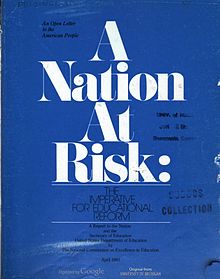
Nancy Bailey criticizes the ongoing campaign to raise academic expectations and academic pressure on children in kindergarten. She traces the origins of this misguided effort on the Reagan-era publication “A Nation at Risk” in 1983.

Although the gloomy claims of that influential document have been repeatedly challenged, even debunked*, it continues to control educational discourse with its assertion that American schools are failing. “A Nation at Risk” led to increased testing, to the passage of George W. Bush’s No Child Left Behind in 2002, to the creation of Barack Obama’s Race to the Top in 2009, to the release of the Common Core standards in 2010.

Despite nearly a quarter century of focus on standards and testing, policymakers refuse to admit that these policies have failed.

And nowhere have they been more destructive than in the early grades, where testing has replaced play. Kindergarten became the new first grade.

But says Bailey, the current Secretary of Education wants to ratchet up the pressure on little kids.

She writes:

In What Happened to Recess and Why are our Children Struggling in Kindergarten, Susan Ohanian writes about a kindergartner in a New York Times article who tells the reporter they would like to sit on the grass and look for ladybugs. Ohanian writes, the child’s school was built very deliberately without a playgroundLollygagging over ladybugs is not permitted for children being trained for the global economy (2002, p.2).   

America recently marked forty years since the Reagan administration’s A Nation at Risk: The Imperative for Educational Reform which blamed schools as being eroded by a rising tide of mediocrity that threatens our very future as a Nation and a people.

Berliner and Biddle dispute this in The Manufactured Crisis: Myths, Fraud, and the Attack on America’s Public Schools. They state that most of these claims were said to reflect “evidence,” although the “evidence” in question either was not presented or appeared in the form of simplistic, misleading generalizations (1995, p. 3)

Still, the report’s premise, that public schools failed, leading us down the workforce path of doom, continues to be perpetuated. When students fail tests, teachers and public schools are blamed, yet few care to examine the obscene expectations placed on the backs of children since A Nation at Risk.

Education Secretary Cardona recently went on a bus tour with the message to Raise the Bar in schools. Raising the bar is defined as setting a high standard, to raise expectations, to set higher goals.

He announced a new U.S. Department of Education program, Kindergarten Sturdy Bridge Learning Community.

This is through New America, whose funders include the Bill and Melinda Gates Foundation, the Waltons, and others who want to privatize public education. Here’s the video, Kindergarten as a “Sturdy Bridge”: Place-Based Investments, describing the plan focusing on PreK to 3rd grade. This involves Reading by 3rd and the Campaign for Grade Level Reading.

Cardona says in the announcement:

Getting kindergarten right has to be top of mind for all of us, because what happens there sets the stage for how a child learns and develops well into their elementary years and beyond. 

Ensuring that kindergarten is a sturdy bridge between the early years and early grades is central to our efforts both to Raise the Bar for academic excellence and to provide all students with a more equitable foundation for educational success. The kindergarten year presents an opportunity to meet the strengths and needs of young learners so they can continue to flourish in the years to come.

Raise the bar? Kindergarten is already the new first grade. What will it be now? Second? Third? Fourth? What’s the rush? How is this developmentally sound? One thing is for sure: there will still be no idle time for children to search for ladybugs.

Few bear the brunt of A Nation at Risk,as do early learners whose schools have been invaded by corporate schemes to force reading and advanced learning earlier than ever expected in the past.

If kindergartners aren’t doing well after all these years of toughness, higher expectations, and an excruciating number of assessments, wouldn’t it seem time to back off, instead of raising the bar higher?

Editor’s note:

*James Harvey and I will discuss the distortions contained in the “Nation at Risk” report at the Network for Public Education conference on Oct. 28-29 in Washington, D.C. James Harvey was a high-level member of the staff that wrote the report. He has written about how the Reagan-era Commissuon in Excellence in Education “cooked the books” to paint a bleak—but false—picture of American public schools. Please register and join us!

Thom Hartmann writes here about how George W. Bush and Dick Cheney cynically used the attacks of 9/11 to get us into America’s longest war. They wanted to go to war. I can’t help but think that if 537 votes in Florida had gone a different way, the world would be a different place today. It was those 537 votes that made Bush the President, not Al Gore. Remember that: Every vote counts.

Hartmann writes:

America has been lied into too many wars. It’s cost us too much in money, credibility, and blood. We must remember the lies, and tell our children about them so that memory isn’t lost…

Today is 9/11, the event that first brought America together and then was cynically exploited by George W. Bush and Dick Cheney to have a war against Iraq, followed by their illegal invasion of Afghanistan just a bit more than a year earlier.

Yet the media today (so far, anyway) is curiously silent about Bush and Cheney’s lies.

Given the costs of both these wars — and the current possibility of our being drawn deeper into conflict in both Ukraine and Taiwan — it’s an important moment to discuss our history of wars, both illegal and unnecessary, and those that are arguably essential to the survival of democracy in the world.

To be clear, I support US involvement — and even an expanded US involvement — in the defense of the Ukrainian democracy against Putin’s Hitler-grabs-Poland-like attack and mass slaughter of Ukrainian civilians. Had the world mobilized to stop Hitler when he invaded Poland in 1939 there almost certainly wouldn’t have been either the Holocaust or WWII, which is why Europe is so united in this effort.

If Putin succeeds in taking Ukraine, his administration has already suggested that both Poland and Moldova are next, with the Baltic states (Latvia, Lithuania, Estonia) also on the menu. That would almost certainly lead to war in Europe.

And China is watching: a Putin victory in Ukraine will encourage Xi to try to take Taiwan. Between the two — war in both Europe and the Pacific — we could find ourselves in the middle of World War III if Putin isn’t stopped now.

That said, essentially defensive military involvement like with Ukraine or in World War II have been the exception rather than the rule in American history. We’ve been far more likely to have presidents lie us into wars for their own personal and political gain than to defend ourselves or other democracies.

For example, after 9/11 in 2001 the Taliban that then ran Afghanistan offered to arrest Bin Laden, but Bush turned them down because he wanted to be a “wartime president” to have a “successful presidency.”

The Washington Post headline weeks after 9/11 put it succinctly: “Bush Rejects Taliban Offer On Bin Laden.” With that decision not to arrest and try Bin Laden for his crime but instead to go to war, George W. Bush set the US and Afghanistan on a direct path to disaster (but simultaneously set himself up for re-election in 2004 as a “wartime president”).

To further complicate things for Bush and Cheney, the 9/11 attacks were not planned, hatched, developed, practiced, expanded, worked out, or otherwise devised in Afghanistan or by even one single citizen of Afghanistan.

That country and its leadership in 2001, in fact, had nothing whatsoever to do with 9/11, as I detailed in depth here on August 15th of last year. The actual planning and management of the operation was done out of Pakistan and Germany, mostly by Khalid Sheik Mohammed.

The Taliban were bad guys, trashing the rights of women and running a tinpot dictatorship, but they represented no threat whatsoever to America or our allies.

Almost two decades later, though, then-President Trump and Mike Pompeo gave the Taliban everything they wanted — power, legitimacy, shutting down 9 of the 10 US air bases in that country to screw incoming President Joe Biden, and the release of 5000 of Afghanistan’s worst Taliban war criminals — all over the strong objections of the democratically elected Afghan government in 2019.

Trump did this so could falsely claim, heading into the 2020 election, that he’d “negotiated peace” in Afghanistan, when in fact he’d set up the debacle that happened around President Biden’s withdrawal from that country.

”The relationship I have with the Mullah is very good,” Trump proclaimed — after ordering the mullah who then named himself President of Afghanistan — freed from prison over the furious objection of Afghan’s government, which Trump had cut out of the negotiations.

Following that betrayal of both Afghanistan and America, Trump and the GOP scrubbed the record of their embrace of the Taliban from their websites, as noted here and here.

And the conservative Boris Johnson administration in the UK came right out and said that Trump’s “rushed” deal with the Taliban — without involvement of the Afghan government or the international community — set up the difficulties Biden faced.

“The die was cast,” Defense Minister Ben Wallace told the BBC, “when the deal was done by Donald Trump, if you want my observation.”

So, Republican George W. Bush lied us into both the Afghanistan and Iraq wars, and then Donald Trump tried to lie us out of at least one of them.

But this was far from the first time a president has lied us into a war.

— Vietnam wasn’t the first time an American president and his buddies in the media lied us into a war when Defense Secretary Robert McNamara falsely claimed that an American warship had come under attack in the Gulf of Tonkin and LBJ went along with the lie.

— Neither was President William McKinley lying us into the Spanish-American war in 1898 by falsely claiming that the USS Maine had been blown up in Havana harbor (it caught fire all by itself).

— The first time we were lied into a major war by a president was probably the Mexican-American war of 1846 when President James Polk lied that we’d been invaded by Mexico. Even Abraham Lincoln, then a congressman from Illinois, called him out on that lie.

— You could also argue that when President Andrew Jackson signed the Indian Removal Act in 1830 leading to the Trail of Tears slaughter and forced relocation of the Cherokee under President Buchanan (among other atrocities) it was all based on a series of lies.

Bush’s lies that took us into Afghanistan and, a bit over a year later into Iraq, are particularly egregious, however, given his and Cheney’s reasons for those lies.

In 1999, when George W. Bush decided he was going to run for president in the 2000 election, his family hired Mickey Herskowitz to write the first draft of Bush’s autobiography, A Charge To Keep.

Although Bush had gone AWOL for about a year during the Vietnam war and was thus apparently no fan of combat, he’d concluded (from watching his father’s “little 3- day war” with Iraq) that being a “wartime president” was the most consistently surefire way to get reelected (if you did it right) and have a two-term presidency.

“I’ll tell you, he was thinking about invading Iraq in 1999,” Herskowitz told reporter Russ Baker in 2004.

“One of the things [Bush] said to me,” Herskowitz said, “is: ‘One of the keys to being seen as a great leader is to be seen as a commander-in-chief. My father had all this political capital built up when he drove the Iraqis out of (Kuwait) and he wasted it.

“[Bush] said, ‘If I have a chance to invade Iraq, if I had that much capital, I’m not going to waste it. I’m going to get everything passed I want to get passed and I’m going to have a successful presidency.’”

The attack on 9/11 gave Bush his first chance to “be seen as a commander-in-chief” when our guy Osama Bin Laden, who the Reagan/Bush administration had spent $3 billion building up in Afghanistan, engineered an attack on New York and DC.

The crime was planned in Germany and Florida and on 9/11 Bin Laden was, according to CBS News, not even in Afghanistan:

“CBS Evening News has been told that the night before the Sept. 11 terrorists attack, Osama bin Laden was in Pakistan. He was getting medical treatment with the support of the very military that days later pledged its backing for the U.S. war on terror in Afghanistan.”

When the Obama administration finally caught and killed Bin Laden, he was back in Pakistan, the home base for the Taliban.

But attacking our ally Pakistan in 2001 would have been impossible for Bush, and, besides, nearby Afghanistan was an easier target, being at that time the second-poorest country in the world with an average annual per-capita income of $700 a year. Bin Laden had run terrorist training camps there — unrelated to 9/11 — but they made a fine excuse for Bush’s first chance to “be seen as a commander-in-chief” and get some leadership cred.

Cheney, meanwhile, was in a world of trouble because of a huge bet he’d made as CEO of Halliburton in 1998. Dresser Industries was big into asbestos and about to fall into bankruptcy because of asbestos lawsuits that the company was fighting through the court system.

Cheney bet Dresser would ultimately win the suits and had Halliburton buy the company on the cheap, but a year later, in 1999, Dresser got turned down by the courts and Haliburton’s stock went into freefall, crashing 68 percent in a matter of months.

Bush had asked Cheney — who’d worked in his father’s White House as Secretary of Defense — to help him find a suitable candidate for VP.

Cheney, as his company was collapsing, recommended himself for the job. In July of 2000, Cheney walked away with $30 million from the troubled company and the year after that, as VP, Halliburton subsidiary KBR received one of the first no-bid no-ceiling (no accountability and no limit on how much they could receive) multi-billion-dollar military contracts.

Bush and Cheney both had good reason to want to invade Afghanistan in October 2001. Bush was seen as an illegitimate president at the time because his father’s corrupt appointee on the Supreme Court, Clarence Thomas, had cast the deciding vote in the Bush v Gore lawsuit that made him president; a war that gave him legitimacy and the aura of leadership.

Cheney’s company was in a crisis, and Afghanistan War no-bid contracts helped turn around Halliburton from the edge of bankruptcy into one of the world’s largest defense contractors today.

Even Trump had to get into the “let’s lie about Afghanistan” game, in his case to have bragging rights that he’d “ended the war in Afghanistan.”

In 2019, Trump went around the Afghan government (to their outrage: he even invited the Taliban to Camp David in a move that disgusted the world) to cut a so-called “peace deal” that sent thousands of newly-empowered Taliban fighters back into the field, and then drew down our troops to the point where today’s chaos in that country was absolutely predictable.

Trump’s deal was the signal to the 300,000+ Afghan army recruits we’d put together and paid that America no longer had their back and if the Taliban showed up they should just run away. Which, of course, is what happened on Trump’s watch. As Susannah George of The Washington Post noted:

“The Taliban capitalized on the uncertainty caused by the [Trump] February 2020 agreement reached in Doha, Qatar, between the militant group and the United States calling for a full American withdrawal from Afghanistan. Some Afghan forces realized they would soon no longer be able to count on American air power and other crucial battlefield support and grew receptive to the Taliban’s approaches.”

Jon Perr’s article at Daily Kos did a great summary, with the title: “Trump put 5,000 Taliban fighters back in battle and tied Biden’s hands in Afghanistan.”

Trump schemed and lied to help his own reelection efforts, and the people who worked with our military and the US-backed Afghan government paid a terrible price for it.

As President Biden told America:

“When I came to office, I inherited a deal cut by my predecessor—which he invited the Taliban to discuss at Camp David on the eve of 9/11 of 2019—that left the Taliban in the strongest position militarily since 2001 and imposed a May 1, 2021 deadline on U.S. Forces. Shortly before he left office, he also drew U.S. Forces down to a bare minimum of 2,500.

“Therefore, when I became President, I faced a choice—follow through on the deal, with a brief extension to get our Forces and our allies’ Forces out safely, or ramp up our presence and send more American troops to fight once again in another country’s civil conflict. I was the fourth President to preside over an American troop presence in Afghanistan—two Republicans, two Democrats. I would not, and will not, pass this war onto a fifth.”

America has been lied into too many wars. It’s cost us too much in money, credibility, and blood. We must remember the lies, and tell our children about them so that memory isn’t lost.

When President Ford withdrew US forces from Vietnam (I remember it well), there was barely a mention of McNamara’s and LBJ’s lies that got us into that war.

Similarly, today’s reporting on the chaos in Afghanistan and the war to seize the Iraqi oil fields almost never mention Bush’s and Cheney’s lies and ulterior motives in getting us into those wars in the first place.

George Santayana famously noted, “Those who cannot remember the past are condemned to repeat it.”

We can’t afford to let these lies go down the memory hole, like we have the other wars we were lied into that I mentioned earlier. Sadly, it’s clear now that neither Bush nor Cheney will be held accountable for their lies or for the American, Afghan, and Iraqi blood and treasure they cost.

But both should be subject to a clear and public airing of the crimes they committed in office and required — at the very least — to apologize to the thousands of American families destroyed by the loss of their soldier children, parents, and spouses, as well as to the people of both Afghanistan and Iraq.

If the media refuses to mention the Bush/Cheney lies on this anniversary of 9/11, it’s all the more important that the rest of us use this opportunity to do so. Pass it on.
Jamelle Bouie is an amazing columnist for the New York Times. if you sign up for his extended column, you get fascinating insights, plus a list of what he’s reading now and even a recipe. This column caught my eye because I was thinking about writing a post about how some counties in Texas are criminalizing travel on roads that lead to the airport or out of state if the traveler intends to get an abortion. They are planning to suspend freedom to travel in order to block abortions. But then I saw that Jamelle Bouie wrote about the same subject, noting that it extended beyond Texas, and drew a parallel with slavery, where different states had different laws regulating human bondage.

Bouie wrote:

One of the ironies of the American slave system was that it depended for its survival on a federal structure that left it vulnerable and unstable.

Within the federal union, the slave-dependent states had access to a national market in which they could sell the products of slave labor to merchants and manufacturers throughout the country. They could also buy and sell enslaved people, as part of a lucrative internal trade in human beings. Entitled to representation under the supreme charter of the federal union, slave owners could accumulate political power that they could deploy to defend and extend their interests. They could use their considerable influence to shape foreign and domestic policy.

And because the states had considerable latitude over their internal affairs, the leaders of slave-dependent states could shape their communities to their own satisfaction, especially with regard to slavery. They could, without any objection from the federal government, declare all Black people within their borders to be presumptively enslaved — and that is, in fact, what they did.

But the federal union wasn’t perfect for slaveholders. There were problems. Complications. Free-state leaders also had considerable latitude over their internal affairs. They could, for example, declare enslaved Black people free once they entered. And while leaders in many free states were unhappy about the extent of their free Black populations — in 1807, as the historian Kate Masur tells us in “Until Justice Be Done: America’s First Civil Rights Movement, From the Revolution to Reconstruction,” Ohio lawmakers passed a law requiring free Black migrants to register with the county clerk and have at least two white property owners vouch for their ability to support themselves — they ultimately could not stop the significant growth of free Black communities within their borders, whose members could (and would) agitate against slavery.

The upshot of all of this was that, until the Supreme Court’s decision in Dred Scott v. Sandford settled the matter in favor of slaveholders, the status of an enslaved Black person outside a slave state was uncertain. It was unclear whether property in man extended beyond the borders of states where it was authorized by law.

It was also unclear whether a slave state’s authority over an enslaved Black person persisted beyond its borders. And on those occasions when a free Black person was within the reach of slave-state law — as was true when free Black sailors arrived in Southern ports — it was unclear if they were subject primarily to the laws of their home states or the laws of the slave states. South Carolina assumed the latter, for example, when it passed a law in 1822 requiring that all “free Negroes or persons of color” arriving in the state by water be placed in jail until their scheduled departure.

One would have to conclude, surveying the legal landscape of slavery before Dred Scott, that federalism could not handle a question as fundamental as human bondage. The tensions, contradictions and conflicts between states were simply too great. As Abraham Lincoln would eventually conclude, “A house divided against itself cannot stand. I believe this government cannot endure, permanently half slave and half free. I do not expect the Union to be dissolved — I do not expect the house to fall — but I do expect it will cease to be divided. It will become all one thing or all the other.”

I want you to keep all this in mind while you read about the latest developments in state and local laws regarding abortion. On Monday, Steve Marshall, Alabama’s Republican attorney general, announced in a court filing that the state has the right to prosecute people who make travel arrangements for women to have out-of-state abortions. Those arrangements, he argued, amount to a “criminal conspiracy.”

“The conspiracy is what is being punished, even if the final conduct never occurs,” Marshall’s filing states. “That conduct is Alabama-based and is within Alabama’s power to prohibit.”

In Texas, anti-abortion activists and lawmakers are using local ordinances to try to make it illegal to transport anyone to get an abortion on roads within city or county limits. Abortion opponents behind one such measure “are targeting regions along interstates and in areas with airports,” Caroline Kitchener reports in The Washington Post, “with the goal of blocking off the main arteries out of Texas and keeping pregnant women hemmed within the confines of their anti-abortion state.”

Alabama and Texas join Idaho in targeting the right to travel. And they aren’t alone; lawmakers in other states, like Missouri, have also contemplated measures that would limit the ability of women to leave their states to obtain an abortion or even hold them criminally liable for abortion services received out of state.

The reason to compare these proposed limits on travel within and between states to antebellum efforts to limit the movement of free or enslaved Black people is that both demonstrate the limits of federalism when it comes to fundamental questions of bodily autonomy.

It is not tenable to vary the extent of bodily rights from state to state, border to border. It raises legal and political questions that have to be settled in one direction or another. Are women who are residents of anti-abortion states free to travel to states where abortion is legal to obtain the procedure? Do anti-abortion states have the right to hold residents criminally liable for abortions that occur elsewhere? Should women leaving anti-abortion states be considered presumptively pregnant and subject to criminal investigation, lest they obtain the procedure?

Laws of this sort may not be on the immediate horizon, but the questions are still legitimate. By ending the constitutional guarantee of bodily autonomy, the Supreme Court has fully unsettled the rights of countless Americans in ways that must be resolved. Once again, a house divided against itself cannot stand.

Timothy Snyder, a professor at Yale who writes often about European history and the fate of democracy, wrote a letter from Kyiv. Ukrainians, he says, are determined not to be conquered by Russia. And he notes the strange rules of this war, where Russia can strike civilian targets in Ukraine at will but Ukrainians are not supposed to strike back outside their own territory.

He wrote:

Greetings from Kyiv.  I have spent the last several days in Ukraine, here in the capital, and in the southerly regions of Odesa, Mykolaïv, and Kherson, trying to get a sense of the state of the war.  I will write more about the experience, but I thought that it might be a good time to share my most general sense.  

It is a crucial moment, partly because of what is happening, and partly because of our own sense of time. One and a half years is an awkward period for us.  We might like to think that it can be brought to a rapid conclusion, with this or that offensive or weapon.  When the war does not quickly end, we jump  to the idea that it is a “stalemate,” which is a situation that lasts forever.  This is false, and serves as a kind of excuse not to figure out what is going on.  This is a war that can be won, but only if we are patient enough to see the outlines and the  opportunities.

Russia’s gains in this invasion were made almost entirely during its first few weeks, in February and March 2022.  Those gains were largely possible thanks to the fact that Russia had seized the Crimean Peninsula in its earlier invasion of Ukraine in 2014.  Over the course of 2022, Ukraine won the battles of Kyiv, Kharkiv, and Kherson, and took back about half of the territory Russia gained. 

In the first half of 2023, Russia undertook an offensive that gained almost nothing but the city of Bakhmut.  In the second half of this year Ukraine has undertaken a counter-offensive which has taken far more territory than did the Russian offensive, but which has not (yet) changed the overall strategic position (but could).  In Russia, a military coup was attempted by Yevgeny Prigozhin, the leader of the mercenary group that took Bakhmut.  He and Putin made a deal, after which Putin killed him.  In a related development, Sergei Surovikin, probably the most capable Russian general, has been relieved of his command.  Russia now has no meaningful offensive potential. Its strategy is to continue terror against civilians until Ukrainians can endure no longer.  This, judging from my experience anyway, is not a tenable approach.  On the other hand, Russia has had time to extensively fortify a long long of defense in the east and south, and to prepare for Ukrainian offensives. This makes Ukrainian offensives very difficult. 

Ukraine did want to press forward last year, before the fortifications were built.  It lacked the necessary weapons, and Elon Musk chose to cut Ukraine off from communications.  That move likely extended the war. Because Musk’s decision was based on his internalization of Russian propaganda about nuclear war, and was accompanied by his repetition of that propaganda, he made a nuclear war more likely.  If powerful men convey the message that just talking about nuclear war is enough to win conventional wars, then we will have more countries with nuclear weapons and more conventional wars that can escalate into nuclear ones. Ukraine has been resistant to this line of Russian fearmongering, fortunately for us all.

Ukraine did not have the arms it needed last year in part for the same reason: Americans allowed Russian propaganda to displace strategic calculation. By now, though, the American side has generally understood that Russia’s nuclear threat was a psychological operation meant to slow weapons deliveries.  The United States and European partners have delivered arms to Ukraine, which has been absolutely indispensable. Hhistorically speaking, though, the pace is slow.  Fighter planes are coming, but a year late for the current offensive.  So Ukrainians are now trying an offensive in conditions that American staff officers would find challenging.  Americans take for granted economic superiority, prior destruction of logistics, and air supremacy, none of which describe the Ukrainian position.  Ukrainians do not even have numerical superiority, let alone of the 3-1 or 5-1 variety that would be standard advice for an offensive.

The fighting this summer has been very hard and very costly for Ukraine, harder and costlier, I think, than it had to be.  I visited wounded soldiers in a rehabilitation center earlier today; among the many feelings this aroused was some guilt that my people could have done more to protect these people. (If you want to protect them, consider a gift to Come Back Alive or United24 or Unite with Ukraine).

Kherson oblast, Ukraine, September 2023, TS

That said, Ukrainian territorial advances this summer have been sufficient to trigger a barrage of calls for a cease-fire from Kremlin-friendly voices.  Given the way or media seems to work, these calls (rather than the events on the ground) sometimes seem to be the news.  Pro-Kremlin op-eds smuggle in the assumption that Ukraine is not advancing, when in fact it is. The Kremlin allies make their case in terms of Ukrainian suffering, but never cite Ukrainians, nor the polling data that shows overwhelming support for the war.

There is zero reason to believe that the Kremlin would actually feel constrained by such an agreement in any place; it did not even begin to hold to the terms of the agreement after its last invasion, and in invading again Moscow has violated all of its agreements with Ukraine (while making clear that it does not consider Ukraine a state).  Russian propagandists talking to Russian audiences do not hide that the goal is the destruction of the Ukrainian nation, and that a ceasefire would just be meant to buy time. Now that the nuclear bluff has largely worn itself out, Moscow has changed its approach, trying instead to make people believe that nothing is happening on the battlefield.  Moscow’s hope is to motivate Ukraine’s allies to restrain Ukraine long enough for Russia to shift the balance of forces in its favor.  

Ukraine is deploying its own long-range strike capability to destroy airplanes and logistics in Russian territory, which is a necessary condition for winning the war.  This is an awkward development, since western partners don’t always think through how a war like this can be brought to an end.  It ends when one side wins.  The questions are who wins and under what conditions. 

The American allies take the correct view that Ukraine to win must break through the Russian lines.  But there are just not that many Ukrainians to throw into surges, and from a Ukrainian perspective those lives should be put at risk when the battlefield has been shaped.  The notion of a breakthrough is also too narrowly defined.  Even setting aside the value of life, which is what this war is all about, military history does show that battlefield victories are the final stage of a larger process that begins with logistics.  

This war has brought an entirely new theory of what a defensive war means: fighting only on one’s own territory.  This does not correspond to international law and has never made any sense.  It is a bit like rooting for a basketball team but believing it should play without ever taking the ball past halfcourt, or rooting for a boxer but claiming he is not allowed to throw a punch after his opponent does.  Had such a notion been in place in past wars, none of Ukraine’s partners would ever have won any of the wars they are proud of winning.  

The voiced concern is that Russia could “escalate.”  This argument is a triumph of Russian propaganda.  None of Ukraine’s strikes across borders has done anything except reduce Russian capacity.  None has led Russia to do things it was not already doing.  The notion of “escalation” in this setting is a misunderstanding.  In trying to undo Russian logistics, Ukraine is trying to end the war.  Ukraine will not do in Russia most of the things Russia has done in Ukraine.  It will not occupy or seize territory, it will not execute civilians, it will not build concentration camps and torture chambers.  What it must be allowed to do, to have some chance of stopping those Russian practices in Ukraine, is to have the capacity to win the war. With every village that Ukraine takes back, we see the most important de-escalation: away from war crimes and genocide, towards something more like a normal life.

Victory will be difficult, but it is the relevant concept.  I don’t know any Ukrainians at this point who have not lost a friend or a family member in this war.  My friends now tend to have a certain dark circle around the eyes and a tendency to look into the middle distance.  And yet the level of determination is very, very high. In the few days I have been here there have been missile attacks in or near both cities where I spent the night, a murderous Russian strike on a market, and a Russian attempt to cut off Ukrainian grain exports with missiles and drones.  This is daily life — but it is Ukrainian daily life, not ours.  The Ukrainians are doing all of the fighting; we are doing part of the funding.  What Ukrainian resistance protects, though, extends far beyond Ukraine.

The Ukrainians are defending the legal order established after the Second World War.  They have performed the entire NATO mission of absorbing and reversing an attack by Russia with a tiny percentage of NATO military budgets and zero losses from NATO members. Ukrainians are making a war in the Pacific much less likely by demonstrating to China that offensive operations are harder than they seem.  They have made nuclear war less likely by demonstrating that nuclear blackmail need not work.  Ukraine is also fighting to restore its grain exports to Africa and Asia, where millions of people have been put at risk by Russia’s attack on the Ukrainian economy.  Last but not least, Ukrainians are demonstrating that a democracy can defend itself.

Ukrainians are delivering to us kinds of security that we could not attain on our own.  I fear that we are taking these security gains for granted.  (In my more cynical moments, I fear that some of us, perhaps even some presidential candidates, resent the Ukrainians precisely for helping us so much.)  

This war will not end because of one sudden event, but nor will it go on indefinitely.  When and how it ends depends largely on us, on what we do, on how much we help. Even if we did not care at all about Ukrainians (and we should), getting this war to end with a Ukrainian victory would be by far the best thing Americans could do for themselves. Indeed, I do not think that, in the history of US foreign relations, there has ever been a chance to secure so much for Americans with so little effort by Americans. I do hope we take that chance.

TS Kyiv 7 September

This is one of the most brilliant articles I have read in many years. It answers the question that constantly arises: why do poor people vote for a political party that offers them nothing but alarming narratives about the Other?

Thom Hartmann explains that if you get people to vote for racism, against trans people, and against other imaginary threats, they will ignore the facts of poverty, health care, and the extreme income inequality and wealth inequality that characterizes our nation today.

Hartmann writes:

There’s a popular internet meme going around that says:

“Say you’re in a room with 400 people. Thirty-six of them don’t have health insurance. Forty-eight of them live in poverty. Eighty-five are illiterate. Ninety have untreated mental illnesses. And every day, at least one person is shot. But two of them are trans, so you decide ruining their lives is your top priority.”

Consider some of the basic realities of life in modern America:

— Almost 30 million Americans lack health insurance altogether, and 43 percent of Americans are so badly under-insured that any illness or accident costing them more than $1000 in co-pays or deductibles would wipe them out.

— Almost 12 percent of Americans, over 37 million of us, live in dire poverty. According to OECD numbers, while only 5 percent of Italians and 11 percent of Japanese workers toil in low-wage jobs, almost a quarter of Americans — 23 percent — work for wages that can’t support a normal lifestyle. (And low-income Japanese and Italians have free healthcare and college.)

— More than one-in-five Americans — 21 percent — are illiterate. By fourth grade, a mere 35 percent of American children are literate at grade level, as our public schools suffer from a sustained, two-decade-long attack by Republicans at both state and federal levels.

— Fully a quarter of Americans (26 percent) suffer from a diagnosable mental illness in any given year: over half of them (54 percent) never receive treatment and, because of cost and a lack of access to mental health care, of the 46 percent who do get help, the average time from onset of symptoms to the first treatment is 11 years.

— Every day in America an average of 316 people are shot and 110 die from their wounds. Gun violence is now the leading cause of death for American children, a situation not suffered by the children of any other country in theworld.

And these are just the tip of the iceberg of statistics about how Americans suffer from Reagan’s forty-year-long GOP war on working-class and poor people.

— Almost half (44 percent) of American adults carry student debt, a burden virtually unknownin any other developed country in the world (dozens of countries actually pay their young people to go to college).

— Americans spend more than twice as much for healthcare and pharmaceuticals than citizens of any other developed country. We pay $11,912 per person per year for healthcare; it’s $5,463 in Australia, $4,666 in Japan, $5496 in France, and $7,382 in Germany (the most expensive country outside of us).

And we don’t get better health or a longer lifespan for all the money; instead, it’s just lining the pockets of rich insurance, pharma, and hospital executives and investors, with hundreds of billions in profits every year.

— The average American life expectancy is 78.8 years: Canada is 82.3, Australia is 82.9, Japan is 84.4, France is 83.0, and Germany is 81.3.

— Our public schools are an underfunded mess, as are our highways and public transportation systems. While every other developed country in the world has high-speed train service, we still suffer under a privatized rail system that prevents Amtrak from running even their most modern trains at anything close to their top speeds.

Given all this, it’s reasonable to ask why Republicans across the nation insist that the country’s most severe problems are teaching Black History and trans kids wanting to be recognized for who they are.

If you give it a minute’s thought, though, the answer becomes pretty obvious. We have a billionaire problem, compounded by a bribery problem, and the combination of the two is tearing our republic apart.

The most visible feature of the Reagan Revolution was dropping the top income tax bracket for the morbidly rich from 74 percent down to 27 percent and then shooting the tax code so full of loopholes that today’s average American billionaire pays only 3.4 percent income tax. Many, like Trump for decades, pay nothing or next to nothing at all. (How much do you pay?)

But for a few dozen, maybe a hundred, of America’s billionaires that’s not enough.

Afflicted with the hoarding syndrome variant of obsessive compulsive disorder, there is never enough money for them no matter how many billions they accumulate.

If they’d been born poor or hadn’t gotten a lucky break, they’d be living in apartments with old newspapers and tin cans stacked floor-to-ceiling; instead, they have mansions, yachts, and virtual money bins worthy of Scrooge McDuck.

That in and of itself wouldn’t be so problematic if those same billionaires hadn’t worked together to get Clarence Thomas to cast the tie-breaking vote in the Citizens United case a few billionaires helped bring before the Supreme Court.

After Thomas and his wife, Ginni, were showered with millions in gifts and lavish vacations, the corrupt Supreme Court justice joined four of his colleagues — several of whom (Scalia, Roberts) were similarly on thetake — to legalize political bribery of politicians and Supreme Court justices.

The rubric they used was to argue that money isn’t really money; it’s actually “free speech,” so the people with the most money get to have the loudest and most consequential voices in our political and judicial discourse.

To compound the crisis, they threw in thenotion that corporations aren’t corporations but, instead, are “persons” fully deserving of the human rights enshrined in the Bill of Rights, the first ten Amendments to theConstitution — including the First Amendment right of free speech (now redefined as money).

In the forty-two years since the start of the Reagan Revolution, bought-off politicians have so altered our tax code that fully $51 trillion has moved from the homes and savings of working class Americans into the money bins of the morbidly rich.

As a result, America today is the most unequal developed nation in the world and the situation gets worse every day: many of our billionaires are richer than any pharaoh or king in the history of the world, while a family lifestyle that could be comfortably supported by a single income in 1980 takes two people working full-time to maintain today.

In the years since the Court first began down this road in 1976, the GOP has come to be entirely captured by this handful of mentally ill billionaires and the industries that made them rich.

As a result, Republican politicians refuse to do anything about the slaughter of our children with weapons of war; ignore or ridicule the damage fossil fuel-caused global warming is doing to our nation and planet; and continue to lower billionaire and corporate taxes every time they get full control of the federal or a state government.

The price of all this largesse for America’s billionaires is defunding the social safety net, keeping the minimum wage absurdly low, and gutting support for education and public services.

While there are still a few Democrats who are openly and proudly on the take (Manchin, Sinema, the corporate “problem solvers” in Congress), most of the Democratic Party has figured out how severe the damage of these neoliberal policies has been.

In the last session of Congress, for example, the For The People Act passed the House of Representatives with near-united Democratic votes (and not a single Republican) and only died in the Senate when Manchin and Sinema refused to go along with breaking a Republican filibuster.

The Act would have rolled back large parts of Citizens United by limiting big money in politics, providing for publicly funded elections, restoring our political bribery laws, and ending many of the GOP’s favorite voter suppression tactics.

All of this, then, brings us back around to that meme that opened this article:

Why are rightwing billionaires funding “activist” groups and politicians who’re trying to end the teaching of Black History and make the lives of trans people miserable?

When you think about it a minute — and look at the headlines in the news — the answer becomes apparent: as long as we’re all fighting with each other about history or gender, the “hoarding syndrome billionaires” and their corporations are free to continue pillaging America while ripping off working people and their families.