Archives for category: Funding

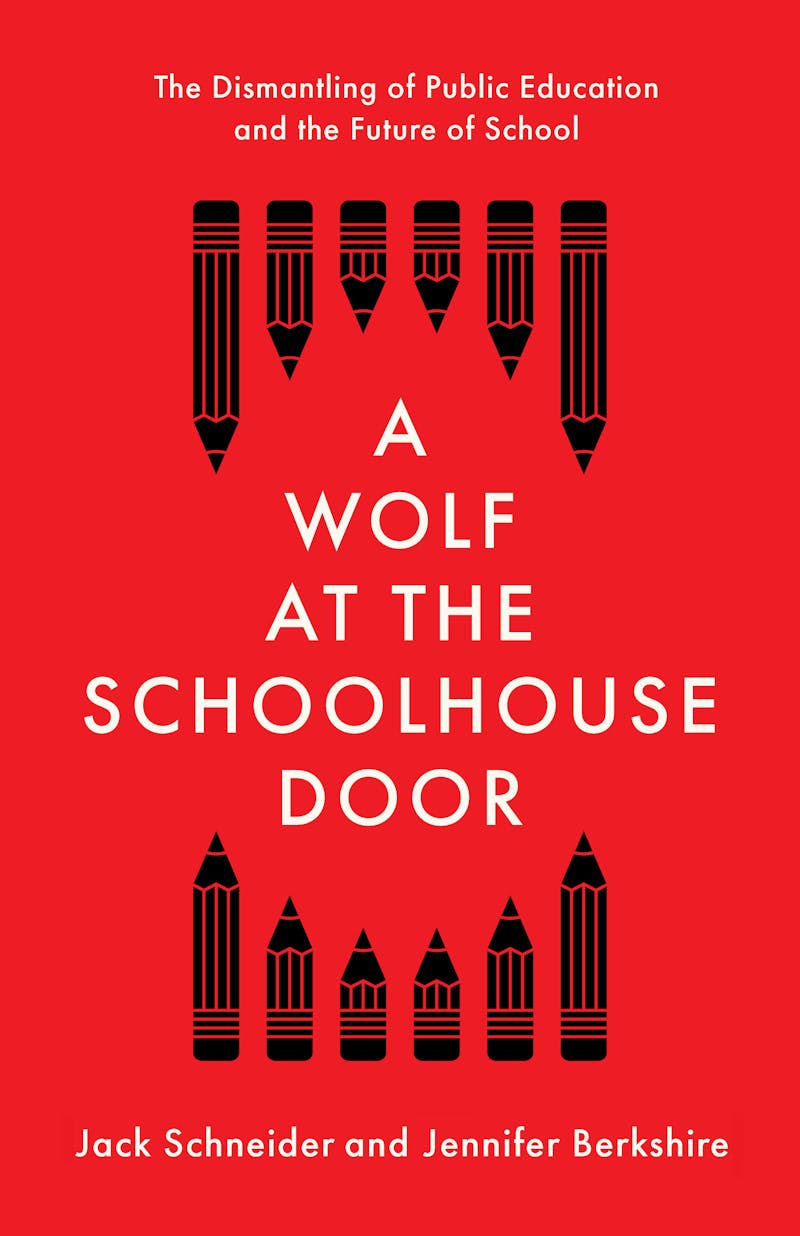
I reviewed A Wolf at the Schoolhouse Door in The New Republic. It is an important book that pulls together all the threads of the privatization movement and shows that their agenda is not to improve education or to advance equity but to destroy public education. The review is here.

Tonight, I will join the authors at a town hall Zoom meeting in Seattle at 9 p.m. EST, 6 p.m. PST. Please join us!

It begins like this:

Two years ago, Margaret Spellings, George W. Bush’s secretary of education, and Arne Duncan, Barack Obama’s secretary of education, wrote an opinion article in The Washington Post lamenting the decline of public support for the bipartisan consensus about education policy that began under Ronald Reagan. Elected officials strongly supported a regime of testing, accountability, and school choice, they wrote, but public enthusiasm was waning due to a lack of “courage” and “political will.”

A Wolf at the Schoolhouse Door: The Dismantling of Public Education and the Future of Schoolby Jack Schneider and Jennifer BerkshireBuy on BookshopThe New Press, 256 pp., $26.99

They were right. Elected officials, educators, and parents were rapidly losing faith in the bipartisan consensus. For a decade, it had failed to produce any improvement on national tests. Parents were opting their children out of the annual testing mandated by federal law; in New York, 20 percent of eligible students refused to take them. Teachers went to court to fight the test-based evaluation methods imposed by Duncan’s Race to the Top. Communities from Los Angeles to Philadelphia were complaining about the growth of charter schools, which diverted funds away from public schools. A year after Spellings and Duncan’s essay appeared, teachers across the nation, from West Virginia to California, went on strike to protest low wages, low funding, and large class sizes, issues that were ignored during the era of bipartisan consensus.

What went wrong? Why did the bipartisan consensus that Spellings and Duncan praised fall apart? In their new book, historian Jack Schneider and journalist Jennifer Berkshire provide a valuable guide to the history and the politics of the rise and fall of the bipartisan consensus. Theirs is indeed a cautionary tale, because they show how Republicans and Democrats joined to support failed policies whose ultimate goal was to eliminate public education and replace it with a free-market approach to schooling. Betsy DeVos was publicly reviled for her contemptuous attitudes toward public schools, but she was not an exception to the bipartisan consensus: She was its ultimate embodiment. She was the personification of the wolf at the schoolhouse door. 

Schneider and Berkshire write that they began the book to answer “a puzzling question: Why had conservative policy ideas, hatched decades ago and once languishing due to a lack of public and political support, suddenly roared back to life in the last five or so years?” Their prime example was private school vouchers, an idea first promoted by Ronald Reagan in the early 1980s and rejected at that time by Congress. Private school vouchers were not the only policy prescription that was recycled from the ashcan of failed ideas. There was also “market-based school choice, for-profit schools, virtual schools,” and deregulation. These ideas were repackaged as innovative while their history and their conservative ideological origins were obscured. True believers, intent on eliminating public schools, built donor networks, cultivated political alliances, and churned out ready-made legislation. A key element in this network-building was the enlistment of billionaires who were enamored of free-market solutions and who opened their wallets to persuade national and state elected officials to inject competition and private-sector solutions into the public education system. 

This is a book you will want to read. Give it to your local school board members and your legislators.

Since the 2020 election, when Republicans won many seats in state legislatures, there has been an explosion of proposed voucher laws, to allow people to get public money to pay for religious schools. David Berliner, one of our nation’s most distinguished researchers of education, explains why funding religious schools with public money is a terrible idea.

Why Religious Schools Should Never Receive a Dollar of Public Funding

David C. Berliner

Regents’ Professor Emeritus

Mary Lou Fulton Teachers College

Arizona State University

I believe in separation of church and state. I think it has done the United States a lot of good to honor Jefferson’s metaphoric and aspirational “wall” between the two. I also believe that money corrupts too many people and too many institutions. Holding those two beliefs simultaneously means 1.) I never want to see any local, state, or federal money used to aide any religious group, and 2.) I don’t want to see any religious group, or affiliated religious organizations, donating to the campaigns of public officials. The latter may be impossible to stop in an era of “dark money.” But the former—government support of religious institutions– is almost always done in public view and is worth stopping now, immediately, as it could easily damage our fragile republic.

Overstated? Hardly! Read on! Few citizens pay attention to the expenditure of public dollars for support of religious schools, but it occurs frequently. It can cost citizens billions of dollars annually, and ends up supporting some horrible things. A contemporary example of this is the criteria for entrance to the Fayetteville Christian School in North Carolina. 

Fayetteville Christian School (FCS) are recipients, in a recent school year, of $495,966 of public money. They get this in the form of school vouchers that are used by students and their families to pay for the students’ religious schooling. The entrance requirements for this school, and other religious schools like it, are quite frightening to me, though clearly acceptable to North Carolinians. From their website, in 2020:1

“The student and at least one parent with whom the student resides must be in agreement with (our) Statement of Faith and have received Jesus Christ as their Savior. In addition, the parent and student must regularly (go to) a local church. (We) will not admit families that belong to or express faith in religions that deny the absolute Deity/Trinity of Jesus Christ as the one and only Savior and path to salvation. …. FCS will not admit families that engage in behaviors that Scripture defines as deviate and sin (illicit drug use, sexual promiscuity, homosexuality (LGBT), etc.)

Once admitted, if the student or parent/guardian with whom the student resides becomes involved in lifestyles contradictory to Biblical beliefs, we may choose to dis-enroll the student/family from the school.” 

So, despite the receipt of public money, the Fayetteville Christian School is really notopen to the public at all! This school says, up front and clearly, that it doesn’t want and will not accept Jews, Muslims, Hindu’s, and many others. Further, although supported by public money, it will expel students for their family’s alleged “sins”. Is papa smoking pot? Expelled! Does your sibling have a homosexual relationship? Out! Has mama filed for divorce? You are gone! The admissions and dismissal policies of this school–receiving about a half million dollars of public funds per yearare scandalous. I’d not give them a penny! North Carolina legislators, and the public who elects them, should all be embarrassed to ever say they are upholders of American democracy. They are not. 

Besides the anti-democratic admission and retention problems in many religious schools, Christian or otherwise, some have serious curriculum problems as well. Those curriculum problems actually terrify me when they occur in publicly supported religious schools. With public money–my money–many of these schools spread ideas that are objectively/scientifically untrue. And some are simply repugnant! 

Do you remember Bobby Jindal? A few years back, Jindal was Governor of Louisiana and even, for a short time, a candidate for president of the United States of America. He pushed hard for publicly supported charter and voucher schools. The curriculum materials in these schools frequently came from one of two sources: Bob Jones University Press (associated with the scandal-ridden university), or from A Beka Book, a publisher of Christian books (now called Abeka). Between them, with the public’s money, these publishers have taught our youth some amazing things, as reported either by Deanna Panor by Alice Greczyn.3

Pan and Greczyn share some very interesting text excerpts. For example, I never learned from the textbooks in my public school that “The majority of slave holders treated their slaves well.” Nor did I ever imagine that “To help them endure the difficulties of slavery, God gave Christian slaves the ability to combine the African heritage of song with the dignity of Christian praise. Through the Negro spiritual, the slaves developed the patience to wait on the Lord and discovered that the truest freedom is from the bondage of sin.”

I also didn’t know that “The Ku Klux Klan in, some areas of the country, tried to be a means of reform, fighting the decline in morality and using the symbol of the cross. Klan targets were bootleggers, wife-beaters, and immoral movies. In some communities it achieved a certain respectability as it worked with politicians.”

I admit that I didn’t exactly get an “A” in my high school algebra course, but I never thought that abstract algebra was too complicated to learn. Perhaps I was wrong. An A Beka book states that “Unlike the ‘modern math’ theorists, who believe that mathematics is a creation of man and thus arbitrary and relative, A Beka Book teaches that the laws of mathematics are a creation of God and thus absolute…A Beka Book provides attractive, legible, and workable traditional mathematics texts that are not burdened with modern theories such as set theory.” (Italics mine.)

Another analyst of Christian school text books, Rachel Tabachnick,4 also informed me of things I never suspected. I simply never knew that “Global environmentalists have said and written enough to leave no doubt that their goal is to destroy the prosperous economies of the world’s richest nations.” This quote is from Economics: Work and Prosperity in Christian Perspective, 2nd ed., A Beka Book, 1999.

Through Tabachnick I also learned that children receiving their education in some Christian schools supported with public money are informed that gay people “have no more claims to special rights than child molesters or rapists.” That quote is from the Teacher’s Resource Guide to Current Events for Christian Schools, 1998-1999, Bob Jones University Press, 1998.

         Writing in Salon Magazine, Wilson5 documents other outrageous claims made in these curricula materials, some of which are purchased with public money for Christian schools in the USA, although these curriculum materials are in use throughout the world:

  • Only ten percent of Africans can read or write, because Christian mission schools have been shut down by communists.
  • God used the ‘Trail of Tears’ to bring many Indians to Christ.
  • It cannot be shown scientifically that man-made pollutants will one day drastically reduce the depth of the atmosphere’s ozone layer.
  • God has provided certain ‘checks and balances’ in creation to prevent many of the global upsets that have been predicted by environmentalists.
  • The Great Depression was exaggerated by propagandists, including John Steinbeck, to advance a socialist agenda. 
  • Unions have always been plagued by socialists and anarchists who use laborers to destroy the free-enterprise system that hardworking Americans have created.

Religious schools should not be subject to much state oversight—I understand that. But many such schools claim to offer curriculum compatible with neighboring public schools, thus allowing their students to move to the public schools should they or their parents request that. For example, it is not uncommon for students in Christian schools to transfer at 6th or 9thgrade to a traditional, public junior or senior high. Or, with a high school degree after years of private Christian education, a student might seek admission to a public college. Since student transfers like these are common, shouldn’t there be more inspection and approval of the curriculum and instruction in private Christian schools? Shouldn’t Christian schools, or Jewish or Islamic or any other school receiving public money, be inspected regularly by some agency of the government so they can be certified not to be teaching anti-democratic, anti-scientific, and anti-communitarian values? We have enough strife in this country without paying for schools whose values and curriculum are antithetical to our increasingly secular democracy. 

Am I overreaching? Although ordinarily private schools should not be subject to public scrutiny, if they accept public funds and if they are teaching age-inappropriate or anti-democratic content to their students shouldn’t the public know? Shouldn’t all public funds be subject to some kind of public audit? 

         For example, Rawls6 cites an adult whose memory of sixth grade instruction in a Christian school was still quite vivid. The teacher “passed around shocking photographs of dismembered babies to teach about abortion.” Sometimes abortion in Christian schools is compared to the holocaust. Other times elementary school students have been taken to local and state abortion protests, even to national events in Washington DC. Some schools regularly take their students to abortion clinics to protest. Are public expenditures for curriculum materials and activities like were just cited appropriate? Shouldn’t we know what is taught and learned in schools supported by public funds?     

Naturally, as part of their anti-abortion campaign, many Christian schools worry a lot about sex. So, they pass along unsubstantiated claims about condom failure and the horrible and life-long consequences of sex outside of marriage. It is often public money that supports curriculum and instruction of this type. Should that be the case? Should the state, often with comingled federal funds, support schools with anti-abortion programs when many state courts, and the Supreme Court, has ruled that abortion is legal? I have absolutely no issues with debate about abortion issues in upper grade levels, but should schools be providing anti-abortion education for our youth with public funds? 

Pregnancy, as might be expected, is often greeted with expulsion for girls at Christian schools. I certainly don’t know anyone who recommends teen parenthood, but if it occurs, shouldn’t the mother be helped, not thrown out of school? Wouldn’t that be the Christian thing to do? 

To accommodate the fact of teen motherhood, a public high school I visited proudly showed me a classroom-cum-nursery, allowing teen mothers a safe place to leave their infants while attending classes to earn their high school diplomas. In fairness, one might ask if that is a proper role of a public school. I believe, as do many Americans, that preparation for successful adulthood is the mission of our public schools—even if it entails these kinds of accommodations to keep youth in school and help them to graduate.7

         Another curriculum question is this: Is it appropriate for American education to promote lessening tensions between nations and religions? I think so. But public funds support Christian schools that teach “[T]he darkness of Islamic religion keeps the people of Turkey from Jesus Christ as their savior.” They teach that “[O]ver 500 people saw the resurrected Jesus Christ, [but] no one witnessed Mohammed’s supposed encounters with the angels.” And they teach that Islam is “fanatically anti-Christian.” 3 

         Finally, I want to point out the almost unanimous call to end corporal punishment of minors by the UN and by psychologists and other social scientists. Because of this I ask, should public money be used to support schools that still engage in corporal punishment? Sadly, both Christian and public schools, particularly in the Southern United States, approve of and still engage in spanking, or “paddling.”8

Although physical punishment of children has not disappeared in contemporary times, it appears to be more prevalent in Christian schools than in public schools because many of them operate on the principle of “spare the rod spoil the child.” Codes of conduct for many Christian schools say it is their obligation to use physical punishment, citing Proverbs 23: 13 and 14, among other biblical sources. There they are told “do not withhold discipline from a child; if you strike him with a rod, he will not die. If you strike him with the rod, you will save his soul…” 

Thus the “rod,” switch, or paddle, along with other harsh punishments to ensure proper child rearing, is recommended in many Christian advice books for Christian parents.So it is not surprising that more physical abuse takes place in fundamentalist Christian schools than in public schools. For example, in 2007, a Chicago Christian school was sued for injury and surgical costs after forcing a 14-year-old boy to kneel in place for nine days, causing a hip injury. In 2011, a Christian school teacher in Orlando was arrested on charges of beating a boy at her home with a rusted broom handle.6 And in 2015, at the Christian based Zarephath Academy in Jacksonville, Florida, a cell phone video shows male students holding down a female student, while her teacher paddled her in front of the whole class. The horrible offence the student committed? Running in the cafeteria!10

         Conclusion: There are certainly debates to have about the admissions and retention policies, qualifications of teachers, and especially the curricula used in all our schools—public, private, charter, religious or secular. We, the American people, settle controversial debates about issues like these in public forums. We rely on an open press, and we settle these debates through citizen voting and in our courts. Public oversight of public funds is part of the American tradition. 

Frequently, oversight of public funding is carried out by inspector generals. In fact, the first inspector general of the USA was appointed, in part, because General Washington had an ill-trained army for the task he had ahead. So, our very first inspector general was charged with identifying an educational problem, and asked to rapidly fix it! 

Now, literally thousands of people work for various offices of federal, state, and (occasionally) municipal inspector generals. Each are typically responsible for identifying fraud, waste, abuse, and criminal activity involving public funds, programs, and operations. But outside of the federal government, few inspector generals are devoted to education, even though roughly 45 percent of all state budgets, and 45 percent of all local budgets are used to support educational activities11. Thus, there is little oversight of how educational dollars are spent, and some of that spending has turned out to be scandalous!12 Just as bad, I think, is that there is even less concern about what is taught and what is learned in secular charter and private schools, or religious schools, that receive public money. This is not how it should be. I certainly would rest easier if there were inspectors spending a bit more time in the field overseeing what is taught and what is learned in our schools, in addition to their worries about how public money is spent. In particular, we need to examine religious institutions receiving public funds, so that the public has the information needed to maintain Jefferson’s wall, as best we can. 

In fact, if I made law, I would see to it that no private school– religious or not—ever received a dime of public money! Such schools can too easily sow seeds of separateness, privilege and dissension, hindering the achievement of one of our nations most cherished goals: e pluribus unum. Out of our many, one!

1.   Fayetteville Christian Church, Admissions. Retrieved February 8, 2021 from https://www.fayettevillechristian.com/copy-of-criteria-1

2.   Pan, D. (2012, August 7). 14 Wacky “Facts” Kids Will Learn in Louisiana’s Voucher Schools. Retrieved February 13, 2021 from https:/www.motherjones.com/kevin-drum/2012/08/photos-evangelical-curricula-louisiana-tax-dollars

3. Greczyn, A. (2020, Blog of June 7). Christianity’s Role in American Racism: An Uncomfortable Look at the Present and the Past.

Retrieved February 2, 2021 from https://www.alicegreczyn.com/blog/christianitys-role-in-american-racism

4. Tabachnick, R. (2017, January17) Vouchers/Tax Credits Funding Creationism, Revisionist History, Hostility Toward Other Religions. Talk to Action. Retrieved February 18, 2021 from: http://www.talk2action.org/story/2011/5/25/84149/9275

5. Wilson, B. (2012, June 19). Shocking Christian school textbooks:Thousands of Louisiana students will receive state voucher money to attend religious schools. What will they learn? Retrieved February 7, 2021 from: https://www.salon.com/2012/06/19/shocking_christian_school_textbooks_salpart/

6. Rawls, K. (2015, January 12). 10 Frightening Things Happening at Conservative Christian Schools That May Be Funded With Your Tax Dollars. AlterNet. Retrieved January 29, 2021 from https://www.alternet.org/2015/01/10-frightening-things-happening-conservative-christian-schools-may-be-funded-your-tax/

7. It is worth noting here that public schools frequently do spend our public money counseling such students and their families, while private schools frequently do not. It is a simple fact that all sorts of “problem” students, the more costly ones, not just the sexually active or pregnant, are frequently expelled from charter and private schools of all kinds, and sent to genuine public schools. Moreover, most charter and voucher schools frequently find ways not to accept special education students, either. Thus, the public schools incur educational expenses that most charter and voucher schools receiving public money do not. So public schools face budgeting challenges that private schools receiving public money do not. Thus, when one hears that charter or voucher schools are more cost efficient than “wasteful government schools,” these facts must be kept in mind.

8. So common has been physical punishment that the precise size and thickness of paddle to be used has often been codified, eg., specifying the type wood, length of paddle, thickness of paddle, etc. Moreover, there is a likely reason that paddling is more common in Southern schools. Severe paddling was used to punish slaves so as to not leave any scars. A whip-scared slave was of less value than an unscared one, because the scars indicated an uncompliant slave and/or a runaway slave. Severely paddled slaves, it was believed, obeyed their masters better–as is desired of children by many adults.

9.  Berliner, D. C. (1997). Educational psychology meets the Christian      right: Differing views of children, schooling, teaching, and learning.  Teachers College Record, 98, 381-416. 

10. Retrieved February 10, 2021 from: https://www.news4jax.com/news/2015/03/10/video-shows-girl-held-down-paddled-in-school/

11. The Condition of Education, National Center for EducationalStatistics (2020).  Retrieved February 20, 2021 from https://nces.ed.gov/programs/coe/indicator_cma.asp

12. Berliner, D. C. (2022, in press). The Scandalous History of Schools That Receive Public Financing, But Do Not Accept the Public’s Right of Oversight. In Berliner, D.C. and Hermanns, C. (Eds.), Public Education: The Cornerstone of American Democracy. New York. Teachers College Press.
One of our greatest allies for public schools in the nation is the remarkable Pastors for Texas Children. They are active every day in Texas, urging the public to support and fund their public schools. Their leadership has helped to spur similar organizations in other states where public schools need help and where privatizers are making a play for public funds.

Here is their latest appeal for funding the public schools of Texas, attended by five million students:

After last week’s freeze, the Texas Legislature is back to work at the Capitol. Our focus on funding public schools fully and fairly is more important than ever.  As you know, our Texas Constitution says in Article 7, Section 1:  “A general diffusion of knowledge being essential to the preservation of the liberties and rights of the people, it shall be the duty of the Legislature of the State to establish and make suitable provision for the support and maintenance of an efficient system of public free schools.”

 Here are three ways we can fulfill our constitutional obligation:

1. Federal COVID Relief Dollars
Last spring, Texas received $1.3 billion in federal stimulus funding earmarked to public education. The money was intended to equip schools for education during a pandemic, including PPE, technology, internet capabilities, and updating facilities. That package was not ever distributed to the local school districts, but was used to fill state budget holes.  

In December 2020, the state received the next federal relief package of $5.5 billion for public education purposes, which has not yet been distributed to school districts.  

We are asking our state leaders to release this and any future stimulus money for its intended purpose: to enable local districts to operate and educate safely without having to dip into reserves. Our friends at Raise Your Hand Texas have developed a helpful fact sheet about the federal stimulus funding. You can read that here, along with other resources.

1. Federal COVID Relief Dollars
Last spring, Texas received $1.3 billion in federal stimulus funding earmarked to public education. The money was intended to equip schools for education during a pandemic, including PPE, technology, internet capabilities, and updating facilities. That package was not ever distributed to the local school districts, but was used to fill state budget holes.  

In December 2020, the state received the next federal relief package of $5.5 billion for public education purposes, which has not yet been distributed to school districts.  

We are asking our state leaders to release this and any future stimulus money for its intended purpose: to enable local districts to operate and educate safely without having to dip into reserves. Our friends at Raise Your Hand Texas have developed a helpful fact sheet about the federal stimulus funding. You can read that here, along with other resources.

Read the Pastors’ legislative priorities here:

Mercedes Schneider comments here on the Biden administration’s unexpected and ridiculous decision to insist on another round of standardized tests in the middle of the pandemic.

She begins:

On February 22, 2021, acting ed secretary Ian Rosenblum (formerly of testing-friendly ed reform org, Education Trust) sent this letter to state school superintendents informing them that standardized testing must happen in the 2020-21 school year “to understand the impact COVID-19 has had on learning and identify what resources and supports students need” and “to address the educational inequities that have been exacerbated by the pandemic.”

Anyone with a smidge of critical thought and modest powers of observation could easily make a short list of the impact that COVID-19 has had on learning. Furthermore, the biggest support public schools have needed for years is adequate (equitable) funding not tied to property taxes and not tied to any federal competition.

Surveying district and state superintendents about what they need in order to provide equitable education opportunities for their students would be a much better use of US Dept of Ed time and money than spending multiple millions on standardized tests.

But, but, but, according to Rosenblum, as a last-thought, tacked-on reason for administering tests during a pandemic, “parents need information on how their children are doing.”

I have been teaching the better part of three decades, and I have yet for any parent to ask me for standardized test scores so that the parent can know how their children are doing. They ask about grades on class assignments; they discuss specific skill areas that are challenging and ask for help with addressing the specific challenges arising from completing classroom assignments; they discuss supports needed when the children or other family members are facing health issues or other crises at home; they ask for assistance addressing behavior issues, but they never ask for standardized test scores out of a need to know how their children are doing.


Eve Ewing is a writer and scholar whose work I very much admire. When her book Ghosts in the Schoolyard: Racism and School Closings on Chicago’s South Side was published in 2018, I called it the best book of the year. Today, however, she published an article in the New York Times about charter schools that completely misses the point about the damage that charter schools do to public schools.

Basically, she says we should be happy whenever any school–whether public or charter–provides a good education. That is what I believed when I was an advocate for charter schools from the late 1980s until about 2007. It was then that I realized that charter schools were not producing better outcomes than public schools and were diverting money and the students they wanted from public schools. The more I learned about charter operators, their billionaire benefactors, their drive for money and power, and the corruption associated with their lack of accountability, the more I realized that this nation needs a strongly resourced, equitable, and excellent public school system. After thirty years of directing funding to charter schools, we have seen no systemic change of the kind that both Eve and I want.

The overwhelming majority of children in the United States attend public schools (only 6% attend charter schools). Public schools in many states are underfunded and have been since at least 2008–and some for even longer. When states authorize charter schools, they do not increase education funding. The funding pie does not grow. It is divided.

Some districts are in danger of being obliterated by charter operators: think New Orleans, which no longer has any public schools. New Orleans is supposedly the North Star of the charter lobby, but New Orleans today is as segregated and stratified as it was before Hurricane Katrina, and its academic performance is below the state average in one of the nation’s lowest performing states on NAEP.

Eve’s is the first article I have ever seen that celebrated the CREDO finding that only 19% of charter schools get higher test scores than public schools. She says, “Good for the 19%!” But what about the 81% of charter schools receiving public funds that are worse or no better than public schools? Those children and their parents were lured by false promises.

Her article does not acknowledge that many of the most “successful” charter schools are notorious for their disproportionately low numbers of students who are English language learners or have special needs. Nor does it note the high attrition rates or entry standards that winnow out the hardest-to-educate students, like the BASIS schools in Arizona and Texas, which regularly top lists of “best high schools” in the nation. BASIS requires its students to pass multiple AP exams in order to graduate and has high numbers of white and Asian-American students in a state with large numbers of Hispanic and Native American students. When Carol Burris reviewed the BASIS charters in Arizona in 2017, she found that the students at its 18 schools were 83% white and Asian in a state where those groups were 42% of the students in the state.

Eve completely ignores the recent explosion of voucher legislation in Red states. In the 2020 election, Republicans strengthened their control of state legislatures, which have now prioritized creating or expanding vouchers to pay for private and religious schools, for-profit schools, homeschooling, and whatever else parents want to spend public money on. Charters encourage consumerism, making schools a consumer choice rather than a civic good that we are all responsible to fund equitably. Charters pave the way for school choice, including vouchers.

Vouchers in Florida are subsidizing religious schools to the tune of $1 billion a year; voucher schools are completely unaccountable and they are allowed to discriminate against gay students and families and any other group they don’t like. Their textbooks teach creationism, racism, and religious dogma.

The photograph that accompanies her article–for which she is not responsible–features a KIPP school and says that KIPP runs more than 250 schools. Do we really want our public schools to be run by private corporations? Should parents who are unhappy with their school be satisfied to be told “leave and choose a different school”?

As I said at the outset, Eve today is expressing the same views I held 20-30 years ago, so I understand where she is coming from. She wants every school to be a great school. So do I.

She writes that parents:

want their kid to learn a language, study the arts, have a clean building, and books in the library.

What would it look like if we built an education policy agenda dedicated to ensuring those resources for all students? Not just the students who win a lottery, but the students who lose, or who never get to enter because they’re homeless or their families are dealing with substance abuse, and the adults in their lives don’t have the information or resources to participate in a school choice “market?” What if our system was built not to reward innovation for the few, but rights for the many?

What if we insisted that all our schools, for all our children, should be safe and encouraging places? What if our new secretary of education, Miguel Cardona, focused on a plan as audacious as the New Deal, as well-funded as the war on drugs, dedicated to an all-hands-on-deck effort to guarantee every child an effective learning environment? What if we as a society pursued the dream of great schools not through punishment (as in No Child Left Behind), and not through competition (as with Race to the Top) but through the provision of essential resources?

Are we likely to reach those goals if states are funding charter schools, voucher schools, home schooling, for-profit corporations, virtual charter schools, and education entrepreneurs? That in fact is where the current drive for more choice is heading. Multiple state legislatures are solely focused on school choice, not funding. Red states in particular start with charters, then move on to some form of public subsidy for religious and private schools. The U.S. Supreme Court is poised to approve the public funding of religious schools and to obliterate the “wall of separation between church and state.” Will the states increase their funding to account for the funding of all students now attending non-public schools?

Eve Ewing has a powerful voice. I wish she would rethink her message and acknowledge that the only way to achieve her vision is by funding and improving the only schools that admit all children and that are subject to civil rights laws and public accountability: Our democratically governed public schools.

Curt Cardine of the Grand Canyon Institute has calculated the cost of the proposed Arizona voucher proposal, which would give public money for private choices to the overwhelming majority of students in the state. If the proposal passes, even if relatively few students take vouchers, it will defund every school district in the state. The public schools of Arizona, already underfunded, will take yet another hit from a state that refuses to pay to educate its children.

Cardine has a 45-year career in education; he has worked in both public and charter schools. He has documented the ripoff of public school funding by unscrupulous entrepreneurs. Please read his book Carpetbagging America’s Public Schools: The Radical Reconstruction of American Public Education. And his book Schooling Alone: The Cost of Privatizing Public Education.

In the attachments, Cardine shows how much money each school district in Arizona is likely to lose, using the most conservative estimates.

The New Hampshire House decided to hold off for a year with the universal voucher bill, that would funnel public money to religious schools, home schoolers, and anyone else who wants public money. However, the State Senate is barreling ahead with the same legislation.

On Thursday, February 18, the House Education Committee unanimously voted to retain HB 20, the statewide voucher bill, delaying further action until next year.

Moments later, the Senate announced a public hearing for SB 130, a nearly identical bill, on Tuesday, March 2, 2021. Both bills would create the most expansive voucher program in the country, and SB 130 would cost the state $100 million in new state spending in its first year alone. 

The public fiercely opposed HB 20 during the public hearing, noting that the bill included no protections for students, less transparency and oversight of taxpayer dollars, and almost no accountability for ensuring that programs funded by taxpayer dollars would be used appropriately or effectively. 

Altogether, 5,218 people signed on in opposition to the bill and 1,107 signed on in support over the course of the two-part hearing, which began on February 2 and had to continue the following week due to unprecedented turnout. 

SB 130 is nearly identical to the original HB 20, and would give families between $3,700 and $8,400 per student per year in taxpayer-funded “Education Freedom Accounts,” or vouchers, to pay for private school tuition, homeschooling expenses, computers, and other education-related costs.

“Our communities continue to struggle under the weight of an inequitable and inadequate school funding system, but this legislature continues to pursue an agenda that will divert resources away from our public schools and communities,” said Christina Pretorius, Policy Director at Reaching Higher NH. “Granite Staters have made it clear that they would rather be talking about expanding opportunities for all of our children, offering property tax relief, and investing in our communities, instead of siphoning off state funds for private education and downshifting costs to cities and towns,” she said.

The public hearing for SB 130 will be held on Tuesday, March 2, 2021 at 9 AM. Members of the public can register their support or opposition, and register to testify, using this link

HB 20: Historic Opposition and Last Minute Amendments

During a day-long executive session on Wednesday, House Education Committee members combed through a new amendment to HB 20 that attempted to address concerns that were brought up in the public hearing, but did not go far enough and in many cases, made the bill worse, according to Committee members. 

The amendment included income eligibility requirements and accountability measures, but did not address broader concerns with regard to discrimination against students and famillies, the potential for fraud and misuse of funds, and the fundamental concern with diverting public tax dollars to fund private and home school programs. 

The marathon executive session also revealed critical technical errors in the bill, particularly around the funding of the program. “A bill of this significance needs to be right. This Committee [is] the folks to do that, this is a good move to pause and reflect and get this done the way it should be,” said Representative Jim Allard (R-Pittsfield). 

Proponents of the bill are quick to point out that this doesn’t mean the conversation around HB 20 is over. Committee members will take the rest of the year to work on the bill, and have the opportunity to re-introduce it next year. 

“I think that if it’s going to be done, it’s going to be done correctly, we have to have bipartisan support and it has to be proven it has to be beneficial to everyone, to taxpayers, children, mostly for the children,” said Committee member Barbara Shaw (D-Manchester). 

About the amendment

The amendment created an income cap for eligible students, stating that only families with household incomes at or less than 375% of the Federal Poverty Limit would be eligible. For a family of four, that number would be about $99,375, which is higher than the median household income in New Hampshire. 

Even with the change, HB 20 would be the most expansive voucher program in the country, and could cost New Hampshire roughly $50 million in new state spending its first year alone. 

The Granite State is known to be parsimonious in spending on schools but the sky’s the limit when it comes to vouchers for religious schools and home schoolers.

The West Virginia legislature is rushing–like other red states–to pass voucher legislation. They know that very few students will apply for vouchers but that the cost will be enormous. West Virginia Republicans want to have the most expansive voucher bill in the nation (they are competing with New Hampshire and Arizona to supply everyone with the chance to use public money to attend a private or religious school).

However, the House Republicans decided to slow down when they saw how much their proposal would cost. And, they also noted that students can get a voucher not to “escape failing public schools,” but to pay for the religious school they already attend. In other words, the “voucher program” would be simply a subsidy to the 25,000 students already in private/religious schools and in home school. And it would cost $112 million a year to subsidize students whose parents are currently paying for them. And this money would be diverted from the state’s public schools, which enroll the vast majority of students.

Ryan Quinn of the Charleston Gazette-Mail writes:

After passing what could be the nation’s least-restrictive nonpublic school vouchers bill Thursday — one that would give every family in West Virginia money to private- and home-school their children if they want to remove them from public schools — the West Virginia House of Delegates recalled the bill.

On Friday, in a voice vote with no dissent heard, the Republican-controlled House recanted its passage vote of the day before. Delegates then sent the legislation (House Bill 2013) back to the House Finance Committee.

The West Virginia Senate had yet to pass the bill. House leadership indicated that it plans to fix issues with the bill and pass it again.

House Finance Chairman Eric Householder, R-Berkeley, said the reason for the move was a fiscal note he saw Thursday night.

“That’s why I decided to let people know what I discovered, what I read,” he said. “And now we’ve also asked [the Department of] Education to prepare a fiscal note, too. So, just trying to do the right thing, cover our bases, make sure everything is right.”

However, the state Division of Regulatory and Fiscal Affairs said the note was posted on the Legislature’s website on or before 11 a.m. Wednesday — so lawmakers could have seen it before voting Thursday.

Fiscal notes estimate how much bills will cost, but Republicans had rushed this bill to passage by just the end of the second week of this year’s legislative session.

The problem Householder cited is connected to the fact that the bill doesn’t specify how long parents must have their students enrolled in public schools to be eligible to receive the estimated $4,600 per-student, per-year to withdraw them and start private- or home-schooling.

“Based on our interpretation of the eligibility criteria, a parent of a student currently in private- or home-schooling could enroll their child in a summer public school program, making them eligible to apply for the Hope Scholarship Program,” the fiscal note said, referring to another name for the bill. “Alternatively, they could enroll their child in the public school system to become eligible. As this would introduce new students into the eligible population, it has the potential to substantially increase costs.”

The voucher for that amount is required to go to educational expenses, although that term is very broad in the bill.

Lawmakers had allowed for this cost increase by making the bill ultimately pay the $4,600 per-student, per-year for families who were currently home-schooling or private-schooling anyway. But they had added a provision saying those payments wouldn’t happen until fiscal year 2026-27 — the fiscal note said such costs could arrive much earlier.

“Based on data from the National Center for Education Statistics, there have been an average of 14,285 private-school students in West Virginia from 2003 to 2017, with no clear increase or decrease over time,” the fiscal note says. “For home-schooled students, we estimate approximately 10,000.

“Assuming current private- and home-school enrollment is similar, and assuming all of these students use one of these methods for becoming eligible for the Hope Scholarship, this could increase the cost of the program to the state by $112,300,882.65 per fiscal year, again assuming no increase in statewide average net state aid allotted per pupil.”

The note points out another potential problem with the likely unprecedented scope of the voucher program. Householder didn’t mention this issue, which is more fundamental to the bill.

The note said its participation estimates of 1% to 3% of current public school students that it used for calculating costs, even if the other problem were fixed, are based on the five states that have this kind of voucher program.

As a result of strong opposition, Republicans who control the New Hampshire legislature decided to postpone consideration of their “number one priority,” school vouchers. Under consideration was the most sweeping voucher bill in the nation. Thousands of people signed up to testify against the legislation.

A bill to create a school voucher-like system in New Hampshire is poised to be kicked to 2022, after Republicans on the House Education Committee said that it needed more time.

In a 20-0 vote Thursday, the committee recommended that the bill be retained, a move that if approved by the full House next week would put off any decision-making until next year’s session.

House Bill 20, named the “Richard ‘Dick’ Hinch education freedom account program” after the late House speaker, was a top priority for House Republicans this year. The proposal would allow parents to withdraw their children from public school and take the per-pupil state money with them.

Under the bill, that state funding, which amounts to $3,700 to $8,000 per student depending on the school, could then be used by the parents for a number of alternative expenses, such as private school tuition, college preparatory courses, school supplies, or transportation.

But a deluge of opposition to the bill from public school advocates and Democrats had slowed down its progress, resulting in contentious hearings and deliberative sessions that stretched through the day. Opponents argue the bill would drain resources from public schools and prompt cutbacks and increased property taxes; proponents say that it would provide new opportunities to families whose public schools aren’t working for their children.

Despite numerous tweaks and amendments, the bill didn’t have the votes to pass out of the GOP-controlled committee.

It is unclear if the committee would have had the votes to pass the bill even if the amendments were drafted correctly. Last week, NHJournal reported James Allard (R-Pittsfield) was likely to vote against the measure.

House insiders tell NHJournal that had a vote on the bill been held, the best-case scenario would have been a 10-10 tie vote in the committee, sending the bill to the floor with no recommendation. That would have set up a heated floor battle.

Attempts to sway Allard and other concerned Republicans included adding income-caps to the EFA eligibility formula. The cap would limit participation to those earning less than 375 percent of the federal poverty limit — roughly $99,000 for a family of four. That proposed income-cap would cut the number of eligible students in half.

Democrats on the Education Committee were pleased with the outcome.”HB 20 contains no protection for students against discrimination, little oversight, and is ripe for fraud…and would act as a tax-dollar giveaway to wealthy families. There has never been as much vocal opposition to a piece of legislation in NH,” Democrat leader on the committee Mel Myler said in a press release Thursday morning.

There’s still an Education Freedom Account bill in the Senate, giving supporters hope the legislation can still be amended and passed this year. In 2017-2018, the Senate passed SB193 – an education savings account program. That bill died in the House, after being heavily amended. The Senate then scrapped a separate bill and reintroduced SB193, the original version. Again, the proposal failed in the House.Democrats and teachers unions argued EFAs would increase property taxes, defund local district schools, and wreak havoc on New Hampshire’s education system. They celebrated Thursday’s win.

It has been well documented that students who leave public schools for voucher schools lose ground academically. Vouchers will not only hurt the state’s poorly funded public schools, it will hurt the children who use vouchers. It is a lose-lose for everyone except the religious schools that win public funds.

Civil rights groups, led by the Southern Education Foundation, are opposing the voucher legislation proposed by Republicans in Georgia.

SEF leads opposition to education savings account bill introduced in Georgia legislature

One of the first pieces of legislation introduced in the Georgia legislature in 2021 was the Georgia Educational Scholarship Act (HB60), a bill that would divert taxpayer dollars to private schools. In February, SEF and nine other education and equity-focused organizations sent a letter to the Georgia House Committee on Education expressing concerns that HB60 would divert funds from public education at a time when schools can least afford to lose it, and further perpetuate inequities.

SEF prepared analysis of the bill and a backgrounder on academic outcomes and participation requirements for similar tax credit scholarship programs across the country.

SEF’s Legislative and Research Analyst also provided testimony to the Senate Education and Youth Committee on SB47, a proposed expansion of the state’s existing special needs voucher program.