Archives for category: Funding

Trump’s tax cuts for the wealthiest will be funded in large part by draconian cuts to Medicare, which provides insurance to poor people. The massive cuts to Medicaid will lead to closure of many rural hospitals, which rely on Medicaid payments. The Senate knows this, and so-called “moderates” are working on adding a fund for rural hospitals. The bill, which Trump insists must pass by July 4, will add trillions to the nation’s debt.

So for all the cuts and firings imposed by Elon Musk and his DOGS, the federal deficit will grow under Trump.

David Dayen of The American Prospect reports:

As we at the Prospect have reported, while the Senate’s version of the Republican budget reconciliation bill was widely expected to be more moderate than the House one, when it comes to health care it is more extreme. This came as a surprise to many Republicans, some of whom now want changes. And they all are highlighting the same area of concern. It would be “potentially really bad for rural hospitals,” Sen. Josh Hawley (R-MO) told The Wall Street Journal. It’s “going to hurt our rural hospitals and hurt them in a big way,” said Sen. Jim Justice (R-WV). Sen. Susan Collins (R-ME) expressed “concerns about the effect on rural hospitals in her state.”

This is all certainly true. Senate cuts to the provider tax, a way for states to get more federal funding for their Medicaid programs, along with the House cuts that have been analyzed as leading to at least 11 million fewer people on the Medicaid rolls, will deeply harm the 700-plus rural hospitals already at risk of closure.

But that’s too narrow a frame. The entire health care provider network would come under heavy strain, and possibly collapse.

That’s because each node of the system is interdependent. If the 190 rural hospitals estimated in a recent Center for American Progress report as collateral damage of the Republican cuts close, all of their patients must find treatment at the remaining health care providers. Many of these new-arrival patients are likely to be uninsured (many thrown off Medicaid or Obamacare by Republicans), crushing hospital finances and potentially adding more closures on top.

This means overcrowded hospitals and overburdened staff, in addition to the serious hardships for patients traveling long distances for care. “The Republican Senate budget accelerates the rural hospital collapse that is under way, like jet fuel on a fire,” said Alex Lawson of Social Security Works, who works directly on health care issues in Washington. “Hospitals that don’t close will be the ones people drive four hours to access. The quality of everybody’s health care in this country will plummet.”

HOSPITALS HAVE LURCHED FROM ONE CRISIS to the next for years. Between the 2020 COVID pandemic and 2024, 36 rural hospitals closed, on the heels of 136 closures in the previous decade. Another 16 have closed this year, suggesting an acceleration of the trend, and hundreds more are at risk.

If the entire hospital doesn’t close, unprofitable business lines are often shuttered first. “I’ve talked to a lot of hospitals worried about having to close maternity wards,” said Chiquita Brooks-LaSure, who ran the Centers for Medicare & Medicaid Services (CMS) in the Biden administration. In California alone, 56 hospitals have ended maternity care since 2012, and the crisis of maternity deserts is acute.

The situation is worse, Brooks-LaSure said, in states that haven’t expanded Medicaid, suggesting that the program is a lifeline for hospitals, supplying a steady stream of paid claims for insured patients. Indeed, Medicaid is often the biggest line item in the accounts receivable budgets for nursing homes, rural hospitals, and maternity wards, as Families USA’s Anthony Wright pointed out to The Bulwark. A letter to the Republican leadership citing data from the Sheps Center for Health Services Research at the University of North Carolina notes that 213 rural hospitals serve a disproportionately high share of Medicaid patients.

While hospitals sometimes complain about low Medicaid reimbursement rates, the government has in the past compensated for that with “state-directed payment” arrangements that boost levels to what commercial insurance pays. That is being attacked in the Senate Finance Committee version of the bill, cutting those reimbursement top-ups to Medicare levels.

Hospitals are legally required to take care of patients in an emergency, regardless of their ability to pay. And more emergencies occur when more people are uninsured and put off care until they absolutely need it, which are made worse still if patients have to travel for hours to get care. Uncompensated care builds up in states with larger proportions of their populations who are uninsured, severely damaging hospital budgets.

Taking nearly $1 trillion out of the health system will magnify that problem across the country. And Medicaid cuts that create more uninsured patients, along with the creation of potentially millions of uninsured through Affordable Care Act changes, are terrible for hospitals. According to the Robert Wood Johnson Foundation, uncompensated care would increase by $204 billion over the next decade if the House version of the bill passed; remember, the Senate bill is even worse. Much of that burden would be thrown onto already shaky hospitals.

To those who argue that the cuts are really to state Medicaid programs and not hospitals, the ways states will deal with those cuts is not likely to be through simply providing more money that they don’t have. They will either change enrollment rules, so fewer people stay on the program, or cut reimbursement payments to hospitals and other providers. Both of these options would directly harm hospital finances.

“These cuts will strain emergency departments as they become the family doctor to millions of newly uninsured people,” said Rick Pollack, president and CEO of the American Hospital Association, in a statement, adding that “the proposal will force hospitals to reconsider services or potentially close, particularly in rural areas.”

Please open the link to see the full scope of the threat this Big Ugly Bill poses to rural Americans, most of whom voted for Trump.

Heather Cox Richardson describes the legal corruption that is now out in the open.

Yesterday at the meeting of the leaders of the Group of Seven (G7), a forum of democracies with advanced economies, President Donald Trump told reporters: “The UK is very well protected. You know why? Because I like them, that’s why. That’s the ultimate protection.”

Commenters often note that Trump talks like a mob boss, but rarely has his organized-crime style of governance been clearer than in yesterday’s statement.

Also yesterday, Ana Swanson and Lauren Hirsch of the New York Times reported that Trump has taken unprecedented control over U.S. Steel. Japan’s Nippon Steel has been trying to take over U.S. Steel since 2023, but the Biden administration blocked the deal for security reasons. In order to move it forward, Commerce Secretary Howard Lutnick demanded an agreement that gives to the president and his successors, or a person the president designates, a single share of preferred stock, known as class G, or “gold.” The deal gives the president permanent veto power over nearly a dozen actions the company might want to take, as well as power over its board of directors.

Swanson and Hirsch note that the U.S. government historically takes a stake in companies only when they are in financial trouble or when they play a significant role in the economy. “We have a golden share, which I control, or the president controls,” Mr. Trump told reporters on Thursday. “Now I’m a little concerned whoever the president might be, but that gives you total control.”

This kind of deal echoes those of the authoritarians Trump appears to admire. His ongoing support for Russian president Vladimir Putin was on display at the G7, when he echoed Russian talking points that blamed European countries and the United States for Putin’s war against Ukraine, rather than acknowledging that it was Russia that attacked Ukraine after giving assurances that it would respect Ukrainian sovereignty in exchange for Ukraine’s giving up the Soviet nuclear weapons stored there.

Also yesterday, Rene Marsh and Ella Nilsen of CNN reported that officials from the Environmental Protection Agency under Trump have been telling staff in the Midwest—which the authors note has a legacy of industrial pollution—to “stop enforcing violations against fossil fuel companies.” At the same time, the Department of Justice has cut its environmental division significantly, leaving “no one to do the work.”

Trump vowed that if he were reelected he would slash the oil and gas regulations he claims are “burdensome.” Now, one EPA enforcement staffer told Marsh and Nilsen, “The companies are scoffing at the cops. EPA enforcement doesn’t have the leverage they once had.”

Also yesterday, outdoor journalist Wes Siler reported in Wes Siler’s Newsletter that while language inserted in the Republicans’ budget reconciliation bill requires the sale of up to 3.3 million acres of publicly owned land, an amendment authorizes the sale of 258 million acres more over the next five years. The amendment comes from the Senate Energy and Natural Resources Committee and was written by Senators Mike Lee (R-UT) and Steve Daines (R-MT).

It includes Bureau of Land Management and U.S. Forest Service lands in 11 states: Alaska, Arizona, California, Colorado, Idaho, New Mexico, Nevada, Oregon, Utah, Washington, and Wyoming. As Siler notes, while the measure does not currently include national monument lands, the Department of Justice under Trump is arguing that the president can revoke national monument protections. If it did so, that would make another 13.5 million acres available for purchase.

Siler notes the process for selling those lands calls for an enormous rush on sales, “all without hearings, debate, or public input opportunities.”

Today, Eliot Brown of the Wall Street Journal reported that Mukesh Ambani, the richest man in India, is now one of the many wealthy foreign real estate developers “pouring money” into the Trump Organization. Brown noted that the Trump family is aggressively developing its businesses while Trump is in the White House, reaching past real estate into cryptocurrency and other sectors.

The growing power of international oligarchs to use the resources of the government for their own benefit recalls a speech Robert Mueller, then director of the Federal Bureau of Investigation, gave in New York City in 2011. In it, he explained that globalization and modern technology had changed the nature of organized crime. No longer regional networks with a clear structure, he said, organized crime had become international, fluid, and sophisticated, with multibillion-dollar stakes. Its operators were cross-pollinating across countries, religions, and political affiliations, sharing only their greed. They did not care about ideology; they cared about money. They would do anything for a price.

These criminals “may be former members of nation-state governments, security services, or the military,” he said. “They are capitalists and entrepreneurs. But they are also master criminals who move easily between the licit and illicit worlds. And in some cases, these organizations are as forward-leaning as Fortune 500 companies.”

These criminal enterprises, he noted, were working to corner the market on oil, gas, and precious metals. And to do so, Mueller explained, they “may infiltrate our businesses. They may provide logistical support to hostile foreign powers. They may try to manipulate those at the highest levels of government. Indeed, these so-called ‘iron triangles’ of organized criminals, corrupt government officials, and business leaders pose a significant national security threat.”

The FBI’s increasing focus on organized crime and national security is what prompted its interest in the connections between the Trump campaign and Russia in 2016.

The willingness of Republicans to enable Trump’s behavior is especially striking today, since June 17 is the anniversary of the 1972 Watergate break-in. On that day, operatives associated with President Richard M. Nixon’s team tried to tap the headquarters of the Democratic National Committee in Washington’s Watergate complex. Early in the morning of June 17, 1972, Frank Wills, a 24-year-old security guard, noticed that a door lock had been taped open. He ripped off the tape and closed the door, but on his next round, he found the door taped open again. He called the police, who found five burglars in the Democratic National Committee headquarters located in the building.

The story played out over the next two years with Nixon insisting he was not involved in the affair, but in early August 1974 a tape recorded just days after the break-in revealed Nixon and an aide plotting to invoke national security to protect the president. Republican senators who had not wanted to convict their president of the charges of impeachment being considered in the House knew the game was over. A delegation of them went to the White House to tell Nixon they would vote to convict him.

On August 9, 1974, Nixon became the first president in U.S. history to resign.

Chris Geidner of LawDork notes that despite the lawmakers in our own era who are unwilling to stop Trump, “the pushback…is very real.” Geidner notes not just the No Kings Day protests of the weekend, but also a lawsuit by the American Bar Association (ABA) suing Trump for his attacks on law firms and lawyers, calling Trump’s actions “unprecedented and uniquely dangerous to the rule of law.”

Geidner also notes that lower court judges are upholding the Constitution, and he points especially to U.S. District Judge William Young, an appointee of Republican president Ronald Reagan. In a hearing yesterday, Young insisted on holding the government accountable “for both Trump’s actions and the follow-up actions from those Trump has empowered to act.”

Young called cuts to funding for National Institutes of Health research grants “illegal” and “void” and ordered the NIH to restore the funds immediately. “I am hesitant to draw this conclusion—but I have an unflinching obligation to draw it—that this represents racial discrimination and discrimination against America’s LGBTQ community. That’s what this is. I would be blind not to call it out. My duty is to call it out.”

“I’ve never seen a record where racial discrimination was so palpable,” Young said during the hearing. “I’ve sat on this bench now for 40 years. I’ve never seen government racial discrimination like this.” He added: “You are bearing down on people of color because of their color. The Constitution will not permit that.… Have we fallen so low? Have we no shame?”

Joyce Vance is a former federal prosecutor for North Alabama. She writes an important blog called Civil Discourse, where she usually explains court decisions and legal issues. Today she turns to education.

Today I’m recovering from the graduation tour, one in Boulder and one in Boston in the last two weeks, and getting back into the groove of writing as I continue to work on my book (which I hope you’ll preorder if you haven’t already). The graduations came at a good moment. 

Watching my kids graduate, one from college and one with a master’s in science, was an emotional experience—the culmination of their years of hard work, sacrifice, and growth, all captured in a single walk across the stage. They, like their friends, my law students, and amazing students across the county, now enter society as adults. Even beyond the individual stories of hardships overcome and perseverance, witnessing these rites of passage makes me feel profoundly hopeful. The intelligence and commitment of the students—many of whom are already tackling big problems and imagining new, bold solutions—gives me a level of confidence about what comes next for our country. In a time when it’s easy to get discouraged, their commitment and idealism stands as a powerful reminder that they are ready to take on the mess we have left them. 

The kids are alright, even though they shouldn’t have to be. Talking with them makes me think they will find a way, even if it’s unfair to ask it of them and despite the fact that their path will be more difficult than it should be. Courage is contagious, and they seem to have caught it. Their educations have prepared them for the future we all find ourselves in now.

As students across the country prepared to graduate this year, Trump released his so-called “skinny budget.” If that’s how they want to frame it, then education has been put on a starvation diet—at least the kind of education that develops independent thinkers who thrive in an environment where questions are asked and answered. Trump pitches the budget as “gut[ting] a weaponized deep state while providing historic increases for defense and border security.” Defense spending would increase by 13% under his proposal.

The plan for education is titled, “Streamline K-12 Education Funding and Promote Parental Choice.”Among its provisions, the announcement focuses on the following items:

  • “The Budget continues the process of shutting down the Department of Education.” 
  • “The Budget also invests $500 million, a $60 million increase, to expand the number of high-quality charter schools, that have a proven track record of improving students’ academic achievement and giving parents more choice in the education of their children.”

As we discussed in March, none of this is a surprise. Trump is implementing the Project 2025 plan. In December of 2024, I wrote about how essential it is to dumb down the electorate if you’re someone like Donald Trump and you want to succeed. A rich discussion in our forums followed. At the time I wrote, “Voters who lack the backbone of a solid education in civics can be manipulated. That takes us to Trump’s plans for the Department of Education.” But it’s really true for the entirety of democracy.

Explaining the expanded funding for charter schools, a newly written section of the Department of Education website reads more like political propaganda than education information: “The U.S. Department of Education announced today that it has reigned [Ed: Note the word “”reigned” is misspelled] in the federal government’s influence over state Charter School Program (CSP) grant awards. The Department removed a requirement set by the Biden Administration that the U.S. Secretary of Education review information on how states approve select entities’ (e.g., private colleges and universities) authorization of charter schools in states where they are already lawful authorizers. This action returns educational authority to the states, reduces burdensome red tape, and expands school choice options for students and families.”

There are already 37 lawsuits related to Trump’s changes to education. Uncertainty is no way to educate America’s children. Cutting funding for research because you want to score political points about DEI or climate change is no way to ensure we nurture future scientists and other thinkers and doers…

I am reminded again of George Orwell’s words: “The most effective way to destroy people is to deny and obliterate their own understanding of their history.” The historians among us, and those who delve into history, will play a key role in getting us through this. Our love and understanding of history can help us stay grounded, understanding who we are, who we don’t want to become, and why the rule of law matters so damn much to all of it….

Thanks for being here with me and for supporting Civil Discourse by reading and subscribing. Your paid subscriptions make it possible for me to devote the time and resources necessary to do this work, and I am deeply grateful for them.

We’re in this together,

Joyce

The Grand Canyon Institute has been tracking the growth and cost of vouchers and charter schools in Arizona for several years. The vast majority of students who take vouchers (almost 3/4). But this year, a larger share were drawn from district schools and charter schools.

The report contains a number of excellent graphics. Open the lin to see them.

This is the Grand Canyon Institute release:

FOR IMMEDIATE RELEASE

Cost of Universal ESA Vouchers

Contact: Dave Wells, Research Director, dwells@azgci.org or 602.595.1025 ex. 2.

Summary of Findings

  • 73% of Universal ESA voucher enrollees have never attended district or charter schools (including adjustments for students entering Kindergarten).
  • In FY2025, however, net new Universal ESA voucher enrollees primarily came from charter and district schools.
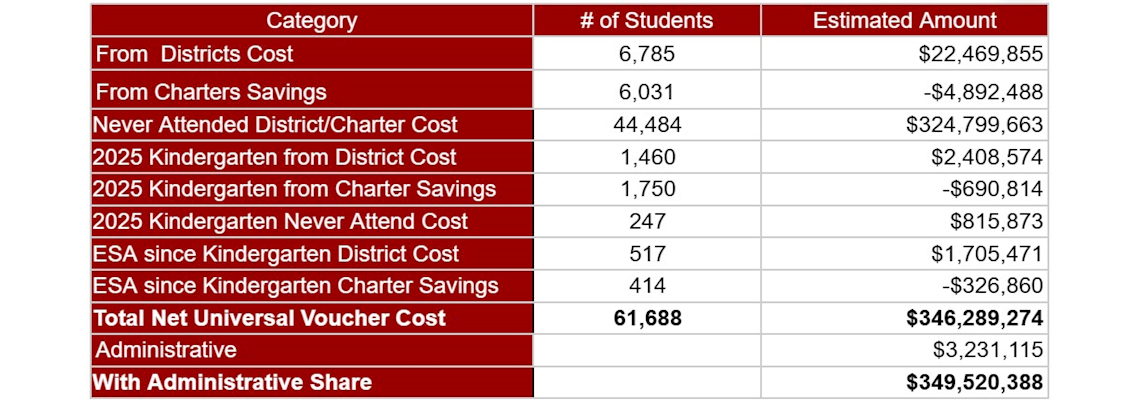
  • While the total cost of the overall ESA program in FY2025 is expected to be $872 million, the net cost after adjusting for where students would have otherwise attended is $350 million for those in the universal ESA voucher program. This represents a slight increase from the $332 million estimated by the Grand Canyon Institute last year.

The Grand Canyon Institute (GCI) estimates a $350 million net cost to the state’s General Fund in FY2025 (July 2024-June 2025) for the universal component of Arizona’s Empowerment Scholarship Account (ESA) voucher program based on a student’s school of origin. This represents a slight increase over the estimated FY2024 cost of $332 million. The estimate assumes basic student funding weights. 

The Joint Legislative  Budget Committee currently estimates the total annual cost of the ESA program to be $872 million, which includes the original targeted program and the universal component. Because student-level data on the universal program is not separated out by the Arizona Dept. of Education, GCI must estimate the origin of universal program enrollees. GCI’s estimate reflects the net cost the state would have incurred if the universal ESA voucher program did not exist. Almost every single child in the original targeted program had to attend a district or charter school for at least 45 days before enrolling in the program. GCI uses historical data on where the targeted students had come from previously, dating back to FY2017, along with current data on where all ESA students have left district or charter schools to estimate the distribution of students across district and charter schools for the original targeted program and the remainder are allocated to the universal program. 


In FY2025, the net growth in the universal ESA vouchers was 7,660 of the total enrollment of 61,688. GCI estimates that 73% of ESA universal voucher recipients never attended a district or charter school, slightly lower than the rate of 80% in FY2025. This includes estimates for kindergarten students using ESA universal vouchers. 

The primary driver of the change in FY2025 was a significant increase in the portion of net new enrollees from district and charter schools. GCI examined the marginal changes since last year and estimates that nearly half the net gain in universal participants of 7,660 from FY2024Q2 to FY2025Q2 came via Kindergarten. Analyzing changes in the portion of students previously attending a district or charter school, GCI estimates that less than 10% never attended (or would have never attended for Kindergarten) while half came from charter schools and just over 40% came from districts.

This change helped lessen the growth of the net cost of the program. GCI presumes that Kindergarten students do not have a record of prior attendance but would mirror the same distribution.  Given that charter school enrollment is about one-fourth of district enrollment, charter schools have been significantly disproportionately impacted by the Universal ESA program.

Despite the change in FY2025, the majority of participants in the universal ESA program never attended a district or charter school should be self-evident. For FY2025, the Quarter 3 Executive and Legislative ESA report identifies that of the total 87,602 students enrolled in the ESA voucher program (targeted and universal), regardless of when they first enrolled, only 33,942 students  moved from charter or district schools to an ESA. Virtually all targeted participants must first enroll in a district or charter school first. The universal program does not require prior attendance. 

Access the full report here.

The Grand Canyon Institute, a 501(c) 3 nonprofit organization, is a centrist think tank led by a bipartisan group of former state lawmakers, economists, community leaders and academicians. The Grand Canyon Institute serves as an independent voice reflecting a pragmatic approach to addressing economic, fiscal, budgetary and taxation issues confronting Arizona.

Elon Musk left Washington, where he enjoyed the exalted status of being Trump’s brain. He returned to Texas, his new home. Where he launched into a Twitter tirade against Trump.

But he left behind a still large contingent of DOGS (Department of Governmental Subsistence).

Who are they?

ProPublica has been tracking them.

In an effort launched shortly after DOGE’s creation, ProPublica has now identified more than 100 private-sector executives, engineers and investors from Silicon Valley, big American banks and tech startups enlisted to help President Donald Trump dramatically downsize the U.S. government.

While Elon Musk has departed the Department of Government Efficiency, the world’s richest man is leaving a network of acolytes embedded inside nearly every federal agency.

At least 38 DOGE members currently work or have worked for businesses run by Musk, ProPublica found in an examination of their resumes and other records. At least nine have invested in Musk companies or own stock in them, a review of available financial disclosure forms shows.

ProPublica found that at least 23 DOGE officials are making cuts at federal agencies that regulate the industries that employed them, potentially posing significant conflicts of interest. One DOGE member tasked with overseeing mass layoffs at the Consumer Financial Protection Bureau, for instance, did so while owning stock in companies the agency regulated.

At least 12 remain, on paper, employees or advisers of the companies they worked at before DOGE, a review of financial disclosure forms shows. And at least nine continue to receive corporate benefits from their private-sector employers, including health insurance, stock vesting plans or retirement savings programs. These employment agreements could create a situation in which a DOGE staffer would be shaping federal policies that affect their employer.

The people behind DOGE are largely men in their 20s and 30s, most of whom bring no government experience to the task. Many of them previously worked in finance.

ProPublica’s list — the largest of its kind by any news organization — allows readers to gain a comprehensive understanding of the backgrounds of the people assigned to one of the Trump administration’s signature efforts. It comes at a crucial moment, as some of the first-generation DOGE members are leaving the government and a new crop is joining.

“Even though Elon Musk and some of his top officials are shifting their attention to other issues, I see no indication that the DOGE team members who remain will slow down their work to test the legal and ethical boundaries of using technology in the name of improving government services,” said Elizabeth Laird, a director at the nonprofit Center for Democracy & Technology.

While the Trump administration asserts it is the most transparent in history, DOGE operates shrouded by the shadows of bureaucracy.

Many of its staffers have deleted their public profiles, have wiped the internet of their professional backgrounds or were encouraged by leadership not to discuss their work with friends. At the behest of the Trump administration, the Supreme Court halted a court order Friday that would have required DOGE to turn over information to a government watchdog — challenging whether the group will ever be subject to public records requests. The Trump administration has banned DOGE staffers from speaking publicly without approval.

To cast a light on this secretive group, ProPublica began reporting in February on Musk’s influence inside the Trump administration, cataloging who was part of DOGE and how associates of the billionaire tech mogul were taking up senior posts across agencies. Our DOGE tracker, the first such list published by media outlets, is the culmination of hundreds of conversations with sources across government.

Today, we are adding 23 staffers to our tracker, taking the total to 109. They are spread throughout the government, from the Department of Defense to the General Services Administration to the Securities and Exchange Commission.

Open the link to see the list of DOGGIES.

By any measure, Musk failed.

First, he said he would cut $2 trillion from the federal budget. Then, he said he would cut $1 trillion.

Then, he dropped his target to $165 billion.

Even that number is disputed because federal courts keep ruling that DOGS firings should be nullified and workers should return to their jobs. Other “savings” were canceled out by the costs of benefits. By some measures, the DOGS game may have cost money, not saved it.

One thing is certain: the federal deficit will grow after Trump’s first year in office, thanks to tax cuts for the top 1%.

Jennifer Rubin was a star columnist at The Washington Post, but resigned after Jeff Bezos tried to exert control over the opinion pages to makts writers less antagonistic to Trump. Ironically, Rubin was originally hired by The Post to be its conservative columnist. But the extremism of the MAGA movement repelled her. After she resigned from The Post, she started a blog called The Contrarian, where she has gathered a stellar lineup of other journalists.

She writes about Trump’s One Big Ugly Bill:

The horrifying assassination of Minnesota state legislator Mellisa Hortman and her husband Mark, and the attempted assassination of state senator John Hoffman and his wife on Saturday followed a week in which the full magnitude of Donald Trump’s violence, cruelty, chaos, and insatiable quest to destroy American democracy as we knew it were on full view. At a time when the country is in dire need of empathy, unity, and healing, MAGA Republicans will return to D.C. this week to pick up where they left off in their reconciliation debate wrangling: seeking to pass a bill that includes the most monstrous transfer of wealth from the poor and middle class to the uber-rich in recent history.

The Congressional Budget Office determined that if the House bill gets enacted, the bottom decile of Americans by income would lose about $1600 while the top 10 decile would gain more than $12,000. Meanwhile, the debt would balloon to 134% of GDP by 2034.

The MAGA reverse-Robin-Hood scheme would, among other things, remove 11 Million people from Medicaid, 5 Million from the Affordable Care Act exchanges, slash SNAP by more than $700M, “strip 4.5 million children who are U.S. citizens or lawful permanent residents of eligibility for the Child Tax Credit,” and eliminate or reduce energy credits and subsidies, sending energy costs soaring, particularly in red states.

The bill targets certain categories of legal immigrants (e.g., TPS holders or asylum seekers) by removing them from access to ACA exchanges and stripping them of Medicare benefits (after they have paid into the system).

The party that once stood for federalism would bludgeon states to eliminate Medicaid benefits for these people, provoking the Center on Budget and Policy Priorities’ assessment that:

“This policy is a direct affront to state sovereignty, placing enormous pressure on states to reduce or terminate coverage programs that their lawmakers have adopted and that they have a legal right to provide or face devastating cuts to Medicaid expansion funding…It goes beyond coercion by imposing a direct, virtually unavoidable penalty on some states.”

Consider the monstrous tradeoffs the bill entails. Former car czar Steven Rattner found that “just the tax cuts for people earning over $500,000 a year would cost $1.1 trillion, very close to the $715 billion that would be saved by cutting Medicaid and SNAP.”

Especially hard-hit would be rural residents in Red states who disproportionately rely on Medicaid. Moreover, their hospitals, which are dependent on Medicaid reimbursement, would go under in dozens of communities. Shuttering hospitals not only deprives residents of access to health services, but in many cases it would mean eliminating the area’s main employer.

Voters have gleaned how this is going to work. The latest Kaiser Family Foundation poll shows “seven in ten adults (72%) are worried that a significant reduction in federal funding for Medicaid would lead to an increase in the share of uninsured children and adults in the U.S., including nearly half (46%) who are ‘very worried’ and one in four (25%) who are ‘somewhat worried.’” In addition, 71% think the bill will negatively impact hospitals, nursing homes, and other health care providers in their communities (71%).

The most heinous aspect of all: Due to the massive cuts in healthcare coverage, Yale and the University of Pennsylvania estimate an additional 51,000 Americans would die each year.

Former president Joe Biden used to say, “Don’t tell me what you value, show me your budget, and I’ll tell you what you value.” Apparently, MAGA Republicans value savaging the poor to stuff more money in their (and their donors’) pockets, turn America into an anti-legal immigration country, and rob people of healthcare and other vital programs. 

The bill’s damage does not stop there. With the huge increase in debt, borrowing costs for individuals and businesses would go up. “A spike in the national debt can be enough to boost inflation on its own,” the Washington Post reports. The government’s rising borrowing costs would yield painful results for families. “A 1 percent increase in the ratio would amount to extra annual interest costs of $60 for car loans, $600 on the typical mortgage and $1,000 for small business loans after five years, the Budget Lab found. After 30 years, the premium is even higher — adding $2,300 per year to the typical mortgage, for example.

All of that comes on top of the Trump tariffs, another regressive tax that falls disproportionately on lower-income Americans.

No wonder the MAGA bill is so unpopular. The latest Quinnipiac poll found voters oppose the plan by a margin of 53% (including 57% of independents). MAGA Republicans who rubber stamp this bill would therefore be inflicting monstrous pain on Americans, growing the debt, and taking perhaps the worst political vote of their careers.

Trump came to office promising to reduce inflation, lower costs, clamp down on energy prices, and even balance the budget. Instead, if MAGA Republicans allow him, he will continue to increase inflation, raise costs, ignite higher energy prices, and bust the budget. When voters go to the polls in 2026 and beyond, they are not likely to forget who betrayed them.

Republicans have wanted to gut the National Endowments for the Arts and Humanities for many years. In the past, they targeted the National Endowment for the Arts by focusing on artists whose work offended them. Somehow the Endowments managed to survive. But not this year. Elon Musk’s DOGS eliminated their funding. One victim of the cuts was National History Day, a competition that encourages the study of history.

Allison Dentzel of MSNBC reported:

This week, thousands of students traveled to the University of Maryland for the annual National History Day contest. However, this year’s competition celebrating America’s history almost didn’t happen after the Trump administration abruptly gutted the organizing nonprofit’s funding in April.

The organization received termination letters for its four-year grant totaling $650,000.

For more than 50 years, students at middle and high schools across the country attempt to qualify for the competition by submitting a historical research project based on that year’s theme. Students can write papers, prepare exhibits or performances, produce documentaries or create a website. After qualifying at the local and state levels, contestants are invited to take part in the national competition in College Park, Maryland.

But in April, the event was put in jeopardy after the Department of Government Efficiency terminated more than 1,000 National Endowment for the Humanities grants, including money for National History Day. The organization received termination letters for its four-year grant totaling $650,000, USA Today reported.

Without the government’s assistance and the competition just weeks away, the executive director of National History Day turned to social media. “We need your help,” Cathy Gorn said in a video posted to Instagram in early April. “We need to raise in the next few months about $132,000 to make History Day happen in June.”

Gorn’s public plea worked: NHD raised the money it needed, and about 3,000 students were able to present their projects on this year’s timely theme, “Rights and Responsibilities in History.”

“They are very in tune to what’s happening in the world, and they’re concerned, and they want to know more,” Gorn told USA Today. “And they’re drawn naturally to topics of fairness. So you’ll see a lot of civil rights, human rights, justice-type of topics here, but that’s so natural for a young person to kind of gravitate in that direction.”

While this year’s competition survived, the future of National History Day remains uncertain.

“Everybody is here, but I don’t know what next year is going to look like,” Gorn told USA Today. “It’ll be a horrible, horrible shame for kids and teachers not to be able to participate.”

Even though the fate of the 2026 competition is up in the air, NHD has selected its theme: “Revolution, Reaction, Reform in History.”

Democratic leaders asked the nonpartisan, highly respected Congressional Budget Office to evaluate the consequences of the Trump tax plan. In brief, the bill would widen the gap between haves and have nots and would increase the number in poverty.

The Financial Times reported:

Donald Trump’s landmark tax bill would make the most prosperous Americans $12,000 richer each year, while wiping $1,600 off the disposable income of the nation’s poorest, Congress’s fiscal watchdog said on Thursday. 

Trump’s “one big beautiful bill” narrowly passed the House of Representatives last month, extending tax cuts introduced during the US president’s first term in the White House in 2017. 

The Congressional Budget Office said in a letter that the top 10 per cent of Americans by income would, on average, see their resources rise by $12,000 a year, or 2.3 per cent of their projected income, should Trump’s “one big beautiful bill” pass the Senate in broadly the same form that it passed the House. 

“The changes would not be evenly distributed among households,” said CBO director Phillip Swagel in the letter addressed to Democrat lawmakers Brendan Boyle and Hakeem Jeffries, who had requested the analysis. 

“The agency estimates that, in general, resources would decrease for households towards the bottom of the income distribution, whereas resources would increase for households in the middle and the top of the income distribution.” 

Jan Resseger is a social justice warrior who fights for the underdog. She describes here how Trump’s budget enacts the fever dreams of evangelicals and billionaires. He would change federal aid from its historic purpose–equitable funding–and turn it into school choice, diverting funds from the poorest children to those with ample resources. Since 1965–for 70 years–federal education funding for public schools has enjoyed bipartisan support. Trump ends it.

She writes:

Earlier this week, Education Week‘s Mark Lieberman released a concise and readable analysis of the likely impact for public education of two pieces of federal funding legislation: the “Big, Beautiful” tax and reconciliation bill currently being debated in the U.S. Senate to shape public school funding beginning right now in FY 2025, and also President Trump’s proposed FY 2026 federal budget for public schooling in the fiscal year that begins October 1st.

Trump’s  FY 2026 budget proposal saves Head Start.

Lieberman shares one important piece of positive news about Trump’s treatment of Head Start in next year’s federal budget: “Some programs survived the cut—including Head Start.” In early May, the Associated Press‘s Moriah Balingit reported: “The Trump administration apparently has backed away from a proposal to eliminate funding for Head Start… Backers of the six-decade-old program, which educates more than half a million children from low-income and homeless families, had been fretting after a leaked Trump administration proposal suggested defunding it… But the budget summary… did not mention Head Start. On a call with reporters, an administration official said there would be ‘no changes’ to it.”

Federal funding for U.S. public schools looks bleak.

Lieberman’s assessment of federal public education funding is not so encouraging.  Overall, “The administration is aiming to eliminate roughly $7 billion in funding for K-12 schools in its budget for fiscal 2026, which starts Oct. 1. Several key programs will be maintained at today’s funding level, without an increase: “Flat funding amounts to a de-facto cut given inflation. The administration is proposing to maintain current funding levels for key programs like Title I-A for low-income students ($18.4 billion), the Individuals with Disabilities Education Act, Part B for special education ($14.2 billion) and Perkins grants for K-12 and postsecondary career and technical education ($1.4 billion).”

What has been historically a key purpose of federal public education funding—to compensate for vast inequity in the states’ capacity and the states’ willingness to fund public education—is being compromised.  Lieberman explains that much of federal funding, “is currently geared toward supporting special student populations including English learners, migrants, students experiencing homelessness, Native students, and students in rural schools. Longstanding federal programs that support training for the educator workforce; preparing students for postsecondary education; reinforcing key instructional areas like literacy, civics, and the arts… would disappear. A new K-12 grant program would offer a smaller pool of funds to states and let them decide whether and how to invest in those areas. And for the first time, all federal funding for special education would flow to states through a single funding stream…. Experts view Trump’s budget as part of an effort to roll back a half-century of effort by the federal government to help make educational opportunities more consistent and equitable from state to state and district to district.”

The “Educational Choice for Children Act,” an alarming federal school voucher bill, is hidden inside the “Big Beautiful” bill.

Lieberman worries about the enormous tuition tax credit voucher plan embedded deep in the weeds of the “Big, Beautiful” tax and reconciliation bill now being considered in the U. S. Senate: “Separate from the federal budget process, Congress is currently advancing a massive package of tax changes, including a proposal for a new tax-credit scholarship program that fuels up to $10 billion a year in federal subsidies for private K-12 education. Annual spending on that program could approach the amount the Trump administration is proposing to cut from elsewhere in the education budget.”  The voucher proposal is called the Educational Choice for Children Act (ECCA).

In a separate analysis of the “Big, Beautiful” bill as the House passed it in late May, Lieberman describes this proposed ECCA tuition-tax-credit voucher program: “House lawmakers narrowly approved a sweeping legislative package with $5 billion in annual tax credits that fuel scholarships and related expenses at K-12 private schools. The federal subsidies would come in the form of dollar-for-dollar tax credits for individuals and corporations that donate to largely unregulated state-level organizations that give out scholarship funds for parents to spend on private educational options of their choosing. Any student—even in states that have resisted expanding private school choice—from a family earning less than 300 percent of the area median gross income would be eligible to benefit from a scholarship paid for with a federally refunded donation.”

Lieberman adds: “No other federal tax credit is as generous. The Internal Revenue Service doesn’t currently supply tax credits worth the full donation amount for any cause, as the private school choice scholarship credit would do. The federal government currently offers tax credits on donations for disaster relief, houses of worship, veterans’ assistance groups, and children’s hospitals at roughly 37 percent of the donated amount.  A $10,000 donation to those causes would yield a tax credit of $3,700.  By contrast, under the proposed legislation, if a taxpayer donates $10,000 to a scholarship (voucher)-granting organization, the IRS would give them a tax credit of $10,000.”

The Institute for Taxation and Economic Policy’s Carl Davis explains that because these federal school vouchers are primarily a tax shelter, they might appeal to wealthy people who are not even supporters of school privatization: “The tax plan…  includes a provision granting extraordinarily generous treatment to nonprofits that give out vouchers for free or reduced tuition at private K-12 schools. While the bill significantly cuts charitable giving incentives overall, nonprofits that commit to focusing solely on supporting private K-12 schools would be spared from those cuts and see their donors’ tax incentive almost triple relative to what they receive today. On top of that, the bill goes out of its way to provide school voucher donors who contribute corporate stock with an extra layer of tax subsidy that works as a lucrative tax shelter. Essentially, the bill allows wealthy individuals to avoid paying capital gains tax as a reward for funneling public funds to private schools.” “We estimate the bill would reduce federal tax revenue by $23.2 billion over the next 10 years as currently drafted, or by $67 billion over the next ten years if it is extended beyond its four-year expiration date… As currently drafted, the bill would facilitate $2.2 billion in federal and state capital gains tax avoidance over the next 10 years.”

The Brookings Brown Center on Education Policy’s Jon Valant warns that the vouchers are so deeply buried in the “Big, Beautiful” bill that lots of people would not be aware of the plan’s existence until after it is passed: “The Educational Choice for Children Act (ECCA) continues to move, quietly, towards becoming one of America’s costliest, most significant federal education programs. Now part of the One Big Beautiful Bill, ECCA would create a federal tax-credit scholarship program that’s unprecedented in scope and scale.  It has flown under the radar, though, and remains confusing to many observers…  ECCA’s stealthiness is partly due to the confusing nature of tax-credit scholarship programs. These programs move money in circuitous ways to avoid the legal and political hurdles that confront vouchers.”

Valant explains how tax-credit vouchers work: “Tax-credit scholarship programs like ECCA aren’t quite private school voucher programs, but they’re first cousins. In a voucher program, a government gives money (a voucher) to a family, which the family can use to pay for private school tuition or other approved expenses. With a tax-credit scholarship, it’s not that simple. Governments offer tax credits to individual scholarship granting organizations (SGOs). These SGOs then distribute funds… to families.”

Valant creates a scenario that shows how this tax credit program could help the wealthy and leave out poorer families. A rich donor, Billy, donates $2 million in stock to an SGO: “Billy’s acquaintance, Fred, lives in the same town as Billy, which is one of the wealthiest areas in the United States. In fact, Fred set up the SGO, looking to capture ECCA funds within their shared community… Like Billy, Fred doesn’t particularly care about K-12 public education… It might seem that Fred’s SGO couldn’t distribute funds to families in their ultra-wealthy area, since ECCA has income restrictions for scholarship recipients. That’s not the case. ECCA restricts eligibility to households with an income not greater than 300% their area’s median income. In Fred and Billy’s town, with its soaring household incomes, even multimillionaire families with $500,000 in annual income are eligible… So, Fred is looking to give scholarship money to some wealthy families in his hometown.”

Valant summarizes the result if the “Big, Beautiful” bill is enacted: “This bill would introduce the most significant and costliest new federal education program in decades. It has virtually no quality-control measures, transparency provisions, protections against discrimination, or evidence to suggest that it is likely to improve educational outcomes. It’s very likely to redirect funds from poor (and rural) areas to wealthy areas.”

When enrollments declined, EPIC virtual charter schools in Oklahoma reacted like any other business: management shrunk the workforce and cut the salaries of those who were not laid off. The remaining teachers found themselves wondering if the charter model itself was flawed.

KFOR in Oklahoma City reported the story:

OKLAHOMA CITY (KFOR) — After Epic Charter Schools laid off hundreds of employees Tuesday, the teachers left behind say they’ve been given no answers, and some are now questioning whether the charter system that they work for truly puts students first.

Those teachers say they don’t know who is in charge, how the school plans to move forward, or whether their jobs are truly safe. At least one teacher says the chaos has her rethinking the charter-school model entirely—and what it means for students.

News 4 reported that more than 350 Epic Charter Schools employees were blindsided on Tuesday with an email informing them that they were being let go….

The state-funded online charter school laid off 357 employees Tuesday, including 83 teachers and nearly 300 administrators.

“We know that there are guidance counselors affected, transition coordinators,” a current Epic teacher said.

The teacher told News 4 that Epic did not inform teachers that the district layoff included eliminating the roles of every principal, leaving teachers unclear about who they now answer to.

“We would love to know. We are very interested in what that looks like,” she said. “And we have not been told any information on how do you have a school without a principal?”

While this teacher still has her job—that has come at a price.

“They cut our pay again two weeks ago,” she said.

She said the new pay scale dropped teachers’ base salaries to $40,000 a year.

“I was hired with the agreement that $60,000 a year would be base pay,” she said. “That’s quite a significant pay cut.”