As I read this frightening post by Thom Hartmann, I was reminded of the many times in first term that he longed for protestors or suspects to be roughed up. He spoke to police officers in New York and urged them not to be so gentle when they apprehended suspects. He encouraged his audience to beat up troublemakers and send him their legal bills. He has a strange love of violence, though he himself dodged the draft five times.
Hartmann describes the freedom of ICE to arrest and detain anyone without a warrant, without any due process. Where is this going?
Imagine stepping off a plane in the United States, fully expecting to enter the country without issue, only to be surrounded by armed agents, handcuffed, and thrown into a freezing detention center. No trial. No lawyer. No contact with the outside world.
In Trump’s America, you are no longer guaranteed your rights or freedom—because now, it takes nothing more than an ICE agent’s “suspicion” to make you disappear.
This isn’t a mistake. It’s part of an expanding system of cruelty, where ICE—once an agency tasked with immigration enforcement—is now operating like an unchecked police force, targeting legal residents, visitors, and even US citizens with impunity.
People who follow every rule, complete all the required paperwork, and obey every regulation are still finding themselves locked away, held in horrific conditions, and stripped of their rights—all based on the whims of an agent who doesn’t even need evidence to justify an arrest.
A U.S. citizen from Chicago was among 22 people recently subjected to unlawful arrests and detention by ICE. The U.S. Government Accountability Office found that during Trump’s first term, immigration authorities asked to hold approximately 600 likely citizens and actually deported about 70 likely citizens.
But now, in part because of the Laken Riley Act, it’s getting worse. Forty-two Democrats in the House and fourteen in the Senate voted to pass this execrable GOP bill last month; it was named after a young woman murdered by an undocumented alien whose story was relentlessly promoted by Fox “News” and other rightwing hate media.
That law, recently signed by Trump, says that ICE now has the authority to detain anybody — anybody — for an indefinite period of time — no time limit whatsoever — if an ICE agent simply says that he or she “suspects” the person is in the country illegally or without documentation.
Fabian Schmidt, a German-born engineer, has lived in the United States for nearly two decades, legally working, paying taxes, and contributing to his community. None of that mattered when he returned home from a trip abroad. As soon as he landed at Logan Airport in Boston, ICE agents pulled him aside. His green card renewal was “flagged” for some unknown reason—no explanation, no opportunity to clarify, just a red mark in a government system.
That was all it took. ICE stripped him of his clothes, subjected him to hours of aggressive questioning, and locked him in a detention center. They threw him into an ice-cold shower and left him shivering on the concrete floor, humiliated and terrified.
For days, his mother, Astrid, desperately tried to find him. She called ICE, Customs and Border Protection, and any agency that might give her an answer. They either ignored her or outright lied, claiming they had no record of her son. When she finally learned where he was, Fabian was barely holding himself together. “They treat us like animals,” he told her.
And why was he there? Because of a supposed “bureaucratic error.” ICE used a minor paperwork issue as an excuse to detain a legal resident of the United States without due process, a tactic that’s becoming frighteningly common.
For Jessica Brösche, a German tattoo artist, her visit to the United States was supposed to be brief—just a trip to see friends and enjoy the country. She had a valid passport, a return ticket, and legal permission to enter under the Visa Waiver Program. Yet, ICE decided that she might try to work while visiting, a baseless assumption that required no proof and no justification.
Just “suspicion.” That was enough to detain her indefinitely.
Once inside, the nightmare deepened. They threw her into a cell with no bed and no access to legal assistance. For eight straight days, they kept her in solitary confinement. The lights never dimmed, and the sounds of other detainees screaming in despair echoed through the walls. She started hallucinating, her grip on reality slipping. Desperate to feel something, anything real, she punched the walls until her knuckles bled.
Meanwhile, her best friend, Amelia, searched frantically for her. ICE refused to confirm her location or even acknowledge that they had detained her. No charges, no trial, no legal recourse—just silence.
Jessica’s case isn’t unique. People who follow all immigration rules are being detained under vague suspicions, often disappearing into a bureaucratic black hole. And once they’re inside the system, their rights mean nothing.
Consider Jasmine Mooney, the actor who starred in the American Pie franchise anda Canadian businesswoman who played by the rules. She secured a job offer, completed all visa paperwork, and followed every U.S. immigration law to the letter. But that didn’t stop ICE from shackling her, chaining her wrists, ankles, and waist as if she were a violent offender.
For days, she was trapped in a brutal private, for-profit detention facility, laying on the bare floor with nothing but a crinkled foil sheet for warmth. Then, in the dead of night, ICE dragged her from her cell, bound her in chains again, and forced her onto a bus with dozens of other women. They drove for hours, denying them food, water, or bathroom breaks. By the time she arrived at another facility, she had been awake for 24 hours and was too weak to stand.
To this day, ICE refuses to explain why she was detained. And why would they? They don’t have to. The agency operates with absolute power, detaining people for as long as they want, answering to no one.
Moody tells her horrifying story to The Guardian, writing:
“I was then placed in a real jail unit: two levels of cells surrounding a common area, just like in the movies. I was put in a tiny cell alone with a bunk bed and a toilet. …
“There were around 140 of us in our unit. Many women had lived and worked in the US legally for years but had overstayed their visas – often after reapplying and being denied. They had all been detained without warning.”
These aren’t isolated cases. ICE has transformed itself into an authoritarian force that detains people indefinitely on suspicion alone. No evidence? No trial? No problem.
And the for-profit prison industry that’s holding many if not most of them has no incentive to help these people; the more they detail and the longer they stay, the more money the prison companies make (which they then share as campaign donations with Republican politicians).
ICE agents don’t need proof. They only need the power to act—and Trump has given it to them.
######
Please open the link to continue reading this important post.
Sherrilyn Ifill is a law professor at Howard University and former president and director-counsel of the NAACP Legal Defense Fund. She writes a blog called Sherrilyn’s Newsletter, where this post appeared. Open the link to see her footnotes.
“There is never time in the future in which we will work out our salvation. The challenge is in the moment. The time is always now.”
-James Baldwin
Illustration by Nick Liu
The past week has shown us in stark terms what it means to fight – to actually fight – to protect against the rise of authoritarians. This week we also saw that somehow, despite years of preparation, some of the leaders of our most powerful institutions seem unprepared for the particular nature of this fight. Others appear just…. unwilling to engage.
Last week the Trump Administration took its most bold actions yet. Through the actions of either Trump himself, Elon Musk or members of Trump’s cabinet, this Administration has:
· Unleashed an unprecedented attack on higher education, the centerpiece of which was a targeted attack on Columbia University. In a letter sent to the University, the Administration[i]demanded that university essentially turn over its decision-making to the Trump Administration, insisting that the University close the Middle Eastern Studies Dept, ban mask-wearing, expel students involved in pro-Palestine protests, and announced the withholding of $400 million in federal dollars until the University accedes to Trump’s demands, unless the University took these actions to address “antisemitism on campus.” The Administration underscored its intentions by entering student dormitories and arresting a Palestinian student who is a legal permanent resident of the U.S. As his 8-month-pregnant wife looked on helplessly, ICE officers arrested Mr. Khalil and then disappeared him, moving him from facility to facility, and offering only vague and unsubstantiated justifications for his arrest. His central “crime” appears to be “advancing positions that are contrary to the foreign policy of this Administration,”[ii]– a concept so staggeringly outrageous it can scarcely be absorbed.
· Fired half the staff of the Department of Education[iii] – as a down-payment on the Administration’s vow to close the agency.
· Indicated its intention to “eliminate Social Security;”[iv]
· Continued firing government workers and removing funding from government agencies including NIH[v] and shuttering offices like the Voice of America.
· Intensified tariffs against Canada and rhetoric suggesting that the sovereign nation of Canada should be annexed to the U.S.;[vi] declared that the European Union was created to “screw the U.S.”; declared that the South African Ambassador to the United States is no longer welcome,[vii] continuing the Administration’s Musk-inspired determination to recognize racist white settlers as victims of Black rule.
· Issued Executive Orders targeting law firms who have litigated cases against Trump in the classified documents cases and who provided pro bono counsel to Special Counsel Jack Smith, removing security clearances and blocking government connected work.
· Argued in court that transgender soldiers should be removed from the military.[viii]
· Removed information about Black, Asian American and women military heroes from the Arlington National cemetery website,[ix]disappearing the accomplishments of people of color and women from official recognition.
And that’s just part of it.
But the resistance to Trump’s authoritarian rule has been busy as well:
· Protests across the country have demanded the release of Mahmoud Khalil, the Palestinian student taken into custody.[x]
· “Tesla Take Down” protests at Tesla dealerships across the country in protest against Elon Musk’s takeover of our government have been so effective in tanking the brand and its stock price,[xi] that President Trump turned the White House into a car lot and personally embodied the used car salesman he was destined to be (if not for his father’s money) in an attempt to gin up Tesla sales.
· Protests nationwide continue to demand an end to government worker firings.
· Voters have shown up at town halls across the country to express anger about proposed plans to cut Medicaid/Medicare and Social Security[xii].
· Lawsuits filed by parents,[xiii] and by a score of states[xiv] have challenged the closing of the Education Department.
· Perkins Coie, the law firm targeted by Trump boldly challenged the Trump administration’s effort to blackball the firm and imperil its business;[xv]
· Federal courts have required Trump to rehire thousands of federal employees fired by DOGE[xvi]
· Federal courts have enjoined Trump’s efforts to freeze spending on governments grants and other funding.[xvii]
· Federal courts enjoined the Administration from removing migrants targeted under Trump’s invocation of the Alien Enemies Act – a decision the Trump Administration has defied.[xviii]
But the big stories last week were less about those who have protested and sued, and more about those among the most powerful institutional actors who appear to have lost the plot. Political scientists Steve Levitsky and Ryan Enos offered a blistering and spot-on condemnation of universities that have remained silent in the face of Trump’s authoritarian challenge to the freedom of universities.[xix]Calling out Harvard University specifically (where both scholars teach) for its silence in the face of the hideous attacks on Columbia University, Levitsky and Enos condemned the inaction of universities that have chosen a strategy of “lying low, avoiding public debate (and sometimes cooperating with the administration) in the hope of mitigating the coming assault.”[xx]
Meanwhile on Capitol Hill, Senate Minority Leader Chuck Schumer has faced a wave of outrage and demands for resignation after his decision to vote in favor of cloture to avert a government shutdown. To be sure, the Democrats have few options for stopping the Republicans, who are firmly in the majority in the House and Senate from torching our government. But as many of us have been reminded ad nauseum during the years when Democrats controlled the Senate, the filibuster is one of the few procedural rules the party in the minority in the Senate has to counter being overrun by the majority.
But frustratingly, although Democrats were unwilling to abolish the filibuster in 2022 to advance their agenda, last week they were unwilling to use the filibuster to defy the Republican power grab. Heads the Republicans win. Tails the Democrats lose.
It was hard to understand the point of Democrats affixing their signature to a continuing resolution to fund a government that is being cut to the bone every day by Elon Musk – an unelected billionaire with no official government position – who has been permitted to usurp the appropriation power of Congress. When Trump and Musk lawlessly gut agencies and fire government workers, and Speaker Mike Johnson and his caucus cede the power of Congress to the President, we are in a constitutional crisis.
Trump and Musk’s anti-constitutional usurpation of congressional power with the complicity of the Republicans in Congress is an emergency. It demands an emergency response. Minority Leader Schumer and 7 other Democratic Senators (and I suspect more who were covered by the Leader’s unpopular action) were unprepared to meet the moment in a way that would have upped the stakes. Sometimes when the game is fixed, you have to overturn the tables.
I will concede a serious point Schumer later offered that got lost in the Comms disaster of his Wednesday night statement that suggested there would be a shutdown, and then his Thursday morning announcement that he would vote to avert one. If the government shutdown happened, there would be little chance of obtaining judicial orders enjoining decisions by Trump/Musk to eliminate programs, because legally during a government closure, the President enjoys unfettered power to determine which functions of government are “essential” – standard to which the courts would likely defer. By contrast, with the government open, challenges to DOGE firings and closures continue to do fairly well in the courts and have slowed down the force of Musk’s chainsaw.
In any case, Schumer’s decision and perhaps moreso the clumsy comms that accompanied it have resulted in boiling outrage within the base of the party, including calls for him to step down from leadership.
Of course, none of this compares to the perfidy of the Republican Party. We must never forget the unconscionable and dastardly conduct of Speaker Mike Johnson and the Republicans in the House and Senate – men and women who have abdicated their allegiance to this country and to democracy itself. Their cowardice and complicity in the destruction of this country must never be forgotten or whitewashed. Their betrayal is singular and historic.
But there’s another group that is failing to meet this moment. America’s corporate leadership has been nearly silent during one of the most volatile economic periods in years. Last week the stock market took a nosedive – entering “correction” status as a result of Trump’s manic and unhinged tariff announcements. [xxi] Trump’s erratic tariffs – up one day, down the next, up again two weeks later – are lunacy. Every rational business leader knows that.[xxii] The predictable market response to Trump’s irrationality threatens the retirement plans of older Americans hoping to retire and the American economy. America’s leadership in the world has been compromised by Trump’s saber-rattling, and his insistence on imperialist moves towards Canada, the Panama Canal and Greenland, is destabilizing the integrity of perception of American stability. Combined with the massive government lawyers, Trump’s policies are bad for America and bad for business.
As Trump literally tanks the American economy and the trust of the international business community, where are the voices of America’s business leaders? Are they all hoping that Trump will do a commercial on the White House lawn hawking their products too? Are the leaders of the Business Roundtable (200 CEOs of the nation’s leading corporations) agnostic about the President’s stubborn insistence on policies that are wrecking the U.S. economy and our standing in the world?
These same business leaders enabled the lie that Trump is a “successful businessperson” – knowing full well that Trump does not seem to know what he’s talking about when he wades into economics, knowing of his six bankruptcies, knowing of his refusal to pay contractors, his false representations, and knowing that no responsible Fortune 500 CEO would ever have gone into business with Trump before he was elected President, or even after. Being wealthy is not the same as being a successful businessperson and they all know it.
In an interview on CNBC, even host Maria Bartiromo – a Trump sycophant – felt compelled to remind Trump that successful business leaders need predictability to make coherent decisions about investments, infrastructure, expansion, and product development for markets. She noted that the up-and-down tariff mania undermines predictability. Trump responded, “well they say that. It sounds good to say.” Really? Is that it? Or is it a fundamental tenet of business that even a first year MBA student would know? At other times last week he has repeated with “we’re gonna have so much money from the tariffs” with a desperate insistence that suggested mental instability.
American corporations have either tried to placate Trump by paying tribute,[xxiii] or have “crawled into a protective shell” like the university officials called out by Levitsky and Enos. In either case, it is utterly irresponsible. Their voices and influence – presented collectively and forcefully – are critical to protecting the economic interests of this country, and our democracy. Their failure to act is a betrayal of their responsibility as citizens.
Media owners have shamed themselves – whitewashing their teams,[xxiv] surrendering the independence and diversity of their editorial pages,[xxv] and taking a knee before Trump’s demands rather than standing firm in the face of the challenge to our democracy.[xxvi]
In the week ahead, there will be many additional opportunities for leaders from our most powerful democratic institutions to meet this moment. Already it appears that the Trump Administration has defied a federal court order to turn around planes taking Venezuelan migrants accused of being to El Salvador.[xxvii] The Administration announced that the first 250 migrants arrived in El Salvador.[xxviii] What does that mean? Two hundred-fifty Venezuelan nationals have been disappeared into the one of the world’s most notoriously abusive prisons in El Salvador, without judicially approved trials or due process.
What will judges do as Trump appears to defy judicial orders? This week will test the readiness of our judiciary to defend the rule of law.
Meanwhile ordinary people have been showing tremendous leadership, protesting, launching and participating in boycotts, conducting teach-ins, calling their elected representatives every week, sometimes several times a week, visiting district offices, participating in “die-ins,” writing letters and petitions, and building support for opposition candidates in special elections. A “mass march” has been announced by the organization Hands/Off for April 5th, although information is still spotty [please drop info in the comments]. Black churches have launched a 40-day Lenten boycott of Target for its obsequious abandonment of its DEI commitments.[xxix]
Every day we are called upon to meet the moment. As we see our neighbors seized by plainclothes agents without judicial warrants, and see our workplaces “obey in advance” – removing from websites, official policies and even mission statements expressing their commitment to equality and to inclusion, and as we see law firms crouch before this Administration’s threats, and media outlets silence voices that write the truth about this Administration, we have to decide how we will respond.
All over America ordinary people are looking into their toolboxes of non-violent actions and determining which ones they will use. It’s been beautiful to see.
But we must not absolve the leaders of our most powerful institutions – those who have the money and power, and influence to insulate themselves from the worst consequences of this Administration’s excesses – from their obligation to act and to meet the moment.
To those who are business leaders, captains of industry, university leaders, and media owners, decide who you will be at this moment. If we fully lose democracy in this country, it will be because the most privileged among us refused to accept the responsibility to speak out, to say “no more,” and to lead. History will not kindly remember those who left it to Americans with considerably less power and protection, to do the hard work of saving this country. Your tax cuts will not be large enough to cover your shame. And we will remember.
This speech by French Senator Claude Malhuret went viral. It has been translated and reproduced at least 1 million times. I personally have received several copies of his speech from friends and family. Recently, it has been translated and published in The Atlantic. Senator Malhuret expresses the shock and dismay that many of us feel about Trump’s decision to abandon Ukraine and Europe and to align the United States with Russia. Please read what he said. This is not normal.
Senator Malhuret said:
Europe is at a crucial juncture of its history. The American shield is slipping away, Ukraine risks being abandoned, and Russia is being strengthened. Washington has become the court of Nero: an incendiary emperor, submissive courtiers, and a buffoon on ketamine tasked with purging the civil service.
This is a tragedy for the free world, but it’s first and foremost a tragedy for the United States. [President Donald] Trump’s message is that being his ally serves no purpose, because he will not defend you, he will impose more tariffs on you than on his enemies, and he will threaten to seize your territories, while supporting the dictators who invade you.
The king of the deal is showing that the art of the deal is lying prostrate. He thinks he will intimidate China by capitulating to Russian President Vladimir Putin, but China’s President Xi Jinping, faced with such wreckage, is undoubtedly accelerating his plans to invade Taiwan.
Never in history has a president of the United States surrendered to the enemy. Never has one supported an aggressor against an ally, issued so many illegal decrees, and sacked so many military leaders in one go. Never has one trampled on the American Constitution, while threatening to disregard judges who stand in his way, weaken countervailing powers, and take control of social media.
This is not a drift to illiberalism; this is the beginning of the seizure of democracy. Let us remember that it only took one month, three weeks, and two days to bring down the Weimar Republic and its constitution.
I have confidence in the solidity of American democracy, and the country is already protesting. But in one month, Trump has done more harm to America than in the four years of his last presidency. We were at war with a dictator; now we are fighting against a dictator supported by a traitor.
Eight days ago, at the very moment when Trump was patting French President Emmanuel Macron on the back at the White House, the United States voted at the United Nations with Russia and North Korea against the Europeans demanding the withdrawal of Russian troops.
Two days later, in the Oval Office, the draft-dodger was giving moral and strategic lessons to the Ukrainian president and war hero, Volodymyr Zelensky, before dismissing him like a stable boy, ordering him to submit or resign.
That night, he took another step into disgrace by halting the delivery of promised weapons. What should we do in the face of such betrayal? The answer is simple: Stand firm.
And above all: make no mistake. The defeat of Ukraine would be the defeat of Europe. The Baltic states, Georgia, and Moldova are already on the list. Putin’s goal is to return to the Yalta Agreement, where half the continent was ceded to Stalin.
The countries of the global South are waiting for the outcome of the conflict to decide whether they should continue to respect Europe, or whether they are now free to trample it.
What Putin wants is the end of the world order the United States and its allies established 80 years ago, in which the first principle was the prohibition of acquiring territory by force.
This idea is at the very foundation of the UN, where today Americans vote in favor of the aggressor and against the aggressed, because the Trumpian vision coincides with Putin’s: a return to spheres of influence, where great powers dictate the fate of small nations.
Greenland, Panama, and Canada are mine. Ukraine, the Baltics, and Eastern Europe are yours. Taiwan and the South China Sea are his.
At the Mar-a-Lago dinner parties of golf-playing oligarchs, this is called “diplomatic realism.”
We are therefore alone. But the narrative that Putin cannot be resisted is false. Contrary to Kremlin propaganda, Russia is doing poorly. In three years, the so-called second army in the world has managed to grab only crumbs from a country with about a quarter its population.
With interest rates at 21 percent, the collapse of foreign currency and gold reserves, and a demographic crisis, Russia is on the brink. The American lifeline to Putin is the biggest strategic mistake ever made during a war.
The shock is violent, but it has one virtue. The Europeans are coming out of denial. They understood in a single day in Munich that the survival of Ukraine and the future of Europe are in their hands, and that they have three imperatives.
Accelerate military aid to Ukraine to compensate for the American abandonment, so that Ukraine can hang on, and of course to secure its and Europe’s place at the negotiating table.
This will be costly. It will require ending the taboo on using Russia’s frozen assets. It will require bypassing Moscow’s accomplices within Europe itself through a coalition that includes only willing countries, and the United Kingdom of course.
Second, demand that any agreement include the return of kidnapped children and prisoners, as well as absolute security guarantees. After Budapest, Georgia, and Minsk, we know what Putin’s agreements are worth. These guarantees require sufficient military force to prevent a new invasion.
Finally, and most urgently because it will take the longest, we must build that neglected European defense, which has relied on the American security umbrella since 1945 and which was shut down after the fall of the Berlin Wall. The task is Herculean, but history books will judge the leaders of today’s democratic Europe by its success or failure.
Friedrich Merz has just declared that Europe needs its own military alliance. This is a recognition that France has been right for decades in advocating for strategic autonomy.
Now it must be built. This will require massive investment to replenish the European Defense Fund beyond the Maastricht debt criteria, harmonize weapons and munitions systems, accelerate European Union membership for Ukraine, which now has the leading army in Europe, rethink the role and conditions of nuclear deterrence based on French and British capabilities, and relaunch missile-shield and satellite programs.
Europe can become a military power again only by becoming an industrial power again. But the real rearmament of Europe is its moral rearmament.
We must convince public opinion in the face of war weariness and fear, and above all in the face of Putin’s collaborators on the far right and far left.
They say they want peace. What neither they nor Trump says is that their peace is capitulation, the peace of defeat, the replacement of a de Gaullian Zelensky by a Ukrainian Pétain under Putin’s thumb. The peace of collaborators who, for three years, have refused to support the Ukrainians in any way.
Is this the end of the Atlantic alliance? The risk is great. But in recent days, Zelensky’s public humiliation and all the crazy decisions taken over the past month have finally stirred Americans into action. Poll numbers are plummeting. Republican elected officials are greeted by hostile crowds in their constituencies. Even Fox News is becoming critical.
The Trumpists are no longer at the height of glory. They control the executive branch, Congress, the Supreme Court, and social media. But in American history, the supporters of freedom have always won. They are starting to raise their heads.
The fate of Ukraine will be decided in the trenches, but it also depends on those who defend democracy in the United States, and here, on our ability to unite Europeans and find the means for our common defense, to make Europe the power it once was and hesitates to become again.
Our parents defeated fascism and communism at the cost of great sacrifice. The task of our generation is to defeat the totalitarianisms of the 21st century. Long live free Ukraine, long live democratic Europe.
The Americans claim that their attempt to humiliate the Ukrainian president in the White House yesterday was about peace. On that premise, nothing they said makes any sense.
The attempted mugging of a visiting president was about the world war that Elon Musk, Donald Trump, and JD Vance have chosen. If we attend to what Vance and Trump said yesterday, we can work our way to the unreason of American policy, and to the chaos that will follow.
JD Vance opened hostilities against Volodymr Zelens’kyi with a claim about negotiations with Russia, treating them as a formula that will magically end the war. Zelens’kyi had said, calmly and correctly, that negotiations with Russia have been tried before and have not worked. The Russians have betrayed every truce and every ceasefire since their first invasion in 2014. And that first invasion of course violated a number of treaties between Ukraine and Russia, as well as the basic principles of international law. Zelens’kyi ran for president in 2019 as the peace candidate, promising to negotiate with Putin to end what was then a war that had been ongoing for five years. Russia did not respond to these overtures, except with contempt, and then with the full-scale Russian invasion of Ukraine in February 2022.
During and after the Oval Office meeting yesterday, Americans suggested that all that had happen was a unilateral Ukrainian ceasefire, and that then the end of the war would automatically follow. Americans indicated that Zelens’kyi was too stupid to understand this. Zelens’kyi’s quite reasonable point was that a ceasefire would have to be followed by efforts to strengthen Ukraine, or the war would simply start again. The evidence is on his side. Even during Trump’s ostensible peace campaign these last six weeks, Russian authorities have never said that they would end the war. The Russians keep committing war crimes every day. Yesterday Russia was attacking hospitals in Kharkiv. The Russians have only said that they would talk to Americans, which is not the same thing as agreeing to take part in a peace process. From the Russian perspective, a ceasefire is an opportunity to halt external support for Ukraine and demobilize the Ukrainian army, preparatory to the next attack. Even were this not obvious from Russian statements and actions, no responsible Ukrainian leader could simply accept the American premise that a ceasefire itself is all that is necessary, or simply take Americans at their word that all would be well afterwards.
After yesterday’s confrontation in the Oval Office, Trump made clear just how unstrategic the American approach had been. He claimed that the real problem had been that Zelens’kyi had wanted to speak about Putin. Russia, of course, is the aggressor. It does not make sense to demand that the country under attack cease to defend itself, and to pretend that this in itself will bring peace. Had the United States under Trump been interested in peace in Ukraine, American power would have been engaged to deter Russia from continuing the war. There was never any meaningful sign of a willingness to do this, and certainly no new American policy, under Trump, to do this. On the contrary, the United States lifted Russia from its international isolation and accepted in advance most Russian demands. But even had that not been the case, the American position would have been illogical. During an ongoing war of aggression, the aggressor cannot simply be humored, as Trump proposes, during a process that aims at peace.
In the emotion of the White House, however, it was evident that the situation was psychological rather than strategic. In Zelens’kyi’s presence, Trump confessed his fundamental sympathy for Putin. In Trump’s view, he and Putin “had gone through a lot together.” The grievance on display here was so capacious that not everyone could grasp what Trump meant. Trump said that he had been the victim of a “hoax,” because people thought that Putin assisted Trump’s presidential campaigns. But Putin, Trump claimed, rather extraordinarily, was also the victim of the “hoax.” And indeed, according to Trump, this had been a very meaningful bonding experience between the two men. This casts some light on the one of the regular conversations between Putin and Trump these last few years. It reflects, though, an emotional commitment based upon a carefully curated unreality. There was, of course, no hoax. Putin supported Trump in all three of his presidential campaigns, right down to Russian bomb threats against predominantly Democratic districts last election day. But the emotional connection between the two men, as Trump revealed, real. For Trump, the imagined wound of ego to his friend Putin was the pertinent reality. The real wounds that real Russians have inflicted on real Ukrainians are not.
In the White House, Zelens’kyi asked Vance whether he had ever been to Ukraine, which is a reasonable question. Vance had issued one of his typically ex cathedra pronouncements. He speaks with great confidence about the war, telling security experts and Ukrainians alike that he is “right” and they are “wrong.” Indeed, one of the most striking moments yesterday was Vance yelling at Zelens’kyi that Zelens’kyi is “wrong.” Vance makes judgements on the basis of numbers, without any knowledge of how the battlefield looks or works. He also ignores the human factor, treating war as a math problem in which big numbers always win — which, as a historical matter, is mistaken. Did the numerically stronger side win the Revolutionary War? Since 1945, it has been normal for the smaller, colonized country to defeat the larger, colonizing power. Vance’s analysis also evades responsibility, as though it does not matter which side the United States took. Where his arrogance leads is the path he has in fact taken: the country that he personally thinks is stronger should win the war because that is what he thinks; if this is not happening, American power should be added to the side that he believes should be winning: Russia. His actions yesterday certainly furthered such a goal.
Also telling was the way Vance responded to Zelens’kyi’s question. Vance took the position that it was better to look at the internet than to learn things in person. He started with the weird idea that Zelens’kyi was to blame for Vance’s failure to visit Ukraine, because Zelens’kyi just took people on “propaganda tours.” This is very illogical. It is true that Ukrainian governments accompany foreign visitors to killing sites, especially Bucha. No doubt those visits have an effect on people. But the mass killing at Bucha did in fact take place. When Vance attaches “propaganda” to the custom of visiting it, he falls painfully close to the Russian claim that the mass killing did not happen at all, and that the signs of it were staged. Because Bucha is a Kyiv suburb, and so relatively accessible for foreign delegations, it serves as a representative example of what are, sadly, many similar cases of the mass shootings of civilians. And that war crime, the mass killing of civilians, has in its turn to stand for many others, including torture, rape, and the kidnaping of children. Had Vance decided to go to Ukraine, he could have visited Bucha with or without Ukrainians, as he preferred. He could also have talked to people in Kyiv, or indeed ventured beyond, to other cities. He could have spoken to soldiers and officers in the Ukrainian armed forces. Nothing stopped him from doing so. He was, after all, a United States Senator, and then the Vice-President of the United States. He could have planned the journey as he liked, and others would have made the arrangements for him.
There is a reason that Vance will not go to Ukraine. He is an online person. Last year at the Munich Security Conference, he refused to meet Zelens’kyi, on the justification that he knew everything he needed to know already. Then he spent time on the internet in his hotel room and posted about certain adolescent concerns. This year at the Munich Security Conference it was made known that Vance would only see Zelens’kyi if the Ukrainians first signed a deed ceding much of the Ukrainian economy to the United States in exchange for nothing. When did meet Zelens’kyi, he did so surrounded by others. In the White House, yesterday, he broadcast the same fear of confronting something real. Yelling across the room to a visiting guest that “you’re wrong, you’re wrong” is not a sign of confidence or wisdom. Vance takes the safe course of dismissing other people rather than admitting that he might have something to learn. More important than visiting Ukraine, said Vance in the White House, was “seeing stories.” It is better to take in information, as he has said, from his own “sources,” those that confirm what he already thinks, than actually engaging with another country or with its people. Vance’s “sources” have led him to repeat claims that originated very specifically as Russian propaganda and have been documented as such, for example the an entirely untrue claim that American aid goes to pay for yachts. Vance helped to spread this lie.
Kharkiv under Russian bombing, March 2022.
Perhaps sensing the awkwardness of his position, Vance then shifted to yelling at Zelens’kyi that he needed to thank President Trump. Zelens’kyi obsessively thanks American and other foreign leaders for their support of Ukraine. He did so during this visit to the United States as well. What Vance seemed to mean is that Zelens’kyi needed to express his thanks then and there, whenever Vance wanted, indeed right at the moment when Vance was yelling at him, and because Vance was yelling at him. Vance was demanding that Zelens’kyi thank Trump for aid that the Biden administration gave to Ukraine, and which the Trump people were threatening to take away — and indeed at that point had almost certainly already decided to take away. The Trump policy to Ukraine, as of yesterday, was something like the following: meet with Russia without Ukraine; concede to every significant Russian demand in advance of any Russian concession and without asking Ukrainians; claim that Russia and Ukraine were jointly responsible for the war; refer to Zelens’kyi as a dictator without condemning Putin; vastly overstate the extend of previous American aid; claim Ukrainian resources as compensation for that aid. In this setting, the compulsive demand for ceaseless gratitude on demand is not only unreasonable: it shifts into the abuser’s need to be portrayed by the victim as the great benefactor.
Even the press mockery of Zelens’kyi’s clothing, perhaps the depths of yesterday’s grotesquerie, reveals a similar disconnect from what is actually happening in the world. The implicit notion is that the people who wear suits and ties are the real heroes, because heroism consists, somehow, in always knowing how to adapt to the larger power structure and to blend it. But in history there do arrive moments when unexpected things happen and behaviors, including symbolic ones, must be adjusted. Zelens’kyi decided three years ago not to wear suits not, as was insultingly suggested yesterday, because he does not own one; and not, as was ridiculously suggested, because he does not understand protocol. Three years ago he decided that he would dress as appropriate to register solidarity with a people at war, his own people at war. This is, frankly, something that Americans should already know, rather than an appropriate subject for a question at the White House, let alone a mocking one. But it is the mockery itself that reveals an American illogic, or worse. Some Americans want to think that the most important thing is conformity, that sneering at human difference shows our own courage. Once we knew better. When Ben Franklin went to the French to ask for support during the Revolutionary War, he wore a coonskin cap, which was not comme il fallait. When Winston Churchill visited the White House during the Second World War, he wore a wartime outfit that not unlike the one that Zelens’kyi wore yesterday.
Trump similarly derided human courage when he demanded that Zelens’kyi accept that Ukraine would have immediately collapsed without American arms. That makes the Americans the heroes and Ukrainians the ones who must thank Americans on demand. It is true, of course, that American weapons have been very important, and that Ukrainians will now suffer from Trump’s decision to shift American power to the Russian side of the war. But all the weapons that had been delivered by February 2022, by both the first Trump and then the Biden administrations, were obviously insufficient for the kind of full-scale land invasion that Russia mounted. The Ukrainians got weapons after February 2022 precisely because they resisted anyway.
Almost all Americans believed when the full-scale invasion began that Ukraine would immediately collapse under Russian might, and that Zelens’kyi would flee the country. But he did not. His physical courage in remaining in Kyiv, an echo of the physical courage shown by millions of Ukrainians, changed the overall situation. Because Ukrainians resisted, western arms began to flow. The courage of Ukrainians made possible an American and European policy to hold back Russian aggression. That same Zelens’kyi, the man who was brave enough to stay and lead his country when the Russians were approaching the capital and the assassination squads were already there, was yesterday made the subject of a public attempt at humiliation by Americans. No doubt Ukrainians should express their thanks to Americans. As they do. But it is illogical, to say the least, for Americans not to thank Ukrainians, or to treat their courageous president as an object of contempt. The coercive ritual of gratitude hides from Americans the basic reality of what has happened these last three years.
During this war, Ukraine has delivered to the United States strategic gains that the United States could not have achieved on its own. Ukrainian resistance gave hope to people defending democracies around the world. Ukrainian soldiers were defending the basic principle of international law, which is that states are sovereign and that borders should not be changed by aggression. Ukraine in effect fulfilled the entire NATO mission, absorbing a full-scale Russian attack essentially on its own. It has deterred Chinese aggression over Taiwan, by showing how difficult offensive operations can be. It has slowed the spread of nuclear weapons, by proving that a conventional power can resist a nuclear power in a conventional war. Throughout the war, Russia has threatened to use nuclear weapons against Ukraine, and the Ukrainians have resisted the nuclear bluff. Should they be allowed to be defeated, nuclear weapons will spread around the world, both to those who wish to bluff with them, and those who will need them to resist the bluff.
Yesterday Vance and Trump repeated familiar Russian propaganda. One example was Trump’s claim that it was the Ukrainians who, by resisting Russia, were risking “World War Three.” The truth is exactly the opposite. By abandoning Ukraine, Trump is risking a terrible escalation and, indeed, a world war. Everything that Ukraine has done these last three years can be reversed. Now that the Trump administration has chosen to throw American power to Russia’s side, Russia could indeed win the war. (This was always Russia’s only chance, as the Russians themselves well knew, and openly said.) In this scenario of an American-backed Russian victory, opened yesterday by American choices in the American capital, the horrible losses extend far beyond Ukraine. Zelens’kyi quite sensibly made the point that the consequences of the war could extend to Americans. This was, in a sense, overly modest: Ukrainian resistance has thus far spared Americans such consequences. He said so very gently, and was yelled at for it — which is itself quite telling. The Americans have a sense of what they are unleashing upon the world by allying with Russia, and they made noise to disguise that.
The expansion of Russian power in Ukraine would mean more killing, more rape, more torture, more kidnaping of children inside Ukraine. But it would also mean that all of the strategic gains become strategic losses. Russia, rather than being prevented by Ukraine from fighting other wars, is encouraged to start new ones. China, rather than seeing an effective coalition to halt aggression, is emboldened to start wars. American endorsement of wars of aggression leads to global chaos. And everyone who can builds nuclear weapons. That is an actual scenario for a third world war, authored by the people who scripted yesterday’s attempted mugging in the White House.
If one starts from the premise that the United States was engaged in a peace process, then what we saw Americans do yesterday makes no sense. The same goes if we begin from the assumption that present American leadership is concerned about peace generally, or cares about American interests as such. But it is not hard to see another logic in which yesterday’s outrages do come into focus.
It would go like this: It has been the policy of Musk-Trump from the beginning to build an alliance with Russia. The notion that there should be a peace process regarding Ukraine was simply a pretext to begin relations with Russia. That would be consistent with all of the publicly available facts. Blaming Ukraine for the failure of a process that never existed then becomes the pretext to extend the American relationship with Russia. The Trump administration, in other words, ukrainewashed a rapprochement with Russia that was always its main goal. It climbed over the backs of a bloodied but hopeful people to reach the man that ordered their suffering. Yelling at the Ukrainian president was most likely the theatrical climax to a Putinist maneuver that was in the works all along.
This, of course, might also seem illogical, and at an even higher level. The current American alliance system is based upon eighty years of trust and a network of reliable relationships, including friendships. Supporting Russia against Ukraine is an element of trading those alliances for an alliance with Russia. The main way that Russia engages the United States is through constant attempts to destabilize American society, for example through unceasing cyberwar. (It is telling that yesterday the news also broke that the United States has lowered its guard against Russian cyber attacks.) Russian television is full of fantasies of the destruction of the United States. Why would one turn friends into rivals and pretend that a rival is a friend? The economies of American’s present allies are at least twenty times larger than the Russian economy. And Russian trade was never very important to the United States. Why would one fight trade wars with the prosperous friends in exchange for access to an essentially irrelevant market? The answer might be that the alliance with Russia is preferred for reasons that have nothing to do with American interests.
In the White House yesterday, those who wished to be seen as strong tried to intimidate those they regarded as weak. Human courage in defense of freedom was demeaned in the service of a Russian fascist regime. American state power was shifted from the defense of the victim to the support of the aggressor. All of this took place in a climate of unreason, in which actual people and their experiences were cast aside, in favor of a world in which he who attacks is always right. Knowledge of war was replaced by internet tropes, internalized to the point that they feel like knowledge, a feeling that has to be reinforced by yelling at those who have actually lived a life beyond social media. A friendship between Donald Trump and Vladimir Putin, a masculine bond of insecurity arising from things that never happened, became more important than the lives of Ukrainians or the stature of America.
There was a logic to what happened yesterday, but it was the logic of throwing away all reason, yielding to all impulse, betraying all decency, and embracing the worst in oneself on order to bring out the worst in the world. Perhaps Musk, Trump, and Vance will personally feel better amidst American decline, Russian violence, and global chaos. Perhaps they will find it profitable. This is not much consolation for the rest of us.
Thinking about… is a reader-supported publication. To receive new posts and support my work, consider becoming a free or paid subscriber.
If you are thinking today about how to help Ukrainians, here are some possibilities: Come Back Alive, a Ukrainian NGO that supports soldiers on the battlefield and veterans; United 24, the Ukrainian state platform for donations, with many excellent projects); RAZOM, an American NGO, tax-deductible for US citizens, which cooperates with Ukrainian NGOS to support civilians; and BlueCheck Ukraine, which aims for efficient cooperation with Ukrainian groups and is also tax-deductible.
Trump’s MAGA base was happy with his beatdown of Zelensky, and Russia too was thrilled. His Cabinet members each dutifully thanked him for offending Zelensky and “putting America First.” ((I doubt they realized that the “America First” crowd in the 1930s was opposed to helping Europe fight Hitler.)
With the exception of the Fascist leader of Hungary, who consolidated power by undermining the press and the judiciary and demonizing LGBT people, our allies cheered on Zelensky.
One hopes that Europe will unify to protect their border from Putin. Maybe the U.S. will be ejected from NATO.
European leaders quickly pledged their continued support for Ukraine on Friday after President Trump’s blistering criticism of Ukraine’s president, Volodymyr Zelensky, in a meeting at the White House.
Leaders lined up behind Ukraine and praised its embattled president, the statements coming one after the other: from France, Germany, Poland, Spain, Denmark, the Netherlands, Portugal, the Czech Republic, Norway, Finland, Croatia, Estonia, Latvia, Slovenia, Belgium, Lithuania, Luxembourg and Ireland. Canadian, Australian and New Zealand leaders added their voices to the Europeans’.
Even as Western leaders generally shied away from explicitly criticizing Mr. Trump, who had told Mr. Zelensky he was “not in a good position” and angrily threatened to pull American support for Ukraine unless he agreed to a cease-fire deal with Russia, many in Europe addressed their statements of encouragement directly to Mr. Zelensky.
“Your dignity honors the bravery of the Ukrainian people,” Ursula von der Leyen, the president of the European Commission, said on social media, referring to Mr. Zelensky. “Be strong, be brave, be fearless. You are never alone, dear President.”
President Emmanuel Macron of France, who had put on a display of friendship with Mr. Trump during a chummy visit to the White House on Monday, said the United States and Europe had been justified in aiding Ukraine and imposing sanctions on Russia after its full-scale invasion of Ukraine three years ago.
In a statement, Mr. Macron urged America to remain on the side of the Ukrainians, who he said were “fighting for their dignity, their independence, their children, and the security of Europe.”
Friedrich Merz, who is on track to become Germany’s next chancellor after the country’s election this week, said in a statement addressed to “Dear Volodymyr” that his country would stand behind Ukraine “in good and in testing times.”
“We must never confuse aggressor and victim in this terrible war,” Mr. Merz added, apparently referring to Mr. Trump, who has called Mr. Zelensky a dictator and blamed him for the invasion. The departing German leader, Chancellor Olaf Scholz, said that Ukraine could rely on Germany and the rest of Europe.
Daniel Fried, a career diplomat under American presidents of both parties who had just returned from a trip to Brussels, said the Oval Office clash had jolted Europe’s capitals, generated a wave of sympathy for Mr. Zelensky and upended a peace process that appeared to be gaining traction.
“The Europeans are horrified and dismayed,” Mr. Fried said, adding that Europeans see the United States shifting to a great-power strategy in which large countries carve up the world. “They’re watching the America they know and respect change in a matter of a couple of weeks.”
Prime Minister Keir Starmer of Britain, a center-left leader who carefully avoided any major disagreements with Mr. Trump during a visit to the White House on Thursday, spoke with Mr. Trump and Mr. Zelensky on Friday, according to the prime minister’s office. Mr. Starmer “retains his unwavering support for Ukraine and is playing his part to find a path forward to a lasting peace,” the office said in a statement.
Mr. Starmer is scheduled to host in London an international meeting on Ukraine on Sunday with Mr. Zelensky and other leaders from across Europe.
Prime Minister Viktor Orban of Hungary, a right-wing nationalist who has long been at odds with much of Europe, appeared to side with Mr. Trump, saying on social media, “Strong men make peace, weak men make war.” He did not mention Ukraine or Mr. Zelensky in his post.
Mr. Trump’s upbraiding of Mr. Zelensky also predictably won praise in Russia. Dmitri Medvedev, a former Russian president who is deputy chairman of Russia’s Security Council, said on Telegram that Mr. Trump had told “the truth.”
The Canadian foreign minister, Mélanie Joly, joined the European leaders in offering words of support for Ukraine, telling reporters that Ukrainians were “fighting for their own freedoms, but also fighting for ours.”
Ms. Joly, whose country’s relationship with Mr. Trump has been deeply strained by the American president’s threats to annex Canada and plans to impose tariffs, stressed the importance of maintaining Western unity over the war in Ukraine. She said that the Russians were watching.
On Saturday morning in Australia, Prime Minister Anthony Albanese echoed the messages of support from Europe. Mr. Albanese said his country was proud to help Ukraine defend itself against “the brutality of Russian aggression.”
Mr. Zelensky responded to each European leader on social media, writing, “Thank you for your support.”
But he offered his most ample statement of gratitude to Mr. Trump, who had said in the Oval Office earlier on Friday that Mr. Zelensky was not “acting at all thankful” for American aid.
“Thank you America, thank you for your support, thank you for this visit,” wrote Mr. Zelensky, also thanking Mr. Trump, and adding, “Ukraine needs just and lasting peace, and we are working exactly for that.”
Today marks the third anniversary of Russia’s unprovoked invasion of Ukraine. Putin said he had no plans to invade. Putin said the 100,000 troops on the Ukrainian border were engaged in “training exercises.” There had not been a ground war in Europe since 1945. The U.N. Charter banned the invasion of one sovereign nation by another. Would he or wouldn’t he? It was inconceivable. But he did. Putin ordered his troops to cross the border, fully expecting that Ukraine would fall in three days. It didn’t.
And here we are. Three years later. Ukraine is still standing. The Russians have bombed the country mercilessly: schools, apartment buildings, hospitals, power stations, cultural centers. Ukraine has suffered terrible damage. Yet they have fought the far larger, more powerful Russian army to a standstill.
Russia demolished the beautiful city of Mariupol. But Ukraine still stands.
Trump appears ready, even eager, to sell Ukraine out. He has repeatedly belittled Ukraine’s leader, Zelensky. Musk insults Zelensky constantly in Twitter. They seem to be ready to betray Ukraine and to restore Putin to a role on the world stage, despite his corruption and brutality.
WHEN HISTORY LOOKS BACK ON this war, on this moment, on these three years of bloodshed and sacrifice, one name will shine above all others.
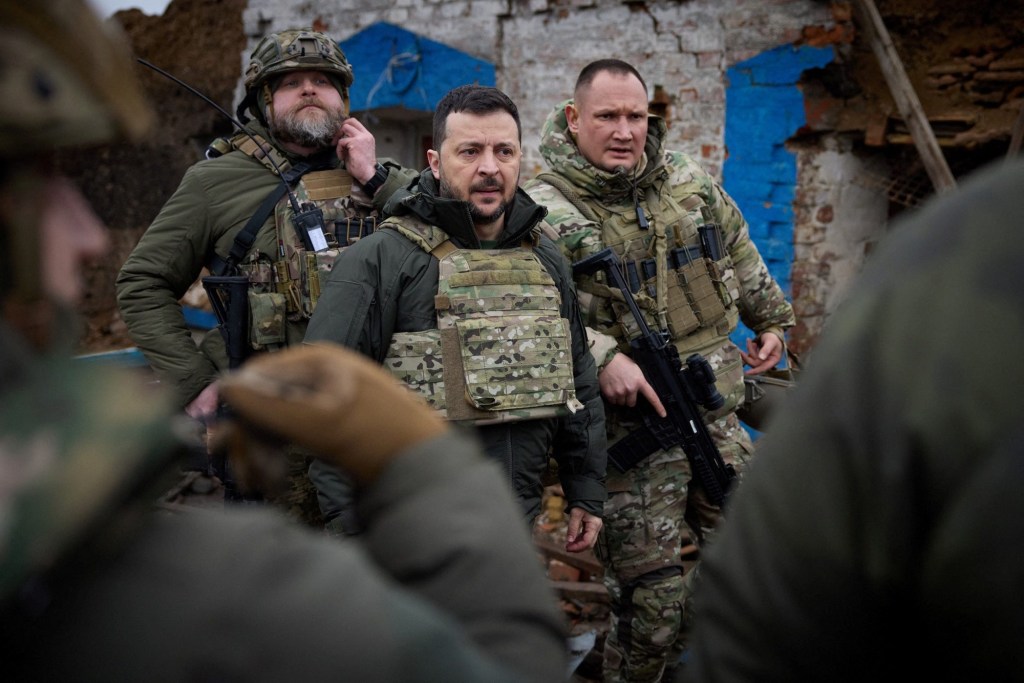
Volodymyr Oleksandrovych Zelenskyy….
We need to talk about this man, because no one truly knows what could have happened if he hadn’t been there to lead.
This is a man who could have left. A man who was expected to leave.
The world was really expecting he would run. Western leaders whispered about setting up a Ukrainian government-in-exile abroad, like the invaded countries did so many times in history. They thought it was the “smart” move, the “practical” move. Many embassies in Kyiv packed up and left, destroying sensitive equipment before crossing the border, never expecting to return.
But Zelenskyy refused.
He looked at the Russian tanks rolling toward Kyiv. He heard the American offer to evacuate him. And he said the words that would define him forever: “I need ammunition, not a ride.”
That moment changed everything.
The citizens of this country, inspired by the president’s defiance, fought harder than anyone imagined. Millions of civillians, many of them who never have operated a rifle before, joined the soldiers and went to the frontlines. The world saw this man standing tall in the middle of pure chaos, and because he stood, everyone else did too.
And Ukraine won the Battle of Kyiv. Almost three years ago now. It was our first big victory of the war. Not only the first victory, but also the first sign that this war would not going to be what Putin had planned. And Zelenskyy has never stopped fighting after that. Ever since, Zelenskyy regularly visits the frontlines to meet with warriors.
We are talking about a man of action, not words.
“If the deal is that we just give up our territories, and that’s the idea behind it, then it’s a very primitive idea. I don’t need a fantastic idea, I need a real idea, because people’s lives are at stake.”
These are not the words of a man looking for an easy way out. These are the words of a leader who understands the cost of surrender. Because it’s more than obvious at this point of time and history this war is not about land. It is about people. It is about justice. It is about the right of a nation to exist.
Our president understands this in a way that many so-called leaders do not.
And then, on the other side of the world, there is Donald Trump.
If Zelenskyy represents the best of humanity, the resilience to stand against evil, Trump represents its worst. Not just incompetence, not just corruption, but an absolute void where morality should be. There is no honor among his ambitions, no higher cause in his conquests. He is a man who poisons everything he touches. Who sees loyalty as something to exploit, who views his own country not as something to protect, but as something to own.
While Ukraine battles on the frontlines for freedom, the West in general but America in particular, face its own war: truth against lies, justice against corruption, courage against cowardice. The stakes are no different. Here, Putin wants to crush us. There, Trump wants to tear America apart from the inside.
If you want to know what leadership looks like, look to Ukraine. Look to the man who walks through trenches and visits soldiers on the frontlines. Look to a president who refuses to abandon his people, who has risked everything. Not for power, not for wealth, but for the simple belief that his country is worth fighting for.
That is leadership. That is courage. That is what we should demand in our own leaders.
But Zelenskyy’s leadership is not just in battle, not just in strategy. It is in his voice. He has spoken to every major government, every parliament, every organization that matters in this fight. He has stood before the U.S. Congress and told them why this war matters not just for Ukraine, but for the future of democracy itself.
And the world listened. Because when he speaks, he does not just represent himself.
He represents the soldiers holding the trenches. He represents the families sleeping in subway stations. He represents the mothers, the fathers, the children, every Ukrainian who refuses to be erased.
One day, this war will end. Ukraine will be in peace again, united, prosperous. This day, Zelenskyy will no longer have to fight. And when that day comes, may he sit peacefully in one of our beautiful beaches of the Black Sea, in a free Crimea, after an uninterrupted night of sleep, and watch his country rise from the ashes.
Because he did not give up. Because he stood when others would have fallen. Because he led when the world needed him most.
Because through the hardest three years in Ukraine’s history, no one would be doing a better job than him.
Thank you for everything, Volodymyr.
We resist because we are Ukrainians.
And every day of these three years, you remind us what that truly means.
Robert Reich is a relentless fighter for our democracy. He served in the administrations of Gerald Ford, Jimmy Carter, and Bill Clinton, in whose administration he was secretary of Labor.
He wrote recently to urge people to organize against Trump’s violations of the law.
Friends,
Before I post my Sunday cartoon, I want to share with you some thoughts about the third hellish week of Trump II.
As of Friday, Trump has signed more than 50 executive orders, covering every aspect of American life and much foreign policy.
It’s not just that this number of executive orders is unprecedented in modern American politics. Many are unlawful, unconstitutional, or both.
In the age of monarchs, kings issued decrees. The tsars of imperial Russia proclaimed ukases. The dictators of the 20th century made diktats.
Trump issues executive orders.
Average people in the age of monarchs, tsars, and dictators were largely powerless. Resistance meant almost certain death.
Many people were resigned to vulnerability. They practiced passivity. They knew no life other than repression. But their deference entrenched and ensured the power of monarchs, tsars, and dictators.
Arbitrary power depends on the acquiescence of everyone subjected to it.
Right now, after three weeks of Trump’s “flooding the zone” (as Trumpers like to say) some of you may be feeling powerless.
Trump wants you to feel powerless. He depends on your passivity in the face of his takeover of American democracy.
He wants to be a strongman who can act unilaterally and arbitrarily — who can issue orders about anything that pops into his head. Purging, firing, prosecuting, or deporting anyone he wants removed. Obliterating, freezing, and pummeling any institution he wants destroyed. Unleashing the richest man in the world to do whatever the hell he wants with the government of the United States.
If you are dumbfounded into inaction, if you don’t even want to hear the news, if you feel as though you’re living through a nightmare over which you have no control, I get it. Every other day I feel the same.
But hear me out.
You and I have no real choice but to stand up to Trump, Musk, and their lapdogs. To allow them to bully us into submission invites more bullying, more lawlessness, more gonzo executive orders.
Last week I suggested a number of actions we can take. It wasn’t an exhaustive list, of course, only some possibilities.
Millions of Americans — including many who have been purged from their positions of responsibility — are standing up to Trump and Musk’s tyranny.
Republican Senator Lisa Murkowski says the Senate phone system has been receiving around 1,600 calls each minute, compared to the 40 calls per minute it usually gets — thus disrupting the system.
We are beginning to flood Trump and Musk’s zone.
Let’s flood it out.
This coming April 19 will mark the 250th anniversary of the battles of Lexington and Concord, which began the American Revolution and our war against monarchical power.
Anti-royalist militia in Massachusetts refused to disperse when ordered to by British troops. A shot was fired, and the troops kept firing, killing eight of those American resisters. Later that day, the militiamen returned that fire, killing a number of British soldiers. The revolution had begun.
Please don’t get me wrong. I do not advocate violence. I’m simply reminding you that this nation was founded on resistance to arbitrary authority. We built American democracy in the face of what seemed to be impossible odds.
And we will never, ever give up that fight.
My friend Harold Meyerson suggests that on April 19 we stage massive peaceful protests in every city and town — crowds of Americans celebrating the anti-monarchical uprising of 1775 and pledging their allegiance to that heritage by denouncing Trump’s increasingly autocratic rule: Thereby flooding Trump and Musk’s zone still further.
The Founding Fathers were unequivocally opposed to creating a theocracy. The Constitutuon they wrote provided that there would be no religious tests for any government office. The First Amendment guaranteed freedom of religion and asserted that Congress would make no law to establish any religion. They did not want the new United States of America to be a Christian nation.
Yet there has always been a vocal minority that does want the U.S. to be a Christian nation.The more diverse we are, the more these extremists want to impose their religion on everyone.
Pete Hegseth, Trump’s new Secretary of Defense, is apparently a Christian nationalist. He has Christian nationalist tattoos. Too bad for non-Christians and atheists. He will probably assume that every woman and person of color I a high-ranking position is a DEI hire. Only straight white men, he assumes, are qualified. Like him.
In a series of newly unearthed podcasts, Pete Hegseth, Donald Trump’s pick for defense secretary, appears to endorse the theocratic and authoritarian doctrine of “sphere sovereignty”, a worldview derived from the extremist beliefs of Christian reconstructionism (CR) and espoused by churches aligned with far-right Idaho pastor Douglas Wilson.
In the recordings, Hegseth rails against “cultural Marxism”, feminism, “critical race theory”, and even democracy itself, which he says “our founders blatantly rejected as being completely dangerous”.
For much of the over five hours of recordings, which were published over February and March 2024, Hegseth also castigates public schools, which he characterizes as implementing an “egalitarian, dystopian LGBT nightmare”, and which the podcast host Joshua Haymes describes as “one of Satan’s greatest tools for excising Christ from not just our classrooms but our country”.
Elsewhere in the recordings, Hegseth expresses agreement with the principle of sphere sovereignty, which, in CR doctrine, envisions a subordination of “civil government” to Old Testament law, capital punishment for infringements of that law such as homosexuality, and rigidly patriarchal families and churches.
Julie Ingersoll, a professor and director of religious studies at the University of North Florida who has written extensively about Christian reconstructionism and Christian nationalism, told the Guardian: “When these guys say they believe in the separation of church and state, they’re being duplicitous. They do believe in separate spheres for church and state, but also in a theocratic authority that sits above both.”
Hegseth’s far-right beliefs have garnered attention as his nomination to lead the world’s largest military has proceeded. The former Fox News television star and US National Guard officer, decorated after deployments that included special operations in Iraq and Afghanistan, has also garnered negative attention over media reports on his allegedly excessive drinking and allegations of sexual assault.
On Hegseth’s probable assumption of a high-ranking cabinet position in the Trump administration, and how he might view his constitutional role, Ingersoll said: “These folks are not particularly committed to democracy. They’re committed to theocracy.”
She added: “If the democratic system brings that about, so be it. If a monarchy brings it about, that’s OK, too. And if a dictatorship does, that’s also OK. So their commitment is to theocracy: the government of civil society according to biblical law and biblical revelation.”
Logan Davis, a researcher, consultant and columnist from Colorado, grew up in a reformed Calvinist church similar to Pilgrim Hill Reformed Fellowship, which Hegseth now attends, and spent middle and high school in a classical Christian school affiliated to the one Hegseth’s children now attend.
In November he wrote a column entitled “Pete Hegseth and I know the same Christian Nationalists”.
Asked how Hegseth would understand his oath if sworn in as secretary of defense, Davis said: “Hegseth will be swearing to defend the constitution that he, to the extent he is aligned with Doug Wilson, does not believe includes the separation of church and state.”
Asked if Hegseth’s performance of his duties might be influenced by the belief that, as Wilson put it in a 2022 blogpost, “We want our nation to be a Christian nation because we want all the nations to be Christian nations,” Davis said: “I can tell you that the reformed leaders around him … are all sincerely hoping that that is how he will view his mandate.”
Doktor Zoom writes on the blog Wonkette. This is an excellent commentary on Biden’s farewell address.
President Biden made mistakes. He was not perfect. But he survived an unprecedented barrage of defamation from the Republications, who did everything possible to portray him as a criminal and to destroy his son. Never mind that the Republican’ star witness against the Bidens was an FBI informant who falsely claimed that Biden and Hunter took millions in bribes, and eventually confessed to being a Russian plant; he was recently sentenced to six years in prison.
Biden is a good man. He is a man with a heart. He is deeply empathetic. We can’t say the same for the felon who succeeds him.
And, despite razor-thin numbers in both houses of Congress, he managed somehow to pass a remarkable lot of legislation that will rebuild our nation’s infrastructure, create good jobs, attract new industries, revive technology manufacturing, and address climate change. Trump inherits a thriving economy–the best in the world–and will claim credit for it. In the 48 months of Biden’s time in office, there was job growth inbb by every single month. Furthermore, he relieved the debts of millions of students, prioritizing those who got debt forgiveness in return for public service. The Republicans accused him of buying votes, but they lied: Biden continued to forgive college debt after the election.
And that Norman Rockwell painting portrayed in the post? It hangs in Biden’s White House. You can be sure it will be moved to storage on Monday.
Doktor Zoom writes:
….Biden made an explicit parallel to Dwight D. Eisenhower’s farewell address, which warned about the threat of the “military-industrial complex” that nevertheless still has a stranglehold on our economy and politics in a “disastrous rise of misplaced power.”
Today, Biden said, we should be wary of the “potential rise of a tech-industrial complex”:
“Americans are being buried under an avalanche of misinformation and disinformation enabling the abuse of power. The free press is crumbling. Editors are disappearing. Social media is giving up on fact-checking. The truth is smothered by lies told for power and for profit.”
He didn’t name Donald Trump explicitly, just some of those forces that helped him retake power, and which threaten to help Trump and his billionaire buddies undo democracy.
Biden also offered some very concrete steps that might help rein in the destructive forces, although the chances they’ll be enacted during the tenure of the Lord of Misrule seem slim. He started with the easy stuff that won’t happen under Trump.
“We must reform the tax code. Not by giving the biggest tax cuts to billionaires, but by making them begin to pay their fair share.
“We need to get dark money — that’s that hidden funding behind too many campaign contributions — we need to get it out of our politics.”
Then it was on to three ideas that will almost certainly have to wait until we bury Trumpism, at the very least.
“We need to enact an 18-year time limit, term limit […] and the strongest ethics reforms for our Supreme Court. We need to ban members of Congress from trading stock while they are in the Congress. We need to amend the Constitution to make clear that no president, no president is immune from crimes that he or she commits while in office. The president’s power is … not absolute. And it shouldn’t be.”
OK, maybe the second one, the ban on members of Congress trading stocks, has some ghost of a chance; it also wouldn’t really do anything to keep Trump in check, though it’s certainly a general good-government idea. Maybe Biden threw it in for the sake of parallelism, to call for reforms in all three branches of government.
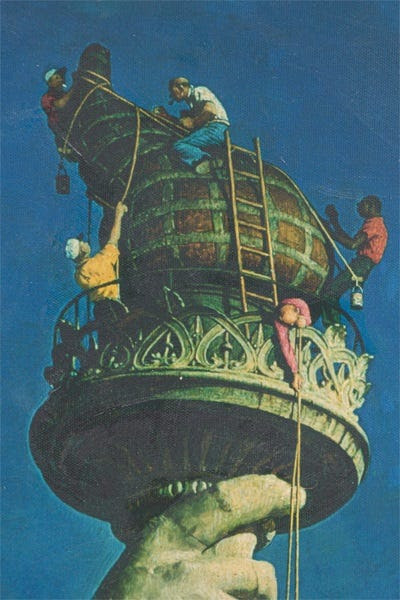
Letting the super-wealthy run things, Biden reminded us, is a recipe not just for oligarchy, but for despair: If everyone knows the system is rigged, we all too often give up, or lash out in violence, neither of which is good for democracy. He offered as a hopeful metaphor an image from a 1946 Norman Rockwell painting that hangs in the White House, showing a crew of workers cleaning the torch on the Statue of Liberty, so its “rays of light could reach out as far as possible.” Keeping that torch lit is the work we all have to do as citizens. And while Biden didn’t mention this detail, do keep in mind that Liberty is not enlightening the world with a damn tiki torch, either.
The bald guy with the pipe is a caricature of Rockwell. Wikipedia notes that ‘The inclusion of a non-white figure working with whites, apparently only noticed in 2011, contravened a Saturday Evening Post policy of only showing people of ethnicity in subservient roles.’ Darn that DEI!
Biden closed with a rather remarkable passing of the torch, not so much to the incoming wrecking crew, but to the only people who can stop those bastards: Us.
“I still believe in the idea for which this nation stands — a nation where the strength of our institutions and the character of our people matter and must endure. Now it’s your turn to stand guard. May you all be the keeper of the flame. May you keep the faith. I love America. You love it, too.”
What a contrast to the rhetoric of Ronald Reagan, who blithely called America a “shining city on a hill” because it’s so plainly the bestest place possible. (As Sarah Vowell reminds us, adding “shining” was a sunny perversion of the original Puritan metaphor’s dour intent, which warned that everyone would see our sins, like Abu Ghraib).
But America isn’t a self-illuminating beacon of virtue that’s virtuous just because it’s America. Instead, Biden argues, the light of freedom requires constant maintenance and renewal — and it only keeps shining if we do the hard, even risky work of participatory democracy.
I frequently get comments by people who are very angry. They are hateful, and their comments are hateful. They say horrible things about anyone who dusagreees with their worldview.
I try to block them but they sometimes slip through. Life is too short to argue with people who wish you were dead.






 Diane Ravitch's blog