Archives for category: Freedom of Speech

Civics education in Texas has been turned into textbook study by a 2021 law that bans student interaction with elected officials. Apparently, the Republicans who control state government want to keep students in the dark about getting involved in civic action. Participation is a feature of civic education, but it’s illegal in the Lone Star State.

The Guardian reports:

The defining experience of Jordan Zamora-Garcia’s high school career – a hands-on group project in civics class that spurred a new city ordinance in his Austin suburb – would now violate Texas law.

Since Texas lawmakers in 2021 passed a ban on lessons teaching that any one group is “inherently racist, sexist or oppressive”, a little-noticed provision of that legislation has triggered a massive fallout for civics education across the state.Being the only one leaves a mark: a Black mother on the long shadow of school segregation

Tucked into page 8 is a stipulation outlawing all assignments involving “direct communication” between students and their federal, state or local officials – short-circuiting the training young Texans receive to participate in democracy itself.

Zamora-Garcia’s 2017 project to add student advisers to the city council, and others like it involving research and meetings with elected representatives, would stand in direct violation.Since 2021, 18 states have passed laws restricting teachings on race and gender. But Texas is the only one nationwide to suppress students’ interactions with elected officials in class projects, according to researchers at the free expression advocacy group Pen America.

Last Sunday’s New York Times Magazine, the same publication that bravely published The 1619 Project, had a cover story about Randi Weingarten. It raised (and implied) the question of whether she is “the most dangerous person in the world.” The cover illustration had several placards, the most prominent saying “Stop Randi Weingarten.” My immediate thought, before reading the story, was that Randi’s life might be in danger, because the illustration and the title made her a target. This is no joke.

Randi has been a friend of mine for many years, and we don’t always agree. I have never persuaded her, and she has never persuaded me. We have had some strong arguments, but she’s still my friend. I believe passionately in the importance of unions, especially in a society with such deep economic inequality as ours. I wrote a letter to the editor about my objections to the article. I hope it gets published.

One important inaccuracy in the article: the author says that “only” 40% of American 8th graders are “proficient” in math, and only 32% are “proficient” in reading. This is a common error among journalists, critics, and pundits who misunderstand the achievement levels of the National Assessment of Educational Progress (NAEP). “Proficient” on NAEP is not grade level. “Proficient” on NAEP represents A level work, at worst an A-. Would you be upset to learn that “only” 40% of 8th graders are at A level in math and “only” 1/3 scored an A in reading?

Jan Resseger, in one of her most brilliant articles, wrote today:

Why Randi Weingarten Is Not a Symbol of What’s Dangerous in American Politics

I felt myself getting angry as I began skimming Jonathan Mahler’s New York Times Magazine article featuring Randi Weingarten. But as I read more carefully, I realized I had to give Mahler credit for recognizing Weingarten’s strong leadership on behalf of public schools and the school teachers she leads as president of the American Federation of Teachers—even in an article framing public school policy according to the standard Republican attack against the teachers unions:

“By now, Pompeo, Tim Scott, Marco Rubio, Ron DeSantis, Donald Trump and the rest of the Republican Party were busy elevating education to a central plank in its 2024 platform…. But Weingarten was building her own case. Public education was now itself a hyperpartisan issue, and she addressed it in hyperpartisan terms in a fiery speech at the National Press Club. Calling out by name some of the people who had demonized her since the pandemic, including Betsy DeVos, she described the ongoing effort to defund public schools as nothing less than a threat to ‘cornerstones of community, of our democracy, our economy and our nation.’ She pointed to studies that have shown that vouchers don’t improve student achievement, characterizing them as a back door into private and parochial schools that are not subject to the same federal civil rights laws as public institutions and can therefore promote discrimination. ‘Our public schools shouldn’t be pawns for politicians’ ambitions… They shouldn’t be destroyed by ideologues.'”

I have myself been delighted to see Randi Weingarten out there fighting for the educational rights of our children during the pandemic, pushing against the widespread blaming of teachers, and opposing the wave of culture war attacks on teachers and on honest and accurate curricula. She has been a far better defender of public schooling than Secretary of Education Miguel Cardona.

But there is a bias in Mahler’s piece that kept me extremely uncomfortable. While Mahler gives Weingarten some credit for defending her side of the debate, he presents his analysis primarily from the point of view of of Mike Pompeo, Tim Scott, Marco Rubio, Ron DeSantis, and Donald Trump.

We learn about “pandemic learning loss” as measured in National Assessment of Educational Progress (NAEP) scores, but we don’t learn that the drop in scores is likely temporary—a one time drop due to Covid disruption. We learn about teachers unions fighting for better protection during Covid—fighting for mask and vaccination mandates. It is implied that teachers unions were partly to blame for school closures, but we read nothing about the struggles of teachers to provide for students’ needs during remote learning, including some pretty difficult periods when many teachers were teaching kids remotely in the same classrooms where they were simultaneously working in-person with groups of kids whose families sent them to school.

Mahler implies that teachers unions are a monolith. He does not tell readers that teachers join their union locals, which operate independently from the national American Federation of Teachers and the National Education Association—the two large teachers unions.

The culture wars comprise a substantial part of Mahler’s profile. He explains that Tina Descovich in Brevard County, Florida and Tiffany Justice, of Indian River County spontaneously decided to join up and create their own parents’ rights group, Moms for Liberty, but he neglects some important background: Moms for Liberty, Parents Defending Education, and No Left Turn in Education are, in fact, Astroturf fronts for a national culture war campaign being mounted by groups like the Manhattan Institute and the Heritage Foundation, with funding from DonorsTrust dark money and Charles Koch. Additionally Mahler reports that the American Federation of Teachers supported Terry McAuliffe against Glenn Youngkin, who ran a culture war campaign against honest teaching about race in American history in the campaign for Governor of Virginia. It should not be a bit surprising that, as a labor union, the American Federation of Teachers can legally endorse and support candidates, and that the AFT endorsed the candidate who stood with the American Historical Association, the American Association of University Professors, and PEN America on the issue of the school curriculum.

Mahler devotes a significant part of his report to what he describes as the “AFT’s left-wing local, the Chicago Teachers Union (CTU).” He adds that “like-minded left-wing slates have since taken control of AFT locals in several other cities, too, including Los Angeles and Baltimore.” Many supporters of public education would embrace the cause of these big-city teachers without identifying themselves as left-wing. Here is how Mahler describes CTU’s agenda: “They see public schools’ ongoing struggles to educate their students as inseparable from the larger societal and economic issues facing their working-class members and the poor communities whose children dominate their classrooms.” Mahler quotes the Chicago Teachers’ Union’s recent past president, Jesse Sharkey: “We are trying to promote a brand of unionism that goes all out in its fight for educational justice and is brave about taking on conflicts.”

The problem with Mahler’s analysis is that today’s debates about public education policy are far more complex and nuanced than a fight between Randi Weingarten as a symbol of teacher unionism and Ron DeSantis and Glenn Youngkin. Those of us who have followed the history of education policy battles through the past two decades of No Child Left Behind and Race to the Top are now watching the far right and dark money campaigns driving culture war chaos across the state legislatures as a path to the expansion of school vouchers. Without any direct connection to teacher unions, many of us share the enlightened assessment that has been articulated by the Chicago Teachers Union.

Mahler mistakes the significance of the recent election of Brandon Johnson, who is a former teacher and more recently an organizer for the Chicago Teachers Union, as Chicago’s new mayor. Mahler sees Johnson’s victory as a symbol of the power of teachers unions: “When Johnson narrowly won, it was a stunning upset…. the teachers’ unions had effectively elected the mayor of America’s third-largest city, who was himself an avowedly progressive union organizer promising to raise taxes on the rich, reform the police and increase funding for the city’s schools…. It was those who had underestimated the political power of the unions who were mistaken.” In reality the meaning of Chicago’s mayoral election was more likely a rejection of nearly a quarter of a century of mayoral governance of Chicago’s public schools, of test-and-punish school accountability, of the explosive growth of charter schools in Chicago, and of Rahm Emanuel’s 2013 closure of 49 elementary schools in Chicago’s Black and Hispanic neighborhoods.

In our alarmingly unequal society, where too frequently our children reside far apart in pockets of concentrated poverty or in pockets of wealth, we will not be able to close children’s opportunity gaps merely by improving the public schools alone. In a new book, The Education Myth, Jon Shelton, a professor at the University of Wisconsin-Green Bay, identifies the No Child Left Behind Act as the embodiment of a deeply flawed plan to equalize school achievement: “At root, the very premise of the bill—that punishing schools for the scores of their students would improve the schools’ performance—was simply flawed, particularly when school districts did not have the ability to raise students out of poverty or alleviate the trauma of racism…. NCLB ignored the broader economic structures that might lead a student to succeed or fail in school as well as the relationship between where a student got an education and what job would actually be available to them.” (The Education Myth, p. 173)

I am grateful that, in the cities where their members teach, some teachers union locals are working actively to support efforts to ameliorate child poverty. That is not a left-wing cause; it is instead a goal for us all to embrace. As we publicly debate the needs of our children and our public schools, it is wrong to define the conversation as a mere battle between right-wing Republicans and the teachers unions


The Tennessee legislature has passed a law controlling the freedom of teachers and college professors to discuss racism. Quite literally, teachers are required to deliver content without expressing a point of view, for instance, acknowledging that slavery was wrong. The author of the bill says he is promoting freedom of expression by restricting freedom of expression.

NASHVILLE, Tenn.—

“Divisive concept” rules are a set of laws passed last year that include many concepts usually taught in courses like sociology, psychology and political sciences.

The bill passed the House of Representatives on April 13, after passing Senate on April 5.

In 2022, lawmakers passed rules that allow state leaders to withhold funding for schools that teach about social, cultural and legal issues related to race and racism. Most of those concepts focus on how the impact of racism affects people today.

The law also specified that schools can teach about ethnic groups’ histories as described in textbooks and instructional materials. Educators can also only teach about controversial aspects of history, such as racial oppression or slavery, as long those discussions are impartial.

The bill, HB 1376, was introduced by Representative John Ragan (R – Oak Ridge). He previously said that the new bill was meant to strengthen the law passed in 2022 by “promoting freedom of expression,” and keep “colleges about advancing knowledge, not about advancing political or social agendas.”

Originally, the bill required institutions to publish a syllabus for each course offered in the semester on its website, meant to assess whether a “divisive concept” may be included in the curriculum. That requirement was removed in an amendment to the bill.

The bill restricts universities from using state funds for meetings or activities of an organization that “endorses or promotes a divisive concept.” It also requires employees who support diversity initiatives to “increase intellectual diversity” and support students through mentoring, career readiness and workforce development initiatives.

Employees would be exempt from the requirement if the new duties conflict with other laws, such as Title IX officers.

It also allows students and employees who believe that the school violated last year’s law a chance to file a report with the school. The school would then need to annually report violations to the comptroller of the treasury, redacting them as needed to stay in compliance with the Family Educational Rights and Privacy Act.

The bill would also specifically require universities to allow any guest speaker on campus regardless of “non-violent political ideology” or “non-violent political party affiliation.”

The concepts that were banned from lessons in 2022’s law are listed below.

  • That one race or sex is inherently superior to another race or sex
  • That a person, by virtue of their race or sex, is inherently privileged, racist, sexist or oppressive — whether consciously or subconsciously
  • That a person should be discriminated against or receive adverse treatment because of their race or sex
  • That a person’s moral character is determined by their race or sex
  • That a person, by virtue of their race or sex, bears responsibility for actions committed in the past by other members of the same race or sex
  • That a person should feel discomfort, guilt, anguish or another form of psychological distress because of their race or sex
  • That a meritocracy is inherently racist, sexist or designed by a particular race or sex to oppress members of another race or sex
  • That Tennessee or the U.S. is fundamentally or irredeemably racist or sexist
  • Promoting or advocating the violent overthrow of the U.S. government
  • Promoting division between, or resentment of, a race, sex, religion, creed, nonviolent political affiliation, social class or class of people
  • Ascribing character traits, values, moral or ethical codes, privileges or beliefs to a race or sex, or to a person because of their race or sex
  • That the rule of law does not exist but instead is a series of power relationships and struggles among racial or other groups
  • That “all Americans are not created equal and are not endowed by their Creator with certain unalienable rights including life, liberty and the pursuit of happiness”
  • That governments should deny to any person within their jurisdiction the equal protection of the law

It also bans lessons that include “race or sex scapegoating” or “race or sex stereotyping,” as those terms are defined in law. In October 2022, a group of UT faculty called the law “chilling,” and questioned the law’s intent.

Rep. Justin Jones (D – Nashville) spoke about the bill when he returned to the House of Representatives after he was expelled and reinstated. He asked a series of questions, such as whether “college students are mature enough to talk about race and systemic racism, some of the concepts you want to prohibit being discussed at the college level?”

“I believe in God. All else is settled by facts and data,” Ragan said.

Jones again asked him to answer the question, but Ragan said he responded to the question.

“So, we’re playing ‘not-answer.’ Okay,” Jones said.

He also asked why the bill was introduced and said it seemed based on “white fragility and fears of the truth of history.”

“This bill was brought to me by a dean of college education, in addition to another university contributed to this bill. That was my motivation, too,” Ragan said.

He also said he did not want to name the person who brought the bill to him.

“How will we be honest about our history if you’re prohibiting any concepts about America’s racist history?” Jones said. “This sounds like fascism. This sounds like authoritarianism. This does not sound like democracy or freedom … This member has consistently invoked God to justify this unjust, immoral and extreme, racist law.”

Speaker Cameron Sexton (R – Crossville) stopped Jones from speaking. Rep. Justin Pearson (D – Memphis) also spoke after being reinstated to the House.

“This is a deeply concerning bill because it is continuing a pattern of practice that is harmful to all people,” he said. “When you try to control what a person thinks, then you are assuming the role of God rather than allowing freedom of thought.”

He said that the list of “divisive concepts” bars discussions on biases, white privilege and racism’s role in slavery.

The bill passed by a vote of 68-26 in the House.

During a meeting on March 13, Ragan said he received complaints from universities in the state about an “overemphasis” of the original law at the expense of “intellectual diversity,” which led to him proposing the new bill.

Representative Harold Love, Jr. (D – Nashville) previously asked if a conference focusing on Black history could still be held and promoted by a university should the bill pass. Ragan said it would be allowed as long as they “are not required to promote or endorse.”

Related Articles

The statehouse in Nashville, Tennessee, was surrounded by parents and students demonstrating in favor of gun control and against the GOP-controlled legislature’s protection of guns. The protest follows the murder of three children and three staff members at the Coventry School in Nashville.

Three Democratic members of the legislature joined the protest, chanting with the protestors.

The GOP leadership threatened to expel the Democrats. The speaker of the House absurdly claimed that the three Democrats were encouraging an insurrection.

Parents and children held signs and shouted chants during a large protest at the Tennessee capitol last week following a deadly school shooting. And while no one was arrested or injured, Republican House Speaker Cameron Sexton is comparing the demonstration to the Jan. 6 insurrection.

During the House Floor session on Thursday — days after the Covenant School shooting — Reps. Gloria Johnson, D-Knox, Justin Pearson, D-Memphis, and Justin Jones, D-Nashville, stood up and chanted with protestors in the gallery.

Pearson and other Democrats attempted to acknowledge the large group of protesters during session, but were told to stick to the subject of the bill by Speaker Cameron.

“We listened to them and helped to elevate the issue that they are demanding justice for,” said Pearson.

House Speaker Cameron Sexton said their actions were more than a breach of decorum, comparing it to the January 6th insurrection in remarks to outlets.

“Two of the members; Representative Jones and Representative Johnson, have been very vocal about Jan. 6 and Washington, D.C., about what that was,” said Sexton. “What they did today was equivalent, at least equivalent, maybe worse depending on how you look at it, to doing an insurrection in the State Capitol.”

Sexton warned that there will likely be consequences for the trio.

“It could be removal of committees; it could be censorship; it could be expulsion from the General Assembly. Anywhere in between,” said Sexton.

Leaders in the Democratic caucus are defending their colleagues. Nashville Democrat John Ray Clemmons says he believes Speaker Sexton is exaggerating.

“You show me the broken windows, you show me anyone who went into the speaker’s office and put their chair up on his desk and trashed his office, you show me where a noose was hanging anywhere on the legislative plaza,” said Clemmons, citing damage committed during the Capitol riot, which resulted in five deaths before and after the event.

The three rebellious Democrats were stripped of their committee assignments. Their member badges were deactivated. Their telephones were disconnected.

In a press conference Monday, Jones says Sexton is more focused on politics than addressing last week’s mass shooting.

“We are members, who are standing in the well, telling our speakers and our colleagues that kids should not be murdered in school,” Jones said, “and rather than address that issue, the speaker has spent more time on Twitter this weekend talking about a fake insurrection than he did about the deaths of six people including 9-year-old children.”

It is not yet clear if the lawmakers will face expulsion. Sexton has not commented on whether they will face further discipline.

A tweet:

Three Tennessee Democrats have been stripped of their committee and subcommittee assignments by the Republican dominated legislature for speaking out against gun violence in the wake of the Nashville shooting that killed three children.

Democracy is dead in Tennessee.

@Sethaweitz

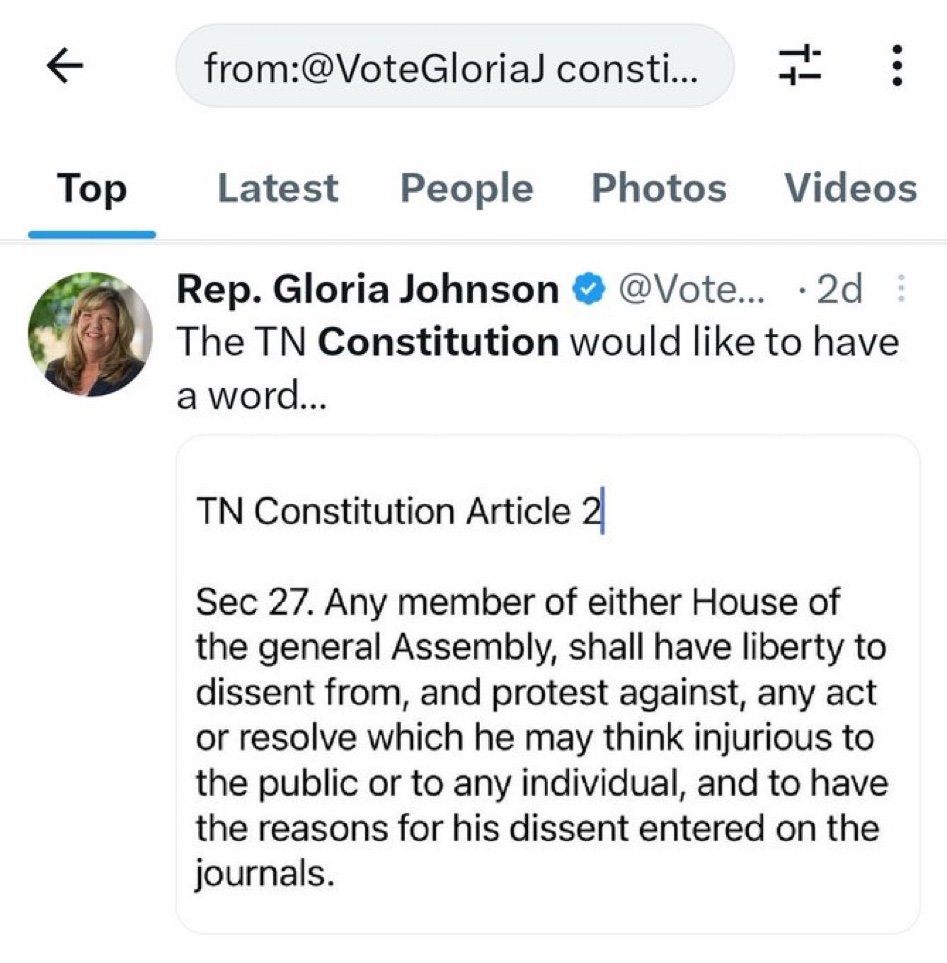
Rep. Gloria Johnson, one of the three Democrats, tweeted:

Governor Ron DeSantis should be careful whom he picks on. Not only did Disney outsmart DeSantis and retain control of DisneyWorkd, but its CEO announced at a shareholder meeting in California that Disney plans to grow in Florida. He also rapped DeSantis for trying to punish Disney for exercising its constitutional right to free speech.

The Orlando Sentinel reported:

The Walt Disney Co. plans to invest $17 billion in Walt Disney World over the next 10 years and create 13,000 new jobs, CEO Bob Iger said Monday, as he accused Gov. Ron DeSantis of being vindictive over Disney’s response to the so-called “don’t say gay” law last year….

Disney World will host 50 million visitors this year, and its planned expansion will bring even more guests and employees to the state in the years to come, along with generating more taxes, Iger said.

“Our point on this is that any action that thwarts those efforts, simply to retaliate for a position the company took, sounds not just anti-business, but it sounds anti-Florida, and I’ll just leave it at that,” he said….

During the company’s annual meeting, Iger also said Disney loves Florida and has heavily invested in the state over the past 50 years in its expansion of the Disney World resort, as the state’s largest taxpayer and through its charitable actions.

The state’s relationship with Florida has “kind of been a two-way street,” Iger said.

But that changed last year when former CEO Bob Chapek spoke out against Florida’s Parental Rights in Education legislation, which restricts discussion of sexual orientation and gender identity in early-grade classrooms. That drew DeSantis’ ire and led to a law dissolving of the company’s special land use, utilities and public service district, Reedy Creek.

“And while the company may have not handled the position that it took very well, a company has a right to freedom of speech just like individuals do,” Iger said.

He said DeSantis dissolved Reedy Creek “in effect to seek to punish a company for its exercise of a constitutional right.”

“And that just seems really wrong to me, against any company or individual but particularly against the company that means so much to the state that you live in,” he added.

The New York Times published an article about a tenured professor at the University of Pennsylvania Law School, Amy Wax, who has frequently made statements that are racist, homophobic, sexist, xenophobic, the whole range of prejudices, not what you expect of someone who supposedly teaches students that everyone is equal in the eyes of the law.

Amy Wax, a law professor, has said publicly that “on average, Blacks have lower cognitive ability than whites,” that the country is “better off with fewer Asians” as long as they tend to vote for Democrats, and that non-Western people feel a “tremendous amount of resentment and shame.”

At the University of Pennsylvania, where she has tenure, she invited a white nationalist to speak to her class. And a Black law student who had attended UPenn and Yale said that the professor told her she “had only become a double Ivy ‘because of affirmative action,’” according to the administration.

Professor Wax has denied saying anything belittling or racist to students, and her supporters see her as a truth teller about affirmative action, immigration and race. They agree with her argument that she is the target of censorship and “wokeism” because of her conservative views.

All of which poses a conundrum for the University of Pennsylvania: Should it fire Amy Wax?

The university is now moving closer to answering just that question. After long resisting the call of students, the dean of the law school, Theodore W. Ruger, has taken a rare step: He has filed a complaint and requested a faculty hearing to consider imposing a “major sanction” on the professor…

For years, Mr. Ruger wrote in his 12-page complaint, Professor Wax has shown “callous and flagrant disregard” for students, faculty and staff, subjecting them to “intentional and incessant racist, sexist, xenophobic and homophobic actions and statements.”

The complaint said she has violated the university’s nondiscrimination policies and “standards of professional competence.”

The article goes on to cite the many times that Professor Wax has offended women, Blacks, gays, foreign students, or anyone else who does not agree with her idyllic view of the culture of the 1950s. Implicitly she means an era when Blacks were subservient, women were compliant wives, gays were in the closet, and foreigners were tourists.

What should the university do?

…many free speech groups, including the Academic Freedom Alliance, PEN America and the Foundation for Individual Rights and Expression, have criticized the dean and said that Professor Wax should not be fired because of her public statements.

My view: She should not be fired. Perhaps she should be admonished for behavior that is insulting to students, but her academic freedom and tenure protect her job.

Academic freedom protects not just the views that one likes, not just the views of the majority, but the views you hate. I might wish that Professor Wax were open-minded and wish that she had a keener sense of humanity, but I defend her right to be offensive, inconsiderate, and obnoxious. Students are not required to take her courses. Those who take her courses should challenge her views if they disagree.

But academic freedom must prevail.

Voltaire: “I may not agree with what you have to say, but I will defend to the death your right to say it.”

We saw this coming. The GOP candidates for President have decided, for now, to focus their campaigns against “critical race theory,” Black history, the threat posed by transgender students, and any teaching about race, sex, and gender.

Juan Perez of Politico reports:

CULTURE CLASH — Once upon a time, back when people used fax machines, education policy — test scores, spending, school choice and the like — were a notable feature of Republican presidential campaigns.

Former President George W. Bush’s support for education spending and the transformative No Child Left Behind Act was enshrined in the party’s 2004 platform. Former Arkansas Gov. Mike Huckabee railed that a general lack of concern about education in the 2008 presidential field “frustrates the fire out of me.” Bush’s brother, Jeb, invoked Martin Luther King Jr.in 2016 when he proposed a detailed education platform before his campaign fizzled.

This year, education is re-emerging as a prominent issue for the budding 2024 GOP field. But America is poised to witness a presidential contest where the debate over school policy sounds dramatically different — with discussions over academic standards and the stunning, once-in-a-generation hitto test scores taking a back seat to issues with a more distinct culture war bent.

Former South Carolina Gov. Nikki Haley is salting a back-to-basics education mantra with brimstone, targeting school lessons on race and sexuality. Former Vice President Mike Pence has put a small Iowa school system’s gender identity policy in the national spotlight. And Former President Donald Trump is stirring up concerns about “pink-haired communists teaching our kids.”

Haley’s campaign launch last week offered a sign of the heightened role the education wars are about to play in the GOP primary.

“They’re talking about critical race theory, where if you send a five year old kindergartner into school — if she’s white, you’re telling her she’s bad, and if she’s brown or Black you’re telling her she’s never going to be good enough and she’s always going to be a victim,” Haley said of the academic practice to a New Hampshire crowd last week. “That’s abusive.”

She added that a Florida ban on sexual orientation and gender identity lessons for young students — championed by rival Republican Gov. Ron DeSantis and dubbed by critics as the “Don’t Say Gay” law — “didn’t go far enough.”

“When I was growing up, we didn’t have sex ed until seventh grade,” Haley said to applause in New Hampshire. “That’s the kind of stuff you do at home, you don’t do that at school. That’s the kind of thing parents do.”

For his part, Pence has focused attention on an Iowa dispute, in which the conservative Parents Defending Education organization is suing the Linn-Mar Community School District to stop it from enforcing a policy that directs educators to protect their students’ gender identities on campus.

The court case has garnered supportive briefs from the Pence-backed Advancing American Freedom organization plus a coalition of Christian groups and Republican state attorneys general. The legal battle is also the focus of a Pence political initiative— funded with an initial budget of $1 million — that will advocate for “parental rights” policies embraced by conservatives.

“We’re told that we must not only tolerate the left’s obsessions with race and sex and gender but we must earnestly and enthusiastically participate or face severe consequences,” Pence told supporters last week. “Nowhere is the problem more severe, or the need for leadership more urgent, than in our public school classrooms,” he said.

Trump’s education plan, unveiled last month, calls for cutting federal funding for any school or program that includes “critical race theory, gender ideology, or other inappropriate racial, sexual, or political content onto our children.”

Trump would also open civil rights investigations into any school district that has engaged in race-based discrimination, particularly against Asian American students. He also called to “keep men out of women’s sports,” make significant cuts to school administrative personnel, elect school principals and end teacher tenure.

“As the saying goes, personnel is policy and at the end of the day if we have pink-haired communists teaching our kids we have a major problem,” Trump said.

Sen. Tim Scott, who is testing the waters on a potential presidential bid, is taking a less combative approach. Speaking at a GOP Black History Month event in Charleston last week, the South Carolina senator said “the story of America is not defined by our original sin, the story of America is defined by our redemption” and urged Republicans to “be the party of parents.”

Scott and others are responding to the GOP grassroots energy surrounding issues at the intersection of race, gender, culture and education — which Virginia GOP Gov. Glenn Youngkin successfully harnessed in his 2021 blue-state victory.

The sharp-edged rhetoric might get sanded down for the general election. But for now, not getting outflanked on education controversies that currently animate the right appears to be the first order of business for the 2024 field.

When the Disney Corporation criticized Ron DeSantis’s “Don’t Say Gay” bill, the Governor struck back by taking control of Disney’s special district and creating a board (appointed by him) to oversee Disney. The board consisted of rightwing extremists and DeSantis campaign donors. DeSantis boasted about his ability to punish and subjugate the state’s largest employer and its economic engine. It was easy to imagine the extremist DeSantis board censoring Disney attractions and shows to make sure nothing happened that was “woke.”

But wait!

While DeSantis was boasting, the Magic Kingdom was making a deal to elude his grasp.

CNN reported here on Disney’s quiet escape from DeSantis’ clutches:

(CNN)The battle between Disney and Florida Gov. Ron DeSantis may not be over yet.

The new board handpicked by the Republican governor to oversee Disney’s special taxing district said Wednesday it is considering legal action over a multi-decade agreement reached between the entertainment giant and the outgoing board in the days before the state’s hostile takeover last month.

Under the agreement — quietly approved on February 8 as Florida lawmakers met in special session to hand DeSantis control of the Reedy Creek Improvement District — Disney would maintain control over much of its vast footprint in Central Florida for 30 years and, in some cases, the board can’t take significant action without first getting approval from the company.

“This essentially makes Disney the government,” board member Ron Peri said during Wednesday’s meeting, according to video posted by an Orlando television station. “This board loses, for practical purposes, the majority of its ability to do anything beyond maintaining the roads and maintaining basic infrastructure.”

The episode is the latest twist in a yearlong saga between Disney and DeSantis, who has battled the company as he tries to tally conservative victories ahead of a likely bid for the 2024 GOP nomination.

The board on Wednesday retained “multiple financial and legal firms to conduct audits and investigate Disney’s past behavior,” DeSantis spokeswoman Taryn Fenske said. According to meeting documents, the board was entering into agreements with four firms to provide counsel on the matter.

“The Executive Office of the Governor is aware of Disney’s last-ditch efforts to execute contracts just before ratifying the new law that transfers rights and authorities from the former Reedy Creek Improvement District to Disney,” Fenske said. “An initial review suggests these agreements may have significant legal infirmities that would render the contracts void as a matter of law.”

In a statement to CNN, Disney stood by its actions.

“All agreements signed between Disney and the District were appropriate, and were discussed and approved in open, noticed public forums in compliance with Florida’s Government in the Sunshine law,” the company said. Documents for the February 8 meeting show it was noticed in the Orlando Sentinel as required by law.

Multiple board members did not immediately respond to request for comment. The Sentinel first reported on Wednesday’s vote to hire legal counsel.

According to a statement Wednesday night from the district’s acting counsel and its newly obtained legal counsel, the agreement gave Disney development rights throughout the district and “not just on Disney’s property,” requires the district to borrow and spend on projects that benefit the company, and gives Disney veto authority over any public project in the district.

“The lack of consideration, the delegation of legislative authority to a private corporation, restriction of the Board’s ability to make legislative decisions, and giving away public rights without compensation for a private purpose, among other issues, warrant the new Board’s actions and direction to evaluate these overreaching documents and determine how best the new Board can protect the public’s interest in compliance with Florida Law,” the statement from Fishback Dominick LLP, Cooper & Kirk PLLC, Lawson Huck Gonzalez PLLC, Waugh Grant PLLC and Nardella & Nardella PLLC said.

The spat between Disney and the governor stems from the company’s opposition to a Florida law that prohibits the instruction of sexual orientation and gender identity through third grade and only in an “age appropriate” manner in older grades. In March of last year, as outrage against the legislation spread nationwide, Disney released a statement vowing to help get the law repealed or struck down by the courts.

DeSantis and Florida GOP lawmakers retaliated by eliminating the Reedy Creek Improvement District, the special taxing authority that effectively gave Disney control of the land in and around its sprawling Orlando-area theme parks. But Republicans in control of the state legislature changed course this year and voted instead to fire the board overseeing the district and gave DeSantis power to name all five replacements. It also renamed Reedy Creek as the Central Florida Tourism Oversight District and eliminated some of its powers.

DeSantis stacked the board with political allies, including Tampa lawyer Martin Garcia, a prominent GOP donor; Bridget Ziegler, the wife of the new chairman of the Republican Party of Florida; and Peri, a former pastor who once suggested tap water could be making people gay.

The controversy is central to DeSantis’ political narrative of a leader who is unafraid to battle corporate giants, even one as iconic and vital to Florida as Disney. It is a saga that is featured prominently in his new book and one he often shares at events across the country as he lays the groundwork for a likely national campaign.

At last month’s signing ceremony for the bill that gave him control of Reedy Creek’s board, DeSantis declared, “The corporate kingdom finally comes to an end.”

“There’s a new sheriff in town,” he added.

However, it may be a while before the new power structure has control, if Disney gets its way. One agreement signed by the outgoing board — which restricts the new board from using any of Disney’s “fanciful characters” — is valid until “21 years after the death of the last survivor of the descendants of King Charles III, king of England,” according to a copy of the deal included in the February 8 meeting packet.

“President Trump wrote ‘Art of the Deal’ and brokered Middle East peace,” said Taylor Budowich, spokesman for the Trump-aligned Make America Great Again PAC. “Ron DeSantis just got out-negotiated by Mickey Mouse.”

The stealth move by Disney prompted allies of DeSantis’ chief political rival, former President Donald Trump, to suggest the governor had been out-maneuvered.

DeSantis’ political operation insisted the governor’s appointees were holding Disney accountable.

“Governor DeSantis’ new board would not, and will not, allow Disney to give THEMSELVES unprecedented power over land (some of which isn’t even theirs!) for 30+ years,” Christina Pushaw, of DeSantis’ rapid response team, wrote on Twitter.

Sorry, Christina, DeSantis should stick to bullying minorities and pick on someone his own size. The Mouse just beat the Mouth.

The BBC scrutinized the new Disney agreement and found that it includes a “royal clause.

The declaration is valid until “21 years after the death of the last survivor of the descendants of King Charles III, king of England”, according to the document.

Such so-called royal lives clauses have been inserted into legal documentation since the late 17th Century, and they are still found in some contracts in the UK, though rarely in the US.

The 151-page Florida agreement also states that no “fanciful characters” owned by Disney, including Mickey Mouse, can be used by the board. The use of the name Disney is also banned.
Take that, DeSatanis!

USA Today conducted a poll and found that most Americans think it’s good to be “woke.”

Republican presidential hopefuls are vowing to wage a war on “woke,” but a new USA TODAY/Ipsos Poll finds a majority of Americans are inclined to see the word as a positive attribute, not a negative one.

Fifty-six percent of those surveyed say the term means “to be informed, educated on, and aware of social injustices.” That includes not only three-fourths of Democrats but also more than a third of Republicans.

Overall, 39% say instead that the word reflects what has become the GOP political definition, “to be overly politically correct and police others’ words.” That’s the view of 56% of Republicans.

So, do you want to be informed and aware?

Or do you prefer to be uninformed and asleep?

By the way, I got an email inviting me to attend a speech by Florida Governor Ron DeSantis at the Nassau Coliseum in Long Island. That means he is running. He will talk about “the Florida Vision.” I assume that means banning books, vetting Black history, banning art, crushing academic freedom, silencing all dissent.

I prefer American values, the ones in our Constitution.

The Miami Herald editorial board published the following editorial in defense of free speech. It was cross posted in The Orlando Sentinel.

Last week, Florida’s government refused to grant permission to the League of Women Voters to hold a rally on the steps of the Old Capitol in Tallahassee, according to a ProPublica story. The group was told that, under a DeSantis administration rule, its rally needed to be sponsored by a state agency.


A thwarted rally during the legislative session may not seem like it warrants a ton of attention in the torrent of bad ideas pouring out of Tallahassee, but this is not small; it’s one more way the state is tightening its chokehold on free speech in Florida.


The league said it was denied permission by the Florida Department of Management Services under a rule that went into effect March 1 that says the use of the space must be “consistent with the Agency’s official purposes.”


In other words, if it isn’t part of Gov. Ron DeSantis’ anti-woke agenda or some other Republican cause, you need not apply.


The supposed reason is to protect public safety and make sure state workers and officials can do their jobs. Funny how, in all these years, that hasn’t been an issue. The area around the state Capitol has long been the site of all sorts of demonstrations, rallies and marches. But suddenly, that’s a problem.


Call us crazy, but could it have something to do with the perception that the League is left-leaning? Last year, a local official in Lake County, Illinois, called League members there “partisan hags” in a Facebook posting, apparently because he thought their debate formats favored Democrats. He later apologized — for the “hag” part, anyway.


In Florida, the League has taken an openly adversarial stance against the DeSantis administration in at least one instance. The group went to court to fight a 2021 voting law, with a judge striking down several provisions on grounds they were discriminatory. The state is appealing.

The change in rules for rallies — an excuse to restrict speech — isn’t happening in a vacuum. We’ve already had the effort by the Republican Legislature to stop discussion of systemic racism at universities and in workplace training, the smackdown of Disney for daring to oppose the governor’s “Don’t say gay” law on sexual orientation and gender identity instruction in schools and a bill to make it easier to sue for defamation that would have a chilling effect on public discourse.


In this latest iteration, the government is using state rules and red tape to stop dissent from being heard. What are lawmakers so afraid of?


And while the League managed to hold its event on a plaza nearby and discussed the muzzling of free speech, that’s poor consolation. Lawmakers need to be open to hearing dissent if they are truly representing the will of the people — and not just the will of one man.


This editorial was published by the Miami Herald. Contact us at insight@orlandosentinel.com
© 2023 Orlando Sentinel