Archives for category: Fraud

Paul Krugman, Nobel-Prize winning economist, writes about shady speculation in the oil futures market. He says it’s not just insider trading, it’s treason.

He writes:

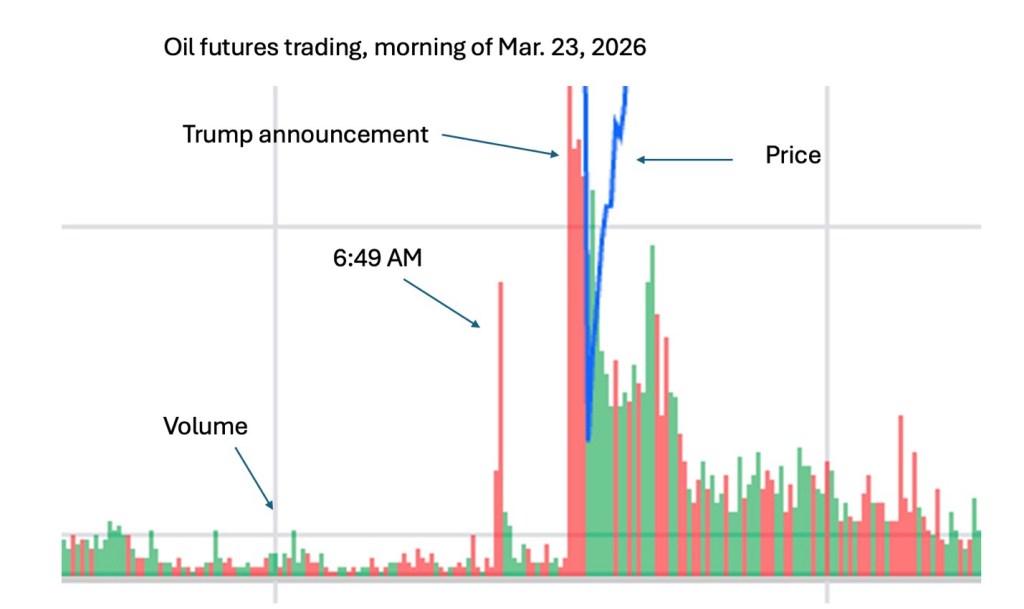
Source: Yahoo Finance


Over the weekend Donald Trump threatened dire vengeance on Iran unless its government opened the Strait of Hormuz within 48 hours, a deadline that would expire Monday evening in Washington. Specifically, he announced that the U.S. would begin bombing power plants — plants that supply electricity to Iran’s civilian population — unless the Strait was cleared.

But at 7:05 AM Monday Trump called the whole thing off — for five days, he said, but many people are assuming that the threatened action, which would have been a massive war crime, is now off the table.

The reason for the about-face, he claimed, was that the U.S. was engaged in productive negotiations with Iranian officials — although this seems to have come as news to the Iranians, who denied that any such negotiations are taking place. Sad to say, in this case, as I tried to explain yesterday, the fanatical, brutal Iranian regime is more credible than the president of the United States. Is he lying or living in a fantasy world? Neither possibility is comforting.

But in any case, Trump’s sudden climb-down was startling. Who could have seen this coming?
The answer is, the person or people who bought large quantities of stock market futures and sold large quantities of oil futures around 15 minutes before Trump’s announcement. As CNBC reports,

At around 6:50 a.m. in New York, S&P 500 e-Mini futures trading on the CME recorded a sharp and isolated jump in volume, breaking from an otherwise subdued premarket backdrop. With thin liquidity typical of early trading hours, the sudden burst stood out as one of the largest volume moments of the session up to that point.
A similar pattern was observed in oil markets. West Texas Intermediate May futures also saw a noticeable pickup in trading activity at roughly the same time, with a distinct volume spike interrupting otherwise quiet conditions.

This “sharp and isolated jump in volume” — which you can see for the oil futures market in the chart at the top of this post — was especially bizarre because there were no major news items — no major publicly available news items — to drive sudden big market transactions. The story would be baffling, except that there’s an obvious explanation: Somebody close to Trump knew what he was about to do, and exploited that inside information to make huge, instant profits.

This wasn’t the first time something like this has happened under Trump. There were large, suspicious moves in the prediction market Polymarket before previous attacks on Iran and Venezuela. But this front-running of U.S. policy was really large: the Financial Times estimates the sales of oil futures in that magic minute Monday morning at about $580 million, and that doesn’t count the purchases of stock futures.

When officers of a company or people close to them exploit confidential information for personal financial gain, that’s insider trading — which is illegal. But we have another word for situations in which people with access to confidential information regarding national security — such as plans to bomb or not to bomb another country — exploit that information for profit. That word is “treason.”

Why is profiting from insider information about national security decisions effectively a form of treason? First, it’s hard to think of a more fundamental principle for officials we entrust with important decisions, especially those that involve national security, that they or people they know should not be allowed to exploit their positions for personal gain.

Second, financial trading based on what should be closely held secrets reveals information to current or potential foreign adversaries. To exaggerate a bit, but only a bit, who needs to bribe agents within the government, or recruit them with honey traps, when you can infer the same information by keeping track of transactions on futures markets?

Finally, there isn’t that big a gap between using knowledge of national secrets to make lucrative financial trades and simply selling those secrets to the highest bidder. Once you’re breached the line that says you shouldn’t profit personally from access to information that is or should be highly classified, the line between trading based on state secrets and selling those secrets directly is a blurry one.

In fact, I’d very much like to know exactly who was making those trades yesterday morning. Were they people directly in the know, or billionaires/traders who paid people in the know for tips?

I’m sure we’ll find out once Kash Patel’s FBI carries out its careful, no-holds-barred investigation.

For the humor-impaired, that was a joke. However, I do believe that the culprits will be easy to determine once Democrats are back in power, and they must apply the full force of law to the people responsible.

One question that may be harder to resolve is the extent to which the possibility of insider trading may actually have influenced policy. Are decisions about war and peace in part serving the cause of market manipulation rather than the national interest? If you dismiss this as unthinkable, you just haven’t been paying attention.

There’s a broader lesson here: You can’t trust a corrupt government to protect national security. And our government is now utterly corrupt: It’s hard to find a single senior official, from the president on down, who treats public office as a grave responsibility rather than an opportunity for personal self-aggrandizement and profit.

Among other things, deeply corrupt governments tend to be very bad at waging war, no matter how much they may exalt “warrior ethos” and “lethality.” When we do a post-mortem on how the Iran debacle happened, arrogant ignorance may still get top billing. But grotesque venality will come a close second.

Thom Hartmann asks a question that many have suspected but were reluctant (or afraid) to say out loud: Is Donald Trump a KGB agent? Does Trump take orders from Putin? How else to account for his close alignment with Putin’s wishes? How else to explain his habit of checking with Putin before he talks to Zelensky? How else to explain his efforts to torpedo NATO? How else to explain his obeisance to Putin? How else to explain the glee he expressed while waiting to meet Putin in Alaska, rolling out the red carpet and pacing excitedly? Why else would Trump put relations with Putin in the hands of personal friends and his son-in-law, not career foreign service officers? Why meetings between them with no one else present to take notes or translate?

This is the only post that will appear today.

Hartmann writes:

Eight of our American service members are dead and over 140 wounded because Iran’s military has suddenly gotten really good at targeting our soldiers, Airmen, and Marines. News reports say they’ve been able to hit us with such precision because Russia is using their extraordinary spy satellite, spy plane, and advanced radar capabilities to help Iran’s military.

The Washington Post, which first reported on this, quoted a Russian military expert as saying that Iran is now “making very precise hits on early-warning radars or over-the-horizon radars,” seeming to validate the concern. The article added:

“Iran possesses only a handful of military-grade satellites, and no satellite constellation of its own, which would make imagery provided by Russia’s much more advanced space capabilities highly valuable — particularly as the Kremlin has honed its own targeting after years of war in Ukraine…”

When asked about the reports, Trump — who’d just returned from the soldiers’ bodies’ dignified transfer — basically downplayed Russian efforts to hurt Americans, just like he did when he learned in 2020 that Putin was paying Afghan insurgents a bounty to kill our soldiers. He pointed out that the US had been sharing intelligence with Ukraine during the Biden administration, so apparently, according to him, Russia is justified in helping Iran kill American service members:

“They’d say we do it against them. Wouldn’t they say that we do it against them?”

His fellow real estate billionaire, Steve Witkoff (whose sons are making billions with Trump’s sons in the Middle East and has been regularly traveling to Moscow for private meetings with Putin) similarly shrugged off the report, tellingCNBC:

“I can tell you that yesterday, on the call with [President Trump], the Russians said they have not been sharing. That’s what they said. So, we can take them at their word, but they did say that.” Witkoff later added, “Let’s hope that they’re not sharing.”

Putin himself, though, was nowhere near as circumspect, saying:

“On my part, I want to confirm our unwavering support of Tehran and our solidarity with our Iranian friends. Russia has been and will remain the Islamic Republic’s reliable partner.”

As if to confirm that Trump is Putin’s toady, just last week, in the wake of Iran shutting off the Strait of Hormuz and cutting oil supplies to Asia and the Subcontinent, our president signed a waiver to our Russia sanctions so Putin can now sell unlimited amounts of Russian oil directly to India.

Every time Putin says “Jump,” Trump asks, “How high?”

Which raises the question: “Why? Why does Trump always give Putin whatever he wants and why is he so terrified of speaking out against him?”

Is it possible that Trump is actively working for Putin? What if Putin somehow owns him? Or is blackmailing him? And has been running him as an Russian asset since at least 2017?

That sort of treason would be more important than Russian agents Robert Hanssen (life without parole), Aldrich Ames (life without parole), or Ethel and Julius Rosenberg (death penalty).

And let’s not forget that right after Trump won re-election in November of 2024, Russian state TV published explicit nudie pictures of Melania Trump and their anchors were laughing about it and at Trump. Was this Putin’s first assertion this cycle that he still owns Donald?

Jack Smith’s case in Florida was limited to Trump stealing sensitive documents and sharing them on two publicly known occasions (and didn’t even reference other known acts like Kid Rock’s allegation that Trump showed him Top Secret maps in the White House: this was apparently a regular thing for Trump).

That said, you can bet your bottom dollar that the FBI and other agencies worked as hard as they could to contain the damage done by Trump’s leaving documents that could cause “grave damage” to America in public places where spies could simply waltz in and take cell-phone pictures of them by attending a wedding or paying $200,000 for essentially unlimited access Club membership.

But what if it goes beyond that? What if Putin has owned him for years?

From Russian oligarchs laundering money through Trump’s operations — real estate is the most common device used worldwide for money laundering — to keeping him alive in his most difficult times, like those multiple bankruptcies in the 1990s when he almost lost everything?

Or perhaps blackmailing him?

What if Putin got him the presidency, and he knows that if America found out for sure, it would destroy him? Or has Epstein’s videos of Trump with underage girls? Or his own pictures, taken when Trump was in Moscow for one of his beauty pageants? 

Which begs the question: exactly how much damage might Trump have already done to our nation, and what does he have planned for the next three years of this second term?

And is he getting ongoing day-to-day instructions from Putin, which explains why he’s so reluctant to discuss their conversations, as Rachel Maddow recently documented?

In 2019 The Washington Post revealed that, throughout his last presidency, Donald Trump was having regular secret phone conversations with Russia’s President Putin (over 20 have been identified so far, including one just days beforethe 2020 election).

The Moscow Project from the American Progress Action Fund documents more than 270 known contacts between Russia-linked operatives and members of the Trump campaign and transition team, as well as at least 38 known meetings just leading up to the 2016 election.

The manager of his 2016 campaign, Paul Manafort — who was previously paid tens of millions by Vladimir Putin’s people to install a pro-Putin puppet as Ukraine’s president in 2010 — has admitted that he was regularly feeding secret inside-campaign strategy and polling information to Russian intelligence via the oligarch who typically paid him on their behalf.

Throughout the campaign, Manafort let Russian intelligence know where Trump needed help, and when, and it appears Russia jumped in to social media to provide the needed help.

Trump pardoned Manafort, which got him out of prison and ended any investigations. He’s still fabulously rich from his work for Russia.

As The New York Times noted in 2020:

“[I]nvestigators found enough there to declare that Mr. Manafort created ‘a grave counterintelligence threat’ by sharing inside information about the presidential race with Mr. Kilimnik and the Russian and [pro-Russian] Ukrainian oligarchs whom he served.”

There is no known parallel to this behavior by any president in American history — one could argue it easily exceeds Benedict Arnold’s audacity — and bringing documents to Mar-a-Lago was just the tip of the iceberg.

The Washington Post reported in 2022 that Trump had a habit of carrying top-secret information that could severely damage our national security, leaving it in hotel rooms in hostile nations.

Was he bringing these documents with him to sell? Or just to show to leaders or oligarchs in those countries to impress them? Or because Putin, who has agents in those countries, told him to?

Trump doesn’t put all that effort into hauling things around unless it’s extraordinarily important to his ego or he thinks he can makes money off them. Or he’s scared.

“Boxes of documents even came with Trump on foreign travel,” The Post noted, “following him to hotel rooms around the world — including countries considered foreign adversaries of the United States.”

When Robert Mueller’s FBI team tried to investigate Trump’s ties to Russia and his possibly sharing sensitive military information with them, they were stonewalled.

The Mueller Report identified ten specific instances of Trump himself trying to obstruct the investigation, including offering the bribe of a pardon to Paul Manafort, asking FBI Director Comey to “go easy” on General Flynn after his dinner with Putin, and directing Attorney General Jeff Sessions to limit Mueller’s ability to investigate Trump’s connections to Russia.

As the Mueller Report noted:

“The President launched public attacks on the investigation and individuals involved in it who could possess evidence adverse to the President, while in private the President engaged in a series of targeted efforts to control the investigation.

“For instance, the President attempted to remove the Attorney General; he sought to have Attorney General Sessions un-recuse himself and limit the investigation; he sought to prevent public disclosure of information about the June 9, 2016 meeting between Russians and campaign officials; and he used public forums to attack potential witnesses who might offer adverse information and to praise witnesses who declined to cooperate with the government.”

It adds, detailing Trump’s specific Obstruction of Justice crimes:

“These actions ranged from efforts to remove the Special Counsel and to reverse the effect of the Attorney General’s recusal; to the attempted use of official power to limit the scope of the investigation; to direct and indirect contacts with witnesses with the potential to influence their testimony.”

There are, after all, credible assertions from American intelligence that when Trump was elected, members of Russian intelligence and Putin’s inner circle were literally partying in Moscow, celebrating a victory they believed they made happen.

And apparently Putin and his intelligence operatives had good reason to be popping the champagne in November, 2016. They were quickly paid off in a big way.

In his first months in office, Trump outed an Israeli spy to the Russian Ambassador in what he thought was going to be a “secret Oval Office meeting” (the Russians released the photo to the press), resulting in MOSAD having to “burn” (relocate, change identity of) that spy.

The undercover agent was apparently working in Syria that year against the Russians, who were embroiled in the midst of Assad’s Civil War and indiscriminately bombing Aleppo into rubble.

That, in turn, prompted the CIA to worry that a longtime American spy buried deep in the Kremlin was similarly vulnerable to Trump handing him over to Putin.

As CNN noted (when the story leaked two years later):

“The source was considered the highest level source for the US inside the Kremlin, high up in the national security infrastructure, according to the source familiar with the matter and a former senior intelligence official.

“According to CNN’s sources, the spy had access to Putin and could even provide images of documents on the Russian leader’s desk.”

The CIA concluded that the risk Trump had burned or was about to burn our spy inside the Kremlin was so great that — at massive loss to US intelligence abilities that may even have otherwise helped forestall the invasion of Ukraine — they pulled our spy out of Russia in the first year of Trump’s presidency, 2017.

Similarly, when they met in Helsinki on July 16, 2018, Trump and Putin talked in private for several hours and Trump ordered his translators’ notes destroyed; there is also concern that much of their conversation was done out of the hearing of the US’s translator (Putin is fluent in English) who may have been relegated to a distant part of the rather large empty ballroom in which they met.

The Washington Post reported, after a leak six months later, that when Trump met privately for those two hours with Putin the CIA went into “panic mode.” A US intelligence official told the Post:

“There was this gasp’ at the CIA’s Langley, Virginia headquarters. You literally had people in panic mode watching it at Langley. On all floors. Just shock.”

Three weeks after Trump’s July 16, 2018 meeting with Putin in Helsinki, Senator Rand Paul made a solo trip to Moscow to personally hand-deliver a document or package of documents from Trump to Putin. Its contents are still unknown, although Paul told the press it was a “personal” letter of some sort.

Senator Paul has also consistently taken Trump’s and Putin’s side with regard to the Ukraine war: he single-handedly blocked a $40 billion military aid package in the Senate. When the FBI searched Mar-a-Lago, he responded with a call for the repeal of the Espionage Act. He further suggested the FBI may have “planted” Secret documents at Mar-a-Lago.

Ten days after Paul’s trip to Moscow, The New York Times reported that the CIA was freaked out because their sources inside Moscow had suddenly “gone silent”:

“The full reasons the sources have gone silent are not known,” the Times reported, but Trump having intentionally given a man working for the FBI to Putin — a man whose job at that time was to find and reveal Russian agents involved in or close to the Trump campaign — may also have had something to do with it:

“[C]urrent and former officials said the exposure of sources inside the United States has also complicated matters,” noted the Times. “This year, the identity of an F.B.I. informant, Stefan Halper, became public after [Trump-loyal MAGA Republican] House lawmakers sought information on him and the White House allowed the information to be shared. Mr. Halper, an American academic based in Britain, had been sent to talk to Trump campaign advisers who were under F.B.I. scrutiny for their ties to Russia.”

Things were picking up the following year, in 2019, as Putin was planning his invasion of Ukraine while Trump was preparing for the 2020 election.

In July 2019, Trump had conversations with five foreign leaders during and just before a presidential visit that month to Mar-a-Lago; they included Putin and the Emir of Qatar.

In one of those conversations, according to a high-level US Intelligence source, Trump “made promises” to a “world leader” that were so alarming it provoked a national security scramble across multiple agencies.

As The Washington Post noted in an article titled, “Trump’s communications with foreign leader are part of whistleblower complaint that spurred standoff between spy chief and Congress”:

“Intelligence Community Inspector General Michael Atkinson determined that the complaint [against Trump] was credible and troubling enough to be considered a matter of ‘urgent concern,’ a legal threshold that requires notification of congressional oversight committees.”

On the last day of that month, July 31, Trump had another private conversation with Putin.

The White House spokespeople told Congress and the press that Trump said that he and Putin discussed “wildfires” and “trade between the nations.” No droids in this car…

But the following week, on August 2nd, The Daily Beast’s Betsy Swan reported that Trump had that week asked the Office of the Director of National Intelligence for a list of all its employees (including all our “spies”) who had worked there more than 90 days, and the request had intelligence officials experiencing “disquiet.”

Perhaps just by coincidence, months after Trump left office with cases of classified documents, The New York Times ran a story with the headline Captured, Killed or Compromised: C.I.A. Admits to Losing Dozens of Informants:

“Top American counterintelligence officials warned every C.I.A. station and base around the world last week,” the Times’ story’s lede began, “about troubling numbers of informants recruited from other countries to spy for the United States being captured or killed, people familiar with the matter said.

“The message, in an unusual top secret cable, said that the C.I.A.’s counterintelligence mission center had looked at dozens of cases in the last several years involving foreign informants who had been killed, arrested or most likely compromised. Although brief, the cable laid out the specific number of agents executed by rival intelligence agencies — a closely held detail that counterintelligence officials typically do not share in such cables.”

And now, to complicate matters, it appears Elon Musk took with him access to the payroll records of all of our nation’s spies and other foreign intelligence agents. The Elon Musk who, himself, The Wall Street Journal reports has also reportedly been having his own secret conversations with Putin.

If it turns out that Trump has been acting as an agent for Russia, how long might this have been going on?

Czechoslovakia’s Státní bezpečnost (StB) first started paying attention to Trump back in 1977, as documented by the German newspaper Bild when the StB’s files were declassified, because Trump married Czech model Ivana Zelnickova, his first wife, recently buried on his golf course in New Jersey.

Czechoslovakia at that time was part of the Warsaw Pact with the Soviet Union, and Ivana and her family had been raised as good communists. Now that a Czech citizen was married into a wealthy and prominent American family, the StB saw an opportunity and started tracking Trump virtually from his engagement.

As 2016 and 2018 investigations by The Guardian found:

“Ivana’s father, Miloš Zelníček, gave regular information to the local StB office about his daughter’s visits from the US and on his celebrity son-in-law’s career in New York. Zelníček was classified as a ‘conspiratorial’ informer. His relationship with the StB lasted until the end of the communist regime.”

An investigative reporting breakthrough by Craig Unger for his book American Kompromat led Unger to Uri Shvets, a former KGB spy who’d been posted to Washington, DC for years as a correspondent for the Soviet news agency TASS.

Shvets told the story — from his own knowledge — of how Trump and Ivana visited Moscow in 1987 and were essentially recruited or seduced by the KGB, a trip corroborated by Luke Harding in his book Collusion: Secret Meetings, Dirty Money, and How Russia Helped Donald Trump Win.

Their trip was coordinated by Intourist, the Soviet travel agency that was a front for the KGB, and the Trumps’ handlers regaled Donald and Ivana with Soviet talking points, presumably about things like the horrors of NATO.

The KGB’s psychological profile of Trump had determined he was vulnerable to flattery and not much of a deep thinker, so they told him repeatedly how brilliant he was and that he should run for president in the US.

Much to the astonishment and jubilation of the KGB, Trump returned from Moscow to the US to give a Republican presidential campaign speech that fall in Portsmouth, New Hampshire.

He then purchased a large ad in The New York Times, The Washington Post, and The Boston Globe on September 1, 1987 that questioned America’s ongoing support of Japan and NATO, both thorns in the side of the USSR and their Chinese allies.

Trump’s ad laid it on the line:

“Why are these nations not paying the United States for the human lives and billions of dollars we are losing to protect their interests? … The world is laughing at America’s politicians as we protect ships we don’t own, carrying oil we don’t need, destined for allies who won’t help.”

As The Guardian reported in 2021:

“The bizarre intervention was cause for astonishment and jubilation in Russia. A few days later Shvets, who had returned home by now, was at the headquarters of the KGB’s first chief directorate in Yasenevo when he received a cable celebrating the ad as a successful ‘active measure’ executed by a new KGB asset.

“’It was unprecedented,’ [Shvets said.] … It was hard to believe that somebody would publish it under his name and that it will impress real serious people in the west but it did and, finally, this guy became the president.’”

Meanwhile, Putin was making friends with powerful influence over American foreign policy.

Turkish President Recep Tayyip Erdoğan, who flipped his nation into a strongman neofascist state following an unsuccessful attempted coup in 2016 (he imprisoned and tortured numerous journalists and political opponents), has been deepening his relationship with Russian President Vladimir Putin ever since that US election year.

In 2017, Erdoğan apparently gained access to America’s deepest secrets by secretly paying off General Michael Flynn even as Flynn became Trump’s National Security Advisor, who also had at least one secret phone conversation with Russian Ambassador Sergey Kislyak after Flynn started working in the White House.

Flynn pleaded guilty in December of 2017 to “willfully and knowingly” making “false, fictitious and fraudulent statements” to the FBI about one of those conversations with Russian Ambassador Kislyak. Flynn was also an unregistered agent of a foreign government while working in the White House: he had taken about a half-million dollars from Erdoğan.

Around the time he was leaving office, Trump pardoned Flynn, essentially burying the entire story.

From campaigning to destroy NATO to selling out Ukraine to letting Russia help kill American soldiers in the Gulf region, Trump’s goal appears to be, to paraphrase Ron DeSantis, to “Make America Russia.”

The big question is, “Why?”
An audit of Arizona voucher funds for home-schools demonstrated that 20% of the purchases by parents were unallowable, spent on consumer items that had nothing to do with education, unless you consider condoms “educational.”

Of some 384,000 transactions from December 2024 to September 2025, about 84,000 were spent on non-educational purposes.

One way to stop this misuse of public funds is to bar those who misspend public funds from participating.

Alexandra Hardle of The Arizona Republic reported:

Audit data shows over 20% of vendor purchases made with Empowerment Scholarship Account dollars could be barred under the program’s guidelines.

The program, run through the Arizona Department of Education allows expenses for homeschooled students under $2,000 to be automatically approved by the department and later audited. But that audit could come months later, a process that Superintendent of Public Instruction Tom Horne has blamed on understaffing.

The program was initially designed primarily for students with disabilities but was expanded to be available for all students in 2022. Many homeschooled students are eligible to receive about $7,000 per year through the program, though money allocated to special needs students can be much higher.

Records released by the Arizona Attorney General’s Office show Arizonans have spent millions of dollars on expenses that appear to fall afoul of the program’s guidelines. A risk-based audit performed by the Department of Education found that 20% of purchases were “unallowed.” A risk-based audit is a financial audit that examines where problems are most likely to happen. In this case, the audit examined a random sample of purchases made through the ESA program.

When the department’s risk-based audit detects “unallowed” purchases, it then performs a full audit of the account to review the account holder’s other purchases. Of the accounts that received a full audit, 46% of the purchases made by those account holders were “unallowable.”

Attorney General Kris Mayes, a Democrat seeking reelection this fall, in a January letter to the Department of Education asked for tighter guardrails on expense approval.

“ADE must do more on the front end to prevent unallowable purchases, and it must do so immediately,” Mayes said in her letter.

Horne declined to comment to The Arizona Republic, saying his office would soon send a letter in response to Mayes.

The Department of Education’s ESA handbook outlines all expenses that cannot be paid for by the program. While many of these expenses slip through the cracks, Horne said in September the department has already recovered about $600,000 during the auditing process.

But Mayes criticized the policy of automatically approving some purchases and auditing them later. That’s given people a “road map for how to game the system,” Mayes said.

What were the ‘unallowable’ ESA purchases discovered in the audit?

One of the heftier purchases was $7,500 in video gaming equipment.

Parents also paid themselves for homeschooling, which is prohibited under the program. One parent paid themselves $5,700, while others kept the payments to below $2,000.

Other expenses forbidden by the ESA handbook included coffee machines, $2,000 in Visa gift cards, a $1,700 diamond necklace and dog training. There were also trips to Mexico, a Kohl’s gift card, scuba diving equipment, swimming pools, condoms and lubrication.

Heather Cox Richardson pulled together the extraordinary events of the past few days. She is the master of the question, “Make it all make sense,” even when it doesn’t. Her commentaries are wildly popular. She has about 3 million subscribers on Substack and an equal number who follow her on Facebook.

President Donald J. Trump is behaving more and more erratically these days, seeming to think he can dictate to other countries.

This morning, Trump told Barak Ravid and Zachary Basu of Axios that he needs to be involved personally in choosing the next leader of Iran. Speaking of Iranian politicians who are preparing to announce a new leader, Trump told the reporters: “They are wasting their time. Khamenei’s son is a lightweight. I have to be involved in the appointment, like with Delcy [Rodríguez] in Venezuela.”

Foreign affairs journalist Olga Nesterova of ONEST reported that in a call with Israel’s Channel 12 this morning, Trump called Israel’s president Isaac Herzog “a disgrace” and demanded Herzog pardon Prime Minister Benjamin Netanyahu “today” because Trump doesn’t want Netanyahu distracted from the war with Iran. Trump said Herzog had “promised” him “five times” to pardon the prime minister, and he appeared to threaten Herzog when he added: “Tell him I’m exposing him.”

In a statement, Herzog noted that “Israel is a sovereign state governed by the rule of law” and said the pardon is being dealt with by the Justice Ministry, as the law requires. After its ruling, Hertzog’s office said, he will examine the issue according to the law and “without any influence from external or internal pressures of any kind.”

In a conversation today with Dasha Burns of Politico, Trump insisted that “[p]eople are loving what’s happening” and said: “Cuba’s going to fall, too.”

The most astonishing example of Trump’s international aggression came from White House press secretary Karoline Leavitt. Although Trump initially said he attacked Iran to keep it from acquiring nuclear weapons, Leavitt yesterday explained that Trump joined Israel in a military attack on Iran because Trump had “a feeling based on fact” that Iran was going to attack the United States.

Trump’s assertion of power globally contrasts with increasing setbacks at home.

Since the Supreme Court struck down the tariffs Trump imposed under the International Emergency Economic Powers Act (IEEPA) as unconstitutional, the administration has tried to slow walk repaying the $130 billion the government collected under those tariffs. But yesterday, Judge Richard Eaton of the U.S. Court of International Trade ruled that companies that paid the tariffs are entitled to a refund.

After the Supreme Court’s decision, Trump immediately imposed new tariffs of 15% on all global trade, using as justification Section 122 of the Trade Act of 1974. As Lindsay Whitehurst and Paul Wiseman of the Associated Press noted, this is awkward because the Department of Justice under Trump argued in court last year that Trump had to use the IEEPA because Section 122 did “not have any obvious application” in fighting trade deficits.

Today the Democratic attorneys general of more than twenty states filed a lawsuit to stop the new tariffs imposed under Section 122. “Once again, President Trump is ignoring the law and the Constitution to effectively raise taxes on consumers and small businesses,” New York Attorney General Letitia James said in a statement Thursday.

The Department of Justice has also quietly backed away from Trump’s demand that it investigate whether former president Joe Biden broke the law by using an autopen to sign presidential documents. Yesterday, Michael S. Schmidt, Devlin Barrett, and Alan Feuer reported in the New York Times that prosecutors in the U.S. attorney’s office in Washington, D.C., “were never quite clear what crime, if any, had been committed by the Biden administration’s use of the autopen.”

They concluded there was no credible case to make against Biden. The journalists noted that “the failed inquiry has only added to the sense among many federal investigators that Mr. Trump has become increasingly erratic in his desire to use the criminal justice system to punish his political adversaries for behavior that comes nowhere close to being criminal.”

Trump had been so invested in his attacks on Biden over his quite ordinary use of an autopen that he replaced a White House picture of Biden with one of an autopen, so the prosecutors’ shelving that investigation has to sting. Likely even more painful, though, is today’s news that Trump’s hand-picked National Capital Planning Commission has put off a vote to approve the ballroom Trump is proposing to replace the East Wing of the White House that he suddenly tore down last October.

At a Medal of Honor ceremony on Monday, Trump called attention to his ballroom and boasted: “I built many a ballroom. I believe it’s going to be the most beautiful ballroom anywhere in the world.” But the American people do not share Trump’s vision. The chair of the commission said “significant public input” has caused him to delay the vote until April 2. Jonathan Edwards and Dan Diamond of the Washington Post say that of the more than 35,000 comments the commission received, more than 97% were opposed to Trump’s plans for the ballroom.

But perhaps the biggest setback for the Trump administration showed in the testimony of now-former secretary of homeland security Kristi Noem before Congress this week. There, days after Trump launched a major military operation in the Middle East without consulting Congress, angry lawmakers of both parties exposed the lawlessness and corruption taking place in the department under Noem’s direction. But their stance was about more than Noem: her lawlessness and corruption represented the larger lawlessness and corruption of the Trump administration.

Noem testified before the Senate Judiciary Committee on Tuesday and the House Judiciary Committee on Wednesday. In both chambers, Democrats jumped right to a central feature of the way in which Noem and the administration are setting up the idea that anyone who opposes the actions of the Trump administration is participating in “domestic terrorism.”

They tried to get Noem to walk back her statements that Renee Good and Alex Pretti, both shot and killed by federal agents acting under her authority in Minnesota, were “domestic terrorists.” Noem refused to do so. She has not actually called them “domestic terrorists” but has said they were engaged in “domestic terrorism,” a distinction that reveals the administration’s attempt to criminalize political opposition. Rachel Levinson-Waldman of the Brennan Center explained that “[t]o actually be called a ‘domestic terrorist, an individual must commit one or more of 51 underlying ‘federal crimes of terrorism,’” which involve nuclear or chemical weapons, plastic explosives, air piracy, and so on. Good and Pretti, and the many others administration officials have accused, do not fit that description. But on September 25, 2025, Trump’s NSPM-7 memo claimed that those opposing administration policies are part of “criminal and terroristic conspiracies” and that those who participate in them are engaging in “domestic terrorism.”

Noem refused to back away from the idea that Trump’s opponents are engaging in “criminal and terroristic conspiracies” by, for example, opposing the behavior of federal agents from Immigration and Customs Enforcement (ICE) and Border Patrol. Leaving that definition behind would undermine the administration’s entire domestic stance.

Democrats slammed Noem for her handling of detentions and deportations, ignoring court orders, and detaining U.S. citizens. In the House, Jamie Raskin of Maryland, the top Democrat on the committee, said she “turned our government against our people, and…turned our people against our government.”

Republicans also called Noem out. Noem’s poor handling of the Federal Emergency Management Agency (FEMA) has left North Carolina still suffering after terrible storms in 2024, and Senator Thom Tillis (R-NC) went after her.

He highlighted a letter from the inspector general for the Department of Homeland Security (DHS), who said the department’s leaders have “systematically obstructed” the work of him and his staff. He identified eleven instances in which the department had refused to provide records and information. In a criminal investigation with national security implications, the department would permit him to access a database only if he revealed details of the investigation of individuals who might be related to the investigation.

Tillis said: “Does anybody have any idea how bad it has to be for the [Office of Inspector General] in this agency to come out and do this publicly? That is stonewalling, that’s a failure of leadership, and that is why I’ve called for your resignation.”

Lawmakers also focused on the corruption in DHS, which now commands more than $150 billion thanks to the Republicans’ One Big Beautiful Bill Act. Lawmakers referred to a November 2025 ProPublica story in which reporters traced a $220 million contract for an ad campaign featuring Noem. The contract went first to a brand new small company organized by a Republican operative just days before winning the contract, and then to a subcontractor, Strategy Group, owned by Noem’s former spokesperson’s husband and closely associated with Noem’s advisor and reputed affair partner Corey Lewandowski.

Noem insisted she had nothing to do with the contract award and claimed Trump had signed off on the ad campaign. About the contract, Representative Joe Neguse (D-CO) commented in apparent disbelief: “You want the American people to believe that this is all above board, that $143 million of taxpayer money just happened to go to this one company that doesn’t have a headquarters, doesn’t have a website, has never done work for the federal government before, and is registered apparently or attached to a residence from a political operative, and of course one of the subcontractors of that contract, as you know, is a political firm that’s tied to, to you back when you were governor of South Dakota?”

Since Noem’s testimony, the Strategy Group released a statement saying it received only $226,137.17 for its work on the ad campaign.

Also under scrutiny was Noem’s purchase of a private plane with a luxurious bedroom in it, which brought up questions about whether, as is widely reported, she is having a sexual relationship with a subordinate. She refused to answer, and insisted Lewandowski had had no role in approving contracts. Joshua Kaplan and Justin Elliott of ProPublica promptly fact-checked her: in fact, Lewandowski has signed off on a number of contracts.

Lawmakers’ indictment of Noem for her extreme partisanship, disregard of the law, corruption, and lying condemned similar behavior from the administration in general. Today Trump told Steve Holland and Ted Hesson of Reuters that he “never knew anything about” Noem’s $220 million ad campaign, suggesting she lied to Congress under oath. This afternoon, just before she went on stage to speak, Trump announced by social media post that he was replacing Noem with Senator Markwayne Mullin of Oklahoma.

This is an assertion of power the president does not have: he can nominate Mullin, but the Senate must confirm or reject his appointment.

Apparently unaware she was fired, Noem proceeded to give a speech in which she recited a false quotation from George Orwell, the writer who devoted much of his work to the importance of manipulating language to facilitate authoritarianism, a fitting end to Noem’s career in the Trump administration.

But Noem is not likely to disappear from the news. Illinois governor J.B. Pritzker recorded a video saying: “Hey, Kristi Noem, don’t let the door hit you on the way out. Here’s your legacy: corruption and chaos. Parents and children tear-gassed. Moms and nurses, U.S. citizens getting shot in the face. Now that you’re gone, don’t think you get to just walk away. I guarantee you, you will still be held accountable.”

Senator Ron Wyden (D-OR) was more direct: “Turns out lawlessness is not a winning strategy,” he posted. “See you at Nuremberg 2.0.”

Notes:

https://www.timesofisrael.com/liveblog_entry/trump-demands-disgraced-herzog-immediately-pardon-netanyahu-so-pm-can-focus-on-iran-war/

https://www.timesofisrael.com/liveblog_entry/responding-to-trump-herzog-says-hes-not-dealing-with-pardon-request-mid-war-will-decide-without-pressures-of-any-kind/

https://www.axios.com/2026/03/05/iran-leader-trump-khamenei

https://www.the-independent.com/news/world/americas/us-politics/trump-iran-war-white-house-briefing-b2931933.html

https://www.independent.co.uk/news/world/americas/us-politics/trump-new-tariffs-lawsuit-b2932816.html

https://www.nbcnews.com/news/us-news/judge-rules-companies-are-entitled-refunds-trump-tariffs-rcna261870

https://www.nbcnews.com/news/us-news/federal-court-rejects-trump-administration-attempt-slow-tariff-refund-rcna261445

https://apnews.com/article/global-15-tariffs-trump-lawsuit-2247451a7cbc9b8283c4574e3ee54537

https://www.washingtonpost.com/politics/2026/03/05/trump-ballroom-federal-review-panel/

https://www.brennancenter.org/our-work/analysis-opinion/labeling-renee-good-domestic-terrorist-distorts-law

https://www.whitehouse.gov/presidential-actions/2025/09/countering-domestic-terrorism-and-organized-political-violence/

https://s3.documentcloud.org/documents/26371599/bondi-memo-on-countering-domestic-terrorism-and-organized-political-violence-1.pdf?inline=1

https://www.reuters.com/world/us/trump-says-he-didnt-sign-off-200-million-border-security-ad-campaign-2026-03-05/

https://abcnews.com/Politics/noem-testifies-house-committee-after-refusing-apologize-labeling/story?id=130752384

https://www.cnbc.com/2026/03/05/trump-cuba-iran-regime-change.html

https://www.politico.com/news/2026/03/05/trump-unleashed-president-bullish-on-iran-eyeing-regime-change-in-cuba-and-impatient-with-ukraine-00814292

https://www.pbs.org/newshour/amp/politics/watch-sen-tillis-calls-for-noems-resignation-as-dhs-head-at-oversight-hearing

https://democrats-judiciary.house.gov/media-center/press-releases/ranking-member-raskin-s-opening-statement-at-hearing-with-homeland-security-secretary-kristi-noem

https://www.politico.com/news/2026/03/04/noem-lewandowski-relationship-tabloid-garbage-00813182

https://www.wsj.com/politics/policy/inspector-general-says-kristi-noems-dhs-has-systematically-obstructed-its-work-32496cfe

X:

Acyn/status/2029257090318086439?s=20

Bluesky:

onestpress.onestnetwork.com/post/3mgdd4r4s6c2l

atrupar.com/post/3mgdrq3x6tt2y

jakelahut.bsky.social/post/3mgdh7ws2es2e

qjurecic.bsky.social/post/3mgdjcjtxcp2l

govpritzker.illinois.gov/post/3mgdiung2uk2n

wyden.senate.gov/post/3mgdivc4oxs2n

atrupar.com/post/3mgcyn6zyg22m

Timothy Snyder left his endowed professorship at Yale University and is now ensconced at the University of Toronto, where he holds the inaugural Chair in Modern European History at the Munk School of Global Affairs and Public Policy. Snyder is known for his many books about European history.

After Trump’s long and tedious State of the Union speech, Snyder wrote this satirical description of a Cabinet meeting.

He begins:

Donald Trump, president of the United States. “Calling this meeting to order. That was a long speech that I just gave. State of the Union. Long speech. Not going to stand up and do that again next year. So let’s hear it. Plans to make sure I don’t have to. Plans to end the United States by a year from now. Around the table. Go. Start us off, Linda.”

Linda McMahon, Education. “Thank you, sir. Nothing is more important for the country than public schools. So we are destroying them by directing tax money away from public school parents and towards private education scams.”

Russ Vought, Management and Budget. “The republic depends on its institutions. As you know, sir, we are wrecking our civil service by firing those who are qualified and replacing them with political hacks. I don’t want to overstate my case, sir, but these are not just normal hacks. They are hackety-hacks, sir. They will use what remains of the government to hasten the process of its destruction. Hackety-hack, sir.”

Trump. “Good. Hack. Good. But maybe something faster.”

Scott Bessent, Treasury. “A government works on the basis of tax revenue. From the beginning of your administration, sir, we have been overseeing a shift whereby people who actually have the money won’t pay any taxes. Indeed, our oligarchs will be the happy recipients of whatever tax money we can scrape up from the middle and working classes. This wealth shift from the population at large to the wealthy few is inconsistent with the survival of a republic. This will help speed along the change Russ is talking about.”

Howard Lutnick, Commerce. “And there’s a next step, if I may, sir. When we empower the oligarchs they can help us. Big tax cuts make them happy and destructive. The endgame here, sir, is to have billionaires control extraterritorial zones, like Epstein Island, a place that I know well, but without any fear of taxation or any other form of government control. These little fiefs then replace the United States. This is the scenario and I do think we can bring it home within a year.”

Pam Bondi, Attorney General. “And a republic is based upon law. This is where Justice comes in. We can ruin law in a number of ways, such as investigating the people we ourselves murdered, or persecuting your personal enemies. A good way to kill our Constitution is to protect pedophile oligarchs, such as yourself, sir. I was attorney general in Florida while Epstein pioneered our future, sir, and I can see this through on a national scale. We can make this Epstein World, sir.”

Trump. “I like it. But that’s familiar stuff. I mean I live there now, right. Let’s see some movement. How about some color.”

silhouette of building under orange clouds

RFK Jr, Health and Human Services. “There was a lot of color in the middle ages, sir. Our freedom and security are based on modern vaccinations and hygiene. We undo all of that and promote epidemics. We see good results already in Texas and South Carolina. Not just people dying but babies and children getting really colorful diseases like encephalitis. By the way, this also opens up wellness markets for the people Howard and Scott are talking about. It takes people a while to die and there is money to be made there.”

Doug Burgum, Interior. “I may have something even more basic than that, sir. Everything we know about human history indicates that rapid changes in climate can bring down whole civilizations. We are deliberately engineering one of those. By suppressing green energy we can generate rapid global warming and make human life unsustainable. And along the way we get that color. People turning against each other, guns out until we run out of ammunition, then clubs, starvation, the works, a real spectacle. And, as Bobby says, disease. Very colorful, sir.”

Lee Zeldin, Environmental Protection. “And, if I may add, sir, our campaign to fry the species gives us all good practice in telling big lies, which are needed for all of these plans. Also, the billionaires will be fine on their islands when all of this happens.”

Trump. “OK, that’s colorful, I get it, but I want something with bad guys. Like a movie. The warming thing doesn’t work as a movie. Do you remember The Day After Tomorrow. I don’t remember the Day After Tomorrow. I want enemies. Bad guys who win.”

Marco Rubio, State. “I can help there. You are right, sir, that a republic to survive has to defend itself against autocratic enemies. So we empower the autocrats in China and Russia. We break the international system that held them back. We prop up Moscow in Ukraine and we give Beijing our most sensitive technology, ideally by way of middlemen who enrich you, sir, personally. If I may say so, sir, your friends and family have been very helpful in all of this.”

Tulsi Gabbard, National Intelligence. “Intelligence is the eyes and ears of our republic, sir, and we want these eyes and ears to be penetrated by foreigners who wish for us to fail and die. So we have liftedour cyber-defenses and announced that we have done so. If I may add, sir, both Russia and China support your incredible leadership in their information ops. It’s as though we all want the same thing. I see it every day and it’s beautiful. Spirit of Aloha. We say hello and they say goodbye…”

Kristi Noem, Homeland Security. “Without disagreeing with any of that, I just wanted to add that a republic exists because people believe they belong to a single nation. So the most direct way to kill our republic is a civil war. This almost worked the last time; this time we are getting the federal government behind white supremacy. We are creating a giant national secret police force in order to invade cities and force a conflict.”

Pete Hegseth, Defense. “Kristi is right. The war we can win is against Americans. And now that we are bringing unsupervised AI to direct our weapons, we won’t have to start it ourselves. It will be automated, we just watch from those safe islands. You see, sir? Movies. Terminators. Squiddies. Remember Wargames, sir, shall we play a game? AI likes nuclear war, it will recommend it 95% of the time. Get me into a conventional war, I lose it quickly, and boom. That would save you from having to give the speech, sir.”

Trump. “I like it. No long speeches. No Union. Steal what we can and burn the rest. Or burn first and then steal? Works either way. Steal, burn. Either way. Burn, steal. To help out I will just be me. Steal, burn. Me. Burn, steal. Me.”

(Applause)

•••

The conversation is fictional, of course. In essence, though, this is little more than a review of the news of the last few days and weeks.

Andy Spears of The Education Report tells the sad tale of unbridled fraud in Arizona’s voucher program.

In 2018, voters in Arizona overwhelmingly rejected expansion of the state’s voucher program. Despite the decisive vote against vouchers, the legislature made vouchers available to every student, regardless of income or need.

Today about 7-8% of the state’s students use vouchers at an annual cost nearing $1 billion a year.

Most of the voucher students never attended public schools. In other words, the universal voucher program is mostly subsidizing the tuition of students already enrolled in private and religious schools.

He writes:

Save Our Schools Arizona reports on the rampant fraud in that state’s school voucher scheme:

Arizona Republican leaders and Superintendent Tom Horne have long insisted that fraud in Arizona’s ESA voucher program is minimal. “One percent or less,” Horne often has said — but 12News has obtained new public records from Horne’s AZ Dept. of Education (ADE) that tell a very different story. Documents show unallowable purchases — spending explicitly banned under ESA voucher program rules — may account for about 20 percent of transactions. That’s one in five.

In 2025, 12News Investigates revealed parents used ESA voucher funds for non-educational purchases, including: diamond rings, smart TVs, gift cards, large appliances, luxury clothing, and lingerie.

These purchases are among more than 100 prohibited items listed in the ESA Parent Handbook. Accounts that make such purchases are supposed to be suspended or removed from the program by the ADE. However, according to 12News, “the spending continues as Horne contends his department uses risk-based auditing that will eventually catch wrongdoing.”

84,000 unallowable purchases??? 12News found an ADE memo covering ESA voucher spending from December 2022 through last September found that of 385,000 ESA purchases reviewed by Horne’s ADE, nearly 84,000 were deemed unallowable — or more than 20 percent of all transactions that should have been refused by the ADE!

Greg Palast and Thom Hartmann write together about the Trump administration’s early steps to rig the vote in 2026 and 2028.

The Republican-sponsored SAVES act has been passed by the House but not the Senate. It would cancel online registration. It requires voters to present a birth certificate or a passport. Millions of American citizens do not have either. Women, in particular, would be disadvantaged because the name on their birth certificates do not match their married names. .

Like me, you probably read that the FBI raided the office of the Fulton County voting headquarters in an effort to prove that the 2020 election was rigged. Just another evidence of Trump’s paranoia.

No, say the authors. That’s a cover story. The truth, they say, is that the raid was intended to rig the elections of 2026 and 2028. It was part of the GOP’s long-running effort to cancel the votes of Blacks and students, groups that favor Democrats.

Palast and Hartmann write:

For god’s sake, let’s get to the REAL agenda behind Wednesday’s-FBI raid on the Fulton County elections office. IT’S NOT ABOUT THE 2020 ELECTION. The warrant says the FBI wants the envelopes from the 2020 election to hunt for crimes. But that’s just the legal excuse for the storm trooping.

This is NOT, as the media seems to think, about Trump’s attempt to prove he won the 2020 race, as if he’s some political Captain Ahab was trying to chase the Moby Dick of 2020 revenge.

This is all about 2026 and 2028. Look at a map. Fulton County is the heart of “Blacklanta.” And Atlanta is the electoral heart of Georgia. And Georgia is the swingiest of swing states. If Republicans don’t cut down the Black vote in Atlanta, they lose the crucial seat now held by Democratic Sen. Jon Ossoff. And in 2028, the GOP, if they don’t suppress the vote in Fulton, they lose the White House. Fulton was the fulcrum of Trump’s loss in 2020 and could spell doomsday for Republicans in 2028.

So, how exactly do you stop Fulton County Black folk (and the LGBTQ community and the hipsters who left rural Georgia because they hate their parents) from voting? The answer is in one word: DROP-BOX.

Surveillance footage of a drop box in Atlanta, used in the film 2000 Mules as evidence of a “mule” whom filmmaker Dinesh D’Souza claimed was paid to stuff this and 26 other ballot boxes. According to D’Souza, this was “the smoking gun! O.J. Simpson…leaving the scene of a crime!” But it doesn’t show anything more than a Black man voting.

Follow me on this.

First, let me explain to my White readers a fact about African-Americans: In the majority, they vote early, having suffered the cruel absurdity of six-hour lines on Election Day. (And remember, it’s a FELONY crime in Georgia to give an elderly voter standing in line, thirsty a bottle of water). From long, sad experience, Black voters have learned to use early voting opportunities, especially mail-in ballots that can be placed in a drop-box.

For example, in the election run-off following the 2020 vote, which put two Georgia Democrats into the US Senate, over a million mail-in ballots (1,084,021) were cast, mainly in drop-boxes, mostly in Fulton/Atlanta.

Republicans took note. So, in a bill signed by GOP Governor Brian Kemp, the infamous SB202, the state declared all-out war on early voting, especially early votes placed in secure drop-boxes.

First, the state slashed the number of drop-boxes allowed in Atlanta and Savannah the two big cities with the urban Black population, by 77%.

Early voting days, when you can use the drop box, were cut from 60 to just seven (!). And drop boxes — meant to serve voters who can only vote when they get off work at night — were sealed up at night in state office buildings.

The result, not reported by a single US outlet (except, God bless him, Thom Hartmann) was that the number of mail-in ballots cast dropped by 83% — 83%! — from over a million to 0.2 million (191,286) by the run-off of 2022.

Why? It goes back to what Donald Trump calls, correctly, one of the most influential documentaries of all time: 2000 Mules. The film, premiered by Trump at Mar-a-Lago, accused 2000 Black men of taking $10 from George Soros, Mark Zuckerberg and Stacey Abrams to stuff drop-boxes with tens of thousands of fraudulent ballots, especially in Fulton County. It was the perfect Sturm for the right, a stimulating concoction of racism and anti-Semitism.

There wasn’t a bit of evidence, of course, but it looked convincing to MAGA-nauts. Every single drop-box in Georgia has a video camera over it to prevent fraud, and the videos are public. So, the Trump front called True the Vote, showed videos of Black men “stuffing” the drop boxes with extra ballots.

Except it wasn’t true. The “star” criminal was a Black man accused of “running from the scene of crime like OJ Simpson.” In fact, the Georgia Bureau of Investigation, which is Republican controlled, ran all over the state to arrest each Black alleged ballot stuffer (a felony crime) — but found that every one, EVERY ONE, was a legal voter. The man accused of thievery was Mark Andrews, who is a Verizon executive who legally dropped his family’s ballots in the drop box. But, as LaTosha Brown, co-founder of Black Voters Matter says, “He was seen guilty of a crime because he was Black.” That, literally, was the only “evidence” of the crime.


Note: I want you to see Mark Andrews, supposed Black “criminal” supposedly caught in the act of VWB, Voting While Black. Next Thursday, February 5, at 6:30pm Central time (4:30pm Pacific), chapters of Indivisible will host a special online showing of my film, Vigilantes Inc., America’s New Vote Suppression Hitmen, which rips Trump’s True the Vote a new one. If you’re in the Chicago area, you can attend the live showing with Q&A to follow.

Early voting, mail-in voting and casting an early vote in a drop were the keys to Joe Biden’s victory in 2020, key to a huge surge in minority and student votes nationwide.

And massive suppression of early, mail-in and drop-box votes were key to Trump’s triumphant return. (Did anyone note that, seen from the Oval, the demolition of the East Wing only leaves the Right Wing.)

Following the 2020 election, over 20 Red States passed laws eliminating or restricting drop-boxes. And in every single case, legislators cited the bullshit “evidence” of 2000 Mules. Fact check: The state of Georgia recounted and reviewed every single Fulton County drop-box and mail in ballot and didn’t find one single forged ballot. Every vote had an identified, verified vote. Not ONE ballot.

White Democrats don’t seem to understand how important early drop-off votes mean to Black and student communities. But the Republicans understand it completely. In fact, GOP Texas Attorney General Ken Paxton said that, had he not gone to court and stopped Houston from mailing out absentee ballots to all voter, “Donald Trump would have lost Texas.” Texas! (Note: Houston has the largest number of Black voters of any city in America.

By seeking every envelope from drop-box and absentee voters, Attorney General Pam Blondi is saving her job by saving the GOP from the voters’ wrath. The game is to force a state (i.e. Republican) takeover of Fulton County voting (possible under SB 202). And you can’t separate the invasion of Atlanta voting offices from the Purge’n General Blondi’s demand that Minnesota hand over its voter rolls.

The underlying purpose of Blondi’s seizure of Minnesota’s voter files is the restoration of two other racially poisonous vote suppression tricks. One is the return of the “Interstate Crosscheck” purge program and its sister, the purge of “aliens” from the rolls. Interstate Crosscheck cost nearly one million voters their registrations in 2016, key to Trump’s first election. Crosscheck was ruled illegal through a grassroots campaign led by the Rev. Jesse Jackson, Sen. Bernie Sanders and litigation brought by PUSH, the NAACP and the ACLU based, I’m proud to say, on the evidence presented to the courts by the Palast Investigative Fund. But. now, Crosscheck is BAAAACK! Want to know about Crosscheck. Read my investigation for Rolling Stone.

And there’s the canard of allegedly MILLIONS of alien voters swimming the Rio Grande just to vote for Democrats. When Florida used the ICE lists to purge 187,000 (!) voters from the rolls, mostly Hispanics, it turns out only ONE was an illegal alien: A Republican from Austria.

But that’s a story for another day — and for our film, Vigilantes Inc. Grab some popcorn and save America.


The Palast team is preparing to launch a full-scale, national investigation of vote suppression in coordination with PUSH, Black Voters Matter Fund, the NAACP and the Transformative Justice Coalition. But dammit, we can’t do it without funding. We don’t need a lot, but if you don’t stand up and help, who will?

Greg Palast Investigates is a reader-supported publication. To receive new posts and support our work, consider becoming a free or paid subscriber.

Originally posted on

Greg Palast Investigates

Greg Palast

Investigative journalist and author of the NY Times bestsellers Armed Madhouse + The Best Democracy Money Can Buy. See my latest film at: https://WatchVigilantesInc.com

Carol Burris, executive director of the Network for Public Education, is an expert on charter schools and charter legislation. For the past decade, she has studied the charter school movement, state charter laws, and federal funding for charters and the consequences of those laws and funding more closely than anyone I know.

She wrote the following article, which was published in the current issue of The Progressive:

More than thirty years have passed since nineteen states first embraced charter schools as laboratories of innovation, and the evidence is clear: The model has broken down. Public trust has sharply eroded. School closures are routine, leaving students stranded and families frustrated. And nearly every day brings yet another charter school scandal.

The second installment of “Charter School Reckoning: Disillusionment,” a three-part report by the National Center for Charter School Accountability, reveals that the very structure of this sector—rather than merely isolated bad actors—is what enables mismanagement, profiteering, and instability at high cost to students and taxpayers. The need to rewrite charter laws is no longer a matter of debate; it is a matter of protecting students, taxpayers, and the public trust.

Roughly half of all charter schools by the 2018-19 school year were operated by management corporations, both for-profit and nonprofit. In Michigan, for-profit operators run 70 percent of the state’s charter schools. In Ohio and Florida, for-profits run half. Nevada’s, North Carolina’s, and South Carolina’s for-profit-run school sectors are quickly increasing. Charter schooling is now an industry, not a public school reform.

This growth in corporate chartering has been accompanied by the expansion of complex real estate and contracting structures. These arrangements are not incidental; they are built into the fabric of many charter school laws. In nearly every state, management companies can own school buildings, set their own lease terms, and collect “management fees” that reach 10 percent to 25 percent of a school’s total revenue. Through these related-party transactions, companies maximize profits, siphoning off funding that should be benefitting students.

In every state, authorizing entities that issue charters for schools are responsible for ensuring that the school is fiscally sound, well-managed, and that students are achieving. According to the new report, authorizers “decide who can start a new charter school, set academic and operational expectations, and oversee school performance. They also decide whether a charter should remain open or closed at the end of its contract.” Unfortunately, fee incentives, multiple authorizers, and political appointees to state authorizing boards often make the authorization process vulnerable to corruption and mismanagement. 

In 25 percent of states with charter school laws, four or more types of organizations—including universities, nonprofits, struggling colleges, junior colleges, school districts, and state agencies—are permitted to authorize charters to collect at least 3 percent of a school’s funding. In some states, small and cash-strapped nonprofits and colleges have created charter portfolios that generate millions of dollars. The “Charter School Reckoning” report also documents examples of failing schools that “authorizer shopped” to avoid being shut down, as well as one case of an authorizer who took charter customers on junkets to London and Stockholm.

Charter school board governance also generally remains slap-dash and unaccountable. Only five states require charter school governance to be based on elections. Nearly all other appointments are created by charter school boards’ bylaws, with only a handful of states having any requirements around term limits or membership.

Too often, board members have been sought out by the school’s operator and serve without term limits or approval beyond the board. The Epic Charter Schools case in Oklahoma shows how boards stacked with associates of the school’s founders failed to oversee tens of millions of dollars in questionable spending, with one board member admitting that he was a childhood friend of co-founder David Chaney.

Drawing from news stories published between September 2023 and September 2025, the “Charter School Reckoning” report documented a staggering $858 million in taxpayer funds lost to fraud, theft, profiteering, or incompetence. In story after story, board members were asleep at the wheel, claiming ignorance of the theft, fraud, and incompetence occurring on their watch. Only three states—California, Minnesota, and Massachusetts—“expressly prohibit contracts between a charter school board member and a company with whom the school is doing business.”

The consequences of these system design flaws fall heavily on students and families, with more than one in four charter schools closing by their fifth year and nearly 40 percent shuttering by year ten. And the funds taken from the public school system and taxpayer pockets are irretrievably lost.

These documented patterns point to a clear conclusion: Charter laws in many states create predictable opportunities for profiteering, opacity, and instability. Reform must therefore address the systemic issues that enable these outcomes. The report concludes with ten concrete legislative changes that, if correctly implemented, will reduce fraud and abuse and bring charter schools back to their original mission to serve as laboratories of educational innovation, deserving of the word “public.” Among the specific changes supported by the evidence in this report are stronger financial transparency rules, clear prohibitions on related-party transactions, limits on authorizer fees, democratic governance requirements for charter school boards, and renewal terms capped at five years.

The report concludes, “We can still incubate good ideas, but we should do so where they belong: inside the public system, with the sunlight, stewardship, and community voice that public money requires. Recommitment to that principle—public dollars for public schools under public rules—is the surest way to move from reckoning to repair.”

Trump filed a lawsuit against the board of the Pulitzer Prizes in 2022, demanding that it retract any prizes awarded to reporters from The New York Times and The Washington Post who covered the investigation into Trump’s relationship with Russia in his first term.

Trump refers to the episode and the FBI’s investigation as the “Russia, Russia, Russia Hoax.”

The Pulitzer board issued the following response:

A Statement from the Pulitzer Prize Board

The Pulitzer Prize Board has an established, formal process by which complaints against winning entries are carefullyreviewed. In the last three years, the Pulitzer Board has received inquiries, including from former President Donald Trump, about submissions from The New York Times and The Washington Post on Russian interference in the U.S. election and its connections to the Trump campaign–submissions that jointly won the 2018 National Reporting prize.

These inquiries prompted the Pulitzer Board to commission two independent reviews of the work submitted by those organizations to our National Reporting competition. Bothreviews were conducted by individuals with no connection to the institutions whose work was under examination, nor any connection to each other. The separate reviews converged in their conclusions: that no passages or headlines, contentions or assertions in any of the winning submissions were discredited by facts that emerged subsequent to the conferral of the prizes.

The 2018 Pulitzer Prizes in National Reporting stand.

The case has dragged on. Recently the board of the Pulitzer Prizes announced a new twist. It has asked Trump to provide full records of his medical history, his psychological tests, and his income tax returns since 2015.

Trump might rethink this particular lawsuit. Other groups sued by the litigious Trump should scrutinize the Pulitzer board’s strategy.

This is a link to a gift article.

Several reporters at The New York Times worked together for months unraveling the secrets of Jeffrey Epstein’s financial success. How did he go from being a high school math teacher to a multimillionaire? His greatest trick, it appears, was cultivating and leveraging friendships among people who were wealthy and powerful. Name-dropping was a tactic. So were lying and boasting, as he rose in elite circles, cultivating contacts, references, women, and friends.