Archives for category: Fascism

Governor DeSantis has pushed through laws that ban the teaching of “critical race theory” and gender studies. The effect of this law and his denunciation of anyone who dares to say that racism is real has been to silence academic freedom. This article in ProPublica (Read the story) shows how professors are dropping the courses they usually teach or changing their names. Untenured teachers— the majority of professors in higher education in Florida and elsewhere worry about being fired if they offend DeSantis’ thought police.

Ironically, the story includes a photograph of a truck owned by a rightwing group, festooned with the words “Freedom of Speech.” To be clear, DeSantis and his rightwing goons are silencing academic freedom and freedom of speech. They are the Thought Police, practicing “cancel culture.”

The article begins:

Jonathan Cox faced an agonizing decision. He was scheduled to teach two classes this past fall at the University of Central Florida that would explore colorblind racism, the concept that ostensibly race-neutral practices can have a discriminatory impact. The first, “Race and Social Media,” featured a unit on “racial ideology and color-blindness.” The second, “Race and Ethnicity,” included a reading on “the myth of a color-blind society.” An assistant sociology professor, Cox had taught both courses before; they typically drew 35 to 40 undergraduates apiece.

As recently as August 2021, Cox had doubted that the controversy over critical race theory — which posits, among other things, that racism is ingrained in America’s laws and power structure — would hamstring his teaching. Asked on a podcast what instructors would do if, as anticipated, Florida restricted the teaching of CRT in higher education, he said that they would need to avoid certain buzzwords. “What many of us are looking at doing is just maybe shifting some of the language that we’re using.”

But a clash with state law seemed inevitable, once Florida’s governor, Ron DeSantis, proposed what he called the strongest legislation in the nation against “the state-sanctioned racism that is critical race theory.” Last April, DeSantis signed the Individual Freedom Act, also known as the “Stop Woke Act,” into law. It bans teaching that one race or gender is morally superior to another and prohibits teachers from making students feel guilty for past discrimination by members of their race. And it specifically bars portraying racial colorblindness — which the law labels a virtue — as racist. A DeSantis spokesperson, Jeremy Redfern, told me in an email that the law “protectsthe open exchange of ideas” (italics in the original) by prohibiting teachers from “forcing discriminatory concepts on students.”

Whatever one thinks of critical race theory, the state’s interference limits the freedom of professors who are experts in their fields to decide what to teach their students. Cox worried, not without reason, that the law effectively banned him from discussing his ideas in class, and that teaching the courses could cost him his livelihood. Cox, who is the only Black professor in the sociology department, will not be considered for tenure until this fall. His salary was his family’s only income while his wife stayed home with their baby.

A month before the fall 2022 semester was set to start, he scrapped both courses. Students scrambled to register for other classes. “It didn’t seem like it was worth the risk,” said Cox, who taught a graduate course on inequality and education instead. “I’m completely unprotected.” He added, “Somebody who’s not even in the class could come after me. Somebody sees the course catalog, complains to a legislator — next thing I know, I’m out of a job.”

Cox’s decision, along with another professor’s cancellation of a graduate course because of similar apprehension, created an unusual gap in the sociology curriculum at UCF, which, with almost 69,000 students, is Florida’s largest university.


Cox’s department chair, Elizabeth Mustaine, said she went along with the professors’ wishes because “I thought: ‘I’m not going to stress anyone out about this. It’s crazy.’” Still, she added, “it’s an absolute tragedy that classes like this get canceled.” Of the 39 courses offered this past fall by a department that specializes in the study of human society, none focused primarily on race.

In just over two years, critical race theory has gone from a largely obscure academic subject to a favorite bogeyman for Republican candidates. Activists such as Christopher Rufo, a senior fellow at the conservative Manhattan Institute, conceived of targeting CRT to foment a backlash against measures enacted following George Floyd’s murder in May 2020. At that time, Rufo told me in an email, “school districts across the country suddenly started adopting ‘equity statements,’ hiring ‘diversity and inclusion’ bureaucrats, and injecting heavily partisan political content into the curriculum.” Black Lives Matter and the left were riding high, said Rufo, who denies that structural racism exists in America. In our email exchange, Rufo described “the fight against critical race theory” as “the most successful counterattack against BLM as a political movement. We shifted the terrain and fought on a vector the Left could not successfully mobilize against.”

The anti-CRT campaign quickly expanded from sloganeering to writing laws. Seven states, including Florida, have passed legislation aimed at restricting public colleges’ teaching or training related to critical race theory. Those laws face impediments. On Nov. 17, 2022, a federal judge temporarily blocked enforcement of the higher-education provisions of Florida’s Individual Freedom Act. “The First Amendment does not permit the State of Florida to muzzle its university professors, impose its own orthodoxy of viewpoints, and cast us all into the dark,” Judge Mark Walker wrote. The DeSantis administration filed a notice of appeal on Nov. 29 and is seeking to stay the injunction pending that appeal. The 11th Circuit, where most of the judges are Republican appointees, will hear the appeal, with briefs to be filed in the next few months and oral arguments potentially this coming summer.

Additionally, with DeSantis’ landslide reelection — after a campaign in which he repeatedly denounced “woke” education — and Republicans gaining a supermajority in both chambers of the state’s Legislature, they are likely to look for new ways to crack down on CRT and what they perceive as higher education’s leftist tilt. And at the federal level, conservatives are drafting a “potential suite of executive orders in 2024,” in case the next presidential election goes their way, to “disrupt the national network of left-wing ideological production and distribution,” according to Rufo.

It’s easy to dismiss the conservative crusade against critical race theory as political theater without real consequences. But most colleges and universities offer social science and humanities courses that address racial inequality and systemic racism, and the anti-CRT laws are already having repercussions for people who teach or take these classes in red states. Moreover, the push against CRT is hitting academia after decades of declines in the proportion of professors protected by tenure, meaning that most faculty members are not in positions secure enough to resist political pressure. Now, forced to consider whether they face any legal or career risk, some are canceling courses or watering down content, keeping quiet rather than sharing their expertise with students.

“When you implement a law like this, you’re asking professors to leave out things that clearly happen or have happened in the past,” Grace Castelin, a UCF undergraduate who plans to introduce a resolution in the student senate condemning the law, told me. “It’s making us more ignorant in this generation and generations to come.”


Fearful that legislators will retaliate by cutting their budgets, few top university administrators have publicly criticized the laws, which put institutions as well as individual teachers at risk. Indeed, UCF Provost Michael Johnson told faculty last July that the university would “have to take disciplinary action” against any faculty member who repeatedly violated the Individual Freedom Act because it couldn’t afford to lose a “catastrophic amount” — $32 million — in state funding linked to graduation rates and other metrics. (Johnson declined an interview request.)

Other states have left professors similarly undefended. In Tennessee, which passed a law much like Florida’s, the provost of the state university’s flagship Knoxville campus made clear to professors that the administration wouldn’t necessarily help them. If they were sued under the law, Provost John Zomchick told faculty, Tennessee’s Republican attorney general would decide whether the university would represent them in court. “People freaked out,” said Anne Langendorfer, a senior lecturer at UT Knoxville and the president of a union for campus workers at the state’s public universities.

A university spokesperson, Kerry Gardner, said that the attorney general makes the final decision in “any situation” where individuals are sued in their capacity as university employees. Administrators “wanted to be fully transparent about how the process works,” while assuring faculty that “we will take every step to defend them,” Gardner said. Zomchick, she added, “does not agree with the view of some faculty” that the law “infringes on the First Amendment or academic freedoms.”

With uncertain support from above, most full and associate professors at least enjoy the protection of tenure, which shields scholars whose insights or research are politically unpopular. Tenured professors can’t be fired without cause and a hearing by their peers. Other faculty typically work on contracts, which the university can decide not to renew without specifying a reason.

Some tenured professors in Florida have resisted anti-CRT pressure. The historian Robert Cassanello, the president of the UCF chapter of United Faculty of Florida, was comfortable becoming a plaintiff in one of the lawsuits contending that the Individual Freedom Act violates free speech. Cassanello, who keeps a life-size cutout of Karl Marx in his office window, told me that he’s less threatened by the law than his untenured colleagues are.
Robert Cassanello, a tenured professor, teaches history at the University of Central Florida and became a plaintiff in a lawsuit challenging a state law that restricts the teaching of critical race theory. (Tara Pixley, special to ProPublica and The Atlantic)

By contrast, Juan Salinas, an assistant sociology professor at the University of North Florida in Jacksonville, declined to be a plaintiff. “For me to stick my name out, I didn’t feel comfortable,” Salinas said. “If I had tenure, I would be more active.”

But even having tenure didn’t feel like “adequate protection” to Scott Carter, the other UCF sociologist who scrapped a course on race in the fall semester. “It’s very sad for students,” Carter told me. “They won’t get the experience of hearing from scholars on contemporary race relations.”
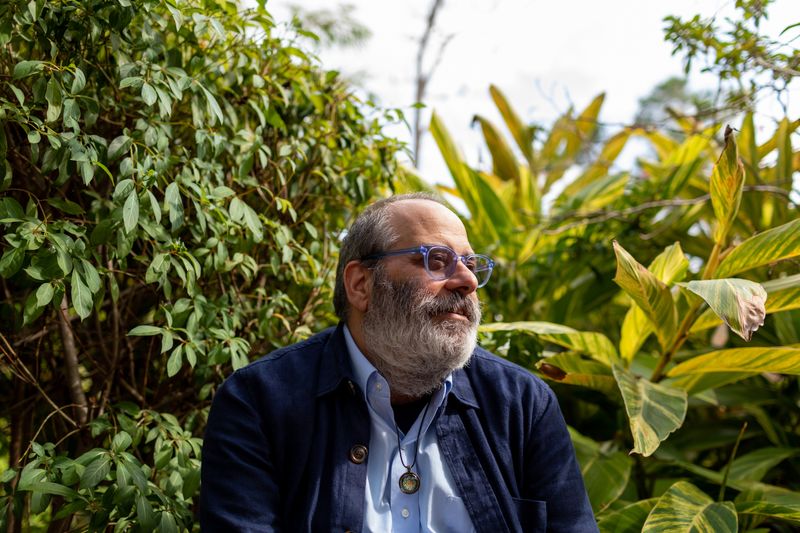
Ruth Ben-Ghiat is a history at New York University who specializes in fascism and authoritarian leaders.

She wrote:

Authoritarianism is about having the power to get away with crime, and waging a genocidal war against another country without othercountries intervening in ways that force a cessation of conflict counts as a big win in the autocrat world. In fact, from the minute they receive intelligence about a planned invasion, autocrats watch carefully to see what happens to transgressors of the international order–and adjust their own plans for aggression accordingly.

Allowing Russian President Vladimir Putin’s war of annihilation against Ukraine to continue by not giving Ukraine the arms it needs to definitively repel the Russian invaders increases the risk that other autocrats will ramp up their own imperialist aspirations. Autocrats interpret any ambivalence about shutting down their peers’ territorial expansions as license to proceed with similar aggressive acts.

History is clear about what happens in such cases. Most people are familiar with the folly of the September 1938 British and French-brokered Munich agreement, which allowed the Third Reich to annex the Sudetenland in Czechoslovakia six months after it annexed Austria.

Far fewer know about the earlier appeasement that set the stage for Hitler’s actions: Benito Mussolini’s war on League of Nations member Ethiopia, which started in October 1935. This was the biggest military operation since World War I, with Italy’s formidable air force dropping hundreds of tons of illegal chemical weapons on Ethiopians.

The weak sanctions levied on Italy by the League of Nations did not deter Il Duce from continuing to commit war crimes. He declared victory in May 1936, and occupied Ethiopia until the Allies drove the Italians out in 1941. “Was it ever likely to be effective?” Winston Churchill wrote critically of the sanctions in June. “Was it real or sham?” That same month, exiled Emperor Haile Selassie I denounced the war crimes to the League of Nations, but no action was taken against the Fascists.

By then, Mussolini’s admirer Hitler had all the information he needed about the consequences a despot might face for military aggression. In March 1936, while Mussolini’s war entered its sixth month, the Führer remilitarized the Rhineland, in violation of the Treaty of Versailles.

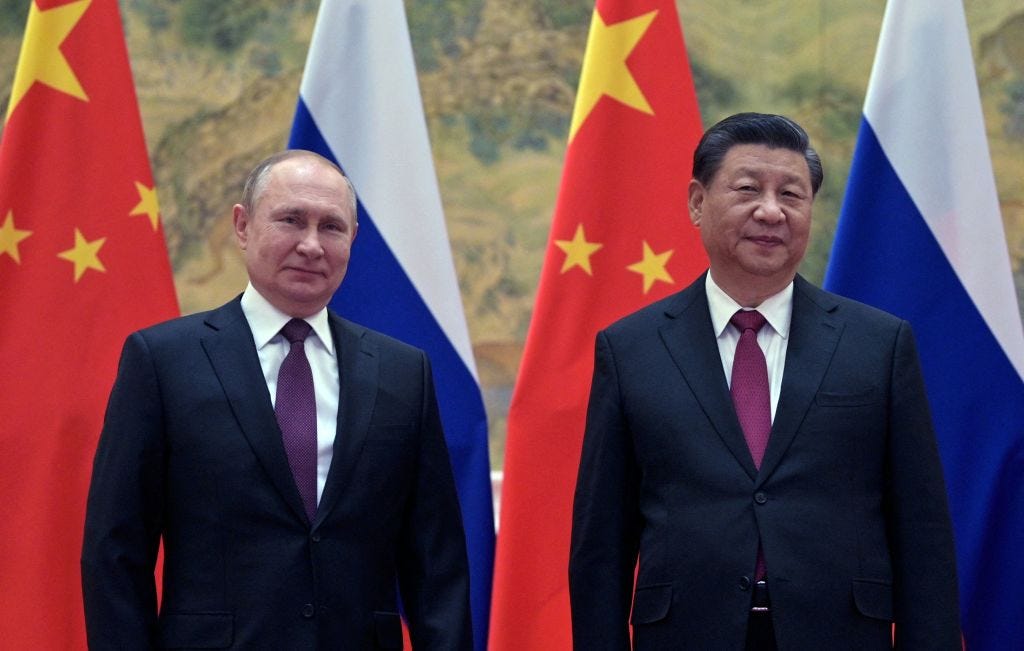
Twenty-first century autocrats watch their kindred spirits’ fates with equal interest. Since the start of Putin’s war on democratic Ukraine, the world has become far less safe. A few weeks before the Russians invaded, Putin and Chinese head of state Xi Jinping issued a joint statementabout the new “multipolar” era of international relations. The premise of this new era –unrestrained imperialism for Russia and China– has become all too clear.

Russian President Vladimir Putin and Chinese President Xi Jinping together in Beijing, Feb. 4, 2022. Alexei Druzhinin/Sputnik/AFP/via Getty Images

Xi Jinping has since become far more aggressive towards the West. His government has increased its rhetoric about its imperialistic claims on Taiwan. He has consolidated his personal power with a third term, while further puffing up his personality cult in ways not seen among Chinese premiers since Mao Zedong.

Turkey has also ramped up its bellicose and expansionist rhetoric regarding Syria and Greece. It has also persecuted Armenians, through its ally Azerbaijan, in the disputedterritory of Nagorno-Karabakh.

Autocrats are transactional beings. You have a deal with an autocrat until you don’t, meaning no one should think that Putin will negotiate with or about Ukraine in good faith. That also holds for their relationships with each other (as Joseph Stalin discovered when Hitler invaded Russia despite signing the Molotov-Ribbentrop non-aggression pact).

Even as dictators cheer on lawlessness that goes unpunished by the democratic order, they also circle each other like vultures, looking for signs of weakness that they can exploit. And everyone knows that Putin is more vulnerable as a player in the sphere of influence game with his resources and attention focused on Ukraine. Turkey, along with China, will seek to fill any power vacuum Putin’s weakness opens up in Eurasia and beyond.

Turkish President Recep Tayyip Erdogan’s relationship with Putin has always been volatile. In the course of a few months in 2016 they went from almost going to war to being “best friends,” dining on plates that immortalized their friendship. I was skeptical of Erdogan’s early claims that he would be a “peacemaker” and mediator between Russia and Ukraine. Turkey intends to exploit this international crisis to increase its own power and prestige.

Now Serbian President Aleksandr Vucic has become the latest authoritarian to be galvanized by the possibilities created by the prolongation of Putin’s war. He has put his military on high alert, citing rising tensions with the Republic of Kosovo. Serbia does not recognize the sovereignty of Kosovo, which declared independence from Serbia in 2008.

All of these conflicts have long histories that are independent of the new climate created by Putin’s invasion of Ukraine. Yet democratic powers’ acceptance of a continuance of Putin’s war will only further destabilize the international order. It also increases the chances that democratic strongholds such as Taiwan will be targeted for “reunification” –the word of choice for autocrats since the days of Hitler to market their imperialism to their peoples and the world.

That’s why Ukrainian President Volodymyr Zelensky was right to state in his speech to U.S. Congress that supporting Ukraine is an investment in global security. He knows that when an autocrat gets away with an imperialist and genocidal war it only increases his megalomania and hubris, making it far more difficult to rein him in later on. It also increases the likelihood that other autocrats will commit their own aggressions toward targeted territories.

And it’s why the warning that economist Anders Aslund issued to his fellow Europeans should be heeded, not least because it builds on historical precedent. As an expert on Putin’s kleptocracy, Aslund knows the value and prestige impunity has among autocrats. “If you don’t deliver enough of arms & funds to Ukraine now,” he tweeted, “you might have to face Russian troops yourselves later on.”

Timothy Snyder, a pre-eminent scholar of fascism, summarized the report of the January 6 Committee:

What did Trump know, and when did he lie about it? How did his Big Lie lead to specific actions to overturn and election and bring down the American system? What did the coup attempt of 2020-2021 look like from within the Trump administration itself?

Thanks to the excellent “Final Report of the Select Committee to Investigate the January 6th Attack on the United States Capitol,” we now know the answers to these and many other questions. I provide here just the briefest of summaries of the report’s recounting of the events of November 2020-January 2021.

It is very easy, when a long report is released, to underplay its basic findings. There is a temptation to act as if something is not shocking if we have heard part of it before, as though this were a mark of political sophistication. The American tendency to normalize threats to democracy is also present in retrospect.

What is described in palpable and convincing detail in the Final Report is indeed profoundly shocking: a planned and coordinated attempt by the president of the United States and his allies to carry out regime change in the United States of America on the basis of a Big Lie.

Here is my very brief summary of the factual part of the report, in fifteen quick points. I am deliberately understating here; the evidence, in the Final Reportitself, permits much broader conclusions.

1. Trump knew that he was likely to lose the 3 November 2020 election, and planned in advance to declare victory (to tell a Big Lie) if he lost.

2. On 3 November 2020, Trump knew that he was very unlikely to have won the election of that day, and declared victory anyway. In the days following, aware that he had lost, he continued to declare victory.

3. Over and over again in November, December, and January, Trump publicized specific claims of electoral fraud shortly after being informed that they were false.

4. Aware that his advisors, campaign officials, and cabinet knew his claims of fraud to be false, Trump promoted people, such as Rudolph Giuliani, who would lie for him in public.

5. In the full knowledge that he had lost the election and that his claims of fraud were false, Trump made several deliberate efforts to overturn the election results and thus American democracy.

6. In states he had lost, Trump personally pressured state officials to fraudulently and illegally alter the electoral outcome.

7. Informed that the Department of Justice had investigated and found no evidence of fraud, Trump nevertheless sought to use its powers, via Jeffrey Clark, to intimidate state officials to change electoral outcomes.

8. Knowing that he had lost the electoral college vote, Trump oversaw an effort to create fake slates of electors. These entirely bogus documents were then sent to the vice-president (who refused them).

9. Though aware that it was the vice-president’s role only to count the electoral votes, Trump pressured the vice-president not to do so, on the theory that the vice-president could, in effect, choose the president.

10. Even the person who devised the plan regarding the vice-president, John Eastman, knew it to be illegal.

11. Knowing by January 6th that all that remained was the formality of certifying Biden’s victory, Trump encouraged supporters he knew to be armed and angry to halt this procedure and violently overthrow our form of government.

12. Trump’s call to violence was successful because enough of his supporters believed his lies and understood what he wanted them to do: prevent a peaceful transition of power.

13. At a time when the Capitol was under attack, the vice-president was in flight, and the members of the vice-president’s security detail feared for their lives, Trump urged his supporters on to further violence.

14. After the failed coup attempt, a number of Republican legislators sought presidential pardons, thereby acknowledging their fears that they had acted illegally.

15. Even had Trump believed that he had won the 2020 election, which he did not, his coup attempt would remain a coup attempt, and his crimes would remain crimes.

These are some of the simple facts, as we now know them, two years on.

Two years ago, I wrote a long essay about the January 6 insurrection, entitled “American Abyss.” It could be published right after Trump’s supporters stormed the Capitol, because I had written it beforehand, as a study of the Big Lie and its consequences. Thanks to the work of some excellent reporters and editors, I could add details from the horrors of the day before the final text went to press in The New York Times Magazine.

Trump’s coup attempt itself was predictable, and I had been predicting it throughout the autumn of 2020. Indeed, since the publication of On Tyrannyin early 2017, I had been trying to make the case that something like this could happen in the United States, and in late 2020 I spent a lot of time saying that it would happen. I like to think that this helped to prepare some of us for the coup attempt when it did come.

Trump is obviously personally responsible. But the techniques he used are not unique to him, and could be perfected by others. The weaknesses he exploited are structural. Now that a coup attempt has taken place, and we know a great deal about how it happened, it is important for us to ask some of the deeper questions about why it could have happened, not least to make sure that nothing similar takes place in the future. In posts to come, I will be interpreting the report, returning to some of the themes I established these last few years, such as the Big Lie.

Cathy Young, writing in The Bulwark, describes the far-right’s hatred for Zelensky and the Ukrainian cause.

Donald Trump Jr. tweeted: “Zelensky is basically an ungrateful international welfare queen.”

He subsequently tweeted a photoshopped image of a naked Hunter Biden standing next to Zelensky on the podium at the Capitol. Twitter deleted his tweet, despite its famous abandonment of content moderation.

Tucker Carlson railed about Zelensky’s combat fatigues, calling them a disgrace.

On and on it goes. She points out that the far-right actually likes the “traditional” (authoritarian) values of Putin, Viktor Orban, and Jair Bolsonaro.

They despise the liberal secular values of the west and are hostile to Ukraine’s desire to be part of the west. So they heap insults on Zelensky and his embattled country, even as Russian missiles rain down on schools, hospitals, and apartment buildings.

Jan Resseger, as always wise and compassionate, reviews the impact of the billionaire-funded culture wars on children and families. The particular focus on erasing the histories of children of color and demonizing LGBT families is harmful to them.

She writes:

Conversations about public schooling have been utterly sidetracked this year by fights about Critical Race Theory, “Don’t say gay!” laws, and whether somebody is “grooming” children at school? Where did these culture wars come from?

A NY Times analysis earlier this week tracks book banning in public schools as part of an epidemic of culture war disruption: “Traditionally, debates over what books are appropriate for school libraries have taken place between a concerned parent and a librarian or administrator, and resulted in a single title or a few books being re-evaluated, and either removed or returned to shelves. But recently, the issue has been supercharged by a rapidly growing and increasingly influential constellation of conservative groups. The organizations frequently describe themselves as defending parental rights. Some are new, and others are longstanding, but with a recent focus on books. Some work at the district and state level, others have national reach. And over the past two years or so, they have grown vastly more organized, interconnected, well funded — and effective. The groups have pursued their goals by becoming heavily involved in local and state politics, where Republican efforts have largely outmatched liberal organizations in many states for years.”

The reporters track research from PEN America: “(T)here are at least 50 groups across the country working to remove books they object to from libraries. Some have seen explosive growth recently: Of the 300 chapters that PEN tracked, 73 percent were formed after 2020. The growth comes, in part, from the rise of ‘parental rights’ organizations during the pandemic. Formed to fight COVID restrictions in schools, some groups adopted a broader conservative agenda focused on opposing instruction on race, gender and sexuality, and on removing books they regard as inappropriate.”

How is the culture war uproar affecting public schools? In a recent newsletter, the National Education Policy Center (NEPC) trackedresearch concluding: “Preparing students to participate in civil and respectful ways in our diverse democracy has long been a core mission of public schools.” Today, “U.S. high schools are struggling to fulfill this mission as they increasingly encounter hyper-partisan efforts. Those efforts have sought to spread misinformation, to encourage harassment of LGBTQ+ students, and to limit opportunities for productively discussing controversial topics. Such challenges are particularly pervasive in politically diverse areas where one party does not dominate.” The researchers surveyed 682 public high school principals and subsequently followed up by interviewing 32 of those principals. NEPC reports:

  1. “Public schools increasingly are targets of political conflict. Nearly half of principals (45 percent) reported that the amount of conflict in their community was higher during the 2021-2022 school year than it was pre-pandemic… Teaching about race and racism was the area where principals were most likely to report challenges from community members, followed closely by LGBTQ+ content.”
  2. “Political conflict undermines the practice of respectful dialogue. A majority of high school principals report that students have made demeaning or hateful remarks toward classmates for expressing either liberal or conservative views and that strong differences of political opinion among students have created more contentious classroom environments.”
  3. “Conflict makes it harder to address misinformation. Misinformation—much of it tied to partisan organizations and causes—makes it more challenging to encourage productive and civil dialogue. After all, it is difficult to develop a shared sense of how to move forward when different people are working from different sets of ‘facts.’ Nearly two thirds of principals (64 percent) say parents or community members have challenged information used by teachers at their schools. The share of principals saying parents or community members challenged teachers’ use of information three or more times nearly doubled between 2018 and 2022.”
  4. “Conflict leads to declines in support for teaching about race, racism, and racial and ethnic diversity. High schools increasingly struggle to teach students about the full spectrum of American experiences and histories, especially when it comes to issues related to racism and race… ‘My superintendent told me in no uncertain terms that I could not address issues of race and bias etc. with students or staff this year,’ said a principal in a red community in Minnesota. ‘We could not address the deeper learning.'”
  5. “Principals report sizable growth in harassment of LGBTQ+ youth. The survey results also suggest that schools are increasingly facing challenges related to teaching students to treat one another with dignity and respect… Fewer than half of principals said school board members or district leaders made statements or acted to promote policies and practices that protected LGBTQ+ student rights.”

“Parents’ rights” are the rallying cry for many of today’s culture warriors who want to protect the dominant culture and shield their children from uncomfortable controversy. But in a recent and very personal Washington Post column, “When Children Ask About Race and Sex, We Have No Choice But to Answer,” Danielle Allen, a political theorist and the Director of the Edmond and Lily Safra Center for Ethics at Harvard University, and an African American mother, explains the point of view of many other parents and children. Allen examines why it is so urgently important for teachers to be able to respond to children’s own observations and questions when the students themselves initiate conversation about the same fraught subjects the NEPC researchers describe organized parents trying to ban from the schools.

Allen describes a conversation her own two-year-old daughter launched about race, while the child sat in seat of the grocery store cart as they were in the midst of shopping. The child declared, “Mommy, I think it’s not good to be Black.”

Allen reflects upon what her toddler had already observed about race in America: “My daughter’s statement was a question. Its subtext went like this: ‘I’ve noticed something, Mommy. It seems like it’s not good to be Black. But can that be right? You’re Black. I love you. How can these things fit together? And what does this mean for me?'”

Allen continues: “What I can assure you of is that even before any of our kids, of any racial or ethnic background, get to school, every Black family in the United States is having to teach its children about race and the history of enslavement and stories of overcoming that have played out generation after generation. The same must be true for kids raised in LGBTQ families, with regard to the history and contemporary experience of gender and sexuality… This means that the only way you can keep knowledge and questions about these histories, experiences and perspectives out of the school curriculum in early grades is to keep Black people or members of LGBTQ families out of school.”

Or, according to NEPC’s research, many school districts are enrolling Black and Brown children and children from LGBTQ families while the school districts may be imposing policies to silence such children, to make their realities invisible to other students, and to refuse to help them answer their own hard questions.

Public schools are required by law to serve all the children whatever their race, ethnicity, religion, or sexual orientation. It is not the business of school board members, school superintendents, school principals, or teachers to cater to any one group of parents’ rights advocates, no matter how well organized or well funded is their lobby.

Here, writing for The Progressive, is retired high school teacher, Peter Greene, who understands educators’ obligation to protect the interests of all the students who fill our nation’s public school classrooms: “Schools must balance the needs and concerns of all of their many stakeholders. Parents absolutely have rights when it comes to public schools, but so do non-parents, taxpayers and other community stakeholders. It’s up to the school district to balance all of these concerns, while also depending on the professional judgment of its trained personnel. It is a tricky balance to maintain, requiring nuance and sensitivity. It is correct to argue that ‘schoolchildren are not mere creatures of the state.’ But framing the issue as parents versus school has served some folks with a very specific agenda.”

Politico reports that there was no sweep for partisans of the culture war issues. We can expect to see more attacks on teachers, students, and school boards in the next election, based on hyped-up falsehoods about race and gender. Support from rightwing conservative foundations—the usual suspects—will keep alive the battles and the fake organizations leading them. (Expect a special report soon from the Network for Public Education on these front groups attacking school boards, written by an authority on Dark Money).

Juan Perez Jr. of Politico writes:

THE DIVIDED CLASSROOM — In case you missed it amid the advertising noise and campaign spending avalanche of November’s midterms, 2022 proved to be an incredibly busy — and contentious — year for education elections.

Fifteen states and the District of Columbia held state school board or education superintendent races this year. Roughly 1,800 local board seats across some 560 districts in 26 states were also up for grabs on Nov. 8, according to the nonpartisan nonprofit Ballotpedia.

Who came out on top? Nobody. Neither Democrats nor Republicans managed a clean sweep.

This means the state of education in the United States remains divided sharply along partisan lines — and the education wars are likely to continue unabated in 2023 and beyond.

The bitter differences between the two sides and lack of consensus between the poles of both parties — over everything from teaching about slavery and gender identity to childhood vaccinations – offer little incentive for either side to back down.

“We are stopping Critical Race Theory from being taught, stopping access to obscene pornography in our schools, and ending the tenure of radicalism and indoctrination of our kids because the left is waging a civil war in our classrooms,” newly-elected Oklahoma State Superintendent Ryan Walters recently wrote in the Daily Caller.

Candidates who supported having race and sex-related curricula or Covid-19 safety requirements in schools won about 40 percent of the roughly 1,800 local board elections tallied by Ballotpedia this year, and tended to win in counties President Joe Biden carried in the 2020 election. Candidates with opposing views won about 30 percent of their elections, often doing so in counties held by former President Donald Trump.

Nearly one-third of incumbent school board members also lost to their challengers on Nov. 8.

“People didn’t feel listened to. Parents felt they lost agency and power over their kids’ education,” Randi Weingarten, president of the American Federation of Teachers labor union, recently told Nightly. “My concern is that we can’t have two countries. This is one United States of America, and we have an obligation to help kids — regardless of whether they’re in South Carolina, Tennessee, New York or California — to learn how to critically think.”

As they turn toward 2023, Democrats take solace in battleground state victories for governor, successful education-related ballot measures and local school board races where moderate incumbents defeated far-right challengers in Louisville, Ky., the suburbs of Austin, Texas, and other places.

Sure, conservatives lost plenty of races. But they won more than enough to show their brand of culture-based education politics thrives in areas controlled by the party faithful. Trump seems to have this on his mind, too. The former president promised schools would lose their federal funding if they don’t get rid of critical race theory, and what he described as “radical civics and gender insanity,” when he announced his reelection bid.

No state school boards with elections this year flipped partisan control, according to the National Association of State Boards of Education. But majority parties did expand their influence on boards in Colorado, Kansas and Utah while conservative incumbents often lost primary challenges.

Candidates endorsed by two upstart GOP-aligned political committees also won roughly half of their midterm elections.

Candidates backed by Moms for Liberty, a group formed by a former Florida school board member to fight school Covid-19 mask requirements and controversial library books, won about half of their 2022 elections, according to the organization. The 1776 Project PAC, a group opposed to the critical race theory academic framework that examines how race and racism have become ingrained in American institutions, saw a similar win-loss ratio.

Open the link to read more.

Congresswoman Marjorie Taylor Greene boasted that if she and Steve Bannon had been in charge of the uprising on January 6, 2021, the rioters would have been armed and they would have succeeded.

The message from MJT: If she and Steve had been in charge, there would have been mass casualties in the Capitol, the electoral vote would have been canceled, and Trump would be awarded the Presidency by force of arms.

This is a woman who took an oath to “support and defend the Constitution” and will take it again:

Yet she jokes about overthrowing the Constitution she swore to support and defend.

It’s not funny. It’s treasonous.

The Boston Globe wrote about the activities of a Dark Money group called Parents Defending Education, which has filed lawsuits against the public schools in Wellesley and Newton in their quest to ban books and cleanse the schools of teaching about racism and gender.

Maurice Cunningham wrote a letter to the Globe explaining the reason for the harassment. He thinks their goal is intimidation. He’s right. But there is more. I think their goal is to undermine confidence in public schools and build support for privatization.

He wrote:

LETTERS

In its challenges to schools, group’s object lesson is intimidation

Updated November 18, 2022, 2:30 a.m.

Moms for Liberty, represented at an event last month in Vero Beach, Fla., is among the groups associated with Parents Defending Education, which has been promoting conservative values in education and challenging school districts in court.

Re “Schools wary as nonprofit targets teaching: Right-leaning group’s complaints cite bias in lessons on gender, race, sexuality” (Page A1, Nov. 15): Parents Defending Education is an obedient franchise of right-wing interests, including Charles Koch and the Council for National Policy, that are working to destroy public education.

Legal actions such as Parents Defending Education’s civil rights complaint against the Newton Public Schools and its lawsuit against Wellesley Public Schools are meant to generate publicity and foster intimidation. As the Globe has reported previously, the group’s civil rights “complaints likely will go nowhere.” The lawsuit settled on terms favorable to Wellesley.


However, Parents Defending Education isn’t after legal recourse; it’s after harassment. Wellesley School Superintendent David Lussier said he has received “obscene” and “awful” e-mails from people connected to the group. In December 2021, the Globe reported that two Black school principals in Newton had received “racist and confrontational” messages after the right-wing publisher Breitbart published an article misrepresenting how the principals’ schools were handling lessons about the verdicts in the trials of Kyle Rittenhouse and the men convicted of killing Ahmaud Arbery. Breitbart’s story was framed by Parents Defending Education.

Racist and obscene messages menacing educators are not an unfortunate consequence of Parents Defending Education’s machinations; they are entirely foreseeable.

Maurice T. Cunningham

Cambridge

The writer is the author of “Dark Money and the Politics of School Privatization.” He is a retired associate professor at the University of Massachusetts Boston and a former state assistant attorney general in Massachusetts.

Kherson was the first regional capital that the Russian army captured after the invasion of Ukraine. A few weeks ago, Putin declared that Russia had annexed four regions of Ukraine, including Kherson, and henceforth they would be “forever Russian.” That occurred at the same time that Russian troops were retreating before the Ukrainian forces. A few days ago, Russian troops abandoned Kherson, and Ukrainian troops arrived. They were greeted by jubilant crowds waving the Ukrainian flag and singing the Ukrainian national anthem.

But before the troops left, they carried out a special mission for V. Putin. They robbed the grave of Potemkin, who conquered Ukraine on behalf of Russia and Empress Catherine the Great in the 18th century. Simon Sebag Montefiore, a British historian of Russia, reports at the website Airmail that Putin is obsessed with Potemkin. Potemkin is Putin’s role model. His body was buried in St. Stephen’s Cathedral in Kherson. Before the Russians evacuated Kherson, they removed Potemkin’s bones and sent them to Moscow.

The New York Times reported the failure of “Russification” in Kherson:

A Ukrainian tearing down a billboard with the slogan “We are together with the Russian government” in Kherson, Ukraine, on Sunday.
A Ukrainian tearing down a billboard with the slogan “We are together with the Russian government” in Kherson, Ukraine, on Sunday.Credit…Lynsey Addario for The New York Times

KHERSON, Ukraine — Iryna Dyagileva’s daughter attended a school where the curriculum included memorizing the Russian national anthem.

But teachers ignored it, instead quietly greeting students in the morning with a salute: “Glory to Ukraine!”

The occupation authorities asked Olha Malyarchuk, a clerk at a taxi company, to settle bills in rubles. But she kept paying in the Ukrainian currency, hryvnia.

“It just didn’t work,” she said of Russian propaganda, beamed into homes through televisions and plastered on billboards for the nine months of Russia’s occupation of Kherson. On Sunday, she was walking in a park, waving a small Ukrainian flag.

One roadside billboard proclaimed in bold text, “We are together with Russia!” But a teenager who offered only his first name, Oleksandr, had shimmied up the supporting pole on Sunday and was tearing the sign to pieces. Asked how he felt, he said, “free.”

The Ukrainian army has reclaimed hundreds of villages in towns in three major counteroffensives, north of Kyiv, in the northeastern Kharkiv region and now in the southern Kherson region.

But the city of Kherson stands out: it was the focus of a major Russian campaign to assimilate the citizenry and stamp out of the Ukrainian identity. Judging by his assertions that Ukrainians and Russians are one nation, it was a goal President Vladimir V. Putin had harbored for all of Ukraine, had his military been more successful.

After Russian forces captured Kherson in the early days of the war, Ukrainian national songs were banned in the city. Speaking Ukrainian could lead to arrest. Schools adopted a Russian curriculum, and young students were to be told that they were Russians, not Ukrainians.

In the first hours and days after the city’s recapture by the Ukrainian army, signs have emerged suggesting that the Russian attempt was a largely futile effort, at least among those who remained in the city.

Many pro-Russian residents had evacuated as Ukraine’s army advance on the city, and the Kremlin-installed authorities had encouraged residents to leave. Many local government officials had collaborated with the Russians.

Serhiy Bloshko, a construction worker, had lived at the homes of friends through the nine-month occupation, fearful he’d be arrested for joining anti-occupation protests in March that broke out soon after the Russian army arrived. Soldiers indeed went to his home, he said. Not finding him, they made off with his television and refrigerator, he said.

“They repressed the pro-Ukrainian population,” he said while waiting in a line for water on Sunday afternoon. Friends had been detained and vanished, he said. Of the cultural assimilation effort, he said, “what happened here was ethnic cleansing.”

The entry into his city of the two armies, one in February and the other last week, was telling, he said.

“When our soldiers drove in, their machine guns were pointed up, into the air,” Mr. Bloshko said. “When the Russians drove in, their guns were pointed at the people. That explains everything. And they said they were our liberators.”

We have been following the activities of various rightwing groups that purport to represent parents. Many if not all are funded by Dark Money, meaning their funders are anonymous. “Parents Defending Education” is now active in Massachusetts, suing districts for events related to race, gender, and sexual orientation. As the article notes, PDE has a staff of 13, some with a Koch background, and is represented by a Trump-connected lawyer. The goal of such groups is to undermine public confidence in public schools and in the judgment of professional educators. The ultimate goal is to heighten the teacher shortage and encourage privatization of schools.

The Boston Globe story begins:

An increasingly active right-leaning non-profit called Parents Defending Education filed a federal civil rights complaint against Newton North High School last month, alleging that a student-led theater production broke the law by limiting auditions to people of color only.


The same group sued Wellesley Public Schools last year for alleged illegal discrimination when Wellesley High School hosted a forum for Asian students and students of color to discuss a mass shooting at an Asian massage parlor in Atlanta. The teacher who organized the session wrote that it was “not for students who identify only as White.”


So far, the national group has identified 43 “incidents” in which they say Massachusetts schools inappropriately – or even illegally – taught students about race, sexual orientation or gender, setting school districts across the Commonwealth on edge that they might be sued next.

“I’ve never seen anything like this before in all my years here,” said Wellesley School Superintendent David Lussier, who settled the lawsuit with the organization in February. “They try to go after superintendents and get people fired.”


Parents Defending Education did not return repeated requests for comment, but supporters say the group offers a vital counterweight to an education system steeped in liberal values.


“I think it’s good because, for a long time, education has been very one-sided,” said Jennifer McWilliams, a consultant to Parents Defending Education who runs her own advocacy group in Indiana. “Schools have decided that they need to teach children morals, values, attitude and worldview over academics.”


The two-year-old organization, based in Washington D.C., urges parents across the country to report incidents in which they believe schools are dividing students on racial lines or inappropriately teaching students about sex or gender roles. The group states on its website that education must be based on “scholarship and facts” and says ethnic studies divides “children into oppressor and ‘oppressed’ groups,” while teaching white students “guilt and shame.”

And the organization has a sizable, well-connected staff to promote their agenda. Parents Defending Education’s website lists 13 staff members including Nicole Neily, former president of an organization affiliated with the Koch Brothers called Speech First and Aimee Viana, a former Trump Administration appointee.


Schools have long been battlegrounds in the nation’s culture wars, but experts say Parents Defending Education marks something new: an attempt to nationalize the agenda. The group has been promoting conservative values across the country, enlisting local groups with names like Moms for Liberty and No Left Turn in Education along the way.


“We see increased coordination, national coordination among groups of all political stripes and partisan stripes, thanks to social media,” said Meira Levinson, a professor at Harvard’s Graduate School of Education. “The right more than the left seems to have mastered techniques of developing language that then can be replicated in legislation, or policy across different municipalities and state governments.”

For Massachusetts educators facing criticism from Parents Defending Education, it suddenly feels like the group is everywhere. The group criticized Brookline schools in April after teachers organized a walkout to protest a Florida measure opponents have characterized as the “Don’t Say Gay” bill.
In June, the organization condemned Milton for teaching a lesson about the country’s first openly gay politician Harvey Milk and the importance of the letters LGBTQ.


“Who the hell wants to go into this profession anymore if this is going to be the type of community that we’re serving and the type of pressure that we’re going to experience,” Wellesley Educators Association President Kyle Gekopi said. “It’s really been forcing a lot of people to question their choices.”


Most recently, Parents Defending Education filed a federal civil rights complaint on Oct. 4 against Newton North High School.


The group alleged to the United States Department of Education that the school violated the Civil Rights Act of 1964 and the Equal Protection Clause of the 14th Amendment. Both are meant to protect people from discrimination based on race, color or national origin in programs or activities that receive federal financial assistance. That protection extends to white students, they say.


Parents Defending Education claims the school’s student-led production, “Lost and Found: Stories of People of Color by People of Color,” restricted auditions to only students of color. The show, which organizers described as “a no-cut, cabaret-style show for students of color,” was meant to “provide a safe community space for students of color to express themselves through the performing arts.”


But Newton Public Schools put out a statement stressing that “no one is turned away or excluded from participating” in the play.


Educators far beyond Newton are nervously watching the case unfold. Brian Fitzgerald, president of the Plymouth County Education Association, said Parents Defending Education remind him of activists in past decades who have fought to curtail sex education, making it difficult to teach students about health.


“My fear is that they’re going to impact the ability of a student to learn,” Fitzgerald said.