Archives for category: Extremism

Send us your thoughts on best/worst events for our schools in 2022 & your hopes for 2023 so @danielalicea & I can share them on @WBAI Sat. at 1 PM EST on #TalkoutofSchool w/special guest @dianeravitch! Instructions here; or DM me. nycpublicschoolparents.blogspot.com/2022/12/for-ou… Deadline: Fri at noon.

You can send your thoughts on the best and worst things that happened to schools this past year by writing a tweet @leoniehaimson

Or writing her directly at “leoniehaimson@gmail.com”

Timothy Snyder, a pre-eminent scholar of fascism, summarized the report of the January 6 Committee:

What did Trump know, and when did he lie about it? How did his Big Lie lead to specific actions to overturn and election and bring down the American system? What did the coup attempt of 2020-2021 look like from within the Trump administration itself?

Thanks to the excellent “Final Report of the Select Committee to Investigate the January 6th Attack on the United States Capitol,” we now know the answers to these and many other questions. I provide here just the briefest of summaries of the report’s recounting of the events of November 2020-January 2021.

It is very easy, when a long report is released, to underplay its basic findings. There is a temptation to act as if something is not shocking if we have heard part of it before, as though this were a mark of political sophistication. The American tendency to normalize threats to democracy is also present in retrospect.

What is described in palpable and convincing detail in the Final Report is indeed profoundly shocking: a planned and coordinated attempt by the president of the United States and his allies to carry out regime change in the United States of America on the basis of a Big Lie.

Here is my very brief summary of the factual part of the report, in fifteen quick points. I am deliberately understating here; the evidence, in the Final Reportitself, permits much broader conclusions.

1. Trump knew that he was likely to lose the 3 November 2020 election, and planned in advance to declare victory (to tell a Big Lie) if he lost.

2. On 3 November 2020, Trump knew that he was very unlikely to have won the election of that day, and declared victory anyway. In the days following, aware that he had lost, he continued to declare victory.

3. Over and over again in November, December, and January, Trump publicized specific claims of electoral fraud shortly after being informed that they were false.

4. Aware that his advisors, campaign officials, and cabinet knew his claims of fraud to be false, Trump promoted people, such as Rudolph Giuliani, who would lie for him in public.

5. In the full knowledge that he had lost the election and that his claims of fraud were false, Trump made several deliberate efforts to overturn the election results and thus American democracy.

6. In states he had lost, Trump personally pressured state officials to fraudulently and illegally alter the electoral outcome.

7. Informed that the Department of Justice had investigated and found no evidence of fraud, Trump nevertheless sought to use its powers, via Jeffrey Clark, to intimidate state officials to change electoral outcomes.

8. Knowing that he had lost the electoral college vote, Trump oversaw an effort to create fake slates of electors. These entirely bogus documents were then sent to the vice-president (who refused them).

9. Though aware that it was the vice-president’s role only to count the electoral votes, Trump pressured the vice-president not to do so, on the theory that the vice-president could, in effect, choose the president.

10. Even the person who devised the plan regarding the vice-president, John Eastman, knew it to be illegal.

11. Knowing by January 6th that all that remained was the formality of certifying Biden’s victory, Trump encouraged supporters he knew to be armed and angry to halt this procedure and violently overthrow our form of government.

12. Trump’s call to violence was successful because enough of his supporters believed his lies and understood what he wanted them to do: prevent a peaceful transition of power.

13. At a time when the Capitol was under attack, the vice-president was in flight, and the members of the vice-president’s security detail feared for their lives, Trump urged his supporters on to further violence.

14. After the failed coup attempt, a number of Republican legislators sought presidential pardons, thereby acknowledging their fears that they had acted illegally.

15. Even had Trump believed that he had won the 2020 election, which he did not, his coup attempt would remain a coup attempt, and his crimes would remain crimes.

These are some of the simple facts, as we now know them, two years on.

Two years ago, I wrote a long essay about the January 6 insurrection, entitled “American Abyss.” It could be published right after Trump’s supporters stormed the Capitol, because I had written it beforehand, as a study of the Big Lie and its consequences. Thanks to the work of some excellent reporters and editors, I could add details from the horrors of the day before the final text went to press in The New York Times Magazine.

Trump’s coup attempt itself was predictable, and I had been predicting it throughout the autumn of 2020. Indeed, since the publication of On Tyrannyin early 2017, I had been trying to make the case that something like this could happen in the United States, and in late 2020 I spent a lot of time saying that it would happen. I like to think that this helped to prepare some of us for the coup attempt when it did come.

Trump is obviously personally responsible. But the techniques he used are not unique to him, and could be perfected by others. The weaknesses he exploited are structural. Now that a coup attempt has taken place, and we know a great deal about how it happened, it is important for us to ask some of the deeper questions about why it could have happened, not least to make sure that nothing similar takes place in the future. In posts to come, I will be interpreting the report, returning to some of the themes I established these last few years, such as the Big Lie.
Heather Long is a member of the Washington Post editorial board. She pinpoints the reasons for the national teacher shortage: low pay, but also pandemic stresses, and the ongoing political attacks on the teaching profession by extremists who want to prevent any teaching about racism or sexuality.

Message: pay teachers as professionals and let them teach as professionals, without censorship or interference by busybodies.

Long writes:

The U.S. economy hit a milestone this year: All 22 million jobs lost during the coronavirus pandemic were fully recovered. But that doesn’t mean workers went back to the same jobs. One of the sectors struggling the most to rebound is K-12 public education, which is still down more than 270,000 employees.


There is an educator shortage in the United States, but it is crucial to understand the details. First, this is about more than teachers. That 270,000 figure includes a lot fewer bus drivers, custodians and other support staff. Second, education isn’t simply about getting enough warm bodies into classrooms; it’s about having effective and qualified teachers and staff. The best analysis of the situation this fall, from the Annenberg Institute at Brown University, indicates a teacher shortage of nearly 2 percent, but more than 5 percent of positions are currently held by under-qualified teachers. Third, the shortage isn’t nationwide. It’s much worse in some schools and in some subjects.

In October, nearly half of public schools were still struggling to fill at least one teacher vacancy, according to a recently released Education Department survey. But schools in high-poverty neighborhoods were significantly more likely to have unfilled positions. Similarly, school districts report having an especially hard time finding special education, computer science and foreign language teachers, and bus drivers and custodial staff.

This isn’t a new phenomenon, but many signs indicate it worsened during the pandemic. Teachers experienced extreme levels of burnout from Zoom classes and safety concerns during the early days of the pandemic. Then came the culture wars that put teachers and staff under constant scrutiny over any conversations involving history, racism and sexuality. Throw in the Great Resignation, a tight labor market and rapidly rising pay in other professions, and the net result has been some teachers and staff retiring early. Others have quit and gone to work in different professions. And some recent graduates have decided not to enter education at all.

Cathy Young, writing in The Bulwark, describes the far-right’s hatred for Zelensky and the Ukrainian cause.

Donald Trump Jr. tweeted: “Zelensky is basically an ungrateful international welfare queen.”

He subsequently tweeted a photoshopped image of a naked Hunter Biden standing next to Zelensky on the podium at the Capitol. Twitter deleted his tweet, despite its famous abandonment of content moderation.

Tucker Carlson railed about Zelensky’s combat fatigues, calling them a disgrace.

On and on it goes. She points out that the far-right actually likes the “traditional” (authoritarian) values of Putin, Viktor Orban, and Jair Bolsonaro.

They despise the liberal secular values of the west and are hostile to Ukraine’s desire to be part of the west. So they heap insults on Zelensky and his embattled country, even as Russian missiles rain down on schools, hospitals, and apartment buildings.

John Merrow shares his wisdom and makes a list of worthy recipients of your holiday giving. I’m happy to note that he included the Network for Public Education.

I was happy to discover this post on the Network for Public Education, which is curated by teacher-blogger Peter Greene. It was written by South Carolina teacher Steve Nuzum.

A South Carolina think tank has issued a “report” that connects every organization in sight to an indoctrination conspiracy in the state. It would be easier to dismiss if the head of the think tank weren’t the state’s newly elected superintendent of education. Teacher Steve Nuzum looks into the work.

This week, incoming Superintendent of Education Ellen Weaver’s “think tank” dropped a crazy “dossier”. Or sometimes it’s “a report”— one without citations for most of its central and most outrageous claims. And sometimes it’s a “handbook”— one without much in the way of advice, except some version of support us and be mad at those teacher unions in NC and VA).

The document, and especially its accompanying graphics, are breathtakingly stupid. Aligning yourself with Aristotle on education policy— a philosopher who, on the one hand, explicitly called for public funding of education1 and, on the other hand, believed some human beings are physically and mentally designed to be slaves2— is quite a look for a pro-voucher think tank that doesn’t want people to think about “segregation academies” every time they hear “school choice”. Openly labeling “progressives” as “villains” is another. This thing was clearly cobbled together hastily by political hacks masquerading as scholars, in the vein of the 1776 Commission Report from the Trump Administration, and they clearly thought lots of colors and graphics would keep us dumb South Carolinians from thinking too hard about any of it.

Even a quick gloss over the “dossier” reveals claims that are unfounded and contrary to the general argument (privatization is good; Leftist woke indoctrinator teachers are “villains”). For example, the report claims that grassroots teacher advocacy group SC for Ed (I’m a board member) was primarily founded to oppose “schools of innovation” legislation. This seems to be a garbled reference to SC for Ed’s opposition to the education omnibus bill H. 3759, a legislative beast with a few good ideas glued to a lot of bad, often ALEC-drafted ideas. There is no citation provided, of course, because it isn’t true— I was there at the rally the “dossier” mentions, which was centered around many educational issues, and I was also there as a member of the group when the bill was just a twinkle in Jay Lucas’ eye. The omnibus bill, thankfully, did not pass, and the “schools of innovation” legislation that did pass, although not supported by SC for Ed, was certainly not some kind of major motivating factor for starting the group. The “dossier” goes on to use the “public-private partnership” Meeting Street Schools as its sole example of why the “schools of innovation” legislation was a good move. This is a weird rhetorical move during a week when, on “almost every criterion, Meeting Street Schools fell below both district and state performance,” according to Nick Reagan of WCSC.

But the thing is, it doesn’t need to make sense.

Read the full post here for more details.

You can view the post at this link : https://networkforpubliceducation.org/blog-content/steve-nuzum-palmetto-promises-conspiracy-corkboard/

Jan Resseger, as always wise and compassionate, reviews the impact of the billionaire-funded culture wars on children and families. The particular focus on erasing the histories of children of color and demonizing LGBT families is harmful to them.

She writes:

Conversations about public schooling have been utterly sidetracked this year by fights about Critical Race Theory, “Don’t say gay!” laws, and whether somebody is “grooming” children at school? Where did these culture wars come from?

A NY Times analysis earlier this week tracks book banning in public schools as part of an epidemic of culture war disruption: “Traditionally, debates over what books are appropriate for school libraries have taken place between a concerned parent and a librarian or administrator, and resulted in a single title or a few books being re-evaluated, and either removed or returned to shelves. But recently, the issue has been supercharged by a rapidly growing and increasingly influential constellation of conservative groups. The organizations frequently describe themselves as defending parental rights. Some are new, and others are longstanding, but with a recent focus on books. Some work at the district and state level, others have national reach. And over the past two years or so, they have grown vastly more organized, interconnected, well funded — and effective. The groups have pursued their goals by becoming heavily involved in local and state politics, where Republican efforts have largely outmatched liberal organizations in many states for years.”

The reporters track research from PEN America: “(T)here are at least 50 groups across the country working to remove books they object to from libraries. Some have seen explosive growth recently: Of the 300 chapters that PEN tracked, 73 percent were formed after 2020. The growth comes, in part, from the rise of ‘parental rights’ organizations during the pandemic. Formed to fight COVID restrictions in schools, some groups adopted a broader conservative agenda focused on opposing instruction on race, gender and sexuality, and on removing books they regard as inappropriate.”

How is the culture war uproar affecting public schools? In a recent newsletter, the National Education Policy Center (NEPC) trackedresearch concluding: “Preparing students to participate in civil and respectful ways in our diverse democracy has long been a core mission of public schools.” Today, “U.S. high schools are struggling to fulfill this mission as they increasingly encounter hyper-partisan efforts. Those efforts have sought to spread misinformation, to encourage harassment of LGBTQ+ students, and to limit opportunities for productively discussing controversial topics. Such challenges are particularly pervasive in politically diverse areas where one party does not dominate.” The researchers surveyed 682 public high school principals and subsequently followed up by interviewing 32 of those principals. NEPC reports:

  1. “Public schools increasingly are targets of political conflict. Nearly half of principals (45 percent) reported that the amount of conflict in their community was higher during the 2021-2022 school year than it was pre-pandemic… Teaching about race and racism was the area where principals were most likely to report challenges from community members, followed closely by LGBTQ+ content.”
  2. “Political conflict undermines the practice of respectful dialogue. A majority of high school principals report that students have made demeaning or hateful remarks toward classmates for expressing either liberal or conservative views and that strong differences of political opinion among students have created more contentious classroom environments.”
  3. “Conflict makes it harder to address misinformation. Misinformation—much of it tied to partisan organizations and causes—makes it more challenging to encourage productive and civil dialogue. After all, it is difficult to develop a shared sense of how to move forward when different people are working from different sets of ‘facts.’ Nearly two thirds of principals (64 percent) say parents or community members have challenged information used by teachers at their schools. The share of principals saying parents or community members challenged teachers’ use of information three or more times nearly doubled between 2018 and 2022.”
  4. “Conflict leads to declines in support for teaching about race, racism, and racial and ethnic diversity. High schools increasingly struggle to teach students about the full spectrum of American experiences and histories, especially when it comes to issues related to racism and race… ‘My superintendent told me in no uncertain terms that I could not address issues of race and bias etc. with students or staff this year,’ said a principal in a red community in Minnesota. ‘We could not address the deeper learning.'”
  5. “Principals report sizable growth in harassment of LGBTQ+ youth. The survey results also suggest that schools are increasingly facing challenges related to teaching students to treat one another with dignity and respect… Fewer than half of principals said school board members or district leaders made statements or acted to promote policies and practices that protected LGBTQ+ student rights.”

“Parents’ rights” are the rallying cry for many of today’s culture warriors who want to protect the dominant culture and shield their children from uncomfortable controversy. But in a recent and very personal Washington Post column, “When Children Ask About Race and Sex, We Have No Choice But to Answer,” Danielle Allen, a political theorist and the Director of the Edmond and Lily Safra Center for Ethics at Harvard University, and an African American mother, explains the point of view of many other parents and children. Allen examines why it is so urgently important for teachers to be able to respond to children’s own observations and questions when the students themselves initiate conversation about the same fraught subjects the NEPC researchers describe organized parents trying to ban from the schools.

Allen describes a conversation her own two-year-old daughter launched about race, while the child sat in seat of the grocery store cart as they were in the midst of shopping. The child declared, “Mommy, I think it’s not good to be Black.”

Allen reflects upon what her toddler had already observed about race in America: “My daughter’s statement was a question. Its subtext went like this: ‘I’ve noticed something, Mommy. It seems like it’s not good to be Black. But can that be right? You’re Black. I love you. How can these things fit together? And what does this mean for me?'”

Allen continues: “What I can assure you of is that even before any of our kids, of any racial or ethnic background, get to school, every Black family in the United States is having to teach its children about race and the history of enslavement and stories of overcoming that have played out generation after generation. The same must be true for kids raised in LGBTQ families, with regard to the history and contemporary experience of gender and sexuality… This means that the only way you can keep knowledge and questions about these histories, experiences and perspectives out of the school curriculum in early grades is to keep Black people or members of LGBTQ families out of school.”

Or, according to NEPC’s research, many school districts are enrolling Black and Brown children and children from LGBTQ families while the school districts may be imposing policies to silence such children, to make their realities invisible to other students, and to refuse to help them answer their own hard questions.

Public schools are required by law to serve all the children whatever their race, ethnicity, religion, or sexual orientation. It is not the business of school board members, school superintendents, school principals, or teachers to cater to any one group of parents’ rights advocates, no matter how well organized or well funded is their lobby.

Here, writing for The Progressive, is retired high school teacher, Peter Greene, who understands educators’ obligation to protect the interests of all the students who fill our nation’s public school classrooms: “Schools must balance the needs and concerns of all of their many stakeholders. Parents absolutely have rights when it comes to public schools, but so do non-parents, taxpayers and other community stakeholders. It’s up to the school district to balance all of these concerns, while also depending on the professional judgment of its trained personnel. It is a tricky balance to maintain, requiring nuance and sensitivity. It is correct to argue that ‘schoolchildren are not mere creatures of the state.’ But framing the issue as parents versus school has served some folks with a very specific agenda.”

The claim that public schools “indoctrinate” their students is an integral part of the rightwing attack on public schools . This is a canard, a bald-faced lie.

The rightwingers insist that any efforts to teach tolerance and acceptance of others is “indoctrination.” Teaching children the importance of justice, they say, is “woke.”

This is the mission of public schools: to teach children academic skills and knowledge, of course, but also to teach them to work with people who are different from them and their family.

Teaching children to live, work, and play with others and to respect others is important to the functioning of our democracy. We are a people of many diverse origins, different nationalities, different religions. One of the implicit functions of public schools is to help bind us together as one nation, one people who share civic values.

Do you know which schools truly indoctrinate students? Religious schools. That is one of the essential goals of religious schools. They teach the doctrines of their faith. That is why they exist.

Yet, driven by religious zealots, red states are draining public money from public schools for religious schools.

The latest movement is to allow religious schools to become charter schools, enabling them to access public funds for teaching their doctrine.

Politico wrote:

CHURCH V. STATE — Oklahoma’s departing attorney general just took a big step toward achieving a conservative education milestone.

— A state law that blocks religious institutions and private sectarian schools from public charter school programs is likely unconstitutional and should not be enforced, Attorney General John O’Connor and Solicitor General Zach West wrote in a non-binding legal opinion this month .

— Their 15-page memo leans on a trio of recent U.S. Supreme Court decisions that favored religious schools and won rapt attention from conservative school choice advocates and faith groups. Oklahoma Republican Gov. Kevin Stitt said the advisory opinion “rightfully defends parents, education freedom, and religious liberty in Oklahoma.” Newly-elected state Superintendent Ryan Walters called it “the right decision for Oklahomans.”

— “The policy implications are huge because this is the first state that is going to allow religious charter schools,” said Nicole Stelle Garnett , a University of Notre Dame law professor and influential religious charter school supporter who wants other states to follow Oklahoma’s lead . “The legal implications are huge because this is the first state that says that they have to,” she told Weekly Education.

— Now it’s time to see if faith-based Oklahoma institutions successfully apply for taxpayer support to create charter schools that teach religion as a doctrinal truth just like private schools do today, and if legislators will push to change state law.Also watch if legal authorities in other Republican-led states pen similar opinions.

— Those looming decisions and court fights will set the stage for renewed constitutional debates about the line between church and state.

Make no mistake: the bogus claim that public schools “indoctrinate” students is being used to advance the public funding of religious schools whose very mission is indoctrination.

John Merrow warns us that the extremists are upping the pressure to undermine public schools and their teachers. Attend local school board meetings. Run for the local school board. Stand up and be counted.

Perhaps you have been giving thanks that the predicted ‘Red Wave’ did not materialize in November’s midterm elections, but the danger isn’t over. Former President Trump has called for suspending the US Constitution, and most Republicans have refused to condemn his outrageous statement. White nationalists, racists, anti-semites, LGBTQ-haters, and the political opportunists and media whores who enable them are still out in force, working as hard as ever to destabilize our nation.

Because of my belief in the importance of public schools, I’m calling out the right-wing political activists who are working to destroy public education– and keep children from reading, thinking, and questioning. More people need to step up and defend public schools, because classrooms are becoming ‘unsafe spaces’ for exploration of anything that’s remotely controversial. That’s the polar opposite of education….and a genuine threat to our democracy.

At the top of my list is “Moms for Liberty” and its co-founder Tiffany Justice. This group is leading an effort to take over school boards in order to restrict the curriculum and fire supposedly ‘woke’ administrators. She told former Trump consigliere Steve Bannon, “We’re going to take over the school boards, but that’s not enough. Once we replace the school boards, what we need to do is we need to have search firms, that are conservative search firms, that help us to find new educational leaders, because parents are going to get in there and they’re going to want to fire everyone.”

In October The New Yorker profiled the organization, a piece well worth your attention.

Blogger Peter Greene, a former high school teacher, cataloged the right-wing campaigns of Moms for Liberty, the 1776 Project, and Patriot Mobile recently in Forbes Magazine. Below is Greene’s description of some of their victories, and the consequences.

Right-wingers took over the “Miami-Dade School Board, where a resolution to recognize LGBTQ History Month (which the district had done just last year) drew a crowd of opponents, including Moms for Liberty, the Christian Family Coalition, and the Proud Boys. The new majority on the board squashed the motion……In Colorado, a superintendent resigned after board members campaigned against his policy priorities. In Florida’s beleaguered Broward County district, a new majority appointed by Governor DeSantis passed a surprise motion to fire the current superintendent…..and in Berkeley County (SC), the new majority, on the same night they were sworn in, fired the superintendent, fired the district legal counsel, cut property taxes, banned “critical race theory,” and set up a committee to begin reviewing and removing books deemed inappropriate. Deon Jackson had served as Berkeley County’s first Black superintendent for just over a year, after long-time employment in the district in other capacities. The board offered no explanation for their action, telling the press only, ‘We expect to be able to share our rationale in the future.’”

Please open the link and keep reading.

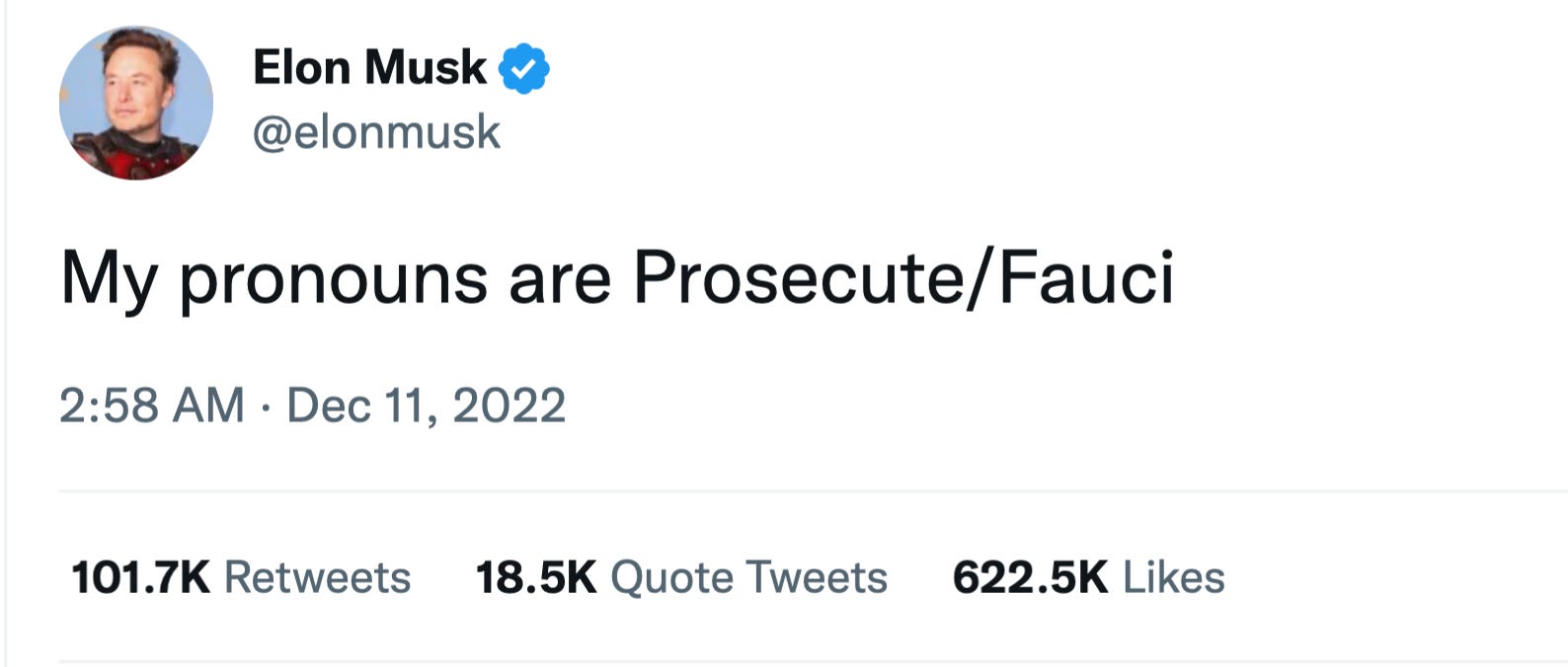
Dan Rather and his colleague Elliott Kirschner wrote a tribute to Dr. Anthony Fauci on his retirement. They noted that the anti-VAXX conspiracy theorists have been howling for Dr. Fauci’s scalp. Surprisingly, Elon Musk joined the anti-science mob with a hostile tweet.

They write:

One of the most dedicated public servants in this nation’s history is stepping down after decades of government service. That this same man is being scurrilously attacked by the world’s richest man on a rapidly degenerating social media platform is a sad but instructive snapshot of our times.

Dr. Anthony Fauci has served presidents since Ronald Reagan. He has led efforts against infectious diseases ranging from HIV/AIDS to Ebola to, of course, Covid-19. His work and dedication have saved countless lives. And for much of his career, he was viewed with great respect on both sides of the political aisle.

But we all know what happened. Fauci has become a target for the anti-science, conspiracy-theory-marinated movement stoked by the former president. And today, Elon Musk sent out a tweet that epitomizes the debasement. Like a smirking bully on the schoolyard, he wrote; My pronouns are Prosecute/Fauci.

Many online were quick to point out how Musk had earlier tweeted favorably about vaccines. And they noted how he has been staggeringly wrong about the pandemic, which he said early on would just disappear. Plus, for what exactly is Fauci supposed to be prosecuted? You have to be fluent in crazy conspiracy theories to start trying to answer that question.

But even to try to debate on the merits is to have already lost.

This isn’t about facts and the truth. This is about scoring political points. It is about flooding our global discourse with horse manure. It is about attacking the very notion of expertise. It is about saying everything can be true so nothing is true. It is about intimidating scientists and health officials. It is about feeding the MAGA crowd with the red meat of a sacrificial lamb.

Who is the real Elon Musk? With all his money and power, why does he pander to the MAGA crowd?