Archives for category: Extremism

Josh Cowen, a professor of education policy at Michigan State University, has engaged in voucher research for two decades. Recently, he realized that the people and groups funding school privatization are the same as those funding other anti-democratic, extremist causes.

He writes:

There’s an old saying that “friends are the family we choose.”

The idea is that none of us played a part in the manner in whichwe were born or raised. We can’t help which city or state or country we grew up in, or whether we had two married parents or parents who divorced, whether one or both of our parents were straight or gay or whether we were only or adopted children. We can’t help which religious tradition—if any—we were raised in although we can decide for ourselves what we believe as adults.

Eventually we come to be known—and to know ourselves—by the company we choose to keep.

I spend a substantial amount of time these days talking to reporters about education policy—not just school privatization but other issues I work on like teacher retention or issues like the dreadful “read or fail” law that Michigan adopted during its Florida-mimicry days. I have a lot of experience trying to explain complicated policy areas to lay readers and writers.

By far and away the most difficult task in that activity has been explaining just how extreme, fringe and even dangerous much of the advocacy around school privatization and school vouchers actually is.

Others have reported at length how artificial the so-called “parents’ rights” groups are, but the drum that needs to be constantly tapped is that the real goal of a voucher system or its latest incarnation of “Education Freedom” is entirely radical.

Let’s walk through it.

First, when we talk about vouchers—or “scholarships” as they’re almost universally euphemized—we’re talking about a policy that’s had catastrophic impacts on student achievement. I’ve written about this here on Diane’s page and in media outlets across the country. You have to look to the COVID-19 pandemic’s impacts on test scores, or to Hurricane Katrina, to find comparable harm to academics. Vouchers are a man-made disaster, and yet the intellectual and political drivers, from Betsy DeVos to Jay Greene, are the same people who were pushing for these policies 25 years ago.

That’s one form of extremism. DeVos herself admitted the Louisiana voucher program—where voucher test score drops were nearly double what COVID did—was “not very well-conceived.” If spending decades and millions of dollars on a policy that did that kind of harm isn’t dangerously radical, I don’t know what is.

But that kind of idolatry-level obsession with a particular public policy begins to make more sense when we look at the other forms of fanatism that voucher activists have linked up with in their organizing.

There’s election denial, for one thing. Voucher activism and research is funded by groups like the Lynde and Harry Bradley Foundation—a key player in the Big Lie push to undermine confidence in the 2020 presidential outcomes. That foundation’s Board Secretary Cleta Mitchell has a starring role in the recently released January 6th Committee Report.

In a way that’s fitting. Vouchers work for kids like Donald Trump won the 2020 election. You have to suspend reality to believe either.

Next, there’s the extreme level of cruelty that voucher activists are increasingly embracing to push toward their goals. The Right-wing voucher-pushing Heritage Foundation has been pumping out screed after screed on topics ranging from book bans to diversity to transgender health care in its explicit exploitation of culture war divisions, and has all-but-encouraged the framing of public school educators as enemies to parents.

So right there that’s election denialism, anti-transgender, anti-diversity and book-banning marching arm and arm with school vouchers.

Add to that Greg Abbott’s busing of migrants to frigid northern cities on Christmas Eve and Ron DeSantis’s similar human trafficking this summer. Abbott is leading the privatization push in Texas with the help of Betsy DeVos staffers, and under DeSantis’s Don’t Say Gay policies, Florida voucher schools are newly empowered to reject LGBTQ kids and parents on the taxpayer dime.

Add further an opposition to reproductive rights. In Michigan for example, the DeVos-backed voucher initiative was led by the same political operatives running the campaign against our constitutional amendment to enshrine the right to choose, and an amendment against voter rights expansions all at the same time!

None of this is an accident. The push to privatize education isfundamentally an effort to discriminate against vulnerable children and to undermine civic institutions ranging from public schools themselves to democratic elections. It’s that extreme.

But really, none of this is new. Many of the younger reporters I talk to have no idea that the voucher movement actually began as part of the South’s “massive resistance” to integration ordered by the Brown v Board of Education decision.

In that sense, it’s hardly surprising that today’s voucher backers want to expel LGBTQ children and lean into book bans all in the name of “values.” As the author William Faulkner once said, “the past is never dead. It’s not even past.”

One of the tricks that advocates for school vouchers and other forms of privatization have been able to pull over the last two decades is to make the erosion of public education seem moderate—even reasonable.

But whether clinging for decades to a voucher policy failure that’s unprecedented in modern education, clinging in the same spirit to a failed presidential candidate’s baseless claims of an electoral victory, or a steadied push to stoke cruelty toward children as a means to an end, the school privatization movement and with it the Right’s attacks on public education are some of the most extreme forces operating today in American politics.

Extreme, and ultimately very dangerous. Defending public schools is becoming increasingly a movement to defend human rights.

Timothy Snyder is a historian at Yale University. He is author of numerous books on tyranny, fascism, and democracy. He is the author of On Tyranny, Bloodlands, and most recently, Road to Unfreedom. This post appeared on his blog “Thinking About…”

He wrote on his blog:

After he lost, Trump was lying to extend his political life. It wasn’t that he labored under a misapprehension about the election. He knew that he had lost. But he was lying not so much to deny the truth [but] to invite people into an alternative reality. In November and December of 2020, this gave him a certain advantage. Everyone else was waiting for the election results, then for the candidates’ reaction. Trump had already thought this through. He knew that he was likely to lose. And he knew what he was going to do. He was going to tell a Big Lie, declare victory, and try to stay in power illegally.

The report of the January 6th committee is enlightening in many ways. For the most part, its authors are concerned to establish the simple course of events, which is damning enough. It is quite clear that Trump, in the full knowledge that he had lost the election, engaged in several acts that were meant to culminate in the overthrow of constitutional rule, and in his installment as president by fraud and violence. For the committee, wishing to establish intention, it was important to show that Trump knew that he lost the election, and also knew that his specific claims of fraud were untrue. And that is all made abundantly clear.

Yet there is a deeper point to be made about the nature of politics, which is that it can be transformed by big lies issued from positions of authority. One of the more interesting sections of the January 6th report is a graph that demonstrates that Trump, time after time, lied about specific claims of fraud right after being informed that they were false. His big lie about the election, once believed, summoned forth countless smaller lies or fantasies that seemed to support it. Trump repeated these more specific lies because it was precisely fiction that he wanted. He couldn’t think them all up himself; he needed help. He waited for the various inventions to reach him, made sure that they were not true, and then repeated them to millions of people.

In Trump’s world, there is no true and false, there is only a kind of Darwinistic competition of belief. If a lie made it up to him on the food chain, then it must be a good one that people will believe.

So the lying by Trump was more than a deliberate falsehood. It was a preference for a Big Lie over reality, and then a search for smaller lies to promote that would cast basic elements of reality into doubt, and thereby create a sense of grievance. The coup attempt that resulted was, in this sense, entirely predictable. Big Lies demand violence, since they command the faith of some, but cannot overcome the common sense or lived experience of others. The smaller lies within the Big Lie, by generating distrust of institutions, create a sense that only violence can restore the righteous order of things. People who believe Big Lies act on the grievances the smaller lies generate. The January 6 committee demonstrates that Trump urged people to violence directly. But it is also important to understand that the deliberate generation of an alternative reality is itself incompatible with democracy.

The striving for an all-embracing fiction explains the deep affinity between Trump and Putin, which came out into the open in 2016. To be sure, Putin had a strategic interest in a Trump presidency, which could be counted upon to weaken the United States, as it did. But in the various Russian efforts to support Trump, there was something more than a calculation: there was also the recognition of a brother in the fraternity of fiction, of another man who understood lying as life.

The Russian backing of Trump in 2016 was based on the assumption that what Trump needed above all was the spread of lies. And so the Russians worked social media not to show any real virtue of Trump, but to pass on lies about Hillary Clinton that would appeal to certain demographics. It did not try to show that Trump had not sexually abused women, but rather changed the subject to an imaginary crime of Clinton. (One of the chief architects of that Russian campaign of 2016, Evgeny Prigozhin, is now a leading figure in the invasion of Ukraine, as the owner of the mercenary firm Wagner.)

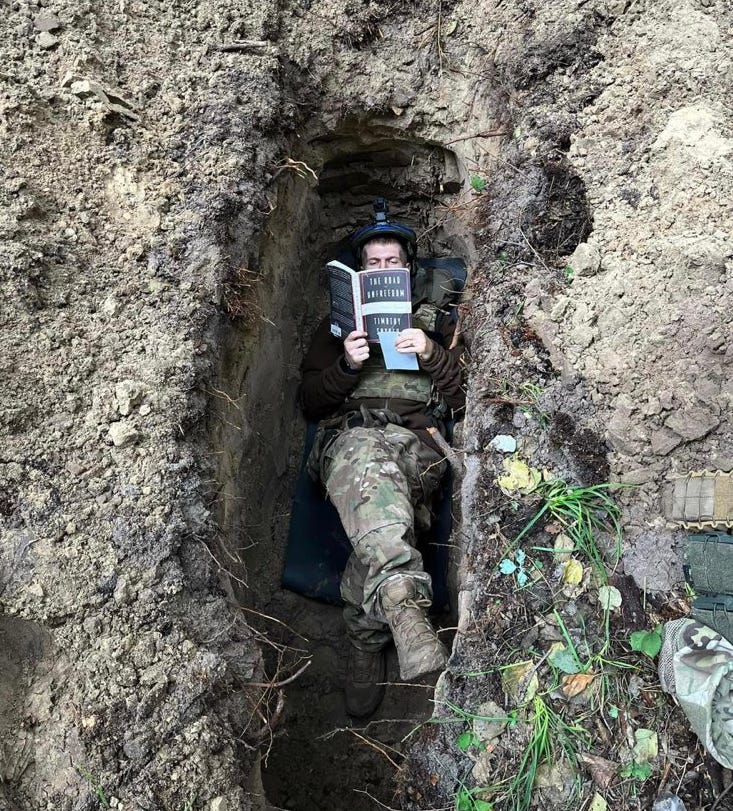
This is my book Road to Unfreedom, read by a Ukrainian soldier on the front. The book is about the turn towards post-truth fascism in Russia and the implications for Europe and the U.S. I am glad to have a reader, but can’t help thinking that he would not have to risk his life resisting Russian invasion if more of us had taken these issues seriously earlier on.

Putin also tells big lies, for example that Ukraine does not exist, that there is no Ukrainian society, no Ukrainian nation. Like Trump’s big lie about the election, Putin’s big lie about Ukraine then incubates smaller lies: If Ukraine does not exist, the war all be a plot of NATO! The people in charge of Ukraine must be Nazis! Or Jews! Or drug addicts! Or gays! Or gender theorists! Or Satanists! (All of these claims are made in the Russian information space; the official line is in fact at the moment that Russia is fighting Satan in Ukraine).

If Ukraine does not exist, then we, the Russian invaders, are the real victims. There should not be anyone there holding us back from what we think is right. This was the same sense of grievance expressed by the Americans who invaded the U.S. Capitol: we are the real victims, we are only restoring what should have been. No one should be holding us back from seeking justice with our own hands. Just as there was a natural affinity between Putin and Trump, there is a natural affinity between those who support Trump’s Big Lie and those who support Putin’s.

Newly-elected congressman George Santos took Trump’s approach to politics to its logical conclusion. Trump was a failed businessman and successful entertainer, who then used his entertainer skills to pretend to be a successful businessman and run for office. But no one could deny that he had careers. In the case of Santos, everything is just made up. He is not even a failed businessman (though he is a confessed thief). He is not even an entertainer (unless you count customer service). He is just a man who understands that lying for its own sake is a way to do politics, attract money and gain power. It will not take years to take apart his story; it will take weeks. (One thing that has emerged is a connection to Russia). And then the question arises: is alternative reality the future of America, or at least of its Republican Party?

Trump’s Big Lie opened the way for Santos, who repeats it, and who attended the rally to, in his own words, “overturn the election for Donald Trump.” Trump was a model of a man who came to power and gained money on little beyond mendacious schtick. Santos is following that lead. But it is also important to understand the new context in which Santos functions. By lying constantly during the first campaign and during the presidency, Trump set an example, one that is most relevant to members if his party. For two years now, Trump’s Big Lie has functioned the way that the Stalinist line used to function in the communist party. What Stalin said had to be treated as true, even if party members knew at some level that it was not. They had to engage constantly in what George Orwell called double-think, living in one lie, and preparing themselves for the next one, all the while imagining that somehow the process served some greater good.

Trump has trained Republicans, and a large part of the American people, in just these mental habits. Elected officials can say that elections don’t work, and no one really even notices the doublethink. Republicans claim that Democrats can alter electoral results, even as Republicans win control of the House of Representatives by a tiny margin. We ask ourselves: how can Russians continue to support the war in Ukraine? How do they handle obvious contradictions, like saying they are fighting a war against Nazis when the country they invade has an elected Jewish president? This is the answer: they have been trained that there is no truth, only the leader’s sheltering fiction, the comforting big lie, the line that comes down from above. We can all be trained like that, and too many Americans have been.

Once factual truth is no defense in politics, all that remains is spectacle and force. If Putin says there is no Ukraine, the war must prove it. If Trump says he won, his followers must storm the Capitol.

What follows from this, as students of democracy have argued since ancient times, is that the truth matters, and that truth needs defenses. Part of that defense is ethical. The truth cannot take revenge on a Santos (or whatever his name turns out to be) or a Trump or a Putin on its own. People have to care about it as a moral value. Democracy can only exist on the basis of such a moral commitment.

Aside from this, truth needs equality. When wealth is too unevenly distributed, as it is in this country, it is very hard to have a national conversation of any sort, and it is very easy for oligarchs to ride artificial spectacle to power (or fund others to do so — it will be interesting to learn who, aside from a sanctioned Russian oligarch’s cousin, funded Santos).

Perhaps most fundamentally, truth needs everyday champions. In every case I have mentioned — Putin’s war in Ukraine beginning in 2014, Trump’s 2016 campaign, Santos’s 2022 campaign — we simply lacked the foreign correspondents or investigative journalists. The only pre-election coverage of Santos’s lies was in a local newspaper, which contradicted his claims to great wealth. No larger medium picked it up in time. If we had more newspapers, and if we had more reporters, this story would likely have developed, and Santos would likely not have been elected.

This is the underlying sadness in the media brouhaha about Santos. Once a few facts were revealed (in a New York Times story on December 19), the television talk shows and social media could unleash a firestorm of indignation. But that was too late. The point of journalism is not to be outraged afterwards, but to prevent outrages from happening. It is not our role as citizens to be angry after an election. It is our role to vote calmly on the basis of what we should know. And we just don’t know what we should.

The problem is not that media are not alert. The problem is that the correct media are ceasing to exist. Talk shows can only talk about what someone else investigates. The internet can repeat, but it cannot report. We speak about the news all day, but pay almost no one to get out and report it. This rewards people who lie as a way of life. Every political career demands investigation at its beginnings, and most American counties lack a daily newspaper. That is where we are, and it has to change.

Paul Bonner is a retired educator who consistently posts wise comments here. I wholeheartedly endorse his view here.

Fundamentalism is a disease not limited to a particular faith. I highly recommend “The Battle for God: Fundamentalism in Judaism, Christianity and Islam” by Karen Armstrong. It is a political strategy imposed by a minority to handcuff any meaningful progress in nation states and beyond. Israel is now teetering on a precipice as a failed democracy due to the efforts of Jewish, Christian, and Muslim radicals. ISIS and AL Qaida are actually reincarnations of the Jewish Maccabean’s prior to the common era. Nazi Germany used such tactics as did Mussolini in his fascist one man as superior ruler dictum. Putin uses the Russian Orthodox Church for the same purposes. In the U.S, we experience this through the organization that runs the annual prayer breakfast and the rampant grift we call televangelism. What these have in common is the desire of a minority to have control and wealth. I wish we could divorce the conversation from the Christian moniker, but the goal of such corruption is to misrepresent a savior as the answer. This is the ongoing archetype of the “anti-christ” against salvation. In spite of our technological and intellectual advances we seem unable to escape this threat to mankind.

Governor DeSantis has pushed through laws that ban the teaching of “critical race theory” and gender studies. The effect of this law and his denunciation of anyone who dares to say that racism is real has been to silence academic freedom. This article in ProPublica (Read the story) shows how professors are dropping the courses they usually teach or changing their names. Untenured teachers— the majority of professors in higher education in Florida and elsewhere worry about being fired if they offend DeSantis’ thought police.

Ironically, the story includes a photograph of a truck owned by a rightwing group, festooned with the words “Freedom of Speech.” To be clear, DeSantis and his rightwing goons are silencing academic freedom and freedom of speech. They are the Thought Police, practicing “cancel culture.”

The article begins:

Jonathan Cox faced an agonizing decision. He was scheduled to teach two classes this past fall at the University of Central Florida that would explore colorblind racism, the concept that ostensibly race-neutral practices can have a discriminatory impact. The first, “Race and Social Media,” featured a unit on “racial ideology and color-blindness.” The second, “Race and Ethnicity,” included a reading on “the myth of a color-blind society.” An assistant sociology professor, Cox had taught both courses before; they typically drew 35 to 40 undergraduates apiece.

As recently as August 2021, Cox had doubted that the controversy over critical race theory — which posits, among other things, that racism is ingrained in America’s laws and power structure — would hamstring his teaching. Asked on a podcast what instructors would do if, as anticipated, Florida restricted the teaching of CRT in higher education, he said that they would need to avoid certain buzzwords. “What many of us are looking at doing is just maybe shifting some of the language that we’re using.”

But a clash with state law seemed inevitable, once Florida’s governor, Ron DeSantis, proposed what he called the strongest legislation in the nation against “the state-sanctioned racism that is critical race theory.” Last April, DeSantis signed the Individual Freedom Act, also known as the “Stop Woke Act,” into law. It bans teaching that one race or gender is morally superior to another and prohibits teachers from making students feel guilty for past discrimination by members of their race. And it specifically bars portraying racial colorblindness — which the law labels a virtue — as racist. A DeSantis spokesperson, Jeremy Redfern, told me in an email that the law “protectsthe open exchange of ideas” (italics in the original) by prohibiting teachers from “forcing discriminatory concepts on students.”

Whatever one thinks of critical race theory, the state’s interference limits the freedom of professors who are experts in their fields to decide what to teach their students. Cox worried, not without reason, that the law effectively banned him from discussing his ideas in class, and that teaching the courses could cost him his livelihood. Cox, who is the only Black professor in the sociology department, will not be considered for tenure until this fall. His salary was his family’s only income while his wife stayed home with their baby.

A month before the fall 2022 semester was set to start, he scrapped both courses. Students scrambled to register for other classes. “It didn’t seem like it was worth the risk,” said Cox, who taught a graduate course on inequality and education instead. “I’m completely unprotected.” He added, “Somebody who’s not even in the class could come after me. Somebody sees the course catalog, complains to a legislator — next thing I know, I’m out of a job.”

Cox’s decision, along with another professor’s cancellation of a graduate course because of similar apprehension, created an unusual gap in the sociology curriculum at UCF, which, with almost 69,000 students, is Florida’s largest university.


Cox’s department chair, Elizabeth Mustaine, said she went along with the professors’ wishes because “I thought: ‘I’m not going to stress anyone out about this. It’s crazy.’” Still, she added, “it’s an absolute tragedy that classes like this get canceled.” Of the 39 courses offered this past fall by a department that specializes in the study of human society, none focused primarily on race.

In just over two years, critical race theory has gone from a largely obscure academic subject to a favorite bogeyman for Republican candidates. Activists such as Christopher Rufo, a senior fellow at the conservative Manhattan Institute, conceived of targeting CRT to foment a backlash against measures enacted following George Floyd’s murder in May 2020. At that time, Rufo told me in an email, “school districts across the country suddenly started adopting ‘equity statements,’ hiring ‘diversity and inclusion’ bureaucrats, and injecting heavily partisan political content into the curriculum.” Black Lives Matter and the left were riding high, said Rufo, who denies that structural racism exists in America. In our email exchange, Rufo described “the fight against critical race theory” as “the most successful counterattack against BLM as a political movement. We shifted the terrain and fought on a vector the Left could not successfully mobilize against.”

The anti-CRT campaign quickly expanded from sloganeering to writing laws. Seven states, including Florida, have passed legislation aimed at restricting public colleges’ teaching or training related to critical race theory. Those laws face impediments. On Nov. 17, 2022, a federal judge temporarily blocked enforcement of the higher-education provisions of Florida’s Individual Freedom Act. “The First Amendment does not permit the State of Florida to muzzle its university professors, impose its own orthodoxy of viewpoints, and cast us all into the dark,” Judge Mark Walker wrote. The DeSantis administration filed a notice of appeal on Nov. 29 and is seeking to stay the injunction pending that appeal. The 11th Circuit, where most of the judges are Republican appointees, will hear the appeal, with briefs to be filed in the next few months and oral arguments potentially this coming summer.

Additionally, with DeSantis’ landslide reelection — after a campaign in which he repeatedly denounced “woke” education — and Republicans gaining a supermajority in both chambers of the state’s Legislature, they are likely to look for new ways to crack down on CRT and what they perceive as higher education’s leftist tilt. And at the federal level, conservatives are drafting a “potential suite of executive orders in 2024,” in case the next presidential election goes their way, to “disrupt the national network of left-wing ideological production and distribution,” according to Rufo.

It’s easy to dismiss the conservative crusade against critical race theory as political theater without real consequences. But most colleges and universities offer social science and humanities courses that address racial inequality and systemic racism, and the anti-CRT laws are already having repercussions for people who teach or take these classes in red states. Moreover, the push against CRT is hitting academia after decades of declines in the proportion of professors protected by tenure, meaning that most faculty members are not in positions secure enough to resist political pressure. Now, forced to consider whether they face any legal or career risk, some are canceling courses or watering down content, keeping quiet rather than sharing their expertise with students.

“When you implement a law like this, you’re asking professors to leave out things that clearly happen or have happened in the past,” Grace Castelin, a UCF undergraduate who plans to introduce a resolution in the student senate condemning the law, told me. “It’s making us more ignorant in this generation and generations to come.”


Fearful that legislators will retaliate by cutting their budgets, few top university administrators have publicly criticized the laws, which put institutions as well as individual teachers at risk. Indeed, UCF Provost Michael Johnson told faculty last July that the university would “have to take disciplinary action” against any faculty member who repeatedly violated the Individual Freedom Act because it couldn’t afford to lose a “catastrophic amount” — $32 million — in state funding linked to graduation rates and other metrics. (Johnson declined an interview request.)

Other states have left professors similarly undefended. In Tennessee, which passed a law much like Florida’s, the provost of the state university’s flagship Knoxville campus made clear to professors that the administration wouldn’t necessarily help them. If they were sued under the law, Provost John Zomchick told faculty, Tennessee’s Republican attorney general would decide whether the university would represent them in court. “People freaked out,” said Anne Langendorfer, a senior lecturer at UT Knoxville and the president of a union for campus workers at the state’s public universities.

A university spokesperson, Kerry Gardner, said that the attorney general makes the final decision in “any situation” where individuals are sued in their capacity as university employees. Administrators “wanted to be fully transparent about how the process works,” while assuring faculty that “we will take every step to defend them,” Gardner said. Zomchick, she added, “does not agree with the view of some faculty” that the law “infringes on the First Amendment or academic freedoms.”

With uncertain support from above, most full and associate professors at least enjoy the protection of tenure, which shields scholars whose insights or research are politically unpopular. Tenured professors can’t be fired without cause and a hearing by their peers. Other faculty typically work on contracts, which the university can decide not to renew without specifying a reason.

Some tenured professors in Florida have resisted anti-CRT pressure. The historian Robert Cassanello, the president of the UCF chapter of United Faculty of Florida, was comfortable becoming a plaintiff in one of the lawsuits contending that the Individual Freedom Act violates free speech. Cassanello, who keeps a life-size cutout of Karl Marx in his office window, told me that he’s less threatened by the law than his untenured colleagues are.

Robert Cassanello, a tenured professor, teaches history at the University of Central Florida and became a plaintiff in a lawsuit challenging a state law that restricts the teaching of critical race theory. (Tara Pixley, special to ProPublica and The Atlantic)

By contrast, Juan Salinas, an assistant sociology professor at the University of North Florida in Jacksonville, declined to be a plaintiff. “For me to stick my name out, I didn’t feel comfortable,” Salinas said. “If I had tenure, I would be more active.”

But even having tenure didn’t feel like “adequate protection” to Scott Carter, the other UCF sociologist who scrapped a course on race in the fall semester. “It’s very sad for students,” Carter told me. “They won’t get the experience of hearing from scholars on contemporary race relations.”

Darcie Cimarusti served on the school board of Highland Park, New Jersey, from 2013 to 2022. She is the communications director of the Network for Public Education. This article appeared in the Bedford Gazette.

She writes:

I have been a local school board member since my daughters, now 11th-graders, were in second-grade. In that time, I have been involved in education policy discussions at the local, state and national levels on issues related to the rights of LGBTQ+ students, standardized testing and the privatization of public education. The rise of the so-called “parental rights” movement in public education has been one of the thorniest, most perplexing issues I have encountered.

There is no doubt that parents play a crucial role in the education of their children. Who would dare argue that they don’t? But in the face of the anti-critical race theory, anti-LGBTQ+, anti-social emotional learning, anti-diversity equity and inclusion juggernaut unleashed by heavily funded, right-leaning astroturf parent groups such as Moms for Liberty, it has become imperative that we have an honest discussion about how much say parents should have in what is (or is not) taught in our public schools.

My district, unlike many, is racially, ethnically and socioeconomically diverse, with 31 languages spoken in the homes of our students. Educating such a diverse student body presents many challenges and requires a nuanced approach to policy and practice that ensures all students have equal opportunities to learn, thrive and grow. While it is easy for school leaders to say they embrace diversity, equity and inclusion, it’s far too challenging to implement policies promoting those principles.

I have spent my time on the school board helping to develop systems that ensure decisions are made collaboratively and with as many voices at the decision-making table as possible. This means making space not only for administrators, teachers, parents and students but also ensuring that historically marginalized groups are represented.

Decisions that affect students should never be based on the whims of those with the most privilege or power and indeed not on who has the loudest voice in the room.

However, the latter has become the hallmark of parental rights activists. They attend meeting after meeting, berating, shouting down and even making death threats against school board members. During the pandemic, battles over masks erupted at podiums at far too many school board meetings across the country and quickly morphed into demands to ban books, censor curriculum and muzzle “woke” teachers that parents accused of “grooming” their children.

In the 2022 midterm elections, parental rights activists were on the ballot in numerous states. With the support and endorsement of Moms for Liberty, they ran campaigns to become school board members in districts in red, blue and purple states. Moms for Liberty operates county chapters that aim to serve as watchdogs “over all 13,000 school districts.” Chapters empower parents to “defend their parental rights” and “identify, recruit & train liberty-minded parents to run for school boards.”

The “anti-woke” agenda espoused by Moms for Liberty endorsed school board candidates who had the greatest successes in Florida, where Gov. Ron DeSantis proudly declared the state being “where woke goes to die.” But in many other parts of the country, parental rights candidates lost their elections, with even conservative political operatives acknowledging that many of their campaigns were “too hyperbolic.”

Chaos has already erupted in several districts where they succeeded and won board majorities, with newly formed, inexperienced boards firing superintendents or forcing them to resign. One board voted to ban the teaching of critical race theory just hours after being sworn in.

After a decade of experience as a school board member, there’s one thing I can say for sure: The majority of parents, teachers and community members do not respond well to instability and disruption in their local public schools. When school boards run amok and rash decisions make headlines, communities work quickly to restore calm. If parental rights school board majorities continue to govern recklessly, they will undoubtedly face a backlash from voters.

Creating and implementing sound school policies and practices that respect and affirm all students requires collaboration. It does not allow for the divisive, polarizing rhetoric and impetuous, rash decision-making that have become the calling cards of the so-called parental rights movement.

One of the regular readers of the blog alerted me to the fact that there were several comments today (January 5) that contained vulgarity and profanity that are not allowed on this blog.

These disgusting comments were written in response to a post I wrote on June 1 called “I Am Woke, You Should Be Too,” in which I asserted that I care about justice, equality, freedom, and other fundamental ideals of our society. I took issue with those who would censor the views of those who disagree with them. I specifically criticized Florida Governor Ron DeSantis for passing laws to silence those who don’t agree with his censorious views.

I wrote:

One of the hot-button words that has been appropriated by rightwing politicians is “woke.” They are trying to turn it into a shameful word. I looked up the definition of WOKE. It means being aware of injustice and inequality, specifically when referring to racism. I strive to be aware of injustice and inequality and racial discrimination and to do whatever I can to change things for the better. Shouldn’t we all do that?

My acronym for WOKE is “Wide Open to Knowledge and Enlightenment.”

What would you say about someone who is not WOKE? They are “asleep,” “unconscious,” “indifferent.” They are “Mind Closed, Mouth Open.”

Yes, I am WOKE. I want Dr. King’s dream someday to be true. It is not true now.

Apparently, this post was reprinted on a rightwing site. Consequently, I have received quite a few hostile, vicious, profane comments, especially today.

I regret that several such profane comments got past me today. I was busy and did not carefully screen every comment.

I apologize for allowing profanity on this site.

I will try to block them as soon as possible.

Yes, I am woke. I am proud to be woke. I hope someday everyone will care passionately about justice, equality, and freedom. Curse all you want. But not on this blog. I will delete them as soon as I see them. I won’t back down.

Diane Ravitch

Josh Cowen is a researcher at Michigan State University who has studied vouchers for many years.

Recently he began writing about the failure of vouchers. They don’t “save children,” in fact, children fall behind when they use vouchers.

Join us on January 11 for a video conference with NPE President Diane Ravitch. Diane’s guest will be Josh Cowen, Professor of Education Policy at Michigan State University. Diane and Josh’s conversation will be titled School Privatization and the Education Culture Wars: The Year in Review and the Year Ahead.

Dr. Cowen has been studying school choice, teacher labor markets, and other policies for nearly two decades, and works directly with policymakers, stakeholders and media professionals to understand the consequences of various education reforms.

“Josh has drawn connections to the school culture wars, privatization, voting rights denial, and other hot-button issues,” Diane said.

RSVP NOW

The new Governor of Arkansas, Sarah Huckabee Sanders, has chosen Jacob Olivia, a member of Ron DeSantis’ education team to lead Arkansas’ schools.

Max Brantley of the Arkansas Times expects that the change in personnel indicates a new move to install vouchers and to copy other parts of disastrous and divisive education agenda.

Yep, the Cabinet appointment today by incoming Governor Sanders was a big one. She’ll be replacing Asa Hutchinson’s Education secretary, Johnny Key, with a veteran of the DeSantis administration in Florida, Jacob Oliva, senior chancellor at the Florida Department of Education, overseeing the Division of Public Schools.

Brantley quotes an opinion piece written in the district where Olivia was a superintendent before DeSantis brought him into a statewide position:

A quick search turned up this opinion piece on Oliva, by a writer who said he’d been a generally progressive school administrator in Flagler County but had drunk DeSantis’ “reactionary Kool-Aid.” It notes that, as a high school principal, Oliva initially moved to kill a student production of “To Kill a Mockingbird,” but relented after protests, a positive sign of his willingness to listen.

But the writer also said of Olivia:

I am trying to understand how you went from being one of the most progressive, innovative and inclusive superintendents in the history of Flagler County to a shill, as one of two Florida senior chancellors of education, for the single most regressive, reactionary and, frankly, just plain mean state departments of education in the nation. Something isn’t adding up.

This isn’t the Jacob Oliva we knew, unless you’ve placed a bet on Ron DeSantis becoming president and your next nameplate getting laminated in Washington. Even so: has your ambition become so primeval that you’re willing to make these Faustian bargains the way you have on covid safety measures, on gender identity, on sanitized civics and history, and now degrading math textbooks for something as innocuous–if not provably useful–as their social-emotional learning content?

I urge you to open the link and read the article, and please, please read the comments.

The Washington Post reported that the anti-vaccination movement has prompted the return of diseases that were previously thought to be eliminated. The anti-vaccination folk are mainly Republicans, and their antipathy to vaccines has been encouraged by their party’s leaders, like Ron DeSantis, who has banned vaccine mandates in Florida. Republican members of Congress forced the abandonment of mandatory vaccinations for the military.

Veteran reporter Lena H. Sun wrote:

A rapidly growing measles outbreak in Columbus, Ohio — largely involving unvaccinated children — is fueling concerns among health officials that more parent resistance to routine childhood immunizations will intensify a resurgence of vaccine-preventable diseases.


Most of the 81 children infected so far are old enough to get the shots, but their parents chose not to do so, officials said, resulting in the country’s largest outbreak of the highly infectious pathogen this year.

“That is what is causing this outbreak to spread like wildfire,” said Mysheika Roberts, director of the Columbus health department.

The Ohio outbreak, which began in November, comes at a time of heightened worry about the public health consequences of anti-vaccine sentiment, a long-standing problem that has led to drops in child immunization rates in pockets across the United States. The pandemic has magnified those concerns because of controversies and politicization around coronavirus vaccines and school vaccine mandates.

More than a third of parents with children under 18 — and 28 percent of all adults — now say parents should be able to decide not to vaccinate their children for measles, mumps and rubella (MMR) to attend public schools, even if remaining unvaccinated may create health risks for others, according to new polling by the Kaiser Family Foundation, a health-care research nonprofit.

Public sentiments against vaccine mandates have grown significantly since the pandemic, said Jen Kates, a Kaiser senior vice president. A 2019 poll by the Pew Research Center found that less than a quarter of parents — and 16 percent of all adults — opposed school vaccination requirements.

The growing opposition stems largely from shifts among people who identify as or lean Republican, the Kaiser survey found, with 44 percent saying parents should be able to opt out of those childhood vaccines — more than double the 20 percent who felt that way in 2019.

Adam Moore, a father of three in the Detroit suburbs, said none of his children — 9, 12 and 17 and enrolled in private school — have received routine childhood immunizations, let alone vaccines for the coronavirus or flu. He values personal liberty and says the government has no right telling people what to do with their bodies.

“I find it a hard argument when the government says we’re all for individual liberty on abortion rights and all this other stuff, but when it comes to vaccinations, there’s no such thing as ‘my body, my choice,’” said Moore, 43, an account manager for a marketing company.

Moore, who describes himself as Republican-leaning, said he does not view childhood diseases such as measles and polio, which have resurfaced in recent years, as threats. But if the deadly Ebola virus were circulating, he said, he would want his children to get vaccinated.

Other parents who oppose school immunization mandates echo long-standing misinformation about vaccines that continue to spread via anti-vaccine groups.

Bianca Hernandez, a 37-year-old dog breeder in the Albuquerque metropolitan area, described concerns about the link between vaccine ingredients and autism, a view that has been extensively disproved. She said her two youngest children receive religious exemptions from school vaccination requirements.

Support for immunization mandates has held steady among Democrats, with 88 percent saying that children should be vaccinated to attend public schools because of the potential risk for others when they are not.

Overall, 71 percent of all adults still support school immunization requirements, compared with 82 percent in 2019.

“The situation about increasing negative sentiment about childhood vaccination is concerning, but in absolute terms, vaccines remain the social norm,” said Saad Omer, director of Yale’s Institute for Global Health and an infectious-disease expert who has studied vaccine hesitancy.

Anne Zink, chief medical officer for Alaska’s health department, said that even in a state with historically lower vaccination rates, childhood immunization rates have yet to return to their pre-pandemic levels. In the years before the pandemic, about 65 percent of Alaskan children 19 to 35 months old had completed their routine childhood immunizations. By the end of 2021, 46 percent had.

A few weeks ago, Zink, an emergency room doctor, saw her first case of chickenpox when a young woman walked into the Mat-Su Regional Medical Center in Palmer covered in large, painful lesions. The woman said she and her family did not believe in vaccinations and told Zink she thought chickenpox no longer existed.

“I think there is more mistrust of the government, there’s more questioning of vaccines, and we’ve been having a harder time getting people vaccinated,” said Zink, who is also president of the Association of State and Territorial Health Officials.

“I was like, ‘Well, it really doesn’t when all of us choose to get vaccinated, but you aren’t vaccinated, your family’s not vaccinated, and the people you hang out with are not vaccinated. Chickenpox has been spreading in your community, and now you’re really sick,’” Zink recalled.

In the past, Zink said, herd immunity would have protected the woman against such childhood diseases. But that protection has waned as anti-vaccine sentiment grows, she said.


To distance its push for vaccination from the current political narrative, the Alaska health department recently brought back images and language from a 1960s promotion for polio vaccination. The new social media campaign uses the vintage Wellbee cartoon and rocket — “Get a booster!” — to remind people that immunization has always been part of the country’s history.

It is too early to see the effects of eroding public support for school vaccination requirements on childhood immunization rates because federal data typically lag by about two years. During the pandemic, routine vaccination rates slipped because of school closures and because children were not going to the doctor.


The growing negative attitudes about school immunization requirements are troubling for health workers. Kentucky officials are urging that people get flu shots after six children — none of whom were vaccinated — died after contracting influenza. South Carolina officials had also promoted childhood vaccinations after two chickenpox outbreaks in March — the first since 2020 — affected nearly 70 people.


A case of paralytic polio in a New York man this summer prompted worry that low childhood immunization rates and rising vaccine misinformation could result in the disease’s resurgence, decades after vaccination had eliminated it in the United States.

“There is definitely a group of parents who have shifted their attitudes,” said Jennifer Heath, immunizations program coordinator for Minnesota’s health department who works on vaccine hesitancy and outreach. “Part of it is true attitude shift. But part is a disconnection to the primary care provider, the human being who’s telling you that vaccines are important.”


School vaccination requirements are among the most effective tools to keep children healthy. All states and the District of Columbia require children to be vaccinated against certain diseases, such as measles, polio and whooping cough, to attend public school. All states grant exemptions based on medical reasons; a growing number allow religious or philosophical exemptions.


D.C. also requires students 12 and older to be vaccinated against covid-19 but has delayed enforcing the mandate until the 2023-2024 school year. California has a pending statewide student coronavirus vaccine mandate that will not take effect until after July 2023. Nearly two dozen states have some form of ban against student coronavirus vaccine mandates.


The Centers for Disease Control and Prevention recommends children get two doses of MMR vaccine, with the first dose at 12 to 15 months, and the second dose between 4 and 6 years old. One dose of the vaccine is about 93 percent effective in preventing measles, one of the most infectious pathogens on the planet that can cause serious complications, including death. Two doses are about 97 percent effective at preventing the disease.

In the Ohio measles outbreak, only three of the 81 children had received a single dose of vaccine, according to state data. None were known to be fully vaccinated.


“I think some of these attitudes were here before the pandemic, and then we probably picked up some additional community members who were accepting of vaccines before but now maybe are more critical about vaccines as a result of what transpired with the coronavirus vaccine,” Roberts said.

Some of the cases occurred in Columbus’s large Somali community, the second-largest Somali population in the United States after the Minneapolis area, Roberts said. Parents have said they “intentionally delayed” giving their children the measles vaccine because of their fear of autism, she said, despite considerable research disproving any relationship between vaccines and autism.

Those fears echoed similar concerns of parents in Minnesota’s Somali community during a 2017 measles outbreak that infected 75 children, mostly unvaccinated preschool kids.

Minnesota is also battling a new measles outbreak — 22 cases — as vaccine hesitancy around the MMR vaccine continues to be an issue, said Doug Schultz, spokesman for the Minnesota health department.

Officials are bracing for more cases in the coming weeks as families travel and gather indoors for the holidays. At least 29 of the Ohio children have been hospitalized, some so sick they required intensive care.

Most of the sickened children — 78 percent — are Black, 6 percent are Asian, 6 percent are White, and 4 percent are Hispanic, according to Columbus officials.

Because the measles virus is so contagious, an overall community vaccination rate of about 90 to 94 percent is needed to keep the virus from causing large outbreaks, according to infectious-disease experts. In the United States, nearly 91 percent of children have received at least one dose of the MMR vaccine by age 2. In the Columbus area, Roberts said, the measles vaccination rate is estimated at 80 to 90 percent, but health-care providers are not required to report data to Ohio’s vaccine registry.

Even if overall coverage in a community is high, measles can transmit easily in clusters of under-vaccinated or unvaccinated people. The Columbus outbreak began when one or two unvaccinated people traveled to countries where measles is still common between June and October and infected others in the community, Roberts said.

In recent years, many of the measles cases reported to the CDC have occurred in underimmunized, close-knit communities, where anti-vaccine misinformation has gained a foothold. In 2019, the United States reported the highest annual number of measles cases — 1,294 — in more than 25 years; three-fourths of those cases occurred among New York’s Orthodox Jewish communities. Outbreaks have also occurred among the Amish in Ohio and Eastern European groups in the Pacific Northwest.

After consulting with counterparts in Minnesota, health officials in Ohio have been working closely with the Somali community to increase vaccination uptake without stigmatizing them. Columbus public health workers have hosted vaccine clinics at a community center and a mosque and are conducting home visits to provide shots. They have also reached out to schools, day-care centers and grocery stores about the importance of vaccination.


The efforts appear to be making a difference.
Nationwide Children’s Hospital in Columbus recently saw a 20 percent increase in the number of parents seeking the MMR vaccine, Roberts said. The health department, too, has seen a small uptick in vaccinations.


“They are trickling in,” she said, “slowly but surely.”
Ruth Ben-Ghiat is a history at New York University who specializes in fascism and authoritarian leaders.

She wrote:

Authoritarianism is about having the power to get away with crime, and waging a genocidal war against another country without othercountries intervening in ways that force a cessation of conflict counts as a big win in the autocrat world. In fact, from the minute they receive intelligence about a planned invasion, autocrats watch carefully to see what happens to transgressors of the international order–and adjust their own plans for aggression accordingly.

Allowing Russian President Vladimir Putin’s war of annihilation against Ukraine to continue by not giving Ukraine the arms it needs to definitively repel the Russian invaders increases the risk that other autocrats will ramp up their own imperialist aspirations. Autocrats interpret any ambivalence about shutting down their peers’ territorial expansions as license to proceed with similar aggressive acts.

History is clear about what happens in such cases. Most people are familiar with the folly of the September 1938 British and French-brokered Munich agreement, which allowed the Third Reich to annex the Sudetenland in Czechoslovakia six months after it annexed Austria.

Far fewer know about the earlier appeasement that set the stage for Hitler’s actions: Benito Mussolini’s war on League of Nations member Ethiopia, which started in October 1935. This was the biggest military operation since World War I, with Italy’s formidable air force dropping hundreds of tons of illegal chemical weapons on Ethiopians.

The weak sanctions levied on Italy by the League of Nations did not deter Il Duce from continuing to commit war crimes. He declared victory in May 1936, and occupied Ethiopia until the Allies drove the Italians out in 1941. “Was it ever likely to be effective?” Winston Churchill wrote critically of the sanctions in June. “Was it real or sham?” That same month, exiled Emperor Haile Selassie I denounced the war crimes to the League of Nations, but no action was taken against the Fascists.

By then, Mussolini’s admirer Hitler had all the information he needed about the consequences a despot might face for military aggression. In March 1936, while Mussolini’s war entered its sixth month, the Führer remilitarized the Rhineland, in violation of the Treaty of Versailles.

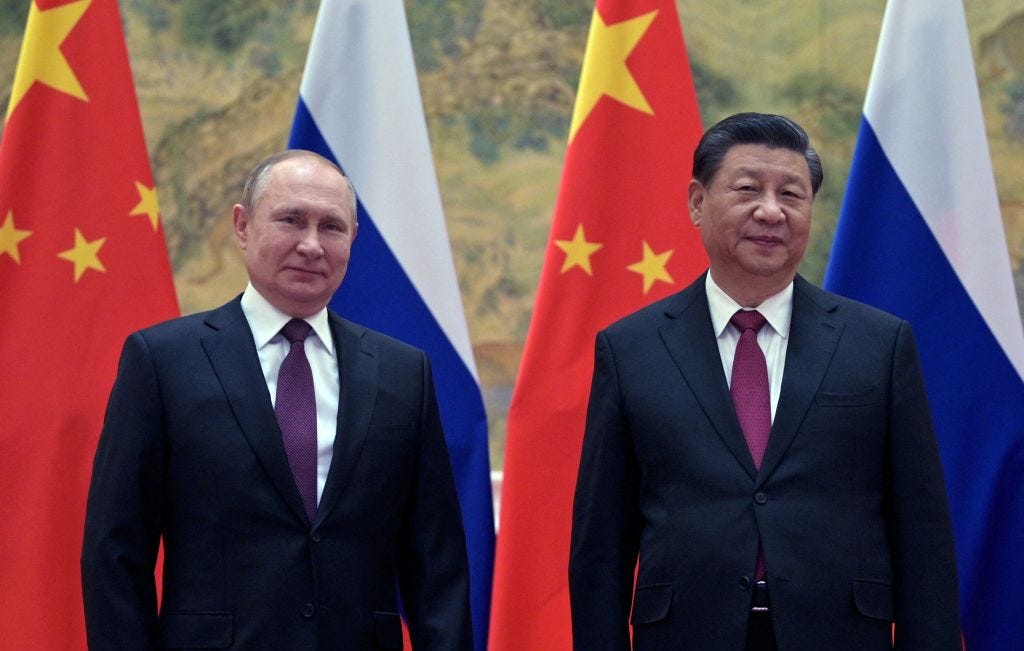
Twenty-first century autocrats watch their kindred spirits’ fates with equal interest. Since the start of Putin’s war on democratic Ukraine, the world has become far less safe. A few weeks before the Russians invaded, Putin and Chinese head of state Xi Jinping issued a joint statementabout the new “multipolar” era of international relations. The premise of this new era –unrestrained imperialism for Russia and China– has become all too clear.

Russian President Vladimir Putin and Chinese President Xi Jinping together in Beijing, Feb. 4, 2022. Alexei Druzhinin/Sputnik/AFP/via Getty Images

Xi Jinping has since become far more aggressive towards the West. His government has increased its rhetoric about its imperialistic claims on Taiwan. He has consolidated his personal power with a third term, while further puffing up his personality cult in ways not seen among Chinese premiers since Mao Zedong.

Turkey has also ramped up its bellicose and expansionist rhetoric regarding Syria and Greece. It has also persecuted Armenians, through its ally Azerbaijan, in the disputedterritory of Nagorno-Karabakh.

Autocrats are transactional beings. You have a deal with an autocrat until you don’t, meaning no one should think that Putin will negotiate with or about Ukraine in good faith. That also holds for their relationships with each other (as Joseph Stalin discovered when Hitler invaded Russia despite signing the Molotov-Ribbentrop non-aggression pact).

Even as dictators cheer on lawlessness that goes unpunished by the democratic order, they also circle each other like vultures, looking for signs of weakness that they can exploit. And everyone knows that Putin is more vulnerable as a player in the sphere of influence game with his resources and attention focused on Ukraine. Turkey, along with China, will seek to fill any power vacuum Putin’s weakness opens up in Eurasia and beyond.

Turkish President Recep Tayyip Erdogan’s relationship with Putin has always been volatile. In the course of a few months in 2016 they went from almost going to war to being “best friends,” dining on plates that immortalized their friendship. I was skeptical of Erdogan’s early claims that he would be a “peacemaker” and mediator between Russia and Ukraine. Turkey intends to exploit this international crisis to increase its own power and prestige.

Now Serbian President Aleksandr Vucic has become the latest authoritarian to be galvanized by the possibilities created by the prolongation of Putin’s war. He has put his military on high alert, citing rising tensions with the Republic of Kosovo. Serbia does not recognize the sovereignty of Kosovo, which declared independence from Serbia in 2008.

All of these conflicts have long histories that are independent of the new climate created by Putin’s invasion of Ukraine. Yet democratic powers’ acceptance of a continuance of Putin’s war will only further destabilize the international order. It also increases the chances that democratic strongholds such as Taiwan will be targeted for “reunification” –the word of choice for autocrats since the days of Hitler to market their imperialism to their peoples and the world.

That’s why Ukrainian President Volodymyr Zelensky was right to state in his speech to U.S. Congress that supporting Ukraine is an investment in global security. He knows that when an autocrat gets away with an imperialist and genocidal war it only increases his megalomania and hubris, making it far more difficult to rein him in later on. It also increases the likelihood that other autocrats will commit their own aggressions toward targeted territories.

And it’s why the warning that economist Anders Aslund issued to his fellow Europeans should be heeded, not least because it builds on historical precedent. As an expert on Putin’s kleptocracy, Aslund knows the value and prestige impunity has among autocrats. “If you don’t deliver enough of arms & funds to Ukraine now,” he tweeted, “you might have to face Russian troops yourselves later on.”