Archives for category: Ethics

The Washington Post tells the story of a high school teacher who was accused of sexually assaulting a student. She was arrested and fired. The charges were dismissed for lack of evidence. The teacher sued the county and won a judgment of $5 million for the damage to her life and career.

I am reminded of an incident that happened in the D.C. public schools in 1991 when I was living in Washington and working for the George H.W. Bush administration. A story appeared in the Washington Post that a junior high school teacher was accused by eight students of sexual misconduct. With so many accusations, it appeared at first reading that the teacher was a dangerous child abuser.

However, the D.C. police interviewed each student separately, and eventually one of them confessed that the group had concocted the story to hurt the teacher because he assigned to much homework. They wanted to punish him. He was cleared but his reputation was destroyed.

Here are the details of this recent case:

The first clue that Kimberly Winters, a high school English teacher, had that a former student had accused her of sexually abusing him was when Loudoun County sheriff’s deputies in full riot gear burst into her bedroom one morning with their rifles drawn.

“It was very terrifying,” Winters said. “I still have nightmares. Big guns.”

Winters said the deputies yanked her out of bed, handcuffed her, and made her stand in the front yard of her Sterling, Va., home in her pajamas while they patted her down, in full view of the neighborhood.

When she went to the Loudoun jail, Winters said, she was strip-searched, which her lawyer said violated the sheriff’s policies because she wasn’t booked into the jail. But her mug shot was taken and distributed to the news media along with a press release saying she was charged with sexually abusing one of her students when he was 17. Soon, she was fired from her job at Park View High School, after teaching in Loudoun for eight years.

When Loudoun prosecutors looked at the case brought by Detective Peter Roque, they promptly dismissed all charges. Winters sued Roque and Loudoun Sheriff Mike Chapman (R). And after a five-day trial earlier this month, a Loudoun jury took less than two hours to find the two law enforcement officials liable for Winters’s economic and punitive damages. They awarded her $5 million.

It appeared Roque had not seriously investigated any of the student’s claims, said Winters’s lawyer, Thomas K. Plofchan. On a sworn search warrant application in November 2018, Roque had written, “Witnesses’ statements are corroborated by phone records,” but there were no records, Plofchan said the evidence showed.

Winters said she could not get a job for two years, even as a stock clerk in a grocery, with her master’s degree in teaching. She lost all of her friends, many from her years in Loudoun schools. And she developed intense anxiety, including an involuntary tremor. “It became so humiliating, I literally couldn’t go out of my house,” Winters said. “This has been going on for four years. The repeated trauma of having to relive this created this tremor. My entire body shakes.

There is more, if you can open the story. Basically, the mother and son had no evidence. No text messages, phone messages, photographs, notes.

The moral of the story is that accusations of this nature should not be made without corroborating evidence. If two people have a sustained relationship, there should be evidence. Otherwise every teacher lives in fear of false accusations.

Ms. Winters gave up teaching. She can’t go back.

Bill Phillis, retired deputy state superintendent of education and tireless advocate for public schools, discovered that the latest Republican effort to gut the State Board of Education violates the State Constitution.

He writes:

Unbelievable—Senate Bill 1, the Bill to render ineffective the State Board of Education violates the 1953 constitutional amendment which established the Board.

The Department of Education in Ohio is comprised of the State Board of Education, the superintendent of Public Instruction and the staff. Prior to the 1953 amendment, the education department, including the Superintendent of Public Instruction and staff (state education agency), constituted an administrative arm of the Governor’s office. This arrangement had been in place since 1913 after the Delegates to the 1912 Constitutional Convention proposed to replace the State Commissioner of Common Schools with the Superintendent of Public Instruction, which proposal, the citizens of Ohio approved on a statewide ballot. In 1939 a constitutional amendment proposal to establish a State Board of Education failed by a near two to one margin. The Depression may have been a factor in the overwhelming defeat.

In 1953 Ohioans passed a constitutional amendment to establish a State board of Education and Superintendent of Public Instruction to be selected by the Board. Prior to the 1953 amendment, the state education agency was completely under the control of the Governor. The State Board of Education, with the newly selected Superintendent of Public Instruction, began operation in January 1956; hence the state education agency operated as a 4th branch of government until the mid-1990’s when legislation was enacted to allow the appointment of eight members by the Governor.

Article VI, section 4 of the Ohio Constitution states that the respective powers and duties of the Board and Superintendent of Public Instruction shall be prescribed by law; however, this language does not authorize the legislature to transfer the core functions of the State Board to the Governor’s office. The 1953 amendment transferred the core functions from the Governor’s office to the State Board. That is why the amendment was passed.

The legislature should deal with this matter in a manner that respects the intent and language of the Constitution. This question should be submitted to the citizens of Ohio to determine if the 1953 amendment should be reversed.

Learn more about the EdChoice voucher litigation

https://vouchershurtohio.com/learn-about-vouchers-hurt-ohio/

https://vouchershurtohio.com/8-lies-about-private-school-vouchers/

Like us on Facebook: https://www.facebook.com/OhioEandA

VOUCHERS HURT OHIO

William L. Phillis | Ohio Coalition for Equity & Adequacy of School Funding | 614.228.6540|ohioeanda@sbcglobal.net| http://ohiocoalition.org

Governor Greg Abbott and Lt. Governor Dan Patrick are crazy for vouchers, even though they would underwrite the tuition of students already in private schools and defund public schools. Behind them, of course, are rightwing billionaires. Here is a story by Forrest Wilder in the Texas Monthly of one sneaky effort that failed:

In October, I wrote about a wild, under-the-radar scheme in the Hill Country town of Wimberley to route taxpayer money to private schools around the state. Unbeknownst to almost anyone in the community, all-Republican members of the Wimberley ISD school board had spent much of last spring and summer laying the groundwork for a plan to create Texas’s first school-voucher program, using a loophole in state law.

The plot had been cooked up by a consortium of right-wing activists and donors, a politically connected charter-school executive, and Texans for Education Rights, a new nonprofit founded by Monty Bennett, a wealthy Dallas hotelier, and Aaron Harris, a GOP consultant from North Texas. Under a novel proposal floated by Texans for Education Rights, students would enroll in Wimberley ISD but attend private schools of their choice across Texas “at no cost to their families.”

Read Next: 

Inside the Secret Plan to Bring Private School Vouchers to Texas

Public education advocates called the plan a “Trojan horse for vouchers” and “a money grab.” The plan’s main local ringleader, an activist named Joe Basel, described it as the opening salvo in a battle to get the Texas Legislature to bless school choice. Other proponents promoted it as a way to “save kids” in struggling schools. (When the proposal ultimately failed in Wimberley, Basel pledged to shop it around to other districts.) The saga also showed the lengths to which proponents of school vouchers would go to circumvent the Legislature, which has repeatedly declined to establish a system that allows public dollars to be spent in private schools. If this all sounds kinda out there, you’re not mistaken. For the full tick-tock, read my investigation.

After the local school board abruptly pulled the plug in early August, Wimberley officials would only offer vague explanations on the record for why they did so, and some of the documents provided to Texas Monthly through the state’s open records law were heavily redacted. But now, newly obtained documents shed light on internal deliberations. They show that the school district’s principals and administrators, only recently debriefed on the proposal, were alarmed and upset by a concept that they and their peers would see as anathema to public education. Their staffs had no idea it was being considered. As the Legislature considers various school-choice proposals in its current session, the strange saga in Wimberley may offer a preview of what’s to come. It also suggests that some degree of support for school choice may come from school boards that have tilted far to the right.

In a mid-July memo to the Wimberley school board, superintendent Greg Bonewald, who had been on the job for just six weeks, seemed to unburden himself. He complained that he was being intimidated into rushing through a poorly thought-out proposal with virtually no input from educators or the community. He argued that the district would see no significant financial benefits from the scheme and seemed at pains to explain to his bosses on the board how unpopular vouchers were in public education circles. Many educators view vouchers as a mortal threat to public schools, a mechanism for subsidizing the education of the children of affluent families while depleting the resources of schools used by the kids of working-class families.

But Bonewald told his bosses in the memo that he had learned from the Texas Education Agency that Wimberley couldn’t expect any “significant financial benefit” from the enhanced per-student funding. Instead, almost all of those dollars would flow to the proposed “partner organization,” presumably the Dallas nonprofit founded by Bennett and Harris, along with the private schools. “There is nothing to indicate that this program is a short or long-term answer to budget challenges,” Bonewald wrote. At the same time, Wimberley would be ultimately responsible for the students’ safety, feeding, state accountability testing, and special-ed services.

Here’s what Bonewald’s memo reveals:

The middlemen and private schools would reap almost all the financial benefits. The Wimberley school board had embraced the proposal as a way to lighten the district’s financial burden in two ways. One, WISD could possibly tap into a rich vein of per-student funding offered to students enrolled in the voucher program. Each student would yield almost $6,900, about $700 more than the state’s basic per-pupil allotment of $6,160. Two, the district could reduce its so-called “Robin Hood” payments to the state—local tax revenue returned to the state by some property-rich districts—by adding new students to its rolls.

Bonewald had been subject to a campaign of intimidation. “I have experienced overt and covert efforts to intimidate me as the new leader,” he wrote the board, “to push forward with a process that I, our team, and potentially our Trustees do not fully grasp.” The superintendent doesn’t name the source of intimidation, and didn’t respond to a request for an interview, but elsewhere in the memo he refers to “multiple conversations” with Joe Basel and Tracey Dean. Basel is a self-described “systemic disruption consultant” best known for leading an effort to secretly videotape lawmakers, lobbyists, and others at the state capitol in 2015. Dean is the founder of Wimberley Area Republicans (WAR), a far-right GOP club that helped elect several of the conservative WISD board members.

Please open the link and keep reading.

Historian Heather Cox Richardson summarized Secretary of State Anthony Blinken‘s address to the U.N. Security Council Ministerial Meeting on Ukraine Sovereignty and Russian Accountability. We must never forget that Ukraine is a sovereign nation, and it is irrelevant that it belonged to Russia in the past or during the repressive era of the Soviet Union. Ukraine belongs to the people of Ukraine. I have highlighted sections of his speech that touched me. Open the link to read the footnotes.

She wrote:

“One year and one week ago—on February 17th, 2022—I warned this council that Russia was planning to invade Ukraine,” Secretary of State Antony Blinken told the United Nations Security Council Ministerial Meeting on Ukraine Sovereignty and Russian Accountability today.

“I said that Russia would manufacture a pretext, and then use missiles, tanks, soldiers, cyber attacks to strike pre-identified targets, including Kyiv,” Blinken continued, “with the aim of toppling Ukraine’s democratically elected government. Russia’s representative—the same representative who will speak today—called these, and I quote, ‘groundless accusations.’

“Seven days later, on February 24th, 2022, Russia launched its full-scale invasion.”

When Putin’s initial attack failed to give him control of Ukraine, Blinken continued, “he called snap referenda in four occupied parts of Ukraine, deported Ukrainians, bussed in Russians, held sham votes at gunpoint, and then manipulated the results to claim near unanimous support for joining the Russian Federation.”

“Over the last year,” Blinken said, “Russia has killed tens of thousands of Ukrainian men, women, and children; uprooted more than 13 million people from their homes; destroyed more than half of the country’s energy grid; bombed more than 700 hospitals, 2,600 schools; and abducted at least 6,000 Ukrainian children—some as young as four months old—and relocated them to Russia.

“And yet, the spirit of the Ukrainians remains unbroken; if anything, it’s stronger than ever.”

Blinken’s remarkable speech told the history of Russia’s 2022 invasion of Ukraine, then highlighted that the world community has come together to stand behind Ukraine and the principles of the United Nations Charter that make all countries safer and more secure: “No seizing land by force. No erasing another country’s borders. No targeting civilians in war. No wars of aggression.”

He noted that the war had caused hardship around the globe, but the “vast majority” of states in the United Nations have condemned Russia’s violations of the U.N. Charter, including 141 who voted for a resolution along those lines just yesterday.

When Putin tried to use hunger as a weapon to end sanctions, more than 100 countries stepped up to bring down world grain prices; when Putin tried to use energy as a weapon, the rest of the world redirected national gas supplies so that the countries he was targeting could keep their people warm, and Europe worked hard to end its dependence on Russian energy.

Blinken said that if we do not defend the basic principles of the U.N. Charter, “we invite a world in which might makes right, the strong dominate the weak. That’s the world this body was created to end.”

While everyone—especially Ukraine—wants peace, he said, that peace must be durable, not simply an excuse to let Russia rest, rearm, and relaunch the war. As Ukraine president Volodymyr Zelensky has outlined, any peace must honor Ukraine’s territorial sovereignty. Putin has rejected this condition out of the box, saying that Ukraine must accept his “annexation” of Ukraine’s territories.

Blinken reminded his listeners that not everything in the world has two sides. “In this war, there is an aggressor and there is a victim,” he said. “If Russia stops fighting and leaves Ukraine, the war ends. If Ukraine stops fighting, Ukraine ends. The fact remains: One man—Vladimir Putin—started this war; one man can end it.”

When Russia and its defenders say the ongoing war is diverting resources from others in need, Blinken said, “look at Moscow’s actions” and look at the numbers. Last year, the U.S. contributed $13.5 billion in food aid and funded more than 40% of the World Food Program’s budget. Russia pays less than 1% of that budget.

Blinken went on: “Based on the latest UN figures, the United States donates over nine times as much as Russia to UN peacekeeping. We donate 390 times as much as Russia to UNICEF. We give nearly a thousand times as much as Russia to the UN Refugee Agency.”

Blinken reminded his listeners that the atrocities we are seeing Russians commit in Ukraine are not normal. “Bucha is not normal,” he said. “Mariupol is not normal. Irpin is not normal. Bombing schools and hospitals and apartment buildings to rubble is not normal. Stealing Ukrainian children from their families and giving them to people in Russia is not normal.

“We must not let President Putin’s callous indifference to human life become our own.”

Today, the leaders of the international Group of Seven, known as the G7, met virtually with Zelensky. The G7 includes Canada, France, Germany, Italy, Japan, the United Kingdom and the United States, as well as the European Union.

The statement they issued echoed Blinken’s speech, then went on to pledge to continue food and humanitarian aid as countries suffer from the war, and to continue to design sanctions to make sure those countries continue to have access to food and fertilizers. The G7 leaders expressed “profound sympathy” for those affected by the “horrifying earthquakes in Türkiye and Syria” and pledged continued support.

“Above all,” they said, “our solidarity will never waver in standing with Ukraine, in supporting countries and people in need, and in upholding the international order based on the rule of law.”

The Biden administration today announced $2 billion in military aid to Ukraine, including drones, communications equipment, HIMARS rockets, and 155-millimeter artillery ammunition, while the G7 has increased its 2023 support for Ukraine to $39 billion, and both Germany and Sweden committed to sending more Leopard 2 tanks.

The deputy chair of Russia’s security council, former president Dmitry Medvedev, said today that Russia planned to “push the borders of threats to our country as far as possible, even if these are the borders of Poland.” Poland is a member of the North Atlantic Treaty Organization (NATO), meaning an attack on it would be an attack on the rest of NATO, including the United States.

At a press conference in Kyiv today, Zelensky said: “Victory will be inevitable. I am certain there will be victory.”

“We have everything for it. We have the motivation, certainty, the friends, the diplomacy. You have all come together for this. If we all do our important homework, victory will be inevitable.”

Timothy Snyder, the noted historian of democracy and tyranny at Yale University, wrote a post listing fifteen reasons why the world needs Ukraine to win and defeat Russian aggression against its very existence as a nation. Most important is to stop the genocidal slaughter of Ukrainians. The New York Times documented 339 significant cultural sites—museums, performing arts centers for theater, music, and dance, historical sites, and other cultural treasures—that have been destroyed in the Russian effort to eliminate Ukrainian existence as a nation.

He writes:

Why does the world need a Ukrainian victory?

1. To halt atrocity. Russia’s occupation is genocidal. Wherever the Ukrainians recover territory, they save lives, and re-establish the principle that people have a right not to be tortured, deported, and murdered.

2. To preserve the international legal order. Its basis is that one country may not invade another and annex its territory, as Russia seeks to do. Russia’s war of aggression is obviously illegal, but the legal order does not defend itself.

3. To end an era of empire. This could be the last war fought on the colonial logic that another state and people do not exist. But this turning point is reached only if Russia loses.

4. To defend the peace project of the European Union. Russia’s war is not directed only against Ukraine, but against the larger idea that European states can peacefully cooperate. If empire prevails, integration fails.

5. To give the rule of law a chance in Russia. So long as Russia fights imperial wars, it is trapped in repressive domestic politics. Coming generations of Russians could live better and freer lives, but only if Russia loses this war.

6. To weaken the prestige of tyrants. In this century, the trend has been towards authoritarianism, with Putinism as a force and a model. Its defeat by a democracy reverses that trend. Fascism is about force, and is discredited by defeat.

7. To remind us that democracy is the better system. Ukrainians have internalized the idea that they choose their own leaders. In taking risks to protect their democracy, they remind us that we all must act to protect ours.

8. To lift the threat of major war in Europe. For decades, a confrontation with the USSR and then Russia was the scenario for regional war. A Ukrainian victory removes this scenario by making another Russian offensive implausible.

9. To lift the threat of major war in Asia. In recent years, a Chinese invasion of Taiwan has been the leading scenario for a global war. A Ukrainian victory teaches Beijing that such an offensive operation is costly and likely to fail.

10. To prevent the spread of nuclear weapons. Ukraine gave up nuclear weapons. Russia, a nuclear power, then invaded. If Ukraine loses, countries that can build nuclear weapons will feel that they need to do so to protect themselves.

11. To reduce the risk of nuclear war. A Ukrainian victory makes two major war scenarios involving nuclear powers less likely, and works against nuclear proliferation generally. Nothing would reduce the risk of nuclear war more than Ukrainian victory.

12. To head off future resource wars. Aside from being a consistent perpetrator of war crimes, Russia’s Wagner group seizes mineral resources by violence wherever it can. This is why it is fighting in Bakhmut.

13. To guarantee food supplies and prevent future starvation. Ukraine feeds much of the world. Russia threatens to use that food as a weapon. As one Russian propagandist put it, “starvation is our only hope.”

14. To accelerate the shift from fossil fuels. Putin shows the threat that hydrocarbon oligarchy poses to the future. His weaponization of energy supplies has accelerated the turn towards renewables. This will continue, if Russia loses.

15. To affirm the value of freedom. Even as they have every reason to define freedom as against something — Russian occupation –, Ukrainians remind us that freedom is actually for something, the right to be the people they wish to be, in a future they can help shape.

I am a historian of political atrocity, and for me personally number 1 — defeating an ongoing genocidal project — would be more than enough reason to want Ukrainian victory. But every single one of the other fourteen is hugely significant. Each presents the kind of opportunity that generations of policy planners wish for, but almost never get. Much has been done, we have not yet seen and seized the moment.

This is a once-in-lifetime conjuncture, not to be wasted. The Ukrainians have given us a chance to turn this century around, a chance for freedom and security that we could not have achieved by our own efforts, no matter who we happen to be. All we have to do is help them win.

23 January 2023

PS What can you do personally? Keep in touch with your elected representatives. Support military and humanitarian assistance. Make your views known. Write a letter to the editor. Share this post widely. Fly a Ukrainian flag. Put a sticker on your computer. Buy and wear Ukrainian merch. In great causes, small gestures matter.

If you want to keep Ukrainian soldiers alive, consider supporting this Ukrainian NGO and this international NGO (a 501(c)3). Here is a way to keep Ukrainians warm during winter (a 501(c)3). One of my commitments, with wonderful colleagues, has been Documenting Ukraine, a project that supports those in Ukraine who are chronicling the war (also a 501(c)3, “Partners” here). Thank you for reading, thinking, caring, and doing.

Pensacola Christian College canceled a six-man group of a capella singers because it had reason to believe that one of the singers was gay. The concert was cancelled two hours before it was scheduled to begin. An audience of more than 5,000 people was expected. The group had performed there in the past. Actually, the group acknowledged that two singers were gay. Why the College found it objectionable to hear a gay man (or two) singing in an ensemble is not clear. Did college officials worry that the sound of his voice might turn students gay? It seems likely that the bigoted Governor DeSantis has lowered the standards of civility across the state.

Javier C. Hernandez wrote in The New York Times:

The King’s Singers, a renowned British a cappella ensemble, looked forward to its appearance last week at Pensacola Christian College in Florida, the final stop on the group’s four-city tour of the United States.

Instead, the college informed the ensemble two hours before the concert was to begin on Saturday that it was being canceled because of concerns about what it called the lifestyle of a singer, who is gay. Students, parents and staff members had complained to the administration, saying that hosting the group would run counter to the college’s Baptist values.

The school’s decision has drawn backlash, with artists, gay rights activists and the ensemble’s fans denouncing the college for homophobia and discrimination. The King’s Singers issued a statement on Monday expressing hope that “any conversations that follow might encourage a greater sense of love, acceptance and inclusion.”

In an interview on Tuesday, Jonathan Howard, a member of the six-person group, called the cancellation “really shocking” and “hurtful.” The singers led a workshop for Pensacola students on Saturday and had started rehearsing for the concert — a crowd of more than 5,000 was expected — when they were pulled aside by college officials and informed of the cancellation, he said.

Howard said it was the first time in the group’s 55-year history that an engagement had been canceled for reasons other than bad weather, war or the coronavirus pandemic. He also said the group had performed at Pensacola before….

Two members of the ensemble are gay, Howard said, though a statement by Pensacola Christian College made reference to only one. The statement provided by the school said it had canceled the concert after learning that one of the singers “openly maintained a lifestyle that contradicts Scripture.” It said it had treated the artists with “dignity and respect,” and that they were paid for the performance.

A section in the school’s articles of faith that refers to several verses in the New Testament says the community believes that “Scripture forbids any form of sexual immorality including adultery, fornication, homosexuality, bestiality, incest, and use of pornography.”

Will future performers on the Pensacola Christian College campus be screened to see whether any of them have committed adultery, fornication, bestiality, incest, or used pornography? Give them a lie detector test, and while they are at it, they should screen the college’s administrators, faculty, staff, and students.

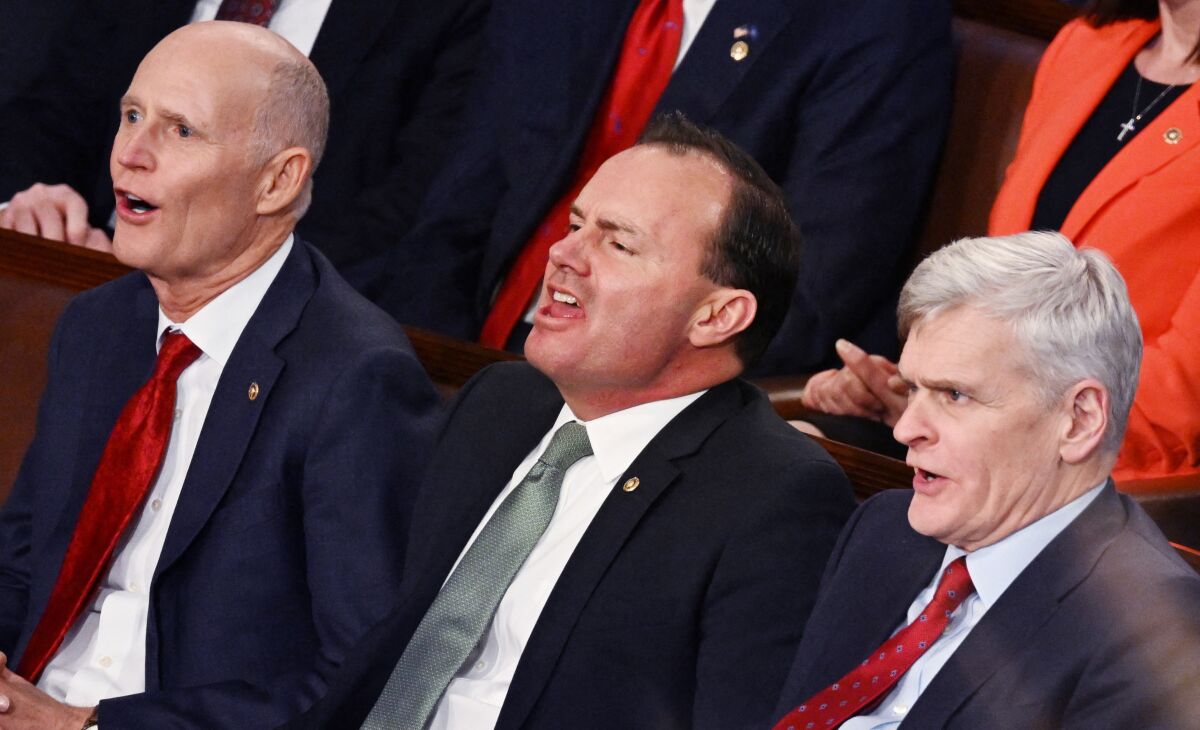
During President Biden’s State of the Union address, he said that Republicans want to cut Social Security and Medicare, and the Republican side of the chamber erupted in jeers and shouts of “liar!” Two of those loudly jeering—Senators Rick Scott of Florida and Mike Lee of Utah—had explicitly made those proposals. Biden then masterfully got the Republican caucuses in both Houses to declare their support for both big entitlement programs.

Michael Hiltzik, business columnist for the Los Angeles, sets the record straight about the Republican stance on Social Security.

From left, U.S. Sens. Rick Scott and Mike Lee jeer.

From left, GOP Sens. Rick Scott of Florida and Mike Lee of Utah jeer during the State of the Union address when President Biden accused Republicans of wanting to cut Social Security. Both senators have proposed exactly that.

(Andrew Caballero-Reynolds / AFP/Getty Images)

Hiltzik writes:

President Biden has congressional Republicans all asquirm as he conducts a post-State of the Union speech national tour.

Why? Because Biden has doubled down — or as Fox News has it, “tripled down” — on his assertion during the speech that the GOP has been planning to cut Social Security.

Not so, they say. Never happened. Sens. Mike Lee (R-Utah) and Rick Scott (R-Fla.) were even caught on camera during the speech wearing “Who, me?” expressions of injured innocence.

It will be my objective to phase out Social Security, to pull it out by the roots.

— Sen. Mike Lee (R-Utah), during his 2010 campaign for the Senate

Unfortunately for them, we have the evidence, as does Biden. Cutting Social Security along with Medicare has been part of the Republican platform for decades.

As I’ve reported before, they often hide their intentions behind a scrim of impenetrable jargon, plainly hoping that Americans won’t do the necessary math to penetrate their subterfuge.

Let’s take a jaunt through the GOP approach to Social Security and Medicare.

Start with their description of these programs as “entitlements,” which they’ve tried to turn into a dirty word. The truth is that they are entitlements, in the sense that most Americans have been paying into these programs for all their working lives, mostly through the payroll tax. So, yes, they’re “entitled” to receive benefits in return.

Republicans, including former Senate Majority Leader Mitch McConnell (R-Ky.), have consistently blamed the federal debt on “entitlements” — never mind that their 2017 tax cut for the wealthy has blown a multitrillion-dollar hole in the budget.

They know they’re on thin ice with the public when they talk about benefit cuts, which is why Sen. Joni Ernst (R-Iowa) once recommended discussing their ideas only “behind closed doors.”

Now we can turn to the specifics of Lee’s and Scott’s plans. In widely circulated videos from Lee’s first successful Senate campaign in 2010 he can be seen and heard stating as follows: “It will be my objective to phase out Social Security, to pull it out by the roots.” He said that was why he was running for the Senate, and added, “Medicare and Medicaid are of the same sort. They need to be pulled up.”

As for Scott, his 12-point “Rescue America” plan, issued last year, included a proposal to sunset all federal legislation after five years. “If a law is worth keeping, Congress can pass it again.” The implications for Social Security and Medicare, which were created by federal legislation, were unmistakable — so much so that the proposal made Republican officeholders’ skin crawl.

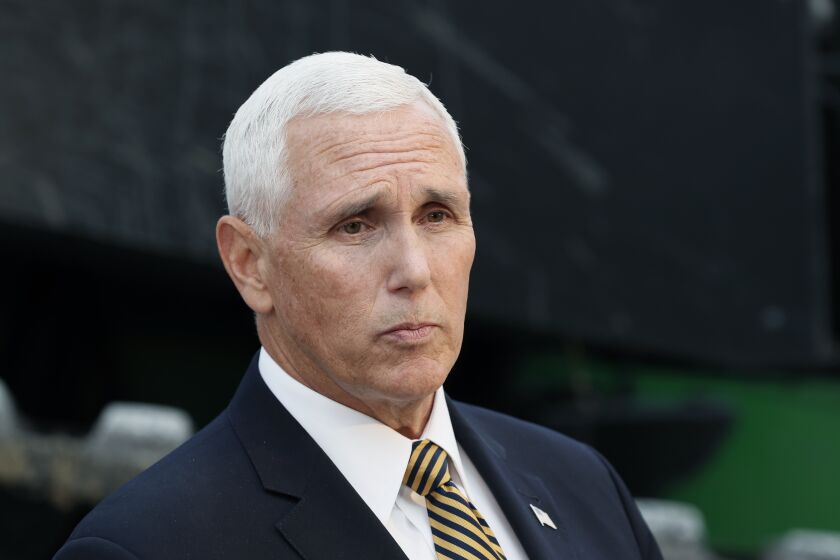
Vice President Mike Pence speaks to reporters during a visit to the Manning Farms, Wednesday, Oct. 9, 2019, in Waukee, Iowa. (AP Photo/Charlie Neibergall)

Column: Mike Pence, would-be president, has a plan to kill Social Security. It will cost you

McConnell disavowed the proposal on the spot and has continued to do so, telling a home-state radio host after the Biden speech that the sunset provision is “not a Republican plan.That was the Rick Scott plan.”

That said, it’s a priceless foil for Biden. When Republicans brayed during his speech that he was lying about it, he offered to make Scott’s manifesto available to anyone who called his office for it. At one of his subsequent appearances, a copy of Scott’s plan was placed on every seat.

The GOP can’t easily wriggle away from its intentions. Let’s examine the fiscal 2023 budget proposal issued by the Republican Study Committee, a key policy body, last June under the title “Blueprint to Save America.”

This plan would increase the Social Security full retirement age, which today is 66 or 67 (depending on one’s year of birth), to 70 by 2040. According to Kathleen Romig, the Social Security expert at the Center on Budget and Policy Priorities, this would translate into a 20% cut in lifetime benefits compared with current law.

As I’ve reported before, raising the full retirement age is a Trojan horse that would affect all retirees across the board, but harm Black workers, lower-income workers and those in physically demanding jobs the most.

It would create particular hardships for those choosing to retire early and collect their benefits prior to their full retirement age.

Doing so exacts a lifetime reduction in monthly benefits, based on a formula aimed at equalizing the lifetime benefit among those who retire early, those who wait until their full retirement age, and those who defer collecting until that age (they receive a bump-up in benefits for every year they delay, topping out at age 70).

Raising the full retirement age to 70, Romig calculates, would mean that retirees who start collecting at the minimum age of 62 would receive only 57% of their full benefit….

The Republican Study Committee also would make it harder for disabled workers to qualify for benefits, and would lengthen the period before those who are disabled and younger than 65 qualify for Medicare to five years from two. This falls into the category of balancing the budget on the backs of the most vulnerable members of society.


As for Medicare, the Republican Study Committee proposes raising the eligibility age, currently 65, so it matches the Social Security retirement age. It also would transfer many more Medicare accounts to private insurance. The committee claims this would save money.

The rest of his incisive analysis is behind a paywall, unfortunately. He demonstrates beyond doubt that Republicans have wanted for years to put these big programs on the chopping block, which are lifelines for senior citizens. They have no objections, however, to cutting the taxes of the wealthiest. That was Trump’s biggest accomplishment: tax cuts for those with the most.

Stephen Owens is an evangelical Christian who has thought deeply about the importance of public schools in our society. He has a Ph.D. In education policy from the University of Georgia and is Director of Education at the Georgia Budget and Policy Institute. His blog is called “Common Grace, Common Schools.”

Let’s begin my argument for public schooling by making the familiar strange. There are aspects of public schooling that you do not see in any other facet of American life that need to be evaluated to better understand the institution’s value. Our familiarity with them takes away their novelty, but they are unique nonetheless. I think of us like a child who has Kelly Clarkson as an aunt. Just because she thinks of the singer as “Aunt Kelly” doesn’t mean we all have aunts who can sing like an angel.

Not only are parts of American public schooling unique, but reflect central tenets of the Christian faith. I want to explore three of them in the next few posts: inclusion, equity and accountability.

To put it concisely: I believe in the American cultural and political environment the public school is best situated to offer the highest quality service for all and, most specifically, the poor. I believe this is known, in my faith tradition, as common grace.

Now when I say the “poor” I’m not just talking about those who have more needs than resources, but a more generalized group of people that, for one reason or another, have structural obstacles to academic success. Students with disabilities and children who speak a language other than English at home are two perfect examples. Further, I don’t mean to imply that the state of a family’s bank account should be conflated with a child’s worth. Being “poor” in this sense cannot mean a person has less intrinsic value. The poor in this blog instead denotes a looser title for those children for which a neutral bystander might say, “good for them!” if the child were to perform a task common to the ruling class such as graduating from college.

I believe public schools are most valuable as a tool to lessen human suffering on the poor–one of the primary, and possibly only, ends of good governance—but that is not to say that its benefits end with this group. In fact, with few exceptions, I’m convinced that public schools are a service that have shown to support allpeople groups in our country. Foundational to this belief is the fact that public schools are required to provide services to every single child that arrives.

Inclusion. Public schools (in their current state) are for everyone. The road to the schools I attended in the 90s is paved with hard-fought legal protections for children that the majority culture would rather not teach. Throughout American history school leaders had to be forced to educate women, immigrants, Black people, students with disabilities and undocumented students via government compulsion. Each of these groups had to wait for laws to be changed to gain the advantages that white, rich, Protestant males shared since before our country was founded. This is not ancient history. My mom was a junior in high school when disabled kids got the right to a public education (1975). Undocumented children were guaranteed the same right two years before I was born (1982).

Inclusion, at least by this definition, has required blood, sweat and tears. It would be foolish to assume that inclusion is natural. In fact, inclusion is so unnatural to the way we consider schooling that its inverse remains a feature of excellence in the public mind. Consider elite schools’ relationship to exclusion: the ability to reject applicants based on test scores or income signals quality in a way that other schools could never replicate with performance alone. Post-secondary education is our best example here. Rejection rates for the Ivy Leagues not only “prove” their superiority but create it. For how could Harvard do poorly as a school if they’re allowed to choose to only educate the top seven percent of all those that apply?

It is only the common, or public, school which is left to teach all who enter her doors and, once inside, compelled to provide basic opportunities to each by threat of legal action. Inclusion, since it has been won, can be demanded.

Here I need to be explicit: inclusion is a good thing. Too often advocates for public schools treat inclusion as a burden to bear—“we can’t turn away students like private schools…”—instead of their greatest strength. Inclusion at some level acknowledges dignity in every person; Christians ought to be familiar with the concept via imago dei (the image of God). Early in Genesis the reader learns that God created humans in His image, bearing His likeness. Theologians have explained this concept differentiates humans from any other created thing by our spiritual/moral/missional similarity to the Creator. There is nothing that can remove this distinction, so every person you and I have ever met “looks” like God in some form. I’m convinced that this concept should be celebrated as the starting place for who is allowed where.

Now consider: where else is this the case? Think about your daily life, what physical spaces are compelled to not only accept everyone, but to give them foundational services? The other day a family came into a coffee shop where I was working and just sat. I will admit to being surprised. They didn’t buy anything, just sat on a couch near me while the kids looked at their iPads. I’m so used to private spaces that I did not think those people belonged until they bought something. This belief did not come out of thin air, many of the places that we imagine as public are only available if we have money, genius, status or some other item to trade. Outside of government programs (public parks, public transit, etc.) it’s hard to imagine a comparable institution to public schools besides hospitals. While I believe there are several similarities between schools and hospitals (nurses and teachers have long seen commonalities between how they are treated, for example), two major differences are apparent: 1) hospitals don’t exist in many rural communities and 2) no one has gone into debt because of the services provided by public schools.


I am, as I hope I’ve made clear up to this point, big on inclusion. But what are the public schools forced to include all children to? What occurs in the inner circle that has for generations been open only to the few? The generally-accepted answer to this question, and more broadly the question of “what is the purpose of education” usually falls into two categories–socialization and skill acquisition. When I describe the need for public schools to include all people it is with the latter purpose in mind. Poor children have been historically kept from learning the skills that are needed to earn living wages. A strong school system can help ensure higher wages, better health outcomes and decreased likelihood of entering the criminal justice system. On the path to living wages (and therefore less human suffering) there are few hurdles higher than failing to graduate high school and college.

The need for public education, and the majority-culture’s attempt to restrict it to the few, has a long history in our country. Tunis Campbell, the father of public education in Georgia, recognized a strong education as necessary to support formerly-enslaved people in post-Civil War Georgia. Without the ability to read, Campbell knew that freed men would continue to be subject to, among other racist practices, predatory labor contracts. Rev. Campbell spent the years following Sherman’s march setting up schools for freed people and is as responsible as any person for the state constitution’s inclusion of a right to public education for all children. He believed education sat alongside land ownership, a just court system and community service as necessary keys to a good life for Black Georgians.

Bringing it back to the present, I will put socialization to the side for now and will describe how the very nature of common schools supports poor families more than their richer neighbors. There are many facets of public schooling which we take for granted but that are frankly unbelievable. Every morning a transit system crawls cities, towns and rural counties to pick up any child that arrives to the stop on time and take them to their school. This service is provided at no additional cost to the child’s family whether they live one mile from the building or 30. In a country that tends to require the ownership and maintenance of a personal-transport vessel as the price for admission to society, the school bus itself is a marvel. It’s far from the only one. Health care, multiple meals and career guidance are all things that richer families can pay for but are often out of reach for the poor. In the public school each (via school health clinics, free food and school counseling) are provided part and parcel to poor public school children. If any one of these services were not already a part of schooling in America, it is impossible to imagine them being created and, more importantly, paid for with public funds. It is services like these that do not neatly fit into a definition of schooling but have become a pivotal safety net for struggling families in our nation. To ignore the role of public schools as welfare is convenient but unhelpful.

To ignore the role of public schools as welfare is convenient but unhelpful.

I’d go as far as to say that the true measure of a school is their support for the poor. The brutal truth of schooling in the U.S. is that parental income is strongly predictive of educational outcomes. While we like to imagine a true meritocracy, the real difference is whether your parents have enough money to provide 1) security (food and housing), 2) accountability, 3) targeted support and 4) social capital. So, any time I come across the “conventional wisdom” of the superiority of private schools it sounds like someone bragging that Georgia beat Vanderbilt in football. Duh: Kirby and…whomever is coaching Vandy… are dealing with two qualitatively different pools of players. If we’re really going to provide the measure of a school, look to the services provided to those that the Bible refers to as “the least of these.”

When you compare the test performance of wealthy Americans to other nations it’s clear we are on par with, or outperforming, every other country in the world. What makes our system “mediocre” is our treatment of poor children. Generations of white supremacist policies have ensured that wealth is concentrated in white families. So, the limitations of our public school system cannot be separated from our nation’s original sin. The good news is that income does not have to equal destiny. Research has shown that investment in public schools can and does level the playing field, but the investments have to go to the schools and/or children that need them the most. Another word for this is equity. I will write about equity in the next post.

Stephen

Writing in the Tampa Bay Times, journalist Jeff Solochek reports that the College Board released a letter last night denouncing the Florida State Department of Education. The College Board says it was naive in trusting the latter agency, which wanted to score political points.

Taken aback by Florida’s attacks against its new AP African American studies course, the College Board late Saturday denounced the state Department of Education, saying it used the course to advance a politically motivated agenda.

The organization’s letter, published at 8 p.m. Saturday, came just two days after it released another statement that did not take such a harsh tone as it pushed back against the department’s claims that portions of the course are “historically fictional.”

“There continue to be conversations and misinformation, and we felt the urgency to set the record straight and not wait another day to do so,” a College Board spokesperson said. The College Board publishes AP courses and exams.

In its latest unsigned statement, the College Board said it is proud of its “historic” course, which has been crafted by renowned scholars. It acknowledged it made mistakes during the rollout and accused Florida of exploiting the situation.

Gov. Ron DeSantis has criticized the course and said Florida would not accept it without revisions. DeSantis has been using attacks against the way race is taught in schools, calling it “woke,” in many speeches amid wide speculation that he will use the issue as part of a presidential campaign.

Neither the governor’s office nor the Department of Education could be reached for comments late Saturday on the College Board’s statement.

Related: Florida claims about AP African American studies are false, College Board says

The College Board stated in its latest letter that it regrets not having denounced the Florida Department of Education’s “slander” that the course “lacks educational value.” The failure to speak up “betrayed Black scholars everywhere,” College Board wrote.

It said it also should have made more clear that the course outline did not include all the scholarly articles, lectures and other materials that will be part of the course. That led to the idea that some important thinkers were eliminated, it said — something Florida officials claimed credit for.

“The vitriol aimed at these scholars is repulsive and must stop,” the group wrote.

College Board made other defenses of the materials and the course preparation. Then it turned its sights on Florida’s interaction with the course.

It called the Department of Education’s claims that it had been in frequent dialogue with College Board over the course content “a false and politically motivated charge.”

Florida officials have claimed credit for changes made to the course outline.

“We had no negotiations about the content of this course with Florida or any other state, nor did we receive any requests, suggestions or feedback,” College Board wrote.

It said the organization was “naive” not to publicize Florida’s course rejection when it first came in September. It said the letter misspelled the word “African” and contained no explanation of the rejection.

The article continues with more detail. What it does not explain is why every objection raised by Florida was met by either a deletion of the name or topic, or a shift from “included” to optional.

Did the College Board cave to Florida or reject Florida’s demands? You decide.

Time and again, Florida Governor Ron DeSantis has exceeded his authority by one-man stunts, created to win national publicity and demonstrate that he’s more fascist than Trump.

Now, his puppet legislature is meeting in special session to clean up the mess DeSantis left behind.

The Miami Herald editorial board excoriates his authoritarian control of weak-kneed legislators.

With Gov. DeSantis’ iron-fisted control of the legislative process in Florida, it’s not elected officials who must conform to the limits of the law; it’s the law that gets modified according to the whims of elected officials.

If you pass a half-baked bill in vengeful haste, someone will clean up your mess. When you get sued for allegedly violating your own migrant-relocation program, no worries, your friends in the Legislature will expand that program and give you ample power — and cash — to make it “right.” When you tout illegal voting arrests of people who the state allowed to vote, and it turns out you might have chosen the wrong prosecutors to bring those charges, you simply change the law.

That’s the story of the special legislative session that began this week in the Florida Capitol. The urgent matter the Republican-controlled Legislature must address is cleaning up the governor’s most controversial policies. Lawmakers couldn’t even wait another month until their regular two-month session that starts in March.

To be fair, there are other valid issues being discussed: providing relief for Hurricane Ian victims and expanding a law that allows college athletes to sign endorsement deals. But this is no ordinary special session. The bulk of it is about giving DeSantis more — and unchecked — power.

Take the law that tried to dissolve the Reedy Creek Improvement District in Central Florida last year. Created in the 1960s, the special taxing district is controlled by Disney and serves as the governing body for the Walt Disney World Resort. Was it time to revisit this unusual arrangement that ceded so much power to a private company (the district can even build its own nuclear power plant)? Maybe, but good governance wasn’t really top of mind. The Legislature, egged on by DeSantis, was retaliating against Disney for opposing the parental-rights law critics nicknamed “Don’t say gay.”

When lawmakers passed a bill to dissolve Reedy Creek last year, they didn’t hash out what to do with Disney’s $1 billion debt that, without the company’s ability to tax itself, would fall on the residents of Orange and Osceola counties.

There’s no mea culpa on the part of Republicans, though they did give themselves until June 1 to make changes to the law. They now want to maintain the district under a different name, take away Disney’s power to control it and give it to our almighty governor, who would nominate the five people who make up the district’s board. We suppose there’s one silver lining: The board would lose the authority to build a nuclear plant.

House Bill 5B and Senate Bill 6B are another gift to the governor from lawmakers. The state is defending a lawsuit filed by a Democratic state senator challenging the taxpayer-funded flights of mostly Venezuelan migrants from Texas to Martha’s Vineyard. Those migrants were duped into believing they would find jobs and resources on the island.

The lawsuit centers on a key component of the relocation program lawmakers funded last year at DeSantis’ urging: that it relocate migrants from Florida, not other states.

Republicans want to get rid of that fine print and give DeSantis the unchecked authority to relocate migrants from anywhere in the country as long as they have been released by the federal government pending the resolution of their case. He also would get $10 million and the possibility to access $500 million in emergency funds because he signed an executive order declaring an immigration emergency in January, the Herald reported.

This gives DeSantis the ability to tap into millions of dollars to target any voter-rich Republican primary state in his expected presidential run, courtesy of taxpayers. The premise of the program is that the border crisis presents a threat to Floridians, but whether or not those migrants would ever make it to the Sunshine State is inconsequential at this point.

The other legislative clean-up relates to the state’s new election-crimes office, created by the Legislature after Donald Trump’s lies about widespread voter fraud in the 2020 election became a major plank in the Republican Party platform. Last year, DeSantis proudly boasted the office had arrested 20 felons who voted illegally.

Those voters told the Herald and other news outlets they were given voter registration cards by their local election offices. DeSantis’ own administration didn’t flag them as ineligible. Some cases were dismissed by judges who found that the statewide prosecutors who filed the charges didn’t have the jurisdiction to do so.

The Legislature’s first order should be to prevent more ineligible voters from slipping through the cracks. Instead, its solution is to make it easier to prosecute them after they have already cast ballots. Legislation would clarify that the Office of Statewide Prosecution can investigate voting-related crimes. The office reports to a Republican, Attorney General Ashley Moody, and is a safer way for DeSantis to score wins than going through Florida’s 20 states attorney, prosecutors who are elected locally.

One-party control of Florida’s government is nothing new. What’s new is that the Legislature has become just another arm of the governor’s office. Its role isn’t to serve as a check on the executive power anymore, but to rubber stamp and inflate the man whose ambition and thirst for the spotlight have turned governing into a power-grabbing spectacle.