Archives for category: Environment

The filmmaker and historian Ken Burns has produced some of the best documentaries ever shown on American television. He has brought history to life with gripping stories of people and momentous events. He is the master of the voice of ordinary people, many of whom are extraordinary.

He recently gave the Commencement speech at Brandeis University. It’s one of the best I have ever read or heard. Here is the link. Read it or listen to it. It’s magnificent.

A memorable paragraph about the current moment:

There is no real choice this November. There is only the perpetuation, however flawed and feeble you might perceive it, of our fragile 249-year-old experiment or the entropy that will engulf and destroy us if we take the other route. When, as Mercy Otis Warren would say, “The checks of conscience are thrown aside and a deformed picture of the soul is revealed.” The presumptive Republican nominee is the opioid of all opioids, an easy cure for what some believe is the solution to our myriad pains and problems. When in fact with him, you end up re-enslaved with an even bigger problem, a worse affliction and addiction, “a bigger delusion”, James Baldwin would say, the author and finisher of our national existence, our national suicide as Mr. Lincoln prophesies. Do not be seduced by easy equalization. There is nothing equal about this equation. We are at an existential crossroads in our political and civic lives. This is a choice that could not be clearer.

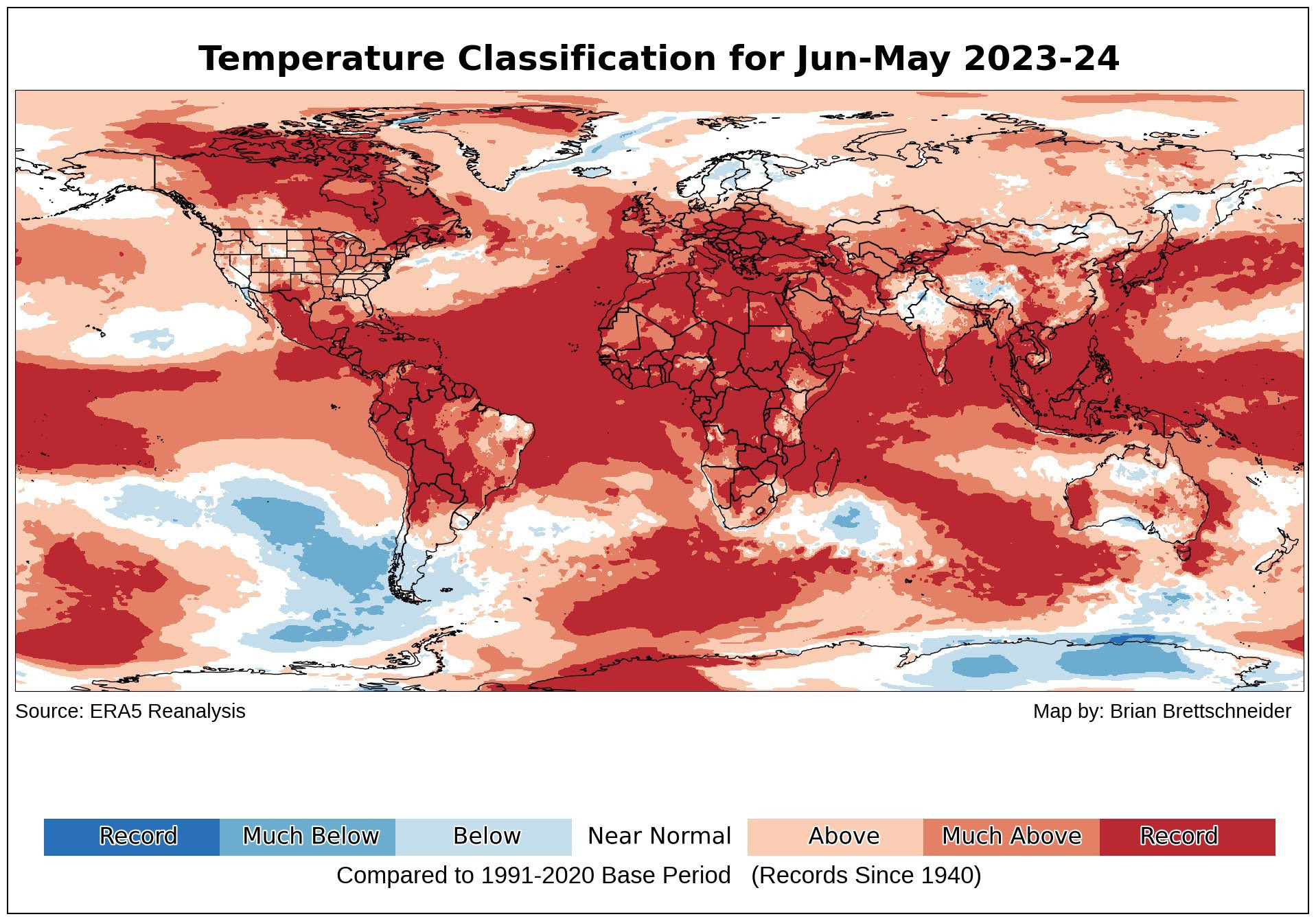
Florida is one of the states affected most by climate change. Hurricanes, flooding, and intense heat are damaging the ocean, the lakes, and the beaches, as well as the sea life and coral, while raising insurance rates and imperiling some beachfront communities. May 2024 was the hottest May on record.

Yet Governor DeSantis signed legislation downgrading the significance of “climate change,” pandering to the ignorant in his party’s base.

Some Floridians who care about science are upset.

Dan Stillman of The Washington Post reported:

Television meteorologists are usually reluctant to weigh into policy matters, instead adhering to their role as science communicators. But after Florida Gov. Ron DeSantis (R) signed a bill removing most references to climate change in state law, Steve MacLaughlin, a meteorologist for the NBC affiliate in Miami, could not restrain himself.


MacLaughlin publicly unleashed a scathing critique of the measure Saturday, earning praise from peers and perhaps paving the way for more meteorologists to speak out about the urgency of climate change action.


“As Florida is on fire, underwater and unaffordable, our state government is rolling back climate change legislation and language,” MacLaughlin wrote on X — the prelude to a passionate minute-long video explaining why he felt the measure was unwise.


“The world is looking to Florida to lead in climate change, and our government is saying that climate change is no longer the priority it once was,” MacLaughlin said in his video, which was also posted on his station’s website.

As MacLaughlin spoke, statistics appeared next to him highlighting April as the planet’s “11th straight hottest month” on record, and Wednesday’s 115-degree heat index in Key West as the city’s “hottest-feeling day on record.”


“Please keep in mind the most powerful climate change solution is the one you already have in the palm of your hands — the right to vote,” MacLaughlin continued. “And we will never tell you who to vote for, but we will tell you this: We implore you to please do your research and know that there are candidates that believe in climate change and that there are solutions, and that there are candidates that don’t.”


The legislation and MacLaughlin’s response came as numerous heat records are being set across South Florida. In Miami, the past 10 days have seen four calendar-day records for high temperature and five for heat index, according to University of Miami meteorologist Brian McNoldy.


The Florida heat wave recently reached a level 5 on Climate Central’s Climate Shift Index — the highest level — indicating “that human-caused climate change made this excessive heat at least five times more likely.”

The Washington Post reported on a meeting at Mar-a-Lago where Trump made an extraordinary offer to leaders of the oil and gas industry: you put up $1 billion for my campaign and I will roll back all Biden’s regulations that restrict drilling.

He promised to reverse all Biden’s efforts to promote clean energy and fight climate change. He said he would open the Gulf of Mexico and the Arctic to drilling. Whatever Biden has done to preserve the environment, Trump promised to void.

Trump’s response stunned several of the executives in the room overlooking the ocean: You all are wealthy enough, he said, that you should raise $1 billion to return me to the White House. At the dinner, he vowed to immediately reverse dozens of President Biden’s environmental rules and policies and stop new ones from being enacted, according to people with knowledge of the meeting, who spoke on the condition of anonymity to describe a private conversation.


Giving $1 billion would be a “deal,” Trump said, because of the taxation and regulation they would avoid thanks to him, according to the people.


Trump’s remarkably blunt and transactional pitch reveals how the former president is targeting the oil industry to finance his reelection bid. At the same time, he has turned to the industry to help shape his environmental agenda for a second term, including rollbacks of some of Biden’s signature achievements on clean energy and electric vehicles…

Texas is represented by some loathsome public officials (looking at you, Governor Abbott, Lt. Gov. Patrick, and Senator Ted Cruz). They have denounced President Biden in every imaginable way. Yet the Biden administration is sending $16 billion to Texas for clean energy and infrastructure. Texas Republicans voted against the legislation but they will gladly take the dollars and the new jobs. (All the red states are getting funds from Biden’s bills that they opposed, while taking credit for them.) And they will continue to insist that climate change is a hoax.

Chris Tomlinson writes in The Houston Chronicle:

Delivering reliable, affordable and sustainable electricity wouldn’t be difficult if officials in Austin and Washington worked together. The challenges are not technological or economic; they are about setting priorities.

Pablo Vegas, chief executive of the Electric Reliability Council of Texas, promised a new approach to grid planning on Tuesday, promising to better track the growing demand for power from industry.

“We need to accelerate aspects of our planning processes and be able to look further into the future, anticipate what’s coming, because it still takes three to six years to build transmission,” Vegas said.

The Legislature ordered ERCOT to start considering long-term proposals to add load to the grid rather than relying only on finalized plans. The new approach makes demand forecasts look much, much larger but also less reliable because not all proposed projects come to fruition.

President Joe Biden, meanwhile, is offering Texans billions of dollars to fortify the electric grid, reduce electricity bills and cut greenhouse gas emissions. On Thursday, the administration promised to upgrade 100,000 miles of transmission lines.

The Environmental Protection Agency also gave $249.7 million to the Texas Solar For All Coalition and  $156.1 million to the Clean Energy Fund of Texas this week to provide solar energy equipment to low-income communities.

The EPA has also granted $104 million in federal funds to 19 Texas school districts to purchase 288 electric school buses. The EPA grants are part of the $16 billion the federal government has committed to clean energy projects in Texas that have created 23,000 jobs.

The money comes from the Inflation Reduction Act, which Texas Republicans vehemently opposed. The massive investment in energy and manufacturing is intended to grow the economy while fighting climate change.

Past investments led Waaree Energies to invest $1 billion in a solar panel manufacturing facility near Houston, creating 1,500 jobs. San Antonio has committed $30 million to build, with federal help, the largest municipal onsite solar project in Texas. Diligence Offshore Services announced in August it would invest $1.23 billion to open an offshore wind support and manufacturing facility off the coast of Port Arthur.

Climate change, though, is still missing from Vegas’ and ERCOT’s lexicon. He’s happy to talk about the growing electricity demand from artificial intelligence and fossil fuel facilities but never mentions the residential demand during climate change-driven extreme weather. That’s what causes record-setting peaks that can trigger outages.

Nationwide, weather caused 80% of the power outages since 2000, and the frequency of blackouts has doubled in the past decade, according to data collated by research nonprofit Climate Central. Texas experienced the most weather-related outages, and the pace is accelerating.

Improving the grid to meet growing industrial electricity demand is quite different from building a system that can withstand a changing climate. Adding more power generation and transmission lines is not enough when facing stronger hurricanes, larger wildfires, colder winter storms and hotter summers.

ERCOT’s planning will remain flawed until officials start preparing for more polar vortexes like 2021’s Winter Storm Uri, rain events like Hurricane Harvey and heat waves like last summer’s.

Transitioning to clean energy and building resilient generation plants and transmission lines offer huge economic opportunities. BlackRock, the world’s largest financial manager, says the world spent $1.8 trillion on the energy transition in 2023 but will need to spend $4 trillion annually by the mid-2030s.

Vegas never mentions climate change because the Republican elected officials who oversee him call it a hoax. Texas will never chart a strong economic course until we have a governor, lieutenant governor and speaker who recognize the greatest threat yet to human prosperity….

Julian Vasquez Heilig, Provost of Eastern Michigan University, writes a blog called Cloaking Inequity. Today he proposed a new concept for a charter school that takes advantage of Michigan’s lakes to explore its environmental challenges.

He writes:

In the heart of Michigan, nestled within the vast, freshwater seas that are the Great Lakes, I’m excited that my revolutionary idea for a new charter school is taking shape. Aquatica: The Great Lakes Underwater School, is a new charter school set to launch in the fall of 2024. The school is not just a new chapter in my life and an educational innovation; it’s a bold reimagination of what a deeper learning environment can be. By submerging students in the literal depths of Lake Michigan, Aquatica aims to foster a profound connection with the natural world, leveraging the immersive power of water to enhance learning and cultivate a generation of environmental stewards.

The Vision Behind Aquatica

The vision for Aquatica was born from my desire to transcend traditional classroom boundaries, creating a space where education and the environment intersect in the most direct manner possible. In a world where ecological concerns are increasingly pressing, Aquatica stands as a beacon of innovative thought, merging the necessity of environmental education with the transformative potential of experiential learning. The school’s location in the Great Lakes near South Haven, a critical freshwater resource, underscores the urgency of its mission: to educate students not just about the world, but on how to care for it.

A Curriculum That Goes Beneath the Surface

Aquatica’s curriculum will be crafted to take full advantage of its unique underwater setting. The school will offer a holistic STEAM (Science, Technology, Engineering, Arts, and Mathematics) curriculum, enriched with a strong emphasis on environmental science and sustainability. This multidisciplinary approach ensures students receive a well-rounded education, while the unique context of learning under water provides unparalleled opportunities for deep, really deep, experiential learning.

Aquatic Sciences classes: Students have the unparalleled opportunity to study aquatic life and ecosystems up close, turning Lake Michigan into a living classroom where lessons in biology, chemistry, and environmental science come alive.

Sustainable Engineering classes: Tasked with designing solutions to real-world challenges, students apply the principles of engineering within the context of sustainability, learning the importance of creating systems that protect and preserve natural resources.

Underwater Robotics classes: By integrating technology and environmental exploration, this class empowers students to engage with the underwater world in innovative ways, fostering skills in robotics, coding, and environmental conservation.

Technological Integration for Deeper Learning

Technology plays a pivotal role in bringing my vision of Aquatica to life. Advanced technological tools, including augmented reality (AR) and virtual reality (VR), will allow students to interact with their surroundings in ways previously unimaginable. AR applications will enable learners to identify species, understand ecosystems, and conduct virtual experiments, all without leaving the underwater classroom. VR, on the other hand, will transport students to distant environments, from coral reefs across the world to the polar ice caps, expanding their understanding of global environmental issues.

Environmental Stewardship at Aquatica’s Core

At its core, Aquatica is more than just an educational institution; it’s a statement about the importance of environmental stewardship. The charter school’s design and operation are models of sustainability, utilizing renewable energy sources and minimizing its ecological footprint. More importantly, the curriculum will be designed to instill a sense of responsibility towards the environment, encouraging students to think critically about their impact on the world and empowering them to take action towards its preservation.

To learn more, open the link.

Heather Cox Richardson touches on some of the high points of Biden’s three years in office. If he had enjoyed a solid majority in both Houses of Congress, he would have surpassed Franklin D. Roosevelt and Lyndon B. Johnson in constructing a fair society where everyone has a chance to lead a decent life. Trump celebrated Infrastructure Week yearly but did nothing. Trump said he had a healthcare plan that was better than Obamacare, but we never saw it.

Despite stubborn opposition from Republicans, Biden was able to deliver.

She writes:

One day short of his first 100 days in the White House, on April 28, 2021, President Joe Biden spoke to a joint session of Congress, where he outlined an ambitious vision for the nation. In a time of rising autocrats who believed democracy was failing, he asked, could the United States demonstrate that democracy is still vital?

“Can our democracy deliver on its promise that all of us, created equal in the image of God, have a chance to lead lives of dignity, respect, and possibility? Can our democracy deliver…to the most pressing needs of our people? Can our democracy overcome the lies, anger, hate, and fears that have pulled us apart?”

America’s adversaries were betting that the U.S. was so full of anger and division that it could not. “But they are wrong,” Biden said. “You know it; I know it. But we have to prove them wrong.”

“We have to prove democracy still works—that our government still works and we can deliver for our people.”

In that speech, Biden outlined a plan to begin investing in the nation again as well as to rebuild the country’s neglected infrastructure. “Throughout our history,” he noted, “public investment and infrastructure has literally transformed America—our attitudes, as well as our opportunities.”

In the first two years of his administration, when Democrats controlled both chambers of Congress, lawmakers set out to do what Biden asked. They passed the $1.9 trillion American Rescue Plan to help restart the nation’s economy after the pandemic-induced crash; the $1.2 trillion Infrastructure Investment and Jobs Act (better known as the Bipartisan Infrastructure Law) to repair roads, bridges, and waterlines, extend broadband, and build infrastructure for electric vehicles; the roughly $280 billion CHIPS and Science Act to promote scientific research and manufacturing of semiconductors; and the Inflation Reduction Act, which sought to curb inflation by lowering prescription drug prices, promoting domestic renewable energy production, and investing in measures to combat climate change.

This was a dramatic shift from the previous 40 years of U.S. policy, when lawmakers maintained that slashing the government would stimulate economic growth, and pundits widely predicted that the Democrats’ policies would create a recession.

But in 2023, with the results of the investment in the United States falling into place, it is clear that those policies justified Biden’s faith in them. The U.S. economy is stronger than that of any other country in the Group of Seven (G7)—a political and economic forum consisting of Canada, France, Germany, Italy, Japan, the United Kingdom, and the United States, along with the European Union—with higher growth and faster drops in inflation than any other G7 country over the past three years.

Heather Long of the Washington Post said yesterday there was only one word for the U.S. economy in 2023, and that word is “miracle.”

Rather than cooling over the course of the year, growth accelerated to an astonishing 4.9% annualized rate in the third quarter of the year while inflation cooled from 6.4% to 3.1% and the economy added more than 2.5 million jobs. The S&P 500, which is a stock market index of 500 of the largest companies listed on U.S. stock exchanges, ended this year up 24%. The Nasdaq composite index, which focuses on technology stocks, gained more than 40%. Noah Berlatsky, writing for Public Noticeyesterday, pointed out that new businesses are starting up at a near-record pace, and that holiday sales this year were up 3.1%.

Unemployment has remained below 4% for 22 months in a row for the first time since the late 1960s. That low unemployment has enabled labor to make significant gains, with unionized workers in the automobile industry, UPS, Hollywood, railroads, and service industries winning higher wages and other benefits. Real wages have risen faster than inflation, especially for those at the bottom of the economy, whose wages have risen by 4.5% after inflation between 2020 and 2023.

Meanwhile, perhaps as a reflection of better economic conditions in the wake of the pandemic, the nation has had a record drop in homicides and other categories of violent crime. The only crime that has risen in 2023 is vehicle theft.

While Biden has focused on making the economy deliver for ordinary Americans, Vice President Kamala Harris has emphasized protecting the right of all Americans to be treated equally before the law.

In April 2023, when the Republican-dominated Tennessee legislature expelled two young Black legislators, Justin Jones and Justin J. Pearson, for participating in a call for gun safety legislation after a mass shooting at a school in Nashville, Harris traveled to Nashville’s historically Black Fisk University to support them and their cause.

In the wake of the 2022 Dobbs v. Jackson Women’s Health Supreme Court decision overturning the 1973 Roe v. Wade decision that recognized the constitutional right to abortion, Harris became the administration’s most vocal advocate for abortion rights. “How dare they?” she demanded. “How dare they tell a woman what she can and cannot do with her own body?… How dare they try to stop her from determining her own future? How dare they try to deny women their rights and their freedoms?” She brought together civil rights leaders and reproductive rights advocates to work together to defend Americans’ civil and human rights.

In fall 2023, Harris traveled around the nation’s colleges to urge students to unite behind issues that disproportionately affect younger Americans: “reproductive freedom, common sense gun safety laws, climate action, voting rights, LGBTQ+ equality, and teaching America’s full history.”

“Opening doors of opportunity, guaranteeing some more fairness and justice—that’s the essence of America,” Biden said when he spoke to Congress in April 2021. “That’s democracy in action.”

One big reason to feel hopeful about the future is that our youth seem to have figured out how to organize for change. After the massacre of students at Marjorie Stoneman Douglas High School in Florida, survivors organized a huge protest demanding gun control. They haven’t won so far but they are not likely to give up.

The grownups are not doing enough to address climate change, and Republicans keep insisting that climate change is a hoax.

But a group of Montana kids banded together to file a lawsuit against the state for failing to take action to reverse climate change. The Christian Science Monitor reports how they did it.

The story says:

In June 2023, the hottest June ever recorded in a summer that would break global heat records, 16 young people walked into a courthouse in Helena, Montana, and insisted that they had the right to a stable climate.

The moment was, in the United States, unprecedented.

For years, youth around the world had been suing governments – state, regional, federal – and demanding more action by policymakers to address what scientists worldwide agree is an environmental crisis directly caused by human behavior. By 2022 there had been 34 global climate cases brought on behalf of plaintiffs ages 25 and younger – part of a global climate litigation explosion, according to Columbia University’s Sabin Center for Climate Change Law.

In the courtroom that day, the young people were asking not for any financial reward, but for the government of Montana to uphold its Constitution, one of a handful in the U.S. that explicitly protects both current and future citizens’ right to a healthful environment. There was Rikki Held, the oldest of the Montana youth plaintiffs at 22, whose name was on the lawsuit and whose family’s ranch was increasingly threatened by fires and floods. There were Lander and Badge Busse, teenage brothers whose schoolmates taunted them about this case, but who’d decided they needed to be part of this lawsuit to protect the wilderness where they loved to fish and hunt. And there was Grace Gibson-Snyder, a Missoula 19-year-old. Her ancestors had come to this big-sky state in a covered wagon. But Ms. Gibson-Snyder worried about whether this land would be habitable for her own children – if she felt it were morally appropriate to have any. She wore her favorite boots to trial, for good luck.

And in some places, young people had begun to make headway. A German court in 2021, for instance, agreed with youth that the government needed to do more to reduce emissions. Colombia’s Supreme Court agreed with young plaintiffs in 2018 that officials needed to better protect the Amazon rainforest, in part because of climate concerns.

But in the U.S., the country that has sent more heat-trapping gases into the atmosphere than any other nation, young people had failed to get courts to rule in their favor.

That was about to change.

In the courtroom that day, the young people were asking not for any financial reward, but for the government of Montana to uphold its Constitution, one of a handful in the U.S. that explicitly protects both current and future citizens’ right to a healthful environment. There was Rikki Held, the oldest of the Montana youth plaintiffs at 22, whose name was on the lawsuit and whose family’s ranch was increasingly threatened by fires and floods. There were Lander and Badge Busse, teenage brothers whose schoolmates taunted them about this case, but who’d decided they needed to be part of this lawsuit to protect the wilderness where they loved to fish and hunt. And there was Grace Gibson-Snyder, a Missoula 19-year-old. Her ancestors had come to this big-sky state in a covered wagon. But Ms. Gibson-Snyder worried about whether this land would be habitable for her own children – if she felt it were morally appropriate to have any. She wore her favorite boots to trial, for good luck.

They and their fellow plaintiffs were represented by an Oregon-based law firm called Our Children’s Trust, which has helped young people across the country bring constitutional climate cases.

Opposing them was the state of Montana, represented by an attorney general whose spokesperson had called the lawsuit “outrageous” and “political theater” – a case of well-intentioned children exploited by an outside interest group.

For the better part of the next two weeks, the two sides presented their cases. 

Then youth and legal experts waited anxiously for the judge’s decision. Held v. Montana, many said, was a crucial moment in what they saw as a legal transformation building around the world. Members of the Climate Generation – as we’re calling the cohort born since 1989, when the world became both climatically unstable and increasingly focused on children’s rights – were working to define what it meant to have rights as a young person. And in particular, they were working to define what it meant to have rights while looking at a future that scientists agree will be shaped by what older people have done to the atmosphere. A ruling in Montana could dramatically impact this global effort.  

“The Montana case is incredibly important,” says Shaina Sadai, the Hitz fellow for litigation-relevant science at the Union of Concerned Scientists. Young people involved with climate action, she adds, “are very internationally connected. They are very much in touch with each other. … A win anywhere for any of them is a win for all of them. It’s that global youth solidarity.”

Which is why Dallin Rima, a 19-year-old plaintiff in a different climate lawsuit, turned up the radio when he heard that Montana District Judge Kathy Seeley had released her verdict.

Mr. Rima is part of a group of Utah youth who have sued their state, arguing that its promotion of fossil fuels violates their constitutional rights to life, health, and safety. He’d been following what was going on in Montana, the same way young climate plaintiffs from Oregon to the South Pacific to Portugal had been keeping track. While he knew firsthand about the challenges of the legal system, about the delays and disappointments, he had allowed himself to hope.

He was driving to his grandmother’s house outside Salt Lake City, listening to NPR, when the news came on. It was a good thing nobody else was in the car, Mr. Rima says. Because as he listened to the newscast, he began to “express himself,” as he puts it. Loudly.

The judge had ruled in the young plaintiffs’ favor. Specifically, this meant that Montana policymakers had violated the young people’s constitutional rights by ignoring the climate impacts of their energy decisions. But Mr. Rima understood that there were far broader implications. 

By siding with the young Montanans, Judge Seeley explicitly connected the right to a clean environment with the right to a stable climate. She gave a judicial stamp of approval to climate science. And she proved that, in the face of what many young people see as politicians’ ineptitude in addressing climate change, the judiciary is a branch of government that might still be able to protect their futures.

“I’ve learned not to get my hopes up. But I was just shocked, ecstatic to hear that they had won,” Mr. Rima says. “It was a really powerful moment. … It feels like our work isn’t in vain.”

Billy Ball’s blog, “Cardinal & Pine,” tells the horrifying story of the poisoning of people in Sampson County, North Carolina, and the malign neglect of the state’s officials. Most of those poisoned by the foul environment are Black and poor.

He writes:

NORTH CAROLINA — A dead vulture hangs by its feet, tied to a street sign on Chesters Road in Sampson County.

It’s there because locals believe the decomposing scavenger will deter other vultures. Sometimes, especially in the summer, the carrion birds descend like a plague on the Snow Hill area of Sampson County, a predominantly Black community that’s within retching distance of the largest landfill in NC. When it’s hot and humid in the summer, the vultures are so thick that the trees look black.

The birds are the least of locals’ worries.

The 85-acre landfill smells like hell. It gets in your lungs and steals your breath. On a bright, clear day, it can give you a headache and make you nauseous. When it’s hot, humid, or rainy, the smell is overwhelming.

Worse still, the landfill—which ranks second in the nation for emissions of the greenhouse gas methane—is contaminated with PFAS. PFAS are synthetic compounds used in nonstick pans, firefighter foam, cosmetics, and other products. It’s linked to cancers, birth abnormalities, high cholesterol and other ailments, but until this year, the US Environmental Protection Agency was silent on regulating it.

In March, EPA Administrator Michael Regan, who’s from NC, called it “one of the most pressing environmental and public health concerns in the modern world.”

The federal regulations, which wouldn’t go into effect until 2026, are late but not unwelcome. Testing in almost 50 water systems in NC has reportedly found high levels of PFAS over the last five years. That’s the case in about 45% of the nation’s drinking water, according to federal regulators. It attacks your thyroid, your liver, and your kidneys. And it’s an open question what treatment systems are best for filtering out this “forever chemical,” so named because it doesn’t break down in the human body or the environment.

PFAS pollution is just one of the crises here. Sampson County—population 58,000— is beset by environmental nightmares, locals say. There’s the landfill, the poultry and pork farms (including the massive Chinese-owned Smithfield Foods plant), and multiple industrial operations that locals say are noisy, ugly, and making them sick.

There are a few dozen hogs per person. To dispose of the waste, farms have been spraying it onto fields. Neighbors say it’s giving them respiratory problems. There’s science behind it, including studies from 2018 and 2022 that found people living close to animal farming operations are more likely to get sick, sometimes very sick.

A small UNC-Chapel Hill study published in 2020also found PFAS in surface water around the landfill.

The well water that thousands of people here depend on—particularly in the poorer, rural areas—is making them sick too, locals say. But unlike other areas of the county, which have gradually been connected to the county water system, most of the low-income folks have been left to protect themselves against rust, iron, arsenic, and other harmful things that are turning up in their well water.

Michigan has Flint. North Carolina has a lot of Flints, and the biggest might be Sampson County.

‘You can’t win for losing’

“We have a story to tell in Sampson County and nobody’s paying any attention to us,” says Sherri White-Williamson.

White-Williamson is a native of the area, the daughter of two high school teachers—one a World War II veteran who taught her to get involved in her community. She worked for the EPA and other federal offices before returning to Sampson County. Now, she leads a local nonprofit called Environmental Justice Community Action Network (EJCAN). She has her work cut out for her.

EJCAN is helping state officials find locals in the Snow Hill area—not to be confused with the incorporated town of the same name in nearby Greene County—who could benefit from a $1 million grant from President Biden’s administration. The grant’s meant to test the well water and, possibly, help find a solution. If anything, it’s just a start.

Testing in this broad, eastern NC county has been slow. State officials are looking for volunteers. They’ve gone door-to-door. But many don’t trust the scientists and regulators showing up. They also don’t trust what comes out of their taps. If they have the money, which many of them don’t, they rely on bottled water.

The NC Department of Environmental Quality (DEQ) and researchers have confirmed PFAS contamination in the area, although state regulators have not made a final determination on the source. Most are pointing at the privately-operated landfill, which is known to have PFAS in it. For now, the state’s administering bottled water to homeowners with polluted water, although PFAS contaminants aren’t just harmful in drinking water. They can also travel through the air.

Then there are the pigs. Smithfield Foods and other hog farms make up a powerful economic force around here. Pork accounts for more than 6,100 jobsin Sampson County and Smithfield is the largest single employer in the county.

The people who live next to hog farms might be miserable, but the political pull of pork is immense. When locals began winning huge multi-million dollar jury awards from hog farmers working for Chinese-owned Smithfield, Republican state legislators intervened on the farmers’ behalf, rewriting statutes to all but ban such lawsuits.

“You can’t win for losing,” White-Williamson says when talking about the state legislature.

Please open the link and keep reading to finish the post.

Thom Hartmann has checked out the record and public statements of the new Speaker of the House of Representatives, Representative Mike Johnson of Louisiana. He is even more of an extremist than his idol Donald Trump.

Hartmann writes:

The election of Louisiana’s Mike Johnson as House Speaker proves the premise that all the GOP has left are Donald Trump and hate.

As Congressman Jamie Raskin told reporters yesterday:

“Donald Trump has cemented his control over the Republican conference in the House of Representatives. He has a stranglehold on the Republican Party. Even as he faces 91 criminal charges and several of his election lawyers have pleaded guilty now to election-related offenses, one of his enablers on January 6 has just become the speaker of the House Representatives.”

Johnson’s hate of Democrats is so deep that he led a Trump-backed effort in the House to get Republicans to back a lawsuit by 18 Republican state attorneys general to overturn Biden’s election as president.

Their lawsuit had no merit and no facts — everybody, including the Republicans involved, knew that Biden had won fair-and-square — but Republican hate of Democrats is now so deep that the idea of Democrats legitimately governing after winning an election is repugnant to them. No matter how big the Democrats’ victory (7 million votes in this case) may be.

Johnson went public with his support of Trump’s hateful, poisonous Big Lie just a week after the 2020 election, saying:

 “You know the allegations about these voting machines, some of them being rigged with this software by Dominion, there’s a lot of merit to that…They know that in Georgia it really was rigged.”

As The Washington Post noted at the time:

“Rep. Mike Johnson (R-La.), head of the conservative Republican Study Committee, spearheaded the effort to round up support on Capitol Hill. Johnson emailed all House Republicans on Wednesday to solicit signatures for the long-shot Texas case after Trump called. The congressman told his colleagues that the president ‘will be anxiously awaiting the final list to review.’”

Johnson got 106 of the 196 Republicans then in the House to sign on to the effort to force four swing states to throw out Democratic votes and declare Trump emperor for life: he was the legal architect of the argument. It doesn’t get more hateful against our republican form of government than that effort to destroy confidence in the vote at the cornerstone of our democracy.

Johnson’s hate of women having agency over their own bodies and lives is so intense that he has repeatedly championed a nationwide ban on abortion. 

His wife Kelly, a “licensed pastoral counselor” with whom he’s in a “covenant marriage,” makes money from Louisiana Right To Life, and before being elected to the House in 2016 he was an attorney for the far-right-billionaire-supported Alliance Defending Freedom that pushed the Dobbs case before the Supreme Court.

While there, he helped sue New York and New Jersey to force them to allow official state license plates that displayed an anti-woman, anti-abortion message; sued New Orleans to try to block benefits for the partners of queer city employees; and promoted a “National Day of Truth” to encourage homophobic students to hate on their LGBTQ+ peers.

Johnson and the GOP explicitly hate queer people and their allies.

“Radical homosexual advocacy groups” are promoting “the culture’s assault on traditional values,” Johnson wrote in an op-ed for a Louisiana newspaper. That “assault,” of course, was gay marriage, something that horrifies Johnson and his wife. 

He wrote:

“Same-sex ‘marriage’ selfishly and deliberately deprives children of either a mother or a father. Children need both. Homosexual relationships are inherently unnatural and, the studies clearly show, are ultimately harmful and costly for everyone.

“Society cannot give its stamp of approval to such a dangerous lifestyle. If we change marriage for this tiny, modern minority, we will have to do it for every deviant group. Polygamists, polyamorists, pedophiles, and others will be next in line to claim equal protection. They already are. There will be no legal basis to deny a bisexual the right to marry a partner of each sex, or a person to marry his pet.”

Johnson also supports a federal version of DeSantis’ “Don’t Say Gay” law that would outlaw any discussion of queer people in any public school classroom in America. In another anti-gay newspaper screed, Johnson wrote:

“Your race, creed and sex are what you are, while homosexuality and cross-dressing are things you do. This is a free country, but we don’t give special protections for every person’s bizarre choices. Where would it end? This is one Pandora’s box we shouldn’t open.”

While Johnson hates queer people, he apparently loves Vladimir Putin, an affection that has earned him the loyalty and help of Donald Trump.

Last month he joined Matt Gaetz and 93 other Republicans in voting to cut off all US military aid to assist Ukraine’s survival in the face of Russia’s ongoing terror campaign.

He’s also a friend to mass shooters and the psychopaths at the NRA. 

Johnson repeatedly voted against gun safety and gun control legislation, and voted against re-authorizing the Violence Against Women Act.

Hating on Medicare and Social Security is another specialty of Johnson and the GOP. As Social Security Works Executive Director Alex Lawson noted yesterday:

“Rep. Mike Johnson has a long history of hostility towards Social Security and Medicare. As Chair of the Republican Study Committee from 2019-2021, Johnson released budgets that included $2 trillion in cuts to Medicare and $750 billion in cuts to Social Security, including:
— Raising the retirement age
— Decimating middle class benefits
— Making annual cost-of-living increases smaller
— Moving towards privatization of Social Security and Medicare.”

Johnson also pushed for $3 trillion in cuts to Medicaid and the Affordable Care Act (Obamacare), saying slashing the entitlement programs should be Congress’ “top priority.” Johnson is also a huge advocate for a Catfood Commission to figure out ways to slash Social Security benefits to seniors (thus forcing them to eat catfood: the White House refers to it as a “death panel for Social Security”).

Like Red state Republican politicians beholden to the tobacco, alcohol, and pharmaceutical industries, Johnson also hates marijuana. He’s repeatedly argued and voted against legalization, as well as helping shoot down a bill that would let legal pot dispensaries use banks to conduct their business.  

Hating on science and our children’s future is a feature, not a bug, of Republican politics, and Mike Johnson fits right in. The largest single group of donors to his political career have been the oil and gas industries, and he happily takes their money and spreads their lies. For example, he argued:

“The climate is changing, but the question is, is it being caused by natural cycles over the span of the Earth’s history? Or is it changing because we drive SUVs? I don’t believe in the latter. I don’t think that’s the primary driver.”

The League of Conservation Voters gave his environmental record a 0 percent (yes, zero) score for 2022: this guy has burrowed so deeply in Big Oil’s pocket that he’s like a blood-filled tick on a shaggy dog. He’ll never let go.

On voting rights, Johnson hates voters in Blue cities in Red states as much as their own Republican legislatures do. A big fan of voter suppression laws, he argued that making it harder to vote and purging people from voter rolls would help the GOP in the 2022 election:

“They’re making sure that the election results can be counted upon, and that’s a critical thing for us to do.”

That was followed by his voting against the John Lewis Voting Rights Act and the For The People Act, both of which would have guaranteed Americans’ right to vote regardless of race, religion, or geography. On the other hand, he voted for a Republican bill that would have enshrined GOP voter suppression efforts nationwide. 

Like Rand Paul and Tommy Tuberville, Johnson apparently also hates our men and women serving in the armed forces.

He voted against the Honoring our Promise to Address Comprehensive Toxics (PACT) Actthat President Biden was cheerleading because it would aid service members like Biden’s son Beau who became deathly sick because of exposure to open-air burn pits and other toxins.

He also voted against a year-end package of bills to aid service members, including requiring states to honor the professional licenses of military spouses who find themselves stationed in states other than where they were originally certified. And he joined Tuberville in his opposition to the Pentagon paying to fly raped servicewomen stationed in countries or states where abortion is illegal to places where it is available.

Johnson has supported a few Republican military spending bills, but only, as military.comnoted, when they are “packed with GOP policy riders such as provisions to bar abortion services, transgender health care, and LGBTQ+ Pride flags at the VA.”

Johnson, like most Republicans who hate the idea of Brown people entering our country legally, is also a “border hawk,” having visited our southern border with Donald Trump and introduced two pieces of legislation that would restrict immigration and refugee status. Speaking of his desire to “build a wall” and keep would-be refugees out of the US, he said:

“Now, I have no illusions about this. I’m sure that President Biden will veto anything we send him, but it will send a very strong message. If we can’t override a veto, we’ll be ready to run when the next Republican president is elected two years later.”

Republicans like Johnson love to plaster the word “freedom” all over everything they do. But they’re just fine with a for-profit prison industry lobbying for harsher sentences, and to keeping draconian drug laws in place.

When Republicans say “freedom,” it’s a safe bet they mean they want the freedom to hate on minorities, the freedom of rich people and giant corporations to screw average working people, and the freedom of billionaires to continue paying only around 3 percent of their income in income taxes.

In MAGA Mike Johnson (what Trump calls him), Republicans have found the perfect embodiment of their deplorable basket of hatreds. At this point, the only “loves” they have are rightwing billionaires and the fossil fuel industry. And, of course, Trump’s good buddy and fossil fuel oligarch Vladimir Putin.

Thank you for reading The Hartmann Report. This post is public so feel free to share it.

Heather Cox Richardson, as usual, has a sharp take on political developments. You should subscribe to her blog.

She writes:

On Saturday, President Joe Biden and First Lady Dr. Jill Biden went to Florida, where he surveyed the damage, praised the Federal Emergency Management Agency (FEMA), and told the people of Florida: “Your nation has your back, and we’ll be with you until the job is done.”

White House press secretary Karine Jean-Pierre reiterated, “It doesn’t matter if it’s a red state or a blue state, the president’s going to show up and be there for the community.” Florida governor Ron DeSantis declined to meet with the president, apparently fearing a backlash from anti-Biden primary voters, but Republican senator and former Florida governor Rick Scott did meet with Biden and praised his rapid response to the hurricane.

Biden’s promise to the Republican-dominated state of Florida even in the face of DeSantis’s pettiness was a striking contrast to former president Trump’s withholding of federal aid from Malden and Pine City, Washington, almost exactly three years ago, when a September 2020 wildfire destroyed 15,000 acres and 85% of the buildings, including 65 homes. Trump held up Washington governor Jay Inslee’s request for a disaster declaration, which frees up federal funds, for more than four months out of spite at the Democratic governor. 

It was Biden who finally approved the declaration days after taking office. According to Emma Epperly and Orion Donovan Smith of the Spokane, Washington, Spokesman-Review, when he heard the declaration was finally in place, Malden Mayor Dan Harwood teared up in relief. “Our citizens are going to be able to go forward now,” he said. “We’ve been waiting for this day for a long time. It’s a very, very good day.”

Yesterday the three most senior civilian officials in the Department of Defense responsible for their branches—Secretary of the Navy Carlos Del Toro, Secretary of the Air Force Frank Kendall, and Secretary of the Army Christine Wormuth—wrote in the Washington Post that Senator Tommy Tuberville (R-AL, though it turns out he lives in Florida) is actively eroding “the foundation of America’s…military advantage” with his blanket hold on military promotions. 

Tuberville says he launched the hold in protest of the military’s policy of ensuring that military personnel can obtain reproductive health care, including abortions, but as the authors of the Post op-ed say, his policy “is putting our national security at risk.” More than 300 of our critical posts have acting officials in place, and three of our five military branches—the Army, Navy, and Marine Corps—have no Senate-confirmed service chief. 

In defense of his position, Tuberville has begun to attack the military leaders whose promotions he is opposing, much as former Fox News Channel personality Tucker Carlson lashed out repeatedly at Joint Chiefs of Staff chair Mark Milley for his support for diversity and inclusion in the military. In their op-ed, the secretaries warned of the danger of politicizing our military and noted that the damage Tuberville is inflicting on the service will echo for years as today’s colonels and captains gather that their service is not valued by members of Congress. 

Tonight, Secretary of the Navy Del Toro, who was born in Cuba, said on CNN: “I would have never imagined that…one of our own senators would actually be aiding and abetting communist and other autocratic regimes around the world. This is having a real negative impact and will continue to have a real negative impact on our combat readiness. That’s what the American people truly need to understand.”

Today marked the start of Texas attorney general Ken Paxton’s impeachment trial in the Texas Senate, which has taken on a meaning far larger than the fate of a single state official and become a fight over the future of the Republican Party. 

Paxton is a hard-right Republican who has based his political career on his identity as a Christian conservative advancing evangelicals’ culture wars. He has pushed Texas rightward since he took office in 2015, first challenging President Barack Obama’s Affordable Care Act and immigration orders, then championing Trump, then celebrating his wins against “woke Biden administration rules” and defending states’ rights. 

Paxton supported Trump’s efforts to overturn the results of the 2020 election, filing a lawsuit drafted by the Trump campaign to challenge other states’ elections and then, when the Supreme Court declined to hear that case, criticizing both the court and other states when he spoke at the January 6 rally at the Ellipse that preceded the attack on the U.S. Capitol. 

But Paxton has been embroiled in scandals since being indicted for securities fraud just months after he took office as the state’s top law enforcement officer. That trial has yet to take place, but now he is embroiled in other scandals that have led the Republican-dominated Texas House of Representatives to pass 20 articles of impeachment against him by a vote of 121 to 23. The House started impeachment proceedings after Paxton asked for $3.3 million in state funds to pay a settlement to four whistleblowers who accused him of abuse of office and bribery in 2020 and who were fired within a month. 

But the impeachment charges center around his ties to his friend and donor Nate Paul. Paxton is accused of helping Paul in exchange both for gifts and for hiring Paxton’s mistress.

The Texas Senate will conduct the impeachment trial. There are 31 members of the Senate, but one of them is Paxton’s wife, whom the Senate banned from voting after she refused to recuse herself. So to convict him, it will take 21 of the 30 state senators who can vote (his wife’s presence makes the conviction threshold 21 rather than 20). If all 12 Democrats in the Senate vote to convict, it will require 9 of the 18 voting Republicans to convict him. 

Robert Downen and Zach Despart of the Texas Tribune yesterday reported that the impeachment trial is expected to focus on Paxton’s infidelity to his wife. He told his staff about the extramarital affair at the center of his relationship with Nate Paul in 2018, when he promised it was over and he was recommitting to his marriage. But, in fact, he didn’t. To hide the affair from his wife and his deeply religious constituents, impeachment managers say, Paxton worked with Paul to get a job for his girlfriend and hide the relationship, and then used his office to help Paul weather lawsuits and bankruptcy.  

The Republican Party in Texas is split over Paxton much as the country is split over former president Donald Trump. Some say that Paxton’s extraordinary behavior warrants impeachment and trial and that, after all, a majority of Republicans in the Texas House were so concerned they impeached him. 

But others insist that he is, as he claims, a victim of political persecution. They maintain that a flawed man can do God’s will, and they support Paxton no matter what his failings out of support for his political crusades on their behalf. J. David Goodman reported yesterday in the New York Times that right-wing donors have embarked on an expensive, high-pressure campaign to convince Republicans in the Texas Senate to vote against conviction, threatening to primary anyone who votes against Paxton.

Still, his approval rating among Republicans has dropped by 19 percentage points since April, while his disapproval rate has more than tripled since last December. 

In other court news, a Florida judge this weekend struck down a state congressional map pushed through the legislature by Florida governor Ron DeSantis, saying it violates the state constitution by diluting Black voting power. The state will automatically appeal. 

Today, three Republican-appointed federal judges struck down Alabama’s new congressional map after the state legislature ignored a court order to redraw the state map to include a second majority Black district since the state map put in place after the 2020 census likely violated the 1965 Voting Rights Act. 

The judges wrote that they were “disturbed” by the state legislature’s refusal to correct its illegal maps. “We are not aware of any other case in which a state legislature—faced with a federal court order declaring that its electoral plan unlawfully dilutes minority votes and requiring a plan that provides an additional opportunity district—responded with a plan that the state concedes does not provide that district.”

The court will appoint a special master to draw Alabama’s congressional map, but Alabama attorney general Steve Marshall, a Republican, has already appealed the decision to the U.S. Supreme Court. 

In Wisconsin, where Republicans have called for impeaching Supreme Court justice Janet Protasiewicz for violating ethics codes by calling the state’s congressional maps “unfair” and “rigged,” a state judiciary disciplinary panel has dismissed those complaints. Republicans drew the congressional map in Wisconsin so fully in favor of their party that in 2018, Democratic candidates for the state assembly won 54% of the popular vote but Republicans “won” 63 of the assembly’s 99 seats, only three seats short of a supermajority that would enable them to override a veto by the Democratic governor. 

And finally, U.S. district judge Tim Kelly sentenced former Proud Boys leader Enrique Tarrio today to 22 years in prison. This is the longest sentence handed down for any of the January 6 rioters, though far shorter than the 33 years prosecutors had requested. Kelly also handed down sentences significantly below the guidelines for the crimes Proud Boys leaders committed: Joseph Biggs was sentenced to 17 years; Zachary Rehl, 15 years; and Ethan Nordean, 18 years. Dominic Pezzola, who was found not guilty of seditious conspiracy but guilty of other crimes, received a 10-year sentence. 

Tarrio is the last of the gang to be sentenced and was not present at the January 6 attack, underscoring the wide reach of a conspiracy conviction