Archives for category: Elections

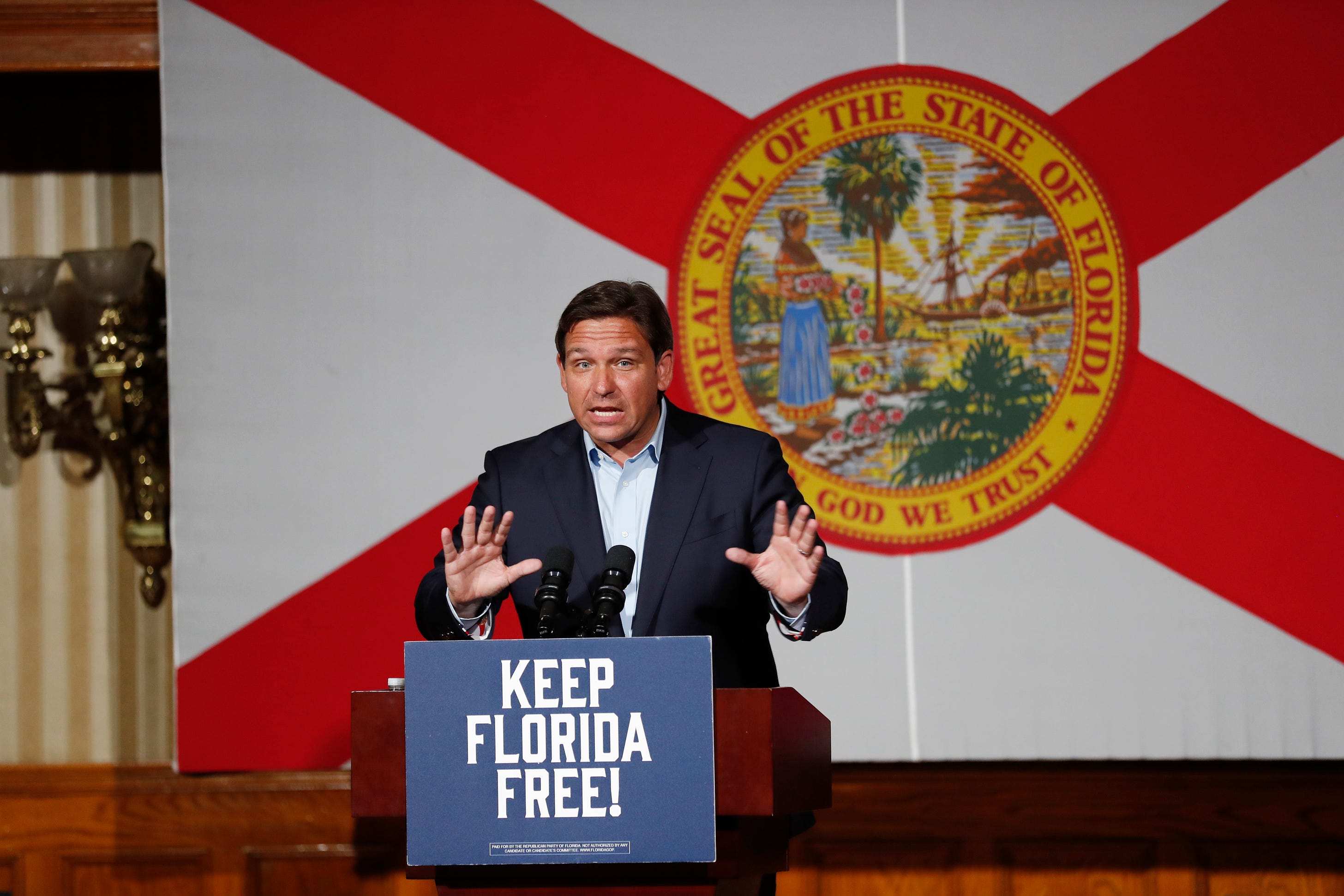
Florida has become a Petri dish for potential fascism. DeSantis has made war on African Americans, on gays, on transgender people, on drag queens, on public schools, on higher education, even on private corporations (Disney). He likes to stand behind signs that declare Florida is “free,” but no one is free to disagree with him. That’s not freedom.

Now DeSantis has proposed to create a military force that answers only to him. To call out the National Guard, he must get federal permission. That’s not good enough for him. He wants a Florida state guard. Some other states have them, but they are not in the hands of a would-be dictator whose vanity knows no limits.

CNN reports:

St, Petersburg, Florida (CNN) — Florida Gov. Ron DeSantis wants to reestablish a World War II-era civilian military force that he, not the Pentagon, would control.

DeSantis pitched the idea Thursday as a way to further support the Florida National Guard during emergencies, like hurricanes. The Florida National Guard has also played a vital role during the pandemic in administering Covid-19 tests and distributing vaccines.

But in a nod to the growing tension between Republican states and the Biden administration over the National Guard, DeSantis also said this unit, called the Florida State Guard, would be “not encumbered by the federal government.” He said this force would give him “the flexibility and the ability needed to respond to events in our state in the most effective way possible.” DeSantis is proposing bringing it back with a volunteer force of 200 civilians, and he is seeking $3.5 million from the state legislature in startup costs to train and equip them.

States have the power to create defense forces separate from the national guard, though not all of them use it. If Florida moves ahead with DeSantis’ plan to reestablish the civilian force, it would become the 23rd active state guard in the country, DeSantis’ office said in a press release, joining California, Texas and New York. These guards are little-known auxiliary forces with origins dating back to the advent of state militias in the 18th century. While states and the Department of Defense share control of the National Guard, state guards are solely in the power of a governor.

Will DeSantis use his state guard to break up peaceful demonstrations? Will he send it to drag shows to close them down? Will he it to harass teachers accused of being woke? The possibilities are frightening.

Paul Vallas is running for mayor of Chicago again. Mercedes Schneider warns the voters of the Windy City to beware.

When Vallas ran before, he garnered only 5% of the vote. But this time, he is a contender. Vallas has a long record in education. He has imposed privatization wherever he went, or in the case of New Orleans, happily advanced the privatization agenda.

She begins her post:

In January 2018, I posted about Paul Vallas, who was at the time dropping hints about becoming Chicago’s next mayor. Vallas ran and lost, winning only 5.4 percent of the vote in the February 2019 general election.

Four years later, in January 2023, Vallas is considered a real possibility (see also hereand here) for at least landing in a mayoral-race runoff following Chicago’s February 28, 2023, general election.

Vallas as mayor would be bad news for Chicago. Full stop. On January 24, 2023, the Chicago Tribune posted this benign candidate bio for Vallas, but don’t be fooled, Chicago. Vallas is anything but benign.

Chicago voters need to be informed about what they would be getting should Vallas become mayor. Therefore, I am reposting some of the Vallas history I posted four years ago, in 2018.

Vallas is terrible with budgets and with fulfilling promises, but through it all, he has managed to serve and protect his own interests.

Please open the link and read her summary of Vallas’ career.

Christopher Lubienski is Professor of Education Policy and director of the Center for Evaluation and Policy Analysis at Indiana University. Among his publications is The Public School Advantage: Why Public Schools Outperform Private Schools. In this article, which appeared in The Tennessean, he points out that vouchers are unpopular as well as ineffective. So unpopular are they that they are usually sold another another name, like “education scholarships.”

He writes:

Recently, a panel of judges dismissed lawsuits against Tennessee’s private school voucher program passed by the General Assembly back in 2019. A month before that decision, the West Virginia Supreme Court ruled in favor of its legislature’s efforts to implement a universal voucher program. These types of legal victories may seem like good news for parents’ rights, but they are also a reminder that the school choice movement is missing a key source of support: the voters.

School choice is continuing to expand across the United States. New Hampshire implemented a statewide voucher program in 2021, and this year Arizona legislators also adopted a universal voucher program.

But these successes often come in spite of overwhelming voter opposition to school choice programs. Arizona lawmakers had passed a similar measure in 2018, only to see the initiative soundly rejected by a 2-to-1 margin at the ballot box. This time around, policymakers successfully undercut an effort to put their initiative back before the electorate.

In Michigan, school choice advocates appeared to have ignored a deadline to place their proposal for a voucher program on the ballot. Since such measures had been overwhelmingly rejected by Michigan voters twice before, voucher proponents instead exploited a quirk in state law that allowed them to put the issue directly before the GOP-run legislature while preempting any veto from the Democratic governor. (Unfortunately for their plan, Michigan voters then flipped the legislature to Democratic control.)

This voter-avoidance strategy is clear with school choice programs across the U.S. According to the pro-voucher organization EdChoice.org, the U.S. has over 75 publicly funded private school choice programs, including vouchers and education savings accounts, as well as another 45 charter school programs. But all of these programs have been implemented by legislators, not the electorate. Following these legislative actions, judges, not voters, can get their say.

In fact, voters have been allowed to weigh in on school choice programs only nine times since 2000, and they almost always reject them, often by overwhelming margins. Only twice did school choice programs pass through the ballot box. In 2012 Georgia voters empowered their legislature with the ability to create charter schools. That same year, although they had clearly rejected it twice before, Washington voters passed a charter school referendum by the slimmest of margins following financial support from Bill Gates and associates for the measure.

This reflects an interesting conflict. Parents seem to like choice programs. Perhaps that’s not surprising, since people are often happy to receive public subsidies. But when asked, voters consistently and overwhelmingly reject these programs.

Policymakers and choice advocates have largely come down on the side of parent rights in endorsing school choice. Since this puts them in opposition to voters, they largely avoid the electorate on the issue.

But policymakers would do well to remember that this is not just a question of who controls education decision-making. After all, they are entrusted with the wise use of taxpayers’ dollars. And recent research is repeatedly showing that the voters may be on to something: that vouchers are not a good investment. Although publicly funded vouchers may be propping up some private schools that might otherwise go out of business, they are not really helping the people they purport to help. In fact, despite parent satisfaction, study after study shows that students using vouchers are falling behind where they would have been if they had remained in public schools. Thus, policymakers might think twice about defying voters on initiatives that actually cause harm to children.

It’s a curious approach for a movement that claims to be working for the grass roots.

You can view the post at this link : https://networkforpubliceducation.org/blog-content/christopher-lubienski-the-school-choice-movement-has-a-voter-problem/

Two of the reddest states in the nation had the largest numbers of people signing up for Obamacare. This reflects the size of their population but also their needs. Their governors may rant against the federal government and its programs, but actions speak louder than words. The public wants what the politicians deride. Yet the public elects the people who deny their basic needs.

Florida led the way with the highest number of people in the country who signed up for health insurance under the Affordable Care Act, with more than 3.2 million people enrolling, or 20 percent of the country’s totals.

A record 16.3 million people nationwide signed up for plans on the federal health insurance exchange during the open enrollment period, which began Nov. 1 and ended on Jan. 15, the Centers for Medicare & Medicaid Services reported Wednesday.

In Florida, enrollment ballooned to 3.2 million, a 19% jump over last year’s open enrollment period under the health law, commonly known as Obamacare.

The 3.2 million represents 20 percent of all enrollees nationwide, even though Florida, the third most populous state in the country with 22 million people, accounts for only about 7 percent of the U.S. population…

For University of Miami professor Dr. Olveen Carrasquillo, an expert on the Affordable Care Act, Florida’s enrollment spike is likely an indication ofoutreach efforts, a lack of jobs that provide health coverage, and that Florida is one of 11 states that did not expand Medicaid eligibility through the Affordable Care Act (ACA).

About 425,000 adults in Florida don’t have health insurance because they are too poor to qualify for coverage under the ACA and the state hasn’t expanded Medicaid, according to the Center on Budget and Policy Priorities. More than half of those adults are Hispanic or Black.

“It shows that there’s a major need for health insurance in our state,” said Carrasquillo, who serves as UM’s dean for Clinical and Translational Research and is also co-director of the Clinical Translational Science Institute.

Almost a million Floridians could lose their Medicaid coverage starting in April once the federal COVID-19 emergency comes to an end, and because Florida didn’t expand its Medicaid eligibility.

Floridians fall into this coverage gap because their incomes fall above the state’s eligibility for Medicaid but below the federal poverty line, making them ineligible for Medicaid, a health insurance program run jointly by the federal government and states.

They would also be ineligible for coverage within the Affordable Care Act marketplace. To qualify for Medicaid in Florida, parents must earn less than 31 percent of the federal poverty line, or less than $6,807 for a family of three, the Center on Budget and Policy Priorities estimates.

Texas has the second-highest enrollment in Affordable Care Act plans among states that used the federal marketplace, with 2.4 million enrollees, according to the Centers for Medicare & Medicaid Services.

Read more at: https://www.miamiherald.com/news/health-care/article271638107.html#storylink=cpy

Dan Rather and Elliott Kirschner write a blog called Steady. Their voice is always thoughtful, reasonable, informed, and…steady. I think that they, like me, are old enough to remember when we believed that overt racism was ebbing and that white supremacy was dead. Our hopes have been shattered since 2016. It takes the use of critical race theory to understand why we were so naive. Here is their take on the big Education story of the day:

Photo credit: Octavio Jones

Editor’s note: this is an ironic banner in front of DeSantis. Florida is not free for those who don’t share his ideology. If you think racism exists today in Florida, you are not free to discuss it in school or college. You are free to agree with him.

Rather and Kirschner write:

Much of American history is entangled with racism and white supremacy. That is the reality of our beloved nation, no matter how much we wish it were not.

As we sit here nearly a quarter of the way through the 21st century, it is obvious that we need to have the maturity to look back to our past as well as ahead to the future. Can we do this with our eyes wide open? Will we study and learn from the lessons of history?

You can’t grapple with the truth if you hide it from view. Yes, our national narrative is an inspiring one — of freedom, rights, and new opportunities. But it is also a narrative of pain — of the bondage, rape, and murder of enslaved people. It is a story of mass death, broken treaties, and land stolen from Native people. And it is a story of persecution of the “other,” time and again.

The chasm between the noble promises of our founding documents and our historical realities continues to obstruct our national journey toward a more perfect union.

Yes, ours is a country that has facilitated exploration, innovation, and growth, but it is also one built upon families torn apart at the auction block, bodies whipped, and police dogs and fire hoses set against children.

Cities were redlined. Public schools were segregated. And despite our carefully cultivated national image as a meritocracy, throughout our history we have seen talent overlooked and our common humanity diminished on account of people’s race, religion, and sexual orientation.

The ripples of injustice continue to destabilize our society.

It shouldn’t be controversial to say any of this. But acknowledging these truths today is a political act, because it threatens the privileged narratives of those who seek to sugarcoat our past. These are men and women who serve their own ambitions by fortifying their cynical holds on power, delighting in division, feeding off fear, and applauding anger.

And that brings us to Florida’s Governor Ron DeSantis.

Listing all of his efforts to leverage the power of his office to attack equity, empathy, and justice would stretch this post immeasurably. But doing so would also jeopardize the central point: DeSantis is an opportunist. He is not weighing the merits of any one campaign. Rather, he wants headlines as a culture warrior standing up to “wokeness,” a term he has eagerly redefined to suit his own purposes. It allows him to sneer at and dismiss any attempt to reckon with American injustice.

DeSantis has focused his assaults on two of our society’s most traditionally marginalized groups: Black Americans and the LGBTQ community. While these populations have thus far felt the brunt of his targeting, we need to see clearly that his rhetoric is a threat to all who care about a democratic, peaceful, empathetic, and just America. Those of us with the greatest privilege should bear a special burden in rejecting this hate.

DeSantis’s pugilism has enabled him to consolidate power in Florida. Any opposition to his toxic initiatives must contend with the uncomfortable truth that voters validated his message and style via his landslide win in November. Now DeSantis thinks he can take his show on the road with a presidential bid. That remains to be seen. Florida has been trending Republican in recent years, and success there might not translate to the current battleground states, many of which saw big Democratic wins in the midterms.

All that being said, there is a great danger to framing this struggle primarily through the lens of electoral politics. This normalizes a discourse that should be rejected by society’s mainstream. Just as the outright bigotry of the past became socially unacceptable, so too should these latest attempts at divisiveness.

It should not surprise us that DeSantis is making schools — both K-12 and college — a central target. He wants to teach a distorted view of America. He wants to make dissenting speech not only suspect but even criminal. He wants to silence the voices of his critics and of critical thinking more generally. This is a playbook that has been followed by demagogues before to very dangerous ends.

It is essential that DeSantis not be covered by the press through a false equivalence paradigm. We can debate what we should teach and how to teach it. But we can’t replace the truth, as unsavory as it may be, with sanitized narratives that suit those already in power. This is a battle for the minds of the voters of the future. This is about what kind of nation we will become.

But DeSantis primarily cares about what kind of country we are now. He wants to appeal to fear because he thinks he can mine that fear for votes. That is his game plan. And he’s not hiding it. There can be no appeasement. DeSantis has already shown that he isn’t interested in deliberations or good faith compromise. Those would disrupt his approach of means to an end.

History illustrates that hatred can be taught, but so can empathy and justice. We are on a winding journey as a nation. And we have much farther to go. But we have made progress in the face of bigots and autocrats because people had the courage to forge the inequities of our past into a more equitable future.

This history, this truth, is what scares people like DeSantis the most. But it is one that can give us hope if we are determined not to look away.

Robert Hubbell writes a thoughtful, informative blog. I’m posting this as part of my personal project to understand the new face of white supremacy. White supremacy has always been there, simmering below the surface. Trump invited them to show their faces and step into the daylight. They did, and DeSantis is sending them signals that he wants to be their champion.

Florida Governor Ron DeSantis has set his anti-education sites on Florida’s state colleges. Through a series of political and legal maneuvers, he has ceded control over Florida’s state colleges to ultra-conservative culture warriors like Christopher Rufo. In short order, DeSantis has announced that he will rid Florida state colleges and universities of curricula not “rooted in Western tradition” or that “compels belief in critical race theory or related concepts such as intersectionality.”

Amid the torrent of reporting on Ron DeSantis’s attack on critical race theory and intersectionality, the quiet part is often left unsaid. So let me say it: DeSantis’s educational agenda is code for racism and white supremacy. (Other parts of his agenda seek to erase the dignity and humanity of LGBTQ people.) DeSantis’s invocation of “Western tradition” is meant to suppress knowledge regarding the people (and contributions) of Asia, Africa, South America, Oceania, and the Indigenous Peoples of the Americas. See Talking Points Memo, DeSantis Makes 2024 Ambitions Clear As He Pours Gasoline On His ‘Woke’ Education Fire.

Given DeSantis’s generalized ignorance, his call to focus on “Western tradition” is a slippery slope that will inevitably lead to the discussion of unpleasant truths about America. For example, the enslavement of Black people was a “tradition” in North America for 246 years—and the abolition of that evil practice is relatively recent (155 years ago). So, a college course that honestly addresses the Western “traditions” of North America should include an examination that the role of slavery played in the economic, social, and political development of America.

But DeSantis isn’t stopping at converting Florida’s colleges and universities into re-education camps in the worst traditions of the USSR. He is seeking to up-end centuries of “Western tradition” embodied in the Constitution and the English common law: the requirement of a unanimous jury to impose capital punishment. DeSantis has floated the idea that a less-than-unanimous jury verdict can impose a sentence of death—an unconstitutional proposal designed to inflict the death penalty on more Black and Latino Americans. See Vox, Ron DeSantis wants to make it much easier for the state to kill people.

DeSantis is willing to do all this because he wants to capture Trump’s loyal base—which is the only hope that DeSantis has of becoming a credible candidate. As Trump becomes mired in criminal prosecutions, DeSantis will become emboldened and radicalized beyond his already extremist views. Doing so ignores the lessons of the 2022 midterms: persuadable Americans are done with Trump and his MAGA extremism. Like all military generals, Ron DeSantis is fighting the last war (the presidential election of 2020) and has failed to heed the tectonic shift that occurred in the midterms.

Charlie Sykes used to be a conservative Republican. Then Trump became President, and Sykes became a Never Trumper (maybe before the election, I’m not sure). Charlie and other Never Trumpers and their friends created a website called The Bulwark. It is consistently interesting. Charlie wrote the following post.

He wrote:

When Twitter banned neo-Nazi Nick Fuentes back in December 2021, the site’s Head of Safety and Integrity, Yoel Roth said, “Hateful conduct has no place here.”

But Roth is gone, Elon Musk is in charge, and the Nazis are back.

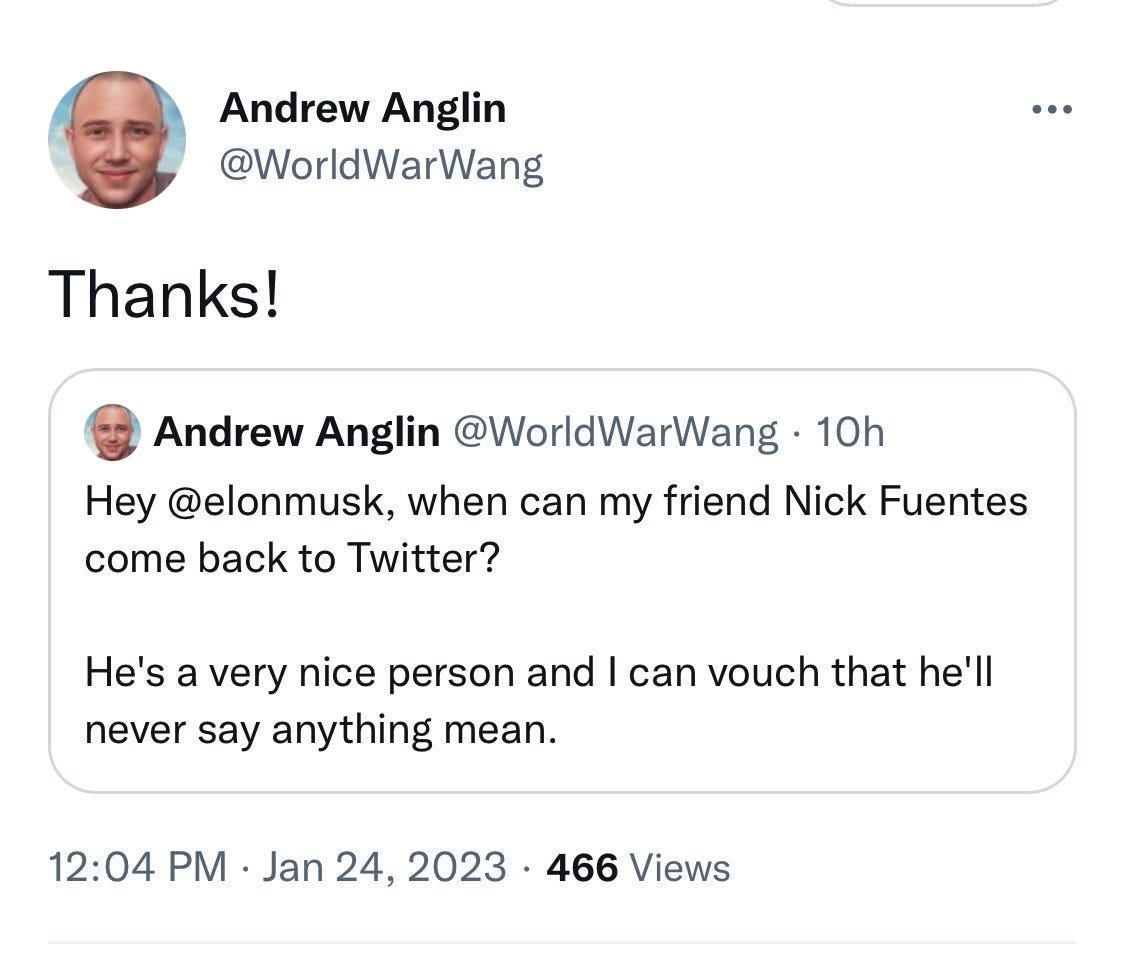
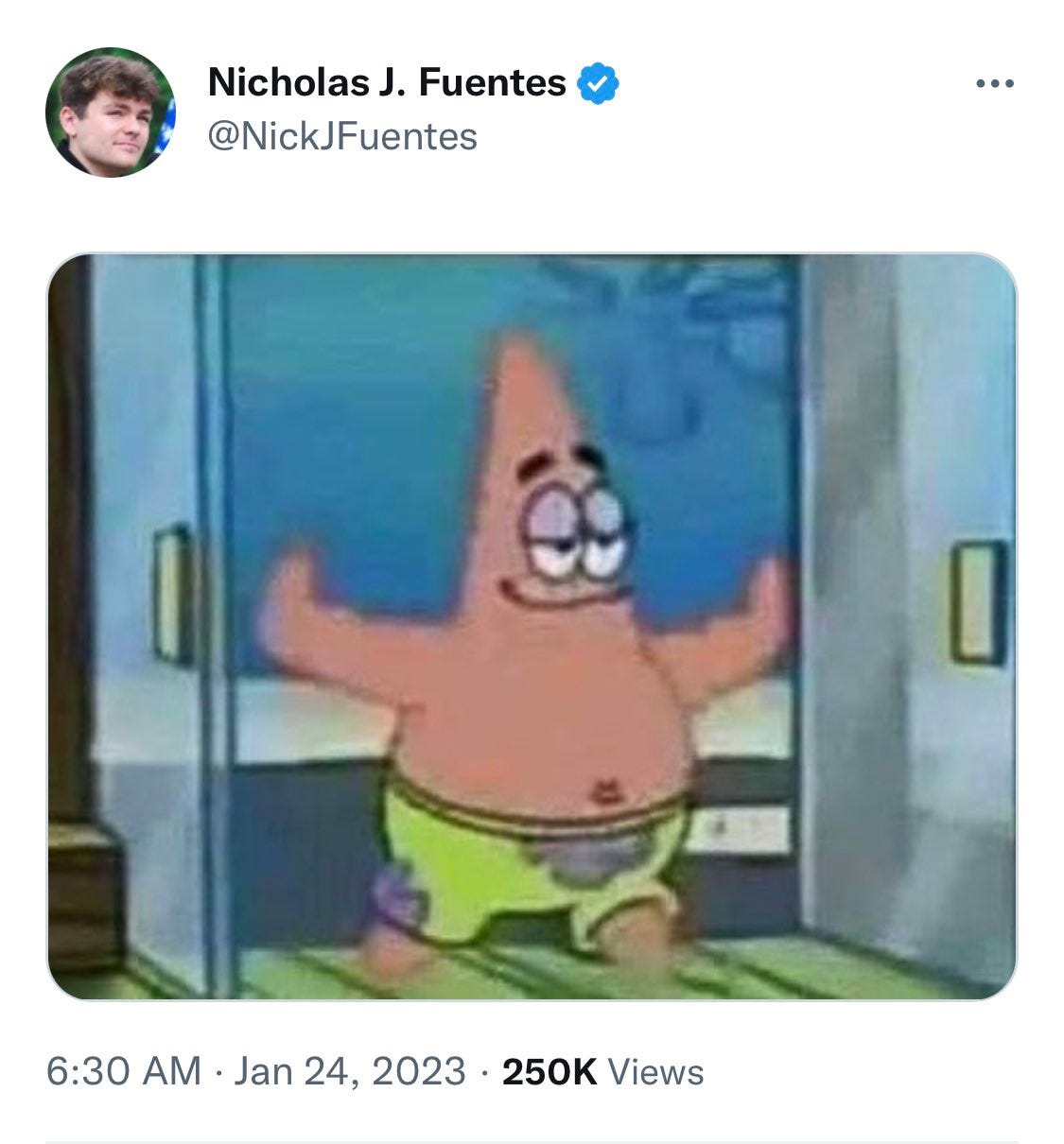
Fuentes, last seen here as Donald Trump’s dinner guest, was reinstated just hours after another actual Nazi, Andrew Anglin— who once described his approach as “Non-ironic Nazism masquerading as ironic Nazism” — asked Musk to bring his friend back on Twitter.

Anglin tweeted Musk that the Holocaust-denying, Jew-baiting Fuentes is “a very nice person and I can vouch that he’ll never say anything mean.”

Leah McElrath @leahmcelrathThe reinstatement of the Twitter account of Nick Fuentes came hours after Andrew Anglin—editor of the neo-Nazi website the Daily Stormer—publicly asked Elon Musk to let Fuentes back on Twitter: 2:51 PM ∙ Jan 24, 202393Likes66Retweets

Musk, apparently took him at his word, and Fuentes made his triumphant return, with his usual restraint, dignity, and class.

Image

**

Who is this new Musk-whisperer?

Back in 2017, The Atlantic profiled Anglin: “The Making of An American Nazi.”

Anglin is an ideological descendant of men such as George Lincoln Rockwell, who created the American Nazi Party in the late 1950s, and William Luther Pierce, who founded the National Alliance, a powerful white-nationalist group, in the 1970s. Anglin admires these predecessors, who saw themselves as revolutionaries at the vanguard of a movement to take back the country. He dreams of a violent insurrection.

But where Rockwell and Pierce relied on pamphlets, the radio, newsletters, and in-person organizing to advance their aims, Anglin has the internet. His reach is exponentially greater, his ability to connect with like-minded young men unprecedented.

Since then, Anglin has tried to rebrand himself as just a garden-variety American Nationalist, but this is mostly eye-wash for clueless billionaires. Notes the Anti-Defamation League:

In an effort to validate their leap from neo-Nazis to flag-waving American patriots, he and his followers equate American nationalism to white nationalism by claiming America was founded on anti-Semitic and racist principles.

**

Anglin is also one of the most vicious trolls on the far-right. I wrote about him in my book, “How the Right Lost Its Mind,” describing the explosion of harassment aimed at Jewish critics of Donald Trump at the time.

Many of the worst instances of harassment were connected to a website known as the Daily Stormer and its founder, a neo-Nazi activist named Andrew Anglin.

I first became aware of the site when I received, via email, a photoshopped image of my picture inside a gas chamber. A smiling Donald Trump wearing a German military uniform is poised to press the red “gas” button. The photoshopping tool had been created by the website and was widely used to troll both Jewish and non-Jewish critics of the Trump campaign.

The site takes its name from the German Nazi newspaper Der Stürmer,which was notorious for the viciousness of its anti-Semitic caricatures of Jews. After World War II, Der Stürmer’s publisher, Julius Streicher, was executed for crimes against humanity.

Anglin created the site in 2013 as an updated version of his previous website, which he called Total Fascism. As of this writing, the new website features pictures of Ronald Reagan and Donald Trump and the slogan “Daily Stormer— The World’s Most Goal-Oriented Republican Website.”

It is important to emphasize again that the Alt Right is a mansion with many rooms and some very real divisions. Anglin, for example, is not a fan of Milo Yiannopoulos, who is depicted on the Daily Stormer with a cartoon of the Jewish nose superimposed on his face and is referred to as “Filthy Rat Kike Milo.”

But Anglin is also interested in emphasizing the common ground among the various disparate groups and interests that make up the white nationalist movement. In his own guide to the Alt Right, Anglin notes that the movement included various factions, but that they had all been led “toward this center-point where we have all met. The campaign of Donald Trump is effectively the nexus of that centerpoint.”

Impressed by Trump’s rhetoric on illegal immigrants, Anglin endorsed Trump in 2015 and urged the readers of the Daily Stormer to “vote for the first time in our lives for the one man who actually represents our interests.”

After Trump called for barring Muslims from the country, the site declared: “Heil Donald Trump— The Ultimate Savior.” But Anglin’s greatest accomplishment was the creation of what he calls his “Troll Army,” which he uses to attack political opponents, deployed to great effect in early 2016.

After GQ magazine published a profile of Melania Trump by writer Julia Ioffe, the future First Lady took to Facebook to denounce the piece as “yet another example of the dishonest media and their disingenuous reporting.” Anglin quickly mobilized his Troll Army, posting an article headlined: “Empress Melania Attacked by Filthy Russian Kike Julia Ioffe in GQ!”

The post featured a picture of Ioffe wearing a Nazi-era yellow star with the word “Jude” and a call to action from Anglin:

“Please go ahead and send her a tweet and let her know what you think of her dirty kike trickery. Make sure to identify her as a Jew working against White interests, or send her the picture with the Jude star from the top of this article.”

The result was a torrent of abuse, including death threats against the journalist.

On Twitter, she was sent pictures of Jews being shot in the head and pictures of her wearing concentration camp stripes. When she answered her phone, a caller began playing a recording of a speech by Adolf Hitler.

“The irony of this is that today,” Ioffe told the British newspaper the Guardian, “I was reminded that 26 years ago today my family came to the US from Russia. We left Russia because we were fleeing antisemitism. It’s been a rude shock for everyone.”

The response from the GOP nominee was also troubling. When Trump was asked by CNN’s Wolf Blitzer about the anti-Semitic attacks and death threats, the future president pointedly refused to condemn them, pleading ignorance and saying, “I don’t have a message to the fans. A woman wrote an article that was inaccurate.”

Trump’s refusal to denounce the Troll Army was greeted with delight by Anglin, who immediately posted: “Glorious Leader Donald Trump Refuses to Denounce Stormer Troll Army.” He exulted:

“Asked by the disgusting and evil Jewish parasite Wolf Blitzer to denounce the Stormer Troll Army, The Glorious Leader declined. The Jew Wolf was attempting to Stump the Trump, bringing up Stormer attacks on Jew terrorist Julia Ioffe. Trump responded to the request with “I have no message to the fans” which might as well have been “Hail Victory, Comrades!”

**

Fast-forward to 2023:

Image

Republicans in Texas are obsessed with voter fraud. Trump won the state in 2020, as did the Republican Governor, Lieutenant Governor, Attorney General, and other statewide offices. Apparently Republican legislators think it’s suspicious that Democratic candidates won any votes at all. So they are launching a fusillade of bills to make it harder to vote.

Michael Hardy of The Texas Monthly reports:

For decades, Texas has maintained one of the worst voter-turnout rates in the country. Less than 61 percent of eligible Texans voted in the 2020 presidential election, placing us forty-third out of fifty states. (In Minnesota, the highest-turnout state, nearly 80 percent of eligible voters participated.) In November, 42.5 percent of eligible Texans cast ballots in the midterm election, placing us thirty-ninth in the nation. Embarrassed by these dismal figures, Texas political leaders will spend the Eighty-eighth Legislature passing laws to encourage more participation in the democratic process.

Just kidding! Instead of removing obstacles to voting, Republican legislators are introducing a slew of new bills that could disrupt elections and further depress turnout. GOP lawmakers say the bills are designed to prevent fraud and ensure election integrity. But several of the proposals—such as a bill by Republican representative Bryan Slaton, of Royse City, that would shorten the early-voting period from two weeks to one week—have no obvious rationale other than to make voting less convenient. (Slaton did not respond to an interview request.) Indeed, this and many other bills seem to proceed from the assumption that too many Texans are taking advantage of their constitutional right to select their leaders. Narrowing the franchise has long been a national Republican priority, although politicians are seldom as explicit as former president Donald Trump, who warned that 2020 voting reforms proposed by congressional Democrats would lead to “levels of voting that if you’d ever agreed to it, you’d never have a Republican elected in this country again.”

Trump’s concern was probably unfounded. There’s no consensus among political scientists on whether higher turnout benefits one party over another. Indeed, rising turnout in recent Texas elections has simply led to more Republican victories. The Texas GOP, it would appear, has little to fear from more election participation. But that doesn’t seem to have dampened the party’s enthusiasm for making it harder to vote. On the contrary: fueled by Trump’s false claims of a stolen election, Texas Republicans have become obsessed with the specter of voter fraud. Attorney General Ken Paxton has spent at least $2.2 million on an Ahab-like quest to find incidents of voter fraud. Between January 2020 and September 2022, he opened nearly four hundred investigations into potential election crimes yet secured only five election-related convictions.

In 2021, Governor Greg Abbott signed Senate Bill 1, a far-reaching “election integrity and security” package, into law. The measure prohibited 24-hour voting and drive-through voting, pandemic-inspired innovations in Harris County that drove up turnout in 2020. It also imposed confusing new vote-by-mail requirements, including forcing each voter to write the ID number with which they registered to vote—either their driver’s license number or the last four digits of their Social Security number—on the ballot. (If they forgot which ID they used to register and picked the wrong one, they were out of luck.) Failure to meet the new requirements led to an unprecedented 12 percent of mail-in ballots being rejected in last year’s primary. (The rejection rate fell for the general election, as Texas voters learned to include both their driver’s license and Social Security numbers.) The bill, Abbott proclaimed in 2021, would “make it easier to vote and harder to cheat.” The same year, Texas secretary of state John Scott launched a “full forensic audit” of the 2020 presidential election in four large Texas counties. The audit, which wrapped up in December 2022, found significant administrative dysfunction in Harris County, but no evidence of widespread voter fraud. Scott, who resigned in December after a little more than a year on the job, has urged “Stop the Steal” activists to accept President Biden’s victory in 2020, blaming their concerns on “a lack of information.”

But as noted philosopher Donald Rumsfeld liked to say, absence of evidence is not evidence of absence. Just as Saddam Hussein’s possession of weapons of mass destruction was an article of faith in the Bush White House, the existence of widespread election fraud has become an article of faith for many in the Texas GOP. To cite just one example, Republican representative Steve Toth, of the Woodlands, author of a bill requiring unique electronic codes for absentee ballots, has accused Democrats of using paper ballots to commit voter fraud and defended MyPillow CEO Mike Lindell’s crusade to prove that the 2020 presidential election was stolen. At its summer convention, the Texas GOP adopted a platform calling President Joe Biden’s victory illegitimate and urging politicians to focus on “election integrity.” To this end, Republican lawmakers have filed more than a dozen bills designed to root out supposed electoral chicanery. To be sure, Democrats have filed plenty of their own election bills, most of them intended to encourage voter registration and make it easier to cast a ballot. But with Republicans controlling the House, Senate, and Governor’s Mansion, there is little chance of the Democratic bills becoming law. Nor will every Republican-authored bill ultimately pass.

With those caveats out of the way, here’s a preview of the major voting bills filed so far in the Eighty-eighth Legislature.

HB 52 & HB 1243 / SB 166

Authors: Representatives David Spiller (R-Jacksboro) and Cole Hefner (R-Mount Pleasant) / Senator Bryan Hughes (R-Mineola)

Purpose: Increases penalty for voter fraud from a Class A misdemeanor to a felony.

Background: In 2021, Governor Abbott signed SB 1, the controversial voting bill that Democrats attempted to block by fleeing to Washington, D.C. The bill eventually passed, but not before a conference committee added a provision lowering the offense of voting illegally from a second-degree felony to a Class A misdemeanor. Less than a month later, after receiving blowback from fellow Republicans, Abbott called on lawmakers to make voter fraud a felony again. These bills answer his call. Class A misdemeanors are punishable by up to a year in jail, while a second-degree felony is punishable by up to twenty years in prison.

HB 125

Author: Representative Bryan Slaton (R-Royse City)

Purpose: Requires district attorneys, under penalty of removal from office, to enforce state election laws.

Background: Republicans have accused the Democratic district attorneys in large cities such as Dallas and Austin of failing to pursue election fraud with sufficient vigor. Attorney General Ken Paxton has sought to prosecute election cases himself, but in September, the Texas Court of Criminal Appeals ruled that he must receive permission from local prosecutors to pursue such cases.

HB 161

Author: Representative Steve Toth (R-The Woodlands)

Purpose: Requires each absentee ballot to include a unique electronic code to verify its authenticity.

Background: For years, right-wing activists have claimed that voting by mail is uniquely vulnerable to election fraud. Former president Trump urged his supporters to vote in person, and he cast efforts to encourage voting by mail during the COVID-19 pandemic as a way for Democrats to steal the election. This bill appears designed to prevent voters from photocopying absentee ballots—a phenomenon for which there is no evidence.

HB 549 / SB 220

Authors: Representative Valoree Swanson (R-Spring) / Senator Paul Bettencourt (R-Houston)

Purpose: Establishes a cadre of “election marshals”—law enforcement officers appointed by the Secretary of State to investigate election fraud. Calls for regional task forces of judges to adjudicate allegations of election fraud on and before Election Day.

Background: This bill is one of numerous GOP proposals in the current Legislature inspired by Florida governor Ron DeSantis. In this case, the new office of election marshal appears modeled after Florida’s Office of Election Crimes and Security, which has charged 20 Floridians (out of 11 million voters in 2020) with voting illegally since it was established last year. The Texas bill prohibits judges from overseeing election challenges in their own counties, apparently under the assumption that these judges would be biased against the candidates challenging the election.

Open the link and read about more bills that are supposedly necessary to protect “election integrity” but whose actual result will suppress the vote by confusing voters and making the process of voting more complicated than at present.
After especially awful massacres, the public expects Congress to take meaningful steps to limit access to guns. Sandy Hook. No action. Marjory Stoneman Douglas HS in Parkland, Florida. No action. The Pulse Nightclub. No action. The Las Vegas music festival massacre. No action. Uvalde. No action. The recent massacres in California? What do you think? Why no action? The Republicans block every attempt to enact meaningful restrictions.

CNN posted a summary of where America stands internationally a day before the killing of 11 people in Monterrey Oark, California.

CNN) – Monterey Park. Atlanta. Orlando. Las Vegas. Newtown. Parkland. San Bernardino. Uvalde.

Ubiquitous gun violence in the United States has left few places unscathed over the decades. Still, many Americans hold their right to bear arms, enshrined in the US Constitution, as sacrosanct. But critics of the Second Amendment say that right threatens another: The right to life.

I insert here that my understanding of the Second Amendment is that it pertains not to the right of every individual to “bear arms,” but to the maintenance and arming of a “well-regulated militia.”

For a time in the 1990s, the Supreme Court agreed, and let stand a decade-long ban on assault weapons.

The 2nd Amendment says:

A well regulated Militia, being necessary to the security of a free State, the right of the people to keep and bear Arms, shall not be infringed.

The CNN article continues:

There are 120 guns for every 100 Americans, according to the Switzerland-based Small Arms Survey (SAS). No other nation has more civilian guns than people.

More guns than people!

Read the article.

You knew this was going to happen. A few days ago, Florida Governor DeSantis persuaded the presidents of the state’s 28 colleges and community colleges to pledge not to “compel belief in critical race theory” or to violate the state’s ban on WOKE thought. Now, his lieutenant governor says, the administration will stamp out diversity, equity, and inclusion in the state’s public universities. Forget about academic freedom. The state belongs to this tin hat dictator. You are free to believe what he believes and free to think what he wants you to think.

Florida will be looking to “curb” diversity, equity and inclusion efforts at the state’s colleges and universities, Lt. Gov. Jeanette Nuñez said Tuesday, offering a preview of what higher education leaders can expect from lawmakers during the upcoming legislative session.

Her statements, delivered at state Board of Governors meeting in Miami, marked the first time the DeSantis administration has explained why its budget office this month requested a detailed accounting of how much colleges and universities spend on such efforts.

Nuñez began, saying “I can give you a few insights as to what we’re working on coming this session,” then referenced a recent statement from the presidents of Florida’s 28 state colleges. It pledged to root out any policy or practice that “compels belief in critical race theory or related concepts.” The lieutenant governor suggested that effort would soon extend to the 12 schools in the university system.

Read more at: https://www.miamiherald.com/news/local/education/article271590247.html#storylink=cpy