Archives for category: Education Industry

Parents in Athens County, Ohio, are concerned that a planned new charter school will drain funding away from their local public schools. The proposed classical academy is relying on conservative Christian Hillsdale College to deliver its curriculum and set it up but insists it is not a Hillsdale charter, despite appearances.

A planned charter school with ties to evangelical Christian and politically conservative organizations could, if successful, divert approximately $2 million a year from area school districts starting in 2024.

Southeast Ohio Classical Academy, to be based in Athens County, has stirred controversy among local parents and educators who are concerned in part about the school’s:

  • Association with a private Christian college known for its political activism.
  • Ties to a “planted” evangelical church in Athens.
  • Curriculum based on “our Western civilization inheritance.”
  • Potential to siphon state funding away from public schools.

Those concerns have been aired on social media, including a spirited discussion in the Women of Athens Facebook group last month and the creation of an Athens Parents against SOCA Twitter page. Local law enforcement investigated one Facebook comment for “indirect threats” to SOCA board members, although the case was closed without charges.

The school’s founders say that SOCA has no religious affiliation, that its curriculum offers a “well-rounded education,” and that “school choice is a part of freedom.”

Public charter school, private Christian backing

Board member Kim Vandlen said she has long hoped to open a classical school, inspired by her own education at Hillsdale Academy in Michigan. The private, Christian K-12 school is operated by Hillsdale College, a private Christian college with longstanding ties to libertarian and conservative politics.

Eva Moskowitz’s Success Academy Charter chain has won national plaudits for its extraordinarily high test scores. SA is a fundraising dynamo, attracting the support of leading figures on Wall Street and the financial sector. She and her chain were the subject of a hagiographic film called “The Lottery,” made by Madeline Sackler of the infamous opioid Sackler family,who are big supporters of the charter industry. The implication was that all students were chosen at random and were exactly the same as those in local public schools.

Over the years, critics have noted the high attrition rate of kids who start at SA schools, as well as an extraordinarily high teacher attrition rate.

Gary Rubinstein, high school math teacher and blogger, has followed the progress of SA in many posts on his blog.

In this post, he explores the effects of SA’s “backfill” policy, meaning that the schools seldom accept new students after fourth grade.

Using public data, Rubinstein explores the chain’s admissions and placement policies.

He writes:

I’ve learned through a lot of first hand stories that one of the biggest factors in the ‘success’ of Success Academy is the way they weaponize the school’s ability to force students to repeat grades or to voluntarily leave the school to avoid having to repeat a grade. When they have a student who they think is not fitting into their system enough, even if that student is on grade level and passing the state test, they sometimes arbitrarily tell the family at the end of the school year that if the student returns to Success Academy the next year they will have either repeat the grade they just completed or they can transfer to a different school and then they won’t have to repeat the grade.

So one way that holding a student back can improve the school’s test scores is that the weaker students leave the school ‘voluntarily.’ But maybe the family will decide that they want to keep their child at Success Academy and then the student will be more likely to do well on the state test when they have just repeated the year in that grade. But there is another way that Success Academy wields the power to arbitrarily make a student repeat a grade. Each year there are many students who leave the school for all kinds of reasons. While most schools give students on a waiting list a chance to be ‘backfilled’ and transfer from another school, it is known that Success Academy only allows backfilling in grades 1 through 4. So students from the waiting list are offered a slot at the school, but sometimes Success Academy will tell these families who just got a position off the waitlist that because Success Academy is so rigorous, the student will have to repeat the grade they just completed at their other school. They say this to the families whose children, Success Academy thinks, will struggle at the school. So these families who are told this will either take the deal and have their children repeat the grade or they will choose to go to a different school. Either way, Success Academy improves their test scores this way either by denying the student a chance to go to Success or by having them retake the same grade where they will likely do better on the state test the second time around than they would if they were in their proper grade.

I have heard about families having to grapple with this choice after getting into the school as a ‘backfill’ student, but I had no idea how common of a thing this was. So I did a freedom of information request to the NYC Department Of Education. Much to my surprise, the data was just emailed to me today and what it reveals is shocking, even by Success Academy abuse of families standards.

Read what he learned.

Chalkbeat Indiana reports on the innovative way that a failing charter school fixed its problems: It changed its name! Ignite Achievement Academy is now the Genius School! There!

Single-digit proficiency rates. Plummeting attendance. A work environment described in a former employee’s lawsuit as “one big mess.”

Ignite Achievement Academy came to and left Indianapolis Public Schools within just four years under challenging circumstances. Some low test scores from Elder Diggs School 42 the traditional school Ignite took over — dropped even lower on Ignite’s watch, while attendance fell below the district average and staff retention rates became the worst in the district.

These falling scores and other poor metrics led Ignite to become just the second charter school to not have its partnership renewed with the district’s innovation network.

Yet despite the school’s challenges, the mayor’s Office of Education and Innovation (or OEI) – the school’s authorizer – has allowed the school to continue operating as an independent charter school under a new name.

Ignite has transitioned from an IPS-affiliated restart charter school to the Genius School, an independent K-6 charter school in a new location near the city’s Fairgrounds neighborhood. It is on probationary status due to poor performance.

Brilliant! The failing Ignite Achievement Academy School is now the Genius School!

You can’t make this stuff up.

A few years ago, teachers at Garfield High School in Seattle launched a boycott to protest the use of the MAP test. They believed it was a waste of time. Teacher Jesse Hagopian wrote about the successful protest in his book More Than a Score. The test was canceled in high school, but unfortunately not in middle schools or elementary schools. It’s typically offered (required) three times a year so teachers can measure student progress in the skill of taking standardized tests.

Steven Singer writes that the MAP test is junk.

He was required to attend training to give the MAP test and write the following:

This is an assessment made by Northwest Evaluation Association (NWEA), a so-called non-profit organization out of Portland, Oregon.

The company claims its assessments are used by over 9,500 schools and districts in 145 countries – but none is more popular than the MAP.

Some states even require the MAP as part of their standardized testing machinery. However, in the Commonwealth, the MAP is used as a pre-test or practice assessment by districts that elect to pay for it.

My building – the middle school – used a variety of different assessments throughout the years for this purpose – IXL, CDT, etc.

However, things are changing this year. No, we’re not getting rid of these pretests altogether – why enact sane policy now after a decade of wrongheadedness!?

My district had used the MAP consistently for years at the elementary schools, so someone in administration thought it made sense to bring it to the middle school now and eventually institute it in the high school, as well.

Do we really need an assessment BEFOREthe state mandated assessments?

Heck no!

Classroom teachers give enough assignments and tests of their own to know where their students are academically throughout the year. We grade them after all. What do you think that’s based on – guessing?

But certain administrators just love these pre-tests. They love looking at spreadsheets of student data and comparing one grading period to another. They think if the numbers go higher, it will be proof they’re good principals and functionaries.

It’s pathetic to be honest. What a waste of taxpayer dollars that could be used for actual learning! What a waste of class time that could be used for actual teaching!

And what a negative impact these assessment actually have on students and their learning!

For instance, at the MAP training, teachers were told the assessment’s job was to show how our students were doing in Reading, Math and Science compared with an average test taker.

How is that useful?

I don’t teach average test takers. I don’t even teach average students.

How is constantly comparing them to a norm going to help them improve?

If I went on a diet and stepped on the scale, learning that my weight loss wasn’t as high as an average dieter would not help me stay away from sweets. If anything, it would inspire me to go on a binge in the snack drawer.

It’s the same with my students. Constantly pounding into them how below average their scores are does not inspire them to do better. It teaches them that they cannot do what is being asked of them so they stop trying.

When learning a skill, it doesn’t help to know how well others are or are not learning that same skill. It matters how much you are learning in comparison to yourself. Yesterday I knew THIS. Today I know a bit MORE. Who cares what the so-called average learner can do!?

Students learn at their own rates – sometimes faster, sometimes slower. We don’t quicken the timescale with needless comparisons.

But no matter how many times I say such things to administrators or paid trainers from NWEA, they just don’t get it.

At this training, the instructor actually wanted to know what “elevator speech” teachers were going to give to parents about why the MAP was important!

It’s bad enough we’re being forced to give this crappy assessment, but now you want us to spout propaganda to the very people paying our salaries!?

Why not invite us to the school board meeting and ask us what we really think of this initiative? Why not have us submit comments anonymously and have them read publicly to the school board?

Why not invite us to the school board meeting and ask us what we really think of this initiative? Why not have us submit comments anonymously and have them read publicly to the school board?

But of course not! That would be actually valuing the opinion of the people you’ve hired to teach!

It’s no wonder the trainer was anticipating blow back. Many parent and teacher groups across the country have opposed the MAP test. Most famously in 2013, teachers at several Seattle schools lead by Garfield High School actually refused to give the MAP test.

Having trusted teachers sooth community worry with corporate propaganda would be a big win for the testing company.

However, I’ll give the trainer one thing – she understood that the MAP assessment scores would not be useful unless students could be encouraged to take the test seriously. Nobody tries their best at something they think is unimportant.

Her solution was two-fold. First, NWEA has produced several propaganda videos to show students why the test is important.

I can imagine how much they’ll love that!

Second, the MAP is an adaptive test taken on a computer or iPad. And it actively monitors the students taking the test.

If its algorithm determines that students are answering questions too quickly or “rapid guessing,” the program pauses the student test.

Teachers are supposed to monitor all this on a screen and intervene when it occurs. We’re supposed to counsel kids not to just guess and then allow them back on the test. If the algorithm still thinks students are guessing, we’re supposed to suspend their test and make them take it all over again.

You know, I did not get a masters in education to become a policeman for a standardized testing organization.

Open the link and read the post in full.

Peter Greene writes here about Michael Petrilli’s reflections on the evolution of the “reform” movement. Now that the “reform” movement has merged with Christian nationalists, book banners, Proud Boys, neo-fascists, and other vicious haters of democracy, public schools, and academic freedom, there is much to reflect on. Unfortunately, that’s not the reflection we learn about here. Let me add that when I was a board member a dozen years ago at the Thomas B. Fordham Institute, I formed a friendship with Mike Petrilli. I always hoped he would flip and join the public school side (his own kids are in fine public schools in Maryland). But a guy’s gotta make a living and the reformer world pays well. I’ve never given up hope for Mike.

Greene begins:

Mike Petrilli at the reformster-minded Thomas Fordham Institute has been taking a look at the current state of ed reform (apparently many of us are in that mood right now?) and it’s worth taking a look at what the guy in every education reporter’s rolodex thinks the state of ed reform is right now. And I promise what I think is an interesting observation at the end.

In “The Evolving Education Reform Agenda,” Petrilli starts with his previous argument that while the “Washington Consensus” is dead, ed reform itself is not. This hints at one of the challenges of the ed reform brand these days, which is that nobody really knows what the term actually means any more. He tries to address that in this piece.

Petrilli argues that the agenda has shifted (a more positive phrase than “we keep moving the goal posts”) from a focus on data and getting students to score proficient on state tests (circa NCLB) and then moved to trying to hold individual teachers responsible, a movement that Petrilli assess pretty frankly:


By the early 2010s, much of the conversation was about holding individual teachers accountable via test-informed teacher evaluations. Ham-handed implementation and poisonous politics led us to leave that misguided reform behind.

If only they had taken the policy with it, but its hammy hands are still felt by many teachers in many states. But one of ed reforms annoying features is that it never picks up after itself; it never puts as much energy into undoing its mistakes as it does into making them in the first place. Just imagine a world in which these thinky tank guys picked up the phone to call their contacts and say, “Look, that thing we convinced you to try? You’ve got to make people stop doing that.” Imagine if Bill Gates put the same kind of money into cleaning up his policy messes as he puts into pushing them.

Sigh. Anyway, Petrilli lists some other new-ish policy foci, like high quality instructional materials. He aptly notes that a new support for better school funding coincides with A) recognition by reformsters that funding does improve student outcomes and B) a desire to get charter and voucher schools more money (the old “choice gets it done more cheaply” talk is toast).

Parental choice? There’s still debate about using tax dollars to fund private and religious schools, particularly those that discriminate, says Petrilli, though I’ve missed the folks in the reformster camp arguing the anti-discrimination side. Unbundling is still a thing.

Testing and transparency? Reformsters still believe in the value of the Big Standardized Test, a point on which they remain resolutely and absolutely wrong, though they are now, he says, also interested in alternative assessments–but that’s still hung up on the obsession with test scores. Writes Petrilli, “How would assessments be different? If schools do well on “alternative measures” but not on test-score growth, then what? Should we ever consider such schools “good”?” I can help, Mike–the answer is “Yes.”

Greene goes on to explain that Petrilli thinks the new focus of reform must be to shift from policy to practice. This is an implicit admission that policy interventions have failed. Neither charters nor vouchers nor evaluation of teachers has been a successful. So now it’s time for reformers to change how teachers teach. But how can they do that when so few reformers have ever been teachers?

This is further complicated by the fact that the individual-to-individual practice end of the scale only happens if the individual has some credibility, and reformsters have always been hampered by their amateur status in education practice (I can think of exactly one who can legitimately claim classroom experience–and no, Temp For America doesn’t count), and that has been further hampered by their insistence that their amateur status actually made them wiser than the teachers who has actually spent their professional career in the classroom.

Greene thinks that reformers should listen to teachers, hire some.

But that won’t get to the root of the reformers’s dilemma. They are now in bed with rightwing fanatics who fought masks and vaccines, people who are racist and homophobic, people who ban books.

Their brand is spoiled.

The good news in this article is that the “Washington consensus” is dead. Democrats—with a few notable exceptions like Cory Booker and Michael Bennett of Colorado—do not support the attacks on public schools and teachers, no longer support charter schools, and adamantly oppose vouchers.

Maurice Cunningham, a retired professor of political science at the University of Massachusetts, is a specialist on the subject of Dark Money. That’s money given to a group or campaign where the donor’s name is hidden. His most recent book is Dark Money and the Politics of School Privatization.

Cunningham was instrumental in the defeat of a referendum in Massachusetts in 2016 to expand the number of charter schools. Early polling showed it would pass easily. But Cunningham dug into the funders and discovered that the proposition was funded by billionaires, including the Waltons and Bloomberg. He learned of an astroturf parent group called the National Parents Union, funded by the Waltons to promote charters and pretend there was a huge parent demand for them. The proposition was overwhelmingly defeated.

Imagine his surprise when he learned recently that the U.S. Department of Education was creating a Nation Parents & Families Council, and the National Parents Union was a member. He wrote to Secretary Miguel Cardona to express his concern that NPU was a Walton-funded astroturf group whose goal was to discredit public schools and promote charter schools.

He received a boilerplate response from the U.S. Department of Education’s communications office, dismissing his concerns.

Maurice T. Cunningham Maurice.Cunningham153@gmail.com


Dear Mr. Cunningham,
August 1, 2022


Thank you for your email to Secretary Miguel Cardona regarding National Parents Union (NPU) representation on the Department of Education’s (the Department) National Parents & Families Engagement Council (the Council). Your letter has been forwarded to the Office of Communications and Outreach and I am pleased to respond.
The Department acknowledges your concern and appreciates the in-depth information shared from your research regarding NPU. The Council is an opportunity for the Department to listen, learn and engage families and caregivers and will be a channel for parents and families to constructively participate in their children’s education. The goal of the Council is to be reflective of the diversity of the country and our public schools and the Department is open and accepting of all parent voices.
Again, thank you for your concern regarding organizations participating on the Council. Please know that the Department’s commitment to all parents, and their crucial role in their children’s education, is unwavering. The Secretary and staff here at the Department will continue to not just listen to parents but seek out their counsel and feedback because a school community works best when parents and educators are working together.
Sincerely,
/S/
Kelly Leon
Press Secretary, Office of Communications and Outreach, Delegated the Authority to Perform the
Functions and Duties of the Assistant Secretary for the Office of Communications and Outreach

Undeterred, Cunningham wrote another letter, going into greater detail.

MAURICE T. CUNNINGHAM, PhD, JD

August 16, 2022

The Honorable Miguel Cardona

Secretary of Education
U.S. Department of Education
400 Maryland Avenue SW
Washington, DC 20202

Ms. Kelly Leon, Press Secretary, Office of Communications and Outreach

U.S. Department of Education
400 Maryland Avenue SW
Washington, DC 20202

Dear Secretary Cardona and Ms. Leon:

I am in receipt of Ms. Leon’s August 1, 2022 reply to my letter to Secretary Cardona of June 28, 2022 in which I detail some of my research showing that National Parents Union does not belong on the Department of Education’s National Parents and Families Engagement Council. Ms. Leon’s response, which simply recites boilerplate about the council seeking to solicit the views of parent, is disappointing and inadequate. National Parents Union is not a parents’ organization at all. That’s the point.

I would have thought that an organization like NPU that was founded in 2020 and almost immediately received $700,000 in funding from the Vela Education Fund, a joint venture of the Charles Koch Foundation and the Walton Family Foundation, might elicit DOE’s curiosity as to NPU’s authenticity. The WFF and individual Walton family members have been involved in school privatization efforts for years. WalMart, the company inherited by the family, is one of the most virulently anti-labor corporations in the world. As the labor historian Nelson Lichtenstein writes, WFF is “the single largest source of funding for the ‘school choice’ movement and a powerful advocate of charter schools and voucher initiatives.” The Waltons’ support for privatization is an entirely ideological project, based on a desire to enhance the social and cultural value of a free market in which government is weak while public goods like . . . education . . . are the fodder for entrepreneurial transformation. . . . Since public schools are by far the most pervasive of public institutions, and highly unionized to boot, this “$700-plus-billion-a-year industry”—John Walton’s phrase—has been a good place to start.

Charles Koch came to K-12 privatization only in recent years, announcing his intentions in a 2018 Koch Seminar in which another Koch network member ($100,000 required simply to attend) called K-12 privatization “low-hanging fruit.” As reported by the Washington Post’s James Hohmann, “Making a long-term play, the billionaire industrialist Charles Koch and his like-minded friends on the right are increasingly focused on melding the minds of the next generation by making massive, targeted investments in both K-12 and higher education.” The Koch network “dreamed . . . of breaking the teachers unions.” Charles Koch, skeptical for years about impacting K-12, had a Koch Industries vice-president named Meredith Olson investigate, and her strategic scheme spurred him on.

Meredith Olson is also important because by June 2019 Koch and WFF (both members of Stand Together) were announcing matching $5 million investments in a joint venture named “4.0”to “transform America’s education system” in their corporate image. Ms. Olson was K-12 Initiative Vice President at Stand Together. More importantly for considering the legitimacy of NPU, Ms. Olson is CEO and a board member of Vela Education Foundation. As her LinkedIn page shows, Ms. Olson is an oil and gas executive. She has no background in or understanding of education. She would have been responsible for the $700,000grant Vela made in August 2020 to NPU—an eight month old organization with no track record in grants administration.

Charles Koch’s “interest” in education was discussed on the podcast “Have You Heard” by Christopher Leonard, author of the best-selling Kochland: The Secret History of Koch Industries and Corporate Power in America. Leonard described Charles Koch, like the Waltons, as an ideological libertarian. Leonard confirmed Koch’s intense anti-unionism and continued: “when you have public education … one of the biggest problems for the libertarians is that it’s funded through taxes. . . they see taxation truly as a form of of (sic) theft and robbery.” An extensive remark by Leonard is worth your careful consideration:

Know what the blueprint is. The Koch influence machine is multifaceted and complex and I am just telling you in a very honest way, there’s a huge difference between the marketing materials produced by Americans for Prosperity (Koch’s political organization, a parallel to NPU) and the behind the scenes actual politicalphilosophy. There’s a huge difference. And here’s the actual political philosophy. Government is bad. Public education must be destroyed for the good of all American citizens in this view.

So the ultimate goal is to dismantle the public education system entirely and replace it with a privately run education system, which the operatives in this group believe in a sincere way is better for everybody. Now, whether you agree with that or not as the big question, but we cannot have any doubt, there’s going to be a lot of glossy marketing materials about opportunity, innovation, efficiency. At its core though the the (sic) network seeks to dismantle the public education system because they see it as destructive. So that is what’s the actual aim of this group. And don’t let them tell you anything different.

One person who is not fooled by the Koch network’s PR machine is Charles Siler and that is because he was once part of it as a lobbyist and communications expert for the Goldwater Institute and Foundation for Government Accountability. Siler describes his former bosses: “Their ideal is a world with as minimal public infrastructure and investment as possible. They want the weakest and leanest government possible in order to protect the interests of a few wealthy individuals and families . . .” Siler describes one public relations technique as the “human shield.” Privatizers front a vulnerable and politically sympathetic population to protect them from progressive criticisms. They also understand that public schools are enormously popular. Thus, their proxies employ a steady drumbeat of messaging about “failing schools.” The goals are the same: destroy unions, strangle public schools, and privatizeeducation.

National Parents Union is a vehicle for the plans of the Waltons and Charles Koch. It presents as representing parents of color in search of a better life for their children, right out of the playbook Siler describes. The NPU team is drawn from alumni of the failed Families for Excellent Schools/Great Schools Massachusetts operations in New York and Massachusetts and as I explain in Dark Money and the Politics of School Privatization FES was in reality the surrogate for Boston hedge funders and yes, the Waltons. NPU has used the Vela money to fund homeschooling pods that weaken public schools. At nearly every media opportunity, NPU spokespersons parrot the “failing schools” script.

Is there any conceivable reason to believe that National Parents Union is the blessed exception to the Waltons’ and Charles Koch’s laser-like focus on destroying public education? As Siler and Leonard teach us, DOE must ignore the elaborate marketing blitz that NPU can deploy and recognize NPU for what it is: an agent of wealthy libertarians with a wildly different and unpopular prescription for what is good for parents and children.

I understand that the council is on hold pending litigation brought by among others Parents Defending Education. As I explained in my letter of June 28, PDE is also a franchise in Charles Koch’s attack on public education. It is in alliance with Moms for Liberty, created by the right wing directorate Council for National Policy; and with Fight for Schools and Families, also a plaintiff in the litigation and headed by a former Trump administration and Republican Party communications executive. Should PDE prevail in its lawsuit and gain a seat on the council that would give Koch two seats on it. Even Betsy DeVos would blush.

The Department of Education should rescind its offer to National Parents Union to join the National Parents and Families Engagement Council.

Respectfully submitted,

Maurice T. Cunningham

Associate Professor (retired)

Department of Political Science

University of Massachusetts at Boston

cc: The Honorable Martin J. Walsh

Secretary of Labor

You can see the writing on the wall. All the astroturf parent groups will demand a place at the table. They fought masking, they fought vaccines, now they fight teaching about racism and gender, and they demand gag orders and book banning.

Will Secretary Cardona invite them to join his Council?
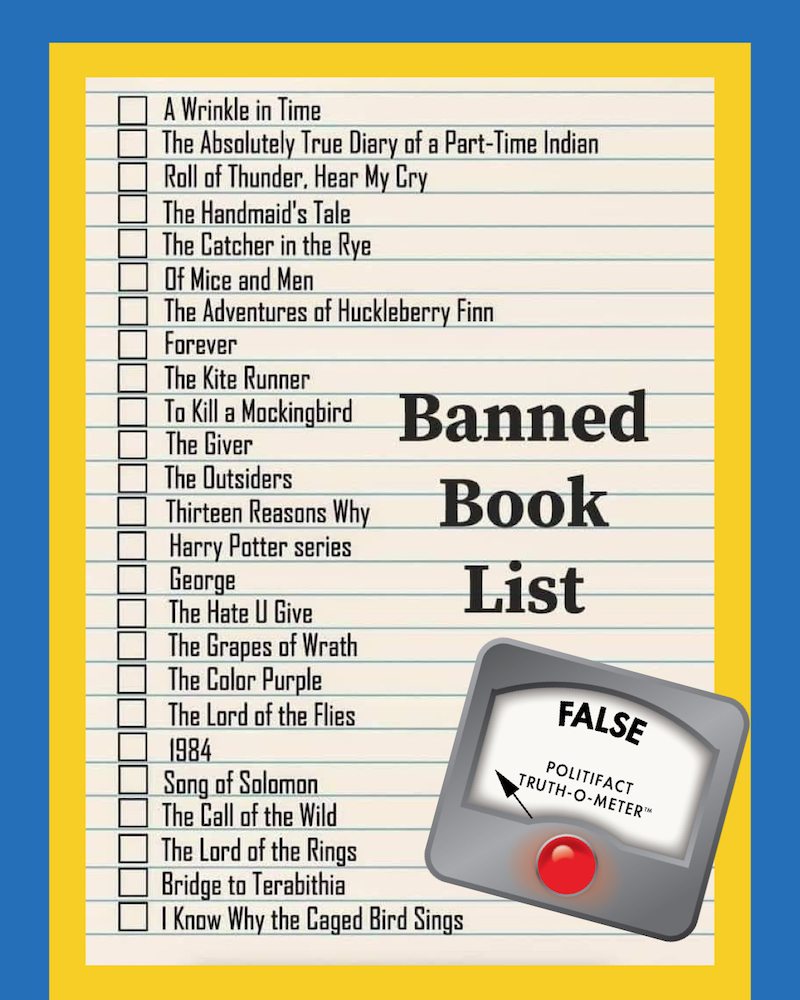
John Merrow’s title is sarcastic. Of course he wants you to read banned books, and he is deeply concerned about the large number of eligible voters—especially young people—who don’t bother to vote.

When someone on Twitter posted a list of 25 popular books that Florida Governor Ron DeSantis had supposedly banned from the state’s public schools, people went crazy. The list included Harper Lee’s “To Kill a Mockingbird,” Alice Walker’s “The Color Purple” and Madeleine L’Engle’s “A Wrinkle in Time.”

Below is a screenshot of the list. How many of these books have you read? Have your children read most of them? What on earth is going on in Florida?

People familiar with DeSantis’s efforts to restrict classroom discussion of controversial topics had no trouble believing that he would try to prevent young people from reading controversial or challenging books. If DeSantis did draw up a list, these books might well be on it.

But the list is a fake, a clever satire.

Many people were fooled, including teacher union President Randi Weingarten and “Star Wars” actor Mark Hamill. Hamill’s screenshot of the list amassed more than 100,000 likes and 24,000 retweets.

(Add my name to the list of those who were taken in.)

Like all good satire, that fake list of banned books is rooted in truth, because book banning is real and growing. Florida school districts have banned around 200 books, according to a report published by PEN America, a nonprofit that tracks book banning in the U.S. Pen America ranks Florida third among US states for banning books, trailing only Texas and Pennsylvania.

We are in the midst of a pandemic of book banning, so it’s hard to imagine any title that would never be banned by some zealous or timid school board or ignorant legislator.

One way to stop this outbreak of censorship is to get active, vote, attend school board meetings, run for school board. Passivity and complaining is a losing strategy.

Time to turn back the rising tide of incipient fascism.

Tom Ultican is one of the very best chroniclers of the “Destroy Public Education” movement. He was thrilled to discover a new book that explains the origins of the attack on public schools and calls out its founding figures. Lily Geismar’s Left Behind is a book you should read and share. It helps explain how Democrats got on board with policies that conservative Republicans like Charles Koch, the Waltons, and Betsy DeVos loved. This bipartisan agreement that public schools needed to be reinvented and disrupted brought havoc to the schools, demoralized teachers, and glorified flawed standardized tests, making them the goal of schooling.

Ultican writes:

Lily Geismer has performed a great service to America. The Claremont McKenna College associate professor of history has documented the neoliberal takeover of the Democratic Party in the 1980’s and 1990’s. In her book, Left Behind: The Democrats Failed Attempt to Solve Inequalityshe demonstrates how Bill Clinton “ultimately did more to sell free-market thinking than even Friedman and his acolytes.” (Left Behind Page 13)

When in the 1970’s, Gary Hart, Bill Bradley, Michael Dukakis, Al Gore, Paul Tsongas, and Tim Wirth arrived on the scene in Washington DC they were dubbed “Watergate Babies.” By the 1980’s Tip O’Neill’s aid Chris Mathews labeled them “Atari Democrats” an illusion to the popular video game company because of their relentless hi-tech focus. Geismer reports.

“Journalist Charles Peters averred that ‘neoliberal’ was a better descriptor. Peters meant it not as a pejorative but as a positive. … Neoliberals, he observed, ‘still believe in liberty and justice and a fair chance for all, in mercy for the afflicted and help for the down and out,’ but ‘no longer automatically favor unions and big government.’” (Left Behind Pages 17-18) [Emphasis added]

Democrats in search of a “third way” formed the Democratic Leadership Council to formulate policies that moved them away from unions, “big government,” and traditional liberalism.

Historian Arthur Schlesinger labeled the DLC “a quasi-Reaganite formation” and accused them of “worshiping at the shrine of the free market.”

Union pollster Victor Fingerhut called them “crypto-Republicans.”

Douglas Wilder a black Virginia politician criticized their “demeaning appeal to Southern white males.”

Others called them the “conservative white caucus” or the “southern white boys’ caucus.”

Jesse Jackson said its members “didn’t march in the ‘60s and won’t stand up in the ‘80s.” (Left Behind Pages 46-47)

In 1989, From convinced Bill Clinton to become the chairman of the DLC. That same year the DLC founded the Progressive Policy Institute to be their think tank competing with the Heritage Foundation and the CATO Institute. Today, it still spreads the neoliberal gospel.

This is an important book that explains how the Democratic Party lost its way.

Republicans are outraged that Biden is forgiving the student loan debt of millions of borrowers by $10,000-20,000. They have denounced loan forgiveness as “socialism,” a “big government giveaway,” and worse.

They are on the wrong side of history and politics.

I can tell you from the two years I worked in the U.S. Department of Education that there is a student loan industry that has a powerful lobby. They want student debt to be as high as possible and they want the rates to be as high as possible. Biden’s decision is very disappointing to their lobbyists.

Zachary D. Carter writes in Slate that there is a long history of forgiving debt. This is a terrific article. I urge you to read it.

He begins:

In 1920, the world’s most famous economist, John Maynard Keynes, was digging through old books on the economy of the ancient world, when he discovered something startling. All his life he had been taught that civilization depended on ironclad financial certainty. Without a stable currency and dependable debt contracts, commerce could not exist. Governments that meddled in such matters were thought to be asking for social chaos.

But the documents he perused on Ancient Greece, Rome, Babylon, Assyria, and Persia showed him something else entirely. Throughout history, political leaders had abolished debts and managed the value of their currencies—another way to revise debts—as routine matters of government policy. Keynes was electrified. A year earlier, he had staked his reputation on a call to cancel the largest debts the world had ever seen—those accrued by the governments of Europe during World War I. If these debts were not cleared, Keynes had argued, the international trading system would break down, leading to misery and another war. Predictably, the financial establishments on two continents responded to this apparent heresy with alarm. Now Keynes had discovered precedent for his ideas — thousands of years’ worth, from Hammurabi in ancient Babylon to Solon of Athens.

[As a side note, the Treaty of Versailles imposed massive debt on Germany. Had that debt been forgiven, there might have been no World War II.]

Indeed, debt relief has always been the handmaiden of debt itself. In the United States we have a formal legal process for eliminating nearly all forms of debt: bankruptcy. When debts become unbearable, people file for bankruptcy to have them discharged in court. In the 15 years preceding the pandemic, more than 14.3 million people filed for bankruptcy, and in the decade prior to the pandemic, more than 20,000 businesses filed for bankruptcy every year, with a high water mark of 60,837 in 2009. Debts are discharged every day in the United States, and have been for decades.

Indeed, debt relief has always been the handmaiden of debt itself. In the United States we have a formal legal process for eliminating nearly all forms of debt: bankruptcy. When debts become unbearable, people file for bankruptcy to have them discharged in court. In the 15 years preceding the pandemic, more than 14.3 million people filed for bankruptcy, and in the decade prior to the pandemic, more than 20,000 businesses filed for bankruptcy every year, with a high water mark of 60,837 in 2009. Debts are discharged every day in the United States, and have been for decades.

Not that you would know from the apocalyptic conservative outrage emanating from social media and cable television this week. When President Joe Biden announced his new student loan relief program on Wednesday, Senate Majority Leader Mitch McConnell decried it as “socialism” and Utah Sen. Mitt Romney called it a naked attempt to “bribe the voters.” Reason magazine’s Robby Soave declared it a “fuck you to every financially responsible person in the country.” These reactions belie centuries if not millennia of economic history.

Capitalism would collapse without debt relief systems. Businesses get in trouble all the time—both good businesses that would work fine without a few onerous debt deals, and bad businesses that need to be liquidated or restructured. Sometimes bad things just happen. People get divorced. They get injured and are overwhelmed by medical bills. They get laid off. They have to pay for a parent’s funeral or care for children with special needs. And yeah, some people just don’t know how to manage their money and buy things they can’t afford. But we do not consign such people to never-ending financial servitude as a result of unforeseen circumstances, or even totally reckless spending habits. We have a formal process to eliminate debts and start over, with a reasonable chance of living a healthy financial life.

But not for students who borrow money to attend college. In 2005, Congress passed a law that made it next to impossible to discharge almost any form of student debt. Even the most creative consumer lawyers estimate that only about $50 billion—less than 3 percent of the $1.75 trillion in outstanding student debt—had the potential to be wiped away, but only if students could persuade a court that they had been egregiously wronged, by say, non-accredited programs or institutions that didn’t actually offer degrees.

Biden’s new student debt relief program exists because student debt is currently ineligible for the ordinary process that Americans use for extinguishing excessive debts….

Nor are the recipients of Biden’s aid particularly wealthy. The plan flatly excludes anyone who makes more than $125,000 a year from participation. According to an analysis by the University of Pennsylvania’s Penn Wharton Budget Model, about half of the money will go to borrowers in the bottom half of the income spectrum, with only 2.5 percent of folks breaking into the top 10 percent receiving relief. The median personal income in the United States—the 50 percent line—is $35,800. This makes sense once we consider the actual demographics of the typical American college student, who is not an Ivy Leaguer bound for the 1 percent. About 40 percent of all undergraduate students attend community colleges, about one-third of whom take out student loans to help pay for their education. The average community college borrowergraduating with more than $13,000 in debt. There are also racial disparities in student debt: According to a Brookings Institute analysis, Black borrowers shoulder roughly double the amount of debt to attend college that white borrowers do.


Carol Burris is a retired high school principal and executive director of the Network for Public Education.

It has been a bad year for the charter school industry’s trade association, the National Alliance for Public Charter Schools (NAPCS). Their bitter campaign last spring to fight regulatory reform of the federal Charter Schools Program used the slogan “Back Off” to intimidate the President and Secretary Cardona. In the end, it was ineffective in stopping the regulations. While they claimed to achieve a few concessions, most of those related to issues that never existed in the first place. I estimate NAPCS spent upwards of one million dollars on the campaign, which included television ads.

As Republicans embrace school choice with the transparent motive of destroying community-governed public schools, Democrats have “backed off,” but not in the way NAPCS wanted. The latest poll by Ed Next, a pro-charter organization, found that only 10% of Democrats strongly support charters. Over twice as many Dems strongly oppose them. And overall support, even lukewarm support, for charters is only 38%.

And so, in desperation, NAPCS recently published a report entitled “Never Going Back” based on a poll they conducted. Its transparent purpose is to convince Democrats that not giving full-throated support to charters will cost them re-election in November.

Their poll data, however, is so profoundly flawed that it cannot be taken seriously. Frankly, it is an embarrassment for an organization that used to serve as the “go-to place” for information about charter schools.

Here is why.

First, NAPCS does not give full access to its survey questions and the possible responses from which respondents could choose.

We have no idea what the full array of survey questions was and what choices respondents had to pick from. This is critically important to allow the full expression of opinion. To illustrate, I provide a link to the full 2022 poll results presented by school choice advocacy organization, Ed Next.

While that survey has its own bias problems, it uses a full Likert scale to allow respondents to provide a nuanced response. Did NAPCS do the same? We don’t know. But given their outlier results, which I will discuss in greater detail later, it is doubtful.

Second, they oversampled parents of students in charter schools.

According to their report, 13% of respondents were charter school parents. But using their own figures from their 2021 report, Voting with Their Feet, only 7.7% of all students in either a public or charter school were charter school students. And that percentage excludes the number of students in private or homeschool settings, which means the percentage of all charter school students is likely lower than 7% of all American K-12 students. Although the percentage of families with a child in a charter school may be higher or lower than the number of students, a six percentage point difference is not credible. Such inflation, however, would undoubtedly skew responses in a pro-charter way.

It should also be noted that during this past year, public school enrollment increased from last year (although it is still down from pre-pandemic levels), and as we showed in this report, charter enrollment 2021-2022 is down; thus, the oversampling is worse than I described above.

Third, an examination of other polling data proves the fix is in.

Reliable polling results will differ by a few percentage points. For example, Ed Next’s recent poll reported that 52% of respondents give their community’s public schools a grade of A or B, while the recently released poll by PDK says that 54% give the two top grades–a record high. Results are aligned. Dramatic differences in polls taken closely in time raise alarms regarding the poll’s veracity.

Now let’s examine the NAPCS and Ed Next’s results on the question of school choice.

NAPCS reports that between 58% and 65% of parents strongly agree that parents should have school choice. Ed Next asks a nearly identical question—“Do you support or oppose school choice?” However, their percentage of parents who strongly agree is only 21%, a dramatic difference of about 40 percentage points.

Much like the school choice question, the NAPCS’ questions regarding support for charter schools are wildly out of sync with the Ed Next poll.

According to Ed Next, 51% of all parents somewhat or strongly support charter schools.

Yet NAPCS incredibly claims that 84% of parents (not interested in sending their own child to a charter school) support charter schools, and 77% of parents want more charter schools in their area. These results, in light of Ed Next’s data, defy logic.

 Much like NAPCS’s underreporting of charter schools run for profit, which we demonstrated in this report, NAPCS cherry-picks data to present charters in a favorable light. I guess one might argue that as a trade organization they are doing their job. Even so, their latest report is beyond the pale and does not deserve the attention of either the press or candidates this fall. And it further damages NAPCS’s already tarnished brand.