Archives for category: Economy

Gary Shteyngart is a successful novelist and author whose family emigrated from the Soviet Union when he was a child. He reviewed Walter Isaacson’s new biography of Elon Musk in The Guardian. On the site formerly known as Twitter, he described his piece as “my review of a dull book about a silly but dangerous man.” Please open the link and read the full review.

He began:

Who or what is to blame for Elon Musk? Famed biographer of intellectually muscular men Walter Isaacson’s dull, insight-free doorstop of a book casts a wide but porous net in search of an answer. Throughout the tome, Musk’s confidantes, co-workers, ex-wives and girlfriends present a DSM-5’s worth of psychiatric and other theories for the “demon moods” that darken the lives of his subordinates, and increasingly the rest of us, among them bipolar disorder, OCD, and the form of autism formerly known as Asperger’s. But the idea that any of these conditions are what makes Musk an “asshole” (another frequently used descriptor of him in the book), while also making him successful in his many pursuits, is an insult to all those affected by them who manage to change the world without leaving a trail of wounded people, failing social networks and general despair behind them. The answer, then, must lie elsewhere.

There’s a lot to work with here, but it doesn’t make reading this book any easier. Isaacson comes from the “his eyes lit up” school of cliched writing, the rest of his prose workmanlike bordering on AI. I drove my espresso machine hard into the night to survive both craft and subject matter. It feels as though, for instance, there are hundreds of pages from start to finish relaying the same scene: Musk trying to reduce the cost of various mundane objects so that he can make more money and fulfil his dream of moving himself (and possibly the lot of us) to Mars, where one or two examples would have been enough. To his credit, Isaacson is a master at chapter breaks, pausing the narrative when one of Musk’s rockets explodes or he gets someone pregnant, and then rewarding the reader with a series of photographs that assuages the boredom until the next descent into his protagonist’s wild but oddly predictable life. Again, it’s not all the author’s fault. To go from Einstein to Musk in only five volumes is surely an indication that humanity isn’t sending Isaacson its best….

Highest on the list of things Musk won’t shut up about is Mars. “We need to get to Mars before I die.” “We got to give this a shot, or we’re stuck on earth forever.” The messianic part of the Muskiverse is his attempt to put 140m miles between himself and his father as he tries to turn humanity into a “multiplanetary civilization” even though we are having a hard enough time making it as a uniplanetary one. But Musk also knows what’s keeping us from reaching the lifeless faraway planet, and he’s not afraid of telling us: “Unless the woke-mind virus … is stopped, civilisation will never become interplanetary.” There is a far more interesting book shadowing this one about the way our society has ceded its prerogatives to the Musks of the world. There’s a lot to be said for Musk’s tenacity, for example his ability to break through Nasa’s cost-plus bureaucracy. But is it worth it when your saviour turns out to be the world’s loudest crank?

Reader Raymond F. Tirana posted a comment in which he described the end goal of the libertarian overhaul of school funding. In Kansas, Florida, and other red states, he says, they are trying to shift responsibility for funding and providing schools from the state to parents. This will not only exacerbate segregate but increase inequity. Of course, they will do this under false pretenses, claiming to “widen opportunities” and to “save poor children from failing schools.” Don’t believe them.

He wrote in a comment:

What will really happen once the state offloads all responsibility for educating children: Inevitably, the budget will be slashed each year (Kansas is already enacting a flat tax that will decimate the State’s ability to raise revenue – people remember Koch Industries is based in Kansas, right?) until the public schools are forced to fold and Kansas parents will be lucky to get any crumbs from their masters to be used toward the education of their kids. This was Milton Freidman’s fantasy, and we are close to seeing it realized in Kansas, Florida and other states, as parents sit by and let their children’s future be stolen from them.

With only one exception, I have never before posted two articles by the same person on one day. The exception occurred several years back, when I discovered the brilliant teacher-blogger Peter Greene and devoted an entire day to his insightful, humorous writings. Heather Cox Richardson stands alone as a historian who posts a timely commentary almost every day. Consider subscribing to her blog. You will be glad you did.

Heather Cox Richardson wrote this post to recognize the historical roots that link contrasting visions of slavery and labor. We live in a society now that has no slavery yet has crippled organized labor and tolerates horrible working conditions. Some states, notably Arkansas and Iowa, have weakened child labor laws, so young teens are permitted to toil in dangerous jobs. Parental rights, you know. Texas legislators recently declined to pass a law requiring employers to provide 15 minutes for water breaks for employees working outdoors in a historic heat wave.

On March 4, 1858, South Carolina senator James Henry Hammond rose to his feet to explain to the Senate how society worked. “In all social systems,” he said, “there must be a class to do the menial duties, to perform the drudgery of life.” That class, he said, needed little intellect and little skill, but it should be strong, docile, and loyal.

“Such a class you must have, or you would not have that other class which leads progress, civilization and refinement,” Hammond said. His workers were the “mud-sill” on which society rested, the same way that a stately house rested on wooden sills driven into the mud.

He told his northern colleagues that the South had perfected this system by enslavement based on race, while northerners pretended that they had abolished slavery. “Aye, the name, but not the thing,” he said. “[Y]our whole hireling class of manual laborers and ‘operatives,’ as you call them, are essentially slaves.”

While southern leaders had made sure to keep their enslaved people from political power, Hammond said, he warned that northerners had made the terrible mistake of giving their “slaves” the vote. As the majority, they could, if they only realized it, control society. Then “where would you be?” he asked. “Your society would be reconstructed, your government overthrown, your property divided, not…with arms…but by the quiet process of the ballot-box.”

He warned that it was only a matter of time before workers took over northern cities and began slaughtering men of property.

Hammond’s vision was of a world divided between the haves and the have-nots, where men of means commandeered the production of workers and justified that theft with the argument that such a concentration of wealth would allow superior men to move society forward. It was a vision that spoke for the South’s wealthy planter class—enslavers who held more than 50 of their Black neighbors in bondage and made up about 1% of the population—but such a vision didn’t even speak for the majority of white southerners, most of whom were much poorer than such a vision suggested.

And it certainly didn’t speak for northerners, to whom Hammond’s vision of a society divided between dim drudges and the rich and powerful was both troubling and deeply insulting.

On September 30, 1859, at the Wisconsin State Agricultural Fair, rising politician Abraham Lincoln answered Hammond’s vision of a society dominated by a few wealthy men. While the South Carolina enslaver argued that labor depended on capital to spur men to work, either by hiring them or enslaving them, Lincoln said there was an entirely different way to see the world.

Representing an economy in which most people worked directly on the land or water to pull wheat into wagons and fish into barrels, Lincoln believed that “[l]abor is prior to, and independent of, capital; that, in fact, capital is the fruit of labor, and could never have existed if labor had not first existed—that labor can exist without capital, but that capital could never have existed without labor. Hence they hold that labor is the superior—greatly the superior of capital.”

A man who had, himself, worked his way up from poverty to prominence (while Hammond had married into money), Lincoln went on: “[T]he opponents of the ‘mud-sill’ theory insist that there is not…any such things as the free hired laborer being fixed to that condition for life.”

And then Lincoln articulated what would become the ideology of the fledgling Republican Party:

“The prudent, penniless beginner in the world, labors for wages awhile, saves a surplus with which to buy tools or land, for himself; then labors on his own account for another while, and at length hires another new beginner to help him. This, say its advocates, is free labor—the just and generous, and prosperous system, which opens the way for all—gives hope to all, and energy and progress, and improvement of condition to all.”

In such a worldview, everyone shared a harmony of interest. What was good for the individual worker was, ultimately, good for everyone. There was no conflict between labor and capital; capital was simply “pre-exerted labor.” Except for a few unproductive financiers and those who wasted their wealth on luxuries, everyone was part of the same harmonious system.

The protection of property was crucial to this system, but so was opposition to great accumulations of wealth. Levelers who wanted to confiscate property would upset this harmony, as Hammond warned, but so would rich men who sought to monopolize land, money, or the means of production. If a few people took over most of a country’s money or resources, rising laborers would be forced to work for them forever or, at best, would have to pay exorbitant prices for the land or equipment they needed to become independent.

A lot of water has gone under the bridge since Lincoln’s day, but on this Labor Day weekend, it strikes me that the worldviews of men like Hammond and Lincoln are still fundamental to our society: Should our government protect people of property as they exploit the majority so they can accumulate wealth and move society forward as they wish? Or should we protect the right of ordinary Americans to build their own lives, making sure that no one can monopolize the country’s money and resources, with the expectation that their efforts will build society from the ground up?

Harold Meyerson of The American Prospect writes that many people think that government works slowly and is outpaced by business efficiency. But, he writes, Biden’s infrastructure plans are starting at a fast clip.

America’s industrial renaissance is happening faster than almost anyone anticipated.

Meyerson writes:

It is a lie universally acknowledged as truth that the government is slow, that if you want something done quickly, you turn to the private sector.

Of course, there are a plethora of instances in which government is slow. Consider, for instance, the efforts of the National Labor Relations Board to compel companies to pay workers whom they’ve illegally fired for trying to unionize. Lawbreaking companies can drag this out for years. Of course, that’s because, beginning with the Taft-Hartley Act 75 years ago, companies and their handmaidens in Congress and the courts have stripped the NLRB of the power to enforce this law expeditiously. When the government is slow, that’s often because powerful private-sector actors have slowed it down to their own advantage.

But sometimes, government can be more swift and effective than its critics can even imagine, as the implementation of the three signature pieces of Biden administration/Democratic Congress legislation is now demonstrating. The Infrastructure Act, the CHIPS Act, and the Inflation Reduction Act have spurred the economy, which grew by 2.4 percent in the last quarter, well beyond anything the private sector could have accomplished by itself, and in less time than establishment economists thought possible. America is building factories again: The spending on factory construction is up by 76 percentfrom last year. Business spending on all forms of infrastructure—not just factories but also transportation equipment, software, and the like—is up by 56 percent. Through the magic of Keynes’s multiplier effect, government subsidies and outlays of roughly $300 billion on such projects have led to an increase in business investment of an additional $500 billion. And bolstering all this investment is the consumer purchasing power that has resulted from Biden’s initial stimulus legislation, which ended the COVID recession much more quickly than any recession in American history and yielded near record-low unemployment and levels of labor force participation not seen in many years.

Biden has sometimes been compared to Franklin Roosevelt for his efforts to renew and expand the kind of social insurance and worker empowerment initiatives that FDR undertook. I’d argue that it’s the scope, speed, and success of his public investments that most resemble Roosevelt’s. Facing the actual prospect of mass starvation in the winter of 1933-1934, FDR’s public-works program managed to employ three million Americans—in a nation of 130 million—in just 60 days. The defense spending that began in 1940 in response to the very real threat of the fascist control of all Eurasia built an army that then ranked 39th in the world in size into one that was the world’s largest by 1944, at which time the nation’s production of planes, ships, and tanks exceeded the combined total of all other nations’.

Learning not just from Roosevelt’s successes but also from the failure of the Obama administration to highlight the projects that its stimulus spending had created, Biden and Democrats are now volubly touting the projects that their own stimulus programs have engendered, many of which are already springing up. Given the public’s skepticism about the effects and durability of this economic revival, and the Republicans’ insistence that no such revival exists, Biden & Company know they will have to keep making this case straight through November of next year.

That said, can we acknowledge that Bidenomics is not only successful but speedy? Yes, we can.

~ HAROLD MEYERSON

Heather Cox Richardson applies her excellent skills as a historian to analyze the news. Open the link to finish reading and to read footnotes.

More good news today for Bidenomics, as the gross domestic product report for the second quarter showed annualized growth of 2.4%, higher than projected, and inflation rose at a slower pace of 2.6%, down from last quarter and well below projections. Economic analyst Steven Rattner noted that as of the second quarter, “the US economy is over 6% larger than it was before COVID (after adjusting for inflation). At this point in the recovery from the Great Recession, 2011, the economy was just 0.7% larger than it had been in 2007.”

Both consumer spending and business investment, which is up 7.7% in real annualized terms, drove this growth. Business spending makes up a much smaller share of gross domestic product, but it drives future jobs and growth, and much of this growth is in manufacturing facilities. In keeping with that trend, the nation’s largest solar panel manufacturer, First Solar, announced today that it will build a fifth factory in the U.S. as alternative energy technology takes off. This commitment brings to more than $2.8 billion the amount First Solar has invested in the U.S. to ramp up production…

While many of us were watching the federal courthouse in Washington, D.C., to see if an indictment was forthcoming against former president Trump for his attempt to overturn the results of the 2020 election, a different set of charges appeared tonight. Special counsel Jack Smith brought additional charges against Trump in connection with his retention of classified documents.

The new indictment alleges that Trump plotted to delete video from security cameras near the storage room where he had stored boxes containing classified documents, and did so after the Department of Justice subpoenaed that footage. That effort to delete the video involved a third co-conspirator, Carlos De Oliveira, who has been added to the case.

De Oliveira is a former valet at the Trump Organization’s Mar-a-Lago property who became property manager there in January 2022. Allegedly, he told another Trump employee that “the boss” wanted the server deleted and that the conversation should stay between the two of them.

In the Washington Post, legal columnist Ruth Marcus wrote, “The alleged conduct—yes, even after all these years of watching Trump flagrantly flout norms—is nothing short of jaw-dropping: Trump allegedly conspired with others to destroy evidence.” If the allegations hold up, “the former president is a common criminal—and an uncommonly stupid one.”

This superseding indictment reiterates the material from the original indictment, and as I reread it, it still blows my mind that Trump allegedly compromised national security documents from the Central Intelligence Agency, the Department of Defense, the National Security Agency, the National Geospatial Intelligence Agency (surveillance imagery), the National Reconnaissance Office (surveillance and maps), the Department of Energy (nuclear weapons), and the Department of State and Bureau of Intelligence and Research (diplomatic intelligence).

It sounds like he was a one-man wrecking ball, aimed at our national security.

The Justice Department has asked again for a protective order to protect the classified information at the heart of this case. In their request, they explained that, among other things, Trump wanted to be able to discuss that classified information with his lawyers outside a Sensitive Compartmented Information Facility, or SCIF, a room protected against electronic surveillance and data leakage.

Former deputy assistant director of the FBI’s counterintelligence division Peter Strzok noted that there is “[n]o better demonstration of Trump’s abject lack of understanding of—and disregard for—classified info and national security. He is *asking the Court* to waive the requirements for classified info that EVERY OTHER SINGLE CLEARANCE HOLDER IN THE UNITED STATES must follow.”

The Senate today passed the $886 billion annual defense bill by a strong bipartisan margin of 86 to 11 after refusing to load it up with all the partisan measures Republican extremists added to the House bill. Now negotiators from the House and the Senate will try to hash out a compromise measure, but the bills are so far apart it is not clear they will be able to create a bipartisan compromise. The National Defense Authorization Act (NDAA) has passed on a bipartisan basis for more than 60 years.

The extremists in the House Republican conference continue to revolt against House speaker Kevin McCarthy’s (R-CA) deal with the administration to raise the debt ceiling. They insist the future cuts to which McCarthy agreed are not steep enough, and demand more. This has sparked fighting among House Republicans; Emine Yücel of Talking Points Memo suggests that McCarthy’s new willingness to consider impeaching President Biden might be an attempt to cut a deal with the extremists.

As the Senate is controlled by Democrats, the fight among the House Republicans threatens a much larger fight between the chambers because Democratic senators will not accept the demands of the extremist Republican representatives.

The House left for its August recess today without passing 11 of the 12 appropriations bills necessary to fund the government after September, setting up the conditions for a government shutdown this fall if they cannot pass the bills and negotiate with the Senate in the short time frame they’ve left. Far-right Republicans don’t much care, apparently. Representative Bob Good (R-VA) told reporters this week, “We should not fear a government shutdown… Most of what we do up here is bad anyway.”

Representative Katherine Clark (D-MA), the second ranking Democrat in the House, disagreed. “The Republican conference is saying they are sending us home for six weeks without funding the government? That we have one bill…out of 12 completed because extremists are holding your conference hostage, and that’s not the full story: the extremists are holding the American people hostage. We will have twelve days…when we return to fund the government, to live up to the job the American people sent us here to do. This is a reckless march to a MAGA shutdown, and for what? In pursuit of a national abortion ban? Is that what we are doing here?

Iowa recently enacted legislation that rolls back the clock on child labor laws. The Economic Policy Institute reports on the Republican-led effort to put young children to work in hazardous industries, which conflicts with federal law.

What a disgrace these laws are! Are the red states lowering the age of employment because they don’t have enough immigrants to take these jobs? Are they ready to sacrifice the well-being of their children to keep immigrants out? All of the jobs opening for children under 18 appear to be the kind that are usually filled by minimum-wage adult workers.

EPI writes:

Last Friday, this concerted attack on child labor safeguards further expanded. Iowa Governor Kim Reynolds signed an expansive bill enacting numerous changes to the state’s child labor laws, including:

  • allowing employers to hire teens as young as 14 for previously prohibited hazardous jobs in industrial laundries or as young as 15 in light assembly work;
  • allowing state agencies to waive restrictions on hazardous work for 16–17-year-olds in a long list of dangerous occupations, including demolition, roofing, excavation, and power-driven machine operation;
  • extending hours to allow teens as young as 14 to work six-hour nightly shifts during the school year;
  • allowing restaurants to have teens as young as 16 serve alcohol; and
  • limiting state agencies’ ability to impose penalties for future employer violations.

Multiple provisions in the new state law conflict with federal Fair Labor Standards Act (FLSA) prohibitions on “oppressive child labor”involving hazardous conditions or excessive hours that interfere with teens’ schooling or health and well-being.

In Arkansas, Governor Sarah Sanders signed a law in March that eliminated youth work permits. Under the law, 14- and 15-year-olds will no longer need an employment certificate from the state Division of Labor verifying proof of their age and parental consent to work.

At a moment when exploitative child labor is on the rise, such changes are dangerous, removing an important paper trail intended to provide “proof that the companies that hire children at least acknowledge—in writing—that they’re following the law.”

In intervening weeks, the U.S. Department of Labor has cited employers for hundreds more serious child labor violations, while additional state legislatures have advanced proposals to weaken child labor standards…

Iowa’s extreme new child labor law violates federal prohibitions on hazardous occupations and excessive work hours

Iowa labor unions and their allies organized significant opposition to weakening the state’s child labor laws, compelling lawmakers to remove some of the original bill’s most egregious proposals—including language allowing teens to work in some areas of meatpacking plants and granting employers blanket immunity from liability for deaths or injuries caused by negligence while employing teens in “work-based learning programs.”

Yet even after several amendments, the final bill(passed with only Republican support) remains one of the most dangerous rollbacks of child labor protections in decades.

Many aspects of the newly enacted Iowa law contradict federal child labor law. In a May 10 letter to Iowa lawmakers, U.S. Department of Labor (DOL) Solicitor of Labor Seema Nanda and Wage and Hour Division Principal Deputy Administrator Jessica Looman clarify that “the FLSA establishes federal standards with respect to child labor, and states cannot nullify federal requirements by enacting less protective standards.”

Because most employment situations are covered by the FLSA, employers who follow weaker new state rules in Iowa will be violating federal child labor law. Enforcing federal standards that the state no longer maintains will, however, now be solely up to the federal government.

In their letter, Nanda and Looman report that “the Department currently has over 600 child labor investigations underway nationwide, including in Iowa” and detail the ways in which Iowa’s proposed bill (most of which has now been enacted) contradicts prohibitions on hazardous work or excessive work hours considered “oppressive” forms of child labor under federal law.

Federal law generally prohibits the employment of children in hazardous occupations. The new Iowa law allows several forms of hazardous child labor that are expressly prohibited under DOL regulations on work permitted for 14–15-year-olds or are banned for all youth under 18 under “Hazardous Occupations Orders” (HOs). These are specific types of work the DOL prohibits based on National Institute for Occupational Safety and Health findings that certain jobs have proven particularly dangerous for teens.

The article lists the details of the Iowa law, showing the age at which children as young as 14 are allowed to work in previously forbidden jobs.

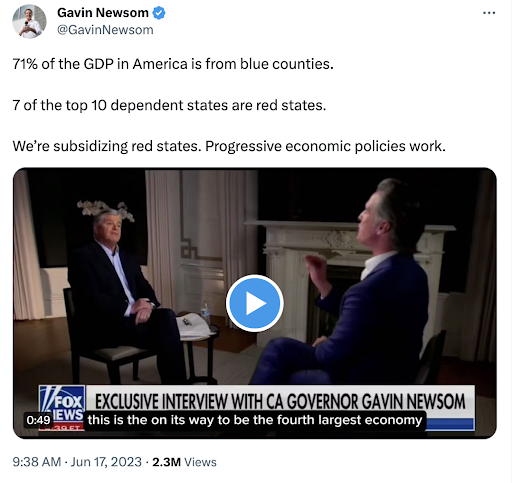
California Governor Gavin Newsom recently had a debate with FOX host Sean Hannity, where he schooled him on the issues.

Gavin just sent out this newsletter:

Dear Diane,

Want the truth? Here’s the truth:

Tweet from Gavin Newsom: Red States vs. Blue States by the numbers

But that is not all.

8 of the 10 states with the highest murder rates are red and gun deaths are almost 2x as high in red states.

The Supreme Court has stripped women of their liberty and let red states replace it with mandated birth.

They ban books, silence teachers and make it harder to vote in red states.

The reason Republicans like Ron DeSantis are fanning the flames of culture wars is to distract from the fact that Florida has higher murder rates, worse education and worse health care outcomes than states like California.

That’s the truth.

– Gavin

Historian Heather Cox Richardson brilliantly contrasts the views of Republicans and Democrats on the role of government. Republicans want it to be as minimal as possible. Democrats want it to use its powers and resources to improve people’s lives. Understanding this difference helps illuminate why Republicans want to get rid of public schools and why billionaires like Charles Koch and Betsy DeVos support vouchers and libertarianism in a society where everyone is on their own.

Yesterday, the Republican Study Committee, a 175-member group of far-right House members, released their 2024 “Blueprint to Save America” budget plan. It calls for slashing the federal budget by raising the age at which retirees can start claiming Social Security benefits from 67 to 69, privatizing Medicare, and enacting dramatic tax cuts that will starve the federal government.

I’m actually not going to rehash the 122-page plan. Let’s take a look at the larger picture.

This budget dismisses the plans of “President Joe Biden and the left” as a “march toward socialism.” It says that “[t]he left’s calls to increase taxes to close the deficit would be…catastrophic for our nation.” Asserting that “the path to prosperity does not come from the Democrats’ approach of expanding government,” it claims that “[o]ver the past year and a half, the American people have seen that experiment fail firsthand.”

Instead, it says, “the key to growth, innovation, and flourishing communities” is “[i]ndividuals, free from the burdens of a burdensome government.” 

It is?

Our history actually tells us how these two contrasting visions of the government play out.

Grover Norquist, one of the key architects of the Republican argument that the solution to societal ills is tax cuts, in 2010 described to Rebecca Elliott of the Harvard Crimson how he sees the role of government. “Government should enforce [the] rule of law,” he said. “It should enforce contracts, it should protect people bodily from being attacked by criminals. And when the government does those things, it is facilitating liberty. When it goes beyond those things, it becomes destructive to both human happiness and human liberty.”

Norquist vehemently opposed taxation, saying that “it’s not any of the government’s business who earns what, as long as they earn it legitimately,” and proposed cutting government spending down to 8% of gross national product, or GDP, the value of the final goods and services produced in the United States. 

The last time the level of government spending was at that 8% of GDP was 1933, before the New Deal. In that year, after years of extraordinary corporate profits, the banking system had collapsed, the unemployment rate was nearly 25%, prices and productivity were plummeting, wages were cratering, factories had shut down, farmers were losing their land to foreclosure. Children worked in the fields and factories, elderly and disabled people ate from garbage cans, unregulated banks gambled away people’s money, business owners treated their workers as they wished. Within a year the Great Plains would be blowing away as extensive deep plowing had damaged the land, making it vulnerable to drought. Republican leaders insisted the primary solution to the crisis was individual enterprise and private charity. 

When he accepted the Democratic nomination for president in July 1932, New York governor Franklin Delano Roosevelt vowed to steer between the radical extremes of fascism and communism to deliver a “New Deal” to the American people. 

The so-called alphabet soup of the New Deal gave us the regulation of banks and businesses, protections for workers, an end to child labor in factories, repair of the damage to the Great Plains, new municipal buildings and roads and airports, rural electrification, investment in painters and writers, and Social Security for workers who were injured or unemployed. Government outlays as a percentage of GDP began to rise. World War II shot them off the charts, to more than 40% of GDP, as the United States helped the world fight fascism. 

That number dropped again after the war, and in 1975, federal expenditures settled in at about 20% of GDP. Except for short-term spikes after financial crises (spending shot up to 24% after the 2008 crash, for example, and to 31% during the 2020 pandemic, a high from which it is still coming down), the spending-to-GDP ratio has remained at about that set point.

So why is there a growing debt?

Because tax revenues have plummeted. Tax cuts under the George W. Bush and Trump administrations are responsible for 57% of the increase in the ratio of the debt to the economy, 90% if you exclude the emergency expenditures of the pandemic. The United States is nowhere close to the average tax burden of the 38 other nations in the Organization of Economic Cooperation and Development (OECD), all of which are market-oriented democracies. And those cuts have gone primarily to the wealthy and corporations. 

Republicans who backed those tax cuts now insist that the only way to deal with the growing debt is to get rid of the government that regulated business, provided a basic social safety net, promoted infrastructure, and eventually promoted civil rights, all elements that stabilized the nation after the older system gave us the Depression. Indeed, the Republican Study Committee calls for making the Trump tax cuts, scheduled to expire in 2025, permanent. 

“There are two ways of viewing the government’s duty in matters affecting economic and social life,” FDR said in his acceptance speech. “The first sees to it that a favored few are helped and hopes that some of their prosperity will leak through, sift through, to labor, to the farmer, to the small businessman.” The other “is based upon the simple moral principle: the welfare and the soundness of a nation depend first upon what the great mass of the people wish and need; and second, whether or not they are getting it.”

When the Republican Study Committee calls Biden’s policies—which have led to record employment, a booming economy, and a narrowing gap between rich and poor— “leftist,” they have lost the thread of our history. The system that restored the nation after 1933 and held the nation stable until 1981 is not socialism or radicalism; it is one of the strongest parts of our American tradition.

Notes:

Ron DeSantis got the Florida legislature to pass strong legislation that puts undocumented immigrants at risk of deportation and puts anyone who helps them at risk of arrest.

Meanwhile, the agriculture industry—a key driver of the state’s economy—is worried about finding enough workers to harvest the crops.

Immigrant advocates warned them to stay home.

But farmers are pleading with immigrants not to leave the state. Even Republican legislators worry that the anti-immigrant law was a mistake.

Republican lawmakers in Florida concerned about the state’s new anti-immigration law and its possible economic consequences begged Latinos to not leave the state in clips from a Monday morning meeting.

The footage, which provides evidence of the law’s “downstream impacts on the state economy” according to MSNBC, shows two conservative Florida legislators attempting to minimize the harm that the law, Senate Bill 1718, could cause, with one asking attendees to advise Latinos against leaving Florida.

“This bill is 100% supposed to scare you,” Republican state Rep. Rick Roth said in a clip shared on Twitter by Democratic activist Tom Kennedy. “I’m a farmer, and the farmers are mad as hell. We are losing employees. They’re already starting to move to Georgia and other states. It’s urgent that you talk to all your people and convince them that you have resources — state representatives and other people — that can explain the bill to you.”

But no one blames DeSantis, who needed to prove his contempt for immigrants.

Agriculture is a big part of Florida’s economy. Who will bring in the crops?

Before the bill passed, the Farmworkers Association warned that about 300,000 of the state’s 500,000 farmworkers are likely undocumented.

Here’s a chance for DeSantis to create jobs for his fervent white supporters. They can pick oranges and grapefruit and other crops in the blazing sun. At minimum wage.

Millions of Americans are saddled with debt due to the cost of their college education. I have met adults who were still paying for their college education years after they graduated. As a society, we send mixed messages to young people: we want you to get a college education, but you will have to spend years paying for it.

When I visited Finland a decade ago, I was amazed to learn that all higher education there is tuition-free. My guide explained the Finnish view: education is a human right, and it’s immoral to make people pay for a human right.

We as a nation know that investing in education is good for the nation’s future. We all benefit when more people are better educated and have more skills and knowledge. To the extent that young people are reluctant to assume the high cost of a college education, they will choose not to go to college. This is not good for them or for our society.

President Biden understands the dilemma and developed a plan to help college students pay down their college student loans. “Unveiled in August, Biden’s loan forgiveness plan would eliminate $10,000 of federal student debt for borrowers earning up to $125,000 annually, or $250,000 for married couples. Recipients of Pell Grants, a form of financial aid for low- and middle-income students, are eligible for an additional $10,000 in forgiveness.”

The GOP is unanimously opposed to helping relieve students of their debt. They reason that others have paid their debt, so no one should get relief. This is penurious and hard-hearted.

Aided by a few Democratic votes (three Senators— Manchin, Sinema, and Tester of Montana—and two members of the House), Republicans passed a bill to kill Biden’s plan for student debt relief. The President vetoed their bill.

The Supreme Court will soon rule on whether it’s constitutional to relieve students of their debt, and that’s another peril for Biden’s plan.

The stubborn opposition of the GOP to any student debt relief is another reason to vote Blue in 2024.

President Biden on Wednesday vetoed a Republican-led resolution that would have struck down his controversial plan to forgive more than $400 billion in student loans.

In a statement on Wednesday, the president said the resolution — which the Senate approved on a 52-46 vote Thursday under the Congressional Review Act, a week after the House passed the measure — would have kept millions of Americans from receiving “the essential relief they need as they recover from the economic strains associated with the COVID-19 pandemic.” The resolution called for a restart of loan payments for millions of borrowers that have been on pause since early in the coronavirus pandemic. It also would have prevented the Education Department from pursuing similar policies in the future.

In his statement, the president said it is “a shame for working families across the country that lawmakers continue to pursue this unprecedented attempt to deny critical relief to millions of their own constituents, even as several of these same lawmakers have had tens of thousands of dollars of their own business loans forgiven by the Federal Government.”

(It wasn’t the first time the White House has highlighted that lawmakers received financial relief from the government during the pandemic through the Payment Protection Program loans.)
The student loan forgiveness program has faced legal challenges, and the Supreme Court is set to issue a ruling on its legality before the end of June.

“I remain committed to continuing to make college affordable and providing this critical relief to borrowers as they work to recover from a once-in-a-century pandemic,” Biden said in his statement Wednesday.

Is it possible for us one day to be a nation that sees the importance of investing in the future and restoring a sense of common purpose? Could we begin to care for everyone’s children as if they were our own?