Archives for category: Economy

California Governor Gavin Newsom recently had a debate with FOX host Sean Hannity, where he schooled him on the issues.

Gavin just sent out this newsletter:

Dear Diane,

Want the truth? Here’s the truth:

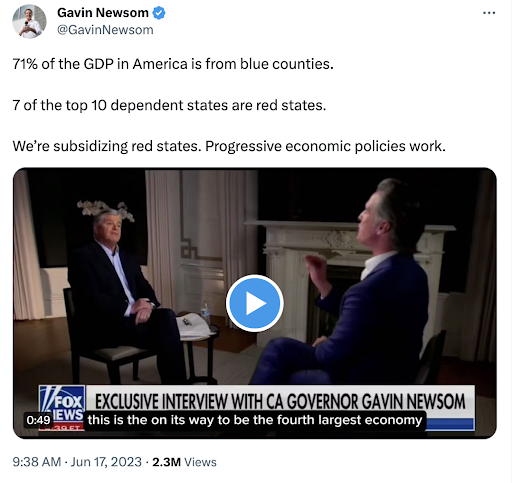
Tweet from Gavin Newsom: Red States vs. Blue States by the numbers

But that is not all.

8 of the 10 states with the highest murder rates are red and gun deaths are almost 2x as high in red states.

The Supreme Court has stripped women of their liberty and let red states replace it with mandated birth.

They ban books, silence teachers and make it harder to vote in red states.

The reason Republicans like Ron DeSantis are fanning the flames of culture wars is to distract from the fact that Florida has higher murder rates, worse education and worse health care outcomes than states like California.

That’s the truth.

– Gavin

Historian Heather Cox Richardson brilliantly contrasts the views of Republicans and Democrats on the role of government. Republicans want it to be as minimal as possible. Democrats want it to use its powers and resources to improve people’s lives. Understanding this difference helps illuminate why Republicans want to get rid of public schools and why billionaires like Charles Koch and Betsy DeVos support vouchers and libertarianism in a society where everyone is on their own.

Yesterday, the Republican Study Committee, a 175-member group of far-right House members, released their 2024 “Blueprint to Save America” budget plan. It calls for slashing the federal budget by raising the age at which retirees can start claiming Social Security benefits from 67 to 69, privatizing Medicare, and enacting dramatic tax cuts that will starve the federal government.

I’m actually not going to rehash the 122-page plan. Let’s take a look at the larger picture.

This budget dismisses the plans of “President Joe Biden and the left” as a “march toward socialism.” It says that “[t]he left’s calls to increase taxes to close the deficit would be…catastrophic for our nation.” Asserting that “the path to prosperity does not come from the Democrats’ approach of expanding government,” it claims that “[o]ver the past year and a half, the American people have seen that experiment fail firsthand.”

Instead, it says, “the key to growth, innovation, and flourishing communities” is “[i]ndividuals, free from the burdens of a burdensome government.” 

It is?

Our history actually tells us how these two contrasting visions of the government play out.

Grover Norquist, one of the key architects of the Republican argument that the solution to societal ills is tax cuts, in 2010 described to Rebecca Elliott of the Harvard Crimson how he sees the role of government. “Government should enforce [the] rule of law,” he said. “It should enforce contracts, it should protect people bodily from being attacked by criminals. And when the government does those things, it is facilitating liberty. When it goes beyond those things, it becomes destructive to both human happiness and human liberty.”

Norquist vehemently opposed taxation, saying that “it’s not any of the government’s business who earns what, as long as they earn it legitimately,” and proposed cutting government spending down to 8% of gross national product, or GDP, the value of the final goods and services produced in the United States. 

The last time the level of government spending was at that 8% of GDP was 1933, before the New Deal. In that year, after years of extraordinary corporate profits, the banking system had collapsed, the unemployment rate was nearly 25%, prices and productivity were plummeting, wages were cratering, factories had shut down, farmers were losing their land to foreclosure. Children worked in the fields and factories, elderly and disabled people ate from garbage cans, unregulated banks gambled away people’s money, business owners treated their workers as they wished. Within a year the Great Plains would be blowing away as extensive deep plowing had damaged the land, making it vulnerable to drought. Republican leaders insisted the primary solution to the crisis was individual enterprise and private charity. 

When he accepted the Democratic nomination for president in July 1932, New York governor Franklin Delano Roosevelt vowed to steer between the radical extremes of fascism and communism to deliver a “New Deal” to the American people. 

The so-called alphabet soup of the New Deal gave us the regulation of banks and businesses, protections for workers, an end to child labor in factories, repair of the damage to the Great Plains, new municipal buildings and roads and airports, rural electrification, investment in painters and writers, and Social Security for workers who were injured or unemployed. Government outlays as a percentage of GDP began to rise. World War II shot them off the charts, to more than 40% of GDP, as the United States helped the world fight fascism. 

That number dropped again after the war, and in 1975, federal expenditures settled in at about 20% of GDP. Except for short-term spikes after financial crises (spending shot up to 24% after the 2008 crash, for example, and to 31% during the 2020 pandemic, a high from which it is still coming down), the spending-to-GDP ratio has remained at about that set point.

So why is there a growing debt?

Because tax revenues have plummeted. Tax cuts under the George W. Bush and Trump administrations are responsible for 57% of the increase in the ratio of the debt to the economy, 90% if you exclude the emergency expenditures of the pandemic. The United States is nowhere close to the average tax burden of the 38 other nations in the Organization of Economic Cooperation and Development (OECD), all of which are market-oriented democracies. And those cuts have gone primarily to the wealthy and corporations. 

Republicans who backed those tax cuts now insist that the only way to deal with the growing debt is to get rid of the government that regulated business, provided a basic social safety net, promoted infrastructure, and eventually promoted civil rights, all elements that stabilized the nation after the older system gave us the Depression. Indeed, the Republican Study Committee calls for making the Trump tax cuts, scheduled to expire in 2025, permanent. 

“There are two ways of viewing the government’s duty in matters affecting economic and social life,” FDR said in his acceptance speech. “The first sees to it that a favored few are helped and hopes that some of their prosperity will leak through, sift through, to labor, to the farmer, to the small businessman.” The other “is based upon the simple moral principle: the welfare and the soundness of a nation depend first upon what the great mass of the people wish and need; and second, whether or not they are getting it.”

When the Republican Study Committee calls Biden’s policies—which have led to record employment, a booming economy, and a narrowing gap between rich and poor— “leftist,” they have lost the thread of our history. The system that restored the nation after 1933 and held the nation stable until 1981 is not socialism or radicalism; it is one of the strongest parts of our American tradition.

Notes:

Ron DeSantis got the Florida legislature to pass strong legislation that puts undocumented immigrants at risk of deportation and puts anyone who helps them at risk of arrest.

Meanwhile, the agriculture industry—a key driver of the state’s economy—is worried about finding enough workers to harvest the crops.

Immigrant advocates warned them to stay home.

But farmers are pleading with immigrants not to leave the state. Even Republican legislators worry that the anti-immigrant law was a mistake.

Republican lawmakers in Florida concerned about the state’s new anti-immigration law and its possible economic consequences begged Latinos to not leave the state in clips from a Monday morning meeting.

The footage, which provides evidence of the law’s “downstream impacts on the state economy” according to MSNBC, shows two conservative Florida legislators attempting to minimize the harm that the law, Senate Bill 1718, could cause, with one asking attendees to advise Latinos against leaving Florida.

“This bill is 100% supposed to scare you,” Republican state Rep. Rick Roth said in a clip shared on Twitter by Democratic activist Tom Kennedy. “I’m a farmer, and the farmers are mad as hell. We are losing employees. They’re already starting to move to Georgia and other states. It’s urgent that you talk to all your people and convince them that you have resources — state representatives and other people — that can explain the bill to you.”

But no one blames DeSantis, who needed to prove his contempt for immigrants.

Agriculture is a big part of Florida’s economy. Who will bring in the crops?

Before the bill passed, the Farmworkers Association warned that about 300,000 of the state’s 500,000 farmworkers are likely undocumented.

Here’s a chance for DeSantis to create jobs for his fervent white supporters. They can pick oranges and grapefruit and other crops in the blazing sun. At minimum wage.

Millions of Americans are saddled with debt due to the cost of their college education. I have met adults who were still paying for their college education years after they graduated. As a society, we send mixed messages to young people: we want you to get a college education, but you will have to spend years paying for it.

When I visited Finland a decade ago, I was amazed to learn that all higher education there is tuition-free. My guide explained the Finnish view: education is a human right, and it’s immoral to make people pay for a human right.

We as a nation know that investing in education is good for the nation’s future. We all benefit when more people are better educated and have more skills and knowledge. To the extent that young people are reluctant to assume the high cost of a college education, they will choose not to go to college. This is not good for them or for our society.

President Biden understands the dilemma and developed a plan to help college students pay down their college student loans. “Unveiled in August, Biden’s loan forgiveness plan would eliminate $10,000 of federal student debt for borrowers earning up to $125,000 annually, or $250,000 for married couples. Recipients of Pell Grants, a form of financial aid for low- and middle-income students, are eligible for an additional $10,000 in forgiveness.”

The GOP is unanimously opposed to helping relieve students of their debt. They reason that others have paid their debt, so no one should get relief. This is penurious and hard-hearted.

Aided by a few Democratic votes (three Senators— Manchin, Sinema, and Tester of Montana—and two members of the House), Republicans passed a bill to kill Biden’s plan for student debt relief. The President vetoed their bill.

The Supreme Court will soon rule on whether it’s constitutional to relieve students of their debt, and that’s another peril for Biden’s plan.

The stubborn opposition of the GOP to any student debt relief is another reason to vote Blue in 2024.

President Biden on Wednesday vetoed a Republican-led resolution that would have struck down his controversial plan to forgive more than $400 billion in student loans.

In a statement on Wednesday, the president said the resolution — which the Senate approved on a 52-46 vote Thursday under the Congressional Review Act, a week after the House passed the measure — would have kept millions of Americans from receiving “the essential relief they need as they recover from the economic strains associated with the COVID-19 pandemic.” The resolution called for a restart of loan payments for millions of borrowers that have been on pause since early in the coronavirus pandemic. It also would have prevented the Education Department from pursuing similar policies in the future.

In his statement, the president said it is “a shame for working families across the country that lawmakers continue to pursue this unprecedented attempt to deny critical relief to millions of their own constituents, even as several of these same lawmakers have had tens of thousands of dollars of their own business loans forgiven by the Federal Government.”

(It wasn’t the first time the White House has highlighted that lawmakers received financial relief from the government during the pandemic through the Payment Protection Program loans.)
The student loan forgiveness program has faced legal challenges, and the Supreme Court is set to issue a ruling on its legality before the end of June.

“I remain committed to continuing to make college affordable and providing this critical relief to borrowers as they work to recover from a once-in-a-century pandemic,” Biden said in his statement Wednesday.

Is it possible for us one day to be a nation that sees the importance of investing in the future and restoring a sense of common purpose? Could we begin to care for everyone’s children as if they were our own?

There is a growing awareness that Biden managed to outsmart Kevin McCarthy in the debt negotiations. Robert Hubbell thinks so. Biden is a lot smarter than he gets credit for. Fifty years in Congress counts for something.

Hubbell writes:

A key part of the Republican mythology heading into 2024 is that Joe Biden is addled to the point of incoherence and incompetence. So, on the eve of the House vote on the debt ceiling legislation, Republicans are struggling with the reality that Biden bested them in a high-stakes negotiation in which they were holding a nuclear bomb they were willing to detonate. 

As Rep. Lauren Boebert admitted on Twitter, “We got absolutely destroyed in this negotiation.” Or, as former-adult-in-the-room GOP Rep. Nancy Mace tweeted, “Republicans got outsmarted by a President who can’t find his pants.” [See my criticism of Rep. Mace in Concluding Thoughts.]

          As Charlie Sykes aptly noted, Republicans are experiencing “cognitive dissonance” as they struggle to digest their defeat. In the Orwellian logic of the GOP, Kevin McCarthy is declaring “total victory” for negotiating a deal that has ignited calls for his removal as Speaker. As Freedom Caucus member GOP Rep. Chip Roy said,

I want to be very clear: Not one Republican should vote for this deal. Not one. It is a bad deal. No one sent us here to borrow an additional $4 trillion to get absolutely nothing in return. . . . [The deal is] a complete and total sellout . . . and a betrayal of the House power-sharing arrangement.

          While McCarthy is attempting to convince his caucus that the sow’s ear compromise bill is a silk purse for Republicans, Biden is being praised in the political press for his Ninja-like negotiating skills. See Jennifer Rubin in Washington PostOpinion | The debt ceiling shows Biden’s underrated deal-making prowess. Or, as Josh Marshall of Talking Points Memo put it, How the “F” Did Joe Biden Do That? For a comprehensive analysis of Biden’s negotiating strategy, see Daily KosThe many levels of genius in Pres. Biden’s negotiating strategy.

          It may take a few days for Republicans to understand what just happened to them, but here is an example. One of McCarthy’s proudest achievements is that he imposed new work requirements for SNAP food assistance for recipients between 50 and 54 years old. But Biden negotiated “carve-outs” to that expanded work requirement that will actually increase the amount of SNAP funding by expanding the pool of eligible recipients. Per the NYTimes,

[The Congressional Business Office] said a series of changes in work requirements for food stamp eligibility — tightening them for some adults, but loosening them for others including veterans — would actually increase federal spending on the program by $2 billion.

While Republicans demanded stricter work requirements be a part of the compromise, the White House bargained to lessen the impact, and the budget office estimated that overall, the deal would increase the ranks of the program, making an additional 78,000 people eligible for nutrition assistance.

          Got that? The signature achievement of Republicans designed to kick people off SNAP will instead increase funding for the program (by $1.8 billion) and expand the number of eligible recipients. As Josh Marshall said, “How the “F” did Biden to that?” Democrats should help pass the bill through Congress before more such details emerge.

         The “good” news is that a floor vote in the House will likely occur on Wednesday—five days before the US will not have sufficient cash to pay all of its bills.  Late on Tuesday evening, the legislation cleared a key hurdle in the House, passing out of the House Rules Committee. As a result, the bill will be put to a vote on Wednesday. See NYTimesDebt Ceiling Deal Moves Toward House Vote Despite GOP Revolt.

          But . . . many Democrats are unhappy with compromises made by Biden to avoid default. Two of the leading criticisms involve the age-based increased work requirements for SNAP recipients and changes to the permitting process for energy projects.

          As to SNAP, Biden agreed to increase the existing work requirements to include beneficiaries 50 to 54 years old. But as noted above, carve-outs to those increased work requirements have the effect of increasing the total number of Americans eligible for SNAP benefits. Still, the precedent of using a debt-ceiling negotiation to target the poorest and most vulnerable Americans is a bad one. See Michael Hiltzik, Los Angeles TimesHiltzik: Debt ceiling deal is all about punishing the poor.

          A corollary to the GOP’s effort to punish the poor is their effort to protect the rich. By reducing funding for the IRS and leaving tax rates untouched, the two groups unaffected by the debt-ceiling compromise are ultra-wealthy Americans and large corporations. See Raw StoryProgressives condemn Biden-GOP debt ceiling deal as ‘cruel and shortsighted’.

A second major point of criticism is the concession to “fast track” future energy projects, thereby limiting environmental review. And the deal expressly grants special consideration for the Mountain Valley Pipeline, a Joe Manchin pet project. See The Guardian, ‘An egregious act’: debt ceiling deal imperils the environment, critics say | Environment.

Per The Guardian,

Environmental groups, already angered by Biden’s ongoing embrace of large fossil fuel projects, such as the recently approved Willow oil drilling operation in Alaska, said these provisions mean that Democrats should block the debt deal when it is voted upon in Congress this week.

“President Biden made a colossal error in negotiating a deal that sacrifices the climate and working families,” said Jean Su, energy justice program director at the Center for Biological Diversity. “Congress should reject these poison pills and pass a clean debt ceiling bill.”

          But apart from the permitting concessions, Biden managed to protect the massive investments in climate and clean energy achieved in the infrastructure bill and Inflation Reduction Act passed during the last session of Congress. The Inflation Reduction Act alone invested $369 billion in climate protection and clean energy—the largest investment in protecting the environment by an order of magnitude. That investment will reduce carbon emissions by 40% by 2030. See CNBC, Inflation Reduction Act: Climate change provisions.

          The criticisms over cruelty targeting the poor and special accommodations for a pipeline that will make Joe Manchin richer are well-taken. But as the director of the Office of Management and Budget, Shalanda Young, said in defense of the bill:

We are in divided government. This is what happens in divided government. They get to have an opinion and we get to have an opinion, and all things equal, I think this compromise agreement is reasonable for both sides.

And we must remember that as we evaluate the provisions of the bill, the implied question is always, “Compared to what?” Here, the relevant comparison is to a national default that would have injured hundreds of millions of Americans and millions of American businesses. Retirement savings would have been decimated, and monthly benefit checks would have been diminished or halted. It is legitimate and reasonable to evaluate (and criticize) the proposed bill, but to do so without recognizing the alternative outcome is an incomplete analysis.

*****************************************

Hubbell goes on to chastise former moderate Nancy Mace of South Carolina, who has gone full-MAGA in her cruel taunts aimed at Biden, who apparently negotiated the pants off McCarthy.

As everyone, I hope, remembers, Kevin McCarthy wanted to be Speaker of the House. He wanted it so badly that he had to wheel and deal to get the votes he needed from the Republican Caucus. Even though the Caucus had a slim majority, the most rightwing members withheld their votes, denying him victory. Ultimately, the so-called Freedom Caucus was able to deny him what he wanted until he made multiple concessions, like putting its members on important committees and agreeing that he could be ousted by a simple majority vote. To win the Speakership on the 15th round of balloting, he had to agree to their demands.

Now his hands are tied in the debt negotiations with President Biden because the Freedom Caucus wants deep budget cuts and no compromise. Basically, everything but defense, Social Security and Medicare would be slashed by some 22%, and Biden’s efforts to address climate change would be gutted.

The Freedom Caucus doesn’t care if the federal government defaults on its debts. The public doesn’t follow details closely, and it would likely blame Biden, because he is President.

Kevin McCarthy needs a way to escape the chokehold of the Freedom Caucus so he can negotiate a compromise.

Here’s a plan to free him. The number of Republicans who are aligned with the Freedom Caucus is between 20-50 (they don’t publicize their numbers). That’s how many votes McCarthy needs to hold on to his job.

Why don’t Democrats offer him enough votes so he doesn’t need the Freedom Caucus? Since the Democrats can never win the Speakership in this session, why shouldn’t they all vote for McCarthy in exchange for his agreement to negotiate to raise the debt ceiling? Why shouldn’t he win bipartisan support for doing the right thing?

The Democrats have it within their power to free McCarthy from the extremists in his party who have no qualms about crashing the world economy.

Ron DeSantis is using government to stamp out ideas he doesn’t like. He doesn’t like investing public money into corporations that take into account climate change and diversity. Such standards are called ESG, or “environmental, social, and governance” standards.

So today he signed a law to block investment in funds with ESG standards. Anyone who cares about such things as climate change, he believes, is “WOKE.”

Florida is one of the most environmentally threatened states in the nation, but DeFascist opposes corporations that care about climate change.

Just last fall, the west coast of Florida was devastated by Hurricane Ian, a category 5 that caused more than $100 billion in damages, in addition to more than 150 deaths.

But DeSantis doesn’t want the state to invest its funds in corporations that want to act against climate change. Maybe he should take a public pledge not to ask for federal relief money when the next big hurricane hits Florida. Put the state’s money where his mouth is instead of sending us the bill for his bull.

The Orlando Sentinel reported:

Gov. Ron DeSantis signed into law Tuesday a bill banning state agencies and local governments from taking climate change and diversity factors into account when investing money.

The Government and Corporate Activism Act targets ESG, or environmental, social and governance standards, derided as “woke” by DeSantis and the GOP-led Legislature in their culture war battles.

Democrats and some business owners say the law could cost the state money and impact municipal bonds.

At an event in Jacksonville, DeSantis called ESG “an attempt by elites to impose ideology through business institutions, financial institutions, and our economy writ large. … They want to use economic power to impose this agenda on our society. And we think in Florida, that is not going to fly here.”

The bill, which passed both the House and Senate along mostly party lines, also bans banks from applying a “social credit score” and denying services to people based on political opinions or speech, which is defined to include religion, ownership of a firearm, being involved in “fuel-based energy, timber, mining, or agriculture,” or supporting the “combating illegal immigration.”

“You’ll actually hear from some folks today who’ve kind of been caught up in this morass where they’ve been discriminated against by financial institutions, just basically because they’re not toeing the ideological line,” DeSantis said.

DeSantis introduced Laura DiBenedetto, the owner of firearms store Sovereign Ammo in Flagler County, who quoted from George Orwell’s 1984 and claimed her industry was “already under totalitarian rule” because they were denied funding by lenders “because our profession didn’t pass muster for an acceptable business.”

The state pension fund has already started pulling out of investments in companies with ESG practices, including $2 billion from BlackRock, the largest asset-management firm in the world. The money was dispersed to other asset managers that also support ESG, however.

Dr. Geoffrey Hinton, widely credited as the “godfather of artificial intelligence,” quit his job at Google and let the world know that he regrets what he launched. where once he thought that AI had great potential to improve our lives, he now worries that it might be a grave danger to human civilization.

The New York Times reports:

Geoffrey Hinton was an artificial intelligence pioneer. In 2012, Dr. Hinton and two of his graduate students at the University of Toronto created technologythat became the intellectual foundation for the A.I. systems that the tech industry’s biggest companies believe is a key to their future.

On Monday, however, he officially joined a growing chorus of critics who say those companies are racing toward danger with their aggressive campaign to create products based on generative artificial intelligence, the technology that powers popular chatbots like ChatGPT.

Dr. Hinton said he has quit his job at Google, where he has worked for more than a decade and became one of the most respected voices in the field, so he can freely speak out about the risks of A.I. A part of him, he said, now regrets his life’s work…

Dr. Hinton’s journey from A.I. groundbreaker to doomsayer marks a remarkable moment for the technology industry at perhaps its most important inflection point in decades. Industry leaders believe the new A.I. systems could be as important as the introduction of the web browser in the early 1990s and could lead to breakthroughs in areas ranging from drug research to education.

But gnawing at many industry insiders is a fear that they are releasing something dangerous into the wild. Generative A.I. can already be a tool for misinformation. Soon, it could be a risk to jobs. Somewhere down the line, tech’s biggest worriers say, it could be a risk to humanity…

After the San Francisco start-up OpenAI released a new version of ChatGPT in March, more than 1,000 technology leaders and researchers signed an open lettercalling for a six-month moratorium on the development of new systems because A.I. technologies pose “profound risks to society and humanity.”

Several days later, 19 current and former leaders of the Association for the Advancement of Artificial Intelligence, a 40-year-old academic society, released their own letter warning of the risks of A.I. That group included Eric Horvitz, chief scientific officer at Microsoft, which has deployed OpenAI’s technology across a wide range of products, including its Bing search engine.

The Washington Post revealed the organization promoting the dilution of child labor laws. Iowa and Arkansas, both solid red states, were first to remove protections for children to meet the needs of employers.

To learn more about the gutting of child labor law in Iowa, watch this chilling video, thanks to reader Greg B.

Remember, the GOP is the party that loves the unborn but disdains the born. They value life in the womb but not actual children.

Investigative reporter Jacob Bogage of the Washington Post wrote:

When Iowa lawmakers voted last week to roll back certain child labor protections, they blended into a growing movement driven largely by a conservative advocacy group.
At 4:52 a.m., Tuesday, the state’s Senate approved a bill to allow children as young as 14 to work night shifts and 15 year-olds on assembly lines. The measure, which still must pass the Iowa House, is among several the Foundation for Government Accountability is maneuvering through state legislatures.
The Florida-based think tank and its lobbying arm, the Opportunity Solutions Project, have found remarkable success among Republicans to relax regulations that prevent children from working long hours in dangerous conditions. And they are gaining traction at a time the Biden administration is scrambling to enforce existing labor protections for children.
The FGA achieved its biggest victory in March, playing a central role in designing a new Arkansas law to eliminate work permits and age verification for workers younger than 16. Its sponsor, state Rep. Rebecca Burkes (R), said in a hearing that the legislation “came to me from the Foundation [for] Government Accountability.”
“As a practical matter, this is likely to make it even harder for the state to enforce our own child labor laws,” said Annie B. Smith, director of the University of Arkansas School of Law’s Human Trafficking Clinic. “Not knowing where young kids are working makes it harder for [state departments] to do proactive investigations and visit workplaces where they know that employment is happening to make sure that kids are safe.”

That law passed so swiftly and was met with such public outcry that Arkansas officials quickly approved a second measure increasing penalties on violators of the child labor codes the state had just weakened.
In Missouri, where another child labor bill has gained significant GOP support, the FGA helped a lawmaker draft and revise the legislation, according to emails obtained by The Washington Post.
The FGA for years has worked systematically to shape policy at the state level, fighting to advance conservative causes such as restricting access to anti-poverty programs and blocking Medicaid expansion.


But in February, the White House announced a crackdown on child labor violators in response to what activists have described as a surge in youths — many of them undocumented immigrants — working at meat packing plants, construction sites, auto factories and other dangerous job sites.
The administration’s top labor lawyer called the proposed state child labor laws “irresponsible,” and said it could make it easier for employers to hire children for dangerous work.
“Federal and state entities should be working together to increase accountability and ramp up enforcement — not make it easier to illegally hire children to do what are often dangerous jobs,” Labor Solicitor Seema Nanda said. “No child should be working in dangerous workplaces in this country, full stop.”
Congress in 1938 passed the Fair Labor Standards Act to stop companies from using cheap child labor to do dangerous work, a practice that exploded during the Great Depression….

On the surface, the FGA frames its child worker bills as part of a larger debate surrounding parental rights, including in education and child care. But the state-by-state campaigns, the group’s leader said, help the FGA create openings to deconstruct larger government regulations.
Since 2016, the FGA’s Opportunity Solutions Project has hired 115 lobbyists across the country with a presence in 22 states, according to the nonpartisan political watchdog group Open Secrets.
“The reason these rather unpopular policies succeed is because they come in under the radar screen,” said David Campbell, professor of American democracy at the University of Notre Dame. “Typically, these things get passed because they are often introduced in a very quiet way or by groups inching little by little through grass-roots efforts.”
Minnesota and Ohio have introduced proposals this year allowing teens to work more hours or in more dangerous occupations, such as construction. A bill in Georgia would prohibit the state government from requiring a minor to obtain a work permit.

The FGA-backed measures maintain existing child labor safety protections “while removing the permission slip that inserts government in between parents and their teenager’s desire to work,” Nick Stehle, the foundation’s vice president, said in a statement.
“Frankly, every state, including Missouri, should follow Arkansas’s lead to allow parents and their teenagers to have the conversation about work and make that decision themselves,” said Stehle, who is also a visiting fellow at the Opportunity Solutions Project.
The FGA declined to make Stehle and other representatives available for interviews.
It’s one of several conservative groups that have long taken aim at all manner of government regulations or social safety net programs. The FGA is funded by a broad swath of ultraconservative and Republican donors — such as the Ed Uihlein Family Foundation and 85 Fund, a nonprofit connected to political operative Leonard Leo — who have similarly supported other conservative policy groups.
The youth hiring or employment bills, as they are often titled, represent growing momentum among conservatives who contend that parents and not government policy should determine whether and where 14- and 15-year-olds should work.
“When you say that a bill will allow kids to work more or under dangerous conditions, it sounds wildly unpopular,” Campbell said. “You have to make the case that, no, this is really about parental rights, a very carefully chosen term that’s really hard to disagree with….”

Supporters of the child worker proposals say they reduce red tape around the hiring process for minors. A spokeswoman for Arkansas Gov. Sarah Huckabee Sanders, a rising Republican star, said her state’s law relieved parents of “obsolete” and “arbitrary burdens.”
“The main push for this reform didn’t come from big business,” Stehle, the FGA vice president, wrote in an essay for Fox. “It came from families like mine, who want more of the freedom that lets our children flourish…”

Tarren Bragdon, a former Maine state legislator, founded the FGA in 2011 with a focus on cutting social safety net and anti-poverty programs. It quickly tapped into conservative political fundraising networks and grew from $50,000 in seed funding to $4 million in revenue by its fourth year, according to tax filings and the group’s promotional materials.

In 2020, the most recent year for which the FGA and its funders’ full financial disclosures are available, more than 70 percent of its $10.6 million in revenue came from 14 conservative groups.

The FGA joined the State Policy Network, a confederation of conservative state-level think tanks that practice what leaders call the “Ikea model” of advocacy, its president said during the group’s 2013 conference. Affiliates such as the FGA display prefabricated policy projects for state officials, then provide the tools — including research and lobbying support — to push proposals through legislative and administrative processes.
In 2021, for example, Arkansas legislators passed 48 measures backed by the FGA, according to the foundation’s end-of-year report. It identified Arkansas, Missouri and Iowa among its five “super states” where it planned to increase its advocacy presence.
In 2022, the FGA claimed 144 “state policy reform wins,” including 45 related to unemployment and welfare, across a slew of states.
“Success in the states is critical for achieving national change, as it often opens the door to federal regulatory reform,” Bragdon wrote in the group’s 2021 report. “Once enough states successfully implement a reform, we can use the momentum and proven results to build pressure for regulatory change.”
Yet even legislators who support the FGA’s policies expanding child labor have found their limits.
Missouri’s bill was amended to require a parental permission form for children aged 14 to 16 who want to take a job. The original legislation, edited by the FGA, did not contain any such provision.

Florida Governor Ron DeSantis is going after Disney again, trying to prove he’s a tough guy. He is angry at Disney because the corporation—Florida’s largest employer—issued a statement opposing the Governor’s “Don’t Say Gay” law.

First, DeSantis retaliated by dissolving the Reedy Creek District, a special self-governing district controlled by Disney, which supplies all services to Disney’s theme park. DeSantis created a new board called the Central Florida Oversight District Board of Supervisors to oversee the district, packed with his cronies.

But before the legislation passed, Disney quietly held public meetings and granted its district decades of future control.

Outraged, DeSantis threatened to increase hotel taxes and put tolls on the roads to Disney. He also told the State Attorney General to investigate Disney. Not a nice way to treat the state’s biggest employer.

Now he is wreaking vengeance again:

The Disney versus DeSantis fight headed into round three on Monday as Florida’s governor announced that the Florida Legislature will revoke the last-minute development agreements that undercut the authority of the governor-controlled board and unleashed a litany of retributive efforts aimed at to the powerful corporation.

“We want to make sure that that Disney lives under the same laws as everybody else,’’ said Gov. Ron DeSantis at the headquarters of the Reedy Creek Improvement District near Orlando.

DeSantis said he has authorized state agencies to increase regulatory oversight over Disney operations, such as the monorail and amusement rides. He suggested the DeSantis-controlled oversight board could use undeveloped land not owned by Disney for other purposes.

“Maybe create a state park, maybe try to do more amusement parks,’’ he said. “Someone even said like, maybe you need another state prison. Who knows? I mean, I just think that the possibilities are endless.”

The announcement comes two days before the newly-named Central Florida Tourism Oversight District’s Board of Supervisors is scheduled to review a new proposal to strengthen its authority over planning, zoning and land development regulations for the special taxing district that operates the 39-square-mile property on which Walt Disney World exists.

DeSantis must be terrifying every big corporation in the nation. This is a guy who puts his nose into corporate governance; he is also hostile to corporations that embrace equity, diversity and inclusion programs and environmental policies.

His desire to exercise political control over private corporations will not win new friends for him except his yahoo base.