Archives for category: Disruption

Peter Greene highly recommends the “60 Minutes” segment about book banning and Moms for Liberty. He pins them on the essential hypocrisy at the heart of their campaign: the M4L asserts the right to deny certain books to all children in a school or a district, thus denying the “liberty” of parents who disagree with them. There is a world of difference between a parent saying “I don’t want my child to read that book” and a parent saying “ No child in that school should be allowed to read that book.”

Peter Greene writes:

If you have not seen the 60 Minutes piece on book banning, here it is. Go ahead and watch; it will be thirteen and a half minutes well spent.

There are several things on display here, not the least of which is a school district taking a sensible students-first, parents-involved approach to the issue of difficult books. 

Reporter Scott Pelley gets right to the heart of several issues. The difference between giving parents the tools to control what their own children can read (something the district also provides in spades) and trying to control what other parents can let their children read. The outrage-enhancing technique of treating isolated mistakes as proof of some widespread conspiracy.

In the midst of it all, the Moms for Liberty, with Tiffany Justice and Tina Descovich finally seen in the footage from an interview they sat for way back in October of 2023. 

The piece is tough on them. The parents that are set up to represent the district are Republican, conservative, combat veterans. Pelley in repeated voice overs points out that the Moms are evasive and avoid answering question but instead retreating to their talking points (he does not point out that they are seasoned political coms professionals, but he doesn’t portray them as cookie-baking domestics, either). Some of the talking points were so six months ago. “We don’t co-parent with the government,” said the women whose demands include forcing the government to help them with the part of parenting that involves keeping an eye on what your children read and watch. 

Their PR firm (Cavalry Strategies) was on the case this morning, emailing out the M4L transcript that includes the part that CBS didn’t include, and offering the duo for press interviews to tell their story. It’s an odd choice, because the stuff they want you to see is just more of the non-answering that CBS showed. That and they are really, really big sad that CBS chose not to air them reading the Really Dirty Parts or Certain Books. This remains one of their weirdest arguments–since this part of this book is too objectionable to read in certain situations, it must be too objectionable to be found in any situation. Like, it’s not okay for me pee on the steps of City Hall at noon, so it must not be okay for me to pee anywhere, ever.

But the question that Pelley asked was a really, really good one. The Moms led into it by saying that although they love teachers so very much, there are some “rogue teachers” out there (I can hear the ty-shirts being printed already). “Parents send their children to school to be educated, not indoctrinated into ideology.”

And so Pelley asked the obvious question– “What ideology are the children being indoctrinated into?”

And the Moms wouldn’t answer. The extended answer in their email (and some tweets) suggests that they’re talking about gender and sex stuff, and their go to example is telling five year olds that genders can be changed). 

The answer remains unclear. What exactly is the objection? What is the problem? What does “gender ideology” even mean? Because the harder I stare at it, the more it seems as if the problem is acknowledging that LGNTQ persons exist.

But in the MAGA Mom playbook, that’s not it as all, which brings us Pelley’s other fruitless attempt to get the Moms to explain what they mean by all the “groomer” language that they use on their own social media. They really didn’t want to talk about that, though they did insist that they like gay folks just fine. They didn’t attempt to address the groomer question in their responses to the 60 Minutes piece. Perhaps that’s because their premise makes no sense. 

But if you boil it all down, this is what you get.

If you acknowledge that LGBTQ persons exist in front of children, then you are grooming those children to become LGBTQ.

Part of the premise for that is an old one– if you believe that nobody is born That Way, that nobody is LGBTQ by nature, then you must believe that all LGBTQ persons are recruited.

But to jump from there to the notion that simply acknowledging that LGBTQ persons exist must only be about recruiting–that’s a hell of a leap. And it leads to the worst culture panic impulse, which is to erase those persons, to treat them as if their very existence must be a dirty secret.

And because acknowledging them is equated with grooming other children, this becomes the worst brand of othering. To make it okay to attack the Other, you have to establish that the Other represents a threat, that you need to defend yourself against them. And that makes violence against them okay.

So when Ryan Walters says that he’s not playing “woke gender games,” he’s saying that he won’t acknowledge that LGBTQ persons exist, and that anyone who does acknowledge they exist is trying to attack children and groom them and so that “woke mob” is attacking, and so it’s okay to attack back. When the Lt. Governor and gubernatorial candidate calls LGBTQ persons “filth,” particularly in the context of talking about them in school at all ever, that message is pretty clear. 

Pelley’s unanswered questions point us at the nuance missing in the Moms for Liberty outrage and panic factory, the nuance that recognizes that reasonable intelligent people can disagree about the value of certain books. In the real world, there’s a huge difference between showing six year olds graphic depictions of the ways one can use a penis and a non-graphic depiction of LGBTQ persons. There’s a vast gulf between grooming some small child for sexual abuse and simply acknowledging there are some LGBTQ persons in the world (and possibly in the classroom or the homes of class members). There’s a planet-seized difference between saying “LGBTQ persons are not extraordinary or unnatural” and saying “You should become an LGBTQ person.”  And yet, in the Moms for Liberty universe, there is no difference between any of those things. 

It’s very hard to distinguish between the opportunists and the truly panicked on this issue. The Heritage Foundations Project 2025 seems like an opportunist’s political project, but it is also shot through with what seems like a sincere and extreme LGBTQ panic. The Ziegler scandal deserves attention because it suggests that one founding M4L member is not all that freaked out about non-het sex. 

But at a certain level, it doesn’t matter whether all this LGBTQ panic is sincere or not, because as the toxic sludge filters through the culture, some people feel justified, even encouraged, in violence and mistreatment of actual human beings. No amount of carefully refined talking points will change that; only the kind of nuanced, complex conversation that doesn’t get you a special seat at the MAGA table. 

The encouraging part of the 60 Minutes piece is that it shows how ordinary folks can actually have some of those conversations. Over a hundred citizens came together to have some thoughtful consideration about the list of 97 books that were marked for removal, and they kept 92 of them. Imagine that.

At DeSantis’s urging, the Florida legislature passed a law known as “Stop Woke.” The law restricts teaching about race and gender in the state’s classrooms and bans “diversity, equity, and inclusion” programs in the workplace. Several employers sued to block the law, calling it a restriction on free speech. The employers won in the federal District Court, and the state appealed the decision. Today the 11th Circuit Court of Appeals overturned the Stop Woke Act as applied to employers. It remains in effect for schools.

The Orlando Sentinel reported:

TALLAHASSEE — A federal appeals court Monday rejected restrictions that Gov. Ron DeSantis and Republican lawmakers placed on race-related issues in workplace training, part of a 2022 law that DeSantis dubbed the “Stop WOKE Act.”


A three-judge panel of the 11th U.S. Circuit Court of Appeals said the restrictions violated First Amendment rights.


“This is not the first era in which Americans have held widely divergent views on important areas of morality, ethics, law and public policy,” the 22-page opinion said. “And it is not the first time that these disagreements have seemed so important, and their airing so dangerous, that something had to be done. But now, as before, the First Amendment keeps the government from putting its thumb on the scale.”


The panel upheld a preliminary injunction issued in 2022 by Chief U.S. District Judge Mark Walker of Tallahassee against the restrictions. The law was challenged by Primo Tampa, LLC, a Ben & Jerry’s ice-cream franchisee; Honeyfund.com, Inc., a Clearwater-based technology company that provides wedding registries; and Chevara Orrin and her company, Collective Concepts, LLC.

Orrin and her company provide consulting and training to employers about issues such as diversity, equity and inclusion.


Walker also separately issued a preliminary injunction against part of the law that would restrict the teaching of race-related concepts in universities. The state has appealed that decision.


The workplace-training part of the law listed eight race-related concepts and said that a required training program or other activity that “espouses, promotes, advances, inculcates, or compels such individual (an employee) to believe any of the following concepts constitutes discrimination based on race, color, sex, or national origin.”


As an example, the law targeted compelling employees to believe that an “individual, by virtue of his or her race, color, sex, or national origin, bears personal responsibility for and must feel guilt, anguish, or other forms of psychological distress because of actions, in which the individual played no part, committed in the past by other members of the same race, color, sex, or national origin.”

The state disputed that the law violated speech rights, saying that it regulated “conduct.” It said businesses could still address the targeted concepts in workplace training but couldn’t force employees to take part.


But the appeals court flatly rejected such arguments Monday. It described the law as the “latest attempt to control speech by recharacterizing it as conduct. Florida may be exactly right about the nature of the ideas it targets. Or it may not. Either way, the merits of these views will be decided in the clanging marketplace of ideas rather than a codebook or a courtroom.”

If you are old enough to remember a different America, an America of neighborhood shops, of local bakeries, butchers, drugstores (with a soda fountain), shoe stores, bookstores, and dress shops, you may have wondered why most of them have been replaced by national chain stores and anonymous strip malls. Now we see even neighborhood public schools replaced by national charter chains, some even operated by for-profit corporations. Thom Hartmann explains the roots of this change in his new book The Hidden History of Monopolies: How Big Business Destroyed the American Dream. He is releasing the book a chapter at a time on his blog, which should whet our appetite to buy and read the book. This chapter describes the legal ploy that resulted in crushing local enterprise and creating billionaires.

He writes:

Robert Bork was Richard Nixon’s solicitor general and acting attorney general and had a substantial impact on the thinking in the Reagan White House—so much so that Reagan rewarded his years of hard work on behalf of America’s monopolists with a lifetime appointment to the federal bench in the DC Circuit, frequently a launching pad for the Supreme Court.

In the years following Lewis Powell’s 1971 memo, as numerous “conservative” and “free market” think tanks and publications grew in power and funding, Bork’s ideas gained wide circulation in circles of governance, business, and the law.

In 1977, in the case of Continental T.V., Inc. v. GTE Sylvania, the Supreme Court took up Bork’s idea and, for the first time in a big way, embraced the “welfare of the consumer” and “demonstrable economic effect” doctrines that Bork had been promoting for over a decade.

Neither of those phrases exists in any antitrust law, at least in Bork’s context. Nonetheless, the Supreme Court embraced Bork’s notion that the sole metric by which to judge monopolistic behavior should be prices that consumers pay, rather than the ability of businesses to compete or the political power that a corporation may amass.

When Ronald Reagan entered the White House in 1981, bringing with him Bork’s free market philosophy and a crew from the Chicago School, he ordered the Federal Trade Commission to effectively stop enforcing antitrust laws even within the feeble guidelines that the Supreme Court had written into law in GTE Sylvania.

The result was an explosion of mergers-and-acquisitions activity that continues to this day, as industry after industry concentrated down to two, three, four, or five major players who function as cartels. (A brilliant blow-by-blow cataloging of that decade is found in Barry C. Lynn’s book Cornered: The New Monopoly Capitalism and the Economics of Destruction.)

Bork’s reasoning—that antitrust law should defend only the consumer (through low prices), and not workers, society, democracy, or local communities—has become such conventional wisdom that in the 2014 Supreme Court case of FTC v. Actavis, Chief Justice John Roberts wrote a virtual word-for-word parroting of Bork: “The point of antitrust law is to encourage competitive markets to promote consumer welfare.”

Barak Orbach, professor of law at the University of Arizona, is one of a small number of scholars today who are genuine experts in the field of antitrust law. In a 2014 paper published by the American Bar Association, he wondered if Bork knew he was lying when he wrote that the authors of the Sherman Antitrust Act intended to reduce prices to advance “consumer welfare,” instead of protecting the competitiveness of small and local businesses, and the independence of government at all levels.

His conclusion, in “Was the ‘Crisis in Antitrust’ a Trojan Horse?” was that Bork was probably just blinded by ideology and had never bothered to go back and read the Congressional Record, which, he noted, says nothing of the kind.74

While Bork wrote that “the policy the courts were intended [by the Sherman Antitrust Act] to apply is the maximization of wealth or consumer want satisfaction,” Orbach said, “Members of Congress . . . were determined to take action against the trusts to stop wealth transfers from the public.” So much for that: today the Walton (Walmart) family is the richest in America and one of the richest in the world. They’re worth more than $100 billion, having squirreled away more wealth than the bottom 40% of all Americans. And they spend prodigiously on right-wing political causes, from the national to the local.

Amazon’s Jeff Bezos is now wealthier than any Walton; with a registered net worth of $112 billion, he is the richest single person in the world. Bezos is so rich that when he divorced his wife, MacKenzie Bezos, she received 19.7 million shares of Amazon worth $36.8 billion. She instantly became the world’s third-richest woman, and Jeff Bezos remained the world’s wealthiest man.75 While local newspapers are shutting down or being gobbled up all over the country, Bezos personally purchased the 140-year-old Washington Post in 2013 for $250 million. Now Bezos, like the Walton family, can use his sub- stantial wealth to obtain political ends that protect his wealth and allow Amazon to continue to grow.

We first heard the term “destroy the administrative state” when Steve Bannon used it in 2015 and 2016. Bannon, a close advisor to Trump, viewed the federal government as a danger to life and liberty. Now, Trump supporters echo that language, and it still sounds bizarre. They may be relying on Social Security and Medicare, they may be drinking clean water and breathing fresh air thanks to the Environmental Protection Agency, they may enjoy daily safety and security thanks to federal regulations, but they are prepared to toss all of it overboard.

They want to get the administrative state out of our lives, except that they don’t. They want the state to control women’s bodies, to limit parental rights to seek medical care for their children, and to control what we can read and what entertainment we can see. They want frozen embryos and fetuses in utero to be declared children, with all the rights of personhood. They want women and girls to be forced to give birth, even if their pregnancy was caused by rape or uncest, even if it endangers the woman’s life, even if the fetus has fatal deficiencies.

No organization has been more influential than the Heritage Foundation in stoking hostility to the Federal government. This venerable D.C. think tank is now planning the second Trump administration.

Over the past year, Heritage gathered rightwing ideologues to draft a document called Project 2025. It is a plan for the next Trump administration.

Here is another link. The section on the federal role in education starts on page 351.

Trump’s allies believe that his ambitious goals in his first term were stymied by career bureaucrats. So they recommend that his first act must be to reorganize the civil service, removing job protections from civil servants, enabling Trump to replace civil servants with Trump loyalists. It’s worth remembering that the civil service was created to eliminate the “spoils system,” the routine practice of filling government jobs with political cronies. Every president currently has thousands of political jobs to fill, but the core functions of government are staffed by experienced civil servants who serve regardless of the party in power.

The Heritage plan would enhance the powers of the President. Every government agency would be staffed by his loyalists. The Justice Department would no longer enjoy a measure of independence; instead it would serve the President. If he wanted to use it to persecute his political enemies, he could. He could carry out his pledges to jail Hillary Clinton and the Biden family. His Justice Department, led by a Trump attorney (Jeff Clark? Robert Hur? Alina Habba?) would follow proper procedures, arrest Trump’s enemies, and charge them with something or other.

PBS described Project 2025:

With a nearly 1,000-page “Project 2025” handbook and an “army” of Americans, the idea is to have the civic infrastructure in place on Day One to commandeer, reshape and do away with what Republicans deride as the “deep state” bureaucracy, in part by firing as many as 50,000 federal workers.

“We need to flood the zone with conservatives,” said Paul Dans, director of the 2025 Presidential Transition Project and a former Trump administration official who speaks with historical flourish about the undertaking….

The ideas contained in Heritage’s coffee table-ready book are both ambitious and parochial, a mix of longstanding conservative policies and stark, head-turning proposals that gained prominence in the Trump era.

There’s a “top to bottom overhaul” of the Department of Justice, particularly curbing its independence and ending FBI efforts to combat the spread of misinformation. It calls for stepped-up prosecution of anyone providing or distributing abortion pills by mail.

There are proposals to have the Pentagon “abolish” its recent diversity, equity and inclusion initiatives, what the project calls the “woke” agenda, and reinstate service members discharged for refusing the COVID-19 vaccine.

As Politico described it, the Project 2025 plan is the product of numerous rightwing groups that are seeking to roll back nothing less than 100 years of what they see as liberal encroachment on Washington. They want to overturn what began as Woodrow Wilson’s creation of a federal administrative elite and later grew into a vast, unaccountable and mostly liberal bureaucracy (as conservatives view it) under Franklin Roosevelt’s New Deal and Lyndon Johnson’s Great Society, numbering about two and a quarter million federal workers today. They aim to defund the Department of Justice, dismantle the FBI, break up the Department of Homeland Security and eliminate the Departments of Education and Commerce, to name just a few of their larger targets. They want to give the president complete power over quasi-independent agencies such as the Federal Communications Commission, which makes and enforces rules for television and internet companies that have been the bane of Trump’s political existence in the last few years.

And they want to ensure that what remains of this slashed-down bureaucracy is reliably MAGA conservative — not just for the next president but for a long time to come — and that the White House maintains total control of it. In an effort to implement this agenda — which relies on another Reagan-era idea, the controversial “unitary theory” of the Constitution under which Article II gives the president complete power over the federal bureaucracy — Dans has formed a committee to recruit what he calls “conservative warriors” through bar associations and state attorneys general offices and install them in general counsel offices throughout the federal bureaucracy.

Dan Rather analyzed Trump’s primary wins and spots signs that he is vulnerable because his well-defined base is limited. Due to his extremism, he is not able to have a big tent that would attract independents and even dissident Democrats. Even more telling is that Trump is not unifying the Republican Party. As soon as Trump won the South Carolina, he proclaimed that he had never seen the Republican Party more united. As Rather explains, that’s not really true.

He writes:

NBC’s “Meet The Press” this morning characterized Donald Trump’s South Carolina primary victory as “delivering a crushing blow to [Nikki] Haley in her home state on Saturday, trouncing her by 20 points with nearly 60 percent of the vote. The former president dominated nearly every key group.”

While he did indeed win handily, a deep dive into the numbers provides some interesting context. 

The part of the story missing from many news reports is that Trump is slipping from his 2020 numbers. His support is strongest among his MAGA base, which pollsters put at no more than 33% of the electorate. Clearly, he will need more than MAGA to win the White House again. 

President Biden won the South Carolina Democratic primary with 96.2% of the vote. Trump, who is essentially an incumbent up against a novice at running for national office, could not muster even 60% of his party’s vote. Exit polls from Saturday night should have GOP leaders nervous. 

The makeup of South Carolina’s Republican voters does not mirror the country. They are heavily weighted with hard-right “conservatives,” older, white, male, evangelical election deniers. Trump won overwhelmingly among them. But Haley won among independents, moderates, and those who care about foreign policy. And that’s the crux of it.

To win the presidency again, Trump will need to bring all Republicans into the tent. Gallop estimates that 41% of the electorate identifies as Republican. Then it gets really tough. He has to convince a large number of independents and Democrats to vote for him. But how?

  • Not by favoring a 16-week national abortion ban 
  • Not by threatening to pull out of NATO
  • Not by defunding Ukraine and supporting Putin’s invasion
  • Not by promising “ultimate and absolute revenge” against his political opponents 
  • Not by refusing to accept the results of elections he’s lost
  • Not by promising to be a dictator on day one of his second term

Not by saying things like: “These are the stakes of this election. Our country is being destroyed, and the only thing standing between you and its obliteration is me.”

Trump is winning primaries while underperforming. Dan Pfeiffer, a former adviser to President Obama and current host of “Pod Save America,” writes: “You cannot win the White House with the coalition that Trump is getting in these primaries. He must expand his coalition, persuade people who aren’t already on board and get beyond the Big Lie-believing MAGA base. Through three primary contests, Trump has gained no ground.”

Polls also indicate a majority of voters in swing states would be unwilling to vote for Trump if he’s convicted of a crime. That could happen as soon as April or May. 

As Axios writes: “If America were dominated by old, white, election-denying Christians who didn’t go to college, former President Trump would win the general election in as big of a landslide as his sweep of the first four GOP contests.” Fortunately, it is not. America is a rich tapestry of heritages, races, and creeds. Immigrants have long been one of our strengths.

But the likely GOP nominee continues to feed fears about immigration using language tailored to his MAGA base. “They’re coming from Asia, they’re coming from the Middle East, coming from all over the world, coming from Africa, and we’re not going to stand for it … They’re destroying our country,” Trump said Saturday at CPAC, a conference of extreme-right Trump supporters.

“No, Mr. Trump, they’re not,” is the answer of many Americans. There is strong public opinion that what is tearing our country apart is the divisiveness and rancor that comes from Trump, the Republican Party, and their right-wing media machine.

The mainstream press may begin to offer more of this context and perspective as we get deeper into the presidential campaign. One of the things Steady was created to do was offer reasoned context and perspective to news stories. This writing is an example.

Trump remains a real and present threat to win the presidency again in November. But that is not assured. Not nearly, as a deep analysis of early primary results indicates.

There is still a long way to go and many rivers to cross for both major candidates.

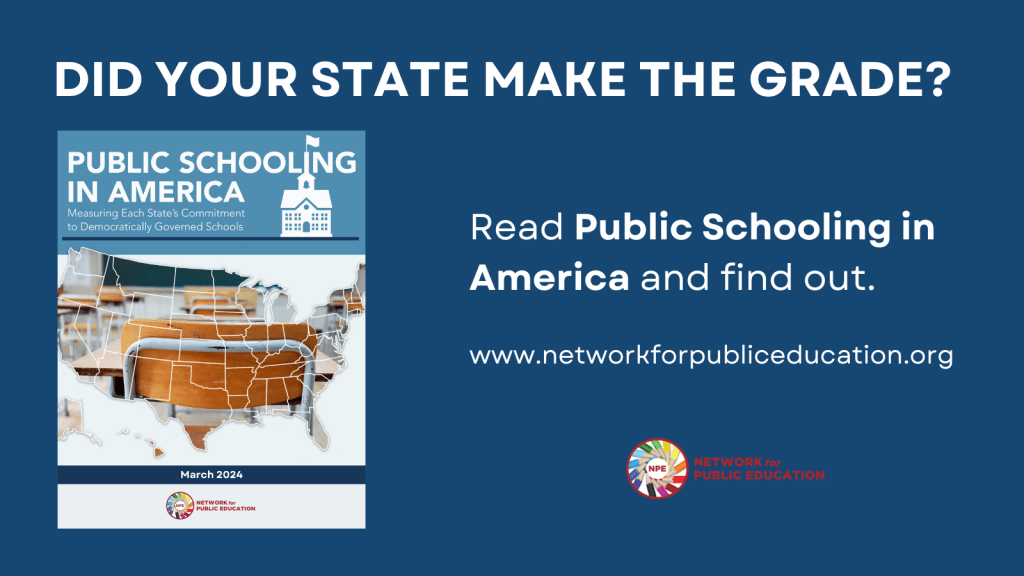
The Network for Public Education released a report card today grading the states on their support for democratically-governed public schools. Which states rank highest in supporting their public schools? Open the report to find out.

Measuring Each State’s Commitment to
Democratically Governed Schools

EXECUTIVE SUMMARY


Neighborhood public schools remain the first choice of the overwhelming majority of Ameri-
can families. Despite their popularity, schools, which are embedded in communities and gov-
erned by elected neighbors, have been the target of an unrelenting attack from the extreme
right. This has resulted in some state legislatures and governors defunding and castigating
public schools while funding alternative models of K-12 education.

This 2024 report, Public Schooling in America: Measuring Each State’s Commitment to
Democratically Governed Schools
, examines these trends, reporting on each state’s commit-
ment to supporting its public schools and the children who attend them.

What We Measure

We measure the extent of privatization in each state and whether charter and voucher laws
promote or discourage equity, responsibility, transparency, and accountability. We also rate
them on the strength of the guardrails they place on voucher and charter systems to protect
students and taxpayers from discrimination, corruption and fraud.

Recognizing that part of the anti-public school strategy is to defund public schools, we rate
states on how responsibly they finance their public schools through adequate and equitable
funding and by providing living wage salaries for teachers.

As the homeschool movement grows and becomes commercialized and publicly funded,
homeschooling laws deserve public scrutiny. Therefore, we rate states on laws that protect
children whose families homeschool.

Finally, we include a new expansive category, freedom to teach and learn, which rewards
states that reject book bans, and the use of unqualified teachers, intolerance of LGBTQ stu-
dents, corporal punishment, and other factors that impinge on teachers’ and students’ rights.

How does your state rank?

Michael Hiltzik of the Los Angeles Times reports on Elon Musk’s latest foray into disrupting the lives of other people. He’s suing to destroy the National Labor Relations Board because it is weighing in on his company’s decision to fire some workers.

We are witnessing the accelerated rollback of the New Deal and the past nine decades of progressive reforms.

He writes:

Few business leaders have taken to heart more than Elon Musk the old lawyer’s saw that if you don’t have the facts or the law on your side at trial, pound the table.

Musk has truculently flouted regulatory standards of all varieties as the guiding spirit of companies such as Twitter, Tesla and SpaceX — keeping factories open despite pandemic shutdown orders, allegedly committing securities fraud by issuing misleading tweets about his investment plans and ignoring government safety recommendations for self-driving automotive technologies.

As I’ve reported, Musk has gotten his way with regulators and municipal officials “through bluster and intimidation.”

Now he’s trying what may be his most audacious flip-off to regulators yet:

Faced with an accusation by the National Labor Relations Board that SpaceX improperly fired nine employees in 2022, among other illegal acts, the company, which is controlled by Musk, filed a lawsuit in federal court in Texas to declare the NLRB’s action — indeed, the board itself — unconstitutional.

Now he’s trying what may be his most audacious flip-off to regulators yet:

Faced with an accusation by the National Labor Relations Board that SpaceX improperly fired nine employees in 2022, among other illegal acts, the company, which is controlled by Musk, filed a lawsuit in federal court in Texas to declare the NLRB’s action — indeed, the board itself — unconstitutional.

There’s more to it than that, however. The SpaceX lawsuit takes direct aim at the very enforcement structure of the NLRB, through which appointed administrative law judges weigh unfair labor practice charges laid against employers and recommend penalties to be imposed by the board itself.

The company’s argument is that because the judges are largely immune from being fired other than “for good cause,” their role in enforcement deprives accused parties of their constitutional right to trial by jury.

It also asserts that the board’s power to act as judge and jury in employment cases and the members’ immunity from being removed by the president violates the separation of powers principle in the Constitution. In sum, SpaceX claims that it’s being held “subject to unlawful proceedings before an unconstitutionally structured agency.”

More such claims are in the offing from businesses facing regulatory scrutiny. According to a transcript obtained by Bloomberg, grocery chain Trader Joe’s made the same argument at a Jan. 16 NLRB hearing on charges that it engaged in illegal union-busting by retaliating against unionization advocates among its workers.

What are these companies up to? The SpaceX claims are unusual, but they’re not unique in recent regulatory litigation. Similar claims have been brought against the Securities and Exchange Commission and the Consumer Financial Protection Bureau.

“This is an effort by a group of lawyers who are foes of the administrative state and the New Deal-era legislation that created the NLRB and the SEC to essentially end enforcement of those statutes,” says Catherine Fisk, an employment and labor law authority at UC Berkeley law school.

Unable to challenge the laws themselves — they’ve been upheld by Supreme Court decisions dating back to the 1930s — or the regulations directly, Fisk told me, “they’re arguing that the administrative structure is in some part unconstitutional.”

Before delving into the details of the SpaceX lawsuit, let’s examine the NLRB’s enforcement case. The agency says SpaceX illegally fired the nine workers for circulating an open lettercomplaining about Musk’s “repeated conduct of issuing inappropriate, disparaging, sexually charged comments on Twitter,” which he owns. The silence of SpaceX management about Musk’s conduct, the letter said, allowed a “culture of sexism, harassment and discrimination” to “pervade … the workplace.”

The NLRB filed a formal complaint against SpaceX on Jan. 3, encompassing not only the firings but charges that it illegally interrogated workers and conducted illegal surveillance of their activities. The agency scheduled a hearing on the charges before an administrative law judge for March 5 in Los Angeles.

The very next day, SpaceX filed its lawsuit.

By some measures, SpaceX’s response to the NLRB charges might be interpreted as overkill. Even if it’s found to have committed all the violations, the consequences are meager. The NLRB can’t levy monetary fines.

It can order back pay and reinstatement for workers who have been wrongly discharged, but those wouldn’t make much of a dent in the finances of a company that was reported to have brought in $8 billion in revenue last year from government and commercial contracts.

Moreover, SpaceX hasn’t yet come before an administrative law judge over the NLRB charges, much less having them voted on by the full board. Its lawsuit, then, looks like a shot across the NLRB’s bow. The company asks the trial judge in Texas to block the NLRB’s case against it, declare that the NLRB’s structure is unconstitutional, and permanently prohibit the agency from pursuing unfair labor practice charges via administrative law judges.

That points to the conclusion that this case, and others like it, aim to exploit the veer to the right seen throughout the federal judiciary generally and the Supreme Court in particular.

This variety of attack on regulations went out of fashion in the 1930s, Fisk observes. The Supreme Court, which had overturned a sheaf of New Deal initiatives as well as state minimum wage laws, turned back to the middle in the face of rising public disdain and the court-packing scheme of Franklin Roosevelt.

FDR ultimately abandoned his proposal, but after 1936 the court ceased ruling against the New Deal — upholding the National Labor Relations Act, which created the NLRB, in 1937.

“For 85 years, those arguments weren’t made,” Fisk says, “because lawyers knew that they would get nowhere with them — they might even get sanctioned. The Supreme Court signaled that it was up to Congress to design regulatory structures.”

But today’s Supreme Court isn’t your great-grandfather’s Supreme Court. “The Supreme Court has given lawyers reason to think that they might be able to invalidate part or all of these statutes as being unconstitutional.”

As recently as last week, a majority of justices appeared ready to overturn or at least pare back the so-called Chevron doctrine, the nearly 40-year-old principle that courts should defer to agencies’ interpretations of their governing laws as long as those interpretations aren’t plainly unreasonable.

Overturning the doctrine, as industry litigants urged the court to do during oral arguments Jan. 17, could sap regulatory agencies’ ability to base their rule-making on expert advice.

Although Congress could theoretically overcome any regulatory problems created by an adverse court ruling by amending the laws in question, that’s not a good bet given the profound dysfunction reigning these days on Capitol Hill. The industries will have achieved their goals for years into the future.

That brings us to Musk’s litigation strategy. SpaceX filed its lawsuit against the NLRB not in Southern California, where the company is headquartered, or Washington, D.C., where the NLRB maintains its main office, but in federal court in Brownsville, Texas, a judicial outpost on the Mexican border. This reflects the practice of filing anti-government lawsuits in remote federal courtrooms in Texas, where plaintiffs have a good chance of drawing a right-wing judge.

On the face of it, that tactic may have failed in this case, because the Brownsville court has two judges, one of whom was appointed by Donald Trump and the other by Barack Obama, and the SpaceX case was assigned to Rolando Olvera, who was Obama’s appointee.

SpaceX, however, is playing a longer game. Any appeal from the Texas federal court would go to the extremely conservative U.S. 5th Circuit Court of Appeals, which I’ve described in the past as “the hackiest of hack-ridden federal courts.”

The New Orleans-based appellate court upheld Texas’ malevolent SB 8 antiabortion law in 2022, for example, after which the Supreme Court allowed the law to go into effect.

Last year it partially endorsed a ruling by federal Judge Matthew Kacsmaryk of Texas narrowing access to the abortion drug mifepristone. Kacsmaryk’s ruling was based on a tendentious and long-abandoned reading of an antique 1873 law, but that was enough for the issue to come before the Supreme Court, which has the case on its docket this year.

More to the point, the 5th Circuit has implicitly endorsed the practice of challenging regulations by taking aim at the constitutionality of regulatory agencies. It did so in a case targeting the Consumer Financial Protection Bureau brought by the payday lending industry, which has long been in the CFPB’s crosshairs.

A 5th Circuit panel composed of three Trump-appointed judges ruled the bureau’s funding mechanism unconstitutional; the government appealed that ruling to the Supreme Court, which heard oral arguments on Oct. 3 but hasn’t yet ruled….

The NLRB has called foul on SpaceX’s choice of venue, calling the company’s rationale for filing in Brownsville “less than paper thin.” The allegedly unlawful conduct of SpaceX took place entirely at the company’s headquarters in the Southern California enclave of Hawthorne, and nothing actually happened in Texas. The government has asked Olvera to transfer the case to federal court in Los Angeles, but he hasn’t yet ruled.

Put it all together, and the SpaceX lawsuit bears watching.

As I’ve written before, conservative federal judges, many of them appointed by Trump, have the power to move the country to the far right for decades to come, eroding reproductive health care, eviscerating gun control laws and making life more difficult for ordinary Americans depending on the federal government to protect their rights. Elon Musk, pursuing his own personal interests, is urging them to keep at it.

Several readers told me they were unable to access my conversation with Todd Scholl of the South Carolina Center for Educatot Wellness and Learning.

We talked about attacks on public schools, standardized testing, and privatization.

Todd sent these links:

The video can be found on the CEWL website at www.cewl.us. A direct link to the video can be found at https://youtu.be/Zm0Vi3S3RLM.

I will be in conversation with Todd Scholl of the Center for Educator Wellness & Learning in South Carolina tonight February 15 at 7 pm EST.

We will talk about privatization of public schools and the attacks on public schools.

The conversation will be livestreamed on Facebook.

Tonight February 15 at 7 pm.

This report was written by Tanisha Pruitt, Ph.D., for Policy Matters Ohio in April 2023. It provides a comprehensive review of the funding of K-12 education in the state. The state has 1.6 million students. The state Constitution says (Article 6, section 2):

The General Assembly shall make such provisions, by taxation, or otherwise, as, with the income arising from the school trust fund, will secure a thorough and efficient system of common schools throughout the state; but no religious or other sect, or sects, shall ever have any exclusive right to, or control of, any part of the school funds of this state.

The legislature and governor of Ohio apparently believe that the state Constitution does not mean what it says. The Republican leadership has steadily increased the funding of charter schools (which are not “common schools,” but are privately managed schools, some for-profit) and vouchers, which go primarily up religious schools.

The report was written before the legislature lifted income caps on vouchers, agreeing to subsidize the tuition of all students regardless of family income.

Please open the link to see the graphs.

The Policy Matters Ohio report begins:

School is a place where childhood happens. Ohio’s public educators teach children of all races and backgrounds basic skills, but also challenge and inspire them to follow their dreams. For many students, school is a safe place to learn, develop and grow.

Ohio currently educates 1.6 million children attending school in our cities, suburbs and small towns. For years, almost no one was happy about how the state of Ohio funded public schools. The system pitted communities against each other and private and charter schools against public schools. We were living in the K-12 version of the “Hunger Games”: The wealthier your district, the stronger your chances of success.

Most state lawmakers signed off on a system that relied too heavily on local property taxes,[1] so communities where many residents have low incomes struggled to pay for the basics like updated resources and teaching materials. The state capped the funding it sent to some districts, often leaving those districts feeling cheated. In others, state funding failed to keep up with changing costs and student needs. Since 2005, lawmakers have been systematically sending more resources to the wealthiest Ohioans by cutting the state income tax, which accounts for nearly one-third of the state’s spending on schools. Meanwhile, lawmakers have diverted almost $1 billion a year from local levies to private and charter schools.[2]

These policy choices have taken a toll on Ohio’s educational outcomes. Education Week ranks Ohio 46th in the nation for equitable distribution of funding.[3] The performance metrics included: (1) state spending by examining per-pupil expenditures adjusted for regional cost differences, the percent of students in districts with per-pupil spending at or above the national average, spending index, and percent of total taxable resources spent on education and (2) Equity, by examining the degree to which education funding is equitably distributed across the districts within the state.[4]

The pandemic has contributed to a decline in test scores, which could have an impact on our overall ranking, if we do not get students caught up.[5] Over nearly two decades, we can draw a straight line between the racial and economic achievement gaps and the lack of funding to provide Black, brown, economically disadvantaged students[6] and students with disabilities what they need to succeed in school.

Ohio’s schools are becoming more racially and ethnically diverse; the Hispanic[7]population (a close proxy for Latinx) alone has more than doubled over the last 10 years.[8] Student poverty is also on the rise with 51% of students considered economically disadvantaged and the homeless student population doubling over the last decade.[9]

COVID-19 created unstable and even chaotic learning environments across Ohio. The elevated stress and social isolation caused by the move to virtual learning[10]exacerbated students’ need for mental health services.[11] The pandemic continues to take a toll on educators as well. COVID and other outbreaks are making educators sick. Moreover, increased stress and low pay cause many educators to leave the profession. Districts across the state have grappled with unprecedented staff shortages. For example, Columbus City Schools (CCS) had 800 employees absent every day during the height of the pandemic.[12] Hamilton City School officials were forced to cancel classes when 170 staff members were out due to illness.[13]

COVID has especially hammered school districts in communities that can’t raise enough money through local property taxes — especially in big cities, where Black, brown and economically disadvantaged students are more likely to live.[14] Schools in these communities often have fewer resources for COVID mitigation efforts like improving ventilation.[15]

Long before COVID, many policymakers neglected public schools, siphoning away their funding for tax giveaways[16] to corporations and undercutting them with schemes that send public money to charters and private schools. Combined with the effects of COVID, Ohio’s legacy of inadequate and inequitable funding has weakened the role school plays as a foundational public service for families and communities. For our state to be a vibrant place where people want to live, we need fully and fairly funded schools in all districts, no matter what students look like, or how much money their families have.

This report describes how the state funds public K-12 education and some key investments proposed in the 2024-25 Executive Budget, the legacy of unconstitutional funding, the role private school vouchers play in harming public schools, and how the Fair School Funding Plan — when fully funded and fully implemented, including weights and cost corrections — can provide districts with more resources to prepare Ohio’s children to succeed.

A brief history of Ohio school funding

The framers of Ohio’s constitution obligated the state to provide a “thorough and efficient system of common schools” for all students.[17] In 1991, the Ohio Coalition for Equity & Adequacy of School Funding, representing more than 500 school districts in Ohio, filed suit in the Perry County courts against the State of Ohio for failing to uphold this constitutional requirement.[18] In DeRolph vs. The State of Ohio — named for Perry County school district student Nathan DeRolph — plaintiffs argued the state was failing to live up to its obligation due to over-reliance on local property taxes for school funding: In wealthy communities, high property values generated revenues needed to provide students with more resources for cutting-edge technology, advanced classes, and extracurricular activities; the opposite was true in poor communities. This left schools in cities, rural areas and many low-income communities severely under-resourced, significantly harming outcomes for their students.

The litigation dragged on until 1994 when Perry County Court Judge Linton Lewis, Jr. ruled that “public education is a fundamental right in the state of Ohio” and that the state legislature must provide a better and more equitable means of financing education.

The DeRolph case was the start of a foundational shift in the school funding system in Ohio, but the fight for constitutional and equitable funding continued for decades following the ruling. By failing to keep up with inflation and by diverting public funds to charter schools[19] and vouchers (i.e., scholarships to private schools), lawmakers in fact cut state aid to traditional public schools over time.[20] As a result, public schools have increasingly relied even more on local resources, which exacerbates the problem of unequal funding and quality across districts,[21] a problem that persists today….

Public dollars, private benefits

Two smaller education systems run alongside Ohio’s traditional public schools: charters and private schools. When legislators redirect funding from traditional public schools to pay for charters and vouchers (which pass public dollars through parents and into private schools), the vast majority of Ohio students who attend traditional public schools have to make do with less.

In Ohio charter schools have been branded “community schools” and are considered “public” because they cannot charge tuition and they are supposed to accept all students. However, charter schools do not necessarily serve the public good. Charter school sponsors may contract with for-profit companies to operate the schools. In 2020, Ohio had 313 charter schools serving 102,645 students and 178 (57%) of them were operated by for-profit entities.[48]These “operators” have been the source of much scandal in Ohio. Simply put: The charter system in Ohio has lots of loopholes for private, profit-seeking companies to siphon off public dollars.

In FY 2022 the state sent $1.45 billion to charter schools — up from nearly $620 million in 2007.[49] During that time, Ohio’s legislators earned our state a reputation as “the wild west of charter schools” by failing to hold charters and their operators accountable.[50] Problems with Ohio’s charter school system came to a head with the ECOT scandal: A for-profit online charter school, the Electronic Classroom of Tomorrow squandered millions in public money by inflating enrollment numbers.[51] Other charter scandals have prompted rounds of legislative reform to reduce self-dealing, prevent the state from paying for students who were not actually attending school, and stop attempts at double-dipping by selling state-purchased materials back to the state for even more public dollars.[52]

The Ohio Charter School Accountability Project, a joint effort of the Ohio Education Association (OEA) and Innovation Ohio, using data primarily from the Ohio Department of Education (ODE), created a tool to help Ohioans know the state of publicly funded charters and private schools that accept public vouchers, and how they compare to traditional school districts. Analysis includes state report card rankings, classroom expenditures, and state aid deductions to charter schools. This system is intended to provide transparency so that parents, teachers, students and advocates can hold charter schools accountable.[53]

Based on the recent Annual Community Schools report conducted by the Ohio Department of Education (ODE),[54]community schools in Ohio are receiving more funding through the Quality Community School Support Grant (QCSS). Eligibility requirements for these grants are based on performance standards and overall academic achievement. In the current budget lawmakers increased funding to QCSS to $54 million for FY 2022, a $24 million increase from 2021. This increase includes a per-pupil increase of $1,750 for economically disadvantaged students and a $1,000 per-pupil increase for all other students.[55]

Vouchers eat up state funding for K-12 schools

As problematic as under-regulated charter schools can be, the proliferation of private school vouchers has had the most serious consequences for public schools and the vast majority of Ohio students who attend them. Since the Cleveland Voucher Program for low-income students in Cleveland City Schools launched in 1996, policymakers have expanded voucher programs across the state. Ohio currently has four main school voucher programs: the Educational Choice (EdChoice) Scholarship Program, the Cleveland Scholarship and Tutoring Program (CSTP), the Autism Scholarship Program, and the Jon Peterson Special Needs (JPSN) Scholarship Program. The EdChoice program is split into two types: the Traditional EdChoice Scholarship, also known as performance-based EdChoice, and the EdChoice Expansion Scholarship, also known as income-based EdChoice.

Policymakers introduced the Traditional EdChoice scholarship program in 2005 and continue to expand it. The EdChoice Expansion program was introduced in 2014 and has also expanded in scope. The performance-based EdChoice program is available to students in underperforming school districts, while the income-based EdChoice program is available to low-income students. The Cleveland Scholarship is for all K-12 students in the Cleveland Metropolitan School District. The other two scholarships, Autism and JPSN, are for autistic students and students with any disability, respectively.

What started as a program to provide alternative education options for students in what the state perceived to be underachieving schools has now expanded to include students from public schools with high achievement grades. According to a brief by the Northwest Local School District, 47.7% of the buildings on the current list of Ohio schools eligible for vouchers have overall grades of “A,” “B,” or “C” under the state’s report card system. The number of eligible schools has also grown rapidly. During the 2018-19 school year Ohio had fewer than 300 school buildings that were considered eligible; by 2020-21, 1,200 school buildings were eligible: a 300% increase in just two years.[56] Similarly, income-based vouchers are now being proposed for families earning up to 400% of the federal poverty level. This expansion would be a costly and needless expansion, subsidizing private education for families that need no help. A family of four could earn up to $120,000 and be considered income eligible. This expansion will make vouchers nearly universal, by providing an additional handout to upper-middle-class families at the expense of public schools.

Vouchers in the state budget

After years of tax cuts for the wealthy and corporations that have drained resources from public schools, and as COVID has created new pressures, the state further undercuts public schools by pumping hundreds of millions of public dollars into private schools.[57]

The 2022-23 biennial budget expanded funding of private schools, especially through EdChoice and other voucher programs. Traditional, performance-based EdChoice received $212.5 million, and the income-based EdChoice Expansion program received close to $103 million, a combined 61.4% of voucher payments statewide in FY 2022. The Autism and JPSN scholarships received $116.5 million and $76.6 million, respectively, making up 17% and 12.4% of distributed scholarship funds. The Cleveland Scholarship program received $46 million and only makes up 9.1% of distributed scholarship funds.[58]

Legislators have increased voucher payments from state funds since 2014, as illustrated in Figure 6.[59]

Figure 6
https://datawrapper.dwcdn.net/7sKMh/2/

The FSFP funds vouchers directly instead of allowing them siphon away districts’ state funding. Lawmakers increased total voucher allocations from $395.4 million in FY 2020 to $635.1 million in FY 2022.[60]They also increased direct state aid to private schools, though not as dramatically. Policymakers increased funding for “auxiliary services” to private schools from $149.9 million in FY 2021 to $154.1 in FY 2022 and just under $156 million in FY 2023. Meanwhile, “nonpublic administrative cost reimbursement” aid — which reimburses charter schools for the cost of mandated administrative and clerical activities such as preparation, filing and records keeping[61] — increased from $68.9 in FY 2021 to $70.8 in FY 2022 and $71.6 in FY 2023.[62]

Lawmakers have increased spending on vouchers by increasing the amount families can receive. For income-based EdChoice Expansion vouchers for FY 2022-23 the state now awards qualifying K-8 students $5,500 per year and high school students $7,500 per year for tuition at non-public schools, up from previous award amounts in FY 2020-21 which provided $4,650 for K-8 students and $6,000 for students grades 9-12.[63]….

Voucher expansion threatens our public schools

Because of the General Assembly’s continued expansion of voucher programs, more Ohio families are enrolling in them — up from 52,000 in 2019 to 69,991 in 2021. Even accounting for this growth, most voucher students were already attending private school before receiving vouchers.[64] Further, the number of vouchers is a fraction of the number of students served in public schools. When students use state-funded vouchers to attend private schools, even if they were never enrolled in traditional school districts, it means less money in the state budget that could otherwise be spent creating great public schools, which must serve all students.

The Ohio Coalition for Equity and Adequacy of School Funding, a coalition of over 100 school district and 20 education and community groups, took the state of Ohio to court, claiming that EdChoice Expansion violates the constitutional requirement that the state provide a “thorough and efficient system of common schools.” Coalition advocates believe that state lawmakers’ growing investment in vouchers could lead to a school funding system that privileges private education even more in years to come.[65]

Many proponents of voucher expansion have painted it as the state simply supporting parents’ right to choose where their child will be educated, but choice is not the problem, priorities are. The state has not fulfilled its constitutionally mandated responsibility to fairly fund public schools. Key components of the FSFP are still outstanding. Allocating close to $1 billion in public funds for students to take vouchers to private schools is a huge disservice to the 90% of students who attend our public schools.

Ultimately, the way the executive budget proposes to distribute foundation aid over FY 2024-25 will further erode the share going to traditional public schools by allocating a greater share to charters. The proposed budget would send 77.9% of foundation funds to traditional schools, compared to 79.1% in the last budget. Charters would take 10.8%, up from 9.9%. Voucher programs stay at 7.1%, and joint vocational school districts increase to 4.2% from 3.8%.

Recommendations & conclusion

Ohio has underfunded public schools and other essential public services for years.[66] Ohio lawmakers have cut state income taxes since 2005, reducing our ability to provide an equitable education system for all our students, and giving huge windfalls to the wealthiest Ohioans and little or no benefit to people with middle or low incomes.

Policymakers have a constitutional duty to protect public schools. Ensuring a thorough and efficient system of common schools means correcting disparities generated from over-reliance on property taxes by fully implementing the FSFP, with accurate estimates of how much it really costs to educate our kids.

Lawmakers in Ohio need to invest in developing an educator workforce of qualified teachers who are paid fairly for their essential work and strongly supported while doing it. Other pressing issues include a bussing crisis,[67] fewer 5-year-olds prepared for kindergarten,[68]lowered reading and math proficiency scores,[69] chronic absenteeism,[70] and a persistent digital divide.[71]

The state has sufficient revenue to meet these challenges, so long as legislators make public schools and kids a priority. Ohio has the money to fully commit to the FSFP in this budget. Instead of phasing in funding piece by piece, year after year, lawmakers should fully fund it right now. Ohioans must come together to demand lawmakers live up to the promise of the FSFP in the next biennium and beyond.