Archives for category: Democrats

Paul Bonner is a retired public school leader.

He has an idea for the Democratic Party that would resonate with the 90% of Americans who went to public schools and whose children attend public schools.

Here’s an ad I would run if I were a PAC supporting the Democratic Party:

Narrator: (As numerous images of schools, students, and teachers engaged in learning are shown across the screen)

“In the early twentieth century the United States of America reinforced a universal commitment to Public Schools. This resulted in an economic powerhouse that generated more wealth than at any time in the history of the world. The alumni of these schools led Democratic governments in the defeat of tyranny in World War II and resulted in the establishment of universities that are the envy of the world. Industry and finance thrived. Yes, the public schools did this.”

(Pan to politicians advocating privatization and attacking teachers)

“Today, there are those who would like to pretend that the public schools have been a failure. That government efforts to educate our children could never produce the work force that would result from subsidies for private efforts. They are wrong!”

(Show closed charter buildings and parents seeking help for their children)

“Any implementation of vouchers has resulted in subsidies for those who already attend private schools, charters have not outperformed public schools academically, and closing public schools with unfulfilled promises of better results has resulted in decimated communities.”


(Pan to schools and parents who are engaged with their public schools in the myriad of ways this happens every day).

The only way to improve educational opportunity in America is to vigorously fund our Public Schools. To support teachers through greater resources, district support, and higher pay. To provide facilities that are equally great in all communities. America has thrived through our support of public schools. We as citizens, need to recommit to Public Schools with our purse and our fervor.”

Historian Heather Cox Richardson brilliantly contrasts the views of Republicans and Democrats on the role of government. Republicans want it to be as minimal as possible. Democrats want it to use its powers and resources to improve people’s lives. Understanding this difference helps illuminate why Republicans want to get rid of public schools and why billionaires like Charles Koch and Betsy DeVos support vouchers and libertarianism in a society where everyone is on their own.

Yesterday, the Republican Study Committee, a 175-member group of far-right House members, released their 2024 “Blueprint to Save America” budget plan. It calls for slashing the federal budget by raising the age at which retirees can start claiming Social Security benefits from 67 to 69, privatizing Medicare, and enacting dramatic tax cuts that will starve the federal government.

I’m actually not going to rehash the 122-page plan. Let’s take a look at the larger picture.

This budget dismisses the plans of “President Joe Biden and the left” as a “march toward socialism.” It says that “[t]he left’s calls to increase taxes to close the deficit would be…catastrophic for our nation.” Asserting that “the path to prosperity does not come from the Democrats’ approach of expanding government,” it claims that “[o]ver the past year and a half, the American people have seen that experiment fail firsthand.”

Instead, it says, “the key to growth, innovation, and flourishing communities” is “[i]ndividuals, free from the burdens of a burdensome government.” 

It is?

Our history actually tells us how these two contrasting visions of the government play out.

Grover Norquist, one of the key architects of the Republican argument that the solution to societal ills is tax cuts, in 2010 described to Rebecca Elliott of the Harvard Crimson how he sees the role of government. “Government should enforce [the] rule of law,” he said. “It should enforce contracts, it should protect people bodily from being attacked by criminals. And when the government does those things, it is facilitating liberty. When it goes beyond those things, it becomes destructive to both human happiness and human liberty.”

Norquist vehemently opposed taxation, saying that “it’s not any of the government’s business who earns what, as long as they earn it legitimately,” and proposed cutting government spending down to 8% of gross national product, or GDP, the value of the final goods and services produced in the United States. 

The last time the level of government spending was at that 8% of GDP was 1933, before the New Deal. In that year, after years of extraordinary corporate profits, the banking system had collapsed, the unemployment rate was nearly 25%, prices and productivity were plummeting, wages were cratering, factories had shut down, farmers were losing their land to foreclosure. Children worked in the fields and factories, elderly and disabled people ate from garbage cans, unregulated banks gambled away people’s money, business owners treated their workers as they wished. Within a year the Great Plains would be blowing away as extensive deep plowing had damaged the land, making it vulnerable to drought. Republican leaders insisted the primary solution to the crisis was individual enterprise and private charity. 

When he accepted the Democratic nomination for president in July 1932, New York governor Franklin Delano Roosevelt vowed to steer between the radical extremes of fascism and communism to deliver a “New Deal” to the American people. 

The so-called alphabet soup of the New Deal gave us the regulation of banks and businesses, protections for workers, an end to child labor in factories, repair of the damage to the Great Plains, new municipal buildings and roads and airports, rural electrification, investment in painters and writers, and Social Security for workers who were injured or unemployed. Government outlays as a percentage of GDP began to rise. World War II shot them off the charts, to more than 40% of GDP, as the United States helped the world fight fascism. 

That number dropped again after the war, and in 1975, federal expenditures settled in at about 20% of GDP. Except for short-term spikes after financial crises (spending shot up to 24% after the 2008 crash, for example, and to 31% during the 2020 pandemic, a high from which it is still coming down), the spending-to-GDP ratio has remained at about that set point.

So why is there a growing debt?

Because tax revenues have plummeted. Tax cuts under the George W. Bush and Trump administrations are responsible for 57% of the increase in the ratio of the debt to the economy, 90% if you exclude the emergency expenditures of the pandemic. The United States is nowhere close to the average tax burden of the 38 other nations in the Organization of Economic Cooperation and Development (OECD), all of which are market-oriented democracies. And those cuts have gone primarily to the wealthy and corporations. 

Republicans who backed those tax cuts now insist that the only way to deal with the growing debt is to get rid of the government that regulated business, provided a basic social safety net, promoted infrastructure, and eventually promoted civil rights, all elements that stabilized the nation after the older system gave us the Depression. Indeed, the Republican Study Committee calls for making the Trump tax cuts, scheduled to expire in 2025, permanent. 

“There are two ways of viewing the government’s duty in matters affecting economic and social life,” FDR said in his acceptance speech. “The first sees to it that a favored few are helped and hopes that some of their prosperity will leak through, sift through, to labor, to the farmer, to the small businessman.” The other “is based upon the simple moral principle: the welfare and the soundness of a nation depend first upon what the great mass of the people wish and need; and second, whether or not they are getting it.”

When the Republican Study Committee calls Biden’s policies—which have led to record employment, a booming economy, and a narrowing gap between rich and poor— “leftist,” they have lost the thread of our history. The system that restored the nation after 1933 and held the nation stable until 1981 is not socialism or radicalism; it is one of the strongest parts of our American tradition.

Notes:

Jeff Bryant writes often about education. He lives in North Carolina. In this article, he tries to solve the mystery of why Democratic state legislator Tricia Cotham switched sides and joined the Republican Party, giving them a supermajority in both houses of the General Assembly?

Cotham was a Democrat who had campaigned in promises to oppose school vouchers; to defend LGBT rights; and support abortion rights.

Once she gave the Republicans the decisive vote in the lower house, the Republicans had a veto-proof majority and were in a position to override any veto by Democratic Governor Roy Cooper.

Cotham, the new Republican, reversed her vote on everything she campaigned for or against. She supported Republicans’ efforts to reduce abortion rights; she endorsed school vouchers; and she sided with Republicans in their attack on trans youth.

In other words, she betrayed the people who voted for her and cast her lot with the hard-right Republicans who have aligned themselves with anti-progressive, anti-liberal, anti-Democrat policies.

Why? She said the Democrats were mean to her. She said they ignored her. She said she didn’t get the committee assignments she wanted. Are these good reasons to join forces with a party that has sought to destroy public education, demoralize teachers, and gerrymander the state to protect its advantages?

None of this made sense. A person doesn’t change their fundamental values because of hurt feelings.

Jeff investigated and determined that her decision was transactional. What did she get in exchange for double-crossing her constituents and her colleagues? Read his article to find out.

Harold Meyerson of The American Prospect writes here about the sharp divergence between red states and blue states. Their elected officials have very different ideas about how to build their state and serve the needs of the public. There is one issue that he overlooked: vouchers. Red states are busy handing out tax dollars to families whose children are already enrolled in private and religious schools and tearing down the wall of separation between church and state.

Which side are you on?

He writes:

Two Prospect pieces on red and blue trifecta states make clear we really are two separate nations.

If there’s anyone who’s still mystified about why congressional Democrats and Republicans can’t come to an agreement on anything so basic as honoring the debts they’ve incurred, may I gently suggest they take a look at what Democrats and Republicans are doing in the particular states they each completely control.

Yesterday, we posted a piece by my colleague Ryan Cooper on how Minnesota, where Democrats now control both houses of the legislature and the governor’s office, has just enacted its own (to be sure, scaled-back) version of Scandinavian social democracy—including paid sick leave for all, paid family leave, a minimum wage for Uber and Lyft drivers, sector-wide collective bargaining in key industries, and the outlawing of “captive audience” meetings, in which management compels employees to attend anti-union rants. A new law also strengthens women’s right to an abortion. Similar laws have been enacted or are under consideration in other Democratic “trifecta” states, though none quite so pro-worker as some of Minnesota’s.

Also yesterday, we posted one of my pieces, this one on everything that Texas’s Republican legislature and governor are enacting to strip power from their large cities, almost all of which are solidly Democratic. One new bill says the state can declare elections to be invalid and compel new ones to be held under state supervision in the state’s largest county, Harris County, which is home to reliably Democratic Houston. And the state Senate has also passed a bill that would strip from cities the ability to pass any regulations on wages, workplace safety, business and financial practices, the environment, and the extent of property rights that exceed the standards set by the state. Which leaves cities with the power to do essentially nothing. No other Republican trifecta states have gone quite as far as Texas, but Tennessee’s legislature did effectively abolish Nashville’s congressional district and expel its assemblymember; Alabama’s legislature revoked Birmingham’s minimum-wage law; and Florida’s governor suspended Tampa’s elected DA because he wouldn’t prosecute women and doctors for violating the state’s new anti-abortion statutes. Beyond their war on cities, Republican trifecta states have long refused to expand Medicaid coverage, have recently also begun to re-legalize child labor and legislate prison terms for librarians whose shelves hold banned books, and in the wake of the Dobbsdecision, criminalized abortions.

Just as cosmic inflation propels the stars away from each other with ever-expanding speed, so Democratic and Republican states are also moving away from each other at an accelerating pace—the Democrats toward a more humane future; the Republicans borne back ceaselessly into a nightmare version of the past. Any dispassionate view of America today has to conclude that the differences between these two Americas are almost as large and intractable as those that split the nation in 1860 and ’61. (The South’s opposition to fairly paid and nondiscriminatory labor was the central issue then and remains a central issue now.)

That said, when confronted with the choice between those two Americas, voters in those red states have frequently backed the blue-state versions of economic rights and personal freedoms, as is clear from their many initiative and referendum votes to raise the minimum wage, expand Medicaid, and preserve the right to an abortion. Likewise, the polling on unions shows their national favorability rating now exceeds 70 percent of the public, including roughly half of self-declared Republicans. Only by their relentless demagoguery on culture-war issues and immigration, their adept gerrymandering, and the disproportionate power that the composition of the Senate vests in barely inhabited states can the Republicans enforce their biases against a rising public tide—but enforce them they do wherever they have the power.

All right, as John Dos Passos wrote in his USA Trilogy, we are two nations—and becoming more so with each passing day.


Postscript: In his Washington Post column…, Perry Bacon noted that while a number of news publications have gone under recently, a few, in his words, “are reimagining political journalism in smart ways.” He cited seven such publications, and his list was headed by—ahem—The American Prospect.

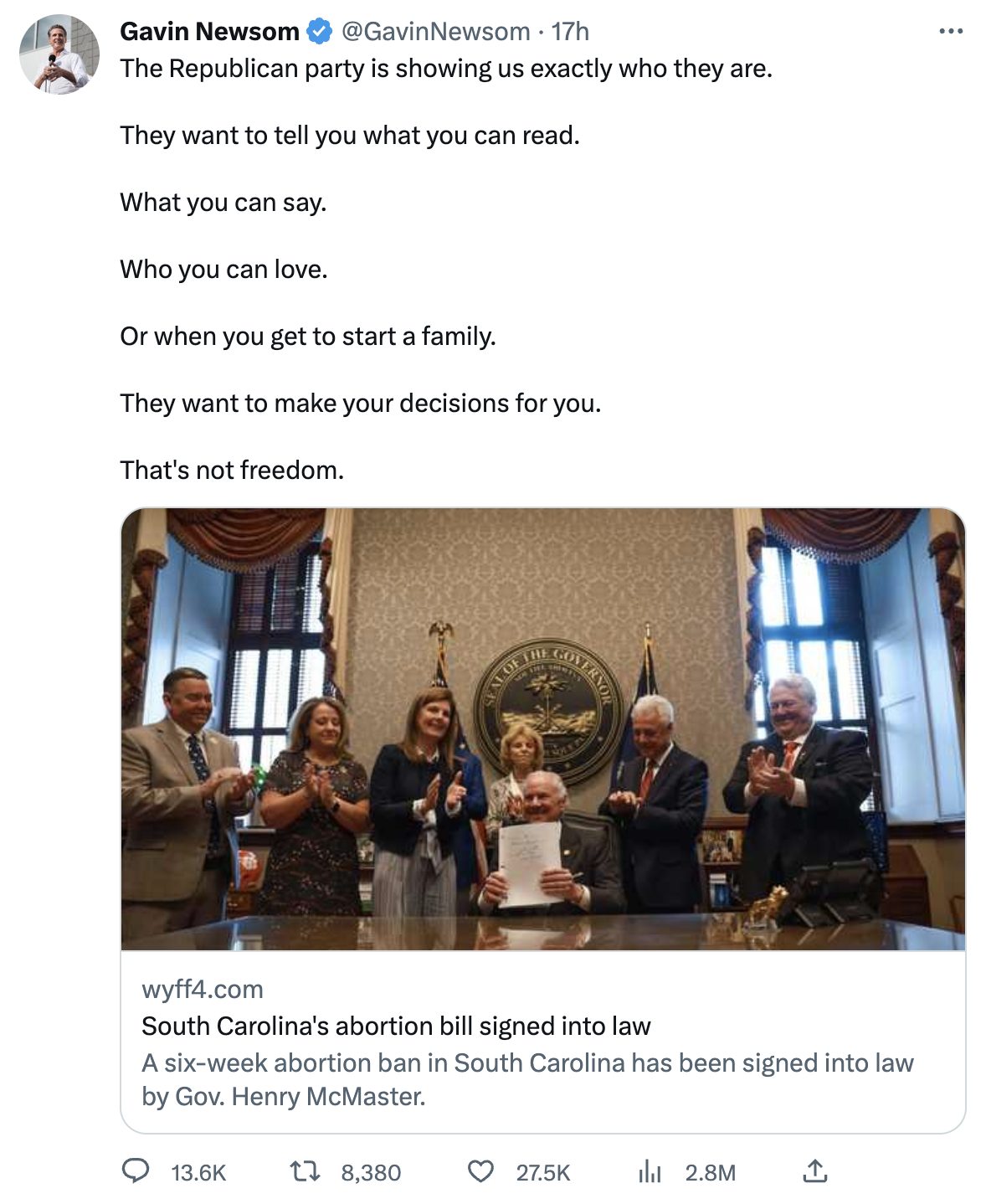
Gavin Newsom, Governor of California, regularly sends out emails pointing out the errors and hypocrisies of Republicans in other states. I enjoy them.

South Carolina, Diane…

Where the Republican governor just signed a six-week abortion ban, which he says will “begin saving lives.” All while that very same governor refuses to do anything about the fact South Carolina has one of the highest homicide rates in the country — more than 2x the rate of California.

Tweet from Gavin Newsom: 'The Republican party is showing us exactly who they are. They want to tell you what you can read. What you can say. Who you can love. Or when you get to start a family. They want to make your decisions for you. That's not freedom.'

You can’t make this up.

Today’s Republican party refuses to regulate assault weapons while gun violence is the leading cause of death of kids in America, but will champion the regulation of women’s bodies and take away reproductive freedom.

This is what Republicans want to do nationally.

And worse.

Be outraged.

Gavin

Michael Hiltzik of the Los Angeles Times explains how Republicans agreed to the increase in the debt ceiling: by cutting aid to the neediest. He wrote: The cruelty is the point.

No one should be surprised that the resolution of our most moronic fiscal policy, the federal debt ceiling, involved our stupidest social policy, work requirements for assistance programs.

But that appears to be the case. In negotiations between the Biden White House and House Speaker Kevin McCarthy’s Republican caucus, one of the last sticking points was whether, and by how much, to tighten work requirements for food stamps and welfare.

In coming days, as Congress moves toward votes on the deal, political commentators will thoroughly masticate the question of whether Biden or McCarthy (R-Bakersfield) prevailed in this dealmaking and which of them will be hurt or harmed politically by the outcome.

Democrats right now are willing to default on the debt so they can continue making welfare payments for people that are refusing to work.

— Rep. Garret Graves (R-La.) tells a giant lie about the debt ceiling negotiations

That’s not a very interesting parlor game. (Personally, I’d go with the judgment of Timothy Noah of the New Republic, who thinks Biden emerges as the political victor and McCarthy’s days as speaker are numbered, thanks to the choler of his far right wing.)

More important is what the deal says about the principles of both camps. The granular details of the agreement were still murky Sunday, and it could still collapse because of objections from congressional Republicans or Democrats.

The deal, as reported, freezes discretionary federal spending — that is, most of the programs for which Americans depend on the federal government — at current levels for the next two years, with increases lower than inflation. That means an effective budget cut, relative to inflation. In return, the debt ceiling is suspended for two years.

But Biden managed to preserve the accomplishments of his presidency thus far from the GOP’s knives. He fended off their efforts to torpedo the support for renewable energy in last year’s Inflation Reduction Act, their harshest proposed budget cuts, the rollback of student debt relief, and repeal of his budget increase for the Internal Revenue Service.

(Reports say that $10 billion will be shaved off the $80-billion 10-year IRS budget increase, but the money can be redirected to other programs.)

Biden rejected Republican demands to impose work requirements on Medicaid, but allowed some tightening of the rules for food stamps — the Supplemental Nutrition Assistance Program, or SNAP, and Temporary Assistance for Needy Families, or TANF, which is what’s left of traditional welfare.

Make no mistake: No rich American will be harmed even a bit by this deal. Some may even be advantaged, if the carve-out from the IRS budget comes from the agency’s enforcement efforts; that would help the rich, who are the nation’s worst tax cheats.

The most vulnerable Americans, however, will bear the brunt of the deal points. Let’s take a look.

Start with work requirements. As I’ve reported ad infinitum over the years, work requirements on safety net programs accomplish nothing in terms of pushing their beneficiaries into the job market.

They are, however, very effective at throwing people off those programs; that’s what happened in Arkansas , where 17,000 people lost Medicaid benefits in 2019 after only six months of a limited rollout of work rules. A federal judge then blocked the changes.

The debt ceiling deal will tighten work requirements for SNAP by requiring able-bodied, childless low-income adults younger than 55 to work 20 hours a week or be engaged in job training or job searches. If they don’t meet that standard, their SNAP benefits end after three months. Current law applies to those adults only up to the age of 49. The change will expire in 2030.

This rule will do virtually nothing to reduce federal spending, which Republicans say has been the whole point of holding the debt ceiling hostage. The Congressional Budget Office estimated in April that the change would reduce federal spending by $11 billion over 10 years, or $1.1 billion a year.

By my calculation, that comes to 17 thousandths of a percent of the federal budget, which this year is $6.4 trillion.

If it’s scarcely a rounding error in federal accounts, however, it’s critically important to the recipients of food aid. The CBO estimated that about 275,000 people would lose benefits each month because they failed to meet the requirement.

Biden’s negotiators did get the Republicans to waive SNAP rules for veterans and the homeless, which will probably lower that figure and limit the reduction of federal spending.

Work requirements for safety net programs have been a Republican hobby horse for decades. It’s based on the Republican image of low-income Americans as layabouts and grifters — the “undeserving poor.”

Sure enough, Rep. Garret Graves (R-La.), one of McCarthy’s debt-ceiling negotiators, couldn’t resist slandering this vulnerable population during the talks. “Democrats right now are willing to default on the debt so they can continue making welfare payments for people that are refusing to work,” he said during a break.

Of course, it was Republicans who showed willingness to default on the federal debt. Nor is there a smidgen of evidence that any sizable percentage of this target population is “refusing to work.”

The vast majority of SNAP recipients already work, but they’re in low-paying jobs that are so unstable that they often drift in and out of employment. According to the Census Bureau, 79% of all SNAP families include at least one worker, as do nearly 84% of married couples on SNAP.

In other words, the GOP insistence on work requirements is nothing but the party’s typical performative malevolence toward the poor. If they really cared about getting SNAP recipients into the job market, they’d fund job training programs and infrastructure projects. They never do.

In any case, the only cohort of beneficiaries that tends to move into the job market at all are younger recipients — not those in their 50s. All that work requirements accomplish is to erect bureaucratic barriers to enrollment in the safety net. But that’s the point, isn’t it?

The work rules for TANF are managed somewhat differently — they’re directed at the states administering the program, which have been required to ensure that a certain percentage of beneficiaries are working or looking for work. How the debt ceiling deal applies to that program is unclear.

In the next week or so, before June 5 — the putative date at which the Treasury Department says the government runs out of money to pay its bills without a debt ceiling increase and thus flirts with an unprecedented default — Biden and McCarthy will hit the hustings to claim victory.

But there’s really only one way to think about the exercise we’ve just gone through. It was a supreme waste of time.

Republicans showed they were willing to crash the U.S. economy to make some bog-standard complaints about the federal deficit, most of which they created themselves through the 2017 tax cuts they enacted for the wealthy. Their initial negotiating stance was so extreme that they must have known it could never gain Democratic votes in the House or pass the Democratic Senate.

The Democrats held reasonably firm. They agreed to some modest budget constraints for two years, moved the next debt ceiling cabaret off to beyond the next election, and saved millions of Americans from serious economic pain.

As I’ve written before, if Republicans were really serious about restraining federal spending, they wouldn’t have voted for the tax cuts and budget increases that that contribute to the deficit.

Instead, they said the only way to control spending is to refuse to pay the bills they ran up, by refusing to increase the debt ceiling. They lied, and every thinking American knows they lied. So tell me, why did we go through this again?
As everyone, I hope, remembers, Kevin McCarthy wanted to be Speaker of the House. He wanted it so badly that he had to wheel and deal to get the votes he needed from the Republican Caucus. Even though the Caucus had a slim majority, the most rightwing members withheld their votes, denying him victory. Ultimately, the so-called Freedom Caucus was able to deny him what he wanted until he made multiple concessions, like putting its members on important committees and agreeing that he could be ousted by a simple majority vote. To win the Speakership on the 15th round of balloting, he had to agree to their demands.

Now his hands are tied in the debt negotiations with President Biden because the Freedom Caucus wants deep budget cuts and no compromise. Basically, everything but defense, Social Security and Medicare would be slashed by some 22%, and Biden’s efforts to address climate change would be gutted.

The Freedom Caucus doesn’t care if the federal government defaults on its debts. The public doesn’t follow details closely, and it would likely blame Biden, because he is President.

Kevin McCarthy needs a way to escape the chokehold of the Freedom Caucus so he can negotiate a compromise.

Here’s a plan to free him. The number of Republicans who are aligned with the Freedom Caucus is between 20-50 (they don’t publicize their numbers). That’s how many votes McCarthy needs to hold on to his job.

Why don’t Democrats offer him enough votes so he doesn’t need the Freedom Caucus? Since the Democrats can never win the Speakership in this session, why shouldn’t they all vote for McCarthy in exchange for his agreement to negotiate to raise the debt ceiling? Why shouldn’t he win bipartisan support for doing the right thing?

The Democrats have it within their power to free McCarthy from the extremists in his party who have no qualms about crashing the world economy.

Retired teacher Fred Klonsky points out the stark difference between national Democratic education policy and the views of Chicago’s new Mayor Brandon Johnson. He would love to see the party follow the lead of Mayor Johnson, who was a teacher in the public schools and an organizer for the Chicago Teachers Union.

The national Democratic Party was once a strong champion of public schools, it once understood the importance of resources and funding for needy students and schools, it was once skeptical about the value of standardized testing.

All of that changed, however, after the Reagan report “A Nation at Risk.” (In a recent article, James Harvey explained how that very consequential report was distorted with cherry-picked data to smear the nation’s public schools.)

Democratic governors jumped aboard the standards-and-testing bandwagon, led by Governor Bill Clinton of Arkansas. When Clinton became president in 1993, his major education legislation was Goals 2000, which put the Democratic Party firmly into the standards-and-testing camp with Republicans. Clinton was a “third way” Democrat, and he also enthusiastically endorsed charter schools run by private entities. His Goals 2000 program included a small program to support charter start-ups. That little subsidy—$4-6 milllion—has grown to $440 million, which is a slush fund mainly for big charter chains that don’t need the money.

George W. Bush’s No Child Left Behind legislation was supported by Democrats; it encompassed their own party’s stance, but had teeth. Obama’s Race to the Top rolled two decades of accountability/choice policy into one package. By 2008-2020, there was no difference between the two national parties on education. From Clinton in 1992 (with his call for national standards and testing) to NCLB to Race to the Top, the policies of the two parties were the same: testing, accountability, closing schools, choice. And let us not forget the Common Core, which was supposed to lift test scores everywhere while closing achievement gaps. It didn’t.

Democrats nationally are adrift, unmoored, while Republicans have seized on vouchers for religious and private schools that are completely unregulated and unaccountable. Despite evidence (Google “Josh Cowen vouchers”) that most vouchers are used by students who never attended public schools and that their academic results are harmful for public school kids who transfer into low-cost, low-quality private schools, red states are endorsing them.

Mayor Johnson of Chicago represents the abandoned Democratic tradition of investing in students, teachers, communities, and schools.

Fred Klonsky writes:

In his speech yesterday, Mayor Johnson addressed the issue of schools and education, an issue that as a retired career school teacher, is near and dear to my heart.

“Let’s create a public education system that resources children based on need and not just on numbers,” Johnson said.

I hope so.

Some have predicted that the election of Brandon to be mayor of a city with the fourth largest school district in the country might represent a shift in Democratic Party education policy.

Chicago under Mayors Daley and Emanuel gave the country Arne Duncan and Paul Vallas who together were the personifications of the worst kinds of top-down, one-size-fits-all curriculum, reliance on standardized testing as accountability and union busting.

Corporate school reform groups like Democrats for Education Reform and Stand for Children dominated the Democratic Party’s education agenda for two decades.

Joe Biden’s Department of Education has mostly been silent on these issues.

If Chicago’s election of Brandon Johnson does reflect a national shift, let alone a local one, it must do it in the face of a MAGA assault on free expression, historical truths and teacher rights.

None of this will be easy.

So, yes. I wish the Mayor the best and will do what I can to help.

President Biden has said he would not compromise on raising the debt ceiling but lately he has sent mixed signals. If the debt ceiling is not raised, the United States would be forced to default on its bonds for the first time in history. Congress raised the debt ceiling three times during Trump’s term in office. Congressional Republicans passed a budget that allows increases for defense and border security but requires steep cuts in everything else. Trump, the titular leader of the Republican Party, said at his New Hampshire town hall, that the U.S. should default on its debt, even though most economists predict that a default would likely precipitate a deep recession, with global consequences. Trump once called himself “the king of debt,” so he has no fear of the consequences, which would hurt Biden in 2024.

Ryan Cooper of The American Prospect explains why the President should not compromise and what those cuts would mean:

For months, President Biden had a consistent line on the debt ceiling: He would accept only a clean increase, without conditions. This was the lesson from the Obama administration, it was thought, learned at great expense when President Obama tried to negotiate with Tea Party Republicans in 2011 to get a grand bargain to cut the deficit. The result was the budget “sequester,” which badly eroded the federal government and elongated the agonizingly slow economic recovery. That’s why Obama stood his ground in 2013, and Republicans—eventually—backed down, getting essentially nothing out of the eventual debt ceiling increase.

But now all that is out the window. With the June 1 X-date approaching, the Washington media clamoring for Biden to cave, and administration officials working themselves into an anxious fit over potential executive actions to nullify the ceiling, it seems President Dark Brandon is returning to be old Conciliatory Joe. The man himself telegraphed this in a speech in New York last week that was designed to hammer Republicans over the debt ceiling, saying “we should be cutting spending and lowering the deficit without a needless crisis, in a responsible way.”

Reuters and Politico report that the White House is preparing to offer concessions in the form of cutting discretionary spending to the level of fiscal year 2022, and then capping the rate of increase at 1 percent per year for an indeterminate period, maybe two years. There would be other parts to the compromise, including rescinding some COVID aid and some bargain on permitting reform, but as far as spending, the discretionary caps would be the major piece.

This is a disastrous move. Politically, it reinforces the precedent that Republicans can extract concessions through legislative terrorism, and by signaling weakness and timidity in the Democratic leadership, it will further enable GOP extremism. If Republicans control either chamber of Congress next time the ceiling is hit—a high likelihood given how bad the Senate map is in 2024—then they’re virtually certain to take the debt ceiling hostage again.

But the practical consequences will also be terrible. We don’t know the details yet, but returning to fiscal year 2022 budget levels would mean an immediate cut of about 13 percent to every government agency and program (thanks to an unusually large spending increase in 2023 to account for economic growth, high inflation, and a few additional programs). If defense and border cops are exempted, then the cut will be perhaps 22 percent.

Read all of our debt ceiling coverage here

Rep. Rosa DeLauro (D-CT), the ranking member on the House Appropriations Committee, solicited estimates from various government departments on what that 22 percent cut would mean. They told her that just for starters, 60,000 people would not be able to attend college; 200,000 children would get kicked off Head Start; 100,000 families would lose child care; and 1.2 million people would be removed from WIC nutrition assistance.

One hundred twenty-five air traffic control towers would be shut down, affecting one-third of airports, and no doubt worsening the chronic snarls in American air travel. Rail safety inspections would be cut back by 11,000 work days, meaning 30,000 miles of track going uninspected. (More dangerous chemical spills, here we come!) Some 640,000 families would lose rental assistance, and 430,000 more would be evicted from Section 8 housing. And even all that isn’t the whole list of carnage.

Now, Republicans have not suggested an across-the-board cut, and it’s certainly possible that some of the above priorities would be spared. But that would only make the cuts to the programs that don’t get such treatment worse, because appropriators would need to hit that overall cap number.

Incidentally, this illustrates well the utter stupidity of Republican budget politics. Instead of drawing up a list of priorities, calculating how to fund them, and then writing a budget plan to fit—they neither know nor care about any of that stuff—they just demand arbitrary and escalating cuts to everything that isn’t the troops or border police, because that’s what right-wing media says is the most conservative thing to do.

Needless to say, there’s no indication of any revenue increases being discussed to offset this pain. Anti-tax Republicans wouldn’t like that, and in this hostage situation, you mustn’t anger the guys (and it’s mostly guys) with the guns.

There may well be macroeconomic effects from this deal as well. These cuts would suck hundreds of billions of dollars out of an economy that is already plainly softening, thanks to high interest rates and instability in the banking system. A ton of austerity might just be the thing that tips America into a recession during an election year, with Biden, a willing negotiator in this process, on the ballot.

Finally, it’s not at all clear that House Republicans will actually accept this partial ransom. Speaker of the House Kevin McCarthy just barely managed to pass his current debt ceiling hostage note by giving the far right everything it asked for (and then only because two Democrats were absent from the chamber). Sure enough, several members told PoliticoFriday that they want the spending cap to last ten years instead of two, at a minimum. As I was writing this, others also told Politico they want harsh border controls as well.

From their perspective, this makes perfect sense. If Biden is too weak-willed to stare down Republicans like Obama did in 2013, and too chicken to mint the coin or invoke the 14th Amendment, why not demand more concessions while he’s on the ropes? Heck, why not demand the entire ransom, including work requirements for Medicaid and gutting the Inflation Reduction Act?

Two years of capped spending is bad enough. But it might end up being even worse.

The federal government has to raise the ceiling on the debt or face a default on its bonds, which would set off a national and international crisis. Congress has raised the debt ceiling many times in the past, including three times during Trump’s term.

An extraordinary part of the national debt was generated during Trump’s four years in office, according to ProPublica, especially his 2017 tax cut for the 1% and corporations:

One of President Donald Trump’s lesser known but profoundly damaging legacies will be the explosive rise in the national debt that occurred on his watch. The financial burden that he’s inflicted on our government will wreak havoc for decades, saddling our kids and grandkids with debt….The growth in the annual deficit under Trump ranks as the third-biggest increase, relative to the size of the economy, of any U.S. presidential administration, according to a calculation by a leading Washington budget maven, Eugene Steuerle, co-founder of the Urban-Brookings Tax Policy Center. And unlike George W. Bush and Abraham Lincoln, who oversaw the larger relative increases in deficits, Trump did not launch two foreign conflicts or have to pay for a civil war.

Republicans do not want to raise the debt ceiling. President Biden challenged them to come up with their own plan. They did. It involves cuts of 22% to everything but Social Security, Medicare, and defense spending.

Dana Milbank wrote in the Washington Post:

Jen Kiggans had the haunted look of a woman about to walk the plank.

The first-term Republican from Virginia barely took her eyes off her text Wednesday as she read it aloud on the House floor. She tripped over words and used her fingers to keep her place on the page.
The anxiety was understandable. Like about 30 other House Republicans from vulnerable districts, she was about to vote in favor of the GOP’s plan to force spending cuts of about $4.8 trillion as the ransom to be paid for avoiding a default on the federal debt.

“I do have serious concerns with the provision of this legislation that repeals clean-energy investment tax credits, particularly for wind energy,” she read. “These credits have been very beneficial to my constituents, attracting significant investment and new manufacturing jobs for businesses in southeast Virginia.”

Directing a question to the Republicans’ chief deputy whip, Guy Reschenthaler (Pa.), she asked for “the gentleman’s assurance that I will be able to address these concerns as we move forward in these negotiations and advocate for the interests of my district.”

The gentleman offered no such assurance. “I support repealing these tax credits,” he replied, offering only the noncommittal promise to “continue to work with the gentlewoman from Virginia, just like we will with all members.”

Kiggans then cast her vote to abolish the clean-energy credits her constituents find so “beneficial.”
House GOP leaders are celebrating their ability to pass their debt plan, even though it has no chance of surviving the Senate nor President Biden’s veto pen. But the bill’s passage has achieved one thing that cannot be undone: It has put 217 House Republicans on record in favor of demolishing popular government services enjoyed by their constituents.

In Kiggans’s Virginia, the legislation she just backed would strip tax incentives that go to the likes of Dominion Energy, which is building a $9.8 billion offshore wind project in her district. She also voted to ax solar and electric-vehicle incentives for hundreds of thousands of Virginians, and tax breaks projected to bring $11.6 billion in clean-power investment to the commonwealth.

In addition, the bill she supported sets spending targets that require an immediate 22 percent cut to all “non-defense discretionary spending” — that’s border security, the FBI, airport security, air traffic control, highways, agriculture programs, veterans’ health programs, food stamps, Medicaid, medical research, national parks and much more. If they want to cut less than 22 percent in some of those areas, they’ll have to cut more than 22 percent in others.

According to an administration analysis of what the 22 percent cuts translate to, Kiggans is now on record supporting:


Shutting down at least two air traffic control towers in Virginia.


Jeopardizing outpatient medical care for 162,300 Virginia veterans.


Throwing up to 175,000 Virginians off food stamps and ending food assistance for another 25,000 through the Special Supplemental Nutrition Program Women, Infants and Children.


Cutting or ending Pell Grants for 162,900 Virginia college students.


Eliminating Head Start for 3,600 Virginia children and child care for another 1,300 children.


Adding at least two months to wait times for Virginia seniors seeking assistance with Social Security and Medicare.


Denying opioid treatment for more than 600 Virginians.


Ending 180 days of rail inspections per year and 1,350 fewer miles of track inspected.


Kicking 13,400 Virginia families off rental assistance.


Similar calculations can be made for the other 30 House Republicans targeted by Democrats in the 2024 elections who joined Kiggans in walking the plank. Since enactment of the clean-energy credits Republicans have now voted to repeal, for example, clean-energy projects worth some $198 billion and 77,261 jobs have moved forward in districts represented by Republicans, according to the advocacy group Climate Power…

Trump’s huge deficits funded tax cuts for the rich. Biden’s deficits are investments in the future and lifelines for struggling people.

The Republicans’ draconian plan with its deep cuts passed by one vote.

But this week, they jammed their giant, secretly negotiated debt-limit bill through the Rules Committee on a party-line vote — at 2:19 a.m. And they did it with a “deem-and-pass” rule.


Even then, after all the reversals and surrenders, the bill came within one vote of failing. The lawmaker who cast the final, deciding vote? Rep. George Santos (R-N.Y.).


How apt that this legislation, built on one broken promise after another, should be carried over the finish line by the world’s most famous liar.