Archives for category: Democracy

John Merrow started a challenge to himself in 2011, on his 70th birthday. He set himself the goal of biking 70 miles, one for each year, and raising money for charity. He has done it every year since then. This year he turns 82. Can he bike 82 miles? I’m betting on John!

He writes here:

In a few days, Lord willing, I will turn 82, and that means it’s time for another attempt at biking my age. I began this exercise in putting off the inevitable in 2011, the year I turned 70. I’ve achieved my goal for 12 consecutive years, but the distance increases every year and I get a year older, so, as those financial ads warn, please remember that “past performance is no guarantee of future results.”

As I have in the past, I’m asking you to dig deep for a preferred good cause, which this year is World Central Kitchen, the remarkable charity founded in 2010 by Chef José Andres. WKC, a non-profit, is first to the frontlines–whether it’s Ukraine or countries like Haiti devastated by a natural disaster. WKC provides fresh meals in response to crises, while simultaneously working to build resilient food systems with locally-led solutions. WKC has served more than 250 million nourishing meals around the world. Charity Navigator makes it clear that 100% of your gift, which is 100% tax-deductible, will help WKC provide more meals to those in need.

Here’s an easy way to donate $820, or $82, or $8.20 to World Central Kitchen. Thank you.

Please open the link to finish reading the post.

I have sent several donations to WKC. I will send another to honor John.

Paul Cobaugh is a military veteran who retired as a Chief Warrant Officer who worked in special operations in communications and narrative strategies. He writes a blog about national security called “Truths About Threats.”

He wrote here about the loathsome Ohio Congressman Jim Jordan.

Cobaugh writes:

This is a short TAT. After all, it is the weekend. This morning, a friend posted on LinkedIn, a copy of the letter Jim Jordan sent to AG, Merrick Garland. That is what pushed me to my keyboard before resuming chores. Endless words will be written after the historical indictment of a former president. I will bring you a very different perspective on that indictment that very few will address, as I wade into this national security nightmare the beginning of next week. In the meantime… please consider my brief thoughts below, not for my sake but for all of ours. “All politics are local.”

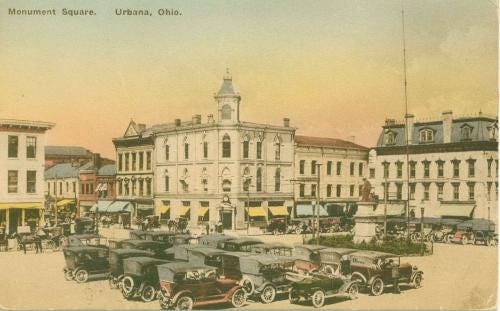
The public square in Urbana, Champaign County, Ohio

Okay, I admit that I have a special disgust for Congressman, Jim Jordan. I will though be fair in this short post.

From a political perspective, any honest and well-informed person knows that Jordan was and in some ways, still is a Seditionist and enabler of the Jan 6th armed rebellion. He is also the Rep for the small Ohio town, where I attended 7th grade thru high school graduation. In my view, one of the finest small towns in the nation. Urbana, Ohio, the county seat of Champaign County numbered around 9000 people at the time, the biggest town in the county.

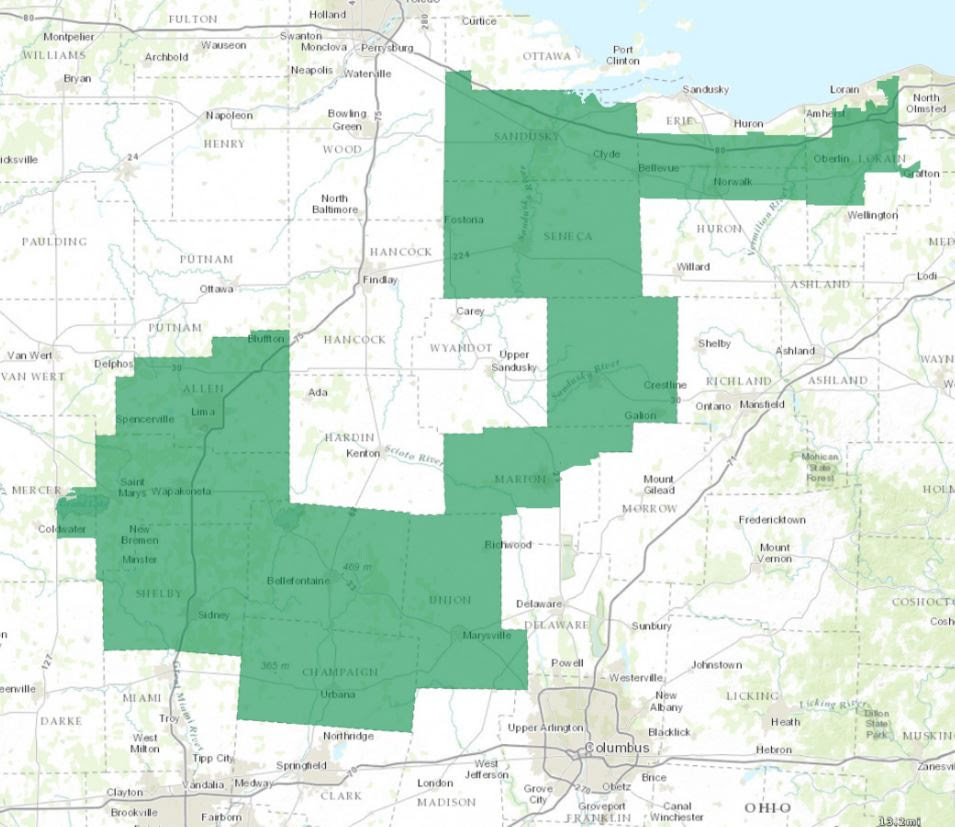
Now Jordan, is the rep of one of the most gerrymandered districts in the country. When I lived in Urbana, Ohio in the late 60’s and early 70’s, our local congressman was exceptionally well liked and respected. Clarence, “Bud” Brown represented what the Republican Party could have been, had they not deviated to scorched earth politics under the leadership and tutelage of Newt Gingrich. America has never been the same since. Don’t see this as an endorsement of the so-called, “other side” but as a statement of clear-eyed facts.

Jim Jordan’s, Ohio 4th Congressional District

This letter by Jordan to the AG, Merrick Garland shows in detail and Jordan’s own hand, the level of false narratives and utter dishonesty that keeps today’s MAGA-controlled GOP afloat. For those who have been warning about this and other indictments based on reality, research, and the opinions of elite experts, this is just another “hail Mary”, mis/ disinformation campaign designed to empower those who’ve proved that they will believe anything, if it suits their political identity. My personal and professional opinion of Jordan sees him as one of the most unethical and dangerous members of Congress.

What I once knew as a community of hardworking mostly rural Ohioans with remarkable grace, compassion and honesty, is now burdened by the weight of being sold snake oil by traitors and conmen who can’t even spell, “American values.” They largely operate on the traitorous narratives of FOX news. Fortunately there is still a solid core of great Americans in my home town but sadly, they are a minority. Even the Trumpists are some of the nicest people you will ever meet. The manipulation of their political identity by unethical, professional influencers, some domestic and some foreign, has resulted in Seditionists like Jordan and his ilk, leading the worst threat to our democracy since the Civil War.

The pain I feel for my hometown, is being played out all across America in small and large towns. The extraordinary work by U.S. Department of Justice, has thrown a hand grenade into their political identity. Now, with DOJ’s meticulously assembled public case being the news of the day, Jordan is launching a full-scale mis and disinformation campaign to support a known traitor. Not one person in Urbana would have tolerated this in my youth, despite being in one of the most reliable Republican Congressional districts in the nation.

Yes, I would also love to scream the words, “I told you so” but that will not heal America. Many Americans who were victimized by foreign and domestic malign influencers, are beginning to realize that they have been badly duped. Give them an open invite back into reality without the derision. They are family, friends and colleagues. Tragically, those who resist reality will likely never recover, because the level of indoctrination that leads to public displays of extremism, more often than not, is like rabies, mostly incurable.

It’s time for all Americans to realize that our fellow citizens are not enemies because they have different beliefs. Our Constitution, based on our founding principles, guarantees our right to our own beliefs, false or not. It’s really up to those who are willing to debate over facts and reality, to heal this nation for America’s sake, not a politcal party. It will be those who adhere to what it means to be a truly patriotic American, left, right or otherwise to put our nation, back on the path of progress, respectability and strength.

Truism: If you vote for honesty, integrity and our true American, founding principles… folks like Jim Jordan would never be in office. However you vote, we can never again allow any extremist movement to have so much say in our government, that they can once again threaten what so many have died to preserve.

Wishing everyone the most enjoyable weekend,

Paul

Ruth Ben-Ghiat, a historian of fascism and autocracy, says that Special Counsel Jack Smith’s 3-minute speech moved her to tears.

She explains why in this post on her blog Lucid:

Welcome back to Lucid, and a big hello to all new subscribers. I started Lucid in 2021 to separate the signal from the noise in politics and provide big-picture thinking about authoritarianism and threats to democracy in the US and around the world. I use my skills as a historian to identify the patterns and dynamics at work in the news that comes at us every day.


In honor of the Department of Justice indictment of Donald Trump, which is only possible because we live in a democracy, for the next week I am offering a 50% discount on the first year of Lucid so that more people can have access to bonus content like this and to the community that has developed from my weekly live Q&As. You can subscribe or convert your current subscription to paid here: (open the link to see the offer).

The bare-bones conference room, with its ugly folding table and florescent lighting overhead. The standard-issue podium at which Jack Smith, Special Counsel at the Department of Justice, stood with his understated attire and not-made for television haircut. There was no glamour and no media buzz as Smith announced the unsealing of a historic indictment against former president Donald J. Trump for “violations of our national security laws as well as participating in conspiracy to obstruct justice.”

All of it moved me to tears.

Special Counsel Jack Smith press conference, June 8, 2023. C-Span.

As an American, I was outraged when I read the indictment. As a scholar of authoritarianism and one of the first people to label Trump as a threat to our freedoms, I was unsurprised at its content. Trump’s proprietary vision of governance was familiar to me, as was his supremely venal attitude. In the strongman world there are no boundaries between public and private. The leader believes it is his right to possess and exploit for personal benefit anything in the nation, from natural resources to economic assets to information—the latter being the most valuable currency.

“Forced out of the White House after his coup attempt failed, beset by financial worries and multiple investigations, how could Trump fail to cast his greedy eyes on the vast store of classified information available to him?” I wrotein Aug. 2022.

Democracy does not churn out telegenic images of demagogues commanding cheering crowds of fanatics. It does not produce dramatic images of coups, whether old-school takeovers with tanks on the streets or today’s radicalized civilian armies assaulting government buildings, as in the US and Brazil.

Democracy has its rituals and rites of passage, but the everyday work of democracy –a political system built on cultivating consensus, rather than lackeys implementing decisions by one man–can seem boring to those who crave theatrics. It entails endless discussions and careful deliberation in Congress and statehouses around the nation.

And so, Jack Smith appeared in his drab institutional surroundings to deliver a message of historic import. In just over three minutes, he informed the public of the status of the investigation he has overseen while also expressing support for some of the most foundational values of democracy and civil society.

Commitment to National Security

In healthy democracies both liberal and conservative politicians share a commitment to protecting their country’s national security. That’s no longer the case in America, where the GOP has left conservatism behind to become an autocratic entity. Republican lawmakers now align with far-right authoritarian parties and governments in Hungary, Russia, and Brazil that see democratic America as an enemy to be taken down.

Add in the GOP’s loyalty to a cult leader who will sell out anyone and anything for more power and profit, and we have a tragic situation: many Republican lawmakers are no longer committed to America’s national security. This shift is partly responsible for the Republican demonization of the Federal Bureau of Investigation (FBI), America’s support for NATO (and Ukraine), and the Department of Justice.

Moreover, as Rep. Jim Jordan’s sham House Select Subcommittee on the Weaponization of the Federal Government has made clear, Trump loyalists do not want the FBI to clean house of extremists, including those apparently loyal to Putin. That is why Jordan defended Steve Friend, an FBI agent who had his security clearance revoked. Friend refused to investigate Jan. 6 insurrectionists, transferred FBI documents to an unauthorized flash drive, and contributed to Kremlin propaganda outlets Russia Today and Sputnik.

This is why Jack Smith started his speech by recognizing the importance of protecting our national security and those who enforce it:

“The men and women of the US intelligence community and the armed forces dedicate their lives to protecting our nation and its people. Our laws that protect national defense information are critical for the safety and security of the United States, and they must be enforced. Violations of those laws put our country at risk.”

Rule of Law

Since today’s autocrats often keep elections going, elections are no longer the main metric of democracy. Instead, we look to accountability and the existence of an independent judiciary to measure democratic health. Both are fundamental to the principle of rule of law, which Jack Smith emphasized in his speech, identifying it as

“a bedrock principle of the Department of Justice. And our nation’s commitment to the rule of law sets an example for the world. We have one set of laws in this country, and they apply to everyone. Applying those laws, collecting facts, that’s what determines the outcome of an investigation. Nothing more, and nothing less.”

We have one set of laws in this country, and they apply to everyone. This bears repeating because authoritarianism is about getting away with crime. When the judiciary has been neutralized, the press threatened into silence, and security services made into tools of the autocrat, then the leader becomes untouchable, no matter how many crimes he commits.

This indictment interrupts that trajectory. I know where that road leads, and how much we stand to lose. This is why Jack Smith’s speech moved me.

I thought I would ignore the story you have read about in every publication: the unprecedented indictment of a former President of the United States. Special Counsel Jack Smith released the indictment yesterday, and I read every word. It is a dramatic narrative of a man who was determined to hold onto state secrets, storing them in public spaces, hiding them when necessary, completely indifferent to the law governing classified documents. The irony, as the indictment points out, is that Trump repeatedly lambasted Hillary Clinton in 2016 for being careless with state secrets and promised to enforce the law if elected.

If you haven’t read the indictment, please do so. At the least, it may make you wonder how Republicans can bring themselves, even now, to echo Trump’s claims that he is the victim of a witch-hunt.

Heather Cox Richardson summarizes the events of the past 24 hours and the underlying issues: can a former President be forgiven for taking home highly classified documents and refusing to give them back when asked? For not only refusing to return them but hiding them from those authorized to collect them? What were his motives? Just to show them off to prove what a big man he is? Or to sell them to foreign agents? Vanity or greed?

And my question: Why are Republicans stridently defending a man who knowingly put the lives of our military at risk and endangered our national security? Have they no shame? Why do they put their loyalty to Trump (or fear of him) above the nation’s security and their oath of office?

She writes:

At 3:00 today, Washington D.C., time, Special Counsel Jack Smith delivered a statement about the recently unsealed indictment charging former president Donald J. Trump on 37 counts of violating national security laws as well as participating in a conspiracy to obstruct justice.


Although MAGA Republicans have tried to paint the indictment as a political move by the Biden administration over a piddling error, Smith immediately reminded people that “[t]his indictment was voted by a grand jury of citizens in the Southern District of Florida, and I invite everyone to read it in full to understand the scope and the gravity of the crimes charged.”


The indictment is, indeed, jaw dropping.
It alleges that during his time in the White House, Trump stored in cardboard boxes “information regarding defense and weapons capabilities of both the United States and foreign countries; United States nuclear programs; potential vulnerabilities of the United States and its allies to military attack; and plans for possible retaliation in response to a foreign attack.” The indictment notes that “[t]he unauthorized disclosure of these classified documents could put at risk the national security of the United States, foreign relations, the safety of the United States military, and human sources and the continued viability of sensitive intelligence collection methods.”


Nonetheless, when Trump ceased to be president after noon on January 20, 2021, he took those boxes, “many of which contained classified documents,” to Mar-a-Lago, where he was living. He “was not authorized to possess or retain those classified documents.” The indictment makes it clear that this was no oversight: Trump was personally involved in packing the boxes and, later, in going through them and in overseeing how they were handled. The employees who worked for him exchanged text messages referring to his personal instructions about them.


Mar-a-Lago was not an authorized location for such documents, but he stored them there anyway, “including in a ballroom, a bathroom and shower, an office space, his bedroom, and a storage room.” They were stacked in public places, where anyone—including the many foreign nationals who visited Mar-a-Lago—could see them. On December 7, 2021, Trump’s personal aide Waltine Nauta took two pictures of several of the boxes fallen on the floor, with their contents, including a secret document available only to the Five Eyes intelligence alliance of the U.S., Australia, Canada, New Zealand, and the United Kingdom, spilled onto the floor.


The indictment alleges that Trump showed classified documents to others without security clearances on two occasions, both of which are well documented. One of those occasions was recorded. Trump told the people there that the plan he was showing them was “highly confidential” and “secret.” He added, “See, as president I could have declassified it….Now I can’t, you know, but this is still a secret.”


This recording undermines his insistence that he believed he could automatically declassify documents; it proves he understood he could not. In addition, the indictment lists Trump’s many statements from 2016 about the importance of protecting classified information, all delivered as attacks on Democratic presidential nominee Hillary Clinton, whom he accused of mishandling such information. “In my administration,” he said on August 18, 2016, “I’m going to enforce all laws concerning the protection of classified information. No one will be above the law.”


The indictment goes on: When the FBI tried to recover the documents, Trump started what Washington Post journalist Jennifer Rubin called a “giant shell game”: he tried to get his lawyer to lie to the FBI and the grand jury, saying Trump did not have more documents; worked with Nauta to move some of the boxes to hide them from Trump’s lawyer, the FBI and the grand jury; tried to get his lawyer to hide or destroy documents; and got another lawyer to certify that all the documents had been produced when he knew they hadn’t.


Nauta lied to the grand jury about his knowledge of what Trump did with the boxes. Both he and Trump have been indicted on multiple counts of obstruction and of engaging in a conspiracy to hide the documents.


Eventually, Trump had many of the boxes moved to his property at Bedminster, New Jersey, where on two occasions he showed documents to people without security clearances. He showed a classified map of a country that is part of an ongoing military operation to a representative of his political action committee.


Trump has been indicted on 31 counts of having “unauthorized possession of, access to, and control over documents relating to the national defense,” for keeping them, and for refusing “to deliver them to the officer and employee of the United States entitled to receive them”: language straight out of the Espionage Act. Twenty-one of the documents were marked top secret, nine were marked secret, and one was unmarked.


These documents are not all those recovered—some likely are too sensitive to risk making public—but they nonetheless hold some of the nation’s deepest secrets: “military capabilities of a foreign country and the United States,” “military activities and planning of foreign countries,” “nuclear capabilities of a foreign country,” “military attacks by a foreign country,” “military contingency planning of the United States,” “military options of a foreign country and potential effects on United States interest,” “foreign country support of terrorist acts against United States interests,” “nuclear weaponry of the United States,” “military activity in a foreign country.”


Smith put it starkly in his statement, “The men and women of the United States intelligence community and our armed forces dedicate their lives to protecting our nation and its people. Our laws that protect national defense information are critical to the safety and security of the United States and they must be enforced. Violations of those laws put our country at risk.”


On Twitter, Bill Kristol said it more clearly: “These were highly classified documents dealing with military intelligence and plans. What did Trump do with them? Who now has copies of them?” Retired FBI assistant director Frank Figliuzzi noted that there is a substantial risk that “foreign intelligence services might have sought or gained access to the documents.”


There is also substantial risk that other countries will be reluctant to share intelligence with the United States in the future. At the very least, it is an unfortunate coincidence that the Central Intelligence Agency in October 2021 reported an unusually high rate of capture or death for foreign informants recruited to spy for the United States.


Since Trump supporters have taken the position that Trump’s indictment over the stolen documents is the attempt of the Biden administration to undermine Trump’s presidential candidacy, it is worth remembering that Trump’s early announcement of his campaign was widely suspected to be an attempt to enable him to avoid legal accountability. Attorney General Merrick Garland appointed Special Counsel Jack Smith precisely to put arms length between the administration and the investigations into Trump.
Smith noted today, “Adherence to the rule of law is a bedrock principle of the Department of Justice. And our nation’s commitment to the rule of law sets an example for the world. We have one set of laws in this country, and they apply to everyone. Applying those laws. Collecting facts. That’s what determines the outcome of an investigation. Nothing more. Nothing less.
“The prosecutors in my office are among the most talented and experienced in the Department of Justice. They have investigated this case hewing to the highest ethical standards. And they will continue to do so as this case proceeds.”


Smith added: “It’s very important for me to note that the defendants in this case must be presumed innocent until proven guilty beyond a reasonable doubt in a court of law. To that end, my office will seek a speedy trial in this matter. Consistent with the public interest and the rights of the accused. We very much look forward to presenting our case to a jury of citizens in the Southern District of Florida.”


Likely responding to MAGA attacks on the FBI and the rule of law, Smith thanked the “dedicated public servants of the Federal Bureau of Investigation, with whom my office is conducting this investigation and who worked tirelessly every day upholding the rule of law in our country,” before closing his brief statement.


The indictment revealed just how much detailed information Smith’s team has uncovered, presenting a shockingly thorough case to prove the allegations. Trump’s lawyers will have their work cut out for them…although the team has shifted since this morning: two of Trump’s lawyers quit today. The thoroughness of the indictment also suggests that Trump and his allies might have reason to be nervous about Smith’s other investigation: the one into the attempt to overturn results of the 2020 election.


Some of Trump’s supporters are calling for violence. After Louisiana representative Clay Higgins appeared to be egging on militias to oppose Trump’s Tuesday arraignment, Democratic senate majority leader Chuck Schumer (D-NY) and House minority leader Hakeem Jeffries (D-NY) issued a joint statement calling for “supporters and critics alike to let the case proceed peacefully in court.” Legal scholar Joyce White Vance noted that it was “extremely sad for our country that this isn’t a bipartisan statement being made by leaders from both parties.”

Notes:
https://www.justice.gov/opa/speech/special-counsel-jack-smith-delivers-statement
https://www.cnn.com/2023/06/09/politics/walt-nauta-trump-indicted/index.html

https://storage.courtlistener.com/recap/gov.uscourts.flsd.648653/gov.uscourts.flsd.648653.3.0_2.pdf
https://www.nola.com/news/politics/clay-higgins-urges-war-over-trump-indictments-author-says/article_db78acde-0701-11ee-af01-73c2414fd4d7.html
https://www.nytimes.com/2023/06/09/us/politics/trump-indictment-lawyers-trusty-rowley.html
https://www.nytimes.com/2021/10/05/us/politics/cia-informants-killed-captured.html
https://www.cornellpolicyreview.com/the-executive-records-recovered-from-mar-a-lago-and-the-c-i-a-s-missing-informants/
https://www.law.cornell.edu/uscode/text/18/793
Twitter links:
BillKristol/status/1667332834514616320
JRubinBlogger/status/1667287186616754177
JoyceWhiteVance/status/1667277258183065601
petestrzok/status/1667276941043351555
djrothkopf/status/1667237607388880922
petestrzok/status/1667276952439324674?s=20

Mitch Randal, a pastor in Norman, Oklahoma, and CEO OF Good Faith Media, published his opposition to the state’s recent decision to fund a religious virtual charter school.

Randal wrote:

The Oklahoma Statewide Virtual Charter School Board voted 3-2 to approve using state funds to support a new Catholic school this week. One of the board members voting “yes” was installed to their post last Friday, according to Tulsa World.

The board’s actions began creating the first religious charter school supported by taxpayer dollars in the United States. The online school, St. Isidore of Seville Catholic Virtual School, will be managed and operated by the Roman Catholic Archdiocese of Oklahoma City and the Diocese of Tulsa.

Oklahoma’s previous Attorney General, John O’Connor, issued a non-binding 15-page opinion in December 2022 suggesting that Oklahoma’s restriction of taxpayer funds from being used for religious schools would most likely be found unconstitutional by the United States Supreme Court.

Education Week reported, “O’Connor had concluded that recent U.S. Supreme Court decisions authorizing the inclusion of religious schools in choice programs such as tax credits for scholarship donations, and tuition assistance meant that the high court would likely not ‘accept the argument that, because charter schools are considered public for various purposes, that a state should be allowed to discriminate against religiously affiliated private participants who wish to establish and operate charter schools.’”

St. Isidore of Seville Catholic Virtual School’s application asked for $2.5 million to serve a potential 500 students in the first year. That will be $2.5 million taken away from public schools to support private religious education.

O’Connor’s successor, Gentner Drummond, withdrew the opinion earlier this year, stating, “Religious liberty is one of our most fundamental freedoms.”

Drummond continued: “It allows us to worship according to our faith, and to be free from any duty that may conflict with our faith. The opinion as issued by my predecessor misuses the concept of religious liberty by employing it as a means to justify state-funded religion.”

While some Christian conservatives, such as Oklahoma’s State Superintendent Ryan Walters, praised the board’s decision, other politicians and faith leaders criticized its actions, characterizing them as unconstitutional and a direct violation of the Establishment Clause.

After the 3-2 vote in favor of funding St. Isidore of Seville Catholic Virtual School, Drummond reiterated his opinion that this decision was improper. “The approval of any publicly funded religious school is contrary to Oklahoma law and not in the best interest of taxpayers,” he said.

“It’s extremely disappointing that board members violated their oath in order to fund religious schools with our tax dollars,” Drummond said. “In doing so, these members have exposed themselves and the State to potential legal action that could be costly.”

Clark Frailey, executive director for Pastors for Oklahoma Kids, commented: “By authorizing a public school that is explicitly affiliated with a particular religion, Oklahoma is endorsing that religion and entangling the government in religious affairs.”

“In addition,” Frailey continued, “the proposed school is to be funded by taxpayer dollars. This clearly misuses public dollars, as it would fund religious indoctrination of children.”

Historically, Oklahoma has been notoriously guilty of using taxpayer dollars to indoctrinate children with religious doctrines. Many times, Good Faith Media has called attention to the misguided and violent actions occurring at Chilocco Indian Agricultural Boarding School.

Thousands of Indigenous children were taken from their families and provided “Christian” education using taxpayer funding. Hiding behind a compassionate mission to educate Indigenous children, the actual objective was to assimilate them into white Protestant doctrines.

While no one suggests the Oklahoma Catholic Diocese is following this model, the dangers of using taxpayer dollars are ominous. Besides taking precious funding away from public education to fund private religious charters, using taxpayer money violates the religious liberty of others not wanting to support religious teachings.

Should taxpayers be forced to support religious teachings contradictory to their belief systems? Will there be any oversight of the use of taxpayer money used at religious schools?

Like public schools, do religious schools have to accept all students or can they discriminate? Will religious schools need curriculum to be approved? If so, who decides? Can any religious sect apply for funding?

Americans United for Separation of Church and State responded, “It’s hard to think of a clearer violation of the religious freedom of Oklahoma taxpayers and public-school families than the state establishing the nation’s first religious public charter school.”

AU went on to point out the unconstitutionality of the action: “State and federal law are clear: Charter schools are public schools that must be secular and open to all students. No public-school family should fear that their child will be required by charter schools to take theology classes or be expelled for failing to conform to religious doctrines. And the government should never force anyone to fund religious education.”

“Funding private religious schools with public dollars violates core legal principles protecting religious freedom for all,” said Amanda Tyler, executive director of BJC (Baptist Joint Committee for Religious Liberty).

Paul Brandeis Raushenbush, CEO of Interfaith Alliance, told The Independent that this would “open the floodgates for taxpayer-funded discrimination.” He added: “Taxpayer money should never be used to fund religious instruction, and it is now up to the state to at least ensure St. Isidore abides by the federal nondiscrimination protections guaranteed in public schools.”

The decision by the Oklahoma Statewide Virtual Charter School Board is clearly a disregard for the democratic principles established by the nation’s founders.

Thomas Jefferson’s words in his letter to the Baptists of Danbury, Connecticut, are as crucial today as they were in 1802: “I contemplate with sovereign reverence that act of the whole American people which declared that their legislature should ‘make no law respecting an establishment of religion, or prohibiting the free exercise thereof,’ thus building a wall of separation between Church & State.”

Mitch Randall headshot

Mitch Randall

CEO of Good Faith Media.

goodfaithmedia.org

Azar Nafisi was teaching American literature in Iran at the time of the revolution in 1979. Because she refused to wear the mandated head covering, she was forced to leave the university. She continued to teach her students in her home. She moved to the United States in 1997. In 2003, she published Reading Lolita in Teheran, which was a huge bestseller. She became an American citizen in 2008. Please open the link and read the interview in full. It appeared on the website of American Purpose.

Since the 1979 Iranian Revolution, Azar Nafisi has championed literature as an act of resistance against threats to freedom and imagination. To read dangerously, as Nafisi puts it, is to arouse curiosity and challenge the status quo. 

Sahar Soleimany sat down with the critically acclaimed Iranian-American author to talk about the importance of resistance writers at a time of heightened threats to democracy, parallels between her own experience in revolutionary Iran and the recent Iranian protest movement, and how the act of “telling” can help keep this movement alive.

Sahar Soleimany: You’re a writer, but you’re also an admirer of great authors. One that you cite often is James Baldwin. What about Baldwin’s life and work particularly speak to you?

Azar Nafisi: I first read James Baldwin in college. In the 70s, we were participating in all sorts of protests. Baldwin was part of those protests, but it wasn’t until many years later that I discovered that he was much more important than just being a leader in the civil rights movement.

When I returned to the United States in 1997 and started re-reading a lot of the writers that I had read during my college years, my attitude had changed. At that point, I had lived in the Islamic Republic for eighteen years and could understand the oppression and the humiliation and the outrage and anger that I found in Baldwin’s works. For Baldwin, the civil rights struggle was never just a political movement. The fight against racism was an existential one. His survival as a human being depended on it and that is what makes him so relevant to all times. Now in America, I see so many trends that move toward totalitarianism. I tell myself, thank God for James Baldwin, because his point of view is instinctively anti-totalitarian, anti-oppression.

SS: So many great works of American literature, including Baldwin’s, have become the subject of book bans across the country. You have written and spoken extensively about living under a totalitarian regime in Iran where authors were—and still are—often censored, jailed, or even killed for their work. What parallels can you draw from your own lived experience in Iran and how concerned are you about the state of democracy in the United States?

AN: One of the first symptoms of the totalitarian mindset is banning books because writing and reading entail a search for truth. Baldwin saw himself as a witness to truth and had to reveal that truth. Totalitarian mindsets, whether in the United States of America or the Islamic Republic of Iran, are scared of truth.

While we may not torture or kill writers and dissidents, there still is a totalitarian threat against liberal democracies—it’s what [Uguccione] Sorbello called “sleeping consciousness,” or atrophy of feeling. We have become intellectually lazy. We don’t want to hear or see or have any connection with those who are not just opposed to us, but are different from us. We want to be comfortable.

People keep saying, “I’m not comfortable with that.” These books that are banned—they’re not comfortable. They disturb us. But as Baldwin said, “Writers are here to disturb the peace.” Life is not about comfort. If you cannot tolerate being disturbed by a book, how can you tolerate being disturbed by life itself? In fact, imagination and ideas help us to confront the discomforts of life.

Right now, the most important thing for our democracy is to celebrate and return to the life of imagination and ideas, and accept that freedom is not something that’s given to you. Even when you live in a free and open society, you still need to nurture and pursue that freedom. You never reach it, but you constantly move toward it, and that is one of our great challenges today. Freedom and imagination go hand in hand. We are in danger right now from ourselves.

SS: Has there been any instance in your own writing where your right to free expression was challenged by a publisher or the public?

AN: I had that experience in Iran, but not yet in the United States. In Iran, when my first book came out, it was on [Vladimir] Nabokov, and it sold out pretty much the same year that it was published. They banned the book. They didn’t allow it to be reprinted. My friends tell me that now they can’t even find it on the black market. One of the reasons that I left Iran was because I wanted my freedom of expression. I wanted to be able to talk to my people without lying to them, without being censored. That was made impossible by the regime.

That is why I came here, and that is why I’m so sensitized about things that are happening here, because I have seen how it happens. It happens when we think it can’t happen to us. I remind people that in the last century, western democracies did not just bring us democracy. They also brought us fascism and communism. That can be repeated; everything that has happened before can happen again…..

Azar Nafisi is an editorial board member of American Purpose and author of the national bestseller, Reading Lolita in Tehran: A Memoir in Books (2003), which spent over 117 weeks on the New York Times bestseller list and has been translated in 32 languages.

Sahar Soleimany is a Middle East research associate in foreign and defense policy studies at the American Enterprise Institute.

Timothy Snyder is a historian at Yale Univerity who has written extensively on European history and threats to democracy. This essay is a fascinating history of Ukraine, which was published in The New Yorker.

He writes:

When Vladimir Putin denies the reality of the Ukrainian state, he is speaking the familiar language of empire. For five hundred years, European conquerors called the societies that they encountered “tribes,” treating them as incapable of governing themselves. As we see in the ruins of Ukrainian cities, and in the Russian practice of mass killing, rape, and deportation, the claim that a nation does not exist is the rhetorical preparation for destroying it.

Empire’s story divides subjects from objects. As the philosopher Frantz Fanon argued, colonizers see themselves as actors with purpose, and the colonized as instruments to realize the imperial vision. Putin took a pronounced colonial turn when returning to the Presidency a decade ago. In 2012, he described Russia as a “state-civilization,” which by its nature absorbed smaller cultures such as Ukraine’s. The next year, he claimed that Russians and Ukrainians were joined in “spiritual unity.” In a long essay on “historical unity,” published last July, he argued that Ukraine and Russia were a single country, bound by a shared origin. His vision is of a broken world that must be restored through violence. Russia becomes itself only by annihilating Ukraine.

As the objects of this rhetoric, and of the war of destruction that it sanctions, Ukrainians grasp all of this. Ukraine does have a history, of course, and Ukrainians do constitute a nation. But empire enforces objectification on the periphery and amnesia at the center. Thus modern Russian imperialism includes memory lawsthat forbid serious discussion of the Soviet past. It is illegal for Russians to apply the word “war” to the invasion of Ukraine. It is also illegal to say that Stalin began the Second World War as Hitler’s ally, and used much the same justification to attack Poland as Putin is using to attack Ukraine. When the invasion began, in February, Russian publishers were ordered to purge mentions of Ukraine from textbooks.

Faced with the Kremlin’s official mixture of fantasy and taboo, the temptation is to prove the opposite: that it is Ukraine rather than Russia that is eternal, that it is Ukrainians, not Russians, who are always right, and so on. Yet Ukrainian history gives us something more interesting than a mere counter-narrative to empire. We can find Ukrainian national feeling at a very early date. In contemporary Ukraine, though, the nation is not so much anti-colonial, a rejection of a particular imperial power, as post-colonial, the creation of something new.

Southern Ukraine, where Russian troops are now besieging cities and bombing hospitals, was well known to the ancients. In the founding myth of Athens, the goddess Athena gives the city the gift of the olive tree. In fact, the city could grow olives only because it imported grain from ports on the Black Sea coast. The Greeks knew the coast, but not the hinterland, where they imagined mythical creatures guarding fields of gold and ambrosia. Here already was a colonial view of Ukraine: a land of fantasy, where those who take have the right to dream.

The city of Kyiv did not exist in ancient times, but it is very old—about half a millennium older than Moscow. It was probably founded in the sixth or seventh century, north of any territory seen by Greeks or controlled by Romans. Islam was advancing, and Christianity was becoming European. The Western Roman Empire had fallen, leaving a form of Christianity subordinate to a pope. The Eastern (Byzantine) Empire remained, directing what we now call the Orthodox Church. As Rome and Constantinople competed for converts, peoples east of Kyiv converted to Islam. Kyivans spoke a Slavic language that had no writing system, and practiced a paganism without idols or temples.

Putin’s vision of “unity” relates to a baptism that took place in this setting. In the ninth century, a group of Vikings known as the Rus arrived in Kyiv. Seeking a southbound route for their slave trade, they found the Dnipro River, which runs through the city. Their chieftains then fought over a patchwork of territories in what is now Ukraine, Belarus, and the northeast of Russia—with Kyiv always as the prize. In the late tenth century, a Viking named Valdemar took the city, with the help of a Scandinavian army. He initially governed as a pagan. But, around 987, when the Byzantines faced an internal revolt, he sensed an opportunity. He came to the emperor’s aid, and received his sister’s hand in marriage. In the process, Valdemar converted to Christianity.

Putin claims that this messy sequence of events reveals the will of God to bind Russia and Ukraine forever. The will of God is easy to misunderstand; in any case, modern nations did not exist at the time, and the words “Russia” and “Ukraine” had no meaning. Valdemar was typical of the pagan Eastern European rulers of his day, considering multiple monotheistic options before choosing the one that made the most strategic sense. The word “Rus” no longer meant Viking slavers but a Christian polity. Its ruling family now intermarried with others, and the local people were treated as subjects to be taxed rather than as bodies to be sold.

Yet no rule defined who would take power after a Kyivan ruler’s death. Valdemar took a Byzantine princess as his wife, but he had a half a dozen others, not to mention a harem of hundreds of women. When he died in 1015, he had imprisoned one of his sons, Sviatopolk, and was making war upon another, Yaroslav. Sviatopolk was freed after his father’s death, and killed three of his brothers, but he was defeated on the battlefield by Yaroslav. Other sons entered the fray, and Yaroslav didn’t rule alone until 1036. The succession had taken twenty-one years. At least ten other sons of Valdemar had died in the meantime.

These events do not reveal a timeless empire, as Putin claims. But they do suggest the importance of a succession principle, a theme very important in Ukrainian-Russian relations today. The Ukrainian transliteration of “Valdemar” is “Volodymyr,” the name of Ukraine’s President. In Ukraine, power is transferred through democratic elections: when Volodymyr Zelensky won the 2019 Presidential election, the sitting President accepted defeat. The Russian transliteration of the same name is “Vladimir.” Russia is brittle: it has no succession principle, and it’s unclear what will happen when Vladimir Putin dies or is forced from power. The pressure of mortality confirms the imperial thinking. An aging tyrant, obsessed by his legacy, seizes upon a lofty illusion that seems to confer immortality: the “unity” of Russia and Ukraine.

In the Icelandic sagas, Yaroslav is remembered as the Lame; in Eastern Europe, he is the Wise, the giver of laws. Yet he did not solve the problem of succession. Following his reign, the lands around Kyiv fragmented again and again. In 1240, the city fell to the Mongols; later, most of old Rus was claimed by the Grand Duchy of Lithuania, then the largest state in Europe. Lithuania borrowed from Kyiv a grammar of politics, as well as a good deal of law. For a couple of centuries, its grand dukes also ruled Poland. But, in 1569, after the Lithuanian dynasty died out, a Polish-Lithuanian commonwealth was formalized, and the territories of Ukraine were placed under Polish jurisdiction.

This was a crucial change. After 1569, Kyiv was no longer a source of law but an object of it—the archetypal colonial situation. It was colonization that set off Ukraine from the former territories of Rus, and its manner generated qualities still visible today: suspicion of the central state, organization in crisis, and the notion of freedom as self-expression, despite a powerful neighbor.

During the sixteenth and seventeenth centuries, all the forces of Europe’s globalization seemed to bear down on Ukraine. Polish colonization resembled and in some measure enabled the European colonization of the wider world. Polish nobles introduced land-management practices—along with land managers, most of whom were Jewish—that allowed the establishment of profitable plantations. Local Ukrainian warlords rushed to imitate the system, and adopted elements of Polish culture, including Western Christianity and the Polish language. In an age of discovery, enserfed peasants labored for a world market.

Ukraine’s colonization coincided with the Renaissance, and with a spectacular flowering of Polish culture. Like other Renaissance thinkers, Polish scholars in Ukraine resuscitated ancient knowledge, and sometimes overturned it. It was a Pole, Copernicus, who undid the legacy of Ptolemy’s “Almagest” and confirmed that the Earth orbits the sun. It was another Pole, Maciej of Miechów, who corrected Ptolemy’s “Geography,” clearing Ukrainian maps of gold and ambrosia. As in ancient times, however, the tilling of the black earth enabled tremendous wealth, raising the question of why those who labored and those who profited experienced such different fates.

The Renaissance considered questions of identity through language. Across Europe, there was a debate as to whether Latin, now revived, was sufficient for the culture, or whether vernacular spoken languages should be elevated for the task. In the early fourteenth century, Dante answered this question in favor of Italian; English, French, Spanish, and Polish writers created other literary languages by codifying local vernaculars. In Ukraine, literary Polish emerged victorious over the Ukrainian vernacular, becoming the language of the commercial and intellectual élite. In a way, this was typical: Polish was a modern language, like English or Italian. But it was not the local language in Ukraine. Ukraine’s answer to the language question was deeply colonial, whereas in the rest of Europe it could be seen as broadly democratic.

The Reformation brought a similar result: local élites converted to Protestantism and then to Roman Catholicism, alienating them further from an Orthodox population. The convergence of colonization, the Renaissance, and the Reformation was specific to Ukraine. By the sixteen-forties, the few large landholders generally spoke Polish and were Catholic, and those who worked for them spoke Ukrainian and were Orthodox. Globalization had generated differences and inequalities that pushed the people to rebellion.

Ukrainians on the battlefield today rely on no fantasy of the past to counter Putin’s. If there is a precursor that matters to them, it is the Cossacks, a group of free people who lived on the far reaches of the Ukrainian steppe, making their fortress on an island in the middle of the Dnipro. Having escaped the Polish system of landowners and peasants, they could choose to be “registered Cossacks,” paid for their service in the Polish Army. Still, they were not citizens, and more of them wished to be registered than the Polish-Lithuanian parliament would allow.

The rebellion began in 1648, when an influential Cossack, Bohdan Khmelnytsky, saw his lands seized and his son attacked by a Polish noble. Finding himself beyond the protection of the law, Khmelnytsky turned his fellow-Cossacks toward revolt against the Polish-speaking, Roman Catholic magnates who dominated Ukraine. The accumulated cultural, religious, and economic grievances of the people quickly transformed the revolt into something very much like an anti-colonial uprising, with violence directed not only against the private armies of the magnates but against Poles and Jews generally. The magnates carried out reprisals against peasants and Cossacks, impaling them on stakes. The Polish-Lithuanian cavalry fought what had been their own Cossack infantry. Each side knew the other very well.

In 1651, the Cossacks, realizing that they needed help, turned to an Eastern power, Muscovy, about which they knew little. When Kyivan Rus had collapsed, most of its lands had been absorbed by Lithuania, but some of its northeastern territories remained under the dominion of a Mongol successor state. There, in a new city called Moscow, leaders known as tsars had begun an extraordinary period of territorial expansion, extending their realm into northern Asia. In 1648, the year that the Cossack uprising began, a Muscovite explorer reached the Pacific Ocean.

The war in Ukraine allowed Muscovy to turn its attention to Europe. In 1654, the Cossacks signed an agreement with representatives of the tsar. The Muscovite armies invaded Poland-Lithuania from the east; soon after, Sweden invaded from the north, setting off the crisis that Polish history remembers as “the Deluge.” Peace was eventually made between Poland-Lithuania and Muscovy, in 1667, and Ukraine was divided more or less down the middle, along the Dnipro. After a thousand years of existence, Kyiv was politically connected to Moscow for the first time.

The Cossacks were something like an early national movement. The problem was that their struggle against one colonial power enabled another. In 1721, Muscovy was renamed the Russian Empire, in reference to old Rus. Poland-Lithuania never really recovered from the Deluge, and was partitioned out of existence between 1772 and 1795. Russia thereby claimed the rest of Ukraine—everything but a western district known as Galicia, which went to the Habsburgs. Around the same time, in 1775, the Cossacks lost their status. They did not gain the political rights they had wanted, nor did the peasants who supported them gain control of the black earth. Polish landowners remained in Ukraine, even as state power became Russian.

Whereas Putin’s story of Ukraine is about destiny, the Ukrainian recollection of the Cossacks is about unfulfilled aspirations. The country’s national anthem, written in 1862, speaks of a young people upon whom fate has yet to smile, but who will one day prove worthy of the “Cossack nation.”

The nineteenth century was the age of national revivals. When the Ukrainian movement began in imperial Russian Kharkov—today Kharkiv, and largely in ruins—the focus was on the Cossack legacy. The next move was to locate history in the people, as an account of continuous culture. At first, such efforts did not seem threatening to imperial rule. But, after the Russian defeat in the Crimean War, in 1856, and the insult of the Polish uprisingof 1863 and 1864, Ukrainian culture was declared not to exist. It was often deemed an invention of Polish élites—an idea that Putin endorsed in his essay on “historical unity.” Leading Ukrainian thinkers emigrated to Galicia, where they could speak freely.

The First World War brought the principle of self-determination, which promised a release from imperial rule. In practice, it was often used to rescue old empires, or to build new ones. A Ukrainian National Republic was established in 1917, as the Russian Empire collapsed into revolution. In 1918, in return for a promise of foodstuffs, the country was recognized by Austria and Germany. Woodrow Wilson championed self-determination, but his victorious entente ignored Ukraine, recognizing Polish claims instead. Vladimir Lenin invoked the principle as well, though he meant only that the exploitation of national questions could advance class revolution. Ukraine soon found itself at the center of the Russian civil war, in which the Red Army, led by the Bolsheviks, and the White Army, fighting for the defunct empire, both denied Ukraine’s right to sovereignty. In this dreadful conflict, which followed four years of war, millions of people died, among them tens of thousands of Jews.

Though the Red Army ultimately prevailed, Bolshevik leaders knew that the Ukrainian question had to be addressed. Putin claims that the Bolsheviks created Ukraine, but the truth is close to the opposite. The Bolsheviks destroyed the Ukrainian National Republic. Aware that Ukrainian identity was real and widespread, they designed their new state to account for it. It was largely thanks to Ukraine that the Soviet Union took the form it did, as a federation of units with national names.

The failure of self-determination in Ukraine was hardly unique. Almost all of the new states created after the First World War were destroyed, within about two decades, by Nazi Germany, the Soviet Union, or both. In the political imaginations of both regimes, Ukraine was the territory whose possession would allow them to break the postwar order, and to transform the world in their own image. As in the sixteenth century, it was as if all the forces of world history were concentrated on a single country.

Stalin spoke of an internal colonization, in which peasants would be exploited so that the Soviet economy could imitate—and then overtake—capitalism. His policy of collective agriculture, in which land was seized from farmers, was particularly unwelcome in Ukraine, where the revolution had finally got rid of the (still largely Polish) landholders. Yet the black earth of Ukraine was central to Stalin’s plans, and he moved to subdue it. In 1932 and 1933, he enforced a series of policies that led to around four million people dying of hunger or related disease. Soviet propaganda blamed the Ukrainians, claiming that they were killing themselves to discredit Soviet rule—a tactic echoed, today, by Putin. Europeans who tried to organize famine relief were dismissed as Nazis.

The actual Nazis saw Stalin’s famine as a sign that Ukrainian agriculture could be exploited for another imperial project: their own. Hitler wanted Soviet power overthrown, Soviet cities depopulated, and the whole western part of the country colonized. His vision of Ukrainians was intensely colonial: he imagined that he could deport and starve them by the millions, and exploit the labor of whoever remained. It was Hitler’s desire for Ukrainian land that brought millions of Jews under German control. In this sense, colonial logic about Ukraine was a necessary condition for the Holocaust.

Between 1933 and 1945, Soviet and Nazi colonialism made Ukraine the most dangerous place in the world. More civilians were killed in Ukraine, in acts of atrocity, than anywhere else. That reckoning doesn’t even include soldiers: more Ukrainians died fighting the Germans, in the Second World War, than French, American, and British troops combined.

The major conflict of the war in Europe was the German-Soviet struggle for Ukraine, which took place between 1941 and 1945. But, when the war began, in 1939, the Soviet Union and Germany were de-facto allies, and jointly invaded Poland. At the time, what is now western Ukraine was southeastern Poland. A small group of Ukrainian nationalists there joined the Germans, understanding that they would seek to destroy the U.S.S.R. When it became clear that the Germans would fail, the nationalists left their service, ethnically cleansed Poles in 1943 and 1944, and then resisted the Soviets. In Putin’s texts, they figure as timeless villains, responsible for Ukrainian difference generally. The irony, of course, is that they emerged thanks to Stalin’s much grander collaboration with Hitler. They were crushed by Soviet power, in a brutal counter-insurgency, and today Ukraine’s far right polls at one to two per cent. Meanwhile, the Poles, whose ancestors were the chief victims of Ukrainian nationalism, have admittednearly three million Ukrainian refugees, reminding us that there are other ways to handle history than stories of eternal victimhood.

After the war, western Ukraine was added to Soviet Ukraine, and the republic was placed under suspicion precisely because it had been under German occupation. New restrictions on Ukrainian culture were justified by a manufactured allocation of guilt. This circular logic—we punish you, therefore you must be guilty—informs Kremlin propaganda today. Russia’s foreign minister, Sergey Lavrov, has argued that Russia had to invade Ukraine because Ukraine might have started a war. Putin, who has said the same, is clearly drawing on Stalin’s rhetoric. We are to understand that the Soviet victory in the Second World War left Russians forever pure and Ukrainians eternally guilty. At the funerals of Russian soldiers, grieving parents are told that their sons were fighting Nazis.

The history of the colonization of Ukraine, like the history of troubling and divisive subjects in general, can help us get free of myths. The past delivers to Putin several strands of colonial rhetoric, which he has combined and intensified. It also leaves us vulnerable to a language of exploitation: whenever we speak of “the Ukraine” instead of “Ukraine,” or pronounce the capital city in the Russian style, or act as if Americans can tell Ukrainians when and how to make peace, we are continuing imperial rhetoric by partaking in it.

Ukrainian national rhetoric is less coherent than Putin’s imperialism, and, therefore, more credible, and more human. Independence arrived in 1991, when the U.S.S.R was dissolved. Since then, the country’s politics have been marked by corruption and inequality, but also by a democratic spirit that has grown in tandem with national self-awareness. In 2004, an attempt to rig an election was defeated by a mass movement. In 2014, millions of Ukrainians protested a President who retreated from the E.U. The protesters were massacred, the President fled, and Russia invaded Ukraine for the first time. Again and again, Ukrainians have elected Presidents who seek reconciliation with Russia; again and again, this has failed. Zelensky is an extreme case: he ran on a platform of peace, only to be greeted with an invasion.

Ukraine is a post-colonial country, one that does not define itself against exploitation so much as accept, and sometimes even celebrate, the complications of emerging from it. Its people are bilingual, and its soldiers speak the language of the invader as well as their own. The war is fought in a decentralized way, dependent on the solidarity of local communities. These communities are diverse, but together they defend the notion of Ukraine as a political nation. There is something heartening in this. The model of the nation as a mini-empire, replicating inequalities on a smaller scale, and aiming for a homogeneity that is confused with identity, has worn itself out. If we are going to have democratic states in the twenty-first century, they will have to accept some of the complexity that is taken for granted in Ukraine.

The contrast between an aging empire and a new kind of nation is captured by Zelensky, whose simple presence makes Kremlin ideology seem senseless. Born in 1978, he is a child of the U.S.S.R., and speaks Russian with his family. A Jew, he reminds us that democracy can be multicultural. He does not so much answer Russian imperialism as exist alongside it, as though hailing from some wiser dimension. He does not need to mirror Putin; he just needs to show up. Every day, he affirms his nation by what he says and what he does.

Ukrainians assert their nation’s existence through simple acts of solidarity. They are not resisting Russia because of some absence or some difference, because they are not Russians or opposed to Russians. What is to be resisted is elemental: the threat of national extinction represented by Russian colonialism, a war of destruction expressly designed to resolve “the Ukrainian question.” Ukrainians know that there is not a question to be answered, only a life to be lived and, if need be, to be risked. They resist because they know who they are. In one of his very first videos after the invasion, when Russian propaganda claimed that he had fled Kyiv, Zelensky pointed the camera at himself and said, “The President is here.” That is it. Ukraine is here.
The Miami Herald editorial board wonders why the state’s leaders devote all their time fighting WOKE but ignoring the dramatic rise in insurance rates.

Ron DeSantis and the Republicans in the legislature have spent an entire session battling drag queens, gays, trans kids, public schools, Black history, librarians, and academic freedom. They have given each other high fives, but homeowners will get hikes in their insurance, which was not on the political agenda.

We know all too well that Florida property insurance costs have been skyrocketing, with no end in sight. Now there’s a new study that shows just how bad it’s gotten, and it’s even worse than we thought.

According to the data analysis company LexisNexis Risk Solutions, the state’s property insurance costs are up by an incredible 57% since 2015 — nearly triple the national average of 21%, as the Miami Herald reported.

If that weren’t enough misery, Florida distinguished itself in another way: Insurance costs have been rising faster in Florida than in any other state.

Given all of that, you might expect to see the governor and Legislature running around as though their hair was on fire, trying to come up with fixes for our crippled insurance market before regular, non-rich Floridians are forced out and lawmakers get blamed for destroying the middle class.

Lawmakers distracted

But that’s the kind of logic that worked in saner times. In 2023, Florida’s leaders are so busy trying to get Gov. Ron DeSantis into the White House — with a legislative session tailored to his agenda, no matter the cost — that they can’t be bothered to spend much time on insurance, even though it’s a complicated and important issue that affects regular people.

No, in Florida, the long-running and worsening property insurance crisis has been buried under an avalanche of anti-woke measures, the ones DeSantis seems to think will carry him to Washington.

That’s a dangerous strategy. As the Florida governor hits the campaign trail in places like Iowa, he leaves himself vulnerable to charges that he’s not taking care of business at home.

For example, on Wednesday, the governor was set to visit the U.S. southern border. It’s a clear attempt to generate more headlines on immigration, following another taxpayer-financed stunt in which Florida flew migrants from Texas to California. Meanwhile, Floridians back home will be facing record hikes in flood insurance — an average hike of 131%. Where’s the governor’s outrage on that?…

The state is facing a property insurance crisis. Where are our leaders?

The Republican Party has an albatross around its neck, namely, the need to feed the fraudulent claim that the 2020 election was stolen. This canard has given them leeway to enact restrictions on the right to vote, typically targeting groups likely to vote for Democrats. DeSantis created a special force to arrest former felons who voted when they were not supposed to, but most of the handful who were arrested were released because the state had sent them registration cards encouraging them to vote.

The latest crazy maneuver by Republicans is to remove their state from a national database that protects election integrity, assuring that no one votes in two states.

First to drop out was Louisiana:

On a night in January 2022, Louisiana Secretary of State Kyle Ardoin stepped on stage in a former airbase in Houma, La.

With American flags draped from the stage, the topic of the night was democracy.

The state’s chief voting official joked that he was competing with a former LSU Tiger great playing in the NFL playoffs the same night.

“I want to thank you all for coming out, competing with Joe Burrow is pretty tough!” Ardoin laughed.

But these were election die-hards.

The group hosting the event — We The People, Bayou Chapter — is one of hundreds of so-called election integrity groups that have popped up across the country since 2020, motivated by former President Donald Trump’s lies about voting.

During the Q&A portion of the event, people asked about how to stop dead people from voting “to support the Democrats” and voiced a number of other popular election conspiracy theories.

“I think one of the reasons we had so much distrust from this past election was because all of a sudden either over the course of the night, or in the wee hours of the morning, votes were discovered,” said one man, repeating a common false claim about how votes were tallied in 2020.

But Ardoin wasn’t just dropping by to talk about electronic voting machines or mail ballot fraud.

He was making an announcement: Louisiana would become the first state ever to pull out of an obscure bipartisan voting partnership known as the Electronic Registration Information Center, or ERIC.

ERIC is currently the only system that can catch if someone votes in more than one state, which is illegal. And election officials widely agree it helps to identify dead people on voting lists.

But Louisiana was done with it.

“This week I sent a letter to [ERIC], suspending Louisiana’s participation in that program,” Ardoin said.

At the time, in early 2022, most Americans had never heard of ERIC.

But in Houma, it seems in large part due to a far-right misinformation machine, Ardoin’s announcement garnered 15 seconds of applause.

It was the first of many times to come in which Republican officials would turn their back on this tool they once praised, in an effort to score political points with their base.

This NPR investigation, which found video of the Houma event posted to Facebook, is the first to report that Ardoin announced his ERIC decision to conservative activists.

And a deeper look at the red-state exodus that followed — eight states and countinghave now pulled out of ERIC — shows a policy blueprint for an election denial movement, spearheaded by a key Trump ally, eager to change virtually every aspect of how Americans vote.

Please open the link to finish this important story.

The Network for Public Education released a new report today that should concern everyone who cares about public schools and the use of public resources. The report shows that a growing segment of the charter industry is controlled by Christian nationalists, who indoctrinate their students, using taxpayer dollars.

Contact: Carol Burris

cburris@networkforpubliceducation.org

(646) 678-4477

NEW REPORT DOCUMENTS HOW FAR-RIGHT CHARTER SCHOOLS ARE FUELING THE CULTURE WARS

Right-wing Republicans involved in the creation and governance of charter schools

American taxpayers across the country are funding the recent explosion of growth in far-right, Christian nationalist charter schools, including those affiliated with Hillsdale College, according to a new report, A Sharp Right Turn: A New Breed of Charter Schools Delivers the Conservative Agenda, released by the Network for Public Education (NPE) today.

NPE identified hundreds of charter schools, predominantly in red states, that use the classical brand or other conservative clues in marketing to attract white Christian families. From featured religious music videos to statements that claim they offer a faith-friendly environment, these charter schools are opening at an accelerated rate, with at least 66 schools in the pipeline to open by 2024. While some of these schools, such as the Roger Bacon Academies, are long-standing, nearly half of the schools we identified opened after the inauguration of Donald Trump–representing a 90% increase.

The report exposes how right-wing Republican politicians, including Congressman Byron Donalds of Florida and failed Colorado gubernatorial candidate Heidi Ganahl, have embroiled themselves in creating and governing these schools, with some benefiting financially. In fact, NPE found that right-wing charters are nearly twice as likely to be run by for-profit management companies than the entire charter sector.

According to NPE Executive Director Carol Burris, who co-authored the report with journalist Karen Francisco, “Sectarian extremists and the radical right are capitalizing on tragically loose controls and oversight in the charter school sector to create schools that seek to turn back the clock on civil rights and education progress. These schools teach their own brand of CRT–Christian Right Theory–capitalizing on and fueling the culture wars. As a taxpayer, I am appalled that my tax dollars are seeding such schools.”

Since 2006, the U.S. Department of Education’s Charter School Programs (CSP) has funneled more than one hundred million dollars to begin or expand right-wing charter schools.

NPE President and education historian Diane Ravitch commented, “Few doubt that the religious right has decided to stake its claim on the next generation of hearts and minds with its unrelenting push for vouchers and book and curricular bans. This report exposes the lesser-known third part of the strategy—the proliferation of right-wing charter schools. It should be a wake-up call to those with progressive ideals who have embraced charter schools. A movement you support is now taking a sharp turn right to destroy the values you cherish.”

To learn more about the rapid growth of right-wing charter schools and their connections with right-wing politicians and the religious right, you can read the full report here.

The Network for Public Education is a national advocacy group whose mission is to preserve, promote, improve, and strengthen public schools for current and future generations of students.

###