Archives for category: Democracy

It’s worth subscribing to the Orlando Sentinel just to read Scott Maxwell. His commentary on Florida politics is priceless. This one asks: “Why not ban voting altogether?”

He writes:

A common trait among Florida legislators, especially those in positions of power, is that they think they’re really smart. Usually smarter than they are. And definitely smarter than you.

It’s not completely their fault. Many live inside bubbles filled with staffers and lobbyists who constantly tell them they’re brilliant. (And attractive. And hilarious joke-tellers.) Plus, they’re surrounded by a bunch of other politicians. So it’s a low bar.

I mention all this because Republican legislators are resuming one of their long-running crusades, trying to make it harder for you to set the policies and priorities you want in the state in which you live. And they do so because they think you’re too dumb to be trusted — at least when it comes to changing state laws.

See, if 50.1% of voters put a politician into office, that politician usually believes voters have demonstrated the wisdom of Solomon.

But if 60% of you vote for something they dislike — like medical marijuana or a higher minimum wage — then they’re convinced you don’t understand what you’re doing. You’re an idiot. So the politicians want to protect you from yourself.

Republican lawmakers began this crusade about two decades ago. Florida voters had already used the constitutional amendment process to demand things like smaller class sizes — and it really ticked off lawmakers.

So the politicians teamed up with deep-pocketed donors, like Publix and the Florida Association of Realtors, to fund a campaign to raise the threshold for future amendments from 50% to 60%. And it worked.

But the politicians and special interests had a problem: You people — the annoying voters — kept on voting for things they disliked by margins of 60% or more.

So now GOP lawmakers want to raise the bar to 66.7%.

You already live in a state where the minority rules. Now they want to make it the superminority.

This is why I think it would be simpler if these guys were just honest about what they really want — for you people not to vote at all.

Just let them run the show. They’re smarter. And they will protect you from your own bad ideas … like quality pre-K programs for all.

Voters should play as little of a role as possible in democracy. That’s the basic idea from Rep. Rick Roth, a Republican from Palm Beach, perhaps by way of Pyongyang or Havana.

Roth is the sponsor of the bill to raise the amendment threshold to 66.67%. And he has a lot of support within his party. Almost all of the Republicans in the State House supported Roth’s bill last year. It was the Senate that said no.

House Republicans called their 67% bill an effort to demand “broader support.” Yet would you like to guess who didn’t receive “broader support” at the polls? Most of the legislators who supported this bill.

Local reps Doug Bankson, Tom Leek, Rachel Plakon, Susan Plasencia, Tyler Sirois and David Smith were all among the House Republicans who voted for the supermajority requirement for issues but fell short of that in their own personal campaigns. They, of course, still felt quite comfortable taking office.

Give those guys a 51% victory, and they consider it a mandate. But a 63% vote for Fair Districts? Well, you dumb voters just didn’t understand what you were doing.

Many lawmakers also claim the amendment process should be tougher because the Florida Constitution is some sort of sacred document whose hallowed words should not be altered by mortal men — an argument that is a total crock. The Florida Constitution wasn’t handed down to Moses on a mountaintop thousands of years ago. It was last ratified in 1968 when the Beverly Hillbillies was still on TV.

And lawmakers themselves have tried to ram all sorts of half-baked ideas into the constitution in recent years,  including a non-binding rant against Obamacare they wanted to insert in 2012.

That they find worthy of inserting into our state’s supposedly sacred constitution. But not restoring civil rights to former felons.

The reason Roth’s push to make the amendment process tougher is getting extra attention this year is that GOP lawmakers are extra nervous about abortion. All over America, moderate Republicans are uniting with Democrats and independents to pass laws guaranteeing the right to abortion access.

Kansas particularly freaked these guys out. When they saw that nearly 60% of voters in that very conservative state supported abortion rights, they knew they needed to change the rules in Florida so that 60% would no longer be considered a victory.

If you can’t win the game on the field, move the goal posts.

But again, it seems like it’d be simpler for these politicians just to ban voting altogether.

Instead of moving the threshold of victory from 50% plus one — which it’s been since the beginning of time — to 60% and then 67% and then who-knows-what later on, just tell citizens they can’t vote anymore.

After all, the politicians are obviously smarter than the rest of us. Just look at the deft way they’ve handled property insurance and things like unemployment benefits.

Citizens, with their silly notions about democracy, fairness, civil rights and quality education, just tend to get in the way.

smaxwell@orlandosentinel.com
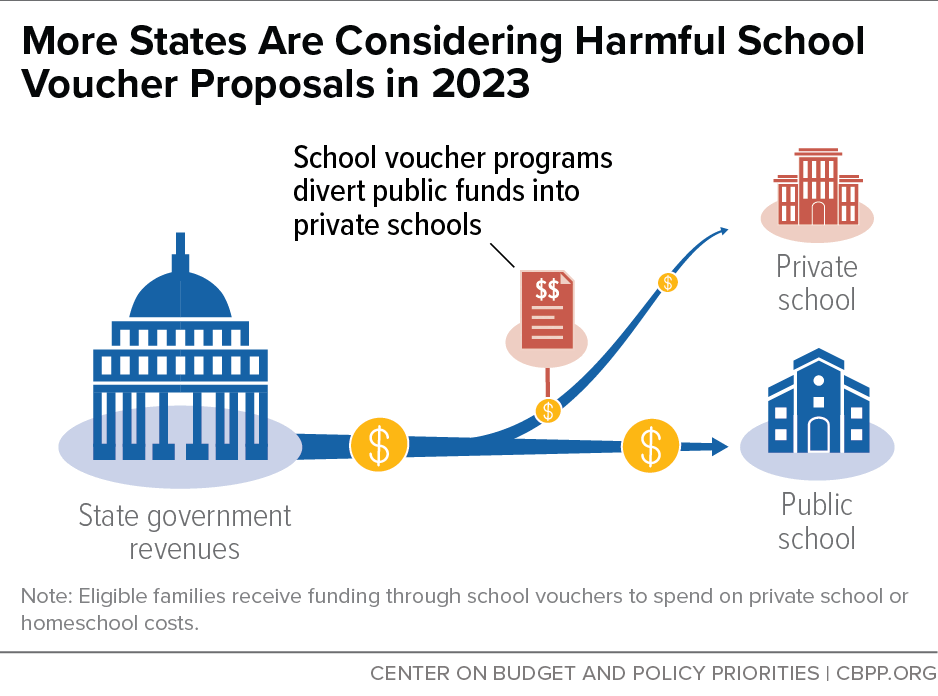
The Center for Budget and Policy Priorities in D.C. issues reports on high-profile issues. This one should be in the hands of every legislator, school board member, and policymaker. It succinctly explains why states should not authorize vouchers.

Iris Hinh and Whitney Tucker wrote this report, which was published in June 2023. One conclusion is clear: vouchers inflict damage on public schools, attended by the vast majority of children, while helping affluent families. After this report appeared, Hinh joined the staff of the Senate Health, Education, Labor and Pensions Committee as an education policy advisor.

Hinh and Tucker write:

K-12 school vouchers are typically funded through state revenues and give families a set amount of money per eligible student to cover a portion of private school tuition. These vouchers divert money away from public schools, sometimes by directly re-routing education funding to private schools, and other times indirectly by making it harder to pay teachers, buy new textbooks, and provide quality after-school programming. The support for public schools is high: families overwhelmingly support their schools, and many teachers and other advocates for public education oppose vouchers.[1]

In the past few months, state lawmakers have expanded and created a record number of school voucher programs with little to no limits on eligibility. This will deplete available state revenues for public education and other critical services and do little to expand opportunity for students.

Regardless of whether school vouchers directly or indirectly divert funding from public schools to private education, state K-12 funding formulas depend on some metric of student count to allocate per-pupil funding. Some school districts can absorb some of the cuts with layoffs and reduced spending on textbooks and supplies. But fixed expenses such as air conditioning, school buses, and building maintenance can lead to funding shortfalls and layoffs.

In early 2023, these states created or expanded their school voucher policies:

  • Nebraska passed the state’s first voucher program, a K-12 tuition tax credit initially capped at $25 million annually, though the cap could rise to $100 million a year depending on demand for tax credits. Individuals and businesses can donate up to half of their taxes owed (with a maximum of $100,000); donations are funneled to scholarship granting organizations (SGOs), which pay private school tuition and other eligible expenses on behalf of students and their families. The tax credits reduce tax liability and thus, decrease the state revenues available for investments in public services, including public schools. Public school advocates are planning to challenge the bill on the 2024 ballot.
  • ArkansasLEARNS Act created, among other harmful policies for public education and teachers, an education savings account (ESA) program, which will phase in universal eligibility by the 2025-2026 school year and provide state-funded vouchers for families to use toward private school tuition and several other allowable expenses (like homeschooling, exam fees, and tutoring).
  • Florida broadened eligibility requirements to make its existing ESA program available to all students (rather than only students with disabilities or those from low-income families), with an estimated cost of $4 billion in the first year of implementation.
  • Iowa created an ESA that is initially targeted to families with lower incomes. But it will expand over time to include all students by the 2025-2026 school year and cost over $340 million per year when fully in effect.
  • South Carolina expanded the state ESA, lifting household income eligibility to 400 percent of the federal poverty level beginning in 2026-2027, but placing a 15,000-student cap on the program.
  • Utah created an ESA starting in the 2024-2025 school year that is available to all students but gives priority to students based on their household’s income.

Other states should not follow the paths of these states. For one, school vouchers primarily benefit wealthier students, families, and businesses. States with existing voucher programs — Arizona, Missouri, New Hampshire, and Wisconsin — have reported that most families who benefitted were already covering the costs of private schools and homeschooling prior to the voucher becoming available.

Wealthy people and companies also benefit when vouchers take the newer form of K-12 tuition tax credits. People and companies who donate to SGOs are allowed to opt out of paying tax to fund public needs and instead fund tuition scholarships at private K-12 schools. This tax incentive can provide state credits — up to 100 percent of the donation — to families with incomes over $200,000 and even allows businesses to profit from claiming federal expense deductions and avoiding capital gains tax.

Vouchers can also increase the likelihood that students experience discrimination and harm. Private schools are not required to offer the same federal civil rights protections for students as public schools. In fact, many voucher bills explicitly require families to waive students’ protections and rights under the federal Individuals with Disabilities Education Act for educational services that students with disabilities may need to learn.

Further, vouchers do not necessarily expand opportunities for students with the greatest needs. Students from families with low incomes often face barriers to navigating the voucher application and private school admission processes. Smaller, rural areas often rely on their local public schools as community hubs and primary sources of employment. Private schools can more easily push students out without recourse based on how they style their hair, what they wear, test scores, and subjective disciplinary action.

Voucher costs often grow beyond what is projected and thus, reduce overall revenues for other state spending. A recent study of school voucher programsin seven states shows how state voucher spending from 2008 to 2019 increased by hundreds of millions of dollars annually, while K-12 spending for public education declined despite public school enrollment increases. Arizona became the first state to implement a universal voucher program in 2022, and as of mid-March 2023, the ESA program is expected to cost the state at least $345 million more than initial projections for the first year. New Hampshire’s voucher program was estimated to cost $130,000 in 2021 and it now costs $14.7 million. And a few private schools in Iowa are already raising tuition only a few months after the new voucher program passed in January of this year.

Some state lawmakers understood the great cost at the expense of public services and stopped multiple school voucher bills this year. For example, 16 House Republicans broke with their party to defeat Georgia’s universal voucher proposal in the final hours of session. And Idaho Senate Republicans raised concerns about the long-term cost of a universal ESA bill, which also applied to subsequent voucher bills.

As some states continue to debate school vouchers during legislative sessions, state lawmakers should understand that their actions now and in the future will have large fiscal and harmful consequences for public education and student opportunities.

Another state that did NOT pass vouchers was Texas, even though Governor Greg Abbott called four special sessions of the legislature. Rural Republicans refused both bribes and threats and voted against vouchers because they wanted to protect their community schools.

More States Are Considering Harmful School Voucher Proposals in 2023

The graph above appeared in an earlier version of this report, published in March 2023.

Geert Wilders is a Dutch politician who has espoused anti-Islamic views for many years. He has campaigned on a platform of putting Dutch people first and blocking immigration from Muslim countries. He has been called the Dutch Trump. In the recent parliamentary elections, his party came in first among a field of 15 parties. It won 37 of 150 seats and will need to persuade other parties to join in a coalition in order to govern. In the past, Wilders has promised to close mosques and Islamic schools, but he is already moderating his hardline views to win over partners. Wilders will need 76 votes—39 more than he has now— to form a new government.

The BBC reported:

Veteran anti-Islam populist leader Geert Wilders has won a dramatic victory in the Dutch general election, with almost all votes counted.

After 25 years in parliament, his Freedom party (PVV) is set to win 37 seats, well ahead of his nearest rival, a left-wing alliance.

“The PVV can no longer be ignored,” he said. “We will govern.”

His win has shaken Dutch politics and it will send a shock across Europe too…

He told the BBC that “of course” he was willing to negotiate and compromise with other parties to become prime minister.

The PVV leader won after harnessing widespread frustration about migration, promising “borders closed” and putting on hold his promise to ban the Koran

A Wilders victory will send shockwaves around Europe, as the Netherlands is one of the founding members of what became the European Union.

Nationalist and far-right leaders around Europe praised his achievement. In France, Marine Le Pen said it “confirms the growing attachment to the defence of national identities”.

Mr Wilders wants to hold a “Nexit” referendum to leave the EU, although he recognises there is no national mood to do so. He will have a hard time convincing any major prospective coalition partner to sign up to that.

He tempered his anti-Islam rhetoric in the run-up to the vote, saying there were more pressing issues at the moment and he was prepared to “put in the fridge” his policies on banning mosques and Islamic schools.

The strategy was a success, more than doubling his PVV party’s numbers in parliament.

For Americans, the elections in the Netherlands and Argentina raise an urgent question: are these elections a portent of the persistence of far-right politics or are they the after-effects of the Trump era? Are they the future or an echo of the past?

Chris Tomlinson is an award-winning columnist for the Houston Chronicle. He uses his space to combat bigotry, stupidity, and lies. He is not a “both sides” kind of journalist.

He writes here about the infamous oil billionaires who use their money to spread their religious views, attack public schools, and encourage indoctrination.

He writes:

Texas oilman H.L. Hunt may have been the first to spend millions to promote right-wing media and extremist ideas, but he was far from the last.

Most Texans, let alone Americans, had never heard of Farris and Dan Wilks or Tim Dunn before this year. But journalists have revealed them as key supporters of some of the most controversial figures in Texas politics and bankrollers of political action committees staffed by Christian nationalists and antisemites.

The reclusive billionaires and their allies rarely respond to requests for comment from mainstream media and did not respond to my messages.

Farris Wilks, fracking billionaire and pastor of the Assembly of Yahweh (7th Day) Church, preaches that the Bible is “true and correct in every scientific and historical detail” and that abortion, homosexuality and drunkenness are serious crimes, according to the church’s doctrinal statement, the Reuters news agency reported.

Dan Wilks attends church with his brother, with whom he co-founded Frac Tech, a company they sold for $3.5 billion. They have since become some of the largest donors in Texas GOP politics, giving $15 million in 2016 to a political action committee backing Sen. Ted Cruz.

Like Hunt, who broadcast his extremist commentary on radio stations nationwide, the Wilks brothers have also invested in media, supporting conservative mouthpieces like The Daily Wire and Prager University. Their PAC bought ads disguised as articles in the Metric Media news network, which includes 59 pseudo-local news sites in Texas, the Columbia Journalism Review reported.

The Wilks brothers have enjoyed their greatest success by joining Dunn to move the Republican Party of Texas as far right as possible through Empower Texans, one of the most influential dark-money political action committees.

Empower Texans shuttered in 2020 after spinning off operations into Texans for Fiscal Responsibility and Texas Scorecard, which rank politicians by their adherence to the group’s ideology. Dunn and the Wilks brothers have provided most of the financing and set the agenda for conservative activist Michael Quinn Sullivan, who has led all three organizations.

In 2016, the groups opposed Texas House Speaker Joe Straus, whom they considered too moderate. They also ran ultra-conservative candidates against Republicans who ranked poorly on their scorecard. When Straus, who is Jewish, invited Dunn for a breakfast meeting, he reportedly said only Christians should have leadership positions, Texas Monthly reported in 2018. This is a sentiment he’d previously expressed in a 2016 Christian radio interview.

Republicans have long struggled with antisemitism. In 2010, State Republican Executive Chairman John Cooke wrote an email proclaiming, “We elected a house with Christian, conservative values. We now want a true Christian, conservative running it,” the Texas Observer reported.

Dunn and the Wilkses also finance special interest PACs. In 2017, Empower Texans supported and advised Texans for Vaccine Choice, an early anti-vaccination movement, former state Rep. Jonathan Stickland told the Washington Post.

Stickland left elected office to start Pale Horse Strategies, a political consulting firm that ran a new Dunn and Wilks PAC, Defend Texas Liberty. The PAC defended Attorney General Ken Paxton against corruption allegations and provided $3 million to Lt. Gov. Dan Patrick weeks before he presided over Paxton’s impeachment trial, where he was acquitted.

Fresh from that victory, a Texas Tribune reporter observed Stickland, Republican Party of Texas chair Matt Rinaldi, prominent white supremacist Nick Fuentes and Black Lives Matter shooter Kyle Rittenhouse enter the Pale Horse Strategies office in Fort Worth on Oct. 6.

Fuentes was driven to the meeting by Chris Russo, who used Dunn and Wilks money to found Texans For Strong Borders PAC. Russo has past ties to Fuentes, the Tribune reported.

When current GOP House Speaker Dade Phelan demanded Patrick give away the $3 million donation, Patrick said Dunn had called him to apologize.

Dunn “is certain that Mr. Stickland and all PAC personnel will not have any future contact with Mr. Fuentes,” Patrick explained.

Yet, when the Tribune’s Robert Downen kept digging, he found that Pale Horse’s social media manager, Elle Maulding, had called Fuentes the “greatest civil rights leader in history” and shared photos of them together. Shelby Griesinger, Defend Texas Liberty’s treasurer, has said Jews worship a false god and depicted them as the enemy on social media.

Dunn and the Wilks brothers have spent $100 million on ultra-conservative candidates, political action committees in Texas, and radical nonprofits. They finance a movement staffed by publicly antisemitic foot soldiers.

Conservatives considered H.L. Hunt a crackpot in his day. But this new generation has the GOP falling into a goose step.

Ron DeSantis clearly wants to have his own country, where he is el caudillo, the guy in charge of everything. Now that he has a supine supermajority in the Legislature and has named the majority on the Florida Supreme Court, what else does he need? His own army!

Never willing to say no to DeSantis, the Legislature appropriated millions for the governor to have a state guard (in addition to the National Guard, which is under federal control).

But that was not good enough for Ron. He wanted his Guard to be combat-ready. So he hired a private company to teach his Guard how to use weapons and explosives and to prepare for urban warfare.

The Orlando Sentinel reports:

The Florida company trains police and military members on tactical shooting, explosives and urban combat and is owned by a former Army green beret who supports the Republican governor’s presidential campaign. The governor, the State Guard and the Florida Department of Military Affairs, which oversees the agreement, didn’t respond to questions about the training services.

The state’s civilian force was initially sold as a unit that would help Florida’s overworked National Guard respond to emergencies within the state. Since then, its scope has been expanded to allow the state guard to respond to emergencies anywhere in the country, and some members have been granted the ability to make arrests and carry weapons….

In promotional videos, Stronghold SOF Solutions highlights training that teaches individuals how to use drones, explosives and precision shooting. The company, based in Destin with a training facility in Defuniak Springs, touts having trained various special forces units, including Army Rangers, and police officers. Its facilities include a shoot house, various firing ranges, an airfield and a targetry.

If DeSantis can’t be President, at least he will have his own combat-ready army.

Researchers at the esteemed Columbia Journalism Review conducted a study of the election coverage on the front pages of The New York Times and The Washington Post and concluded, despite the protests of editors, that the pre-election coverage in recent years was not objective. Their biggest complaint was that the newspapers reported the Presidential campaign as a horse race instead of informing readers about real policy differences between the candidates. But there was another kind of bias at work: The New York Times published ten front-page articles about Hillary Clinton’s emails in the months before the election, which turned out to be a phony issue.

The article begins:

Seven years ago, in the wake of the 2016 presidential election, media analysts rushed to explain Donald Trump’s victory. Misinformation was to blame, the theory went, fueled by Russian agents and carried on social networks. But as researchers, we wondered if fascination and fear over “fake news” had led people to underestimate the influence of traditional journalism outlets. After all, mainstream news organizations remain an important part of the media ecosystem—they’re widely read and watched; they help set the agenda, including on social networks. We decided to look at what had been featured on the printed front page of the New York Times in the three months leading up to Election Day. Of a hundred and fifty articles that discussed the campaign, only a handful mentioned policy; the vast majority covered horse race politics or personal scandals. Most strikingly, the Times ran ten front-page stories about Hillary Clinton’s email server. “If voters had wanted to educate themselves on issues,” we concluded, “they would not have learned much from reading the Times.”

We didn’t suggest that the election coverage in the Times was any worse than what appeared in other major outlets, “so much as it was typical of a broader failure of mainstream journalism.” But we did expect, or at least hope, that in the years that followed, the Times would conduct a critical review of its editorial policies. Was an overwhelming focus on the election as a sporting contest the best way to serve readers? Was obsessive attention to Clinton’s email server really justified in light of the innumerable personal, ethical, and ultimately criminal failings of Trump? It seemed that editors had a responsibility to rethink both the volume of attention paid to certain subjects as well as their framing.

After the 2022 midterms, we checked back in, this time examining the printed front page of the Times and the Washington Post from September 1, 2022, through Election Day that November. As before, we figured the front page mattered disproportionately, in part because articles placed there represent selections that publishers believe are most important to readers—and also because, according to Nielsen data we analyzed, 32 percent of Web-browsing sessions around that period starting at the Times homepage did not lead to other sections or articles; people often stick to what they’re shown first. We added the Post this time around for comparison, to get a sense of whether the Times really was anomalous.

It wasn’t. We found that the Times and the Post shared significant overlap in their domestic politics coverage, offering little insight into policy. Both emphasized the horse race and campaign palace intrigue, stories that functioned more to entertain readers than to educate them on essential differences between political parties. The main point of contrast we found between the two papers was that, while the Postdelved more into topics Democrats generally want to discuss—affirmative action, police reform, LGBTQ rights—the Times tended to focus on subjects important to Republicans—China, immigration, and crime.

By the numbers, of four hundred and eight articles on the front page of the Timesduring the period we analyzed, about half—two hundred nineteen—were about domestic politics. A generous interpretation found that just ten of those stories explained domestic public policy in any detail; only one front-page article in the lead-up to the midterms really leaned into discussion about a policy matter in Congress: Republican efforts to shrink Social Security. Of three hundred and ninety-three front-page articles in the Post, two hundred fifteen were about domestic politics; our research found only four stories that discussed any form of policy. The Post had no front-page stories in the months ahead of the midterms on policies that candidates aimed to bring to the fore or legislation they intended to pursue. Instead, articles speculated about candidates and discussed where voter bases were leaning. (All of the data and analysis supporting this piece can be found here.)

Exit polls indicated that Democrats cared most about abortion and gun policy; crime, inflation, and immigration were top of mind for Republicans. In the Times, Republican-favored topics accounted for thirty-seven articles, while Democratic topics accounted for just seven. In the Post, Republican topics were the focus of twenty articles and Democratic topics accounted for fifteen—a much more balanced showing. In the final days before the election, we noticed that the Times, in particular, hit a drumbeat of fear about the economy—the worries of voters, exploitation by companies, and anxieties related to the Federal Reserve—as well as crime. Data buried within articles occasionally refuted the fear-based premise of a piece. Still, by discussing how much people were concerned about inflation and crime—and reporting in those stories that Republicans benefited from a sense of alarm—the Times suggested that inflation and crime were historically bad (they were not) and that Republicans had solutions to offer (they did not).

I urge you to open the link and read the article. It confirms what many of us suspected: the major media are all too easily sucked into the GOP narrative and parrot it. Expect to see a focus in the lead-up to the 2024 election that emphasizes inflation, crime, fears about Biden’s age, and every verbal slip up he makes, and every other reason either to abstain from voting or to vote for Trump. We will see, as we do already, a drumbeat of articles about why this group or that one will not vote for Biden (so far, I have seen such articles about the youth vote, the Black vote, the Hispanic vote, and the Muslim vote). It would be ironic if Muslims didn’t vote for Biden because of his support for Israel, since Trump tried to ban immigration from Muslim-majority nations and is openly nativist.

Will the major media allow Trump and his enablers again to set their agenda?

Robert Hubbell read this study and remarked that the major media are again treating the Presidential campaign as a horse race between Biden and Trump, as though it were a normal election. It’s not. Trump has already sketched the plans for his second term, and they are a recipe for enhancing his power and destroying his enemies.

Hubbell wrote:

I am going to take this opportunity to make a direct plea to journalists, producers, and editors in the news media who read this newsletter. I know you are out there because I hear from you when you feel that I unfairly bash the news media. I occasionally receive mistaken “reply-to-all” or forwarded emails to your colleagues that inadvertently include me. (Don’t worry; I delete them immediately.) (Hint: Do a Google search for “How to remove a name from autofill in an email address field.”)

Let me start with an olive branch. There are exceptional journalists doing great work every day. I cite them every day. They can’t please everyone all the time. They deserve our support and thanks—and forbearance for the occasional mistake. So here it is: Thank you to every journalist who is doing a tough job well in a news environment that is the equivalent of a war zone of disinformation.

Ignore my whining and carping; dismiss me as a crank if you want. But please ask yourselves whether the news reporting and editorial stances at your outlet are rising to this perilous moment in American history. Everyone—including you—knows in their bones that Trump is a unique threat to democracy. He is consciously emulating the worst dictators of the last century. His aides are leaking their plans to undermine democracy. That existential threat must be in every story you write. If you must, report on polls or horse races or political infighting but do so while acknowledging that one candidate seeks to destroy democracy while the other candidate seeks to operate within its confines.

I believe that Americans will prevail against the threat of MAGA extremism with or without the support of a free press rising to the challenge of this moment. But it would be easier—and victory would be more assured—if major media outlets did not treat Trump as just another candidate after his failed coup and incitement to insurrection.

Imagine if Hitler had survived WWII and then ran for re-election as Chancellor of Germany from a prison cell. Would any story be written that merely reported on polls discussing the level of voter support for Hitler versus his opponent? Or would every story include discussion of his fascist takeover of Germany, his war on Europe, and his attempt to exterminate the Jewish people? Why does Trump get a free pass in hundreds of articles a day that treat him as the legitimate political opponent of Joe Biden? How can any story be written that asks, “Is Biden too old,” without asking the more urgent question, “Will Trump end democracy in America.”

I have slipped back into offense when I meant to invite you to reflect on the balance and editorial position of your news organization. Tens of millions of Americans are hoping that you will get it right. You don’t have to defend Democrats or Joe Biden. But defending the Constitution and democracy is not partisan. The future of our democracy is partly in your hands. It should be a part of every story you write.

Heather Cox Richardson wrote a compelling piece about the challenges we face in the year leading up to the 2024 election. The media keeps warning us about ominous polls, about the dangers of Trump, about Biden potentially losing this or that demographic. Trump seems to be driven by two goals: 1) to stay out of prison (as president, he could pardon himself for federal crimes, not state convictions); and 2) the chance to wreak vengeance on his enemies.

Richardson wrote:

Yesterday, David Roberts of the energy and politics newsletter Volts noted that a Washington Post article illustrated how right-wing extremism is accomplishing its goal of destroying faith in democracy. Examining how “in a swing Wisconsin county, everyone is tired of politics,” the article revealed how right-wing extremism has sucked up so much media oxygen that people have tuned out, making them unaware that Biden and the Democrats are doing their best to deliver precisely what those in the article claim to want: compromise, access to abortion, affordable health care, and gun safety. 

One person interviewed said, “I can’t really speak to anything [Biden] has done because I’ve tuned it out, like a lot of people have. We’re so tired of the us-against-them politics.” Roberts points out that “both sides” are not extremists, but many Americans have no idea that the Democrats are actually trying to govern, including by reaching across the aisle. Roberts notes that the media focus on the right wing enables the right wing to define our politics. That, in turn, serves the radical right by destroying Americans’ faith in our democratic government. 

Former Republican National Committee chair Michael Steele echoed that observation this morning when he wrote, “We need to stop the false equivalency BS between Biden and Trump. Only one acts with the intention to do real harm.”

Indeed, as David Kurtz of Talking Points Memoputs it, “the gathering storm of Trump 2.0 is upon us,” and Trump and his people are telling us exactly what a second Trump term would look like. Yesterday, Trump echoed his “vermin” post of the other day, saying: “2024 is our final battle. With you at my side, we will demolish the Deep State, we will expel the warmongers from our government, we will drive out the globalists, we will cast out the Communists, Marxists, and Fascists, we will throw off the sick political class that hates our Country, we will rout the Fake News Media, we will evict Joe Biden from the White House, and we will FINISH THE JOB ONCE AND FOR ALL!”   

Trump’s open swing toward authoritarianism should be disqualifying even for Republicans—can you imagine Ronald Reagan talking this way?—but MAGA Republicans are lining up behind him. Last week the Texas legislature passed a bill to seize immigration authority from the federal government in what is a clear violation of the U.S. Constitution, and yesterday, Texas governor Greg Abbott announced that he was “proud to endorse” Trump for president because of his proposed border policies (which include the deportation of 10 million people).

House speaker Mike Johnson (R-LA) has also endorsed Trump, and on Friday he announced he was ordering the release of more than 40,000 hours of tapes from the January 6, 2021, attack on the U.S. Capitol, answering the demands of far-right congress members who insist the tapes will prove there was no such attack despite the conclusion of the House committee investigating the attack that Trump criminally conspired to overturn the lawful results of the 2020 presidential election and refused to stop his supporters from attacking the Capitol. 

Trump loyalist Senator Mike Lee (R-UT) promptly spread a debunked conspiracy theory that one of the attackers shown in the tapes, Kevin Lyons, was actually a law enforcement officer hiding a badge. Lyons—who was not, in fact, a police officer—was carrying a vape and a photo he stole from then–House speaker Nancy Pelosi’s office and is now serving a 51-month prison sentence. (Former representative Liz Cheney (R-WY) tweeted: “Hey [Mike Lee]—heads up. A nutball conspiracy theorist appears to be posting from your account.”)

Both E.J. Dionne of the Washington Post and Will Bunch of the Philadelphia Inquirer noted yesterday that MAGA Republicans have no policies for addressing inflation or relations with China or gun safety; instead, they have coalesced only around the belief that officials in “the administrative state” thwarted Trump in his first term and that a second term will be about revenge on his enemies and smashing American liberalism. 

MIke Davis, one of the men under consideration for attorney general, told a podcast host in September that he would “unleash hell on Washington, D.C.,” getting rid of career politicians, indicting President Joe Biden “and every other scumball, sleazeball Biden,” and helping pardon those found guilty of crimes associated with the January 6th attack on the U.S. Capitol. “We’re gonna deport a lot of people, 10 million people and growing—anchor babies, their parents, their grandparents,” Davis said. “We’re gonna put kids in cages. It’s gonna be glorious. We’re gonna detain a lot of people in the D.C. gulag and Gitmo.”

In the Washington Post, Josh Dawsey talked to former Trump officials who do not believe Trump should be anywhere near the presidency, and yet they either fear for their safety if they oppose him or despair that nothing they say seems to matter. John F. Kelly, Trump’s longest-serving chief of staff, told Dawsey that it is beyond his comprehension that Trump has the support he does. 

“I came out and told people the awful things he said about wounded soldiers, and it didn’t have half a day’s bounce. You had his attorney general Bill Barr come out, and not a half a day’s bounce. If anything, his numbers go up. It might even move the needle in the wrong direction. I think we’re in a dangerous zone in our country,” Kelly said.  

Part of the attraction of right-wing figures is they offer easy solutions to the complicated issues of the modern world. Argentina has inflation over 140%, and 40% of its people live in poverty. Yesterday, voters elected as president far-right libertarian Javier Milei, who is known as “El Loco” (The Madman). Milei wants to legalize the sale of organs, denies climate change, and wielded a chainsaw on the campaign trail to show he would cut down the state and “exterminate” inflation. Both Trump and Brazil’s Jair Bolsonaro, two far-right former presidents who launched attacks against their own governments, congratulated him. 

In 1959, President Dwight D. Eisenhower took on the question of authoritarianism. Robert J. Biggs, a terminally ill World War II veteran, wrote to Eisenhower, asking him to cut through the confusion of the postwar years. “We wait for someone to speak for us and back him completely if the statement is made in truth,” Biggs wrote. Eisenhower responded at length. While unity was imperative in the military, he said, “in a democracy debate is the breath of life. This is to me what Lincoln meant by government ‘of the people, by the people, and for the people.’” 

Dictators, Eisenhower wrote, “make one contribution to their people which leads them to tend to support such systems—freedom from the necessity of informing themselves and making up their own minds concerning these tremendous complex and difficult questions.” 

Once again, liberal democracy is under attack, but it is notable—to me, anyway, as I watch to see how the public conversation is changing—that more and more people are stepping up to defend it. In the New York Times today, legal scholar Cass Sunstein warned that “[o]n the left, some people insist that liberalism is exhausted and dying, and unable to handle the problems posed by entrenched inequalities, corporate power and environmental degradation. On the right, some people think that liberalism is responsible for the collapse of traditional values, rampant criminality, disrespect for authority and widespread immorality.”

Sunstein went on to defend liberalism in a 34-point description, but his first point was the most important: “Liberals believe in six things,” he wrote: “freedom, human rights, pluralism, security, the rule of law and democracy,” including fact-based debate and accountability of elected officials to the people.

PEN America has published a state-by-state study of gag orders in education.

Has your state passed gag orders banning books or topics? Check the PEN listing.

PEN wrote:

Over the past three years, state legislators have launched an onslaught of educational gag orders—state legislative and policy efforts to restrict teaching about topics such as race, gender, American history, and LGBTQ+ identities in educational settings.1 PEN America tracks these bills in our Index of Educational Gag Orders.

During the 2023 state legislative sessions, 110 bills that PEN America defines as educational gag orders were introduced, and 10 became law. Four more gag orders were imposed via executive order or state or system regulation: two in Florida, and one each in Arkansas and California. These developments bring the number of educational gag orders that have become law or policy to a total of 40 across 21 states as of November 1, 2023.

While it is difficult to guess the total number of educators affected by these laws and policies, a conservative estimate would put the number at approximately 1.3 million public school teachers and 100,000 public college and university faculty.2 The students who have been directly affected—through canceled classes, censored teachers, and decimated school library collections—likely number in the millions. The chilling effect on public education across the country is certainly much larger.

In this report, we analyze the educational gag orders introduced and passed in the 2023 legislative sessions, as well as the impact of laws passed in 2022 and 2021. We find the following trends:

  • In 2023, educational gag orders changed dramatically in their shape. Their supporters, who remain overwhelmingly politically conservative, have learned from past mistakes and have new and more insidious strategies for silencing America’s educators.
  • Backers of these laws in K–12 schools have shifted their emphasis to bills that restrict speech about LGBTQ+ topics and identities, including numerous copycats of last year’s HB 1557 in Florida, known to critics as the “Don’t Say Gay” law.
  • In higher education, legislators have introduced a new set of bills that attack the traditional support network that underpins academic freedom and free speech,including proposed restrictions on university governance, curricula, faculty tenure, DEI offices and initiatives, and accreditation agencies.
  • New surveys of K–12 and college teachers affected by educational gag orders show for the first time the extensive toll such laws are having on educators.
  • Fortunately, resistance to educational gag orders is rapidly growing. Increasing majorities of Americans have had enough, and organized opposition to educational censorship has increased across the country, with some notable successes.
  • In 2024, legislative efforts to censor educational institutions are likely to continue. Each of the past three legislative sessions has seen greater and more varied proposals to impose prohibitions on the freedom to learn and teach in schools, colleges, and universities. The 2024 general election is likely to contribute to ongoing escalation of this trend.

Dan Rather and Elliott Kirschner write on their blog Steady about the dangers of another Trump presidency. Trump 2.0, they predict, will mean the end of democracy. They call it “a horrific sequel.” Trump has pledged to turn the Department of Justice into a partisan tool to punish his enemies, both Republicans and Democrats. He will politicize the career civil service and stock it with Trump loyalists. He will use the Insurrection Act to mobilize the military to shut down demonstrations and protests. His plan, Project 2025, lays out a radical plan to redesign the federal role into an instrument of Trump’s vengeance and egotism.

Rather and Kirschner write:

Lately, much of the attention of the Washington establishment, and the media ecosystem that feeds it, has been focused on debating (or diminishing) the electoral prospects of President Biden. There is no shortage of diving boards from which to plunge into the punditry.

One jumping-off point is a series of polls that show Biden in dire straits. These are accompanied by the predictable news reports that quote Democratic “elected officials,” “party leaders,” “campaign strategists,” or even “people close to Biden,” who decline to go on the record when they echo the prevailing wisdom that he is in trouble.

Then there is a rash of third-party candidates threatening to further splinter an already fractured electorate. For example, West Virginia Senator Joe Manchin’s decision not to seek reelection is being framed as both an omen of Biden’s weakness and a threat, because Manchin could represent yet another possible rival for the presidency. Meanwhile, the decisive victories of Democrats across multiple state elections last week have already disappeared in the news cycle’s rearview mirror.

At this point in the campaign season, it is typical for an incumbent president to face this level of scrutiny, second-guessing, and soul searching. Usually, the opposition party is far from deciding on a nominee, and horse race coverage of the current occupant of the Oval Office is catnip for pundits looking for things on which to opine. Furthermore, it is easier to judge an incumbent than a challenger, because we have a lot of data points for how the former would perform in the job of president of the United States — a role without parallel in the world.

But all of these conventions should be thrown out the door for 2024. For starters, while there is a pantomime of a primary campaign going on for the Republican nomination, it has about as much uncertainty as a Harlem Globetrotters game. There is a frontrunner so far ahead that he feels no need to even show up for the debates. And he has paid no price for skipping them. Furthermore, we don’t have to guess what it would be like to have him as president. We’ve already lived through that nightmare once.

But here is where things get even more grim. If Trump were to be reelected, it would be worse, much worse, than the first time. That’s not idle speculation or fantastical conjecture. Trump’s not hiding the truth that he would end American democracy.

We’ve already seen how lies about the 2020 election have become a litmus test for Republican elected officials — including the new speaker of the House. And a recent Washington Post report details how Trump and his allies plan to use the Department of Justice to go after his political rivals, in the kind of revenge politics one finds in dictatorships. Then, in an interview with the Spanish language news service Univision, Trump doubled down on weaponizing the DOJ to attack his opponents.

In a Veterans Day rant in New Hampshire, Trump called upon the authoritarian playbook of dehumanizing political opponents. He railed against “the radical left thugs that live like vermin within the confines of our country” and added, “The threat from outside forces is far less sinister, dangerous and grave than the threat from within.”

Of course, Trump has always been a master of projection. His eagerness to weaponize the DOJ stems from his misplaced sense of victimhood — his belief that he has been targeted with his numerous indictments. The legal jeopardy he faces stems from his attempts to tear down American democracy once. In his rage, he promises to escalate. That has been his playbook in business and politics.

Trump is who he is. And that means it is all the more important for the press not to normalize this election. Yes, there will be polls. And yes, there is a horse race. And yes, reporters can and should cover Biden and his policies with objectivity, to the extent humanly possible. But there should be no diminishing what the other candidate intends to do if he regains the White House. There should be no acceptance of the fact that large swaths of one of our two major political parties are denying the results of a free and fair election.

Recently, reporters are becoming bolder in demanding Republicans state that the 2020 election wasn’t stolen. That is a positive trend and should be followed up with questions about Trump’s attacks on democracy and the rule of law.

This is not simply an election between a Democrat and a Republican or an incumbent and a challenger. This is not primarily about weighing polls and voter enthusiasm in battleground states. This should not be reduced to comparing advertising dollars or voter registration numbers. This is about a vote that will decide the future of our nation in ways unlike any since the Civil War.

Trump isn’t hiding his intentions. There is no excuse for minimizing the threat he poses. What’s at stake in the upcoming election is the continuity of America’s precarious experiment in democracy.

If you missed the 10th annual conference of the Network for Public Education, you missed some of the best presentations in our ten years of holding conferences.

You missed the brilliant Gloria Ladson-Billings, Professor Emerita and formerly the Kellner Family Distinguished Professor of Urban Education in the Department of Curriculum and Instruction at the University of Wisconsin-Madison.

Ladson-Billings gave an outstanding speech that brought an enthusiastic audience to its feet. She spoke about controversial topics with wit, charm, wisdom, and insight.

Fortunately, her presentation was videotaped. If you were there, you will enjoy watching it again. If you were not there, you have a treat in store.