Archives for category: Democracy

Forgive me for posting two reviews of my last book, which was published on January 20, 2020.

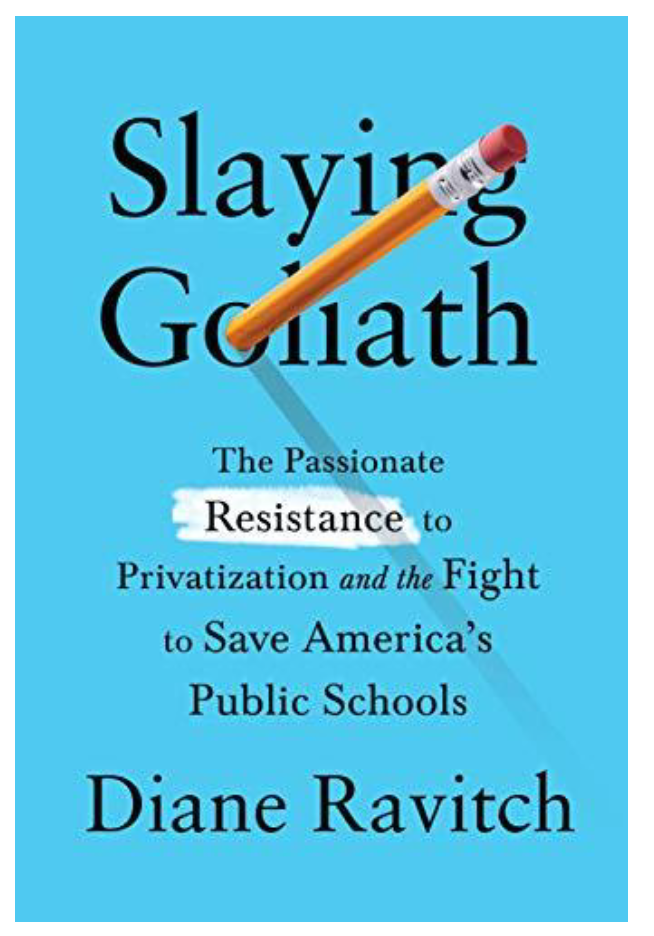
As I explained in the previous post, I did not see either of these reviews until long after they appeared in print. Slaying Goliath appeared just as COVID was beginning to make its mark, only a few weeks before it was recognized as a global pandemic. In writing the book, I wanted to celebrate the individuals and groups that demonstrated bravery in standing up to the powerful, richly endowed forces that were determined to privatize their public schools through charters or vouchers.

America’s public schools had educated generations of young people who created the most powerful, most culturally creative, most dynamic nation on earth. Yet there arose a cabal of billionaires and their functionaries who were determined to destroy public schools and turn them into privately-managed schools and to turn their funding over to private and religious schools.

Having worked for many years inside the conservative movement, I knew what was happening. I saw where the money was coming from, and I knew that politicians had been won over (bought) by campaign contributions.

Publishing a book at the same time as a global pandemic terrifies the world and endangers millions of people is bad timing, for sure.

But the most hurtful blow to me and the book was a mean-spirited review in The New York Times Book Review. The NYTBR is unquestionably the most important review that a book is likely to get. Its readership is huge. A bad review is a death knell. That’s the review I got. The reviewer, not an educator or education journalist, hated the book. Hated it. I found her review hard to read because she seemed to reviewing a different book.

I was completely unaware that Bob Shepherd reviewed the review. I didn’t see it until two or three years after it appeared. He wrote what I felt, but I, as the author, knew that it was very bad form to complain, and I did not.

So I happily post Bob Shepherd’s review of the review here.

I am almost four years late in discovering this review by two scholars for whom I have the greatest respect: David C. Berliner and Gene V. Glass.

I was happy to read this review because Slaying Goliath had a checkered fate. It was published in mid-January 2020. I went on a book tour, starting in Seattle. By mid-February, I made my last stop in West Virginia, where I met with teachers and celebrated the two-year anniversary of their strike, which shut down every school in the state.

As I traveled, news emerged of a dangerous “flu” that was rapidly spreading. It was COVID; by mid-March, the country was shutting down. No one wanted to read about the fight to save public schools or about its heroes. The news shifted, as it should have, to the panicked response to COVID, to the deaths of good people, to the overwhelmed hospitals and their overworked staff.

To make matters worse, the New York Times Book Review published a very negative review by someone who admired the “education reform” movement that I criticized. I thought of writing a letter to the editor but quickly dropped the idea. I wrote and rewrote my response to the review in my head, but not on paper.

Then, again by happenstance, I discovered that Bob Shepherd had reviewed the review of my book in The New York Times. He said everything that I wish I could have said but didn’t. His review was balm for my soul. Shepherd lacerated the tone and substance of the review, calling it an “uniformed, vituperative, shallow, amateurish ‘review.’” Which it was. His review of the review was so powerful that I will post it next.

Then, a few weeks ago, I found this review by Berliner and Glass.

The review begins:

Reviewed by Gene V Glass and David C. Berliner Arizona State University, United States

They wrote:

In a Post-Truth era, one must consider the source. 

In this case, the source is Diane Rose Silvers, the third of eight children of Walter Silverstein, a high school drop-out, and Ann Katz, a high school graduate. The Silvers were a middle-class Houston family, proprietors of a liquor store, and loyal supporters of FDR.

After graduation from San Jacinto High School, she enrolled in Wellesley College in September, 1956. Working as a “copy boy”for the Washington Post, Diane met Richard Ravitch, a lawyer working in the federal government and son of a prominent New York City family. They married on June 26,1960, in Houston, two weeks after Diane’s graduation from Wellesley. The couple settled in New York City, where Richard took employment in the family construction business. He eventually served as head of the Metropolitan Transit Authority and Lieutenant Governor in the 2000s, having been appointed by Democratic Governor David Paterson.

 Diane bore three sons, two of whom survived to adulthood. Diane and Richard ended their 26-year marriage in 1986. She had not been idle. For a period starting in 1961, Diane was employed by The New Leader, a liberal, anti-communist journal. She later earned a PhD in history of education from Columbia in 1975 under the mentorship of Lawrence Cremin.

Diane was appointed to the office of Assistant Secretary of Education, in the Department of Education by George H. W. Bush and later by Bill Clinton. In 1997, Clinton appointed her to the National Assessment Governing Board (NAGB), on which she served until 2004. 

Ravitch worked “… for many years in some of the nation’s leading conservative think tanks.

Read the full pdf here.

Gwen Frisbie-Fulton is a columnist for the News & Observer in North Carolina. She explains in this column why extremist Michelle Morrow is unqualified to be elected as state superintendent of public instruction. What the public knows about her is that she homeschools her children, she has called the public execution of Obama, Biden, Clinton, and other leading Democrats. But there’s more.

Frisbie-Fulton writes:

After years of being a science nerd, devouring books about space and astrophysics, my son recently became very athletic. This came as a surprise — he comes from a long line of artists and wanderers.

I embraced this new development wholeheartedly and cheered enthusiastically for his team from the sidelines. Next to me, always, was his coach, yelling support until his throat was raw.

A book-smart high school logic teacher, his coach was also learning the sport. He threw himself all in, researching and bringing different hill sprints and threshold runs into their practices. He read, researched and frequently solicited advice from others. The team never became top- tier, but every single runner improved their times and they made it to the regionals. Measured by wins, he might not have been the greatest coach — but he was a very solid leader.

This year, North Carolinians will head to the polls. While elections are inherently about politics, we will also be tasked to determine which candidates are equipped to lead.

To lead, someone must of course be experienced, but he or she also must be curious and open to about the world around them. And that is why I think that my son’s coach — whose politics I disagree with substantially —would be a better, more qualified candidate for superintendent of public instruction than GOP nominee Michelle Morrow.

Experience matters in leadership and Michele Morrow’s experience is extremely limited. While my son’s coach spends nine hours a day at the school, plus another two hours outside it on practice days, Morrow has homeschooled her children. Nonetheless, she has formed rigid opinions about North Carolina’s public schools, calling them “socialism centers” and “indoctrination centers” (WRAL).

Morrow not only lacks experience with public education, but she also lives a life very distant from what most students who rely on our schools know. While my son’s coach lives in an apartment complex where, no doubt, many of his students also live, Morrow lives in a wealthy suburb of Raleigh in a house valued at more than twice the average North Carolina home. In contrast to the Morrows, nearly half of all students in North Carolina are considered economically disadvantaged (with family incomes less than 185% of the federal poverty line). Morrow might believe that “the whole plan of the education system from day one has actually been to kind of control the thinking of our young people” (WRAL), but she fails to understand the supportive, stabilizing impact of public schools in children’s lives.

Good leaders are curious. While my son’s coach has a lot of experience with kids and schools, he didn’t have a much experience coaching — which is why he read, researched and sought advice from others. Morrow appears curiously uncurious. Active on the internet, she puts herself in an echo chamber of views, falling victim to conspiracy theories. During the pandemic, she used the QAnon hashtag #WWG1WGA multiple times and she spread disinformation about vaccinations (Fox 8).

Offline, Morrow further surrounds herself with people who will reinforce, not challenge or grow, her understanding of the world. She was photographed at a far-right candidate training session alongside John Fisher, a Proud Boy, and Sloan Rachmuth, an extremist provocateur who famously trolls and harasses her opponents on social media. Morrow served on the board of one of Sloan’s anti-public education projects (Libertas Prep, which appears to have never launched) alongside extremist Emily Rainey, who at one point claimed to have information about the attack on Moore County’s electrical grid. This insular clique mimics one anothers’ anti-diversity, anti-LGBTQIA+, and anti-education stances, just as Morrow parroted insurrectionist talking points while filming herself on her way to the U.S. Capitol on Jan. 6: “If you’re going to commit treason, if you’re going to participate in fraud in a United States election, we’re coming after you,” she said into her livestream.

If you don’t have experience, and you don’t surround yourself with different ideas and opinions, you must at least have a deep, principled commitment to fight for everyone to be a leader. My son and his coach spar regularly about politics and culture, but he makes sure my kid is always included, respected and heard. On the contrary, Michele Morrow prides herself on her intolerance, calling repeatedly for the “execution” of people she disagrees with (CNN).

She supports banning Islam (HuffPost), though our state has the 10th-largest Muslim population in the country. She has made anti-inclusivity a cornerstone of her campaign, railing against the LGBTQIA+ community, saying “There is no pride in perversion” (Media Matters). Morrow’s ability to lead schools that include many Muslim and LGBTQIA children is, in a word, impossible.

Having opinions doesn’t make you a leader: Experience, curiosity and the desire to work for everyone does.

When fully funded and at their best, North Carolina’s schools are creating our state’s future leaders — and our students need to see what good leadership looks like. The many teachers and coaches who model good leadership to our children day in and day out are not running for office this year; unfortunately Michele Morrow is.

Frank G. Splitt is a regular reader of the blog and a retired engineer of great distinction. He sent me his Amazon review of Liz Cheney’s best-selling book about the Congressional hearings conducted by the January 6 Select Committee. I have been meaning to review the book myself but put it off and am glad to print Frank’s review, as I agree with him.

I found the book to be absorbing, revealing what Congressional leaders said to one another on the day of the insurrection, as well as the inner workings of the January 6 Committee. Cheney doesn’t pull her punches. She was appalled by Trump’s disrespect for the Constitution and his egregious lying. She is contemptuous of Congressionals leaders like Kevin McCarthy who first condemned the violent attack, then turned on a dime to bend his knee to Trump.

Liz Cheney gave up her leadership role because of strong principles. Chief among these was her oath to the Constitution. She refused to betray it, and by doing so, she gave up the likelihood that she would one day be Speaker of the House. Very few Republicans were willing to follow her lead. I have immense respect for her.

Frank G. Splitt writes:

Liz Cheney wrote the book with purpose in mind: to assure that the January 6 Select Committee’s work that revealed the culpability of former president Donald Trump in the January 6.2021, attack on the U.S. Capital would not only be thoroughly documented for posterity, but would also illuminate in detail his criminal behavior backed by solid evidence via trustworthy testimony, mostly from members of his own administration.


The book is fact-based and well organized—providing the author’s first-hand beginning-to-end account of the January 6th, 2021, insurrection from outside and inside the halls of the Capital. She tells in consummate detail how, in the aftermath of the 2020 presidential election, Donald Trump ignored the rulings of dozens of courts, plotted to overturn a lawful election, and provoked a violently egregious attack on our Capitol. Cheney goes on to tell how Trump and his congressional enablers broke their oaths of office— betraying the American people and the Constitution in their attempt to prevent the counting of electoral votes and so keep Trump in office.


Liz Cheney helped organize and lead the Congressional Select Committee investigation into how it happened. In her book she tells the story of this perilous moment in our history—exposing those who helped Trump spread his stolen-election lie while forsaking her promising political career in the process.


In the end, I am disappointed not only with the gullibility of so many American citizens who buy into Trump‘s lies, but even more so with craven politicians who keep silent for fear of losing their positions in Congress. No doubt, Cheney would have been near the top of the list of courageous U. S, Senators in John Kennedy’s 1956 book Profiles in Courage.


I am also somewhat disappointed that Trump did not respond to the Select Committee’s subpoena to testify before the committee. By not appearing, Cheney was denied the opportunity to emulate Senate lawyer Joseph Welch’s admonition of lying Wisconsin Senator Joseph McCarthy at the 1953 Army-McCarthy hearing by saying: Mr. Former President, you’ve done enough. Have you no sense of decency, sir, at long last? Have you left no sense of decency?


This should be a must-read book for every American voter as Cheney’s warning concerning the likely consequences of Trump’s return to office is indeed chilling.

Thom Hartmann warns that we will install a fascist regime if Trump should be re-elected.

Every one of us must do what we can to prevent this from happening.

Our democracy has many defects and it sorely needs fundamental change, but it needs change for the better, not change for the worse. We need a government that will roll back the rule of the oligarchy, we need more equality of wealth and income, we need fewer billionaires, we need Medicare for all, we need to reverse Citizens United. We need many changes. But we don’t need fascism.

Hartmann writes:

Fascism doesn’t typically take over countries by military means (WWII’s temporary order notwithstanding); instead, it relies on rhetoric. 

Words. Speeches. News conferences. Rallies. Media. Money. And they all point in one direction: violence in service of the fascist leader.

The rhetorical embrace and appreciation of violence is one of the cardinal characteristics of fascism, and a big step was taken this week in a New York City courtroom to push back against the current fascist campaign being waged by Donald Trump against our American form of government.

Noting that Trump’s “statements were threatening, inflammatory, [and] denigrating” Judge Juan Merchan imposed a gag order on the orange fraudster and rapist, forbidding him from further attacks against the court’s staff, the DA’s staff, witnesses, and jurors. 

Why? Because all were concerned about becoming the victims of Trump’s fascist army.

Because the judge omitted himself from the list, as its his job to try send bad guys to prison, Trump got slick and attacked the judge’s daughter (who’s also not on the list). Now she’sgetting death threats. 

This isn’t the first time. Whenever Trump finds himself in trouble, fraud or violence follow, as has already been determined by a court in New York this month and we saw in the pattern of his presidency….

Analysts of fascism from Umberto Eco to Hannah Arendt to Timothy Snyder and Ruth Ben-Ghiat generally agree on a core set of characteristics of a fascist movement. It includes:

— A romantic idealization of a fictional past (“Make America Great Again”)
— Clear definition of an enemy within that is not quite human but an “other” (“vermin,” “rats,” “animals,” all phrases Trump has used just in past weeks to describe immigrants and employees of our criminal justice system)
— Vilification of the media (“fake news” or lugenpresse)
— Repeated attacks on minorities and immigrants as a rallying point for followers (shared hatred often binds people together)
— Disparagement of elections and the rule of law (because neither favors the fascist movement)
— Glorification of political violence and martyrdom (the January 6th “patriots” and Ashley Babbitt)
— Hostility to academia and science leading to the elevation of Joe Sixpack’s ability to “do his own research” (simple answers to complex questions or issues)
— Embrace of fundamentalist religion and the moral codes associated with it
— Rejection of the rights of women and members of the queer community as part of the celebration of toxic masculinity
— Constant lies, even about seemingly inconsequential matters (Hannah Arendt noted in 1978: “If everybody always lies to you, the consequence is not that you believe the lies, but rather that nobody believes anything any longer.”)
— Performative patriotism that replaces the true obligations of citizenship (like voting and staying informed) with jingoistic slogans, logos, and mass events: faux populism
— Collaboration with oligarchs while claiming to celebrate the average person

Donald Trump and his MAGA movement check every single box.

So did the American Confederacy and the Democratic Party it seized in the 1860s. And the American fascist movements of the 1920s and 1930s (albeit, they were much smaller). And the white supremacy movement of the mid-20th century, from the KKK to the White Citizens’ Councils (ditto).

This is not our first encounter with fascism, as I detail in The Hidden History of American Oligarchy. Nor will it be our last: fascism has a long history and an enduring appeal for insecure, angry psychopaths who want to seize political power and the great wealth or opportunity that’re usually associated with it…

Preventing a fascist takeover is not particularly complex, and there are encouraging signs that America is beginning to move in this direction. It involves a few simple steps:

— Recognize and call out the fascists and their movement as fascists

With Trump and his fascist MAGA movement, this is happening with greater and greater frequency. Yesterday, for example, the Financial Times’ highly worldwide-respected columnist Martin Wolf published an article titled Fascism has Changed, but it is Not Dead.

“[W]hat we are now seeing,” Wolf writes, “is not just authoritarianism. It is authoritarianism with fascistic characteristics.” He concludes his op-ed with: “History does not repeat itself. But it rhymes. It is rhyming now. Do not be complacent. It is dangerous to take a ride on fascism.”

For a top columnist in one of the world’s senior financial publications to call a candidate for US president and his movement fascists would have been unthinkable at any other time in modern American history. And it’s happening with greater and greater frequency across all aspects of American media.

— Debunk and ridicule extremism while ostracizing fascists from “polite company”

Increasingly, Trump’s fascist movement and those aligned with it are becoming caricatures of themselves. Book-banners and disruptors of public education are reaching the end of their fad-like existence. Moms for Liberty is a sad joke founded by some of the country’s more bizarre examples of hypocrisy; the former head of the RNC was fired from NBC for her participation in Trump’s fascist attempt to overthrow our government; and CPAC has shriveled into a hardcore rump (pun intended) faction of the conservative movement.  

Political cartoonists lampoon Trump followers as toothless rubes and obese, gun-obsessed men; so many women are rejecting Republicans as dating partners that both sociologists and media have noticed; and the GOP is looking at a possible bloodbath (to use Trump’s favorite term) this November, regardless of how many billions in dark money their billionaires throw into the races. We saw the first indicator of that this week in Alabama.

— Support democratic institutions and politicians who promote democracy

The media landscape of America has become centralized, with a handful of massive and mostly conservative corporations and billionaires owning the majority of our newspapers, radio and TV stations, and online publications.

Nonetheless, there are many great online publications beating the drum for democracy, and many allow subscriptions or donations. My list includes Raw StoryAlternetDaily KosCommon DreamsSalonTalking Points MemoThe New RepublicMother JonesThe NationThe GuardianDemocratic UndergroundJacobinOpEdNewsSlate, and Free Speech TV. In addition, there are dozens of worthwhile publications that share this Substack platform with Hartmann Report: you can find my recommendations here. And I’m live daily on SirusXM Channel 127 (Progress) and on Free Speech TV, as are many of my progressive colleagues. Read, use, listen, share, and support them.

There are also multiple organizations dedicated to promoting democracy and democratic values in America. They range from your local Democratic Party to IndivisibleProgressive Democrats of AmericaMove to AmendMoveOn.orgRoots ActionProgressive Change Campaign Committee (PCCC)EMILY’s ListRun for SomethingNextGen AmericaAdvancement ProjectLeague of Women VotersDemocracy InitiativeCommon Cause, and Citizens for Responsibility and Ethics in Washington (CREW).

Other democratic institutions we should be supporting by joining, donating, or participating in their governance include public schools, libraries, city councils, county government groups, etc. When MAGA fascists show up to disrupt these institutions and intimidate their members, we should be there to defend them.

President Biden, speaking last fall at an event honoring John McCain, laid it on the line and challenged all of us:

“As I’ve said before, we’re at an inflection point in our history — one of those moments that only happens once every few generations. Where the decisions we make today will determine the course of this country — and the world — for decades to come.

“So, you, me, and every American who is committed to preserving our democracy carry a special responsibility. We have to stand up for America’s values embodied in our Declaration of Independence because we know MAGA extremists have already proven they won’t. We have to stand up for our Constitution and the institutions of democracy because MAGA extremists have made clear they won’t.

“History is watching. The world is watching. Most important, our children and grandchildren are watching.”

Robert Kennedy Jr. is a crackpot who is running for President as a spoiler. His name may draw the votes of some disappointed Democrats. His penchant for conspiracy theories may draw some disaffected Trump voters. He has no chance of winning but he has an opportunity to drain away 15% or so of the votes.

His choice of Nicole Shanahan as his running mate guarantees him a sound financial footing. She is the ex-wife of Sergey Brin, co-founder of Google, and is probably a billionaire. She is a lawyer but has no experience in politics or government.

The New York Times reported that Robert Kennedy said that Biden is a bigger threat to democracy than is Trump. That’s because the Biden administration has tried to persuade social media companies to eliminate misinformation, such as the false claims about the dangers of vaccines. Since Kennedy is a vaccine critic, he sees this campaign to combat misinformation as a direct threat to freedom of speech, far more dangerous to democracy than attempting a coup.

Mr. Kennedy’s stance drew fresh scrutiny this week after he said in an interview on CNN, “President Biden is a much worse threat to democracy, and the reason for that is President Biden is the first candidate in history, the first president in history that has used the federal agencies to censor political speech, to censor his opponent.” He repeated himself on Fox News on Tuesday, saying that a president like Mr. Biden was “a genuine threat to our democracy.”

The remarks by Mr. Kennedy, who carries the name but not the support of a storied Democratic family, were an escalation of his attacks on Mr. Biden and the Democratic Party — and he quickly backtracked, saying in an interview with Chris Cuomo on NewsNation on Tuesday night that he had been misunderstood. “What I said was that I could make this argument. I didn’t say definitively whether I believed one or the other was more dangerous to democracy. I did say that I don’t believe either of them are going to destroy democracy….”

But several scholars who have studied democratic governments and the ways they can backslide told The New York Times that it was nonsensical to suggest that social media moderation — which the Supreme Court seemed inclined to uphold as a legitimate goal of government — posed a greater threat than what Mr. Trump has done.

They pointed to his refusal to accept an election loss, his stoking of political violence, and his efforts to consolidate executive power and undermine public confidence in independent sources of information.

The two most fundamental tenets of democracy are that politicians “must always unambiguously accept the results of elections and must always unambiguously reject political violence,” said Steven Levitsky, a professor of government at Harvard who co-wrote the book “How Democracies Die.” “I don’t think you’ll find a democracy expert in the world who will claim that the mild efforts to regulate social media in the United States are somehow equivalent or worse than an effort to overturn an election or the encouragement of political violence.”

Kennedys family members have endorsed Biden. RFK Jr. disgraces his family name. A man with a tragic family history. Sad.

Dana Milbank, columnist for The Washington Post, wrote that Trump is counting on voters to forget how chaotic it was when he was President. Even now, we are daily inundated with the chaos that, as Nikki Haley said, always follows in Trump’s wake.

Milbank reminds us of the character of the man who would be President again or dictator for a day:

The Very Stable Genius is glitching again.
This week, he announced that he is not — repeat, NOT — planning to repeal the Affordable Care Act. He apparently forgot that he had vowed over and over again to do exactly that, saying as recently as a few months ago that Republicans “should never give up” on efforts to “terminate” Obamacare.

“I’m not running to terminate the ACA, AS CROOKED JOE BUDEN DISINFORMATES AND MISINFORMATES ALL THE TIME,” the Republican nominee wrote this week on his Truth Social platform. Rather, he said, he wants to make Obamacare better for “OUR GREST AMERICAN CITIZENS.”

Joe Buden disinformates and misinformates? For a guy trying to make an issue of his opponent’s mental acuity, this was not, shall we say, a grest look.

The previous day, Trump held a news conference where he nailed some equally puzzling planks onto his platform.

“We’ll bring crime back to law and order,” he announced.

Also: “We just had Super Tuesday, and we had a Tuesday after a Tuesday already.”

And, most peculiar of all: “You can’t have an election in the middle of a political season.”

If he can’t recall that elections frequently do overlap with political seasons, then he surely can’t be expected to remember what was happening at this point in 2020. “ARE YOU BETTER OFF THAN YOU WERE FOUR YEARS AGO?” he asked last week. The poor fellow must have forgotten all about the economic collapse and his administration’s catastrophic bungling of the pandemic.

Or maybe he didn’t forget. Maybe he’s just hoping the rest of us will forget. In a sense, Trump’s prospects for 2024 rely on Americans experiencing mass memory loss: Will we forget just how crazy things were when he was in the White House? And will we forget about the even crazier things he has said he would do if he gets back there?

This week, the Supreme Court heard arguments from antiabortion forces who want to ban mifepristone, the pill used in about 60 percent of abortions. But just as the justices were taking up the case, Trump’s own proposal to ban the abortion pill vanished.

The Heritage Foundation-run Project 2025, to which Trump has unofficially outsourced policymaking for a second term, said that a “glitch” had caused its policies — including those embracing a mifepristone ban — to disappear from its website. The Biden campaign said it was “calling BS on Trump and his allies’ shameless attempt to hide their agenda,” and the missing documents returned — including the language calling abortion pills “the single greatest threat to unborn children” and vowing to withdraw regulatory approval for the drugs.

About seven in 10 Americans believe the abortion pill should be legal. So it’s easy to see why Trump might wish to erase his plan to ban the pill — just as he would like to erase his calls for the repeal of Obamacare, which has the support of 6 in 10 Americans.

The extremism isn’t just at Project 2025, stocked with former Trump advisers. The House Republican Study Committee, which counts 80 percent of House Republicans as members, put out a budget last week that would rescind approval of mifepristone, dismantle the “failed Obamacare experiment” and embrace a nationwide abortion ban from the moment of conception.

Trump and some vulnerable congressional Republicans might wish that Americans will forget such things by November. But it’s all there in black and white.

Trump is a man of greatness. So says Trump. “It is my great honor to be at Trump International Golf Club in West Palm Beach tonight, AWARDS NIGHT, to receive the CLUB CHAMPIONSHIP TROPHY & THE SENIOR CLUB CHAMPIONSHIP TROPHY,” he proclaimed over the weekend. “I WON BOTH!

So much winning. “Congratulations, Donald,” President Biden tweeted. “Quite the accomplishment.”

Trump won a more significant victory on Monday, when an appellate panel reduced the bond he needs to post as he appeals a fraud verdict against him to $175 million from $454 million. Trump didn’t have enough cash to secure the larger bond. But at a news conference he assured reporters that he was still really, really rich: “I have a lot of money … I don’t need to borrow money. I have a lot of money. … I have a lot of cash. … I have a lot of cash and a great company. … I have very low debt. … I built a phenomenal company that’s very low leverage, unbelievably low leverage with a lot of cash, a lot of everything else.”

Give that man another trophy.

Trump seemed particularly hurt that the judge in the fraud case valued Mar-a-Lago at $18 million, he said, when “half of the living room is worth more than that. So it’s worth anywhere from 50 to 100 times that amount.”

Give that man $1.8 billion for Mar-a-Lago, and another trophy.

Actually, Trump’s supporters have already given him about $5 billion this week — at least on paper — for doing nothing at all. His Truth Social went public, and even though it had a loss of $49 million in the first nine months of 2023 on revenue of just $3.4 million, it was valued at more than $8 billion. That’s because Trump’s fans, wanting a piece of the action, bid up the price. The stock in the company will almost certainly collapse. The only question is whether Trump can unload his shares before then (he’s supposed to keep them for six months) and leave his supporters once again holding the bag.

Trump uses Truth Social to post doctored articles about him that omit negative details, and now he’s making up stuff about Truth Social. He said he didn’t list the company on the New York Stock Exchange because it would be “treated too badly in New York” by Democratic officeholders. So he instead listed the company on Nasdaq, which is based in … New York. Trump said the “top person” at the NYSE “is mortified. … He said, ‘I’m losing business.’ ” As CNN pointed out, neither the president nor the chair of the exchange is a “he.”

Trump must not have a lot of faith that he’ll make off with his billions before the Truth Social bubble bursts, because he’s actively seeking other ways to grift. This week he started hawking bibles.

“Happy Holy Week! Let’s Make America Pray Again,” Trump posted. “As we lead into Good Friday and Easter, I encourage you to get a copy of the God Bless the USA Bible.” He directed his supporters to a website selling the Good Book for $59.99 a copy.

The website boasts: “Yes, this is the only Bible endorsed by President Trump!” Read on and you find out that the bible mongers are using Trump’s name and likeness “under paid license from CIC Ventures LLC,” a company owned by Trump.
Trump is getting kickbacks for selling the gospel — marketing God the same way he sold Trump-branded “Never Surrender High-Tops” sneakers last month for $399 a pair and, before that, digital trading cards showing Trump as a superhero.

“All Americans need a Bible in their home, and I have many. It’s my favorite book,” Trump said in the video promoting his new bible hustle.
Trump has an arms-length relationship with the Bible, which he brandished outside a church near Lafayette Square after protesters were dispersed with tear gas; he once referred to a passage from Second Corinthians as “Two Corinthians” and, at another point, couldn’t come up with a favorite Bible verse.

But the man does have a God complex. His campaign has promoted a video at rallies announcing that “God Gave us Trump.” He has called himself “the chosen one” and has shared a post calling him “the second greatest” after Jesus.

This week, Trump shared another post with a verse from Psalms, topped by a message likening Trump’s suffering in the fraud case to the Crucifixion: “It’s ironic that Christ walked through His greatest persecution the very week they are trying to steal your property from you,” the message said, along with Trump’s reply: “Beautiful, thank you!”

A crucial difference, however, is that Jesus was not facing a trial over hush money paid to a porn actress. The judge in that case, Juan Merchan, said the trial will begin on April 15. Trump responded to this news by attacking the judge because his daughter works for a Democratic consulting firm. The judge slapped a gag order on Trump blocking him from harassing jurors and people who work for the judge or for Manhattan District Attorney Alvin Bragg and their families. Trump responded with another attack on the judge and his daughter (who weren’t included in the gag order). Merchan is “suffering from an acute case of Trump Derangement Syndrome,” Trump said of the judge, postulating that “maybe the Judge is such a hater because his daughter makes money by working to ‘Get Trump.’”

If there is a trophy for pretrial self-sabotage, Trump wins that one, too.

Trump’s stranglehold on the Republican Party grew yet tighter this week. The Post’s Josh Dawsey reported that those seeking employment at the Republican National Committee have been asked during job interviews whether they believe the 2020 election was stolen. (The correct answer, from the RNC’s perspective, is “Hell yes.”)

Trump daughter-in-law Lara Trump, installed as RNC co-chair this month as part of a pro-Trump purge, this week brought Scott Presler to party headquarters. “Exciting things to come!” she promised. No doubt: Presler was on the Capitol grounds on Jan. 6, 2021, promotes QAnon conspiracy ideas, planned “stop the steal” events, and organized “March Against Sharia” protests in his work for an anti-Islam group.
As for the Trump effort to win over disenchanted Nikki Haley voters, Shane Goldmacher and Maggie Haberman report in the New York Times that he has opted to “bypass any sort of reconciliation” with her. Said former Trump adviser Steve Bannon: “Screw Nikki Haley — we don’t need her endorsement.”

But the MAGA takeover goes far deeper than personnel. Consider the wild conspiracy theories that came from the Trump crowd right after a massive cargo ship lost power and struck Baltimore’s Francis Scott Key Bridge, collapsing it. “Is this an intentional attack or an accident?” asked Rep. Marjorie Taylor Greene (R-Ga.), demanding an investigation. Fox’s Maria Bartiromo invited speculation about the “potential for foul play given the wide-open border.” Others blamed racial-diversity policies.
Nothing shows the thoroughness of the MAGA takeover of the GOP as well as the House’s Republican Study Committee budget. The group is the GOP mainstream now, counting some 172 of the 218 House Republicans as members, including many from swing districts and five — Juan Ciscomani and David Schweikert (Ariz.), Mike Garcia (Calif.), Don Bacon (Neb.) and Brandon Williams (N.Y.) from districts Biden won.

Yet here the RSC is, embracing a nationwide abortion ban without exceptions; a ban on the abortion pill, an increase in the retirement age for Social Security; defunding the police (through cuts to the Community Oriented Policing Services program); ending Amtrak funding and selling it off; eliminating broadband provided by the Affordable Connectivity Program; and blocking the “red flag” provisions that keep guns from dangerous people.

This is what Republicans will do next year if Trump wins the White House and Republicans control Congress. Don’t forget it.

William S. Becker is a former U.S. Department of Energy central regional director who administered energy efficiency and renewable energy technologies programs. He is executive director of the Presidential Climate Action Project, a nonpartisan initiative founded in 2007 to develop action plans for facing the climate crisis.

In this post, he proposes ways to restore the integrity of the U.S. Supreme Court.

The U.S. Supreme Court is the ultimate authority on the Constitution and the nation’s laws. But who judges the justices when they violate the public trust? 

It’s not a hypothetical question. In recent decisions and revelations, the current court has shown it is co-opted by right-wing ideology and corrupted by a certain ex-president trying to escape justice on more than 90 felony charges

So, who ultimately judges the justices?  

As usual, the answer is voters. Our Supreme Court must abide by higher standards for objectivity and fairness than any other government institution. Yet public respect for the court has been declining for years.  

Earlier this month, a Politico poll found that a big majority of Americans want Donald Trump to stand trial before the November election. A third said his conviction would make a difference in how they vote, but 75 percent don’t fully trust the Supreme Court to be fair and nonpartisan.   

Unfortunately, voters have no direct authority to restore the court’s integrity. The people’s recourse is to elect a Congress willing to force the court to reform. The next opportunity is Nov. 5. 

So, what are the several ways the Roberts Court has undermined public trust?  

Until recently, it refused to subscribe to the ethics standards set for other members of the federal judiciary. Even after the news media found at least two members engaged in apparent conflicts of interest, the justices hesitated for months before adopting an ethics code. It turned out to be neither binding nor enforceable

Second, the court has abandoned the standard of judging without fear or favor. Its conservative majority has bent over backward to protect Trump from accountability for his role in the Jan. 6, 2021, insurrection. The justices even agreed to hear Trump’s specious claim that he enjoys total immunity for his alleged crimes. It delayed oral arguments until next April, making it unlikely Trump’s trial will occur before the election

In another case, the justices decided to protect Trump by rewriting the Constitution rather than enforcing it.  

The 14th Amendment disqualifies people from public office if they swear to support the Constitution, then aid an insurrection. It says oath-swearing insurrectionists can escape disqualification only with a two-thirds vote of the House and Senate. The court’s conservatives gave Congress a new role, saying no insurrectionist can be sanctioned unless Congress says so, apparently on a case-by-case basis. So, a highly partisan body, rather than the Constitution, will make these decisions. 

Third, the justices disregard “settled laws” decided by and repeatedly affirmed by previous courts. The most egregious example was its reversal of Roe v. Wade. Now, state politicians decide whether women have the right to make their own reproductive decisions. The court also gutted the landmark Voting Rights Act of 1965, reasoning, perhaps naively, that racism is no longer a problem in the South. 

Fourth, the court opened the floodgates for corporations to make unlimited anonymous monetary contributions to political campaigns. The majority reasoned unrealistically that campaign contributions don’t influence how members of Congress vote. It also stretched credulity by ruling that money is speech and corporations are people. As a result, corporations and wealthy Americans gained even more power to shape the nation’s laws to their benefit

So, Supreme Court reform should be a top objective for voters this year. That requires a Congress committed to the goal. In a previous article, I pointed out that Congress has the necessary powers. Democrats (ideally joined by moderate Republicans and independents) should promise to use them if voters give them a trifecta: control of the White House, House, and Senate.  

Congress could: 

  • Allow President Biden to create better ideological balance on the court by adding four new justicesduring his second term; 
  • Establish by rule that the Senate’s duty in confirming Supreme Court nominees includes maintaining ideological balance on the court. The rule also should require that the Senate act on presidential appointments to the court regardless of their proximity to elections
  • Require the Judicial Conference of the United States to create and enforce a strict code of ethics for justices, including mandatory disclosure of potential and apparent conflicts of interest. The code should require justices to recuse themselves from cases where real or apparent conflicts exist; 
  • Establish term limits of 18 years for justices and require them to retire at or before age 70. This would bring the Supreme Court in line with the District of Columbia and 32 states that have set mandatory retirement ages for appellate court judges; 
  • Send President Biden legislation to restore Roe v. Wade and a strong Voting Rights Act as the laws of the land; 
  • Pass legislation to strengthen the Federal Elections Commission, end gerrymandering and voter suppression, and eliminate unlimited and anonymous campaign contributions.  
  • By statute or proposed constitutional amendment, clarify that the president of the United States a) does not have absolute immunity for violating laws, b) can be prosecuted while in office, and c) can be permanently disqualified from public office under Section 3 of the 14th Amendment without an act of Congress. 
  • Under Article III of the Constitution, strip federal appellate courts including the Supreme Court of jurisdiction over certain classes of cases, including those involving women’s reproductive rights and the obligation of governments to protect “public trust assets” for current and future generations. 
  • Discourage growing abuses of the First Amendment by racists, militants, domestic terrorists, accelerationists and other extremists by compelling the court to define unprotected speech by contemporary standards. For example, pass a law that clarifies when predictions of civil violence and “blood baths” cross the line into true threats; when hate speech becomes discriminatory harassment; and when threats of violence or death constitute unprotected “true threats.” 

These and other commitments for reforming the Supreme Court should be part of the next Congress’s Contract with America. 

Thom Hartmann writes here about Republican efforts to rig the vote in 2024.

He wrote recently:

Other than last Sunday’s revelation that Saudi Arabia and Russia have begun manipulating oil availability to create high gas prices to kneecap Biden this fall, the most under-reported story of the week was also posted to The New York Times the same day.

Alexandra Berzon and Nick Corasaniti wrote for last Sunday’s Times:

“A network of right-wing activists and allies of Donald J. Trump is quietly challenging thousands of voter registrations in critical presidential battleground states, an all-but-unnoticed effort that could have an impact in a close or contentious election.”

Noting that there’s virtually no evidence of voter fraud in any of the states targeted by this new group, which is run by “former Trump lawyer, Cleta Mitchell, and True the Vote, a vote-monitoring group with a long history of spreading misinformation,” the Times article notes that their targets are quite specific. 

In Michigan, for example, they have:

“[T]urned up large numbers of supposedly questionable voters in dense areas of Detroit and in student housing in Ann Arbor, both overwhelmingly Democratic cities.”

Using arcane laws and loopholes, Republican-affiliated groups are challenging the right to vote of thousands of mostly democratic voters across the states most likely to determine the outcome of the 2024 election.

While the Times report makes it seem like this is a new tactic, it’s been a major part of Republican electoral strategy since the 1960s. They’re just getting more sophisticated these days.

William Rehnquist, for example, was a 40-year-old Arizona lawyer and Republican activist in 1964, when his idol, Barry Goldwater, was running against Lyndon Johnson for president. Rehnquist helped organize a program titled Operation Eagle Eye in his state to aggressively challenge the vote of every Hispanic and Black voter and to dramatically slow down the voting lines in communities of color to discourage people who had to get back to work from waiting hours to vote.

As Democratic poll watcher Lito Pena observed at the time, Rehnquist showed up at a southern Phoenix polling place to do his part in Operation Eagle Eye:

“He knew the law and applied it with the precision of a swordsman,” Pena told a reporter. “He sat at the table at the Bethune School, a polling place brimming with black citizens, and quizzed voters ad nauseam about where they were from, how long they’d lived there—every question in the book. A passage of the Constitution was read and people who spoke broken English were ordered to interpret it to prove they had the language skills to vote.”

Rehnquist was richly rewarded for his activism; he quickly rose through the GOP ranks to being appointed by President Nixon, in 1972, to the Supreme Court and then elevated in 1986 by President Reagan to chief justice, a position he used to help stop the vote recount in 2000 and hand the election that year to George W. Bush in the case of Bush v. Gore.

(Interestingly, three GOP-employed attorneys who worked with the Bush legal team to argue that case before Rehnquist included then-little-known lawyers John Roberts, Amy Coney Barrett, and Brett Kavanaugh. Bush rewarded Roberts by appointing him not just to the Court but directly to the chief justice position when Rehnquist died. Roberts was also a tie-breaking vote to allow Ohio to continue its voter purges in 2017, and he wrote the 5–4 decision that gutted the Voting Rights Act in Shelby County v. Holder in 2013.)

But ever since Kathrine Harris and Jeb Bush got away with stealing the 2000 election from Al Gore, Republicans have redoubled their efforts. When they suffered virtually no blowback or media exposure (beyond Greg Palast’s BBC reports) for the open theft of the presidency, that election became a major turning point for amping up Republican election fraud across the nation.

Months before the election, Florida Governor Jeb Bush had his Secretary of State, Kathryn Harris, throw around 90,000 African Americans off the voting rolls and then, just for good measure, invented a new category of ballots for the 2000 election: “Spoiled.”

“Spoiled ballots” were ballots mostly coming from Black neighborhoods where Bush’s and Harris’ people had installed old, defective, and unreliable punch-card voting card devices. When people weren’t sure all the right holes had been punched (because some hadn’t worked right), they’d often write in “Al Gore” in the “write in” space along with punching the Gore hole in the ballot.

This, according to Bush and Harris, “spoiled” the ballots so they didn’t need to be counted, although there is no state or federal law that would back up that claim and require those ballots to be ignored.

As The New York Times reported a year after the 2000 election when the consortium of newspapers they were part of finally recounted all the votes and discovered tens of thousands of uncounted ballots:

“While 35,176 voters wrote in Bush’s name after punching the hole for him, 80,775 wrote in Gore’s name while punching the hole for Gore. [Florida Secretary of State] Katherine Harris decided that these were all ‘spoiled’ ballots because they were both punched and written upon and ordered that none of them should be counted.”

The result was that 45,599 Florida ballots that were clearly intended to be cast for Al Gore were not counted. As the Times noted:

“Many were from African American districts, where older and often broken machines were distributed, causing voters to write onto their ballots so their intent would be unambiguous.”

George W. Bush “won” the election by 537 votes in Florida, because the statewide recount ordered by the Florida Supreme Court — which would have revealed and counted the “spoiled” ballots, handing the election to Gore (who’d won the popular vote by over a half-million) — was stopped when GHW Bush appointee Clarence Thomas became the deciding vote on the Supreme Court to block the recount order from the Florida Supreme Court.

Since then, Republican voter purge efforts have gone on steroids. More recently, a shocking 2023 study from Demos lays out the dimensions of this voter purge crisis of democracy brought to us by an increasingly desperate GOP.

Republicans are doing this because they know that their policies are unpopular: most Americans aren’t fans of tax cuts for billionaires, more pollution, deregulation, high-priced drugs, privatizing Medicare, ending Social Security, criminalizing abortion and birth control, student debt, hating on Black and queer people, and the GOP’s war on unions and working people.

So, the GOP does everything they can to make voting difficult or even impossible, particularly for people in heavily Democratic neighborhoods (which are usually college towns, big cities, and Black neighborhoods).

When Republicans run elections in such areas (typically Blue cities in Red states), they’ll close or change polling places at the last minute to sow confusion and cause people to give up when they show up at their normal polling place and find it closed.

For example, in last fall’s election in Ohio the state changed polling places for voters in heavily Black Cuyahoga and Summit counties just five days before the election, as Newsweek noted in an article titled “Ohio GOP Changing Polling Locations Days Before Election Raises Questions.”

Ohio voters were outraged, and that outrage spread across X (formerly Twitter) with comments like this:

“The Ohio GOP is playing ‘Your polling place has moved’ with 47,000 voters in the largest African American voting county in Ohio—just five days before the election. Making it harder to vote—in the crucial August 8th special election (deciding if a majority of voters still can amend Ohio’s state constitution)—is wrong.”

Another X user noted:

“Ohio Republicans are so damn shady! … This stinks to high heaven. At the last minute, before Ohio’s special election, polling locations were changed in Cuyahoga and Summit counties. More than 47,000 voters are affected by changes to 50 voting precincts.”

The fact that this little trick in Ohio last fall got virtually no national press coverage guarantees Red states will be doing more of it in the upcoming 2023 and 2024 elections.

But that’s just the beginning.

Knowing that working-class people are less likely to vote Republican than white upper-class suburbanites, Republicans also engineer polling situations so people paid by the hour will have to wait for hours in line to vote, losing out on income. 

Every year, we’re treated to pictures and videos of hours-long lines to vote in Blue cities in Red states, while lines in white suburbs in those same states typically run less than 10 to 15 minutes.

Similarly, many Red states have imposed draconian penalties on people conducting voter registration drives for making even the smallest mistakes, or for failing to “properly register” themselves with the state. This has shut down many voter registration programs, including some from long-term organizations like the League of Women’s Voters.

As The Kansas Reflector newspaper noted, the penalty for even a minor, inadvertent error is now 17 months in the state prison and a $100,000 fine:

“The League of Women Voters of Kansas and other nonprofits are suspending voter registration drives for fear of criminal prosecution under a new state law.”

The League has sued FloridaTennessee, and Texas for their criminalization of voter registration drives as well.

But purging voters — by the tens of millions every election cycle — is where Republicans find their best result. As the Demos report notes:

“Between the close of registration for the 2020 general election and the close of registration for the 2022 general election, states reported removing 19,260,000 records from their voter registration rolls. This was equal to 8.5% of the total number of voters who were registered in the United States as of the close of registration for the 2022 general election.”

Additionally, 17 million voters were purged in the two years leading up to the 2018 election, fully ten percent of America’s voting population, according to the Brennan Center.

Given that the most radical purges took place among Black and youth voters in Republican-controlled Red states, those 8.5 percent and 10 percent “national averages” could well be two or three times that percentage in the states where these purges were concentrated.

They added, most of the purge activity was taking place in former Confederate Red states that — before five Republicans on the Supreme Court gutted the Voting Rights Act in their 2013 Shelby County decision — had to have purges pre-cleared by the federal government:

“The median purge rate over the 2016–2018 period in jurisdictions previously subject to preclearance [Red states] was 40 percent higher than the purge rate in jurisdictions that were not covered by Section 5 of the Voting Rights Act [Blue states].”

More than a quarter of those purged during this period from 2016-2022 were removed from the rolls either because they failed to vote in the previous election or because they failed to return a postcard mailed out by a Republican secretary of state (that is usually designed to look like junk mail).

This is called “caging” and used to be illegal, but Sam Alito broke the tie and wrote the 5-4 decision in the 2018 Husted v A Phillip Randolph Institute decision when the five Republicans then on the Court ruled that Ohio Republican Secretary of State Husted could continue his practice of mailing the postcards into Ohio cities with the largest Black populations.

In his dissent, Justice Stephen Breyer pointed out that only around 4 percent of Americans move out of their county every year. Yet, he wrote:

“The record shows that in 2012 Ohio identified about 1.5 million registered voters—nearly 20% of its 8 million registered voters—as ineligible to remain on the federal voter roll because [Republican Secretary of State Husted said that] they changed their residences.”

The Brennan Center found that just between 2014 and 2016, in the two years leading up to the Hillary/Trump presidential election, over 14 million people were purged from voter rolls, largely in Republican-controlled states. Then-Secretary of State Brian Kemp purged over a million voters in Georgia alone in 2018, leading up to his 50,000-vote win that year against Stacey Abrams.

Calling the findings “disturbing,” the Brennan Center noted

“Almost 4 million more names were purged from the rolls between 2014 and 2016 [just after the Supreme Court legalized large-scale no-oversight voter purges in 2013] than between 2006 and 2008. This growth in the number of removed voters represented an increase of 33 percent—far outstripping growth in both total registered voters (18 percent) and total population (6 percent).”

Another strategy that the GOP has rolled out in a big way to suppress the vote in Blue areas of Red states is “strict signature matching.” They primarily use this against voters who’ve succeeded in obtaining vote-by-mail ballots, which are authenticated by comparing the signature on the envelope with the voter’s registration card.

Because signatures change over time and often vary a lot when people are in a hurry, this is low-hanging fruit for the GOP.  Last year they started a program to field an “army” of 50,000 “poll watchers,” including interviewing candidates from among white supremacist militia groups, for the 2024 election.

While some of these poll watchers will be on hand to try to intimidate or challenge Black and young voters (a practice that’s legal in most Red states), many will be overseeing the counting of mail-in ballots, which are generally more Democratic than Republican.

All they have to do is claim that, in their opinion, a signature doesn’t match and the ballot goes into the “provisional” pile and won’t be counted until or unless the voter shows up in person at the county elections office. Most people never even know their ballot was challenged and not counted.

Meanwhile, the GOP in Texas is quietly recruiting 10,000 white volunteers “courageous” enough to go into Black and Hispanic polling places and confront people trying to vote.  

As Jessica Corbett reported for Common Dreams:

“Common Cause Texas on Thursday shared a leaked video of a Harris County GOP official discussing plans to ‘build an army’ of 10,000 election workers and poll watchers, including some who ‘will have the confidence and courage’ to go into Black and Brown communities to address alleged voter fraud that analyses show does not actually exist.”

Which brings us back to last weekend’s report about the aggressive voter roll purges detailed in The New York Times. Not only are they trying to strip people of their right to vote, but they’re also laying the groundwork to challenge Democratic winners after the election.

The Times reporters found that even when Republican efforts to get clerks to remove Democratic voters from the rolls fail, the registration purgers consider that a victory because they will then use the initial allegation that those voters were “fraudulent” as the basis to contest the election after the fact — as Trump tried to do in 2020 — by claiming they should have been stripped from the rolls.

As Joanna Lydgate, the chief executive of the nonpartisan States United Democracy Center, told the Times, in some cases:

“It really is aimed at being able to cast doubt on the results after the fact.”

Voting in Red states has become difficult, and registering voters is now treacherous since five Republicans on the Supreme Court legalized all these tricks and strategies to purge or discourage Democratic voters.

If you live in a Blue area of a Red state, or one of the swing states that will decide the next president, get ready: the GOP is pulling out all the stops for this fall’s election.

Double-check your voter registration every month or two at Vote.org, and be sure to double-check it in the weeks just before the deadline for registration, as Republican Secretaries of State prefer to purge people in this window so by the time people discovered they’re purged it’s too late to re-register. And let your friends, relatives, co-workers, and neighbors know that they need to do the same.

Forewarned is forearmed. Pass it on.
It may be a federal crime to threaten the life of the president of the United States. Who would know this better than a former President?

Yet Trump posted an image of President Biden, kidnapped and bound with rope lying in the back of a truck.

Olga Lautman posted this on her blog, Trump Tyranny Tracker.

Earlier today, Trump exhibited his alarming inclination towards violence by sharing a video on Truth Social depicting President Joe Biden bound in the back of a pickup truck. This disturbing act is just the latest instance of Trump injecting political violence into our national discourse. The recollection of Ambassador Yovanovitch’s ordeal stands as a stark reminder of Trump’s perilous nature and the threats he poses to democracy.

The Meidas Touch blog has similar images. Apparently Trump saw these Trump trucks while visiting on Long Island and liked them so much he posted them on “Truth Social.”

Some MAGA Republicans have been displaying this graphic depicting President Joe Biden bound with rope and laying in the bed of a pickup truck apparently kidnapped. Trump is now encouraging such imagery.

The bound Biden graphic on another pickup truck

This is loathsome. It also might be criminal. The Secret Service and FBI should investigate those who encourage violence against the President.