Archives for category: Democracy

The Constitution says Congress has the power of the purse, not the president. The president executes the funding decisions of Congress.

Yesterday Trump called on the Corporation for Public Broadcasting to stop funding public radio and public television. Never mind that National Public Radio brings news to listeners in areas totally saturated by rightwing Sinclair stations. Never mind that PBS is the best source of documentaries about science, history, nature, medicine, other nations, and global affairs. PBS is educational television at its best.

The Washington Post reported:

President Donald Trump signed an executive order on Thursday evening seeking to prohibit federal funding for NPR and the Public Broadcasting Service (PBS). The order, which could be subject to legal challenge, called the broadcasters’ news coverage “biased and partisan.”

It instructs the Corporation for Public Broadcasting to cease providing direct funds to either broadcaster. It also orders CPB to cease indirect funding of the services through grants to local public radio and television stations.

CPB is the main distributor of federal funds to public media. It receives about $535 million in federal funds per fiscal year, which it mostly spends on grants to hundreds of stations nationwide. The stations spend the grants on making their own programming or on buying programming from services such as NPR and PBS.

CPB, created by an act of Congress in 1967, also sometimes provides direct grants to NPR and PBS to produce national programs.
Thursday’s order instructs the CPB board to ensure that stations receiving its grants “do not use Federal funds for NPR and PBS.”

Thom Hartmann sees the pattern on the rug. Trump and Musk are stifling democratic institutions and rushing headlong towards the tyranny they both admire. Trump thinks that he can make himself dictator for life, Like his buddies in Russia and North Korea. Will the public defend the Constitution?

He wrote:

When Harvard, one of America’s oldest and most revered institutions of higher learning, stands defiant as the federal government freezes billions in funding simply because it refuses to knuckle under to authoritarian demands — like gutting DEI programs and turning faculty into immigration informants — we’re no longer playing the usual game of politics.


This is the open throttling of academic freedom, part of a larger, deliberate campaign to silence dissent, centralize power, and erase democratic norms.


We’ve seen this playbook before in other countries — but now it’s being run right here, in the land that once proudly called itself the world’s beacon of liberty.


Democracy doesn’t die in darkness, as the saying goes; it suffocates in broad daylight.


Americans are witnessing an unprecedented assault on the very foundations of our democratic experiment, orchestrated with a precision that would make authoritarian strongmen worldwide nod in approval.


Senator Chris Murphy has raised alarm bells about what he describes as a methodical attack on American institutions that are supposed to keep government accountable to its citizens. By his account, the strategy isn’t dramatic coups or burning parliaments; that’s not how modern democracies perish. Instead, they’re slowly dismantled through the calculated erosion of accountability mechanisms.


History provides a disturbing playbook, and we’re watching it unfold right now here in America. Putin, Orbán, and Erdoğan didn’t need tanks in the streets. They understood that the process is multi-part but straightforward:


— Legitimize political violence,
— Capture the media,
— Intimidate lawyers,
— Install corrupt leaders within regulatory and police agencies,
— Disappear first minorities and later opposition leaders,
— Silence universities, and
— Starve opposition movements by denying their nonprofit status and funding.


Consider what we’re seeing unfold. The recent January 6 pardons sent an unmistakable message about the acceptability of political violence. When legislators openly express fears of “retaliation” — as Senator Lisa Murkowski just did — we’re already several steps down a dangerous path.


Meanwhile, the concentration of media power in the hands of billionaires who increasingly bend to political pressure isn’t accidental. Whether through ownership, lawsuits, or regulatory threats, the ability to speak truth to power is being systematically constrained.


Universities, traditionally bastions of free thought and youth activism, face unprecedented pressure to conform or lose federal support.

Legal professionals, our front-line defenders of constitutional rights, are being asked to choose between principles and practice.


The economic dimension of this strategy can’t be ignored. Targeted tariffs and funding cuts effectively create a corporate compliance regime where business survival depends on political loyalty. When small-dollar online giving platforms become targets, it’s clear this is about drying up resources for political opposition.


Senator Murphy’s warning carries particular weight: “I still believe we can stop it,” he says. His prescription includes institutional solidarity, mass mobilization, and political courage. These steps aren’t just wishful thinking: history shows they work when deployed with determination.


The challenges are clear, but so is the path forward. Democrats and defenders of democracy must recognize this isn’t politics as usual. The systematic undermining of accountability mechanisms isn’t merely partisan: it’s anti-democratic in the most fundamental sense.


It’s the first stages of outright tyranny, the first American dictatorship.


If conventional resistance proves insufficient, Murphy suggests civil disobedience may become necessary. That’s not a suggestion to be taken lightly, especially from a sitting US senator.

The coming months will test America’s democratic resolve. The institutions being targeted aren’t merely political; they’re the scaffolding of self-governance itself. As Murphy warns, “We still have the power, but we probably have less time than most think.”


For those wondering where the line exists between alarmism and appropriate warning, consider this: When elected officials speak openly about fear of retaliation, when media owners preemptively capitulate, when universities face unprecedented political pressure, and when legal professionals must toe ideological lines, we’re no longer discussing hypotheticals.


The American experiment has faced threats before, but, outside of the Confederacy, rarely have they been so comprehensively designed or so methodically executed.


Recognition of this reality isn’t partisan, it’s patriotic. The future of American democracy depends on understanding what’s at stake and acting accordingly.


The assault on Harvard is just one chapter in a larger story — one where the villains aren’t hiding in shadows, but are operating in full view with chilling precision.


The question isn’t whether this is happening. It’s whether enough Americans will recognize the danger in time to stop it.

Joyce Vance was the U.S. Attorney for the Northern District of Alabama. She writes a smart blog called Civil Discourse, in which she writes about court cases and the law, in language accessible to non-lawyers. In this post, she explains how massive protests can change the course of history.

She writes:

This coming Tuesday marks Donald Trump’s 100th day in office, a tenure that has led to a steady decline in the economy. If we use that measure, which many voters said led them to vote for Trump, these first 100 days have been a failure. Even as Trump has successfully seized power from Congress and some organizations have bent the knee to his every request, lawyers are winning in court, and some law firms, businesses, universities, and individuals are standing up to the president who would rather be a king. Trump may not have lost the first 100 days, but he hasn’t exactly won them either. Our democracy has been weakened, but it can still be saved.

Thursday is May Day, May 1st. There will be renewed protest marches across the country, many of them focused on Americans’ increasing awareness that the fundamentals of democracy, which we’ve taken for granted for so long, are in danger. It’s not just due process concerns, although that is an enormous part of it, as the deportations continue. Last week we learned that included some involved American citizen children and children with cancer, with Secretary Rubio offering a sorry rejoinder on Meet the Press this morning, blaming the mothers who took young children back to their countries of origin with them, rather than being forced to abandon them. There are plenty of reasons to march.

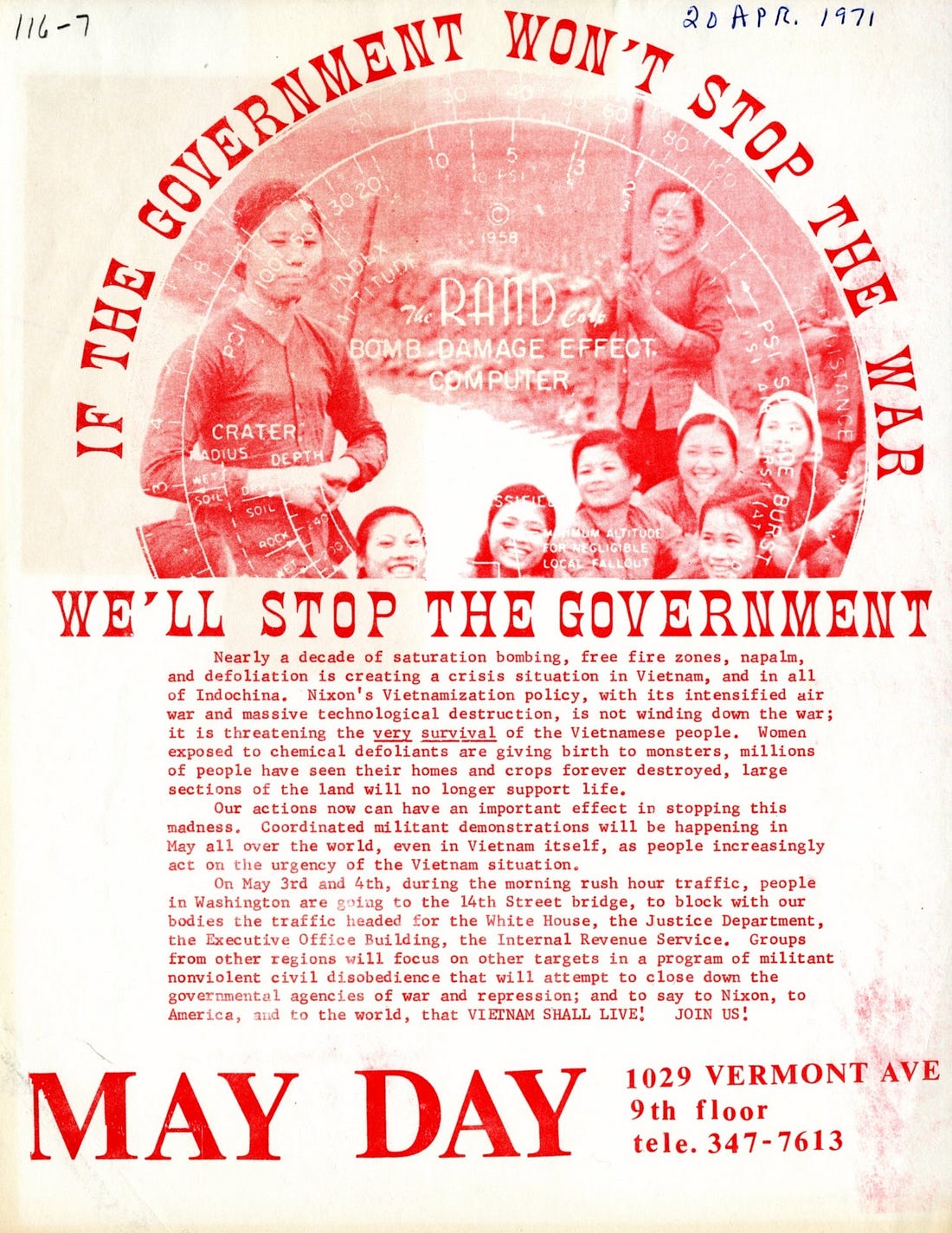
This will not be the first time Americans have engaged in mass protests on May Day. In 1971, tens of thousands of people took to the streets in Washington, D.C., to protest the Vietnam War. They began on May 3 and continued for two more days. By the time the protest ended, more than 12,000 protestors had been arrested. The protesters’ goal was to cause a traffic jam that would keep government employees from getting to work; their slogan was “If the government won’t stop the war, we’ll stop the government.”

Mass protests that are large and sustained have an impact on even an entrenched presidency. They did with Nixon. The White House Historical Association’s official version of events concludes that “the enormity of the protest pushed Nixon to accelerate the nation’s exit from Vietnam.” 

Even though it’s a different era, protests are bound to get to the thin-skinned president whose staffers, during his first term in office, had to prepare folders of positive stories about Trump for him to review twice each day. Imagine having thousands of people protesting within earshot of the White House. It must be even more galling because these protests are nonviolent and aim to support democracy through a legitimate exercise of First Amendment rights. They make a powerful statement, in contrast to a president who has abandoned the rule of law. 

In 1970, two-thirds of Americans had come to believe U.S. involvement in the Vietnam War was a mistake. We are not quite there yet when it comes to people’s view of the Trump administration. The most recent NBC News Stay Tuned Poll shows only 45% of Americans approve of the job Trump is doing. But, when asked about how strongly they hold their beliefs about the president, “the vehemence of the opposition outweighs the intensity of support from the president’s MAGA base.” Twenty-three percent of Americans said they were “furious” about what Trump is doing.

Thursday is also Law Day, an annual celebration of the rule of law. Although it has been in effect since 1958, it doesn’t usually receive much attention. This year, lawyers across the country have big plans for the day—make sure you look to see what’s going on in your area. President Dwight Eisenhower established Law Day as a day of national dedication to the principles of government under law. State Bar Associations hold essay competitions for school children, and there are state and national dinners most years. In 2025, Law Day takes on special significance as Americans’ concerns about due process come to the forefront. How fitting that the May Day protests sync with the Law Day commemoration. 

I’ve been doing a lot of research and writing about the origins of Law Day for my book (Giving Up Is Unforgivable, due out October 21), so I’ll leave that for another time, but I want to make sure everyone knows about Law Day. This year, many lawyers across the country will retake their oath to show their support for the rule of law. There is no reason the rest of the country can’t participate too!

The president issues a proclamation every year for Law Day. Trump did during his first term in office, too. In 2019, the proclamation began, “On Law Day, we renew our commitment to the rule of law and our Constitution. The rule of law requires that no one be above the obligations of the law or beneath its protections, and it stands as a bulwark against the arbitrary use of government power.” Unfortunately, he never lived up to those sentiments. On Thursday, we can look for the proclamation and point out the inconsistencies between what we expect from our presidents and how this one is behaving. The hypocrisy is always full force, and we shouldn’t shy away from pointing it out.

Due process is the sleeper issue of the second Trump presidency. No one really expected democracy issues, let alone concepts like the rule of law and due process to animate a country’s protests. But it’s increasingly clear that Americans are smart, and when we are well-informed, we have no difficulty assessing what matters and what is true. We see more and more of that as Americans carry signs that say “No Kings” and “Due Process” at local rallies. All of us can be advocates for democracy, not just the lawyers among us.

Here at Civil Discourse, we all understand the importance of this. We need to make sure the rest of the country does too. Until the Trump administration is over, it has to be Law Day every day. 

In 2024, the Law Day theme was “Voices of Democracy,” recognizing that the people are the rulers in a democracy. Americans express their views without fear of retribution because of the First Amendment and vote in elections to select their leaders. It’s up to us to make sure it stays that way.

This week will bring more briefings in the Abrego-Garcia case and others. There will be outrages, like the fact that Trump has a website hawking merchandise, literally selling the presidency. It’s not just the $50 price tag on the hat; there’s also the slogan, “Trump 2028,” a reference to Trump’s not-so-subtle hints that he’d like to serve a Constitution-busting third term in office. It’s not a joke. It never is with him.

So, make sure you take some time this week to celebrate Law Day. Invite people over. Go for a walk with friends or neighbors and share your views. Talk with your kids. Democracy is not automatic; it’s a participatory sport we must all play in together, one with critically important outcomes. Democracy is important. Let’s make sure we play for keeps.

We’re in this together,

Joyce

Jamelle Bouie, one of the most insightful columnists for The New York Times, observes that Trump has no interest in governing. He is interested in ruling. He thinks he has a mandate, even though he did not win 50% of the popular vote. He thinks his will is as powerful as law. He does not share power with Congress, and he’s testing how far he can go to diminish the courts.

Bouie reflects on Trump’s indifference to the other branches of Govenment in this newsletter:

I think it’s obvious that neither President Trump nor his coterie of agents and apparatchiks has any practical interest in governing the nation. It’s one reason (among many) they are so eager to destroy the federal bureaucracy; in their minds, you don’t have to worry about something, like monitoring the nation’s dairy supply for disease and infection, if the capacity for doing so no longer exists.

But there is another, less obvious way in which this observation is true. American governance is a collaborative venture. At minimum, to successfully govern the United States, a president must work with Congress, heed the courts and respect the authority of the states, whose Constitutions are also imbued with the sovereignty of the people. And in this arrangement, the president can’t claim rank. He’s not the boss of Congress or the courts or the states; he’s an equal.

The president is also not the boss of the American people. He cannot order them to embrace his priorities, nor is he supposed to punish them for disagreement with him. His powers are largely rhetorical, and even the most skilled presidents cannot shape an unwilling public.

Trump rejects all of this. He rejects the equal status of Congress and the courts. He rejects the authority of the states. He does not see himself as a representative working with others to lead the nation; he sees himself as a boss, whose will ought to be law. And in turn, he sees the American people as employees, each of us obligated to obey his commands.

Trump is not interested in governing a republic of equal citizens. To the extent that he’s even dimly aware of the traditions of American democracy, he holds them in contempt. What Trump wants is to lord over a country whose people have no choice but to show fealty and pledge allegiance not to the nation but to him.

What was it Trump said about Kim Jong-un, the North Korean dictator, during his first term in office? “Hey, he’s the head of a country. And I mean he is the strong head. Don’t let anyone think anything different,” Trump said in 2018. “He speaks, and his people sit up at attention. I want my people to do the same.”

He wants his people to do the same.

Ad

Trump’s FBI and ICE agents arrested Milwaukee County Circuit Judge Hannah Duggan in her courtroom and led her away in handcuffs because she sent a defendant out a back door. Trump officials said the judge was helping the defendant evade arrest, and they demonstrated that “no one is above the law” ( except Donald Trump). Critics said that Trump’s Department of Justice made a mockery of the law by arresting a judge.

See the comments of this Wisconsin Appeals Court judge who told CNN the Trump administration was sending a message to judges everywhere to bend to the will of the Trump administration. He was “appalled” that Judge Dugan was publicly humiliated, and that the director of the FBI Kash Patel posted a tweet of her being led away.

Judge Dugan told the agents that they should return with the correct warrant. One agent rode in the same elevator with the man sought by the Feds, but made no attempt to arrest him.

The New York Daily News editorial board said:

The FBI arrest of a Milwaukee local judge on felony counts related to immigration enforcement is an unwarranted and dangerous escalation by the Trump administration.

For the FBI to arrest someone at their workplace, they usually have to have been charged with something especially dire. For Milwaukee County Circuit Judge Hannah Dugan, this offense was allegedly refusing to hand defendant Eduardo Flores Ruiz, who had just had a hearing before the judge, over to an ICE task force that showed up in her courtroom. Dugan was charged with two federal felonies and taken into custody, which FBI Director Kash Patel gloated about on social media.

Attorney General Pam Bondi, for whom advancing the MAGA movement’s political agenda supersedes ensuring the equal and fair administration of justice, went on TV to say: “no one is above the law.” Aside from the dissonance of serving under a president who was only able to evade extremely serious federal charges by being elected to the White House, Bondi either doesn’t realize or doesn’t care that Dugan was in fact attempting to ensure the integrity of the legal process.

Flores may have been guilty of his misdemeanor charges, or he may not. The point of the proceedings before Dugan was to establish that and, if appropriate, what his punishment should be. Because of ICE’s detention, that won’t happen, which is bad for Flores, bad for any alleged victims — who won’t see justice — and bad for the larger community as immigrants and their families begin to see the courthouse as a dangerous place to be.

Having ICE at the courthouse means immigrants won’t report crimes, assist law enforcement, or show up for their own court hearings, which makes everyone less safe, not to mention completely undercuts the baseline American ideal of due process, not something that Bondi and her cadre seem to hold in very high esteem.

It’s ironic that Dugan was charged with “obstructing a proceeding” when the only people obstructing an official proceeding here were the task force that showed up to take Flores into custody. This task force, per the government’s own criminal complaint, consisted of just one ICE agent plus one Customs and Border Protection agent, two FBI agents and two DEA agents.

We wonder if six federal agents, four of whom are not in immigration-focused agencies, could have found a better use of their time than detaining a single person at a courthouse. Now, more federal resources will be wasted on this fiasco as the government tries to move forward with a prosecution of a sitting judge whose alleged crime was simply letting a defendant walk through a different hallway.

Patel, Bondi and Trump are overplaying their hand, especially as the president’s immigration policy approval keeps dropping amid public outrage over authoritarian assaults on due process and separation of powers. Going to war with the judiciary is not going to end well, especially given the volume of federal judges, including Trump-appointed and conservative judges and the Supreme Court’s own conservative majority, that are questioning the administration’s power grab.

Federal judges aren’t likely to look favorably on this flagrant assertion of power in arresting a popular county-level counterpart just for not letting her courtroom become an ICE staging ground.

Robert Reich has been a champion of democracy throughout the Trump era. An economist, he knows that we are crippled as a nation by escalating income inequality. He describes here how Viktor Orban provided a model for Trumpism and what we should do to resist our headlong plunge into oligarchy, authoritarians, and ultimately full-blown fascism. h/t to Retired Teacher, who called my attention to this article.

Reich writes:

Friends,

A few days ago I had breakfast with my old friend John Shattuck, who, as president of Central European University in Budapest, saw firsthand how Viktor Orbán took over Hungary’s democracy and turned it into an authoritarian state. 

When Trump was elected in 2016, Trump endorsed Orbán, and Orbán started attacking universities — forcing the Central European University out of Hungary. 

John believes Trump is emulating Orbán’s playbook. (Steve Bannon once declared that “Orbán was Trump before there was Trump.”)

Orbân’s playbook has 10 parts, according to John: 

One: Take over your party and enforce internal party discipline by using political threats and intimidation to stamp out all party dissent. 

Two: Build your base by appealing to fear and hate, branding immigrants and cultural minorities as dangers to society, and demonizing your opponents as enemies of the people.

Three: Use disinformation and lies to justify what you’re doing.

Four: Use your election victory to claim a sweeping mandate — especially if you don’t win a majority.

Five: Centralize your power by destroying the civil service.

Six: Redefine the rule of law as rule by executive decree. Weaponize the state against all democratic opponents. Demonize anyone who doesn’t support the leader as an “enemy of the people.” 

Seven: Eliminate checks and balances and separation of powers by taking over the legislature, the courts, the media, and civil society. Target opponents with regulatory penalties like tax audits, educational penalties such as denials of accreditation, political penalties like harassment investigations, physical penalties like withdrawing police protection, and criminal penalties like prosecution. 

Eight: Rely on your oligarchs — hugely wealthy business and financial leaders — to supervise the economy and reward them with special access to state resources, tax cuts, and subsidies. 

Nine: Ally yourself with other authoritarians like Vladimir Putin and support his effort to undermine European democracies and attack sovereign countries like Ukraine.

Ten: Get the public to believe that all this is necessary, and that resistance is futile.

John noted that Orbán’s influence now reaches across Europe.

In Austria, a political party founded by former Nazis will be part of a new coalition government this year headed by a leader who has close ties to Russia and opposes European support for Ukraine. A similar nationalist far-right government has taken over next door in Slovakia.

Europe’s three biggest countries, Italy, France and Germany, have all swung toward the far-right, but so far they remain democracies.

Italy has a nationalist government headed by Prime Minister Giorgia Meloni, who’s followed parts of the Orbán playbook but has been pushed toward the center and has softened her position on immigration and Ukraine.

In France, the far-right party of Marine Le Pen won last year’s parliamentary elections, but a coalition of opposition parties, prodded by Emmanuel Macron, united to deny her party a parliamentary majority. Their resistance will be tested by new elections in June.

In Germany, the center-left government headed by Olaf Scholz fell at the end of last year. In late February, parliamentary elections took place that determined whether the far-right Alternative for Germany (AfD) party would become part of a new government. Viktor Orbán, Elon Musk, and JD Vance all endorsed the AfD before the elections, but it came in second with just under 20 percent of the vote, and polls show that 71 percent of Germans believe that the AfD is a threat to democracy because of its overt connections to the Nazi past.

Poland, the biggest new democracy in Eastern Europe, at first adopted but is now resisting the Orbán model. A far-right government elected in 2015 almost destroyed the independence of the Polish judiciary, but opposition parties united to defend the courts and defeated the government in 2023, replacing it with a centrist regime headed by Donald Tusk, with a strong commitment to restore Polish democracy.

What lessons can be drawn from all this?

John believes that the best way to respond to Orbán’s right-wing populism is by building coalitions for economic populism based on health care, education, taxes, and public spending. 

He points to historical examples of this, like the American Farmer-Labor coalition that brought together urban workers, white farmers, and Black sharecroppers and led to the Progressive Movement and the New Deal in the 20th century. Today there’s an urgent need for a new populist movement to attack economic inequality.

John says that defending democracy should itself be a populist cause. In the Orbán playbook, the national flag was hijacked by the authoritarian leader. John believes that the flag of American democracy must be reclaimed as a symbol of the rule of law, a society built on human rights and freedoms, and international alliances and humanitarian values. 

When these soft-power democratic assets are destroyed, a huge void opens up — to be filled by authoritarians like Xi Jinping and Vladimir Putin, who are the ultimate political models for Viktor Orbán and Donald Trump.

John urges that we pro-democracy anti-Trumpers move quickly with protests, lawsuits, and loud resistance. He says that those who believe Democrats should just play dead and wait for the 2026 midterm elections are profoundly wrong. Speed is essential. 

I was struck by John’s optimism. He believes that the U.S. is better situated than Hungary to resist authoritarianism. We are 30 times bigger and infinitely more diverse, and our diversity is the source of our economic and cultural strength. The U.S. has an enormous and active civil society, a judiciary that remains mostly independent, a free and open if partially captured and manipulated media, and a constitution that guarantees the rights of the people to challenge and change their government. 

Trump won less than 50 percent of the vote in last fall’s election, and his approval rating is well below that in recent polls.

National polls show that 70 percent of Americans today see democracy as a core American value.Resistance to the assault on democracy is not only possible, John says, but it’s essential — and it can work, as shown by the growing number of successful lawsuits that have been brought against Trump’s flood of executive decrees and the rising tide of grassroots mobilization by civil society groups across the country who are organizing demonstrations and lobbying legislators to stand up for democracy.

For two and a half centuries, Americans have fought to expand the right to vote, to achieve equal protection, to oppose intolerance and political violence, to gain freedom of speech and religion, to guarantee due process of law. 

These goals may now seem to be blocked by Trump, but the U.S. is not Germany in the 1930s nor Hungary in 2025. Americans across the country are beginning to resist. John believes American democracy will emerge stronger for our efforts.

The Trump administration claims that it wants to reduce federal intervention into the nation’s public and private institutions. But it intervenes forcefully in both public and private sectors to punish anyone with different views. It has threatened to withhold federal funding for research from universities unless the targeted universities allow the federal government to supervise its curriculum, its hiring policies, and its admissions policies. And he threatened to stop the funding of any K12 school that continues DEI programs.

The Trump regime has created a nanny state.

From Day 1, Trump made clear that he would ban practices and policies intended to diversity, equity, and inclusion. He threatened to withhold federal funding of schools that ignored his order to eliminate DEI. He has taken complete control of the Kennedy Center, so as to block DEI programming, and he has appointed a woman with no credentials to remove DEI from the Smithsonian museums.

Who knows how the African American Museum will survive Trump’s DEI purge.

ABC News reported that a federal district judge has halted the DEI ban, at least in schools associated with one of the lawsuit’s plaintiffs, the NEA.

ABC News reported:

The Trump administration’s attempt to make federal funding to schools conditional on them eliminating any DEI policies erodes the “foundational principles” that separates the United States from totalitarian regimes, a federal judge said on Thursday.

In an 82-page order, U.S. District Judge Landya McCafferty partially blocked the Department of Education from enforcing a memo issued earlier this year that directed any institution that receives federal funding to end discrimination on the basis of race or face funding cuts.

“Ours is a nation deeply committed to safeguarding academic freedom, which is of transcendent value to all of us and not merely to the teachers concerned,” Judge McCafferty wrote, adding the “right to speak freely and to promote diversity of ideas and programs is…one of the chief distinctions that sets us apart from totalitarian regimes.”

“In this case, the court reviews action by the executive branch that threatens to erode these foundational principles,” she wrote.

The judge stopped short of issuing the nationwide injunction, instead limiting the relief to any entity that employs or contacts with the groups that filed the lawsuit, including the National Education Association and the Center for Black Educator Development.

Carol Burris is the executive director of the Network for Public Education. She was a high school teacher and principal in New York State, where she was honored by the state principal’s association as principal of the year. She is a tireless advocate of public schools and an equally tireless opponent of privatization.

She writes:

On April 30, the U.S. Supreme Court will hear a pivotal case concerning whether a charter school can teach a religious curriculum. The Oklahoma Statewide Virtual Charter School Board v. Drummond addresses Oklahoma’s St. Isidore of Seville Catholic Virtual School’s attempt to become the nation’s first publicly funded religious charter school. 

This case was always intended to go to the Supreme Court, testing the limits of the separation of Church and State. What is surprising, however, is who has entered the fight against St. Isadore. The National Alliance for Public Charter Schools (NAPCS), which has never met a charter school it did not like, has filed an amicus brief against its existence. This is unexpected from an organization that has supported charter schools run by for-profit corporations, virtual schools with poor outcomes, and even micro-schools, claiming that different models provide needed choice and innovation. When public money is allocated to religious private schools via vouchers, the charter lobby is either supportive or silent in the name of “choice.”

The reason for their present opposition is self-interest. According to the National Alliance for Public Charter Schools, “a decision to allow religious charter schools will throw charter laws into chaos nationwide, resulting in significant financial and operational uncertainties.”  Nina Rees, the former long-time CEO of the organization, lamented that a ruling in favor of St. Isadore “could also jeopardize the myriad federal and state funding streams they [charters] currently qualify for—funding that the sector has fought hard to secure and continues to fight for on the premise that students attending public charter schools are entitled to the same funds they would receive in district schools.”

On what basis, then, will SCOTUS make its decision? At the heart of the case is whether charter schools are state actors or state contractors providing educational services. The Oklahoma State Virtual Charter Board argues that merely because the state legislature declares a charter school “public,” it does not transform it into a public school. Furthermore, even if charter schools are state actors for some functions, they might not be state actors for purposes of the First Amendment, specifically regarding curriculum matters.

There is precedent for their argument.

In 2010, both a federal court and the U.S. Court of Appeals for the 9th Circuit, in San Francisco, determined, in an employment case, that an Arizona charter school was not a “state actor” and thus a wrongful termination lawsuit could not be brought forth by a former teacher.  “This case presents the special situation of a private nonprofit corporation running a charter school that is defined as a ‘public school’ by state law,” the three-judge appeals court panel said in its unanimous Jan. 4 decision in Caviness v. Horizon Community Learning Center. The court concluded that the corporation running the charter school (private non-profit or for-profit corporations run most charter schools) was not a state actor but a contractor providing a service.

In some states, where districts are the only authorizers of charter schools, charter schools likely fully meet the “state actor” test. That was the original intent of the charter movement—schools within a district free of some restraints to try innovative practices. However, only a few states still embrace that model, thanks to the relentless pressure from organizations like NAPCS, which have provided St. Isadore with more than enough fodder for its arguments. Over the years, charter trade organizations have successfully lobbied for looser charter laws, expanded charter management organizations, and vigorously defended for-profit corporations like Academica and Charter Schools USA, which use nonprofit schools as a façade. In short, they have made charter schools as “private” and profitable as possible. 

Remember how charter schools could secure Paycheck Protection Program (PPP) funds during COVID-19 when public schools could not? Charter trade organizations, including NAPCS, encouraged charter schools to leverage their corporate status, resulting in the sector securing billions of dollars. Some even provided talking points for justification.

The truth is that charter schools have used their private status when it is in their interest, even as they secure an advantage from the public label. And that is why they have only themselves to blame if the chicken comes home to roost and the sector is thrown into chaos. If that results in a shake-up of the charter industry and a return to truly public charter schools in most states, that may not be a terrible outcome. 

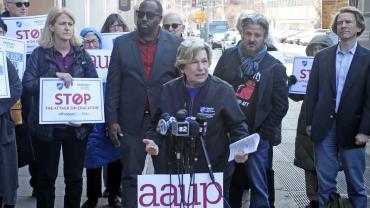
Randi Weingarten is president of the American Federation of Teachers. She is my friend.

Randi wrote:

President Donald Trump has declared war on America’s colleges and universities, demanding they bow to his demands on what they can teach and whom they can admit or hire. Trump’s illegal and autocratic actions are tantamount to a war on knowledge intended to force schools to bend the knee to his ideology and chill free speech and academic pursuit.

Weingarten announcing a lawsuit to stop the federal funding cuts at Columbia University.
Weingarten announcing a lawsuit to stop the federal funding cuts at Columbia University. CREDIT: AFT

Trump says much of his attack on higher education is in response to antisemitism on campuses. Without a doubt, there was antisemitism before the heinous actions by Hamas on Oct. 7 and the ensuing war, and it has grown since. We need to address antisemitism on campus and ensure Jewish students, and all students, feel safe. But Trump is weaponizing antisemitism investigations to attack disfavored speech and stoke culture wars, distrust and division, and to undermine higher education as a bulwark of democracy and an engine of our economy. It’s wrong, antidemocratic and unconstitutional. The administration is using Jews as an excuse to disappear students who are here legally, with immigration officials arresting and attempting to deport students who have committed no crimes—without due process, a linchpin of American democracy.

This may help Trump’s aim to divide Americans, but it won’t make campuses safer for Jewish students or answer the real issues around antisemitism. That’s one reason that a coalition of Jewish organizations released a statement saying that Trump’s actions make Jewish students and the Jewish community less safe.

Trump has launched investigations into dozens of colleges and universities and stripped billions in research grants from schools. The administration has issued demands ranging from direct government oversight of academic programs—or in the case of Columbia University, oversight of the whole institution—to dictating disciplinary policies and controlling hiring decisions. It is targeting students for exercising their First Amendment rights, and revoking visas for faculty and staff. The administration’s intent is to remake America’s higher education system in its image through blunt force.

The freedom to pursue knowledge, the freedom of expression and the freedom of speech are fundamental American rights that are foundational to a functioning democracy. America’s public schools, colleges and universities cultivate the exploration of knowledge and free expression and empower students to become engaged citizens. One of their hallmarks is that they are a marketplace of ideas where free and open discussion and disagreement is encouraged. That is enabled by ensuring our education institutions are independent from government control or coercion. When a government asserts control over what can be taught, thought or said, democracy itself is at risk.

The free pursuit of knowledge empowers Americans.

Stripping research and innovation funding to force compliance will hurt America’s competitiveness and help our adversaries outpace us in technological and other advancements. America’s university research and innovation centers have long been the envy of the world. The federal government, through federal agencies and grants, is a fundamental powerhouse and supporter of health, scientific, technology and other research. The U.S. is the world leader in this research—research that the private sector cannot and will not do on its own and that leads to discoveries, innovations, cures and advances that benefit the common good and move our society forward. Colleges and universities are also anchors of their local communities, supporting local jobs and small businesses, providing community gathering spaces, and growing industries tied to university research and innovation. 

This war on knowledge and expression must be opposed in the courts, on the streets, and by our colleges and universities.

As the largest union of higher education staff and faculty, the AFT joined our affiliate, the American Association of University Professors, to sue the Trump administration on behalf of our members for unlawfully cutting millions in federal funding for public health research at Columbia.

Last week, Harvard University boldly rejected Trump’s unlawful and unprecedented demands for government control over it. Harvard’s president wrote that “no government … should dictate what private universities can teach, whom they can admit and hire, and which areas of study and inquiry they can pursue.”

Americans have also taken to the streets to oppose this war on knowledge and freedoms. The attacks on higher education were a major focus of the April 5 Hands Off actions that mobilized tens of thousands of Americans across the country to reject Trump’s chaotic and cruel agenda.

The free pursuit and availability of knowledge empowers Americans, strengthens our economy and democracy, and is foundational for opportunity. That’s why we all must take a stand against this war on knowledge.

Under the misguided policies of Trump and Hegseth, censorship and book banning have been widespread, especially by the Defense Department. Hegseth is eager to please Trump and has stripped recognition from anyone of distinction who is female and/or non-white. Even a photograph of the Enola Gay, the plane that dropped the first atomic bomb, was taken down–because of its name. The Navajo Code Talkers were put into storage. The first women to achieve military feats and honors were mothballed. The U.S. Naval Academy removed almost 400 books from its library because of DEI (diversity, equity, inclusion) themes.

Ryan Holiday was invited to lecture at the Naval Academy a few weeks ago, as he had in the past. Shortly before he was to speak, he was asked not to mention the books that had been removed from the Academy’s library. When he refused, his speech was canceled.

Question: if the men and women of the U.S. Navy are brave enough to risk their lives, aren’t they brave enough to read a book about race and gender?

Holiday wrote in The New York Times:

For the past four years, I have been delivering a series of lectures on the virtues of Stoicism to midshipmen at the U.S. Naval Academy in Annapolis, Md., and I was supposed to continue this on April 14 to the entire sophomore class on the theme of wisdom.

Roughly an hour before my talk was to begin, I received a call: Would I refrain from any mention in my remarks of the recent removal of 381 supposedly controversial books from the Nimitz library on campus? My slides had been sent up the chain of command at the school, which was now, as it was explained to me, extremely worried about reprisals if my talk appeared to flout Executive Order 14151(“Ending Radical and Wasteful Government D.E.I. Programs and Preferencing”).

When I declined, my lecture — as well as a planned speech before the Navy football team, with which my books on Stoicism are popular — was canceled. (The academy “made a schedule change that aligns with its mission of preparing midshipmen for careers of service,” a Navy spokesperson told Times Opinion. “The Naval Academy is an apolitical institution.”)

Had I been allowed to go ahead, this is the story I was going to tell the class:

In the fall of 1961, a young naval officer named James Stockdale, a graduate of the Naval Academy and future Medal of Honor recipient who went on to be a vice admiral, began a course at Stanford he had eagerly anticipated on Marxist theory. “We read no criticisms of Marxism,” he recounted later, “only primary sources. All year we read the works of Marx and Lenin.”

It might seem unusual that the Navy would send Stockdale, then a 36-year-old fighter pilot, to get a master’s degree in the social sciences, but he knew why he was there. Writing home to his parents that year, he reminded them of a lesson they had instilled in him, “You really can’t do well competing against something you don’t understand as well as something you can.”

At the time, Marxism was not just an abstract academic subject, but the ideological foundation of America’s greatest geopolitical enemy. The stakes were high. The Soviets were pushing a vision of global Communism and the conflict in Vietnam was flashing hot, the North Vietnamese fueled by a ruthless mix of dogma and revolutionary zeal. “Marxism” was, like today, also a culture war boogeyman used by politicians and demagogues.

Just a few short years after completing his studies, in September 1965, Stockdale was shot down over Thanh Hoa in North Vietnam, and as he parachuted into what he knew would be imprisonment and possibly death, his mind turned to the philosophy of Epictetus, which he had been introduced to by a professor at Stanford.

He would spend the next seven years in various states of solitary confinement and enduring brutal torture. His captors, sensing perhaps his knowledge as a pilot of the “Gulf of Tonkin incident,” a manufactured confrontation with North Vietnamese forces that led to greater U.S. involvement in Vietnam, sought desperately to break him. Stockdale drew on the Stoicism of Epictetus, but he also leveraged his knowledge of the practices and the mind-set of his oppressors.

“In Hanoi, I understood more about Marxist theory than my interrogator did,” Stockdale explained. “I was able to say to that interrogator, ‘That’s not what Lenin said; you’re a deviationist.’”

In his writings and speeches after his return from the prison known as the Hanoi Hilton, Stockdale often referred to what he called “extortion environments,” which he used to describe his experience as a captive. He and his fellow P.O.W.s were asked to answer simple questions or perform seemingly innocuous tasks, like appear in videos, and if they declined, there would be consequences.

No one at the Naval Academy intimated any consequences for me, of course, but it felt extortionary all the same. I had to choose between my message or my continued welcome at an institution it has been one of the honors of my life to speak at.

As an author, I believe deeply in the power of books. As a bookstore owner in Texas, I have spoken up about book banning many timesalready. More important was the topic of my address: the virtue of wisdom.

As I explained repeatedly to my hosts, I had no interest in embarrassing anyone or discussing politics directly. I understand the immense pressures they are under, especially the military employees, and I did not want to cause them trouble. I did, however, feel it was essential to make the point that the pursuit of wisdom is impossible without engaging with (and challenging) uncomfortable ideas.

Seneca, the Stoic philosopher, used a military metaphor to make this very argument. We ought to read, he said, “like a spy in the enemy’s camp.” This is what Stockdale was doing when he studied Marxism on the Navy’s dime. It is what Seneca was doing when he read and liberally quoted from Epicurus, the head of a rival philosophical school.

The current administration is by no means unique in its desire to suppress ideas it doesn’t like or thinks dangerous. As I intended to explain to the midshipmen, there was considerable political pressure in the 1950s over what books were carried in the libraries of federal installations. Asked if he would ban communist books from American embassies, Eisenhower resisted.

“Generally speaking,” he told a reporter from The New York Herald Tribune at a news conference shortly after his inauguration, “my idea is that censorship and hiding solves nothing.” He explained that he wished more Americans had read Hitler and Stalin in the previous years, because it might have helped anticipate the oncoming threats. He concluded, “Let’s educate ourselves if we are going to run a free government.”

ADVERTISEMENT

SKIP ADVERTISEMENT

The men and women at the Naval Academy will go on to lead combat missions, to command aircraft carriers, to pilot nuclear-armed submarines and run enormous organizations. We will soon entrust them with incredible responsibilities and power. But we fear they’ll be hoodwinked or brainwashed by certain books?

Hitler’s “Mein Kampf” was not one of the books removed from the Naval Academy library, and as heinous as that book is, it should be accessible to scholars and students of history. However, this makes the removal of Maya Angelou’s “I Know Why the Caged Bird Sings” inexplicable. Whatever one thinks of D.E.I., we are not talking about the writings of external enemies here, but in many cases, art, serious scholarship and legitimate criticism of America’s past. One of the removed books is about Black soldiers in World War II, another is about how women killed in the Holocaust are portrayed, another is a reimagining of Kafka called “The Last White Man.” No one at any public institution should have to fear losing their job for pushing back on such an obvious overreach, let alone those tasked with defending our freedom. Yet here we are.

The decision by the academy’s leaders to not protest the original order — which I believe flies in the face of basic academic freedoms and common sense — has put them in the now even stickier position of trying to suppress criticism of that decision. “Compromises pile up when you’re in a pressure situation in the hands of a skilled extortionist,” Stockdale reminds us. I felt I could not, in good conscience, lecture these future leaders and warriors on the virtue of courage and doing the right thing, as I did in 2023 and 2024, and fold when asked not to mention such an egregious and fundamentally anti-wisdom course of action.

In many moments, many understandable moments, Stockdale had an opportunity to do the expedient thing as a P.O.W. He could have compromised. He could have obeyed. It would have saved him considerable pain, prevented the injuries that deprived him of full use of his leg for the rest of his life and perhaps even returned him home sooner to his family. He chose not to do that. He rejected the extortionary choice and stood on principle.