Archives for category: Democracy

Ruth Ben-Ghiat is a history at New York University who specializes in fascism and authoritarian leaders.

She wrote:

Authoritarianism is about having the power to get away with crime, and waging a genocidal war against another country without othercountries intervening in ways that force a cessation of conflict counts as a big win in the autocrat world. In fact, from the minute they receive intelligence about a planned invasion, autocrats watch carefully to see what happens to transgressors of the international order–and adjust their own plans for aggression accordingly.

Allowing Russian President Vladimir Putin’s war of annihilation against Ukraine to continue by not giving Ukraine the arms it needs to definitively repel the Russian invaders increases the risk that other autocrats will ramp up their own imperialist aspirations. Autocrats interpret any ambivalence about shutting down their peers’ territorial expansions as license to proceed with similar aggressive acts.

History is clear about what happens in such cases. Most people are familiar with the folly of the September 1938 British and French-brokered Munich agreement, which allowed the Third Reich to annex the Sudetenland in Czechoslovakia six months after it annexed Austria.

Far fewer know about the earlier appeasement that set the stage for Hitler’s actions: Benito Mussolini’s war on League of Nations member Ethiopia, which started in October 1935. This was the biggest military operation since World War I, with Italy’s formidable air force dropping hundreds of tons of illegal chemical weapons on Ethiopians.

The weak sanctions levied on Italy by the League of Nations did not deter Il Duce from continuing to commit war crimes. He declared victory in May 1936, and occupied Ethiopia until the Allies drove the Italians out in 1941. “Was it ever likely to be effective?” Winston Churchill wrote critically of the sanctions in June. “Was it real or sham?” That same month, exiled Emperor Haile Selassie I denounced the war crimes to the League of Nations, but no action was taken against the Fascists.

By then, Mussolini’s admirer Hitler had all the information he needed about the consequences a despot might face for military aggression. In March 1936, while Mussolini’s war entered its sixth month, the Führer remilitarized the Rhineland, in violation of the Treaty of Versailles.

Twenty-first century autocrats watch their kindred spirits’ fates with equal interest. Since the start of Putin’s war on democratic Ukraine, the world has become far less safe. A few weeks before the Russians invaded, Putin and Chinese head of state Xi Jinping issued a joint statementabout the new “multipolar” era of international relations. The premise of this new era –unrestrained imperialism for Russia and China– has become all too clear.
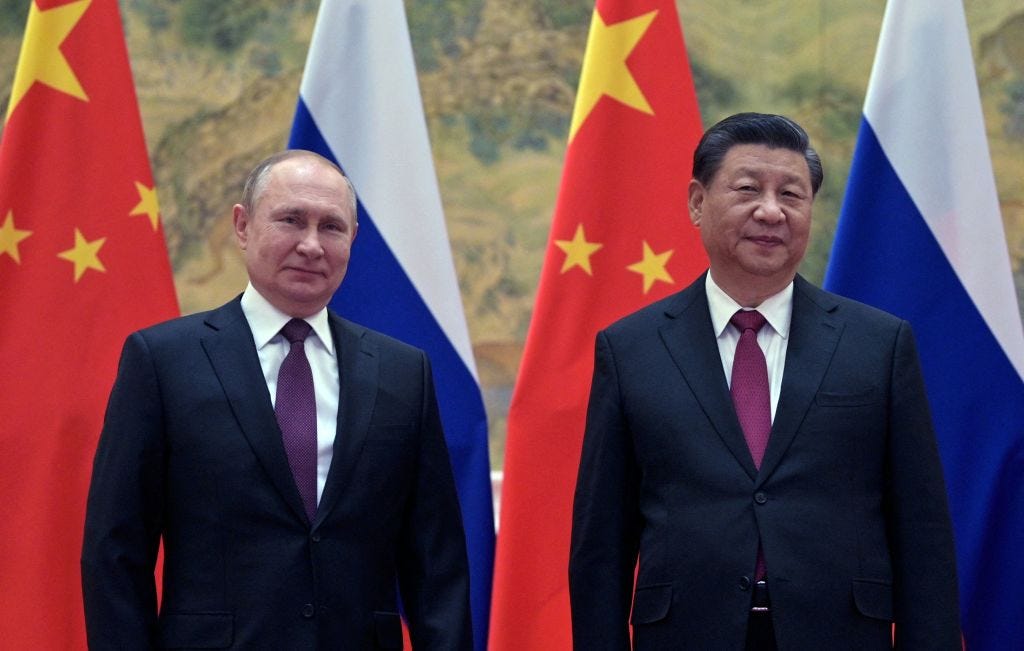
Russian President Vladimir Putin and Chinese President Xi Jinping together in Beijing, Feb. 4, 2022. Alexei Druzhinin/Sputnik/AFP/via Getty Images

Xi Jinping has since become far more aggressive towards the West. His government has increased its rhetoric about its imperialistic claims on Taiwan. He has consolidated his personal power with a third term, while further puffing up his personality cult in ways not seen among Chinese premiers since Mao Zedong.

Turkey has also ramped up its bellicose and expansionist rhetoric regarding Syria and Greece. It has also persecuted Armenians, through its ally Azerbaijan, in the disputedterritory of Nagorno-Karabakh.

Autocrats are transactional beings. You have a deal with an autocrat until you don’t, meaning no one should think that Putin will negotiate with or about Ukraine in good faith. That also holds for their relationships with each other (as Joseph Stalin discovered when Hitler invaded Russia despite signing the Molotov-Ribbentrop non-aggression pact).

Even as dictators cheer on lawlessness that goes unpunished by the democratic order, they also circle each other like vultures, looking for signs of weakness that they can exploit. And everyone knows that Putin is more vulnerable as a player in the sphere of influence game with his resources and attention focused on Ukraine. Turkey, along with China, will seek to fill any power vacuum Putin’s weakness opens up in Eurasia and beyond.

Turkish President Recep Tayyip Erdogan’s relationship with Putin has always been volatile. In the course of a few months in 2016 they went from almost going to war to being “best friends,” dining on plates that immortalized their friendship. I was skeptical of Erdogan’s early claims that he would be a “peacemaker” and mediator between Russia and Ukraine. Turkey intends to exploit this international crisis to increase its own power and prestige.

Now Serbian President Aleksandr Vucic has become the latest authoritarian to be galvanized by the possibilities created by the prolongation of Putin’s war. He has put his military on high alert, citing rising tensions with the Republic of Kosovo. Serbia does not recognize the sovereignty of Kosovo, which declared independence from Serbia in 2008.

All of these conflicts have long histories that are independent of the new climate created by Putin’s invasion of Ukraine. Yet democratic powers’ acceptance of a continuance of Putin’s war will only further destabilize the international order. It also increases the chances that democratic strongholds such as Taiwan will be targeted for “reunification” –the word of choice for autocrats since the days of Hitler to market their imperialism to their peoples and the world.

That’s why Ukrainian President Volodymyr Zelensky was right to state in his speech to U.S. Congress that supporting Ukraine is an investment in global security. He knows that when an autocrat gets away with an imperialist and genocidal war it only increases his megalomania and hubris, making it far more difficult to rein him in later on. It also increases the likelihood that other autocrats will commit their own aggressions toward targeted territories.

And it’s why the warning that economist Anders Aslund issued to his fellow Europeans should be heeded, not least because it builds on historical precedent. As an expert on Putin’s kleptocracy, Aslund knows the value and prestige impunity has among autocrats. “If you don’t deliver enough of arms & funds to Ukraine now,” he tweeted, “you might have to face Russian troops yourselves later on.”

Heather Cox Richardson shares news about the fissure in the Republican Party between Trump crazies and responsible elected officials.

Today, President Joe Biden signed into law the bipartisan year-end omnibus funding bill passed by the House and the Senate before lawmakers left town.

The $1.7 trillion measure addresses key goals of both parties. It funds the military and domestic programs. It funds public health and science, invests in law enforcement, and funds programs to prevent violence against women. It funds veterans’ services, and it provides assistance to Ukraine in its struggle to protect itself against Russia’s invasion. It updates the Electoral Count Act to prevent a president from trying to overturn a presidential election, as former president Trump did.

Biden said, “This bill is further proof that Republicans and Democrats can come together to deliver for the American people, and I’m looking forward to continued bipartisan progress in the year ahead.”

But on his social media platform, Trump took a stand against the bill that funds the government. “Something is going on with [Senate minority leader] Mitch McConnell [(R-KY)] and all of the terribly and virtually automatic ‘surrenders’ he makes to the Marxist Democrats, like on the $1.7 Trillion ‘Ominous’ Bill,” Trump wrote. “Could have killed it using the Debt Ceiling, or made it MUCH better in the Republican House. Nobody can be this stupid.” Then he went on to blame the deal on McConnell’s wife, Trump’s own Transportation Secretary Elaine Chao, using a racist slur.

This exchange reveals the dynamic dominating political leadership at the end of 2022. Biden and the Democrats are trying to show that the government can produce popular results for the American people. They are joined in that effort by Republicans who recognize that, for all their talk about liberty, their constituents want to see the government address their concerns. Together, they have passed the omnibus bill, as well as the CHIPS and Science Act, the bipartisan infrastructure law, and gun safety legislation.

This cooperation to pass popular legislation is an important shift in American politics.

But Trump and his cronies remain determined to return to power, apparently either to stop this federal action Trump incorrectly calls “Marxism” or, in the case of extremist Republicans, to use the government not to provide a basic social safety net, regulate business, promote infrastructure, or protect civil rights—as it has done since 1933—but instead to enforce right-wing religious values on the country. They reject the small-government economic focus of the Reagan Republicans in favor of using a strong government to enforce religion.

The determination of Trump and his team to dominate the government, and through it the country, has been illustrated powerfully once again today with the release of more transcripts from testimony before the House Select Committee to Investigate the January 6th Attack on the U.S. Capitol. Former White House director of strategic communications Alyssa Griffin recalled how Trump’s son-in-law, Jared Kushner, dismissed the idea that the Trump administration should coordinate with the incoming Biden officials over the coronavirus pandemic. “It was the first COVID… meeting that Jared led after [Biden won],” Griffin recalled, “& Dr. Birx… said, “Well, should we be looping the Biden transition into these conversations?” & Jared just said, ‘Absolutely not.’”

Similarly, in an extraordinarily petty exchange, the chief of staff to former first lady Melania Trump, Stefanie Grisham, recalled that Trump wanted to fire the chief White House usher, Tim Harleth, for being in contact with the Biden team about the presidential transition. (Secret Service agents told Trump about the contact, raising more questions about the role of the agents around Trump.) Melania Trump stopped the firing out of concern for the stories Harleth could tell about the Trump family, but he was let go just before Biden’s inauguration, leaving the Biden’s standing before the closed doors of the White House for an awkwardly long time when they entered for the first time.

This determination of far-right Republicans to bend the country to their will presents a problem for the Republican Party. Establishment Republicans came around to backing Trump in 2017 after he promised them lower taxes and less regulation, the goals they had embraced since the presidency of Ronald Reagan.

But Trump managed to stay in power by feeding the reactionaries in the party: those who reject the idea of American equality. Trump’s base is fiercely opposed to immigration and against the rights of LGBTQ Americans, while also in favor of curtailing the rights of women and minorities. Rejecting the equality at the heart of liberal democracy, many of them hope to enforce religious rules on the rest of the country and admire Russian president Vladimir Putin and Hungarian leader Viktor Orbán for replacing democracy with what Orbán has called “Christian democracy,” or “illiberal democracy” that enforces patriarchal heterosexual hierarchies. As Trump encouraged them to, many of them reject as “fraudulent” any elections that do not put their candidates in power.

Now, as Republican establishment leaders recognize that Trump’s star is fading and his legal troubles seem likely to get worse—his tax returns will be released tomorrow, among other things—they seem eager to cut Trump loose to resurrect their anti-tax, anti-regulation policies. But those Americans who reject democracy and want a strong government to enforce their values are fighting for control of the Republican Party.

The far right has turned against Republican National Committee chair Ronna McDaniel, whom Trump hand-picked and who helped arrange the false electors in 2020. Trump loyalist Mike Lindell, the pillow magnate, is challenging McDaniel. Of more concern to her is the challenge of Harmeet Dhillon, a prominent election denier who has provided legal counsel for Trump in his struggles against the January 6th committee, calling it “a purely political witch-hunt, total abuse of process & power serving no legitimate legislative purpose.” Orbán supporter and Fox News Channel personality Tucker Carlson and Turning Points USA founder Charlie Kirk are backing Dhillon.

Kirk, who is a prodigious fundraiser, has warned the RNC that the party must listen “to the grassroots, our donors, and the biggest organizations and voices in the conservative movement” or it would lose in 2024. “If ignored, we will have the most stunted and muted Republican Party in the history of the conservative movement, the likes of which we haven’t seen in generations.”

The far right is also challenging the bid of House minority leader Kevin McCarthy (R-CA) for House speaker, creating such havoc that today former Republican representative, senator, and secretary of defense William S. Cohen and former congressional staff director and presidential senior fellow emeritus at the Council on Foreign Relations Alton Frye published an op-ed in the New York Times warning that “the Republican caucus is dominated by campaigns and commitments that gravely encumber efforts to define common ground in the political center.” They urged House members to recruit a moderate speaker from outside the chamber and to “fortify those Republicans who seek to move the party beyond the corrosive Trump era.”

They called for a secret ballot, so Republican members won’t have to fear retaliation.

Cohen and Frye suggested that organization of the House by an outsider would allow for “meaningful coalition building,” but the Republicans about to take control of the House have so far indicated only that they intend to investigate the Biden administration before the 2024 election, a throwback to the methods party leaders have used since 1994 to win elections by portraying the Democrats as corrupt.

Representatives James Comer (R-KY) and Jim Jordan (R-OH), who are expected to take over the House Oversight Committee and the House Judiciary Committee, respectively, have already demanded records from the White House. When White House Special Counsel Richard Sauber said the White House would respond to those committees after the Republicans were in charge of them—a position administrations have as taken since the 1980s—Comer and Jordan took to social media today to complain that “at every turn the Biden White House seeks to obstruct congressional oversight and hide information from the American people.” (Jordan, of course, refused to respond to a subpoena from the January 6th committee.)

The year 2022 has seen an important split in the Republican Party. The party’s response to voters’ dislike appears to be either to reject democracy altogether or to double down on the old rhetoric that has worked in the past, although you have to wonder if they have gone to that well so many times it’s drying up.

In the meantime, the Democrats have worked with willing Republicans to demonstrate that lawmakers in a democracy really can accomplish big things for the American people, and for the world.

Which vision will win out will be a key political story of 2023.

Timothy Snyder, a pre-eminent scholar of fascism, summarized the report of the January 6 Committee:

What did Trump know, and when did he lie about it? How did his Big Lie lead to specific actions to overturn and election and bring down the American system? What did the coup attempt of 2020-2021 look like from within the Trump administration itself?

Thanks to the excellent “Final Report of the Select Committee to Investigate the January 6th Attack on the United States Capitol,” we now know the answers to these and many other questions. I provide here just the briefest of summaries of the report’s recounting of the events of November 2020-January 2021.

It is very easy, when a long report is released, to underplay its basic findings. There is a temptation to act as if something is not shocking if we have heard part of it before, as though this were a mark of political sophistication. The American tendency to normalize threats to democracy is also present in retrospect.

What is described in palpable and convincing detail in the Final Report is indeed profoundly shocking: a planned and coordinated attempt by the president of the United States and his allies to carry out regime change in the United States of America on the basis of a Big Lie.

Here is my very brief summary of the factual part of the report, in fifteen quick points. I am deliberately understating here; the evidence, in the Final Reportitself, permits much broader conclusions.

1. Trump knew that he was likely to lose the 3 November 2020 election, and planned in advance to declare victory (to tell a Big Lie) if he lost.

2. On 3 November 2020, Trump knew that he was very unlikely to have won the election of that day, and declared victory anyway. In the days following, aware that he had lost, he continued to declare victory.

3. Over and over again in November, December, and January, Trump publicized specific claims of electoral fraud shortly after being informed that they were false.

4. Aware that his advisors, campaign officials, and cabinet knew his claims of fraud to be false, Trump promoted people, such as Rudolph Giuliani, who would lie for him in public.

5. In the full knowledge that he had lost the election and that his claims of fraud were false, Trump made several deliberate efforts to overturn the election results and thus American democracy.

6. In states he had lost, Trump personally pressured state officials to fraudulently and illegally alter the electoral outcome.

7. Informed that the Department of Justice had investigated and found no evidence of fraud, Trump nevertheless sought to use its powers, via Jeffrey Clark, to intimidate state officials to change electoral outcomes.

8. Knowing that he had lost the electoral college vote, Trump oversaw an effort to create fake slates of electors. These entirely bogus documents were then sent to the vice-president (who refused them).

9. Though aware that it was the vice-president’s role only to count the electoral votes, Trump pressured the vice-president not to do so, on the theory that the vice-president could, in effect, choose the president.

10. Even the person who devised the plan regarding the vice-president, John Eastman, knew it to be illegal.

11. Knowing by January 6th that all that remained was the formality of certifying Biden’s victory, Trump encouraged supporters he knew to be armed and angry to halt this procedure and violently overthrow our form of government.

12. Trump’s call to violence was successful because enough of his supporters believed his lies and understood what he wanted them to do: prevent a peaceful transition of power.

13. At a time when the Capitol was under attack, the vice-president was in flight, and the members of the vice-president’s security detail feared for their lives, Trump urged his supporters on to further violence.

14. After the failed coup attempt, a number of Republican legislators sought presidential pardons, thereby acknowledging their fears that they had acted illegally.

15. Even had Trump believed that he had won the 2020 election, which he did not, his coup attempt would remain a coup attempt, and his crimes would remain crimes.

These are some of the simple facts, as we now know them, two years on.

Two years ago, I wrote a long essay about the January 6 insurrection, entitled “American Abyss.” It could be published right after Trump’s supporters stormed the Capitol, because I had written it beforehand, as a study of the Big Lie and its consequences. Thanks to the work of some excellent reporters and editors, I could add details from the horrors of the day before the final text went to press in The New York Times Magazine.

Trump’s coup attempt itself was predictable, and I had been predicting it throughout the autumn of 2020. Indeed, since the publication of On Tyrannyin early 2017, I had been trying to make the case that something like this could happen in the United States, and in late 2020 I spent a lot of time saying that it would happen. I like to think that this helped to prepare some of us for the coup attempt when it did come.

Trump is obviously personally responsible. But the techniques he used are not unique to him, and could be perfected by others. The weaknesses he exploited are structural. Now that a coup attempt has taken place, and we know a great deal about how it happened, it is important for us to ask some of the deeper questions about why it could have happened, not least to make sure that nothing similar takes place in the future. In posts to come, I will be interpreting the report, returning to some of the themes I established these last few years, such as the Big Lie.

A reader who signs as “Wait, What” left the following comment:

Dear Florida Woke Police:

You must ban these documents and prominent figures’ quotes from our schools’ textbooks and bookshelves immediately! They are clear examples of content woke schools teaching of “systemic injustices in our society”

Abraham Lincoln
“There is no greater injustice than to wring your profits from the sweat of another man’s brow.” –

George W. Bush
“Laura and I are anguished by the brutal suffocation of George Floyd and disturbed by the injustice and fear that suffocate our country.

We have often underestimated how radical that quest really is, and how our cherished principles challenge systems of intended or assumed injustice.” –

P.L. 94-142
“more than half of the handicapped children in the United
States do not receive appropriate educational services which
would enable them to have full equality of opportunity”

National Association Opposed to Woman Suffrage
They stated that the interests of women and men were generally the same, and that women were not “suffering from any injustice” that having the vote would change. They also believed that women and men had different duties in the government, as they did in the home, and that the woman suffrage movement was a “backward step in the progress of civilization.”

Attorney General Eric Holder – 2009 on The Matthew Shepard and James Byrd, Jr., Hate Crimes Prevention Act of 2009

It also creates a new federal criminal law which criminalizes willfully causing bodily injury (or attempting to do so with fire, firearm, or other dangerous weapon) when:

(1) the crime was committed because of the actual or perceived race, color, religion, national origin of any person or (2) the crime was committed because of the actual or perceived religion, national origin, gender, sexual orientation, gender identity, or disability of any person and the crime affected interstate or foreign commerce or occurred within federal special maritime and territorial jurisdiction.

Abraham Lincoln, speech on Repeal of the Missouri Compromise, 1854
This declared indifference, but as I must think, covert real zeal for the spread of slavery, I can not but hate. I hate it because of the monstrous injustice of slavery itself.*

And, the granddaddy of them all..
“We the People of the United States, in Order to form a more perfect Union, establish Justice…”

*Continuation of Lincoln’s statement on Missouri Compromise – HA! TAKE THAT GOP – ah, the foreshadowing of the last phrase about “self-interest”

“…I hate it because it deprives our republican example of its just influence in the world — enables the enemies of free institutions, with plausibility, to taunt us as hypocrites — causes the real friends of freedom to doubt our sincerity, and especially because it forces so many really good men amongst ourselves into an open war with the very fundamental principles of civil liberty — criticizing the Declaration of Independence, and insisting that there is no right principle of action but self-interest.”

Cathy Young, writing in The Bulwark, describes the far-right’s hatred for Zelensky and the Ukrainian cause.

Donald Trump Jr. tweeted: “Zelensky is basically an ungrateful international welfare queen.”

He subsequently tweeted a photoshopped image of a naked Hunter Biden standing next to Zelensky on the podium at the Capitol. Twitter deleted his tweet, despite its famous abandonment of content moderation.

Tucker Carlson railed about Zelensky’s combat fatigues, calling them a disgrace.

On and on it goes. She points out that the far-right actually likes the “traditional” (authoritarian) values of Putin, Viktor Orban, and Jair Bolsonaro.

They despise the liberal secular values of the west and are hostile to Ukraine’s desire to be part of the west. So they heap insults on Zelensky and his embattled country, even as Russian missiles rain down on schools, hospitals, and apartment buildings.

In a remarkable bipartisan move, Congress passed a budget bill to finance the federal government until September 2023. Heather Cox Richardson describes the political maneuvering behind its passage. Republicans in the House wanted to wait until the new Congress is seated. They hold a slim majority. With Kevin McCarthy courting the MAGA caucus, who knows if the House would ever agree on a budget.

Jim Jordan—the Trump lackey from Ohio who seldom wears a jacket— keeps tweeting snide comments about the budget. But he never mentions that half the budget—$850 billion—is defense spending. I enjoy tweeting that fact to him.

Heather Cox Richardson wrote yesterday:

Today, by a vote of 225 to 201, the House passed the 4,155-page omnibus spending bill necessary to fund the government through September 30, 2023. The Senate passed it yesterday by a bipartisan vote of 68–29, and President Joe Biden has said he will sign it as soon as it gets to his desk.

The measure establishes nondefense discretionary spending at about $773 billion, an increase of about $68 billion, or 6%. It increases defense spending to $858 billion, an increase of about 10%. Defense funding is about $45 billion more than Biden had requested, reflecting the depletion of military stores in Ukraine, where the largest European war since World War II is raging, and the recognition of a military buildup with growing tensions between the U.S. and China.

Senators Patrick J. Leahy (D-VT) and Richard C. Shelby (R-AL) and Representative Rosa L. DeLauro (D-CT) hammered out the bill over months of negotiations. Leahy and Shelby are the two most senior members of the Senate Appropriations Committee, and both are retiring at the end of this session. Shelby told the Senate: “We know it’s not perfect, but it’s got a lot of good stuff in it.”

House Republicans refused to participate in the negotiations, tipping their hand to just how disorganized they are right now. House minority leader Kevin McCarthy (R-CA) insisted that the measure should wait until the Republicans take control of the House in 11 days. This reflects the determination of far-right extremists in the party to hold government funding hostage in order to get concessions from the Democrats.

But their positions are so extreme that most Republicans wanted to get the deal done before they could gum it up. Indeed, right now they are refusing to back Republican minority leader McCarthy for speaker, forcing him to more and more extreme positions to woo them. Earlier this week, McCarthy publicly claimed that if he becomes House speaker, he will reject any bill proposed by a senator who voted yes on the omnibus bill. After the measure passed the House, McCarthy spoke forcefully against it, prompting Representative Jim McGovern (D-MA) to say: “After listening to that, it’s clear he doesn’t have the votes yet.”

The measure invests in education, childcare, and healthcare, giving boosts to the National Institute of Health and the Centers for Disease Control and Prevention and investing in mental health programs. It addresses the opioid crisis and invests in food security programs and in housing and heating assistance programs. It invests in the Environmental Protection Agency and the National Park Service and makes a historic investment in the National Science Foundation. It raises the pay for members of the armed forces, and it invests in state and local law enforcement. It will also provide supplemental funding of about $45 billion for Ukraine aid and $41 billion for disaster relief. It reforms the Electoral Count Act to prevent a plan like that hatched by former president Donald Trump and his cronies to overturn an election, and it funds prosecutions stemming from the January 6, 2021, attack on the U.S. Capitol.

“A lot of hard work, a lot of compromise,” Senate majority leader Chuck Schumer, (D-NY) said. “But we funded the government with an aggressive investment in American families, American workers, American national defense.” Schumer called the bill “one of the most significant appropriations packages we’ve done in a really long time.”

And so, members of Congress are on their way home, in the nation’s severe winter storm, for the winter holiday.

Please open the link and read the rest of her post.

I hope you will consider making a donation to the Network for Public Education—either a one-time gift or a monthly gift.

NPE is working on behalf of students, families, teachers, public schools, and communities every day.

We have a small but mighty staff. We don’t waste money on a physical office. We produce reports, letters to legislators, and work with journalists to spread the good news about our public schools and their incredible teachers and students.

We need your help!


From Carol Burris, executive director of NPE:

December Newsletter: A new “Conversation with Diane Ravitch” and more

Can you spare just $5.00 a month to save public education?

Your monthly gift provides a dependable source of funding, enabling our team to put out Action Alerts, newsletters, seminars, and reports that inform the public, the press, and policymakers about the war on public schools.

Please commit today to a monthly amount of $5, $10, $15, or even $20. For NPE, monthly donations add up to make a big difference.

The stakes are getting higher all of the time. Just this week, the outgoing Oklahoma attorney general declared that it is unconstitutional to prohibit religious charter schools.

Betsy DeVos’s American Federation for Children and the Oklahoma governor applauded.

A Catholic online charter chain is ready to put in its application. The time is now to act to save public education.

Please sign up to make a monthly donation today.

DONATE NOW

Arthur Camins, a retired science educator, poses a question that everyone should answer.

He asks: What if our basic needs were met, as they are in some other countries?

He writes:

Step back from the day-to-day slog to meet your pressing needs. Put aside the daily onslaught of depressing bad news. Take a deep breath to take five away from the insecurity of its all.

Imagine what life would be like if the needs of you, your family, friends, and community were met. What if you didn’t have to worry about any of it?

Step back from the day-to-day slog to meet your pressing needs.  Put aside the daily onslaught of depressing bad news. Take a deep breath to take five away from the insecurity of its all.

Imagine what life would be like if the needs of you, your family, friends, and community were met. What if you didn’t have to worry about any of it?

What would it change if ….

  • the cost of high-quality health care was not an issue for anyone?
  • no one had to choose between going to work and taking care of themselves and their families when sick?
  • a decent place to live was assured to everyone?
  • all schools got the same resources as upper middle-class schools?
  • public post-secondary education was free to all?
  • paying for food, clothing, and care were not an issue for any seniors?
  • all work was respected and was paid with a living wage?
  • clean energy was assured in the near future for our children and grandchildren?

What if we were not alone in dealing with all of it?

Pie in the sky? It’s not possible? Not so, fast. A lot of folks in a lot of other countries get some, most, or all these needs met. In the U.S. none of it is assured.

It’s not just that. Unmet needs fester, driving insecurity, toxic resentment, and helplessness.

Shifting that dynamic is all about organizing to shift who has voice and power. It is all about a shift perspective from, “I wish I had that,” to “That is my right!” And then, “We demand it.”

To achieving it, we need to know what we are up against. A recent example: Dismissing the voices of workers, Congress just preemptively stepped in to settle a private labor dispute ahead of a potential strike–undermining the only leverage unions have, withholding their labor–without even stipulating the modest demand for seven paid sick days. Railroad owners won. Railroad workers lost. Elected Democratic and Republican lawmakers regularly prioritize the voice and power of corporations and the wealthy over that of workers and their families.

Another: With a writ of certiorari, the Supreme Court appears to be preemptively poised to take up a case that may block President Biden’s modest student-debt relief program ahead of the customary wait for lower court rulings. Lenders will win. Students will lose.

The list of such examples is just too long. Why? Campaign contributions, surely. But not only.

Please open the link and read on.

Jan Resseger, as always wise and compassionate, reviews the impact of the billionaire-funded culture wars on children and families. The particular focus on erasing the histories of children of color and demonizing LGBT families is harmful to them.

She writes:

Conversations about public schooling have been utterly sidetracked this year by fights about Critical Race Theory, “Don’t say gay!” laws, and whether somebody is “grooming” children at school? Where did these culture wars come from?

A NY Times analysis earlier this week tracks book banning in public schools as part of an epidemic of culture war disruption: “Traditionally, debates over what books are appropriate for school libraries have taken place between a concerned parent and a librarian or administrator, and resulted in a single title or a few books being re-evaluated, and either removed or returned to shelves. But recently, the issue has been supercharged by a rapidly growing and increasingly influential constellation of conservative groups. The organizations frequently describe themselves as defending parental rights. Some are new, and others are longstanding, but with a recent focus on books. Some work at the district and state level, others have national reach. And over the past two years or so, they have grown vastly more organized, interconnected, well funded — and effective. The groups have pursued their goals by becoming heavily involved in local and state politics, where Republican efforts have largely outmatched liberal organizations in many states for years.”

The reporters track research from PEN America: “(T)here are at least 50 groups across the country working to remove books they object to from libraries. Some have seen explosive growth recently: Of the 300 chapters that PEN tracked, 73 percent were formed after 2020. The growth comes, in part, from the rise of ‘parental rights’ organizations during the pandemic. Formed to fight COVID restrictions in schools, some groups adopted a broader conservative agenda focused on opposing instruction on race, gender and sexuality, and on removing books they regard as inappropriate.”

How is the culture war uproar affecting public schools? In a recent newsletter, the National Education Policy Center (NEPC) trackedresearch concluding: “Preparing students to participate in civil and respectful ways in our diverse democracy has long been a core mission of public schools.” Today, “U.S. high schools are struggling to fulfill this mission as they increasingly encounter hyper-partisan efforts. Those efforts have sought to spread misinformation, to encourage harassment of LGBTQ+ students, and to limit opportunities for productively discussing controversial topics. Such challenges are particularly pervasive in politically diverse areas where one party does not dominate.” The researchers surveyed 682 public high school principals and subsequently followed up by interviewing 32 of those principals. NEPC reports:

  1. “Public schools increasingly are targets of political conflict. Nearly half of principals (45 percent) reported that the amount of conflict in their community was higher during the 2021-2022 school year than it was pre-pandemic… Teaching about race and racism was the area where principals were most likely to report challenges from community members, followed closely by LGBTQ+ content.”
  2. “Political conflict undermines the practice of respectful dialogue. A majority of high school principals report that students have made demeaning or hateful remarks toward classmates for expressing either liberal or conservative views and that strong differences of political opinion among students have created more contentious classroom environments.”
  3. “Conflict makes it harder to address misinformation. Misinformation—much of it tied to partisan organizations and causes—makes it more challenging to encourage productive and civil dialogue. After all, it is difficult to develop a shared sense of how to move forward when different people are working from different sets of ‘facts.’ Nearly two thirds of principals (64 percent) say parents or community members have challenged information used by teachers at their schools. The share of principals saying parents or community members challenged teachers’ use of information three or more times nearly doubled between 2018 and 2022.”
  4. “Conflict leads to declines in support for teaching about race, racism, and racial and ethnic diversity. High schools increasingly struggle to teach students about the full spectrum of American experiences and histories, especially when it comes to issues related to racism and race… ‘My superintendent told me in no uncertain terms that I could not address issues of race and bias etc. with students or staff this year,’ said a principal in a red community in Minnesota. ‘We could not address the deeper learning.'”
  5. “Principals report sizable growth in harassment of LGBTQ+ youth. The survey results also suggest that schools are increasingly facing challenges related to teaching students to treat one another with dignity and respect… Fewer than half of principals said school board members or district leaders made statements or acted to promote policies and practices that protected LGBTQ+ student rights.”

“Parents’ rights” are the rallying cry for many of today’s culture warriors who want to protect the dominant culture and shield their children from uncomfortable controversy. But in a recent and very personal Washington Post column, “When Children Ask About Race and Sex, We Have No Choice But to Answer,” Danielle Allen, a political theorist and the Director of the Edmond and Lily Safra Center for Ethics at Harvard University, and an African American mother, explains the point of view of many other parents and children. Allen examines why it is so urgently important for teachers to be able to respond to children’s own observations and questions when the students themselves initiate conversation about the same fraught subjects the NEPC researchers describe organized parents trying to ban from the schools.

Allen describes a conversation her own two-year-old daughter launched about race, while the child sat in seat of the grocery store cart as they were in the midst of shopping. The child declared, “Mommy, I think it’s not good to be Black.”

Allen reflects upon what her toddler had already observed about race in America: “My daughter’s statement was a question. Its subtext went like this: ‘I’ve noticed something, Mommy. It seems like it’s not good to be Black. But can that be right? You’re Black. I love you. How can these things fit together? And what does this mean for me?'”

Allen continues: “What I can assure you of is that even before any of our kids, of any racial or ethnic background, get to school, every Black family in the United States is having to teach its children about race and the history of enslavement and stories of overcoming that have played out generation after generation. The same must be true for kids raised in LGBTQ families, with regard to the history and contemporary experience of gender and sexuality… This means that the only way you can keep knowledge and questions about these histories, experiences and perspectives out of the school curriculum in early grades is to keep Black people or members of LGBTQ families out of school.”

Or, according to NEPC’s research, many school districts are enrolling Black and Brown children and children from LGBTQ families while the school districts may be imposing policies to silence such children, to make their realities invisible to other students, and to refuse to help them answer their own hard questions.

Public schools are required by law to serve all the children whatever their race, ethnicity, religion, or sexual orientation. It is not the business of school board members, school superintendents, school principals, or teachers to cater to any one group of parents’ rights advocates, no matter how well organized or well funded is their lobby.

Here, writing for The Progressive, is retired high school teacher, Peter Greene, who understands educators’ obligation to protect the interests of all the students who fill our nation’s public school classrooms: “Schools must balance the needs and concerns of all of their many stakeholders. Parents absolutely have rights when it comes to public schools, but so do non-parents, taxpayers and other community stakeholders. It’s up to the school district to balance all of these concerns, while also depending on the professional judgment of its trained personnel. It is a tricky balance to maintain, requiring nuance and sensitivity. It is correct to argue that ‘schoolchildren are not mere creatures of the state.’ But framing the issue as parents versus school has served some folks with a very specific agenda.”

Politico reports that there was no sweep for partisans of the culture war issues. We can expect to see more attacks on teachers, students, and school boards in the next election, based on hyped-up falsehoods about race and gender. Support from rightwing conservative foundations—the usual suspects—will keep alive the battles and the fake organizations leading them. (Expect a special report soon from the Network for Public Education on these front groups attacking school boards, written by an authority on Dark Money).

Juan Perez Jr. of Politico writes:

THE DIVIDED CLASSROOM — In case you missed it amid the advertising noise and campaign spending avalanche of November’s midterms, 2022 proved to be an incredibly busy — and contentious — year for education elections.

Fifteen states and the District of Columbia held state school board or education superintendent races this year. Roughly 1,800 local board seats across some 560 districts in 26 states were also up for grabs on Nov. 8, according to the nonpartisan nonprofit Ballotpedia.

Who came out on top? Nobody. Neither Democrats nor Republicans managed a clean sweep.

This means the state of education in the United States remains divided sharply along partisan lines — and the education wars are likely to continue unabated in 2023 and beyond.

The bitter differences between the two sides and lack of consensus between the poles of both parties — over everything from teaching about slavery and gender identity to childhood vaccinations – offer little incentive for either side to back down.

“We are stopping Critical Race Theory from being taught, stopping access to obscene pornography in our schools, and ending the tenure of radicalism and indoctrination of our kids because the left is waging a civil war in our classrooms,” newly-elected Oklahoma State Superintendent Ryan Walters recently wrote in the Daily Caller.

Candidates who supported having race and sex-related curricula or Covid-19 safety requirements in schools won about 40 percent of the roughly 1,800 local board elections tallied by Ballotpedia this year, and tended to win in counties President Joe Biden carried in the 2020 election. Candidates with opposing views won about 30 percent of their elections, often doing so in counties held by former President Donald Trump.

Nearly one-third of incumbent school board members also lost to their challengers on Nov. 8.

“People didn’t feel listened to. Parents felt they lost agency and power over their kids’ education,” Randi Weingarten, president of the American Federation of Teachers labor union, recently told Nightly. “My concern is that we can’t have two countries. This is one United States of America, and we have an obligation to help kids — regardless of whether they’re in South Carolina, Tennessee, New York or California — to learn how to critically think.”

As they turn toward 2023, Democrats take solace in battleground state victories for governor, successful education-related ballot measures and local school board races where moderate incumbents defeated far-right challengers in Louisville, Ky., the suburbs of Austin, Texas, and other places.

Sure, conservatives lost plenty of races. But they won more than enough to show their brand of culture-based education politics thrives in areas controlled by the party faithful. Trump seems to have this on his mind, too. The former president promised schools would lose their federal funding if they don’t get rid of critical race theory, and what he described as “radical civics and gender insanity,” when he announced his reelection bid.

No state school boards with elections this year flipped partisan control, according to the National Association of State Boards of Education. But majority parties did expand their influence on boards in Colorado, Kansas and Utah while conservative incumbents often lost primary challenges.

Candidates endorsed by two upstart GOP-aligned political committees also won roughly half of their midterm elections.

Candidates backed by Moms for Liberty, a group formed by a former Florida school board member to fight school Covid-19 mask requirements and controversial library books, won about half of their 2022 elections, according to the organization. The 1776 Project PAC, a group opposed to the critical race theory academic framework that examines how race and racism have become ingrained in American institutions, saw a similar win-loss ratio.

Open the link to read more.