Archives for category: Democracy

Jeff Bezos, the billionaire owner of The Washington Post, decided it was time to change the political orientation of the opinion section of the newspaper. The purge actually began shortly before the 2024 election, when Bezos forbade the editorial board from publishing an endorsement. The board had already written its endorsement of Kamala Harris. It never was published.

Some members of the editorial board quit. Over 200,000 subscribers canceled their subscriptions. Some of the Post’s best-known columnists quit, including Jennifer Rubin, Eugene Robinson, and Ruth Marcus. Some of its leading reporters quit and were quickly hired by other journals, including Ashley Parker and Michael Scherer, senior national political correspondents, who left to join The Atlantic;  Tyler Pager, White House reporter, who moved to The New York Times;  Josh Dawsey, investigative politics reporter, joined The Wall Street Journal;Philip Rucker, National Editor at The Post, joined CNN as Senior VP of Editorial Strategy;  Matea Gold, managing editor, was hired by The New York Times.

The Post had a reputation for journalistic excellence and defense of democratic values. When Trump was first elected in 2016, the Post adopted the motto “Democracy dies in darkness.” The motto proclaimed its defiance of any efforts by Trump to stifle democratic values and institutions.

Nine years later, democracy is under threat, and the defiant tone of 2016 is gone. Bezos now says he wants the editorial section to champion personal liberties and economic freedom. Those vague words mean different things to different people. They are by no means defiant.

With Trump determined to monopolize power, to rewrite the Constitution or ignore it, to crush academic freedom, to break democratic norms and laws, the threats to democracy have never been greater.

Bezos wants to be Trump’s friend.

Oliver Darcy, a media critic, described the purge of the opinion section:

Over the past several days, an astonishing exodus from The Post’s opinion section has taken shape. Jonathan CapehartPhilip BumpCatherine Rampell, Perry Bacon, and Eduardo Porterhave all—in one way or another—announced their departures. Separately, Dana Milbank and Karen Tumulty have opted to return to the newsroom. While the circumstances of their moves differ (they had been in motion prior to O’Neal’s entrance), the cumulative effect has been unmistakable: a significant brain drain inside one of the paper’s most high-profile departments.

Even Monica Hesse, a columnist focused on gender and society—whose role, I’m told, was requested by Bezos himself during the height of the #MeToo movement—is no longer on solid footing. O’Neal informed her over the last several days that her column does not align with his editorial vision, according to people familiar with the matter. Whether she will remain at The Post in some capacity or accepts a buyout remains unclear. But the fact that her column is no longer desired by management is yet another marker reflecting the shifting nature of Bezos as well as the newspaper he leads.

And it’s not just the columnists heading for the exits. Editors, too, are taking the hint. Michael Larabee, a deputy opinion editor who has worked at the newspaper for two decades, is departing, according to people familiar with the matter. Alyssa Rosenberg, who has overseen letters and community engagement, is also leaving. Stephen Stromberg, another deputy opinion editor, is said to be weighing his options, though his plans have yet to be finalized.

A spokesperson for The Post declined to comment.

Democracy dies in darkness.

Jennifer Berkshire sums up the malicious goals that are embedded in Trump’s One Big Ugly Budget Bill. It will widen the distance between those at the bottom and those at the top. It will reduce the number of students who can pay for graduate degrees. All to assure that the very rich get a a tax break.

While the media may have moved on from the big awful bill that is now the law of the land, I continue to mull over its mess and malice. The single best description I’ve come across of the legislation’s logic comes from the ACLU’s Stefan Smith, who reminds us that the endless culture warring is all a big distraction. The real agenda when you add up all of the elements is “creating more friction for those climbing up the economic ladder in order to ease competition for those already there.” In the future that this legislation entrenches, rich kids will have an even greater advantage over their poor peers, of whom there will be now be many more. Smith calls this “reordering pipelines;” moving the rungs on the ladder further apart or kicking the ladder away works too. However you phrase it, our ugly class chasm just got wider by design.

This is why, for instance, the legislation includes seemingly arbitrary caps on how much aspiring lawyers and doctors can borrow in order to pay for school. By lowering that amount, the GOP just narrowed the pipeline of who can, say, go to med school. As Virginia Caine, president of the National Medical Association, bluntly put it: “Only rich students will survive.” Indeed, college just got more expensive and a lot less accessible for anyone who isn’t a rich student. Meanwhile, cuts to federal Medicaid funding will lead to further cuts in spending on higher education—the sitting ducks of state budgets—meaning higher tuition and fewer faculty and programs at the state schools and community colleges that the vast majority of American students attend. All so that the wealthiest among us can enjoy a tax cut.

This is also the story of the federal school voucher program that has now been foisted upon us. While the final version was an improvement over the egregious tax-shelter-for-wealthy-donors that the school choice lobby wanted, the logic remains the same, as Citizen Stewart pointedly points out:

It’s a redistribution of public dollars upward. And it’s happening at the exact moment many of the same politicians championing school choice are cutting food assistance, slashing Medicaid, gutting student loan relief, and questioning whether children deserve meals at school.

In their coverage of the new program, the education reporters at the New York Times, who’ve been pretty awful on this beat of late, cite a highly-questionable study finding that students who avail themselves a voucher are more likely to go to college. In other words, maybe vouchers aren’t so bad! Except that this sunny view misses the fast-darkening bigger picture: as states divest from the schools that the vast majority of students still attend, the odds of many of those students attending college just got steeper. That’s because as voucher programs balloon in cost, states confront a math problem with no easy answer, namely that there isn’t enough money to fund two parallel education systems. (For the latest on where the money is and isn’t going, check out this eye-opening report from FutureEd.)

Add in the Trump Administration’s decision to withhold some $7 billion from school districts and you can see where this is headed. In fact, when the folks at New America crunched the numbers, they turned up the somewhat surprising finding that the schools that stand to lose the most due to the Trump hatchet are concentrated in red states. Take West Virginia, for example, which is home to 15 of the hardest-hit districts in the land. The state’s public schools must 1) reckon with $30 + million in federal cuts even as 2) a universal voucher program is hoovering up a growing portion of state resources while 3) said resources are shrinking dramatically due to repeated rounds of tax cuts for the wealthiest West Virginians. That same dynamic is playing out in other red states too. Florida, which is increasingly straining to pay for vouchers and public schools, just lost $398 million. Texas, where voucher costs are estimated to reach $5 billion by 2030, just lost $738 million. While 28 states are now suing the administration over the funding freeze, no red state has spoken up.

Shrinking chances

On paper, budget cuts can seem bloodless. Part of the Trump Administration’s strategy is to bury the true cost of what’s being lost in acronyms and edu-lingo, trusting that pundits will shrug at the damage. But as states struggle with a rising tide of red ink, what’s lost are the very things that inspire kids to go to school and graduate: extra curriculars, special classes, a favorite teacher, the individualized attention that comes from not being in a class with 35 other kids. That’s why I’ve been heartened to see that even some long-time critics of traditional public schools are now voicing concern over what their destabilization is going to mean for students. Here’s Paul Hill, founder of the Center for Reinventing Public Education, warning that the explosion of vouchers in red states is going to have dire consequences, not just for students in public schools but for the states themselves:

Enrollment loss will likely reduce the quality of schools that will continue to educate most children in the state. States will be left with large numbers of students who are unprepared for college and career success. 

David Osborne, who has been banging the drum for charter schools since the Clinton era, sounds even more worried. 

Over time, as more and more people use vouchers, the education market in Republican states will stratify by income far more than it does today. It will come to resemble any other market: for housing, automobiles or anything else. The affluent will buy schools that are the equivalent of BMWs and Mercedes; the merely comfortable will choose Toyotas and Acuras; the scraping-by middle class will buy Fords and Chevrolets; and the majority, lacking spare cash, will settle for the equivalent of used cars — mostly public schools.

Meanwhile, the billions spent on vouchers will be subtracted from public school budgets, and the political constituency for public education will atrophy, leading to further cuts.

We’ve seen this movie before

Well, maybe not the exact same movie but a similar one. Anybody recall Kansas’ radical experiment in tax cutting? Roughly a decade ago, GOP pols slashed taxes on the wealthiest Kansans and cut the tax rate on some business profits to zero. Alas, the cuts failed to deliver the promised “trickle-down” economic renaissance. What they did bring was savage cuts in spending on public schools. As school funds dried up, programs were cut, teachers were pink slipped, and class sizes soared, all of which led to a dramatic increase in the number of students who dropped out. Meanwhile, the percentage of high schoolers going to college plunged. 

Young people in the state “became cannon fodder in the fight to redistribute wealth upward,” argues Jonathan Metzl, a scholar and medical doctor, who chronicled the impact of Kansas’s tax-cutting experiment in Dying of Whiteness. Just four years of school budget cuts was enough to narrow the possibilities for a generation of young Kansans. 

But by taking a chainsaw to the public schools, the GOP also gave rise to a bipartisan parent uprising. And not only were lawmakers forced to reverse the tax cuts and restore funding for schools, but voters, who could see with their own eyes what the cuts had meant for their own kids and kids in their communities, threw the bums out the next time they had a chance. Today we’re watching as a growing number of states, with the aid of the federal government and the ‘big beautiful bill,’ embark on their own version of the Kansas experiment—slashing spending, destabilizing public schools, and limiting what’s possible for kids. They’re betting that red state voters will fall in line, sacrificing their own schools, and even their own kids, to ‘own the libs.’ That’s what the ideologues in Kansas thought too.

As I’ve been arguing in these pages, Trump’s education ‘action items’ represent the least popular parts of his agenda. Eliminating the Department of Education is a loser with voters, while cutting funds to schools fares even worse. The idea of cutting funds in order to further enrich the already rich has exactly one constituency: the rich. As the MAGA coalition begins to fragment and fall apart, we should keep reminding voters of all colors and stripes of this fact.

Mark Joseph Stern writes about the law for Slate. In this post, he writes about the Supreme Court’s acquiescence to Trump’s effort to become the all-powerful authoritarian of the federal government, unfettered by laws, Congressional powers, precedent, or norms.

This is a Court whose majority claims to be “originalists”, “textualists,” faithful to the language of the Constitution.

But now we can say with certainty that the six-member reactionary majority will reliably give Trump whatever power he wants.

The most recent example of the Court’s obsequiesence to Trump is its ruling that gave Trump the power to fire members of independent commissions whose members can be removed–by law–only “for cause,” such as corruption, malfeasance, failure to act responsibly.

I hoped, as I’m sure you did, that the Supreme Court might be a moderating force during Trump’s second term, even though he appointed three of its 6-members Republican majority. Back in the day, conservative Republicans were not extremists. They respected the rule of law and the Constitution.

But the Roberts Court is turning out to be a patsy for MAGA extremism and an all-powerful executive branch.

The Republicans on the Court claim to be “originalists” and “textualists,” rendering every decision with fidelity to the Constitution.

But now we can say with certainty that the six-member reactionary majority will reliably give Trump whatever power he wants.

If the Founders were united on one principle, it was the balancing of power among the three branches: the President, the Congress, and the Judiciary. No one of them was to reign supreme.

And yet the Roberts Court has allowed Donald Trump to run roughshod over the Congress, the Judiciary, even the law.

Trump and his handlers have spent six months assuming the powers of Congress, especially the power of the purse. and ignoring the laws passed by Congress.

The Supreme Court has approved his mass firings, even those firings that resulted in the elimination of Departments, agencies, and functions written into law by Congress. SCOTUS greenlighted his seizure of USAID and approved his evisceration of the Education Department. SCOTUS disregarded the fact that the President cannot abolish functions authorized by Congress without Cingressional approval.

If Trump and his handler want to take control of an agency or abolish it, the Suprreme Ciurt gives him a thumbs up.

His disregard for law and norms began with his mass firing of Inspectors General. These are the high-level, nonpartisan ombudsmen in every department who guard against waste, fraud, and abuse. Gone.

Then he peremptorily fired members of independent agencies and boards who were appointed for a set term and cannot be fired for any reason other than malfeasance and neglect of duty. These independent bodies were supposed to be insulated from partisan politics. Trump ignored the safeguards and began firing Democrats, on grounds that they would not support his agenda.

Trump fired Gwynne Wilcox as chair of the National Labor Relations Board (NLRB) and Cathy Harris as chair of the Merit Systems Protection Board (MSPB). The two women were appointed by Biden. Lower courts enjoined their firing, but the DC Court of Appeals said it was ok for Trump to remove them.

NPR said:

These agencies and many others have historically operated with a degree of autonomy granted by Congress. Their structure, with Democratic and Republican members serving staggered terms, has helped ensure some distance and independence from the White House.

Members are nominated by presidents and confirmed by the Senate. But in creating those agencies, Congress held that presidents can only fire members for cause, such as neglect of duty or malfeasance.

In 1935, the Supreme Court upheld those limits on the president’s power in a case known as Humphrey’s Executor about another independent agency, the Federal Trade Commission. Now the future of that 90-year-old decision is highly uncertain.

In March, Trump fired the two Biden appointees on the Federal Trade Commission, Commissioners Alvaro Bedoya and Rebecca Kelly Slaughter. His letter of ouster said that the commissioner’s “continued service on the F.T.C. is inconsistent with my administration’s priorities.”

Trump removed Christopher Hanson, a former chairman of the U.S. Nuclear Regulatory Commission. Hanson said he was removed without cause, flatly contradicting the law and precedent.

Democracy Docket reported on the Supreme Court decision released this week, which gave its approval to Trump’s firing of the Democratic members of independent agencies. The majority did not write an opinion. The dissenters did.

The U.S. Supreme Court granted President Donald Trump’s emergency request to fire members of the Consumer Product Safety Commission (CPSC) without cause. The ruling allows Trump to proceed with his purge of three Democratic CPSC commissioners and replace them with appointees of his choosing, despite federal law requiring “neglect of duty or malfeasance” for removal.

In a dissent, Justice Elena Kagan wrote that the decision allows for “the permanent transfer of authority, piece by piece by piece, from one branch of Government to another.”

The court, in a 6-3 vote, blocked a lower court ruling Wednesday that reinstated the fired commissioners, siding with Trump and halting the lower court’s enforcement of statutory protections.

In its ruling, the Court cited a similar decision from May, Trump v. Wilcox, which allowed Trump to remove Democratic members of the National Labor Relations Board. 

“The stay we issued in Wilcox reflected our judgment that the Government faces greater risk of harm from an order allowing a removed officer to continue exercising the executive power than a wrongfully removed officer,” the Court wrote. “The same is true on the facts presented here.”

Kagan, joined by Justices Sonia Sotomayor and Ketanji Brown Jackson,  issued a blistering dissent accusing the majority of upending nearly a century of legal precedent that protects the independence of federal agencies – all without full briefing, oral argument or a decision on the merits. 

“Once again, this Court uses its emergency docket to destroy the independence of an independent agency, as established by Congress,” Kagan wrote.

Kagan mocked the stacking of precedent with no clear rationale, noting that the court’s only justification was its previous order in Wilcox.

“Next time, though, the majority will have two (if still under-reasoned) orders to cite,” Kagan added. “Truly, this is turtles all the way down.”

Anthony Michael Kreis, a law professor at Georgia State University, recently told Democracy Docket that in not offering explanations, the Supreme Court is damaging its own authority. 

“The power of the Court is its judgment. It doesn’t have the power of the purse nor the power of the sword,” Kreis said. “So, when six justices fail to explain the Supreme Court’s rulings and let major changes in the federal government’s structure go forward that appear to be inconsistent with the law, one must ask why?”

The CPSC was designed by Congress to be bipartisan, with five members serving staggered terms. By law, the president cannot remove commissioners without cause and no more than three of the Commissioners can be affiliated with the same political party.

The same structure governs other independent agencies like the Federal Trade Commission, Securities and Exchange Commission and Federal Communications Commission. Trump’s firings — now twice greenlit by the court — appear to break that model. 

The justices did not rule on the case’s legal merits yet. But by staying the lower court’s ruling, the court effectively sided with Trump’s expansive view of executive authority while appeals proceed. 

By allowing Trump to remove Democratic appointees on independent boards without cause, in direct violation of the law, the 6-member majority presents itself as a wing of MAGA. The majority is enabling a remarkable concentration of power in the hands of the President. The Imperial Presidency arrives, courtesy of the U.S. Supreme Court.

Assuming that the Democrats regain control of the White House in a future election, the Supreme Court has removed the guardrails that protect a balance of power.

Jan Resseger writes here about the injustice of the budget for public schools passed by the Ohio legislature. Firmly in the control of hard-right Republicans, the legislature eagerly funds vouchers and charter schools while underfunding the public schools. As in every other state, the vast majority of Ohio students attend public schools. The only evaluation of the Ohio voucher program showed that most students who used the vouchers were already attending private schools; those who transferred from public schools fell behind the peers they left behind.

Ohio legislators know that vouchers and charters do not increase educational opportunity. They don’t care. Parents of public school students must inform themselves and act to protect their public schools.

She writes:

In the last week of June, two important events happened almost simultaneously in Ohio: A district court in Columbus found the state’s EdChoice voucher program unconstitutional, and the state legislature passed a budget that at the same time shorts the state’s public schools that serve the mass of our state’s children, significantly cuts the state income tax, and increases funding for private school vouchers over the next two years.

We all desperately hope the Vouchers Hurt Ohio lawsuit will save our public schools, but appeals of the case to higher courts will likely take several years, a period when the  new budget’s underfunding of the Fair School Funding Plan, the effect of the income tax cuts and the diversion money to private school vouchers will inevitably continue to diminish the state’s investment in Ohio’s public schools.

In the new budget, the legislature technically phased in a new Fair School Funding Plan—a mathematical formula to ensure that the state will guarantee adequate and equitably distributed state school funding. However, after the House Speaker called the plan unsustainable, the legislature failed fully to fund the new formula’s provisions and thereby ensured the new formula’s ultimate failure before Ohio can even try it out.

The Ohio legislature’s income tax reduction along with lawmakers’ choice to permit continuing growth of publicly funded, universal EdChoice private school tuition vouchers emerges from a philosophy that government’s responsibility is to protect individual parents’ freedom. Solid support for the state’s public schools would instead embody a commitment to what we call the social contract, explained here by economist Joseph Stiglitz:

“A social contract defines the relationship between individuals and societies, much as an actual contract would, outlining the obligations of the parties to the contract and to each other. There is one big difference between the social contract and ordinary contracts. When an actual contract is breached, there are consequences both for the relationship and especially for the breaching party… But when the state violates what it is supposed to do, there is no corresponding mechanism for enforcing the social contract.” The Road to Freedom, p. 86)

Article VI, Section 2 of the Ohio Constitution definesthe state’s responsibility to provide a strong system of public education as part of the social contract: “The General Assembly shall make such provisions, by taxation, or otherwise, as, with the income arising from the school trust fund, will secure a thorough and efficient system of common schools throughout the state; but no religious or other sect, or sects, shall ever have any exclusive right to, or control of, any part of the school funds of this state.”

Here are three ways in which the new state budget undermines Ohio’s public education social contract.

The New Ohio Budget Does Not Commit the State to Equitable and Adequate Public School Funding.

In a new brief, Lawmakers Underfund Ohio Schools by $2.86B in FY26-27; Veto Overrides Risk Another $330M, along with an attached PowerPoint slide presentation, Policy Matters Ohio shows how Ohio’s Fiscal Year 2026-2027 budget undermines the new Fair School Funding Plan just as it is being launched.

The first slide of Policy Matters’ PowerPoint presentation summarizes the impact of the new budget for the state’s public schools: “Ohio lawmakers give a billion-dollar annual tax break to Ohioans earning six figures, underfund (public) schools by $2.86 billion, and leave behind students with the greatest need.”

In Slide 3, Policy Matters compares the amount of public school funding allocated in the new state budget to the amount the new Fair School Funding Plan (FSFP) would have awarded to each school district if the legislature had, as the formula requires it to do, correctly factored in the district’s current costs instead of old cost data from FY 2022. “Under the enacted plan, 74% of Ohio’s school districts will receive less than what the FSFP says they need to meet the costs of an adequate education.”

In a recent Hannah News Service publication, Howard Fleeter, Ohio’s well known school finance expert, explains¹ exactly how the legislature robs school districts of what they had expected under the Fair School Funding Plan: “One of the most important features of the Fair School Funding Plan is its utilization of an inputs-based approach to determining adequacy, which results in a base per-pupil amount which can vary across districts based on the number of students and their distribution across grade levels… In order to not just fully phase in the funding formula but to adequately fund it, the base cost in FY 26 should be based on FY 24 input data and the base cost in FY 27 should be based on FY 25 data.” However, this year the legislature used old, FY 2022 cost data, thereby failing accurately to measure school districts’ costs. In other words, the state should recognize that school district expenses rise year after year due to inflation, and the formula should recognize that school districts have to keep up or risk losing teachers and services.

In Policy Matters’ Slide 5, a bar graph demonstrates that in the new budget, legislators leave farthest behind the school districts serving concentrations of the state’s poorest students. These school districts will fall 107% behind what the FSFP would have brought them in state funding. Their school funding is actually being cut this year.

Part of the loss to school districts serving masses of poor children comes from a recalculation of Disadvantaged Pupil Impact Aid.  Slide 7 explains that the legislature used “direct certification, a process of identifying low-income students by relying on public benefits data that will lead to fewer low-income students being counted in the system and fewer DPIA dollars going to the places that desperately need them.” Why has the legislature chosen to base DPIA on a data set that will, “cut more than $200 million in DPIA funds over the next biennium, from FY 2025 levels of support”?

Slide 7 adds, as a preface to Slide 8, that the new budget, “appears use that money to offset the ‘performance’ supplement which is estimated to cost $215 million over the biennium.”  What is the Performance Supplement? Slide 8 explains: “The Performance Supplement would rely on (each district’s)  state report card data, increasing funding by $13 per student times the number of stars on their state report card or progress report… Report card scores are built on testing performance as well as factors like chronic absenteeism, and the ‘breadth of coursework available in the district.’ ”

Policy Matters Slide 8 clearly identifies the injustice embedded in the Performance Supplement: “Low scores on these indicators should signal to policymakers that the school and the community it serves are devalued, under-resourced, and in need of more help, not less.  It explicitly reverses course on closing opportunity and education gaps, which would help schools improve.” In Slide 8, we also learn that the budget adds a $225 per student Enrollment Growth Supplement for the fastest growing suburban school districts. While the supplement will help meet the costs of serving new students moving to these districts, it is important to remember that these are districts serving wealthier families.

In the brief itself, you can link to your own school district’s profile to see how your district fares under the new budget here.

The New Budget Reduces Ohio’s State Income Tax—Undermining the State’s Capacity to Raise Its Share of Public School Funding.

The Plain Dealer‘s Anna Staver explains: “Lawmakers eliminated the state’s top income tax bracket, collapsing Ohio’s tax structure from two rates to one. It’s the last step in a decade-long push for a flat tax —and this final move amounts to a $1.14 billion cut.”  Signal Ohio‘s Andrew Tobias adds: “That new top tax rate of 2.75% is lower than any surrounding state and lower than any time in the past five decades… About 96% of the $1.1 billion in annual lost revenue… will stay in the pockets of those earning $138,000 or more….” Policy Matters Ohio’s Slide 10 depicts the legislature’s new flat tax diverting a billion dollars of essential state revenue to wealthy individuals and away from the state’s social contract. The new budget exacerbates a long trend of tax slashing in Ohio. Last fall, Policy Matters Ohio’s Bailey Williams tracked two decades of Ohio tax cuts that have progressively reduced Ohio’s capacity to support the needs of the public and to support the system of common schools promised in the Ohio Constitution.

The New Budget Allows Private School Vouchers to Continue Eating Up School Revenue.

In his June 27th On the Money¹ school funding expert Howard Fleeter describes another primary drain on state revenue: private school tuition vouchers will continue to eat up an increasingly large chunk of the new state budget. Fleeter compares the legislature’s investment in public school funding to the legislature’s investment in private school vouchers. Fleeter calculates, “that state foundation funding for Ohio’s traditional school districts—spread across the state’s 609 local school districts—will increase by $281.9 million over the Fiscal Year 2026-2027 biennium compared to current funding levels.” He continues: “Voucher funding is slated to increase by $327.1 million over the FY26-27 biennium…. This increase is $45 million more than the increase slated for the traditional K-12 districts over the biennium, despite the fact that K-12 districts educate roughly 8 times as many students as do private schools.”

In the New Budget, Legislators Shift the Responsibility for Funding Public Schools More Heavily onto Local School Districts.

We continue to hear a lot from our legislators about the danger of rising property taxes, but ironically, by reducing the state’s investment in public education, the legislature itself has made it necessary for school districts to increase reliance on local property taxes or cut programs and teachers. Howard Fleeter concludes¹ that, in the current fiscal year (FY 2025) under the budget that passed two years ago, the state is paying 38.4% of public school funding in Ohio. In the new budget, in which the legislature has failed to update the cost data in the formula, has cut the state income tax, and has kept on letting an uncapped voucher program grow,“the average state share (of total public school funding) will drop to 35.0% in FY 26 and to 32.2% in FY 27….”

When a state violates the social contract by reneging on its responsibility to fund public schools, the funding burden falls more heavily and more inequitably on local school districts.


¹Howard Fleeter, “On The Money,” Hannah News Service, June 27, 2025, (available free in many public library research collections).

Heather Cox Richardson makes two important points in this post:

  1. Trump’s poll numbers have gone down on his deportation policy (the public wants him to deport criminals, not honest, hard-working non-citizens) and on his tariff policy.
  2. Trump has thrown red meat to his base (stripping Rosie O’Donnell’s citizenship, telling Coke to change to cane sugar, demanding that two sports teams return to their original names, which were offensive to Native Americans), but his distractions have not worked.

I wonder: How can we survive another 3 and one-half years of this craziness?

No matter what Trump does or says, he will stil be President. The Republicans who control the House and Senate will not impeach him, no matter what. His Cabinet of lapdogs will not invoke the 25th Amendment to remove him. The best we can hope for is a Democratic sweep of both houses of Congress in 2026 so Trump is not allowed to get away with lying and grifting and destroying the global economy.

Richardson writes:

On Friday, G. Elliott Morris of Strength in Numbers reported that “polls show Trump’s position plummeting.” On Friday morning, the average job approval rating for Trump was 42.6% with 53.5% disapproving.


Those numbers break down by policy like this: Gallup polls show that only 35% of Americans approve of Trump’s immigration policy with 62% opposed. A new poll out from CBS News/ YouGov today shows that support for Trump’s deportations has dropped ten points from the start of his term, from 59% to 49%. Fifty-eight percent of Americans oppose the administration’s use of detention facilities. The numbers in a CNN/SSRS poll released today are even more negative for the administration: 59% of Americans oppose deporting undocumented immigrants without a criminal record while only 23% support such deportations, and 57% are opposed to building new detention facilities while only 26% support such a plan.


American approval of Immigration and Customs Enforcement (ICE) is unlikely to rise as news spreads that last Monday, the government gave ICE unprecedented access to the records of nearly 80 million people on Medicaid, allegedly to enable ICE to find undocumented immigrants. Kimberly Kindy and Amanda Seitz of the Associated Press reported that the Centers for Medicare and Medicaid Services signed an agreement with the Department of Homeland Security that enables ICE to access Medicaid recipients’ name, ethnicity and race, birthdate, home address, and social security number.

Undocumented immigrants are not eligible for Medicaid, although they may use it in an emergency to cover lifesaving services in a hospital emergency room. The release of personal information from Medicaid lists is unprecedented. Senator Adam Schiff (D-CA) warned: “The massive transfer of the personal data of millions of Medicaid recipients should alarm every American…. It will harm families across the nation and only cause more citizens to forego lifesaving access to health care.”


Trump’s tariffs are not popular. An Associated Press–NORC poll on Thursday found that 49% of Americans thought Trump’s policies have made them worse off while only 27% think his policies have helped.


And then there are the Epstein files.


A YouGov poll from Tuesday showed that 79% of Americans think the government should release all the documents it has about the Epstein case while only 4% think it should not. Those numbers included 85% of Democrats, but also 76% of Independents and 75% of Republicans. And that was BEFORE the publication of the Wall Street Journal article detailing the lewd and suggestive birthday letter Trump apparently contributed to Epstein’s fiftieth birthday album.


As Morris notes, Trump is underwater on all the issues of his presidency, but he is most dramatically underwater over Epstein.


You don’t need polls to see that Trump, at least, is panicking. He is throwing red meat to his base in what appears to be an attempt to regain control of the narrative. After his July 12 threat to strip comedian and talk show host Rosie O’Donnell of her citizenship (she was born in New York, and he does not have that power), he has kept up a stream of social media posts that seem designed to distract his wavering followers from the news around them.


On Wednesday, Trump announced on social media: “I have been speaking to Coca-Cola about using REAL Cane Sugar in Coke in the United States, and they have agreed to do so. I’d like to thank all of those in authority at Coca-Cola. This will be a very good move by them—You’ll see. It’s just better!”


But Coca-Cola had apparently not gotten the memo. It uses cane sugar in a number of foreign markets but has used high-fructose corn syrup in U.S. products since 1985. On its website, it wrote: “We appreciate President Trump’s enthusiasm for our iconic Coca‑Cola brand. More details on new innovative offerings within our Coca‑Cola product range will be shared soon.”


Social media users posted memes of Coke bottles emblazoned with the words “Trump is on the List” and, in small letters below, “Now with cane sugar.”


On Thursday, after observers had noted both the president’s swollen ankles and what appeared to be makeup covering up something on his hand, the White House announced that Trump has been diagnosed with chronic venous insufficiency, a condition that his physician described as a “benign” and common condition in which veins don’t move blood back to the heart efficiently.


Trump has never offered any information about his health, and his doctors have presented accounts of his physical exams that are hard to believe, making observers receive this announcement at this moment with skepticism. “Chronic venous insufficiency is a condition where the veins in the legs have difficulty drawing attention from the fact that the Epstein Files still haven’t been released,” one social media meme read.


Today, Trump posted on social media: “The Washington ‘Whatever’s’ should IMMEDIATELY change their name back to the Washington Redskins Football Team. There is a big clamoring for this. Likewise, the Cleveland Indians, one of the six original baseball teams, with a storied past. Our great Indian people, in massive numbers, want this to happen. Their heritage and prestige is systematically being taken away from them. Times are different now than they were three or four years ago. We are a Country of passion and common sense. OWNERS, GET IT DONE!!!”


Hours later, he posted that his post “has totally blown up, but only in a very positive way.” Then he threatened to block the deal to move the Commanders back to Washington, D.C., from a Maryland suburb unless they “change the name back to the original ‘Washington Redskins.’”
At the turn of the last century, those worried that industrialization was destroying masculinity encouraged sports to give men an arena for manly combat. Sports teams dominated by Euro-Americans often took names that invoked Indigenous Americans because those names seemed to them to harness the idea of “savagery” in the safe space of a playing field. By the end of the twentieth century, the majority of Americans had come to recognize the racism inherent in those names, and colleges started to retire Native American team names and mascots. In 2020 the Washington football team retired its former name, becoming the Commanders two years later. At about the same time, the Cleveland baseball team became the Cleveland Guardians in honor of the four pairs of art deco statues installed on the city’s Hope Memorial Bridge in 1932.


Trump’s attempt to control the narrative didn’t work. “The thing about the Redskins and Indians is that Donald Trump is on the Epstein list,” one social media user wrote. The post was representative of reactions to Trump’s post.


Today marked the end of the first six months of Trump’s second term, and he marked it with a flurry of social media posts praising his performance as “6 months of winning,” and attacking those he sees as his opponents. He again went after the Wall Street Journal, which ran the story about Epstein’s birthday album. He complained the paper had run a “typically untruthful story” when it said Treasury Secretary Scott Bessent had had to explain to Trump that firing Fed chair Jerome Powell would be bad for markets. Trump took exception to the idea he did not understand the interplay of the Fed and markets, despite his repeated threats against Powell.


“Nobody had to explain that to me,” he wrote. “I know better than anybody what’s good for the Market, and what’s good for the U.S.A. if it weren’t for me, the Market wouldn’t be at Record Highs right now, it probably would have CRASHED! So, get your information CORRECT. People don’t explain to me, I explain to them!”

Tonight, Trump’s social media posts seemed to project his own fears on Democrats he perceives as enemies. He once again claimed Senator Schiff, who managed one of the impeachment cases against Trump when he was a representative, had falsified loan documents in 2011 and should go to prison. In 2023, a judge determined that the Trump Organization had falsified loan documents. Trump posted: “Adam Schiff is a THIEF! He should be prosecuted, just like they tried to prosecute me, and everyone else—the only difference is, WE WERE TOTALLY INNOCENT, IT WAS ALL A GIANT HOAX!”


On Late Night with Stephen Colbert last night, Schiff said: “Donald, piss off…. But Donald, before you piss off, would you release the Epstein files?”
Trump also posted an image of intelligence agents and politicians in prison garb as if in mug shots, and reposted both an image of what appears to be lawmakers in handcuffs and an AI-generated video showing former president Barack Obama being arrested by FBI agents and then being held in a jail cell.


Meidas Touch posted: “The crazy thing about Donald Trump posting an AI video of Obama getting arrested is that Trump once had someone organize a party for him and invite a bunch of ‘young women’ and it turned out Jeffrey Epstein was his only other guest.” Alan Feuer and Matthew Goldstein broke the story of that party in Saturday’s New York Times.

I recently subscribed to 404 Media, which offers fascinating content about technology, like this post by Samantha Cole about the collaboration between the White House and PragerU. The post shows different AI-generated videos of the Founding Fathers, speaking and animated. There is a hackneyed phrase about “bringing history to life.” Now you can see it happen, even though it’s fake and politically slanted.

Does it bear repeating that PragerU is not a university by any definition? Or that its founder Dennis Prager was a rightwing talk-show host before he started hawking his whitewashed history videos? Or that some red states have adopted his videos for classroom instruction even though Prager is not a historian and has no credentials to teach history?

Samantha Cole:

Conservative content mill PragerU is partnering with the White House to make AI-generated videos of founding fathers and Revolutionary War-era randos.

PragerU is a nonprofit organization with a mission “to promote American values through the creative use of digital media, technology and edu-tainment,” according to its website. It’s been criticized for advancing climate denial and slavery apologism, frequently publishes videos critical of “wokeness” and “DEI,” and is very concerned about “the death of the West.” It has also been increasingly integrated into school curricula around the country.

PragerU held a launch event for the series, “Road to Liberty,” on June 25. Secretary Linda McMahon took some time away from dismantling the Department of Education to speak at the event. In person at the White House, visitors can tour a display of notable Revolutionary War people and places, and scan a QR code on displays that take them to PragerU’s AI-generated videos of people from that time period speaking. 

Each of the videos highlights a different person who was alive during the signing of the Declaration of Independence, from former presidents to relatively minor players in the fight for independence. The videos are clearly AI-generated, with the sepia-toned peoples’ mouths moving almost independently from the rest of their faces in some of them. In one, an AI-generated John Adams says “facts do not care about our feelings,” a phrase commonly attributed to conservative commentator and PragerU contributor Ben Shapiro. 

At the end of the videos, there’s a logo for the White House with the text “brought to you by PragerU,” and a disclaimer: “The White House is grateful for the partnership with PragerU and the U.S. Department of Education in the production of this museum. This partnership does not constitute or imply U.S. Government or U.S. Department of Education endorsement of PragerU.”

Professor of history Seth Cotlar spotted the videos in a thread on Bluesky….

I asked Cotlar, as someone who specializes in American history and the rise of the far-right, what stood out to him about these videos. I thought it was odd, I said, that they chose to include people like politician and disgraced minister Lyman Hall and obscure poet Francis Hopkinson alongside more well-known figures like John Adams or Thomas Jefferson. 

“You’re right to note that it’s a pretty odd collection of figures they’ve chosen,” Cotlar said. “My guess is that this is part of the broader right wing populist push to frame themselves as the grassroots ‘true Americans,’ and they’re including all of these lesser known figures with the hopes that their viewers will be like ‘oh wow, look at all of these revolutionary freedom fighters like me who were just kinda ordinary guys like me but who still changed history.’” 

He also said it’s noteworthy that the “Road to Liberty” lineup so far is almost entirely white men, including the random dudes like Hall and Hopkinson. “The lack of any pretense to inclusion is pretty notable. Even conservative glosses on the Revolution from the pre-Trump era would have included things like the Rhode Island Regiment or Lemuel Haynes or Phyllis Wheatley. Needless to say, they absolutely do not include Deborah Sampson,” Cotlar said. All of the people in the “coming soon” section on PragerU’s website are also white men. 

AI slop has become the aesthetic of the right, with authoritarians around the world embracing ugly, lazy, mass-produced content like PragerU’s founding father puppets. Here in the U.S., we have President Donald Trump hawking it on his social media accounts, including AI-generated images of himself as the Pope and “Trump Gaza,” an AI video and song depicting the West Bank as a vacation paradise where Trump parties alongside his former bestie Elon Musk. As Republicans used the response to Hurricane Helene to blame migrants, Amy Kremer, founder of Women for Trump, posted an AI image of a child caught in a flood hugging a puppy and then said she didn’t care that it wasn’t real: “Y’all, I don’t know where this photo came from and honestly, it doesn’t matter,” she wrote on X. Mike Lee shared the same image. AI slop makes for quick and easy engagement farming, and now it’s being produced in direct partnership with the White House.

I’m not sure what app or program PragerU is using to make these videos. I thought, at first, that they might be using one of the many basic lipsyncing or “make this old photo come alive” mobile apps on the market now. But the videos look better, or at least more heavily produced, than most of those apps are capable of. Just to make sure they haven’t somehow advanced wildly in the last few months since I checked one out, I tried one of them, Revive, and uploaded an image of John Adams to see if it would return anything close to what PragerU’s putting out. It did not. 

The PragerU videos aren’t this bad, but they also aren’t as good as what would come out of Veo 3, the newest AI video generator, which generates highly realistic videos complete with sound and speech, from text prompts. I gave Veo a painting of John Adams and told it what to say; PragerU probably isn’t using this generator, because the result is much more realistic than what’s in the “Road to Liberty” series, even when I use a screenshot from one of their videos.

JOHN ADAMS IN VEO 3 USING A PAINTING AS A PROMPT.

On the off chance the culprit is Midjourney—although the series’ style and the way the subjects’ mouths move almost independently of the rest of their faces don’t match what I’ve seen of Midjourney’s videos—I tried that one, too. I just gave Midjourney the same Adams portrait and a prompt for it to animate him praising the United States and it returned a raving lunatic, silently screaming. 

Striking out so far, I emailed Hany Farid, a professor at UC Berkeley and Chief Science Officer of synthetic media detection company GetReal, and asked if he had any leads. He said it looked similar to what comes out of AI video creation platform HeyGen, which creates AI talking heads and generates speech for them using ElevenLabs. I tried this on screenshots of the avatars in PragerU’s Martha Washington and John Adams videos to see if the puppet-mouth-style matched up, and they were pretty close.

0:00

/0:011×

HEYGEN JOHN ADAMS

HEYGEN MARTHA WASHINGTON

PragerU’s videos are still more heavily produced than what I could make using the free version of HeyGen; it’s possible they used a combination of these to make the videos, plus some old-fashioned video editing and animation to create the final products. PragerU reported almost $70 million in income last year, they can afford the effort. 

“While the PragerU stuff is distinctly terrible, it’s not like our culture has commemorated the Revolution with high-minded sophistication,” Cotlar told me. “I was 8 during the bicentennial and while I definitely learned some stuff about the founding era, most of what I absorbed was pretty schlocky.” He mentioned the “Bicentennial minutes” that were broadcast in 1975 and 76, sponsored by Shell, and which TV critic John J. O’Connor called “so insubstantial as to be almost meaningless.” The series won an Emmy.

In the last two years, several states, beginning with Florida, have approved PragerU content to be taught in public school classrooms. In Oklahoma, teachers relocating from states with “progressive education policies” will have to undergo an assessment in partnership with PragerU to determine if they’re allowed to teach. “If you want to teach here, you’d better know the Constitution, respect what makes America great, and understand basic biology,” State Superintendent Ryan Walters said in a press release. “We’re raising a generation of patriots, not activists, and I’ll fight tooth and nail to keep leftist propaganda out of our classrooms….”

Open the link to continue reading.

ABOUT THE AUTHOR

Sam Cole is writing from the far reaches of the internet, about sexuality, the adult industry, online culture, and AI. She’s the author of How Sex Changed the Internet and the Internet Changed Sex.

Samantha Cole

404 Media is a new independent media company founded by technology journalists Jason Koebler, Emanuel Maiberg, Samantha Cole, and Joseph Cox.

© 2025 404 MEDIA. PUBLISHED WITH GHOST.

Governor Kelly Ayotte stunned some of her fellow Republicans by vetoing bills that are part of the rightwing assault on public schools. Among the bills she vetoed was one that allowed any parent to get a book banned because that parent considered it offensive.

She also vetoed an anti-trans bill, as well as other rightwing obsessions.

She highlights the split between the rightwingers in the GOP who want to control the lives of everyone and the conservatives who want to let people make their own decisions. Sibce New Hampshire has a significant number of libertarians, Ayotte’s decisions must have pleased them.

Heather Cox Richardson sums up recent chaos in the Trump administration and recognizes that its business as usual. Most egregious is the deference paid to Trump by the reactionary majority on the Supreme Court and the frightened Republicans in Congress. The members of Congress are afraid that Trump will endorse their opponent in the next Republican primary. The Justices have lifetime tenure; they have no excuse for rubber-stamping unconstitutional actions.

Richardson writes:

Without any explanation, the right-wing majority on the Supreme Court yesterday granted a stay on a lower court’s order that the Trump administration could not gut the Department of Education while the issue is in the courts. The majority thus throws the weight of the Supreme Court behind the ability of the Trump administration to get rid of departments established by Congress—a power the Supreme Court denied when President Richard M. Nixon tried it in 1973.

This is a major expansion of presidential power, permitting the president to disregard laws Congress has passed, despite the Constitution’s clear assignment of lawmaking power to Congress alone.

President Donald J. Trump has vowed to eliminate the Department of Education because he claims it pushes “woke” ideology on America’s schoolchildren and that its employees “hate our children.” Running for office, he promised to “return” education to the states. In fact, the Education Department has never set curriculum; it disburses funds for high-poverty schools and educating students with disabilities. It’s also in charge of prohibiting discrimination on the basis of race and sex in schools that get federal funding.

Trump’s secretary of education, professional wrestling promoter Linda McMahon, supports Trump’s plan to dismantle the department. In March the department announced it would lay off 1,378 employees—about half the department. Nineteen states and the District of Columbia sued to stop the layoffs, and Massachusetts federal judge Myong Joun ordered the department to reinstate the fired workers. The Supreme Court has now put that order on hold, permitting the layoffs to go forward.

Justices Ketanji Brown Jackson and Elena Kagan concurred in a dissent written by Justice Sonia Sotomayor, noting that Trump has claimed power to destroy the congressionally established department “by executive fiat” and chastising the right-wing majority for enabling him. “When the Executive publicly announces its intent to break the law, and then executes on that promise, it is the Judiciary’s duty to check that lawlessness, not expedite it,” they say.

“The President must take care that the laws are faithfully executed, not set out to dismantle them. That basic rule undergirds our Constitution’s separation of powers. Yet today, the majority rewards clear defiance of that core principle with emergency relief.”

Another Trump power grab is before Congress today as the Senate considers what are called “rescissions.” These are a request from the White House for Congress to approve $9.4 billion in cuts it has made in spending that Congress approved. By law, the president cannot decide not to spend money Congress has appropriated, although officials in the Trump administration did so as soon as they took office. Passing this rescission package would put Congress’s stamp of approval on those cuts, even though they change what Congress originally agreed to.

Those cuts include ending federal support for the Corporation for Public Broadcasting, which helps to fund National Public Radio (NPR), the Public Broadcasting Service (PBS), and local stations. The Trump administration says NPR and PBS “fuel…partisanship and left-wing propaganda.”

Congress must approve the request by Friday, or the monies will be spent as the laws originally established. The House has already passed the package, but senators are unhappy that the White House has not actually specified what will be cut. Senators will be talking to the director of the Office of Management and Budget, Russell Vought—a key architect of Project 2025—today in a closed-door session in hopes of getting more information.

In June, Vought told CNN that this package is just “the first of many rescissions bills” and that if Congress won’t pass them, the administration will hold back funds under what’s called “impoundment,” although Congress explicitly outlawed that process in the 1974 Impoundment Control Act.

“We still are lacking the level of detail that is needed to make the right decisions,” Senator Susan Collins (R-ME), the chair of the Senate Appropriations Committee, said. “It’s extremely unusual for any senator to not be able to get that kind of detailed information.”

Andrew Goudsward of Reuters reported yesterday that nearly two thirds of the lawyers in the unit of the Department of Justice whose job was to defend Trump administration policies have quit. “Many of these people came to work at Federal Programs to defend aspects of our constitutional system,” one lawyer who left the unit told Goudsward. “How could they participate in the project of tearing it down?”

As the Supreme Court strengthens the office of the presidency without explaining the constitutional basis for its decisions, who is actually running the government is a very real question.

A week ago, Jason Zengerle of the New York Times suggested that the real power in the Oval Office is deputy White House chief of staff Stephen Miller, who is driving the administration’s focus on attacking immigrants. Secretary of Homeland Security Kristi Noem defers to Miller, a Trump advisor told Zengerle. Attorney General Pam Bondi is focused on appearing on the Fox News Channel and so has essentially given Miller control over the Department of Justice. White House chief of staff Susie Wiles is “producing a reality TV show every day” and doesn’t care about policy.

On the same day Zengerle was writing about domestic policy decisions, Tom Nichols of The Atlantic was making a similar observation about international policy. He notes that Trump has only a fleeting interest in foreign policy, abandoning issues he thinks are losing ones for others to handle. Secretary of Defense Pete Hegseth keeps talking about “lethality” and trans people but doesn’t seem to know policy at all. Secretary of State Marco Rubio—who is also the national security advisor—appears to have little power in the White House.

Apparently, Nichols writes, American defense policy is in the hands of Elbridge Colby, the undersecretary of defense for policy, who made the decision to withhold weapons from Ukraine and who ordered a review of the U.S. defense pact with the United Kingdom and Australia in an attempt to put pressure on Australia to spend more on defense.

“In this administration,” Nichols writes, “the principals are either incompetent or detached from most of the policy making, and so decisions are being made at lower levels without much guidance from above.” This is a common system in authoritarian regimes, Nichols notes, “where the top levels of government tackle the one or two big things the leader wants done and everything else tumbles down to other functionaries, who can then drive certain issues according to their own preferences (which seems to be what Colby is doing), or who will do just enough to stay under the boss’s radar and out of trouble (which seems to be what most other Trump appointees are doing). In such a system, no one is really in charge except Trump—which means that on most days, and regarding many issues, no one is in charge.”

Either that chaos or deliberate evil is behind the Trump administration’s recent order to burn nearly 500 metric tons of emergency high-nutrition biscuits that could feed about 1.5 million children for a week. As Hana Kiros reported in The Atlantic, the U.S. Agency for International Development (USAID) spent about $800,000 on the food during the Biden administration for distribution to children in Afghanistan and Pakistan. It was in storage in the United Arab Emirates when the Trump administration gutted USAID. Still, Secretary of State Marco Rubio assured the House Appropriations Committee that the food would get to the children before it spoiled.

But the order to burn the biscuits had already been sent out because, the State Department said, providing food to Afghanistan might benefit terrorists (there was no stated reason for destroying food destined for Pakistan, or suggestion that the food could go to another country). Now the food has passed its safe use date and cannot even be repurposed as animal feed. Destroying it will cost the U.S. taxpayers $130,000.

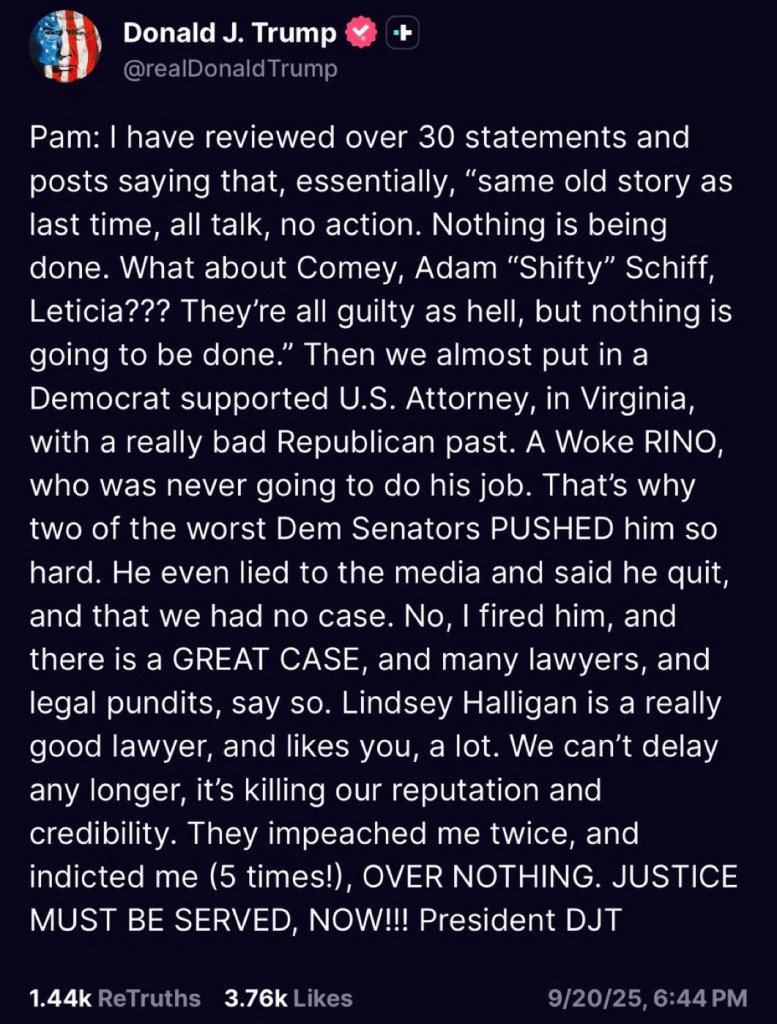
What the administration does appear to be focused on is regaining control of the political narrative that has slipped away from it. Today, after news broke that inflation is creeping back up as Trump’s tariffs take effect, Trump posted on social media alleging that Senator Adam Schiff (D-CA), who managed one of the impeachment cases against Trump, had committed mortgage fraud and must be brought to justice.

But so far, nothing appears to be working to distract MAGA from the Epstein files. As David Gilbert of Wired noted today, MAGA supporters were angry over a number of things already. Former Fox News Channel host Tucker Carlson hated the bombing of Iran; others hated Trump’s accepting a luxury plane from Qatar. Podcaster Ben Shapiro objected to Trump’s tariffs, and podcaster Joe Rogan has turned against Trump over the targeting of migrants who have not been even accused of crimes. Billionaire Elon Musk turned against Trump over the debt incurred under the new budget reconciliation law Trump called the One Big, Beautiful Bill.

The Epstein files appear to be one bridge too many for MAGA to cross. The administration tried to stop discussion of Epstein, and for a while the effort seemed to catch: by noon yesterday, the Fox News Channel had mentioned Epstein zero times but had mentioned former president Joe Biden 46 times. Today all but one Republican House member voted against a Democratic measure to require the release of the Epstein files. But Chicago journalist Marc Jacob noticed this afternoon that while the Fox News website didn’t mention Epstein in its top 100 stories today, “[t]he top 3 stories on the New York Times website, the top 2 stories on the Washington Post site and the top story on the CNN site are about Jeffrey Epstein.”

And then, this afternoon, Dhruv Mehrotra of Wired noted that the video from a camera near Epstein’s prison cell that the Department of Justice released as “raw” footage had approximately 2 minutes and 53 seconds cut out of it.

Journalist Garrett M. Graff, a former editor of Politico, commented: “Okay, I am not generally a conspiracist, but c’mon DOJ, you are making it really hard to believe that you’re releasing the real full evidence on Epstein….”

Johann Neem is a professor of history at Western Washington University. He is the author of Democracy’s Schools: The Rise of Public Education in America. His essay appeared originally in Education Week. The question Neem poses is this: Should students be allowed to opt out of any discussion of issues that offend their religion? The Supreme Court said yes. Need questions whether this is possible in a school where parents hold very different views.

He wrote:

On June 27, the Supreme Court released its decision in Mahmoud v. Taylor. The decision has not received the attention it merits. A close reading of the conservative majority’s opinion suggests that the high court is moving toward determining that public schooling violates the First Amendment of the Constitution. The decision could mean the end of public education in America.

The case concerned the Montgomery County, Md., board of education’s decision to integrate LGBTQ+ inclusive readings into its literacy curriculum to further its goal of representing diversity. At first, the district permitted parents to opt out their children, but when that policy became unworkable, it decided that parents would no longer be notified when the books were being used.

In response, several parents sued, arguing that exposing their children to the books threatened their right to raise their children according to their faith.

The U.S. Supreme Court sided with the parents. The court’s majority opinion concluded that exposing students to progressive ideas about marriage and gender placed an unconstitutional burden on parents’ religious liberties. Writing for the court’s six conservative justices, Justice Samuel A. Alito Jr. argued that the determining precedent is Wisconsin v. Yoder (1972), in which the court decided that a law mandating all children attend high school violated the religious liberties of the Amish community.

The majority determined that Yoder, far from an isolated case concerning a discrete community, is a general precedent applicable to all parents. In other words, all parents are Amish now, with the right to require the public schools to protect their children from curricula that burdens their capacity to raise their children according to their faith.

What, then, constitutes a burden on religious freedom? The court first disputed the school board’s claim to be merely exposing students, arguing that the record showed that the school board’s goal was to teach students to support same-sex marriage and gender fluidity.

If the court had stopped there, that would have been one thing, but Alito makes an additional move, arguing that even exposure to ideas that go against parents’ faith could be unconstitutional. The issue is not whether public schools coerce students’ beliefs but whether introducing an idea might undermine parents’ religious freedom. “We reject this chilling vision of the power of the state to strip away the critical right of parents to guide the religious development of their children,” Alito wrote.

In her dissent, signed by the three liberal justices, Justice Sonia Sotomayor responds that the court’s majority decision is untenable. “Given the great diversity of religious beliefs in this country,” she writes, “countless interactions that occur every day in public schools might expose children to messages that conflict with a parent’s religious beliefs.”

Sotomayor predicts the result of the decision will be “chaos for this Nation’s public schools.” “Never, in the context of public schools or elsewhere, has this Court held that mere exposure to concepts inconsistent with one’s religious beliefs could give rise to a First Amendment claim.” Ultimately, Sotomayor concludes, “to presume public schools must be free of all such exposure is to presume public schools out of existence.”

Sotomayor’s objection is ultimately practical: The majority’s opinion is so broad and its criteria so loose that public schools will not be able to function. Instead of elected school boards working things out locally, courts will ultimately adjudicate all curricular decisions at great cost of time and money.

Within the court’s majority opinion, however, lies a deeper threat to the existence of public schools. Because the court determined that exposure to objectionable material violates parents’ rights, policies involving that exposure are subject to “strict scrutiny,” the highest standard of judicial review. This level of judicial review requires that the government must demonstrate that the policy in question both serves an interest of the “highest order” and is “narrowly tailored” to achieve that interest.

The Supreme Court would, no doubt, agree that an educated citizenry is a public interest “of the highest order.” What the court does not address is whether public school systems are “narrowly tailored” to achieve the state’s goals.

Today, elected officials at the state and local levels choose the curricula that their schools will teach. But in effectively determining that any curriculum will violate parents’ rights, the court took a step toward outlawing public schools.

What might the court deem a more “narrowly tailored” policy to achieve the state’s goals of an educated citizenry? Although the court does not say so, the answer may be a private school voucher program in which parents choose schools that fit their faith rather than common schools that serve an entire community.

One cannot exaggerate how dangerous and unhistorical this ruling is. The founding generation considered increasing access to education one of government’s most important functions, enshrining it in the young country’s revolutionary state constitutions. In the 1787 Northwest Ordinance, the federal government even stated that “schools and the means of education shall forever be encouraged” and followed through by requiring land be set aside in new territories to generate revenue for public schools.

Today, every state constitution mandates a public education system, with many explicitly framing education as one of the state’s highest obligations.

All this history is at risk of being jettisoned. Instead, the court has determined that the need to protect students from being exposed to ideas hostile to their family’s religious beliefs trumps everything else. Under the court’s new rules, no curriculum could ever be constitutional unless parents are always informed in advance and can protect their children from anything objectionable to their specific religious beliefs.

Given this burden, states may be forced to find a more “narrowly tailored” approach to educating citizens. And before we know it, one of America’s greatest successes, one of the most popular American institutions, and one of the few we still share in common, will be gone.