Archives for category: Cruelty

Secretary of Homeland Security Kristi Noem testified before the Senate Appropriations Committee’s Subcommittee on Homeland Security a few days ago. During the hearing, Senator Chris Murphy gave her a stern lecture on all the ways she is breaking the law–by overspending her budget, by picking up and deporting people with legal status, by ignoring the due process rights of those detained, and by repeatedly breaking the law and defying Congress.

It’s five minutes of your time, time well spent.

Rob Curran writes about finance and other topics for Dow Jones, The Wall Street Journal, and other major publications. This article appeared in The Dallas Morning News.

Curran writes:

Neri Alvarado Borges was working for Latin Market Venezuelan Treats, which has locations in Far North Dallas and Lewisville, before he was deported to El Salvador’s Centro de Confinamiento Contra del Terrorismo last month.(Alvarado family / Courtesy)

****

The Trump administration has couched its aggressive ramp-up of deportations as an action to root out criminals. But signs are quickly emerging that the Immigration and Customs Enforcement Agency is scooping up hardworking North Texas migrants with little or no criminal past in its “crackdown.”

Last week, editorial columnist Robert Wilonsky chronicled the case of Neri Alvarado Borges, a young Lewisville resident with a jigsaw-ribbon tattoo associated with autism awareness he wore in honor of his autistic little brother. Did Alvarado look like a hardened criminal to you?

In February, the Venezuelan citizen was seized by ICE officers outside his apartment, and eventually taken to an El Salvadoran prison with suspected members of the Tren de Aragua gang. If he ever gets out, Alvarado’s trauma will be lifelong.

Paul Hunker is a Dallas immigration attorney and former chief counsel of the Dallas office of the U.S. Immigration and Customs Enforcement agency. Since the Trump administration took power, Hunker has been shocked by the profile of clients who come to him for help fighting deportation proceedings, he told me. These clients typically do not have criminal histories, Hunker said. They are hardworking members of the community, longtime residents. There’s a brief police encounter, a routine traffic stop, and they land in ICE custody.

“The model is detain-and-deport,” Hunker said. “The focus [in my time] was people who were a threat to their community, national-security threats and recent entrants. … Now they’re just going after everybody, even if they’ve been here for 20 years, with family ties. It doesn’t matter.”

ICE’s remit has changed drastically, and that change threatens to drag us all into something akin to a police state. ICE, and before it the Immigration and Naturalization Service’s enforcement arm, traditionally worked with the border patrol, focused on preventing undocumented migrants crossing the border. Apprehending a migrant in the act of an irregular border crossing is a vital part of rule-keeping, and something that has happened throughout U.S. history. Dragging family men out of their cars, throwing them into detention centers and kicking them out of the country is something ICE has never done. Until now.

That’s what appears to be happening to Jesus Ramos, of Lewisville. He, like me, is a green-card holder. Now, he’s facing deportation, allegedly because of nonviolent offenses in his past which have already been adjudicated. Ramos is on probation for simple assault and intent to possess drugs, according to reporting from NBC5.

He may have some substance-abuse problems, but Ramos is not a hardened criminal. Most families have members who go through similar struggles.

There are other stories. In Cedar Park in January, a young Venezuelan man with no criminal record was apprehended by ICE, according to an NPR story which withheld his name. Immigration officers told his family that the 18-year-old had appeared in an online video with guns and drugs, but they couldn’t produce the video for the family or for NPR.

ICE is still targeting serious offenders as the agency has always done since it launched in 2003, according to Hunker. But, as these cases and many of Hunker’s cases illustrate, ICE has new targets, too. And they are targets that we all know well.

ICE is targeting the people who climb on our roofs after hailstorms to fix the shingles. ICE is targeting the people who clean our houses and mind our children. What happens the next time your house-cleaner or your handyman drives home after a few too many?

That’s when the thorny moral question arises, the one your grandchildren may ask you: What did you do when dear, dear Nanny Gloria was swept up by burly officers and thrown in a cell?

What could you do? You will say. You were just one person.

“Tell your congressmen, ‘We don’t want this police state,’” said Hunker, who worked for ICE and its predecessor for more than 20 years. “‘Let ICE focus on people that are dangerous, and don’t try to deport those people who have their lives here.’”

I was reared in Ireland where memories of 1930s Central Europe were fresh. We are not there, yet or hopefully ever, but 20th-century history is no longer an abstract lesson. 

My grandmother met some of the young people brought to London in the Kindertransport operation that evacuated Jewish children from Central Europe before World War II. She inspired my mother with a compassion for displaced families, and an animus for state authorities who displaced those families because of their outsider status. 

It is all too easy, my mother taught me, to turn a blind eye to the state’s mistreatment of vulnerable outsiders. 

A couple of weeks ago, I was in Houston. I saw an ICE officer cruising around a strip mall in her patrol SUV, and felt a familiar chill. As a reporter with interest in the subject, I wanted to ask the officer why she was there, who she was looking for. But I turned my back, and moved on.

In Ireland, looking on from across the ocean, we contrasted Europe’s 20th-century dystopia with Reagan’s America, a land where hard work and enterprise counted for more than paperwork. Kids a few years ahead of us in school escaped to New York and Chicago from recession-wracked Ireland. A few won green-card lotteries. Most fudged the paperwork for a few years. Nobody shook them down. They were allowed to build skyscrapers, restaurant chains and plumbing empires, and sort the paperwork out later.

Now their children run emergency rooms, law offices and trading floors all over this nation.

That’s the story of immigration in modern America. The authorities have always sought to facilitate the inclusion of hardworking immigrants, rather than seeking to exclude and detain people for paperwork reasons.

The Trump administration continues to insist it is only targeting migrants with a criminal past. ICE’s broad interpretation of those criteria is what troubles me. Who’s to say that today’s deportation for DUI won’t be tomorrow’s deportation for a traffic violation, or for having the wrong surname?

Or writing a newspaper column critical of the regime. My green card is soon up for renewal. I sometimes fear it will be revoked by the thin-skinned Trump government.

But I must be able to look my children in the eye, and so I must speak up for Neri Alvarado and for Jesus Ramos and an unnamed Venezuelan 18-year-old.

Someone has to.

Thom Hartmann sums up what Trump is: a malignant narcissist intent on destroying every shred of our democracy and our ideals. we knew from his first term that he was a liar and a fraud. Yet here he is, acting with even more rage, vengeance, and destruction than before.

Let us not forget that Trump is enabled by the Republican Party. By their slim majorities in Congress. They have meekly watched as he terminated departments and agencies authorized by Congress. They have quietly given the power of the purse to Trump and Musk. They have watched as he turned himself into an emperor and made them useless. They could stop him. But they haven and they won’t.

He writes:

The Trump administration just gutted Meals on Wheels.

Seriously. Meals on Wheels!

Donald Trump didn’t just “disrupt” America; he detonated it. Like a political Chernobyl, he poisoned the very soil of our democratic republic, leaving behind a toxic cloud of cruelty, corruption, and chaos that will radiate through generations if we don’t contain it now.

He didn’t merely bring darkness; he cultivated it. He made it fashionable. He turned cruelty into currency and made ignorance a political virtue.

This man, a grotesque cocktail of malignant narcissism and petty vengeance, ripped the mask off American decency and showed the world our ugliest face. He caged children. Caged. Children. He laughed off their cries while his ghoulish acolytes used “Where are the children?” as a punchline for their next QAnon rally.

He welcomed white supremacists with winks and dog whistles, calling them “very fine people,” while spitting venom at Black athletes who dared kneel in peaceful protest.

He invited fascism to dinner and served it on gold-plated Trump steaks. He made lying the lingua franca of the right, burning truth to the ground like a carnival barker selling snake oil from a flaming soapbox.

And let’s not forget the blood on his hands: 1,193,165 dead from COVID by the time he left office, 400,000 of them unnecessarily, dismissed as nothing more than “a flu,” while he admitted — on tape — that he knew it was airborne and knew it was lethal. His apathy was homicidal, his incompetence catastrophic.

He tried to overthrow a fair election. He summoned a violent mob. He watched them beat cops with American flags and screamed “Fight like hell!” while cowering in the White House, delighting in the destruction like Nero fiddling as Rome burned.

And now, like some grotesque twist on historical fascism, Trump’s regime is quietly disappearing even legal U.S. residents — snatched off the streets by ICE and dumped into El Salvador’s CECOT mega-prison, a dystopian nightmare of concrete and cruelty.

One such man, Kilmar Ábrego García, had legal status and a home in Maryland. But Trump’s agents defied a federal court order and deported him anyway, vanishing him into a foreign hellhole so brutal it defies comprehension.

This isn’t policy: it’s a purge. A test run for authoritarian exile. And if Trump’s not stopped by Congress, the courts, or We The People in the streets, it won’t end there.

But somehow, he’s still here, waddling across the political stage like the Stay Puft Marshmallow Man of authoritarianism, bloated with power, empty of soul, and reeking of spray tan and sulfur.

Donald Trump didn’t just bring darkness: he’s a goddamn black hole, a gravity-well of cruelty sucking the light out of everything he touches.
This is a man who desecrates everything good.
Empathy? He mocks it. Truth? He slanders it. Democracy? He’d bulldoze it for a golf course.
And if we let him continue, he won’t just end democracy — he’ll make damn sure it never rises again.

So the question is: are we awake yet?

Or will we let this orange-faced death-cult leader finish the job he started, grinning over the corpse of the America we once believed in?

Now is not the time to kneel: it’s the time to rise. Stay loud, stay vigilant, and show up. Every protest, every march, every call to DC, every raised voice chips away at the darkness.

Democracy isn’t a spectator sport: it’s a fight, and we damn well better show up for it.

Trump’s war on higher education is similar to his war on every other major institution. He wants everyone to be afraid of him. He wants no critics to escape his wrath. He wants dissident voices silenced. He wants to be our king, our emperor, our dictator.

He has threatened to punish law firms that have represented his opponents, such as his 2016 challenger Hillary Clinton and Special Counsel Jack Smith, who gathered evidence of Trump’s crimes but was ultimately defeated by Trump’s delaying tactics.

He has threatened the news media, hitting CBS News “60 Minutes” with a $10 billion lawsuit for editing its interview with Kamala Harris (which is standard practice) and suing ABC News for a remark by George Stephanopoulos that he didn’t like. Both of these are frivolous lawsuits, but CBS is negotiating a settlement and ABC paid out $15 million to end the lawsuit. In a pre-emptive conciliatory move, Amazon (Jeff Bezos) bought the rights to a documentary about Melania Trump for $40 million, which will be produced by Melania. Bezos owns The Washington Post, where he has told the editorial board to go easy on Trump. The Post lost some of its best journalists after Bezos groveled to Trump.

He has threatened to cut off federal funding to universities if they don’t meet his demands. The ostensible reason for targeting universities is to compel them to combat anti-Semitism on their campuses, but it’s hard to credit Trump’s sincerity. He has defended anti-Semites, dined with them, and received their support. His best friend Elon Musk supported Germany’s far-right AfD party in the recent elections. A man who cares so little about civil rights, who attacks academic freedom, who defunds education and social services, who belittles minorities, who threatens democracy, and who is so utterly lacking in compassion–is no friend of Jews.

Last Friday, Trump said on his “Truth Social” account:

“We are going to be taking away Harvard’s Tax Exempt Status,” Trump wrote in a social media post. “It’s what they deserve!”

The President of the United States cannot take away the tax-exempt status of any individual or organization. That is a decision made by the IRS, and it is illegal for the President or Vice-President or any other government official to interfere in that decision. Such a decision is made by the IRS, must be made for cause, and the institution has the right to defend itself. The process can take years.

If the President could order the IRS to audit or investigate his enemies, it would be a very dangerous policy. He can’t. With Trump, the law is a minor inconvenience, so who knows what he will do. The Supreme Court told him he has absolute immunity so maybe he can disregard the law.

The Trump administration is blasting away at Harvard on multiple fronts. The Department of Homeland Security has threatened to revoke Harvard’s ability to enroll international students, who are 27 percent of Harvard’s enrollments.

The Education Department has demanded that Harvard supply the names and email addresses of all foreign students who were expelled since 2016. The Department also wants the names of all scholars, researchers, students and faculty associated with any foreign government. Just a few days ago, Secretary McMahon informed Harvard that it is no longer eligible for new funding so long as it continues to oppose the president’s agenda. That would mean allowing Trump’s agents to take control of admissions, hiring, and curriculum. The nation’s most prestigious university would have to abandon its independence to Trump.

The Department of Health and Human Services and the National Science Foundation have suspended over $2 billion in grants to Harvard for medical and scientific research. Studies that are focused on causes and cures for tuberculosis and ALS, for example, have come to a halt. Another $7 billion in research funding could be suspended. This could damage the research and work of hospitals across the Boston metro area, and the economy of Massachusetts as well. Since Massachusetts is a blue state, Trump doesn’t care.

If this looks like harassment, that’s because it is.

Trump is certainly no libertarian. He is using every federal source of funding to compel universities, colleges, schools, cities, and states to follow his commands.

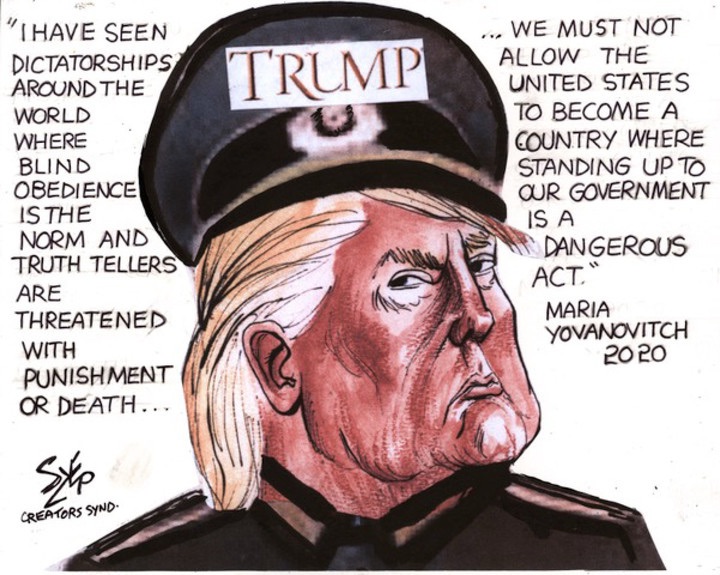
That’s not democracy. That’s dictatorship.

New York State law requires private and religious schools to offer an education that is substantially equivalent to what is offered at secular public schools. Some Orthodox Jewish schools refuse to comply. Repeated inspections have found that the recalcitrant Yeshivas do not teach English and do not teach math and science in English.

Dr. Betty Rosa, an experienced educator and New York State Commissioner of Education, has insisted that Yeshivas comply with the law. She fears that their students are graduating from high school without the language skills required for higher education and the workplace.

The Hasidim are a tight-knit group that often votes as a bloc to enhance their political power. They vote for whoever promises to support their interests. Both parties compete for their endorsement.

Eliza Shapiro and Benjamin Oreskes reported the story in the New York Times:

New York lawmakers are considering a measure that would dramatically weaken their oversight over religious schools, potentially a major victory for the state’s Hasidic Jewish community.

The proposal, which could become part of a state budget deal, has raised profound concern among education experts, including the state education commissioner, Betty Rosa, who said in an interview that such changes amount to a “travesty” for children who attend religious schools that do not offer a basic secular education.

“We would be truly compromising the future of these young people,” by weakening the law, Ms. Rosa said. “As the architect of education in this system, how could I possibly support that decision,” she added.

Gov. Kathy Hochul on Monday announced a $254 billion budget agreement but acknowledged many of the particulars are still being hashed out.

Behind the scenes, a major sticking point appears to be whether the governor and the Legislature will agree to the changes on private school oversight, according to several people with direct knowledge of the negotiations, which may include a delay in any potential consequences for private schools that receive enormous sums of taxpayer dollars but sometimes flout state education law by not offering basic education in English or math.

The state is also considering lowering the standards that a school would have to meet in order to demonstrate that it is following the law.

Though the potential changes in state education law would technically apply to all private schools, they are chiefly relevant to Hasidic schools, which largely conduct religious lessons in Yiddish and Hebrew in their all-boys schools, known as yeshivas.

The potential deal is the result of years of lobbying by Hasidic leaders and their political representatives…

The Hasidic community has long seen government oversight of their schools as an existential threat, and it has emerged as their top political issue in recent years.

It has taken on fresh urgency in recent months, as the state education department, led by Ms. Rosa, has moved for the first time to enforce the law, after years of deliberation and delay….

There is little dispute, even among Hasidic leaders, that many yeshivas across the lower Hudson Valley and parts of Brooklyn are failing to provide an adequate secular education. Some religious leaders have boasted about their refusal to comply with the law and have barred families from having English books in their homes.

Mayor Eric Adams’s administration, which has been closely aligned with the Hasidic community, found in 2023 that 18 Brooklyn yeshivas were not complying with state law, a finding that was backed up by state education officials.

A 2022 New York Times investigation found that scores of all-boys yeshivas collected about $1 billion in government funding over a four-year period but failed to provide a basic education, and that teachers in some of the schools used corporal punishment.

It is clear why Hasidic leaders, who are deeply skeptical of any government oversight, would want to weaken and delay consequences for the schools they help run.

It is less obvious why elected officials would concede to those demands during this particular budget season. There is widespread speculation in Albany that Ms. Hochul, facing what may be a tough re-election fight next year, is hoping to curry favor from Hasidic officials, who could improve her chances with an endorsement….

Hasidic voters are increasingly conservative and tend to favor Republicans in general election contests.

New York’s state education law related to private schools, which is known as the substantial equivalency law, has been on the books for more than a century.

It was an obscure, uncontroversial rule up until a few years ago, when graduates of Hasidic yeshivas who said they were denied a basic education filed a complaint with the state, claiming that their education left them unprepared to navigate the secular world and find decent jobs.


After Trump introduced Elon Musk and his so-called “Department of Government Efficiency,” several Republican-controlled states created their own DOGE operations. Like the one Musk launched, these were non-governmental, unelected, unaccountable cost-cutters, set loose to apply a chainsaw to state government.

John Thompson reports on what happened in Oklahoma.

CBS’s Sixty Minutes recently reported on the danger of H5N1 bird flu spinning out of control. It cited Dr. Kamran Khan who explained why “We are really at risk of this virus evolving into one that has pandemic potential.” Another expert agreed that “this flu could make Covid look like a walk in the park.”

This frightening reporting comes as the DOGE–OK seeks to cut nearly $150 million for programs that provide immunization services, pathogens surveillance, and emerging infectious diseases prevention, and provide Epidemiology and Laboratory Capacity for Prevention of Control of Emerging Infectious Diseases.

And this is only one reason for looking into the DOGE–OK process.

Anyone paying attention to Elon Musk’s leadership of the Trump administration’s DOGE campaign to cut federal programs has reason the fear the DOGE campaigns launched in 26 states. After all, as the Economic Policy Institute (EPI) explains, when Governor Kevin Stitt opened Oklahoma’s DOGE-OK, he called for a reduction in our personal income and corporate tax rates, thus making the state’s tax code even more regressive.

The EPI further explained that Stitt selected Marc Nuttle, “who was the ‘chief strategist’ behind Oklahoma’s 2001 so-called right-to-work referendum—a policy designed to disempower workers and lower wages (and contrary to proponents’ claims, it did not bolster job growth in the state).” The executive order empowered Nuttle to lead efforts of a newly formed agency to study the state budget.

Moreover, the EPI explains:

DOGE-OK is itself duplicative since the Office of the State Auditor and Inspector is constitutionally mandated to “examine the state and all county treasurers’ books, accounts, and cash on hand, stipulating that [the office] shall perform other duties as may be prescribed by law.” Similar to DOGE-OK, the auditor reviews staffing levels, assesses state spending, and issues public reports to promote transparency.

The DOGE-OK report now explains:

Once DOGE-OK ideas are received, they are analyzed and vetted with the appropriate group. If validated, ideas are added to the DOGE-OK website. 

But, when I studied the report, I found no sign of hard evidence to back its claims. For instance, they didn’t explain their methodology, and offered no cost/benefit analyses. DOGE didn’t explain what “groups” it considered to be “appropriate,” and what data was used to analyze and vet, and validate their ideas.  

Since the first DOGE headlines focused on $157 million in supposedly “wasteful health grants” by the federal government, I focused on Medicaid and Department of Health cuts.

These proposed cuts are especially disturbing because, as Shiloh Kantz, the executive director of the nonpartisan Oklahoma Policy Institute, explained, “Oklahoma already ranks among the worst in health outcomes.”

First, DOGE-OK claimed that $60 million per year would be saved if the state, not the federal government, performed eligibility checks on children. And, they cited two drugs that received accelerated approval without working, costing $42 million. But, they did not mention the number and the benefits of the other drugs, like the Covid vaccine, that received accelerated approval.

Also, DOGE-OK inexplicably said that easing the prescription drug cost cap would improve prices. And they recommended repeal of staffing requirements for Long-Term Care facilities in order to save $76 million annually, without mentioning harm to elderly patients due to under-staffing.

DOGE-OK also said that three Oklahoma State Department of Health programs should be cut by almost $150 million because their funding exceeded the amount necessary.  As already mentioned, in the wake of Covid pandemic, and as measles and bird flu spread, these programs provide immunization services, pathogens surveillance, and emerging infectious diseases prevention, etc. So, how did DOGE reach the conclusion that the full funding of those programs is no longer necessary?  

Then, DOGE-OK said that 7 programs should have cuts because of “duplication,” with partners doing the same or similar work. They said $2.2 million would be saved by getting rid of the team efforts necessary to improve health.

And Sex Education should be cut by $236,000 because of its low Return on Investment.

Again, I saw no evidence behind their recommendations for $157,606,300 in overall health care reductions. Neither did they address financial costs of implementing their ideas. And, there is no evidence that DOGE seriously considered the costs in terms of the lives that would be damaged or lost.

Given the history of the Trump/Musk DOGE, none of the DOGE–OK should be a surprise. When Gov. Stitt selected Nuttle, a true-believer in Milton Friedman, to run the project, Stitt said, “With his help, we’ll leave state government leaner than we found it.”

Is that the proper way to launch a supposedly balanced and evidence-driven investigation of such complex and crucial policy approaches?

Stitt’s news release previewed Nuttle’s methodology: “use his knowledge of the inner workings of government to comb through agency budgets, legislative appropriations, and contracts.”

So, to paraphrase the DOGE-OK report’s description of its methodology, its proposals would be “analyzed and vetted” by what they see as the “appropriate group.”

In other words, Oklahomans were never promised an open, balanced, evidence-based DOGE process for making our state better. But the same is also true for Musk’s federal DOGE chainsaw.

The second Trump administration may well go down in history as the most corrupt presidency in our history. We learned yesterday that the Trump family crytocurrency just received an investment of $2 billion from a fund in Abu Dhabi; this is a sure way to gain access to the patriarch in the White House. Not only is he enriching himself and his family, but has also allowed Elon Musk to violate every ethical rule in the federal government while shackling his competitors.

Steven Rattner, a columnist for The New York Times, details some of the ways that Trump enriches himself during his Presidency. We should not be surprised. Throughout his adult life, Trump has been a hustler, a con man, a performer, and a man who loves money.

He wrote:

No presidential administration is completely free from questionable ethics practices, but Donald Trump has pushed us to a new low. He has accomplished that by breaking every norm of good government, often while enriching himself, whether by pardoning a felon who, together with his wife, donated $1.8 million to the Trump campaign; promoting Teslas on the White House driveway; or holding a private dinner for speculators who purchase his new cryptocurrency.

Mr. Trump’s blatant transgressions have swamped those of any modern president and even those of his first term. Remember the outrage when he refused to divest his financial holdings or when he used a Washington hotel he owned as a kind of White House waiting room? Those moves seem quaint in comparison.

In his trampling of historically appropriate behavior, Mr. Trump appears to be pursuing several agendas. Personal enrichment stands out: Imagine any other president collecting a cut of sales from a cryptocurrency marketed with his likeness. There is the way he is expanding his powers: He has ignored or eliminated large swaths of rules that would have inhibited his freedom of action and his ability to put trusted acolytes in key roles. And then there’s rewarding donors, whether through pardons or favors for their clients.

I was working in the Washington bureau of The Times when Richard Nixon resigned, and even he — taken down by his efforts to cover up his misdeeds — did not engage in such a vast array of sordid practices.

The corruption of Trump 2.0 has not gotten the attention it deserves amid the barrage of news about Mr. Trump’s tariff wars, his attack on scientific research and his senior appointees’ Signal text chains. But self-dealing is such a defining theme of this administration that it needs to be called out. Like much that Mr. Trump has done in other areas, it announces to the world that America’s leaders can no longer be trusted to follow its laws and that influence is up for sale.

Just as in the post-Nixon era, when guardrails were established to prevent transgressions, the next president could decide to restore some of the sound government practices that Mr. Trump has trampled on. But the damage he has inflicted by, say, pardoning his donors or lining his own pockets is irreversible.

The below represents just a sampling of what’s transpired these past 100 days.

  • He turned a legitimate federal employee designation into a loophole. By giving senior officials such as Elon Musk the title “special government employee,” Mr. Trump avoided requirements that they publicly disclose their financial holdings and divest any that present conflicts before taking jobs in the administration.
  • He ended bans that stopped executive branch employees from accepting gifts from lobbyists or seeking lobbying jobs themselves for at least two years.
  • He loosened the enforcement of laws that curb foreign lobbying and bribery.
  • He dismissed the head of the office that polices conflicts of interest among senior officials.
  • He jettisoned the head of the office that, among other things, protects whistle-blowers and ensures political neutrality in federal workplaces.
  • He purged nearly 20 nonpartisan inspectors general who were entrusted with rooting out corruption within the government.

Rewarding donors is part of any presidential administration. Every president in my memory appointed supporters to ambassadorships. But again, Mr. Trump has gone much further.

  • Jared Isaacman, a billionaire with deep tentacles into SpaceX, gave $2 million to the inaugural committee and was nominated to head NASA — SpaceX’s largest customer.
  • The convicted felon Trevor Milton and his wife donated $1.8 million to the campaign and Mr. Milton received a pardon, which also spared him from paying restitution.
  • The lobbyist Brian Ballard raised over $50 million for Mr. Trump’s campaign, and Mr. Trump handed major victories to two Ballard clients. He delayed a U.S. ban on China-owned TikTok his first day in office and killed an effort to ban menthol cigarettes, a major priority of tobacco company R.J. Reynolds, on his second.

Mr. Musk, the Tesla and SpaceX billionaire who spent $277 million to back Mr. Trump and other Republican candidates, requires his own category.

As a special government employee, Mr. Musk is supposed to perform limited services to the government for no more than 130 days a year. By law, no government official — even a special government employee — can participate in any government matter that has a direct effect on his or her financial interests. That criminal statute hasn’t stopped Mr. Musk and his so-called Department of Government Efficiency from interacting with at least 10 of the agencies that oversee his business interests.

  • He installed a SpaceX engineer at the Federal Aviation Administration to review its air traffic control system. The F.A.A. is reportedly considering canceling Verizon’s $2.4 billion contract to update its aging telecommunications infrastructure in favor of a SpaceX’s Starlink product. (SpaceX has denied it is taking over the contract.)
  • SpaceX is a leading contender to secure a large share of Mr. Trump’s “Golden Dome” missile defense project, an effort that could involve billions of revenue for the winner.
  • X, Mr. Musk’s social media outlet, has become an official source of government news. The White House welcomed a reporter from the platform at a recent briefing, and at least a dozen government agencies started DOGE-focused X accounts.
  • As Mr. Musk’s political activities started to repel many potential customers of Tesla, his electric vehicle company, Mr. Trump lined Tesla vehicles up on the White House driveway and extolled their benefits. Then Commerce Secretary Howard Lutnick urged Fox News viewers to buy Tesla shares.
  • DOGE nearly halved the team at the National Highway Traffic Safety Administration that regulates autonomous vehicles. The agency has been investigating whether Tesla’s self-driving technology played a role in the death of a pedestrian in Arizona.

Critics of crypto argue that it has demonstrated little value beyond enabling criminal activity. Despite this, Mr. Trump has wasted no time eliminating regulatory oversight of the industry at the Securities and Exchange Commission and the Justice Department, even as his family grows ever more invested in it.

By enabling money to be delivered anonymously and without any bank participation, crypto offers the possibility for any individual or foreign state to funnel money to Mr. Trump and his family secretly. Moreover, Bloomberg News recently estimated that the Trump family crypto fortune is nearing $1 billion.

  • On the eve of his inauguration he released $TRUMP and $MELANIA memecoins — a type of crypto derived from internet jokes or mascots. Next, the S.E.C. announced it would not regulate memecoins. Then last week, Mr. Trump offered a private dinner at his golf club and a separate “Special VIP Tour” to the top 25 investors in $TRUMP, causing the price of the currency to surge and enriching the family. (That tour was initially advertised as being at the White House. Then the words “White House” disappeared, but the rest of that prize remained.)
  • The S.E.C. eliminated its crypto-enforcement program, ending or pausing nearly every crypto-related lawsuit, appeal and investigation. That includes the civil suit against Justin Sun, a crypto entrepreneur who had separately purchased $75 million worth of tokens tied to Mr. Trump’s family after the election.
  • The S.E.C. also suspended its civil fraud case against Binance, the huge crypto exchange that pleaded guilty to money-laundering violations and allowed terrorist financing, hacking and drug trafficking to proliferate on its platform. Soon after, the company met with Treasury officials to seek looser oversight while also negotiating a business deal with Mr. Trump’s family.
  • World Liberty Financial, a crypto company that Mr. Trump and his sons helped launch, said it had sold $550 million worth of digital coins. A business entity linked to him gets 75 percent of the sales.
  • The Trump family has said it will partner with the Singapore-based crypto exchange Crypto.com to introduce a series of funds comprising crypto and securities with a made-in-America focus.
  • The federal government’s “crypto czar,” David Sacks, Mr. Lutnick and Mr. Musk all have connections to the market. (Mr. Musk named DOGE after a memecoin.)
  • Mr. Trump is reportedly on his way to raising $500 million for his political action committees — highly unusual for a president who cannot run for re-election.
  • A new Trump Tower is underway in Jeddah, Saudi Arabia’s second largest city, with plans for two more projects for the kingdom announced after Mr. Trump’s November election victory, all in partnership with a Saudi company with close ties to the Saudi government.
  • Mr. Trump’s team asked about bringing the signature British Open golf tournament to his Turnberry resort in Scotland during a visit of the British prime minister, Keir Starmer, to the White House.
  • He posts news-making announcements on Truth Social, the company in which his family owns a significant stake.

It’s all a sorry and sordid picture, a president who had already set a new standard for egregious and potentially illegal behavior hitting new lows with metronomic regularity.

Kevin Cullen of the Boston Globe asked why Trump and Melania are attending the funeral of Pope Francis, since the two men disagreed about almost everything. He thinks it is Trump’s way of consoling his Catholic base. The Pope and Trump exchanged harsh words. The Pope was a man of faith who called on the faithful to welcome immigrants. Trump hates immigrants. The Pope called for mercy and compassion. All Trump can give is hatred and vitriol.

Cullen writes:

There’s a great scene in “The Godfather,” when all the other Mafia bosses attend Don Corleone’s funeral.

Ostensibly, the Godfather’s rivals are there to show respect, but there’s the unmistakable reality they are not mourning a death so much as relishing an opportunity.

The image of Donald Trump sitting near the body of Pope Francis conjures the image of Don Barzini nodding to Corleone’s family as he calculates in his head how many of Corleone’s soldiers and contacts he can peel off now that the Godfather is dead.

Why, on God’s green earth, would Donald Trump deign to attend Pope Francis’ funeral? To show respect? To mingle with other world leaders? To get his mug on television?

Pope Francis was arguably Trump’s highest-profile critic, especially when it came to the Trump administration’s treatment of migrants.

In the aftermath of the pope’s death, Trump was uncharacteristically gracious, posting on social media that Pope Francis was “a very good man.”

Trump called that very good man “disgraceful” in 2016 after the pope dismissed Trump’s proposal to build a wall between the US and Mexico. The pope said that anyone who only thinks about building walls instead of bridges “is not Christian.”

Trump, whose base includes millions of evangelical Christians and conservative Catholics, hit back, saying, “For a religious leader to question a person’s faith is disgraceful.”

For all the kind words he showered on the pope in the immediate aftermath of the pope’s death, it’s hard to imagine Trump disagreed with the less than charitable assessment offered by Roger Stone, the Trump advisor who avoided 40 months in prison after Trump commuted his sentence for lying to Congress to protect Trump. 

Stone, displaying the compassion of a viper, said this of the pope: “His papacy was never legitimate and his teachings regularly violated both the Bible and church dogma. I rather think it’s warm where he is right now.”

So gracious.

But, give Stone this much: at least he was honest.

Trump’s platitudes ring hollow indeed. But the death of Pope Francis offers Trump and MAGA Catholics the prospect, however unlikely, of replacing a progressive voice in the Vatican with someone more ideologically in tune with the more conservative voices within the church in the US.

At the very least, Trump has to be hoping the next pope isn’t as withering a critic as Francis was.

Nearly 60 percent of US Catholics voted for Trump last November, according to exit polls.Another survey put the figure at 54 percent

Either way, Trump, who describes himself as a non-denominational Christian, won the Catholic vote, decisively. The pope’s criticism of Trump when it came to the environment, the poor and especially immigration doesn’t appear to have dissuaded the majority of American Catholics from voting for Trump.

Catholics comprise more than one third of Trump’s cabinet.

The 9-member US Supreme Court that has been deferential to Trump’s unprecedented claims and exercise of executive power is comprised of six Catholics, only one of whom, Sonia Sotomayor, is liberal and regularly rules against Trump. (You could argue there are six conservative “Catholics” justices, given that Justice Neil Gorsuch, now an Episcopalian, was raised and educated as a Catholic, and voted with the five other conservative Catholic justices to overturn Roe v. Wade.) 

Thomas Groome, a professor of theology at Boston College, acknowledges that conservative Catholics in the US have been a boon to Trump, and suspects Trump show of respect to Pope Francis and the institution is keeping with his transactional approach to pretty much everything: that the conclave of cardinals who will elect a new pope will reward Trump with someone who thinks more like him.

Highly unlikely, says Groome.

“Francis appointed about two-thirds of the cardinals who will select his successor,” Groome said. “Trump may be hoping he’ll get a reactionary, a right-wing pope. But I don’t think that will happen.”

Groome said he was more concerned about Trump’s reaction when the president realizes that, following Vatican protocol, he won’t get the best seat in the house at St. Peter’s Basilica.

“My understanding is he’s been assigned to sit in the third row,” Groome said. “He’s not going to like that.”

Still, gripped by Christian charity, and influenced by an enduring belief in redemption, Groome holds onto the remote, infinitesimal chance Donald Trump could, on the way to Rome, have a Road to Damascus conversion, that some of Pope Francis’ empathy could somehow rub off on him.

“St. Paul fell off his horse,” Groome said. “Maybe Donald Trump will, too.”

Trump has long demonstrated his admiration for Putin. No one can say exactly why Trump admires Russia’s ruthless dictator. But Trump insists that Ukraine is responsible for Putin’s invasion of Ukraine in 2022. His lame efforts to broker an end to Russia’s war on Ukraine have robustly echoed Putin’s demands.

Heather Cox Richardson analyzes how Trump has changed American policy towards the Russian war on Ukraine. Trump’s “peace plan” gives Russia everything Putin wants:

She writes:

After previously suggesting that the U.S. would not involve European representatives in negotiations to end Russia’s war against Ukraine, Secretary of State Marco Rubio and presidential envoy Steve Witkoff met in Paris last week for talks with Ukrainian and European officials. The U.S. presented what it called “the outlines of a durable and lasting peace,” even as Russia continued to attack Ukrainian civilian areas.

A senior European official told Illia Novikov, Aamer Madhani, and Jill Lawless of the Associated Press that the Americans presented their plan as “just ideas” that could be changed. But Barak Ravid of Axios reported on Friday that Trump was frustrated that the negotiations weren’t productive and said he wanted a quick solution.

Talks were scheduled to resume today, in London, but yesterday Rubio pulled out of them. The U.S. plan is now “a final offer,” Ravid reported, and if the Ukrainians don’t accept it, the U.S. will “walk away.”

On a bipartisan basis, since 2014 the United States has supported Ukraine’s fight to push back Russia’s invasions. But Trump and his administration have rejected this position in favor of supporting Russia. This shift has been clear in the negotiations for a solution: Trump required repeated concessions from Ukraine even as Russia continued bombing Ukraine. Axios’s Ravid saw the proposed “final offer,” and it fits this pattern.

The plan would recognize Russia’s occupation of Ukraine’s Crimea and its occupation of almost all of Luhansk oblast and the portions of Donetsk, Kherson, and Zaporizhzhia oblasts Russia has occupied. This would essentially freeze the boundary of Ukraine at the battlefront.

Ukraine would promise not to join the North Atlantic Treaty Organization (NATO), the post–World War II defensive alliance that first stood against the aggression of the Soviet Union and now stands against the aggression of Russia.

Sanctions imposed against Russia after its 2014 and 2022 invasions of Ukraine would be lifted, and the United States, in particular its energy and industrial sectors, will cooperate with Russia.

In essence, this gives Russian president Vladimir Putin everything he wanted.

What the Ukrainians get out of this deal is significantly weaker. They get “a robust security guarantee,” but Ravid notes the document is vague and does not say the U.S. will participate. We have been here before. After the Soviet Union crumbled in 1991, Ukraine had the third-largest stockpile of nuclear weapons in the world. In exchange for Ukraine’s giving up those weapons, the United States, the United Kingdom, and Russia agreed to secure Ukraine’s borders. In the 1994 Budapest Memorandum on Security Assurances, they agreed they would not use military force or economic coercion against Ukraine.

Russia violated that agreement with its 2014 and 2022 invasions, making it unlikely that Ukraine will trust any new promises of security.

Under the new plan, Ukraine would also get back a small part of Kharkiv oblast Russia has occupied. It would be able to use the Dnieper River. And it would get help and funds for rebuilding, although as Ravid notes, the document doesn’t say where the money will come from.

There is something else in the plan. The largest nuclear power plant in Europe is Ukrainian: the Zaporizhzhia plant. It will be considered Ukrainian territory, but the United States will operate it and supply the electricity it produces to both Ukraine and Russia, although the agreement apparently doesn’t say anything about how payments would work. The plan also refers to a deal between the U.S. and Ukraine for minerals, with Ukraine essentially repaying the U.S. for its past support.

Ravid notes that the U.S. drafted the plan after envoy Steve Witkoff met for more than four hours last week with Putin. But the plan has deeper roots.

This U.S.-backed plan echoes almost entirely the plan Russian operatives presented to Trump’s 2016 campaign manager Paul Manafort in exchange for helping Trump win the White House. Russia had invaded Ukraine in 2014 and was looking for a way to grab the land it wanted without continuing to fight.

Special Counsel Robert Mueller’s 2019 report on Russian interference in the 2016 presidential election explained that Manafort in summer 2016 “discussed a plan to resolve the ongoing political problems in Ukraine by creating an autonomous republic in its more industrialized eastern region of Donbas, and having [Russian-backed Viktor] Yanukovych, the Ukrainian President ousted in 2014, elected to head that republic.”

The Mueller Report continued: “That plan, Manafort later acknowledged, constituted a ‘backdoor’ means for Russia to control eastern Ukraine.” The region that Putin wanted was the country’s industrial heartland. He was offering a “peace” plan that carved off much of Ukraine and made it subservient to him. This was the dead opposite of U.S. policy for a free and united Ukraine, and there was no chance that former secretary of state Hillary Clinton, who was running for the presidency against Trump, would stand for it. But if Trump were elected, the equation changed.

According to the Republican-dominated Senate Intelligence Committee, Manafort’s partner and Russian operative Konstantin Kilimnik wrote: “[a]ll that is required to start the process is a very minor ‘wink’ (or slight push) from D[onald] T[rump] saying ‘he wants peace in Ukraine and Donbass back in Ukraine’ and a decision to be a ‘special representative’ and manage this process.” Following that, Kilimnik suggested that Manafort ‘could start the process and within 10 days visit Russia ([Yanukovych] guarantees your reception at the very top level, cutting through all the bullsh*t and getting down to business), Ukraine, and key EU capitals.’ The email also suggested that once then–Ukrainian President Petro Poroshenko understood this ‘message’ from the United States, the process ‘will go very fast and DT could have peace in Ukraine basically within a few months after inauguration.’”

According to the Senate Intelligence Committee, the men continued to work on what they called the “Mariupol Plan” at least until 2018.

After Russia invaded Ukraine again in 2022, Jim Rutenberg published a terrific and thorough review of this history in the New York Times Magazine. Once his troops were in Ukraine, Putin claimed he had annexed Donetsk, Luhansk, Zaporizhzhia, and Kherson, two of which were specifically named in the Mariupol Plan, and instituted martial law in them, claiming that the people there had voted to join Russia.

On June 14, 2024, as he was wrongly imprisoning American journalist Evan Gershkovich, Putin made a “peace proposal” to Ukraine that sounded much like the Mariupol Plan. He offered a ceasefire if Ukraine would give up Donetsk, Luhansk, Zaporizhzhia, and Kherson, including far more territory than Putin’s troops occupy, and abandon plans to join NATO. “If Kyiv and the Western capitals refuse it, as before,” Putin said, “then in the end, that’s their…political and moral responsibility for the continuation of bloodshed.”

On June 27, 2024, in a debate during which he insisted that he and he alone could get Gershkovich released, and then talked about Putin’s 2022 invasion of Ukraine, Trump seemed to indicate he knew about the Mariupol Plan: “Putin saw that, he said, you know what, I think we’re going to go in and maybe take my—this was his dream. I talked to him about it, his dream.”

Now that plan is back on the table as official U.S. policy.

Ukraine president Volodymyr Zelensky has said that his country will not recognize the Russian occupation of Crimea. In this determination, he speaks for the global rules-based order the U.S. helped to create after World War II. Recognition of the right of a country to invade another and seize its territory undermines a key article of the United Nations, which says that members won’t threaten or attack any country’s “territorial integrity or political independence.” French president Emmanuel Macron and other European leaders are standing behind those principles, saying today in a statement from Macron’s office that they reject Russian territorial gains under the U.S. plan. “Ukraine’s territorial integrity and European aspirations are very strong requirements for Europeans,” the statement said.

But Trump himself seems eager to rewrite the world order. In addition to his own threats against Greenland, Canada, and Panama, in a post today on his social media site he echoed Putin’s 2024 statement blaming Ukraine for Russia’s bloody war because it would not agree to Putin’s terms. Today, Trump said Zelensky’s refusal to recognize the Russian occupation of Crimea was “inflammatory,” and he pressured Zelensky to accept the deal.

Curiously, he felt obliged to write that “I have nothing to do with Russia…”.

Jason Garcia is an investigative reporter in Florida who has had plenty to investigate during the regime of Ron DeSantis. His blog is called “Seeking Rents.” This is a post you should not miss.

The governor acts like a dictator, and the Republican-dominated legislature doesn’t stop him. Remember the takeover of New College? It was the only innovative, free-thinking public institution of higher education in the state. It was tiny, only 700 students. But DeSantis took control of the college’s board, hired a new president (a crony) and set about destroying everything that made it unique. He issued one executive order after another for the entire state to crush DEI and assure the only permissible thought mirrored his own. He attacked drag queens and threatened to punish bars and hotels that allowed them to perform. He created a private army, subject only to his control. He selected politicians to run major universities. He imposed thought control on the state. Fascism thrives in Florida.

Thus far, he has gotten away with his gambits. But Garcia doesn’t think he will get away with this one.

He writes:

A simmering scandal erupted Friday afternoon when the Tampa Bay TimesMiami Herald and Politico Florida revealed that the administration of Gov. Ron DeSantis orchestrated a $10 million payment last fall to a charity founded by the governor’s wife — which then turned around and gave the money to groups that helped finance the governor’s campaign against a proposed constitutional amendment to legalize marijuana in Florida.

In a nutshell: The DeSantis administration pressured a major state contractor to make a $10 million donation to the Hope Florida Foundation, the controversial charity spearheaded by First Lady Casey DeSantis. It was part of a settlement negotiated with Centene Corp., after the state’s largest Medicaid contractor overbilled the state by at least $67 million.

Days later, Hope Florida transferred that $10 million to a pair of dark-money nonprofits. The state-backed charity gave $5 million each to “Save Our Society From Drugs,” an anti-marijuana group founded by a late Republican megadonor, and “Secure Florida’s Future,” a political vehicle controlled by executives at the Florida Chamber of Commerce, the Big Business lobbying group.

And days after that, Save Our Society From Drugs and Secure Florida’s Future gave a combined $8.5 million to “Keep Florida Clean,” a political committee — chaired by Ron DeSantis’ then-chief of staff — created to oppose Amendment 3, the amendment on last year’s ballot that would have allowed Floridians to use marijuana recreationally rather than solely for medicinal reasons.

It’s a daisy chain that may have transformed $10 million of public money — money meant to pay for health insurance for poor, elderly and disabled Floridians — into funding for anti-marijuana campaign ads.

DeSantis, of course, has repeatedly insisted that he did nothing wrong while also lashing out in increasingly vitriolic ways at everyone from the Republican speaker of the state House to the newspaper reporters digging into the story.

But at least one prominent GOP lawmaker — Rep. Alex Andrade, a Pensacola Republican who has been presiding over hearings into Hope Florida — told the Times and Herald that the transaction chain “looks like criminal fraud by some of those involved.”

Clearly, this looks very bad. But it is also by no means an isolated incident. 

In fact, this is part of a larger pattern of potential abuses that Ron DeSantis committed last fall when he chose to turn the power of state government against two citizen-led constitutional amendments that appeared on the November ballot: Amendment 3 and Amendment 4, which would have ended Florida’s statewide abortion ban.

Consider what we already know about how DeSantis financed his campaigns against the two amendments using public money taken from taxpayers — and private money taken from donors who got public favors from the governor.

  • Five state agencies directly funded television commercials meant to weaken support for the marijuana and abortion-rights ballot measures. We still don’t know the full extent of their spending, although Seeking Rents has estimated the total taxpayer tab at nearly $20 million. We also know that the DeSantis administration commandeered money for anti-marijuana advertising from Florida’s share of a nationwide legal settlement with the opioid industry — money that was supposed to be spent combatting the opioid addiction crisis.
  • At the same time, another nonprofit funded by Florida taxpayers poured at least $5 million into television ads attempting to soften Florida’s image on women’s healthcare at a time when Florida’s near-total abortion was under intense attack. It was the Florida Pregnancy Care Networks’ first-ever TV ad campaign. And its commercials, which were overseen by DeSantis administration staffers, complemented the state agency ads against the abortion-rights amendment — right down to using the same slogan.
  • Last June, after DeSantis vetoed legislation that would have strictly regulated the state’s hemp industry, CBS News Miami revealedthat industry executives and lobbyists promised to raise $5 million in exchange for the veto for the governor to spend on his campaign against Amendment 3. “Our lobby team made promises to rally some serious funding to stand with him on this,” a hemp industry representative wrote in one message that included a bank routing number for the Republican Party of Florida. “We have to pay $5 million to keep our end of the veto,” a hemp executive wrote in another message.
  • In the closing weeks of the campaign, records show that the Big Tobacco giant Philip Morris International gave $500,000 to DeSantis’ personal political committee — which was also chaired by the governor’s then-chief of staff and which DeSantis was using to campaign against both Amendment 3 and Amendment 4. Shortly after the election, the DeSantis administration handed Philip Morris a lucrative tax break, ruling that the company could sell a new line of electronically heated tobacco sticks free of state tobacco taxes.

There were other abuses of power, too. DeSantis and his team threatened to criminally prosecute television stations that aired ads supporting Amendment 4. They sent state police to the homes of Florida voters who signed Amendment 4 petitions. And they hijacked the ballot-writing process for Amendment 4.

There’s a reason why the DeSantis administration made sure to extract a promise of legal immunityfrom the organization that sponsored Amendment 4 as part of a legal settlement negotiated after the election.

DeSantis’ tactics worked. Though Amendments 3 and 4 each won majority support from Florida voters — 55.9 percent for recreational marijuana, 57.2 percent for abortion rights — both fell short of the 60 percent support needed to amend the state constitution.

But, suddenly, it looks like this may not be over — at least not for Ron DeSantis.

House Republicans are seeking troves of records from the DeSantis administration, including text messages and emails related to Hope Florida. The chamber has also scheduled another hearing on the Casey DeSantis charity next week.

What’s more, the House also unveiled a sweeping ethics reform package last week that would, among other things, explicitly expose senior government officials to criminal penalties if they interfere with elections.

That particular legislation would also prohibit state employees from soliciting money for political campaigns — an idea that emerged after DeSantis aides got caught squeezing lobbyistsfor more donations to their boss’ political committee ahead of a possible Casey DeSantis campaign for governor….

Ron DeSantis bet his political future on beating the marijuana and abortion-rights amendments. And he won both of those battles.

But it may turn out that he ultimately lost the war.

Wishful thinking? I hope not.

To give you an idea of how far/right the legislature is, Garcia lists some of the bills that are currently moving through the legislative process:

  • House Bill 549: Requires all new public school textbooks to refer to the Gulf of Mexico as the “Gulf of America.” Passed the Senate by a 28-9 vote. (See votes) Previously passed the House of Representatives by a 78-29 vote. (See votes) Goes to the governor.
  • House Bill 575: Replaces Gulf of Mexico with “Gulf of America” in state law. Passed the Senate by a 28-9 vote. (See votes) Previously passed the House of Representatives by a 78-27 vote. (See votes) Goes to the governor….
  • House Bill 1517: Allows someone to file a wrongful death lawsuit seeking lost wages on behalf of an embryo or fetus. Passed the House of Representatives by a 79-32 vote. (See votes)…
  • House Bill 7031: Cuts the state sales tax rate from 6 percent to 5.25 percent. Passed the House of Representatives by a 112-0 vote. (See votes)
  • House Bill 123: Allows a traditional public school to be converted into a charter school without the consent of the teachers who work at the school. Passed the House Education & Employment Committee by an 11-4 vote. (See votes)