Archives for category: Creativity

On her blog called “Teacher in a Strange Land,” Nancy Flanagan describes the heartwarming story of a high school marching band that carried on after their teacher quit and explains why the story is not heartwarming after all.

She writes:

It’s a sad but kind of sweet story:a little rural school (282 students, total, K-12) in West Virginia has a small but mighty high school band, enthusiastically supporting the home team on Friday nights. Over the summer the band director leaves the district. First day of school, the principal shows up in the band room, offering the 38 band members the option of dropping out and taking another class. Ten of the students, however, decide to stay and teach themselves (with the principal’s permission, noting that he had already set money aside in the budget for a band program).

The rest of the story, in the Washington Post, praises the students for making their own rules, playing the fight song and chants at games, and generally keeping the ball rolling, with two bona fide teachers serving as advisors.

The story dedicates half a sentence– West Virginia is experiencing a certified teacher shortage like many states nationwide—to the real, underlying problem. The headline is particularly annoying: A high school band teacher quit. Now, the students teach, direct themselves.

Imagine a first-grade classroom, with a dozen adorable, willing children. Their teacher quits, in August. So the principal decides that a couple of adult wranglers can manage them, because she’s set aside money for new reading books and computers, and because they all learned their letters in kindergarten. Maybe a new teacher will turn up. In the meantime, they can be kept busy doing what they did last year.

Perhaps you’re thinking that the national shortage of teachers is limited to certain sub-specialties, or geographic regions, that no responsible school leader would leave a group of six-year-olds to “teach themselves.” If so, you ought to take a look at the percentages of students, especially in charter schools, with unqualified substitutes. There are uncertified subs everywhere, in all subjects, k-12, and unfilled jobs in prestigious private and suburban schools, two months after the start of the school year.

The loyal-to-band kids in West Virginia do not surprise me. Band students, in my thoroughly biased opinion, are THE BEST, and these kids appear to be like band kids everywhere—self-starters, and leaders. Good kids.There are, of course, good kids in all grades and disciplines, in every school, those who can be trusted to carry on when the chips are down.

But here’s the thing that doesn’t get mentioned in this feel-good story: the band kids in WV learned how to do the things they have done—writing rules, running rehearsals, playing tunes—from a teacher. By all indications, a pretty good teacher, someone who instilled a spirit of cooperation that led students to try to balance out the band sound by switching instruments.

Once football season is over, who will be moving their music education forward, teaching them the new skills and music they deserve? Who is preparing younger students there, who will take become the high school musicians when these amazing kids graduates? There is no building process, no pipeline of activities that lead to cycles of growth. Without a teacher, this program is headed toward a dead end.

Please open the link and finish the story.
Steve Nelson, retired educator, objects to the simulated experiences that young people are increasingly exposed to. Technology has become a means of depriving them of direct encounters with life. Life should not be a simulation. It should be real. For the reasons he describes, I do not write about ChatGPT or AI. Sometimes it’s inevitable, but I don’t consider these technological gimmicks to be educational.

He writes:

“This car climbed Mt. Washington.”

This bumper sticker is commonly seen in New England and refers to the highest peak in the East. As implied, there is a winding road to the summit. These bumper stickers never fail to irritate, as the “achievement” is remarkably unremarkable. It’s rather like having a CD player with a label reading, “This electronic device played the Brahms Violin Concerto.”

This long-standing pet peeve was rekindled by the explosion (one can wish) of the e-bike phenomenon. Many areas in Colorado are allowing the use of e-bikes on mountain bike trails and in wilderness areas. On my local single track trails it is now common to be passed on uphills by rather smug looking riders half my age and half again my weight.

There are legitimate benefits to the e-bike phenomenon, including emission-free commuting and expanded opportunities for the elderly or impaired. I suppose riding an e-bike is a notch above a recliner and a beer – but only a notch.

But I come to bury, not praise.

I admit to being a physical purist. There are certain experiences that should be earned, at least if the “earning” is possible. At the very least, if one chooses ease and convenience over commitment and effort, don’t brag about it, whether Mt. Washington or Brahms.

Most alarming, at least in my community, is the proliferation of e-bikes among young folks. Many riders are careless, helmet-less, and riding far too fast for conditions. I expect a rapid increase in head injuries. I suspect that the serious injury curve is lagging just behind the soaring sales curve.

The segue from e-bikes to AI or ChatGPT should be obvious. Like an e-bike, ChatGPT produces results that are disproportionate to effort. Perhaps the analogy is a bit tortured, but creating cogent prose demands conscious effort resulting in real satisfaction , just as pedaling with your own effort to the top of single track trails elevates one’s heart rate and spirit.

I worry that in these ways and many others we are denying children the experiences they most need. They can sit on an e-bike to get to school, use a calculator to calculate, write an essay with a few prompts, “paint” a picture on a computer screen, “play” music on a pre-programmed electronic keyboard, create a cinematic masterpiece on an iPhone and go home to a dinner prepared by scanning a QR code.

As an educator I often ranted about the digital representation of life. Such representations are not life, although advances in technology can make one hard to distinguish from the other. The conveniences and efficiencies of technology have benefits, I suppose, but technology can also deprive children (and adults) of the most valuable and meaningful learning experiences – and life experiences.

A central principle of progressive education is learning by doing. It is not merely a philosophical slogan. It is rooted in the most sophisticated understanding of neurobiology and cognition. A mathematical concept is better understood through using all senses. Truly making music is finding perfect bow speed on a violin string, adjusting lip position to turn futile blowing into a glorious tone on a flute or feeling the deep sonorities of a cello in your bones. The feeling of a brush stroke transmits emotion directly to the canvas.

The phrase “no pain, no gain” is trite but true, although perhaps more aptly phrased, “no effort, no gain.” My life and the lives of most people have been immeasurably enriched by striving. (It is a concept that should be untethered from its more toxic companion, achievement.) At age 76, partially impaired and slowed by age, I still feel great satisfaction from summiting a small peak or charging down a pump track on a mountain bike, knowing I earned the gift of gravity by investing effort. The pace and duration are irrelevant. The feeling is undiminished from decades ago.

Years ago, the cardiologist/writer George Sheehan wrote that we are, at the core, simply mammals and that our first responsibility is to be a good animal. That means running, playing, sucking air deep into your lungs, reaching a destination by dint of your own power and knowing the joy of exhaustion.

I am sufficiently self-aware to know that I may be seen as a strident romanticist. I plead guilty. But I fervently believe that children must be exposed to real things, not their convenient digital or electric doppelgänger. They should pedal bikes, not just sit on them. (And wear helmets!!) They should climb mountains, not ride up in the family car. They should play instruments, finger paint, and bake cookies.

When small humans have real experiences they will prefer them to technologically-enhanced imposters. Providing those experiences is our primary responsibility as parents, grandparents and educators.

Recently a bus carrying members of the Farmingdale (Long Island), New York, high school marching band to band camp in Pennsylvania crashed through a road barrier and rolled down a 50-foot deep ravine. Two people were killed: the marching band director, Gina Pellettierre, and a retired teacher who was a chaperone, Bea Ferrari.

Their deaths brought an outpouring of grief from the community. Especially touching were the tributes from Ms. P’s former students. She made an indelible imprint on their lives. She also modeled the life of a great teacher, an inspiration to her students.

This article appeared in the North Fork Patch, a local newspaper. See this one too by Michael DeSantis, a reporter for The Patch.

FARMINGDALE, NY — Gina Pellettiere, the director of the Farmingdale High School marching band and wind ensemble, left a lasting impact with every student-musician she ever taught and every person she ever worked with, all agree…

Joanna McCoskey Wiltshire, class of 2010

“Gina, or Ms. P as we called her, was a force to be reckoned with, with a smile that lit up the room. She made me believe that anything I wanted to do was possible, all while being able to make me laugh until my sides hurt. I looked to her as the inspiration to go into music teaching, especially with an emphasis on wind conducting. She encouraged this love in me by giving me conducting pointers anytime I was on the podium and giving me multiple opportunities to practice in front of the band. She loved her job but most importantly, we knew that she loved us. Gina made band our home and safe space. I will never be able to thank her enough for the impact she had on my life and for showing me an example of the educator I want to become — someone who was passionate and dedicated to her craft and the music, all while never forgetting to stop and live in the moment with her students. I will miss her terribly and I mourn her loss along with the rest of the Farmingdale community

“I just am grateful to have ever had her as my teacher and to have known her. As a music teacher in another state now, I kind of took for granted how amazing our music education truly was. Her education and passion for music prepared me for a lifelong love for music, so much so that I made it my career. I can only hope to be half the teacher she was for us one day.

“My favorite memories of her were her pranks. One day when we were on spring break, it happened to be April Fool’s Day, and Joanna and I went to visit the high school and Ms. P during 9th period band. Before class started, she told us she had dipped Mike Tuzzolo’s mouthpiece in salt, so we just kept an eye on him for his reaction, and it was so funny. She fell over laughing. I think her joking around and pranking kids just made her bond with them that much stronger.”

Brian Entwistle, class of 2012

“Her love of The Office is the reason I’m a professional musician today. That piano arrangement she threw at me in music theory one day led to everything I’m doing now.

As for memories… The biggest, on a personal level, will always be the time I performed Ewazen’s ‘Pastorale’ with her and Mr. K. It’s such a beautiful piece of music, but it’s forever going to be special to me for that reason.

As for some fun memories… aside from ‘Hey Joe’ and the muffin joke, that faculty vs. student volleyball game in 2011 will always be a highlight.

And the time she got scolded by Ms. Lindsley for throwing a mannequin leg onto the stage from the pit during Prank Day.”

Alex Cox, class of 2013

“Ms. Pellettiere didn’t stand out for just a few moments of the years she was with FHS. She made every memory just by being her energetic and intense self. A passionate person without limits and made sure everyone was valued for who they were.”

Joe Pantorno, class of 2009

“Ms. P always had a knack for speaking to students on the same level. There was no air of superiority or that traditional, ‘I’m the teacher and you’re the student, do as I say,’ dynamic. She always had a way of getting the very best out of her students and knew the right buttons to press for each individual, whether it was motivation, tough love or a nurturing pat on the back. It was always so clear that she wanted us to succeed and improve, because she legitimately cared about us — and every year she seemingly had an army of 100 during concert season or 300 during marching band season that would run through a wall for her because of that.”

Deborah Kick, class of 2011

“I was in wind ensemble all four years and marching band all four years. What I loved the most about Ms. P is that she saw all of us collectively and individually as musicians and human beings.

You were a wonderful teacher and human being. You saw your students as individuals while also recognizing what we can accomplish as a group. You made band fun, even during the most grueling moments of band camp and the tensest rehearsals before concerts or NYSSMA Majors. How lucky I was to learn under you. Your lessons carry me through my career today.

I will forever miss your warmth, your great hugs, your bright smile, and shout of ‘Deb Kick!’ when you saw me (I was never just ‘Deb’). I hope I can bring a fraction of the welcome, joy, and kindness to those in my life that you brought to everyone.

I hope all of us Dalers can find some peace in ourselves and in our community soon.”

Please open the link to finish the article.

Retired educator Paul Bonner succinctly summarized the error at the core of education technology:

The principle fallacy of the Ed Tech movement is the supposition that input equals output. This bias is based on the idea that the human brain is merely a biological representation of a CPU. What contemporary brain science tells us is that the mass in our cranium is just a portion of the brain that is our entire body. We cannot simply plug information into our brain matter and get a preferred result. We are sentient beings. We have touch, feel, smell, hearing, and voice to interpret and act on various stimuli in our environment. We have to be in proximity to one another and various environments to adapt to the intellectual requirements needed to interact with everything around us. The various media that make up our technological tools create an incomplete data source that inhibits the developing mind if we ignore the emotional and physical aspects of intellect that bring about motivation and creativity. What we should have learned through the pandemic is that presence in a school community is critical for learning. Technological and digital tools are no substitute for human interaction.

Alan Singer is a professor of secondary education at Hofstra University in New York. He is a consistent defender of the right to read. He writes here about Banned Books Week. This recognition is of extraordinary importance this year because of the surge in book banning, fueled by Governor Ron DeSantis in Florida, Governor Greg Abbott in Texas, and extremist groups like Moms for Liberty.

He writes:

This year Banned Books Week is October 1 – 7, 2023. The theme is “Let Freedom Read!” Banned Books Week draws national attention to the harms of censorship. The ALA Office for Intellectual Freedom (OIF) compiles lists of challenged books as reported in the media and submitted by librarians and teachers across the country.

Sixty percent of all banned book demands come from just eleven people who are virtually prurient porn purveyors who see pornography everywhere, but especially in any book that includes homosexual characters or where teenagers have sex. An article in The Washington Post focused on a woman from Spotsylvania County, Virginia who purchases “suspect” books on Amazon, bookmarks pages with color-coded post-it notes, highlights the “disgusting” passages she doesn’t like, and has filed 71 complaints with the local public school board. Based on her complaints, two members of the board recommended burning the books.

Banned Books Week was launched in 1982 in response to a surge in the number of challenges to books in libraries, bookstores, and schools. The annual event highlights the value of free and open access to information and brings together the entire book community — librarians, educators, authors, publishers, booksellers, and readers of all types — in shared support of the freedom to seek and to express ideas.

Reading advocate, writer, and television and film star LeVar Burton is the honorary chair of Banned Books Week. Burton will headline a live virtual conversation with Banned Books Week Youth Honorary Chair Da’Taeveyon Daniels about censorship and advocacy at 8:00 p.m. ET on Wednesday, October 4. The event will stream live on Instagram (@banned_books_week). Visit BannedBooksWeek.org for more details.

Saturday, October 7 is “Let Freedom Read Day,” a day of action against censorship. Call community decision-makers, write them letters, and buy a banned book. For information about ways to participate and resources, visit bannedbooksweek.org/let-freedom-read-day/.

PEN America is calling on supporters to email to their Congressional Representative urging them to support House Resolution 733 introduced by Congressman Jamie Raskin (D-MD) and Senator Brian Schatz (D-HI). The resolution recognizes Banned Book Week and expresses concern about “the spreading problem of book banning and the proliferation of threats to freedom of expression in the United States.”

John Merrow has some excellent ideas about how to broaden the base of support in your community, town, or city. Reach out and involve others, people who have little direct contact with the schools. Seeing what the students are doing is a big counterweight to the lies and propaganda of extremist groups. Long before people had television sets, the school was the hub of community life. Friends and neighbors turned out to watch the spelling bee, to see the football games, to enjoy student performances. No one dreamed of opening up corporate chains or using taxpayer dollars to fund competing schools.

Open the link to finish reading the post. If you have more ideas, please comment.

Merrow writes:

The problem with the truism “It Takes a Village to Raise a Child” is that most villagers have no direct connection to children or to the schools they go to. Only about 25 percent of homes have school age children, and in some communities that number drops into the teens. Even if one includes households with grandparents, the percentage probably won’t reach 40. And although support for local public schools is at an all-time high (54%), that may not be high enough to withstand the vicious attacks on the institution by “Moms for Liberty” and other radical right groups. Educators need to do more to win the support of ‘outsiders.’

The 60-80% of households without a strong connection to public education will determine the future of public schools.  Because they vote on school budgets, their opinion of schools, teachers, and students matter.  That’s why educators must develop and adopt strategies to win their support.  It’s not enough for good things to be happening in schools; ‘the outsiders’ need to be supportive, and a good way to win their support is to get them involved.

Because students who are engaged in their work are the best advertisement for public education, adults need to do two things:  1) Make sure the work is engaging and 2) that it involves the world outside the classroom.  Substitute “Production” (meaning that students are actually producingknowledge) for “Regurgitation” (where students parrot back what their teachers have told them).

Start with a public website and a YouTube Channel that features student productions done outside of school–in their community.  Whatever their ages, kids should work in teams, because it’s safer and it’s also how the adult world functions.  Every smartphone is also a great video camera, and so young people can interview adults in their community, then edit those interviews to create oral histories of people and places in their neighborhood–a sure crowd pleaser because everyone loves talking about themselves. When students know that their work is going to be out there for everyone to see, they will go the extra mile to make them as good as possible.  Adults can help set high standards, of course.  

The possibilities are endless:

*Students can create a photo gallery of the residents of their apartment building or their street and then post portraits on the web for all to see and talk about. Include photos of how the neighborhoods have changed over time.

*Art students can sketch portraits of business storefronts, or workers and bosses, also to be posted on the web.

*The school’s jazz quintet can perform at community centers and post the recordings on the YouTube channel.

*Video teams can interview adults in senior citizen centers around a chosen theme (best job, favorite trip, et cetera), to be edited into a short video for the web. Producing short biographies of ordinary citizens will teach all sorts of valuable skills like clear writing, teamwork and meeting deadlines.

*Music and drama students can rehearse and then present their productions at retirement homes and senior centers — but with a twist: involve some of the adults in the process (a small part in the play, a role in selecting the music, and so on).

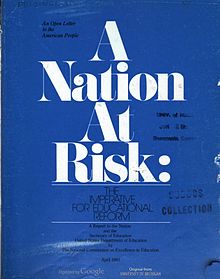
Nancy Bailey criticizes the ongoing campaign to raise academic expectations and academic pressure on children in kindergarten. She traces the origins of this misguided effort on the Reagan-era publication “A Nation at Risk” in 1983.

Although the gloomy claims of that influential document have been repeatedly challenged, even debunked*, it continues to control educational discourse with its assertion that American schools are failing. “A Nation at Risk” led to increased testing, to the passage of George W. Bush’s No Child Left Behind in 2002, to the creation of Barack Obama’s Race to the Top in 2009, to the release of the Common Core standards in 2010.

Despite nearly a quarter century of focus on standards and testing, policymakers refuse to admit that these policies have failed.

And nowhere have they been more destructive than in the early grades, where testing has replaced play. Kindergarten became the new first grade.

But says Bailey, the current Secretary of Education wants to ratchet up the pressure on little kids.

She writes:

In What Happened to Recess and Why are our Children Struggling in Kindergarten, Susan Ohanian writes about a kindergartner in a New York Times article who tells the reporter they would like to sit on the grass and look for ladybugs. Ohanian writes, the child’s school was built very deliberately without a playgroundLollygagging over ladybugs is not permitted for children being trained for the global economy (2002, p.2).   

America recently marked forty years since the Reagan administration’s A Nation at Risk: The Imperative for Educational Reform which blamed schools as being eroded by a rising tide of mediocrity that threatens our very future as a Nation and a people.

Berliner and Biddle dispute this in The Manufactured Crisis: Myths, Fraud, and the Attack on America’s Public Schools. They state that most of these claims were said to reflect “evidence,” although the “evidence” in question either was not presented or appeared in the form of simplistic, misleading generalizations (1995, p. 3)

Still, the report’s premise, that public schools failed, leading us down the workforce path of doom, continues to be perpetuated. When students fail tests, teachers and public schools are blamed, yet few care to examine the obscene expectations placed on the backs of children since A Nation at Risk.

Education Secretary Cardona recently went on a bus tour with the message to Raise the Bar in schools. Raising the bar is defined as setting a high standard, to raise expectations, to set higher goals.

He announced a new U.S. Department of Education program, Kindergarten Sturdy Bridge Learning Community.

This is through New America, whose funders include the Bill and Melinda Gates Foundation, the Waltons, and others who want to privatize public education. Here’s the video, Kindergarten as a “Sturdy Bridge”: Place-Based Investments, describing the plan focusing on PreK to 3rd grade. This involves Reading by 3rd and the Campaign for Grade Level Reading.

Cardona says in the announcement:

Getting kindergarten right has to be top of mind for all of us, because what happens there sets the stage for how a child learns and develops well into their elementary years and beyond. 

Ensuring that kindergarten is a sturdy bridge between the early years and early grades is central to our efforts both to Raise the Bar for academic excellence and to provide all students with a more equitable foundation for educational success. The kindergarten year presents an opportunity to meet the strengths and needs of young learners so they can continue to flourish in the years to come.

Raise the bar? Kindergarten is already the new first grade. What will it be now? Second? Third? Fourth? What’s the rush? How is this developmentally sound? One thing is for sure: there will still be no idle time for children to search for ladybugs.

Few bear the brunt of A Nation at Risk,as do early learners whose schools have been invaded by corporate schemes to force reading and advanced learning earlier than ever expected in the past.

If kindergartners aren’t doing well after all these years of toughness, higher expectations, and an excruciating number of assessments, wouldn’t it seem time to back off, instead of raising the bar higher?

Editor’s note:

*James Harvey and I will discuss the distortions contained in the “Nation at Risk” report at the Network for Public Education conference on Oct. 28-29 in Washington, D.C. James Harvey was a high-level member of the staff that wrote the report. He has written about how the Reagan-era Commissuon in Excellence in Education “cooked the books” to paint a bleak—but false—picture of American public schools. Please register and join us!

One of our readers, Rick Charvet, reacted to Nancy Flanagan’s review of Alexandra Robbins’ new book THE TEACHERS. Robbins wrote about three teachers after spending a year in their classrooms. It is a deeply sympathetic description of their lives as teachers.

Rick Charvet commented:

I have lived the three tales and more. I worked nights. I worked Saturdays. When I speak “from the trenches” it sounds like I “make crap up.” I did everything to survive on a teacher’s salary (and our district was the lowest paid in the county) and there wasn’t a day that went by I said, “I gotta quit.” But then I saw the little kid who had no socks; the little kid who didn’t have his hair combed for picture day; the other young man who fell asleep on my backroom floor so exhausted and more kids who had nothing to eat so just like The Lorax, “Who will help them?” And, of course, no one sees this. These are the things that go on when no one is watching. I loathed staff meetings to hear the “whine sessions.” This helped no one. I always thought about the lady who kept wiping away spider webs and could not figure out how to stop them: you need to get rid of the spider! As a creative, I learned quickly that I needed to get to the root of the issues. So many students with so many problems. The school psychologist told me, “You really found your niche helping the most needy.” So any time there was a troubled child, “Send ’em to Charvet, he will help them.” As in Ms. Flannagan’s review, I stayed away from the staff lunch room — such negative vibes; I preferred making a safe space for my kids. It was taxing, but in the end, it was about helping them to a brighter place. Times were dark. Kids did not see much beyond 18. And as Flanagan pointed out, “…If I hear one more time how Mr. Charvet did this or that…I even posted in the staff bulletin, “If anyone needs to send their student to me, I am willing to accept them into my room for a time out. Sometimes students just need a change of scenery because “it’s not happening for them today.” Oh how I heard, “Charvet won’t punish them. It wasn’t that they got away with stuff, it was about making amends and moving forward. Each day could be refreshed. And when I mentioned, “We are the eyes and ears for our kids. We teach to the whole child.” Basically, “Shut up, Charvet.” Charvet this and that…but the kids knew who LISTENED. And you know what? Those kids are fine today. But what did I know? It got to a point that because of my efforts to get the best out of students I was disciplined; written up “Created a negative environment…needs remediation…assigned to a peer review mentor to learn how to instruct…cannot adhere to curriculum…cannot manage a five-point lesson plan.” The peer mentor finally looked at me, “What the hell is going on here; you don’t need me.” I said, “I just want admin to let me be.” The kids needed a support system; school for me was not punitive, but making sure kids understood the consequences of their actions good or bad. And, I was even told that students who were not on grade level could never earn more than a C even it they were maxing out their cognitive capabilities. Wow, what joy! “Hey kid no matter how hard you work, you will never, ever earn an A.” Yeah motivates me. I never said I was great, I just followed my heart. But, here’s something for you all. https://gilroylife.com/2020/01/31/brownell-students-draw-on-creativity-to-solve-problems-initiate-change/ AND https://gilroylife.com/2019/06/07/education-project-h-o-p-e-helps-motivate-and-inspire-struggling-students/ Don’t get me wrong, there was joy and we laughed a lot — I mean I constantly told them, “If you can’t laugh, laugh at me because guaranteed I will do something stupid. Hey, but that’s how life is, eh? We shared life and I learned tremendously from my students.

Do open the articles to which he links.

Rob Rogers created an excellent TikTok video that shows where Chris Rufo fits into the war on public schools. Rufo invented the “critical race theory” hysteria out of whole cloth. He’s proud of his malicious role in “laying siege to the institutions.” Of course, Ron DeSantis appointed him to the board of New College as part of a rightwing takeover of that once highly esteemed liberal arts college that welcomed free-thinkers. To people like DeSantis and Rufo, free thinking is anathema.

To get the full Rufo treatment, watch his speech at Hillsdale College from April 2022.

I try to imagine a world in which everyone thought as Rufo wants them to: ban the artists, the creatives, the innovators, the dissenters, the dreamers, the people who think differently. I don’t want to live in that world. It feels like North Korea.

Bethany Erickson wrote in D Magazine about the revolution in Dallas. The superintendent, Stephanie Elidzalde, declared that test prep is dead. She is determined to make school joyful. Imagine that! I have been waiting a long time for a superintendent with the brains and guts to do what she’s doing. The teacher shortage in Dallas has shrunk dramatically. Not surprising. What wonderful news.

Erickson writes:

School started at Dallas ISD today, and parents of students attending school at any of the 230 campuses may notice something different this year.

During her state of the district address last May, superintendent Stephanie Elizalde said the district would soon eschew the numerous tests designed to find out whether students were ready for the STAAR in favor of, as she put it, more “joy” in the classroom.

In last year’s address, she declared teaching to the test was “officially dead,” and added that some schools were testing as frequently as every few weeks in preparation for the STAAR test, and doing classwork in between those assessments that also practiced STAAR strategy.

“How about we put them all together and we have a huge bonfire?” she said.

That doesn’t mean that there won’t be occasional checks to make sure a student is understanding concepts learned in the classroom. But it does mean that Elizalde recognizes something many parents have been saying for years—the frequent testing only amps up anxiety about the test.

“Do kids need to know what the tests look like? Yes,” Elizalde said in May. “But do we need to be doing that once every six weeks, once every nine weeks? No we don’t. … Because we worry so much about the test, we have added pressure in a way that actually is hindering the success of how students do.”

And while there wasn’t an actual bonfire, Elizalde reiterated that stance last week in a note to students and parents.

 “As I said in my State of the District speech, test scores will take care of themselves if joy – and on-grade-level materials – are in the classroom,” she said. “We do not need to drill and kill to prepare for the state assessment.”

Elizalde said the amount of testing and preparation for testing had “gotten completely out of control.” The district tallied up all the time teachers were spending preparing for tests and testing, which equated to roughly 18 school days. 

The district is providing a full curriculum to teachers with lesson plans that will allow them more time to teach, Elizalde says. The aim at uniformity will also help a district where students often switch schools during the school year.

During her state of the district address, Elizalde said the goal was to provide a consistent framework, not to have teachers reciting lessons by rote.

ADVERTISEMENT

null

Anecdotally it appears that mileage varies on teacher experiences with the lesson plans. Some teachers have said they didn’t have all the materials their lesson plans required. But others said they felt they had a great deal of freedom to teach beyond the lesson plan, so long as they met their specific goals and taught the required skills. 

The other lynchpin in Elizalde’s joy ride is making sure every student has a teacher in their classroom on the first day of school. Earlier this month, she told teachers at the Dallas ISD’s New Teacher Academy held at the Winspear Opera House that the district had fewer than 140 open positions out of its 10,000 total teaching jobs. (Last year, that number was 220.)

She also reiterated to those new hires that they would not be teaching to the test. “This whole movement is going to allow teachers to truly feel both the science and the art that is teaching,” she said.

It will be interesting to see which provides the district with a path to success. As a parent of a student, I’m rooting for the joy plan, especially if we can also figure out a way to pay teachers what they’re worth, and the state legislature can come out of the next special session robustly funding public education.