Archives for category: Creativity

Robert Hubbell is one of my favorite bloggers. I could not resist reposting his Thanksgiving commentary. It’s so beautiful!

He wrote:

We are living through challenging times. It isn’t easy to feel gratitude in the midst of trying circumstances. The answer to regaining a sense of gratitude is to expand our perspective—which allows us to look beyond today’s troubles to the greater blessings that will endure for generations to come.

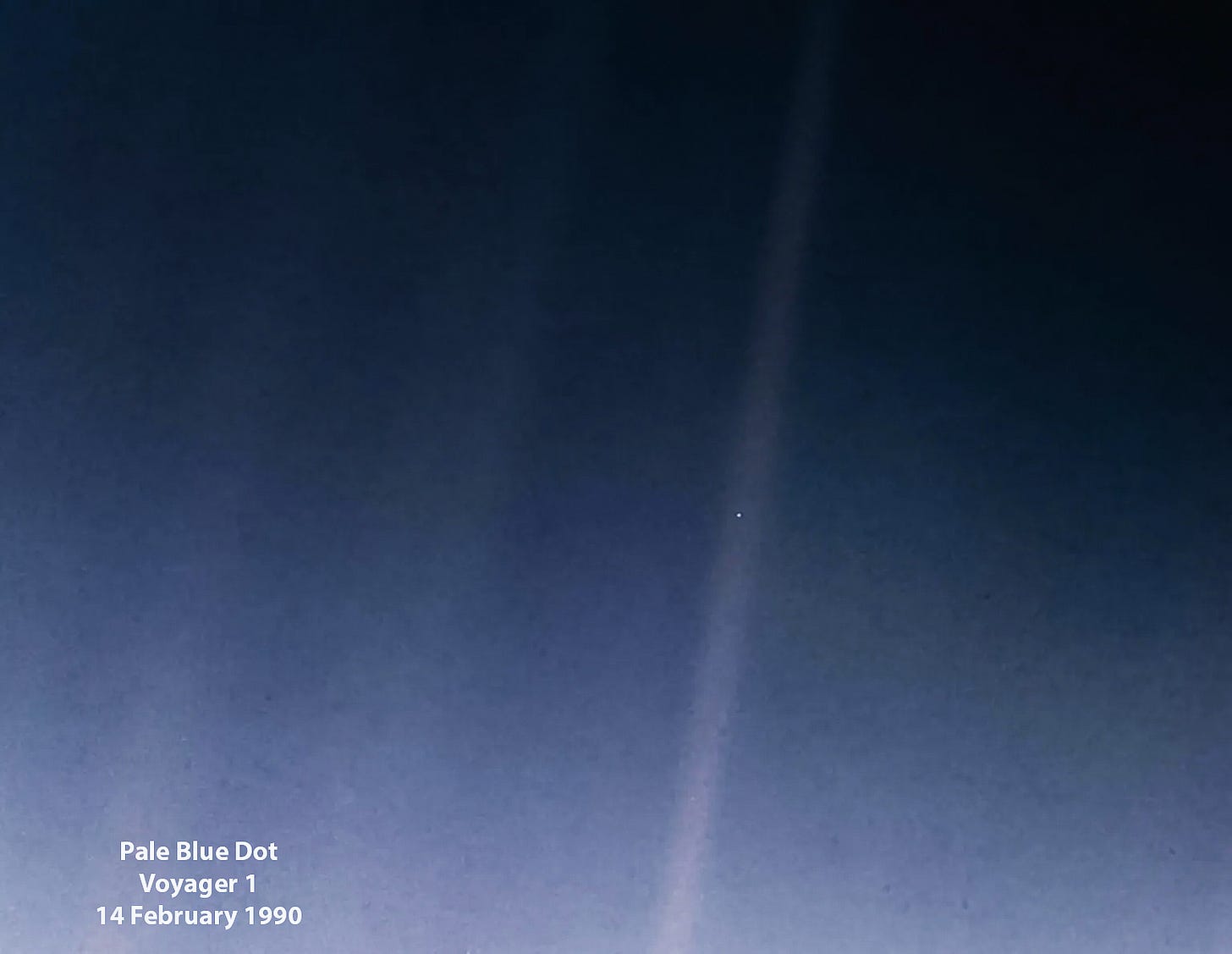
To help regain perspective, I suggest reading an excerpt from Carl Sagan’s book Pale Blue Dot, which references our home planet. The Planetary Society website explains the background for Sagan’s reflection and quotes the most famous passage from his book. It is a fitting reflection for Thanksgiving.

Many readers have used Sagan’s Pale Blue Dot as their reflection for Thanksgiving dinner.

First, this introduction from The Planetary Society: 

The following excerpt from Carl Sagan’s book Pale Blue Dot was inspired by an image taken, at Sagan’s suggestion, by Voyager 1 on 14 February 1990. As the spacecraft was departing our planetary neighborhood for the fringes of the solar system, it turned around for one last look at its home planet.

Voyager 1 was about 6.4 billion kilometers (4 billion miles) away, and approximately 32 degrees above the ecliptic plane, when it captured this portrait of our world. Caught in the center of scattered light rays (a result of taking the picture so close to the Sun), Earth appears as a tiny point of light, a crescent only 0.12 pixel in size.

Here is Carl Sagan’s reflection on the photo and our place in the cosmos:

Look again at that dot. That’s here. That’s home. That’s us. On it everyone you love, everyone you know, everyone you ever heard of, every human being who ever was, lived out their lives. The aggregate of our joy and suffering, thousands of confident religions, ideologies, and economic doctrines, every hunter and forager, every hero and coward, every creator and destroyer of civilization, every king and peasant, every young couple in love, every mother and father, hopeful child, inventor and explorer, every teacher of morals, every corrupt politician, every “superstar,” every “supreme leader,” every saint and sinner in the history of our species lived there–on a mote of dust suspended in a sunbeam.

The Earth is a very small stage in a vast cosmic arena. Think of the rivers of blood spilled by all those generals and emperors so that, in glory and triumph, they could become the momentary masters of a fraction of a dot. Think of the endless cruelties visited by the inhabitants of one corner of this pixel on the scarcely distinguishable inhabitants of some other corner, how frequent their misunderstandings, how eager they are to kill one another, how fervent their hatreds.

Our posturings, our imagined self-importance, the delusion that we have some privileged position in the Universe, are challenged by this point of pale light. Our planet is a lonely speck in the great enveloping cosmic dark. In our obscurity, in all this vastness, there is no hint that help will come from elsewhere to save us from ourselves.

The Earth is the only world known so far to harbor life. There is nowhere else, at least in the near future, to which our species could migrate. Visit, yes. Settle, not yet. Like it or not, for the moment the Earth is where we make our stand.

It has been said that astronomy is a humbling and character-building experience. There is perhaps no better demonstration of the folly of human conceits than this distant image of our tiny world. To me, it underscores our responsibility to deal more kindly with one another, and to preserve and cherish the pale blue dot, the only home we’ve ever known.

Carl Sagan, Pale Blue Dot, Copyright © 2006 by Democritus Properties, LLC.

John Thompson of Oklahoma writes about a Zoom he attended for people over 60, called “Elders for Kamala.” What a great idea to harness the power of Zoom to reach thousands, tens of thousands of people, and bring them together in conversationfor a common purpose. I joined a Women for Kamala. There was also White Dudes for Kamala, and many more. The purpose now is to change the direction of the country from the personal vendettas of Trump to Kamala’s capacious vision for the future.

He writes:

An incredible burst of energy has grown out of zoom calls for Kamala Harris by Black women, then Black men; White women and men; Black queer men, South Asian women, Latinas, Native women; and, now, the Third Act’s “Elders for Kamala.” I was blown away by the Third Act’s zoom call which spoke to around 11,000 and harnessed “our long years of wisdom and courage to back Kamala Harris as she tries to protect our democracy.”

The Third Act is a “community of Americans over 60 determined to change the world for the better.” It “harnesses an unparalleled generational power to safeguard our climate and democracy.”

The call began with Jane Fonda, who was particularly eloquent in calling for an end to tax breaks for oil and gas industries. She was followed by Sen. Bernie Sanders who praised World War II veterans and those who suffered through the Great Depression, and who laid the foundation for post-WWII generations. Similarly, Black co-moderator Akaya Windwood thanked her mother for her dream as she put her Akaya on the bus to the Sit-Ins, and helped pave the way for the dream of a Black President.

Co-moderator Bill McKibben praised today’s “mild chaos of the best kind,” and shifted his focus to kids who will be alive in the 22th Century.  Robin Wall Kimmerer advanced the conversation about how such change occurs. It requires today’s elders to be “good Ancestors;” she then brought the house down by proposing the meme, “Pollinators for Kamala.”

Judith LeBanc, Executive Director of the Native Organizers Alliance, and a citizen of the Caddo Nation, articulated a message which I believe is especially important for young people. She said, “Representation is not destination,” but it lays a crucial foundation for empowering “our ancestors” in behalf of “our descendents.”  She cited the progress made by Interior Department Secretary Deb Van Holland as evidence that, “Politics doesn’t end on election day; it begins on election day.”

Gus Speth, who served in the Carter Administration, as well as co-founding the National Resources Defense Council, and who was jailed for protesting the Keystone pipeline, gave more specific advice. He said that the positions he took in political and legal battles were less important than the position he took in a D.C. jail for civil disobedience. Reverend Lennox Yearwood, who was arrested for protesting the pipeline while campaigning for Barrack Obama, also explained how he found a balance between working outside and inside the political system.

Former Senator John Kerry, who had been a spokesperson for the Vietnam Veterans Against the War, stressed another way to find such a balance. Sen. Kerry explained how and why climate change is our greatest security threat. It will produce 10s of millions of climate refugees, further undermining stability in a dangerous world. Sen. Kerry then praised Jane Fonda for her leadership in the 1969 Earthday. Then, Kerry recalled how his team targeted and defeated 7 of the “Dirty Dozen,” who were the worst climate deniers in Congress. That helped lead the way to the foundation of the Environmental Protection Agency.

Similarly, historian and activist Rebecca Solnit explained that corporate powers sought to “privatize our imagination.” She then pointed out Sam Brown’s experience in organizing the nation’s biggest anti-Vietnam War rally, and how Brown said “we don’t want to elect Putin’s best friend.”  Author and co-founder of the Chief Relationship Officer of Bioneers, Nina Simons, explained that we need Kamala to win big so we will have more power to “really win for the earth.” 

And Terry Tempest Williams called in from a house in Utah where the heat wave produced temperatures as high as 100 degrees in-doors. She personally witnesses so many tragic climate disasters, but she also set the stage for hopeful advice. She began by introducing the audience to her cats, and then calling the crowd to “put our love into action” for Kamala Harris. We should see ourselves as “Elders in training,” who “listen and support our young people.”

Of course, this is just a brief account of the Third Act’s elders’ advice. I haven’t even gotten to all the former legislators, activists, and authors who shared their wisdom on zoom. My personal focus is on cross-cultural and cross-generational conversations, so I was thrilled to experience the eloquence with which they discussed the stages of history that produce change. I loved the way they grounded those processes in the best of humanity. Even though participants were blunt about the existential threats we face, they offered hope. 

For instance, the author Catherine Grundy said that humans “have the ability to evolve on a daily basis,” and “impossible is just a word.” Former Senator Tim Wirth addressed the nuances of operating in the political system, but also said, “the nicest thing about the last two weeks is …. So many people had a great smile on their face.”

While our immediate focus must be on the next three months, their call for shortterm and longterm grassroots actions after election day were extremely valuable. Between election day and the inauguration, we can celebrate but, mostly we must beat back Trump’s likely efforts to steal the election. Then we must commit to decades of work. “Elders for Kamala” is thus an inspiring, as well as pragmatic, call for unity and building on our better selves to save both our democracy and planet.   

On Monday, we started watching the Kamala & Tim rally in Philadelphia an hour early. We couldn’t wait! The arena at Temple University was packed, and the crowd was excited. We shared their excitement, watching at home.

Josh Shapiro was terrific, dynamic, and passionate in introducing the candidates. I thought, “This guy has a great future ahead of him. He might be President in eight years.” But I was glad Kamala didn’t choose him to run with her, because the ticket will be bombarded with racism and misogyny; it doesn’t need the additional handicap of anti-Semitism. Also, I was turned off by his support for vouchers; Republicans do that, not Democrats.

What was enthralling about the Philly event and the rally in Eau Claire, Wisconsin, was the euphoria. The large crowds cheered and applauded with ebullience.

They chanted “We won’t go back!”

When JD Vance’s name was mentioned, they chanted “He’s a weirdo!”

When Trump’s name was mentioned, the crowd chanted, “Lock him up!”

In Eau Claire, Kamala thanked President Biden for his fifty years of service, and the crowd chanted, “Thank you, Joe!“

The crowds cheered every reference to restoring the right of women to control their bodies. They cheered their support for gay rights. They cheered the importance of clean air and clean water. They cheered her pledge to pass gun control legislation. They cheered her promise to sign voting rights legislation. They cheered the candidates’ pledge to champion unions and to build the middle class. Kamala said, “When the middle class is strong, America is strong,” and the crowd cheered louder.

Ebullience! Enthusiasm! Energy!

Something transformative is happening in the race and to the Democratic Party. People are ready to work for this ticket, ready to turn the country in a direction that serves the people, not big corporations.

A political party that was divided and fearful has been transformed in only weeks into a mass of people willing to march, cheer, sign up new voters, dig deep, and turn this country towards the future.

Two things stand out.

First, MAGA is a backward-looking movement, longing for the days of white Christian male supremacy, when men ran the world, and women had babies and stayed in the kitchen. Kamala says: “We are not going back!” and she paints a picture of building a nation with a better future for everyone.

Second, there is a striking difference in tone between the two parties. The Republican candidates are angry, humorless, bitter, and vengeful; their candidates scowl. The Democrats are happy, joyous, and excited; their candidates laugh and are enjoying the experience.

One party is fading, the other is energized.

Hope is in the air.

The Atlantic contains a lovely article by contributing writer Stephanie H. Murray about a growing movement to close streets to cars so that children can play without adult direction.

She begins:

In the summer of 2009, Amy Rose and Alice Ferguson, two mothers living on Greville Road in Bristol, a midsize city in southwest England, found themselves in a strange predicament: They saw entirely too much of their kids. “We were going, like, Why are they here?” Rose told me. “Why aren’t they outside?” The friends decided to run an experiment. They applied to shut their quarter-mile road to traffic for two hours after school on a June afternoon—not for a party or an event but just to let the children who lived there play. Intentionally, they didn’t prepare games or activities, Rose told me, as it would have defeated the purpose of the inquiry: “With time, space, and permission, what happens?”

The results were breathtaking. The dozens of kids who showed up had no problem finding things to do. One little girl cycled up and down the street “3,000 times,” Rose recalled. “She was totally blissed out.” Suddenly, the modern approach to children’s play, in which parents shuttle their kids to playgrounds or other structured activities, seemed both needlessly extravagant and wholly insufficient. Kids didn’t need special equipment or lessons; they just needed to be less reliant on their time-strapped parents to get outside.

The experiment also produced some unexpected results. As children poured into the street, some ran into classmates, only just then realizing that they were neighbors. Soon it became clear to everyone present that far more children were living on Greville Road than anyone had known. That session, and the many more it prompted, also became the means by which adult residents got to know one another, which led to another revelation for Ferguson and Rose: In numerous ways, a world built for cars has made life so much harder for adults.

The dominance of cars has turned children’s play into work for parents, who are left coordinating and supervising their children’s time and ferrying kids to playgrounds and play dates. But it has also deprived adults of something more profound. Over the years, as Rose and Ferguson have expanded their experiment to other parts of the United Kingdom, neighborhoods across the country have discovered that allowing kids to play out in the open has helped residents reclaim something they didn’t know they were missing: the ability to connect with the people living closest to them.

Modern folks tend to think that streets serve largely mobile purposes—getting cars from one place to another in swift, orderly fashion. But “prior to the automobile, streets had a ton of stationary functions,” Marcel Moran, a faculty fellow at New York University’s Center for Urban Science and Progress, told me. Streets were where people sold wares and socialized. And particularly after the United States and Europe began to industrialize, streets were the primary location for the rising number of urban-dwelling children to play, according to Jon Winder, a historian and the author of Designed for Play: Children’s Playgrounds and the Politics of Urban Space, 1840–2010. This remained the case in the U.K. and the U.S. even after playgrounds became widespread in the early 20th century. Only when cars hit the streets in larger numbers did things begin to change. Society, Winder told me, began prioritizing “the movement and storage of motor vehicles over children and their playful behavior…”

Rose and Ferguson’s project on Greville Road is of course not the first or only effort to reclaim the streets for children. In the U.K., play streets emerged roughly a century ago as a sort of compromise in the process of booting kids off the street. But after peaking in the 1960s, they largely dwindled out, to be revived only in the late 2000s. New York has had a play-streets program since 1914, and Philadelphia for more than half a century—and recently, the idea has been taken up in other U.S. cities. Chicago launched a play-streets program in 2012, followed by Los Angeles in 2015; an initiative in Portland, Oregon, hosted its first events in 2023.

In the U.K., Rose, Ferguson, and their friend Ingrid Skeels expanded their experiment in 2011 by founding Playing Out, an organization that has helped residents on more than 1,000 streets in dozens of cities across the country set up their own play sessions. These typically last for two hours and occur weekly, biweekly, or monthly.

Open the link to read the rest of the article. It’s an inspiring idea that is great for children and parents alike. Plus, it introduces neighbors to each other.

Governor Ron DeSantis vetoed all arts funding for ALL Florida because of two performing groups that he considers “sexualized.” Six hundred groups lost $32 million in state funding, in some cases jeopardizing their survival.

The two groups that offended the prudish DeSantis offered to give up state funding so DeSantis could restore funding to the others.

Leaders of two performing arts festivals said Thursday that they would gladly give up their grants if Florida Gov. Ron DeSantis restores the $32 million in state funding he nixed for more than 600 Florida arts groups, explaining the reason for his veto as being because the two theatrical events were “a sexual festival.” 

Leaders of The Orlando Fringe and Tampa Fringe described the governor’s description as inaccurate on Thursday at a news conference, but they said it was important for the state’s arts groups to be funded because they play critical roles in their communities. The Orlando festival had been slated to get $70,500, and the Tampa festival was in line to receive $7,500 before the veto.

I recently visited the Metropolitan Museum of Art, one of the world’s finest museums, to see a memorable exhibition. It’s called “The Harlem Renaissance and Transatlantic Modernism.”

It is a spectacular collection of works by and about African-American artists. The art is drawn from museums around the country. You may never see these artworks in one space again.

The quality of the art is breath-taking. I know that many of you don’t live in or near New York City, but this is a good reason to plan a trip. The show runs through the end of July.

Here are a few of the photos I took with my cell phone. I wish I had taken more. Some of the pictures are off-center because the crowds were large, and I didn’t have a clear path.

Painted by William H. Johnson (1901-1970), “Mom and Dad, 1944.” This folk-art painting of the artist’s mother and a portrait of his late father was borrowed from the Smithsonian American Art Museum.

Painted by Allan Rohan Crite (1910-2007). It is titled “School’s Out” and was painted in 1936. It depicts children emerging from Everett Elementary School in Boston. It was lent to the exhibition by the Smithsonian American Art Museum.

Painted by Aaron Douglas (1879-1979). Titled “Building More Stately Mansions, 1944.” It is owned by the Fisk University Galleries in Nashville. According to the artist, “his objective was to spotlight the contributions of exploited Black labor to great civilizations worldwide. He thus resituated African American history in a global context, in which the sphinx of Egypt appears together with the spire of a Western cathedral, the tiers of an Asian Buddhist pagoda, and a building crane extending over American skyscrapers, emblems of modernity meant to connote growth.”

Painted by Winold Reiss (1886-1953), who emigrated from Germany to America. It is a painting of Fred Fripp, a graduate of the Penn School and a teacher, with his daughters Carol and Evelyn. The painting is owned by the Fisk University Galleries in Nashville.

The caption of the portrait says:

“The sitter looks away in introspection while his young daughters gaze outward, settled into the security of their father’s steadying embrace.

“Reiss met Fred Fripp when he traveled to South Carolina to portray the Gullah-speaking Black residents of St. Helena Island, whose ancestors were among the last enslaved West African people forcibly brought to the United States. The luminous triple portrait, its triangular composition and gold leaf background reminiscent of Renaissance madonnas, celebrates Fripp as a teacher, scholar, and parent.”

As I viewed this magnificent exhibit, I kept wondering about the African-American artists. In their wildest dreams, did they ever imagine that their paintings and sculptures would one day be shown in the nation’s premiere museum?

The exhibition is a large and rich portrayal of the artists and intellectuals of the Harlem Renaissance. If you can’t get to New York by July 28, the last day, you might consider buying the catalogue from the Met.

At last, a state superintendent who is a passionate advocate for public schools! Chris Reykdal is running for re-election, and he richly deserves it.

Chris is a graduate of public schools and wants every child in Washington to have the opportunities he had.

He has been an amazingly effective leader and advocate for the state’s public schools. While other states are squandering money on choice, which subsidizes religious schools and wealthy parents’ tuition payments, Washington has focused on improving its public schools, whose doors are open to all. You can read about the progress made in recent years in the endorsement of Chris by NPE Action.

I am happy to add my personal endorsement of Chris Reykdal. It’s thrilling to know that he is working every day to improve the public schools, which enroll 90% of the state’s children.

Chris is a leader with knowledge, experience, wisdom, and vision. Washington’s students and teachers need him.

NPE Action is proud to endorse Chris Reykdal for Washington Superintendent of Public Instruction. Chris began his professional career as a public school teacher. He served on a local school board, spent fourteen years as an executive in Washington’s public community and technical college system, served six years in the Legislature, and for the last seven years as Washington State School Superintendent. Chris has experienced education in Washington from nearly every perspective. Chris strongly believes that public education is the great equalizer. He will not yield to those who attack Washington’s  public schools for their personal gain.

In the six years that Chris has been the Washington Superintendent for Public Instruction, the state has seen several major achievements. Graduation rates are at an all-time high and the state college remediation rates are at an all-time low. Chris has fought hard to make sure more children have free school meals and as a result free school meals are given to over 300,000 additional students. During his tenure, Washington has increased funding to support students with disabilities and Washington has the highest number of students with disabilities learning in general education classrooms.

Chris has goals for the next four years that are centered around children and he will ensure that Washington public schools remain public. Chris believes that there is no greater fight in Washington’s public education system than to ensure schools are publicly funded, publicly operated, and publicly accountable. Chris will lead the state to maintain focus in all policy and budget matters to focus on closing opportunity gaps. 

Chris Reykdal is the benefactor of a state and a community that was committed to giving him opportunity, and he wants that for every child in Washington state. NPE Action urges public education supporters in Washington to get out the vote for Chris Reykdal in the primary election on August 6th. 


Not authorized by any candidate or candidate committee. Authorized and paid for by Network for Public Education Action, PO Box 227. New York, NY 10156. 646-678-4477

The filmmaker and historian Ken Burns has produced some of the best documentaries ever shown on American television. He has brought history to life with gripping stories of people and momentous events. He is the master of the voice of ordinary people, many of whom are extraordinary.

He recently gave the Commencement speech at Brandeis University. It’s one of the best I have ever read or heard. Here is the link. Read it or listen to it. It’s magnificent.

A memorable paragraph about the current moment:

There is no real choice this November. There is only the perpetuation, however flawed and feeble you might perceive it, of our fragile 249-year-old experiment or the entropy that will engulf and destroy us if we take the other route. When, as Mercy Otis Warren would say, “The checks of conscience are thrown aside and a deformed picture of the soul is revealed.” The presumptive Republican nominee is the opioid of all opioids, an easy cure for what some believe is the solution to our myriad pains and problems. When in fact with him, you end up re-enslaved with an even bigger problem, a worse affliction and addiction, “a bigger delusion”, James Baldwin would say, the author and finisher of our national existence, our national suicide as Mr. Lincoln prophesies. Do not be seduced by easy equalization. There is nothing equal about this equation. We are at an existential crossroads in our political and civic lives. This is a choice that could not be clearer.

A high school student in Idaho peaceably performed a quiet but powerful protest against censorship at her graduation ceremonies. For her courage, her commitment to freedom to read, and her sheer chutzpah, I add the name of Annabelle Jenkins to the honor roll of this blog.

An Idaho high school graduate staged an unusual form of protest at her graduation when she offered a book to the school district’s superintendent, who had banned it months earlier.

Annabelle Jenkins was one of 44 graduates to have her name called during the Idaho Fine Arts Academy graduation ceremony on May 23.

After she shook hands with administrators on the stage, Jenkins paused in front of West Ada School District Superintendent Derek Bub and pulled out “The Handmaid’s Tale” from the sleeve of her graduation gown.

Bub stood firm with his arms crossed and declined the book, leaving Jenkins to drop it at his feet as she moved across the stage.

The graphic novel version, written by Margaret Atwood and Renee Nault, was one of 10 the school district banned from its libraries earlier in the academic year over its graphic imagery, deemed unsuitable for the student body.

I hope that Annabelle read the full text version of the book, in addition to the banned graphic novel.