On Monday, we started watching the Kamala & Tim rally in Philadelphia an hour early. We couldn’t wait! The arena at Temple University was packed, and the crowd was excited. We shared their excitement, watching at home.
Josh Shapiro was terrific, dynamic, and passionate in introducing the candidates. I thought, “This guy has a great future ahead of him. He might be President in eight years.” But I was glad Kamala didn’t choose him to run with her, because the ticket will be bombarded with racism and misogyny; it doesn’t need the additional handicap of anti-Semitism. Also, I was turned off by his support for vouchers; Republicans do that, not Democrats.
What was enthralling about the Philly event and the rally in Eau Claire, Wisconsin, was the euphoria. The large crowds cheered and applauded with ebullience.
They chanted “We won’t go back!”
When JD Vance’s name was mentioned, they chanted “He’s a weirdo!”
When Trump’s name was mentioned, the crowd chanted, “Lock him up!”
In Eau Claire, Kamala thanked President Biden for his fifty years of service, and the crowd chanted, “Thank you, Joe!“
The crowds cheered every reference to restoring the right of women to control their bodies. They cheered their support for gay rights. They cheered the importance of clean air and clean water. They cheered her pledge to pass gun control legislation. They cheered her promise to sign voting rights legislation. They cheered the candidates’ pledge to champion unions and to build the middle class. Kamala said, “When the middle class is strong, America is strong,” and the crowd cheered louder.
Ebullience! Enthusiasm! Energy!
Something transformative is happening in the race and to the Democratic Party. People are ready to work for this ticket, ready to turn the country in a direction that serves the people, not big corporations.
A political party that was divided and fearful has been transformed in only weeks into a mass of people willing to march, cheer, sign up new voters, dig deep, and turn this country towards the future.
Two things stand out.
First, MAGA is a backward-looking movement, longing for the days of white Christian male supremacy, when men ran the world, and women had babies and stayed in the kitchen. Kamala says: “We are not going back!” and she paints a picture of building a nation with a better future for everyone.
Second, there is a striking difference in tone between the two parties. The Republican candidates are angry, humorless, bitter, and vengeful; their candidates scowl. The Democrats are happy, joyous, and excited; their candidates laugh and are enjoying the experience.
In the summer of 2009, Amy Rose and Alice Ferguson, two mothers living on Greville Road in Bristol, a midsize city in southwest England, found themselves in a strange predicament: They saw entirely too much of their kids. “We were going, like, Why are they here?” Rose told me. “Why aren’t they outside?” The friends decided to run an experiment. They applied to shut their quarter-mile road to traffic for two hours after school on a June afternoon—not for a party or an event but just to let the children who lived there play. Intentionally, they didn’t prepare games or activities, Rose told me, as it would have defeated the purpose of the inquiry: “With time, space, and permission, what happens?”
The results were breathtaking. The dozens of kids who showed up had no problem finding things to do. One little girl cycled up and down the street “3,000 times,” Rose recalled. “She was totally blissed out.” Suddenly, the modern approach to children’s play, in which parents shuttle their kids to playgrounds or other structured activities, seemed both needlessly extravagant and wholly insufficient. Kids didn’t need special equipment or lessons; they just needed to be less reliant on their time-strapped parents to get outside.
The experiment also produced some unexpected results. As children poured into the street, some ran into classmates, only just then realizing that they were neighbors. Soon it became clear to everyone present that far more children were living on Greville Road than anyone had known. That session, and the many more it prompted, also became the means by which adult residents got to know one another, which led to another revelation for Ferguson and Rose: In numerous ways, a world built for cars has made life so much harder for adults.
The dominance of cars has turned children’s play into work for parents, who are left coordinating and supervising their children’s time and ferrying kids to playgrounds and play dates. But it has also deprived adults of something more profound. Over the years, as Rose and Ferguson have expanded their experiment to other parts of the United Kingdom, neighborhoods across the country have discovered that allowing kids to play out in the open has helped residents reclaim something they didn’t know they were missing: the ability to connect with the people living closest to them.
Modern folks tend to think that streets serve largely mobile purposes—getting cars from one place to another in swift, orderly fashion. But “prior to the automobile, streets had a ton of stationary functions,” Marcel Moran, a faculty fellow at New York University’s Center for Urban Science and Progress, told me. Streets were where people sold wares and socialized. And particularly after the United States and Europe began to industrialize, streets were the primary location for the rising number of urban-dwelling children to play, according to Jon Winder, a historian and the author of Designed for Play: Children’s Playgrounds and the Politics of Urban Space, 1840–2010. This remained the case in the U.K. and the U.S. even after playgrounds became widespread in the early 20th century. Only when cars hit the streets in larger numbers did things begin to change. Society, Winder told me, began prioritizing “the movement and storage of motor vehicles over children and their playful behavior…”
Rose and Ferguson’s project on Greville Road is of course not the first or only effort to reclaim the streets for children. In the U.K., play streets emerged roughly a century ago as a sort of compromise in the process of booting kids off the street. But after peaking in the 1960s, they largely dwindled out, to be revived only in the late 2000s. New York has had a play-streets program since 1914, and Philadelphia for more than half a century—and recently, the idea has been taken up in other U.S. cities. Chicago launched a play-streets program in 2012, followed by Los Angeles in 2015; an initiative in Portland, Oregon, hosted its first events in 2023.
In the U.K., Rose, Ferguson, and their friend Ingrid Skeels expanded their experiment in 2011 by founding Playing Out, an organization that has helped residents on more than 1,000 streets in dozens of cities across the country set up their own play sessions. These typically last for two hours and occur weekly, biweekly, or monthly.
Open the link to read the rest of the article. It’s an inspiring idea that is great for children and parents alike. Plus, it introduces neighbors to each other.
Governor Ron DeSantis vetoed all arts funding for ALL Florida because of two performing groups that he considers “sexualized.” Six hundred groups lost $32 million in state funding, in some cases jeopardizing their survival.
The two groups that offended the prudish DeSantis offered to give up state funding so DeSantis could restore funding to the others.
Leaders of two performing arts festivals said Thursday that they would gladly give up their grants if Florida Gov. Ron DeSantis restores the $32 million in state funding he nixed for more than 600 Florida arts groups, explaining the reason for his veto as being because the two theatrical events were “a sexual festival.”
Leaders of The Orlando Fringe and Tampa Fringe described the governor’s description as inaccurate on Thursday at a news conference, but they said it was important for the state’s arts groups to be funded because they play critical roles in their communities. The Orlando festival had been slated to get $70,500, and the Tampa festival was in line to receive $7,500 before the veto.
It is a spectacular collection of works by and about African-American artists. The art is drawn from museums around the country. You may never see these artworks in one space again.
The quality of the art is breath-taking. I know that many of you don’t live in or near New York City, but this is a good reason to plan a trip. The show runs through the end of July.
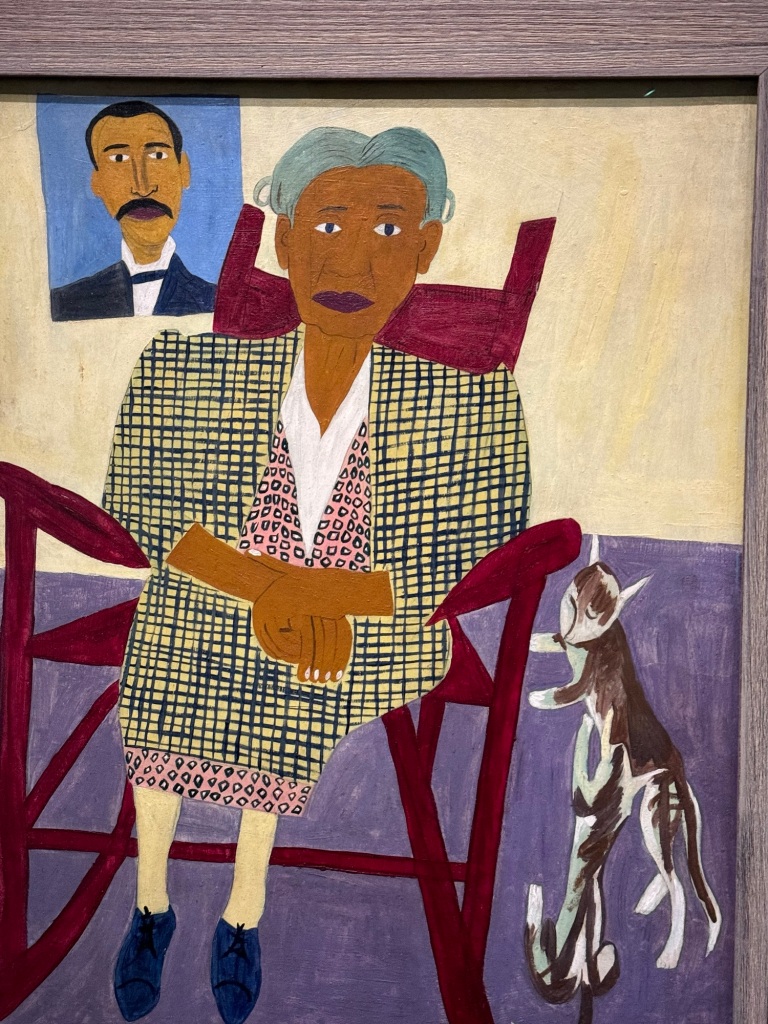
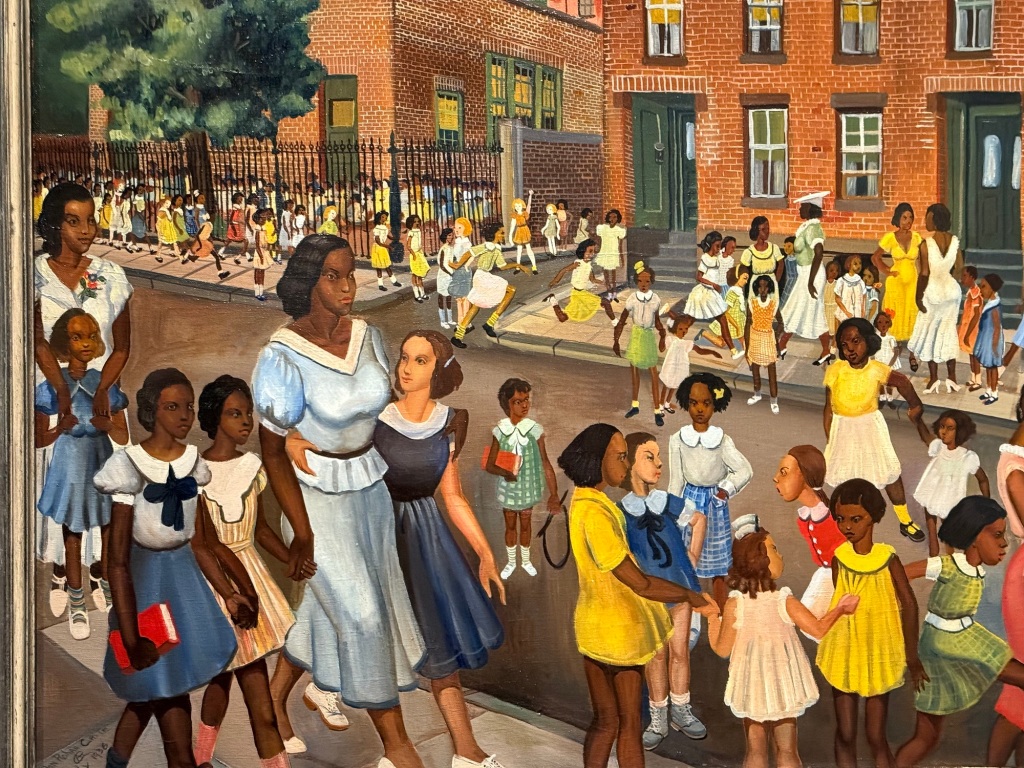
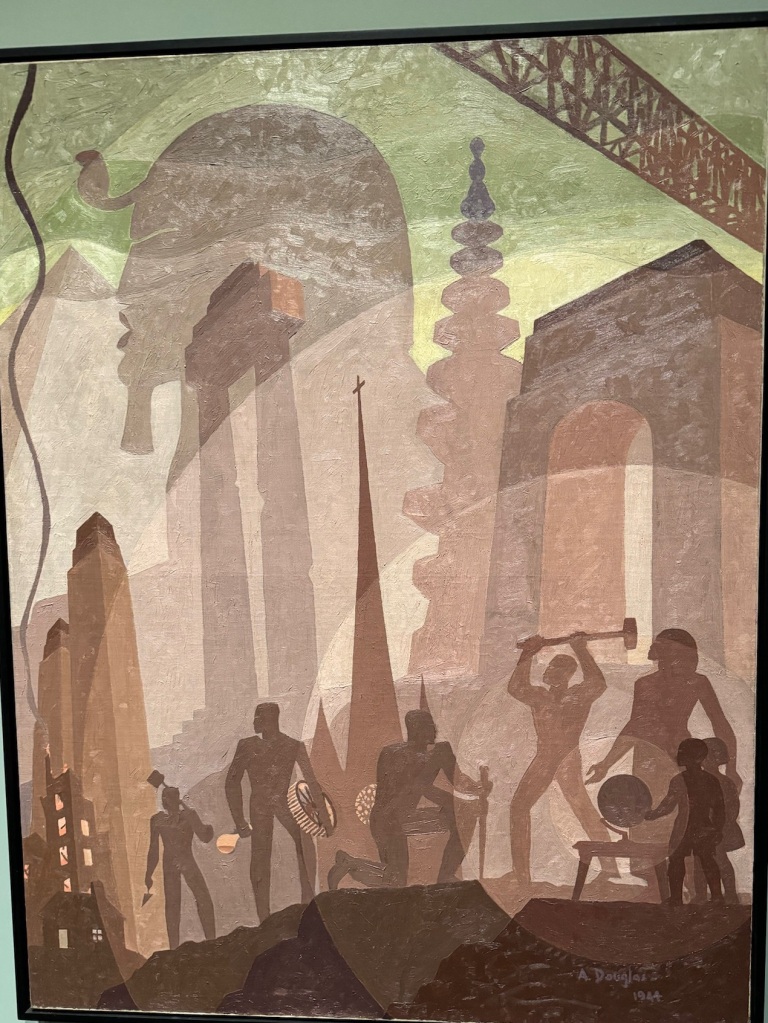
Here are a few of the photos I took with my cell phone. I wish I had taken more. Some of the pictures are off-center because the crowds were large, and I didn’t have a clear path.
Painted by William H. Johnson (1901-1970), “Mom and Dad, 1944.” This folk-art painting of the artist’s mother and a portrait of his late father was borrowed from the Smithsonian American Art Museum.
Painted by Allan Rohan Crite (1910-2007). It is titled “School’s Out” and was painted in 1936. It depicts children emerging from Everett Elementary School in Boston. It was lent to the exhibition by the Smithsonian American Art Museum.
Painted by Aaron Douglas (1879-1979). Titled “Building More Stately Mansions, 1944.” It is owned by the Fisk University Galleries in Nashville. According to the artist, “his objective was to spotlight the contributions of exploited Black labor to great civilizations worldwide. He thus resituated African American history in a global context, in which the sphinx of Egypt appears together with the spire of a Western cathedral, the tiers of an Asian Buddhist pagoda, and a building crane extending over American skyscrapers, emblems of modernity meant to connote growth.”
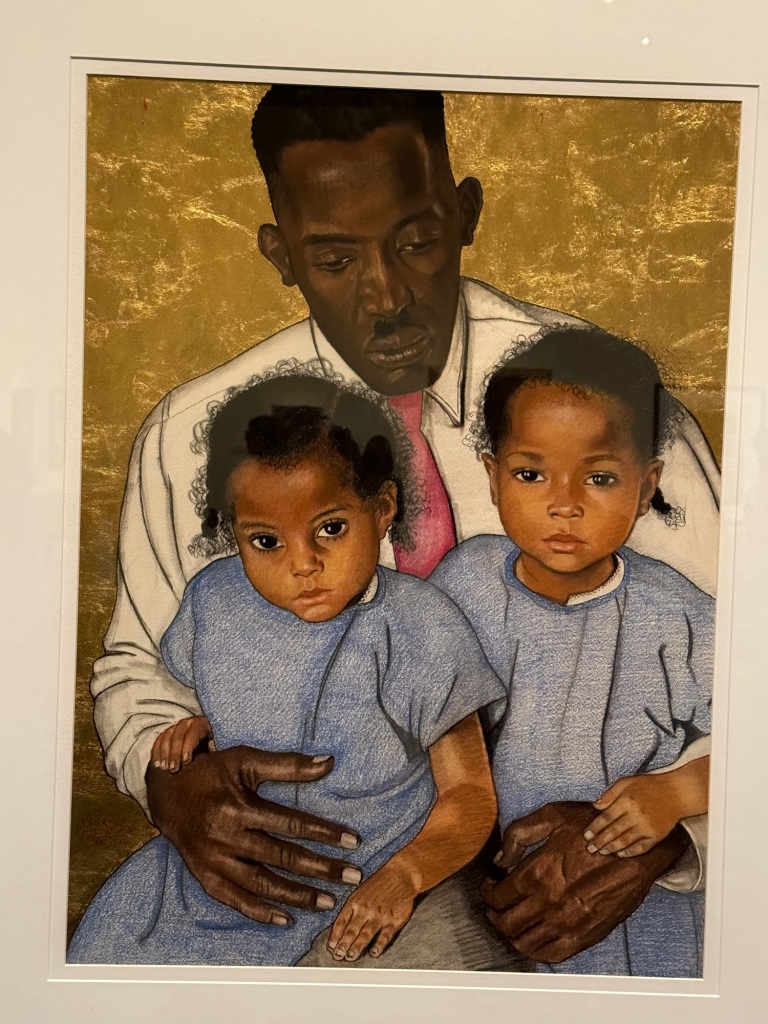
Painted by Winold Reiss (1886-1953), who emigrated from Germany to America. It is a painting of Fred Fripp, a graduate of the Penn School and a teacher, with his daughters Carol and Evelyn. The painting is owned by the Fisk University Galleries in Nashville.
The caption of the portrait says:
“The sitter looks away in introspection while his young daughters gaze outward, settled into the security of their father’s steadying embrace.
“Reiss met Fred Fripp when he traveled to South Carolina to portray the Gullah-speaking Black residents of St. Helena Island, whose ancestors were among the last enslaved West African people forcibly brought to the United States. The luminous triple portrait, its triangular composition and gold leaf background reminiscent of Renaissance madonnas, celebrates Fripp as a teacher, scholar, and parent.”
As I viewed this magnificent exhibit, I kept wondering about the African-American artists. In their wildest dreams, did they ever imagine that their paintings and sculptures would one day be shown in the nation’s premiere museum?
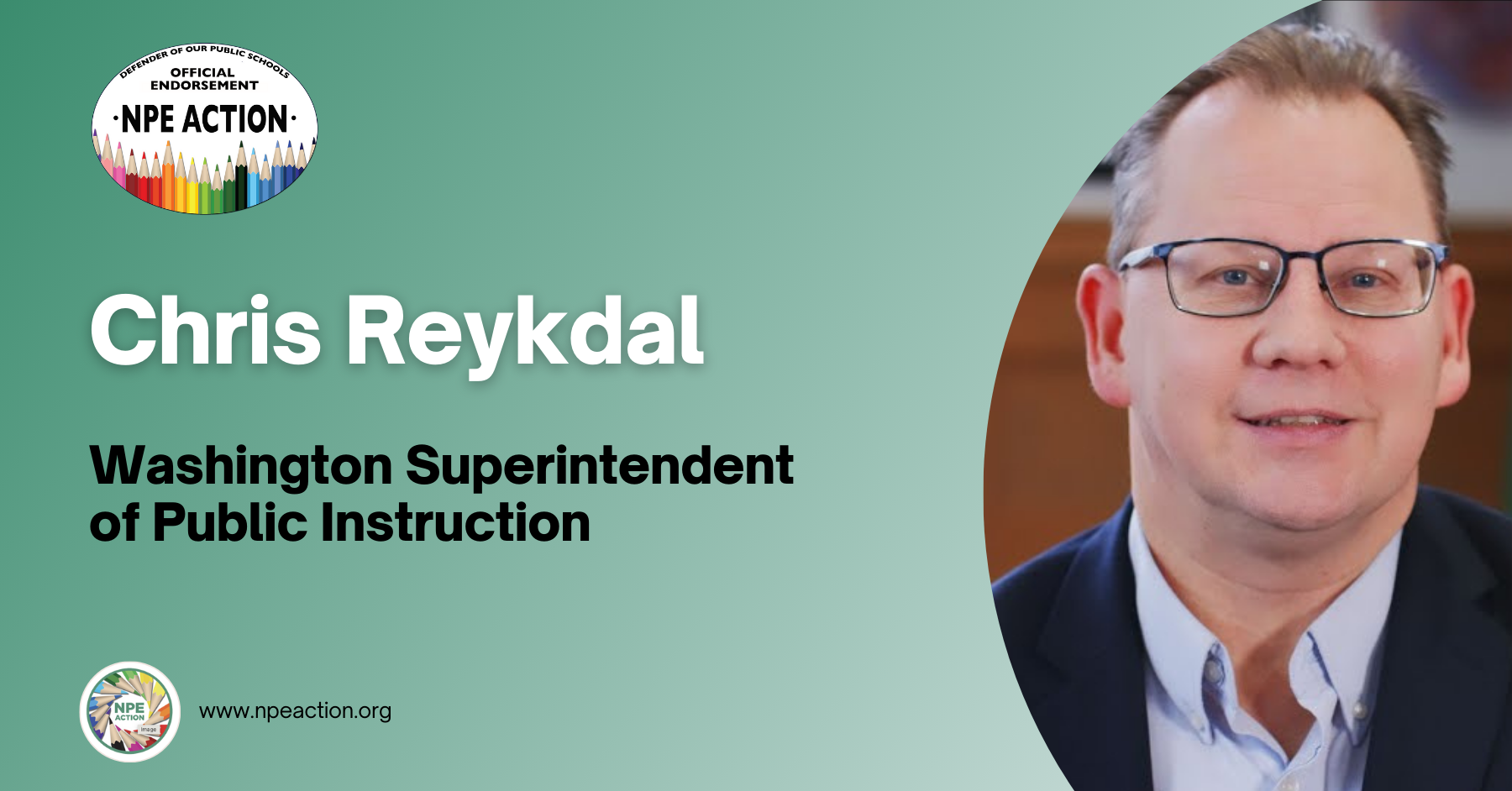
At last, a state superintendent who is a passionate advocate for public schools! Chris Reykdal is running for re-election, and he richly deserves it.
Chris is a graduate of public schools and wants every child in Washington to have the opportunities he had.
He has been an amazingly effective leader and advocate for the state’s public schools. While other states are squandering money on choice, which subsidizes religious schools and wealthy parents’ tuition payments, Washington has focused on improving its public schools, whose doors are open to all. You can read about the progress made in recent years in the endorsement of Chris by NPE Action.
I am happy to add my personal endorsement of Chris Reykdal. It’s thrilling to know that he is working every day to improve the public schools, which enroll 90% of the state’s children.
Chris is a leader with knowledge, experience, wisdom, and vision. Washington’s students and teachers need him.
NPE Action is proud to endorse Chris Reykdal for Washington Superintendent of Public Instruction. Chris began his professional career as a public school teacher. He served on a local school board, spent fourteen years as an executive in Washington’s public community and technical college system, served six years in the Legislature, and for the last seven years as Washington State School Superintendent. Chris has experienced education in Washington from nearly every perspective. Chris strongly believes that public education is the great equalizer. He will not yield to those who attack Washington’s public schools for their personal gain.
In the six years that Chris has been the Washington Superintendent for Public Instruction, the state has seen several major achievements. Graduation rates are at an all-time high and the state college remediation rates are at an all-time low. Chris has fought hard to make sure more children have free school meals and as a result free school meals are given to over 300,000 additional students. During his tenure, Washington has increased funding to support students with disabilities and Washington has the highest number of students with disabilities learning in general education classrooms.
Chris has goals for the next four years that are centered around children and he will ensure that Washington public schools remain public. Chris believes that there is no greater fight in Washington’s public education system than to ensure schools are publicly funded, publicly operated, and publicly accountable. Chris will lead the state to maintain focus in all policy and budget matters to focus on closing opportunity gaps.
Chris Reykdal is the benefactor of a state and a community that was committed to giving him opportunity, and he wants that for every child in Washington state. NPE Action urges public education supporters in Washington to get out the vote for Chris Reykdal in the primary election on August 6th.
Not authorized by any candidate or candidate committee. Authorized and paid for by Network for Public Education Action, PO Box 227. New York, NY 10156. 646-678-4477
The filmmaker and historian Ken Burns has produced some of the best documentaries ever shown on American television. He has brought history to life with gripping stories of people and momentous events. He is the master of the voice of ordinary people, many of whom are extraordinary.
He recently gave the Commencement speech at Brandeis University. It’s one of the best I have ever read or heard. Here is the link. Read it or listen to it. It’s magnificent.
A memorable paragraph about the current moment:
There is no real choice this November. There is only the perpetuation, however flawed and feeble you might perceive it, of our fragile 249-year-old experiment or the entropy that will engulf and destroy us if we take the other route. When, as Mercy Otis Warren would say, “The checks of conscience are thrown aside and a deformed picture of the soul is revealed.” The presumptive Republican nominee is the opioid of all opioids, an easy cure for what some believe is the solution to our myriad pains and problems. When in fact with him, you end up re-enslaved with an even bigger problem, a worse affliction and addiction, “a bigger delusion”, James Baldwin would say, the author and finisher of our national existence, our national suicide as Mr. Lincoln prophesies. Do not be seduced by easy equalization. There is nothing equal about this equation. We are at an existential crossroads in our political and civic lives. This is a choice that could not be clearer.
A high school student in Idaho peaceably performed a quiet but powerful protest against censorship at her graduation ceremonies. For her courage, her commitment to freedom to read, and her sheer chutzpah, I add the name of Annabelle Jenkins to the honor roll of this blog.
An Idaho high school graduate staged an unusual form of protest at her graduation when she offered a book to the school district’s superintendent, who had banned it months earlier.
After she shook hands with administrators on the stage, Jenkins paused in front of West Ada School District Superintendent Derek Bub and pulled out “The Handmaid’s Tale” from the sleeve of her graduation gown.
Bub stood firm with his arms crossed and declined the book, leaving Jenkins to drop it at his feet as she moved across the stage.
The graphic novel version, written by Margaret Atwood and Renee Nault, was one of 10 the school district banned from its libraries earlier in the academic year over its graphic imagery, deemed unsuitable for the student body.
I hope that Annabelle read the full text version of the book, in addition to the banned graphic novel.
Jack Burgess, retired teacher, military veteran, added his own poem in the comments section. Thank you, Jack!
How War Ends
by Jack Burgess, Sp3, US Army, 894th Tank Battalion
…and they shall beat their swords into plowshares, and their spears into pruning hooks: nation shall not lift up sword against nation, neither shall they learn war any more.
Isaiah
This is how war ends:
The guns stop everywhere.
Fifty-ton tanks roll to a stop,
war ships dock,
fighters and bombers come down from the sky,
and two moments of silence follow.
The war dead honored by the first,
the 2nd silence is for reflection,
for hearing frogs, and your own breath.
This is followed by a single voice,
then a murmur. Screwdrivers and crow bars
come out, and the green tanks are
dismantled, gas siphoned for school buses.
Troop ships sail home from a hundred shores,
so that husbands and wives can kiss unvirtually,
and children see the strong eyes of their fathers,
feel their love and their arms about them.
Uniforms become keepsakes and relics.
All flags are fine and flying.
Those in congresses clear their throats
apologetically and say, “What shall we do with
the leftover money?” Children with swollen bellies,
When I was in college, I remember classmates going to the local art-movie house to see “Casablanca,” and laughing about how many times they had seen it. I had never seen it, but since then have seen it many times, at least a dozen times.
My partner and I recently decided to introduce our 17-year-old grandson to classic movies. The first one we chose was “Casablanca.” (The second was Orson Welles’ “Citizen Kane.”) That was a few months ago. Recently “Casablanca” was playing on Turner Classic Movies, and I was going to skip it but was immediately drawn in and watched to the end. It never grows stale. Then I saw this column by Greg Olear, who explains why the film speaks to us and remains fresh.
He writes:
Dear Reader,
The first time I saw Casablanca was in 1992, at the Key Theatre, a now-defunct arthouse cinema on Wisconsin Avenue in Georgetown, at a special theatrical release celebrating the film’s 50th anniversary. The most recent time I saw Casablanca was last night. In between, I’ve seen it probably two dozen times. On each viewing, I notice something I hadn’t seen before, walk away with something new.
Casablanca is often described as a romance—and it is. Bogart and Bergman are one of the all-time Hollywood pairings, and, “Here’s looking at you, kid,” is probably the film’s best known line. The conflict in romances derives from the insurmountability of the obstacle, on what is keeping the two lovers apart: Romeo and Juliet are the teenage kids of two families in a blood feud; Harry and Sally don’t want to risk their friendship for a romantic engagement that might not work out; Tom Hanks lives in Baltimore and Meg Ryan lives in Seattle. The obstacle in Casablanca, which I will not spoil, is realistic, tragic, and completely insurmountable. It is a riddle that cannot be solved, a problem that has no solution, like how to fix the United States while the Senate exists.
But Casablanca is not just a romance. It is a drama. It is a war film. It is a buddy movie, replete with some of the sharpest comic dialogue ever written. It is a heist picture—we don’t see the two German couriers murdered on the train, we don’t see the letters of transit stolen from them, but the rush to obtain those two documents animates one of cinema’s greatest plots. It is an exploration of how to deal with heartbreak and loss. It is a story about sacrifice and courage and redemption and standing up to tyranny. It is an allegory for a world that, when it was made in 1942, was very much still at war—and, as such, is an overtly political film. Casablanca contains multitudes.
When I first watched the movie, I was more concerned with the romantic content. I loved Rick, loved his café, loved his white tuxedo jacket and his gruff manner and how he threw the best party but always held himself at a remove. But it is impossible to watch Casablanca in 2024 and not focus on the Nazis.
The first action we see in Casablanca is a violent police crackdown. And not just any violent police crackdown. This part of North Africa is controlled by unoccupied France, the German rump state based in Vichy. A prominent Nazi is coming to town, and the local authorities are detaining all the potential rabble-rousers—the usual suspects, as it were—who might not welcome the Gestapo’s jackbooted presence in French Morocco. One fellow is menaced by the police, who shoot and kill him when he tries to resist arrest; when they search his body, they find he is carrying leaflets for Free France.
If the film were made today, this scene would have been shot on location, in Casablanca or a city that could reasonably pass as Casablanca, and the terror of the crackdown would be amplified in one of those grandiose action scenes that modern movies often open with. But the film was produced in 1942. It was shot on a soundstage in Hollywood. The danger is cloaked behind old-timey cinematic production. No matter. The opening distinctly shows brutal, Nazi-aligned cops using unnecessary force, shooting and killing an agent of the Resistance: an anti-Fascist.
Similarly, the first time we see Rick—after we meet Captain Renault, the French prefect of police, and Major Strasser, the Nazi big wheel—he is alone at a chess board in the casino part of the club. His first lines of dialogue are directed to an arrogant Nazi—an official at Deutsche Bank, no less!—whom he bars from entering the inner sanctum:
—Your cash is good at the bar. —What? Do you know who I am? —I do. You’re lucky the bar’s open to you.
Rick owns and manages the café, and he is a good boss. He supports his employees, reassuring Emil after the house loses 20,000 francs, and keeping everyone on the payroll when the police shut him down. But he keeps himself aloof. “I stick my neck out for no one,” he says when the police arrest Ugarte. “I’m the only cause I’m interested in,” he tells Ilsa. But this is a false front, a defense mechanism. He doesn’t want his heart broken again. He is, as Victor Laszlo astutely observes, a man trying to convince himself of something he doesn’t really believe.
At 17 and a half minutes into the movie, Ferrari, criminal overlord and owner of the Blue Parrot, remarks to Rick that “isolationism is no longer a practical policy.” That line may as well have been spoken to the entire country. Rick and Sam, his friend and piano player, are the only Americans in Casablanca, and as such, represent the United States. The staff and clientele at his club come from everywhere: Carl is an anti-Nazi German, Sascha is Russian, Emil and Yvonne are French, Abdul is Moroccan, Berger is Norwegian, and so on. In that sense, the café is a microcosm of Europe. (In real life, many of the supporting actors are European war refugees who had escaped the actual Nazis—including the astonishingly good actor who plays the Gestapo’s Major Strasser, Conrad Veidt, who fled his native country with his Jewish wife when Hitler came to power.)
It is no accident that the action in Casablancatakes place over three days in early December, 1941—just before Pearl Harbor. Rick, like the U.S. in the late fall of 1941, preferred to remain neutral. But ultimately, like the U.S., he is drawn into the fight—and his presence ultimately helps the good guys prevail.
Perhaps the film’s most rousing scene is when the orchestra, with its brass instruments, overpowers the Germans singing patriotic songs at the piano, with a stirring rendition of “La Marseillaise,” the French national anthem. In 1992, I chalked it up to Hollywood schlock; now, I recognize the scene’s awesome power: music becomes the field of battle. Even Yvonne, last scene flirting with a handsome Nazi, is moved to tears:
But the film is not all doom and gloom. Casablanca rewards us with sharp dialogue and genuinely funny moments. When Victor Laszlo arrives at Rick’s, he orders drinks, only to have his orders upgraded and put on someone else’s tab, which annoys him; it’s a running joke that he can’t pay for his own drink. Carl’s aside with the couple practicing their English before leaving for America is comic gold. And as Captain Renault, Claude Reins drops one-liner after one-liner, in a remarkably modern performance—not least of which the famous “I’m shocked, shocked” scene.
When Rick sits down for his interrogation by the Nazis, he is asked his nationality. “I’m a drunkard,” he says dryly—and it looks like the men at the table are genuinely laughing, as if the line was ad-libbed. But Renault immediately supplies the rejoinder: “And that makes Rick a man of the world.”
We learn that what causes Rick’s moral paralysis is his heartbreak. Ilsa Lund—the wife and traveling companion of the Resistance leader Victor Laszlo, who has just arrived in town—is, improbably, the woman who broke his heart. The chances of them meeting again like this are a million to one, which Rick alludes to in yet another famous line: “Of all the gin joints in all the towns in all the world, she walks into mine.”
During their confrontation later in the film, Ilsa accuses him of, basically, nurturing a grievance: “You want to feel sorry for yourself, don’t you? With so much at stake, all you can think of is your own feelings. One woman has hurt you, and you take your revenge on the rest of the world. You’re a coward and a weakling.” She may as well be addressing Elon Musk, or any one of a thousand other alt-right Twitter incels.
But by then, Rick has already started to change. Precedents are being broken. He’s having a drink with customers now. He’s involving himself in politics more overtly. This is made clear in the scene with the Bulgarian refugee, Annina. She is, Rick observes, underage and should not be at the bar. But she seeks him out. She wants to be reassured, without explicitly saying so, that if she has sex with Captain Renault, he will honor his promise and let her and her husband leave for America. This is dark, dark stuff, concealed by the soft lighting and the beautiful actress:
Oh, monsieur, you are a man. If someone loved you very much, so that your happiness was the only thing that she wanted in the world—but she did a bad thing to make certain of it—could you forgive her?
Rick replies with a punch to the gut: “No one ever loved me that much.”
But this is not true, although he doesn’t realize it yet. Ilsa did love him that much. And he is sufficiently moved by Annina to arrange for her husband to win at roulette, securing enough money to finance their visas—much to the delight of the staff.
The first time I saw the movie, I knew what the last line was, so I had some idea of the ending, but I didn’t know anything else. Twenty minutes from the end, Rick gives Victor Laszlo the letters of transit. Renault emerges from the shadows to arrest him. And I remember thinking, “Holy shit! How the hell are they going to resolve this?” I wasn’t the only one. Even the screenwriters didn’t know, well after production began. All they did was devise the best ending of all time.
[This is a good time to stop reading, if you haven’t seen the movie, because spoilers are coming.]
We think Rick and Ilsa will take the letters of transit and leave. Ilsa thinks that, too. But that’s not what happens. Once at the airport, Rick informs Renault that Ilsa and Victorwill be the ones leaving. This surprises Ilsa, Renault—and the audience. But this is Rick putting away his personal grievance for the greater good. This is him atoning for the sins of the past. This is also him entering the fray, as Laszlo tells him on the tarmac, in a line I use in the intro to my podcast: “Welcome back to the fight. This time, I know our side will win.” That line is spoken in December of 1941—for all we know, Japanese planes are bombing Pearl Harbor as Laszlo’s plane flies to Lisbon. If Rick represents America, this is America entering the war. And, remember, the movie came out in 1942! “Our side” winning was nota sure thing.
(Also: Rick told Victor that the letters of transit were not for sale at any price. At the end, he refuses to take Victor’s money—which both makes the comment about the letters not being for sale true, and also continues the running joke about Laszlo not being able to pay for his own drinks.)
The Resistance leader and his wife get on the plane. The plane taxis out to the strip. And then, the Nazi big wheel shows up! After warning him to put down the phone, Rick shoots and kills him. Renault explains how “unpleasant” this is going to be. “I’ll have to arrest you, of course.”
The plane takes off, heading for Lisbon. The couple makes it out of Casablanca. Rick wins his 10,000 franc bet with Renault. Then the police show up. And watching the movie, we prepare for Rick’s impending arrest. “Major Strasser has been shot,” Renault tells his charges. And there is a long, dramatic pause, before he delivers yet another of the film’s famous lines: “Round up the usual suspects.” With those five words, he lets Rick go free.
Renault—an unscrupulous lech who “blows with the wind,” a “poor, corrupt official” who exploits his authority by bedding desperate refugee women—has found his own way back to the light. He, too, is back in the fight. And he and Rick leave together, bound for the French garrison at Brazzaville, and adventures to come, and a continuation of what is already a beautiful friendship.
Watching the film again last night, there was something else I realized about Casablanca. No one wants to be in Morocco. Everyone wants to go to America. The word is spoken countless times: America, America, America. Rick is American but can’t go back to America, although he desperately wants to. America is the symbol of freedom, of safety, of security, of respite from the Third Reich. The entire black market of French Morocco revolves around guarantees of safe passage to America. It’s taken as a given that America is the land of the free.
But now, somehow, 82 years after the release of Casablanca, this is no longer a given. Nazis are again on the rise—only this time, they’re not in Europe or North Africa but here, in America, among us. What would those supporting actors who fled the Third Reich have made of that? What would Rick have thought?
While helping dress his wound, Rick asks Victor if he thinks what he’s fighting for—that is, democracy, freedom, anti-fascism—is worth it. I leave you with Laszlo’s response: “You might as well question why we breathe. If we stop breathing, we’ll die. If we stop fighting our enemies, the world will die.”