Last February, Trump met with the nation’s governors. He gave them a lecture about his agenda. When it came to his determination to ban transgender athletes, he called out Governor Janet Mills of Maine. He warned her that had “better comply” with his executive order. They exchanged words. She was unbowed. She said to Trump: “See you in court.”
Trump told the Agriculture Department to hold back $3 million in food from Maine schools.
Maine sued to get the money that was due.
They settled. Maine got its $3 million. Governor Mills changed nothing.
The state’s attorney general, Aaron M. Frey, said his office had withdrawn a lawsuit it filed in objection to the funding freeze, which had held up around $3 million, he estimated, and was initiated by the Agriculture Department last month. The federal dollars, Mr. Frey said in an interview, pay for food preparation in schools and child care centers, and also assist in feeding disabled adults in congregate settings…
“The food doesn’t just buy itself, deliver itself, cook itself,” Mr. Frey said Friday, adding that the Trump administration had tried to “bully” Maine. “The message here is if you don’t follow the law and you try to target Maine without relying on any shred of law to support it, we’re going to have to take you to court.”
The White House deferred comment to the Agriculture Department.
Ms. Mills said in a statement that the Trump administration had made an “unlawful attempt to freeze critical funding.” But the agreement, she said, will preserve healthy meals for about 170,000 schoolchildren across Maine.
That’s the thing about bullies. If you stand up to them, they back off. They get their power by intimidation. At bottom, they are cowards. Take Trump. He dodged the draft. Five times. Don’t be afraid of him.
Most of us have never met a transgender person. The first time I knowingly met a transgender person was 2016, in Los Angeles, where I met Caitlyn Jenner, once celebrated as the Olympic superstar Bruce Jenner. I attended a corporate luncheon, where she was the main draw for an audience of young people (of which I was not one).
Trump and his friends have made a major issue of demonizing trans men and women, although they are a tiny proportion of the population (1%?) and threaten no one. So far as I know, they are not murderers, rapists, or members of violent gangs. What they want is to live their lives in peace, without harassment.
My view, as I have often expressed in the comments section, is that it’s not up to me or you or Trump to tell them how to live. The decisions they make are not my business nor anyone else’s aside from their parents and medical professionals. In Caitlyn’s case, she decided to transition at the age of 65, a decade ago. She is a political anomaly, as she supported Trump in the 2024 election, despite the hysteria he promoted about trans people.
Here is a better representative of a trans woman: Hannah Szabó.
Hannah Szabó
A friend sent me a video of Hannah Szabó speaking at Central Synagogue in Manhattan on April 4. She is a senior at Yale. She is editor-in-chief of the Yale Historical Review and has a double major in Computing-&-Linguistics (B.S.) and Comparative Literature (B.A.).
Central Synagogue is a historic reform synagogue. Rabbi Angela Buchdahl is the first and probably the only Korean-American rabbi in the country. Both my sons celebrated their bar mitzvahs in this synagogue almost 50 years ago.
More than 100 universities joined forces to oppose the Trump administration’s efforts to control their curriculum, their hiring policies, and their admissions policies. The initial statement was released this morning and almost another 100 universities signed on.
The Trump administration’s threat to academic freedom by suspending federal funding and threatening the universities’ tax-exempt status alarmed the universities and spurred them to resist the administration’s unprecedented effort to stifle academic freedom.
Washington — More than 100 U.S. universities and colleges, including Harvard, Princeton, Penn, Brown, MIT, Cornell and Tufts issued a joint letter Tuesday condemning President Trump’s “political interference” in the nation’s education system.
The move comes a day after Harvard University sued the Trump administration, which announced an initial funding freeze of $2.2 billion and later signaled its intention to suspend an additional $1 billion in grants. The moves came after weeks of escalation between the administration and Harvard, which had rejected the administration’s demands to change many of the school’s policies and leadership, including auditing the student body and faculty for “viewpoint diversity.”
“We speak with one voice against the unprecedented government overreach and political interference now endangering American higher education,” Tuesday’s letter read.
“We are open to constructive reform and do not oppose legitimate government oversight. However, we must oppose undue government intrusion,” it said, adding: “We must reject the coercive use of public research funding.”
Mr. Trump has sought to bring several prestigious universities to heel over claims they tolerated campus antisemitism, threatening their budgets and tax-exempt status and the enrollment of foreign students.
The letter said the universities and colleges were committed to serving as centers where “faculty, students, and staff are free to exchange ideas and opinions across a full range of viewpoints without fear of retribution, censorship, or deportation.”
“Most fundamentally,” the letter reads, “America’s colleges and universities prepare an educated citizenry to sustain our democracy.
“The price of abridging the defining freedoms of American higher education will be paid by our students and our society. On behalf of our current and future students, and all who work at and benefit from our institutions, we call for constructive engagement that improves our institutions and serves our republic.”
Reuters reported that other higher education institutions added their names to the statement, which now has nearly 200 signatories.
The New York Timesreported today that some of Harvard’s major donors were urging it to settle with the administration. Eventually, the government’s threats to take control of the university made a settlement impossible.
Of course, the racist, homophobic, xenophobic Trump administration threatened to cut off Harvard’s federal research grants if they didn’t do more to combat anti-Semitism, a phony issue. Trump demanded an apology from Harvard for “egregious anti-Semitism.” Garber, the President of Harvard, is Jewish.
The administration also demanded that Harvard abolish all programs to promote diversity, equity, and inclusion. But then it demanded that Harvard hire new professors to guarantee “diversity” of viewpoint. Is Trump for or against diversity?
Garber wrote:
For three-quarters of a century, the federal government has awarded grants and contracts to Harvard and other universities to help pay for work that, along with investments by the universities themselves, has led to groundbreaking innovations across a wide range of medical, engineering, and scientific fields. These innovations have made countless people in our country and throughout the world healthier and safer. In recent weeks, the federal government has threatened its partnerships with several universities, including Harvard, over accusations of antisemitism on our campuses. These partnerships are among the most productive and beneficial in American history. New frontiers beckon us with the prospect of life-changing advances—from treatments for diseases such as Alzheimer’s, Parkinson’s, and diabetes, to breakthroughs in artificial intelligence, quantum science and engineering, and numerous other areas of possibility. For the government to retreat from these partnerships now risks not only the health and well-being of millions of individuals but also the economic security and vitality of our nation.
Certainly, Garber wrote, Harvard would fight anti-Semitism, but it would not sacrifice its independence.
The administration’s prescription goes beyond the power of the federal government. It violates Harvard’s First Amendment rights and exceeds the statutory limits of the government’s authority under Title VI. And it threatens our values as a private institution devoted to the pursuit, production, and dissemination of knowledge. No government—regardless of which party is in power—should dictate what private universities can teach, whom they can admit and hire, and which areas of study and inquiry they can pursue.
Garner made clear that Harvard would not allow the government to control teaching and learning at Harvard.
Yesterday, Trump threatened to strip Harvard’s tax-exempt status. Doing so is literally illegal but law never gets in Trump’s way.
This is tyranny and a blatant attack on academic freedom.
The ignorant, self-centered Trump wants to wipe out academic freedom from any institution that does not kneel to his wishes.
Be it noted that Elise Stefanik, a graduate of Harvard, cheered on Trump’s attack on her alma mater. She wrote on Twitter: “Harvard University has rightfully earned its place as the epitome of the moral and academic rot in higher education,” she posted on X, and said that Harvard should lose its tax exemption. She obviously was not brainwashed at Harvard. She should return her diploma.
Happily, Harvard has the resources to fight Trump. He picked on the wrong target.
Trump has been waging war against the nation’s top universities, demanding that they accept his orders to stamp out DEI or lose their federal grants. Trump uses the phony claim that he is combatting anti-Semitism, but the reality is that he is silencing academic freedom and free speech. For the record, Trump has accepted the support of American Nazis, so his concern for Jews cannot be taken seriously.
The first campus to receive Trump’s demands was Columbia University. Trump threatened to withhold $400 million if Columbia did not put several departments (Middle Eastern Studies, African American Studies, and South Asian Studies) into receivership. Sadly, Columbia complied.
Harvard was threatened with the loss of $9 billion in research grants. Harvard said NO. Harvard will not bend the knee to Trump as he seeks to trample academic freedom of faculty and students.
Lawyers for Harvard University said Monday the school will not comply with a new list of demands sent by the Trump administration on Friday, as part of the government’s purported crackdown on antisemitism and alleged civil rights violations at elite universities.
The new demands expand on a previous list sent to Harvard’s leaders on April 3, which ordered Harvard to close diversity offices and cooperate with federal immigration authorities, among other directives.
In a message to the campus community Monday, Harvard president Alan Garber vowed that the university will not yield to the government’s pressure campaign.“The University will not surrender its independence or relinquish its constitutional rights,” Garber said.
Harvard’s stance is the most forceful pushback yet against the Trump administration’s crackdown on elite universities. It is a sharp contrast to the approach taken by Columbia University’s leaders who acquiesced to a list of demands from the Trump administration last month. Columbia promised to change student disciplinary procedures and place a Middle East studies department under new oversight, among other measures.
Then, last Friday, the government sent Harvard a much more detailed explanation of its demands, which Harvard released Monday afternoon. Harvard’s lawyers said the university“is not prepared to agree to demands that go beyond the lawful authority of this or any administration.”
Contrary to previous announcements, Dr. Azar Nafisi will NOT appear at Wellesley College on April 15.
Non-tenure track teaching faculty are string, and Dr. Nafisi would not take the chance of appearing while faculty are striking. She would not cross a picket line.
Her lecture–about her book Reading Dangerously–will be rescheduled.
Nancy Flanagan is a retired veteran teacher. Her blogs are always insightful because she sees the issues from the perspective of her long career in the classroom. In this post, she explains why some conferences work and some don’t. She wrote it after returning home from the Network for Public Education conference.
She writes:
I am just back from the Network for Public Education conference, held this year in Columbus, Ohio. Columbus is an eight-hour drive from my house, and we arrived at the same time as ongoing flood warnings. But—as usual—it was well worth the time and effort expended.
For most of my career—35 years—I was a classroom teacher. Garden-variety teachers are lucky to get out of Dodge and attend a conference with their peers maybe once a year. Teachers don’t get airfare for conferences in other states and often end up sharing rides and rooms, splitting pizzas for dinner. They go with the intention of getting many new ideas for their practice toolboxes—lesson plans, subject discipline trends and tips, cool new materials—and to connect with people who do what they do. Be inspired, maybe, or just to commiserate with others who totally get it.
In the real world (meaning: not schools), this is called networking. Also in the real world—there’s comp time for days missed at a weekend conference, and an expense form for reimbursements. Conversely, in schools, lucky teachers get a flat grant to partially compensate for registration, mileage, hotel and meals. In many other schools, nobody goes to a conference, because there’s just not enough money, period.
When you hear teachers complaining about meaningless professional development, it’s often because of that very reason—there’s not enough money to custom-tailor professional learning, so everyone ends up in the auditorium watching a PowerPoint and wishing they were back in their classrooms.
Back in 1993, when Richard Riley was Secretary of Education, his special assistant, Terry Dozier, a former National Teacher of the Year, established the first National Teacher Forum. (In case you’re wondering, the Forums lasted just as long as the Clinton administration, and Riley, were in the WH.) Teachers of the Year from all 50 states attended. The purpose of the conference was to engage these recognized teachers in the decision-making that impacted their practice. In other words, policy.
It was probably the most memorable conference I ever attended. I took nothing home to use in my band classroom, but left with an imaginary soapbox and new ideas about how I could speak out on education issues, engage policymakers, and assign value to my experience as a successful teacher. The National Teacher Forum literally changed my life, over the following decades.
But—the idea that teachers would start speaking out, having their ideas get as much traction as novice legislators’ or Gates-funded researchers, was a hard sell. Education thinkers aren’t in the habit of recognizing teacher wisdom, except on a semi-insulting surface level. In the hierarchy of public education workers, teachers are at the lowest level of the pyramid, subject to legislative whims, accrued data and faulty analyses, and malign forces of privatization.
Which is why it was heartening to see so many teachers (most from Ohio) at the NPE conference. The vibe was big-picture: Saving public education. Debunking current myths about things like AI and silver-bullet reading programs. Discussing how churches are now part of the push to destabilize public schools. New organizations and elected leaders popping up to defend democracy, school by school and state by state. An accurate history of how public education has been re-shaped by politics. The resurgence of unions as defenders of public education.
Saving public education. A phrase that has taken on new and urgent meaning, in the last three months. Every single one of the keynote speakers was somewhere between on-point and flat-out inspirational.
Here’s the phrase that kept ringing in my head: We’re in this together.
The last two speakers were AFT President Randi Weingarten and MN Governor Tim Walz. I’ve heard Weingarten speak a dozen times or more, and she’s always articulate and fired-up. But it was Walz, speaking to his people, who made us laugh and cry, and believe that there’s hope in these dark times.
He remarked that his HS government teacher—class of 24 students, very rural school—would never have believed that Tim Walz would one day be a congressman, a successful governor and candidate for Vice-President. It was funny—but also another reason to believe that public schools are pumping out leaders every day, even in dark times.
In an age where we can hear a speaker or transmit handouts digitally—we still need real-time conferences. We need motivation and personal connections. Places where true-blue believers in the power of public education can gather, have a conversation over coffee, hear some provocative ideas and exchange business cards. Network.
Wisconsin Public Radio reported that State Superintendent Jill Underly has announced that the state will not comply with a letter from U.S. Secretary of Education Linda McMahon in which she directed states to agree with the Trump administration about stamping out diversity, equity, and inclusion. Trump wants to eliminate DEI, which would involve reversing compliance with existing civil rights law. In addition, although McMahon may not know it, she is violating federal law by attempting to influence curriculum and instruction in the schools.
Thank you, Superintendent Underly!
WPR reported:
Wisconsin school districts won’t comply with a directive from the Trump administration to eliminate diversity, equity and inclusion programs until districts have more information.
On Wednesday, state Superintendent Jill Underly asked the U.S. Department of Education for clarification on both the intent and legality of an April 3 directive that schools sign a letter acknowledging they’re following the government’s interpretation of civil rights laws.
This school year, Wisconsin received about $216 million in Title I funds. About $82 million of that money went to Milwaukee Public Schools.
Underly said the request from the Department of Education potentially violates required procedural steps, is unnecessarily redundant and appears designed to intimidate school districts by threatening to withhold critical education funding.
“We cannot stand by while the current administration threatens our schools with unnecessary and potentially unlawful mandates based on political beliefs,” Underly said in a statement. “Our responsibility is to ensure Wisconsin students receive the best education possible, and that means allowing schools to make local decisions based on what is best for their kids and their communities.”
On Feb. 14, the U.S. Department of Education sent a “Dear Colleague” letter giving educational institutions 14 days to eliminate diversity initiatives or risk losing federal funding.
At that time, the state DPI issued guidance to school districts encouraging a “measured and thoughtful approach, rather than immediate or reactionary responses to the federal government’s concerns.”
Secretary of Education Linda McMahon has not clearly defined what the administration considers a violation of civil rights law. The February letter said institutions must “cease using race preferences and stereotypes as a factor in their admissions, hiring, promotion, scholarship.”
In a related document addressing frequently asked questions about how the administration would interpret Title VI of the Civil Rights Act of 1964, the agency said: “Many schools have advanced discriminatory policies and practices under the banner of ‘DEI’ initiatives.”
The document went on to say that schools could engage in historical observances like Black History Month, “so long as they do not engage in racial exclusion or discrimination.”
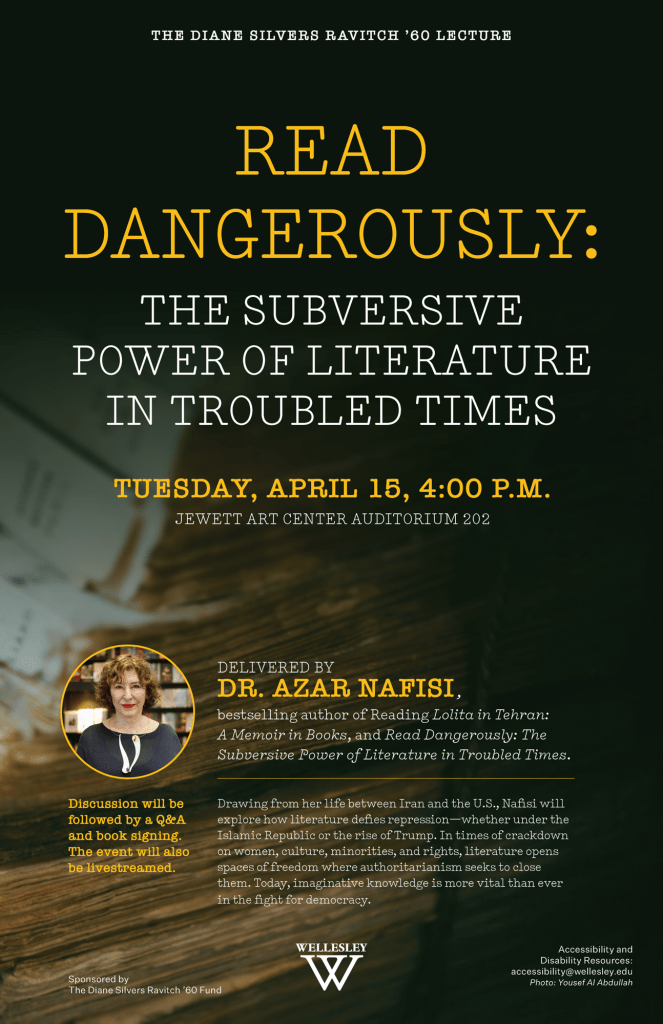
Dr. Azar Nafisi, author of the mega-bestseller Reading Lolita in Tehran, will speak at Wellesley College on April 15 at Wellesley College at 4 p.m. in the Jewett Arts Center. Admission is free.
Please mark the date on your calendar. She is speaking in a lecture series that I endowed several years ago. The lecture will be available eventually on the archive website of the College.
The book, which was a sensation upon its publication for its depiction of life under the mullahs, has recently been made into a film.
This review of the film was published by The Atlantic and written by Arash Azizi. At present, the film can be seen only at film festivals.
He wrote:
The past few years may well be remembered as the nadir of Iranian-Israeli relations, and the first occasion when the two countries attacked each other directly. But they were also a golden period for Iranian-Israeli collaboration in cinema. In 2023, Tatami was the first-ever film to be co-directed by an Israeli (Guy Nattiv) and an Iranian (Zar Amir). And in 2024 came Reading Lolita in Tehran, directed by Eran Riklis, who is Israeli, and adapted from a book by an Iranian author, with an almost entirely Iranian cast. The film premiered at the Rome Film Fest last year and is now starting to tour the United States.
Anyone old enough to remember cultural life at the beginning of this century will know the book. Azar Nafisi’s memoir came out in 2003, spent 36 weeks on the New York Times best-seller list, and quickly developed a cult following. A reviewer for The Nation confessed to missing a dental appointment, a business lunch, and a deadline just because she couldn’t put the book aside.
Literary scholars—Nafisi is an English professor—are not known for their page-turning thrillers. But Nafisi’s story and prose are captivating. She’d gone to Iran shortly after the 1979 revolution in the hope of putting her American education to use by teaching English at a university. Instead, she was hounded out of the classroom by authorities hostile to Western literature. She wound up holding clandestine seminars for young women in her living room, delving into the masterpieces that the Islamic Republic forbade: the Vladimir Nabokov novel that gives the memoir its name, alongside the works of Henry James and Jane Austen, as well as one of Nafisi’s favorites, F. Scott Fitzgerald’s The Great Gatsby. Nafisi brings these classics into dialogue with the real-life stories of young Iranians in the heady decades following the 1979 revolution. Her book isn’t just about reading and teaching literature under a repressive regime, but about how literature in and of itself could serve as an antidote to all that the regime stood for.
Despite its global fame and translation into 32 languages, Reading Lolita in Tehran was never turned into a film before now, mostly because Nafisi didn’t like the proposals she’d received. Then, seven years ago, Riklis came around, as he recounted to a New York audience on January 13, after a special screening of the film. The Israeli director managed to convince Nafisi of his vision—and then to secure the funding, assemble a suitable Iranian cast, and settle on Rome as the shooting location, given that Tehran was not an option.
When the book was initially released in 2003, the American zeitgeist, shaped by 9/11 and the Bush administration’s global War on Terror, was rife with debates about the representations of Muslim women and life in the Middle East. Nafisi’s was one of several popular memoirs by Iranian women published during this period, including Firoozeh Dumas’s Funny in Farsi (2003) and Marjane Satrapi’s Persepolis series (2000–03). And perhaps inevitably, given its success, Nafisi’s book became the subject of political scrutiny, much of it bearing little relation to the book’s content. Although Nafisi opposed the Iraq War, some critics lumped her in with neoconservatives because she portrayed the travails of Iranians under an anti-American regime. One scholar even proclaimed that he saw no difference between her and American soldiers convicted of abusing prisoners in Iraq.
More than 20 years later, Riklis’s loyal adaptation has opponents just as the book did, and even more so because of the nationality of its director. In Tehran, the regime media have denounced the film as furnishing a “pretext for attacking Iran” and called its Iranian actors “traitors working with Zionists.” One outlet claimed that the film peddled a “violent, anti-culture, anti-art, and anti-human view of Iran and Iranians.”
The idea that Reading Lolita in Tehran is anti-Iranian because of its portrayal of the Islamic Republic, and of the life of women under its rule, was always patently ridiculous. The claim bears up particularly poorly in 2024, two years after women-centered protests rocked Iran under the slogan “Women, Life, Freedom.” What Nafisi does best, and the reason her work has endured, is precisely to refuse cartoonish portrayals and basic morality plays.
In Riklis, known for his empathetic depiction of Israelis and Palestinians in films such as Lemon Tree and Dancing Arabs, her book finds an able interpreter who has stayed true to its ethos. The film isn’t neutral. It vividly tells the story of how puritanical Islamist goons attacked universities in the early years after 1979, imposed mandatory veiling on women, and banned books they didn’t like. But neither is it a simple story of scary Islamists versus heroic women resisters.
The film captures the atmosphere of Iran in the 1980s and ’90s remarkably well for having been shot in Italy and directed by an Israeli who has never set foot in the country. The dialogue is mostly in Persian, a language Riklis doesn’t speak; he was able to pull this off with the help of a carefully chosen cast of diasporic Iranians. Golshifteh Farahani, perhaps the best-known Iranian actor outside the country, is at her height as Nafisi, whom she plays as confident but humane, by turns brazen and vulnerable.
The young women of the clandestine class include Sanaz (Zar Amir), who has survived imprisonment and torture; Mahshid (Bahar Beihaghi, in one of the film’s most delightful performances), who, unlike most of her classmates, wore the Islamic veil even before the revolution and defends an ideal of modesty as virtue; and Azin (Lara Wolf), whose multiple divorces make her an object of fascination to the less experienced students, but who turns out to be suffering from domestic abuse.
In Nafisi’s apartment, the students are far from the prying eyes of the regime and also of men (even the professor’s husband is barred from their meetings). They construct for themselves, in that all-female room, a little literary republic that survives the years of war and revolution. In one memorable scene, Nafisi has the students practice a Jane Austen–era dance as part of their study of Pride and Prejudice, drawing parallels between the stifling rules of courtship in Victorian England and those of some contemporary families in Iran.
The film also ventures beyond that cloistered space. Bahri (Reza Diako), a devout 1979 revolutionary, is nevertheless an avid student in Nafisi’s class at the university before it is shut down. Despite their diametrically opposed politics, Nafisi and Bahri form a bond. Early in the story, she tells him his essay on Huckleberry Finn is the best she’s ever received from a student, even in America. The two reconnect when Bahri returns from the Iran-Iraq War of 1980–88, having lost an arm. He has used his family connections to the regime to obtain a surprise gift for his old professor: two tickets to The Sacrifice, by Andrei Tarkovsky, showing at the Tehran film festival. The connection between Nafisi and Bahri is presented with complexity and without sentimentality, neither papering over political differences nor caricaturing Bahri as a generic revolutionary.
In this way, both film and book avoid didacticism. And in doing so, they demonstrate exactly the point Nafisi explores with her students, which is the power of literature to stir empathy across seemingly unbridgeable divides. When the group discusses The Great Gatsby, Nafisi insists on understanding the forbidden love that Daisy Buchanan, the married socialite, has for Jay Gatsby as a true human feeling, not a symbol of Western perfidy, as some of her more revolutionary students claim it to be. The latter advocate banning the book. Nafisi organizes a mock trial for the novel in her class, with students divided into teams for and against.
Nafisi calls on students on both sides of the political divide to treat each other with humanity. When she catches some in her class expressing glee at the wartime deaths of pro-regime peers, she enjoins them not to become like their oppressors. And she is no dogmatic opponent of Islam, only of religiously inspired repressive government: At one point Nafisi tells Bahri, “My grandmother was the most devout Muslim I knew. She never missed a prayer. But she wore her scarf because she was devout, not because she was a symbol.” (I am not the only critic with a Muslim background who found this line powerful.)
The point here isn’t just to repeat the liberal platitude that “the problem isn’t with Islam but with its repressive enforcement.” Rather, Nafisi is rejecting the revolutionaries’ tendency to treat all that surrounds them as a field of symbols. People are worth more than that, she tells them and us, as though echoing the Kantian dictum to treat one another “as an end, never merely as a means.”
This message about the humane power of literature makes Reading Lolita in Tehran a work of art rather than an exercise in sloganeering. And the fact that now, more than two decades after the book’s release, and at a time of regional tension, an Israeli filmmaker has worked with Iranians to adapt Nafisi’s book to the screen gives the film a special power.
The audience at the screening I attended, at a Jewish community center on the Upper West Side, included American Jews, Israelis, and Iranians. What we had in common was the experience of being gripped by a story about the capacity of literature to reveal us to one another as ends rather than as means. The setup might sound mawkish. But I recommend avoiding the temptation of cynicism and embracing the film as truly one for these times.
Last weekend, the Network for Public Education hosted its conference in Columbus, Ohio. Since our first conference in 2013 in Austin, everyone has said “this is the best ever,” and they said it again on April 7.
The attendees included the newly re-elected State Superintendent of Schools in Minnesota, Jill Underly. The Democratic leader of the Texas House Education Committee, Gina Hinojosa. Numerous teachers of the year from many states. Parent leaders from across the nation.
The Phyllis Bush Award for grassroots organizing was won by the Wisconsin Public Education Network, a parent-led group, who have stood firm for their public schools.
The David Award for the individual or group who courageously stands up to powerful forces on behalf of public schools and their students was won by Pastor Charles Johnson of Pastors for Texas Children, whose organization has fought against Governor Greg Abbott and the billionaires who want to impose vouchers, despite their failure everywhere else and the harm they will wreak on rural schools.
The last speaker was Tim Walz, Governor of Minnesota and former Democratic candidate for Vice President in 2024. He was warm, funny, and inspiring.
Nearly 400 educators attended the conference from all across the nation, and everyone stayed to hear Governor Walz, who was wonderful. In time, I will post videos of the main presentations, including his. April 7 was his birthday, and it was too late to get a birthday cake. But two veteran educators left the hotel to find a bakery and returned with a cake.
I introduced Randi Weingarten and reminded the audience that Mike Pompeo had called her “the most dangerous person in the world,” which she should wear as a badge of honor.
Randi gave a rip-roaring speech that brought the audience to its feet. She presented Governor Walz with his birthday cake and everything sang “Happy birthday.”
He was fabulous. He was supposed to slip away at the end of his speech, through a private back door but someone caught up with him and asked for a selfie. Of course, he obliged. Within minutes, it appeared that at least 250 or more people were standing in line for a selfie. He did not leave. He signed autographs and posed for selfies with everyone who wanted one.
He is humble, self-effacing, has a crackling dry wit, and is most definitely a people person.
In the opening session on Friday night, I engaged in a Q & A with Josh Cowen about his recent book: The Privateers: How Billionaires Created a Culture War and Sold School Vouchers. Again, the room was overflowing. Josh was excellent at explaining the terrible results of vouchers and how they turned into a subsidy for wealthy families. Why do politicians continue to promote them. The billionaire money is irresistible.
The panels were fabulous. I participated in one about the close link between public schools and democracy. The room was packed, and we had people lining the walls. A panel led by Derek Black, law professor at the university of South Carolina, and Yohuru Williams, dean of the University of Saint Thomas in St. Paul, talked about the history of Black education, inspired by Derek’s new book Dangerous Learning: The South’s Long War on Black Literacy.
Public schools are in the crosshairs of the Trump Administration. The fact that they have failed matters not at all to religious zealots and libertarians. The fact that they bust state budgets doesn’t matter. The fact that they are a subsidy for rich families doesn’t matter. Those rich families will vote for the politicians who gave them a gift.
The urgency of standing up for public schools, defending their teachers, protecting their students, and fighting censorship of books and curriculum has never been more important than now.
The Network for Public Education is committed to stand up for kids, teachers, public schools, and communities. .



 Diane Ravitch's blog