Archives for category: Corporate Reform

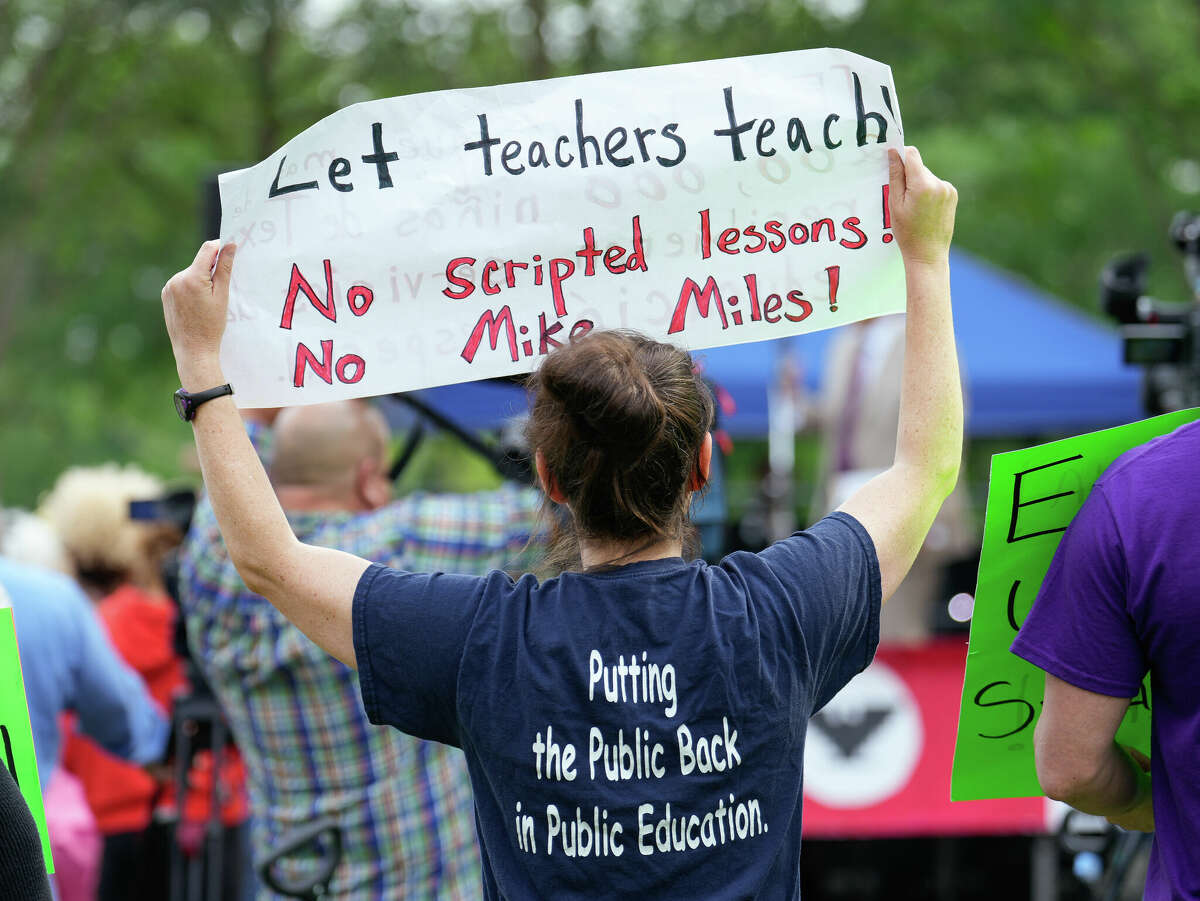
Mike Miles, the state-imposed superintendent of the Houston Independent School District, has never been a teacher, but he thinks he knows exactly what teachers should do. He has dubbed his behaviorist program the “New Education System.” Those teaching in certain designated schools are required to do it his way or get out. Clearly he has never read the research on motivation (Edward Deci, Dan Ariely, Daniel Pink), or he would know that forced compliance depresses motivation.

The Houston Press reported:

Teachers called to a last-minute after school meeting at Chrysalis Middle School Friday afternoon were told to get with the New Education System program instituted by Houston ISD Superintendent Mike Miles or get gone. And that they had until 6 p.m. Sunday to let the district know whether they’d be staying or wanted to be moved to another school.

Dr. Luz Martinez, the Central Division superintendent (previously at Midland in 2021 and Round Rock in January 2023 before moving to HISD this June), minced no words in making it clear that there wasn’t to be any more questioning of the new policies at the NES-Aligned schools, part of the Miles plan after the state takeover of HISD.

By Saturday, two teachers who tried to ask questions — one of whom was thrown out of the meeting — received letters that the district was beginning the process of terminating their employment and they were barred from campus. “Insubordination” was cited as the precipitating factor in Carr’s case.

“We are not going back. We are not compromising,” Martinez had told the teachers at the meeting while Principal Mary Lou Walter stood by, “All this noise that is going on, that’s in the past. We are moving forward. We are NES-Aligned.” She went on to insist that the NES program was “never intended to be rigid, never intended to be mechanical.”

At the same time, Martinez told teachers she’d be bringing more outsiders into the schools who would be in the teachers’ classrooms “all the time” to ensure they are “implementing the model with fidelity.”

Science teacher Teresa Carr said she attempted to ask in what way the teachers at Chrysalis were supposedly falling short. “[Martinez] said we were not implementing with fidelity,” said Carr but when the district superintendent was pressed, the only example she came up with was three elementary students she’d spotted on their way to the office because they’d had bathroom accidents. Pointing out that involved Cage and not the middle school or its teachers, Carr said she was unable to get Martinez to give any specific examples involving Chrysalis.

After Carr left the meeting, another teacher attempted to continue with follow up questions, Carr said. That teacher also received a letter of reprimand and notice that termination proceedings were beginning against her, Carr said.

The holder of a BA in science education and a master’s in English education, Carr said she had never been in trouble with the district before and clearly by Sunday was still very unsettled by what had happened. One bright spot was that she had joined the Houston Federation of Teachers union for the first time before the start of school this year and had already talked with her union rep.

A group of parents at Cage Elementary and Chrysalis — they share the campus and principal with Chrysalis — have planned a protest at 7:30 a.m. Monday about what happened Friday and the NESA program in general. Parent Mayra Lemus echoed the bewilderment of many when she pointed out that Cage has been an A level Blue Ribbon School, so why were the more rigid educational approaches that are part of NES instituted there.

Naturally enough, given the times in which we live, someone recorded part of Martinez’s speech.

Carr said when she asked again for an answer to her questions, Martinez walked toward her saying “You can leave. You can leave. You can leave.”

In her written reprimand to Carr, Martinez wrote that the science teacher had “acted in a highly unprofessional manner” in the meeting and was “insubordinate.” According to Martinez, Carr yelled during the exchange and talked over her. Carr insists that it was Martinez who did the yelling.

“As a result, I will move forward with an immediate recommendation to terminate your contract effective 9/16/2023,” Martinez wrote. She also notified Carr that she was not allowed on the Cage/Chrysalis campus for any reason and that she would have to make arrangements to have her personal items picked up after 5:30 p.m.

“If you’re one of those teachers who don’t want to do the model, that is fine. But you will not be here,” Martinez had told teachers assembled Friday. She gave them the weekend to think it over, but later that was shortened to 6 p.m. Sunday.

While looking over my site, I came across this post written in 2014.

It is as timely now as it was then. Reformers worked with communications specialists to develop language that conceals its true meaning.

For example, reformers today don’t want to improve public schools. They want to defund them. Some want to destroy them. They think that public money should go to anyone, any organization that claims they are educating young people. They are fine with funding religious schools. No doubt, they would have no objection to funding Satanic schools, for fairness sake.

These reformers believe in tight accountability for public schools, their principal, their teachers, their students.

They believe in zero accountability for anyone taking public money for nonpublic schools. In most states with vouchers, voucher schools do not require students to take state tests. Students can’t be judged by test scores as public school students are; their teachers can’t be evaluated by test scores. Their schools can’t be closed because of test scores. There are no test scores.

Teachers in public schools must be college graduates who have studied education and who are certified. Teachers in voucher schools do not need to be college graduates or have certification.

Hundreds of millions, maybe billions, now fund homeschooling. With well-educated parents, home schooling may be okay, although the children do miss the positive aspects of meeting children from different backgrounds, working in teams, and learning how to get along with others. But let’s face it: not all home schoolers are well-educated. Poorly educated parents will teach their children misinformation and limit them to what they know, and no more.

Then there is the blessing that the US Supreme Court gave to public funding for religious schools. The purpose of most religious schools is to teach their religion. The long word for that is indoctrination. We have a long history of not funding religious schools. But now all of us are expected to foot the bill for children to learn the prayers and rituals of every religion. I don’t want to pay taxes for someone else’s religion to be inculcated. I also don’t want to pay taxes to inculcate my own religion.

But the Supreme Court has step by step moved us to a point where the government’s refusal to pay for Catholic schools, Muslim schools, Jewish schools, and evangelical schools—with no regulation, no accountability, and no oversight—violates freedom of religion. That’s where we are going.

Ninety percent of the people in this country graduated from public schols. Those who sent their children to private or religious school paid their own tuition. That arrangement worked. Over time, we became the leading nation on earth in many fields of endeavor. Our education system surely had something to do with our national success.

I believe that people should have choices. Most public schools offer more curricular choices than charter schools, private schools, or religious schools. Anyone may choose to leave the public school to attend a nonpublic school, but they should not ask the taxpayers to underwrite their private choice.

The public pays for a police force, but it does not pay for private security guards. The public pays for firefighters, highways, beaches, parks, and many other public services. Why should the public pay for your decision to choose a private service?

Saddest of all, the current trend toward school choice will lower the overall quality of education. The children of the affluent who attend elite private schools will get a great education, although they will not get exposed to real life on their $60,000 a year campus. None of those campuses will get poor voucher kids because all they bring is a pittance.

We are now learning that most public schools are superior to most of the voucher schools. Many charter schools are low-performing.

On average, school choice will dumb down our rising generation. It will deepen social and religious divisions. It will not produce better education or a better-educated society. It will widen pre-existing inequalities.

Books have been and will be written about this fateful time, when we abandoned one of our most important, most democratic institutions. Libertarians and religious zealots have worked for years, decades, on this project. By convincing leaders of both parties to follow them, they have betrayed the rest of us. They have lost sight of the common good.

Those two words are key. The “common good.” With them, we as a society can conquer any goal, realize any ideal. Without them, we are reduced to squabbling tribes, cliques, factions. We are becoming what the Founding Fathers warned about.

If it’s not too late, that is the banner behind which we should rally: the common good. An understanding that we are all in the same boat, and we must take care of others.

Nikhil Goyal has written an alarming book about the effects of poverty on young people. His book Live to See the Day: Coming of Age in American Poverty documents the lives of three teenagers in Philadelphia, all of whom live in poverty.

The book is an implicit rebuke of the “reformers” who insisted that schools were the root cause of inequality, not poverty. They liked to say, “fix schools, and that will fix poverty.”

Goyal describes the obstacles in these young people’s lives, and it’s clear that the “reformers” had it backwards.

A recent review by Julia Craven in The Washington Post raves about the book.

Each of the three protagonists in sociologist Nikhil Goyal’s new book, “Live to See the Day: Coming of Age in American Poverty,” is navigating a pivotal juncture: adolescence, that unique and universally exhausting stage of human development when one moment can sometimes change the trajectory of life. For Ryan Rivera, that moment is being among a group of preteen boys who set fire to a trash can near their middle school’s atrium, a childish mistake that cast him into the school-to-prison pipeline. Corem Coreano, who came out as queer, and then changed their name and pronouns, ultimately made the difficult choice to leave home because of their mother’s refusal to leave an abusive relationship. And Giancarlos Rodriguez was — puzzlingly — thrown out of Philadelphia’s education system after fighting to protect his and his peers’ future by leading student walkouts to protest school closures and educational budget cuts.

Rooted in almost a decade of reporting, “Live to See the Day” is a sweeping indictment of poverty, America’s educational system, and how comfortably they both interact with the criminal justice system to upend the lives of young people and underprivileged families of color. All three protagonists hail from Kensington, an impoverished neighborhood in North Philadelphia.

According to Goyal, babies born with an address in Kensington aren’t expected to live beyond their 71st birthday — a staggering 17 years less than children born to families in Society Hill, less than four miles away.

A chunk of the book is spent world-building so readers can grasp the muddy terrain these children navigate, and Goyal does so by layering social systems atop one another so readers can draw connections. As Goyal explains it, underfunded public schools are at the heart of the issue. Schools are governed by racist educational policies that push students into the criminal system through the use of metal detectors, zero-tolerance rules and temperamental resource officers. Children leave the schoolyard and return home to families drowning because of crippling poverty, food insecurity, chronic joblessness, inequitable access to physical and mental health care, domestic violence, evictions, and addiction. In their social interactions, anything perceived as “soft” — whether it be snitching or queerness — doesn’t align with survival.

Goyal, who is on the staff of Senator Bernie Sanders, makes clear why programs like No Child Left Behind and Race to the Top were destined to fail. They ignored the conditions in which young people live. Evaluating their teachers by test scores, firing them, closing their schools, turning their schools over to entrepreneurs and corporate chains do nothing to change their lives.

Peter Greene weighs in on Mike Petrilli’s article in the New York Times.

He writes:

Mike Petrilli, head honcho of the right-tilted Fordham Institute thinky tank, made it into the New York Times today to do some chicken littling about Learning Loss and suggest a bold solution. Don’t have a NYT subscription? That’s okay– let me walk you through the highlights of this festival of Things We Can Stop Saying About Education Right Now, Please.

Let’s start by invoking general Learning Loss panic. Petrilli points out that students “lost significant ground” during covid, and now NWEA says that students continue “backsliding” and “falling further behind.” People, in Petrilli’s view, are not panicking enough about “America’s massive learning loss.”

First, let’s use some more precise language, please. In all discussions of learning loss, we are actually talking about scores on a Big Standardized Test of reading and math going down. We will never, ever know how much of the slippage in tests scores is the result of students going a year or two without practicing for the BS Test. But in the meantime, it would be great if we stopped talking about test scores as if they were infallible equivalents of learning and achievement.

Second, “learning loss” is a misnomer. I’m willing to bet that verrrrrrry tiny number of students in this country actually lost learning. I’m equally certain that the vast majority of students did not learn as much as they would have in a non-pandemic year, but that’s not the same. 

Think of it this way. It’s budget time, and the Mugwumps’ proposed budget increases spending on widgets from $500 to $600. The Wombats say, “Let’s only increase widget spending to $550.” That gets us to the part where the Mugwump talking point is “The Wombats want to cut spending on widgets.” When in fact everybody wants widget spending to go up.

That’s where we are. During the pandemic, learning occurred–just not as much as might have been expected in a normal-ish year. And this looks most like a crisis if you think of test scores like stock prices and focus on data rather than individual human students. (Petrilli does not invoke the baloney about impact on future earnings, so we’ll not go there right now.)

And, it should also be pointed out, it is where we were for a decade before covid even hit.

Having sounded the alarm, Petrilli bemoans the surfeit of leaders willing to make alarmy noises.The country is in desperate need of leaders who will speak the truth about what’s happening in our K-12 schools, and are willing to make the hard choices to fix it. Simply put, we need to bring some tough love back to American education.

Tough love? Back? Petrilli doesn’t really explain how the pandemic led to a loss of tough love in education. But that’s the dog we’re going to try to hunt with.

He cites Michael Bloomberg, who is ceaselessly alarmed about anything going on in public schools. Bloomberg wants a plan from Washington, a joint session of Congress, a Presidential address. 

Ah, says Petrilli–you know when politicians were on the same page about education, presumably flinging tough love around with wild abandon.

We’re talking, of course, about the golden days of No Child Left Behind. 

Petrilli remembers it fondly, citing how we saw “significant progress” which of course means “test scores went up,” which they did, at first, for a few years. Anyone who was in a classroom, especially a math or reading classroom, can tell you why. Within a couple of years, schools figured out what test prep would be most effective. Then they targeted students who were teetering on the line between High Enough Scores and Not High Enough Scores, especially the ones in special subgroups, and test prepped the hell out of those kids. At which point scores started stagnating because schools had done all they could do. 

The Average Yearly Progress requirements were set up as a bomb that would go off during the next administration. Again, if you were working in a school at the time, you remember that chart, showing a gentle upward glide for a bit before jutting upward to 2014, the magical year in which 100% of students were to score above average on the BS Test. Oh, Congress will fix that before it happens, we were told. They did not. By the early 20-teens, there were two types of school districts–those that were failing, and those that were cheating. 

Petrilli claims maybe success probably, saying NCLB “likely contributed” to graduation rates (no, schools just learned how to game those), college attainment rates (eh, maybe, but correlation is not causation) and “possibly” future real-life outcomes (absolutely not a shred of evidence–even reformster Jay Greene said as much).”It’s true that No Child Left Behind was imperfect,” says Petrilli. No. It stunk. But Petrilli has quite the tale here.There were fierce debates over “teaching to the test” and “drill and kill” instruction; about closing low-performing schools versus trying to fix them; and about the link between student achievement and family poverty. But once the law’s shortcomings became apparent, policymakers responded by adopting common standards and improving standardized tests, so as to encourage higher-level teaching. They poured billions into school turnarounds, invested in stronger instructional materials and started grading schools on how much progress their kids made from year to year, rather than focusing on one snapshot in time — an approach that is markedly fairer to high-poverty campuses. Still, the bipartisan effort that was No Child Left Behind ultimately fell apart as our politics fractured.

That’s quite the load. There was no debate about teaching to the test or drill and kill, because nobody was in favor of it except shrugging administrators who were staring at 2014. Petrilli also forgets that “teach to the test” ended up meaning “cut out any other classes–or recess–that does not appear on the test.” Arts slashed. History and science cut (at least for those teetering students). Closing low-performing schools was, in fact, the quickest way for a district to free itself of the low scores; who knows how many districts were restructured to put predictably low 8th grade scores under the same roof as better scores from lower or higher grades. And yes, poverty affects scores, despite all the No Excusing in the world.

What came next did not address any of these issues, The Common Core was an amateur hour fiasco. Were standardized tests improved? Not really (as witnessed by the fact that states dumped the SBA and PARCC as quickly as they could)–but it made a lucrative contract for some test manufacturers. Including progress in scores is great–unless you’re teaching kids who are already scoring at the top. School turnarounds have consistently failed (e.g. Tennessee’s failed Achievement School District). 

But he’s right that Trump’s election and appointment of Betsy DeVos hurt the reformster alliance (despite the fact that DeVos had long been part of the club). But then, so was the increasing split between the social justice wing of reform and the free marketeer AEI-Fordham wing. 

But look– NCLB and the sequel, Race to the Top, were just bad. They started from bad premises: 1) US education is failing because 2) teachers either don’t care or don’t know what they’re doing. They rest on a foundation of using a mediocre BS Test as an unquestioned proxy for student learning and teacher effectiveness, creating a perfect stage on which to conduct a national field test of Campbell’s Law (when you make a measure a proxy for the real thing, you encourage people to mess with the measure instead of the real thing, and it gets worse if the measure isn’t very good). And none of the “policymakers” who championed this mess ever came up with a single solitary idea of how to Fix Things that actually worked on either a local or macro scale.

The pandemic did not help anything in education. But it did lead to some flaming prose, like Petrilli’s assertion that “here we are, with decades of academic progress washed away and achievement trends still moving in the wrong direction.” This kind of overheated rhetoric is nothing new from the folks who gave us The Pandemic Erased Two Decades of Progress in Math and Reading as a headline. But what does it even mean? Washed away to where? Did knowledge dribble out of students’ heads? Did the learning of the past several years retroactively vanish with former students waking up across America feeling a little bit dumber somehow? Did teachers forget everything they knew about how to teach students, so they have to start over? Or do we just mean “test scores are down”?

Petrilli breaks this down to some other issues. His first point starts out fine– there’s an attendance problem right now. But he tries to set that beside an alleged nationwide move to lower standards. I’m not sure what basis there is for that assertion. He points to the “no zeros” rule used in some schools, but that rule existed in many places (like my old district) for ages. Maybe it’s letting slackers slide through in other places, but my own experience with no zeros policy is that it merely kept students working who would otherwise have given up–kind of the opposite of encouraging slacking. 

But then he’s slicing NCLB-style baloney again:Virtually all schools and districts have enjoyed a vacation from accountability. Almost nobody is worried about state officials shutting their campuses because of low performance, or forcing district schools to replace their principals or teachers.

You say that like it’s a bad thing, Mike. 

Embedded here are many of the same bad assumptions that have driven ed reform for decades. Teachers and schools have no motivation to do their jobs unless they have some kind of threat of punishment hanging over their heads. This isn’t just bad education policy–it’s bad management. As management which W. Edwards Deming pointed out often, fear should be driven out of the workplace. But NCLB and RttT were always all stick, no carrot, always starting out with the worst possible assumptions about the people who had chosen education as their life’s work (assumptions made largely by people who had never actually worked in a school). 

And even if you don’t dig Deming, there’s another thing to consider–none of the stuff Petrilli misses actually worked (which was Deming’s point). He points out that the kind of thing being done in Houston right now has become rare, to which I say “Good,” because Houston is a nightmare and it will end just like all the other similar attempts–no actual success, but lots of disruption and dismay and upheaval of children’s education.

Petrilli will now argue for NCLB 3.0. We need “action at scale,” but we can’t ignore “the support and assistance schools require.” Holding schools accountable wasn’t enough because– wait for it– if NCLB failed it was because schools lacked the expertise and know-how to do it right. And now Petrilli almost–but not quite–gets it.“Teaching to the test” and other problems with No Child Left Behind stemmed from schools resorting to misguided practices to meet requirements. Under pressure to boost scores, but without the training to know what to do, some educators engaged in endless practice testing, and stopped instruction in any subject that was unlikely to be on the state assessment. In a few places, educators even resorted to outright cheating. They likely felt they had no choice, because they hadn’t been given the tools to succeed.

Nope. Close but no cigar. No, the reason all those things happened was because, as NCLB 1.0 and 2.0 were designed, those things were the tools to “succeed.” Because “success” was defined as “get maximum number of kids to score well on a poorly-designed multiple-choice math and reading test.” Granted, when most of us think about “success” in education, we have a whole list of other things in mind–but none of those things were valued by NCLB or RttT.

But we’re rolling up to the finish now. But after a decade of building capacity, offering helping hands and adding funds, it’s time once again to couple skill-building with will-building.

That is a great line. But what capacity-building? More seats in unregulated charters and voucher-accepting schools? Which helping hands? And exactly whose will needs to be built? Parents? Children? Teachers? Policymakers? I’m seriously asking, because I think a hell of a lot of will was involved in slogging through the last couple of years. 

Petrilli calls on schools to spend their “federal largesse” to “catch their kids up”–and I think the call to accelerate education is one of the most infuriating calls of the last few years. Sure– because all along teachers have known how to educate children faster but they just haven’t bothered to do it, but hey, now that we have certified lower test scores, teachers will all bust the super-secret Faster Learning plans out of their file cabinets. 

Petrillii says we don’t actually need to bring back NCLB, though he seems to have been talking about nothing else– just let’s get out those big sticks and get back to (threats of) “tough interventions for persistent underperformance,” because that has totally worked in the past. No, wait. It hasn’t actually worked ever. 
Kids, too, should know that it’s time to hit the books again. We need to rethink our lax grading policies, make clear to parents that their children need to be at school and bring back high school graduation exams and the like to ensure that students buckle down.

Also, get those kids off our lawns. And while you’re making sure parents know their kids should be in school, maybe talk to all the reform crowd that has been working hard to build distrust of public schools and deepen disrespect of educators.

And the big finish:Education matters. Achievement matters. We need leaders who are willing to say so, and educators who are willing to act like these simple propositions are true.

This seems straightforward enough, though if you replace “achievement matters” with “standardized test scores matter,” which is what he really means, it doesn’t sound quite as compelling. And it’s insulting as hell to suggest that the ranks of educators are filled with people who are unwilling to act as if education matters. 

Well, the piece is completely on brand for the New York Times, and it certainly echoes the refrain of that certain brand of reformster whose response to their own policy failures has been, “Well, get in there and fail harder.” No Child Left Behind failed, and it not only failed but left some of its worst policy ideas embedded in the new status quo, continuing to do damage to public education right through today. 

The pandemic did many things, and one thing it did was panic the testing industry, which faced an existential threat that everyone might realize that school without the BS Test, or NWEA’s lovely test-prep tests, might actually be okay. It’s no wonder that they feel a special nostalgia for the days when the entire weight of the government reinforced their importance. So here we are, painting low reading and math tests scores as an educational crisis whose only solution is to get more fear, more threats, and especially more testing back into schools. 

I’m sorry if this assessment of some reformsters, their policies, and their motives seems harsh, but, you know– tough love.

Mike Petrilli, president of the Thomas B. Fordham Institute, published an article in the New York Times yesterday in which he lamented the “learning loss” caused by the pandemic and called for a new national effort, like No Child Left Behind, to instill rigor and accountability, which he says will raise test scores. Time to bring back tough love, he wrote.

I have a hard time criticizing Mike Petrilli because I like him. When I was on the board of the Thomas B. Fordham Foundation/Institute, I got to know Mike, and he’s a genuinely good guy. But when I left the board of the TBF Institute in 2009, it was because I no longer shared its beliefs and values. I concluded as early as 2007 that No Child Left Behind was a failure. I wrote an article in the conservative journal EdNext in 2008 about NCLB, saying “End It,” paired with an article by the late John Chubb saying, “Mend It.”TBF sponsored charter schools in Ohio—a move I opposed because think tanks should be evaluating policy, not implementing it; also, during the time I was on the board, the charters sponsored by TBF failed.

By the time I left, I had concluded that the NCLB emphasis on high-stakes standardized testing was a disaster. It caused narrowing the curriculum, gaming the system, cheating, excessive test prep, and squeezed the joy of teaching and learning out of classrooms.

Furthermore, the very idea that Congress and the U.S. Department of Education were stigmatizing schools as failures and closing them was outrageous. I worked in the US ED. There are many very fine career civil servants there, but very few educators. In Congress, the number of experienced educators is tiny. Schools can’t be reformed or fixed by the President, Congress, and the Department of Education.

NCLB and Race to the Top were cut from the same cloth: Contempt for professional educators, indifference to the well-established fact that test scores are highly correlated with family income, and a deep but misguided belief that punishing educators and closing schools were cures for low test scores. Both the law (NCLB) and the program (RTTT) were based on the assumption that rewards and punishments directed at teachers and principals would bring about an educational renaissance. They were wrong. On the day that the Obama administration left office, the U.S. Department of Education quietly released a study acknowledging that Race to the Top, having spent billions on “test-and-punish” strategies, had no significant impact on test scores.

And as icing on the cake, Mike Petrilli wrote an article in 2017 about the latest disappointing NAEP scores, lamenting “a lost decade.” That “lost decade” was 2007-2017, which included a large chunk of NCLB and RTTT. In addition, the Common Core standards, released in 2010, were a huge flop. TBF was paid millions by the Gates Foundation both to evaluate them and to promote them. The NAEP scores remained flat after their introduction. Please, no more Common Core.

I wrote two books about the failure of NCLB and RTTT: The Death and Life of the Great American School System: How Testing and Choice Are Undermining Education (2010) and Reign of Error: The Hoax of the Privatization Movement and the Danger to America’s Public Schools.

Mercedes Schneider and I both wrote posts commending Mike Petrilli in 2019 when he wrote about the “dramatic achievement gains” of the 1990s and early 2000s before NCLB kicked in. He attributed those gains to improving economic conditions for families and declining child poverty rates. I wanted to give him a big kiss for recognizing that students do better in school when they are healthy and well-nourished.

So, what did No Child Left Behind and Race to the Top produce? A series of disasters, such as the Tennessee Achievement School District and Michigan’s Educational Achievement Authority, both gone. A landscape of corporate charter chains, for-profit charters, for-profit online charters, and now vouchers, in which red states commit to pay the tuition of students in religious schools and fly-by-night private schools. A national teacher shortage; a sharp decline in people entering the teaching profession.

Please, no more tough love. No more punishment for students, teachers, principals, and schools. Let bad ideas die.

Ed Johnson is a systems thinker and advocate for public education. He lives in Atlanta. He has studied the work of G. Edwards Deming, an international expert on systems thinking, and knows that those who promise instant success by breaking up public schools are perpetrating a hoax. He knows the history of 50CAN, funded largely by Jonathan Sackler of the notorious family that profited by selling opioids. He knows that charter schools are distractions from the hard work of systems improvement. After more than three decades of charter schools, it should be clear that they do not produce “achievement now.”

He writes:

Part 2 of the The King Center’s Strategies for Beloved Community Education is set to be presented online on Tuesday, September 5, at 6:00 PM EST. Visit https://thekingcenter.org/for details.

As with Part 1, available for viewing on YouTube here, Part 2 will feature an “expert panel” in facilitated discussion.

One member on the “expert panel” for Part 2 will be Marc Porter Magee, CEO of 50CAN.

Thus, the simple question, asked without prejudice, is, why?

This question was presented to The King Center 24 hours ago along with requesting an immediate reply, so as to avoid assuming why. A reply has yet to come. Given that, I offer the following.

50CAN, which stands for 50-State Campaign for Achievement Now, is the umbrella organization that includes GeorgiaCAN, and we know GeorgiaCAN pushes for school choice and charter schools, do we not?

50CAN evolved from ConnCAN (Connecticut CAN). ConnCAN was funded pretty much wholly by Sackler Family fortunes earned as ill-gotten profits from over-prescribed sales of Oxycontin by the family’s Purdue Pharma. Because of such greed for profits, hundreds of thousands of people worldwide have died, and continue to die, from opioid addiction.

As with similar other organizations and their local operatives—for example, The City Fund and its local operatives, Ed Chang leading reformED Atlanta—it is fairly well-known that 50CAN and its state-level operatives aim to dismantle hence destroy public education as the common good that is foundational to sustaining democracy, so as to transform destroyed public schools into privatized and commodified schools composing competitive education marketplaces. Think Milton Friedman and the “invisible hand of the market.”

It is also fairly well-known that 50CAN, like similar other organizations, has advanced its aim to destroy public education by expressly targeting and catalyzing Black communities to demand school choice and charter schools that will magically deliver “achievement now.”

In effect, 50CAN and such others “politrick” Black communities into facilitating their own destruction and that of their own children. Again, while “It takes a village to raise a child,” it also takes a village to destroy a child.

The usual assumption is that charter schools transformed from destroyed public schools are inherently better than “failing public schools.” This is a lie, plain and simple. It is impossible for charter schools to be inherently better or worse than “failing public schools.” Because entropy is a fact of life, our public schools need improvement, have always needed improvement, and always will need improvement. Reality offers charter schools no grace from the entropy fact of life.

To assert that charter schools are inherently better than “failing public schools” is like asserting members of a certain group of human beings are inherently superior to members of other groups of human beings, based solely on expressions of variation in some few arbitrarily-chosen human physical features said to signify “race,” which is another lie.

Charter schools do, however, appeal to certain retributive justice, behaviorally emulative, and selfish consumerist mindsets for which improvement-thinking has always been meaningless, at worst, and theoretical, at best. 50CAN knows this, and so uses it to catalyze Black communities to demand “achievement now.” “Instant pudding,” the late, great systems thinker W. Edwards Deming (1900-1993) might say.

Consequently, “Our children can’t wait!” has been a decades-long handy refrain that has always begged easy, quick, learningless change but never improvement with knowledge, which requires learning and unlearning.

Unfortunately, systems thinking teaches through a nonviolence lens that the more often easy, quick, learningless change happens, the less improvement becomes possible; then, the less improvement becomes possible, the less sustainable democracy becomes; then, the less sustainable democracy becomes, the more societal dysfunctions develop and emerge, after a time, in Black communities and elsewhere; then, the more societal dysfunctions show up, the more the refrain, “Our children can’t wait!”

It is all a destructively vicious, self-reinforcing feedback loop that 50CAN and similar other destroyers of public education are happy to catalyze in Black communities, in particular, and to support its playing out, if only continually, but continuously, ideally…

Although some are quite capable to look below the performative surface, or show stage, of the proverbial iceberg and down into its greater depths to see and know Dr. Martin Luther King, Jr., was also a profound systems thinker, systems thinking seems generally absent in Black culture; certainly, children labeled “Black” seem never to learn about this deeper and critically important aspect of Dr. King.

All too often the children learn to conserve racism and so-called white supremacy rather than learn to help humanity relieve itself of these scourges. The children learn and internalize racial categorization, the false narrative at the heart of racial violence. It seems the children never learn to internalize an understanding of human variation, the truth at the heart of nonracial nonviolence.

It is quite puzzling that some fight and rail against racism, all the while conserving it and the “race” lie racism needs in order to exist, in truth.

Therefore, a question for The King Center must be, why is The King Center giving a platform to 50CAN?

An organization known to be about making “Beloved Community” a virtual impossibility, in all respects?


Ed Johnson

Advocate for Quality in Public Education

Atlanta GA | (404) 505-8176 | edwjohnson@aol.com

Mike Miles was imposed on the Houston Independent School District by State Commissioner Mike Morath. Neither Miles nor Morath was ever a teacher. HISD was graded a B district before the state takeover. The takeover was based on spite, on Governor Greg Abbott’s hatred for a district that opposes him.

Miles thinks he is an innovator, but none of his authoritarian mandates has ever succeeded anywhere else. They won’t succeed in Houston because he lacks the single most essential ingredient of leadership: Trust.

He rules by fiat. That may work in dictatorships but not in schools. Fear is not a good long-term motivator. If Miles know anything about research on motivation, he would know that the greatest motivators are intrinsic, such as a sense of mastery and autonomy.

This post was written and published on a teacher website. It reports what’s happening in Houston’s classrooms, through the eyes of teachers.

The post begins:

The largest school district in Texas has been in the news a lot lately. You may know the district was issued a state takeover and its superintendent was replaced by Mike Miles, who, notably, has never taught. 

You may know that as a part of his “wholescale, systemic reform” he identified 28 underperforming schools and identified them as NES Schools—which stands for New Education System. 

You may know a few headlines—the most bizarre being that Miles starred in a musical skit for convocation that’s been scrubbed from the Internet. 

Often, the real story isn’t as bad as newspaper headlines make them out to be. That’s not the case with what’s happening in H.I.S.D. 

The experiences teachers are sharing are a different story entirely.

Here is what this reform looks like on a classroom level, from teachers currently in H.I.S.D. 

Teachers read from a script the first two days of school. 

Read right off the page. No get-to-know-yous, no surveys, no relationship-building, no games, nothing. Right into curriculum. 

Teachers must keep classroom doors propped open. 

However, teachers and parents argue this violates past safety mandates to leave classroom doors shut and locked.

Teachers cannot dim lights. 

Even if they leave the windows open, have lamps, etc., the lights must be at full power.

Teachers have constant interruptions from administrators and district “minders.”

APs have to submit a minimum of five teacher observations per day, so this means near-constant interruption.

Administrators evaluate teachers on a checklist that has very little to do with pedagogy.

Teachers don’t know how school leaders will use these observations. This is the actual form (big thanks to Janice Stokes).

[Open the link to see the form.]

My first three reactions:

If teachers are reading from a script created by the district, why are we evaluating them on their instruction being relevant and engaging? Isn’t that on your people, Mike? 

MRS stands for Multiple Response Strategies. Pair and share, whip around, etc. These are acceptable checks for understanding, but every four minutes is formulaic and prevents any kind of extended focus or stamina. 

I haven’t heard “DOL” since 1992.

Classroom monitors can coach teachers on instruction at any time.

Even with students present. Not insulting at all!

No “weak readers” can read aloud because it models disfluency.

Huh. OK.

At NES schools, libraries have been replaced with detention centers

A district employee I spoke to insists it is a “flex space that can have other uses besides discipline.” I said, “Oh, like a library?” She did not respond. 

Students may not free-write.

Also, they may not work independently for more than four minutes. 

Every four minutes, teachers are required to hold an all-class response to check for understanding. Which is great, until you actually have to read a book, take a standardized test, or focus for more than four minutes.

Every classroom activity must tie directly to instruction. 

No classroom celebrations, relationship-building activities, brain breaks, or routines/procedures instruction are permitted. 

Teachers received extremely limited training on this model.

The location chosen for training left people sitting on floors and stuck in parking lots for over 45 minutes.

There is no information tying any of these strategies to best practice or research on what’s best for kids.

This authoritarian approach to education is taking a huge toll on school climate and morale. A friend of mine said teachers at her school are breaking down on a daily basis. Even the strongest, most experienced educators—department chairs and leaders with stellar records—feel demoralized and unnerved (and that’s saying a lot after the past few years). 

And no, the answer isn’t to “just move,” or switch districts, or quit teaching altogether. First, that response is lazy and reductive, but more importantly doesn’t account for the hundreds of thousands of kids in H.I.S.D. schools forced to learn in environments counterproductive to their wellness and development. 

Public school teachers in Texas have known for years that it’s in the best interest of the state to destroy public education and reallocate funding to religious and private schools. Years of slashing budgets, demonizing teachers, lowering standards, letting chaplains offer mental health counseling—don’t tell me that’s a state that holds any kind of value for public education. That’s a state that wants to “prove” public education doesn’t work so it can privatize.

It’s just wild to me that they’re not even hiding it anymore.

School started in the Houston Independent School District, and many teachers were stunned by the extent to which their actions were constrained by a script. The new superintendent Mike Miles has be never been a teacher but he thinks he knows everything about teaching. He laid down strict rules, and teachers must comply without hesitation. Miles is the kind of leader who, if put in charge of a hospital, would tell surgeons how to conduct surgeries. This story appeared in the Houston Chronicle and was written by staff writer Anna Bauman.

As she prepared for the start of a new school year in Houston ISD, a fifth-grade reading teacher stripped much of the colorful personality from her classroom, including motivational posters, student art projects, several bins of books and a social-emotional learning nook with comfy furniture.

She wiped away tears and, earlier this week, started teaching at a school under the New Education System, a wholesale reform model introduced by Superintendent Mike Miles, who was appointed in June by the Texas Education Agency to run the largest school system in Texas.

HISD teacher Sarah Rivlin participates in a rally hosted by The Greater Houston Justice Coalition and other community groups to speak against the state takeover of HISD Friday, March 31, 2023, at Cesar Chavez High School in Houston.

While parents and students may have noticed few of the changes, educators from a wide swath of schools in HISD say they feel micromanaged and stressed in their first week under new district leaders, who are reportedly enforcing strict guidelines and conducting frequent classroom observations that have sparked frustration, fear and low morale among teachers at both NES and non-NES schools.

“I feel like they are not allowing me to do what’s in the best interest of the children,” said the reading teacher. “Every day I go to work, I’m crying. Every day I leave from work, I’m crying.”

The superintendent, meanwhile, said he has been pleased with what he has seen while collecting a “baseline” at NES schools in the first week.

“I was very impressed with their progress, even in one day, but also their preparation for the beginning of the school year,” Miles said. “Teachers were teaching well, they were following the instructional model, and it was pretty good. It shows that the schools and the teachers have been preparing hard for the first day, second day of school.”

The district is laying the groundwork for a pay-for-performance evaluation system geared toward measuring the quality of a teacher’s instruction, although a Harris County judge has temporarily blocked HISD from implementing the system.

“The high-quality instruction, there’s a clear rubric for that, there’s a clear spot observation form, because we have to train teachers,” Miles said. “We can’t just do what we’ve always done, which is go into a classroom every three weeks or three months and think we’re going to see something that is effective teaching, and just rely on, ‘Oh, I’ll know it when I see it.’”

This year, all principals will be evaluated under a new system that requires them to give instructional feedback and spend significant time coaching teachers in classrooms. Principals will be graded in part based on the quality of instruction at their school. Meanwhile, teachers will also be measured with a new evaluation system this year, although those who do not work in the schools targeted for reform may ask for a waiver.

District leaders trained teachers in recent weeks on the evaluation system and new classroom expectations. For example, one slideshow presented during teacher training listed some “common practices that we want to generally avoid,” including stream of consciousness writing, rooms with dim lighting and worksheets that are not purposeful. The training materials also discouraged teachers from showing entire films, letting kids “earn” free time and allowing “poor readers” to read aloud during class.

The slideshow instructed teachers to post a “lesson objective” on the board before the start of each class, avoid wasting time on transitions between activities, teach “bell to bell,” teach grade-level content to “every student every day” and use a timer to guide pacing of the lesson. Teachers should use a “multiple response strategy,” an activity that engages and checks the understanding of all students, every four minutes, according to a sample spot observation form.

On the first day, teachers said they were expected to skip introductions and get-to-know-you games, instead jumping right away into instructional material.

“I don’t even know who my kids are because we haven’t been able to get to know them,” said the fifth-grade reading teacher. “They still call me ‘teacher’ because they can’t remember my name.”

She has struggled to stay on pace with the timed lessons and was scolded for bringing in additional materials to help students, many of whom are Spanish speakers who cannot read on grade level. When she raised concerns about the fast pace, a district official told a campus administrator that the teacher was “moving too slow.”

“We’re not allowed to give them work on a level they understand. Most of the time, they sit there confused,” the teacher said. “I’ve had students crying since day two, saying they’re overwhelmed.”

Meanwhile, Jessica Waligorski, a special education support teacher at Isaacs Elementary School, said she appreciates the rigor, high expectations and organization of the NES model. Administrators are supportive and easily accessible at her NES campus, she said. Teachers lift each other up when doubts creep in and students have taken to the new model “like sponges,” she said.

“Everyone is holding each other to a standard and we’re not wavering,” she said. “We have set the tone, we have set expectations, we have set goals … and our kids have been engaged, learning. They don’t have a minute to misbehave because there’s so many things they’re learning.”

Miles has said there is no directive from the district mandating that teachers at non-NES schools teach with a specific curriculum or follow a certain instructional model. In reality, however, many of the new rules and expectations seem forced on campuses across the district, including high-performing schools that do not fall under NES.

Some of the rules seem to have been taken to an extreme. One teacher said she asked for an accommodation to use lamps instead of florescent lights in her classroom due to a serious medical condition. District officials denied her request and suggested another option: Wear sunglasses.

The teacher has already started getting headaches from the bright lights.

“I have all my lights on,” she said. “I’m trying to get through the day.”

In addition to turning on lights, the teacher, who works at a non-NES middle school, has made several other changes this year, including removing bean bag chairs from her classroom, keeping the classroom door open and following the new instructional techniques outlined on the evaluation rubric.

District staff have been observing classrooms almost every day this week, she said. The teacher said she was nervous to sit down while taking attendance or interrupt a lesson to tell a funny story during class.

“We all feel afraid to step out of line,” she said.

One teacher at a non-NES campus said she was observed by appraisers three times on Monday, creating a climate of fear and nerves even at a top-ranked campus. She loves having visitors in her classroom — “I’m a really good teacher and I’m proud of what I do” — but it feels different when “someone’s sitting there, ticking boxes,” especially on the first day of class.

“People are having trouble sleeping because they’re on edge,” she said. “It’s the constant anxiety that we’re going to be caught and that we’re going to be dinged. … I think you’re going to see a mass exodus of teachers at the end of this year, if this continues.”

One teacher at a different non-NES campus said he and other educators were chastised for spending the first day on introductions, logistics and relationship building with students rather than teaching content.

The teacher stayed three hours late that night to adjust his lesson plans for the second day, and his principal checked in first thing the next morning to make sure that he was prepared to teach a full-blown lesson, as expected by the appraiser in his classroom.

The new expectations and frequent classroom observations from district administrators this week has created a sense of frustration and anxiety on campus, according to the teacher, who said he was ready to quit even though he feels “called” to the profession.

“There’s no grace, there’s no empathy, there’s no treating people as people,” he said. “We are not encouraged to move forward — we’re pushed off the cliff and told to fly. And if you don’t fly, you fail.”

Many of the teachers at his top-rated campus have decades of experience, he said.

“I work at a really special school. … We should not be the target,” he said. “We were hoping that we’d be so far under the radar that we’d be left alone, but that’s not the case.”

Stephen Dyer is a former Ohio legislator who keeps track of education policy in his state. He reports frequently on scandals in charter schools, Cybercharters, and voucher schools. Every state should have a watchdog like him.

In his latest post, he writes about the failure of most of Ohio’s charter schools. Remember, they were supposed to “save” students from low-performing public schools? Instead, they offer an inferior choice, which coincidentally defunds higher-performing public schools. Who will save the children of Ohio from failing charter schools?

He writes:

In its latest national rankings, U.S. News & World Report pointed out that generally, charter schools around the country are disproportionately doing well on their national ratings. “Charters show up in disproportionately high rates among the top schools,” according to the report. And I’m sure charter proponents will take off and run with that.

But that ain’t happening in Ohio.

According to the rankings released today, only 5 of 44 ranked Ohio Charter Schools rate outside the bottom 25 percent nationally. U.S. News doesn’t rank high schools lower than 13,261st. They just put the worst performers in a single band.

And only 5 Ohio Charter High Schools are NOT in that band.

Saying that nearly 9 in 10 Ohio Charter High Schools rank in the bottom 25 percent of all High Schools in the country is a terrible black eye for our state. Especially as the Ohio General Assembly continues to dump more than $1 billion a year into these schools.

And even the 5 that do better than the bottom 25 percent nationally still don’t do awesome.

For example, the top ranked school — KIPP Columbus — ranked lower than two Akron Public Schools, two Cincinnati Public Schools, three Cleveland Municipal schools, a Columbus City school, and a Dayton City school.

That’s not great, especially when Charter Schools were promised as rescue vehicles for kids in urban public schools.

House Bill 2 was supposed to save Ohio’s Charter Schools from being the “wild, wild west” of the nation’s charter schools. But clearly it’s not working. If only 5 of Ohio’s 44 ranked Charter High Schools are not ranked in the bottom 25% nationally, then perhaps it’s time to re-examine our $1 billion a year commitment to these privately run, publicly funded schools.

Just saying.

Mercedes Schneider summarizes the checkered career of Mike Miles, who was put in charge of the Houston Independent School District by State Commissioner Mike Morath, who was appointed by hard-right Republican Governor Greg Abbott. Abbott wants to punish Houston for not voting for him. What better punishment than to install Mike Miles as superintendent?

Schneider writes:

In June 2023, the Houston Independent School District (HISD) became the latest major school district to experience a top-down, ed-reform tactic that largely ignores community investment and fail to deliver on promised academic gains: the state takeover of a school district.

On June 01, 2023, the Texas Education Agency (TEA) appointed Mike Miles as the new HISD superintendent.

Miles is the golden-child product of market-based, ed-reform leadership. As reported in his LinkedIn bio, Miles holds no college degrees in teaching (engineering; slavic languages and literature; international affairs and policy). He has never been a classroom teacher, never a site-based administrator, yet he was a district superintendent in Colorado for six years (2006-11) and superintendent of Dallas ISD for three.

Though he does not mention it in his LinkedIn bio, Miles was a member of the Class of 2011 at the Broad Superintendents Academy A 2011 EdWeek article on Broad superintendents includes the criticism that they “use corporate-management techniques to consolidate power, weaken teachers’ job protections, cut parents out of decisionmaking, and introduce unproven reform measures.”

Indeed.

In 2015, Miles abruptly resigned from Dallas ISD amid being, as WFAA.com states, “at the center of controversy since he took the position nearly three years ago,” which apparently included questions about misdirecting funding intended for at-risk students and the subsequent exit of the Dallas ISD budget director. (Also calling Miles “a lightening rod for controversy,” WFAA.com offers this timeline of Miles’ unsettling tenure in Dallas.)

Despite all of his Dallas ISD controversy, TEA– which is no stranger to stepping into its own controversy— chose to hire Miles to lead its newly-state-snatched HISD.

Following his Dallas ISD exit, in 2016, he founded a charter school chain, Third Future Schools, which has locations in Colorado, Texas, and Louisiana. For two years (2017-19), Miles was a senior associate in an education consulting firm, FourPoint Education Partners.

And according to his LinkedIn bio, Miles is/was on a number of ed-reform organization boards, including Teach for America (TFA) Colorado (2017-20); National Council on Teacher Quality (NCTQ) (2013-present), and Chiefs for Change (2015-present).

Please open the link to finish reading the post.