Archives for category: Civil Rights

The New York Times brings news that is not new to anyone who reads this blog. A movement is rising to revive Christian domination of public and private life, and it is a movement fueled by racists. It is specifically opposed to the separation of church and state, and it seeks to destroy public education, ban abortion, censor teaching about race and racism, as well as gender and sexuality.

This movement was behind Trump’s election and used this irreligious man as their instrument to gain power and control of the Supreme Court.

The article begins:

Three weeks before he won the Republican nomination for Pennsylvania governor, Doug Mastriano stood beside a three-foot-tall painted eagle statue and declared the power of God.

“Any free people in the house here? Did Jesus set you free?” he asked, revving up the dozens before him on a Saturday afternoon at a Gettysburg roadside hotel.

Mr. Mastriano, a state senator, retired Army colonel and prominent figure in former President Donald J. Trump’s futile efforts to overturn the state’s 2020 election results, was addressing a far-right conference that mixed Christian beliefs with conspiracy theories, called Patriots Arise. Instead of focusing on issues like taxes, gas prices or abortion policy, he wove a story about what he saw as the true Christian identity of the nation, and how it was time, together, for Christians to reclaim political power.

The separation of church and state was a “myth,” he said. “In November we are going to take our state back, my God will make it so.”

Mastriano, the Republican candidate for Governor of Pennsylvania, participated in the January 6 Insurrection.

Mr. Mastriano’s ascension in Pennsylvania is perhaps the most prominent example of right-wing candidates for public office who explicitly aim to promote Christian power in America. The religious right has long supported conservative causes, but this current wave seeks more: a nation that actively prioritizes their particular set of Christian beliefs and far-right views and that more openly embraces Christianity as a bedrock identity.

Many dismiss the historic American principle of the separation of church and state. They say they do not advocate a theocracy, but argue for a foundational role for their faith in government. Their rise coincides with significant backing among like-minded grass-roots supporters, especially as some voters and politicians blend their Christian faith with election fraud conspiracy theories, QAnon ideology, gun rights and lingering anger over Covid-related restrictions.

Their presence reveals a fringe pushing into the mainstream.

“The church is supposed to direct the government, the government is not supposed to direct the church,” Representative Lauren Boebert, a Republican representing the western part of Colorado, said recently at Cornerstone Christian Center, a church near Aspen. “I’m tired of this separation of church and state junk.” Congregants rose to their feet in applause.

Some states may become inhospitable for non-Christians and for Christians who don’t believe in compelling everyone else to worship their way.

The Founding Fathers most certainly believed in separating church and state. They most certainly wanted a secular, non-religious state. They were well aware of the carnage in Europe that resulted from religious wars and persecution. This new nation was meant to be free of state-sponsored religion.

Those who now seek to obliterate the separation of church and state and to impose their religion on others are rejecting the inheritance and wisdom of the Founding Fathers.

Mercedes Schneider writes in this post about two ministers whom she heard on the radio. One spoke mockingly about separation of church and state. The other spoke about the importance of overcoming division. Mercedes transcribed their speeches. In this post, she focuses on the calming words of the second minister. And she helpfully reminds us of the Ninth Amendment to the U.S. Constitution.

The Ninth Amendment undercuts the cramped views of the Supreme Court’s reactionary majority, which has claimed that the rights not listed (“enumerated”) in the Constitution do not exist.

The Ninth Amendment says:

The enumeration in the Constitution, of certain rights, shall not be construed to deny or disparage others retained by the people.

Schneider begins:

I did a double-take on the idea that there is an organized push to enable states to formally declare Christianity as an official state religion. That’s what this is: A far-right attempt to pee on the telephone pole of America, thereby marking it “for Christians only” and further exacerbating division in our country In the Name of Jesus.

I write this as a Christian: Such efforts stoke self-righteous egos and sow dangerous discord.

So, as I was flipping channels on my TV on July 03, 2022, hearing a Southern Baptist pastor mockingly use the phrase “separation of church and state” caught my attention. Sure enough, the point of his sermon was to promote a return to Christianity as the established religion on the state-level.

I recorded his sermon and transcribed it in order to write about it on this blog in a future post (not this one). It is a harsh, hard, self-centered promotion that I have some more work on editing and proofing prior to posting.

The point of this post is to present the words of another pastor, one I heard as I was recovering from the awfulness of transcribing the harsh, self-absorbed guy. This second pastor, Andy Stanley, who founded North Point Ministries in Atlanta, has a refreshingly different message, which he happened to deliver on the same day (July 03, 2022), and which shows that not all Christian pastors with major platforms are buying into the terrible divisiveness of some state-by-state, Christain Nationalism.

Keep reading. You will find this post of great interest.

Writing in Slate, Mark Joseph Stern explains that the five extremists (and the extraneous Chief Justice) on the Supreme Court have laid the groundwork for reversing rights that did not exist in 1868. They made their rationale clear in the Dobbs decision that overturned Roe v Wade.

The Supreme Court’s decision on Friday overruling Roe v. Wade is a devastating blow to individual autonomy and women’s equality, a horrific assault on liberty that will inflict unspeakable suffering and death in the states that are already criminalizing abortion. That decision, Dobbs v. Jackson Women’s Health Organization, marks the culmination of a decadeslong battle against reproductive freedom.

But it also constitutes the start of another crusade—an all-out assault on the many other rights that are “all part of the same constitutional fabric,” as the liberal justices put it in dissent. With Dobbs, the majority has torn down the entire doctrine protecting gay rights, marriage, and contraception, among other personal liberties. These rights are now in grave and immediate jeopardy….

The basic threat is easy to grasp. For more than a century, a debate has raged over how courts should define the “liberty” guaranteed by the 14th Amendment. Some say it protects unenumerated rights, but only those deemed “fundamental” in 1868 when the amendment was ratified. Others say it also safeguards modern rights which are “so fundamental that the state must accord them its respect.” The court relied on this second conception of liberty in Griswold, Lawrence, and Obergefell, as well as other cases like Skinner v. Oklahoma (barring involuntary sterilization) and Loving v. Virginia (safeguarding interracial marriage)…

The conservative legal movement scored its single greatest victory on Friday when the Supreme Court rewarded its relentless assault on a precedent that most Americans thought was settled. That movement will now devote its energy to toppling other precedents that, at this moment, many consider to be sacrosanct, or at least settled. Any statements to the contrary by the court’s far-right bloc are not to be believed. Less than four years ago, Kavanaugh told the nation, under oath, that he believed Roe was “settled,” then proceeded to unsettle it at the earliest opportunity. No constitutional right favored by progressives is safe from this Supreme Court’s wrecking ball.

Will Justice Thomas lead the way in overturning the Loving v Virginia decision? That would dissolve his marriage to Ginni. Is this his devious way of shedding a wife who has become a political burden? Just kidding.

The reality is that this extremist Court is taking a wrecking ball to our personal relations, which we assumed were secure. Now, they assert, we are to live by the rights, mores, and practices of 1868. This is the dream of the Federalist Society, which selected Trump’s three extremist justices for him.

Turning the clock back by a century and a half is not conservative. It’s nuts.

Historian Heather Cox Richardson pointed out an interesting development on her blog:

There was international condemnation of right-wing policies in the U.S. today, when the European Parliament voted 324 to 155, with 38 abstaining, to condemn the Supreme Court’s recent decision in Dobbs v. Jackson Women’s Health, overturning the 1973 Roe v. Wadedecision recognizing the constitutional right to abortion. It also demanded that the European Union recognize the right to abortion in its charter, and to provide “safe, legal and free abortion services, pre-natal and maternal healthcare services, voluntary family planning, youth-friendly services, and HIV prevention, treatment and support, without discrimination.”

What is happening to the America that we swore allegiance to every day in public school? what happened to the America that was “indivisible, with liberty and justice for all”? How did we get a rogue Supreme Court that recklessly demolishes women’s rights, the separation of church and state, gun control, public safety, and efforts by government to prevent climate disasters? Who kidnapped the conservative Republican Party that believed in stability and tradition? From whence came the people who scorn the commonweal and ridicule Constitutional norms?

Former state legislator Jeanne Dietsch has an answer. Connect the dots by looking at what has happened to New Hampshire. The coup failed in Washington, D.C. on January 6, she writes. But it is moving forward in New Hampshire, with many of the same characters and all of the same goals.

If you read one post today, read this.

She writes:

During the last few weeks, US House leaders documented the nearly successful January 6 coup piece by piece, before our eyes. That personal power grab failed. Meanwhile, the steps clinching takeover of our government by radical reactionaries have nearly triumphed. A plan decades in the making. A plan nearly invisible to the ordinary public.


I can barely believe myself how this story weaves from Kansas to Concord to DC to the fields of southern Michigan over the course of six decades. It starts in Witchita. Koch Industries is the largest privately held company in the US, with over $115 billion in revenues, mostly fossil-fuel related. For many years, two of the founders’ sons, Charles and David Koch, each owned 42% of the company.


The younger, David, studied in the engineering department of MIT for 5 years, simultaneous with young John H. Sununu. Both finished their Master’s degrees in 1963.

1980: THE KOCHS SET THEIR GOALS


Seventeen years later, David Koch ran for Vice President of the US on the Libertarian ticket. The campaign was largely funded by Koch interests. The Libertarian platform of 1980, shown below, may look disturbingly familiar to those following news today.

Open her post to read the Koch Libertarian platform of 1980.

Libertarians demanded the abolition of Medicare, Medicaid, Social Security, public schools, aid to children, the Post Office, the Environmental Protection Agency, the Department of Energy, and more.

The infrastructure for achieving that platform was founded two years later. It was called the Federalist Society. It was a plan by a “small but influential group of law professors, lawyers, and judges.” Its goal?

To train members of their professions to believe in “originalism.” Originalists “strictly construe” the Constitution as they believed the Framers designed it way back in 1787. This matched David Koch’s 1980 platform. It would leave corporations free to do whatever profited them most without regard for social costs or regulations. Older Federalist Society members used their influence to advance their followers to higher judgeships.

SUNUNU FAMILY ROLES


Meanwhile, John Sununu became governor of New Hampshire, then Chief of Staff for President George W. Bush. In that role, John thwarted a plan for the US to join the international conference to address climate change in 1989. Actions like this, that benefitted Koch and the rest of the fossil-fuel industry, would become a hallmark of the Sununu family.


In 1993, an executive of Charles and David’s Koch Industries Michigan subsidiary, Guardian Industries, became a founding trustee of the Josiah Bartlett Center for Public Policy [JBC] in NH. Its mission was to advance many of the policies listed on David Koch’s platform of 1980. John Sununu, and later his son James, would chair the JBC board through today. Another of Sununu’s sons, Michael, would become a vocal climate denier and industry consultant. Still another, Senator John E. Sununu, would oppose the Climate Stewardship Act of 2003. But the Sununus were not coup leaders, just complicit.

BUILDING INFRASTRUCTURE FOR THE COUP


But let’s jump back to the Federalist Society. Its mission was succeeding. They were stacking the lower courts.?..Those justices hired young lawyers as clerks. From 1996-97, Thomas employed a Federalist Society clerk named John Eastman.


Twenty-three years later, Eastman would meet secretly with President Donald Trump. He would convince him that Vice President Pence could refuse to accept electoral college ballots on January 6. But back in 1999, Eastman became a senior fellow at the Claremont Institute. “The mission of the Claremont Institute is to restore the principles of the American Founding to their rightful, preeminent authority in our national life.”


Now we’re almost at the secret clubhouse of the coup. The Claremont Institute was run by a fellow regressive named Larry Arnn.(Photo below) In late 1999, Arnn was in the process of replacing the president of Hillsdale College because of a scandal that made national news. Hillsdale promotes conservative family values. Yet its leader was having an affair with his daughter-in-law. She committed suicide. Hillsdale was the central hub for Libertarian radicals so they needed a strong leader to pull them out of the mud.

Please read the rest of this fascinating post. There is one blatant error: she refers to “Clarence Thomas and Stephen Breyer” as Koch justices, but Breyer was a liberal justice appointed by Clinton. She must have meant the crackpot Alito.

Bill Press, a former correspondent at CNN, argues that there is no way to fix the Second Amendnent. Despite the obvious political roadblocks, he believes that the only remedy for the damage caused by the Second Amendment is to repeal it. it was written, he says, to protect Southern slaveholders, who wanted to protect their right to use deadly force to suppress slave rebellions. Two Supreme Court Justices, both appointed by Republican presidents, have urged its repeal. It is now a license for civilians to own deadly military weapons. Is it politically possible now? No. If the massacres continue, public opinion may change.

He writes:

After Columbine, Aurora, Sandy Hook, Orlando, Virginia Tech, Margery Stoneman Douglas, El Paso, Buffalo, Uvalde and so many others, it’s always the same.

First, shock. Then, grief. Then, a demand for action. Then, the phony claim: Too bad, but we can’t do anything about guns because of the Second Amendment. And then, nothing is done to prevent the next attack.

This time, could things be different? After the senseless assassination of 19 elementary school students and two teachers in Uvalde, Texas, senators of both parties are actually talking about a compromise on guns.

But don’t hold your breath. No matter what they come up with, chances are still slim that there will be 10 Republicans willing to override the filibuster. (A total of 60 votes are needed to end a filibuster in the evenly-divided US Senate.)

Anything they agree on will probably just nibble around the edges of the gun issue. Sen. John Cornyn, the lead Republican negotiator, has already vetoed one of the most sensible proposals: raising the legal age for buying an assault weapon from 18 to 21 years…

Let’s face it. The way many judges and conservatives interpret the Second Amendment is a total con job. And, as wildly misinterpreted today, it is, for all intents and purposes, a license to kill as many people as you want with as many guns as you want.

The only effective way to deal with the Second Amendment is to repeal it — and then replace it with something that makes sense in a civilized society.

I’m hardly the first person to say that the Second Amendment has been a disaster for this country. In fact, two Supreme Court justices — justices appointed by Republican presidents — have said as much.

In a March 2018 opinion piece for the New York Times, former Justice John Paul Stevens, who was appointed by then-President Gerald Ford, wrote that Americans protesting the massacre of 17 people at Marjory Stoneman Douglas High School “should demand a repeal of the Second Amendment…”

And decades earlier, in 1991, former Chief Justice Warren Burger, appointed by President Richard Nixon, told the PBS Newshour: “If I were writing the Bill of Rights now, there wouldn’t be any such thing as the Second Amendment.

Burger called the Second Amendment “one of the greatest pieces of fraud — I repeat the word ‘fraud’ — on the American people by special interest groups that I have ever seen in my lifetime.”

Indeed, you only have to read the Second Amendment to see what a fraud it’s become. Here it is, all 27 words: “A well regulated Militia, being necessary to the security of a free State, the right of the people to keep and bear Arms, shall not be infringed.”

Read it again. There’s no way you can logically leap from those 27 words about the existence of a state militia to the unfettered right of any citizen to buy as many guns — and any kind of gun — that they want, without the government being able to do anything about it.

It’s clear from the wording of the Second Amendment itself that it has nothing to do with individual gun ownership; nothing to do with self-defense; and nothing to do with assault weapons. The amendment speaks, not to the rights of well-armed individual citizens, but only to citizens as members of a group, a “well regulated militia.”

And its history is well-known. The founders saw no need to mention guns in the original Constitution. As many constitutional scholars and American historians have shown, the Second Amendment was added later by James Madison as part of a deal to secure the support of Patrick Henry and other White racist Virginians for confirmation of the Constitution. Noted academic Carol Anderson, for one, describes the “anti-Blackness” that lies at the heart of the Second Amendment in her book “The Second,” as well as its “architecture of repression.”

As such, it was not about self-defense. It was, in the opinion of these historians, about reassuring White plantation owners that the new federal government would not interfere with their practice of forming White militias to patrol the South, ready to put down rebellion by disgruntled Black slaves or chase down slaves who tried to flee.

And again, the amendment has nothing to do with self-defense or allowing ownership of any kind of gun. As Stevens noted in his New York Times op-ed: “For over 200 years after the adoption of the Second Amendment, it was uniformly understood as not placing any limit on either federal or state authority to enact gun control legislation.”

Two things changed that. First, a band of gun extremists took over the NRA at its 1977 annual convention in Cincinnati and changed its mission from championing the Second Amendment as the right of hunters to giving every American the right to own a gun for self-defense. The NRA proceeded, successfully, to sell that unfounded idea of self-defense to politicians and the general public.

Second, in 2008, former Justice Antonin Scalia wrote the majority opinion in District of Columbia v. Heller, which — again for the first time in over 200 years — established the right of every American under the Second Amendment to own a gun for self-defense. And he rounded up four other votes.

However, it’s important to note that even in Heller, Scalia took pains to argue that as with other rights, those granted under the Second Amendment are not unlimited — and that governments retain the power to regulate what kind of guns, or how many, people may own.

Of course, those provisions of Heller are conveniently ignored by gun worshippers like Republican Sen. Ted Cruz of Texas, who uphold the Second Amendment as reinterpreted by Scalia. That flawed reasoning allowed a Texas teenager to buy two AR-15’s on his 18th birthday, walk into an elementary school and mow down 19 students and two teachers.

We are a sick nation indeed, if we allow that idiocy to stand.

Dana Milbank is my favorite columnist at the Washington Post. In this column, he responds to the Texas GOP platform, which proposes that the state secede from the US and become a sovereign nation. Milbank says. “Good riddance!” As a native Texan, I’m ashamed for my state, ashamed that it’s been taken over by theocrats and dumbbells.

The Lone Star State does not have the best track record as a sovereign power. The Republic of Texas survived only 10 years from independence to annexation by the United States in 1845. Texas seceded during the Civil War — and, with the rest of the Confederacy, was crushed.


But, as the saying goes: If at first you don’t secede, try, try again. The Texas GOP now wants the state to vote on declaring independence.


And the United States should let Texas go! Better yet, let’s offer Texas a severance package that includes Oklahoma to sweeten secession — the Sooner the better.

Over the weekend, while many Americans were celebrating the 167th anniversary of Juneteenth (when Union Gen. Gordon Granger, in Galveston, Tex., delivered the order abolishing slavery) the Texas Republican Party voted on a platform declaring that federal laws it dislikes “should be ignored, opposed, refused, and nullified.”


The proposed platform (it’s expected to be approved when votes are tallied) adds: “Texas retains the right to secede from the United States, and the Texas Legislature should be called upon to pass a referendum consistent thereto.” It wants the secession referendum “in the 2023 general election for the people of Texas to determine whether or not the State of Texas should reassert its status as an independent nation.”


Yee-haw!


Of course, protections would have to be negotiated for parts of Texas that wish to remain on Team Normal. Dallas, Houston, Austin, San Antonio and parts of South Texas would remain in the United States, and they will need guaranteed safe passage to New Orleans or Santa Fe, along with regular airlifts of sustainable produce, accurate textbooks and contraceptives.

But consider the benefits to the rest of the country: Two fewer Republican senators, two dozen fewer Republican members of the House, annual savings of $83 billion in defense funds that Texas gets. And the best reason? The Texas GOP has so little regard for the Constitution that it is calling for a “Convention of the States” to effectively rewrite it — and so little regard for the United States that it wishes to leave.


In democracy’s place, the Republican Party, which enjoys one-party rule in Texas, is effectively proposing a church state. If you liked Crusader states and Muslim caliphates, you’ll love the Confederate Theocracy of Texas.


The Texas GOP platform gives us a good idea what such a paradise for Christian nationalists would look like. Texas would officially declare that “homosexuality is an abnormal lifestyle choice.” It would redefine marriage as a “covenant only between one biological man and one biological woman,” and it would “nullify” any court rulings to the contrary. (The gay Log Cabin Republicans were banned from setting up a booth at the convention.) It would fill schools with “prayer, the Bible, and the Ten Commandments” but ban “the teaching of sex education.” It would abolish all abortions and require students to “learn about the Humanity of the Preborn Child.”


The Texas Theocracy, which maintains that President Biden “was not legitimately elected,” would keep only traces of democracy. It wants the Voting Rights Act of 1965 “repealed,” and it would rewrite the state constitution to empower minority rule by small, rural (and White) counties. It would rescind voters’ right to elect senators and the Constitution’s guarantee of birthright citizenship.

The Texas Theocracy would probably be broke; it wants to abolish the federal income tax, “Axe the Property Tax” and do away with the estate tax and various business taxes. Yet it is planning a hawkish foreign policy! The platform argues that Texas is currently “under an active invasion” and should take “any and all appropriate measures the sovereign state defines as necessary to defend” itself. It imagines attacks by a “One World Government, or The Great Reset” — an internet-born conspiracy belief — and proposes “withdrawal from the current United Nations.” The Theocracy would put the “wild” back in the West, abolishing the minimum wage, environmental and banking regulations, and “red-flag” laws or waiting periods to prevent dangerous people from buying guns.

Above all, the Confederate Theocracy of Texas would be defined by thought police. It would penalize “woke corporations” and businesses that disagree with the theocracy over abortion, race, trans rights and the “inalienable right to refuse vaccination.”

Government programs would be stripped of “education involving race.” Evolution and climate change “shall be taught as challengeable scientific theories subject to change.” There would be a “complete repeal of the hate crime laws.” The Texas Revolution “shall not be ‘reimagined’” in a way the theocracy finds “disrespectful.” Confederate monuments “shall be protected,” “plaques honoring the Confederate widows” restored, and lessons on “the tyrannical history of socialism” required.

In their platform, the Texas Republicans invoked “God” or the “Creator” 18 times and “sovereignty” or sovereign power 24 times. And the word “democracy”? Only once — in reference to China.

I hope you can read the comments. Readers suggest other states that should secede with Texas.

Mark Joseph Stern wrote recently in Slate about the dangers embedded in the Supreme Court’s Carson v. Makin decision. In this decision, the Supreme Court ruled that the state of Maine was compelled to pay tuition at religious schools because it paid tuition at some other private schools. Stern warns that the Supreme Court is very likely to extend this concept to every state that underwrites nonsectarian private schools. The Court’s zeal for religious schools is not going to end in Maine. Please open the link and read the entire article. Make no mistake: This Supreme Court is determined to abolish any separation between church and state and to require every state to pay for religious education. So you don’t want your tax dollars to underwrite a school that would not admit your own children or grandchildren; too bad. So you don’t want to pay for Madrassas, yeshivas, or schools that teach racial hatred? Too bad.

The Republican majority on the Supreme Court claims it is dedicated to the principles of the Original Constitution, as written. They say they are Constitutional fundamentalists. This decision demonstrates how phony their “Originalism” is. The Founding Fathers were very explicit in their desire to separate religion from the state. This Court is not dedicated to the Constitution or its principles. If it were, it would never have written this decision.

He writes:

The Supreme Court’s conservative supermajority effectively declared on Tuesday that the separation of church and state—a principle enshrined in the Constitution—is, itself, unconstitutional. Its 6–3 decision in Carson v. Makin requires Maine to give public money to private religious schools, steamrolling decades of precedent in a race to compel state funding of religion. Carson is radical enough on its own, but the implications of the ruling are even more frightening: As Justice Stephen Breyer noted in dissent, it has the potential to dismantle secular public education in the United States.

Carson challenges Maine’s effort to provide quality civic education to every child in the state. The government created a tuition assistance program to help families who live in remote, sparsely populated regions without any public schools. Under the program, parents can send their kids to certain private schools, and the state covers the cost of tuition. To qualify, these schools must give students a secular education. They may be affiliated with, or even run by, a religious organization. But their actual curricula must align with secular state standards.

Two families challenged this limitation, arguing that it violated the First Amendment’s free exercise clause. Just two decades ago, this claim would’ve been laughed out of court: SCOTUS only permitted states to subsidize religious schools in 2002; at the time, it would’ve been absurd to say that states have a constitutional obligation to subsidize them. Beginning in 2017, the court began to assert that states may not exclude religious schools from public benefits that are available to their secular counterparts. And in 2020, the conservative justices forced states to subsidize religious schools once they began subsidizing secular private education.

Tuesday’s decision in Carson takes this radical theory to a new extreme, ordering Maine to extend public education funds to religious indoctrination.

The upshot of Chief Justice John Roberts’ opinion for the court is that states have no compelling interest in providing public, secular education to children. Indeed, Roberts suggests that the very concept of secular schooling is a smokescreen for “discrimination against religion”—a pretext for unconstitutional animus toward pious Americans. His opinion reaches far beyond Maine. About 37 states have amendments to their constitutions that bar government funding of religious institutions, including schools. Carson essentially invalidates those laws while undermining the broader constitutional basis for the nation’s public school system.

Roberts reached this astonishing result by overruling broad swaths of precedent respecting states’ authority to separate church and state more strictly than the U.S. Constitution requires. The court previously upheld states’ interest in avoiding the “establishment” of religion by refusing to underwrite the indoctrination of students into a particular faith. No longer. Roberts condemned Maine’s efforts to guard against religious establishment as nothing more than “discrimination against religion”—an effort to “exclude some members of the community” from public benefits “because of their religious exercise.” He also overruled a line of cases that let the government withhold funding on the basis of religious use (like indoctrination) but not religious status (like affiliation with a church). That distinction, he wrote, “lacks a meaningful application not only in theory, but in practice as well,” tossing it in the precedential dumpster.

The chief justice maintained that Carson’s rule only kicks in once a state starts sending taxpayer dollars to private schools through vouchers, tax credits, or scholarships. So, in theory, a state can send all its money to public schools and avoid constitutional concerns. Even if that’s true, the consequences are sweeping: Most states offer at least one of these programs, so Carson gives millions of families an opportunity to bail out of the public school system and demand public money for parochial education...

It’s worth pausing, as both Breyer and Justice Sonia Sotomayor did in dissent, to reflect on the victims of Tuesday’s decision. The two Maine schools that may now receive public funding are openly discriminatory, expelling students and teachers who do not adhere to evangelical Christianity. LGBTQ students, as well as straight children of same-sex couples, are not welcome, nor are LGBTQ teachers. Even custodians must be born-again Christians. One school teaches students to “refute the teachings of the Islamic religion” and believe that men serve as the head of the household. Another requires students to sign a “covenant” promising to glorify Jesus Christ and attend weekly religious services.


The Supreme Court’s conservative supermajority effectively declared on Tuesday that the separation of church and state—a principle enshrined in the Constitution—is, itself, unconstitutional. Its 6–3 decision in Carson v. Makin requires Maine to give public money to private religious schools, steamrolling decades of precedent in a race to compel state funding of religion. Carson is radical enough on its own, but the implications of the ruling are even more frightening: As Justice Stephen Breyer noted in dissent, it has the potential to dismantle secular public education in the United States.

Carson challenges Maine’s effort to provide quality civic education to every child in the state. The government created a tuition assistance program to help families who live in remote, sparsely populated regions without any public schools. Under the program, parents can send their kids to certain private schools, and the state covers the cost of tuition. To qualify, these schools must give students a secular education. They may be affiliated with, or even run by, a religious organization. But their actual curricula must align with secular state standards.

Two families challenged this limitation, arguing that it violated the First Amendment’s free exercise clause. Just two decades ago, this claim would’ve been laughed out of court: SCOTUS only permitted states to subsidize religious schools in 2002; at the time, it would’ve been absurd to say that states have a constitutional obligation to subsidize them. Beginning in 2017, the court began to assert that states may not exclude religious schools from public benefits that are available to their secular counterparts. And in 2020, the conservative justices forced states to subsidize religious schools once they began subsidizing secular private education.

Tuesday’s decision in Carson takes this radical theory to a new extreme, ordering Maine to extend public education funds to religious indoctrination.

The upshot of Chief Justice John Roberts’ opinion for the court is that states have no compelling interest in providing public, secular education to children. Indeed, Roberts suggests that the very concept of secular schooling is a smokescreen for “discrimination against religion”—a pretext for unconstitutional animus toward pious Americans. His opinion reaches far beyond Maine. About 37 states have amendments to their constitutions that bar government funding of religious institutions, including schools. Carson essentially invalidates those laws while undermining the broader constitutional basis for the nation’s public school system.

Roberts reached this astonishing result by overruling broad swaths of precedent respecting states’ authority to separate church and state more strictly than the U.S. Constitution requires. The court previously upheld states’ interest in avoiding the “establishment” of religion by refusing to underwrite the indoctrination of students into a particular faith. No longer. Roberts condemned Maine’s efforts to guard against religious establishment as nothing more than “discrimination against religion”—an effort to “exclude some members of the community” from public benefits “because of their religious exercise.” He also overruled a line of cases that let the government withhold funding on the basis of religious use (like indoctrination) but not religious status (like affiliation with a church). That distinction, he wrote, “lacks a meaningful application not only in theory, but in practice as well,” tossing it in the precedential dumpster.

The chief justice maintained that Carson’s rule only kicks in once a state starts sending taxpayer dollars to private schools through vouchers, tax credits, or scholarships. So, in theory, a state can send all its money to public schools and avoid constitutional concerns. Even if that’s true, the consequences are sweeping: Most states offer at least one of these programs, so Carson gives millions of families an opportunity to bail out of the public school system and demand public money for parochial education.

But can this distinction hold? Roberts’ bright line dims under scrutiny: Maine, after all, wanted private schools to replace public education for some students, not supplement it. And yet the court found no good reason for the state to insist that these substitute schools adhere to secular standards. Indeed, the chief justice’s rhetoric depicts education not as a state-sponsored benefit for all, but rather as a personal matter best left up to parents. There is, he claimed, no “historic and substantial state interest” in preserving secular education. If that’s true, how can any state refuse to fund religious schooling?

It’s worth pausing, as both Breyer and Justice Sonia Sotomayor did in dissent, to reflect on the victims of Tuesday’s decision. The two Maine schools that may now receive public funding are openly discriminatory, expelling students and teachers who do not adhere to evangelical Christianity. LGBTQ students, as well as straight children of same-sex couples, are not welcome, nor are LGBTQ teachers. Even custodians must be born-again Christians. One school teaches students to “refute the teachings of the Islamic religion” and believe that men serve as the head of the household. Another requires students to sign a “covenant” promising to glorify Jesus Christ and attend weekly religious services….

“Legislators,” Breyer wrote, “did not want Maine taxpayers to pay for these religiously based practices,” as doing so might violate their own faith or conscience. The majority tells these Mainers their own views don’t matter, because the First Amendment forces them to foot the bill for other people’s religious indoctrination. Doing so creates a “serious risk of religion-based social divisions,” Breyer explained, exacerbating the “religious strife” that the religion clauses “were designed to prevent.” Sotomayor put the point more sharply: “While purporting to protect against discrimination of one kind,” she wrote, “the court requires Maine to fund what many of its citizens believe to be discrimination of other kinds.”

The conservative majority, however, has perfected the art of ignoring genuine discrimination while perceiving anti-Christian persecution where none exists. In the process, they are elevating the rights of one sect over all others. Carson will not benefit any religious minorities; there are not enough Muslims or Jews to create a school in the far-flung corners of Maine. Every time Roberts uses the word “religion,” he might as well be saying “Christian.” The right will praise Carson as a triumph of religious liberty. But if you practice a religion that does not stand to gain from the ruling, your liberty does not matter to this Supreme Court.

Blogger Robert Hubbell brings clarity and reason to the abortion debate. The Court’s decision overturns a precedent that had been in place for 49 years. Both Justices Gorsuch and Kavanaugh pledged to Senators that they would not overturn roe. They lied. What now?

Hubbell writes:

There is much to discuss after the Supreme Court’s brutal ruling in Dobbs v Jackson Women’s Health, but the most important question is, “What are we going to do about it?” We have several effective paths forward and must pursue all simultaneously.

First, Alito claims he is returning the decision of reproductive freedom “to the people and their state representatives.” Let’s ignore (for the moment) Alito’s smoldering bad faith and thinly veiled contempt for the rights of women. We need to flip state legislatures to repeal antiabortion legislation and capture statewide executive offices that can veto legislation abortion bans. While this path is not an answer in every state, it can make a difference in states where the GOP margin of control is thin.

Second, we must demand that Congress pass legislation codifying Roe. That means gaining a 54-seat majority in the Senate, carving out an exception to the filibuster, and retaining control of the House. Will national legislation be challenged? Sure! Will the Supreme Court invalidate it? Possibly, but it is worth the effort.

Will national legislation be challenged? Sure! Will the Supreme Court invalidate it? Possibly, but it is worth the effort.

Third, we must break the Supreme Court. Democrats should expand the Court to thirteen justices. This path also requires holding the House, gaining a 54-seat majority in the Senate, and carving out an exception to the filibuster. Expanding the Court requires only a majority vote in both chambers of Congress and signing of the bill by the president. Will Republicans expand the Court to nineteen? Maybe. But what Republicans might do in the future shouldn’t deter us now. Will tit-for-tat expansions of the Court undermine its legitimacy? It is far too late for that.

Fourth, reproductive choice must be on the ballot in every race. Republicans have finally achieved what they wanted—no right to abortion and no exceptions for rape or incest. We must make every Republican running for every office in the land own the GOP position on abortion in its ugliest manifestation. The outcome in Dobbs is opposed by a strong majority of Americans and should provide a basis for a sweeping Democratic victory in 2022.

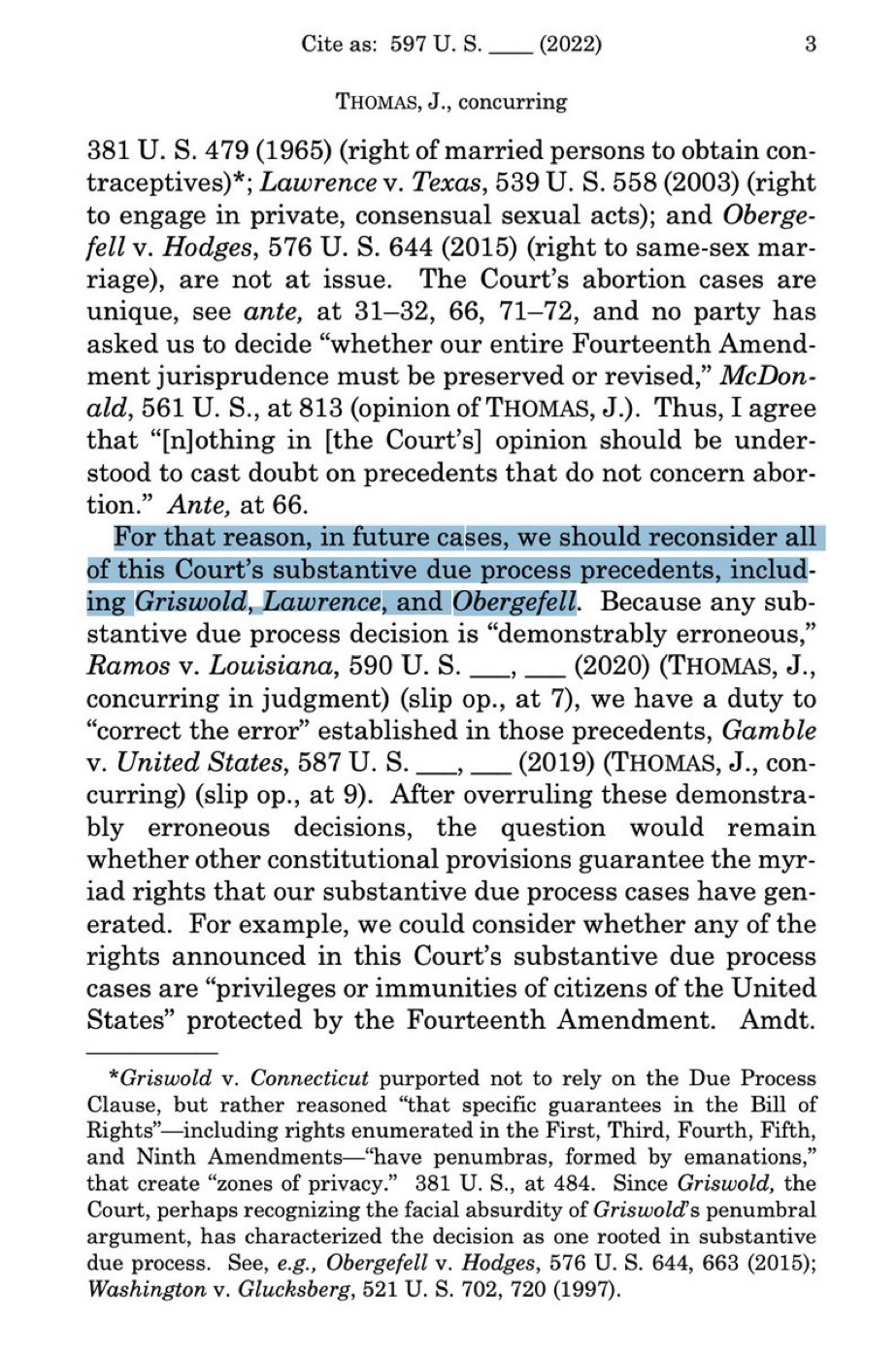
Finally, the right to same-sex marriage, same-sex relations, contraception, and other privacy-based rights must be on the ballot in every race. Justice Clarence Thomas’s concurrence declared war on those rights and invited reactionary legislatures to pass laws to serve as test cases. We would be foolish to assume that the other members of the reactionary majority will not follow his lead, given a chance.

None of these approaches will be easy or provide a complete answer. Readers have already sent emails that preemptively identify the problems with some of these approaches and dismiss their chances of success. But these are the paths available to us. We can choose to pursue them or do nothing. We must pursue them relentlessly until we have regained control of every branch of government, including the Supreme Court. Only then can we reverse the ruling in Dobbs and preserve other liberties grounded in the same right to privacy that supported reproductive rights for a half-century.

We are the majority, and American democracy presumes majority rule while protecting the rights of the minority. Republicans are attempting to reverse that presumption by seeking to impose permanent minority rule with no protection for the rights of the majority. That cannot stand. It will not stand. But it is up to us to restore the natural balance to democracy. It is not enough that we vote with greater passion or conviction. We must motivate those who did not believe this day would not come or who were not paying attention. We can do that—if we act with greater passion, conviction, and urgency.

The ruling.

Alito’s final decision is a judicial insult. In a single blow, he has demoted American women to second-class citizens. It is filled with venom and contempt in addressing a contentious issue on which people of good faith can disagree. He refers to physicians as abortionists when they seek to save a woman’s life or terminate a pregnancy forced on a teenager by a rapist. He misrepresents, minimizes, and dismisses the burdens and risks of pregnancy. He substitutes his Catholic dogma for judicial analysis.

Alito’s final version of his opinion changed little from the draft leaked last month. As such, it retains the dishonesty and intellectual sophistry of the “deeply rooted tradition” analysis contained in the draft—an analysis that deliberately misrepresents the American tradition relating to abortion. See Aaron Tang in The Los Angeles Times, Op-Ed: The Supreme Court flunks abortion history.

But most ominously, Alito’s “deeply rooted” analysis signals Alito’s intent to attack other privacy-based rights, such as same-sex marriage. Alito dissented in the Court’s decision recognizing same-sex marriage, Obergefell v. Hodges. Alito wrote in Obergefell, as follows:

          To prevent five unelected Justices from imposing their personal vision of liberty upon the American people, the Court has held that “liberty” under the Due Process Clause should be understood to protect only those rights that are ‘deeply rooted in this Nation’ s history and tradition.’ And it is beyond dispute that the right to same-sex marriage is not among those rights.

There it is: Alito’s analysis in overruling Roe v. Wade does not stop with reproductive rights. It reaches to same-sex marriage. He said so in his dissent in Obergefell. And Justice Thomas made that explicit in his concurrence in Dobbs:

          In future cases, we should reconsider all of this Court’s substantive due process precedents, including Griswold, Lawrence, and Obergefell.

Griswold recognized the right to use contraceptives of choice; Lawrence recognized the right to enter into a same-sex relationships; and Obergefell recognized the right of same-sex couples to marry. Justice Thomas notably omitted a right based on “substantive due process precedents”—the right of members of different “races” to marry, a right first granted in Loving v. Virginia in 1967. If the Court reverses Loving v. Virginia, Thomas’s marriage to Ginny Thomas would be illegal in some states.

For a longer discussion of the threat to other rights, see Mark Joseph Stern in Slate, The Supreme Court decision overruling Roe v. Wade puts marriage equality in immediate jeopardy.

It will take weeks to understand the implications of Justice Alito’s decision, but a good place to start is with Ian Millhiser’s analysis in Vox, The Roe v. Wade abortion decision, explained.

Finally, for a discussion of self-inflicted damage to the Court’s legitimacy, see Dahlia Lithwick, in Slate, Roe v. Wade overturned: The Supreme Court will pay for abortion decision.

The corruption and illegitimacy of the Supreme Court.

As currently constituted, the Supreme Court is illegitimate and corrupt. It is illegitimate because two justices appointed by Trump resulted from norm-busting “rules” made up by Mitch McConnell on the fly. Gorsuch sits in a seat stolen from an Obama appointee, and Barrett sits in a seat that belonged to the incoming president.

The Court is corrupt because Gorsuch, Kavanaugh, and Barrett lied to the Senate about their pre-determined intent to overrule Roe v. Wade. And it is corrupt because Justice Thomas has refused to recuse himself from cases in which his wife assisted in an attempted coup.

The trust of the American public in the Court has plummeted to an all-time low of 25%. It will decline further if the January 6th Committee proves that Ginny Thomas funneled information about Court deliberations to John Eastman. It will fall further if the Committee demonstrates that Justice Thomas knew of and condoned his wife’s insurrectionist activities.

Jennifer Rubin succinctly summarizes the death blow to the Court’s legitimacy in her column in WaPo, The Supreme Court eviscerates abortion rights and its own legitimacy. Per Rubin,

The hypocrisy and intellectual dishonesty of the court’s right-wing justices lead to the conclusion that they have simply appointed themselves super-legislators free to impose a view of the United States as a White, Christian and male-dominated society despite the values, beliefs and choices of a majority of 330 million modern Americans.

The court’s decision may result in women’s deaths. But it has certainly killed off what is left of the court’s credibility. And for that, there is no solution in sight.

Concluding Thoughts.

On a day like today, it does not feel right to end on an optimistic note. Rather, we should acknowledge the anger, frustration, fear, and grief that tens of millions of women in America are feeling after the ruling. There will be a time to rally and rejoin the fight for the dignity and equality of women—a fight we will win.

But today, we should acknowledge what women have lost and give them the time and space to absorb and recover from a once-in-a-generation shock. As they do, everyone in their lives should let them know we are at their side every step of the way. Walk along in silence and listen. Nothing can be “fixed” today, but we can begin the long journey back in the coming days.

Justice Clarence Thomas warns us which other decisions are likely to fall, under the reign of the authoritarian Trump Court: the right of married couples to buy contraceptives; the decriminalization of consensual gay sex in the privacy of one’s home; and gay marriage. Notice he left out the Loving decision, which made interracial marriages legal. Was that to protect his own marriage?