Archives for category: Childhood

The New York Times Sunday Magazine published an article titled “America’s Children Are Unwell. Are Schools Part of the Problem?” It was written by staff member Jia Lynn Yang.

I anticipated that the article would be another lament about test scores, of which there have been many recently. But it wasn’t!

Instead, Yang described the explosion of mental health issues among the nation’s children. And she attributed it largely to the unending pressure to compete for ever higher test scores. EXACTLY!

Yang knows that the changes in school are not the only cause of declining mental health. There are many more culprits, including social media and the pressures of contemporary life. And there is also the possibility that children are being misdiagnosed and overdiagnosed. I can’t help but recall a story from 1994 about an elite private school that received a private $2 million grant to screen children for learning disabilities. Overrun by experts, the program “got out of hand.” Nearly half the children were diagnosed with disabilities, and the program was cancelled.

We live in a stressful world. Children are pressured to succeed, to comply, to compete, to win the approval of their peers, to dress the “right” way, to be and do things by which they will be judged by their peers, by their parents, by the world they inhabit. Some children succeed, many don’t.

Schools these days are doing things to children that add to their stress. They have been doing harmful things to children by federal mandate since 2002.

Besieged by expectations, demands, and pressures, many children are breaking. It’s our fault.

She writes:

One of the more bewildering aspects of the already high-stress endeavor of 21st-century American parenting is that at some point your child is likely to be identified with a psychiatric diagnosis of one kind or another. Many exist in a gray zone that previous generations of parents never encountered.

A diagnosis of attention deficit hyperactivity disorder is practically a rite of passage in American boyhood, with nearly one in four 17-year-old boys bearing the diagnosis. The numbers have only gone up, and vertiginously: One million more children were diagnosed with A.D.H.D. in 2022 than in 2016.

The numbers on autism are so shocking that they are worth repeating. In the early 1980s, one in 2,500 children had an autism diagnosis. That figure is now one in 31.

Nearly 32 percent of adolescents have been diagnosed at some point with anxiety; the median age of “onset” is 6 years old. More than one in 10 adolescents have experienced a major depressive disorder, according to some estimates. New categories materialize. There is now oppositional defiant disorder, in addition to pathological demand avoidance…

The experience of school has changed rapidly in recent generations. Starting in the 1980s, a metrics-obsessed regime took over American education and profoundly altered the expectations placed on children, up and down the class ladder. In fact, it has altered the experience of childhood itself.

This era of policymaking has largely ebbed, with disappointing results. Math and reading levels are at their lowest in decades. The rules put in place by both political parties were well-meaning, but in trying to make more children successful, they also circumscribed more tightly who could be served by school at all.

“What’s happening is, instead of saying, ‘We need to fix the schools,’ the message is, ‘We need to fix the kids,’” said Peter Gray, a research professor at Boston College and the author of “Free to Learn: Why Unleashing the Instinct to Play Will Make Our Children Happier, More Self-Reliant, and Better Students for Life….”

Other books have echoed this critique. I think offhand of the book by Pasi Sahlberg and William Doyle: Let the Children Play: How More Play Will Save Our Schools and Help Children Thrive. This is how they summarize their argument:

“Play is how children explore, discover, fail, succeed, socialize, and flourish. It is a fundamental element of the human condition. It’s the key to giving schoolchildren skills they need to succeed–skills like creativity, innovation, teamwork, focus, resilience, expressiveness, empathy, concentration, and executive function. Expert organizations such as the American Academy of Pediatrics, the National Academy of Sciences, and the Centers for Disease Control agree that play and physical activity are critical foundations of childhood, academics, and future skills–yet politicians are destroying play in childhood education and replacing it with standardization, stress, and forcible physical restraint, which are damaging to learning and corrosive to society.”

There is an organization–Defending the Early Years–that fights for the rights of childhood, that tries to keep academic pressures out of the classrooms of very young children.

But who defends the children in grades 1-12? There are groups of parents in almost every state who oppose the pressures of high-stakes testing, oppose the efforts by tech companies to replace actual experiences with machines and technologies, oppose the interference of politicians to standardize teaching.

One group fights off the tech companies that use personal student data to market their products: The Parent Coalition for Studebt Privacy.

Corporate America now looks to the schools as a source of profit. The schools and students need to be protected from rapacious capitalism, which wants to privatize schools for profit and sell products that monetize instruction.

Yang describes the transformation of the school from the 1980s to the present:

School was not always so central to American childhood. In 1950, less than half of all children attended kindergarten. Only about 50 percent graduated from high school, and without much professional penalty. A person spent fewer years of their life in school, and fewer hours in the day furiously trying to learn. However bored a child might become sitting behind a desk, freedom awaited after the final bell rang, with hours after school to play without the direction of adults.

But as the country’s economy shifted from factories and farms to offices, being a student became a more serious matter. The outcome of your life could depend on it.

During an era of global competition, the country’s leaders also began to see school as a potential venue for national glory, or shame. In 1983, a commission created by Ronald Reagan’s secretary of education, Terrel H. Bell, released a dire report on the state of American schools called “A Nation at Risk.” It warned that “if an unfriendly foreign power had attempted to impose on America the mediocre educational performance that exists today, we might well have viewed it as an act of war.”

Over the next decade, Democratic and Republican governors such as Bill Clinton in Arkansas and Lamar Alexander in Tennessee began molding their states’ schools with new standards of testing and accountability. Schools were treated more like publicly traded companies, with test scores as proxies for profits. Before long, schools had public ratings, so ubiquitous they now appear on real estate listings.

The pressure kept rising. By 2001, 30 states had laws that imposed a system of punishments and rewards for schools based on their test scores. The next year, President George W. Bush’s signature education reform law, No Child Left Behind, made the effort national.

With school funding now on the line, there were unmistakable incentives for children to be diagnosed. Starting in the 1990s, students with autism or A.D.H.D. become newly eligible for added support in the classroom. Getting a child treated, potentially with medication, could help an entire classroom achieve higher scores, especially if the child’s behavior was disruptive to others. And in some parts of the country, children with disabilities were not counted toward a school’s overall marks, a carve-out that could boost scores.

The added metrics may well have compelled more children to receive the support they needed. Either way, educational policymaking yielded a change in diagnoses. In states that added new accountability standards, researchers found a clear rise in A.D.H.D. According to one analysis, the rate of A.D.H.D. diagnoses among children ages 8 to 13 in low-income homes went from 10 percent to 15 percent after the arrival of No Child Left Behind.

The impact of the law on autism diagnoses has been less documented. But there is a great deal of overlap among these disorders. Anywhere from 30 to 80 percent of children diagnosed with autism also have A.D.H.D. Experts have also pointed out that the rise in autism has largely taken place on the more subtle end of the spectrum, where psychiatrists expanded the diagnosis. Students with this profile often need educators who can be eminently flexible in their approach, a tough task when an entire classroom has to focus on narrowly mastering certain testable skills.

The demands on performance in higher grades trickled down into younger and younger ages. In 2009, the Obama administration offered greater funding to schools that adopted new national learning standards called the Common Core. These included an emphasis on reading by the end of kindergarten, even though many early childhood experts believe that not all children are developmentally ready to read at that age.

With each new wave of reforms, the tenor of kindergarten changed. Rote lessons in math and reading crept into classrooms, even though experts say young children learn best through play. Researchers discovered that in the span of about a decade, kindergarten had suddenly become more like first grade.

Preschool was not far behind, as even toddlers were expected to stay still for longer stretches of time to imbibe academic lessons. This again defied the consensus among early childhood experts. Children, parents and teachers struggle through this mismatch daily. In 2005, a study showed that preschoolers were frequently being expelled for misbehavior, and at rates more than three times that of school-age children.

“We’re not aligning the developmental needs of kids with the policies and practices that go on daily with schools,” said Denise Pope, senior lecturer at Stanford University and co-founder of Challenge Success, a nonprofit group that works with schools to improve student well-being.

The pressure to learn more led to a restructuring of the school day itself. Before the 1980s, American children usually had recess breaks throughout the day. By 2016, only eight states required daily recess in elementary schools. And when researchers studied what had become of lunchtime, they learned that children often had just 20 minutes to not only eat but stop to use the bathroom after class, walk to the cafeteria and wait in line for food.

I think about my own time in the public elementary public schools in Houston. We had recess every day. I don’t think it was a matter of state law. Educators then knew that children needed time to play. It was common sense. Today, parent groups organize to persuade legislatures to mandate recess. If they don’t, parents fear, every minute will be spent preparing for tests and taking tests.

They are right. The so-called “reforms” of the past quarter century–No Child Left Behind, high-stakes testing, competition, Race to the Top, punishing or rewarding teachers for their students’ test scores, closing schools and firing staff because of low test scores, the Common Core standards–have made test scores and standardization the heart of schooling.

In a continuing campaign to raise test scores, there are winners and losers. Typically, the winners are children from affluent families, and the losers are the children of not-affluent families. The winners are celebrated, the losers are stigmatized. The social class divide among children is hardened by these practices.

Worse, the pressure on students has caused an increase in anxiety, depression, and boredom. In response, parents seek diagnoses of autism or some other learning disorder so that their children will get more time or attention.

Some parents blame the public schools for the pressure and competition imposed on them by elected officials. They seek alternatives to the public schools, which are obsessed with standardization, testing, and accountability.

Yang points out:

This discontent helps empower the conservative effort to defund the public school system and let parents pick their own schools, with taxpayers covering the tuition. Each child who no longer seems to fit into the country’s education system — and more often than not they are boys — potentially expands the constituency for these ideas. And trust erodes further in the progressive project of a democracy built on giving everyone a free and equal education.

The Democratic Party is unable or unwilling to see the problems they helped create. The Republican Party is quite happy to see the public search for alternatives like charter schools and vouchers, and it has enabled the movement to have taxpayers foot the bill for private and religious schools.

By turning childhood into a thing that can be measured, adults have managed to impose their greatest fears of failure onto the youngest among us. Each child who strays from our standards becomes a potential medical mystery to be solved, with more tests to take, more metrics to assess. The only thing that seems to consistently evade the detectives is the world around that child — the one made by the grown-ups.

Who made that world? Both political parties. Governors. Legislatures. Think tanks. The wealthiest, who believe their financial success proves their superiority. Editorial boards.

Here is the most significant lesson that our elected officials refuse to learn. Their elaborate schemes for testing and measuring children have hurt children and undermined the joy of learning. They have raised the anxiety level of children while corrupting education itself.

Education is not what gets measured on standardized tests. Education is exploration, investigation, insight, observation, wanting to know more, learning to love learning.

Our politicians, prodded by so-called “reformers,” have managed to pollute education while demoralizing teachers and destroying public commitment to public schools.

Our public schools need to be freed from the failed ideas that hurt children. We need a rebirth of sturdy ideas that

Dr. Paul Offit is a medical doctor who specializes in children’s infectious diseases. He is appalled by the actions and policies of Robert F. Kennedy Jr., because they endanger the health of our nation, especially children.

Robert F. Kennedy Jr. is a disgrace to his family name. He should not have been put in charge of public health. Not only is he totally unqualified, but his beliefs about medicine are dangerous.

Dr. Offit writes:

On April 15, 2025, Dr. Fiona Havers, an epidemiologist at the CDC, presented data on the impact of COVID-19 on children the previous year. She found that COVID-19 had caused thousands of children to be hospitalized; 20 percent of whom were admitted to the intensive care unit. Virtually all were unvaccinated, half were previously healthy, and 152 had died, most less than 4 years of age. The conclusion was clear; young children in the United States who had never been vaccinated will still benefit from a COVID-19 vaccine. Although the pandemic was over, the virus wasn’t.

Six weeks later, on May 27, 2025, Robert F. Kennedy Jr., the Secretary of Health and Human Services (HHS), in a video posted on X, said that COVID-19 vaccines would no longer be recommended for young, healthy children. When asked to provide evidence for this unilateral, behind-closed-doors decision, he couldn’t.
This week, the American Academy of Pediatrics (AAP) released its own recommendations. Consistent with the CDC’s findings—and in direct contrast to Kennedy’s edict—the AAP stated, “Infants and children 6 to 23 months of age are at high risk for severe COVID-19…All infants and children in this age group [should] receive the 2025-2026 COVID-19 vaccine…Those who are previously unvaccinated should receive an initial series.”

Hours after the AAP released its statement, Kennedy fired back, posting on X that the AAP was engaging in a “pay-to-play scheme to promote commercial ambitions of AAP’s Big Pharma benefactors.” Kennedy linked to a page showing that the AAP’s Friends of Children Fund, a charity that focuses on adolescent mental health and suicide prevention, had received donations from several vaccine makers. Kennedy also claimed that the medical journal that published the AAP’s recommendations, Pediatrics, was part of this same “pay-to-play scheme.” Kennedy’s actions were a tiresome rerun of his many accusations over the past 20 years. Whenever scientists, doctors, public health officials, academic institutions, scientific journals, or medical or professional societies claim that a vaccine is safe, effective, or valuable, he says that they are all in the pocket of the pharmaceutical industry. No one is to be trusted, except him.

Kennedy’s conflict-of-interest gambit is a misdirection game. If he can get the press and the public to talk about conflicts-of-interest, he can distract from his decision to recommend against COVID-19 vaccines for children that wasn’t supported by the evidence.

Then Kennedy made a veiled threat, posting on X that the “AAP should be candid with doctors and hospitals that recommendations that diverge from the CDC’s official list are not shielded from liability under the 1986 Vaccine Injury Act.” Defy me, argued Kennedy, and I will make sure that doctors and hospitals that recommend COVID-19 vaccines for young children could be sued. It was an empty threat. Doctors and hospitals are protected from liability related to COVID-19 vaccines by the PREP Act. Kennedy’s threat was yet another mean-spirited attempt at misdirection.

Pediatricians, parents, and public health officials are confused by these conflicting recommendations. Epidemiological evidence says one thing, Kennedy another. This confusion will likely result in some young children failing to receive a COVID-19 vaccine. It is also likely that some of these children will be admitted to the hospital, or intensive care unit, or die as a result. And when that happens, we won’t have to look any further than the man who for the past 20 years has been an anti-vaccine propagandist, science denialist, and conspiracy theorist to understand why.

W.H. Auden, a British American poet, wrote, “When all the mass and majesty of this world, when all that carried weight and always weighed the same, lay in the hands of others. They were small and could not hope for help and no help came.” How many children will have to suffer needlessly at the hands of RFK Jr. before someone, anyone steps up to save them?

I’m reminded that protestors against the war in Vietnam used to chant,

“Hey, hey, LBJ,

How many kids did you kill today?”

When will they say that about RFK?

Pediatricians, parents, and public health professionals have been anxiously awaiting the first meeting of RFK Jr.’s newly reconstituted vaccine panel. He fired every member of the pre-existing panel. The outcome wasn’t as bad as they feared, nor was it satisfying.

Apoorva Mandavilli of The New York Times reported:

In a meeting that devolved into confusion and near chaos, federal advisers on Thursday voted 8 to 3 against vaccinating children under four years old with a combination shot that protects against measles, mumps, rubella and chickenpox.

The meeting ended without a planned vote on whether newborns should receive the vaccine against hepatitis B, a highly infectious disease that damages the liver, as is currently the standard. That vote was postponed until Friday.

About half of the panel’s members were appointed by Health Secretary Robert F. Kennedy Jr. earlier this week. In a sign of how hastily the committee was put together, many of the members needed explanations of the usual protocol for these meetings, the design of scientific studies, and critical flaws in the data they suggested including.

Many of the panelists also seemed unsure about the purpose of the Vaccines for Children program, which provides free shots to roughly half of all American children. Approving which vaccines the program should cover is a key function of the committee.

The decision to rescind the M.M.R.V. recommendation is unlikely to have widespread consequences. The recommendations for other vaccines given separately to protect against those diseases — the more common practice — remain unchanged.

In a bizarre twist, the members also voted 8 to 1 to have the Vaccines for Children program continue to cover the M.M.R.V. vaccine for children under 4. It was unclear whether the members all understood what they were voting for. Three members abstained altogether, one of them explicitly citing his confusion as the reason.

Still, the vote is likely to have yielded the first of many changes to the official recommendations for routine immunizations. 

In an hourslong discussion, the committee members seemed inclined to restrict the hepatitis B vaccine to newborns whose mothers are known to be infected, and to other babies only after they are at least one month old.

But experts said that doing so would increase the risk to newborns. Many hepatitis B infections in pregnant women are missed, despite a longstanding recommendation to test them routinely. Infected women may also not be identified because of inaccurate results or because of problems reporting or interpreting the results.

“It will be challenging to identify all positive moms, and ensure that a birth dose is available to those infants in hospitals, especially for those who do not receive prenatal care,” said Chari Cohen, president of the Hepatitis B Foundation.

*************************************

WHY CHANGING THE HEPATITIS B VACCINE SCHEDULE MATTERS!

Michael Hiltzik of the Los Angeles Times explained why medical experts are opposed to postponing the vaccination for hepatitis B.

Hiltzik wrote a column praising Senator Bill Cassidy for stepping up to the plate and criticizing RFK because it was his one vote that enabled RFK to be confirmed. Senator Cassidy agreed to vote for him after RFK pledged not to change the vaccine schedule, a promise he reneged on.

Hiltzik wrote:

Cassidy closed the hearing by expressing concern that Kennedy’s handpicked vaccine advisory committee, stocked with anti-vaccine activists, was scheduled to meet Thursday, at which it seemed poised to alter the CDC’s recommendations on childhood vaccinations by removing several from the recommended list — a step that horrifies the pediatric and epidemiological communities.

Cassidy’s specific concern was about the hepatitis B vaccine, which the CDC has recommended be given at birth. Republicans on the committee ridiculed that recommendation, because hep B is commonly transmitted sexually, and what baby is having sex? The response from physicians is that babies can contract the disease from their mothers, even if their mothers might not even know they’re carriers.

Cassidy, as it happens, is a liver specialist. “I have seen people die from hepatitis,” he said. “This was my practice for 20 years before I entered politics.”

He continued, “For those who say why should a child be vaccinated for a sexually transmitted disease, at birth the child passes through the birth canal. … That passage through the birth canal makes that child vulnerable to the virus. … If that child is infected at birth, more than 90% of them develop chronic, lifelong infection.” That means a lifelong threat of cirrhosis or other deadly liver conditions.

“Before 1991, as many as 20,000 babies — babies — were infected” per year, Cassidy said. In the first decade, through 2001, after the vaccine was approved for newborns, however, “newborn infections of hepatitis B was reduced by 68%. Now, fewer than 20 babies per year get hepatitis B from their mother. That is an accomplishment to make America healthy again,” Cassidy said, mischievously citing RFK Jr.’s policy mantra.

“We should stand up and salute the people that made that decision,” Cassidy said, “because there are people who would otherwise be dead if those mothers were not given that option to have their child vaccinated.”

So, kudos, Sen. Cassidy, for finally explaining why vaccines are necessary.

In the world of science and medicine, vaccines have been one of the greatest achievements in history. Many diseases that afflicted humanity have been eradicated, thanks to vaccines.

When I was a child, my family worried about measles, mumps, chickenpox, and worst of all, polio. Now it’s rare to hear of anyone getting those diseases, although measles is making a comeback among unvaccinated children.

Only a crackpot would oppose vaccines whose safety and effectiveness have been demonstrated for decades.

We have at least two crackpots trying to discourage vaccinations. One is the nation’s top public health official, Robert F. Kennedy Jr., who has a long record as a vaccine opponent.

Now there is the Surgeon General of Florida, Dr. Joseph A. Lapado. He has decided to eliminate all vaccine requirements for school children.

Make no mistake. This is dangerous. This encourages the spread of deadly diseases among children.

Florida plans to become the first state to end all vaccine mandates, including for schoolchildren, rejecting a practice that public health experts have credited for decades with limiting the spread of infectious diseases.

Patricia Mazzini of The New York Times reported:

Dr. Joseph A. Ladapo, the Florida surgeon general, made the announcement on Wednesday alongside Gov. Ron DeSantis, a Republican. Mr. DeSantis rose to national prominence during the coronavirus pandemic, and over time he has espoused increasingly anti-vaccine views.

“Who am I to tell you what your child should put in their body?” Dr. Ladapo, a vocal denigrator of vaccines, said to applause during an event on Wednesday in Valrico, Fla., near Tampa. “Your body is a gift from God.”

He added that the administration would be “working to end” all vaccine mandates. “Every last one of them is wrong and drips with disdain and slavery,” Dr. Ladapo said.

Dr. Ladapo has faced repeated criticism from others in his field for his stances on public health. He allowed parents to choose whether to send unvaccinated children to school during a measles outbreak in Weston, Fla., in 2024, rejecting longstanding, evidence-based public health guidelines. The misinformation he spread about Covid vaccines prompted a public rebuke from the Centers for Disease Control and Prevention in 2023.

It is unclear what the process of undoing the state’s longstanding vaccine mandates might look like. Dr. Ladapo said the Florida Department of Health, the agency he oversees, would do away with rules promulgating vaccine mandates. State lawmakers “are going to have to make decisions” as well, Dr. Ladapo said. “That’s how this becomes possible.”

All 50 states have at least some vaccination requirements for children entering school, though all allow for medical exemptions, and most allow exemptions for religious or personal reasons. The number of students receiving exemptions has been increasing in recent years, and immunization rates have been falling, according to KFF, a health policy research group.

Mr. DeSantis, who appointed Dr. Ladapo as surgeon general in 2021, also announced the creation of a commission to align Florida with goals laid out by Robert F. Kennedy Jr., President Trump’s secretary of Health and Human Services and a vocal vaccine skeptic. The commission will be headed by Casey DeSantis, the governor’s wife.

If Florida follows through on this nutty policy, the law should ban access to vaccines to the children of state officials who endorse this policy. No hypocrisy!

Trump (or more likely, his puppetmaster Russell Vought, Director of the Office of Budget and Management [OMB]) pulled the wool over the eyes of the Republicans who control Congress.

Trump insisted that he would rein in the budget; he brought in Elon Musk and his Kiddie Corps, to shut down vital functions of the federal government and pare the federal workforce. But Trump’s newly enacted budget adds at least 3 trillions to the deficit.

But first a word about Russell Vought. He was the primary author and editor of Project 2025, which is a blueprint for Trump’s second term. He worked at the far-right Heritage Foundation before the election. Now as director of OMB, he holds the most consequential job in the federal government. OMB decides which programs are priorities and which are not, which need more funding and which do not.

To understand the Trump administration’s policies and goals, read Project 2025. During the campaign, Trump pretended to know nothing about Project 2025. He lied.

John Thompson, historian and retired teacher in Oklahoma, writes here about the real human costs of this evil plan.

He writes:

Even though my primary focus is on public education, I have been concentrating on President Trump’s so-called “Big, Beautiful Bill,” which is estimated to increase the federal deficit by $3.3 trillion, or more. 

My biggest concerns, however, were budget cuts that will likely result in the world-wide loss of untold millions of lives. For instance, even before Trump dramatically increased the subsidies for fossil fuel production, and undercut non-fossil fuel production, it was estimated that by 2049 global warming would cost the global economy $38 trillion per year, and that over 2 billion years of healthy lives would be lost by 2050.

Moreover, Robert F. Kennedy’s attacks on medical science and vaccines could result in pandemics that cost millions of lives. In fact, Kennedy’s attacks on Gavi vaccines would undermine a public health process which would likely save an estimated 8 million lives across the world by 2030.     

And it is estimated that the USAID programs Trump cut “have saved over 90 million lives over the past two decades.” It is now estimated that by 2030 those cuts could cost the lives of 14 million people.

Since the Trump plan passed through Congress, I’ve been catching up on the interconnected ways that it undermines education.

As Chalkbeat reported, this bill:

Slashes spending on Medicaid, which provides health insurance to some 37 million children and is a critical revenue source for schools. It also limits eligibility for the Supplemental Nutrition Assistance Program, or SNAP, which provides food assistance to over 13 million children and makes kids automatically eligible for free meals at school.

Its revised tax credit will hurt an additional two million children. 

Moreover, the cuts will hurt the funding of hospitals and other medical service providers.

And anti-immigration raids will increase chronic absenteeism rates, and “have significant effects on children’s physical and mental health, as well as on broader school climate.”

And that brings me back to the damage done to Oklahoma students. As the Oklahoma Voice reports:

The Trump administration is indefinitely withholding more than $70 million in federal education programs meant for Oklahoma students and educators, including money for teacher development, English learners, after-care programs and migrant children.

Every day I hear about the results caused by threats to the $15.68 million that were authorized, but not delivered for before- and after-school programs, and the “$6.43 million dedicated for the 13% of Oklahoma students learning English as their non-native language.” 

In the Oklahoma City Public Schools, for instance, “47% of students are learning English as their second language. The district expected $1.1 million in federal revenue from Title III, which supports English learners.”

Finally, I recently attended the OK Justice Circle’s Breaking Bread with the Hispanic Community where educators and service providers described the cruelty that Hispanic students were facing. For instance, as a panelist was leaving for the conference, a student told her that she is studying the Holocaust. The student was worried about the tragedies that immigrants like her were experiencing, and how awful they could become.

The educator further explained that a big majority of her students are Hispanic. Due in large part to the current deportation campaign, at times, absenteeism has surged to 30% to 40%. And many students come to school every day with their birth certificates in the backpack in case they have to face raids by the United States Immigration and Customs Enforcement (ICE).

The panelists explained how deportations of family members have produced a surge in the wide, interconnected, and painful crises that undermine student learning.

One of the services that schools can provide is referring students and families to nonprofit and public institutions. In an especially revealing set of discussions, educators described their “do-s and don’t-s” when sharing immigration information with patrons. 

But those statements are based on trust in the law and procedures that ICE agents are required to follow.  Today, it was agreed, it is hard to trust the immigration process.

As I struggled to reach the best possible emotional balance when evaluating the brutality imposed on children, families, and people across the world, I received a message from the Oklahoma Appleseed Center for Law and Justice. It’s Executive Director, Colleen McCarty, expressed the frustration that I continually hear:

Congress passed the so-called “Big Beautiful Bill”—a piece of legislation wrapped in soundbites and flag pins—that will strip thousands of Oklahomans of life-saving healthcare. It will supercharge Immigration and Customs Enforcement, giving new power and resources to deport millions of people, tear families apart, and criminalize human existence based on borders and skin color

But she is committed to “stand in one courtroom fighting for freedom,” even though she leaves “to find the government systematically dismantling it on the largest scale imaginable.” 

We also must continue to fight both legal and political battles in defense of our democracy.

Jennifer Berkshire has been writing about the politics of education for many years. She has written two books with education historian Jack Schneider, A Wolf at the Schoolhouse Door and The Education Wars. This is the second installment in her excellent series called “Connecting the Dots.” Her Substack blog is called “The Education Wars.”

She writes:

BAs are out, babies are in

The Trump world’s obsession with the declining birthrate doesn’t quite rank with rooting out “DEI,” tariff-ing, or expelling immigrants but it’s up there. In a recent interview, Elon Musk confessed that a fear of the shrinking number of babies keeps him up at night. What does this have to do with education? Everything. Last year, two of the big education ‘thinkers’ at Heritage released a guide to how changes in education policy could increase “the married birthrate”:

Expensive and misguided government interventions in education are, whether intended or not, pushing young people away from getting married and starting families—to the long-term detriment of American society.

What are those government interventions? Things like subsidizing student loans, thereby encouraging young women to go to college. Or requiring teachers, who are mostly women, to have bachelor degrees, thereby encouraging young women to go to college. Of course there is a voucher angle—there always is with these folks. But the key here is that a chorus of influential Trump thinkers like this guy keep telling us that there are too many women on campus, and that policy shifts could get them back into the home where they belong. 

If the administration succeeds in privatizing the government-run Student Loan Program, college will become much more expensive, significantly shrinkign the number of kids who’ll be able to attend. And that seems to be the point, as conservative activist Chris Rufo explained in an interview a few weeks ago.

By spinning off, privatizing and then reforming the student loan programs, I think that you could put the university sector as a whole into a significant recession. And I think that would be a very salutary thing.

So when you hear the rising chorus coming from Trump world that there are too many of the wrong people on the nation’s campuses, recall that an awful lot of these self-styled ‘nationalists’ believe this: “If we want a great nation, we should be preparing young women to become mothers.”

Some people are more equal than others 

I’ve been making the case that both the Department of Education and public education more broadly are especially vulnerable because of the equalizing roles that they play. Of course, education is not our only equalizer. Indeed, all of the institutions and policy mechanisms intended to smooth out the vast chasms between rich and poor are on the chopping block right now. While you were clicking on another bad news story, Trump eviscerated collective bargaining rights for thousands of federal workers. While teachers weren’t affected, a number of red states have been rushing to remedy that, including Utah which just banned collective bargaining for public employees. 

Writer John Ganz describes the unifying thread that connects so much of Trump world as ‘bosses on top,’ the belief that “the authority and power of certain people is the natural order, unquestionable, good.” We got a vivid demonstration of what this looks like in Florida this week as legislators debated whether to roll back (more) child labor protections, allowing kids as young as 14 to work over night. 

Governor Ron DeSantis is busily spinning the bill as about parents rights, but what it’s really about is expanding the power of the boss. The ‘right’ to work overnight while still in school is actually the boss’ right to demand that young employees keep working. Nor is it hard to imagine the long-term consequences of this policy change. Teen workers who labor through the night end up dropping out of school, their futures constrained in every possible way. Here’s how Marilynn Robinson described the rollback of child labor laws in her adopted home state of Iowa: “If these worker-children do not manage to finish high school, they will always be poorer for it in income and status and mobility of every kind.”

Go back one hundred years when the country was in the midst of a fierce debate over child labor, and you’ll hear the same arguments for ‘bosses on top’ that are shaping policy today. At a time when public education was becoming compulsory, conservative industry groups like the National Association of Manufacturers cast their opposition to both child labor laws and universal public education in explicitly bossist terms, as Naomi Oreskes and Erik Conway recount in The Big Myth: How American Business Taught Us to Loathe Government and Love the Free Market:

“They believed that men were inherently unequal: it was right and just for workers to be paid far less than managers and managers far less than owners. They also believed that in a free society some children would naturally enter the workforce. Child labor laws wer (to their minds) socialistic because they enforced erroneous assumptions of equality—for example, that all children should go to school—rather than accepting that some children should work in factories.”

Back to the states

Did you hear the one about how we’re returning education to the states? Back-to-the-states has become a mantra for the Trump Administration on all kinds of favored policy issues, as the New York Times recently pointed out. Of course, education is already a state ‘thing,’ which means that we can look at the states Trump keeps pointing to as models and see how they’re faring. So how are they faring? Not so well, as the education reform group EdTrust lays out here, reviewing both NAEP scores and the track records of these states in supporting low-income students and students of color.

But there are plenty of warning signs beyond test scores. Ohio seems poised to slash funding for public education, even as the state’s voucher program balloons. (And let’s not even get into the just-enacted Senate Bill 1, which limits class discussions of any ‘controversial’ topic and goes hard at campus unions.) But for a glimpse of the future that awaits us, pay attention to another state in my beloved Heartland, and which Trump has repeatedly showered with praise: Indiana.

Now, Indiana happens to be home to one of my favorite economists, Ball State’s Michael Hicks, who has been warning relentlessly that the state’s decision to essentially stop investing in K-12 and public higher education has been an economic disaster. Hoosiers, he pointed out recently, earn less than the typical Californian or New Yorker did in 2005. As the number of kids going to college in Indiana has plummeted, the state now spends more and more money trying to lure bad employers to the state. Here’s how Hicks describes the economic and education policies that Indiana has embraced:

“If a diabolical Bond villain were to craft a set of policies that ensured long-term economic decline in a developed country, it would come in two parts. First, spend enormous sums of money on business incentives that offer a false narrative of economic vibrancy, then cut education spending.”

As for Indiana’s 25-year-long school choice experiment, Hicks concludes that it has been a failure. Why? Because the expansion of school vouchers and charter schools was used to justify spending less on public schools—precisely the policy course that we’re hurtling towards now. Today, Indiana spend less money per student on both K-12 and public higher education than it did in 2008.

GOP-run states have already begun to petition what’s left of the Department of Education for ‘funding flexibility’—the ability to spend Title 1 dollars, which now go to public schools serving low-income and rural students, on private religious education. We shouldn’t be surprised. This is precisely the vision laid out in Project 2025. (Fun fact: the same Heritage thinker who penned the education section of Project 2025 also co-authored the above referenced guide to getting young married ladies to have more babies.)

And just like in Indiana, school privatization will be used to justify reducing the investment in K-12 public education. So when an economist tells us that school choice “risks being Indiana’s single most damaging economic policy of the 21st century,” we should probably listen.

Olga Lautman keeps a close watch on Trump’s tyranny and his allegiance to Putin. She is especially appalled by his decision to abandon the thousands of Ukrainian children kidnapped by Russian troops and transported to Russia. Trump doesn’t care. Anything to make Vladimir happy.

Lautman writes:

For years, the world watched as Russia systematically kidnapped tens of thousands of Ukrainian children, erasing their identities and forcing them into Russian families. This isn’t just a war crime—it’s genocide in real time.

Now, Trump’s regime is actively helping Russia cover up this genocide. His State Department quietly terminated a crucial contract that was facilitating the transfer of evidence on Russia’s mass abduction of Ukrainian children to European law enforcement, according to The New Republic.

This decision cripples efforts to track and recover abducted children, making it harder to hold Russia accountable for what international courts have already labeled a war crime. By cutting off this support, Trump’s regime is not just abandoning Ukraine—they are actively obstructing justice.

This isn’t just inaction—it’s complicity in one of the most horrific acts of genocide and war crimes.

Russia’s War Crime: The Mass Kidnapping of Ukrainian Children

Under Putin’s direct orders, at least 20,000 Ukrainian children—though the real number may be much higher—have been stolen from Ukraine and transported to Russia. Many have been ripped from orphanages and hospitals in occupied territories, while others—despite having living relatives—have been abducted and placed in “re-education” camps designed to erase their Ukrainian identity. These children are tortured, subjected to psychological reprogramming, and stripped of their Ukrainian heritage, culture, and language. They are then forcibly granted Russian citizenship and placed with Russian families as part of an illegal state-run program aimed at assimilating them into Russian society and erasing their Ukrainian identity forever.

Russia does not even attempt to hide these hideous crimes. Grigory Karasin, head of the international committee in Russia’s upper house of parliament, openly boasted that 700,000 children from illegally occupied territories in Ukraine have been taken to Russia. The sheer scale of this state-sponsored mass abduction is staggering—one of the largest forced deportations of children in modern history. This is not just a war crime— it is clear evidence of Russia’s genocidal intent to erase Ukrainian identity by targeting children, severing them from their families, their culture, and their homeland.

The International Criminal Court recognized this as a war crime as investigations continue. In March 2023, the ICC issued arrest warrants for Vladimir Putin and Maria Lvova-Belova, Russia’s Commissioner for Children’s Rights, for the “unlawful deportation and forced transfer of Ukrainian children.” This systematic abduction is not just a violation of international law—it is genocide. Russia is not merely stealing children but destroying Ukraine’s future by erasing an entire generation.

And now, Trump, Musk, and Rubio are actively helping Russia cover up the genocide and war crimes.

Trump’s State Department Blocks Efforts to Track Abducted Ukrainian Children

Since Russia’s full-scale invasion, the U.S. State Department funded a Yale research team that tracked kidnapped Ukrainian children using satellite imagery and open-source intelligence. Their work was crucial in exposing Russia’s state-run program of forced deportation and illegal adoption, providing undeniable evidence of war crimes committed against Ukrainian children.

Now, that work is under threat. Trump’s Secretary of State, Marco Rubio, has canceled the program, cutting off funding and blocking the transfer of key evidence to European law enforcement. Without this support, it will be significantly harder to locate and rescue kidnapped children, hold Russia accountable for genocide and war crimes, and ensure that stolen children are returned to Ukraine.

The Humanitarian Research Lab at Yale worked with Ukrainian President Volodymyr Zelenskyy’s Bring Kids Back UA campaign, which has helped track and locate hundreds of abducted children, successfully repatriating approximately 1,240 so far. With funding cut off, these efforts are now at risk.

Genocide and War Crimes: What’s at Stake

Under the Genocide Convention, the forced deportation and assimilation of children meets the legal definition of genocide, as it involves forcibly transferring children from one group to another with the intent to erase their identity, conducting mass deportations under state policy, and destroying cultural, linguistic, and familial ties. The International Criminal Court has already taken action by issuing arrest warrants, but its ability to prosecute and hold Russia accountable depends on cooperation from governments like the United States.

Instead of aiding these efforts, Trump is actively sabotaging them, cutting off crucial funding for investigations and making it harder to track abducted children and bring perpetrators to justice. Even the U.S. Congress, led by Rep. Susan Wild (D-PA-7), recognizing the horror of this crime, overwhelmingly passed a resolution in 2024 condemning Russia’s abduction and forced transfer of Ukrainian children. 

Yet, Trump’s regime is doing the opposite—helping obstruct justice while aligning itself with Russia’s war crimes.

Trump’s Loyalty to Moscow

This isn’t an isolated incident—it’s part of Trump’s broader fealty to the Kremlin and his regime’s Russia-aligned policies. From cutting off military aid to amplifying Kremlin propaganda, Trump continues to systematically weaken Ukraine’s ability to defend itself while strengthening Russia’s position. Every move he makes advances Russia’s strategic goals, further undermining Ukraine’s sovereignty and the West’s ability to hold Russia accountable.

We all saw as JD Vance ambushed Zelensky in the Oval Office meant to send a clear message that the U.S. is no longer a reliable partner. Trump echoes Kremlin propaganda at every opportunity, falsely branding Zelensky a “dictator” and insisting that Ukraine must hold elections immediately—a demand that directly serves Russia’s interests, as Moscow has repeatedly attempted to assassinate Zelensky and would exploit an election to further destabilize Ukraine.

Trump’s so-called “peace plan” is nothing more than a thinly veiled attempt to force Ukraine into surrender, as he insists that Kyiv must “negotiate”—a demand that would strip Ukraine of its sovereignty and hand Putin exactly what he wants. 

Meanwhile, Trump’s State Department is actively obstructing efforts to hold Russia accountable for war crimes, cutting off support for investigations into the kidnapping and forced deportation of Ukrainian children. At every turn, Trump is working to weaken Ukraine, embolden Russia, and dismantle any accountability for Russia’s crimes—all while seeking to reestablish financial deals with Moscow and prioritizing his personal and political interests.

As part of carrying out Russia’s agenda, Trump is also attacking NATO and attempting to dismantle alliances that have kept America safe, further isolating the U.S. while handing Putin exactly what he wants.

What Can We Do?

We cannot stay silent while the U.S. government helps Russia cover up genocide. And if Trump is willing to excuse war crimes against children, what won’t he justify?

Please call your members of Congress and demand answers. Ask them why the State Department cut funding for tracking abducted Ukrainian children and why the U.S. is turning its back on accountability for Russian war crimes. 

It was entirely predictable that Florida Governor Ron DeSantis would create a labor shortage by driving immigrants away. Whether documented or not, immigrants are the backbone of the tourist industry and agriculture, two of the basic elements in the state’s economy. Once they were gone, who would replace them? Children. DeSantis is now promoting a reduction in child labor laws to replace the immigrant labor he criminalized. Orlando Sentinel columnist Scott Maxwell describes the new Florida economy, balanced on the backs of children. Not the rich kids, but the poor kids.

Maxwell writes:

The Newsweek headline looked like satire: “Florida May Replace Immigrant Workers With Child Labor.”

Savvy Floridians know, though, that you can’t fictionalize stories more absurd than this state’s reality. And Florida lawmakers are, in fact, trying to roll back the state’s child-labor laws.

Basically, if employers in this state can’t exploit immigrants, the governor and Legislature want them to be able to legally exploit your children.

The latest proposal would allow teens to work longer hours, without breaks and even overnight shifts on school nights. Take that, Myanmar.

Up next, maybe we can emulate Burkina Faso where more than half the kids are in the labor force, some as young as 7. Now there’s a country with values.

What you’re witnessing is a real-life version of the dog that chased cars without thinking about what he’d do if he actually caught one. In this case, Gov. Ron DeSantis and the state’s GOP legislators have fumed for years about undocumented workers without having the slightest clue about how they’d respond if those workers actually walked off Florida job sites.

So now they’re panicking and want your kids to fill the bill.

Normally, in a free-market economy, if an employer can’t find workers, it would just raise wages until people start applying. That’s how supply and demand works.

But Florida’s GOP politicians don’t want to ask their campaign donors to raise wages. They’d rather flood the market with another class of exploitable workers — teenagers.

Maybe you used to dream of your teen becoming an engineer or architect. Well, forget that Ivy League, ivory-tower fiddle-faddle. Florida’s economy needs them harvesting tomatoes and cleaning motel rooms.

In some ways, it makes sense to put our kids to work. We’re sure not educating them. Florida’s SAT scores have dropped to 47th in America. And our state’s eighth-graders just posted the lowest math and reading scores in 20 years.

So, if we’re not preparing them for higher education or high-paying jobs, we might as well get them primed for the low-wage tourism and agriculture jobs that make this state hum.

Senate Bill 918, would eliminate restrictions on how many hours 16- and 17-year-olds can work. It would end guaranteed meal breaks and also lift restrictions for kids as young as 14 who are home schooled or enrolled in virtual school. (So if you want your rugrat pulling down a paycheck, just yank ’em out of traditional school.)

The Florida Policy Institute summarized the bill by saying it would allow Florida to work teens “for unlimited hours, any time day or night, seven days per week and without breaks.”Welcome to childhood in Florida.

Not all Republicans think this is a boffo idea. Sen. Joe Gruters, a former chairman of the Republican Party of Florida, joined Democrats in opposing the bill, saying: “I think we need to let kids be kids.”

Gruters chose his words carefully: “Let kids be kids” is a line DeSantis uses a lot, usually when he’s pushing censorship laws.

Apparently, in DeSantis’ worldview, teens aren’t mature enough to see certain drag performers, even alongside their parents — but are mature enough to work right through the night until school starts at 7 am. That’s just kids being kids.

As I’ve said before, I’m a fan of teens having jobs. I had a paper route in middle school and landed my first real job at a drugstore when I was 14 — old enough to legally sell condoms and tampons, but still immature enough to giggle about it. (Basically, if you ever entered a Revco in the 1980s,  nervous about making a purchase, I was your worst nightmare.)

But here’s the thing: I believe teens should get jobs when they and their parents want them to get jobs — not because we need to plug labor holes in our low-wage economy.

Keep in mind: DeSantis didn’t promote his roll-back-child-labor-laws ideas at a panel discussion on building teen character. He did it at panel discussion on immigration. After noting that undocumented workers provided “dirt cheap labor,” DeSantis asked: “Why do we say why we need to import foreigners, even import them illegally, when you know teenagers used to work at these resorts?”

This is just about swapping one exploitable labor class for another … in a state that already turns a blind eye to companies that break labor laws.

Remember Florida’s “mandatory” E-Verify law? It explicitly said that the state couldn’t even fine companies caught breaking the law until they’re caught three times. And that law-breaking employers must be given 30 days to stop breaking the law before they’re punished. What other laws work like that?

This is a state that gives companies a pass on labor-law violations and now wants to give them a younger workforce. What a dangerous combo. Even moreso when you consider GOP lawmakers also want to let businesses subvert minimum wage laws for some workers “younger than 18 years of age.”

Kids in Florida who say they have financial “hardships” can surrender even more workplace protections. Basically, the poorer you are, the more you can be exploited. So it ain’t gonna be the private, prep-school kids working farm fields and cleaning motel rooms at 3 in the morning.

DeSantis seemed particularly interested in using kids to fill the theme parks’ job needs. But the proposed rollbacks would also allow teens to work longer hours waxing floors, painting houses, stocking shelves, doing landscaping and working in fast food. Kids would still be banned from doing particularly dangerous jobs like mining or tarring roofs higher than six feet.

So teens could be asked to work overnight shifts right up until the start of a school day. That’s just “kids being kids.” But we’d draw the line at putting kids in boiler rooms and phosphate mines. A state has to have standards, after all.

smaxwell@orlandosentinel.com

ProPublica estimated the number of children who will die–of starvation or lack of medical care–because DOGE closed down USAID. The deaths of hundreds of thousands of children, in addition to their families, are the direct result of the shuttering foreign aid. These lives don’t matter to Trump and Musk; they are not white. Musk is a well-known pro-catalyst; he thinks women must have more babies. He himself now has 14 children, by different mothers. But he seems to care only about white babies.

Here is a portion of their report:

For weeks, some of the federal government’s foremost authorities on global health have repeatedly warned Secretary of State Marco Rubio and other leaders about the coming death toll if they carried out the Trump administration’s plan to end nearly all U.S. foreign aid around the world.

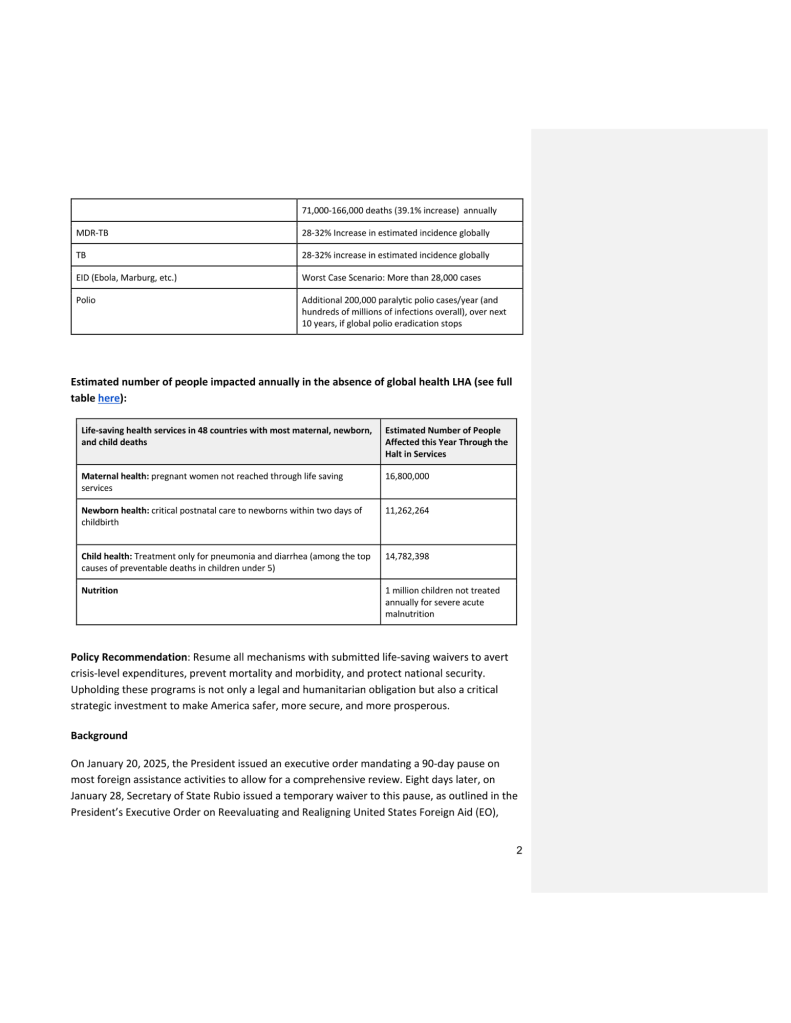
In their clearest accounting yet, top officials have estimated the casualties: One million children will not be treated for severe acute malnutrition. Up to 166,000 people will die from malaria. New cases of tuberculosis will go up by 30%. Two hundred thousand more children will be paralyzed by polio over the next decade.

Instead of acting on the repeated warnings, top administration officials, including the State Department’s director of foreign assistance, Peter Marocco, thwarted their own experts’ efforts to keep the U.S. Agency for International Development’s most vital programs up and running, according to internal memos and estimates compiled by global health leaders at the agency and obtained by ProPublica.

President Donald Trump’s political appointees, along with billionaire Elon Musk’s Department of Government Efficiency, pressed ahead with their plan to dismantle USAID by ignoring and impeding staff who tried to protect lifesaving operations — even as the administration publicly insisted that those programs remained online — according to the memos and interviews with government officials.

During exchanges outlined in one of the memos, a DOGE engineer emailed staff and said they were not allowed to review the programs they were canceling. At another point, USAID’s then-deputy chief of staff, Joel Borkert, told agency personnel to take a “draconian” approach to approving waivers.

The explosive memos — which include summaries of email exchanges and top-level meetings inside USAID, as well as internal agency research — were sent by Nicholas Enrich, acting assistant administrator for global health. ProPublica also obtained detailed breakdowns of lifesaving programs managed by the bureau and the projected impact of cutting them. Enrich was placed on leave Sunday.

Enrich told The New York Times he released the memos, which multiple other officials contributed to, after learning he was being placed on leave, as thousands of others at the agency have been. The memos were circulated to the staff and obtained by ProPublica.

The documents identify several key senior policymakers behind the scenes while also puncturing the administration’s claims of a careful, deliberative review of USAID programming. The records also represent the government’s most explicit concerns to date memorialized by a senior official from inside Trump’s administration.

The State Department, USAID and Elon Musk did not respond to questions about this story. Rubio and Marocco did not respond to a request for an interview.

Since the inauguration, Rubio, Musk and Marocco have taken dramatic steps to incapacitate USAID, the largest foreign aid donor in the world, by firing its employees and halting operations. The global health bureau was one of the first parts of the agency targeted for mass layoffs.

Then, last week, they abruptly cancelled 10,000 foreign aid projects, which account for 90% of USAID’s humanitarian operations and about half of the State Department’s. Lifesaving programs that were still operating around the world were forced to close down immediately.

How do you sleep at night, when you know that your actions were responsible for the deaths of hundreds of thousands of children? And their parents?

The New York Times story that was linked in the story gave more details:

The Trump administration’s decision to withdraw foreign aid and dismantle the U.S. Agency for International Development is likely to cause enormous human suffering, according to estimates by the agency itself. Among them:

  • up to 18 million additional cases of malaria per year, and as many as 166,000 additional deaths;
  • 200,000 children paralyzed with polio annually, and hundreds of millions of infections;
  • one million children not treated for severe acute malnutrition, which is often fatal, each year;
  • more than 28,000 new cases of such infectious diseases as Ebola and Marburg every year.

Those stark projections were laid out in a series of memos by Nicholas Enrich, acting assistant administrator for global health at U.S.A.I.D., which were obtained by The New York Times. Mr. Enrich was placed on administrative leave on Sunday.

This was the opening of Enrich’s bold memo, as reprinted in the New York Times:

Takeaway: The temporary pause on foreign aid and delays in approving lifesaving humanitarian assistance (LHA) for global health will lead to increased death and disability, accelerate global disease spread, contribute to destabilizing fragile regions, and heightened security risks-directly endangering American national security, economic stability, and public health. If the pause leads to permanent contract terminations, the $7.7B in resources appropriated by Congress are no longer be used to support these lifesaving global health programs, which could potentially result in wasted resources. The impacts on mortality and morbidity are summarized in the tables below. While the Foreign Assistance Review is set to take place in the coming weeks, it is important to recognize that a mechanism-by-mechanism approach may overlook the broader impact of these programs across global health program areas. This includes missed opportunities to enhance efficiency and cost-effectiveness within LHA program areas.

Marco Rubio, how do you feel about the deaths of so many people? Does it trouble you? Can you look in the mirror in the morning without seeing a murderer reflected back to you?

We know that Trump and Musk don’t care. What about you, Mr. Rubio?

Jan Resseger, who spent many years as an advocate for children and social justice, reviews the effects of Trump’s promise of mass deportations on the children of immigrants. Others look at the economic costs of his promise. Jan considers the human costs. Please open the link to read her post in full.

She writes:

On Tuesday, the NY Times’ Dana Goldstein rather blandly reported that the nation’s largest school district, the New York City Public Schools, has now sent guidance to school principals to prepare them for President-elect Trump’s threatened immigration raids:

“If immigration agents arrive on the doorstep of a New York City public school, principals have been told what to do. Ask the officers to wait outside, and call a school district lawyer.  The school system has enrolled about 40,000 recent immigrant students since 2022. Now, as President-elect Donald J. Trump prepares to take office with promises to deport millions of undocumented immigrants, the district has shared with school staff a protocol to try to shield students who have a tenuous legal status. In a December letter to principals, Emma Vadehra, the district’s chief operating officer, wrote, ‘We hope using this protocol will never be necessary.’ Still, New York and some other school districts across the country are readying educators and immigrant families for a potential wave of deportations.”

Goldstein’s interest seems more centered on the challenges these students have presented for the school districts serving new immigrant families, however, than on the coming trauma if Trump’s threatened raids actually become a reality: “Public schools serving clusters of migrant children have already dealt with a dizzying set of challenges in recent years, as an influx of hundreds of thousands of migrants crossed the southern border. Some are educating students who speak Indigenous languages and may have never before been enrolled in formal education. Others are trying to prod teenagers to class, when they may face intense pressure to earn money. And many have assisted newly arrived families with finding shelter, food and winter clothes. Now, these schools are facing an additional challenge: convincing parents to send their children to class when some are so anxious about deportation that they are reluctant to separate from their children for even part of the day.”

Of course, public schools, no matter their location, are expected to provide appropriate services for all the children in the community, and most are prepared with qualified English as a Second Language teachers. While 40,000 new immigrant students would overwhelm most local school districts, the NYC public schools serve approximately a million students every day and were likely well prepared. One wonders if Goldstein remembers the chaos that schools faced during immigration raids back in 2019.

More realistically, Chalkbeat‘s Kalyn Belsha has explored some recent history to remind readers about what happens when a massive immigration raid at a local industry disrupts the community’s public schools and terrifies children and adolescents: “When immigration agents raided chicken processing plants in central Mississippi in 2019, they arrested nearly 700 undocumented workers—many of them parents of children enrolled in local schools. Teens got frantic texts to leave class and find their younger siblings. Unfamiliar faces whose names weren’t on the pick-up list showed up to take children home. School staff scrambled to make sure no child went home to an empty house, while the owner of a local gym threw together a temporary shelter for kids with nowhere else to go. In the Scott County School District, a quarter of the district’s Latino students, around 150 children, were absent from school the next day. When dozens of kids continued to miss school, staff packed onto school buses and went door to door with food, trying to reassure families that it was safe for their children to return. Academics were on hold for weeks, said Tony McGee, the district’s superintendent at the time. ‘We went into kind of a Mom and Dad mode and just cared for kids,’ McGee said. While some children bounced back quickly, others were shaken for months. ‘You could tell there was still some worry on kids’ hearts.’”

In an important December 18, 2024 update that considered President-elect Trump’s threatened immigration raids after he takes office in January, Belsha described the struggle school districts will possibly face: “For three decades, federal policy has limited immigration arrests at or near schools, treating the places where children learn as ‘sensitive’ or ‘protected’ areas. But President-elect Donald Trump likely will rescind that policy soon after his return to the White House, according to recent reporting from NBC News. That could open the door for immigration agents to more frequently stop parents as they drop their kids off at school, or for interactions with school police to lead to students and their parents being detained. Educators and advocates for immigrant children worry that would create an environment of fear that could deter families from bringing their children to school or participating in school events. That could, in turn, interrupt kids’ learning and make it harder for educators to build trusting relationships with immigrant families.”

In her December report, Belsha also provides important context for concern about Trump’ threatened immigration raids: “An estimated 4.4 million U.S.-born children have at least one undocumented parent, and an estimated 733,000 school aged kids are undocumented themselves. Other students may have authorization to live in the United States but hold temporary immigration statuses that Trump has threatened to revoke. Researchers estimate that half a million school-age children have arrived in the U.S. just in the last two years.  Federal law generally overrides state and local statutes, and immigration agents have broad authority to detain people they suspect of being in the country illegally.” She adds, however, “Nevertheless, several large school districts already have mapped or expanded policies they crafted during the first Trump administration to reassure students and parents… Trump left the sensitive locations policy intact during his first term, but won re-election with a series of hardline immigration proposals, including a plan for mass deportations.”